

Sample Category Title
EUR/USD Mid-Day Outlook
Daily Pivots: (S1) 1.1350; (P) 1.1366; (R1) 1.1385; More...
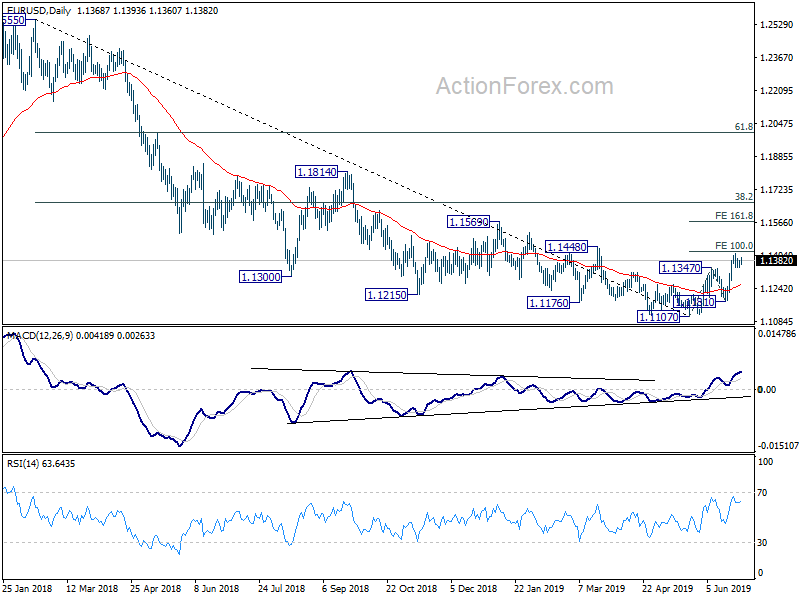
Intraday bias in EUR/USD remains neutral and outlook is unchanged. With 1.1317 minor support intact, another rise remains mildly in favor. On the upside, break of 100% projection of 1.1107 to 1.1347 from 1.1181 at 1.1142 will pave the way to 161.8% projection at 1.1569 next. However, firm break of 1.1317 will be an early sign of completion of rise from 1.1107. Intraday bias will be turned back to the downside for 1.1181 support instead.
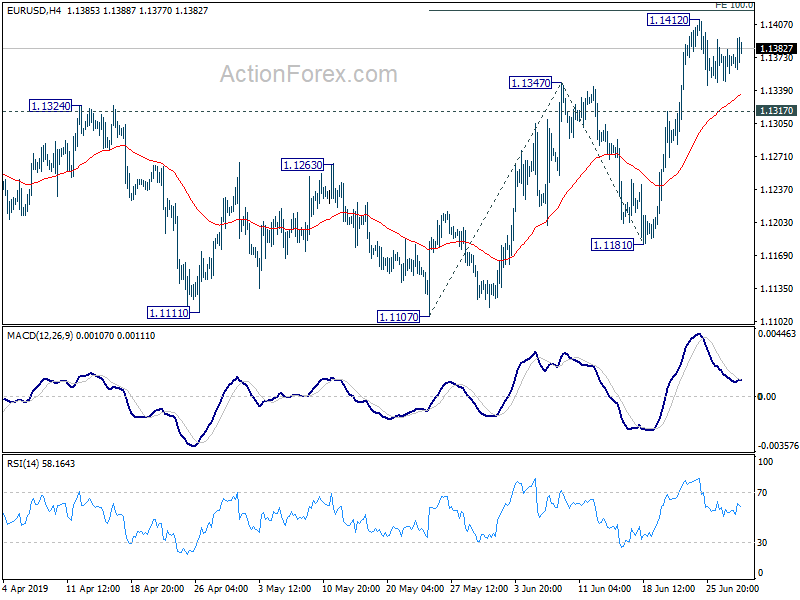
In the bigger picture, considering bullish convergence condition in daily and weekly MACD, a medium term bottom should be in place at 1.1107 after hitting 61.8% retracement of 1.0339 (2016 low) to 1.2555 (2018 high) at 1.1186. Further rise should be seen to 38.2% retracement of 1.2555 to 1.1107 at 1.1660. Reactions from there could indicate whether rebound from 1.1107 is a corrective rise or reversing medium term trend.
Canada: Energy Sector Drives Solid April GDP Report
- Economic output rose 0.3% m/m in April, slightly ahead of market expectations. The healthy performance comes on the heels of a 0.5% gain in March, marking the strongest two month gain since mid-2017. Breadth was a bit lacking, as only 11 of 20 major industry groups reported rising output.
- The goods-producing remained solid, up 0.4% as mining, quarrying and oil and gas activity rose 4.5% on the back of reduced production restrictions in the energy sector. Construction activity also rose, up 0.2%, while the other major categories fell.
- The service side of the economy rose 0.2%, led by wholesale trade, which climbed an impressive 1.4% month-on-month. Performances in other sub-sectors were mixed, although real estate activity (+0.3%) rose for a second month owing to increased resale activity.
Key Implications
- Thank goodness for energy. Without the surge of activity in that sector, driven by the easing of production restrictions, this would have been a much more modest report. It was encouraging to see construction and real estate in (modestly) positive territory, but retail trade activity remains stuck in neutral, and the decline in manufacturing appears to have been driven by more than just temporary auto plant shutdowns.
- Still, with the healthy headline from April and early signs from May and June so far encouraging, the Canadian economy seems to be shaking off its late-2018 blues. We now track second quarter growth at 2.5% annualized, nearly double the Bank of Canada's forecast in its April Monetary Policy Report (MPR).
- The consensus view is for the Federal Reserve to reduce its policy rate in short order, but today's data highlights that the situation for the Bank of Canada is quite different, underscored by the bid up in the loonie following this report to levels last seen in October. Uncertainty may be elevated, but an upgraded growth forecast is likely to feature in next month's MPR, leaving another 'no change' interest rate decision and a divergence between Canadian and U.S. monetary policy the most likely outcome.
US: Personal Spending Growth Holds Steady in May
- Personal income rose 0.5% in May, beating the median survey estimate for 0.3%. Nominal personal spending rose 0.4%, broadly in line with expectations. April spending was revised up to 0.6% (from 0.3%).
- Removing the effect of price changes, real spending rose 0.2%, slightly weaker than expectations for a 0.4% print. However, real spending growth in April was revised up to 0.2% from a previously flat print. Goods spending rose 0.4% due to a 1.6% expansion in durables. Spending on services rose 0.2% in May.
- The personal consumption price deflator rose 0.2% on the month, and 1.5% on a year-on-year basis. Core PCE rose 0.2% (month-on-month), holding at a 1.6% year-on-year rate.
- The personal saving rate held steady at 6.1% in May, although the saving rate for April was revised down a touch (from 6.2%).
Key Implications
- Personal spending and income growth remained healthy in May. An upward revision to April helps to ensure that real spending growth in the second quarter is on track for an above 3% (annualized) performance. Strong consumer spending will be the key to ensuring that GDP growth holds near trend this quarter.
- Core inflation held steady in May, a sign that temporary factors are likely still weighing on price growth. This remains the key metric on the Fed's dashboard as it plans the timing of its first of likely two rate cuts this year.
- The resilience of the American consumer will be tested in the months ahead. Tariffs increased in May on $200bn in Chinese imports, but left consumer goods largely unaffected. However, the next (threatened) escalation in tariffs would hit nearly-all consumer goods imported from China. The result could be noticeably higher prices, decreasing the purchasing power of U.S. households.
GBP/USD Mid-Day Outlook
Daily Pivots: (S1) 1.2647; (P) 1.2686; (R1) 1.2710; More....
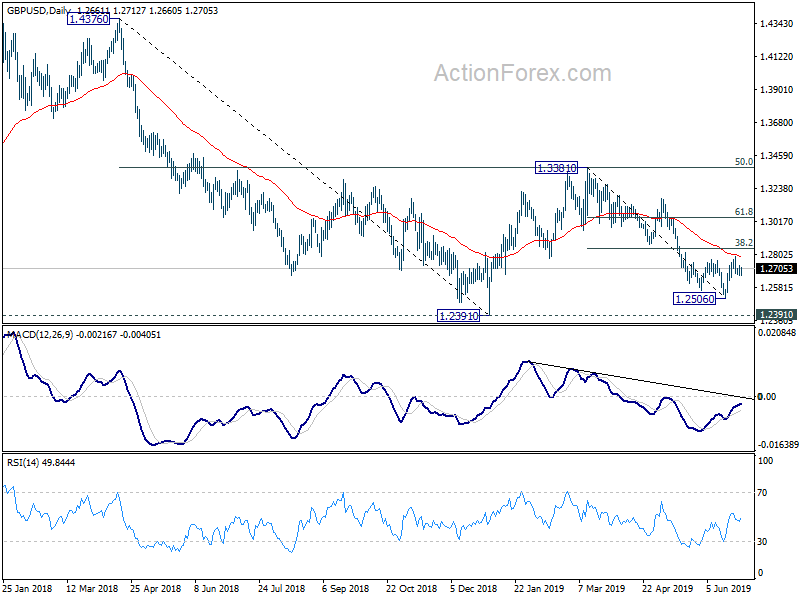
GBP/USD recovers mildly but stays below 1.2783 resistance. Intraday bias remains neutral first. With 1.2642 minor support intact, corrective rebound from 1.2506 could still extend higher. But upside should be limited by 38.2% retracement of 1.3381 to 1.2506 at 1.2840. On the downside, break of 1.2642 minor support will turn intraday bias back to retest 1.2506 low. However, sustained break of 1.2840 will bring stronger rise to 61.8% retracement at 1.3047 next.
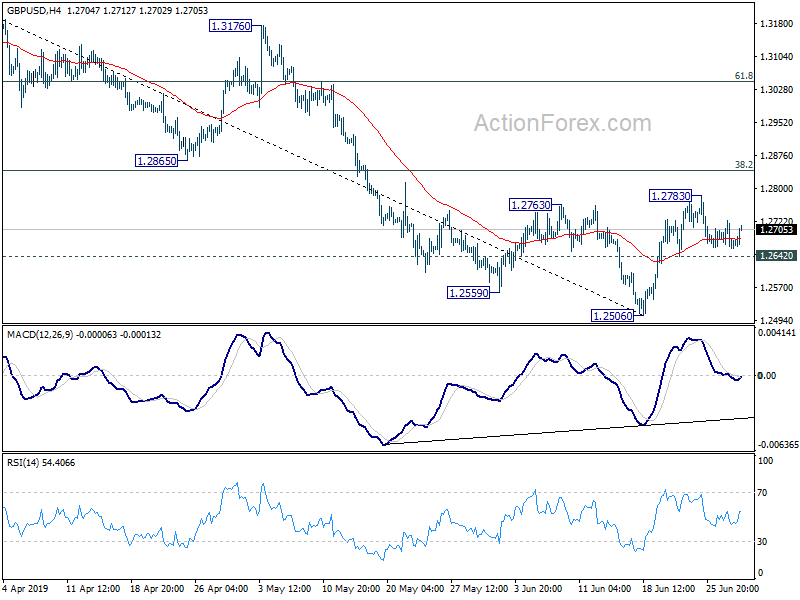
In the bigger picture, down trend from 1.4376 (2018 high) is still in progress. Break of 1.2391 would target a test on 1.1946 long term bottom (2016 low). For now, we don't expect a firm break there yet. Hence, focus will be on bottoming signal as it approaches 1.1946. In any case, medium term outlook will stay bearish as long as 1.3381 resistance holds, in case of strong rebound.
Dollar Mildly Lower in Quiet Markets, G20 Eyed
Dollar trades broadly lower in relatively quiet markets today. Trading is rather subdued firstly due to quarter end effect. More importantly, traders are awaiting the highly anticipated Trump-Xi meeting. It's cautiously optimistic that some form of agreement would be made to avert further tariff escalations. But this is far from being certain.
Staying in the currency markets, Australian Dollar is the second weakest for today, then Yen. Sterling is the strongest, followed by Swiss Franc and Euro. Over the week, Yen is the weakest one, followed by Sterling, and then Dollar. Commodity currencies are broadly higher, led by New Zealand Dollar.
In Europe, FTSE is up 0.27%. DAX is up 0.53%. CAC is up 0.40%. German 10-year yield is down -0.001 at -0.319. Earlier in Asia, Nikkei dropped -0.29%. Hong Kong HSI dropped -0.28%. China Shanghai SSE dropped -0.60%. Singapore Strait Times dropped -0.21%. Japan 10-year JGB yield dropped -0.213 to -0.163.
Trump denies six-month reprieve on new China tariffs
Ahead of tomorrow's meeting with Chinese President Xi Jinping, Trump denied today on offering Xi a six-month reprieve on new tariffs. He expected the meeting to "productive" at a minimum, but didn't elaborate further. Xi, on the hand, warned of "bullying practices" in his remarks to African leaders. And he said "any attempt to put one's own interests first and undermine others' will not win any popularity", without directly mentioning Trump's "America First" policies.
Japan & US agreed to speed up trade negotiation, but no time frame assigned
Japan Economy Minister Toshimitsu Motegi said US and Japan agreed to speed up trade negotiations. He noted that after meeting US Trade Representative Robert Lighthizer in Osaka as sideline of G20 leaders summit. Working level meetings will be held starting next month, towards a bilateral trade agrement.
However, Motegi also said there is no time frame for completing the deal. He said noted "we share understanding of each other's thinking and stance and where our gap lies. Based on that, we are discussing ways to narrow our differences."
US personal income rose 0.5%, spending rose 0.4%, core PCE unchanged at 1.6%
In May, US personal income rose 0.5% or USD 88.6B, above expectation of 0.3%. Personal spending rose 0.4% or USD 59.7B, below expectation of 0.5%. Headline PCE deflator slowed to 1.5% yoy, down from 1.6 yoy but matched expectations. Core PCE was unchanged at 1.6% yoy, also matched expectations. While core PCE inflation remained below Fed's 2% target, there is no clear deterioration that could force Fed for an immiedate rate cut in July.
Canada GDP rose 0.3% in April, above expectation of 0.2%
Canada GDP rose 0.3% mom in April, above expectation of 0.2% mom. Goods-producing industries rose 0.4%, while services producing industries increased 0.2%. The 20 industrial sectors were nearly evenly split between gains and losses. On three-month rolling basis, GDP grew 0.3%, up from 0.1% in the three months to March.
Also from Canada, IPPI rose 0.1% mom in May versus expectation of 0.0% mom. RMPI dropped -2.3% mom, versus expectation of -3.0% mom.
Eurozone CPI unchanged at 1.2%, but core CPI jumped to 1.1%
Eurozone CPI was unchanged at 1.2% yoy in June, matched expectations. However, CPI core accelerated to 1.1% yoy, up from 0.8% yoy and beat expectation of 0.9% yoy. Looking at the main components of euro area inflation, 'food, alcohol & tobacco', 'energy' and 'services' are expected to have an annual rate of 1.6% in June. The annual rate of 'non-energy industrial goods' is expected to be 0.2%
Also released, Germana import price dropped -0.1% mom in May, above expectation of -0.2% mom.
UK Q1 GDP finalized at 0.5%, services the largest contributor
UK Q1 GDP was finalized at 0.5% qoq, 1.8% yoy, unrevised. Services output rose 0.4%, production rose 1.1% while construction rose 1.4%. Services sector provided the largest contribution to growth in the output approach to measuring GDP, while production also contributed positively, due largely to growth of 1.9% in manufacturing output. Household expenditure, government consumption and investment contributed positively to GDP growth in Quarter 1 2019, while net trade contributed negatively.
Gfk consumer confidence dropped to -13 in June, down from -10 and missed expectations of -11. Current account deficit widened to GBP -30.0B in Q1, less than expectation of GBP-32.0B.
Swiss KOF dropped to 93.6, downward tendency flattening out
Swiss KOF Economic Barometer dropped to 93.6 in June, down from 93.8 and missed expectation of 94.9. KOF said "the downward tendency that has been present since the beginning of the year is now flattening out." But economic outlook "remains dampened" in the middle of 2019.
The almost unchanged reading is primarily due to balancing tendencies in foreign demand, the goods producing sector (manufacturing and construction) and private consumption. While indicators show a positive tendency with regard to foreign demand, the joint indicators of the goods producing sector and private consumption point in the opposite direction with almost equal magnitude. In addition, there is a slight slowdown in the banking and insurance sector.
BoJ: All policy measures should be considered if baseline scenario changes
In the summary of opinions at June 19-20 BoJ meeting, it's noted that Japan's economy is "likely to continue on a moderate expanding trend". And "year-on-year rate of change in the consumer price index (CPI) is likely to increase gradually toward 2 percent". Although "downside risks warrant attention", it's "appropriate" to continue with "current monetary policy stance".
However, there was "an increase in uncertainties regarding overseas economies. US-China trade conflicts and threat of no-deal Break has "started to affect Japan's economy and people's sentiment". The schedule consumption tax hike could "exert downward pressure on economic activity and prices."
It's argued that it's important for BoJ to take "some kind of policy responses if some changes emerge in the baseline scenario of the outlook for prices". And, "all policy measures -- including adjustments in short- and long-term interest rates, an acceleration in the pace of expansion in the monetary base, and an increase in the amount of assets to be purchased -- should be deliberated when considering additional easing."
Additionally, it's also argued that considering growing expectation for easing by Fed and ECB, BoJ "also needs to strengthen monetary easing". And, "it is necessary to further consider in depth the feasibility of a wide range of additional easing measures, as well as their effects and side effects."
Released in Asian session, Japan Tokyo CPI core slowed to 0.9% yoy in June, down from 1.1% yoy and missed expectation of 1.0% yoy. Industrial production rose 2.3% mom in May, above expectation of 0.7% mom. Unemployment rate was unchanged at 2.4% in May, matched expectations. Housing starts dropped -8.7% yoy, below expectation of -4.2% yoy. Australia private sector credit rose 0.2% mom in May, matched expectations.
GBP/USD Mid-Day Outlook
Daily Pivots: (S1) 1.2647; (P) 1.2686; (R1) 1.2710; More....
GBP/USD recovers mildly but stays below 1.2783 resistance. Intraday bias remains neutral first. With 1.2642 minor support intact, corrective rebound from 1.2506 could still extend higher. But upside should be limited by 38.2% retracement of 1.3381 to 1.2506 at 1.2840. On the downside, break of 1.2642 minor support will turn intraday bias back to retest 1.2506 low. However, sustained break of 1.2840 will bring stronger rise to 61.8% retracement at 1.3047 next.
In the bigger picture, down trend from 1.4376 (2018 high) is still in progress. Break of 1.2391 would target a test on 1.1946 long term bottom (2016 low). For now, we don't expect a firm break there yet. Hence, focus will be on bottoming signal as it approaches 1.1946. In any case, medium term outlook will stay bearish as long as 1.3381 resistance holds, in case of strong rebound.
Economic Indicators Update
| GMT | Ccy | Events | Actual | Forecast | Previous | Revised |
|---|---|---|---|---|---|---|
| 23:01 | GBP | GfK Consumer Confidence Jun | -13 | -11 | -10 | |
| 23:30 | JPY | Unemployment Rate May | 2.40% | 2.40% | 2.40% | |
| 23:30 | JPY | Tokyo CPI Core Y/Y Jun | 0.90% | 1.00% | 1.10% | |
| 23:50 | JPY | BoJ Summary of Opinions | ||||
| 23:50 | JPY | Industrial Production M/M May P | 2.30% | 0.70% | 0.60% | |
| 01:30 | AUD | Private Sector Credit M/M May | 0.20% | 0.20% | 0.20% | |
| 05:00 | JPY | Housing Starts Y/Y May | -8.70% | -4.20% | -5.70% | |
| 06:00 | EUR | German Import Price Index M/M May | -0.10% | -0.20% | 0.30% | |
| 07:00 | CHF | KOF Leading Indicator Jun | 93.6 | 94.9 | 94.4 | 93.8 |
| 08:30 | GBP | GDP Q/Q Q1 F | 0.50% | 0.50% | 0.50% | |
| 08:30 | GBP | Current Account Balance (GBP) Q1 | -30.0B | -32.0B | -23.7B | |
| 09:00 | EUR | Eurozone CPI Estimate Y/Y Jun | 1.20% | 1.20% | 1.20% | |
| 09:00 | EUR | Eurozone CPI Core Y/Y Jun A | 1.10% | 0.90% | 0.80% | |
| 12:30 | CAD | GDP M/M Apr | 0.30% | 0.20% | 0.50% | |
| 12:30 | CAD | Industrial Product Price M/M May | 0.10% | 0.00% | 0.80% | |
| 12:30 | CAD | Raw Materials Price Index M/M May | -2.30% | -3.00% | 5.60% | 5.70% |
| 12:30 | USD | Personal Income May | 0.50% | 0.30% | 0.50% | |
| 12:30 | USD | Personal Spending May | 0.40% | 0.50% | 0.30% | 0.60% |
| 12:30 | USD | PCE Deflator M/M May | 0.20% | 0.20% | 0.30% | |
| 12:30 | USD | PCE Deflator Y/Y May | 1.50% | 1.50% | 1.50% | 1.60% |
| 12:30 | USD | PCE Core M/M May | 0.20% | 0.20% | 0.20% | |
| 12:30 | USD | PCE Core Y/Y May | 1.60% | 1.60% | 1.60% | |
| 13:45 | USD | Chicago PMI Jun | 54 | 54.2 | ||
| 14:00 | USD | U. of Mich. Sentiment Jun F | 97.9 | 97.9 | ||
| 14:30 | CAD | BoC Business Outlook Survey |
Upside Risk to BoC’s Q2 GDP Call
- GDP rose 0.3% in April (expectations +0.1%)
- Mining, oil and gas was up 4.5%
- GDP ex-mining, oil and gas increased by 0.1%
Today’s GDP report showed further easing in some of the key headwinds that weighed on Canada’s economy in the last two quarters—namely a slowdown in the energy sector and housing. In fact, the mining, oil and gas industry saw one of its strongest monthly increases in recent years as output ramped up alongside higher production limits in Alberta. The increase in April GDP, coming on the heels of a 0.5% gain in March, leaves Q2 growth tracking north of 2% (vs. 0.3% annualized in Q4/18-Q1/19). This return to above-trend growth is happening somewhat sooner than the BoC thought—they’ll likely revise up their Q2 forecast (last at 1.3%) on July 10.
The key question is whether rising trade tensions and a softer global outlook will result in downward revisions to domestic growth over the second half of the year. The BoC’s Business Outlook Survey (to be released today at 10:30 ET) will help determine how Canadian firms are dealing with growing external risks. A further decline in business sentiment (following Q1’s sharp deterioration) would certainly temper the BoC’s enthusiasm about stronger Q2 GDP.
Canada GDP rose 0.3% in April, above expectation of 0.2%
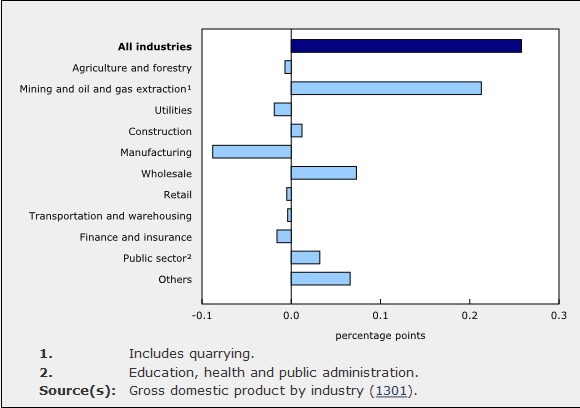
Canada GDP rose 0.3% mom in April, above expectation of 0.2% mom. Goods-producing industries rose 0.4%, while services producing industries increased 0.2%. The 20 industrial sectors were nearly evenly split between gains and losses. On three-month rolling basis, GDP grew 0.3%, up from 0.1% in the three months to March.
Also from Canada, IPPI rose 0.1% mom in May versus expectation of 0.0% mom. RMPI dropped -2.3% mom, versus expectation of -3.0% mom.
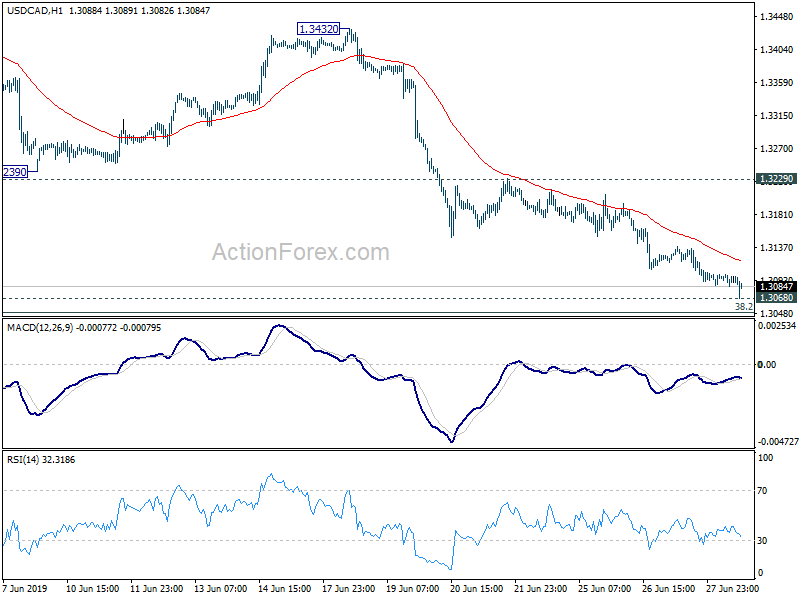
USD/CAD dips mildly after the releases. Focus remains on 1.3068 cluster support (38.2% retracement of 1.2061 to 1.3664 at 1.3052). Decisive break should confirm medium term bearish trend reversal.
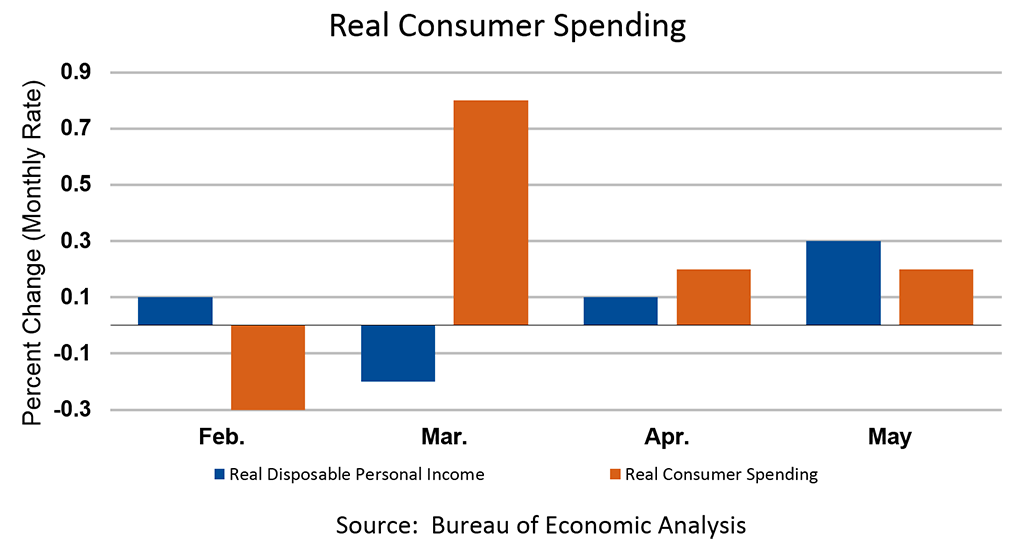
US personal income rose 0.5%, spending rose 0.4%, core PCE unchanged at 1.6%
In May, US personal income rose 0.5% or USD 88.6B, above expectation of 0.3%. Personal spending rose 0.4% or USD 59.7B, below expectation of 0.5%. Headline PCE deflator slowed to 1.5% yoy, down from 1.6 yoy but matched expectations. Core PCE was unchanged at 1.6% yoy, also matched expectations.
EUR/JPY: Faces Consolidation Threats
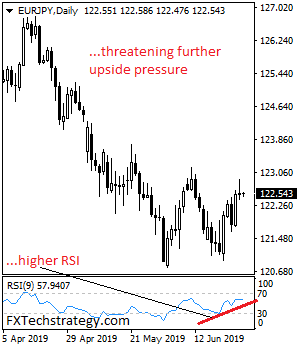
EURJPY faces consolidation threats as it looks for directional move. Support comes in at the 122.00 level where a break if seen will aim at the 121.50 level. A cut through here will turn focus to the 121.00 level and possibly lower towards the 120.50 level. On the upside, resistance resides at the 123.00 level. Further out, we envisage a possible move towards the 123.50 level. Further out, resistance resides at the 124.00 level with a turn above here aiming at the 124.50 level. On the whole, EURJPY retains its broader downside pressure but with recovery risk.
High Noon for Trump and Xi on Trade?
This is Japan’s first time hosting the G20 and no doubt PM Abe would like the world to focus on “promoting free trade and innovation, achieving both economic growth and reduction of disparities, and contributing to the development agenda.” But financial markets appear to be a lot more interested in the bilateral meetings that will take place on the side, especially between US President Trump and Chinese President Xi.
Risk appetite improved last week when President Trump tweeted that the pair would have “an extended meeting.” But the schedule from the White House allows only about 90 minutes for the meeting on Saturday, before Trump is due to meet Turkey’s Erdogan. This raises the suspicion that the meeting will largely be a rubber stamp of a pre-agreed policy tweak.
It’s not clear how much has been agreed in advance though. Press reports suggest that “Xi plans to present Trump with a set of terms the U.S. should meet before Beijing is ready to settle a market-rattling trade confrontation”. This list includes removing the blacklisting of Huawei, lifting all new tariffs and dropping efforts to get China to buy even more US exports than was agreed at the December G20 in Buenos Aires.
While the US has not published a list of its demands, ending forced technology transfer, IP theft and state owned enterprise funding of foreign company acquisition would arguably top that list.
Thus it’s not obvious that an agreement is within easy reach in 90 minutes. However, with the US willing to suspend the threat of 25% tariffs on the $300bn or so of China goods imports that are not already subject to tariffs, there is a keen sense that both sides should be able to agree to further talks.
This is hardly the basis for a major improvement in the risk mood but is at least better than delivery of Trump’s 5 May declaration that the 25% tariffs would be imposed “shortly”.
The prospect of talks about talks has been enough to generate strong gains for global equity markets. The S&P 500 is up over 6% for the month of June and over 16% in the first half of 2019. This is the best first half performance for US equity market since 1997.
To be sure, Fed guidance of possible rate cuts has helped with Fed chair Powell suggesting that the FOMC “will closely monitor the implications of incoming information for the economic outlook and will act as appropriate to sustain the expansion”.
That is still not enough for Trump though who suggested that “We should have Draghi instead of our Fed person” on Fox Business this week, again noting that he has the “right to demote him” and the “the right to fire him”.
Financial markets are pricing in a full rate cut plus from the Fed in July and just under 3 cuts by the end of the year.
Speculation that we may even see a 50bps cut in July has weighed on the US$ this last week with a commonly watched index of the US$, the DXY index, hitting lows back to March.
Now despite Thursday next week being US Independence Day, it’s a full week in terms of data and events. We have important updates on US manufacturing, the ISM on Monday and the non-manufacturing ISM on Wednesday and then the non-farm payrolls report on Friday.
It’s a very busy week next week here in Australia too. On Tuesday the RBA reviews the 1.25% cash rate, having cut from 1.50% in June. Since then, Governor Lowe has said that it is “not unrealistic to expect” another cut.
Such language leaves us expecting a cut to 1% on Tuesday. Market pricing is around 70-75% so if the RBA does deliver, this should cap the A$ just above 0.70.
Over and above the RBA, we also have Parliament resuming where the focus will be on fiscal policy and the passage of PM Morrison’s tax package. We also have May building approvals and merchandise trade balance Wednesday and retail sales Thursday.
Event risk: Trump-Xi meeting at Japan G20 (Sat), China Jun official manufacturing PMI (Sun), Japan Q1 Tankan business survey, US Jun manufacturing ISM (Mon), RBA policy decision (Tue), Aust May trade balance & building approvals (Wed), Aust May retail sales, US Independence Day holiday (Thu), US Jun employment, Canada Jun employment (Fri)