Sample Category Title
Japan & US agreed to speed up trade negotiation, but no time frame assigned
Japan Economy Minister Toshimitsu Motegi said US and Japan agreed to speed up trade negotiations. He noted that after meeting US Trade Representative Robert Lighthizer in Osaka as sideline of G20 leaders summit. Working level meetings will be held starting next month, towards a bilateral trade agrement.
However, Motegi also said there is no time frame for completing the deal. He said noted "we share understanding of each other's thinking and stance and where our gap lies. Based on that, we are discussing ways to narrow our differences."
USD/JPY Could Continue To Decline
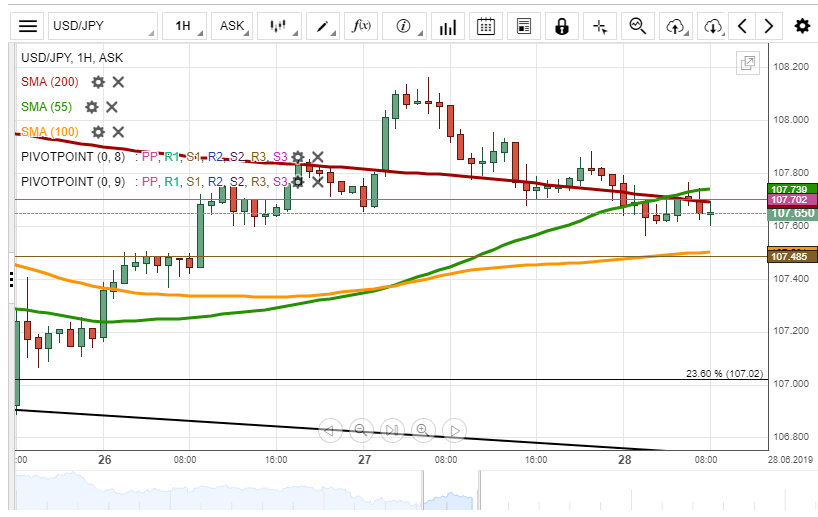
On Thursday, the USD/JPY currency pair declined to the support level formed by the 55– and 200-hour SMAs, as well the weekly PP at 107.70. During today's morning, the pair was testing the given support.
If the given support level holds, it is expected, that a reversal north could occur within the following trading hours. In this case, the exchange rate could try to surpass the psychological level at the 108.00 mark.
Otherwise, it is likely, that the Japanese Yen could continue to appreciate against the US Dollar. Note, that the rate could be supported by the 100-hour moving average and the monthly S1, located at 107.50 and 107.39 respectively.
XAU/USD Might Reverse North
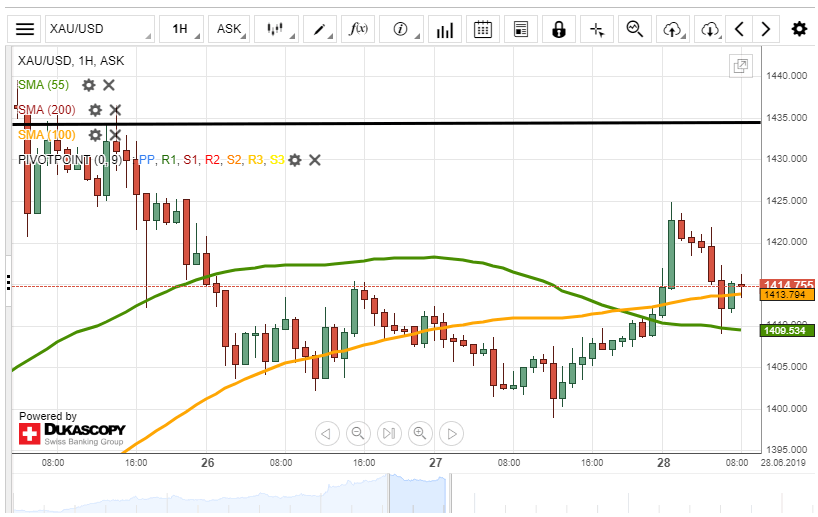
Yesterday, the price for gold tested the psychological level at 1,425.00. During Friday's morning, the XAU/USD exchange rate was testing the support level formed by the 55– and 100-hour SMAs, located circa 1,410.00.
If the given support holds, it is expected, that gold could remain its appreciation against the Greenback. A potential upside target is the upper boundary of the ling-term ascending channel at 1,435.00.
On the other hand, the exchange rate could trade sideways, trying to surpass the given moving averages.
It is unlikely, that the price for gold could tumble lower than 1,390.29 mark due to the support of the 200-hour SMA.
Markets Eye The G20 Meeting
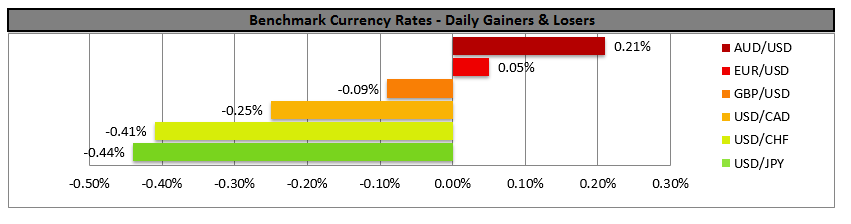
The USD remained rather stable yesterday, as expectations about the G20 meeting are flooding the markets. Market participants eye especially the Trump-Xi meeting, as it could render a breakthrough to the current impasse of the US-Sino relationships. Chinese media reported that the two countries were laying out an agreement that would help avert the next round of tariffs on US imports from China. Analysts on the other hand tend to be more on the cautious side, as any result seems to be quite uncertain currently. Please note that should there be any signs of progress in the US-Sino relationships, we could see the AUD and the USD getting some support. On the flip side, should the end result of the meeting fail the markets, we may experience a disproportional reaction of the markets, weakening the USD. EUR/USD maintained a sideways motion yesterday, between the 1.1380 (R1) resistance line and 1.1340 (S1) support line. We maintain the view for the pair to keep its current direction, yet the G20 meeting could provide substantial fundamentals for the pair to alter its course. Should the bulls take over the pair’s direction, we could see it breaking the 1.1380 (R1) resistance line and aim for the 1.1415 (R2) resistance level. Should the bears take over, we could see the pair breaking the 1.1340 (S1) support line and aim for the 1.1300 (S2) support level.
Easy come, easy go for Bitcoin
Bitcoin relented most of the gains made last week within one day’s session, yesterday. Analysts note that Bitcoin reversed course after a prominent cryptocurrency exchange reported an outage, yet we remain skeptical if the fundamentals are sufficient for such a drop. On other news, an Asian crypto exchange shut down and anther one was hacked, with 4 million worth of assets being reportedly stolen. Please bear in mind that Bitcoin, started its latest rise after a number of large organizations and especially Facebook, showed signs of some form of adoption of cryptocurrencies. We expect volatility to be maintained over the short term with both directions being possible. Bitcoin dropped heavily yesterday, breaking consecutively the 12360 (R2) and the 11580 (R1) support lines, now turned to resistance and at some point temporarily the 11000 (S1) support line. We see the drop as a correction lower, yet would not be surprised to see the crypto currency rising again. For the time being, as the crypto’s price action broke the upward trendline incepted since the 20th of June, we switch our bullish bias in favor of a sideways scenario. Should Bitcoins long positions be favored once again from the market, we could see the crypto’s value rising and breaking the 115800 (R1) resistance line and aim for the 12360 (R2) resistance hurdle. Should the bears take over, we could see the pair breaking the 11000 (S1) support line once again and aim for the 10400 (S2) support barrier.
Other economic highlights today and early tomorrow
Today during the European session, we get France’s preliminary CPI (EU Normalised) rate for June, UK’s final GDP growth rate for Q1 and Eurozone’s preliminary CPI rate for June. In the American session, we get Canada’s GDP rate for April and from the US the Eurozone’s industrial sentiment and business climate indicators, both for June. Later on, we get Germany’s preliminary HICP rate for June. In the American session, we get the final US GDP growth rate for Q1 as well as the US the personal consumption rate for May, the Core PCE price index for May, the final Michigan consumer Sentiment for June and later on the Baker Hughes oil rig count. In the early hours on Sunday, China’s NBS manufacturing PMI for June is due out. On Monday during the Asian session, we get the Caixin Manufacturing PMI for June and Japan’s Tankan large manufacturers Index for Q2.
Bitcoin H4
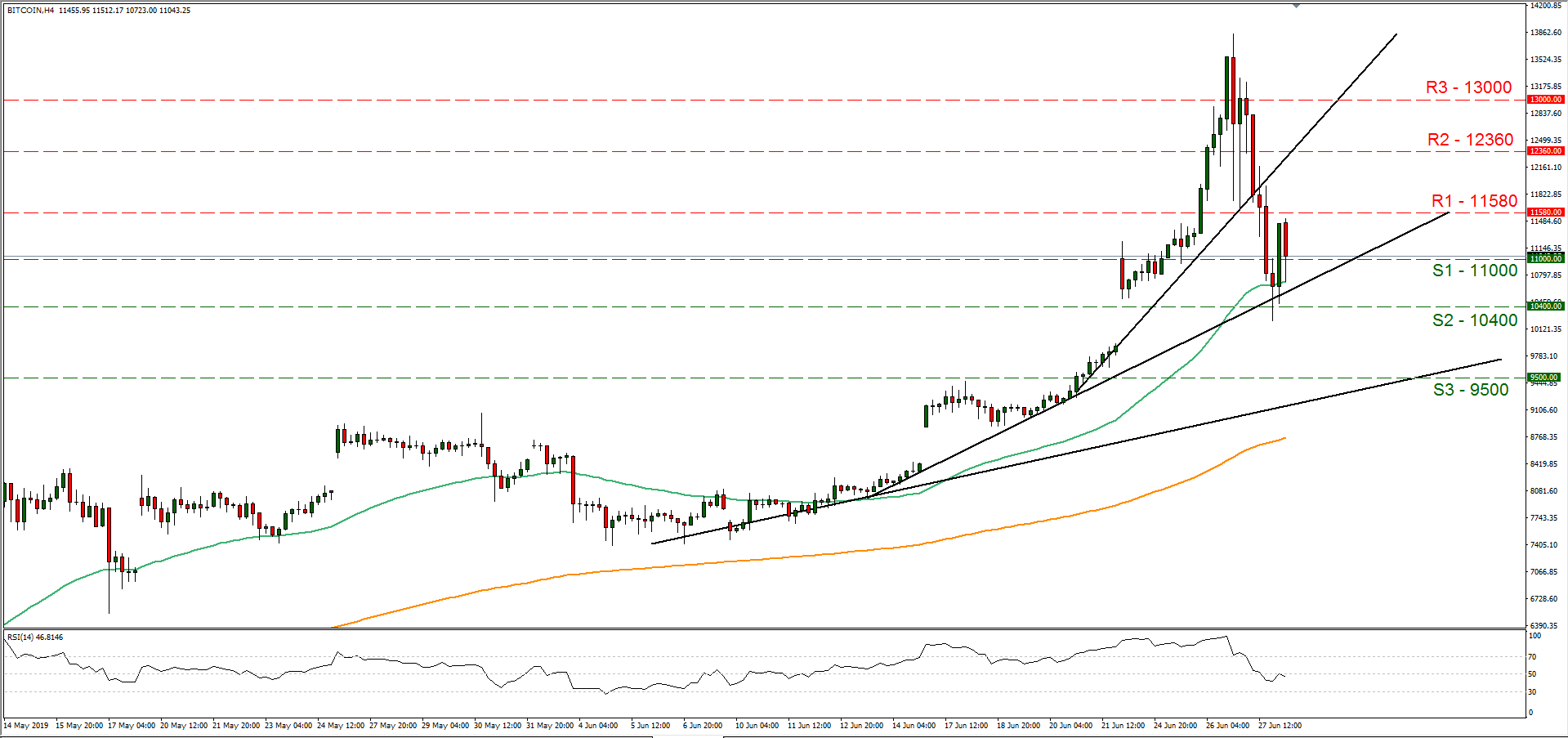
Support: 11000 (S1), 10400 (S2), 9500 (S3)
Resistance: 11580 (R1), 12360 (R2), 13000 (R3)
EUR/USD H4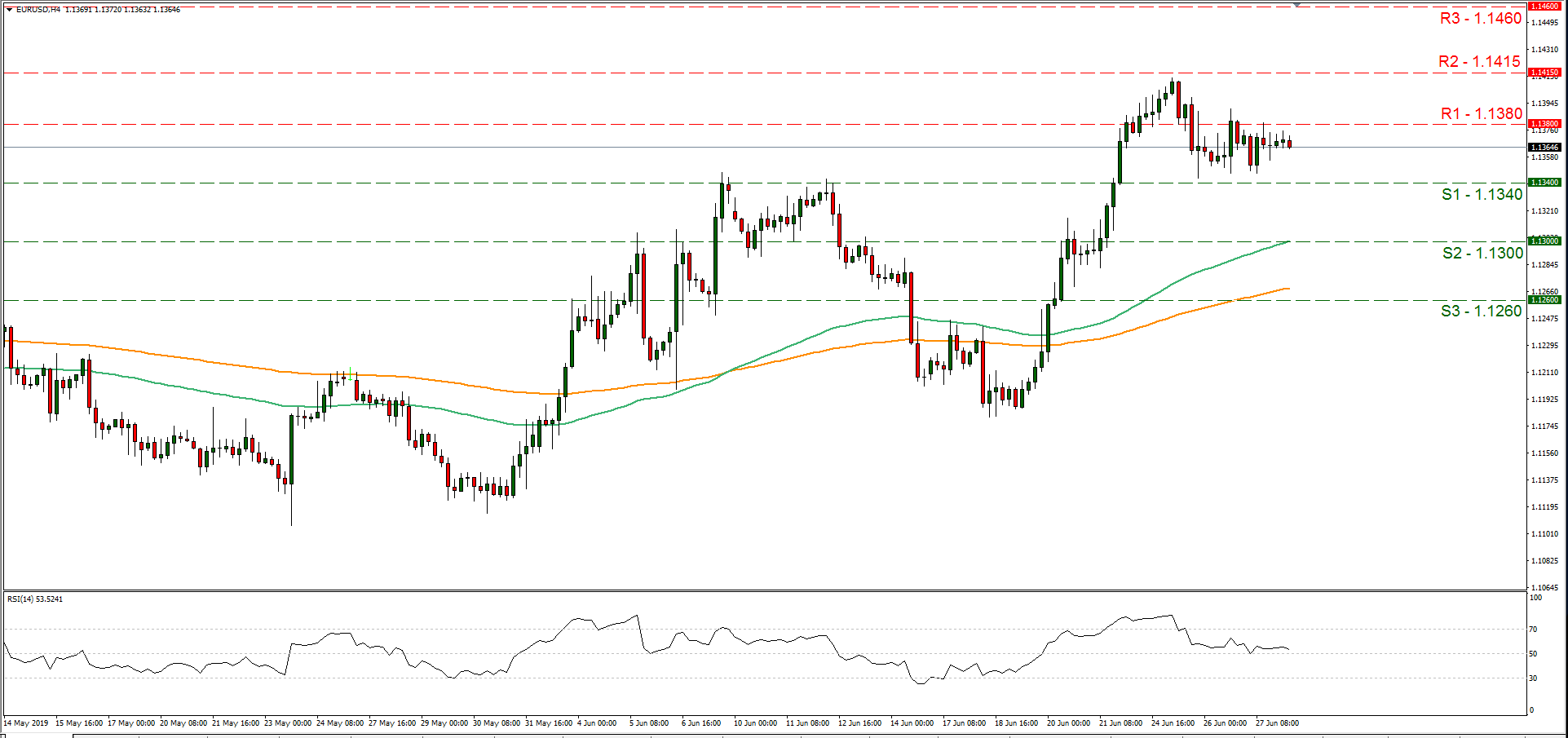
Support: 1.1340 (S1), 1.1300 (S2), 1.1260 (S3)
Resistance: 1.1380 (R1), 1.1415 (R2), 1.1460 (R3)
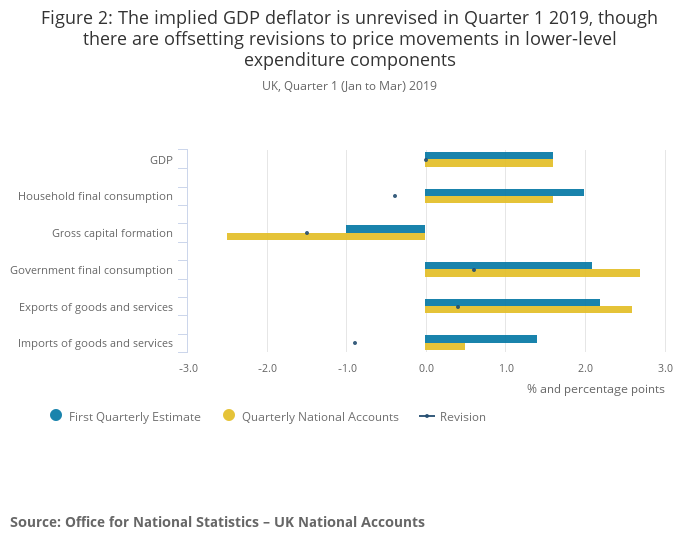
UK Q1 GDP finalized at 0.5%, services the largest contributor
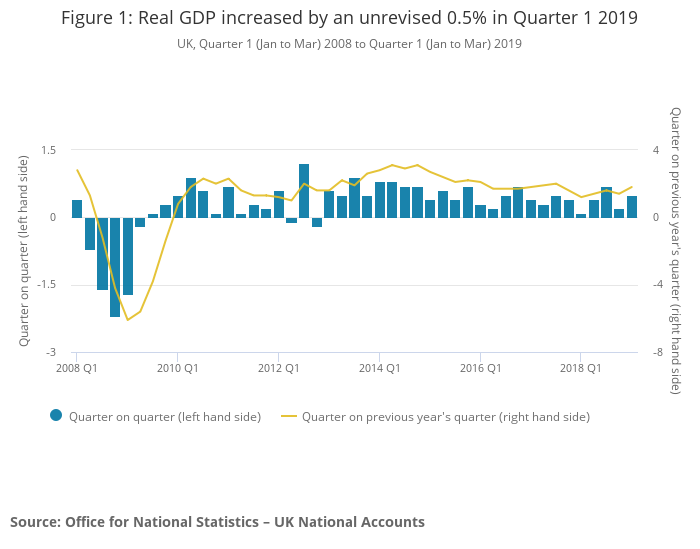
UK Q1 GDP was finalized at 0.5% qoq, 1.8% yoy, unrevised. Services output rose 0.4%, production rose 1.1% while construction rose 1.4%.
Services sector provided the largest contribution to growth in the output approach to measuring GDP, while production also contributed positively, due largely to growth of 1.9% in manufacturing output.
Household expenditure, government consumption and investment contributed positively to GDP growth in Quarter 1 2019, while net trade contributed negatively.
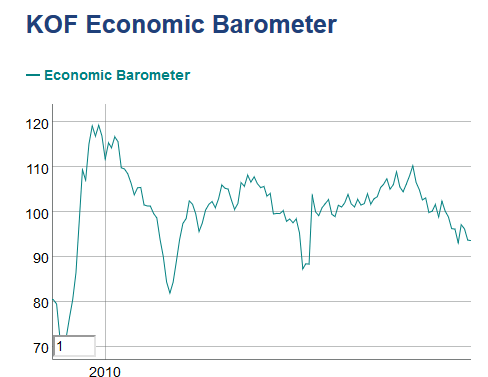
Swiss KOF dropped to 93.6, downward tendency flattening out
Swiss KOF Economic Barometer dropped to 93.6 in June, down from 93.8 and missed expectation of 94.9. KOF said "the downward tendency that has been present since the beginning of the year is now flattening out." But economic outlook "remains dampened" in the middle of 2019.
The almost unchanged reading is primarily due to balancing tendencies in foreign demand, the goods producing sector (manufacturing and construction) and private consumption. While indicators show a positive tendency with regard to foreign demand, the joint indicators of the goods producing sector and private consumption point in the opposite direction with almost equal magnitude. In addition, there is a slight slowdown in the banking and insurance sector.
Dollar Drifts Lower As G20 Outcome Anxiously Awaited, Inflation Data Eyed
- Markets anxiously await US-China trade talks as G20 summit gets underway
- Dollar and other majors steady but equities struggle
- Eurozone and US inflation data in focus amid rate cut talk
All eyes on Trump-Xi meeting
As the G20 summit gets underway in Osaka, Japan, investors’ attention is fixated on the much-anticipated meeting between US President Trump and Chinese President Xi as the two leaders attempt to mend their fraught relations. There’s a lot of uncertainty as to what the meeting, due to place on Saturday (0230 GMT), will produce, but the minimum outcome that traders are anticipating is for the two sides to restart the stalled trade negotiations and delay imposing any additional tariffs.
Such a result might help lift risk sentiment slightly as it would keep alive hopes of an eventual deal but is unlikely to significantly alter the global economic outlook and therefore do little to curb expectations of rate cuts by major central banks around the world.
In the event, however, of an unexpected breakthrough, the global growth picture would brighten substantially and lessen the need for monetary easing to boost stagnating economies.
Dollar edges lower
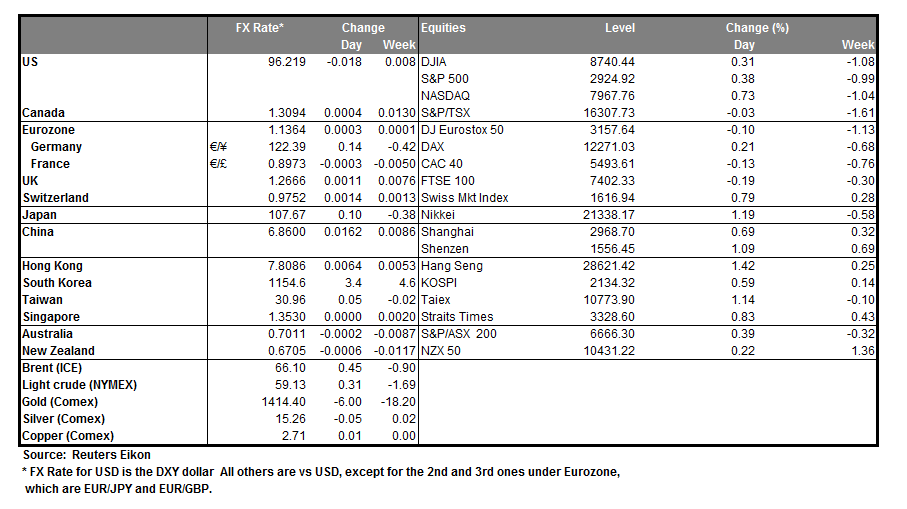
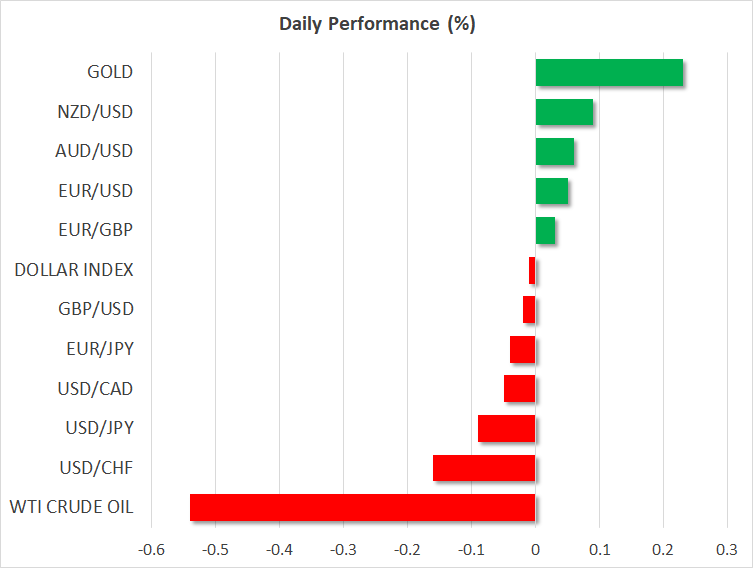
The US dollar was marginally weaker but steady on Friday as traders warily awaited the headlines to emerge from this weekend’s crucial G20 talks. The dollar index was heading back towards the 96.0 level, while the yen strengthened slightly to 107.65 per dollar, having yesterday hit a one-week low of 108.15.
The cautious market mood helped gold increase its distance above $1400 an ounce after briefly dipping below the level yesterday.
Despite the uncertainties regarding what direction the Trump-Xi talks will take, the Australian and New Zealand dollars continue to scale fresh highs against their US counterpart. Expectations that the Fed will cut rates more aggressively than the RBA and RBNZ have driven the aussie and kiwi to multi-week highs over the last few days. The RBNZ kept rates on hold this week but signalled more cuts will be needed in the coming months, while the RBA is highly anticipated to lower its cash rate for the second meeting in a row when it convenes next week.
In equities, European and US stock futures were modestly higher but low expectations of the G20 summit pushed the main Asian indices to negative territory on Friday. Trump’s top economic advisor, Larry Kudlow, on Thursday said the President had not conceded to any preconditions for the meeting with Xi, contradicting earlier reports that suggested Trump had tentatively agreed to postpone any decisions on new China tariffs.
Eurozone and US inflation coming up
With the inflation picture in both the United Stated and the Eurozone still very muted, the latest price indicators out of the two countries will be watched today as both the Federal Reserve and the European Central Bank debate whether to ease policy. The Eurozone’s flash inflation numbers for June are due at 0900 GMT and the core PCE price index out of the US will be released at 1230 GMT, along with personal income and spending figures.
The euro has been struggling to make a decisive break above $1.14 even as the dollar has been on the retreat as expectations that the ECB will loosen policy soon has capped gains.
The pound has also not been able to fully take advantage of the weaker dollar and has slipped back below the $1.27 level on growing fears that Boris Johnson – the next likely prime minister of the UK – would allow a disorderly Brexit. Rising risks of an early general election that could bring Labour into power are also weighing on the British currency.
In other data to keep an eye on today, Canadian monthly GDP number for April will be important, as well as the Bank of Canada’s quarterly business outlook survey as the Canadian dollar surges to 5-month highs on diminishing expectations that the BoC will follow the Fed in cutting rates.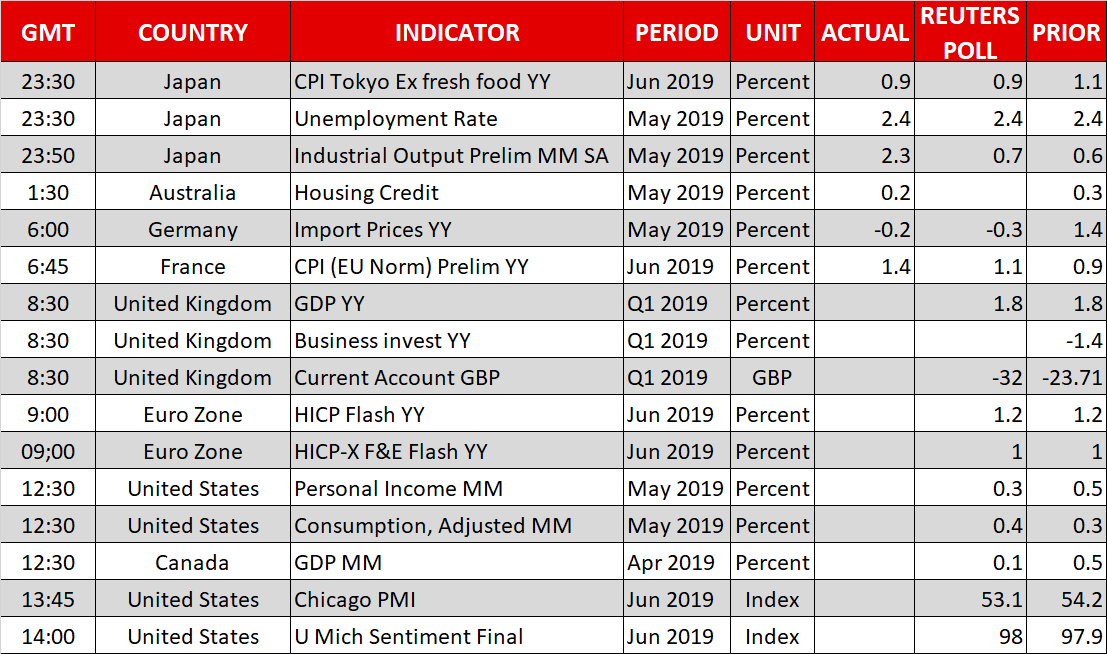
GBP/JPY Daily Outlook
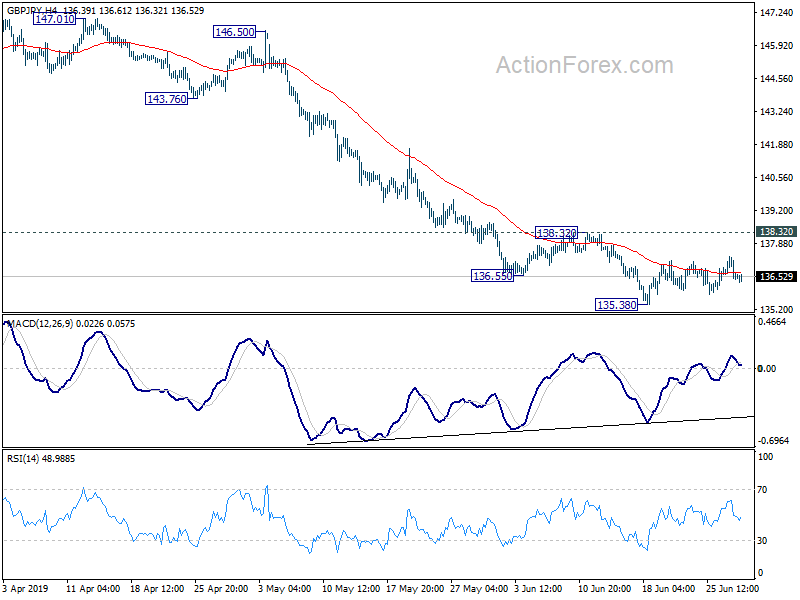
Daily Pivots: (S1) 136.22; (P) 136.78; (R1) 137.13; More...
GBP/JPY is staying in consolidation from 135.38 and intraday bias remains neutral. . In case of another rise, upside should be limited by 138.32 resistance to bring fall resumption. On the downside, break of 135.38 will extend recent fall from 148.87 to retest 131.51 low. Though, firm break of 135.38 will confirm short term bottoming and bring stronger rebound to 55 day EMA (now at 139.61) and above.
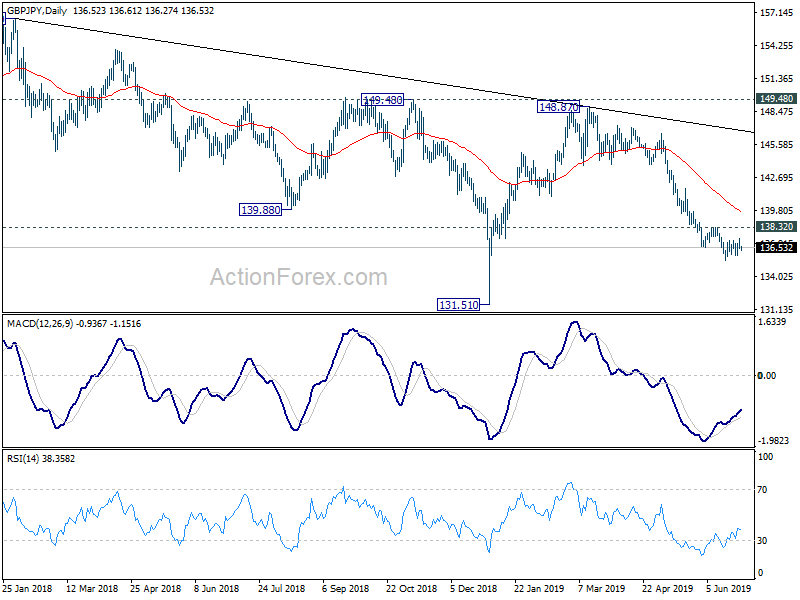
In the bigger picture, current development suggests that GBP/JPY's medium term fall from 156.59 (2018 high) is still in progress. Break of 131.51 will target 122.36 (2016 low). Structure of such decline is corrective looking so far, arguing that it's just the second leg of consolidation from 122.36. Thus, we'd expect strong support from 122.36 to contain downside to bring reversal.
EUR/JPY Daily Outlook
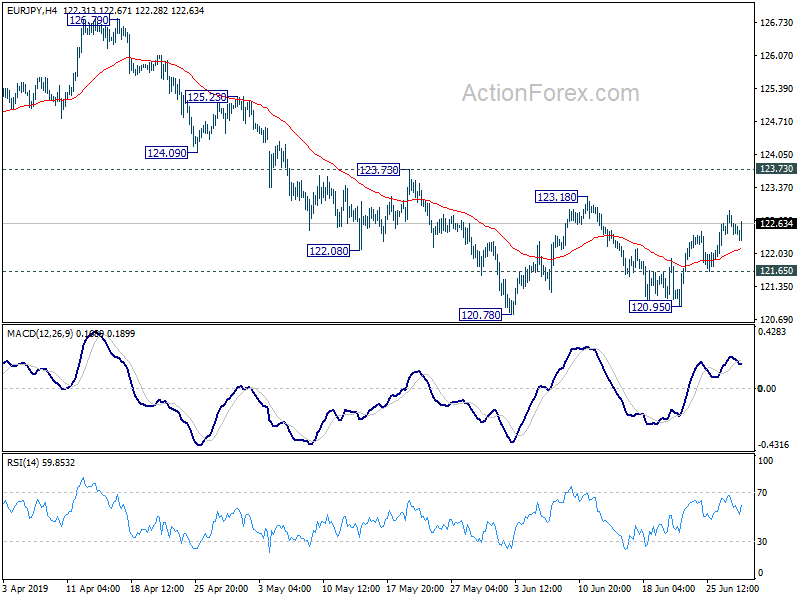
Daily Pivots: (S1) 122.32; (P) 122.61; (R1) 122.82; More....
EUR/JPY is staying in consolidation from 120.78 and outlook is unchanged. Further rise might be seen but upside should be limited below 123.73 resistance to bring fall resumption eventually. On the downside, below 121.65 minor support will turn bias to the downside for 120.78 low. Decisive break there will resume the decline from 127.50 and target 118.62 low next.
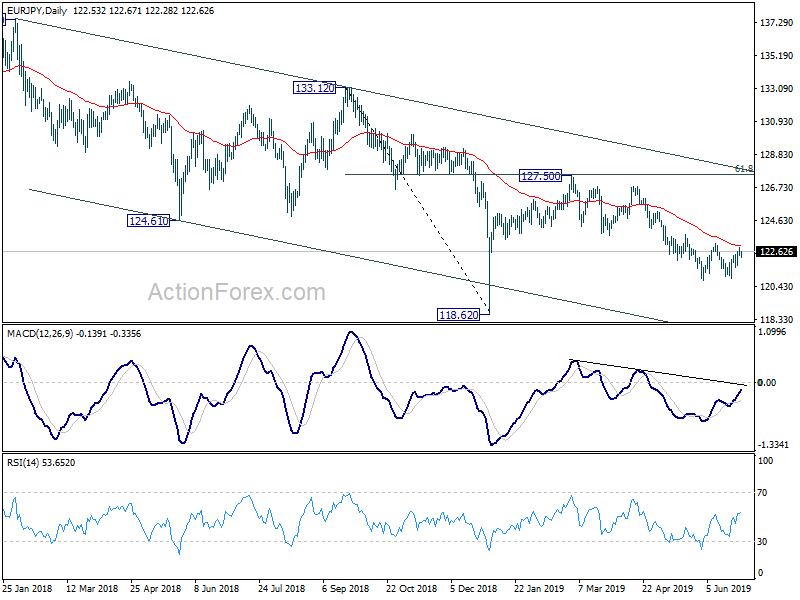
In the bigger picture, down trend from 137.49 is still in progress with the cross staying inside long term falling channel. Break of 118.62 will extend the fall to 109.48 (2016 low). On the upside, break of 127.50 resistance is needed to be the first sign of medium term reversal. Otherwise, outlook will remain bearish in case of strong rebound.
GBPJPY Likely Waiting For A Trend Reversal
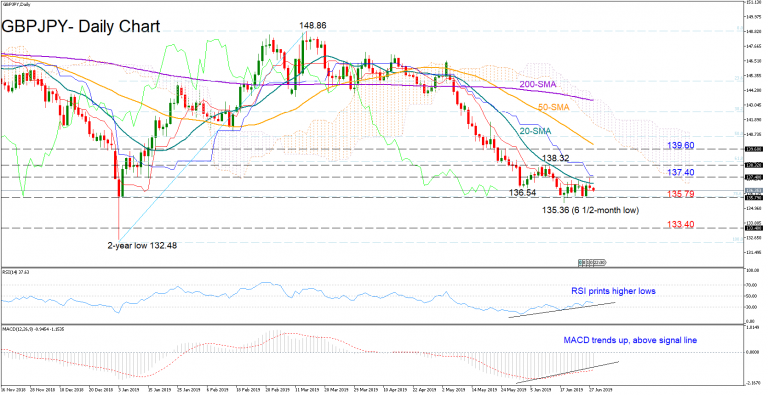
GBPJPY had an uneventful trading for another week, remaining stuck between the 137.40 resistance and the 135.79 key support, which coincides with the 78.6% Fibonacci of the upleg from 132.48 to 148.86 . There is however a bullish divergence signal of a possible trend reversal , as the RSI and the MACD continue to print higher lows at a time when the price keeps trending downwards, suggesting that the market may soon change direction.
A strong rally above the previous high of 138.32 and more importantly above the 139.60 barrier could be interpreted as a validation of the bullish divergence warning. Before that, the price should first breach the 137.40 level.
Alternatively, a break below the 135.79 handle and a decisive close under the 6 ½-month low of 135.36 could strengthen negative momentum, pushing support towards 133.40 and the 2-year low of 132.48 reached in January. Consequently, the medium-term outlook would shift even bearish.
In brief, GBPJPY is trading neutral for the second week but the opposite direction between the price and the momentum indicators is likely detecting a reversal in the bearish trend. Meanwhile, the medium-term picture is holding negative.