Sample Category Title
Jerome Powell May Surprise Markets
Gold price has retraced from its six year high as investors are not fully certain about the Fed’s next action. You cannot neglect the fact that the fed can always sit out and say that they need more time to observe the economic data and this is despite the fact that the chairman of the Federal Reserve has admitted that the downside risk has increased for the economy.
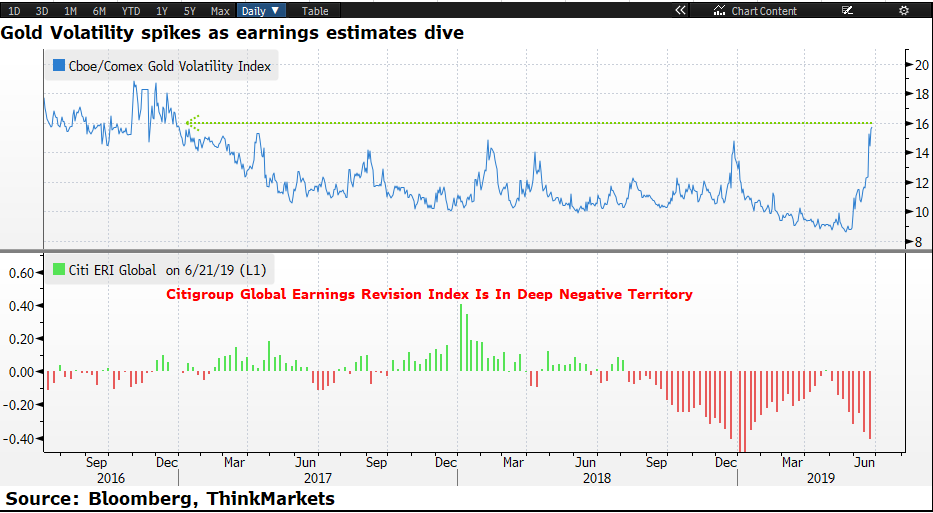
The Cboe/Comex gold volatility index has touched a multi-year high and touched a level not seen since early 2017. This was when Donald Trump was only coming into power and investors were thinking that his polices are going to derail the market.
However, the recent rise in the gold volatility index is primarily due to on-going trade war between the US and China and the fact the picture doesn’t look so bright for the upcoming earning season. A large number of investment banks have already downgraded their earning expectations. The below chart shows a spike in the gold volatility and the lower panel shows the Citigroups global earnings revision index which is in deep negative territory. This confirms a pessimistic outlook.
All eyes will be on the Fed chairman’s speech and his words are going to move the gold price. There is always an element of surprise from the Fed and this is the reason that we have seen the dollar index recovering some of its losses. The bigger question for everyone is how big that interest rate cut will be?
Word Power: How The Fed Let The Markets Slide Down
Tuesday's trading cannot be described as calm, but predictable. The situation with the Fed it is both simple and complicated at the same time: the desire to soften monetary policy is mixed with the uncertainty expressed in statements. It is not the first time that this has led to an extremely negative effect on the markets. Yesterday, Jerome Powell reported that the Fed is still "on hold" with the rates question, having no consensus on lowering the current level. He mentioned that the main problem is the achievement of 2% by the inflation rate: this goal, apparently, would take longer than expected.
However, the main character of the session was not Powell but Bullard. On the one hand, he said that now is the best time for the rate reduction but on the other hand, in his opinion, it is not worth taking off 0.5% in July. Bullard stressed that he does not support this position, citing the same economic uncertainty. Such statements looked even more prominent following recent hints from Trump who expressed dissatisfaction with the high level of the current rate.
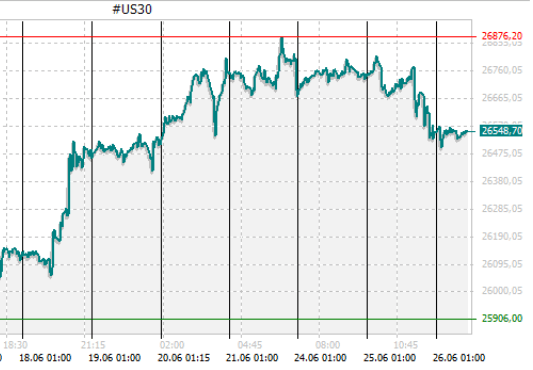
All that affected the stock markets negatively, and the indices unanimously closed the session in the red: S&P500 fell by 0.95%, Dow Jones went down by 0.67%, and NASDAQ was in the red zone by 1.51%. It is most likely that this large fall will not end ahead of a reporting season that could bring many unpleasant surprises.
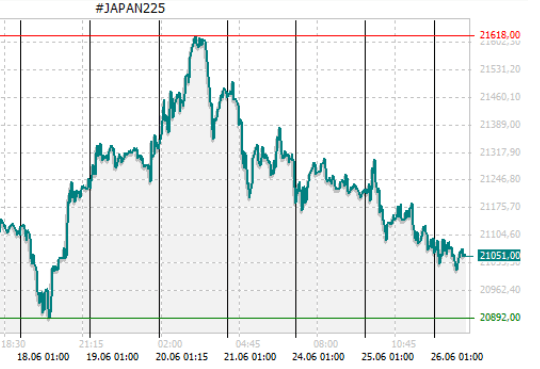
As mentioned by the FxPro Analyst team, the US indices are not alone: on Tuesday, NIKKEI 225 also turned out to be in the red by -0.43%, as well as Hang Seng, which lost -1.15% by the end of the session.
Among the risks included in such a fall are the future results of the upcoming Trump-Xi meeting at the G20 summit. The American media publish predictions as the potential outcome of the negotiations. The major version (that influences the current quotes) comes down to the fact that the leaders will not commit to anything concrete, instead announcing their intentions to continue working on the trade agreement. In the short term, and in the absence of other drivers, all that will continue to put pressure on the markets by not allowing the opportunity to rehabilitate.
Meanwhile, Brent rose by 1.62%, ending Tuesday at $65.83. The price was supported by the US weekly reserves data, decreasing in 7.55 million barrels. However, the resistance at $66 has not passed yet, and in order to break through, additional news is required. It can be the Ministry of Energy statistics that is often at odds with the API values, and therefore that can be the spur for quotes growth.
Japan Abe expects US-China trade resolution, France to insist on climate change agreement at G20
Japan Prime Minister Shinzo Abe, host of this week's G20 summit in Osaka, urged the group to deliver a strong message on issues including promotion of free trade, innovation-driven global growth and rule-making for the digital economy. He also expressed optimism that US and China will resolve their conflicts on trade. Abe said in a news conference, "I expect that the United States and China will resolve their trade friction in a constructive manner through dialogue such as their bilateral meeting at G20".
Separately, it's reported that French President Emmanuel Macron would insist on mentioning Paris climate change accord in the communiques. An unnamed French official was quoted by Reuters, "as for myself, I have one red line. If we don't talk about the Paris Agreement and if we don't get an agreement on it amongst the 20 members in the room, we are no longer capable of defending our climate change goals, and France will not be part of this, it's as simple as that."
EURGBP Retests 5-Month High, Golden Cross Awaited
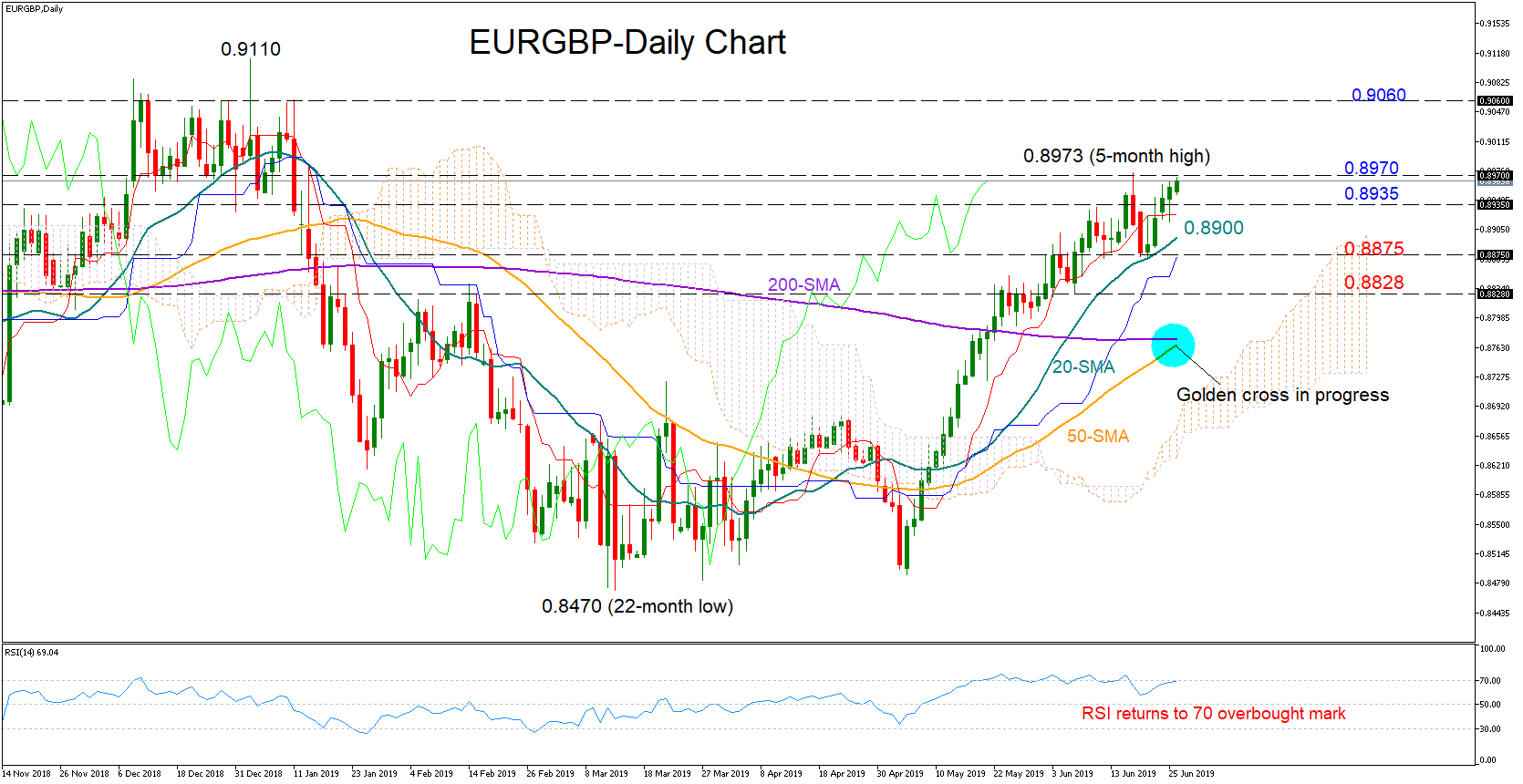
EURGBP found some footing around the 20-day simple moving average (SMA) last week and returned to a bullish trend thereafter.
The price is currently testing the recent five-month peak of 0.8973 and a former restrictive area, where any decisive close higher may prove valuable to the market. The red Tenkan-sen however remains flat above the blue Kijun-sen and the RSI is currently flirting with overbought levels, pointing to a softer short-term trading.
A pullback may meet immediate support around the 0.8935 barrier, while slightly lower the bears could try to overcome the 20-day SMA currently near 0.8900 and the 0.8875 levels. Should the price retreat under the 0.8828 number too, the April upward pattern could come under speculation.
In the positive scenario, the pair could improve above the five-month high of 0.8973 to challenge a stronger resistance around 0.9060. The 0.9100 area, however, which strictly capped bullish action last year, remains the big highlight.
Meanwhile, in the medium-term picture, the situation seems to be getting more interesting as the 50-day SMA and the 200-day SMA are heading for a golden cross. Should the lines intersect each other and then keep some distance between them, the positive outlook may turn even brighter.
In brief, EURGBP is expected to pause the run to the north in the short-term, while in the medium-term, buying interest could advance if the market confirms a golden cross between the 50- and the 200-day SMA.
EURJPY Turns Neutral In Near Term, Still Bearish Overall
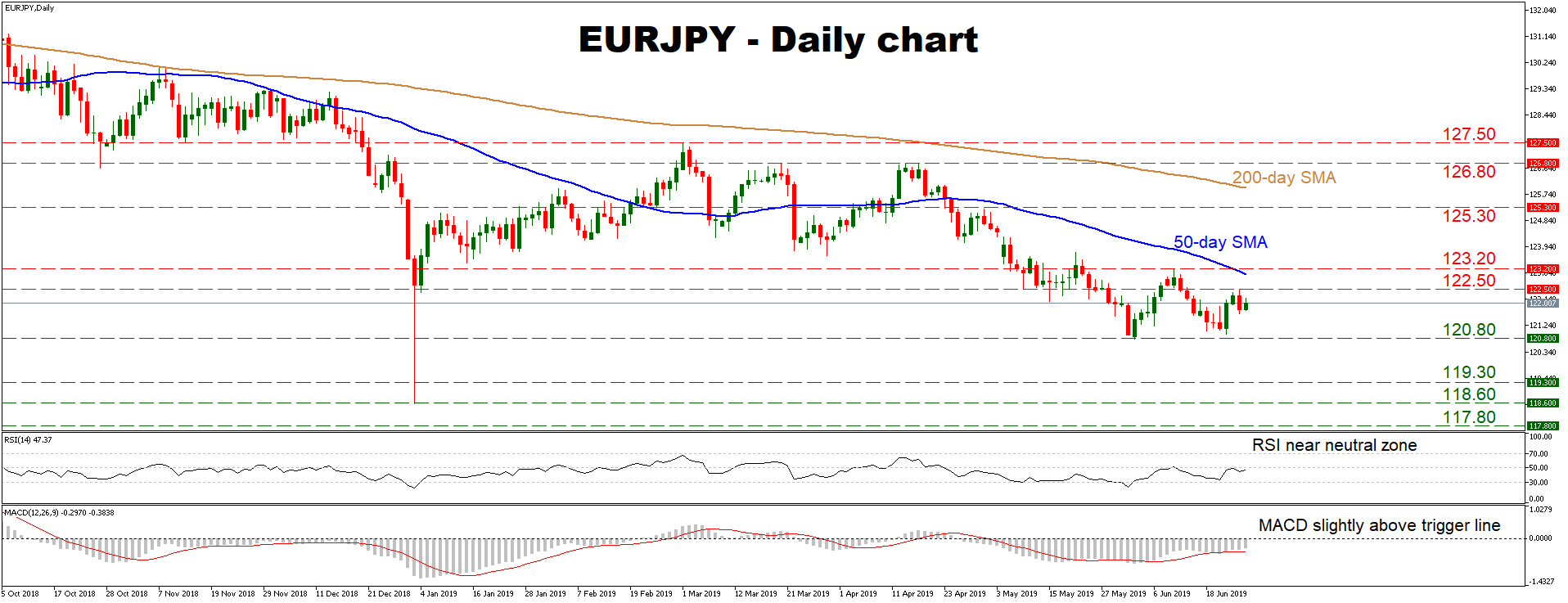
EURJPY has stabilized somewhat since early June, trading within a narrow range with an upper bound of 123.20 and a lower bound of 120.80, which keeps the near-term bias neutral for now. A break on either side is needed to determine the short-term direction. In the bigger picture however, the pair is still in a downtrend.
Momentum oscillators paint a flat picture too, with the RSI being just below its 50 line and the MACD slightly above its red trigger line.
Another wave lower could stall initially at 120.80, where a downside break could reaffirm the continuation of the broader downside trend and open the door for a test of 119.30 – an area marked by the low of February 7, 2017.
On the other hand, if the bulls retake the reins and manage to pierce above 122.50, attention would turn to the 50-day simple moving average (SMA) at 122.99 and the 123.20 zone. Another move above that territory would turn the medium-term picture to a more neutral one too, with the next obstacle being the 125.30 region.
In brief, the short-term picture seems neutral as long as the pair trades between 123.20 and 120.80, though the medium-term outlook is still negative.
Dollar Bounces Back As Powell Signals July Rate Cut Not A Done Deal
- Fed Chairman Jerome Powell pushes back on aggressive rate cut bets
- But dollar rebounds only modestly as markets still see a 25-bps cut in July
- G20 summit remains the week’s focal point but hopes of a major breakthrough are low
Powell says Fed is 'grappling' whether to cut rates
Markets were dealt a reality check on Tuesday after Fed Chairman Jerome Powell signalled that a rate cut in July was not a done deal. Speaking in New York, Powell said he and his colleagues are 'grappling whether these uncertainties will continue to weigh on the outlook and thus call for additional policy accommodation'. However, he also reiterated that many FOMC members see a 'strengthened' case for policy easing, before adding that they do not want to 'overreact to any individual data point or short-term swing in sentiment'.
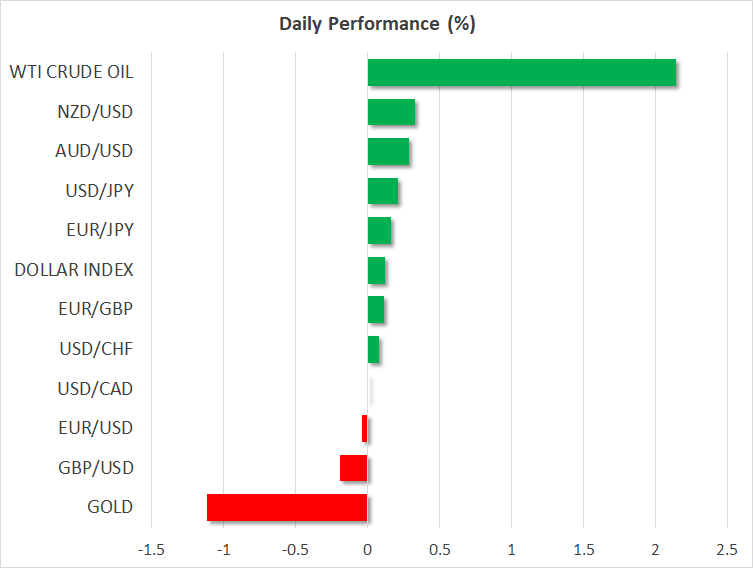
The US dollar jumped higher on Powell’s remarks, climbing back above the 107 level versus the yen, while the euro lost ground below the $1.14 handle. The dollar index bounced back from 5½-month lows to recover to around 96.25.
However, the greenback’s rebound was exaggerated as the currency was due a technical correction and the moves in bond and futures markets were more muted. US Treasury yields rose only marginally from their recent lows, but more significantly, a full 25 basis point cut is still being priced in by investors.
Aggressive Fed rate cuts looking less likely
Powell may have put expectations of an aggressive 50 bps cut to bed, but markets seem certain that the Fed will still cut rates by 25 bps. The odds of a 50-bps reduction have fallen sharply from about 40% yesterday to around 22% today.
St. Louis Fed President, James Bullard, who is one of the most dovish members on the FOMC, further cast doubt on a big cut saying 'I think 50 basis points would be overdone' in a Bloomberg interview on Tuesday.
But softer-than-expected economic data out of the United States on Tuesday reinforced the view that the US economy is slowing faster than anticipated. The US consumer confidence index unexpectedly tumbled in June and new home sales were sharply lower in May.
Powell acknowledged the 'significant' change in the global risk picture in recent weeks. And with uncertainty rising about a US-China trade deal as well as a possible military conflict with Iran, safe-haven favourites like the yen, franc and gold are likely to stay in demand in the coming weeks even as they fall back slightly today on profit taking.
G20 doubts and Iran tensions still weigh on sentiment
US and Chinese officials continue to work behind the scenes to set the stage for the high stakes talks between Presidents Trump and Xi on the sidelines of this weekend’s G20 summit in Japan. The US has signalled it will not accept any conditions regarding the use of tariffs, but investors are hopeful that at the very least, the two leaders will strike some kind of a truce not to impose any additional tariffs and restart the trade negotiations.
As markets anxiously await the outcome of the G20 talks, US data on durable goods orders, due later today, and PCE inflation numbers on Friday will be on investors’ radar for more clues on the US economy.
Kiwi up even as RBNZ signals further rate cuts
The New Zealand dollar outperformed its peers today despite the Reserve Bank of New Zealand signalling lower rates in the future. The RBNZ kept rates on hold at its policy meeting today but indicated it may need to cut rates again to meet its objectives.
This wasn’t enough, however, to offset the even more dovish bets against the Fed and the kiwi extended its gains for an eighth straight day to climb to two-week highs above $0.6650.
In contrast, Bank of England governor, Mark Carney, is expected to reiterate the Bank’s tightening bias when he testifies before a parliamentary committee at 09:15 GMT. The pound though was on the backfoot today as Boris Johnson, the favourite to become the next British prime minister, stepped up his rhetoric of leaving the EU on October 31 with 'deal or no deal'.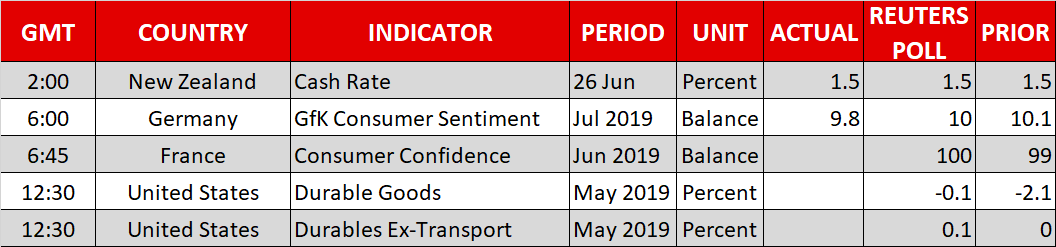
European Open – Powell Tempers Expectations
Fed dashes rate cut hopes
Stock markets are looking a little soft now heading into the G20 later in the week after Fed Chair Jerome Powell insisted that the Fed will be insulated from short-term political interests.

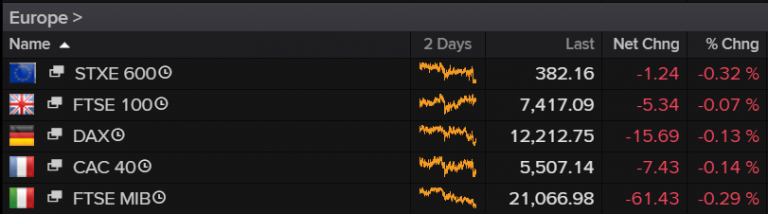
It's quite clear who that message was intended for but it's actually investors that it seems to have struck a nerve with. The impression that investors have got over the last week is that the Fed is prepared to cut rates and will start in July but these comments have thrown a spanner in the works.
Interest rate expectations haven't changed too dramatically though but the odds of 50 basis points have halved. This was also helped by Bullard's suggestion that 50 points may be overdone and 25 would be sufficient.
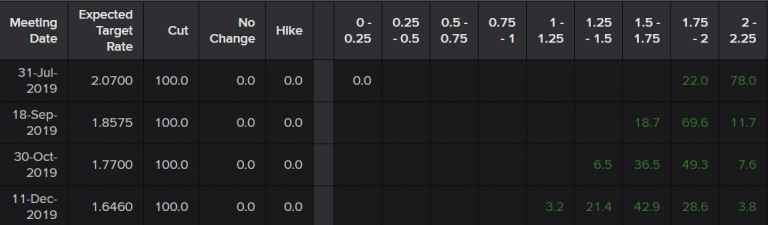
Given he's one of the more dovish members, that sends quite a strong message. I still think markets are too dovish at the moment, almost trying to force the hand of the Fed. They may end up being successful to a point but the message we're getting from these latest comments is that they're may be expecting too much
Elliott Wave Analysis: USD Index, EUR/USD And GBP/USD
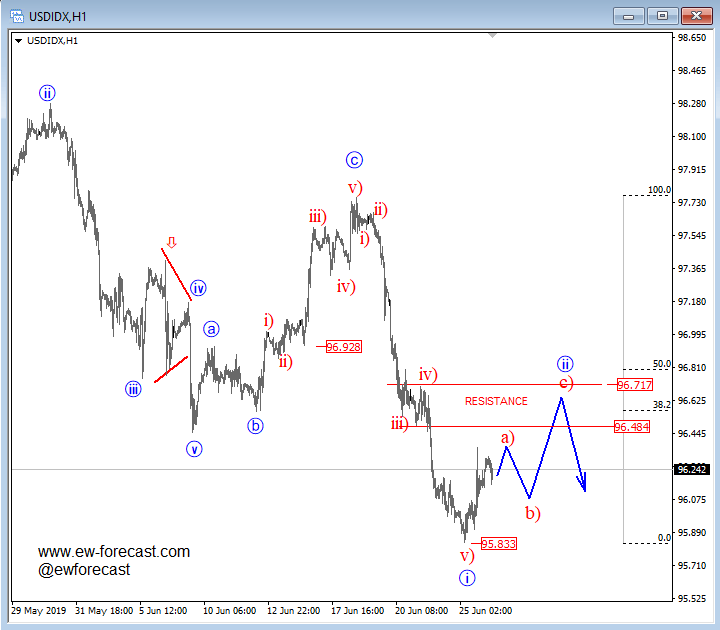
As expected, Dollar Index is doing perfect, so be aware of a bigger three-wave a)-b)-c) recovery here back to around 96.50 – 96.70 resistance area, and from where downtrend may resume. At the same time we can expect a deeper a)-b)-c) correction on EURUSD, ideally down to around 1.1315 or maybe even 1.1270 support area, and something similar we may see on Cable, where a three-wave a)-b)-c) pullback can retest 1.2640 support level. That being said, watch out for more weakness on the US Dollar, but after that small corrective pullback.
USD Index, 1h
EURUSD, 1h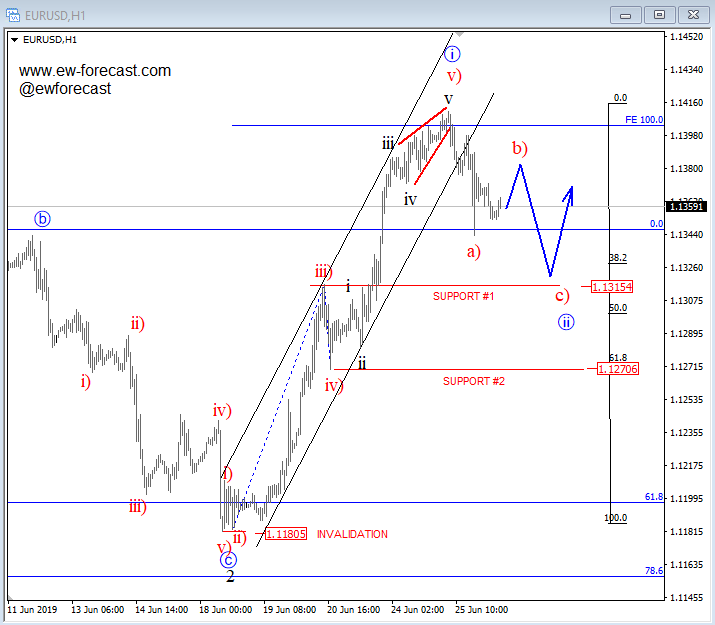
GBPUSD, 1h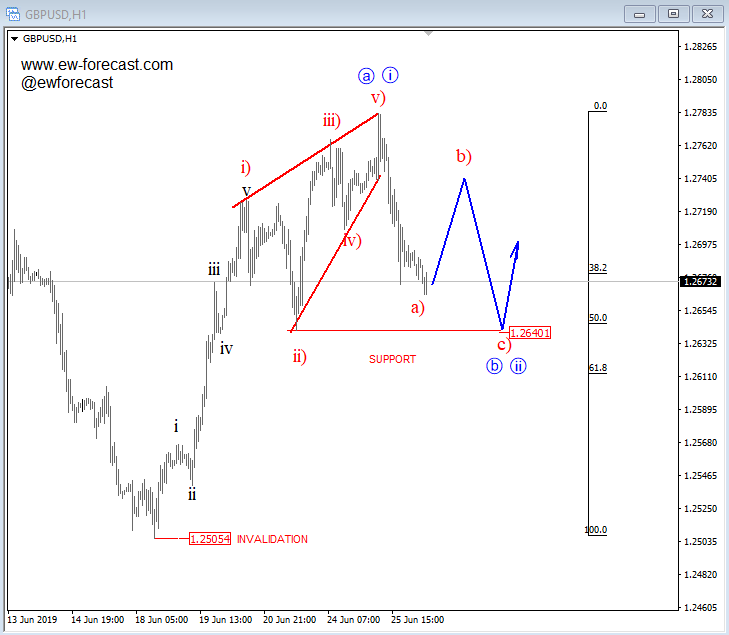
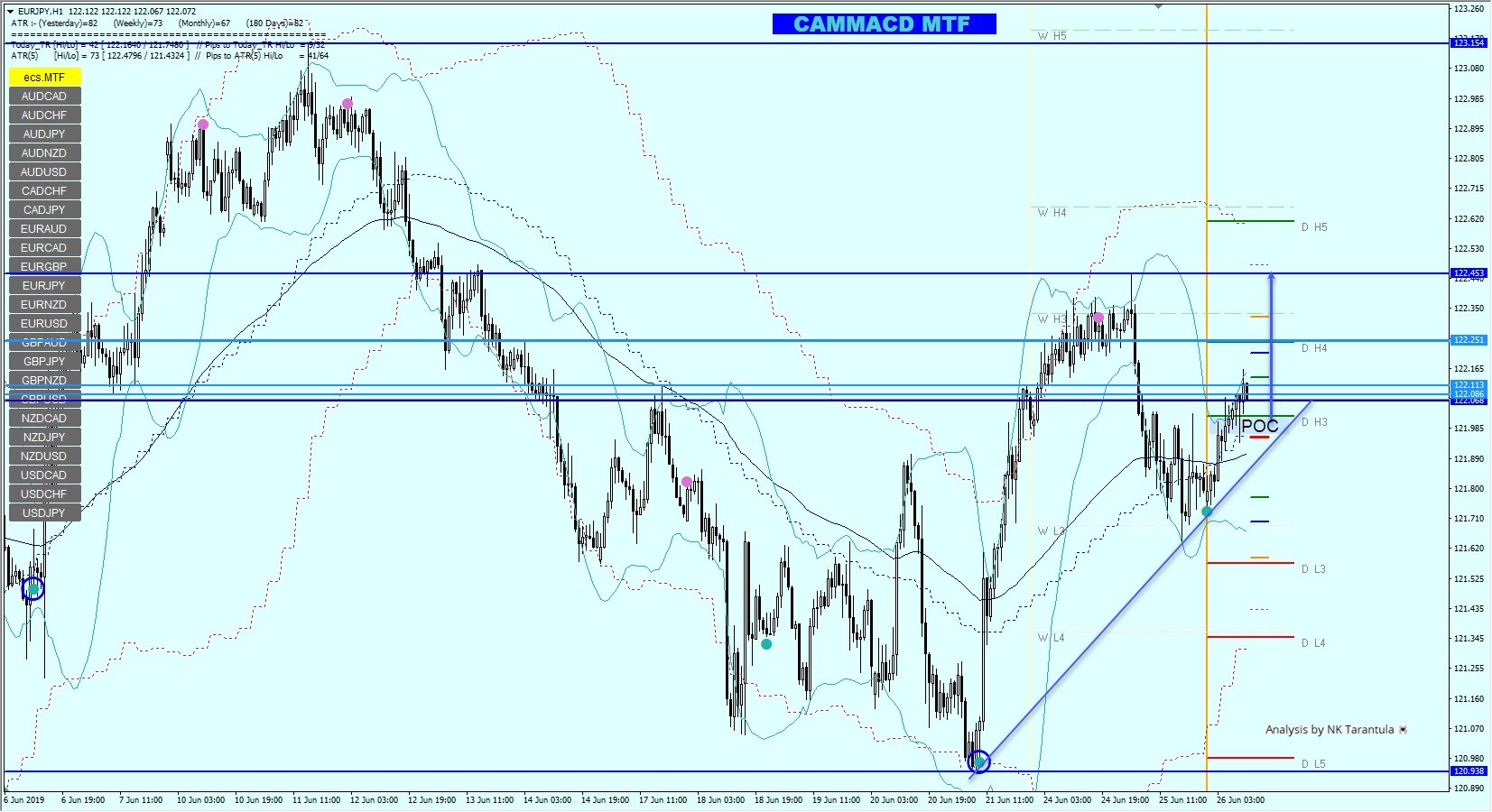
EUR/JPY Bullish Above 122.00
The EUR/JPY has been supported at the POC zone slightly above D L3 and ascending trend line. The ATR pivot additionally supports the pair.
The POC zone at D L3 122.00-122.10 is supportive for the EUR/JPY. However, the price ideally needs to stay above the POC zone for bullish continuation. If momentum persists, next targets ate 122.25 and 122.48, the final intraday ATR projection. Only a strong bullish impulse can get above the ATR high towards 122.65. If the pair drops below 121.95, it might start a down move towards 121.60.
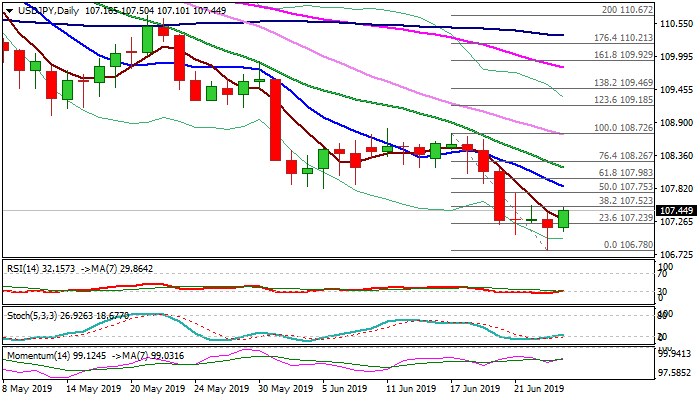
USD/JPY Outlook: Reversal Signal After Double-Doji And Hammer Requires Confirmation On Close Above 107.52 Fibo Barrier
The pair bounces higher in Asia / early Europe on Wednesday, after double-Doji (Fri/Mon) and hammer candle (Tue) signaled that bears are running out of steam and market direction may change.
Reversal of daily RSI and stochastic from oversold territory supports the notion, along with dollar’s firmer tone after comments from Fed officials, who said that 0.5% rate cut might be overdone.
Pivotal Fibo barrier at 107.52 (38.2% of 108.72/106.78) is under pressure and break here would provide bullish signal for recovery extension towards 107.75 (50% retracement) and 107.85 (falling 10SMA).
Failure to clear 107.52 barrier would signal extended consolidation, with existing risk of fresh downside attempts as overall picture remains bearish.
Res: 107.52, 107.75, 107.85, 107.98
Sup: 107.23, 107.10, 106.78, 106.43