

Sample Category Title
Mnuchin Lifts Markets In Early Trade, Nothing New From Carney’s Testimony
US stocks are set to rise in early trade as the US appears set to delay more Chinese tariffs. US Treasury Secretary Steven Mnuchin reiterated that the US-China deal is 90% complete in a CNBC interview which delivered an optimistic tone. Markets are also bid because the tensions between the US and Iran seem poised to be a war of words and not a full-blown military conflict. Iran President Rouhani said that if they keep getting tested they will not get to the negotiating table. Tensions in the Middle East appear to be going nowhere anytime soon, with risks for further tanker attacks, non-US assets seem likely.
Positioning ahead of the G20 summit meeting between Trump and Xi could see investors want skin in the game ahead of what many feel could yield a very positive outcome. A reset of talks is likely becoming the base case scenario and if we see a timeline put in place, we could see equities resume the march to uncharted territory.
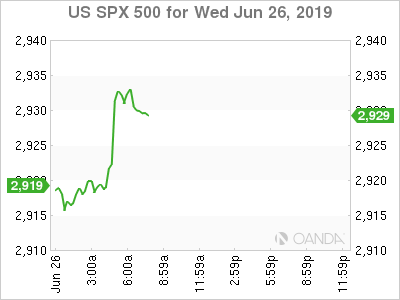
The S&P 500 futures are up 0.5% while the Nasdaq is higher by 0.7%. The dollar is softer to the commodity currencies and unchanged against the euro.
BOE
Bank of England Governor Mark Carney testimony before Parliament’s Treasury Committee on the May Inflation Report highlighted that the risks for no-deal have risen. He reiterated that the BOE is more likely to provide stimulus if we see a no-deal.
Carney’s comments did not deliver any new insights, just further proof the BOE will wait to see how Brexit unfolds before doing anything substantial.
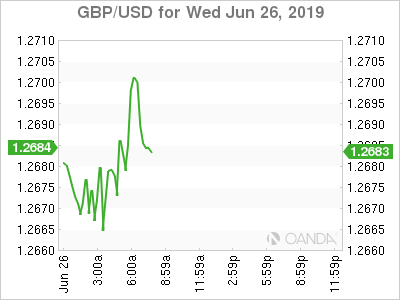
The British pound is slightly higher against the dollar.
European Confidence Data Mixed In Session
Notes/Observations
- Focus on upcoming G20; will US and China agree on no new tariffs as a goodwill gesture???
- Euro region confidence data mixed (Beat: France; Miss: Germany)
- UK Tory candidate Johnson toughened his Brexit rhetoric with a "do or die" pledge to leave the European Union on Oct. 31st (shifted his rhetoric on Tuesday to a tougher no-deal stance)
Asia:
- New Zealand Central Bank (RBNZ) left the Official Cash rate (OCR) unchanged at 1.50% (as expected) and noted that a lower OCR might be needed over time due to downside risks
- G20 draft communique called for promotion of free trade as a means for strong global economic growth; called for need to create positive economic cycle of growth and distribution (will not explicitly oppose protectionism due to opposition from US)
- China Q2 Beige Book notes domestic economy showed modest improvement, manufacturing and retail outperformed; Risks ahead looked more serious
Europe/Mideast:
- New UK PM to be announced on July 23rd
- ECB did not object to thrust of League's law proposal to clarify that Bank of Italy gold belongs to the state; ECB suggests amendment to proposal. Said to ask the Italy's League to remove the reference to the Bank of Italy holding gold as an 'exclusive title of deposit'
- Germany Chancellor Merkel hoped EU Parliament selected candidates by midweek; called for an EU Commission solution by June 30th
Americas:
- Fed Chair Powell: Monetary policy shouldn't overreact to short-term swings in sentiment. To look at the overall situation and want to see more; It's important not to overreact in the short term
- Fed's Bullard (dove, voter, dissenter): Think 2 rate cuts before the end of the year would ensure a soft landing, move policy from slightly restrictive to slightly accomodative; if Fed does cut rates in July do not feel a need to also end reduction in the balance sheet since that is already going to end in Sept. Believed that a 50bps cut in July would be overdone; 50bps cut is not called for right now. Doesn't like suggesting that Fed will go as next meeting as proper tactic; if conditions are right for a cut, we should just cut
- Fed's Barkin (hawk, non-voter): Fed policy stance is modestly accommodative; doesn't know whether rates should be cut this year. Fed wants to be ready to adjust to a fragile environment
- Senior Trump Administration official: no broad trade deal was expected to be made at the G20 meeting between Trump and Xi; US not willing to come to the Trump-Xi meeting with concessions on trade; It's possible that US and China might agree on no new tariffs as a goodwill gesture, but not clear if that would happen
Energy:
- Weekly API Oil Inventories: Crude: -7.6M v -0.8M prior
- Iran Dep Foreign Min: Iran has no reason left to carry out nuclear deal commitments unilaterally
- Iran President Rohani reiterated stance that Iran is not looking for war with the US
- Philadelphia Energy Solutions expected to permanently close oil refinery after recent fire (largest refinery on east coast); US gasoline futures rise over 5%
SPEAKERS/FIXED INCOME/FX/COMMODITIES/ERRATUM
Equities
- Indices [Stoxx600 -0.19% at 382.66, FTSE -0.05% at 7,418.75, DAX +0.2% at 12,231.00, CAC-40 -0.1% at 5,508.00, IBEX-35 +0.31% at 9,190.00, FTSE MIB -0.18% at 21,090.50, SMI -0.29% at 9,863.50, S&P 500 Futures +0.17%]
- Market Focal Points/Key Themes: European Indices trade mixed as following a mixed session in Asia and higher US futures, following weakness yesterday, ahead of the G-20 meeting in Japan later this week. On the corporate front shares of RM2 International declines almost 80% after the company provides a funding update noting the likely suspension of shares; whilst DIA in Spain gains over 15% after reaching an agreement with lenders for an additional €271M in financing. On the corporate front John Wood Group gains after a trading update in which the outlook was affirmed; Stagecoach gains after rise profits despite a sharp fall in Revenues. Meanwhile RPS group declines over 30% following a profit warning, with Bonmarche also declining sharply after continued weakness in clothing business. Elsewhere Bunzl declines following a trading update, with Kappahl, Zoo Digital and Air Partner among other decliners after earnings and trading updates. In other news Brenntag declines on reports that company sold chemicals to Syria using a Swiss subsidiary in 2014, while EU chipmakers gain in sympathy with the stronger results from Micron after the close. Looking ahead notable earners include Blackberry, General Mills and Paychex among others.
Equitie
- Consumer discretionary: John Wood Group [WG.UK] +5.5% (trading update), Bunzl [BNZL.UK] -1.5% (trading update), RPS Group [RPS.UK] -35% (profit warning), RM2 International [RM2.UK] -76% (trading update), Bonmarche Holdings [BON.UK] -22.5% (trading update)
- Consumer staples: British American Tobacco [BATS.UK] -0.5%, Imperial Brands [IMB.UK] +1% (San Francisco becomes the first US city to ban sales of e-cigarettes that have not been approved by the FDA)
- Healthcare: Faron Pharmaceuticals [FARN.UK] -15% (study results)
- Industrials: ThyssenKrupp [TKA.DE] +6% (interest speculation), Norma [NOEJ.DE] -2.5% (analyst action), Brenntag [BNR.DE] -4% (press report on Syria), DIA [DIA.ES] +14% (financing)
- Technology: AMS [AMS.CH] +3%, Infineon [IFX.DE] +0.5%, Dialog Semiconductor [DLG.DE] -0.5% (in sympathy with Micron earnings)
Speakers
- France President Macron: G20 communique must mention the Paris climate accord; topic is a 'red line'
- Iceland Central Bank (Sedlabanki) policy statement noted that contraction in the domestic economy was still anticipated and was expected to show more clearly in coming months
- Thailand Central bank Policy Statement noted that the vote to keep policy steady was unanimous. Reiterated stance that monetary policy remained accommodative. THB currency (Baht) strength might not be in-line with economic fundamental. MPC to follow economic situation and fund inflows closely
- South Korea President Moon: US had proposed working level talks with North Korea. Behind the scene talks for a possible 3rd summit between US-NK
- Japan PM Abe reiterates stance that would not hesitate to counter any economic downside risks via flexible steps. Expected US-China to resolve the trade dispute through constructive dialogue
- China Foreign Ministry spokesperson Geng Shuang urged Britain to stop interfering in Hong Kong affairs. Reiterated stance that Canada should release Hauwei CFO Meng Wanzhou
- Supreme leader Khameni: "Enemy pressure' would have no impact
- US Treasury Sec Mnuchin: Sanctions were working against Iran
Currencies/ Fixed Income
- The USD held on to recent gains over the past 24 hours after several Fed officials pushed back on aggressive US rate cut views. Fed dove (and dissenter) Bullard noted on Tuesday that a 50 basis points cut in July would be overdone. Fed chief Powell stopped short of saying a cut was guaranteed next month.
- NZD currency (Kiwi) saw some volatility after the RBNZ left the key rate unchanged but hinted of more cuts down the road. The kiwi did initially weakened after the central bank noted that it did discuss a rate cut earlier today but tempered the losses afterwards. NZD/USD higher by 0.5% just ahead of the NY morning at 0.6670 area
Economic Data
- (DE) Germany July GfK Consumer Confidence: 10.0e
- (NO) Norway Apr AKU Unemployment Rate: 3.2% v 3.6%e
- (DK) Denmark May Retail Sales M/M: -0.3% v -0.5% prior; Y/Y: -0.7% v +3.1% prior
- (FR) France Jun Consumer Confidence: 101 v 100e
- (TH) Thailand Central Bank (BOT) left its benchmark Interest Rate unchanged at 1.75% (as expected)
- (AT) Austria Jun Manufacturing PMI: 47.5 v 48.3 prior - (PL) Poland May Unemployment Rate: 5.4% v 5.4%e
- (IT) Italy Q1 Budget Deficit to GDP: 4.1% v 2.1% prior
- (CH) Swiss Jun Credit Suisse Expectations Survey: -30.0 v -14.3 prior
- (UK) May BBA Finance Loans for Housing: 42.4K v 41.0Ke
- (IS) Iceland Central Bank (Sedibanki) cut the 7-Day Term Deposit Rate by 25bps to 3.75% (2nd straight rate cut)
- (IS) Iceland Jun CPI M/M: 0.4% v 0.2% prior; Y/Y: 3.3% v 3.6% prior
Fixed Income Issuance
- (AT) Austria Debt Agency (AFFA) opened its book to sell 2047 and 2117 RAGB bonds via syndicate
- (IN) India sold total INR200B vs. INR200B indicated in 3-month, 6-month and 12-month bills
- (IT) Italy Debt Agency (Tesoro) sold €6.0B vs. €6.0B indicated in 6-month bills; Avg Yield: -0.063% v -0.048% prior; Bid-to-cover: 1.41x v 1.65x prior
- (NO) Norway sold NOK2.0B vs. NOK2.0B indicated in 1.75% Feb 2027 bonds; Avg Yield: 1.36% v 1.63% prior; Bid-to-cover: 2.33x v 5.4x prior
Looking Ahead
- 05:30 (EU) ECB LTRO 3-month allotment
- 05:30 (ZA) South Africa announces details of next bond auction (held on Tuesdays)
- 06:00 (CZ) Czech Republic to sell 2033 and 2057 bonds
- 06:00 (RU) Russia OFZ bonds auction
- 06:45 (US) Daily Libor Fixing
- 07:00 (US) MBA Mortgage Applications w/e Jun 21st: No est v -3.4% prior
- 07:00 (CZ) Czech Central Bank (CNB) Interest Rate Decision: Expected to leave Repurchase Rate unchanged at 2.00%
- 07:00 (BR) Brazil Jun FGV Construction Costs M/M: No est v 0.0% prior (revised from 0.1%)
- 08:00 (UK) Daily Baltic Dry Bulk Index
- 08:15 (CZ) Czech Central Bank Gov Rusnok to hold post Rate Decision press conference
- 08:30 (US) May Preliminary Durable Goods Orders: -0.2%e v -2.1% prior; Durables (ex-transportation): 0.1%e v 0.0% prior; Capital Goods Orders (Non-defense/ex-aircraft): 0.1%e v -1.0% prior; Capital Goods Shipments (Non-defense/ex-aircraft): 0.1%e v 0.0% prior
- 08:30 (US) May Advance Goods Trade Balance: -$71.8Be v -$72.1B prior
- 08:30 (US) May Preliminary Wholesale Inventories M/M: 0.5%e v 0.8% prior; Retail Inventories M/M: 0.3%e v 0.5% prior
- 08:30 (CL) Chile Central Bank Traders Survey
- 09:00 (MX) Mexico May Unemployment Rate (Seasonally Adj): 3.5%ev 3.5% prior; Unemployment Rate NSA (unadj): 3.5%e v 3.5% prior
- 09:00 (BR) Brazil May Total Federal Debt (BRL): No est v 3.879T prior
- 09:30 (BR) Brazil May Total Outstanding Loans (BRL): No est v 3.27T prior; M/M: No est v 0.0% prior; Personal Loan Default Rate: No est v 4.7% prior
- 10:30 (US) Weekly DOE Oil Inventories
- 11:30 (US) Treasury to sell 2-Year Floating Rate Notes Reopening
- 12:00 (CA) Canada to sell 2 Year Bonds
- 13:00 (US) Treasury to sell 5-Year Notes
- 13:30 (BR) Brazil May Central Govt Budget Balance (BRL): -17.5Be v +6.5B prior
- 15:00 (AR) Argentina Apr Economic Activity Index (Monthly GDP) M/M: No est v -1.3% prior; Y/Y: -2.9%e v -6.8% prior
- 15:00 (AR) Argentina Q1 Current Account Balance: -$2.7Be v -$2.3B prior
- 15:00 (AR) Argentina Trade Balance: $1.1Be v $1.1B prior
AUD/USD Outlook: Aussie Extends Advance, Helped By Kiwi’s Gains And Positive Signals From US/China Trade Talks
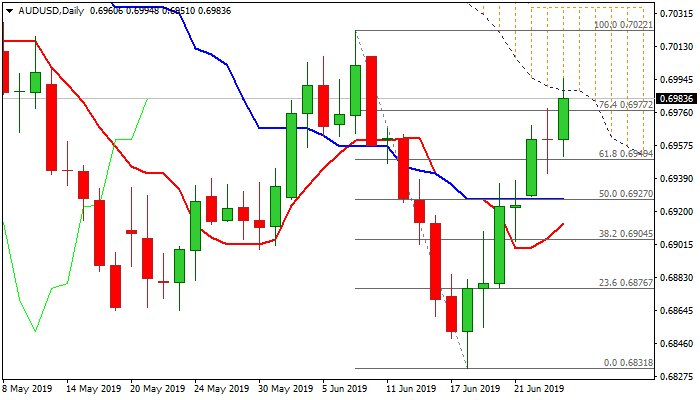
The Australian dollar cracked the base of falling and thickening daily cloud (0.6988), in extension of recovery rally from 0.6831 (18 June low) which paused on Tuesday and left long-legged Doji.
Fresh advance was sparked by rally of Kiwi dollar following the dovish hold of RBNZ, earlier today, in expected action of the central bank and from optimistic comments of top US officials about US/China trade deal.
Close in the daily cloud will provide fresh bullish signal for eventual attack at key barrier at 0.7022 (7 June high) that would also expose daily cloud top (0.7035).
Positive sentiment is boosted by rising bullish momentum, however, bulls may show hesitation under daily cloud base as stochastic is overbought and moves sideways.
Consolidation is likely to precede fresh advance and should ideally stay above 0.6949 (broken Fibo 61.8% barrier / rising 5SMA) to keep bulls intact.
Res: 0.6988, 0.7000, 0.7022, 0.7035
Sup: 0.6949, 0.6937, 0.6925, 0.6914
US PCE Inflation And Consumption Data Eyed As Fed Considers Whether To Cut Rates
The US personal income and outlays report, which features the Fed’s favoured inflation gauge, will be scrutinized on Friday at 12:30 GMT, as speculation about the central bank’s next move reaches fever pitch. Subdued inflation and increased uncertainties about the outlook led the Fed to drop its ‘patient’ stance in June and signal its readiness to 'act as appropriate'. But as the Federal Reserve considers its response to the worsening outlook, the US dollar’s recent sell-off is starting to seem overdone.
Personal income and spending figures, as well as the core Personal Consumption Expenditures (PCE) price index will be the most important release out of the United States before next week’s crucial jobs report for June. As the debate about a July rate cut quickly moves from 'will they or won’t they' to '25bps or 50bps', the two reports could prove decisive for policymakers as the economic data so far is inconclusive about the extent of the slowdown being encountered in the US.
Personal income and spending to continue steady rise
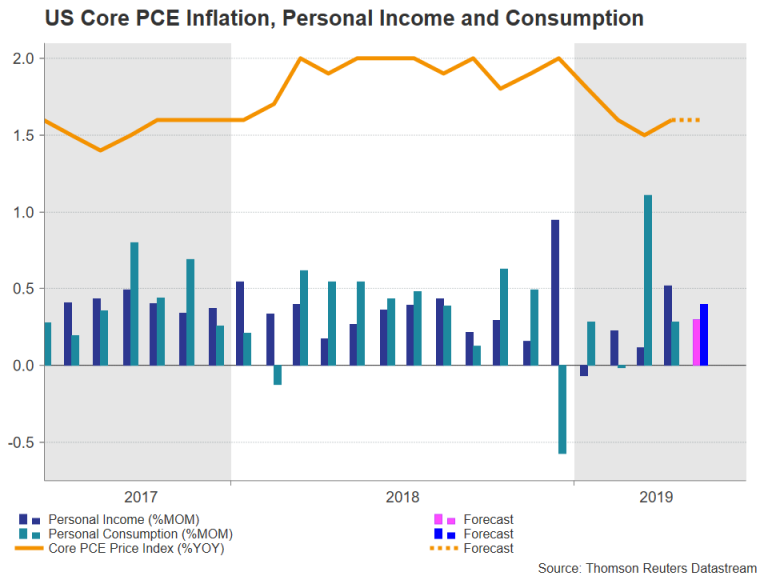
Personal income is forecast to have risen by 0.3% month-on-month in May, easing slightly from the prior 0.5% rate. Personal consumption is expected to have accelerated a little, however, during the month, growing by 0.4% m/m. The figures by themselves suggest domestic demand remains healthy with no sign yet that consumption – the largest component of the US economy – is in danger of dwindling.
Core PCE price index stuck below Fed's 2% target
The main worry for the Fed, even before the collapse of the US-China trade talks, has been the surprisingly soft inflation picture. The core PCE price index, has come off the Fed's 2% target this year, with policymakers blaming the decline on transitory factors. But even the Fed now appears to be questioning whether all the weakness is down to transient forces. The core PCE price index is forecast to stay unchanged at 1.6% year-on-year in May, indicating no pickup still in inflationary pressures.
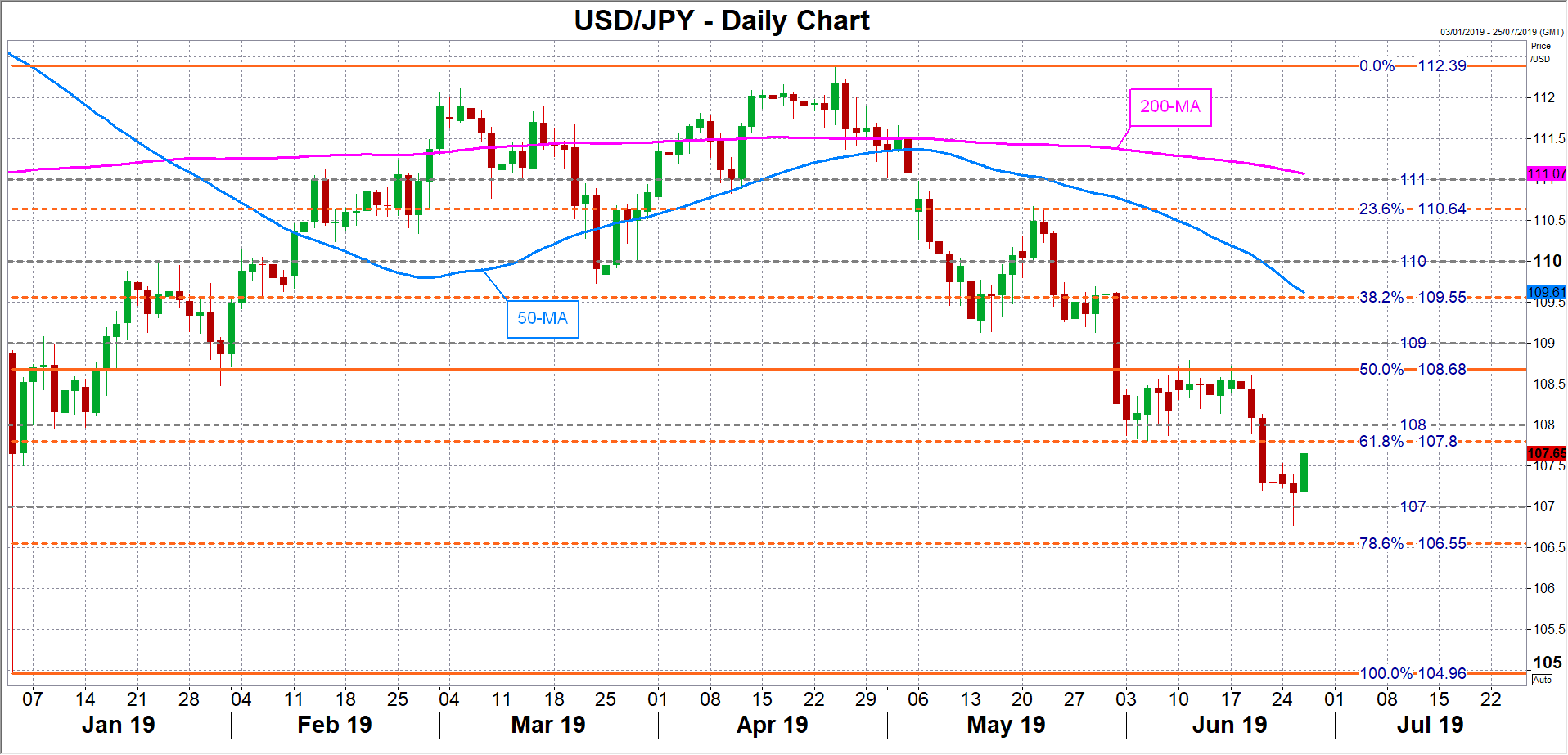
The dollar is likely to remain on the backfoot if the PCE numbers are more or less in line with expectations and do little to alter the current picture on growth and inflation. But if the data disappoints, dollar/yen could extend its losses and head towards the 78.6% Fibonacci retracement of the January-April uptrend, at 106.55. Breaching this support would bring the 105 level into range, which is just above the 2019 low of 104.96.
Dollar vulnerable to upside surprises in the data
However, given that the pair is looking somewhat oversold at the moment (according to key technical indicators), a positive surprise could trigger an upside correction even if Fed funds futures don't budge. Dollar/yen could break above immediate resistance at the 61.8% Fibonacci at 107.80 and the psychologically important 108 mark.
Looking further ahead and nearer the next FOMC meeting, the outlook for the greenback is becoming increasingly bearish as the Fed appears to be content in letting markets anticipate a rate cut. The bigger risk is whether the gloomy predictions stemming from the trade and other geopolitical uncertainties will materialize and what happens if investors have to sharply pare back their rate cut expectations for the Fed.
GBPUSD 1.2660 Holds Firm
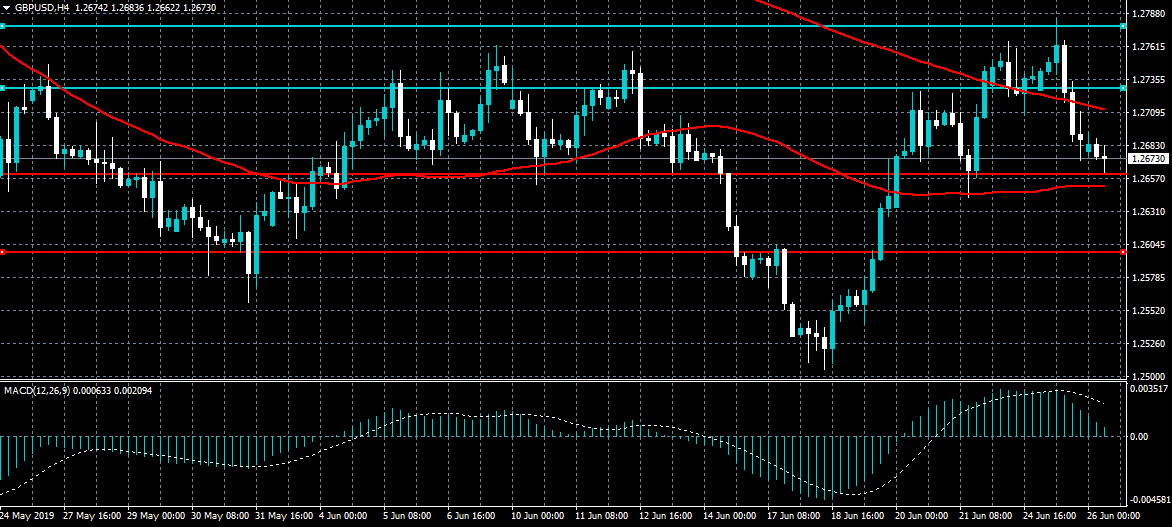
The British pound is attempting to gain upside momentum against the US dollar after bears failed to move price below the pivotal 1.2660 level. Buyers looking for a stronger risk-reward entry may be an attempt to enter the GBPUSD pair from the 1.2660 level. If GBPUSD sellers move price under the 1.2660 level, further weakness towards at least 1.2640 should be expected.
The GBPUSD pair is only intraday bullish while trading above the 1.2710 level, key resistance is found at the 1.2730 and 1.2780 levels.
If the GBPUSD pair trades below the 1.2660 level, key support is found at the 1.2640 and 1.2600 levels.
USDJPY Weak Correction
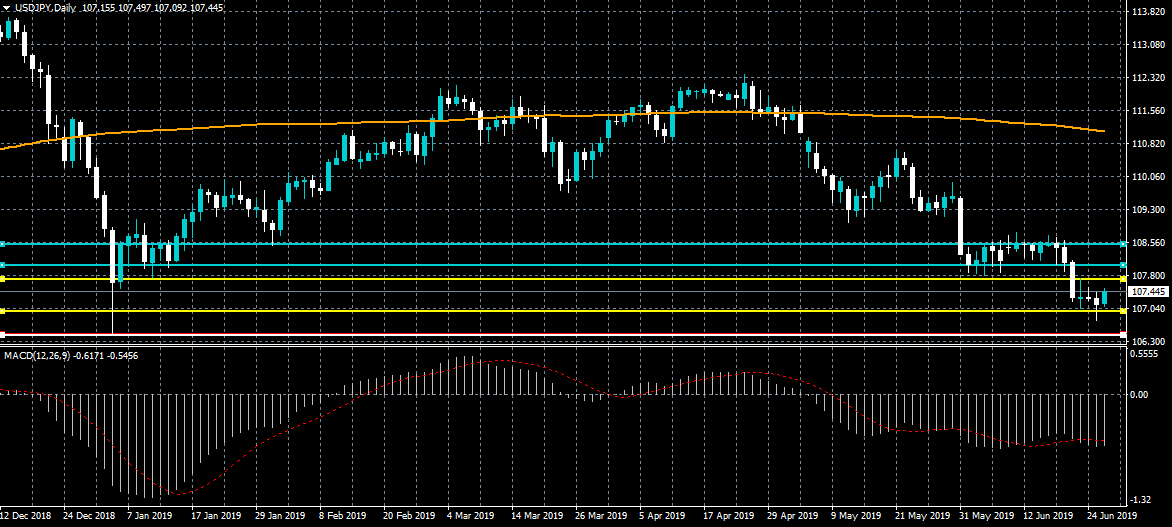
The US dollar has staged a technical correction higher against the Japanese yen currency after the greenback received a much-needed boost on Tuesday. The move higher is fairly weak leaving the recent downtrend still in play, with USDJPY bears targetting the 106.40 level. A clear break of the 107.00 to 107.80 price range is now needed for the next USDJPY directional breakout.
The USDJPY pair is bearish while trading below the 107.80 level, key support remains at the 107.00 and 106.40 levels.
If the USDJPY pair trades above the 107.80 level, key technical resistance remains at the 108.00 and 108.55 levels.
The US Dollar Has Moved Away From Local Lows
The US dollar has moved away from local lows after the speech by Fed Chairman Powell. Yesterday, Fed members lowered investors' expectations for a sharp reduction in rates by half a percentage point at the July meeting. Fed Chairman, Jerome Powell, said that officials were currently wondering whether the decrease in rates was necessary due to the uncertainty concerning US tariffs, Washington’s conflicts with other world countries, and low inflation. St. Louis Fed President, James Bullard, does not consider, in turn, the state of the US economy to be heavy enough to cut the interest rate by 50 basis points at the next meeting in July. According to CME FedWatch Tool, more than 75% of financial market participants believe that the regulator will reduce the range of key interest rates by 25 basis points to 2.00% -2.25% at a meeting in July. The US dollar index (#DX) closed in the positive zone (+0.17%).
Today, during the Asian trading session, the Reserve Bank of New Zealand has left the interest rate unchanged at 1.50%. Investors expect important economic releases from the US. We also recommend following the election of a new leader of the Conservative Party, who will become the head of the UK government as well.
The "black gold" prices show a strong uptrend. At the moment, futures for the WTI crude oil are testing the mark of $58.80 per barrel. At 17:30 (GMT+3:00) crude oil inventories will be published in the US.
Market Indicators
- Yesterday, aggressive sales were observed in the US stock market: #SPY (-0.98%), #DIA (-0.71%), #QQQ (-1.72%).
- The 10-year US government bonds yield is at 2.02-2.03%.
The news feed on 2019.06.26:
- Core durable goods orders in the US at 15:30 (GMT+3:00).
Gold – Peaks as Fed tempers expectations
Gold may have finally run out of steam
It's been an impressive rally in gold over the last week in particular but it ran into a brick wall on Tuesday as Fed Chair Jerome Powell and FOMC voter James Bullard delivered a sprinkling of reality to investors.
The message was much less dovish than traders had taken away from the meeting last week – not by accident I'm sure – prompting a bounce in the dollar which in turn weighed on gold.
Gold Daily Chart
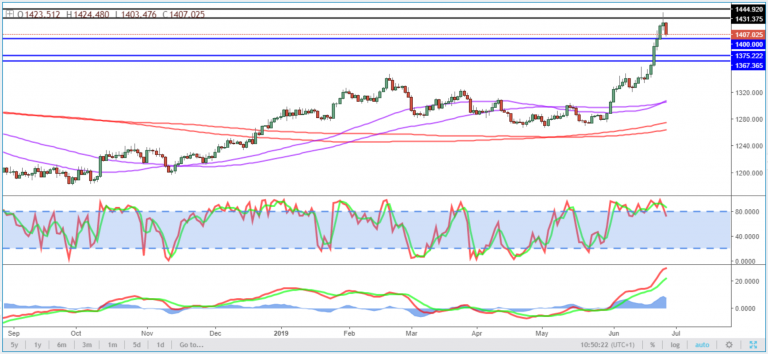
Interestingly, the rebound hasn't been particularly strong and interest rate expectations haven't adjusted too considerable which suggests markets remain engaged in a game of bluff with the Fed.
The rebound did occur around past resistance in gold – $1,440 – so perhaps the timing was convenient. The first test of support may come around $1,400.
G20 Meeting: Trade Ceasefire Or More Hardball?
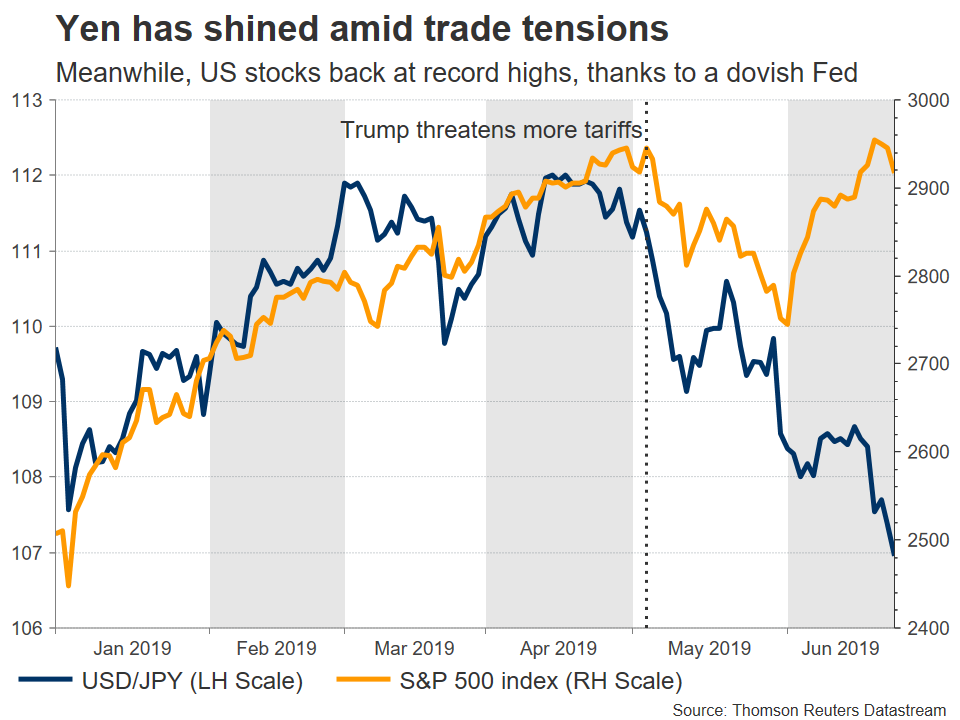
G20 summits usually pass without any market reaction, but this time will probably be different, as the American and Chinese leaders are expected to meet to discuss trade. It’s a close call, but an agreement to restart negotiations seems more likely than nothing at all being agreed. If so, that could propel stocks higher, and take some shine off safe havens like the yen, franc, and gold.
The G20 conference in Japan will run from Friday through Saturday, and markets are laser-focused on a meeting between Presidents Trump and Xi that is expected to take place on the final day. The hope is that they can iron out some of their trade differences, paving the way for a formal resumption of the negotiations that broke down last month.
The US has threatened tariffs on another $300bn worth of Chinese products and has already started the hearings for imposing these duties, so what happens this weekend will likely determine whether the trade war escalates further, or whether it quiets down again.
Crucial for markets, and central banks
Naturally, the signals the two Presidents send could have long-lasting implications for markets, not only directly via the risk sentiment channel, but also indirectly by influencing how aggressively the major central banks will cut rates. Risky assets like stocks and havens such as the Japanese yen will probably see the biggest reaction, though the dollar may also move if the outcome is seen as making the Fed more – or less – likely to ease.
Both sides want a truce
Predicting how such events will play out is a notoriously difficult task, but on the margin, the most likely outcome appears that of de-escalation. The two sides could strike a conciliatory tone and indicate they will restart sincere talks, with the US postponing any new tariffs while the discussions are ongoing.
Simply put, Trump wants more talks – as evidenced by him calling Xi lately – and China is unlikely to refuse. Even if the two camps remain far apart on key issues, they still have an incentive to portray a positive picture, for fear of further damaging business sentiment in their home economies if they don’t. From Trump’s point of view, imposing more tariffs may also be politically problematic as many of the goods in question are core consumer products like phones and computers, taxes on which might anger voters ahead of the 2020 election race.
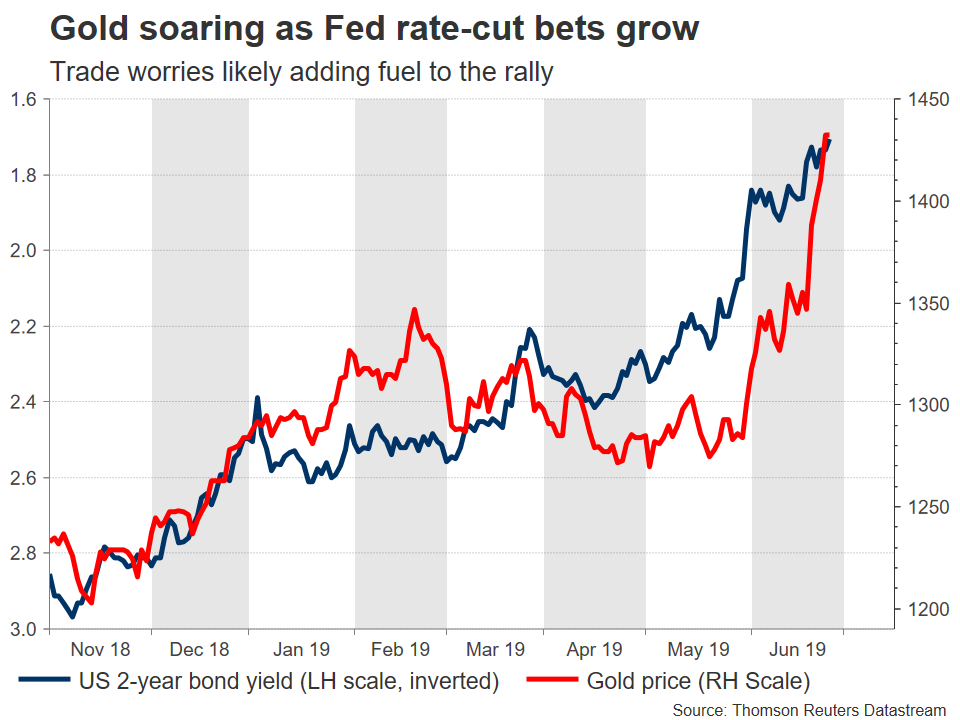
In this scenario, stocks would likely rally alongside commodity currencies like the aussie and kiwi. The dollar may tick higher too, as the optimism could diminish the odds that the Fed delivers an aggressive 50bps rate cut at its July meeting. Meanwhile, the yen, Swiss franc, and gold could all give back some of their latest gains.
But Trump may still try to play hardball
The flipside to the above is that with US stock markets at all-time highs and the Fed set to ease soon, Trump might feel he has more leverage than Xi does, and attempt to play ‘hardball’ again. The risk therefore is that Trump sticks to demands that Xi finds unreasonable, causing this summit to conclude without any hints for new talks.
This would be the worst-case scenario for markets. It may raise the likelihood that the US proceeds with more tariffs, sending equities lower and safe havens higher. The ‘good news’ is that fresh tensions could weigh on sentiment so much the Fed becomes more likely to act forcefully and shock markets with a 50bps rate cut in July – a factor which would likely hurt the dollar, but keep any drop in equities contained.
The technical outlook
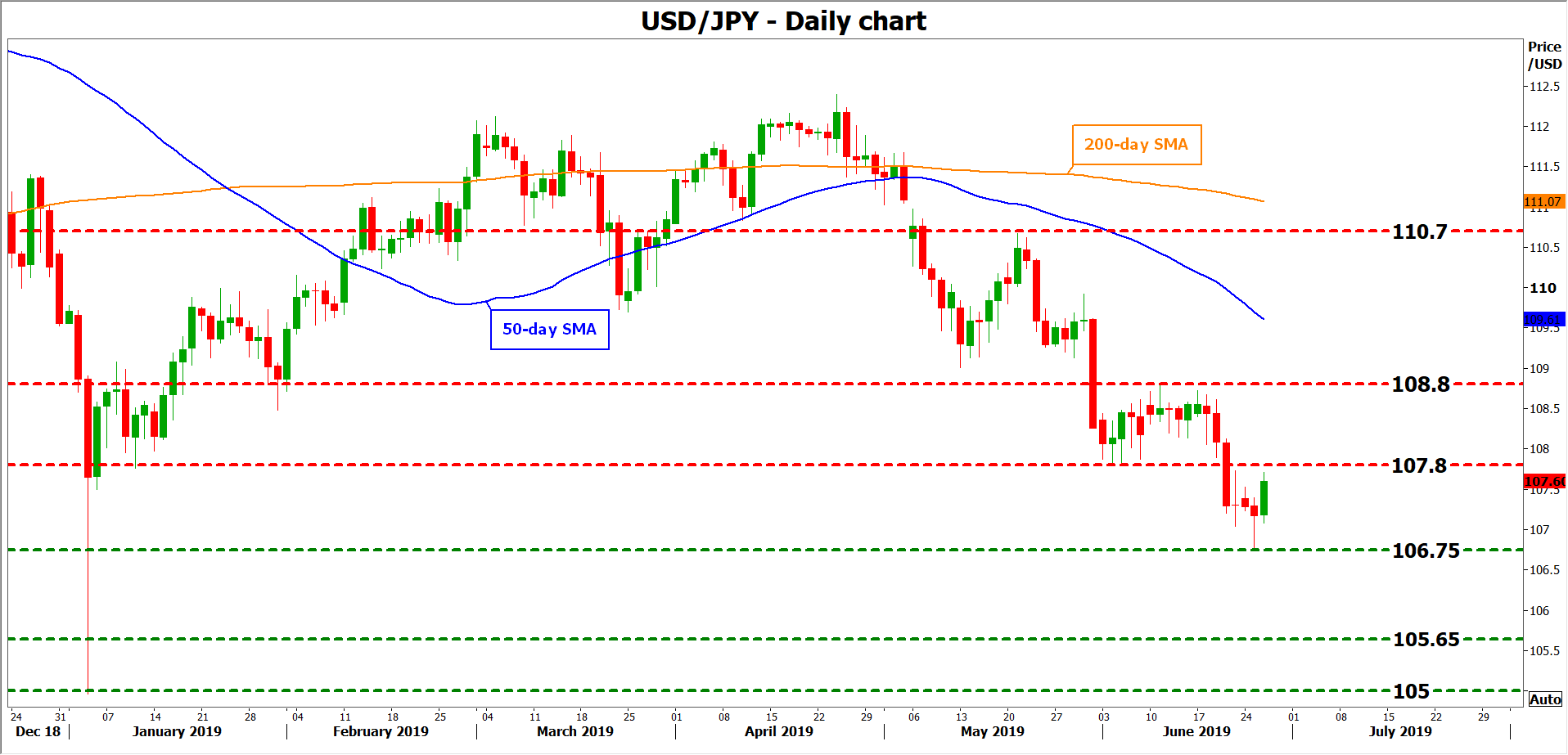
Taking a look at dollar/yen, an agreement to restart talks may see the pair edge higher towards the 107.80 zone, which capped the drop in early June. An upside break may open the door for 108.80.
On the flipside, a failure to reach a truce could initially push dollar/yen lower towards 106.75. Even lower, the 105.65 region would attract attention, marked by the lows of April 2018.
Markets In Waiting Mode, NZD In Demand
Markets in waiting mode
Fed Chairman Jerome Powell stated at since early May the economic outlook has become darker, underpinning the case of interest rates cut by the Fed in July. Mr. Powell said, "We do see that the risks to that outlook have increased. We're very mindful of those risks and prepared to use our policy tools to support activity as needed." In response the US 10-year treasury yield fell by 2bps to below 2.0%. Interestingly Powell also stated that "It's important not to overreact in the short term to things which may turn out to be temporary." In our view, this comment goes directly at trade war concerns and the potential for a resolution to drive equities higher. However, the rising expectations (Fed’s Bullard comments have use rethinking the probably of 50bp cut) was not able to lift Asian equity markets. Most Asian stocks market were lower, Shanghai -0.17% and Nikkei -0.51%, with those in the green baseline. Global risk appetite remains weak.
The news flow that is likely to give stocks a renewed vigor is reports that new tariffs on the remaining $300bn worth of Chinese goods are on hold. This new should be the minimal announcement after the Trump-Xi summit scheduled for this Saturday. Yet the optimism has been tempered by rumors that three Chinese Banks are under US probe due to violations of North Korea sanctions. We still view trade rhetoric as short-term volatility-inducing rather than a longer-term cyclical shift. Given this thinking, we are constructive on EM currencies as a bloc. The Fed dovish pivot and aggressive rate cut expectations will force investors to search for yield. After a period of hesitation, the Fed is now prepared to do whatever is necessary to secure US growth, especially in the absence of inflation. The only real question is how quickly monetary and fiscal policy change react to shifts in data. The surge in Gold is typical when central banks plan further debasing of their currencies.
NZD in demand despite dovish statement
As expected, the Reserve Bank of New Zealand has maintained its Cash Rate unchanged at 1.50% at its monetary policy meeting. Yet the RBNZ dovish statement about weakening economic outlook, downside risks on trade, employment and inflation does not seem to convince FX traders, which continue to favor long NZD trades. Next rate cut should occur on 7 August 2019 meeting. Meanwhile, the Reserve Bank of Australia release of monetary policy minutes from June are hinting towards further cuts at its policy meeting next Tuesday.
It seems that market participants consider Governor Adrian Orr comment as not so dovish since the kiwi outperforms G10 currencies in early trading. However the RBNZ continues to support the idea of a cut of its Cash rate this year, a move that should most likely occur in August and therefore put additional pressures on NZD. Certainly, speculations over a suspension in a new round of tariffs and the resumption of trade talks following Saturday Trump – Xi meeting during G20 supports risk-on sentiment. Concurrently, a negative headline on the matter would necessarily have a stronger impact on the downside.
For now, NZD/USD rally remains, approaching 0.6680 short-term.