Sample Category Title
CFTC Commitments of Traders – Precious Metals Glittered as Rate Cut Hopes Heightened
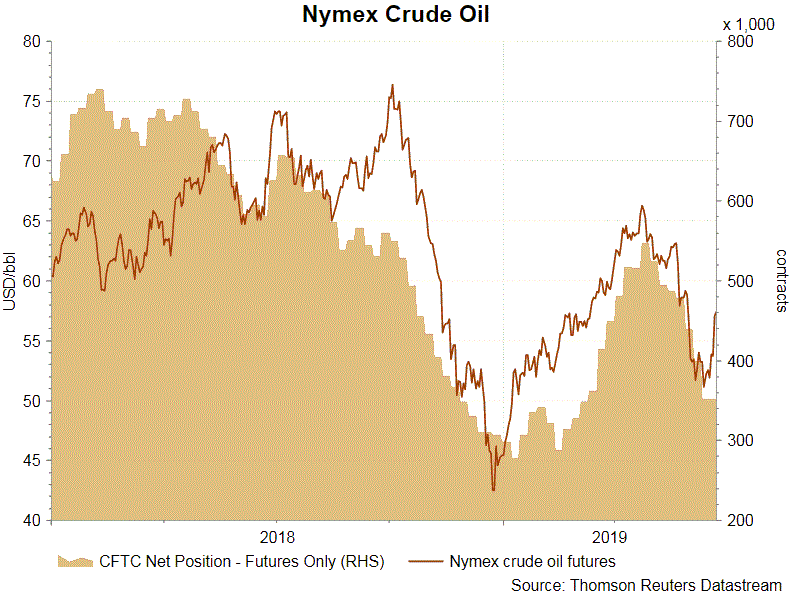
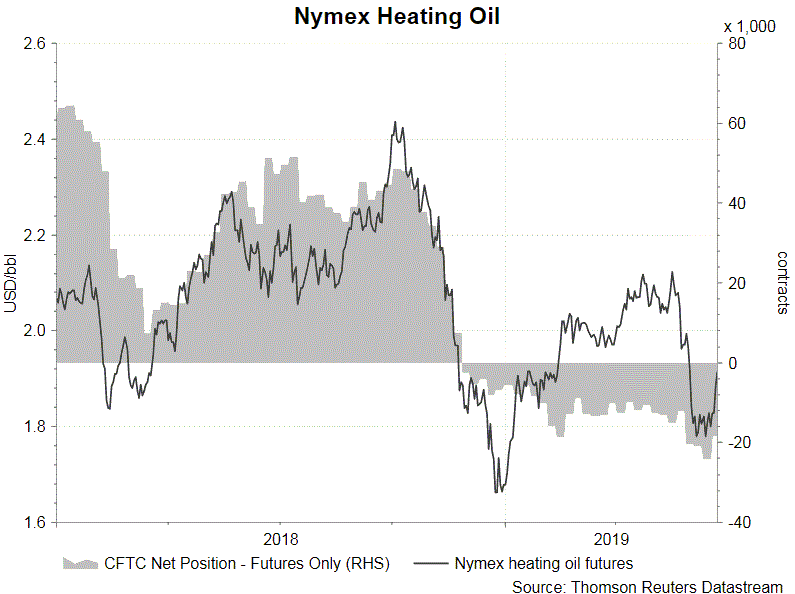
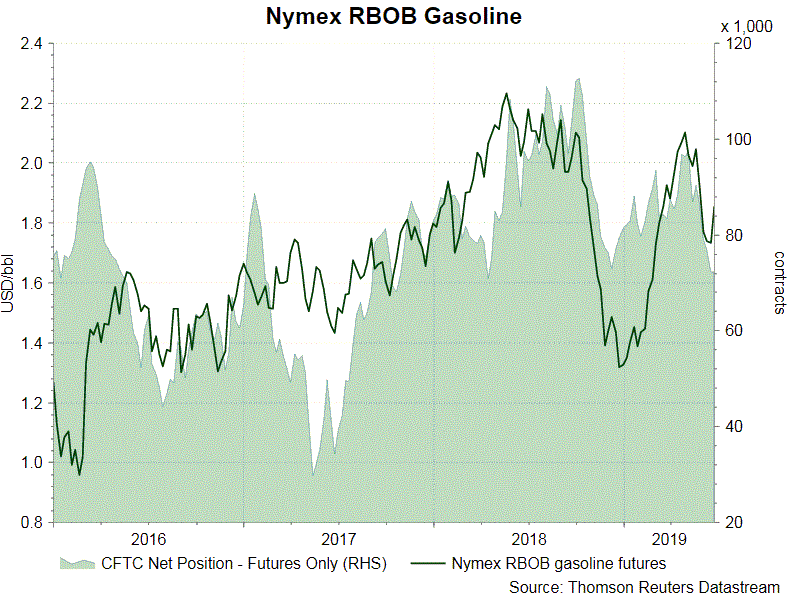
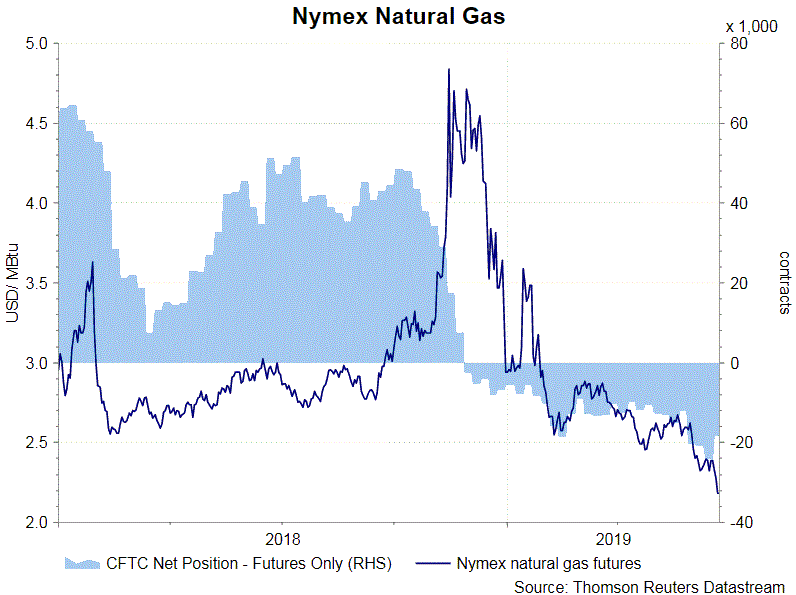
According to the CFTC Commitments of Traders report for the week ended June 18, NET LENGTH for crude oil futures rose +24 140 contracts to 363 087 for the week. Speculative long positions fell -12 708 contracts but shorts declined by a sharper -24 140 contracts. Escalated tensions between US and Iran have drove away the bears. Yet, the bulls need more confirmation to bet for higher prices. We expect NET LENGTH to rise further in the coming week. For refined oil products, NET LENGTH for gasoline added +830 contracts to 73 124, while NET SHORT for heating oil dropped -5 754 contracts to 18 302 for the week. NET SHORT for natural gas futures rose +10 351 contracts to 137 299 contracts for the week.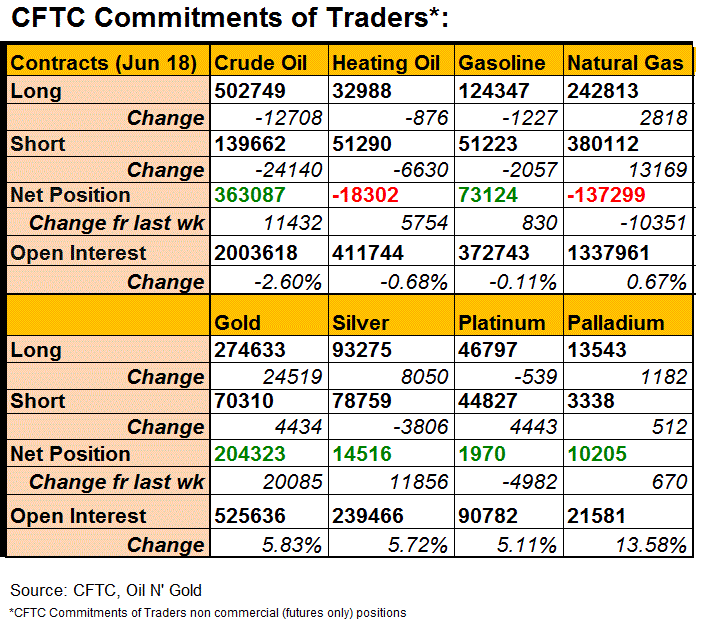
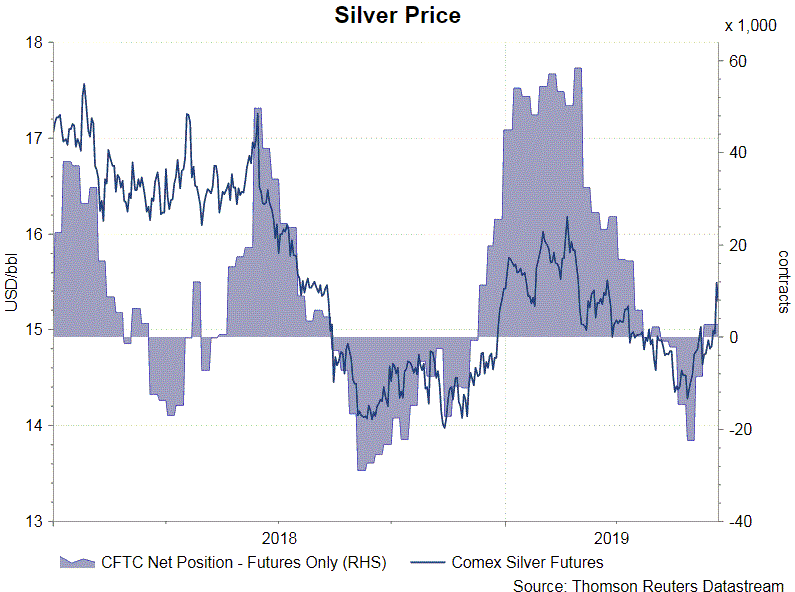
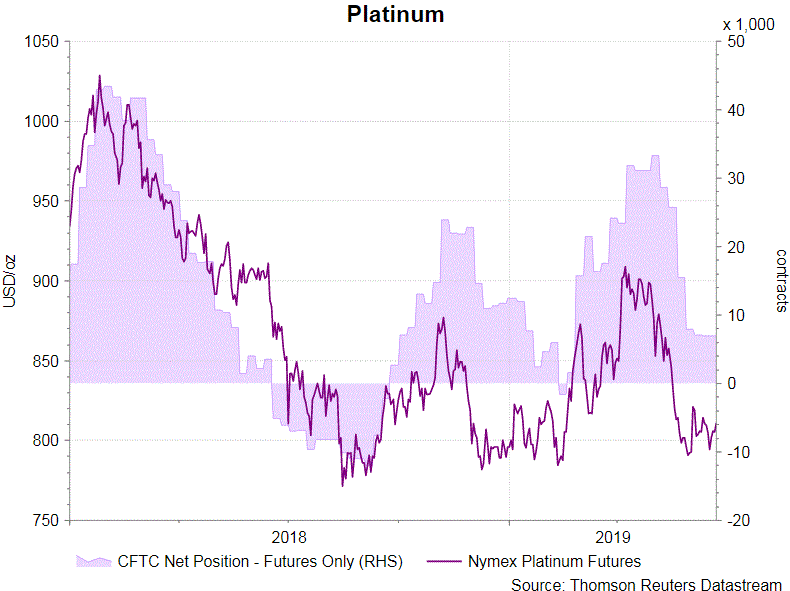
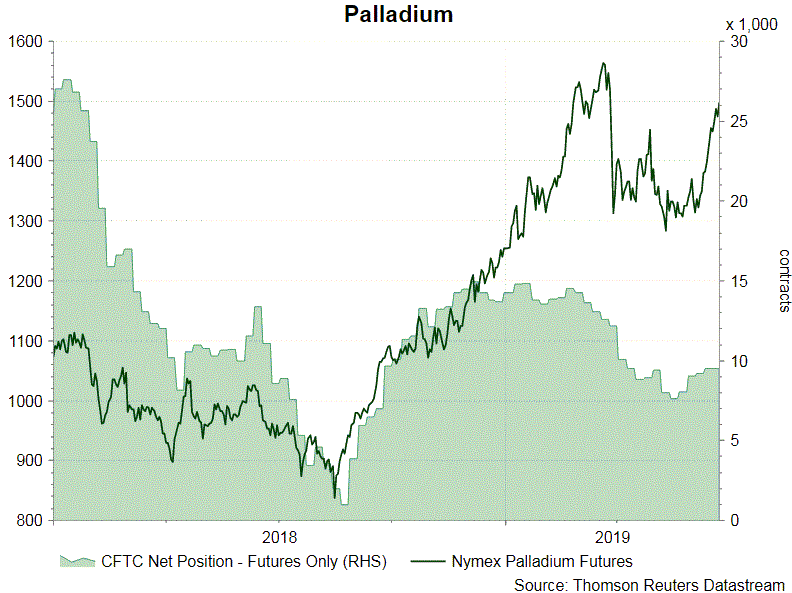
 Precious metals soared last week, lifting NET LENGTH of gold and silver futures. The trend should likely continue in the coming week as the market continued to price in at least two Fed funds rate cuts this year after the FOMC meeting. NET LENGTH for gold futures rose +20 085 contracts to 204 323 last week. Speculative long positions surged +24 519 contracts, while shorts added +4 434. For silver futures, speculative long positions jumped +8 050 contracts while shorts dropped -3 806. NET LENGTH for silver futures was lifted to 14 516 contracts, up +11 856 from a week ago. For PGMs, NET LENGTH of Nymex platinum futures dropped -4 982 contracts to 1 970 while that for palladium increased +670 contracts to 10 205.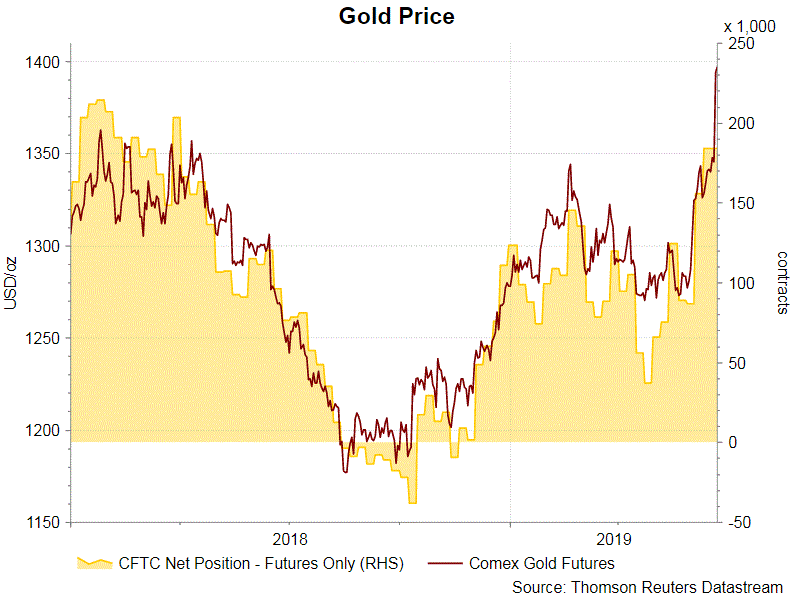
CFTC Commitments of Traders – Rising Bets for Higher USD Likely Short-lived
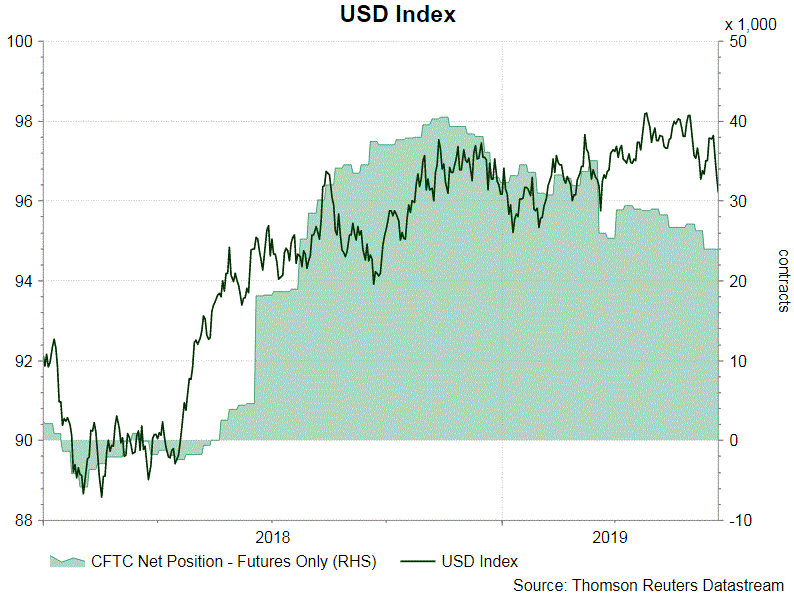
The CFTC Commitments of Traders report in the week ended June 18 shows that NET LENGTH in USD Index gained +4 560 contracts to 28 549. Speculative long positions added +3 434 contracts while short positions decreased -1 126 contracts during the week. We expect NET LENGTH to decline in the week ahead, as USD slumped after the June FOMC meeting revealed that more members favored rate cut this year. All other major currencies stayed in NET SHORT positions.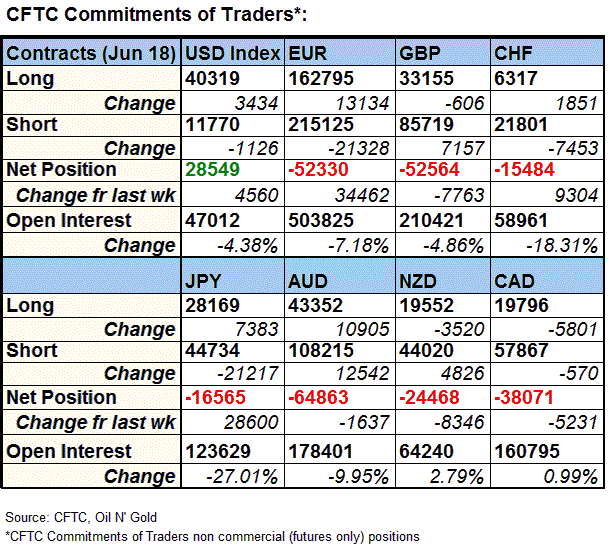
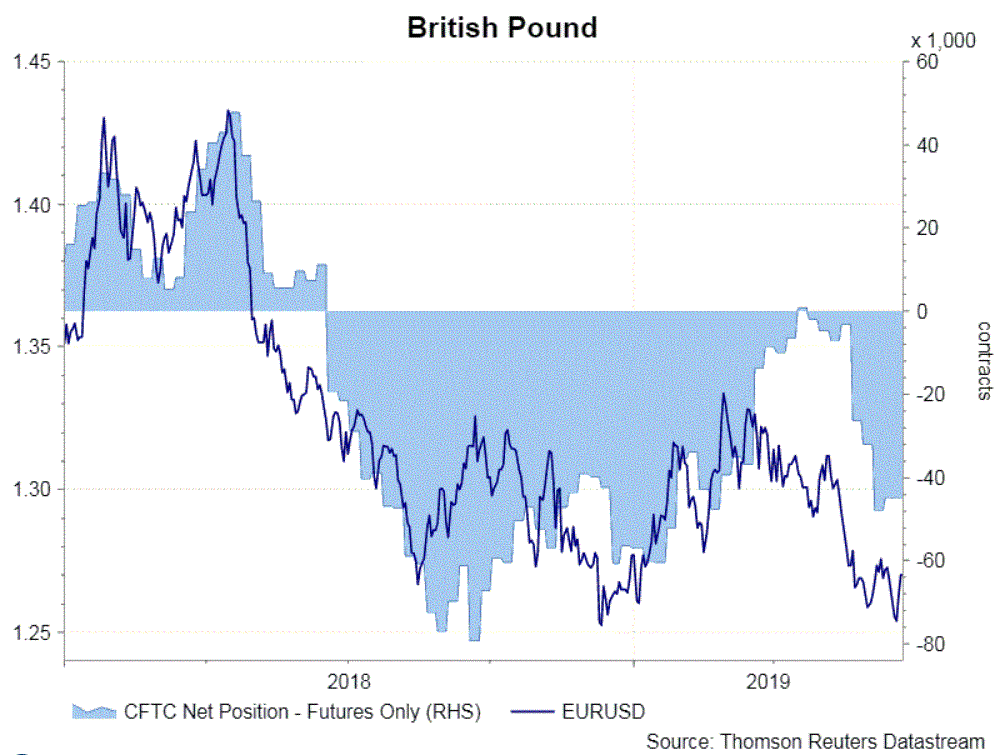
 Concerning European currencies, NET SHORT for EUR futures slumped -52 330 contracts to 52 330. NET SHORT for GBP futures rose +7 763 contracts to 52 564. Speculative long positions fell -606 contracts while speculative shorts rose +7 157 contracts for the week. GBP is expected to remain volatile in the near- to medium- term. Jeremy Hunt and Boris Johnson have become the final two MPs vying to be Tory party leader, and the Prime Minister of the UK. Opinion polls show that Johnson is leading. Although we do not expect a no-deal Brexit to materialize, Johnson's victory would inevitably raise the possibility of a hard Brexit.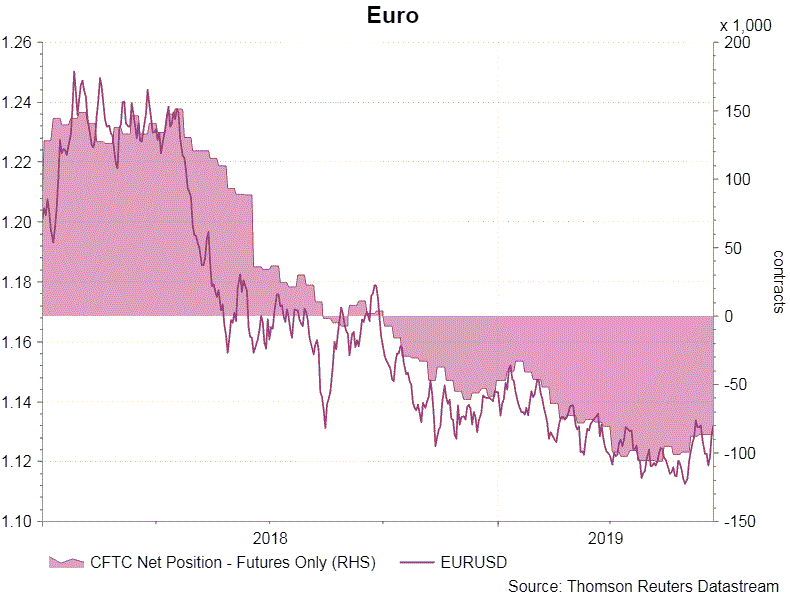
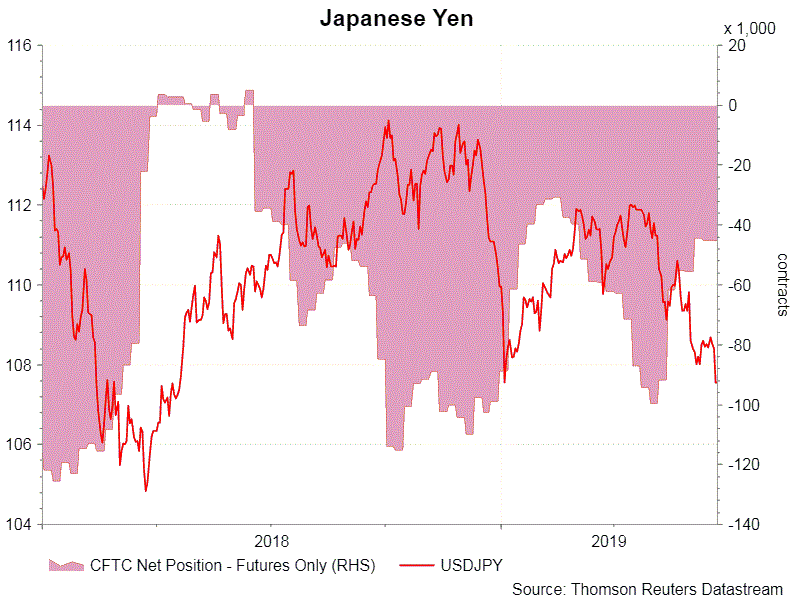
 On safe-haven currencies, Net SHORT for CHF futures plunged -9 304 contracts to 15 484. NET SHORT for JPY futures slumped -28 600 contracts to 16 565 during the week. Speculative long positions gained +7 383 contracts while shorts also plunged -21 217 contracts.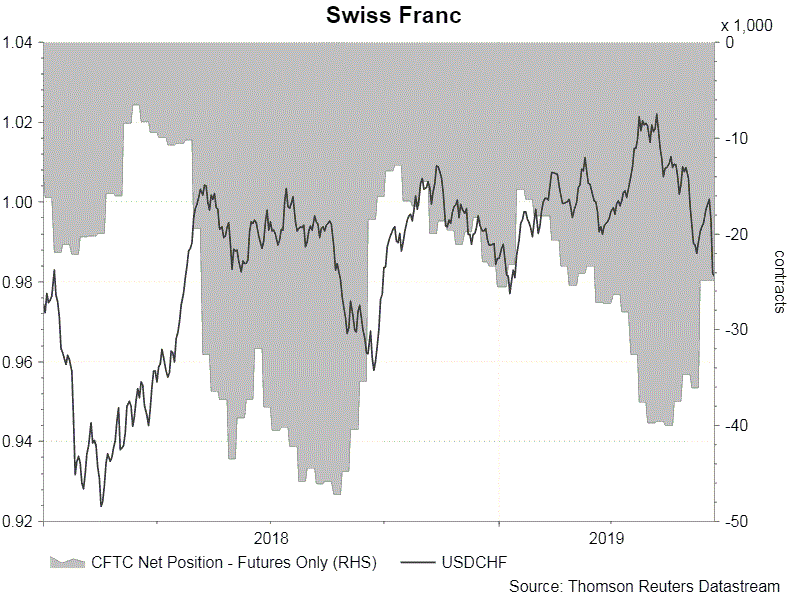
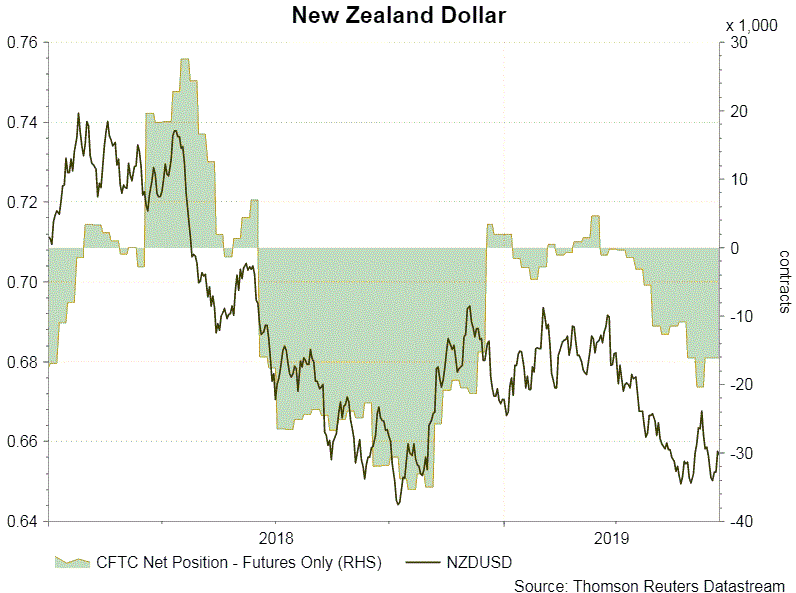
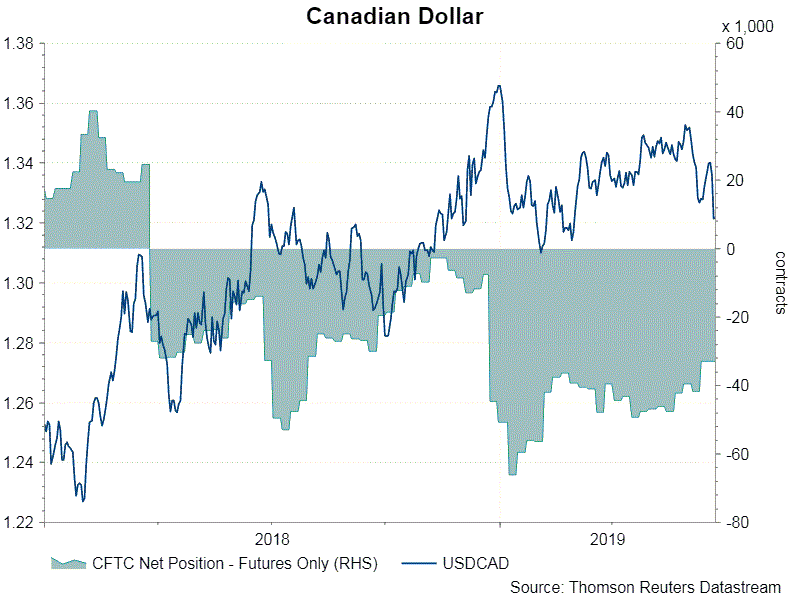
 On commodity currencies, NET SHORT for AUD futures added +1 637 contracts to 64 863. Speculative long positions increased +10 905 contracts while shorts also added +12 542 contracts. Aussie dived last week after RBA minutes explicitly suggested that the policy rate could go further lower. Separately, NET SHORT for NZD jumped +8 346 contracts to 24 468 contracts last week. NET SHORT for CAD futures gained +5 231 contracts to 39 082.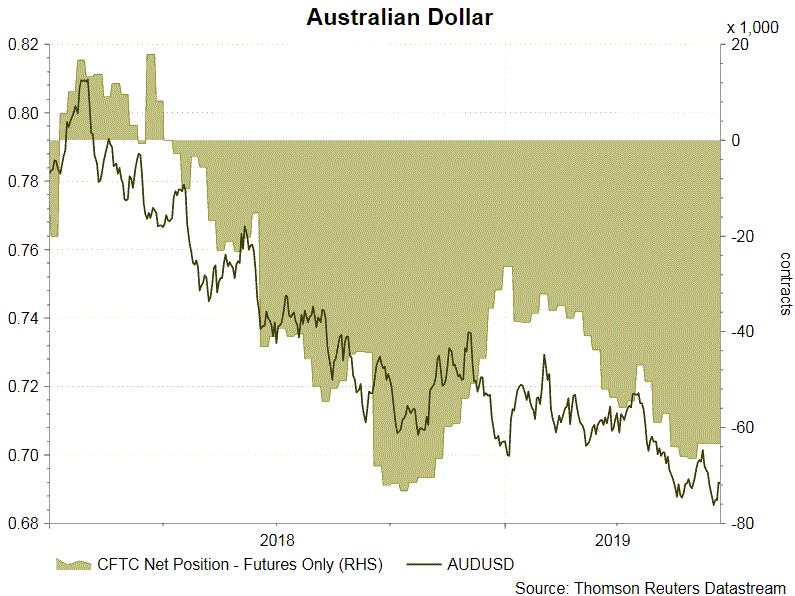
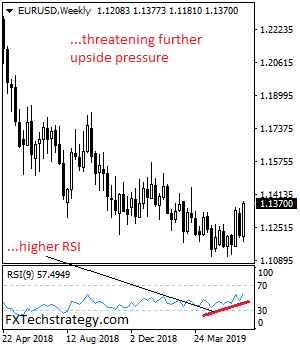
EURUSD Eyes Further Upside Pressure On Bull Pressure
EURUSD eyes further upside pressure on bull pressure as we enter a new week. Support comes in at the 1.1300 where a violation will turn risk to the 1.1250 level. A break below here will target the 1.1200 level. Further down, support sits at the 1.1150. Conversely, on the upside, resistance resides at 1.1400 level with a break through there opening the door for further upside towards the 1.1.1450 level. Further up, resistance comes in at the 1.1500 level where a violation will expose the 1.1550 level. All in all, EURUSD expects more recovery in the new week.
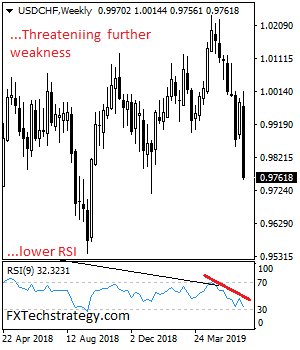
USDCHF Tumbles Lower On Bearishness
USDCHF tumbles lower on bearishness with more weakness expected in the new week. Resistance resides at the 0.9800 level. Above here, resistance lies at the 0.9850 level and then the 0.9900 level. Further out, resistance comes in at the 0.9950 level. On the downside, support is seen at the 0.9700 level with a turn below here opening the door for more decline towards the 0.9650 level. And then the 0.9600 level. Further down, support resides at the 0.9550 level. Its weekly RSI is bearish and pointing lower suggesting further weakness. All in all, USDCHF targets further weakness in the days ahead.
Eco Data 6/24/19
[php_everywhere instance="1"]
Forex Forecast for July – August
The peak of the vacation season is approaching, which usually entails a decline in business activity, including that in financial markets. On the one hand, a decrease in the volatility of major currency pairs, which is already low, entails a fall in profits, but on the other hand, it also reduces potential losses in the event of a failed position.
We have repeatedly discussed in our previous forecasts, the trade wars led by US President Trump with both China and Europe, and the possibility of a global economic crisis and local recessions, Brexit and other political risks, prospects for a rate increase by the Fed and quantitative easing in the Eurozone, as well as many other factors influencing the formation of both short-term and long-term trends. If we talk about the mood of experts in the coming months, for the most part they expect that the US dollar will be able to strengthen its position in relation to other leading world currencies.
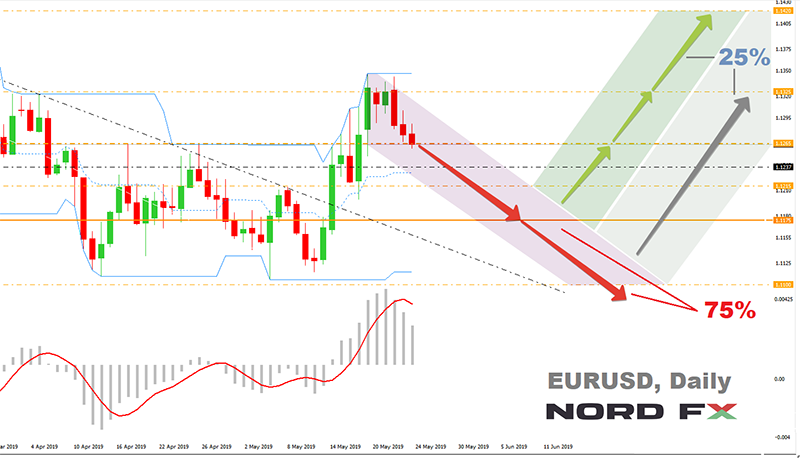
EUR/USD. Here, 75% of analysts, supported by 80% of indicators on MN, believe that the pair will definitely make another attempt to update the lows of spring 2019 and will finally break through support in the 1.1100 zone. The targets for the bears are 1.0900 and 1.0800 (of course, a possible margin of ± 25÷35 points must be considered). According to the remaining 25% of experts, the zone of 1.1100 is the fall limit, and the pair will now go to the zone 1.1530-1.1650. Most trend indicators and oscillators on W1 are also colored green.
USD/CHF. The euro and the Swiss franc are quite strongly correlated: the European currency is falling against the dollar, and the Swiss currency is losing ground at the same time. That is why here, just as in the case of EUR/USD, most experts (75%) have preferred the “American”. According to them, the pair is expected to rise, first to the level of 1.0130, and then 100 points higher, to the height of 1.0230. By the way, about 15% of the oscillators on W1 and MN are already signaling that the pair is oversold. An alternative view is presented by a quarter of experts who do not see the dollar above the symbolic 1.0000 level. In their opinion, no more than 0.9600-0.9700 francs will be given for the “American” in the second half of the summer.
NZD/USD and AUD/USD. We only talk about those pairs In this review, regarding the future of which most experts have already more or less formed an opinion. One of these pairs is NZD/USD: here 85% of the votes have been cast for the bears. If this prediction turns out to be correct, the New Zealand kiwi may fall to the low of 10/08/2018 in the zone of 0.6420. 90% of the oscillators on both timeframes, W1 and MN, agree with this forecast.
Bears have scored a bit less support when voting for the future of the nearest “colleague” of the New Zealander, the Australian dollar. Those turned out to be only 60%. True, they have been supported by almost 85% of trend indicators and oscillators on W1 and MN. The purpose of the bears is to update the June 17 lows, reaching the bottom in the zone of 0.6750-0.6800. 20% have favored the growth of the pair to the height of 0.7300, and another 20% have predicted a calm movement along the Pivot Point at the level of 0.7000.
And there are two more pairs, the forecasts for which have seemed to us quite interesting. Both are tied to the British pound, these are GBP/JPY and EUR/GBP.
70% of analysts believe that the pair GBP/JPY has reached its bottom at 135.65, and now it is expected to grow first to the height of 141.50, and then a rise above the horizon 143.75 is not excluded. Those experts who expect a tough Brexit and the UK exit from the EU without a deal see the pair at 131.00.
Even though the British currency fell against the euro throughout May and early June, most analysts are looking at the future of the pound rather optimistically. Just as in the case of GBP/JPY, 70% have voted for the growth of the pound and the decline of the EUR/GBP pair to the zone of 0.8600-0.8680. The next target is the lows of March 2019 in the area 0.8470. As for the bulls, they aim to rise above the high of 01/01/2019, breaking the height of 0.9100.
RBNZ Preview – Maintaining Cautious Tone to Pave Way for Further Cuts
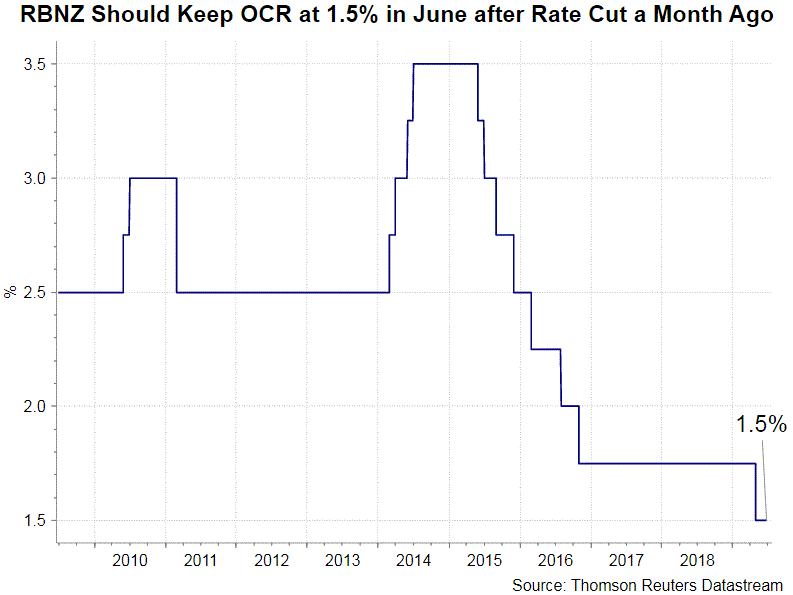
After lowering the policy rate by -25 bps to 1.50% in May, RBNZ would likely remain on hold this month. Domestic economic developments came in largely consistent with policymakers’ projections. Yet, global economic outlook remains uncertain and major central banks have recently shifted their stance on the dovish side.
As such, we expect RBNZ to maintain a cautious tone in June. Softness in leading indicators signal risks to growth are skewed to the downside, paving the way for further rate cuts later this year.
Mixed Domestic Economic Developments
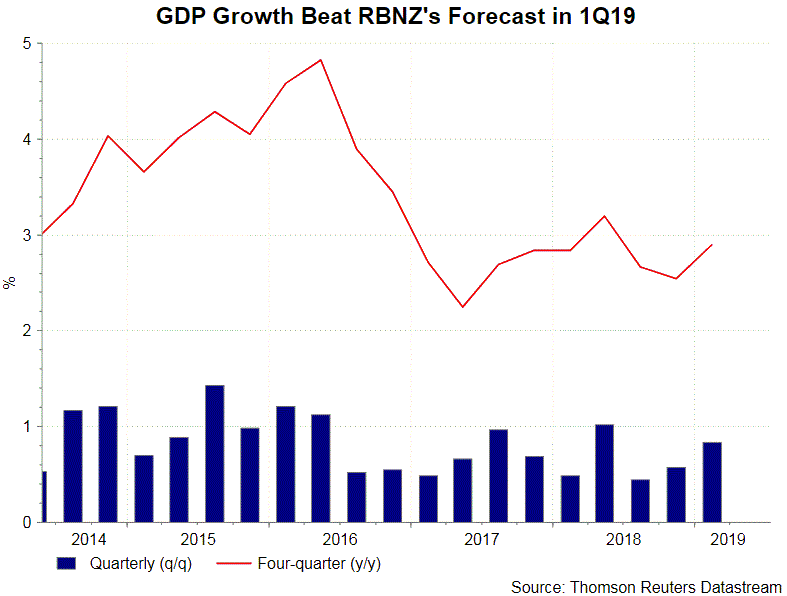
GDP expanded +0.6% q/q in 1Q19, beating RBNZ expectations of +0.4%. The details were mixed. Household consumption growth eased to +0.5% q/q, from +1% in the prior quarter. Investment growth, however, accelerated. Residential investment expanded +2.7% y/y, following a +1.9% growth in 4Q18, while other fixed asset investment growth also accelerated to +1.9% q/q. from +1.4% in 4Q19. Moreover, net exports expanded +0.6% q/q n 1Q19, up from +0.4% in the previous quarter. Sector-wise, the good-producing sector gained a solid +2% q/q. However, growth in services activities was soft at +0.2% q/q and mixed across the industries, while the primary sector saw contraction of -0.7%.q/q.
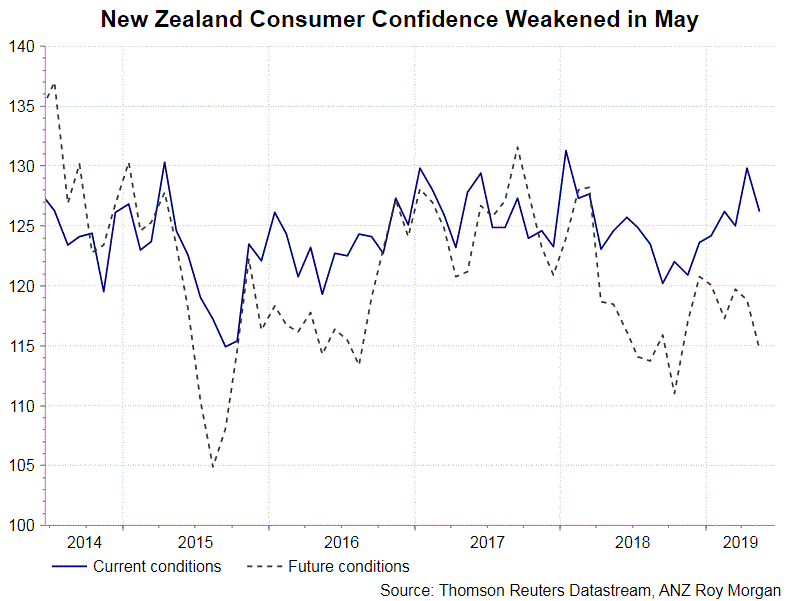
Leading indicators have signaled downside risks to domestic growth. ANZ Roy Morgan’s consumer index showed decline in May, while the manufacturing PMI (by BusinessNZ) fell to 50.2 in May, down -2.5 points from April and the lowest since December 2012. For the latter, the accompanying report indicates that it is “a warning signal for near term growth via its mix of falling production, near flat new orders, and rising inventory”.
Global Uncertainty and Dovish Central Banks
Globally, we do not expect immediate resolution on US-China trade war after the G20 meeting. At best, both sides would agree to resume negotiations. That is, uncertainty of trade war remains. Meanwhile, major central banks have shifted to the dovish side, signaling that future monetary policy stance is skewed to the easing side. RBA, after cutting the cash rate in June, revealed in the minutes that “more likely than not that a further easing in monetary policy would be appropriate in the period ahead”. Although the Fed left the policy rate unchanged in June, removal of the reference “patient” in the forward guidance could be paving the way for future rate cuts. Moreover, the median dot plots revealed that more members are in favor of lowering interest rates later this year, while the plots have projected a rate cut in 2020.
Although headline GDP growth beat RBNZ's expectations, the breakdowns were mixed, at best. The forward-looking indicators, however, have signaled that risks to growth are skewed to the downside. Globally, it is unlikely that G20 summit this week would resolve the US-China trade war. Meanwhile, major central banks have either resumed accommodative monetary policy or hinted easing in the near-future. All these should lead the RBNZ to adopt a cautious tone this month, while opening the door for reducing interest rates again later this year.
EUR/USD Weekly Outlook
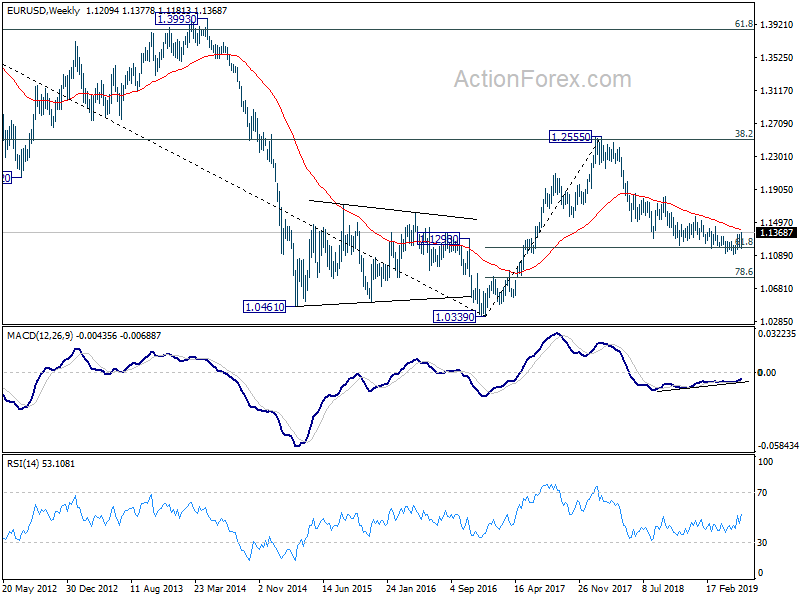
EUR/USD's rebound form 1.1107 resumed last week by breaking through 1.1347 resistance to as high as 1.1377. Initial bias remains on the upside this week for 100% projection of 1.1107 to 1.1347 from 1.1181 at 1.1142 first. Break will target 161.8% projection at 1.1569 next. On the downside, below 1.1317 minor support will turn intraday bias neutral and bring consolations. But outlook will stay bullish as long as 1.1181 support holds.
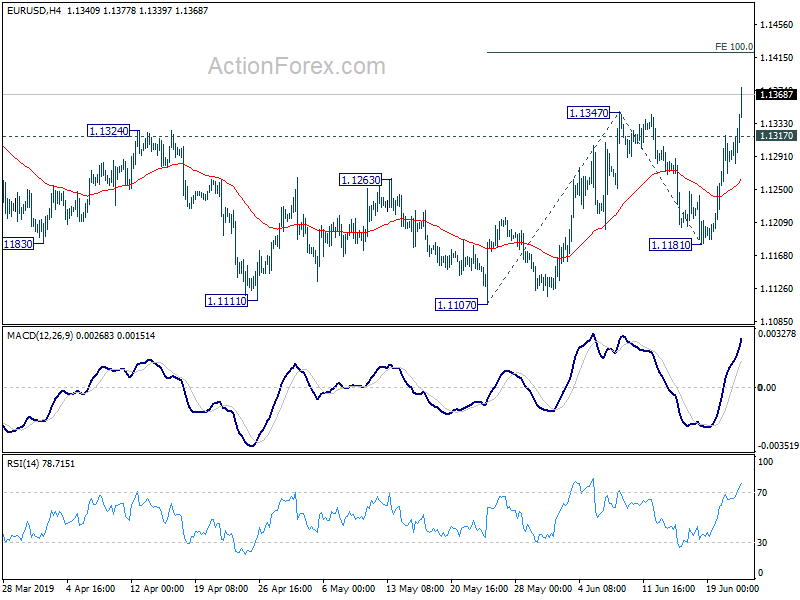
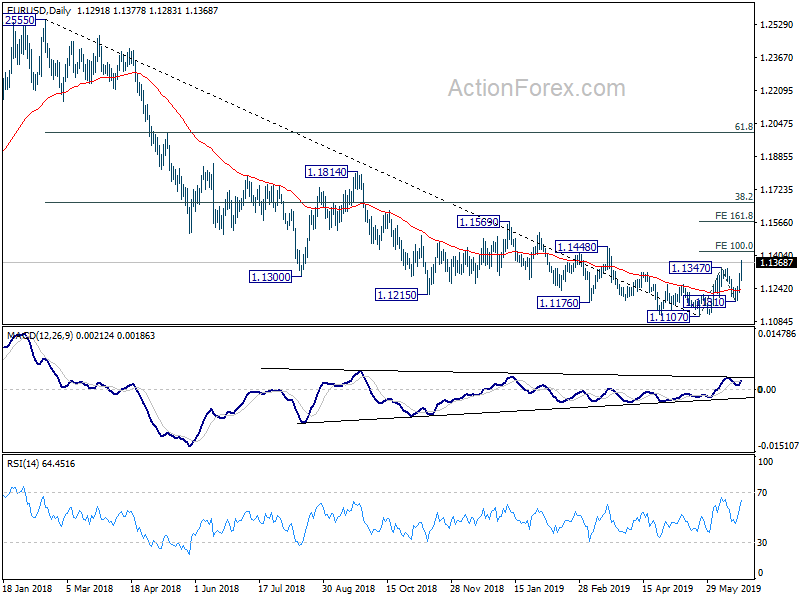
In the bigger picture, considering bullish convergence condition in daily and weekly MACD, a medium term bottom should be in place at 1.1107 after hitting 61.8% retracement of 1.0339 (2016 low) to 1.2555 (2018 high) at 1.1186. Further rise should be seen to 38.2% retracement of 1.2555 to 1.1107 at 1.1660. Reactions from there could indicate whether rebound from 1.1107 is a corrective rise or reversing medium term trend.
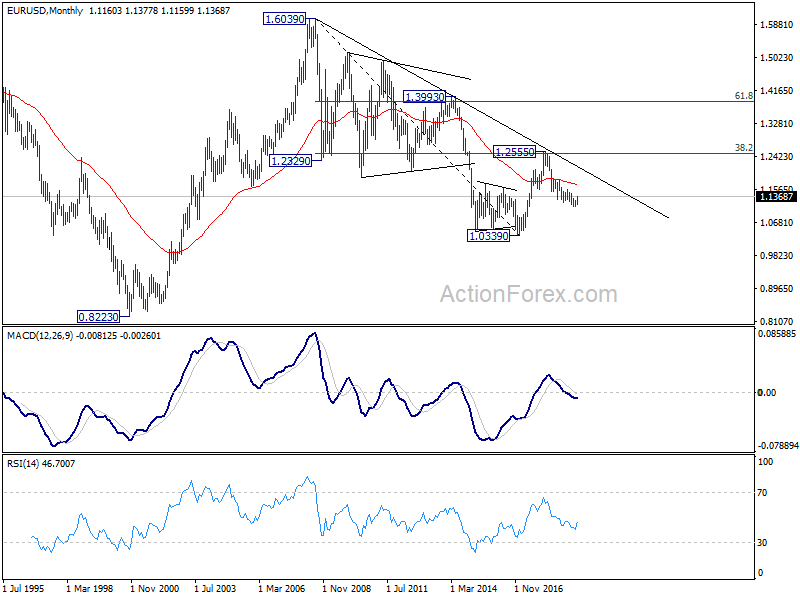
In the long term picture, outlook remains bearish for now. EUR/USD is held below decade long trend line that started from 1.6039 (2008 high). It was also rejected by 38.2% retracement of 1.6039 to 1.0339 at 1.2516 before. A break of 1.0039 low will remain in favor as long as 55 month EMA (now at 1.1685) holds).
USD/JPY Weekly Outlook
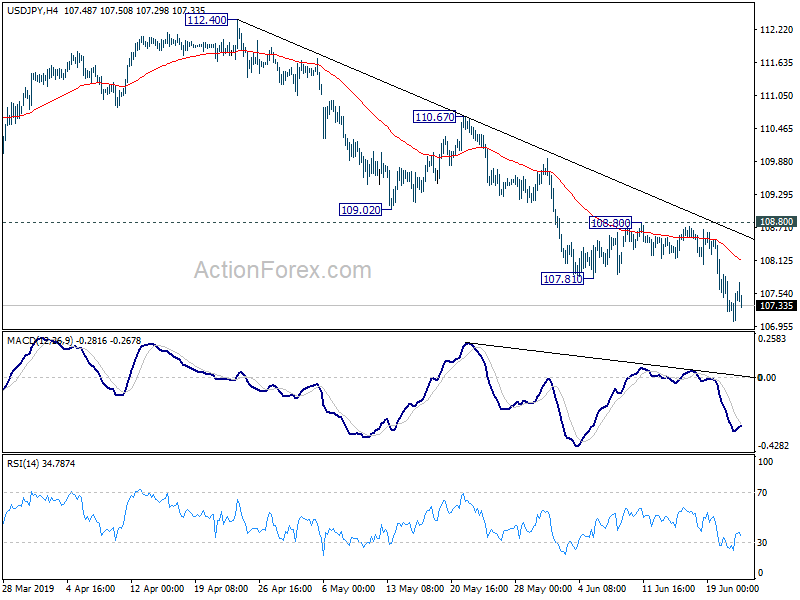
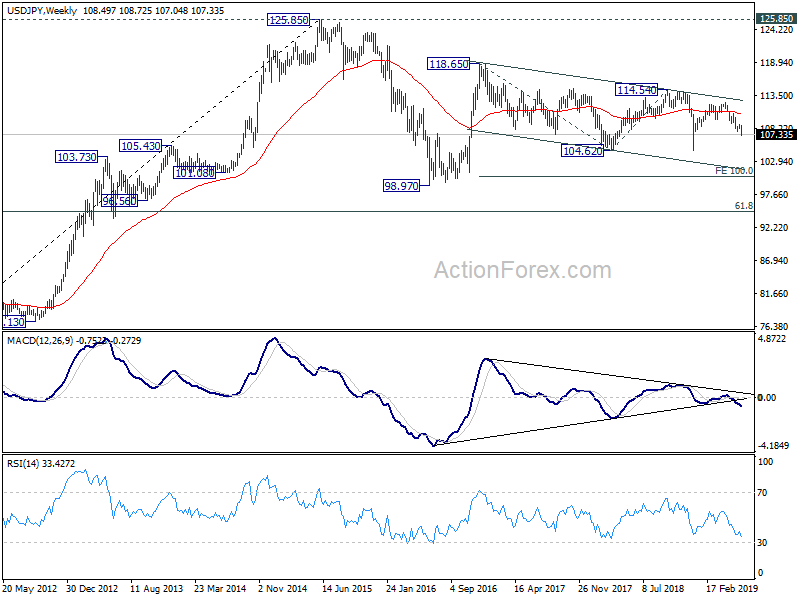
USD/JPY's decline from 112.40 resumed last week and reached as low as 107.04. Initial bias stays on the downside this week. With 61.8% retracement of 104.69 to 112.40 at 107.63 taken out, further fall should be seen to retest 104.69 low. On the upside, break of 108.80 resistance is needed to indicate short term bottoming. Otherwise, outlook will remain bearish in case of recovery.
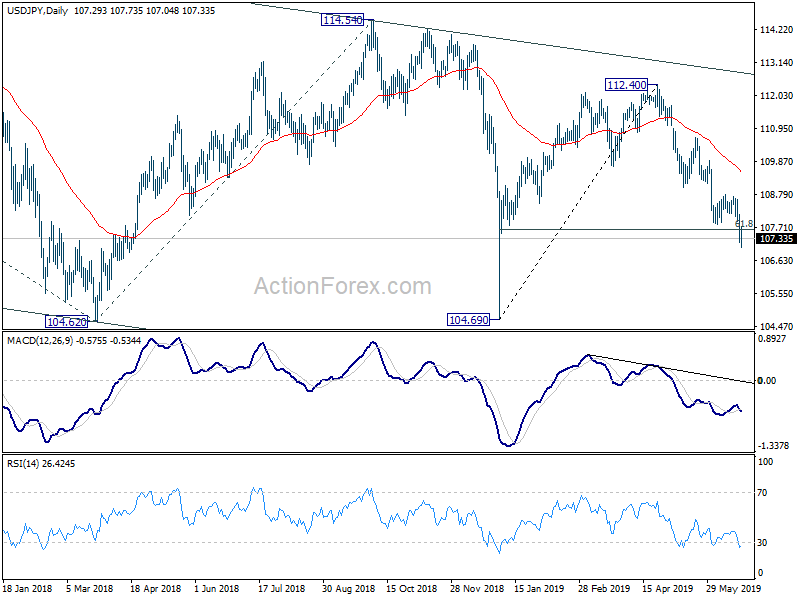
In the bigger picture, decline from 118.65 (Dec 2016) is still in progress, with the pair staying inside long term falling channel. Break of 104.62 will target 100% projection of 118.65 to 104.62 from 114.54 at 100.51. For now, we'd expect strong support above 98.97 (2016 low) to contain downside to bring rebound.
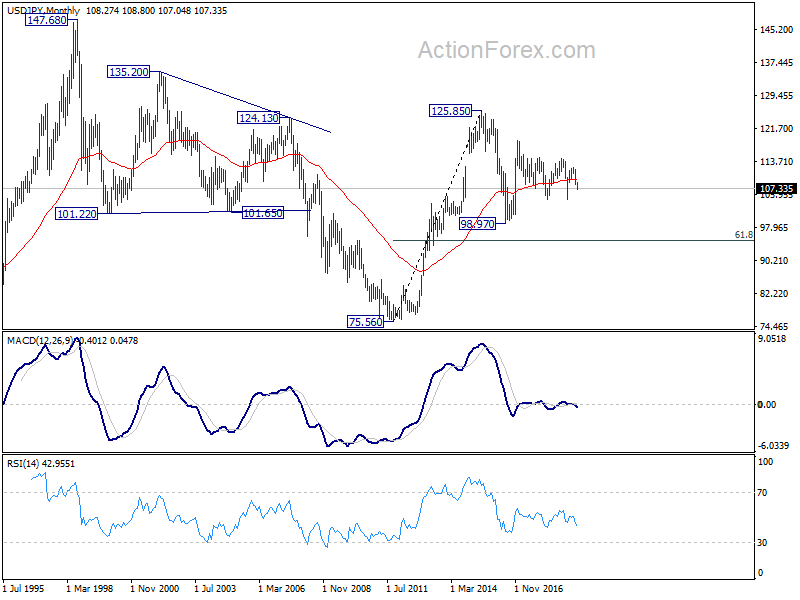
In the long term picture, the rise from 75.56 (2011 low) long term bottom to 125.85 (2015 high) is viewed as an impulsive move, no change in this view. Price actions from 125.85 are seen as a corrective move which could still extend. In case of deeper fall, downside should be contained by 61.8% retracement of 75.56 to 125.85 at 94.77. Up trend from 75.56 is expected to resume at a later stage for above 135.20/147.68 resistance zone.
GBP/USD Weekly Outlook
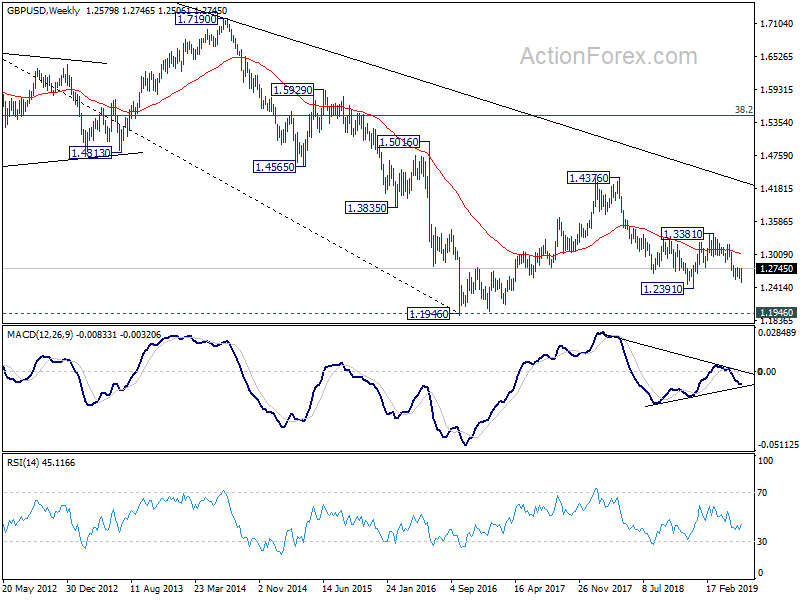
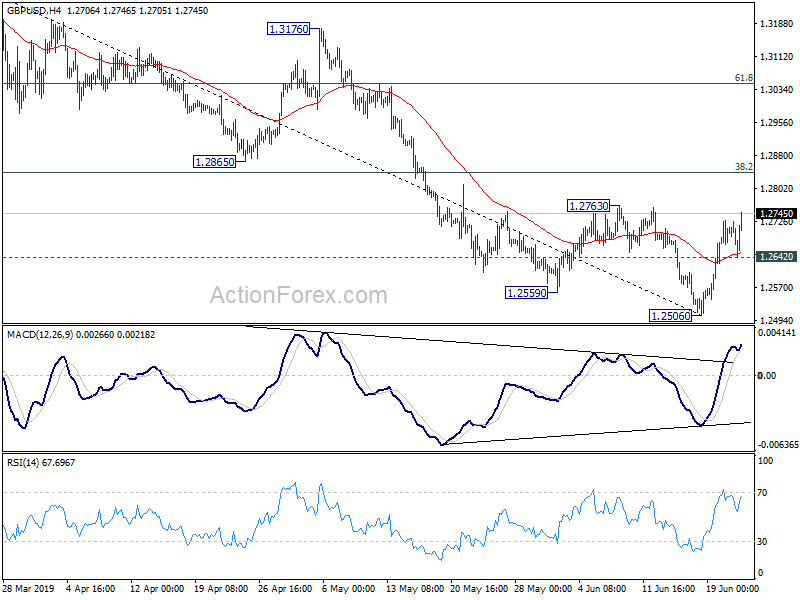
GBP/USD edged lower to 1.2506 last week but formed a short term bottom there and rebounded. Initial bias remains on the upside this week for 55 day EMA (now at 1.2802). We'd expect strong resistance from 38.2% retracement of 1.3381 to 1.2506 at 1.2840 to limit upside. On the downside break of 1.2642 minor support will turn intraday bias back to retest 1.2506 low. However, sustained break of 1.2840 will bring stronger rise to 61.8% retracement at 1.3047 next.
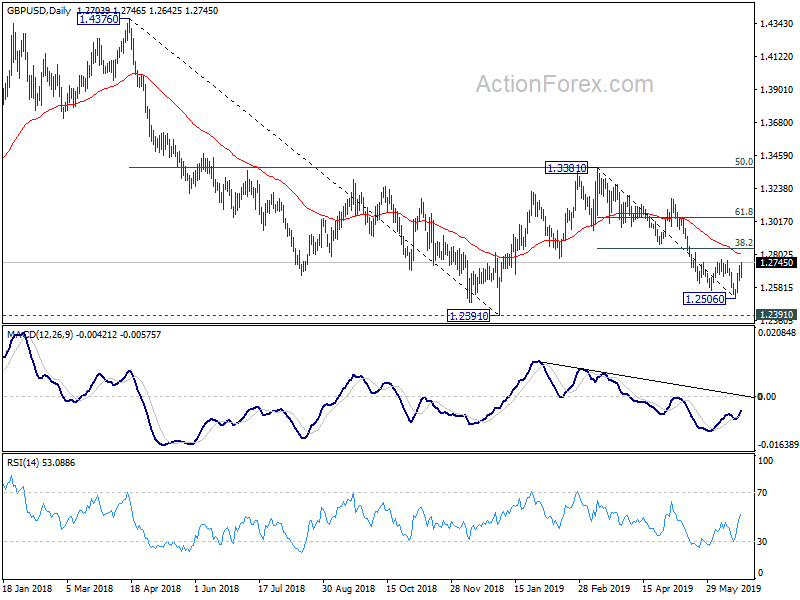
In the bigger picture, down trend from 1.4376 (2018 high) is still in progress. Break of 1.2391 would target a test on 1.1946 long term bottom (2016 low). For now, we don't expect a firm break there yet. Hence, focus will be on bottoming signal as it approaches 1.1946. In any case, medium term outlook will stay bearish as long as 1.3381 resistance holds, in case of strong rebound.
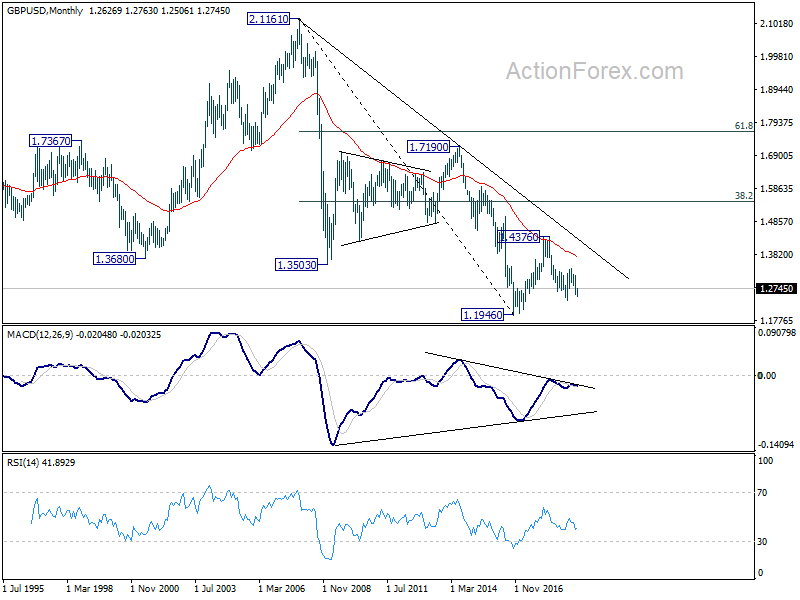
In the longer term picture, consolidative pattern from 1.1946 (2016 low) could still extend with another rising leg. But after all, decisive break of 38.2% retracement of 2.1161 (2007 high) to 1.1946 at 1.5466 is needed to indicate long term reversal. Otherwise, an eventual downside breakout will remain in favor.