

Sample Category Title
Swiss Franc Trading Lower In The Asian Session
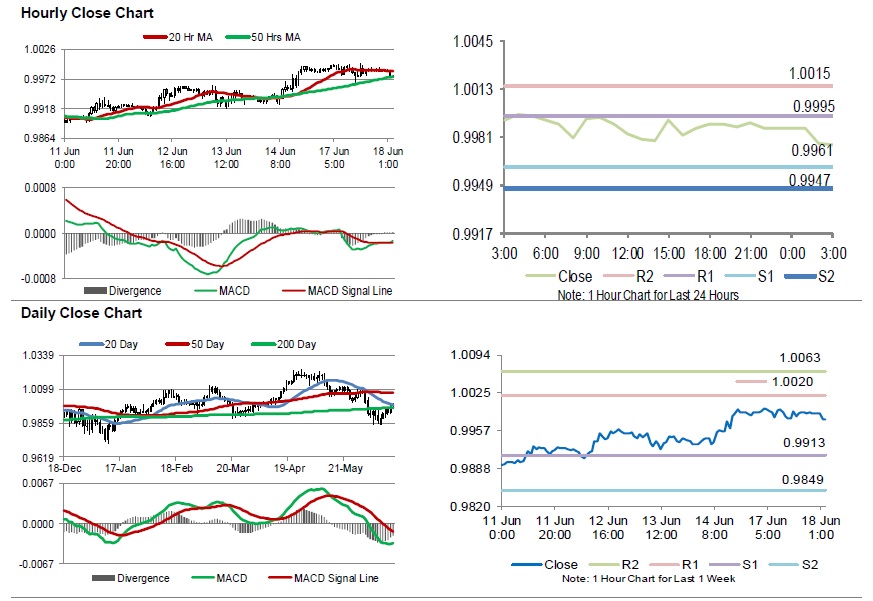
For the 24 hours to 23:00 GMT, the USD marginally declined against the CHF and closed at 0.9987.
In economic news, Switzerland’s total sight deposits slightly rose to a level of CHF578.5 billion in the week ended 14 June 2019, from CHF578.1 billion in the previous week.
In the Asian session, at GMT0300, the pair is trading at 0.9976, with the USD trading 0.11% lower against the CHF from yesterday’s close.
The pair is expected to find support at 0.9961, and a fall through could take it to the next support level of 0.9947. The pair is expected to find its first resistance at 0.9995, and a rise through could take it to the next resistance level of 1.0015.
With no macroeconomic releases in Switzerland today, investors would look forward to global macroeconomic releases for further direction.
The currency pair is trading below its 20 Hr moving average and showing convergence with its 50 Hr moving average.
Loonie Trading A Tad Higher In The Morning Session
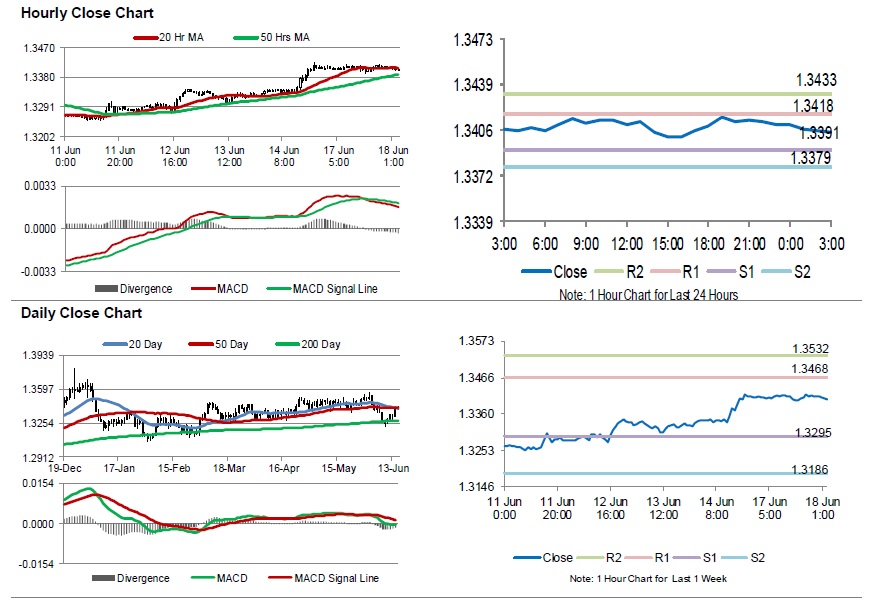
For the 24 hours to 23:00 GMT, the USD slightly rose against the CAD and closed at 1.3410.
In the Asian session, at GMT0300, the pair is trading at 1.3404, with the USD trading marginally lower against the CAD from yesterday’s close.
The pair is expected to find support at 1.3391, and a fall through could take it to the next support level of 1.3379. The pair is expected to find its first resistance at 1.3418, and a rise through could take it to the next resistance level of 1.3433.
Trading trend in the Loonie today is expected to be determined by Canada’s manufacturing shipments for April, scheduled to release later in the day.
The currency pair is showing convergence with its 20 Hr moving average and trading above its 50 Hr moving average.
RBA Is Likely To Cut Interest Rates In Near Term
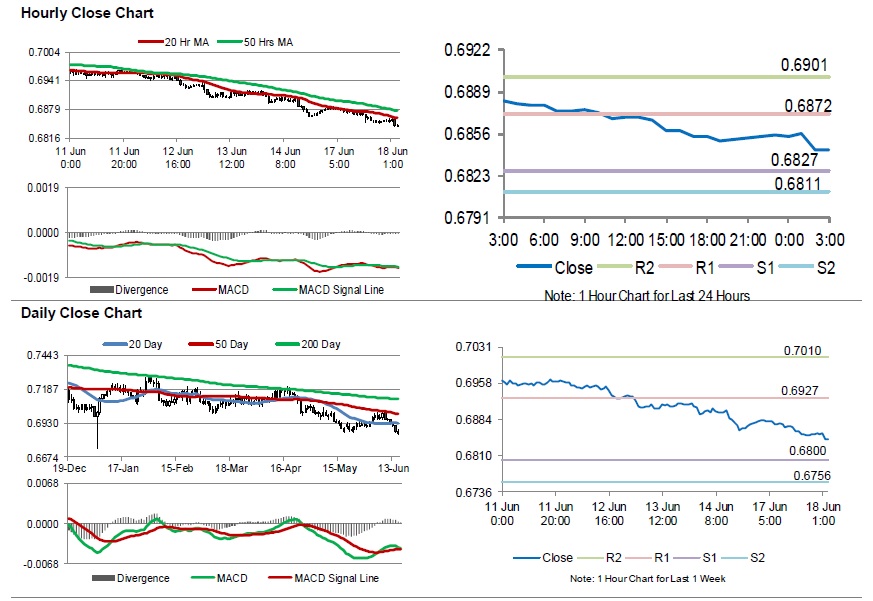
For the 24 hours to 23:00 GMT, the AUD declined 0.38% against the USD and closed at 0.6855.
LME Copper prices declined 0.9% or $49.0/MT to $5756.0/MT. Aluminium prices declined 1.0% or $17.5/MT to $1719.5/MT.
In the Asian session, at GMT0300, the pair is trading at 0.6843, with the AUD trading 0.18% lower against the USD from yesterday’s close.
The minutes of the Reserve Bank of Australia’s (RBA) June monetary policy meeting showed that policymakers are considering lowering interest rates in the near-term and reiterated that labour market developments are significant for deciding further easing of the monetary policy.
The pair is expected to find support at 0.6827, and a fall through could take it to the next support level of 0.6811. The pair is expected to find its first resistance at 0.6872, and a rise through could take it to the next resistance level of 0.6901.
Moving forward, traders would closely monitor Australia’s Westpac leading index for May slated to release overnight.
The currency pair is trading below its 20 Hr and 50 Hr moving averages.
Gold: Yellow Metal Trading Higher In The Asian Session
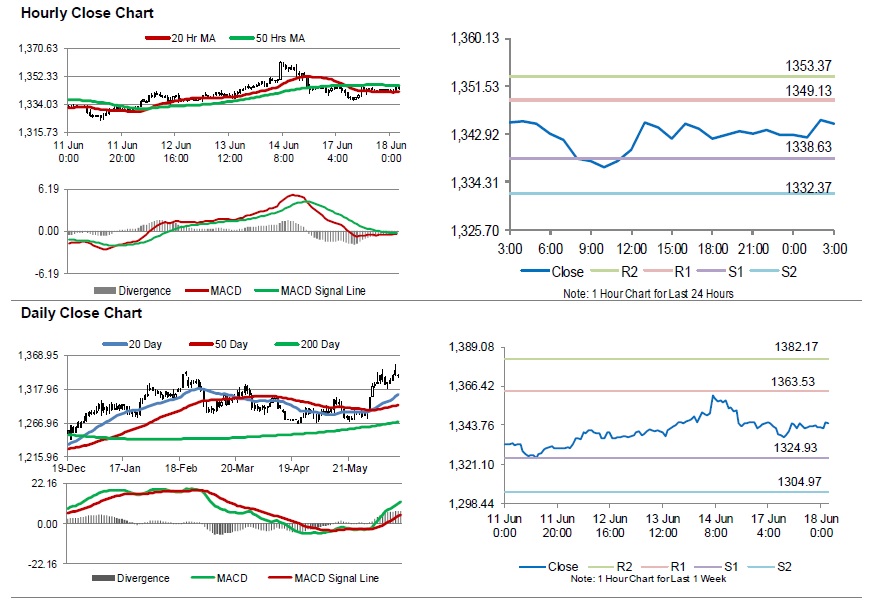
For the 24 hours to 23:00 GMT, Gold declined 0.06% against the USD and closed at USD1343.70 per ounce.
In the Asian session, at GMT0300, the pair is trading at 1344.90, with gold trading 0.09% higher against the USD from yesterday’s close.
The pair is expected to find support at 1338.63, and a fall through could take it to the next support level of 1332.37. The pair is expected to find its first resistance at 1349.13, and a rise through could take it to the next resistance level of 1353.37.
The yellow metal is trading above its 20 Hr moving average and showing convergence with its 50 Hr moving average.
Silver: White Metal Trading On A Stronger Footing This Morning
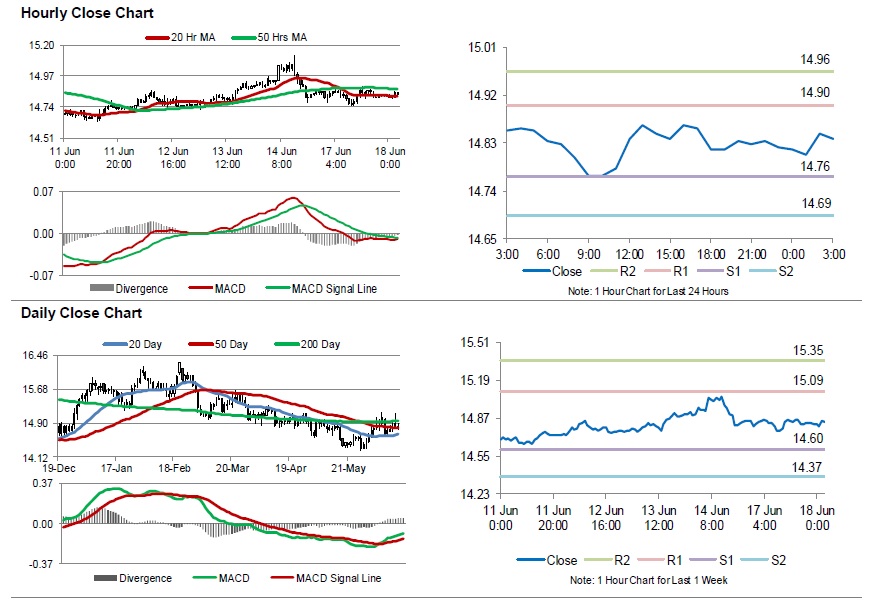
For the 24 hours to 23:00 GMT, Silver declined 0.13% against the USD and closed at USD14.82 per ounce, tracking losses in gold prices.
In the Asian session, at GMT0300, the pair is trading at 14.84, with silver trading 0.10% higher against the USD from yesterday’s close.
The pair is expected to find support at 14.76, and a fall through could take it to the next support level of 14.69. The pair is expected to find its first resistance at 14.89, and a rise through could take it to the next resistance level of 14.96.
The white metal is showing convergence with its 20 Hr moving average and trading below its 50 Hr moving average.
Crude Oil: Oil Trading Lower, Ahead Of API’s Weekly Crude Oil Inventories Data
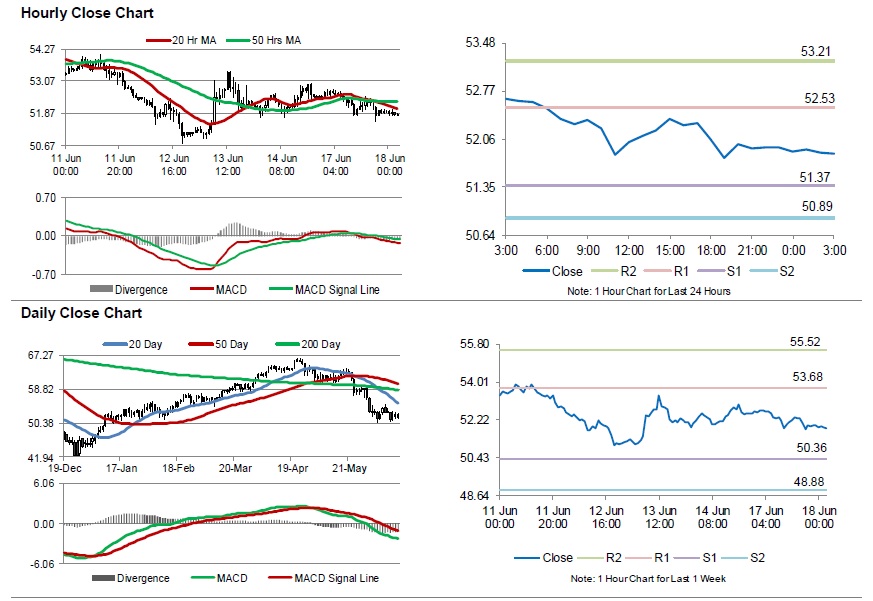
For the 24 hours to 23:00 GMT, Crude Oil declined 1.40% against the USD and closed at USD51.94 per barrel, after the Energy Information Administration report indicated that seven major US shale producers projected a rise in their crude oil output by 70,000 barrels per day to 8.5 million barrels a day in July.
In the Asian session, at GMT0300, the pair is trading at 51.84, with oil trading 0.19% lower against the USD from yesterday's close.
The pair is expected to find support at 51.37, and a fall through could take it to the next support level of 50.89. The pair is expected to find its first resistance at 52.53, and a rise through could take it to the next resistance level of 53.21.
Crude oil is trading below its 20 Hr and 50 Hr moving averages.
Australia house prices dropped -3% in Q1, decline in all capital cities
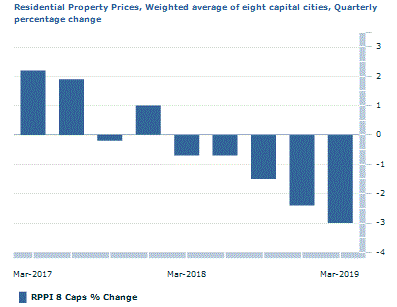
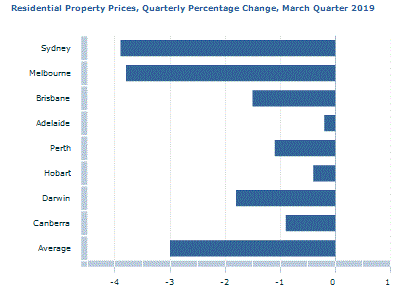
Australia house price index dropped -3.0% qoq in Q1, much worse than expectation of -2.6%. There's also deterioration from Q4's -2.4% qoq. House prices also declined in all capital cities: Sydney (-3.9%), Melbourne (-3.8%), Adelaide (-0.2%) and Hobart (-0.4%), Brisbane (-1.5%), Perth (-1.1%), Canberra (-0.9%) and Darwin (-1.8%).
ABS Chief Economist, Bruce Hockman said: "These results are in line with soft housing market indicators, with sales transactions and auction clearance rates lower than one year ago, and days on market trending higher. A continuation of tight credit supply and reduced demand from investors and owner occupiers has contributed to weakness in property prices in all capital cities this quarter."
BOE Preview – Record Low Interest Rate Remains Intact Despite Recent Hawkish Comments
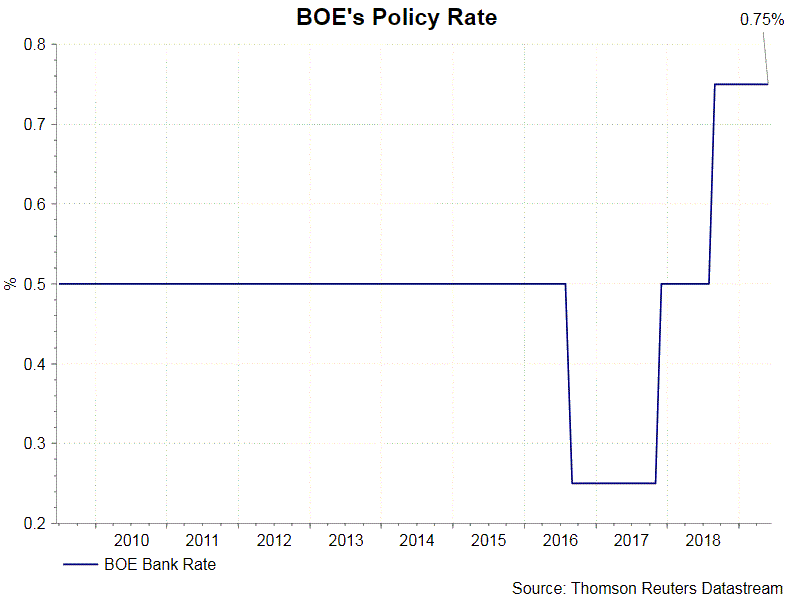
We expect BOE to leave the policy rate unchanged at 0.75% this week. It would also keep the size of the asset purchase program at 435B pound. Although there has been some noise pushing for a rate hike, we expect the votes on both measures to be unanimous.
UK’s economy has shown further weakness over the past months. Although inflation has been lifted by sterling depreciation, it has not reached a level that would require tightening actions. Meanwhile, UK's economic outlook would still be subject to Brexit uncertainty and US-China trade war. We expect BOE to reiterate the stance that the policy rate would increase “at a gradual pace, and to a limited extent” over the next couple of years.
Economic Data Have Been Mixed, If Not Disappointing
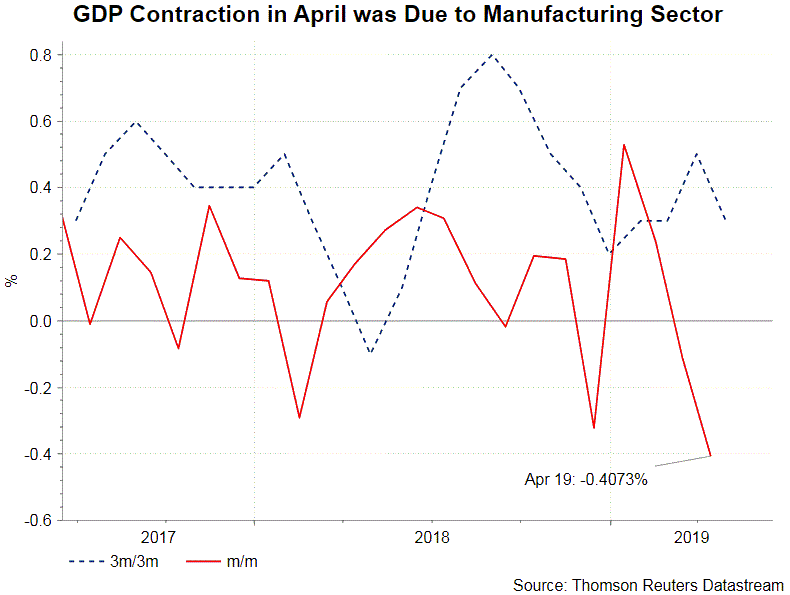
UK’s economy contracted -0.4% m/m in April, deteriorating from March’s -0.1%. The weaker- than- expected figure (consensus: -0.1%) was mainly driven by car factory shutdown ahead of the original Brexit deadline. Yet, the auto sector was only part of the reasons leading manufacturing activities to dive -3.9%, sharpest since 2002. From a year ago, GDP growth eased to +1.3%, from March’s +1.9%. As suggested in ONS' statement, “GDP growth showed some weakening across the latest 3 months, with the economy shrinking in the month of April mainly due to a dramatic fall in car production, with uncertainty ahead of the UK’s original EU departure date leading to planned shutdowns”. It added that “there was also widespread weakness across manufacturing in April, as the boost from the early completion of orders ahead of the UK’s original EU departure date has faded”.
The manufacturing sector is expected to deteriorate further. The IHS Markit/ CIPS manufacturing PMI fell to 49.4, lowest in 34 months in May, with both new orders and employment indices down. Not only does the reading mark a sharp decline from April's 53.1, it also signals the the manufacturing sector is in contraction. As noted in the accompanying report, "a slowdown in the global economy, and trade wars hotting up could tip the scales even further next month and increase the likelihood that the UK manufacturing sector will remain in contraction territory".
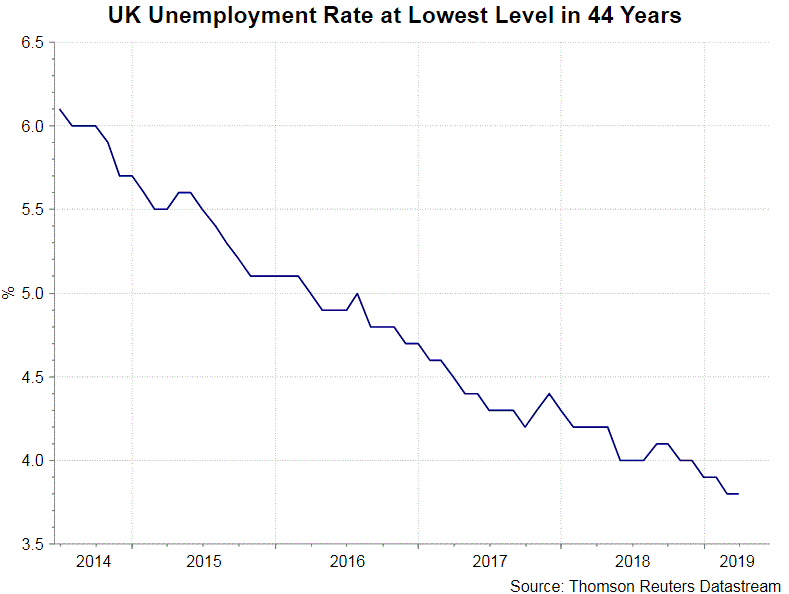
On the job market, employment gained +32K to 32.75M in the three months to April. While this came in higher than consensus of +10K, it was just about one-third of the addition in March. Moreover, this marks the smallest increase since August and is significantly weaker than the average +167K in 1Q19. That said, the unemployment stayed at a 44-year low of 3.8%. On the positive note, average wage (ex bonus) grew +3.4% y/y in the three months through to April. This came in higher than consensus of +3.1% and the +3.3% growth in March.
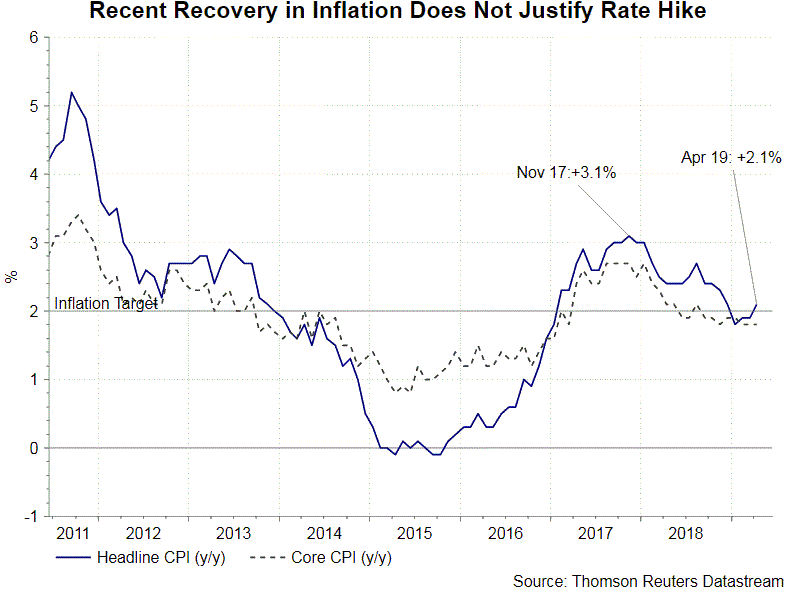
Inflation was the key reasons for the previous two BOE rate hikes. While depreciation in British pound has boosted inflation, we believe the current price level is not strong enough to trigger another rate hike yet. Headline CPI improved to +2.1% y/y in April, beating consensus of +2.2% and +1.9% in March. Core CPI steadied at +1.8% y/y, compared with consensus of +1.9%. the inflation report for May is scheduled to release this week.
Mixed Messages from BOE Members
Michael Sauders, probably the most hawkish member, suggested last week that BOE might need to raise interest rate earlier than market expectations. He “stressed” that the central bank “does not necessarily have to keep rates on hold until all Brexit uncertainties are resolved”. This was despite the forecast of “pretty soft numbers in April”. His comment echoed that of Andy Haldane, BOE’s chief economist and another hawkish member. In an opinion piece in the Sun newspaper, he suggested that the time was nearing “when a small rise in rates would be prudent to nip any inflationary risks in the bud”. Earlier this month, BOE Governor Mark Carney suggested that interest rate would need to be increased if the economy performs as expected. This came in line with BOE stance over the previous meetings. While some of the members appear hawkish and has been pushing for a rate hike earlier than market expectations, others remain concerned about downside risks to global and domestic economic outlook. For instance, Gertjan Vlieghe last week noted that recent "data has been a little disappointing and in terms of both the global downside risks and the domestic downside risks my read is that they have both intensified". He added that "trade relations are making a lot of companies nervous", noting that trade tensions, as well as Brexit uncertainty have derailed economic improvement.
Brexit Uncertainty
Brexit uncertainty has been prolonged, not eliminated. Surveys show that Brexit hardliner Boris Johnson has the highest chance to be the next PM. The stance of Johnson, as well as the victory of the Brexit camp in the EU parliamentary election, has increased the odds of no-deal Brexit. Yet, it is still not our base scenario. The majority of the MPs (including the Conservatives) in the parliament rejects a no-deal Brexit. Heightened conflict between the government (with the new PM pushing to leave the EU no matter what) and the MPs could leading to some Conservative MPs to trigger a vote of confidence in the new PM, resulting in an early election. For an early election to take place, the UK might need to apply further extension of Brexit into 2020, from October 31 currently.
RBA Minutes: Further rate cut is more likely than not
Australian Dollar falls broadly today on dovish RBA minutes as well as miss in house price data. RBA cut cash rate by -25bps to 1.25% at the June 4 meeting. The minutes noted that "members agreed that it was more likely than not that a further easing in monetary policy would be appropriate in the period ahead."
Policymakers acknowledged that inflation has been below 2-3% target range for three years and even deteriorated to 1.5% in Q1. Unemployment rate had not declined any further in the last six months despite ongoing job growth. It has eve edged up in the most recent two months. Thus, "a lower level of interest rates would support growth in the economy, thereby reducing unemployment and contributing to inflation rising to a level consistent with the target."
Also, lower interests could support the economy through lower exchange rate, reduced borrowing rates for businesses, and lower interest payments for households. And give the extent of spare capacity in the economy and the subdued inflationary pressures, there was "a low likelihood of a decline in interest rates resulting in an unexpectedly strong pick-up in inflation."
Instead, lowest interest rates would " stimulate activity and thereby improve the resilience of the Australian economy to any future adverse shocks."
BoJ Kuroda will certainly debate risks from trade war and China at upcoming meeting
Ahead of BoJ's June 19-20 monetary policy meeting, Governor Haruhiko Kuroda warned the parliament of risks from US-China trade war and China's economy. And he pledged that the issues will "certainly" be debated.
Kuroda said, "as for recent overseas economic developments, there are strong downside risks regarding the Sino-U.S. trade friction and China's economy." And, "we'll certainly debate such overseas developments" at the upcoming meeting.
He also reiterated that "BOJ will guide monetary policy appropriately taking into account the impact overseas economic changes could have on Japan's economic outlook and the momentum for achieving our inflation target".