Sample Category Title
USD/JPY Daily Outlook
Daily Pivots: (S1) 108.42; (P) 108.58; (R1) 108.68; More...
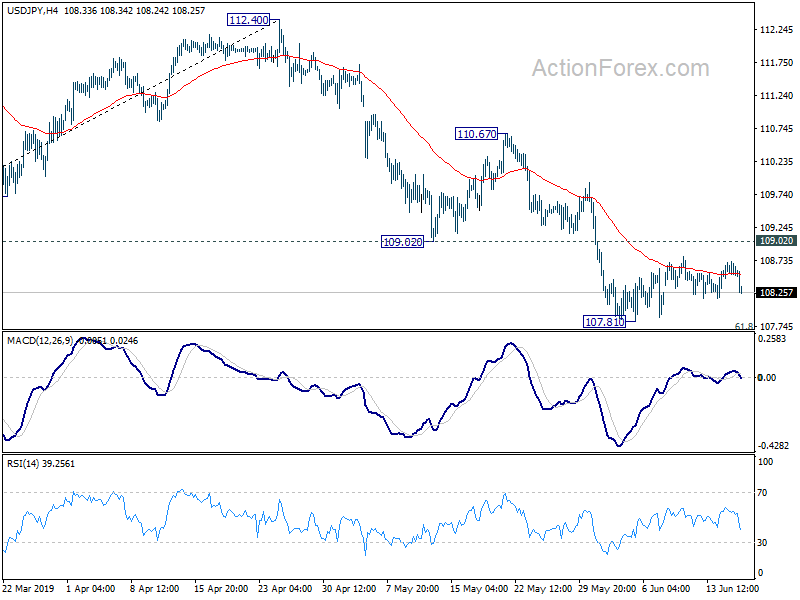
USD/JPY is staying in consolidation from 107.81 and intraday bias stays neutral. Outlook is unchanged that upside of recovery should be limited by 109.02 support turned resistance to bring fall resumption. On the downside, sustained break of 61.8% retracement of 104.69 to 112.40 at 107.63 will pave the way back to 104.62/9 key support. However, break of 109.02 support turned resistance will indicate short term bottoming and bring lengthier consolidations first.
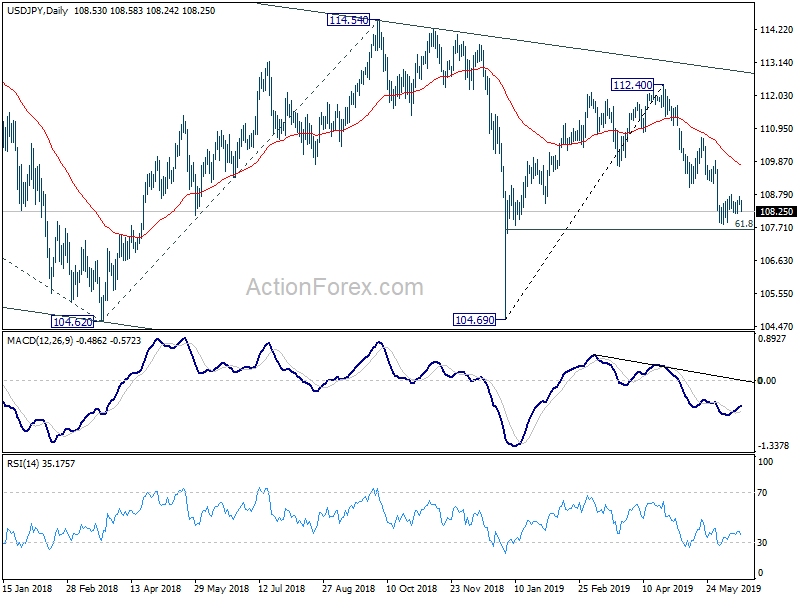
In the bigger picture, decline from 118.65 (Dec 2016) is still in progress, with the pair staying inside long term falling channel. Break of 104.62 will target 100% projection of 118.65 to 104.62 from 114.54 at 100.51. For now, we'd expect strong support above 98.97 (2016 low) to contain downside to bring rebound.
USD/CAD Daily Outlook
Daily Pivots: (S1) 1.3398; (P) 1.3409; (R1) 1.3425; More...
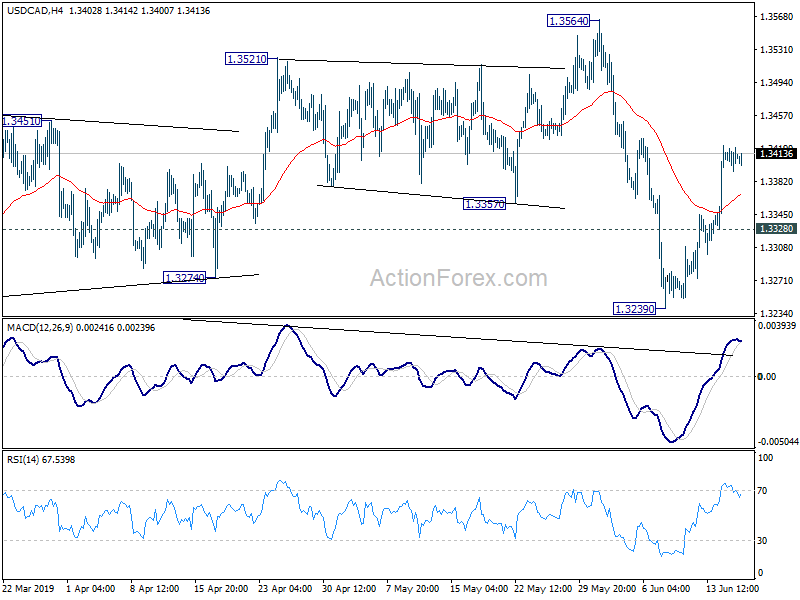
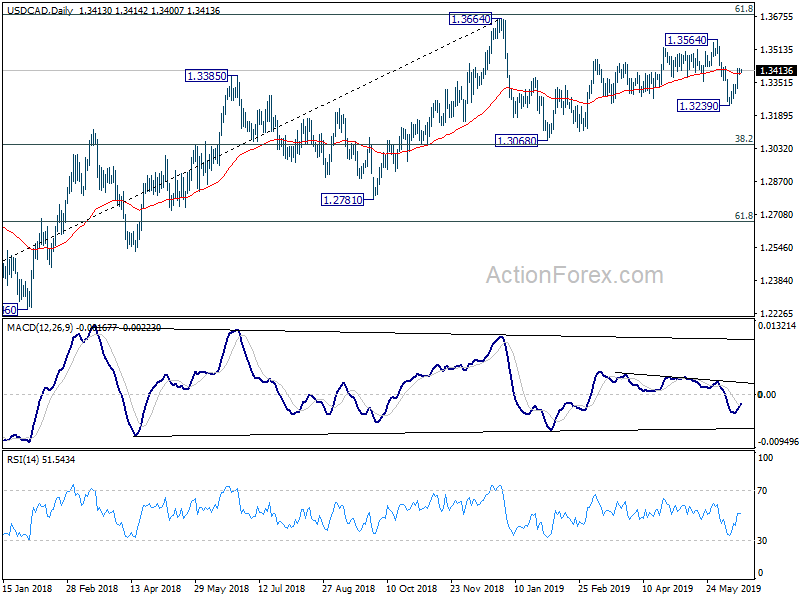
Intraday bias in USD/CAD remains mildly on the upside for the moment. Current rebound from 1.3239 could target 1.3564 resistance first. Break will target 1.3664 high. On the downside, below 1.3328 minor support will turn intraday bias back to the downside for 1.3239 support instead.
In the bigger picture, outlook is turned mixed after USD/CAD drew strong support from 55 week EMA (now at 1.3232) and rebounded. Nevertheless, sustained break of 61.8% retracement of 1.4689 (2016 high) to 1.2061 at 1.3685, is needed to confirm resumption of up trend from 1.2061 (2017 low), towards 1.4689. Otherwise, medium term outlook will stay neutral first. Break of 1.3239 will revive the case of medium term topping at 1.3664. And, decisive break of 1.3068 cluster support (38.2% retracement of 1.2061 to 1.3664 at 1.3052) will confirm and pave the way to 61.8% retracement at 1.2673 next.
AUD/USD Daily Outlook
Daily Pivots: (S1) 0.6839; (P) 0.6862; (R1) 0.6876; More...
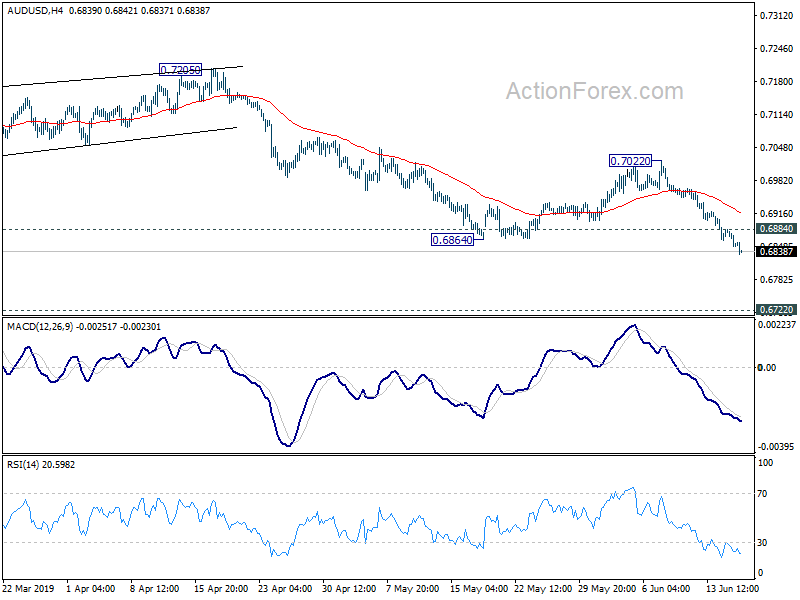
AUD/USD drops further to as low as 0683 so far today as decline from 0.7295 is extending. Intraday bias stays the downside for retesting 0.6722 low next. On the upside, above 0.6884 minor resistance will turn intraday bias neutral and bring consolidations. But recovery should be limited well below 0.7022 resistance to bring fall resumption.
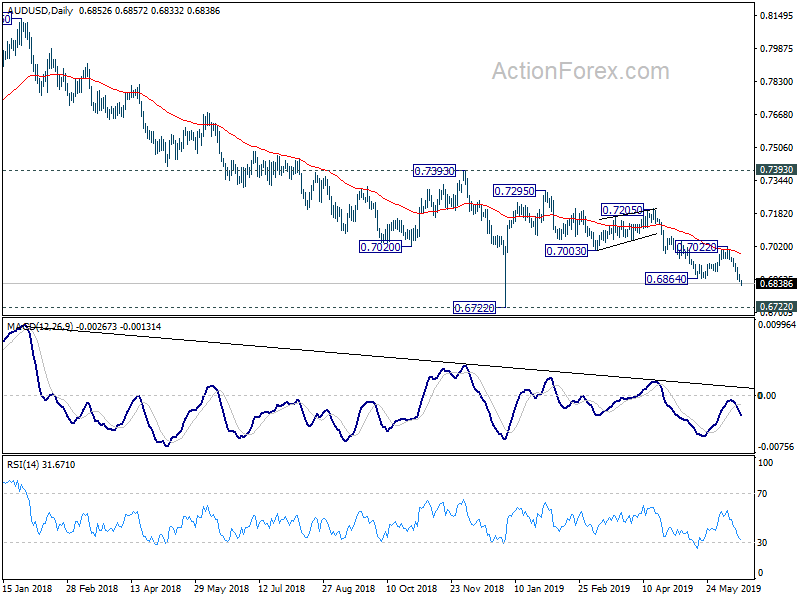
In the bigger picture, with 0.7393 key resistance intact, medium term outlook remains bearish. The decline from 0.8135 (2018 high) is seen as resuming long term down trend from 1.1079 (2011 high). Decisive break of 0.6826 (2016 low) will confirm this bearish view and resume the down trend to 0.6008 (2008 low). However, firm break of 0.7393 will argue that fall from 0.8135 has completed. And corrective pattern from 0.6826 has started the third leg, targeting 0.8135 again.
Australian Dollar Tumbles on Dovish RBA Minutes, Sterling Weakens Too
Australian Dollar drops broadly today after RBA minutes confirm that more rate cuts are underway. Additional, worse than expected house price data gives the Aussie more selling pressure. Sterling is not far away as second weakest, ahead of the next round of UK Conservative leadership voting today. For now, Yen is the strongest one following decline in Nikkei as well as weakness in major treasury yields. Euro continues to be very resilient and follows as the second strongest for today. Though, the common currency will face test from German economic sentiment data.
Technically, AUD/USD's recent fall from 0.7295 is in progress to retest 0.6722 flash crash low. EUR/AUD breaks first projection level at 1.6410 and is targeting 1.6631 next. AUD/JPY also breaks 74.25 fibonacci level and should be heading to 70.27 low. GBP/USD is on track to retest 1.2391 low. EUR/GBP is accelerating towards 0.9101 high. GBP/JPY is also targeting 131.51 low. USD/JPY could be a focus today as it struggled to stand above 4 hour 55 EMA again. Deeper fall could be seen back towards 107.81 low should US and German treasury yields extend weakness.
In Asia, Nikkei closed down -0.72%. Hong Kong HSI is up 1.11%. China Shanghai SSE is up 0.01%. Singapore Strait Times is up 0.92%. Japan 10-year JGB yield is down -0.0022 at -0.128. Overnight, DOW rose 0.09%. S&P 500 rose 0.09%. NASDQ rose 0.62%. 10-year yield dropped -0.007 to 2.086.
RBA Minutes: Further rate cut is more likely than not
RBA cut cash rate by -25bps to 1.25% at the June 4 meeting. Minutes of the meeting noted "members agreed that it was more likely than not that a further easing in monetary policy would be appropriate in the period ahead."
Policymakers acknowledged that inflation has been below 2-3% target range for three years and even deteriorated to 1.5% in Q1. Unemployment rate had not declined any further in the last six months despite ongoing job growth. It has eve edged up in the most recent two months. Thus, "a lower level of interest rates would support growth in the economy, thereby reducing unemployment and contributing to inflation rising to a level consistent with the target."
Also, lower interests could support the economy through lower exchange rate, reduced borrowing rates for businesses, and lower interest payments for households. And give the extent of spare capacity in the economy and the subdued inflationary pressures, there was "a low likelihood of a decline in interest rates resulting in an unexpectedly strong pick-up in inflation."
Instead, lowest interest rates would " stimulate activity and thereby improve the resilience of the Australian economy to any future adverse shocks."
Australia house prices dropped -3% in Q1, decline in all capital cities
Australia house price index dropped -3.0% qoq in Q1, much worse than expectation of -2.6%. There's also deterioration from Q4's -2.4% qoq. House prices also declined in all capital cities: Sydney (-3.9%), Melbourne (-3.8%), Adelaide (-0.2%) and Hobart (-0.4%), Brisbane (-1.5%), Perth (-1.1%), Canberra (-0.9%) and Darwin (-1.8%).
ABS Chief Economist, Bruce Hockman said: "These results are in line with soft housing market indicators, with sales transactions and auction clearance rates lower than one year ago, and days on market trending higher. A continuation of tight credit supply and reduced demand from investors and owner occupiers has contributed to weakness in property prices in all capital cities this quarter."
BoJ Kuroda will certainly debate risks from trade war and China at upcoming meeting
Ahead of BoJ's June 19-20 monetary policy meeting, Governor Haruhiko Kuroda warned the parliament of risks from US-China trade war and China's economy. And he pledged that the issues will "certainly" be debated.
Kuroda said, "as for recent overseas economic developments, there are strong downside risks regarding the Sino-U.S. trade friction and China's economy." And, "we'll certainly debate such overseas developments" at the upcoming meeting.
He also reiterated that "BOJ will guide monetary policy appropriately taking into account the impact overseas economic changes could have on Japan's economic outlook and the momentum for achieving our inflation target".
EU: China tops the list of trade and investment barriers
In a report released yesterday, European Commission said, in 2018, China had the highest stock of recorded barriers, with 37 obstacles hindering EU export and investment opportunities. Russia was a close second with 34 barriers in place. India (25), Indonesia (25) and US (23) followed. On new barriers, Algeria and India topped with five new measures. US and China followed with four new measures each.
Commissioner for Trade Cecilia Malmström said: "In the complex context we have today with a growing number of trade tensions and protectionist measures, the EU must keep defending the interests of its companies in the global markets. Making sure that the existing rules are respected is of utmost importance. Thanks to our successful interventions, 123 barriers hindering EU exports opportunities have been removed since I took office in late 2014. Working on specific problems reported by our companies we manage to deliver economic benefits equivalent in value to those brought by the EU's trade agreements. Those efforts certainly must continue."
Looking ahead
Eurozone will release trade balance and CPI final in European session. But main focus will likely be on German ZEW economic sentiment. Later in the day, Canada will release manufacturing sales. US will release housing starts and building permits.
AUD/USD Daily Outlook
Daily Pivots: (S1) 0.6839; (P) 0.6862; (R1) 0.6876; More...
AUD/USD drops further to as low as 0683 so far today as decline from 0.7295 is extending. Intraday bias stays the downside for retesting 0.6722 low next. On the upside, above 0.6884 minor resistance will turn intraday bias neutral and bring consolidations. But recovery should be limited well below 0.7022 resistance to bring fall resumption.
In the bigger picture, with 0.7393 key resistance intact, medium term outlook remains bearish. The decline from 0.8135 (2018 high) is seen as resuming long term down trend from 1.1079 (2011 high). Decisive break of 0.6826 (2016 low) will confirm this bearish view and resume the down trend to 0.6008 (2008 low). However, firm break of 0.7393 will argue that fall from 0.8135 has completed. And corrective pattern from 0.6826 has started the third leg, targeting 0.8135 again.
Economic Indicators Update
| GMT | Ccy | Events | Actual | Forecast | Previous | Revised |
|---|---|---|---|---|---|---|
| 21:00 | NZD | Westpac Consumer Confidence Q2 | 103.5 | 103.8 | ||
| 1:30 | AUD | House Price Index Q/Q Q1 | -3.00% | -2.60% | -2.40% | |
| 1:30 | AUD | RBA Minutes Jun | ||||
| 9:00 | EUR | Eurozone Trade Balance (EUR) Apr | 16.4B | 17.9B | ||
| 9:00 | EUR | Eurozone CPI M/M May F | 0.20% | 0.70% | ||
| 9:00 | EUR | Eurozone CPI Y/Y May F | 1.20% | 1.70% | ||
| 9:00 | EUR | Eurozone CPI Core Y/Y May F | 0.80% | 0.80% | ||
| 9:00 | EUR | German ZEW Economic Sentimen Jun | -5.8 | -2.1 | ||
| 9:00 | EUR | German ZEW Current Situation Jun | 6.1 | 8.2 | ||
| 9:00 | EUR | Eurozone ZEW Economic Sentiment Jun | -3.6 | -1.6 | ||
| 12:30 | CAD | Manufacturing Sales M/M Apr | 0.40% | 2.10% | ||
| 12:30 | USD | Housing Starts May | 1.24M | 1.24M | ||
| 12:30 | USD | Building Permits May | 1.30M | 1.29M |
RBA Minutes Confirm More Easing on the Way
The minutes of the June RBA Board meeting show the decision to cut the cash rate by 25bp at that meeting was driven by a revised assessment of spare capacity in the labour market and that the Board expects to ease policy further. We continue to expect a further 25bp rate cut in August and a final 25bp cut in November.
Note that much of the information from the minutes is not new. Key aspects have already been covered in a speech by the RBA Governor on the day of the decision and in other commentary from the Bank since then. Assessments have also likely evolved since June 4, particularly following the March quarter national accounts released a day later.
As such, our main interest in reading the meeting minutes is around the commentary from members and the tone of the discussion – particularly the degree of urgency around policy easing.
The minutes are clear on the prospect of further cuts, noting in the concluding paragraph that “… it was more likely than not that a further easing in monetary policy would be appropriate in the period ahead”. In the lexicon of RBA statements, “period ahead” signals that policy is ‘live’ in coming meetings but stops short of indicating an imminent move at the next meeting.
The case for easing in June rested firmly on a reassessment of the labour market. Updates on wage costs, showing growth of 0.5%qtr, 2.3%yr to March, were seen as “further evidence of spare capacity”. The latest data around jobs and unemployment is assessed as “mixed” – with an increase in unemployment and underemployment and a moderation in employment growth noted, albeit with the latter still running above growth in the labour force and participation rates reaching a record high. The contrast with the “strong” description in the May minutes is striking.
However, the real change was around the assessment of the extent of spare capacity – i.e. the degree to which unemployment was above the ‘full employment’ levels associated with stable inflation. As outlined by the Governor, the Bank now sees this as around 4.5% compared to the 4.75-5% cited previously – the shift reflecting the unfolding mix of wage and unemployment outcomes. The current 5.2% unemployment rate is a sizeable 0.7ppts above this target level. While noting estimates are uncertain, Board members concurred with the change in assessment.
Other factors behind the decision to cut seem less urgent. The outlook for both the global economy and the Australian economy was assessed as “reasonable” albeit with the latter conditioned on market pricing for the cash rate that implied interest rates would be lower in the period ahead. Around inflation, the persistence of low underlying inflation – below the 2-3% target range for three years and expected to remain low near term – looks to have been a secondary consideration behind the cut, giving scope for the move rather than driving the decision. That said, there did seem to be some concern that this might start to undermine medium term inflation expectations.
The risks a rate cut would present around high household debt and housing markets were assessed as low. Members judged it “was unlikely to encourage a material pick-up in borrowing by households that would add to medium term risks”. Interestingly, members also noted that lower rates would “stimulate activity and thereby improve the resilience of the Australian economy to any future adverse shocks” – perhaps an indication that the Board is a little keener to get the economy moving.
Conclusion
Overall, the minutes confirm more easing is on the way. Board members appear very much aligned to the Governor’s views, particularly around the labour market. That said, the ‘tone’ is not urgent in the sense that growth outlook still does not seem to be viewed as that challenging and low inflation is not a driving force behind the easing.
We continue to see the next 25bp rate cut coming in August and a final 25bp cut in November.
There are complications. After shifting its view on full employment and having identified more significant spare capacity in the labour market, the Board may see little point in delaying follow-on easing moves – the case having already been made.
However, we expect the next move to instead be framed by a downgrade to the Bank’s forecasts meaning it will be more inclined to move in August when the full set of revised forecasts are released in its Statement on Monetary Policy. We expect this to include a downward revision to the Bank’s near term growth forecast from ‘around 2.75%’ to something more materially below trend. The disappointing March quarter national accounts release has already lowered the starting point. Updates on the consumer are likely to show soft conditions extending into the June quarter. Meanwhile weak labour market updates are likely to take the unemployment further away from the Bank’s 4.5% target. Given the need to adjust, it is much simpler communication-wise, to cut rates at the time the forecast is changed than to cut in July and announce the lower forecast a month later.
Elliott Wave View: Further Weakness In GBP/USD Expected
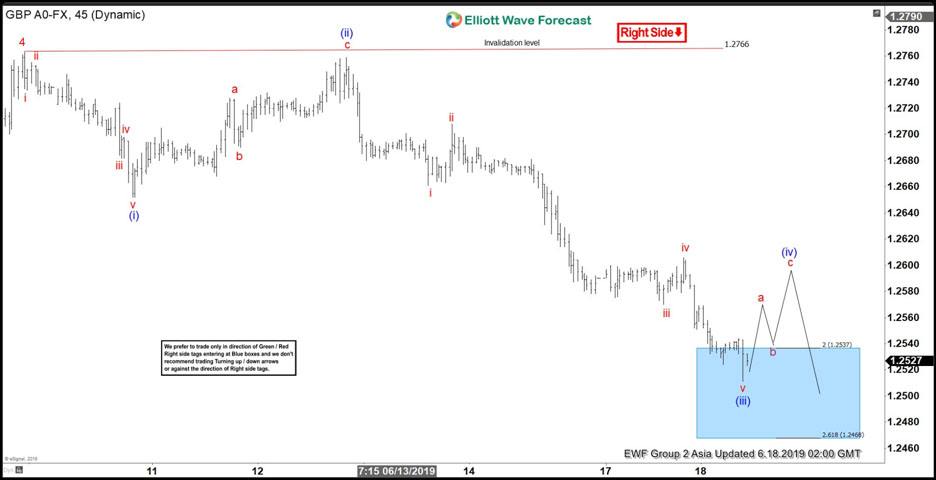
Short Term Elliott wave view in GBPUSD suggests the decline from June 7 high is unfolding as an impulse Elliott Wave structure. Down from 1.276, wave (i) ended at 1.265 with internal as an impulse in lesser degree. Wave (ii) bounce ended at 1.276 as a zigzag Elliott Wave structure. Pair has now reached 200% extension within wave (iii) showing a typical extension within wave 3 of an impulse. Wave i of (iii) ended at 1.266, wave ii of (iii) ended at 1.2708, wave iii of (iii) ended at 1.257, and wave iv of (iii) ended at 1.2606.
Short term, wave v of (iii) can be complete already at 1.251 low, but so far it still does not have enough separation from the low. If pair breaks below 1.251, it doesn’t change the idea that wave (iii) should complete soon. As the third wave shows an extension, this suggests that pair should see further downside at least 1 more leg after a wave (iv) rally. Thus we don’t like buying the pair and expect pair to find sellers in wave (iv) bounce in 3, 7, or 11 swing as far as pivot at 1.276 stays intact.
GBPUSD 1 Hour Elliott Wave Chart
Euro Reverses Its Losses In The Asian Session
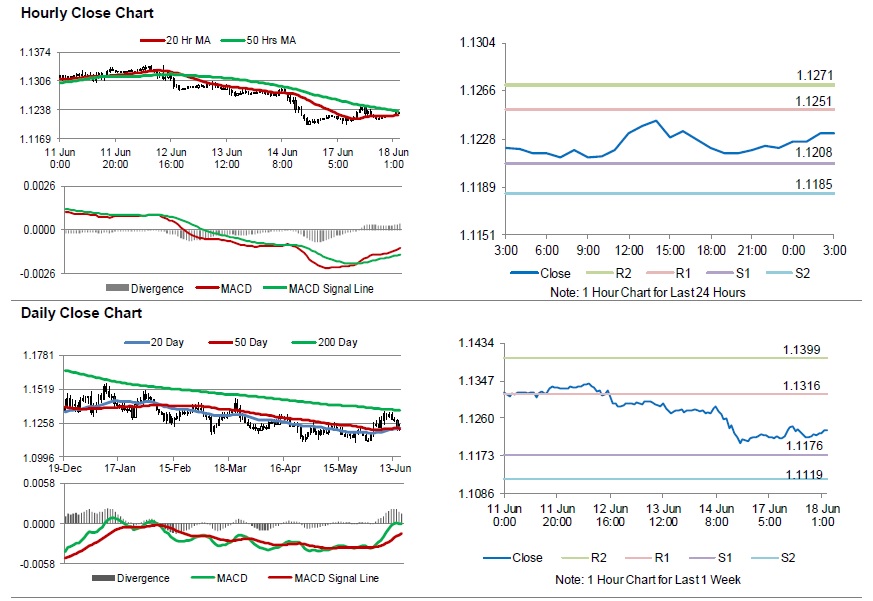
For the 24 hours to 23:00 GMT, the EUR slightly declined against the USD and closed at 1.1221.
In the US, data indicated that the NY Empire State manufacturing index dropped to a 3-year low level of -8.6 in June, compared to a reading of 17.8 in the prior month. Market participants had envisaged the index to record a fall to a level of 11.0. Moreover, the NAHB housing market index unexpectedly fell to a level of 64.0 in June, declining for the first time in 6 months, amid worries over escalating construction costs. The index had registered a reading of 66.0 in the prior month, while markets had expected for a gain to a level of 67.0.
In the Asian session, at GMT0300, the pair is trading at 1.1232, with the EUR trading 0.10% higher against the USD from yesterday’s close.
The pair is expected to find support at 1.1208, and a fall through could take it to the next support level of 1.1185. The pair is expected to find its first resistance at 1.1251, and a rise through could take it to the next resistance level of 1.1271.
Looking ahead, traders would await Euro-zone’s trade balance data for April, consumer price index for May along with Germany’s ZEW survey indices for June, set to release in a few hours. Later in the day, the US housing starts and building permits, both for May, will garner significant amount of investor attention.
The currency pair is trading above its 20 Hr moving average and showing convergence with its 50 Hr moving average.
Sterling Trading Lower In The Morning Session
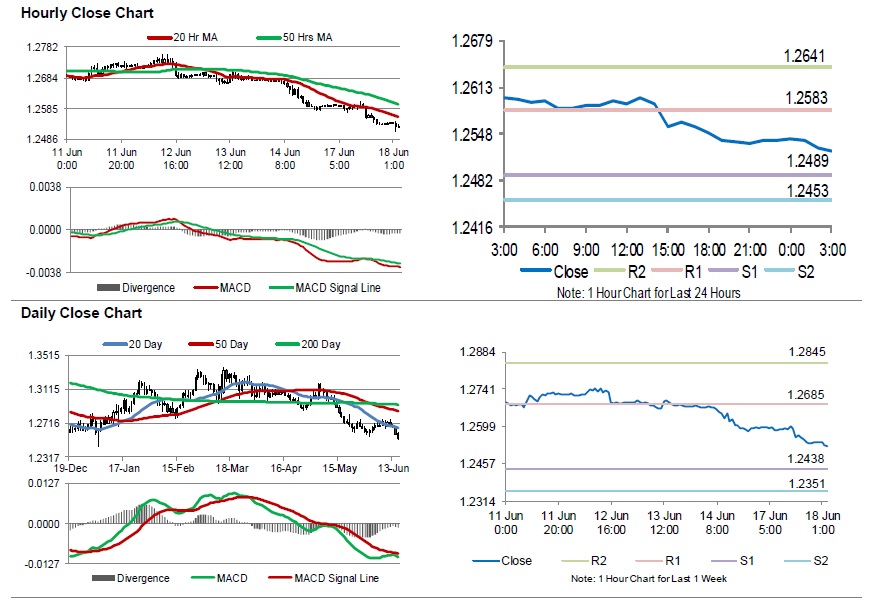
For the 24 hours to 23:00 GMT, the GBP declined 0.46% against the USD and closed at 1.2538, amid raising concerns over no-deal Brexit as Boris Johnson is likely to be the Prime Minister of UK.
In the Asian session, at GMT0300, the pair is trading at 1.2524, with the GBP trading 0.11% lower against the USD from yesterday’s close.
The pair is expected to find support at 1.2489, and a fall through could take it to the next support level of 1.2453. The pair is expected to find its first resistance at 1.2583, and a rise through could take it to the next resistance level of 1.2641.
Gong forward, investors would keep an eye on the Bank of England’s Governor Mark Carney’s speech, due later in the day.
The currency pair is trading below its 20 Hr and 50 Hr moving averages.
RBA Minutes Indicate More Rate Cuts In Coming Months
RBA, in its June meeting minutes, explicitly noted that the policy rate would be lower. This message came in more dovish than market expectations. The major concern remained in the lackluster improvement in the labor market. RBA cut the bank rate by -25 bps to 1.25% in June. The market has now priced in 50% chance of another rate hike in July.
The key message in the minutes is as follows: “Given the amount of spare capacity in the labour market and the economy more broadly, members agreed that it was more likely than not that a further easing in monetary policy would be appropriate in the period ahead”. The members have paid much attention in the job market. As noted in the minutes, “members agreed that further improvement in the labour market would be required for wages growth and inflation to rise to levels consistent with the medium-term inflation target”.
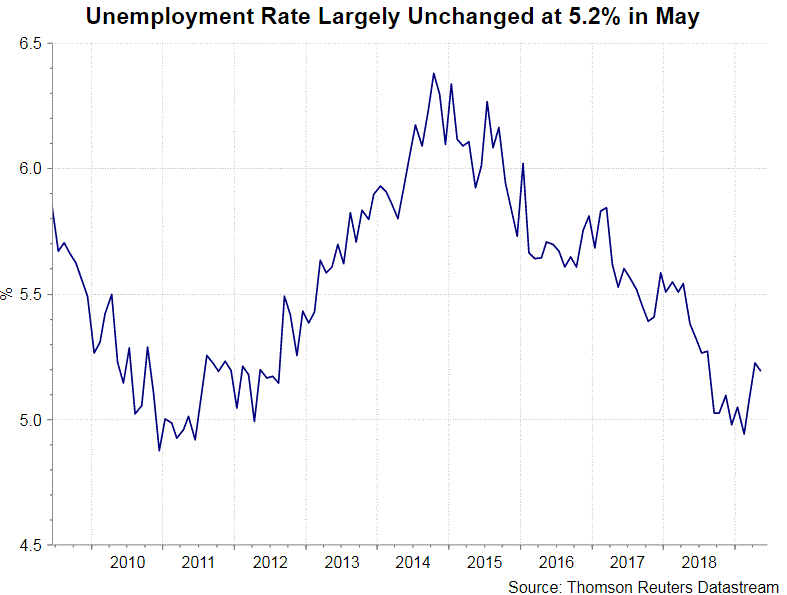
Since the June meeting, we have received the employment report for May. the numbe of payrolls added +42.3k in May, beating consensus of +16K. Yet, the growth was mainly driven by part-time jobs which rose 39.8K. Full-employment only added +24K. The unemployment rate slipped marginally to 5.19% from 5.22% in April. However, this level remains well above 4.5%, a level RBA judges is required to boost wage growth.
 More rate cuts is highly likely to come in coming months. The next key event would be Governor Lowe’s speech on “The labour market and spare capacity” on Thursday. Hopefully, he would send more hints about the central bank’s next decision.
Japanese Extend Its Gains In The Asian Session
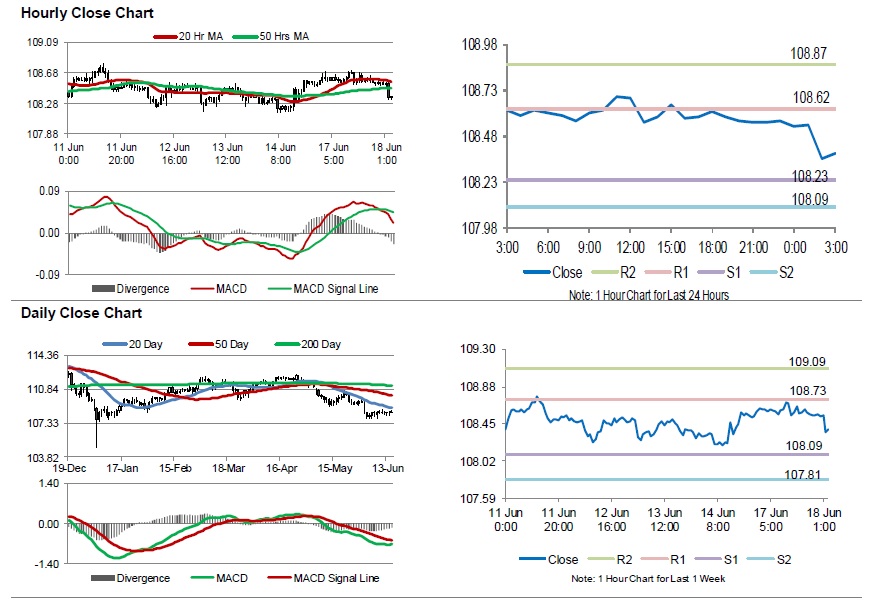
For the 24 hours to 23:00 GMT, the USD declined 0.06% against the JPY and closed at 108.56.
In the Asian session, at GMT0300, the pair is trading at 108.38, with the USD trading 0.17% lower against the JPY from yesterday’s close.
The pair is expected to find support at 108.23, and a fall through could take it to the next support level of 108.09. The pair is expected to find its first resistance at 108.62, and a rise through could take it to the next resistance level of 108.87.
Going ahead, traders would await Japan’s trade balance data for May, slated to release overnight.
The currency pair is trading below its 20 Hr and 50 Hr moving averages.