Sample Category Title
EUR/JPY Breakout Occurs
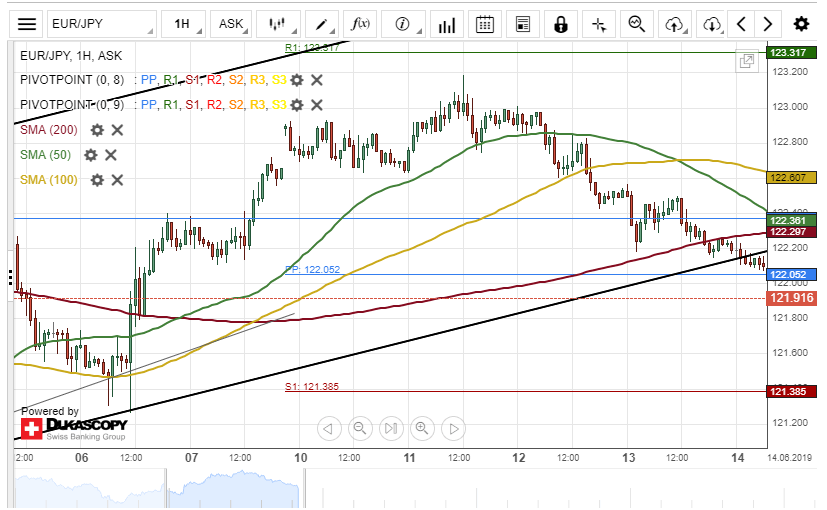
The common European currency has depreciated about 50 base points against the Japanese since yesterday's trading session. A breakout occurred through the lower boundary of an ascending channel pattern at 122.12 during the morning hours of Friday's trading session.
Given that a breakout had occurred, it is likely that the EUR/JPY currency pair will continue its downward momentum within this session. Bears could aim for the weekly S1 at 121.38.
Meanwhile, technical indicators flash sell signals on the 4(H) time-frame chart.
AUD/USD Decline Likely To Continue
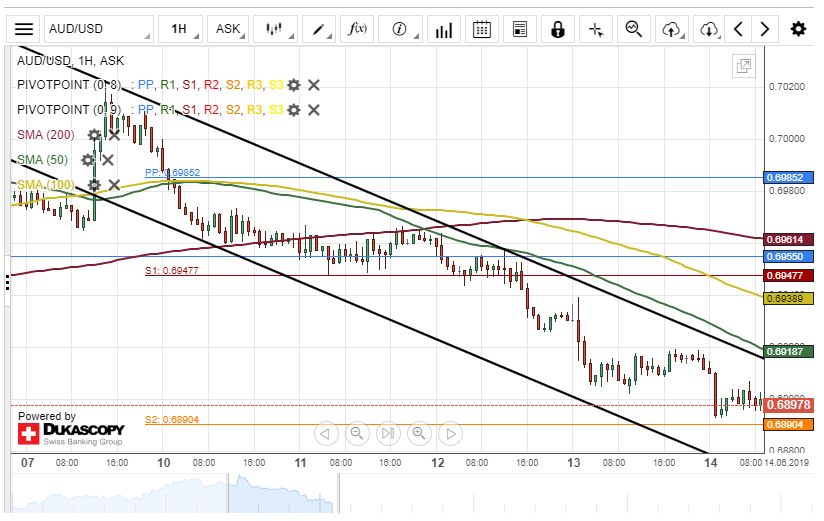
The Australian Dollar depreciated about 35 base points against the US Dollar on Thursday. The currency pair maintained the junior descending channel pattern during yesterday's trading session.
Given that the 50-, 100– and 200-hour SMAs are located above the price level, most likely, the exchange rate will continue its downward momentum during the following trading session.
Although, a support level formed by the weekly S2 at 0.6890 could provide support for the currency exchange rate today.
USD/CAD Breaches 200-Hour SMA
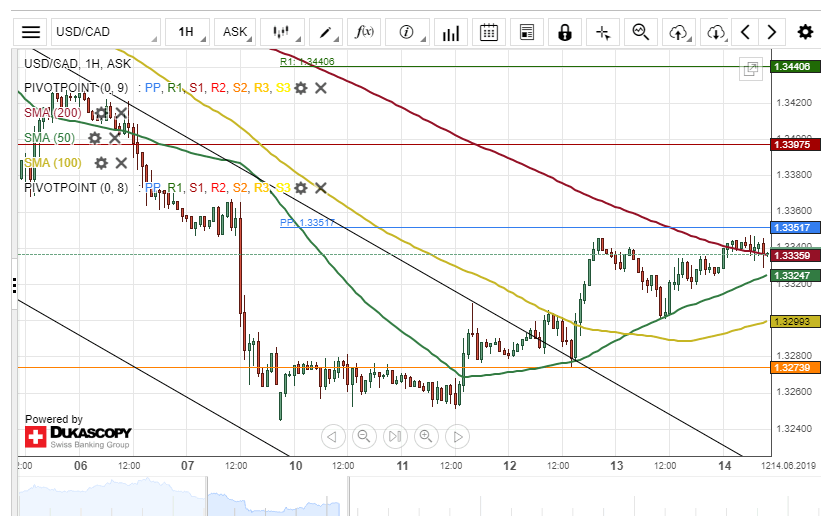
The 50-hour simple moving average provided support for the US Dollar versus the Canadian Dollar on Thursday. After hitting the 50-hour SMA, the currency pair made a reversal to the upside.
The exchange rate breached the 200-hour SMA resistance level during the morning hours of today's trading session.
Everything being equal, it is likely that the USD/CAD exchange rate will continue to gain strength during the following trading session.
The possible target for bullish traders will be near the monthly pivot point at 1.3397 in the short-term.
NZD/USD Could Still Edge Lower
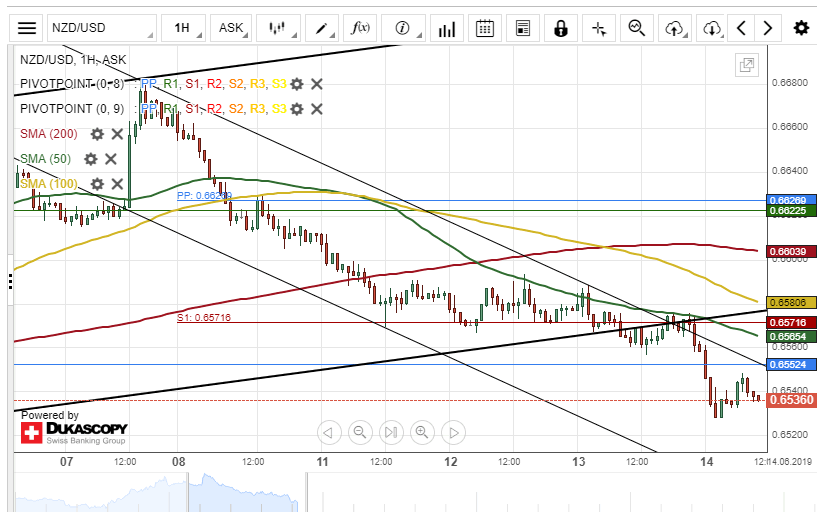
The New Zealand Dollar has depreciated about 43 base points against the US Dollar since yesterday's trading session. The currency pair has been guided by the three moving averages since May 14.
As for the near future, it is likely that the NZD/USD exchange rate will continue its downward swing in the short term. The pair might aim for a support cluster formed by the weekly and the monthly pivot points at 0.647.
Bearish traders might push the currency exchange rate towards a support level set by the weekly S1 at the 0.6485 area today.
Markets Hit By Caution Ahead Of US Retail Sales Data
The mood across financial markets was cautious this morning as rising geopolitical tensions in the Middle East and persistent uncertainty over US-China trade developments capped risk appetite
Asian stocks were subdued on Friday after China's industrial output dropped to its lowest levels for more than 17 years in May. The risk-off tone and disappointment from Asia have already infected European markets which are trading lower this morning. With a sense of caution also kicking in ahead of next week's Federal Reserve meeting, Wall Street may struggle to maintain gains this afternoon as investors adopt a guarded approach towards riskier assets.
Although global equity markets have performed relatively well in June thus far, the quarter-to-date (QTD) gains across the board are nothing to celebrate. One must really question the sustainability of the stock market rally, given the storm of headwinds weighing on global sentiment. It must be kept in mind that the fundamental ingredients for a selloff across stock markets are bubbling dangerously in the cauldron. Equity bears remain in the vicinity and may be simply waiting for the perfect opportunity to make their move.
Dollar waits for US retail sales report
The main risk event for the Dollar today will be the highly anticipated US retail sales report for May which will be closely scrutinised by investors for signs of trade tensions negatively impacting domestic consumption.
Sizzling trade tensions and disappointing economic data from the States have fuelled speculation over the Federal Reserve cutting interest rates this year. Since the Federal Reserve will be meeting next week, the retail sales data will play an important role in shaping expectations for the central bank's forward guidance. Should retail sales disappoint by printing below 0.6% month-on-month forecast, the Dollar will feel the pain, as the 75% probability for a Fed rate cut in July will potentially tick higher.
Looking at the technical picture, the Dollar Index is trading around 97.00 as of writing. Prices have scope to retest 96.50 is retail sales disappoint.
Commodity spotlight – Gold
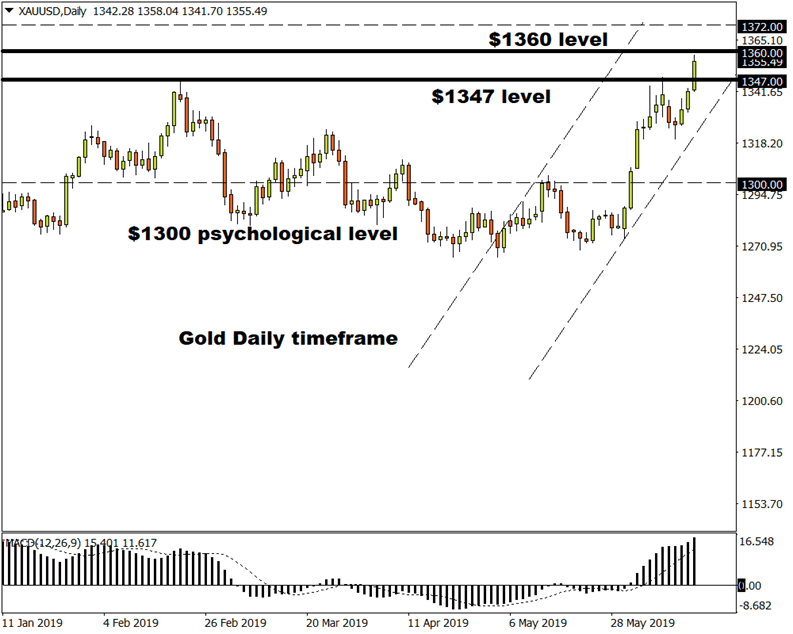
It has been an unquestionably bullish trading week for Gold which has rallied to a yearly high above $1355.
The forces behind Gold's aggressive appreciation revolve around geopolitical tensions in the Middle East, ongoing US-China trade tensions and rising expectations over the Fed cutting interest rates. With these key fundamental drivers straining investor confidence and souring appetite for riskier assets, Gold is set to shine as investors sprint to safe-haven assets. From a technical perspective, Gold bulls are in the driver's seat with a weekly close above $1360 opening the doors towards $1372 and $1390, respectively.
USD/JPY Outlook: Negative Bias After Bull-Trap
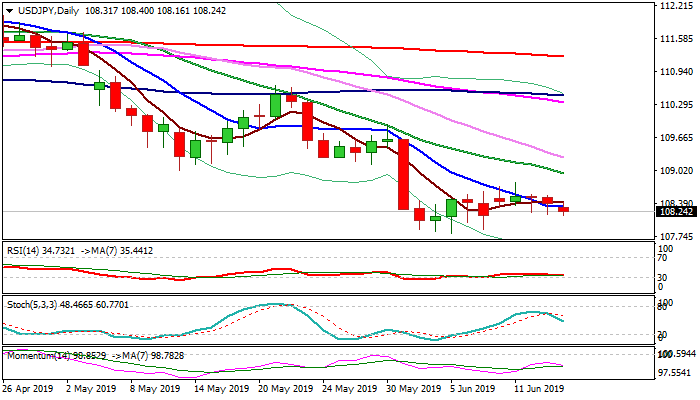
The pair holds in red in European trading on Friday and maintaining negative near-term bias after Mon/Tue bull-trap.
Rising bearish momentum and daily MA’s in negative setup, support scenario as fresh weakness repeatedly probed below pivotal support at 108.19 (61.8% of 107.81/108.80), clear break of which is needed to confirm lower top at 108.80.
Thick 4-hr cloud (108.28/87) maintains pressure and only lift above cloud top (also near Fibo 38.2% of 110.67/107.81) would neutralize bears.
Res: 108.33, 108.53, 108.80, 108.80
Sup: 108.16, 108.04, 107.81, 107.57
Forex Technical Analysis: EUR/USD, USD/JPY, GBP/USD
EUR/USD
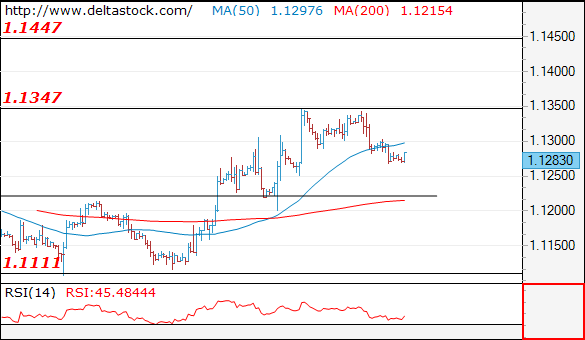
Current level - 1.1283
There should be an intraday attempt at 1.1220 major support and it will determine the outlook on the senior frames. Intraday minor resistance lies at 1.1300.
| Resistance | Support | ||
| intraday | intraweek | intraday | intraweek |
| 1.1350 | 1.1450 | 1.1250 | 1.1015 |
| 1.1450 | 1.1450 | 1.1220 | 1.0860 |
USD/JPY
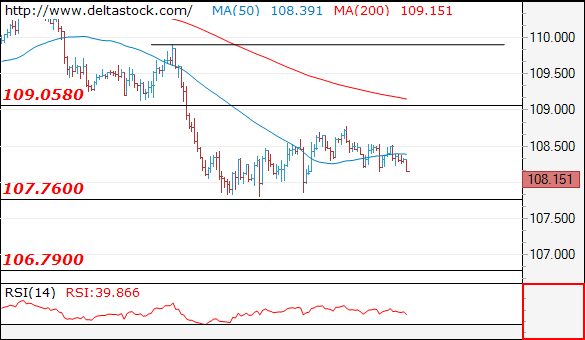
Current level - 108.15
The lack of trend dynamics prevails and the outlook remains neutral.
| Resistance | Support | ||
| intraday | intraweek | intraday | intraweek |
| 109.05 | 109.90 | 107.70 | 107.70 |
| 109.05 | 112.40 | 107.70 | 106.70 |
GBP/USD
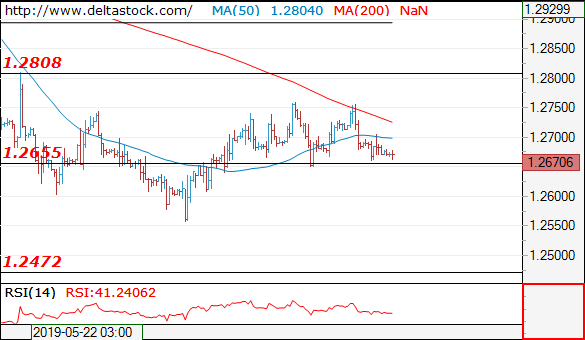
Current level - 1.2670
The pair is ready for a dip to 1.2600 area and the latter should build a base for an upswing towards 1.2810.
| Resistance | Support | ||
| intraday | intraweek | intraday | intraweek |
| 1.2760 | 1.2960 | 1.2650 | 1.2570 |
| 1.2810 | 1.3170 | 1.2550 | 1.2470 |
Fed Backstops Risk
Fed backstops risk
Overall risk sentiment remains weak after reports of attacks on two oil tankers in the Gulf of Oman. US equity markets closed higher due to rally in energy stocks, US yields fell, while oil and gold prices bounced. Classic safe-haven flows. The US has accused Iran of the attacks increasing the tensions in the Middle-East. However, we are living in extreme times where the natural pricing of markets are no longer relevant. New that would have sent markets on a hair raising, roller coaster ride saw crude volatility and price increase only marginally. Central banks dislocating extreme monetary policy, which has shifted toward expansion, in recent months, continues to backstop risk. Given this view, we see the current pullback in risky assets as a short-term move. Further support is likely to come from next week Federal Reserve meeting and press conference.
The FOMC is preparing arguments for interest rate cuts in September. The Fed will have a tricky time to highlight downturn due to escalating trade war and soft macro-economic data, at the same time not spooking the market. This shift will herald the way for global monetary policy turn. The market has already priced in a 25bp cut and probability of a recession in the coming 12 months stand at 30%. Yet hearing the Fed articulate, the strategy will affect the markets. The net result is likely weaker USD, especially against EM currencies and a further improvement in equities. Moving forward, it will be fascinating to see if Fed Chair Powell can stop President Trump from driving the USA into recession. Arguably America’s two most powerful institutions going head-to-head in the months to come.
NZD slides amid disappointing Manufacturing PMI
The New Zealand dollar was the worst performer amongst the G10 complex following an unexpected slump in Manufacturing PMI. NZD/USD fell as much as 0.63% to 0.6528 after Business Manufacturing PMI came in at 50.2 versus 53 median forecast and 52.7 in the previous month. According to the latest report from BusinessNZ, the manufacturing PMI dropped 2.5 points in May, thanks to sharp contractions in Production (-3.7) and Deliveries (-3.6) sub-components. Only the Finished Stocks sub-component managed to edge higher, up 4 points to 56.5. However, the details remains worrying, as the PMI slid to the lowest since December 2012 and the trend is clearly bias to the downside. Most worryingly, the sharp drop in production to 46.4 is of bad omen for the months to come, especially since new orders printed close to the neutral threshold and inventories are building up – finished stocks came in at 56.5.
Looking at the big picture, data from New Zealand suggests a stabilisation in the first quarter but the story could be much in the second one as data from the job market, service sectors and manufacturing sectors point to slower economic expansion. The recent monetary push by RBNZ suggests that the central bank anticipates such a scenario. However, we believe that there is room for further USD debasement as market participants have been pricing more rate hikes from the Fed. Now that Powell is about to engage the reverse gear, the greenback should continue to trim gains, which should prevent the Kiwi to slide further.
EUR/USD – Euro Subdued As Investors Await U.S Retail Sales
EUR/USD is showing little movement on Friday, continuing the lack of activity seen on Thursday. Currently, the pair is trading at 1.1280, up 0.03% on the day. On the release front, there are no major German or eurozone events. The German Wholesale Price Index slowed to 0.3% in May, down from 0.6% a month earlier. In France CPI dropped to 0.1%, its lowest level in three months. In the U.S., the key events are the May retail sales reports. Core retail sales are projected to climb to 0.5%, after a weak gain of 0.1% a month earlier. Retail sales are expected to rebound to 0.7%, after a reading of -0.2% in April. The week winds up with the UoM Consumer Sentiment report, which is expected to fall to 98.1, after an outstanding reading of 102.4 in the previous release.
The slowdown in eurozone is alive and well, as underlined by weak eurozone numbers on Thursday. German CPI gained just 0.2% in May, compared to April. With the eurozone’s locomotive showing weak inflation, the ECB is not under any pressure to raise interest rates anytime soon. In March, the ECB changed its forward guidance on rates, saying that it expected rates to remain unchanged throughout 2019. Previously, the bank had said it would not alter rates prior to the summer of 2019. Manufacturing remains depressed, as eurozone industrial production declined 0.5%, marking a third straight decline. The escalation in global trade tensions, particularly between the U.S. and China, have reduced the demand for German and eurozone exports and dampened manufacturing activity.
Consumer inflation numbers for May were soft, but the markets are counting on better news from consumer spending data. Retail sales and core retail sales are expected to rebound in May, and these numbers could play a crucial role in the Federal Reserve’s forward guidance for rates. The markets are prepared for a rate cut, possibly two, in the second half of the year. The CME Group has set the odds of a July cut at 62% and another cut in September at 55%. Lower interest rates make the U.S. dollar less attractive to investors, so some headwinds could be ahead for the greenback.
Why Investors Should Not Be Bullish On Oil Prices
Crude and Brent oil are up nearly 10.93% and 12.50% year-to-date respectively. These percentage gains have a special meaning when we look at things from the lens of slowing global economic growth. Over the past two days, speculators tried their best to push the prices higher on the back of the news that two oil tankers were attacked in the Gulf of Oman, precisely on Thursday. Looking at the history, such an event could easily push the prices higher by 5-7%, however, this particular incident failed to bring similar kind of moves in the oil prices. We did see the crude prices jumping higher by 2% due to this event but these gains were merely covering the weekly losses.
External Forces Should Not Promote War In The Middle East
The reason is pretty simple for oil prices not exploding like the 1991 when U.S. forces created a major turmoil between Kuwait and Iraq by launching the operation called “Desert Storm”. Simply put, we still have mammoth amount of oil supply and this is keeping the lid on the oil prices. Looking at the recent EIA data, it shows that crude inventories are still rising, the number jumped by 15.7 million barrels marking the largest monthly increase going back all the way to 1991 for the month of May.
This is not to say that the ongoing conflicts cannot errupt anymore.
External forces should not be getting engaged in the Middle Eastern affairs. This is because it will only make matters worse. The U.S. is clearly blaming Iran for these recent attacks on oil tankers while Iran is rejecting search accusing statements. The Middle East is a very sensitive part of the world, we have Iran and Saudi Arabia, both locked up in unconstructive dialogues for decades. External comments and involvements make things only worse in the region. Remember in the 1980s, the U.S. shot down a civilian Iranian aircraft killing 300 passengers after mistaking it for a fighter plane. The efforts should be to promote and create peace rather than making allegations and targeting one particular country.
The Two Important Factors
More importantly, the U.S. needs to resolve it's own matters first rather than taking sides with other countries in different parts of the world. The ongoing trade war between the U.S. and China is the biggest issue which is damping the oil demand. The two major reasons that we did not see the surge in the oil price are:
- The mammoth increase in the U.S. shale oil production due to the higher oil prices
- The never ending trade war between the U.S. and China
According to the EIA oil data, the U.S. shale oil production has increased to such a level that the country only needed to buy 1,000,000 barrels of oil per day from the countries based in the Persian Gulf during the month of March. Back in 2003, this number used to stand at 3,000,000 barrels a day.
A Technical View
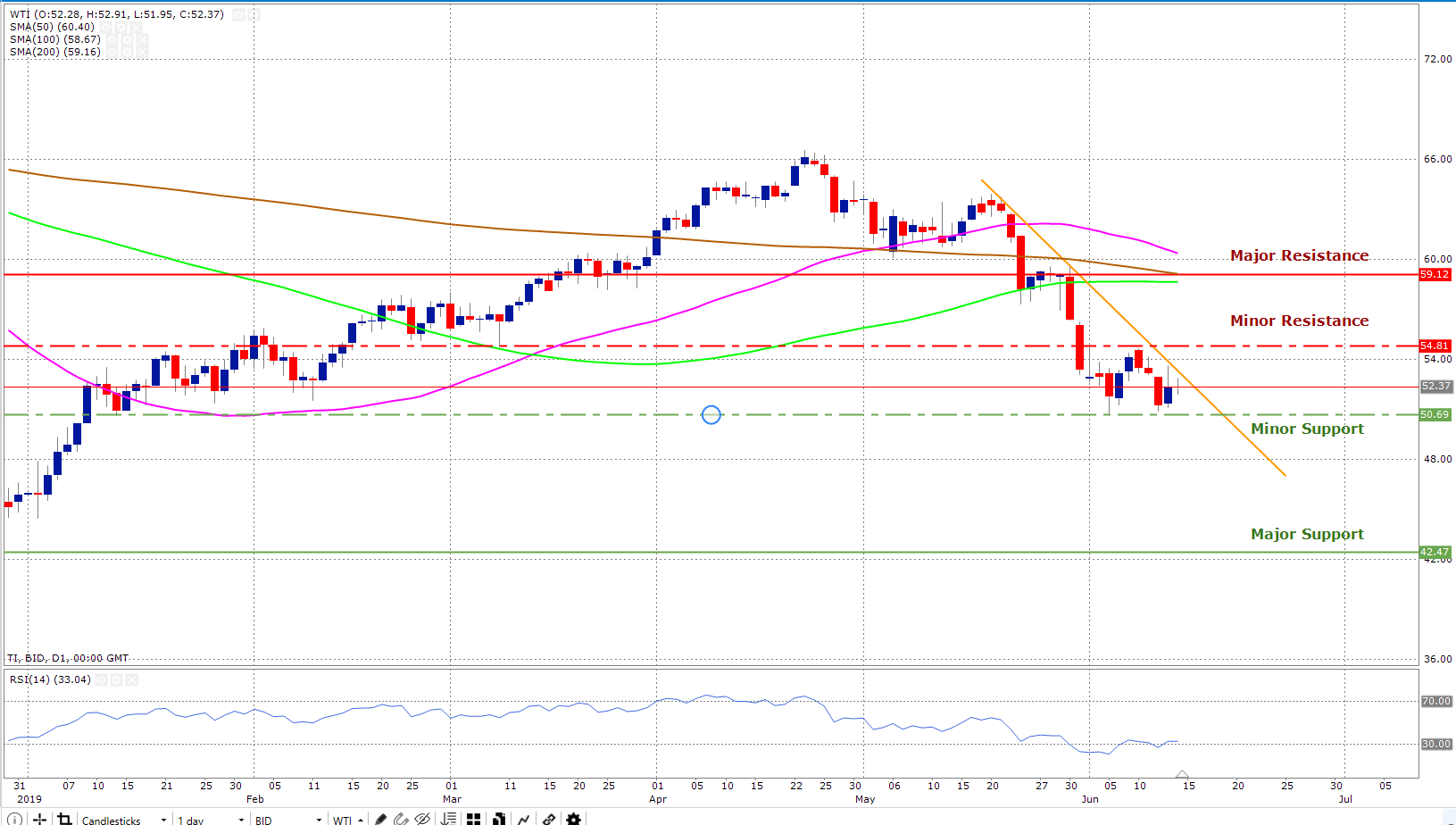
From a technical analysis perspective the price of crude oil is down nearly 22% from its high off $66.37 formed back in April 2019. The daily chart shows that the Relative Strength Index is still trading in an oversold territory which means it is likely for the prices to move higher. However, any upward move may be capped by the resistance of $54.81. A break of this level will open the room towards the next resistance of $59.12, this is where the 100-day moving average sits.