Sample Category Title
US Stocks to Open Lower Following Mixed Chinese and US Data; Middle East in Focus
Markets remain cautious as Chinese data continues to soften as the effects of US tariff war increase and as tensions remain on high alert between the US and Iran. American officials unveiled images of an Iranian navy ship removing an unexploded mine off the hull of the Japanese-owned chemical tanker Kokura Courageous. The attack in the Gulf of Oman follows a barrage of attacks that occurred a month ago in the Strait of Hormuz. The crippling impact of US sanctions on the Iranian economy is likely to see continued retaliation with the disruption of vital oil shipping lanes. Iran is selling oil at discount and will try to prop up prices. Markets are wary if this situation will lead to another US conflict in the Middle East, but expectations are that will not be the case.
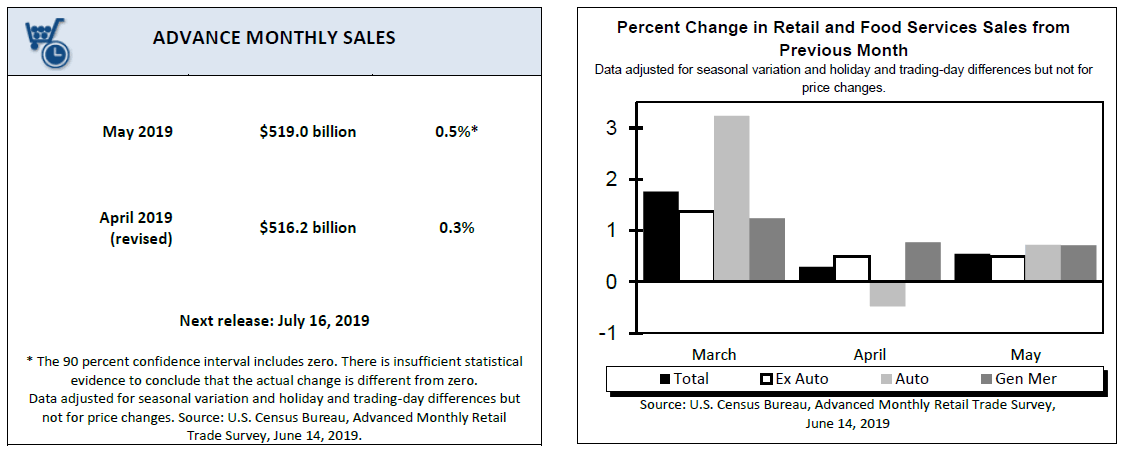
The US retail sales release in North America saw limited market reactions in equities, but a slight bid for the US dollar. The US retail sales data for the month of May rebounded and the prior month was revised higher. Mostly coming in better than expected, the report still will do little to ease deceleration growth concerns for the second quarter. Today’s reading did not help tilt the scale for the Fed to be urgent in cutting rates. S&P 500 is poised to open 0.2% lower, while the Nasdaq is down 0.7%, also being weighed by the Broadcom’s disappointing quarterly results and slashed guidance.
- CNY – China Industrial data slumps as trade war intensifies
- RUB – Russia cuts rates as expected
- Oil – Pares gains from Gulf of Oman tanker attacks
- Gold – 14-month high on Iran, Fed and Trade
CNY
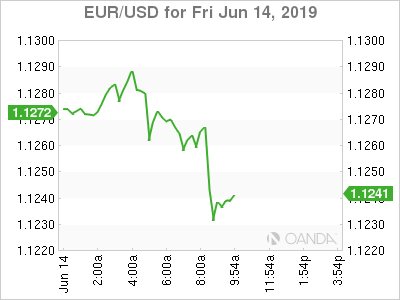
Softer than expected factory data sent Chinese indexes lower, with the CSI 300 Index leading the decline with 0.8% drop. China’s industrial output growth dropped to worst pace since 2002, up 5.0% from a year earlier. Investments also slumped with a 5.6% gain, missing expectations and down from a month ago. Retail sales did provide a nice beat, but that was mainly attributed to the May Day holiday.
As the private sector grows cautious and the effects of the extended trade war continue to weigh on business, expectations remain high for the PBOC to deliver more easing in the immediate future. The end of month G20 summit remains the biggest risk event for Chinese markets. Any stimulus released by Beijing may just help the market from continuing to selloff. In order for Chinese equities to see sustained gains, meaningful trade progress is required, a de-escalation in tariffs from the US.
The situation in Hong Kong remains tense, but key officials are starting to waver on the immediate insistence on pushing the proposed extradition bill forward. Beijing is expected to ultimately follow through in pushing this bill forward, but they may choose to wait until trade deals are done with the US. If the US makes the Hong Kong situation part of the trade negotiations, we may never see a deal done.
RUB
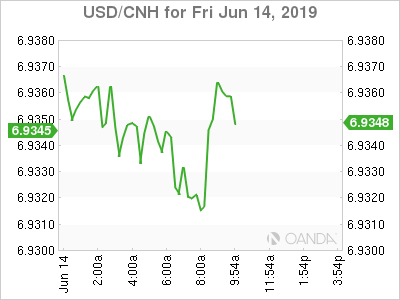
The Russian central bank (CBR) cut their key rate for the first time since March 2018, also delivering a dovish tilt that suggest more cuts could be coming. The CBR cut both their growth and inflation forecasts.
It appears that we could be see many more central banks adopt additional easing, especially since we are likely to see the two largest economies delivering fresh stimulus. The global growth slowdown is likely to see emerging markets see more easing money flowing around this summer. Chile and India also recently delivered rate cuts and next week we will hear from the Fed.
Oil
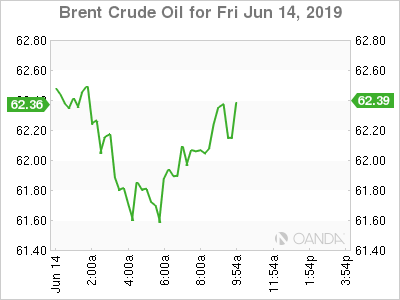
Crude prices pared yesterday’s gains that stemmed from attacks on two oil vessels in the Gulf of Oman. Geopolitical risks appear to be the only bullish driver for stronger oil prices. Oil is struggling to muster a meaningful rally as trade war uncertainty is hurting global demand and US production is expected to continue deliver fresh record levels.
Instability in the Middle East region is likely to intensify in the coming months as the US sanctions continue to take a toll on the Iranian economy and the Trump administration has no interest in resuming talks. Japanese PM Abe’s two-day visit was hoping to ease tensions with Tehran and aim to find a diplomatic solution, but it appears the trip yielded no progress. Trump tweeted, “I personally feel that it is too soon to even think about making a deal. They are not ready, and neither are we!”
Tensions between the US and Tehran remain high as the US is blaming Iran for the attacks on two oil tankers. The situation remains tense, but we may not this news cycle be much of a catalyst for higher oil. The key to seeing oil rally in the short-term may require a falling US dollar, which could continue to happen once the Fed cuts rates.
Gold
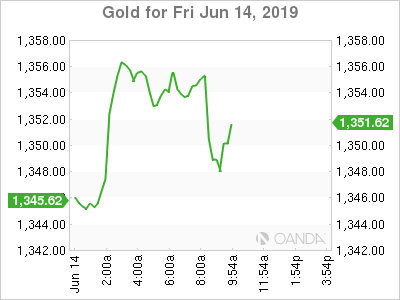
Gold is breaking out on geopolitical risks, Fed easing expectations and continuing global growth concerns. The main catalyst that took the yellow metal above the $1,350 an ounce level was Mideast tensions that are threatening a major global oil route. The economic war that US and Iran are battling out is at risk about growing into a major conflict that could see military action. Mideast tensions will not be going away anytime soon and any flareups could see gold extend its gains.
The yellow metal is also firming up ahead of next week’s FOMC decision, which are seeing the odds go up for the Fed to deliver a rate cut. Future markets see a 30% for a hike next week, while 87.5% chance for the July meeting. A weakening dollar could help key gold in demand next week, and many investors are scrambling to own it as ETF holdings continue to rise.
EUR/USD Outlook: Euro Falls Further after Strong US Retail Sales
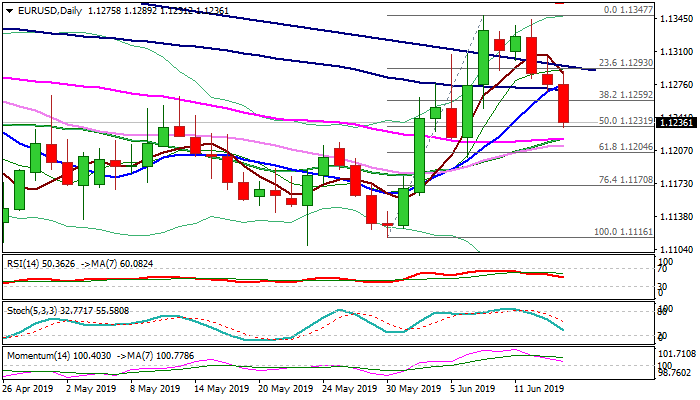
The Euro accelerated lower after Strong US retail sales (May 0.5% vs Apr 0.3%, revised upward from -0.2%) inflated dollar and reduced greatly probability of rate cut on FOMC policy meeting next week. Fresh weakness surged through Fibo support at 1.1259 (38.2% of 1.1116/1.1347) and cracked 50% retracement at 1.1231, approaching key support zone between 1.1218/04 (converged 20/55/30SMA/daily cloud base/Fibo 61.8% of 1.1116/1.1347). Weaker daily techs on south-heading momentum/stochastic/RSI support scenario, with close below daily cloud base, needed to confirm double-top at 1.1347/43 (7/12 June high). Bears may face headwinds from 1.1218/04 support zone and reduce the pace, for consolidation before final break lower. Broken Fibo 38.2% (1.1259) now offers initial resistance, guarding pivotal barriers at 1.1275/79 (broken 100SMA/daily cloud top) which need to stay intact and keep bears in play.
Res: 1.1259; 1.1279; 1.1294; 1.1303
Sup: 1.1218; 1.1204; 1.1170; 1.1160
Aussie Losses Continue as Chinese Industrial Output Slides
AUD/USD has headed lower for a third straight day. In North American trade, AUD/USD is trading at 0.6892, down 0.34% on the day. On the release front, there are no Australian events. In the U.S., consumer spending numbers improved in May. Core retail sales climbed 0.5%, matching the estimate. Retail sales also improved to 0.5%, but fell shy of the forecast of 0.7%. Later in the day, the U.S. releases UoM Consumer Sentiment, which is expected to fall to 98.1, after an outstanding reading of 102.4 in the previous release.
The Australian dollar has had a dreadful week, falling 1.4%. The economy created an outstanding 42.3 thousand jobs in May, but this was not enough to prop up the currency. Investors preferred to focus on the unemployment rate, which remained at 5.2%, higher than the estimate of 5.1%. The currency is under pressure on Friday after soft Chinese manufacturing data. Industrial output was unexpectedly soft, dropping to its lowest level since 2002. The indicator gained 5.0% in May on an annualized basis, well off the forecast of 5.5%. The Aussie is sensitive to Chinese data, as the Asian giant is Australia’s largest trading partner.
As expected, U.S. retail sales data improved sharply in May, and these strong numbers could play a crucial role in the Federal Reserve’s forward guidance for rates. The markets are prepared for rate cuts in the second half of the year. The CME Group has set the odds of a July cut at 62% and another cut in September at 55%. Lower interest rates make the U.S. dollar less attractive to investors, which could be good news for equities.
USD/JPY Mid-Day Outlook
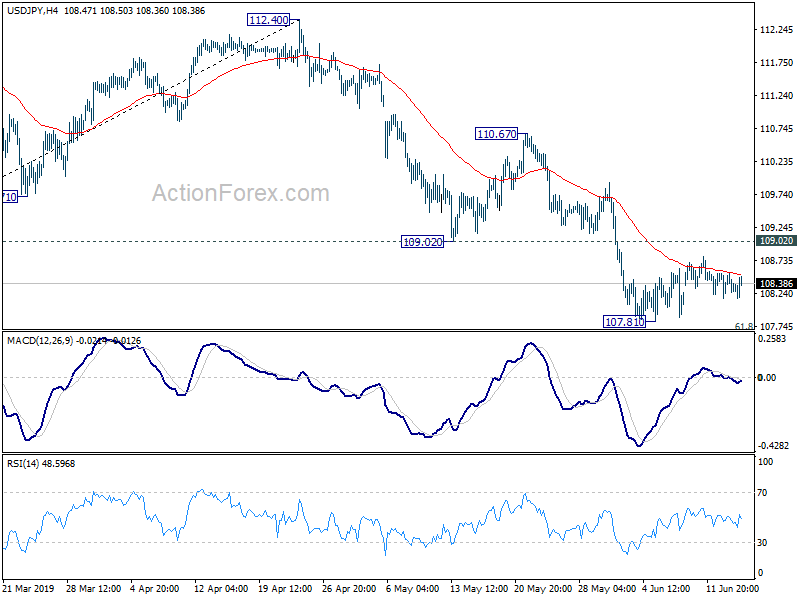
Daily Pivots: (S1) 108.19; (P) 108.37; (R1) 108.56; More...
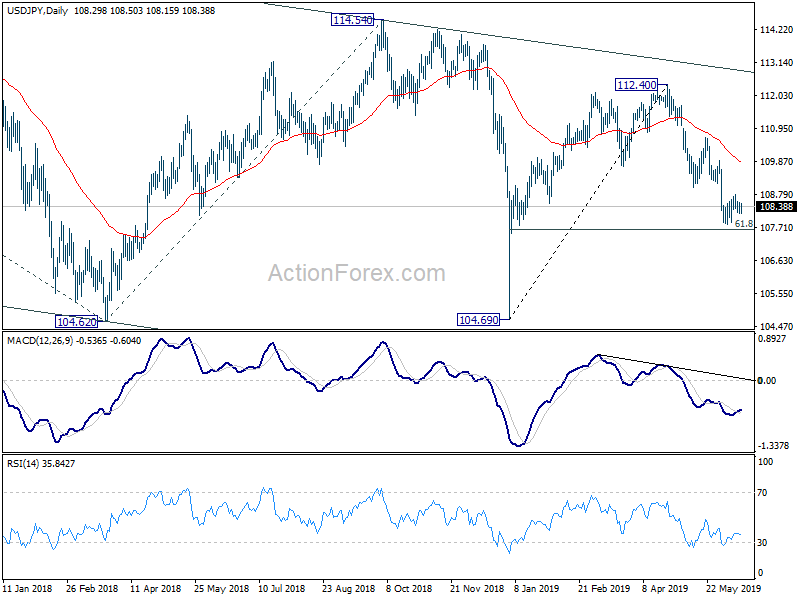
USD/JPY is staying in consolidation from 107.81 and intraday bias remains neutral first. In case of another recovery, upside should be limited by 109.02 support turned resistance to bring fall resumption. On the downside, sustained break of 61.8% retracement of 104.69 to 112.40 at 107.63 will pave the way back to 104.62/9 key support zone. Though, break of 109.02 support turned resistance will indicate short term bottoming and bring lengthier consolidations first.
In the bigger picture, decline from 118.65 (Dec 2016) is still in progress, with the pair staying indicate long term falling channel. Break of 104.62 will target 100% projection of 118.65 to 104.62 from 114.54 at 100.51. For now, we'd expect strong support above 98.97 (2016 low) to contain downside to bring rebound.
USD/CHF Mid-Day Outlook
Daily Pivots: (S1) 0.9916; (P) 0.9938; (R1) 0.9960; More...
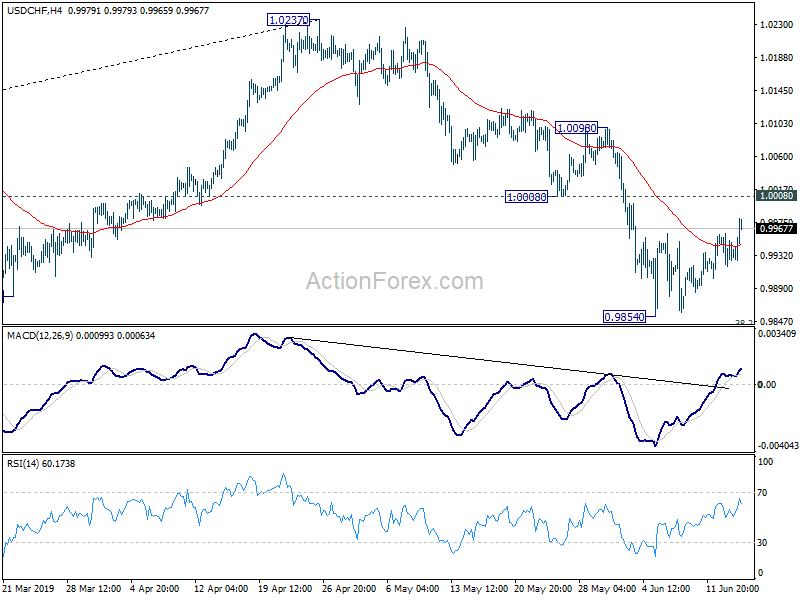
USD/CHF's recovery from 0.9854 extends higher today but outlook is unchanged. We'd still expect upside to be limited by 1.0008 support turned resistance and bring fall resumption. On the downside, break of 0.9854 will extend the decline from 1.0237 to 0.9716 cluster support (50% retracement of 0.9186 to 1.0237 at 0.9712). However, sustained break of 1.0008 will indicate short term bottoming and bring stronger rise back to 1.0098 resistance first.
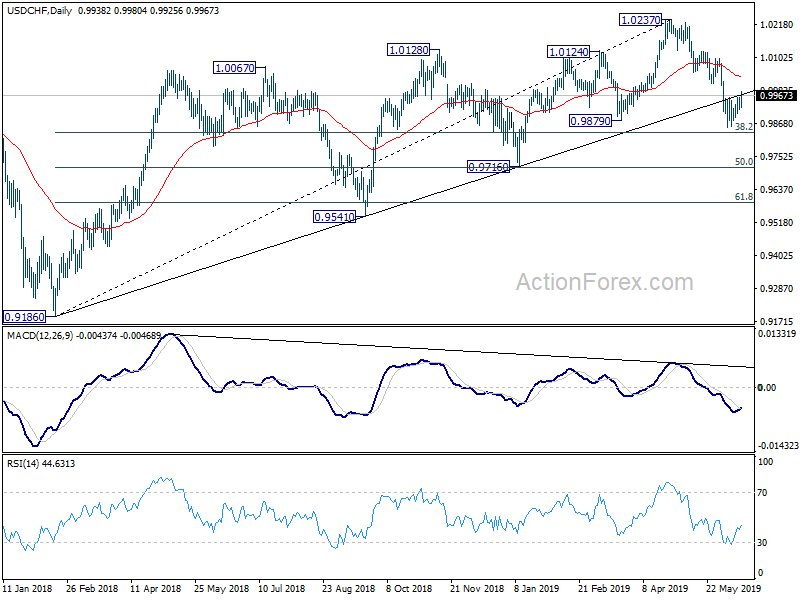
In the bigger picture, USD/CHF's break of long term trend line support is the first indication of medium term reversal. Focus is now back on 0.9879 support. Sustained break should confirm that medium term up trend from 0.9186 has completed at 1.0237 already. Further fall should be seen to 0.9716 cluster support (50% retracement of 0.9186 to 1.0237 at 0.9712) next. Break will target 61.8% retracement at 0.9587.
China’s Economic Data Prove Economy Slowing Down. PBOC Could Follow FOMC in Cutting Interest Rate
Despite the mixed headline readings, China's macroeconomic data in May were in line with our view that the country's economy continues to slow.
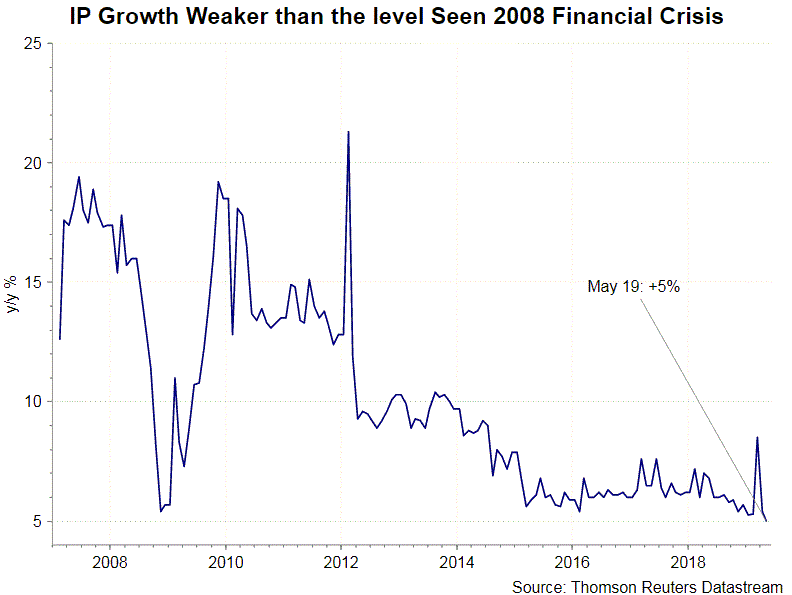
Growth in industrial production fell to 5% y/y, missing consensus of , and April's, 5.4%. IP growth in May marks the lowest growth since 2002. Moreover, this signals a significant decline from averaged expansion of +7% in March- April and +6.5% in 1Q19.
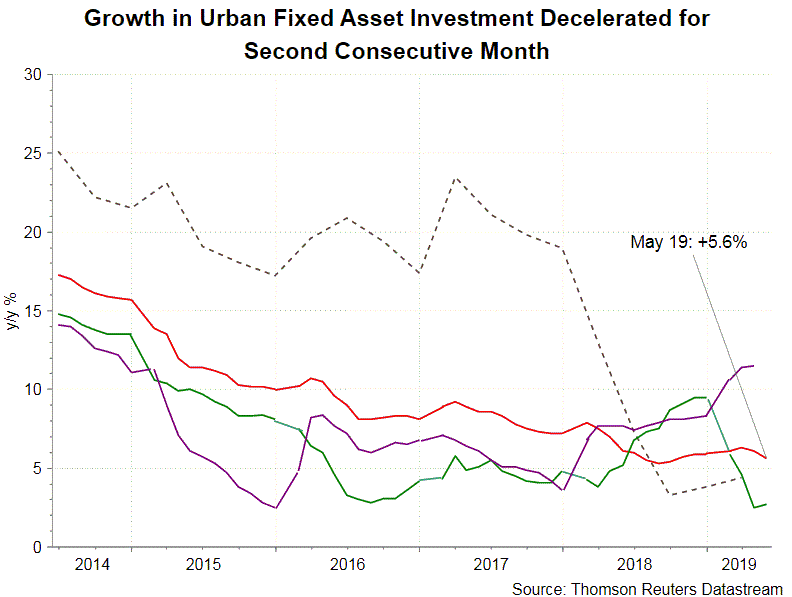
 Urban fixed asset investment expanded +5.6% y/y in the first 5 months of the year, compared with +6.1% in the first 4 months of the year. The market had anticipated it to stabilize at 6.1%. Looking into the details, real estate investment began to moderate. Meanwhile, infrastructure investment failed to improve and manufacturing investment stayed at low levels.
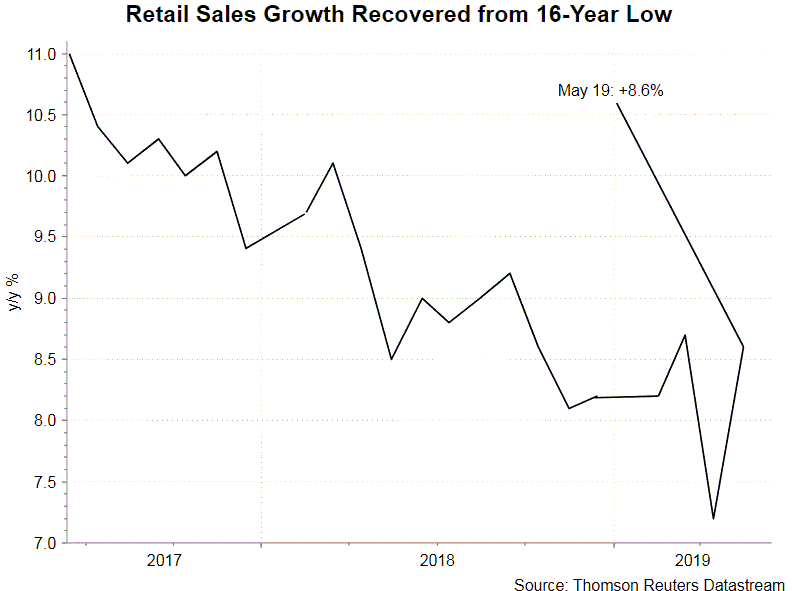
Retail sales growth rebounded to +8.6%, after April's growth dived to +7.2%, a level not seen since 2003. Seasonal factor - a longer May Day holiday this year- also helped boost retail sales.
 Inflation
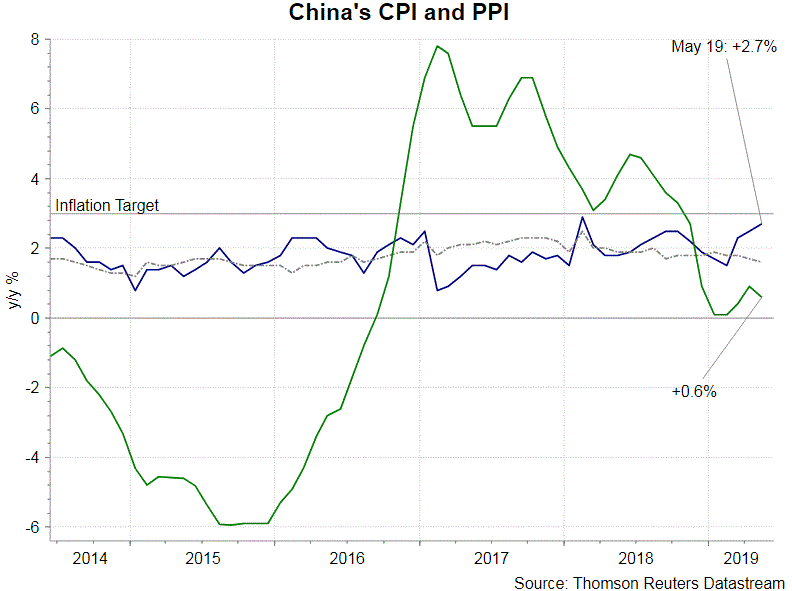
Headline CPI picked up further to +2.7% y/y in May, from +2.5% a month ago. Yet, the improvement was mainly driven by food prices which surged to +7.7% (from April’s +6.1%). Core CPI, excluding food and energy, dipped to a 33-month low of +1.6%. PPI inflation eased to +0.6% y/y, from April’s +0.9%. This was driven by the decline in the prices of commodities, in particular oil, coal and copper.
We expect risks to both CPI and PPI are skewed to the downside. Headline inflation could lose momentum as food prices ease while the weakness in energy prices remains. Softer domestic economy and slowdown in exports growth could reduce demand for commodities and other factors of production, leading to further deceleration in PPI. Indeed, deflation in PPI is likely.
FX Reserve
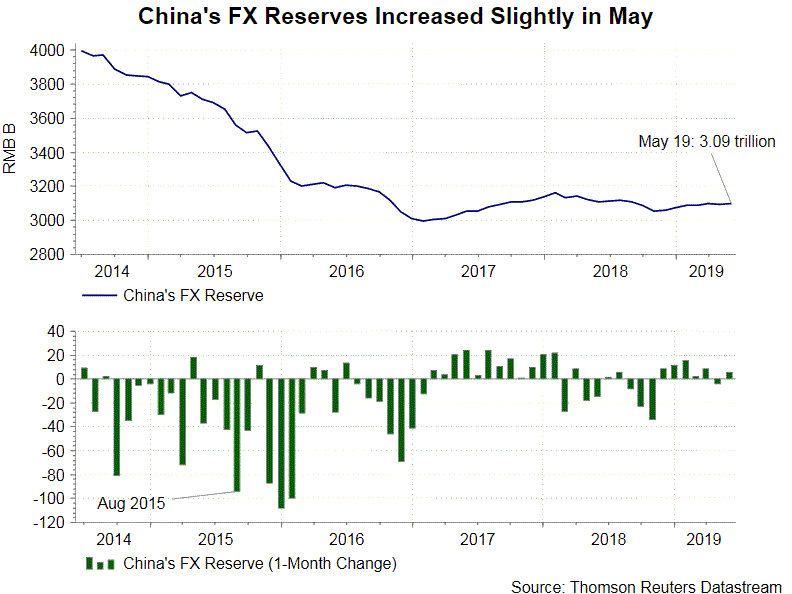
China’s FX reserves increased +US$6B in May to $3.101 trillion, compared with consensus of a decline to US$3.090 trillion. Half of the increase was driven by valuation effect while the rest might be attributed to government’s intervention to weaken renminbi (a.k.a. Yuan, CNY).
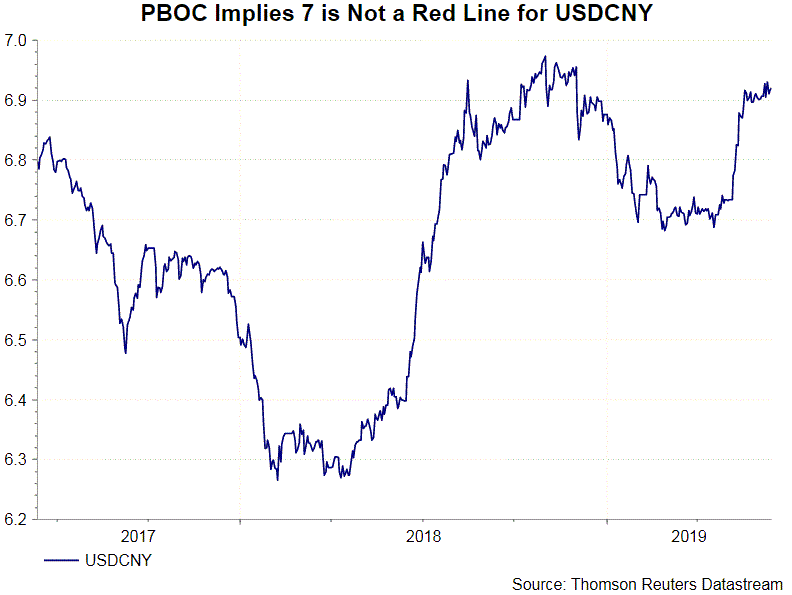
PBOC governor Yi Gang suggested on June 7 that, concerning the movement of renminbi, there’s no number that is more important than other numbers. He added that “a little bit of flexibility of renminbi is good for Chinese economy and global economy, because it provides an automatic stabilizer for the economy”. This has led to some speculations that the government might allow USDCNY to break the level of 7.
PBOC may Cut Rate This Year, Unlikely to Allow USDCNY Breaks 7
So far, PBOC has mainly resorted to RRR cuts in order to encourage bank lending. This is adopted together with fiscal measures. On June, PBOC, MOF and CBIRC announced to loosen restrictions on how local governments can fund infrastructure projects. For instance, eligible local governments are allowed to use proceeds from special bonds as capital for some projects (mainly transportation projects). Also, banks are encouraged to offer loans to projects funded by special bonds. The central bank has refrained from cutting interest rates so as not to accelerate capital outflow. However, we expect the Fed's potential rate cut this year would give more flexibility to PBOC, paving the way for a rate cut in China. As mentioned above, China has attempted to water down the importance of USDCNY at the rate of 7. Yet, we still do not expect the government to allow it to break this psychological level. A breach of which would imply that China's economy has deteriorated so sharply that the government has to ease by massively depreciating its currency. This could undoubtedly lead to severe capital outflow.
GBP/USD Mid-Day Outlook
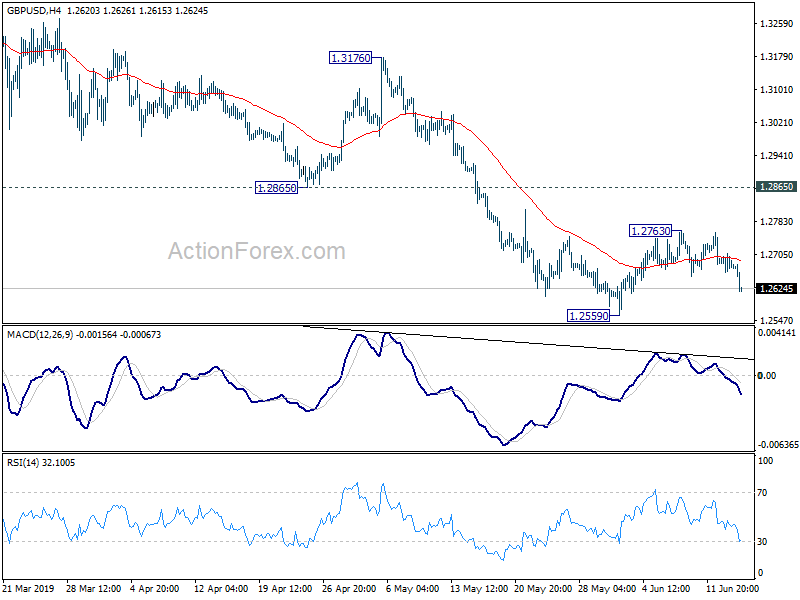
Daily Pivots: (S1) 1.2654; (P) 1.2681; (R1) 1.2700; More....
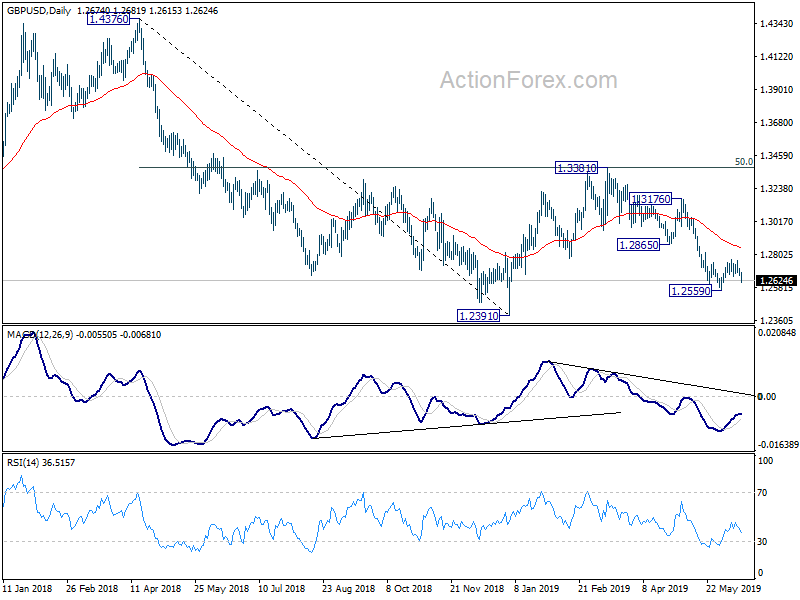
Current development argues that recovery from 1.2559 has completed at 1.2763 already. Intraday bias is mildly on the downside for retesting 1.2559 first. Break will resume larger decline from 1.3381 for 1.2391 low next. On the upside, in case of another rise, upside should be limited by by 1.2865 support turned resistance to bring fall resumption eventually.
In the bigger picture, medium term decline from 1.4376 (2018 high) is possibly ready to resume. Decisive break of 1.2391 would target a test on 1.1946 long term bottom (2016 low). For now, we don't expect a firm break there yet. Hence focus will be on bottoming signal as it approaches 1.1946. In any case, medium term outlook will stay bearish as long as 1.3381 resistance holds, in case of strong rebound.
EUR/USD Mid-Day Outlook
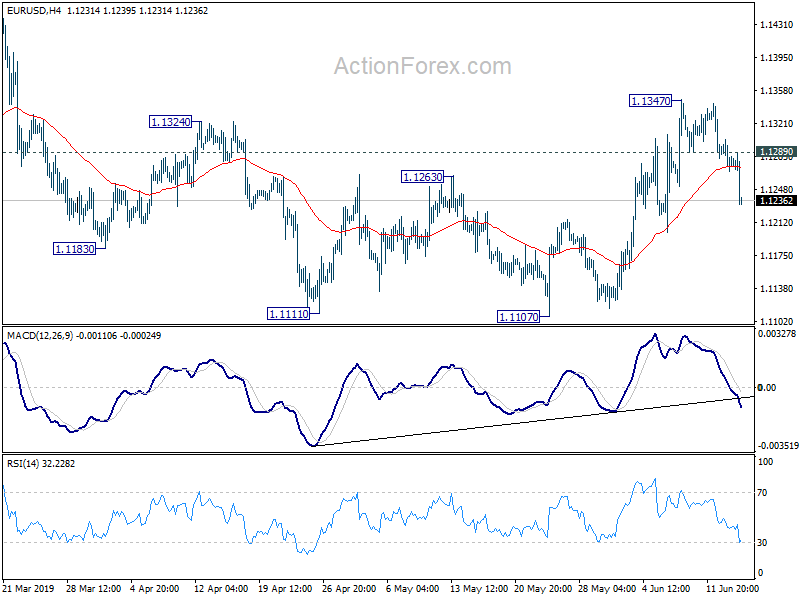
Daily Pivots: (S1) 1.1259; (P) 1.1282; (R1) 1.1299; More......
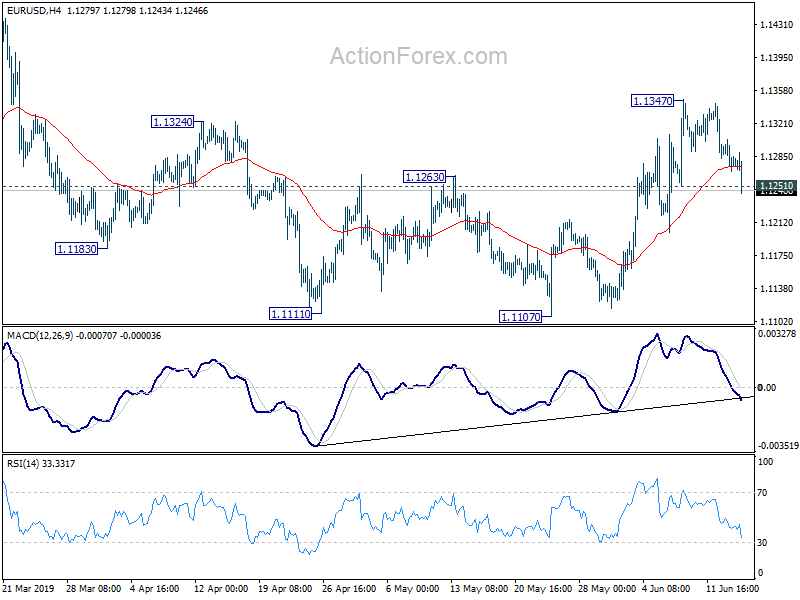
EUR/USD's break of 1.1251 minor support indicates completion of rebound from 1.1107 at 1.1347. Intraday bias is turned to the downside for retesting 1.1107 first. But decisive break there is needed to confirm resumption of larger down trend from 1.2555. Otherwise, more consolidation from 1.1107 might still extend further. On the upside, above 1.1289 minor resistance will turn intraday bias neutral first.
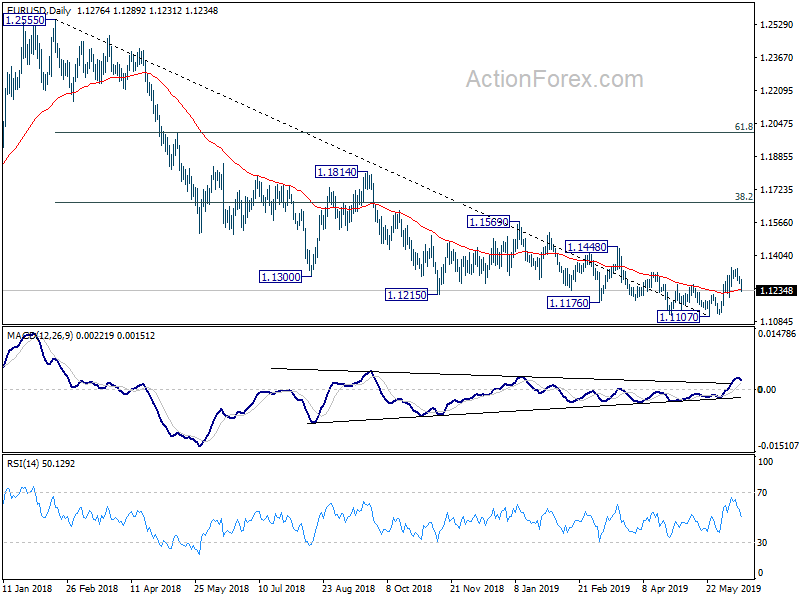
In the bigger picture, current development argues that a medium term bottom could be in place at 1.1107, on bullish convergence condition in daily MACD. Decisive break of 1.1448 resistance would confirm this case. And stronger rebound would be seen to 38.2% retracement of 1.2555 to 1.1107 at 1.1660. At this point, it's early to judge whether rise from 1.1107 is a corrective move or the start of an medium term up trend. We'd look at the structure of the rebound to decide later. But in any case, for now, risk will remain on the upside as long as 1.1107 low holds.
Dollar Rises Broadly on Retail Sales and Industrial Production
Dollar jumps broadly in early US session after solid gain in retail sales in May, with upward revision in April figures. Yen is following as the second strongest on risk aversion, followed by Canadian Dollar. Geopolitical tensions heightened after US blame Iran for attacks on oil tankers yesterday. New Zealand Dollar is currently the weakest one, as pressured by poor manufacturing PMI. Australian Dollar is the second weakest, followed by Sterling.
Technically, EUR/USD's break of 1.1251 minor support suggests that recovery from 1.1107 has completed. And more decline could be seen back to retest 1.1107 low. This follows the break of 122.10 support in EUR/JPY earlier today, which indicates completion of recovery from1 20.78. Focus is now firstly on 136.55 support in GBP/JPY for indicating decline resumption. Nevertheless, USD/JPY looks safe for now with today's recovery.
In Europe, FTSE is currently down -0.43%. DAX is down -0.54%. CAC is down -0.26%. German 10-year yield is down -0.005 at -0.244. Earlier in Asia, Nikkei rose 0.40%. Hong Kong HSI dropped -0.65%. China Shanghai SSE dropped -0.99%. Singapore Strait Times rose 0.06%. Japan 10-year JGB yield dropped -0.0154 to -0.125.
US retail sales rose 0.5%, ex-auto sales rose 0.5%, April's figure revised up
US retail sales rose 0.5% mom in May, below expectation of 0.7% mom. But ex-auto sales rose 0.5% mom, above expectation of 0.4% mom. April's headline sales was revised up from -0.2% mom to 0.3% mom. April's ex-auto sales was also revised up from 0.1% mom to 0.5% mom.
Also from US, industrial production rose 0.4% mom in May, above expectation of 0.2% mom. Capacity utilization rose to 78.1%, above expectation of 78.0%.
ECB Draghi: Policy has neutral effect of bank profitability, lower-income households are main beneficiaries
ECB President Mario Draghi sent separate letters to four Members of the European Parliaments today, explaining the impact of the central bank's monetary policy. There Draghi noted the "overall effect" of ECB's monetary policy on bank profitability has so far been "broadly neutral". The negative impact on banks' net interest margins has been offset by an improvement in the economic outlook that has led to an "increase in the total volume of loans" and, moreover," improved credit quality", which has reduced provisioning costs. Though, he also pledged to carefully monitor the overall effects of negative interest rates.
Draghi also said lending to non-financial corporations (NFCs) "recovered significantly" since the ECB introduced its non-standard monetary policy measures. And overall, the non-standard measures "have contributed to a more uniform transmission of monetary policy to bank lending rates across euro area countries and firm sizes."
Moreover, taking into account both financial and macroeconomic effects, ECB research finds that "lower-income households have been among the main beneficiaries of the ECB's non-standard monetary policy measures, through their positive impact on growth and employment creation."
New Zealand Manufacturing PMI dropped to 50.2, lowest since 2012, downside risks accumulating
New Zealand BusinessNZ Manufacturing PMI dropped to 50.2 in May, down from 52.7. Also, it's the lowest reading since December 2012. BusinessNZ's executive director for manufacturing Catherine Beard said that the drop in activity to its lowest point in over six years was obviously a concern, especially when the sub-index values are examined.
She added: "Production (46.4) was at its lowest value since April 2012, while the other key sub-index of new orders (50.4) only just managed to stay in positive territory. Given the latter feeds through into the former, it does not instil a strong belief that the sector will show solid improvement over the next few months".
BNZ Senior Economist, Doug Steel said that "the PMI sends a warning signal for near term growth via its mix of falling production, near flat new orders, and rising inventory. Next week's Q1 GDP should be reasonable, but beyond this downside risks are accumulating".
Elsewhere
China fixed asset investment rose 5.6% yoy in May, below expectation of 6.1% yoy. Industrial production rose 5.0% yoy, below expectation of 5.4% yoy. Nevertheless, retail sales rose 8.6% yoy, above expectation of 8.0% yoy. Unemployment rate was unchanged at 5.0% . From Japan, industrial production was finalized at 0.6% mom in April.
EUR/USD Mid-Day Outlook
Daily Pivots: (S1) 1.1259; (P) 1.1282; (R1) 1.1299; More......
EUR/USD's break of 1.1251 minor support indicates completion of rebound from 1.1107 at 1.1347. Intraday bias is turned to the downside for retesting 1.1107 first. But decisive break there is needed to confirm resumption of larger down trend from 1.2555. Otherwise, more consolidation from 1.1107 might still extend further. On the upside, above 1.1289 minor resistance will turn intraday bias neutral first.
In the bigger picture, current development argues that a medium term bottom could be in place at 1.1107, on bullish convergence condition in daily MACD. Decisive break of 1.1448 resistance would confirm this case. And stronger rebound would be seen to 38.2% retracement of 1.2555 to 1.1107 at 1.1660. At this point, it's early to judge whether rise from 1.1107 is a corrective move or the start of an medium term up trend. We'd look at the structure of the rebound to decide later. But in any case, for now, risk will remain on the upside as long as 1.1107 low holds.
Economic Indicators Update
| GMT | Ccy | Events | Actual | Forecast | Previous | Revised |
|---|---|---|---|---|---|---|
| 22:30 | NZD | BusinessNZ Manufacturing PMI May | 50.2 | 53 | 52.7 | |
| 04:30 | JPY | Industrial Production M/M Apr F | 0.60% | 0.60% | 0.60% | |
| 07:00 | CNY | Fixed Assets Ex Rural YTD Y/Y May | 5.60% | 6.10% | 6.10% | |
| 07:00 | CNY | Industrial Production Y/Y May | 5.00% | 5.40% | 5.40% | |
| 07:00 | CNY | Retail Sales Y/Y May | 8.60% | 8.00% | 7.20% | |
| 07:00 | CNY | Surveyed Jobless Rate May | 5.00% | 5.00% | ||
| 12:30 | USD | Retail Sales Advance M/M May | 0.50% | 0.70% | -0.20% | 0.30% |
| 12:30 | USD | Retail Sales Ex Auto M/M May | 0.50% | 0.40% | 0.10% | 0.50% |
| 13:15 | USD | Industrial Production M/M May | 0.40% | 0.20% | -0.50% | -0.40% |
| 13:15 | USD | Capacity Utilization May | 78.10% | 78.00% | 77.90% | |
| 14:00 | USD | U. of Mich. Sentiment Jun P | 98 | 100 | ||
| 14:00 | USD | Business Inventories Apr | 0.40% | 0.00% |
US retail sales rose 0.5%, ex-auto sales rose 0.5%, EUR/USD dives
US retail sales rose 0.5% mom in May, below expectation of 0.7% mom. But ex-auto sales rose 0.5% mom, above expectation of 0.4% mom. April's headline sales was revised up from -0.2% mom to 0.3% mom. April's ex-auto sales was also revised up from 0.1% mom to 0.5% mom.
EUR/USD breaks through 1.1251 minor support after the release. The development suggests that rebound from 1.1107 has completed at 1.1347. Intraday bias is now back on the downside for retesting 1.1107 low.