Sample Category Title
EURUSD Quiet Ahead Of ECB Fireworks
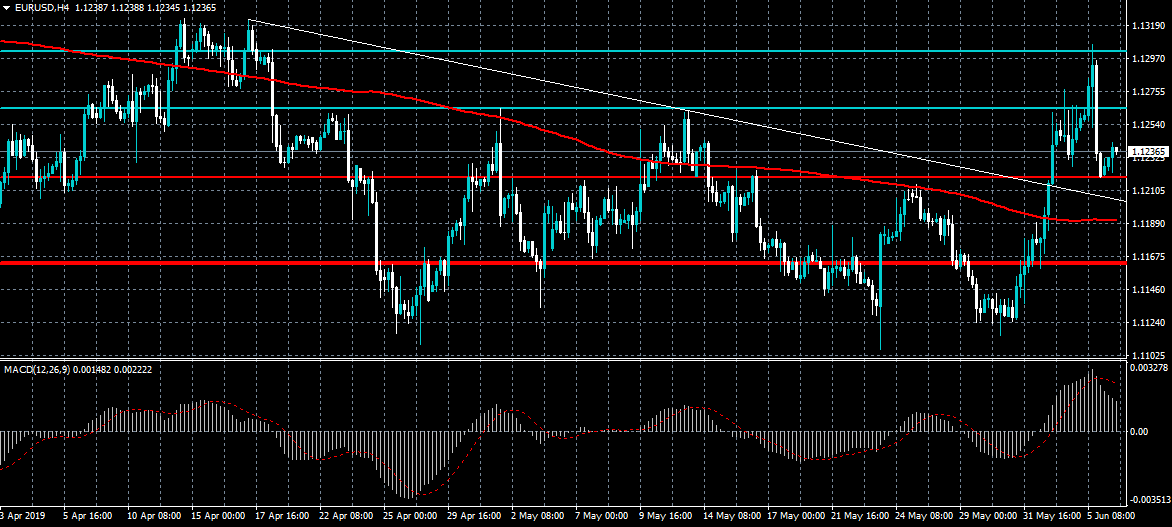
The euro has traded in an increasingly narrow range against the US dollar during the European trading session as traders remain cautious ahead of today’s ECB policy decision. A hawkish tone from ECB President Mario Draghi will likely send the EURUSD pair towards the 1.1320 level. A more bearish view from President Draghi will likely prompt the EURUSD pair to test to the 1.1165 support level.
The EURUSD pair is only bearish while trading below the 1.1200 level, key technical support is found at the 1.1180 and 1.1165 levels.
If the EURUSD pair trades above the 1.1265 level, buyers may test the 1.1300 and 1.1325 levels
AUD/USD Outlook: Near-Term Bias Remains With Bulls But Needs Further Evidence For Confirmation
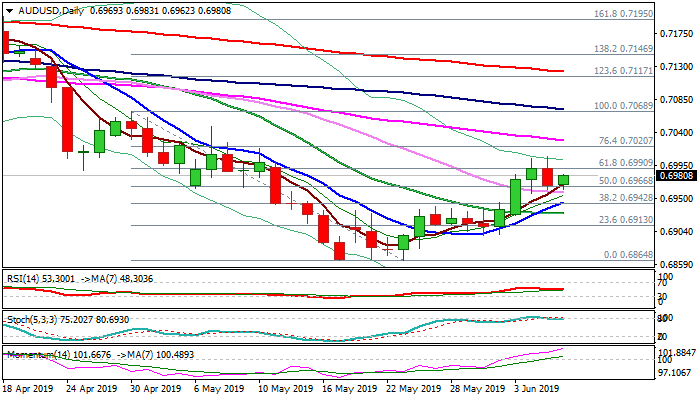
The Australian dollar regains traction on Thursday and pressures psychological 0.70 barrier, with near-term action being supported by broken 30SMA (0.6957).
Wednesday's close in red after repeated failure to close above cracked double-Fibo barrier at 0.6990/94, had so far limited negative impact, as the greenback remains weighed by signs of widening trade conflict.
Near-term action is expected to remain biased higher while above 30SMA, but needs close above 0.6990/94 Fibo's and 0.70 barrier to signal continuation of recovery leg from 0.6864 base.
Strong bullish momentum on daily chart supports scenario, although weighed by stochastics' reversal from overbought zone.
Loss of 30SMA would generate initial bearish signal, with stronger bearish pressure expected on extension below rising 10SMA (0.6943).
Friday's US jobs data could provide fresh direction signals.
Res: 0.6994, 0.7007, 0.7029, 0.7048
Sup: 0.6957, 0.6943, 0.6928, 0.6898
GBP/USD Outlook: Near-Term Action Holds Between 10 And 20SMA’s And Looks For Signal On Break Of Either Side
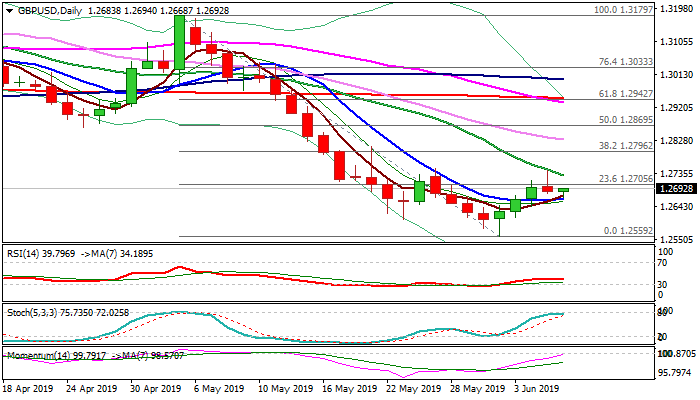
Cable is consolidating above two-day low at 1.2668, reinforced by 10SMA and awaiting fresh signal from today's ECB policy meeting.
Recovery leg from 1.2559 low stalled at 1.2743 (capped by falling 10SMA) and subsequent pullback resulted in formation of inverted hammer candle.
The pair looks for initial direction signal on break of pivotal resistance (20SMA / support (10SMA) which could be provided by ECB's decision.
Conflicting daily indicators (rising momentum / sideways-moving RSI/Stochastic and mixed MA's) lack firmer direction signal for now.
Overall picture remains bearish and weighed by strong concerns about no-deal Brexit, keeping the downside vulnerable.
Loss of 10SMA support (1.2663) would shift near-term focus lower and increase risk of re-visiting 1.2559 low.
Bullish signal could be expected on sustained break above 20SMA that would open pivotal Fibo barrier at 1.2796 (38.2% of 1.3179/1.2559).
Res: 1.2705, 1.2730, 1.2747, 1.2796
Sup: 1.2663, 1.2610, 1.2580, 1.2559
European Update – Bad News Is Good News
Are central banks becoming the only game in town again?
It would appear that we’ve gone back a number of years to a time where bad news is actually good news in the markets, with a poor ADP number on Wednesday seemingly bringing some additional relief to stocks.
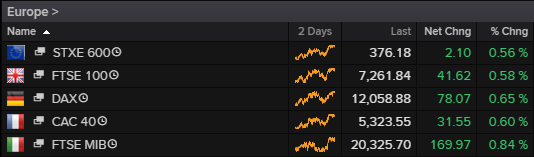
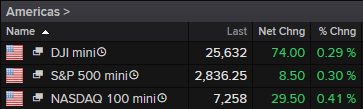
Once again we’re trading in the green on Thursday, with the US also seen edging a little higher, as traders opt to focus on the prospect of more central bank rate cuts rather than why they’re deemed necessary. With Trump making it clear that tariffs are his preferred weapon of choice, whether he’s facing an economic conflict or a border problem, the reality of a slowdown have weighed on the markets leaving investors with little choice but to hope the Fed and other come to the rescue. It’s been a while since that’s been the case.
The result is that we now appear back in the bizarre situation where weaker data, which pressures the central bank into rate cuts, lifts equity markets. On Wednesday, that was the ADP number which – while not being an overly reliable predictor of the NFP – was so bad that expectations for Friday will now be much lower. A bad report on Friday could put a rate cut this month realistically on the table, despite only currently being 20% priced in.
Moreover, a third rate cut this year is now more priced in that not, which seems remarkable when you consider that much of the US data has remained quite strong. With economic pessimism seemingly so backed, a poor report on Friday will not do those odds any favours and will further feed the belief that we’re heading for a tough second half of the year, one in which we’ll have to increasingly rely on the Fed and others.
Does Draghi Have One Last Surprise In Store?
Plenty for traders to be on the lookout for on Thursday
The ECB meeting on Thursday may be an interesting affair given the current global economic environment – one the euro area has shown it’s far from immune to – but we shouldn’t expect any knockout announcements.
- ECB may await Draghi successor
- Traders eye TLTRO III details
- Macroeconomic projections may signal future stimulus
I don’t think anyone would suggest we won’t see further attempts at stimulus over the next 6-12 months – although how they would do that having just wrapped up the QE program would be interesting – but the timing of the meeting may discourage any significant action.
Draghi is due to be replaced as ECB President at the end of October and while his successor hasn’t yet been selected, he may prefer to leave it to them to lead the next phase of the central bank. Perhaps if his predecessor had made a similar choice, the ECB wouldn’t have had to reverse course and cut rates at his first meeting back in November 2011.
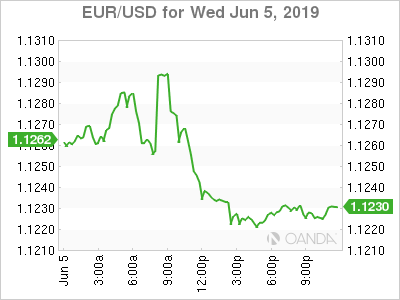
As I said though, that doesn’t mean this won’t be an interesting and potentially market moving meeting. The central bank doesn’t stop just because plans are already underway for its chief’s leaving party.
In fact, another round of TLTROs were recently announced and traders are keen to find out exactly what the terms of it will be. Will they be generous and therefore act as a small stimulus during a difficult period for the region, or will they be less so and rather just intended to ensure the continued flow of liquidity for the regions more stressed banks.
Could the ECB respond to weaker inflation readings?
We’ll also get a new batch of growth and inflation forecasts from the central bank which will be of interest, especially when you consider the direction of travel recently from almost every major central bank.
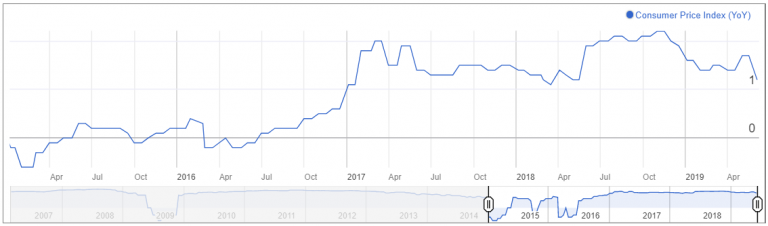
Moreover, the latest dip in inflation suggests the central bank may have to once again get creative, not only to boost growth but also to drive inflation higher, with 1.2% overall and 1% on a core basis not even near the target of below but close to 2%.
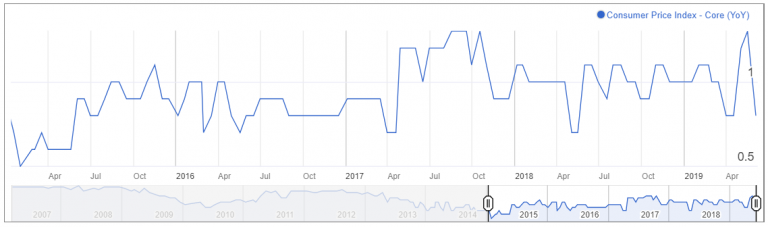
The next ECB President has quite a job on their hand and tomorrow may give us a better idea of just how big a job that is. I think Draghi will think it easy by comparison to what he’s dealt with over the last eight years and fingers crossed, the next President won’t have to rely on a now infamous, euro-saving, “whatever it takes” speech, to prevent the collapse of the common currency.
The Dollar Index Has Moved Away From Local Lows. Trade Tensions Are Still High. We Expect The ECB Meeting
The US dollar is still under pressure against a basket of major currencies. Despite this, the US dollar index (#DX) closed yesterday in the positive zone (+0.26%). Positive statistics on economic activity in the non-manufacturing sector of the US supported the greenback. Meanwhile, the Japanese yen has strengthened against the increasing investor concerns about global trade disputes and the growing demand for safe-haven currencies. As it became known, negotiations between the US and Mexico were not progressive. "Immigration discussions at the White House with representatives of Mexico have ended for the day. Progress is being made, but not nearly enough ... Talks with Mexico will resume tomorrow with the understanding that, if no agreement is reached, Tariffs at the 5% level will begin on Monday, with monthly increases as per schedule," – wrote D. Trump on Twitter.
Yesterday, the Fed's Beige Book was published, according to which the growth rate of economic activity was generally restrained from April to mid-May in the US. In the previous period, growth rates were assessed as weak. Uncertainty in world trade relations, as well as a lack of skilled staff are the main risks for the economy. Today, the financial market participants are focused on the ECB meeting. It is expected that the regulator will keep the key marks of monetary policy at the same level. We recommend paying attention to the speech by the head of the Central Bank, Mario Draghi.
The "black gold" prices recovered part of the losses after a sharp collapse the day before. At the moment, futures for the WTI crude oil are testing the mark of $52.00 per barrel.
Market Indicators
- Yesterday, the aggressive purchases were observed in the US stock market: #SPY (+0.87%), #DIA (+0.82%), #QQQ (+0.74%).
- The 10-year US government bonds yield is consolidating. Currently, the indicator is at the level of 2.11-2.12%.
The news feed on 2019.06.06:
- Eurozone GDP at 12:00 (GMT+3:00);
- ECB interest rate decision at 14:45 (GMT+3:00);
- Ivey PMI at 17:00 (GMT+3:00).
Trade Duty Threats Weigh On MXN
Times have become difficult for December-elected President Andres Manuel Lopez Obrador. US President unexpected threat of implementing tariffs on all exports to the US set for next Monday as well as recent Fitch downgrade and Moody's negative outlook could push the country into a recession.
Mexico's heavy reliance on external trade makes the country much more sensitive to potential trade war effects. Total exports contribution to GDP accounts for 35% or over $450 billion, while US exports are estimated at 80% of the total. Therefore, a unique tariff slap from the US of 5% would imply duties of $18 billion worth and if no convincing solutions are presented by Mexican Foreign Ministry to stem illegal immigration, the rise could set at 10% on 1 July and then increase by five percentage points each month until October 25% threshold is reached. Although this scenario is yet far from being reasonable, USD/MXN grew +2.89% as the announcements made by Fitch and Moody's added oil to the fire. Fitch cut Mexico's sovereign debt to BBB, at the border between investment grade and junk status, while Moody's followed S&P and cut its outlook to negative due to AMLO's $8 billion refinery spending plan, Petroleos Mexicanos, the state-owned and world's most indebted oil company as well as recent trade tensions with Mexico's first commercial partner. While the recent decision offsets positive sentiment from last week over USMCA trade of steel and aluminum, we expect Mexican peso to remain under pressure short-term until final call. In the event of a no-deal, we should see upside risks to inflation, which the Banxico would defend by maintaining high interest rates (Overnight rate: 8.25%) and tight monetary conditions, at the cost of economic growth. In the opposite scenario, Mexican peso would benefit from a push. A last-minute deal is however very likely.
NZD/USD Analysis: Anatwo Scenarios Likely
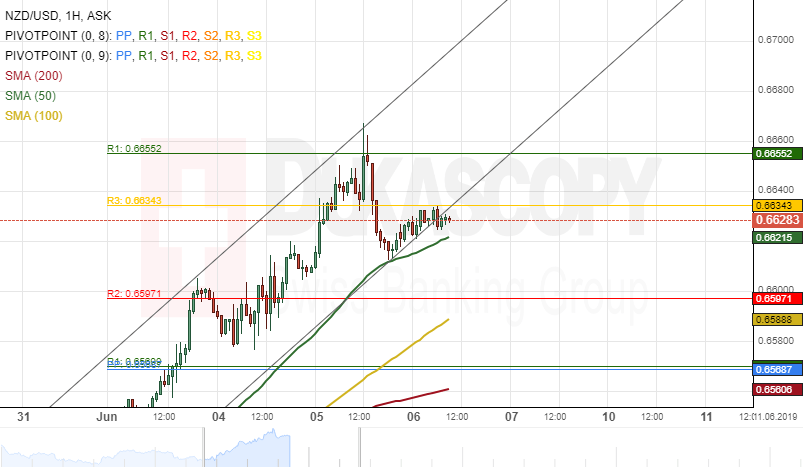
The New Zealand Dollar has been appreciating in a narrow ascending channel pattern against the US Dollar since the end of May. The currency pair re-tested the upper boundary of the channel pattern at 0.6666 during yesterday's trading session.
The 50-hour simple moving average is currently providing support for the exchange rate at 0.6619.
If the support line holds, a surge towards the 0.6680 mark could follow within this session.
However, if the NZD/USD pair passes the 50-hour SMA, bears could drag the rate towards the weekly R2 at 0.6597 in the short-term.
AUD/USD Analysis: Tests 100-Hour SMA
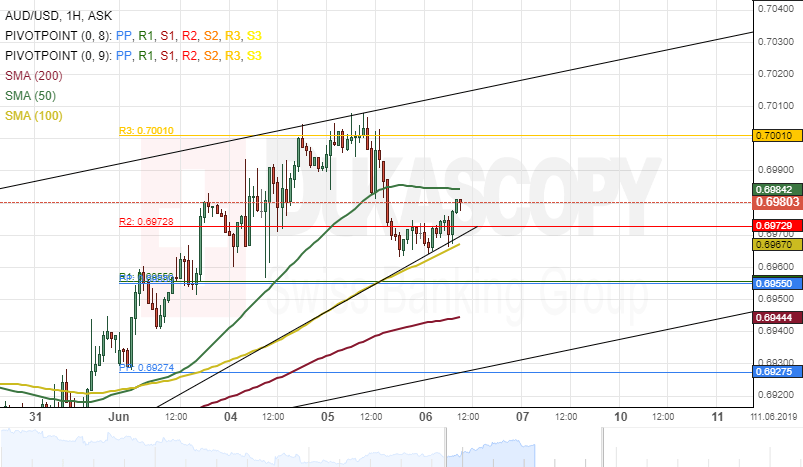
The Australian Dollar depreciated about 42 base points against the US Dollar on Wednesday. The decline was stopped by a support level formed by the 100-hour simple moving average at 0.6965.
If the support level set by the 100-hour SMA holds, the AUD/USD currency pair will continue its upside swing during the following trading session.
However, if the currency exchange rate breaks the support line as mentioned above, a decline towards the 200-hour SMA at 0.6943 could be expected in the nearest future.
USD/CAD Analysis: Sets For Breakout
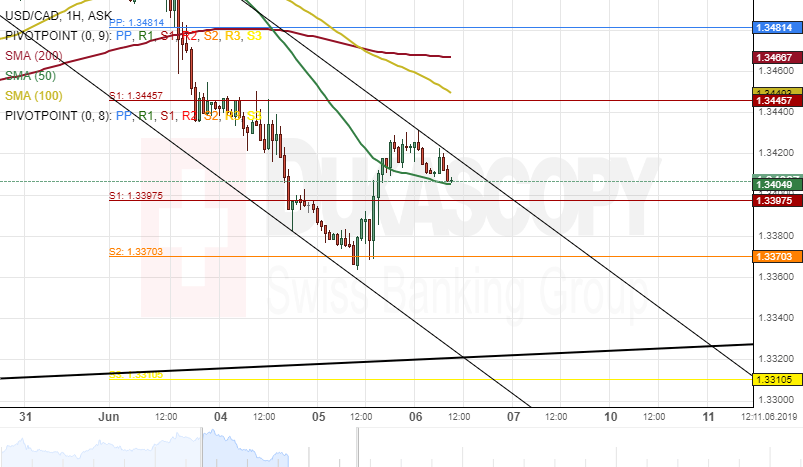
The US Dollar has been depreciating in a descending channel pattern against the Canadian Dollar since the end of May. The currency pair reached near a three-week low at 1.3360 on Wednesday.
The exchange rate is currently trading near the upper boundary of the descending channel pattern at 1.3421 and could be set for a breakout.
If this breakout occurs, a surge towards the resistance cluster formed by the combination of the 100– and 200-hour SMAs at 1.3467 during the following trading session.
However, if the channel pattern holds, bears could aim for the weekly S2 at 1.3370 within this session.