Sample Category Title
US jobless claims unchanged at 218k, trade deficit dropped to USD 50.8B
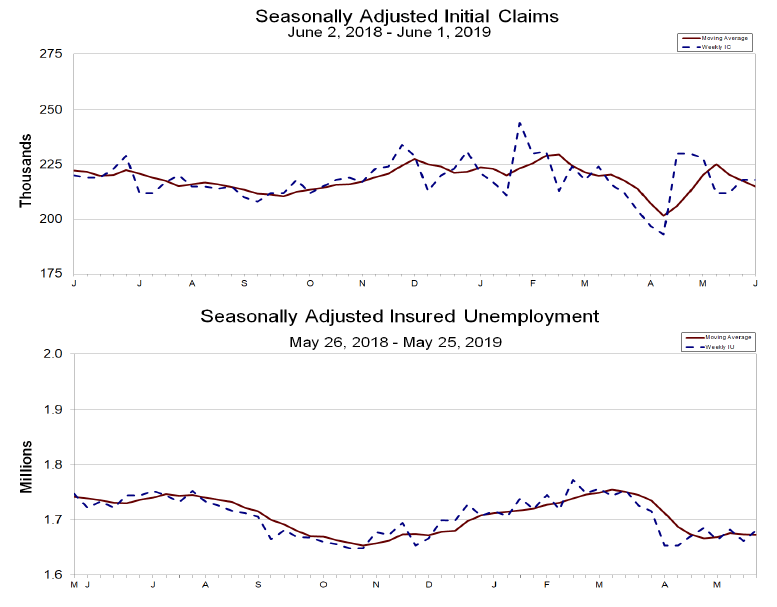
US initial jobless claims was unchanged at 218k in the week ending June 1, slightly above expectation of 215k. Four-week moving average of initial claims dropped -2.5k to 215k. Continuing claims rose 20k to 1.682m in the week ending May 25. Four-week moving average of continuing claims dropped -1k to 1.673m.
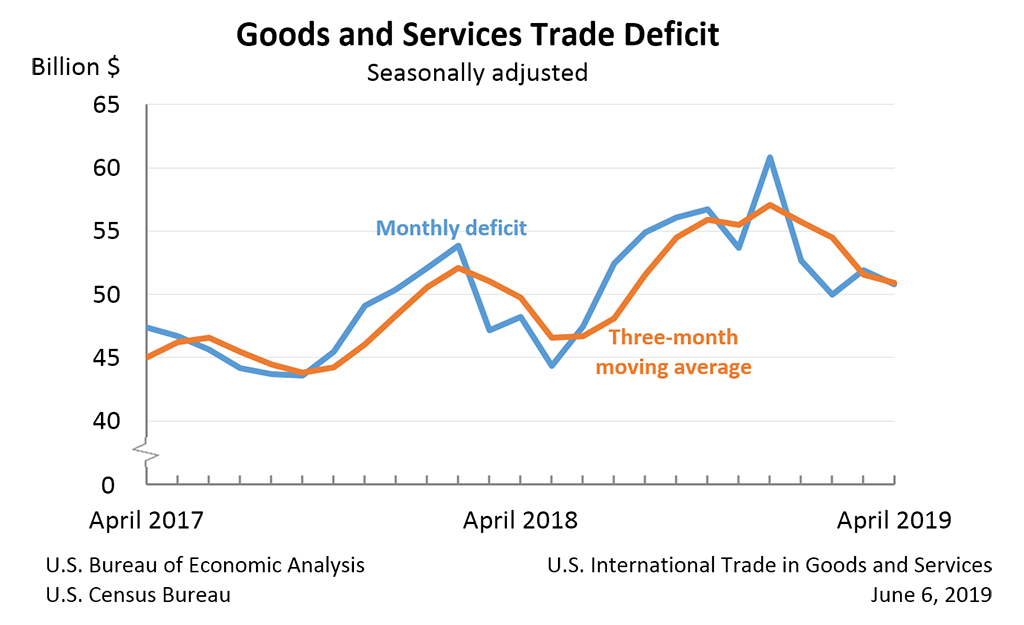
Trade deficit dropped -2.1% to USD -50.8B, slightly larger than expectation of USD -50.5B. Exports dropped -2.2% to USD 206.8B. Imports dropped -2.2% to USD 257.6B.
With China, in April, deficit increased USD 2.1B to USD 29.4B. Exports decreased USD 1.8B to USD 8.5B and imports increased USD 0.3B to USD 37.9B. In Q1 after revisions, deficit decreased USD 22.9B to USD 80.8B. Exports increased USD 4.9B to USD 41.4B and imports decreased USD 18.0B to USD 122.2B.
GBPCAD is Neutral in Very Short-Term; Advances are Expected
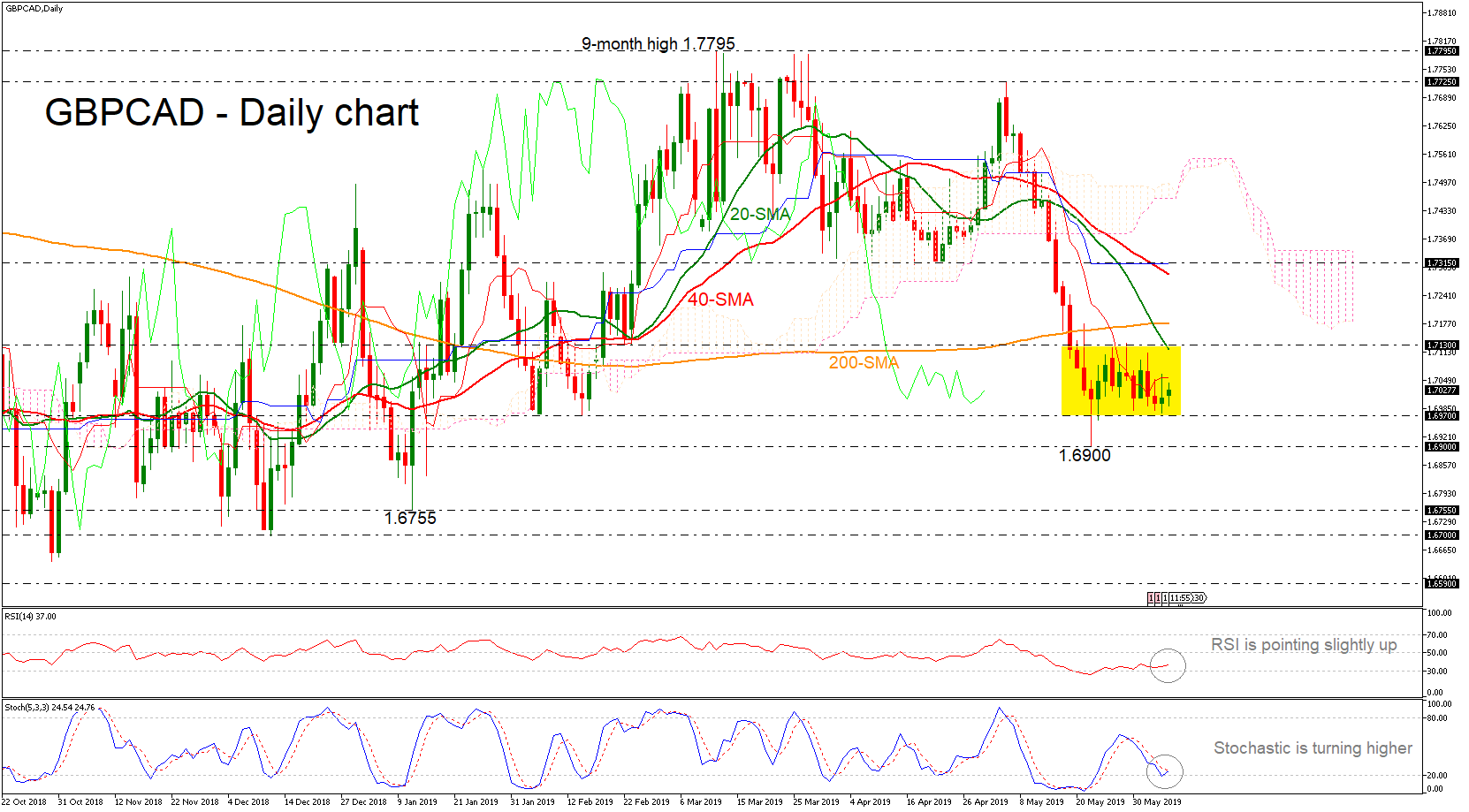
GBPCAD has been on the sidelines for the most part of the week as the 1.7130 level seems to be a real struggle for the bulls. Technically, the price could lose some ground in the short-term as the RSI is flattening near the 30 mark, while the stochastics are warning of an oversold market, but it seems to be turning higher in the daily chart.
A rebound on the 1.6970 support could keep the pair in a narrow range, challenging again the 1.7130 resistance, where the 20-day simple moving average (SMA) is currently located. Should the price overcome this level, resistance could run up to the 1.7315 barrier, which overlaps with the blue Kijun-sen line.
A decline under 1.6970, could meet a strong barrier at the 1.6900 psychological level. Breaking this level, the 1.6755 and 1.6700 obstacles could take control for more bearish structure.
In the short-term picture, GBPCAD is pointing down over the past month, framing a negative profile. A strong rally below 1.6970 would extend the downward movement.
ECB press conference live stream
https://www.youtube.com/watch?v=BgH4GaBIsLE&feature=youtu.be
INTRODUCTORY STATEMENT
Ladies and gentlemen, the Vice-President and I are very pleased to welcome you to our press conference. I would like to thank Chairman of the Board Vasiliauskas for his kind hospitality and express our special gratitude to his staff for the excellent organisation of today's meeting of the Governing Council. We will now report on the outcome of our meeting.
Based on our regular economic and monetary analyses, we have conducted a thorough assessment of the economic and inflation outlook, also taking into account the latest staff macroeconomic projections for the euro area. As a result, the Governing Council took the following decisions in the pursuit of its price stability objective.
First, we decided to keep the key ECB interest rates unchanged. We now expect them to remain at their present levels at least through the first half of 2020, and in any case for as long as necessary to ensure the continued sustained convergence of inflation to levels that are below, but close to, 2% over the medium term.
Second, we intend to continue reinvesting, in full, the principal payments from maturing securities purchased under the asset purchase programme for an extended period of time past the date when we start raising the key ECB interest rates, and in any case for as long as necessary to maintain favourable liquidity conditions and an ample degree of monetary accommodation.
Third, regarding the modalities of the new series of quarterly targeted longer-term refinancing operations (TLTRO III), we decided that the interest rate in each operation will be set at a level that is 10 basis points above the average rate applied in the Eurosystem's main refinancing operations over the life of the respective TLTRO. For banks whose eligible net lending exceeds a benchmark, the rate applied in TLTRO III will be lower, and can be as low as the average interest rate on the deposit facility prevailing over the life of the operation plus 10 basis points.
A press release with further details of the terms of TLTRO III will be published at 15:30 CET today.
The Governing Council also assessed that, at this point in time, the positive contribution of negative interest rates to the accommodative monetary policy stance and to the sustained convergence of inflation is not undermined by possible side effects on bank-based intermediation. However, we will continue to monitor carefully the bank-based transmission channel of monetary policy and the case for mitigating measures.
Today's monetary policy decisions were taken to provide the monetary accommodation necessary for inflation to remain on a sustained path towards levels that are below, but close to, 2% over the medium term. Despite the somewhat better than expected data for the first quarter, the most recent information indicates that global headwinds continue to weigh on the euro area outlook. The prolonged presence of uncertainties, related to geopolitical factors, the rising threat of protectionism and vulnerabilities in emerging markets, is leaving its mark on economic sentiment.
At the same time, further employment gains and increasing wages continue to underpin the resilience of the euro area economy and gradually rising inflation. Today's policy measures ensure that financial conditions will remain very favourable, supporting the euro area expansion, the ongoing build-up of domestic price pressures and, thus, headline inflation developments over the medium term. Looking ahead, the Governing Council is determined to act in case of adverse contingencies and also stands ready to adjust all of its instruments, as appropriate, to ensure that inflation continues to move towards the Governing Council's inflation aim in a sustained manner.
Let me now explain our assessment in greater detail, starting with the economic analysis. Euro area real GDP rose by 0.4%, quarter on quarter, in the first quarter of 2019, following an increase of 0.2% in the fourth quarter of 2018. However, incoming economic data and survey information point to somewhat weaker growth in the second and third quarters of this year. This reflects the ongoing weakness in international trade in an environment of prolonged global uncertainties, which are weighing, in particular, on the euro area manufacturing sector. At the same time, the euro area services and construction sectors are showing resilience and the labour market is continuing to improve. Looking ahead, the euro area expansion will continue to be supported by favourable financing conditions, the mildly expansionary euro area fiscal stance, further employment gains and rising wages, and the ongoing – albeit somewhat slower – growth in global activity.
This assessment is broadly reflected in the June 2019 Eurosystem staff macroeconomic projections for the euro area. These projections foresee annual real GDP increasing by 1.2% in 2019, 1.4% in 2020 and 1.4% in 2021. Compared with the March 2019 ECB staff macroeconomic projections, the outlook for real GDP growth has been revised up by 0.1 percentage points for 2019 and has been revised down by 0.2 percentage points for 2020 and by 0.1 percentage points for 2021.
The risks surrounding the euro area growth outlook remain tilted to the downside, on account of the prolonged presence of uncertainties, related to geopolitical factors, the rising threat of protectionism and vulnerabilities in emerging markets.
According to Eurostat's flash estimate, euro area annual HICP inflation was 1.2% in May 2019, after 1.7% in April, reflecting mainly lower energy and services price inflation. On the basis of current futures prices for oil, headline inflation is likely to decline over the coming months, before rising again towards the end of year. Looking through the recent volatility due to temporary factors, measures of underlying inflation remain generally muted, but labour cost pressures continue to strengthen and broaden amid high levels of capacity utilisation and tightening labour markets. Looking ahead, underlying inflation is expected to increase over the medium term, supported by our monetary policy measures, the ongoing economic expansion and stronger wage growth.
This assessment is also broadly reflected in the June 2019 Eurosystem staff macroeconomic projections for the euro area, which foresee annual HICP inflation at 1.3% in 2019, 1.4% in 2020 and 1.6% in 2021. Compared with the March 2019 ECB staff macroeconomic projections, the outlook for HICP inflation has been revised up by 0.1 percentage points for 2019 and revised down by 0.1 percentage points for 2020.
Turning to the monetary analysis, broad money (M3) growth stood at 4.7% in April 2019, after 4.6% in March. Sustained rates of broad money growth reflect ongoing bank credit creation for the private sector and low opportunity costs of holding M3. The narrow monetary aggregate M1 continues to be the main contributor to broad money growth on the components side.
The annual growth rate of loans to non-financial corporations increased to 3.9% in April 2019, from 3.6% in March. Beyond short-term volatility, the annual growth rate of loans to non-financial corporations has moderated somewhat in recent months from its peak in September 2018, reflecting the typical lagged reaction to the slowdown in economic growth observed over the course of 2018. The annual growth rate of loans to households stood at 3.4% in April, compared with 3.3% in March, continuing its gradual improvement.
The monetary policy measures taken today, including TLTRO III, will help to safeguard favourable bank lending conditions and will continue to support access to financing, in particular for small and medium-sized enterprises.
To sum up, a cross-check of the outcome of the economic analysis with the signals coming from the monetary analysis confirmed that an ample degree of monetary accommodation is still necessary for the continued sustained convergence of inflation to levels that are below, but close to, 2% over the medium term.
In order to reap the full benefits from our monetary policy measures, other policy areas must contribute more decisively to raising the longer-term growth potential and reducing vulnerabilities. The implementation of structural reforms in euro area countries needs to be substantially stepped up to increase resilience, reduce structural unemployment and boost euro area productivity and growth potential. The 2019 country-specific recommendations should serve as the relevant signpost. Regarding fiscal policies, the mildly expansionary euro area fiscal stance is providing support to economic activity. At the same time, countries where government debt is high need to continue rebuilding fiscal buffers. All countries should reinforce their efforts to achieve a more growth-friendly composition of public finances. Likewise, the transparent and consistent implementation of the European Union's fiscal and economic governance framework over time and across countries remains essential to bolster the resilience of the euro area economy. Improving the functioning of Economic and Monetary Union remains a priority. The Governing Council welcomes the ongoing work and urges further specific and decisive steps to complete the banking union and the capital markets union.
We are now at your disposal for questions.
WTI Crude – About to Break $50?
Inventory data weighs heavily on crude prices
Crude prices have also been given some reprieve over the last few days, albeit to a lesser extent, with a large inventory build once again weighing on Wednesday.
Safe to say, the 6.8 million barrel increase reported by EIA came as quite a surprise prompting a more than 4% drop in WTI over the following hour or so. This was almost double the build API reported a day earlier and far exceeded expectations.
Both WTI and Brent did bounce back from the setback, aided by the stronger performance in the stock markets on the back of comments from various Fed officials including Chair Powell, not to mention a weak ADP number. WTI now finds itself around 1.3% off the pre-release levels.
WTI Daily Chart
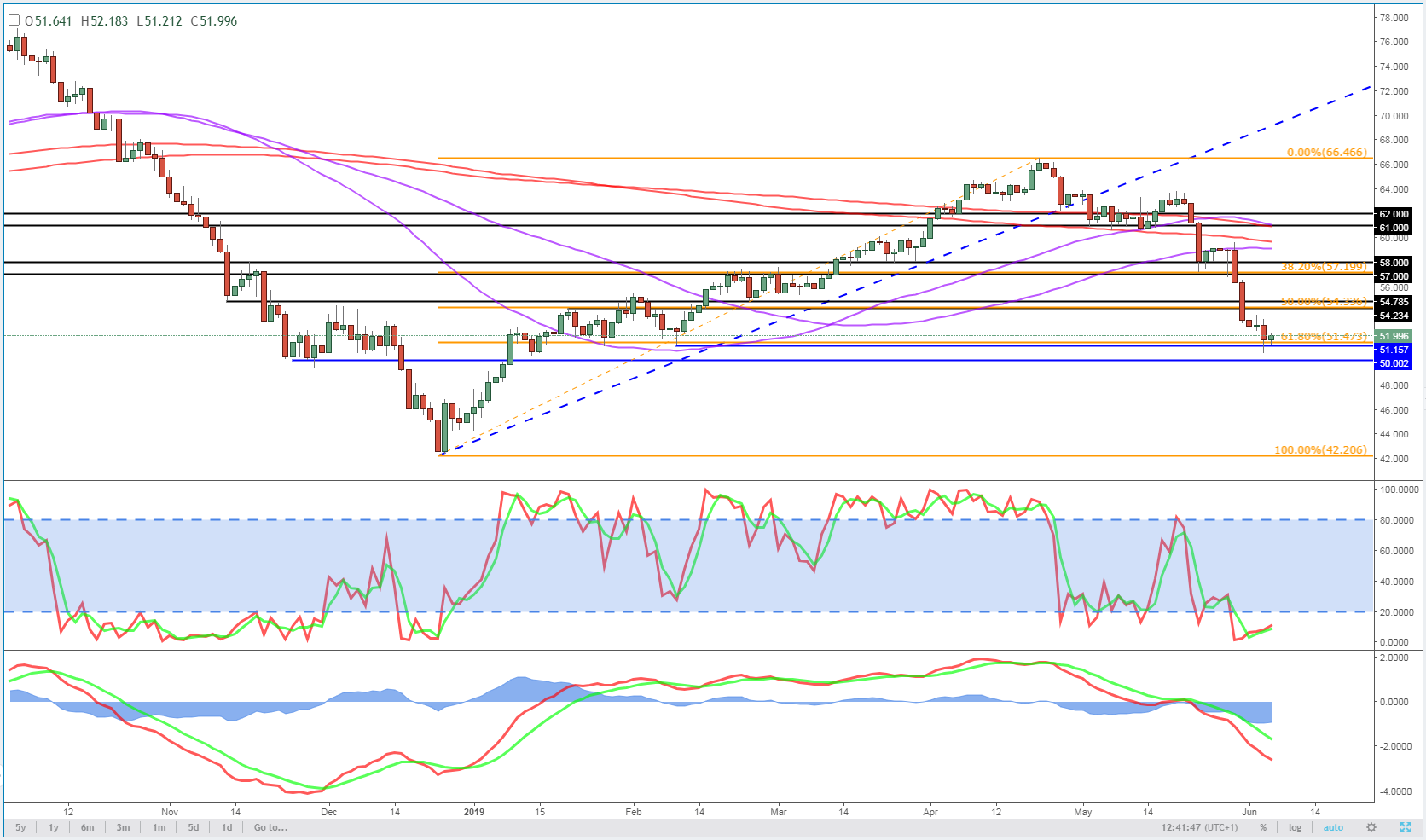
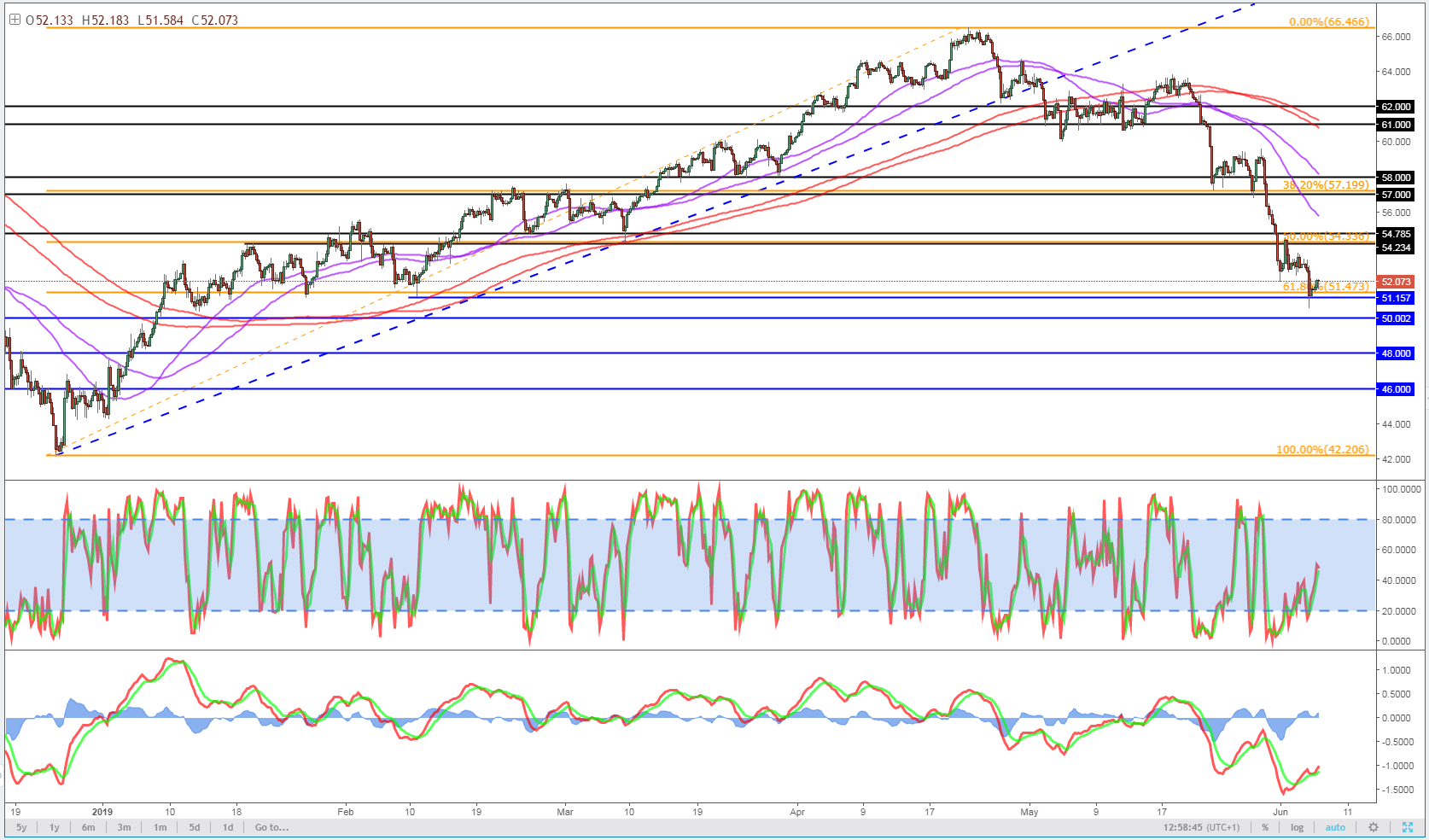
The question now is whether the improved sentiment will be sustained to support a rebound in oil prices, or whether $50 will come under pressure earlier than some may have expected. And if $50 does come under pressure, how well supported will it remain? It’s clearly a major support level, having already held, but also representing prior support and roughly the 61.8% retracement from the end of December lows to this year’s highs.
Should this level break, it would be both psychologically and technically significant which could make the following price action very interesting. Further support below may be found around $48 and $46, having been notable levels earlier in the year.
WTI 4-Hour Chart
EURUSD Rejects Higher Prices, Weakens
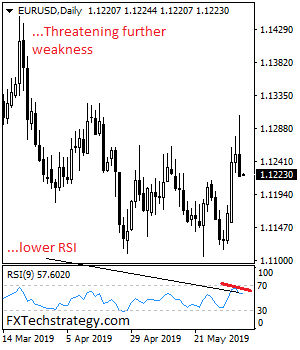
EURUSD rejects higher prices, weakens as it lost upside pressure on Wednesday. Support comes in at the 1.1200 where a violation will turn risk to the 1.1150 level. A break below here will target the 1.1100 level. Further down, support sits at the 1.1050. Conversely, on the upside, resistance resides at 1.1300 level with a break through there opening the door for further upside towards the 1.1350 level. Further up, resistance comes in at the 1.1400 level where a violation will expose the 1.1450 level. All in all, EURUSD continues to threaten further upside pressure on correction.
ECB keeps interest rate at 0.00%, will stay there through H1 2020
ECB left interest rates unchanged today as widely expected. That is, main refinancing, marginal lending and deposit rates are kept at 0.00%, 0.25% and -0.40% respectively.
ECB changed the forwards guidance and said interest rates will remainat present levels "at least through the first half of 2020, longer than "the end of 2019". ECB also announce the rates of TLTRO III opertaions.
Full release below.
Monetary Policy Decisions
At today's meeting, which was held in Vilnius, the Governing Council of the European Central Bank (ECB) took the following monetary policy decisions:
(1) The interest rate on the main refinancing operations and the interest rates on the marginal lending facility and the deposit facility will remain unchanged at 0.00%, 0.25% and -0.40% respectively. The Governing Council now expects the key ECB interest rates to remain at their present levels at least through the first half of 2020, and in any case for as long as necessary to ensure the continued sustained convergence of inflation to levels that are below, but close to, 2% over the medium term.
(2) The Governing Council intends to continue reinvesting, in full, the principal payments from maturing securities purchased under the asset purchase programme for an extended period of time past the date when it starts raising the key ECB interest rates, and in any case for as long as necessary to maintain favourable liquidity conditions and an ample degree of monetary accommodation.
(3) Regarding the modalities of the new series of quarterly targeted longer-term refinancing operations (TLTRO III), the Governing Council decided that the interest rate in each operation will be set at a level that is 10 basis points above the average rate applied in the Eurosystem's main refinancing operations over the life of the respective TLTRO. For banks whose eligible net lending exceeds a benchmark, the rate applied in TLTRO III will be lower and can be as low as the average interest rate on the deposit facility prevailing over the life of the operation plus 10 basis points.
The President of the ECB will comment on the considerations underlying these decisions at a press conference starting at 14:30 CET today.
Onto The ECB
The pivot towards economic data is in full swing as the Fed and market participants try to figure out how the trade war is affecting the real economy. The US dollar rebounded Wednesday but it was a rough ride. The ECB decision is next and the main question is whether any more dovishness from Draghi will keep the euro capped (more below). A new Index trade was issued yesterday for Premium susbcribers.
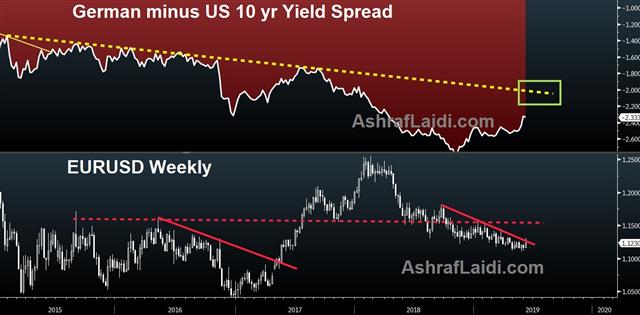
The market's fresh focus on economic data was on full display Wednesday. The weakest ADP reading in nine-years sent USD/JPY to the lowest since early January but a solid ISM non-manufacturing survey 90 minutes later prompted a U-turn.
Even with the turn in data, the market isn't exactly sure what it wants. The bond market is entirely focused on the Fed and the front end of the Treasury curve rallied once again and yields touched new lows. Stock markets like the idea of rate cuts but hate the idea of weaker growth so that's a balancing act that can change day-to-day. The FX market is also caught in the middle.
USD/JPY and USD/CHF are straight-forward USD-negatives on bad news but other USD pair reactions depend on if US economic weakness is contained or another dynamic that will cause central banks elsewhere to ease. Generally, it's the latter but on tariff-specific news the dollar can suffer solo.
On that front, the first day of US-Mexico meetings ended without a deal as Lopez-Obrador's team asked for US help and funds to stem the flow of migrants, among other requests. Talks will continue and the come after Fitch downgraded Mexico and Moody's lowered its outlook.
Those headlines will be key late in the day but earlier the focus will be on Draghi's press conference. The market will be looking for TLTRO details and the possible introduction of a tiering system for deposit rates. Economic forecasts could also be trimmed but the reaction to that will depend on how Draghi frames it. Expect plenty of hand-wringing about global trade.
(ECB) Monetary Policy Decisions
At today's meeting, which was held in Vilnius, the Governing Council of the European Central Bank (ECB) took the following monetary policy decisions:
(1) The interest rate on the main refinancing operations and the interest rates on the marginal lending facility and the deposit facility will remain unchanged at 0.00%, 0.25% and -0.40% respectively. The Governing Council now expects the key ECB interest rates to remain at their present levels at least through the first half of 2020, and in any case for as long as necessary to ensure the continued sustained convergence of inflation to levels that are below, but close to, 2% over the medium term.
(2) The Governing Council intends to continue reinvesting, in full, the principal payments from maturing securities purchased under the asset purchase programme for an extended period of time past the date when it starts raising the key ECB interest rates, and in any case for as long as necessary to maintain favourable liquidity conditions and an ample degree of monetary accommodation.
(3) Regarding the modalities of the new series of quarterly targeted longer-term refinancing operations (TLTRO III), the Governing Council decided that the interest rate in each operation will be set at a level that is 10 basis points above the average rate applied in the Eurosystem's main refinancing operations over the life of the respective TLTRO. For banks whose eligible net lending exceeds a benchmark, the rate applied in TLTRO III will be lower and can be as low as the average interest rate on the deposit facility prevailing over the life of the operation plus 10 basis points.
The President of the ECB will comment on the considerations underlying these decisions at a press conference starting at 14:30 CET today.
EUR/USD – Euro Steady Ahead Of ECB Rate Decison
EUR/USD has ticked higher in the Thursday session. Currently, the pair is trading at 1.1237, up 0.14% on the day. On the release front, German Factory Orders slowed to 0.3%, above the estimate of 0.1%. Eurozone GDP improved to 0.4%, matching the estimate. Later in the day, the ECB releases its key interest rate, which is expected to remain at a flat 0.00%. In the U.S., the key event is unemployment claims, which is projected to remain steady at 215 thousand.
All eyes are on the ECB, which holds its policy meeting on Thursday. With policymakers expected to hold rates at 0.00%, investors will be focused on the policy statement, and follow-up comments from Mario Draghi. Traders should be prepared for a dovish stance at Draghi’s post-meeting press conference. The ECB will also provide new outlooks for inflation and growth. In March, the ECB forecast GDP at 1.1% and inflation at 1.2% in 2019. Will the bank revise the upcoming forecast upwards? If so, investors could respond with a thumbs-up and drive the euro higher.
Since raising rates back in December, the Federal Reserve has sounded neutral with regard to rate movement. However, the passive stance was shattered this week, with Fed Chair Jerome Powell hinting at a rate cut. On Tuesday, Powell said that the Fed would “act as appropriate to sustain the expansion”. It was also noteworthy that Powell did not mention his “patient” approach to monetary policy, which has been a buzzword in his recent comments. Also this week, St. Louis Fed president said that the Fed might have to lower rates shortly due to low inflation and the ongoing trade war with China.
USDJPY Range Break Needed
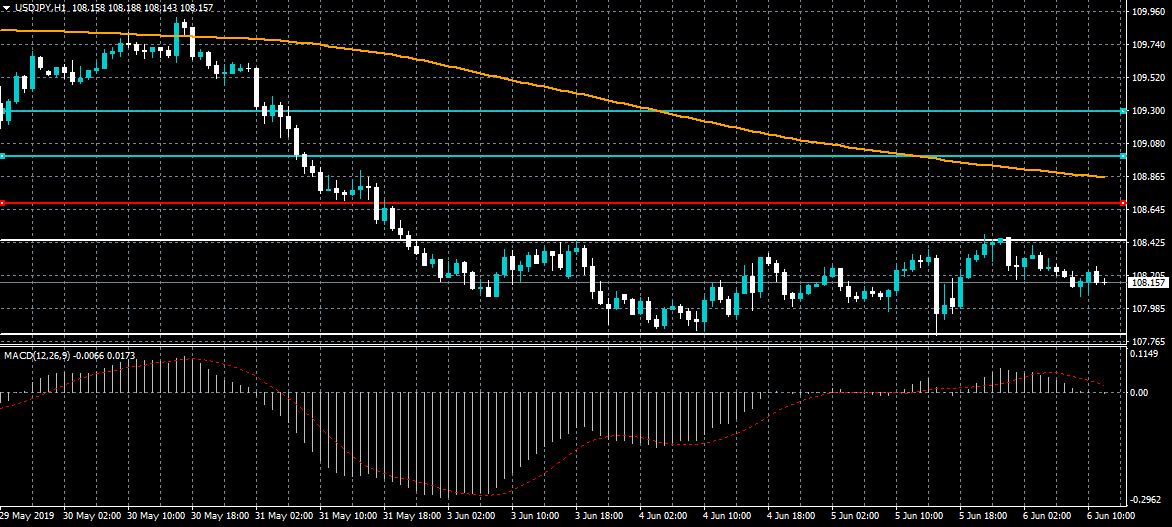
The US dollar continues to trade in a relatively tight range against the Japanese yen currency with price remaining trapped within a horizontal channel. A break above the 108.42 level should trigger additional technical buying towards at least the 108.65 level. A bearish breakout below the 107.70 level should provoke an important technical test of the 107.40 support level.
The USDJPY pair is bearish while trading below the 109.00 level, key support is found at the 107.70 and 107.40 levels.
If the USDJPY pair trades above the 108.42 level, key technical resistance is found at the 108.65 and 108.86 levels.