

Sample Category Title
GBP/USD Mid-Day Outlook
Daily Pivots: (S1) 1.2658; (P) 1.2702; (R1) 1.2724; More....
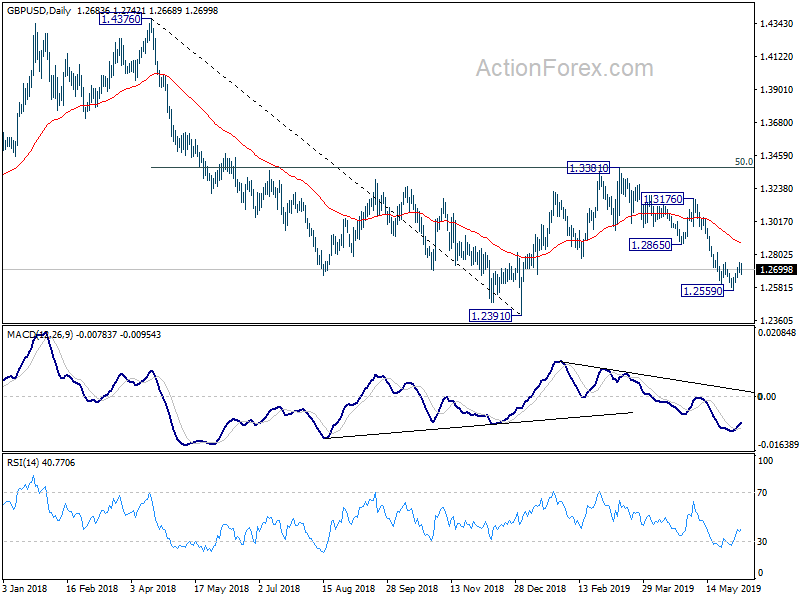
Intraday bias in GBP/USD remains neutral and consolidation from 1.2559 short term bottom might extend further. In case of stronger recovery, upside should be limited by 1.2865 support turned resistance to bring fall resumption. On the downside, break of 1.2559 will extend the decline from 1.3381 for 1.2391 low first. However, sustained break of 1.2865 will indicate completion of fall from 1.3381. In that case, corrective pattern from 1.2391 would be in another rising leg through 1.3381 resistance.
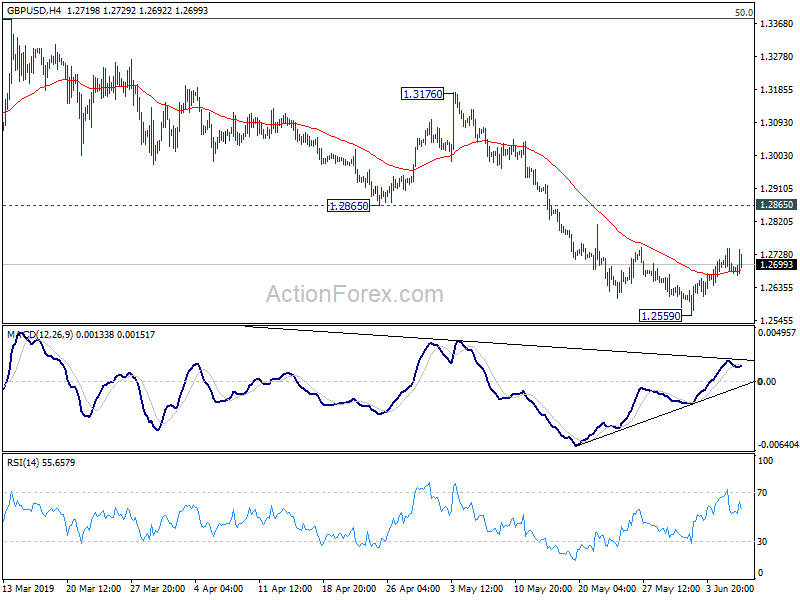
In the bigger picture, medium term decline from 1.4376 (2018 high) is possibly ready to resume. Decisive break of 1.2391 would target a test on 1.1946 long term bottom (2016 low). For now, we don't expect a firm break there yet. Hence focus will be on bottoming signal as it approaches 1.1946. In any case, medium term outlook will stay bearish as long as 1.3381 resistance holds, in case of strong rebound.
ECB Not Panicking Yet
ECB not as dovish as markets were expecting
More often than not in recent years, the key takeaway from these ECB meetings is that a hawkish action has been wrapped up in dovish message but that was very much not the case today.
People in the markets seemed convinced that we were heading for a dovish press conference from the soon-to-be outgoing ECB President but Draghi and his colleagues clearly had other ideas. For one, the revisions to the growth and inflation projections were not all negative as some would have assumed, based on recent inflation data and growing global risks. In fact, projections for this year were slightly raised in both cases, which was offset by slight reductions in the years after.
ECB Inflation Projections
- 2019 – 1.3% (1.2% in March)
- 2020 – 1.4% (1.5%)
- 2021 – 1.6% (1.6%)
ECB Growth Projections
- 2019 – 1.2% (1.1% in March)
- 2020 – 1.4% (1.6%)
- 2021 – 1.4% (1.5%)
We looked to be set up for a dovish session when the announcement came, as we were told that the ECB took policy action at the meeting – which immediately sent the euro lower – before being told that rates will remain at present levels through the first half of 2020, while details of TLTRO III were also released. It didn’t exactly live up to the opening line and the euro quickly reversed course to trade higher on the day.
The euro built on the rebound to trade around 1.13 against the dollar – from 1.12 after the announcement – as Draghi proceeded to layout the small changes to the projections and explain that there was an ample degree of monetary accommodation.
EURUSD Daily Chart
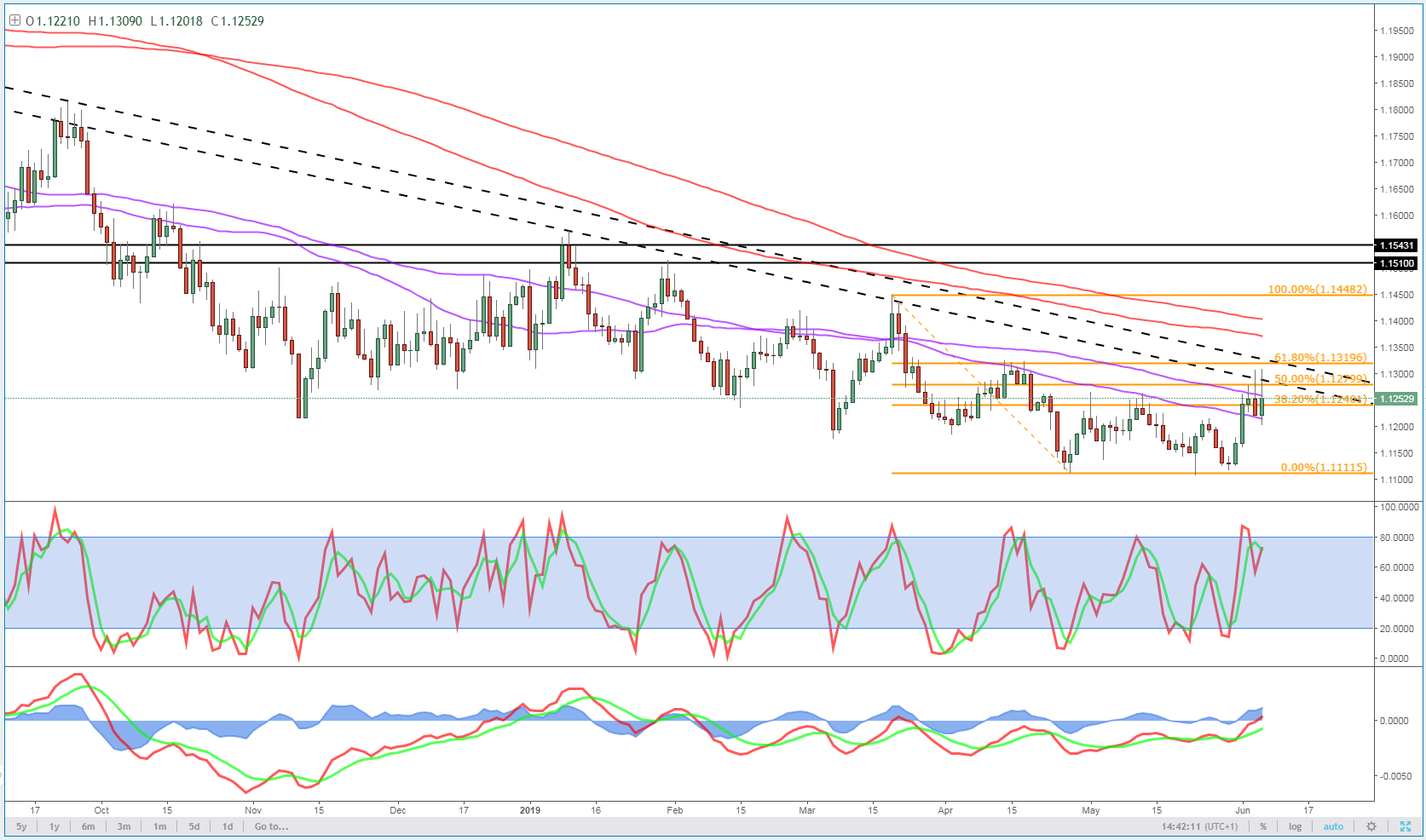
Of course, as ever with the ECB, there was the caveat that all instruments remain available – including restarting APP – the policy space is there and they’re ready to act in case of adverse contingency. He also stressed that the next move isn’t necessarily tilted towards rate hikes, which may have taken some of the edge off the euro near the highs.
Perhaps the central bank will become more dovish later in the year and lay out future steps once Draghi’s successor takes control but one thing was clear today, the committee was in no mood to panic this month and will wait a little longer before responding to something that hasn’t even yet fully materialised.
US: Slight Improvement in Trade Deficit in April
- The U.S. trade deficit lessened somewhat to $50.8bn in April from a downward revised $51.9bn in March (prev: $50bn). The report was in line with consensus forecast of the trade deficit. (Note: this release includes historical revisions going back to 2014. For full details please see the full report from the U.S. Census Bureau).
- Trade deficits with most major trading partners widened in the month, with the exception of Mexico.
- Exports dropped 2.2% m/m, more than reversing gains reported in the prior two months. The decline was generally broad based, with capital and automotive goods experiencing greatest monthly declines in excess of 5%. The decline in capital goods was largely due to lower shipments of civilian aircraft. Food and beverage exports were up 1%. On a volumes basis, goods exports were down 3.4% in April, the first decline of this year.
- Import performance was similar to exports. After a strong March, all major categories of imported goods declined in April. Capital goods and automotive imports saw the largest drop, both in excess of 3%. About half of the decline in capital goods imports was due to a fall in semiconductor purchases from abroad. On a volumes basis, goods imports fell 2.6%, marking the third monthly decline in volumes so far this year.
- Services fared similar to goods, with exports falling 0.3% in April.
Key Implications
- With trade tensions escalating, April's report is likely the last report this year that will be largely unaffected by rising tariffs. Last month the U.S. administration raised its tariff on about $200bn in imported goods from China to 25% from 10%, with the tariff taking full effect at the start of June. On Monday, the U.S. administration is expected to enact a 5% tariff on $350bn in imported goods from Mexico, although talks are underway with Mexican authorities that may delay or eliminate the threat. While this latest wave of tariffs is unlikely to cause large disruptions in trade flows, they are likely to still cause some disruptions to global value chains. For example, the U.S. automobile industry is heavily integrated with Mexican automobile supply chains, with parts and components passing across borders multiple times. Although small, a 5% tariff is likely to raise costs along the supply chain, leading to higher car prices for consumers.
Canada’s International Trade Deficit Marrows in April
- Canada posted a $0.97 billion trade deficit in April, down from a revised $2.3 billion deficit in March (previously reported as $3.2 billion). This came lower than consensus estimates for a $2.8 billion deficit. Exports advanced 1.3% to $50.7 billion, while imports dropped 1.4% to $51.7 billion.
- After accounting for price changes, the picture was encouraging, with export volumes up 2%. Import volumes were down 1.9%.
- The increase in exports spanned 6 of the 11 export categories, but was largely driven by a spike in metal and non-metallic mineral products (+15%) which Statistics Canada attributes to a large increase in gold demand. Exports of farm, fishing, and food products were also up (+5.1%) due to a surge in wheat exports. Providing the most offset was a decline in exports of motor vehicles and parts (-4.6%).
- Imports declined in 6 of the 11 product categories and were largely driven by a slump in the volatile aircraft and other transportation equipment category (-23.6%). Providing some offset was an increase in imports of energy products (+10.7%).
- Canada's merchandise trade surplus with the U.S. narrowed to $4.2 billion. Its merchandise trade deficit with the rest of the world narrowed to $5.2 billion.
Key Implications
- April's international merchandise trade data joins a suite of other data releases pointing to improving momentum heading into the second quarter. Indeed, after exports created a substantial drag on GDP in the first quarter, the March and April data point to an improving trade picture and to net trade contributing positively to growth in Q2. Of course, it is important to note that some of the bigger changes this month were in volatile categories (the surge in gold exports and the drop in aircraft imports), but the overall release and trend should still be viewed positively.
- At the same time, it is important to flag the increasing relevance of trade uncertainty as a downside risk. Affecting Canada recently are issues related to canola shipments to China, which resulted in a 14.7% drop in April. More important, however, are the recent tariff increases (and threats thereof) on Chinese and Mexican goods into the U.S., which may result in spillover effects through confidence and supply chain channels.
Rising Exports, Falling Imports Shrank Canada’s Trade Deficit in April
- The trade balance narrowed to $1.0 billion in April. Nominal exports increased 1.3% and imports fell 1.4%
- Export volumes rose 1.1% (~1.5% excluding energy products), but in large part due to a big surge in gold exports. Imports volumes fell 2.1%.
The improvement in the April trade balance was larger than expected, but the details were not as strong. Export volumes jumped 1.1%, but a big chunk of that came from the a 15% surge in exports of metal and non-metallic mineral products That reflected higher gold exports, an often-volatile component, that is not likely to be repeated going forward. A big 2.1% drop in import volumes helped make the net trade balance look better in April – and we continue to expect net trade will retrace about half of the large 4 percentage point drag on overall Q1 GDP growth in Q2. But lower imports of electrical equipment and the continued retracement of a huge surge in aircraft imports in January also suggests that business investment spending in Q2 will retrace a big chunk of the 40% Q1 gain.
Broader trends for exports still look relatively uninspiring, non-energy exports are still up only modestly from a year ago by our count. That is not new, but the US-led escalation in global trade tensions over the last couple of months also leaves some downside risk. Not all the recent trade news for Canada has been bad with steel and aluminum tariffs, and Canadian retaliatory actions, also being removed. That makes even the latest escalation in US trade tensions look a little bit more manageable. A bounce-back in oil production after mandated production cuts in Alberta and better weather still leave overall GDP growth on track to bounce-back to a slightly above-2% rate in Q2. But it is Canada’s deep ties with the US industrial sector – which stands to bear the brunt of escalating US trade tensions to-date – that are keeping the near-term Canadian trade risks to the downside.
EUR/USD Mid-Day Outlook
Daily Pivots: (S1) 1.1192; (P) 1.1248; (R1) 1.1278; More.....
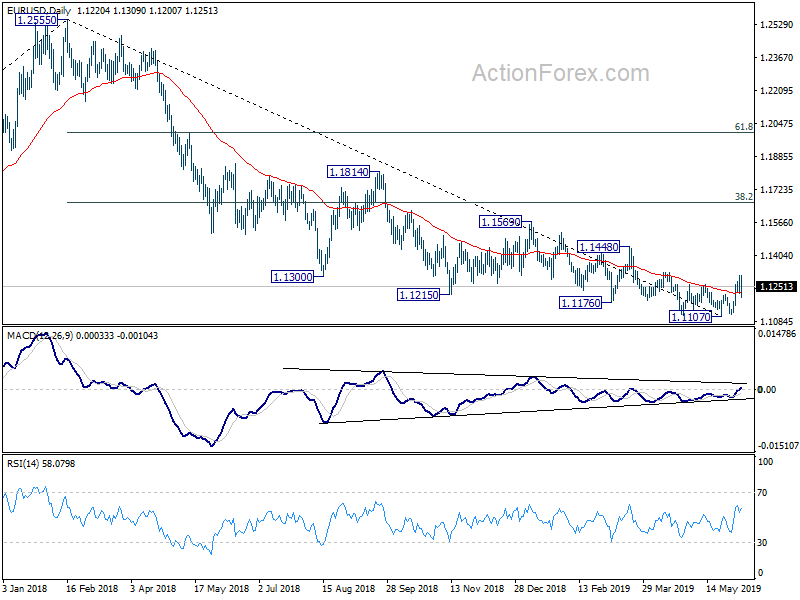
After some volatility and breaking yesterday's low and high, EUR/USD is staying in consolidative mode. Intraday bias remains neutral for the moment. Further rise is still currently in favor and break of 1.1309 will extend the rebound from 1.1107 short term bottom to 1.1448 key resistance. Decisive break there will carry larger bullish implications. However, break of 1.1200 should now confirm completion of the rebound from 1.1107. Intraday bias will then be turned back to the downside for 1.1107 low instead.
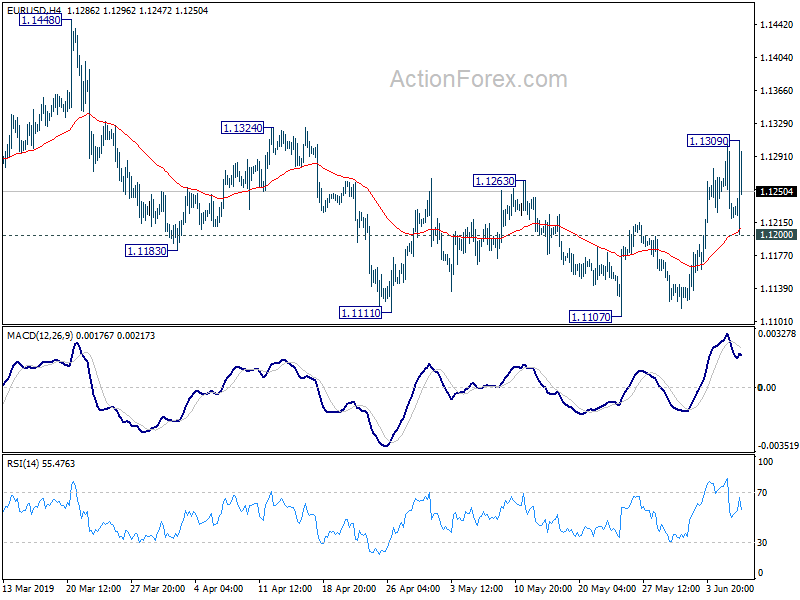
In the bigger picture, down trend from 1.2555 (2018 high) might still be in progress. Such decline would target 78.6% retracement of 1.0339 (2016 low) to 1.2555 (2018 high) at 1.0813 on resumption. However, break of 1.1448 resistance would confirm medium term bottoming, on bullish convergence condition in daily MACD. In such case, stronger rebound should be seen to 38.2% retracement of 1.2555 to 1.1107 at 1.1660. We'd look at the structure of the rebound to decide whether it's a corrective rise later.
Euro in Range after Rough Ride on ECB’s Not Dovish Enough Meeting
It's a roller coaster ride for Euro. It initially dipped after ECB said there will be no rate hike at least through mid 2020. Then it recovered and breaks yesterday's higher against Dollar as the press conference and new economic projections turn out to be not that dovish. Though, upside is capped as President Mario Draghi bluntly said "no" to the idea that next move is more likely a hike. After all, the announcement was, just like Draghi said, an expression of "confidence in the present baseline, but also clear acknowledgement of risks"
On the other hand, Dollar's recovery attempt faltered quickly today with tariffs threats ahead. US and Mexico are going to resume negotiations after progress were "not nearly enough" with yesterday's meeting. Trump hinted he's likely to impose the 5% tariffs next Monday. On another front, Trump repeated his threat to tariff all currently untaxed USD 300B of Chinese imports. Such a decision could be made soon after G20 meeting later in month. For now, there is no sign that Trump and Xi will even meet of shake hands there given recent hard-line rhetorics from both sides.
In the currency markets, currently, Euro is the strongest one, followed by Swiss Franc. Dollar is the weakest followed by Canadian. But all major pairs and crosses are bounded inside yesterday's range. Over the week, Dollar is undoubtedly the weakest on bet of Fed rate cut. Yen follows as second weakest. Kiwi and Loonie are the strongest ones, followed by Swiss and Euro.
In other markets, DOW open slightly higher and is currently up 0.10%. 10-year yield is down -0.0163 at 2.118. In Europe, FTSE is up 0.43%. DAX is down -0.22%. CAC is flat. German 10-year yield is up 0.0229 at -0.201, still below -0.2 handle. Earlier in Asia, Nikkei dropped -0.01%. Hong Kong HSI rose 0.26%. China Shanghai SSE dropped -1.17%. Singapore Strait Times rose 0.12%. Japan 10-year JGB yield rose 0.0042 to -0.121.
ECB said rates to stay low longer, but overall announcement not dovish enough
ECB left interest rates unchanged today as widely expected. That is, main refinancing, marginal lending and deposit rates are kept at 0.00%, 0.25% and -0.40% respectively. ECB changed the forwards guidance and said interest rates will remain at present levels "at least through the first half of 2020, longer than "the end of 2019". ECB also announce the rates of TLTRO III operations.
President Mario Draghi didn't sound too dovish in the post meeting press conference, nor were the new economic projections. He noted that "most recent information indicates that global headwinds continue to weigh on the euro area outlook". And, "the prolonged presence of uncertainties, related to geopolitical factors, the rising threat of protectionism and vulnerabilities in emerging markets, is leaving its mark on economic sentiment."
However, "further employment gains and increasing wages continue to underpin the resilience of the euro area economy and gradually rising inflation." And, ECB is "determined to act in case of adverse contingencies and also stands ready to adjust all of its instruments, as appropriate".
In the June 2019 Eurosystem staff macroeconomic projections for Eurozone, growth is projected to be at 1.2% in 2019 (revised up by 0.1%), 1.4% in 2020 (down by -0.2%) and 1.4% in 2021 (down by -0.1%). HICP is projected to be at 1.3% in 2019 (revised up by 0.1%), 1.4% in 2020 (revised down by -0.1%) and 1.6% in 2021 (unchanged).
Draghi noted that risks to growth outlook remain "tilted to the downside".
EU Dombrovskis: Italy needs substantial deficit correction in 2019 and 2020
European Commission Vice President Valdis Dombrovskis said that Italy will need a "substantial deficit correction in 2019 and 2020". He told La Repubblica daily a day after the Commission opened the way to so called "Excessive Deficit Procedure" on Italy. Dombrovskis also warned the coalition government's planned tax cut reform could be very expensive and risks further deteriorating Italy's public finances.
Economics Commissioner Pierre Moscovici told the European affairs commission of the lower house of France's parliament, "it's up to Italy to bear the burden of proof that it's reducing its deficits and debt." He reiterated that "my door is open to talk, to listen and to take note."
Italy's Deputy Prime Minister Luigi Di Maio insisted "there should not be a budget correction." The coalition will start negotiations with EU to avoid disciplinary proceedings over its rising debt. However, Di Maio emphasized that such negotiations should be led by politicians, not "bureaucrats".
Eurozone Q1 GDP growth finalized at 0.4%, EU at 0.5%
Eurozone Q1 GDP growth was finalized at 0.4% qoq, unrevised. Over the year, Eurozone GDP grew 1.2% yoy. EU28 growth was finalized at 0.5% qoq, 1.5% yoy. Among Member States for which data are available for the first quarter of 2019, Croatia (1.8%) recorded the highest growth compared with the previous quarter, followed by Hungary and Poland (both 1.5%). A decrease was observed in Latvia (-0.1%).
Quarterly, on the components, household final consumption expenditure rose by 0.5% in both the euro area and the EU28. Gross fixed capital formation increased by 1.1% in the euro area and by 1.3% in the EU28. Exports increased by 0.6% in the euro area and by 0.5% in the EU28. Imports increased by 0.4% in the euro area and 1.2% in the EU28.
Also released, Eurozone employment growth was finalized at 0.3% qoq in Q1. German factory orders rose 0.3% mom in April, above expectation of 0.0% mom.
US jobless claims unchanged at 218k, trade deficit dropped to USD 50.8B
US initial jobless claims was unchanged at 218k in the week ending June 1, slightly above expectation of 215k. Four-week moving average of initial claims dropped -2.5k to 215k. Continuing claims rose 20k to 1.682m in the week ending May 25. Four-week moving average of continuing claims dropped -1k to 1.673m.
Trade deficit dropped -2.1% to USD -50.8B, slightly larger than expectation of USD -50.5B. Exports dropped -2.2% to USD 206.8B. Imports dropped -2.2% to USD 257.6B.
With China, in April, deficit increased USD 2.1B to USD 29.4B. Exports decreased USD 1.8B to USD 8.5B and imports increased USD 0.3B to USD 37.9B. In Q1 after revisions, deficit decreased USD 22.9B to USD 80.8B. Exports increased USD 4.9B to USD 41.4B and imports decreased USD 18.0B to USD 122.2B.
Non-farm productivity was finalized at 3.4% in Q4, unit labor costs at -1.6%%. From Canada, trade deficit narrowed to CAD -0.97B in April.
Trump repeats his verbal threat of tariffs on $300B Chinese imports
Trump reiterated his threat to further escalate trade war with China again as the told reporters today. He said "Our talks with China, a lot of interesting things are happening. We'll see what happens… I could go up another at least $300 billion and I'll do that at the right time. But he added that "China wants to make a deal" and "Mexico wants to make a deal badly."
On the other hand, China's Commerce Ministry blamed Trump's use of "ultimate pressure" has caused serious setbacks to trade negotiations. The ball is in the US court as future direction of talks would depend on Washington. MOFCOM also said China will have to adopt the necessary countermeasures if the United States decides to unilaterally escalate trade tensions.
Australia trade surplus at AUD 4.87B in Apr, exports rose 2.5% mom, imports rose 2.8% mom
Australia trade surplus came in smaller than expected at AUD 4.87B in April. Exports rose 2.5% mom, 17.2% yoy to AUD 40.42B. Imports rose 2.8% mom, 5.4% yoy to AUD 35.55B.
Looking at the details of exports, non-rural goods rose AUD 691m (3%), non-monetary gold rose AUD 272m (20%) and net exports of goods under merchanting rose AUD 8m (73%). Rural goods fell AUD 67m (2%). Services credits rose AUD 65m (1%).
For imports, intermediate and other merchandise goods rose AUD 423m (4%), capital goods rose AUD 308m (5%) and consumption goods rose AUD 298m (3%). Non-monetary gold fell AUD 40m (9%). Services debits fell AUD 5m.
EUR/USD Mid-Day Outlook
Daily Pivots: (S1) 1.1192; (P) 1.1248; (R1) 1.1278; More.....
After some volatility and breaking yesterday's low and high, EUR/USD is staying in consolidative mode. Intraday bias remains neutral for the moment. Further rise is still currently in favor and break of 1.1309 will extend the rebound from 1.1107 short term bottom to 1.1448 key resistance. Decisive break there will carry larger bullish implications. However, break of 1.1200 should now confirm completion of the rebound from 1.1107. Intraday bias will then be turned back to the downside for 1.1107 low instead.
In the bigger picture, down trend from 1.2555 (2018 high) might still be in progress. Such decline would target 78.6% retracement of 1.0339 (2016 low) to 1.2555 (2018 high) at 1.0813 on resumption. However, break of 1.1448 resistance would confirm medium term bottoming, on bullish convergence condition in daily MACD. In such case, stronger rebound should be seen to 38.2% retracement of 1.2555 to 1.1107 at 1.1660. We'd look at the structure of the rebound to decide whether it's a corrective rise later.
Economic Indicators Update
| GMT | Ccy | Events | Actual | Forecast | Previous | Revised |
|---|---|---|---|---|---|---|
| 01:30 | AUD | Trade Balance (AUD) Apr | 4.87B | 5.05B | 4.95B | 4.89B |
| 06:00 | EUR | German Factory Orders M/M Apr | 0.30% | 0.00% | 0.60% | 0.80% |
| 09:00 | EUR | Eurozone Employment Q/Q Q1 F | 0.30% | 0.30% | 0.30% | |
| 09:00 | EUR | Eurozone GDP Q/Q Q1 F | 0.40% | 0.40% | 0.40% | |
| 11:30 | USD | Challenger Job Cuts Y/Y May | 85.90% | 10.90% | ||
| 11:45 | EUR | ECB Rate Decision | 0.00% | 0.00% | 0.00% | |
| 12:30 | EUR | ECB Press Conference | ||||
| 12:30 | CAD | International Merchandise Trade (CAD) Apr | -0.97B | -2.8B | -3.2B | -2.34B |
| 12:30 | USD | Nonfarm Productivity Q1 F | 3.40% | 3.50% | 3.60% | |
| 12:30 | USD | Unit Labor Costs Q1 F | -1.60% | -0.90% | -0.90% | |
| 12:30 | USD | Initial Jobless Claims (JUN 1) | 218K | 215K | 215K | 218K |
| 12:30 | USD | Trade Balance Apr | -50.8B | -50.5B | -50.0B | -51.9B |
| 14:00 | CAD | Ivey PMI May | 56.2 | 55.9 | ||
| 14:30 | USD | Natural Gas Storage | 110B | 114B |
Breaking Market Commentary: European Central Bank meeting
Another day, another downbeat assessment of the global economy that has been provided from a leading central bank.
That is the message that the European Central Bank (ECB) has followed, in a week where interest rates have been cut in both Australia and India in defense against a weaker global environment. The ECB pushed back its own expectations on higher interest rates in Europe until at least the second half of 2020, but in reality the case for higher interest rates is closed for an indefinite period as the global economy awaits the incoming negative impacts from a multitude of different US-led trade disputes.
Stronger Euro, but not because of ECB policy
It isn’t that much of a surprise to anyone that the ECB is kicking the can down the road on conversations regarding higher interest rates in Europe, however it can be considered as somewhat unexpected that the Euro is bouncing higher on this move. It is somewhat true that ECB President Mario Draghi is not coming across as negative as expected. Although the simple observation that each of the G10 currencies are trading higher against the USD shows that the bounce higher in the Euro has not got much to do with the ECB rate decision, but everything to do with the spell of weakness that has transpired in the US Dollar.
Shorting the Dollar becoming a crowded trade
The markets have got way too ahead of themselves with recent Dollar positioning and the same can be said with the expectations that have emerged that the Federal Reserve will jump into its car and reverse US interest rate policy at full speed.
Investors need to be very careful with a crowded USD short trade that has appeared in recent weeks. Everyone is now pricing into expectations that the Federal Reserve will cut interest rates as early as the coming months, but I don’t see this as being that easy for Dollar bears.
1.1320 potential ceiling in waiting for EURUSD
1.1320 is a potential ceiling in waiting for Eurodollar buyers and I would be mindful of a round of sudden profit-taking on the EURUSD if tomorrow’s US employment report provides light at the end of the tunnel for Dollar buyers, in that US economic momentum is not crashing downhill as fast as the market has priced in the past week.
Euro lifted by not so dovish ECB Draghi
ECB President Mario Draghi didn't sound too dovish in the post meeting press conference, nor were the new economic projections. he noted that "most recent information indicates that global headwinds continue to weigh on the euro area outlook". And, "the prolonged presence of uncertainties, related to geopolitical factors, the rising threat of protectionism and vulnerabilities in emerging markets, is leaving its mark on economic sentiment."
However, "further employment gains and increasing wages continue to underpin the resilience of the euro area economy and gradually rising inflation." And, ECB is "determined to act in case of adverse contingencies and also stands ready to adjust all of its instruments, as appropriate".
In the June 2019 Eurosystem staff macroeconomic projections for Eurozone, growth is projected to be at 1.2% in 2019 (revised up by 0.1%), 1.4% in 2020 (down by -0.2%) and 1.4% in 2021 (down by -0.1%). HICP is projected to be at 1.3% in 2019 (revised up by 0.1%), 1.4% in 2020 (revised down by -0.1%) and 1.6% in 2021 (unchanged).
Draghi noted that risks to growth outlook remain "tilted to the downside".
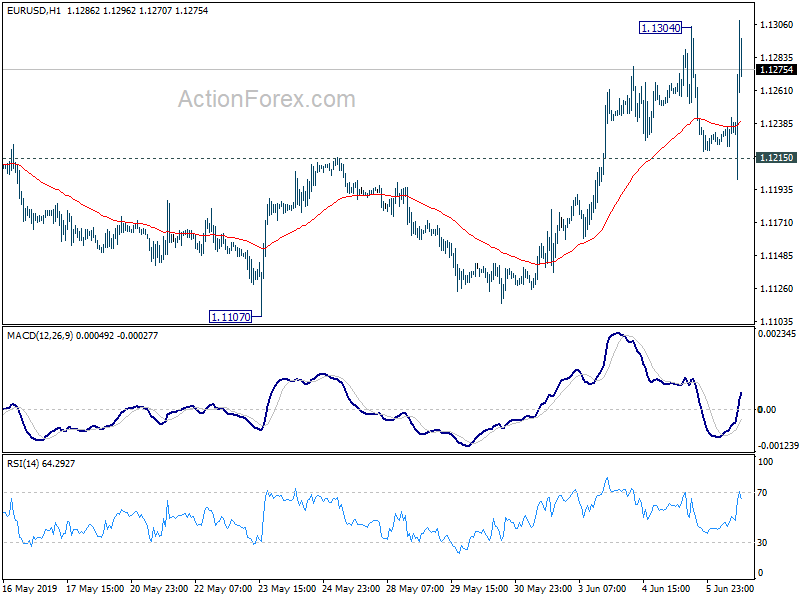
EUR/USD dipped initially after the release in reaction to the change in forward guidance. But it's then quickly rebounded and breaks yesterday's high at 1.1304 on not-that-dovish Draghi.
(ECB) Introductory Statement to the Press Conference
Mario Draghi, President of the ECB,
Luis de Guindos, Vice-President of the ECB,
Vilnius, 6 June 2019
INTRODUCTORY STATEMENT
Ladies and gentlemen, the Vice-President and I are very pleased to welcome you to our press conference. I would like to thank Chairman of the Board Vasiliauskas for his kind hospitality and express our special gratitude to his staff for the excellent organisation of today's meeting of the Governing Council. We will now report on the outcome of our meeting.
Based on our regular economic and monetary analyses, we have conducted a thorough assessment of the economic and inflation outlook, also taking into account the latest staff macroeconomic projections for the euro area. As a result, the Governing Council took the following decisions in the pursuit of its price stability objective.
First, we decided to keep the key ECB interest rates unchanged. We now expect them to remain at their present levels at least through the first half of 2020, and in any case for as long as necessary to ensure the continued sustained convergence of inflation to levels that are below, but close to, 2% over the medium term.
Second, we intend to continue reinvesting, in full, the principal payments from maturing securities purchased under the asset purchase programme for an extended period of time past the date when we start raising the key ECB interest rates, and in any case for as long as necessary to maintain favourable liquidity conditions and an ample degree of monetary accommodation.
Third, regarding the modalities of the new series of quarterly targeted longer-term refinancing operations (TLTRO III), we decided that the interest rate in each operation will be set at a level that is 10 basis points above the average rate applied in the Eurosystem's main refinancing operations over the life of the respective TLTRO. For banks whose eligible net lending exceeds a benchmark, the rate applied in TLTRO III will be lower, and can be as low as the average interest rate on the deposit facility prevailing over the life of the operation plus 10 basis points.
A press release with further details of the terms of TLTRO III will be published at 15:30 CET today.
The Governing Council also assessed that, at this point in time, the positive contribution of negative interest rates to the accommodative monetary policy stance and to the sustained convergence of inflation is not undermined by possible side effects on bank-based intermediation. However, we will continue to monitor carefully the bank-based transmission channel of monetary policy and the case for mitigating measures.
Today's monetary policy decisions were taken to provide the monetary accommodation necessary for inflation to remain on a sustained path towards levels that are below, but close to, 2% over the medium term. Despite the somewhat better than expected data for the first quarter, the most recent information indicates that global headwinds continue to weigh on the euro area outlook. The prolonged presence of uncertainties, related to geopolitical factors, the rising threat of protectionism and vulnerabilities in emerging markets, is leaving its mark on economic sentiment.
At the same time, further employment gains and increasing wages continue to underpin the resilience of the euro area economy and gradually rising inflation. Today's policy measures ensure that financial conditions will remain very favourable, supporting the euro area expansion, the ongoing build-up of domestic price pressures and, thus, headline inflation developments over the medium term. Looking ahead, the Governing Council is determined to act in case of adverse contingencies and also stands ready to adjust all of its instruments, as appropriate, to ensure that inflation continues to move towards the Governing Council's inflation aim in a sustained manner.
Let me now explain our assessment in greater detail, starting with the economic analysis. Euro area real GDP rose by 0.4%, quarter on quarter, in the first quarter of 2019, following an increase of 0.2% in the fourth quarter of 2018. However, incoming economic data and survey information point to somewhat weaker growth in the second and third quarters of this year. This reflects the ongoing weakness in international trade in an environment of prolonged global uncertainties, which are weighing, in particular, on the euro area manufacturing sector. At the same time, the euro area services and construction sectors are showing resilience and the labour market is continuing to improve. Looking ahead, the euro area expansion will continue to be supported by favourable financing conditions, the mildly expansionary euro area fiscal stance, further employment gains and rising wages, and the ongoing – albeit somewhat slower – growth in global activity.
This assessment is broadly reflected in the June 2019 Eurosystem staff macroeconomic projections for the euro area. These projections foresee annual real GDP increasing by 1.2% in 2019, 1.4% in 2020 and 1.4% in 2021. Compared with the March 2019 ECB staff macroeconomic projections, the outlook for real GDP growth has been revised up by 0.1 percentage points for 2019 and has been revised down by 0.2 percentage points for 2020 and by 0.1 percentage points for 2021.
The risks surrounding the euro area growth outlook remain tilted to the downside, on account of the prolonged presence of uncertainties, related to geopolitical factors, the rising threat of protectionism and vulnerabilities in emerging markets.
According to Eurostat's flash estimate, euro area annual HICP inflation was 1.2% in May 2019, after 1.7% in April, reflecting mainly lower energy and services price inflation. On the basis of current futures prices for oil, headline inflation is likely to decline over the coming months, before rising again towards the end of year. Looking through the recent volatility due to temporary factors, measures of underlying inflation remain generally muted, but labour cost pressures continue to strengthen and broaden amid high levels of capacity utilisation and tightening labour markets. Looking ahead, underlying inflation is expected to increase over the medium term, supported by our monetary policy measures, the ongoing economic expansion and stronger wage growth.
This assessment is also broadly reflected in the June 2019 Eurosystem staff macroeconomic projections for the euro area, which foresee annual HICP inflation at 1.3% in 2019, 1.4% in 2020 and 1.6% in 2021. Compared with the March 2019 ECB staff macroeconomic projections, the outlook for HICP inflation has been revised up by 0.1 percentage points for 2019 and revised down by 0.1 percentage points for 2020.
Turning to the monetary analysis, broad money (M3) growth stood at 4.7% in April 2019, after 4.6% in March. Sustained rates of broad money growth reflect ongoing bank credit creation for the private sector and low opportunity costs of holding M3. The narrow monetary aggregate M1 continues to be the main contributor to broad money growth on the components side.
The annual growth rate of loans to non-financial corporations increased to 3.9% in April 2019, from 3.6% in March. Beyond short-term volatility, the annual growth rate of loans to non-financial corporations has moderated somewhat in recent months from its peak in September 2018, reflecting the typical lagged reaction to the slowdown in economic growth observed over the course of 2018. The annual growth rate of loans to households stood at 3.4% in April, compared with 3.3% in March, continuing its gradual improvement.
The monetary policy measures taken today, including TLTRO III, will help to safeguard favourable bank lending conditions and will continue to support access to financing, in particular for small and medium-sized enterprises.
To sum up, a cross-check of the outcome of the economic analysis with the signals coming from the monetary analysis confirmed that an ample degree of monetary accommodation is still necessary for the continued sustained convergence of inflation to levels that are below, but close to, 2% over the medium term.
In order to reap the full benefits from our monetary policy measures, other policy areas must contribute more decisively to raising the longer-term growth potential and reducing vulnerabilities. The implementation of structural reforms in euro area countries needs to be substantially stepped up to increase resilience, reduce structural unemployment and boost euro area productivity and growth potential. The 2019 country-specific recommendations should serve as the relevant signpost. Regarding fiscal policies, the mildly expansionary euro area fiscal stance is providing support to economic activity. At the same time, countries where government debt is high need to continue rebuilding fiscal buffers. All countries should reinforce their efforts to achieve a more growth-friendly composition of public finances. Likewise, the transparent and consistent implementation of the European Union's fiscal and economic governance framework over time and across countries remains essential to bolster the resilience of the euro area economy. Improving the functioning of Economic and Monetary Union remains a priority. The Governing Council welcomes the ongoing work and urges further specific and decisive steps to complete the banking union and the capital markets union.
We are now at your disposal for questions.