

Sample Category Title
USD/JPY Remains In Downtrend Below 109.00
Key Highlights
- The US Dollar declined heavily and settled below the key 109.00 support against the Japanese Yen.
- If USD/JPY corrects higher, it is likely to face a strong resistance near 108.80 and 109.00.
- The US Initial Jobless Claims for the week ending June 01, 2019 remained stable at 218K.
- The US nonfarm payrolls in May 2019 could rise 185K, less than the last 263K.
USDJPY Technical Analysis
In the past few days, there were steady losses in the US Dollar below 110.00 against the Japanese Yen. The USD/JPY pair remained in the bearish zone and recently settled below the key 109.00 support.
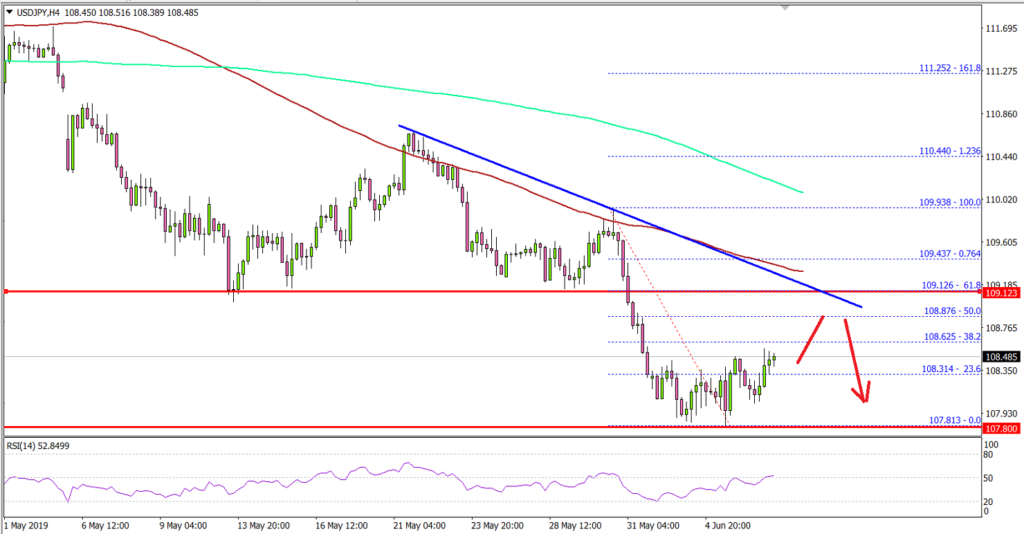
Looking at the 4-hours chart, the pair declined heavily below 108.80 and 108.50. The decline was such that the pair traded to a new monthly low below 108.00. A swing low was formed at 107.81 before it started consolidating losses.
The pair recovered above 108.00 and tested the 23.6% Fib retracement level of the downward move from the 109.92 high to 107.81 swing low.
If there is an upside correction above the 108.50 and 108.60 levels, the pair could recover towards the main 109.00 resistance area. There is also a major bearish trend line forming with current resistance near 109.10 on the same chart.
Besides, the 50% Fib retracement level of the downward move from the 109.92 high to 107.81 swing low is also near the 108.87 level to act as a resistance.
Therefore, if USD/JPY corrects higher, sellers are likely to defend the 108.80 and 109.00 resistance levels. If there is a successful close above 109.00, the pair could start a strong upward move.
Conversely, if the pair fails to recover above 108.80 or 109.00, it could resume its downward move below the 108.00 level.
Fundamentally, the US Initial Jobless Claims figure for the week ending June 01, 2019 was released by the US Department of Labor. The market was looking for no change from the last reading of 115K.
However, the actual result was neutral since there was no change from the last reading, but the last reading was revised up from 215K to 218K.
The report stated that:
The 4-week moving average was 215,000, a decrease of 2,500 from the previous week's revised average. The previous week's average was revised up by 750 from 216,750 to 217,500.
Overall, USD/JPY needs to recover above the 108.80 and 109.00 resistance levels to start a fresh upward move. If not, there is a risk of more downsides below 108.00.
Economic Releases to Watch Today
- US nonfarm payrolls May 2019 – Forecast 185K, versus 263K previous.
- US Unemployment Rate May 2019 – Forecast 3.6%, versus 3.6% previous.
- Canada's employment Change payrolls May 2019 – Forecast 8.0K, versus 106.5K previous.
- Canada's Unemployment Rate May 2019 – Forecast 5.7%, versus 5.7% previous.
Market Morning Briefing: Aussie Is Holding Below 0.70 Just Now
STOCKS
Dow is gaining strength and can move further higher which would negate our bearish view. DAX remains below its key resistance and looks vulnerable for a fresh fall. Nikkei can move further higher in the near term before resuming it downtrend. Sensex and Nifty are poised near crucial supports which have to hold to avoid a fresh sell-off.
Dow (25720.66, +181.09, +0.71%) is poised just below the key level of 25740 (21-week moving average). However, the daily chart looks strong and bullish indicating a possible break above 25740 and a rise 25950-26000
The resistance at 12100 is continuing to hold well on DAX (11953.14, -27.67, -0.23%). While below 12100, the outlook is bearish for a fall to 11800 and 11600. A break below 11900 will accelerate the downmove.
The corrective rally in Nikkei (20873.44, +99.40, +0.48%) remains intact. There is room on the upside to test the 21000-21100 resistance region after which the downtrend is likely to resume targeting 200000 and 19500 over the medium term.
Shanghai (2827.80, -33.62, -1.17%) is closed today on account of a public holiday.
Sensex (39529.72, -553.82, -1.38%) has crucial supports at 39500 and 39350 which have to hold in order to avoid further fall to 38700-38500.
Similarly, Nifty (11843.75, -177.90, -1.48%) has to sustain above 11800. Else a fall to 11700-11600 can be seen in the coming days.
COMMODITIES
Gold and Silver remains higher and can move up in the near term. But key resistances are coming up for both gold and silver which may cap the upside. Copper can consolidate before resuming its downtrend. Oil has bounced from the key Fibonacci support. A near-term corrective rally is possible before the overall downtrend resumes.
Gold (1333) sustains higher, but is not gaining momentum. It has to breach the 1345 resistance to move up further targeting 1355-1360. In the absence of any fresh triggers, we expect the upside to be capped at 1360 and gold is likely to reverse lower again.
Silver (14.88) can test 15 in the near term and need to see if it manages to break above it or not. A strong break above 15 will see the current corrective rally extending towards 15.15-15.20 after which a pull-back is possible.
Copper (2.65) may consolidate between 2.61 and 2.68 for some time and then resume its downtrend targeting 2.58 and 2.55 on the downside.
Brent (62.21) has bounced from the 61.8% Fibonacci retracement support level of 59.74. A Brent can rise to 63.5 and 64 on a break above 62.75 The overall downtrend is likely to resume thereafter.
WTI (53.11) can test 54-54 before the overall downtrend resumes targeting 45 on the downside over the long term.
FOREX
Mexico and US are in talks for significant changes in the asylum rules and border enforcement that could keep Trump away from imposing tariffs on all Mexican imports. The talks increases optimism that an agreement could be reached soon and prevent imposition of tariffs. Yesterday’s all day negotiations that ended without an agreement is likely to be continued with another set of discussions today in Washington.
Dollar Index (97.05) has managed to hold above immediate support at 96.75. Markets await a series of data today including the US NFP which is expected to come our lower. A fall in NFP data could probably see some sell-off in US Dollar before the index recovers. Below 96.75, there could be scope of testing 96.50/30 in the near term from where a bounce back towards 97.50/75 looks likely.
ECB kept rates unchanged as expected but also said that the rates are likely to remain lower until at least middle of next year. Euro (1.1272) tested 1.1309 yesterday, below our mentioned upper limit of 1.1320/25. While below yesterday’s high Euro could possibly see some trade within 1.13-1.12 in the near term before falling below 1.12. There is still some scope of falling below 1.12 in the near term which would be negated on a sharp and sustained break above 1.1325.
Euro-Yen (122.30) has risen and could target 123.50 on the upside in the near term.
Dollar-Yen (108.51) could re-test 109 while support at 107.50 holds. Hopes of optimism from US-Mexico talks could boost global equities and could possibly pull up Nikkei and Dollar-Yen to higher levels in the near term. It would be important to see if the currency pair manages to break above 109 in the near term. While below 109, medium term is bearish for USDJPY.
Aussie (0.6977) is holding below 0.70 just now. Immediate support is seen near 0.6940 which if holds could gradually push Aussie towards 0.70/71 on the upside. Near term is sideways to bullish while above 0.6940.
Pound (1.2693) is seeing sell-off near 1.2750 for the last 2-sessions. While 1.2750 holds, we could see a fall towards 1.2600 again.
USDCNY (6.9081) has fallen and could test 6.87 on the downside while below 6.92. We would continue to watch price action closely near 6.92.
USDINR (69.2750) saw a decline after the RBI cut 25bps yesterday in line with the market expectations. The dip in the pair is likely to continue today targeting 69 on the downside before a bounce from there is seen.
INTEREST RATES
The US yields are mixed. The yields at the shorter end have risen while we see a dip at the longer end. The US 30Yr (2.62%) is down 2bps while the 10Yr (2.13%) is stable and the 5Yr (1.89%) is up by 3bps. the US 10-5yr (0.24%) has sharply fallen from trend resistance near 0.26% and could continue to fall in the near term. This could possibly indicate a faster rise in 5Yr yield compared to the 10Yr yield.
The German-US 10Yr (-2.36%) and German-US 2Yr (-2.54%) have declined and could pull down Euro from current levels towards 1.12 or lower. The German-Us 10Yr could fall towards -2.39%.
The US-Japan 10YR (2.26%) has risen 2bps and looks bullish in the near term indicating a bounce in Dollar-Yen. But the sharp fall in the Japan yields could be a concern for the near term. The Japan 5Yr (-0.24%), 10YR (-0.129%) and 30Yr (0.40%) are down from -0.248%, -0.122% and 0.424%. the 5Yr has some support near current levels and could bounce back in the near term while the 10YR could have some more room on the downside.
The UK and German yields also have fallen sharply and look bearish for the near term. The UK 10Yr (0.83%) and German 10Yr (-0.237%) are down from 0.8570% and -0.227%. Near term looks bearish.
ECB Not Dovish Enough – Low Rate to Stay until Mid-2020 and TLTRO Pricing Revealed.
We believe ECB’s more dovish tone in June is insufficient to stimulate the economy. As expected, ECB extended the timing that the historically- low interest would remain. It also released the pricing of the TLTRO-III. We were slightly disappointed that the interest rates offered was higher than those in the previous operations. The updated staff economic projections contain little change from those in March. While GDP growth and inflation for this year were revised slightly higher, the staff downgraded the forecasts for 2020.
At the press conference, President Mario Draghi stressed that downside risks have “gained importance” and the members take the problems of weak inflation expectations “seriously”. He also suggested that the members have “the readiness to act in case of adverse contingencies”. In fact, “several members raised the possibility of further rate cuts”, while others ‘raised the possibility of restarting the asset purchase program”.
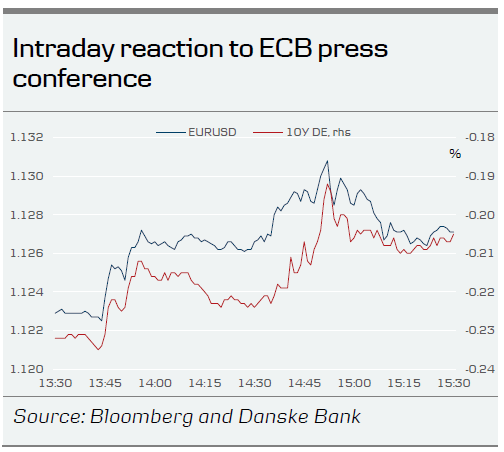
The euro jumped after the announcement. ECB sounded more dovish but it is not yet ready to act more. It might have poured cold water to those who had priced in 50% chance of rate cut by end-2019. Yet, as economies of both Eurozone and the world slow further, ECB would have to hint further stimulus measures– cutting policy rate and/ or restarting QE, towards the end of this year.
Forward Guidance
As expected, ECB extended the forward guidance in keeping the policy rates at current low levels. It expects them to remain at their present levels “at least through the first half of 2020”. The reinvestment of QE proceeds and interests remains in progress. This came largely in line with our expectations.
Economic Projections
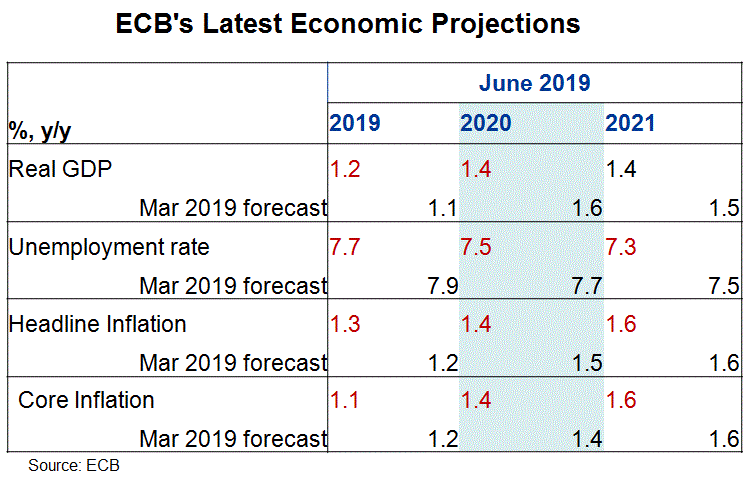
Only minor changes were made. GDP growth forecast for this year was revised up to +1.2% y/y, from March’s projection of +1.1%. Estimates for both 2020 and 2021 are revised lower to +1.4%, from +1.6% and +1.5% respectively. On inflation, headline HICP was revised higher to +1.3% y/y for this year, from +1.2%. The forecast for 2020 is ticked down to +1.4%, from 1.5%. Core inflation is expected to reach +1.1% in this year (March: +1.2%), before recovering to +1.4% in 2020 (unchanged from March) and +1.6% in 2021(unchanged from March). ECB forecasts better employment market throughout the forecast period. It expects the unemployment rate to drop to 7.7% in 2019, before falling further to 7.5% and +7.3% in 2020 and 2021 respectively. All three estimates came in lower than those in March.
TLTRO-III Pricing
ECB released technical details of the new lending operations- TLTRO-III. The interest rate in each operation will be set “at a level that is 10 bps above” the main refi-rate. The interest rate for banks whose eligible net lending exceeds a benchmark would be 10 bps above the deposit rate of -0.4%. These were a bit higher than the TLTRO-II in 2016, of which the interest rates were the main refi-rate and deposit rate, respectively. News about the tiered rate system was lacking. This might signal that market expectations of further ECB rate cut could be overextended.
USD/CAD Canadian Dollar Higher On Narrow Trade Deficit And Soft Dollar
The Canadian dollar rose against the US dollar by 0.37 percent on Thursday. The loonie appreciated on the back of a softer dollar and rising commodity prices. The market keeps piling on higher probabilities that an interest rate cut by the U.S. Federal Reserve will come sooner rather than later.
Trade data showed the Canadian trade deficit shrunk by more than expected. Rising exports and falling imports are a positive sign for the economy. Employment data is up next. The spotlight will be on the US jobs report published at the same time, but a small gain in Canada is expected. The monster 106,500 job creation will not be replicated, but as long as Canada keeps adding jobs the loonie could withstand a rise from the US dollar.
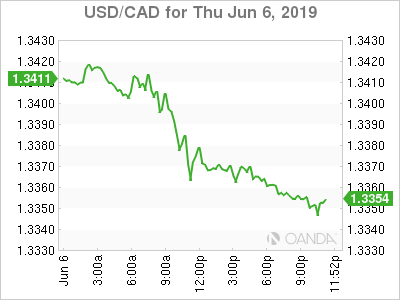
An interest cut by the US central bank is getting closer as Fed speaker after Fed speaker issues remarks.
Euro Rises as ECB Doesn’t Go Full Dove
The US dollar was lower across the broad with the euro rising 0.48 percent against the greenback. While an interest rate cut is being pricing in against the US dollar, the euro got a pass from the ECB that did not include the monetary policy option as part of the available tools that it could use. The fact that the ECB upgraded economic growth and inflation forecasts higher was not as dovish as Fed remarks have been recently. The central bank did extend the period it expects to keep interest rates unchanged until the first half of 2020.
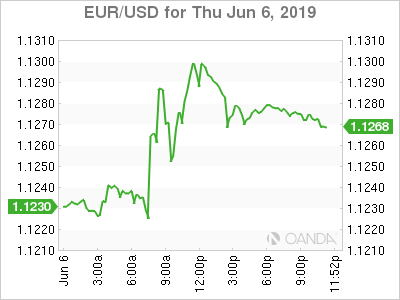
Economic indicators in Europe have been mixed with manufacturing in contraction. The German economy in particular has not regained enough momentum to bring up European manufacturing to an expansion.
OIL – Crude Rebounds as White House Offer Mexico Tariff Hopes
Oil rebounded from the previous session. WTI jumped 2.9 percent and Brent 2.61 percent with a combination of a weaker US dollar and signs that a deal with Mexico to at least delay tariffs could be close. Crude remains flat on a weekly basis as trade disputes have been offset with central banks signalling that rates will remain low, or in the case of the Fed reverse their monetary policy to avoid the economy falling in to a recession.
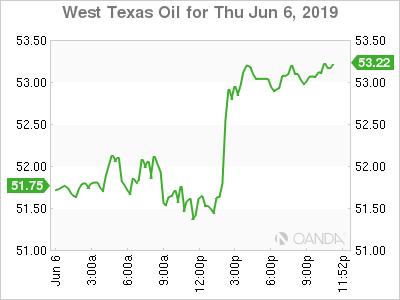
The surprise buildup of 6.8 million barrels of crude and 3.2 million barrels of gasoline put downward pressure on energy prices on Wednesday which combined with the negative effect of a prolonged trade war with China have on crude prices.
GOLD – Gold Rises on Soft Dollar as US Rate Cut Narrative Gather Momentum
Gold rose 0.45 percent on Thursday as the Fed keeps signalling a rate cut could be near. The White House went from reopening a trade front and reducing the appeal of the US dollar as a safe haven. Gold was higher, despite comments in the afternoon that a delay could be announced as talks between the US and Mexico continue.
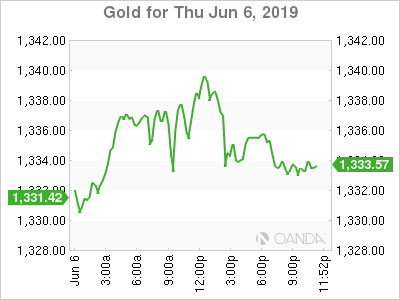
Central banks remain committed to avoiding a recession. The Fed hiked four times in 2018 and has almost gone full 180 degrees after a hard stop in January. Now Fed members keep dropping hints about a potential rate cut if it’s needed to stabilize the economy. The European Central Bank (ECB)
Issued a similar statement as he is ready to use all instruments to support the economy.
Gold has remained above the $1,330 level thanks to the ramp up in trade war rhetoric from the US. The market does not expect a long dispute with Mexico as talks appear to be near an agreement. Talks with China have taken a backseat, but as the two sides are far apart and with an upcoming G20 meeting at the end of the month there could be good news. Then again, we have been here before, where an agreement was within reach, only to be snatched away at the last second.
The yellow metal is a preferred destination for investors that seek refuge from uncertainty, especially if the US is battling in more than one trade front. As trade concerns ease there will be less appetite for a safe haven.
STOCKS – Equities Rally on Mexico Tariff Hopes
A report that US officials could announce a delay on Mexican import tariffs boosted equities on Thursday trading. President Trump has said that progress has been made, but not enough prompting markets to price in delay as the most likely scenario. The US is asking Mexico to keep Central American migrants during their asylum-seeking proceedings.
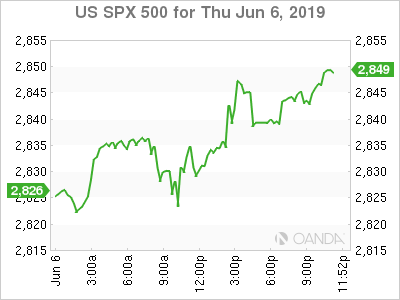
The auto sector was one of the hardest hit due to the integration of the production between the two nations, so it was understandable that it rebounded on positive US-Mexico news. The market continues to be sensitive to trade war rhetoric. The US-China dispute will drag on, with the next round of talks unclear, with a chance of a meeting of the two leaders in Japan as part of the G20 at the end of June.
Trump continues to beat the trade war drum, announcing that tariffs against China could rise $300 billion if necessary. Equities had put China in the back burner until more details emerged, but the Mexico trade spat once again highlighted the perceived negative impact that a prolonged trade will can have on the global economy.
Eco Data 6/7/19
[php_everywhere instance="1"]
China Weekly Letter – Are We Heading for an All-Out Trade War?
- There is no sign of improvement in the war of attrition between the US and China as the trade war widens in scope.
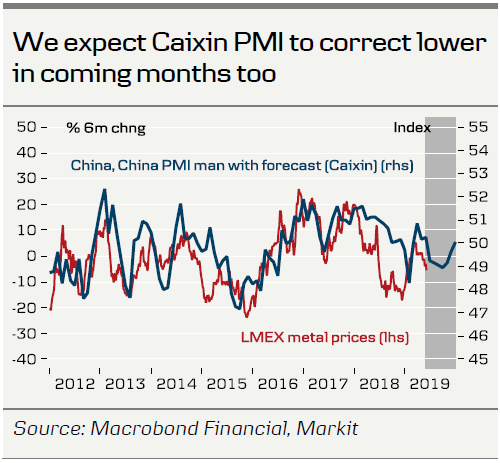
- Chinese PMI data for May is mixed but we expect more weakness in the short term. There are more signs the trade war is also starting to hurt US manufacturing.
Further escalation as trade war widens in scope
Following a short break last week, we are back with more updates on Chinese developments. The trade war with the US continues to be the dominant issue. It increasingly looks like a broad economic war with measures widening in scope. Below is an overview of recent developments.
- China 'unreliable entities list'. In response to the US export ban on Huawei, China last week announced it will create an 'unreliable entities list ' of foreign companies, organisations and individuals that it deems 'unreliable' and harming Chinese companies. Shortly after, it announced it would launch an investigation of FedEx , as packages with paperwork sent by Huawei to offices in Asia had been shipped to the US instead.
- Threat of restrictions on rare earth exports. China's National Development and Reform Commission is currently studying a proposal to control rare earths exports, which in the short term could hurt US production of a wide range of products. China has 70-80% of global mining of the rare earth minerals needed to produce things such as mobile phones, electric vehicles and missiles.
- China issues travel warning. This week China warned its' citizens to 'fully assess the risks' of travelling to the US. Reduced tourism is one way China could hurt the US service sector. Around 3 million Chinese tourists travelled to the US in 2018, although visits from China declined for the first time in 15 years.
- China also warned students about going to the US. China has 360,000 students in the US, creating good business for US colleges and universities. The US at the same time is tightening visa rules for Chinese students and US lawmakers are preparing legislation to target the Chinese spy threat from Chinese students and researchers already in the US.
- China released a White Paper putting blame on the US for the escalation of the trade war and pointing to the US backtracking during the trade talks, suggesting it would be impossible for the US to use 'extreme pressure' to force concessions from China . The US responded with a joint statement by the US Trade Representatives Office and the US Treasury expressing that they are 'disappointed ' by China's blame game.
- Donald Trump repeats threat of tariffs on USD300bn. On Thursday, Trump said 'I could go up another at least USD300bn and I'll do that at the right time'. Later in the day, he stated that a decision on tariffs would be made around the G20 meeting. Over the weekend, Trump tweeted 'the word TARIFF is a beautiful word indeed!'.
- More Chinese reference to the Korean War. A Chinese paper referenced the Korean Warand the talks lasting for two years afterwards. The paper says in the end the US retreated from what it saw as unfair demands from the Chinese and Korean side. This may be another sign that China is preparing for a long trade war instead of making concessions.
Bloomberg this week ran a story that the trade war is threatening one of the biggest deals ever between Boeing and its Chinese counterpart. It is likely the Boeing order will be made conditional on a trade deal with the US and it is unlikely to go through in a scenario of continued trade war.
US Vice-President Mike Pence is apparently scheduled to speakon US-China relations on 24 June, just four days before the Xi Jinping-Trump meeting at the G20 summit. Pence's hawkish speech in October 2018 led to the first speculation about whether we are heading for a new kind of cold war.
Comment: We see no signs that either the US or China is about to blink. Trump is signalling that he expects China to give in because it wants a deal badly and companies are leaving the country. In addition, China is continuing with its defiant tone and preparing its people for a long trade war, which could be painful. The Xi-Trump meeting at the G20 summit is crucial for whether we get a further escalation leading to an all-out trade war. We see a 50-50 probability of this. We do not expect China to give in on its 'red lines', or what it has called 'core principles'. According to SCMP, Xi discussed this with the Politburo on 13 May and they took a decision to stand firm. So, Trump has to consider whether or not he can accept this. Ultimately, we expect a deal in H2, because the market stress and economic damage are becoming too much for Trump to go into election with. However, the road from here is indeed very murky.
Both US and Chinese economies are weakening
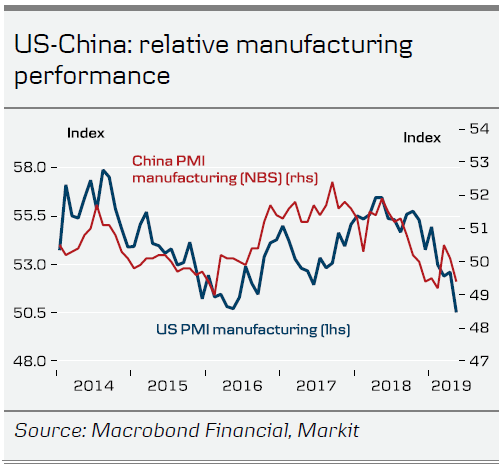
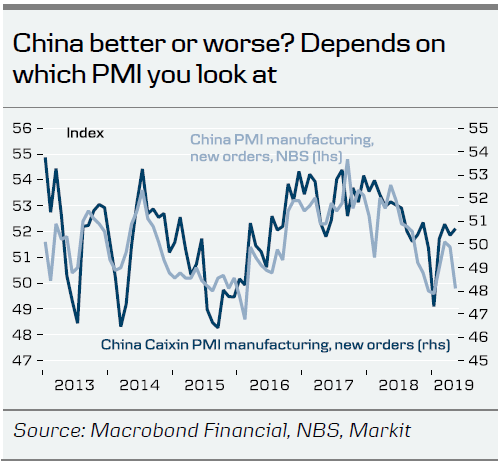
The Chinese PMI for May was mixed with the official PMI manufacturing falling sharply, while the private version from Caixin actually rose slightly. In the US, manufacturing data worsened in May (see chart on front page). China on Thursday published a plan to lift private consumption, with measures to lift purchases of green vehicles, home appliances and other products.
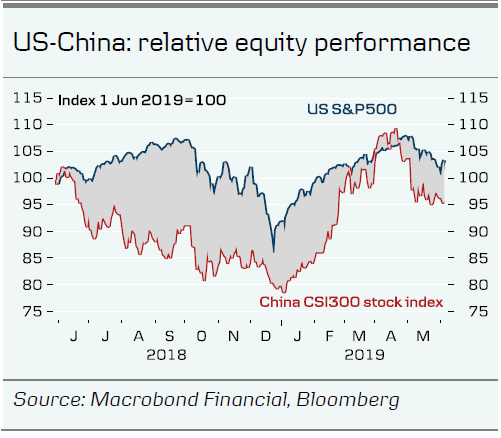
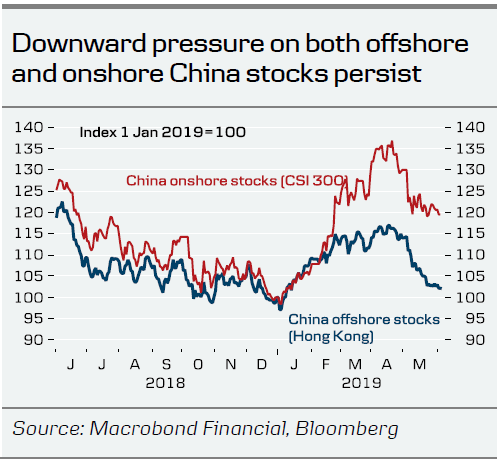
Comment: We believe the downward pressure on China will continue in the short term due to heightened uncertainty. We expect a trade deal in H2 at some point and more stimulus to pave the way for a recovery. There are signs that the trade war is also taking its toll on US companies and further escalation would be likely to cause real pain. We expect the Fed to cut rates in H2 but it would take time for any cuts to lift the economy again.
Other China news over the past week:
China and Russia strengthened their partnership on Xi Jinping's visit to Moscow.
Malaysia and Singapore urged the US and China to solve their differences and work together.
The US is pursuing a weapons sale to Taiwan, adding to tensions with China.
Huawei employees are working day and night (literally) to eliminate the company's dependence on the US.
ECB Not Delivering to Market Expectations
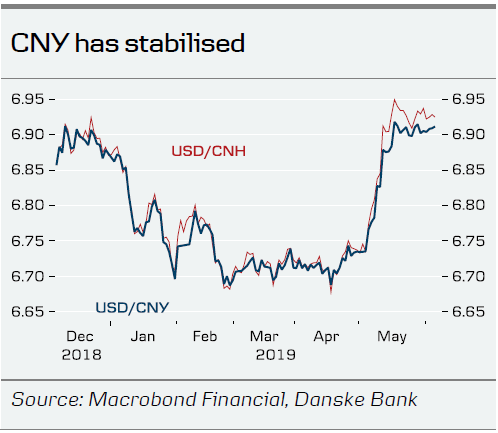
- The ECB's decision today to extend the forward guidance to 'at present levels at least through H1 2020' were on the dovish side of our expectations, but significantly more hawkish than markets expected. However, the price action after the press conference suggest that markets don't expect Draghi to have been dovish enough. TLTRO3 modalities came in as broadly expected.
- The European hunt for yield environment continues after today's meeting. Front end fixed income markets reacted strongly to the decision of rates not being cut in the near future, with EONIA 1y1m EONIA jumping 4bp on the decision. Long dated yields basically unchanged. Markets will not sell EUR until rate cuts or ECB easing measures are clearly discussed.
- The updated staff projections were broadly unchanged, leading to an unchanged baseline narrative, although the external environment posed a more prominent risk than previously.
A Draghi special
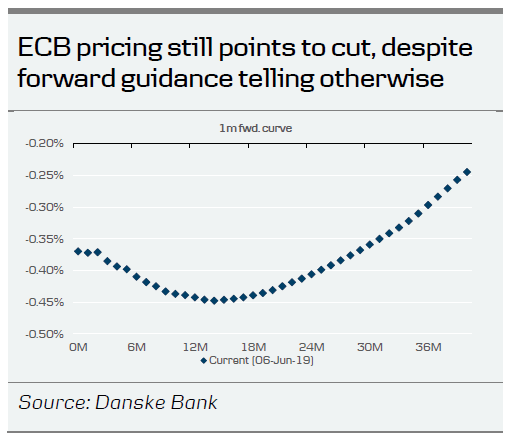
Draghi was on the dovish side today raising concerns with the risks to the baseline narrative stemming from the external environment. However, Draghi was not dovish enough to deliver on the front end as ECB confirmed that rates will remain at present levels at least through the first half of 2020. As a result, the major expectations that were built up in markets ahead of the ECB meeting to cut rates by end year saw major disappointment. Prior to the meeting markets priced almost a 50-50 chance of a rate cut in September this year.
Draghi made sure several times during the press conference to stress that all options are on the table, including rate cut and restart QE, which was mentioned during the discussions in case of contingencies. Therefore, we do not find that surprising (in fact prudent), as a central bank should always discuss all its policy options. Unfortunately, Draghi didn't provide any flesh to the discussion as the real details and how to structure a potential restart of QE were left unsaid.
The TLTRO3 modalities came in as broadly expected mirroring the TLTRO2, although with the incentive structure build from MRO+10bp to depo+10bp (compared to TLTRO2 which were MRO to depo rate). There are no options to repay early in the operations, which makes the TLTRO3 a liquidity measure rather than a monetary policy measure.
The growth and inflation remain broadly unchanged although with more prominent risks (Brexit, trade war and China) and labour market tightness (see more in next section).
As expected, Draghi said that the deteriorating inflation expectations are being taken seriously, but nothing that warrants change so far in the monetary policy stance as inflation expectations are anchored in the surveys (note the SPF from April pointed to inflation at 1.8% in the longer term). He further noted that there is no risk of deflation but there was the shift in inflation pricing distribution. In other words, the negative risk premium and the cyclical nature of the inflation market pricing makes the ECB believe no real de-anchoring at this stage.
Staff projections: a broadly unchanged narrative
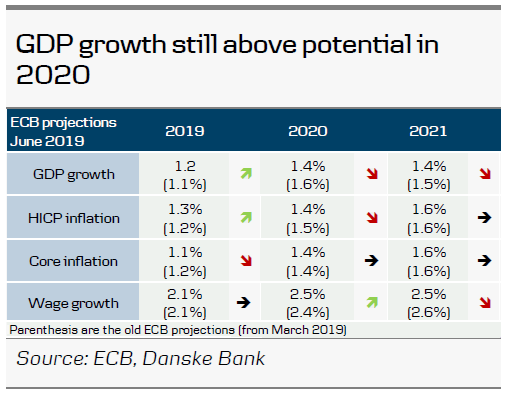
The staff projections were little changed compared to the March vintage. Most noteworthy was the 2020 growth projection which was revised down by 0.2pp as well as an upward revision of 2019 growth (which is attributed to a strong Q1 figure of 0.4% q/q). That said, the risk drivers were more prominent than previously as Draghi also pointed to a somewhat weaker growth momentum in Q2 and Q3 this year, mainly reflecting the external trade environment which weighed on the euro area manufacturing sector.
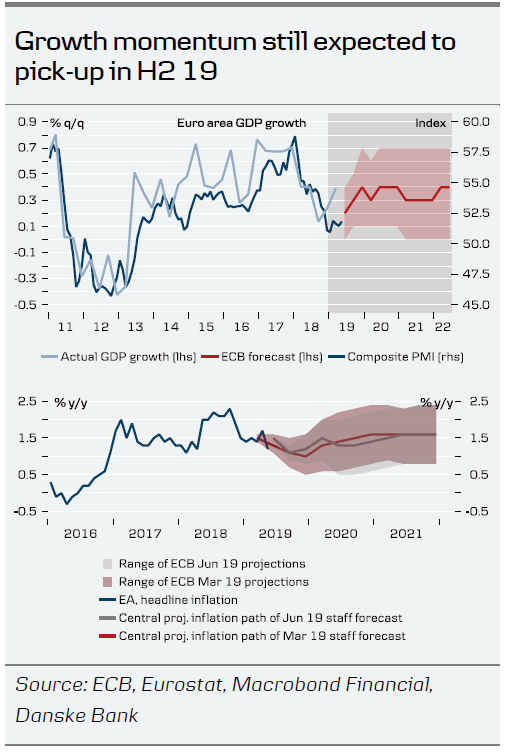
The overall narrative of economic expansion continuing was emphasised several times as ECB stressed that the expansion is expected to continue due to favourable financing conditions, fiscal support and the strong labour market – although there were nothing new in this.
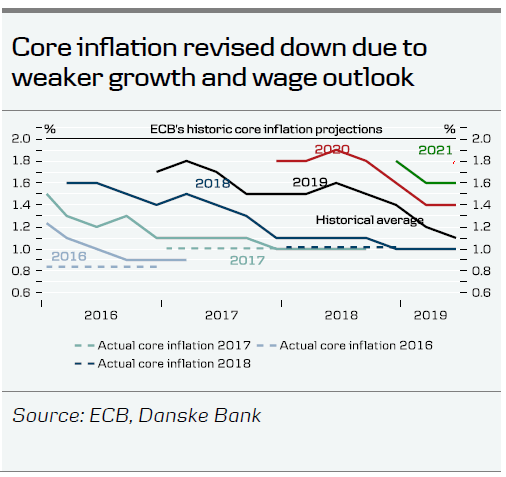
The inflation projections were only marginally changed, although with a small revision this year driven by the energy component. The ECB continues to find the underlying inflationary pressures generally muted albeit with a confidence in a tight labour market and 'stronger wage growth'. Importantly, core inflation was broadly unchanged. In other words, inflation is delayed, not derailed.
Note that the ECB projections do not take into account the recent escalation in the USChina trade deal.
FI: Draghi to flatten the curve 5s10s
The ECB statement and press conference was a disappointment for the fixed income market and the market has consequently lowered the probability of a rate cut. There is now priced 8bp of cut on a 12M horizon. However, importantly Draghi did mention during the press conference that ECB board members had during today's session raised the possibility of rate cuts or restarting QE as a contingency tool, however we believe that it should be seen in a context of a broader discussion on contingency plans.
We doubt we are in for an extended Bund sell-off. The market will still see the risk skewed towards a future rate cut given the prominent risks lurking in the horizon. Furthermore, today's announcement will do very little to lift inflation expectations that trade close to an all time low and arguments of it being de-anchored have floated the markets. 5y5y EUR inflation forward falling further after the announcement, now standing at 1.27% - a level where ECB previously stepped up its stimuli at an earlier stage. Hence, today's flattening of the German curve 2s10s and 5s10s is fair.
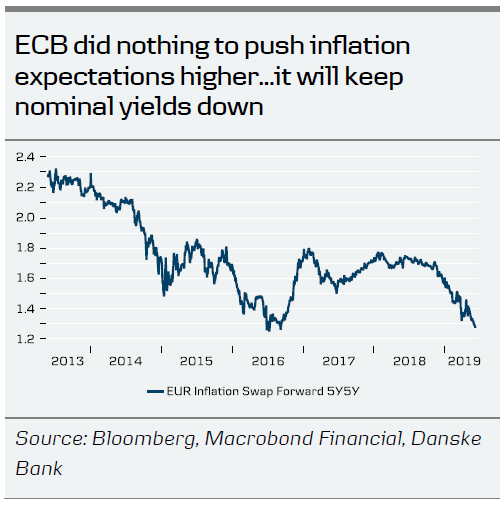
The direction of Bunds for the coming days will depend on how other risk-markets receive this. The ECB on hold in a situation where the Fed is embarking on easing does not necessarily bode well for risk-appetite and EUR/USD could be pushed higher - adding further downside for eurozone inflation.
We saw today that the Italian bond market came under pressure as stimuli were lacking and as the modalities of the new TLTRO were marginally less attractive than expected. Draghi actually underlined that there is a risk that the TLTRO's will justify 'carry trades'. Remember, the TLTRO's are basically designed to support periphery banks. Spain and Portugal continued to outperform as investors look for alternatives to negative yielding core and semi-core bonds.
FX: EUR rises on (not enough) dovish ECB, compared to market
EUR rose across the space of G10 currencies today as the dovish market expectations were left gravely disappointed. The lack of clear hints that easing, either in terms of rate cuts or QE, is coming means that the market will find a hard time selling EUR on the expectation of easing unless ECB officials start addressing this in public. After a week where Fed and ECB monetary policy has been in focus the market is now left with a Fed ready to cut rates and an ECB which has only started discussing how it would respond if the economy deteriorated even further. The monetary policy divergence supports our 6M forecast for EUR/USD of 1.15.
New Zealand Dollar Shrugs Off Weak Commodity Numbers
The New Zealand dollar has gained ground on Thursday, the fifth straight winning session. In North American trade, NZD/USD is trading at 0.6639, up 0.34% on the day. In New Zealand, ANZ Commodity Prices slowed to 0.0% in May. In the U.S., unemployment claims rose to 218 thousand, above the estimate of 215 thousand. On Friday, the U.S. releases nonfarm payrolls and wage growth.
With the Federal Reserve sending hints that it could ease monetary policy later this year, the U.S. dollar has been under pressure. The New Zealand dollar has taken advantage, gaining 1.6% this week. The currency is on track to post its strongest weekly gains since mid-February. At the same time, domestic economic conditions remain soft. New Zealand is heavily dependent on its export sector, and this week’s commodity releases have raised concerns. The ANZ Commodity Price Index slowed to 0.0% in May, the first time it failed to record a gain since December. Earlier in the week, the GDT Price Index, a key gauge of dairy prices, declined 3.4% in June. This marked a second straight decline. The slowdown in China has had damaged the New Zealand economy, and with the U.S.-China trade war showing no signs of easing, New Zealand’s economy and the New Zealand dollar could face headwinds.
Since raising rates back in December, the Federal Reserve has sounded neutral with regard to rate movement. However, the Fed made a dramatic U-turn this week, with Fed Chair Jerome Powell hinting at a rate cut. On Tuesday, Powell said that the Fed would “act as appropriate to sustain the expansion”. It was also noteworthy that Powell did not mention his “patient” approach to monetary policy, which has been a buzzword in his recent comments. Also this week, St. Louis Fed president James Bullard said that the Fed might have to lower rates shortly due to low inflation and the ongoing trade war with China.
Aussie Edges Higher Despite Soft Trade Surplus
AUD/USD has posted slight gains in the Thursday session, erasing most of the losses seen on Wednesday. In North American trade, AUD/USD is trading at 0.6985, up 0.23% on the day. In Australia, the trade surplus narrowed to A$4.87 billion in April, down from A$4.95 billion a month earlier. This missed the forecast of A$5.05 billion. Later in the day, Australia releases AIG Construction Index and Home Loans. In the U.S., unemployment claims rose to 218 thousand, above the estimate of 215 thousand. On Friday, the U.S. releases nonfarm payrolls and wage growth.
Australia’s trade surplus missed expectations, as the global trade war has taken a bite out of the country’s key export sector. The slowdown in China has translated into economic pain for Australia, as the Asian giant is Australia’s number one trading partner. Growth in Q1 was just 1.8% on an annualized basis, far lower than the long-term average of 3.5%. The RBA has finally stepped in with a rate cut, but will there be more pain before gain? The bank lowered rates from 1.50% to 1.25%, marking the first time the RBA has cut rates since August 2016. If key economic indicators continue to struggle, we could see another rate cut in the second half of the year.
Is the Federal Reserve on its way to lowering rates for the first time in 2019? Since raising rates back in December, the Federal Reserve has sounded neutral with regard to rate movement. However, the Fed made a dramatic U-turn this week, with Fed Chair Jerome Powell hinting at a rate cut. On Tuesday, Powell said that the Fed would “act as appropriate to sustain the expansion”. It was also noteworthy that Powell did not mention his “patient” approach to monetary policy, which has been a buzzword in his recent comments. Earlier in the week, St. Louis Fed president James Bullard also discussed the need to lower rates in order to stabilize the economy. Bullard said that the Fed might have to cut rates due to low inflation and the ongoing trade war with China.
NAFTA: Next American Fat Tariff Assessment
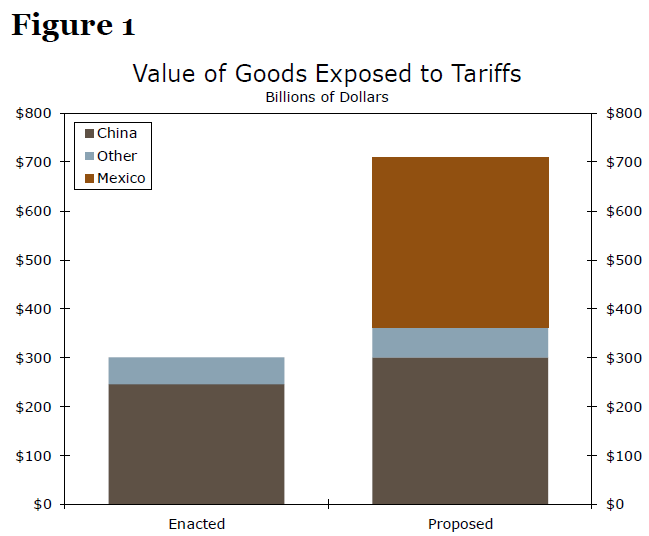
U.S. and Mexico officials failed to reach a deal on tariffs at the conclusion of yesterday's trade talks. Unless negotiators make major progress in the next few days, tariffs on goods coming into the United States from Mexico will be subject to a 5% tariff. Across the board, tariffs on Mexican goods would more than double the dollar value of goods currently subject to tariffs (Figure 1).
Unlike earlier tariffs with other countries, which were announced several weeks or months in advance, this new round against Mexico could go into effect this Monday, June 10, if a deal is not struck to demonstrate that Mexico is shutting down the path for illegal immigration into the United States. There is a built-in escalation of five percentage points each month until the tariff rate hits 25% on Monday, July 8.1
With each passing hour it appears less likely that there will be a deal in hand by Monday, but the fact that there is little appeal for these tariffs on either side of the aisle suggests Mexican tariffs could be short-lived. This special report puts the issue in context by evaluating the importance of Mexico as a trading partner to the United States and considers potential implications for this new front in the trade war.
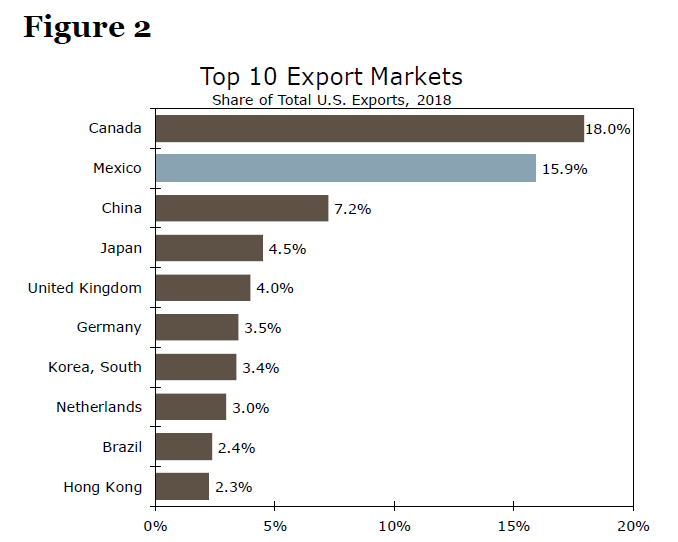
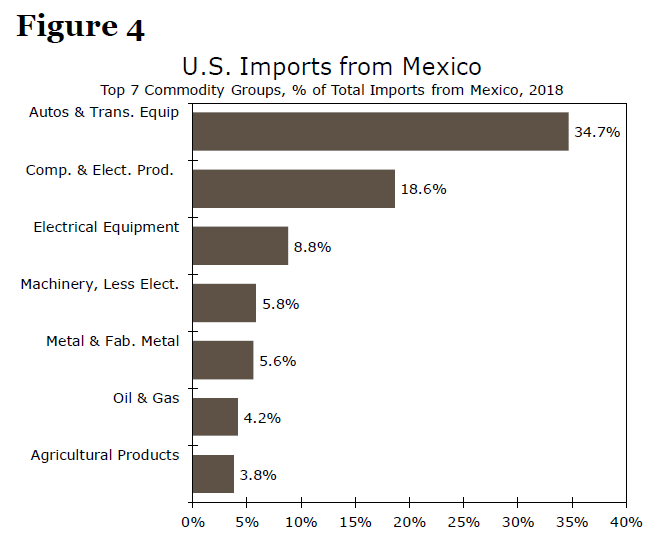
By itself, a trade war with Mexico would not plunge the U.S. economy into recession. Still this spat with Mexico is not the only iron in the fire at the moment; cumulative effects add up. Also, Mexico is our second largest export market (Figure 2) and vital to a number of industries, none more so than the auto sector. Comprising roughly a third of all goods coming from Mexico, the auto sector is a key area of vulnerability in any sustained trade dispute with Mexico. For reasons that will become clear in a moment it is likely these figures substantially underestimate the importance of the auto sector. There are also greater risks for border states, which conduct a larger share of trade than the national average, as well as for states that depend on auto manufacturing, as supply chain disruptions could weigh on production and output.
Numbers to Put the Mexican Trade Relationship in Context
Trade with Mexico is essential to the vitality of the U.S. economy. Of all the goods imported into the United States last year, Mexico was second only to China with a 13.6% share. On the export side, China is less critical, coming in third on the list of export partners with just a 7.2% share of U.S. exports in 2018 (Revisit Figure 2).
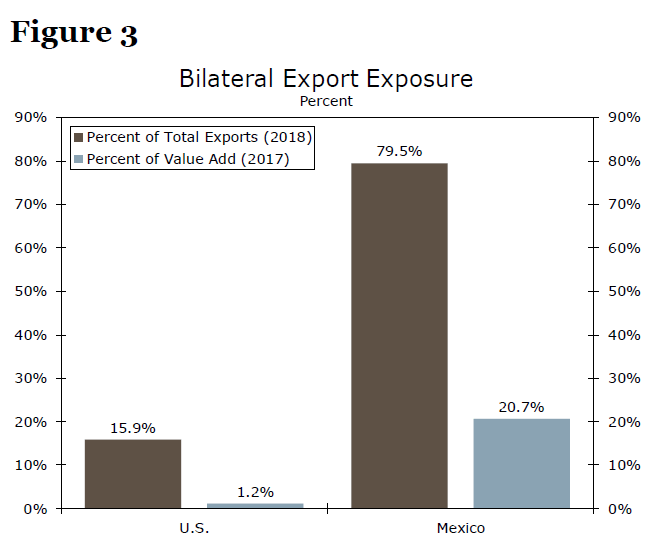
By itself, a trade war with Mexico would not plunge the economy into recession. Exports to Mexico comprise only 1.2% of value added in the U.S. economy (Figure 3). The United States exports more to Mexico than to any other country except Canada, but still the share of total U.S. exports is just 15.9%. A big number, but it pales in comparison to the 79.5% share of Mexican exports that went to the United States in 2018. So at least in terms of the bilateral trade relationship, Mexico has more to lose than the United States.
The magnitude of the relationship, however, implies that if tariffs on Mexican goods were to go through, it would mark the biggest escalation yet in the ongoing trade war. If you add up the dollar value of all of the goods currently subject to tariffs, the totals is about $300 billion. The proposed tariffs on Mexico would affect an additional $346 billion of goods coming into the United States. This is more than just a new front; it is a more than doubling of the trade war in one shot (Revisit Figure 1).
Integrated Supply Chains
A key reason for the close relationships between the three North American economies are the integrated supply chains that have evolved in a number of key manufacturing industries since NAFTA went into effect in the early 1990s (Figure 4). Those close relationships and integrated supply chains blur the lines in tallying the share of imports. This is particularly true in the auto sector, where in the course of the manufacturing process a vehicle can cross international borders multiple times.
Consider a pair of vehicles from Honda, the HR-V and the Fit. The versions of these subcompact crossover vehicles for sale in the U.S. market are produced in Guanajuato, Mexico, but they share some chassis and body components with the popular Honda CR-V, which is produced in Ontario, Canada; East Liberty, Ohio and Greensburg, Indiana. Due to the multiple border crossings of parts and components for these vehicles, it is a difficult to dial in the precise impact by country within North American.
Research conducted by American University takes on this thorny issue by considering seven location variables including profit margin, labor and research and development to score specific automobile models and estimate what percent of a given vehicle is made in a given location.2
According to that methodology, the 2018 Honda HR-V is 30% Mexican-made, and 20% U.S. & Canadian-made. The 2018 Honda Fit is 45% Mexican-made and 20% U.S. & Canadian-made.
The point here is that even Mexican-made vehicles can have a significant share of manufacturing activity that occurs within the United States. The inverse is also true. Quintessentially American-made vehicles rely on parts production in Mexico. The Ford F-150 is 15% Mexican-made, and 44% of the Chevy Silverado comes from Mexico.
The deep interconnectedness of the auto sector means the supply chain disruptions from tariffs directed against Mexico could cause plenty of harm to U.S. business interests as well. Unlike the Chinese tariffs, which find at least some support among congressional leaders from both parties, the tariffs threatened against Mexico have engendered the rare rebuke of the president's policies from GOP leadership in Congress along with the more predictable pushback from Democratic party leaders. For these reasons, we would anticipate it being difficult for the tariffs against Mexico to have a long shelf life.
Conclusion
It may not pay to play the long game on this one. We do not consider ourselves political analysts but there does not seem to be much support for these policies on either side of the aisle. Still, that may not prevent the tariffs from going into effect next week or escalating in subsequent weeks. Should these measures go into effect, and if our analysis about the interconnectedness of the American and Mexican economies is right, the economic pain they will cause, particularly in the auto sector, will likely make this a politically untenable plan in the longer run.
1 This action is under the authority granted in the International Emergency Economic Powers Act. See the "Statement from the President Regarding Emergency Measures to Address the Border Crisis" (May 30, 2019) for more detail.
2 Made in America Auto Index, Research by Frank DuBois, American University, Washington, D.C.