

Sample Category Title
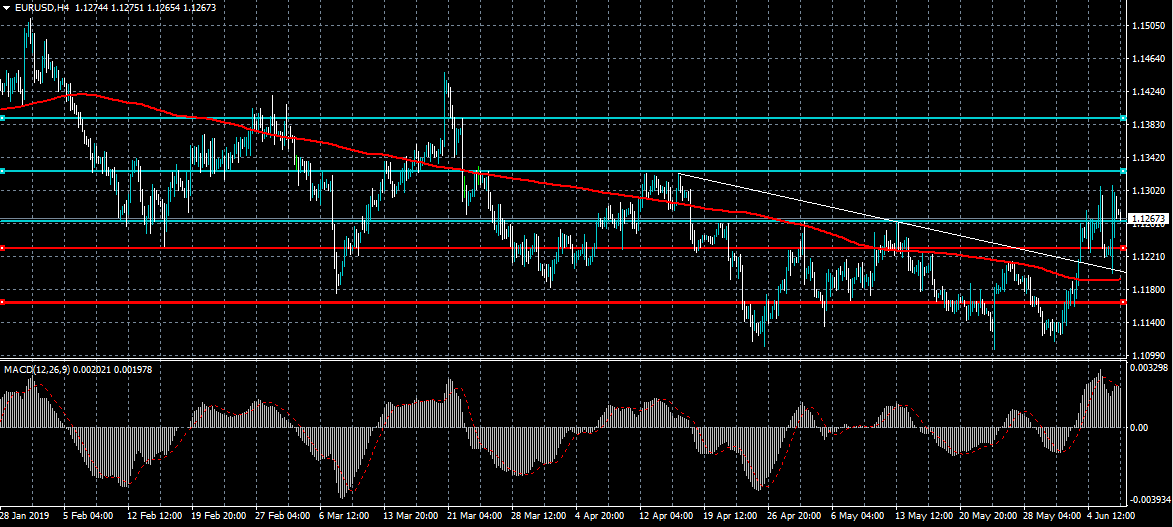
EURUSD 1.1321 Next Big Level
The euro has slipped back towards the key 1.1265 level against the US dollar after the pair briefly traded above the 1.1300 level following the ECB policy decision. The 1.1321 level is the key upside level to watch today, with the 1.1380 and 1.1410 key resistance above. The 1.1265 and 1.1230 levels are major intraday support following the EURUSD pairs rollercoaster ride lower on Thursday.
The EURUSD pair is only bearish while trading below the 1.1230 level, key technical support is found at the 1.1200 and 1.1165 levels.
If the EURUSD pair trades above the 1.1300 level, buyers may test the 1.1320 and 1.1380 levels.
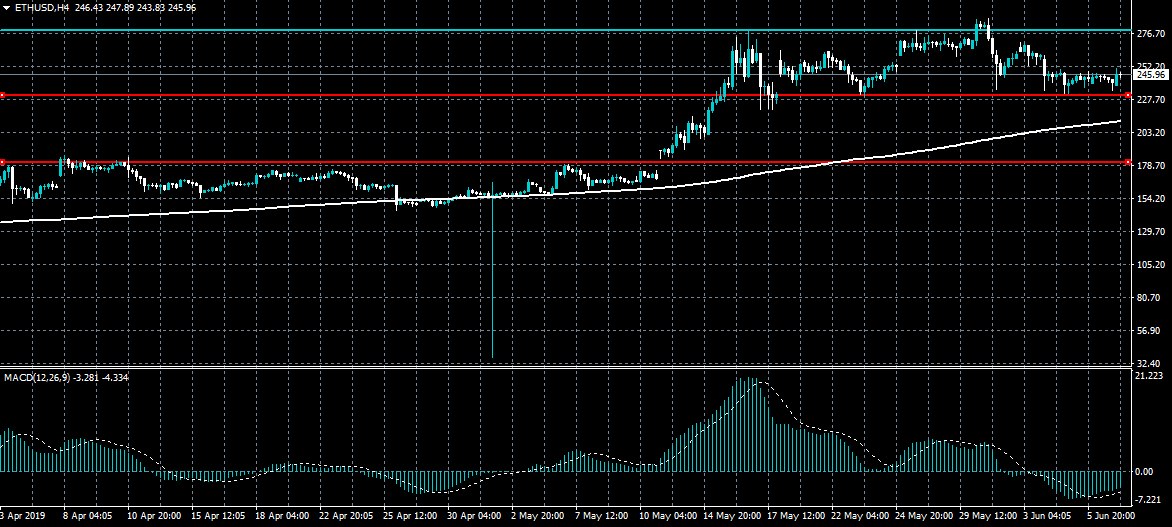
ETHUSD $230.00 Downside Level To Watch
Ethereum is back under pressure on Friday, with the second largest cryptocurrency by market capitalization testing towards neckline support. The four-hour time frame highlights that bearish breakdown towards the $205.00 level is possible if price slips below the $230.00 level. Bulls ideally need to lift the ETHUSD pair above the $280.00 level to negate the bearish head and shoulders pattern.
The ETHUSD pair is intraday bearish while trading below the $230.00 level, key support is found at the $220.00 and $205.00 levels.
If the ETHUSD pair trades above the $230.00 level, key resistance is found at the $245.00 and $280.00 levels.
Currencies: Euro Rises Despite Soft ECB. Will Payrolls Propel EUR/USD Beyond 1.13?
- Rates: ECB ready to ease policy further if needed
ECB President Draghi signaled readiness to ease policy further if needed. The market reaction suggested that investors think of revamping QE as more likely than cutting policy rates deeper. Focus turns to payrolls today. The US 10-yr yield might retest 2.06% support given downside risks, but we think that sufficient softness is discounted by now. - Currencies: Euro rises despite soft ECB. Will payrolls propel EUR/USD beyond 1.13?
Soft ECB comments were not soft enough yesterday to weaken the euro. EUR/USD retested the 1.13 area. The focus turns to the US payrolls today. We see risks for a mediocre report. If so, it might put the dollar further under pressure. A sustained break beyond EUR/USD 1.1300/24 would further weaken the greenback's technical picture.
The Sunrise Headlines
- US stock markets edged higher yesterday after reports suggested Mexican tariffs could be delayed. The DJI outperformed (+0.71%). With the exception of India, Asian equities follow US gains. Korea (+1%) outperforms, China is closed.
- The US considers delaying tariffs on Mexican goods that would go into effect on Monday, people familiar with the matter said. Vice President Pence however dismissed the report later, saying the US will move forward with tariffs.
- UK's PM May formally steps down today. She remains acting leader however until her successor is chosen. 11 MP's have already announced candidacy. A decision is expected in the week of 22 July.
- PBOC's Yi said China still has tools to withstand trade headwinds. The central bank governor referred to interest rates, the required reserve ratio and fiscal policy. He added that the PBOC isn't focussed on the level of the exchange rate.
- Fitch downgraded the Mexican state oil company Pemex to “junk”. The move risks starting a fire sale if other agencies were to follow. It cut the sovereign rating just yesterday, partially inspired by the precarious situation of Pemex.
- Fed Williams' base case for the US is still an above-trend GDP growth but he sees headwinds from increasing trade tensions. He said he Fed may need to “adjust” rates depending on the future data.
- In today's economic calendar the US payrolls (May) are particularly interesting after the ADP job report's strong miss Wednesday. Economic data in the EMU is only of secondary importance
Currencies: Euro Rises Despite Soft ECB. Will Payrolls Propel EUR/USD Beyond 1.13?
Will soft payrolls trigger further USD losses?
The focus for FX trading turned to the ECB meeting yesterday. The ECB 'eased' its guidance as indicated to keep rates at current low levels at least through the first half of 2020. Some governors also raised the issue of cutting the deposit rate or restarted QE but this wasn't deemed necessary yet. Even so, this dovish spin in the ECB communication didn't weaken the euro. On the contrary, EUR/USD retested the recent correction top just north of 1.13. However, a sustained further break didn't occur. EUR/USD returned back in the 1.12, partially due to a better bid for the dollar later on (unconfirmed rumours) that the US could delay imposing tariffs on Mexico. EUR/USD closed at 1.1276 (from 1.1221). USD/JPY finished at 108.40 (from 108.46).
This morning, Chinese markets are closed, but CNH is losing slightly ground on officials' comments downplaying the importance of the USD/CNY 7 level from a policy point of view. Most Asian equity markets are trading in positive territory awaiting the outcome of the US-Mexico talks. EUR/USD trades in the 1.1265 area. USD/JPY is near 108.45/50.
Today, the focus for USD trading will be on the US payrolls. Job growth is expected at a solid 174 000. The jobless rate is seen stable at a multi-decade low (3.6%). Wage growth is seen a 0.3% M/M. We see downside risks for job growth and the unemployment rate. There is not that much room for US yields to decline further as a lot of Fed easing is already discounted. Even so, the dollar might still be sensitive to negative news. Headlines on the US trade policy remain wildcard. We also keep an eye on the debate in the US administration whether it should act action against countries that the US considers have undervalued currencies.
Of late, EUR/USD extensively tested the 1.1110 support, but no break occurred. The USD topside was blocked as markets anticipate substantial Fed rate cuts. EUR/USD still tries to break the 1.1265 level in a sustainable way. A break would improve the technical picture with 1.1324 the next target. We stay cautious on the dollar.
Yesterday, sterling continued to trade weak, especially against the euro, but there was not important enough news to push EUR/GBP beyond recent top in the 0.89 area. Today, UK house price data are probably not that important for sterling trading. Headlines from the political scene will again set the tone for sterling. We expect sterling to stay weak as long as current political stalemate persists.
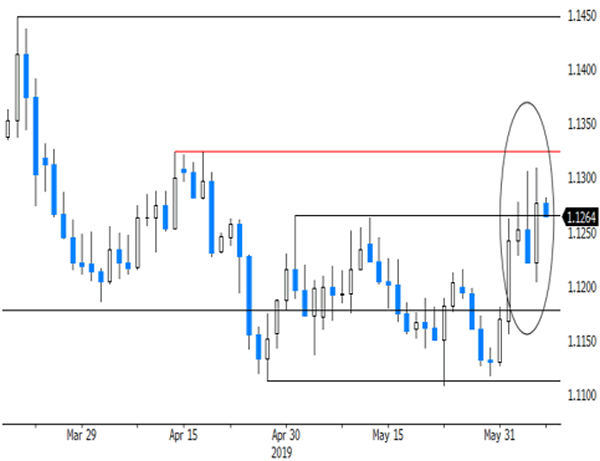
EUR/USD holding near recent correction top. Will (soft) payrolls trigger a break higher
USD/CAD Daily Outlook
Daily Pivots: (S1) 1.3337; (P) 1.3385; (R1) 1.3410; More...
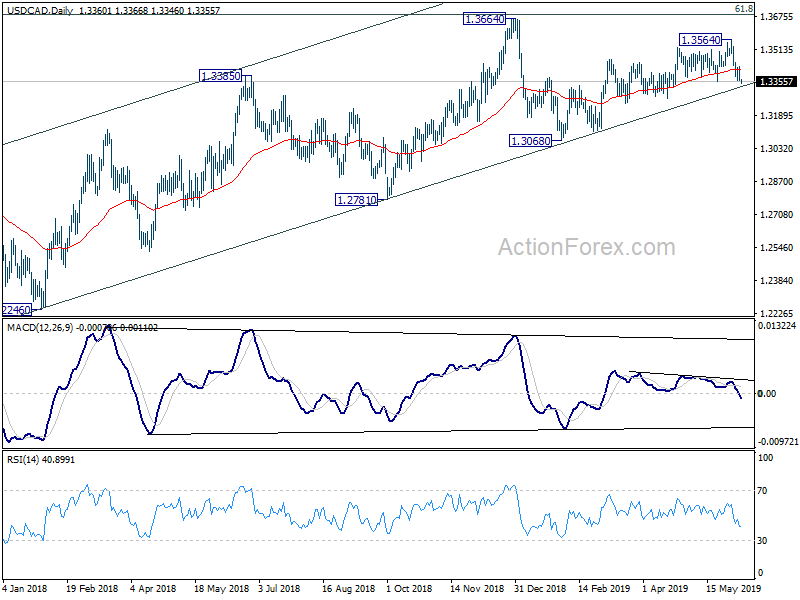
USD/CAD's fall resumed after brief recovery and intraday bias is turned back to the downside. Current development suggests that choppy rise from 1.3068 has completed at 1.3564, on bearish divergence condition in daily MACD. Sustained trading below 1.3357 support should confirm this bearish case and target 1.3274support next. More importantly, that could also have medium term channel support taken out, which carries larger bearish implications too. However, break of 1.3430 resistance will revive near term bullishness and turn bias back to retest 1.3564.
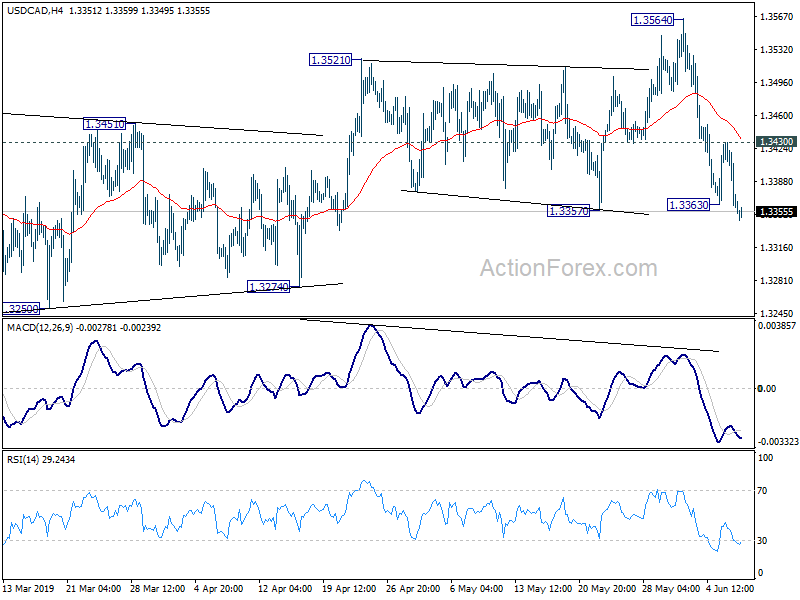
In the bigger picture, USD/CAD is staying well inside medium term rising channel (support at 1.3335). Thus, the up trend from 1.2061 (2017 low) could be in progress. On the upside, decisive break of 61.8% retracement of 1.4689 (2016 high) to 1.2061 at 1.3685 will pave the way to 78.6% retracement at 1.4127 next. This will remain the favored case as long as 1.3068 support holds. However, sustained break of the channel support will be the first sign of medium term reversal. Firm break of 1.3068 would confirm.
Dollar Recovers ahead of Job Data, But More Downside Still in Favor
Dollar recovers mildly today, continuing to stabilize from this week's selloff. The greenback is staying in range established earlier except versus Canadian. There is some optimism on the outcome of US-Mexico negotiations. Or at least, tariffs won't go up to the worst case of 25% down the road. Together with expectations on Fed rate cut, sentiments improved notably, which is clearly reflected in the rebound in the stock markets. Nevertheless, today's non-farm payroll report could be the ultimate test for investor sentiments for the near term.
In the currency markets, Canadian is currently the strongest one for today, helped by mild recovery in oil prices. Sterling is the second strongest, followed by Dollar. Euro is the weakest one but it's generally bounded in range only. Aussie is the second weakest after poor housing data. For the week, Yen overtook Dollar's position as worst performing while Dollar is second, than Aussie. Kiwi is the strongest one, followed by Canadian and then Franc.
Technically, USD/CAD's breach of 1.3357 support is a sign of bearish reversal. That is, rise from February low at 1.3068 has possibly completed at 1.3564 already. But of course the outlook will very much depend on today's job data from both Canada and US. As for Dollar, further decline remains in favor in general. Some near term levels are needed to be taken out, at least some of them, to confirm a turn around in the greenback. Otherwise, we won't be convinced by any knee jerk bullish reactions to NFP. Those levels include 1.1200 support in EUR/USD, 0.6938 support in AUD/USD, 1.0008 resistance in USD/CHF, 109.02 resistance in USD/JPY and 1.3430 resistance in USD/CAD.
In Asia, Nikkei rose 0.58%. Singapore Strait Times is up 0.38%. China and Hong Kong are on holiday. Japan 10-year JGB yield is up 0.0029 at -0.118. Overnight, DOW rose 0.71%. S&P 500 rose 0.61%. NASDAQ rose 0.53%. 10-year yield rose 0.001 to 2.092.
Mexico offered more to US but tariffs still loom
The negotiations between US and Mexico on migration and tariff issues appeared to have made some progress. But the talks would continue on Friday and probably into the weekend. It's reported that the US is considering to delaying the 5% tariffs on all Mexican imports, which is due on Monday, June 10. But White House spokesperson Sarah Sanders reiterated Trump is still moving forward with the tariffs.
After the meeting on Thursday, US Vice President Mike Pence said Mexico had offered "more". "There has been some movement on their part. It's been encouraging," he said. "The discussions are going to continue in the days ahead." Mexican Foreign Minister Marcelo Ebrard said 6000 members of the National Guard were sent to secure its southern border with Guatemala.
Fed Williams: Shifts in demographics and productivity growth fundamentally altered the world after
In a speech delivered yesterday, New York Fed President John Williams said he viewed the pre-2008 crisis era as "the world before" and the period after that as "the world after". Inflation was a "major concerns" in the pre-2008 era. But now "inflation that's too low is now a more pressing problem." The experience of a slow recovery and persistently low inflation is a symptom of deeper problems afflicting advanced economies.
Two changes have taken place in "shifts in demographics and productivity growth" that fundamentally altered the economic environment. And that "translate directly into slower trend economic growth". Also, "an abundance of savings, and a decline in demand for savings resulting from slower trend growth, together lead to lower interest rates". Combined, they have contributed to "dramatic declines" in the longer-term neutral rate of interest, or r-star.
On the economy, he said "my baseline is a very good one" with GDP growth at above-trend 2.25% to 2.50%. Though, tailwinds from last year's tax cuts are fading. Headwinds from trade tensions are rising. He added the yield curve inversion is a "pretty strong signal" of "perception that rates are going to be lower". But he didn't take that as "an oracle".
IMF raises US growth forecasts to 2.6% in 2019, agrees to Fed pausing rate hikes
IMF Managing Director Christine Lagarde said economic forecasts for US for 2019 will be raised by 0.3% to 2.6%. For 2020, growth is expected to slow to 1.9%. IMF is "seeing a lot of positives in the macroeconomic outcomes" and "there is a lot for Americans to be proud of".
Meanwhile, IMF "full agree" with Fed's approach in "pausing its process of raising interest rates". That will "give policymakers time to gauge the balance of risks to both inflation and employment outcomes and to build a clearer picture of whether further adjustments in the federal funds rate are warranted."
On trade, however, Lagarde emphasized "it will be essential that the U.S. and its trading partners work constructively together to better address distortions in the trading system". And, "it is especially important that the trade tensions between the U.S. and its trading partners including China and Mexico… are quickly resolved through a comprehensive agreement that results in a stronger and more integrated international trading system."
PBoC Yi: Tremendous room in fiscal and monetary policy to counter trade war
People's Bank of China Governor Yi Gang said in a Bloomberg interview that China has "tremendous" room for adjusting its fiscal and monetary policy to counter the impact of trade war with US. And, there is no red line in Yuan's exchange rate.
"We have plenty of room in interest rates, we have plenty of room in required reserve ratio rate, and also for the fiscal, monetary policy toolkit, I think the room for adjustment is tremendous," Yi said. He also noted that China's fiscal policy this year is "probably the largest and strongest fiscal reform package". That include tax cuts and fiscal resources allocation. If situation is getting "a little bit worse", the current fiscal package "is able to cover". But it situations gets "tremendously worse", they will "open the discussion".
On Yuan exchange rate, Yi said "trade war would have a temporary depreciation pressure on renminbi". However, he insisted "after the noise, renminbi will continue to be very stable and relatively strong compared to emerging market currencies, even compared to convertible currencies." Meanwhile, Yi also emphasized there is no red line in the exchange rate, and no "numeric number" is more important than the others.
Euro in familiar range after ECB triggered moves
Much volatility was seen in Euro yesterday on ECB, but it settled in familiar range after all the moves. In short, ECB said interest rates are going to stay at currently level for longer, "at least through the first half of 2020". The post meeting press conference was not too dovish at all. It just rejected, as President Mario Draghi described "confidence in the present baseline, but also clear acknowledgement of risks". Growth outlook for 2019 was revised up, but slightly down for 2020 and 21. Inflation outlook for 2019 was revised up, down for 2020.
More on ECB:
- ECB Not Dovish Enough – Low Rate to Stay until Mid-2020 and TLTRO Pricing Revealed.
- ECB Promises Additional Easing If Needed
- ECB Not Delivering to Market Expectations
- ECB Not Panicking Yet
- Breaking Market Commentary: European Central Bank meeting
- Euro lifted by not so dovish ECB Draghi
- (ECB) Introductory Statement to the Press Conference
- ECB Not Dovish Enough
- ECB press conference live stream
- ECB keeps interest rate at 0.00%, will stay there through H1 2020
On the data front
Australia home loans dropped -1.2% mom in April versus expectation of -0.3% mom. AiG Performance of Construction index dropped further to 40.4 in May, down from 42.6. From Japan, household spending rose 1.3% yoy in April versus expectation of 2.7% yoy. Labor cash earnings dropped -0.1% yoy versus expectation of -0.7% yoy. Leading indicator dropped to 95.5, down from 95.9.
Looking ahead, German industrial production and trade balance will be featured in European session. Swiss will release foreign currency reserves. Later in the day, US non-farm payroll and Canada job data will be the major focuses.
USD/CAD Daily Outlook
Daily Pivots: (S1) 1.3337; (P) 1.3385; (R1) 1.3410; More...
USD/CAD's fall resumed after brief recovery and intraday bias is turned back to the downside. Current development suggests that choppy rise from 1.3068 has completed at 1.3564, on bearish divergence condition in daily MACD. Sustained trading below 1.3357 support should confirm this bearish case and target 1.3274support next. More importantly, that could also have medium term channel support taken out, which carries larger bearish implications too. However, break of 1.3430 resistance will revive near term bullishness and turn bias back to retest 1.3564.
In the bigger picture, USD/CAD is staying well inside medium term rising channel (support at 1.3335). Thus, the up trend from 1.2061 (2017 low) could be in progress. On the upside, decisive break of 61.8% retracement of 1.4689 (2016 high) to 1.2061 at 1.3685 will pave the way to 78.6% retracement at 1.4127 next. This will remain the favored case as long as 1.3068 support holds. However, sustained break of the channel support will be the first sign of medium term reversal. Firm break of 1.3068 would confirm.
Economic Indicators Update
| GMT | Ccy | Events | Actual | Forecast | Previous | Revised |
|---|---|---|---|---|---|---|
| 22:30 | AUD | AiG Performance of Construction Index May | 40.4 | 42.6 | ||
| 23:30 | JPY | Overall Household Spending Y/Y Apr | 1.30% | 2.70% | 2.10% | |
| 23:30 | JPY | Labor Cash Earnings Y/Y Apr | -0.10% | -0.70% | -1.90% | -1.30% |
| 1:30 | AUD | Home Loans M/M Apr | -1.20% | -0.30% | -2.80% | -2.30% |
| 5:00 | JPY | Leading Index CI Apr P | 95.5 | 96 | 95.9 | |
| 5:45 | CHF | Unemployment Rate May | 2.40% | 2.40% | 2.40% | |
| 6:00 | EUR | German Industrial Production M/M Apr | -1.90% | -0.50% | 0.50% | |
| 6:00 | EUR | German Trade Balance (EUR) Apr | 17.0B | 18.7B | 20.0B | |
| 7:00 | CHF | Foreign Currency Reserves (CHF) May | 772B | |||
| 12:30 | CAD | Net Change in Employment May | -5.5K | 106.5K | ||
| 12:30 | CAD | Unemployment Rate May | 5.70% | 5.70% | ||
| 12:30 | USD | Change in Non-farm Payrolls May | 180K | 263K | ||
| 12:30 | USD | Unemployment Rate May | 3.60% | 3.60% | ||
| 12:30 | USD | Average Hourly Earnings M/M May | 0.30% | 0.20% | ||
| 14:00 | USD | Wholesale Inventories M/M Apr F | 0.70% | 0.70% |
ECB Promises Additional Easing If Needed
- ECB sees increased risks warranting a further delay to tightening
- No major change in economic view in new projections but…
- …Draghi says ECB determined to act if ‘adverse contingencies’ arise
- Options for possible further easing being discussed
- Slight hints at limited scope including a possible need to resort to fiscal policy
- So, differing if modest FX and interest rate market reactions make sense
Market expectations ran quite high ahead of yesterday’s ECB governing council meeting and on several occasions in the past such expectations have been sorely disappointed. While the exchange rate of the Euro did rise somewhat in the aftermath of ECB pronouncements, market interest rates softened marginally, suggesting ECB president Mario Draghi provided some measure of comfort to investors that Euro area interest rates are likely to remain lower for even longer than had previously been envisaged and also raising the (still limited) possibility of a further policy easing.
The slightly divergent responses of FX and interest rate traders could be interpreted as suggesting that while the ECB didn’t announce as much as some might have hoped, it did a little more than some may have feared.
ECB strikes an easier note
At a technical level, the ECB provided details of the previously signalled new round of funding operations for the banking sector, the third instalment of Targeted Long Term Refinancing Operations (TLTRO’s) that will begin in September 2019. However, this was not the most significant element of the ECB’s pronouncements
The most notable aspect was the acknowledgement of increased downside risks to the economic outlook and the impact this has had on ECB thinking. The most immediate impact was the decision to delay any increase in interest rates by six months‐until the second half of 2020 at the earliest from the previously indicated end of 2019.
At least as important was the increased signalling that the ECB was prepared to ease policy again if needed, a willingness underlined by the inclusion of the phrase’ Looking ahead, the Governing Council is determined to act in case of adverse contingencies..’ in Mr Draghi’s opening press statement. To emphasise the ECB’s capacity in this regard Mr Draghi indicated that there had been a detailed discussion regarding potential easing measures that the ECB might consider if needed in the future.
Alert to dangers
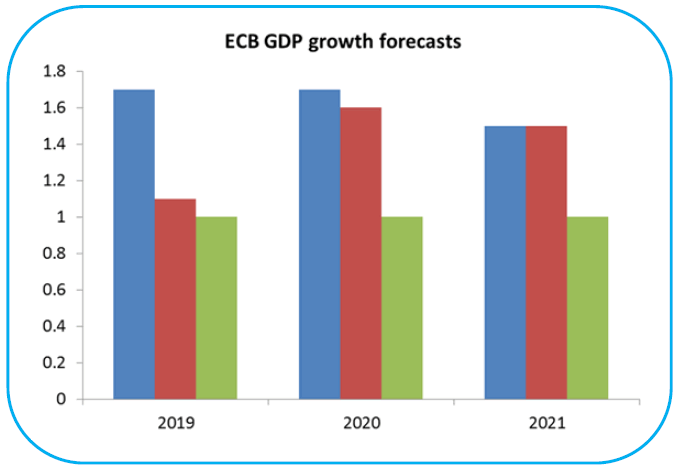
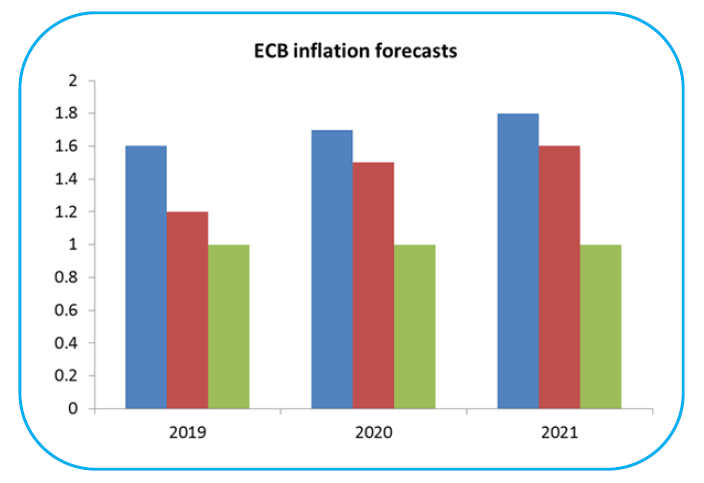
While the past few weeks have seen financial markets move into panic mode on fears of a notably poorer economic outlook, it should be emphasised that the increased risks acknowledged by the ECB have not in its view translated into a notably darker economic reality at least for now. Indeed, on a number of occasions, Mr Draghi referred to ‘the disconnect between what markets see and what people expect’. Compared to the previous estimates made three months ago, new ECB projections envisage fractionally stronger economic growth and inflation in 2019 and, as the diagram below illustrates only marginally weaker trajectories for 2020 and 2021
Circumstances in which the ECB sees the current outlook as still moderately positive but significantly threatened might suggest the ECB should keep its powder dry but to seek to impress upon markets that it had ample ammunition and was willing and able to use it. This is likely the driving force behind Mr Draghi’s indication that there was ‘a readiness to act in case of adverse contingencies’ and that this had led to a ‘discussion of granularity’ on the measures the ECB might use to ease policy further.
To emphasise the ECB’s scope to act was substantial, Mr Draghi indicated that ‘policy space is there’. He noted that that several members raised the possibility of further rate cuts, other members referred to restarting the Asset Purchase Programme or further extending forward guidance. However, he added that such discussions had just started and the governing council hadn’t discussed which contingency would call for which instrument. This addition is likely designed to emphasise the nature of these discussions is preliminary and tentative to prevent markets from concluding that the process of preparing a future ECB easing action has already begun.
Might fiscal policy action be needed?
The central message of Mr Draghi was that the ECB was aware of increased downside risks, that this meant any future rate increases would be further delayed and that should such risks increase further and translate into a notably poorer outlook, the ECB was both able and willing to act to ease policy further. However, some other comments made by Mr Draghi might also suggest that the ECB’s scope to act might be limited in some important respects.
One important constraint on further cuts to the deposit rate and possibly even on the extended maintenance of the deposit rate at current levels is the ongoing concern that prolonged negative interest rates might weaken the profitability of the banking sector and thereby diminish its lending capacity that is central to transmitting ECB policy to the broader economy.
While Mr Draghi argued that thus far ‘in the aggregate’, the ECB wasn’t seeing any adverse effects on lending, a significant insertion in yesterday’s opening press statement noted ‘we will continue to monitor carefully the bank‐based transmission channel of monetary policy and the case for mitigating measures.’ This wording might suggest the deposit rate is close, possibly very close, to the effective lower bound at present and the ability to sustain it at current levels cannot be taken for granted.
Arguably of major significance in the ECB pronouncements was Mr Draghi’s acknowledgement that ECB policy alone was unlikely to be able to fully offset a serious downturn in economic conditions. Mr Draghi noted ‘Certainly, fiscal policy will have to come into consideration…and play a fundamental role..’. This hints at a possibly fundamental change in ECB thinking. If the ECB were to countenance a more expansionary policy (even though Draghi only referred to it in circumstances of ‘adverse contingencies’), it would represent a major regime shift with potentially significant implications for the interest rate outlook in the medium term. It would also accord with some academic thinking for a more nuanced view of the role of fiscal policy such as that proposed in Olivier Blanchard’s address to the American Economic Association at the start of the year.
Market reaction modestly but differently
While Euro area market interest rates softened marginally, the exchange rate of the Euro rose slightly in the wake of Mr Draghi’s pronouncements. These outcomes that can often be no more than a reflection of different market capacities to absorb changes in positions, might also suggest different verdicts on the part of interest rate and FX traders.
To the extent that the date of any possible ECB tightening has been further delayed and the possibility of a further easing increased but in both instances in a direction the market had expected, the reaction of interest rate markets is not surprising. However, for FX traders, the expectation that the US Federal reserve can ease much more aggressively, that the details of Mr Draghi’s pronouncements may be hints at limits to what the ECB can do and perhaps even the prospect of a more supportive fiscal stance within the Euro area would all rationalise a slightly stronger Euro exchange rate.
In light of Mr Draghi’s pointers in regard to possible future policy actions, the ECB’s announcement of the details of the upcoming TLRTO got relatively little attention. Mr Draghi indicated that they were an important backstop and in circumstances where there are concerns about the impact of negative rates on the banking sector, the terms of the new TLTRO’s might seem to reflect an attempt to strike a balance between conflicting views on the governing council. On one hand, the base pricing at 10 basis points over the main ECB refinancing rate represents a penalty, albeit modest, for such funding. However, as was the case with the previous TLTRO, in an effort to stimulate credit creation, the rate charged by the ECB to banks that increase their lending can be reduced by as much as 40 basis points. While the TLTRO, will support Euro area lending capacity, it is unlikely to make any dramatic change to the current outlook for the broader Euro area economy or consequently for the future path of monetary policy.
AUD/USD And NZD/USD Could Dip Before Fresh Increase
AUD/USD started a strong upward move and recently tested the 0.7000 resistance. NZD/USD also climbed higher and is currently correcting gains. However, dips remain supported for a fresh increase.
Important Takeaways for AUD/USD and NZD/USD
- The Aussie Dollar started a solid upward move after it broke the 0.6940 resistance against the US Dollar.
- There is a breakout pattern forming with support near the 0.6965 level on the hourly chart of AUD/USD.
- NZD/USD climbed higher recently and broke the key 0.6600 resistance area.
- It is currently correcting lower and broke a bullish trend line with support near 0.6625 on the hourly chart.
AUD/USD Technical Analysis
After forming a support base near the 0.6900 level, the Aussie Dollar started a strong upward move against the US Dollar. The AUD/USD pair broke the key 0.6920 and 0.6950 resistance levels to move into a positive zone.
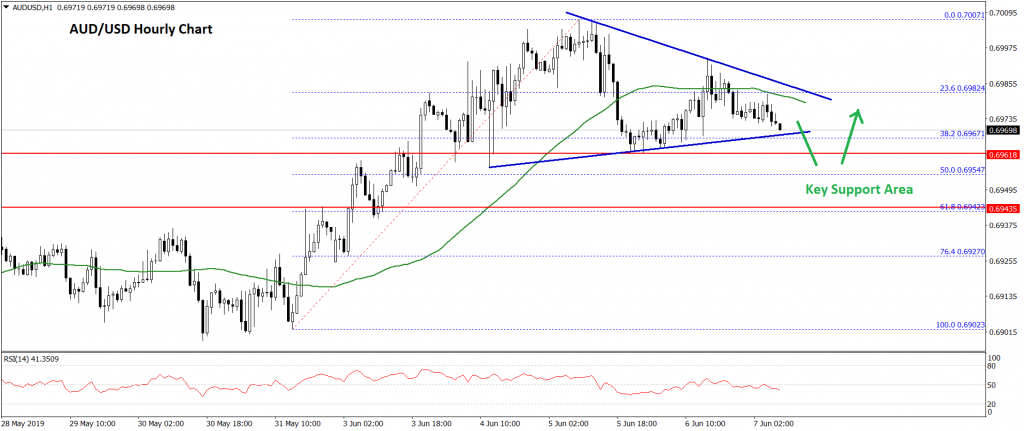
The hourly chart suggests that the pair gained momentum above 0.6950 and the 50 hourly simple moving average. It even broke the 0.6980 level and spiked above the 0.7000 level.
A swing high was formed at 0.7007 before the pair started a downside correction. There was a break below the 23.6% Fib retracement level of the last wave from the 0.6902 low to 0.7007 high.
The price action was such that the pair even corrected below the 0.6980 level and the 50 hourly SMA. There is also a breakout pattern forming with support near the 0.6965 level on the hourly chart of AUD/USD.
It seems like there could be a downside spike below 0.6970 before the pair could start a fresh increase. The main support is near the 0.6950 and 0.6940 levels. The 50% Fib retracement level of the last wave from the 0.6902 low to 0.7007 high is also near the 0.6955 level to act as a support.
On the upside, an initial resistance is near the 0.6985 level. However, the main resistances on the upside are near the 0.7000 and 0.7020 levels.
NZD/USD Technical Analysis
The New Zealand Dollar also gained momentum this week and broke the key 0.6600 resistance against the US Dollar. The NZD/USD pair even traded above 0.6650 and formed a swing high at 0.6666.
Recently, it started a downside correction below the 0.6640 and 0.6620 support levels. There was also a break below the 23.6% Fib retracement level of the last wave from the 0.6497 low to 0.6666 high.
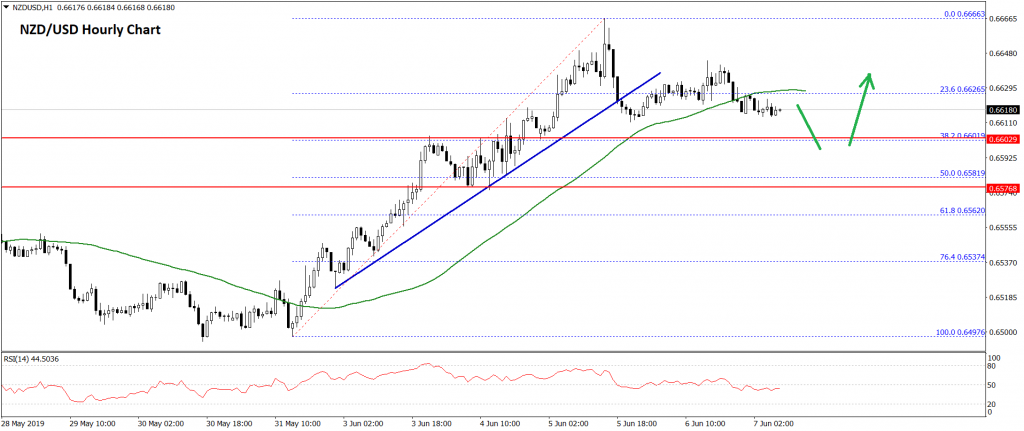
There was also a break below a major bullish trend line with support near the 0.6625 level on the hourly chart. The pair is now trading below the 0.6625 level and the 50 hourly simple moving average.
An immediate support is near the 0.6600 level and the 38.2% Fib retracement level of the last wave from the 0.6497 low to 0.6666 high.
If there are more losses below the 0.6600 level, there are chances of extended declines. The next main support is near the 0.6580 level and the 50% Fib retracement level of the last wave from the 0.6497 low to 0.6666 high.
The overall price action is positive and it seems like there could be more upsides above the 0.6650 level. A clear break above 0.6650 might push the price above 0.6660.
GBP/USD Testing 1.2750 Resistance Zone Of Wave-4
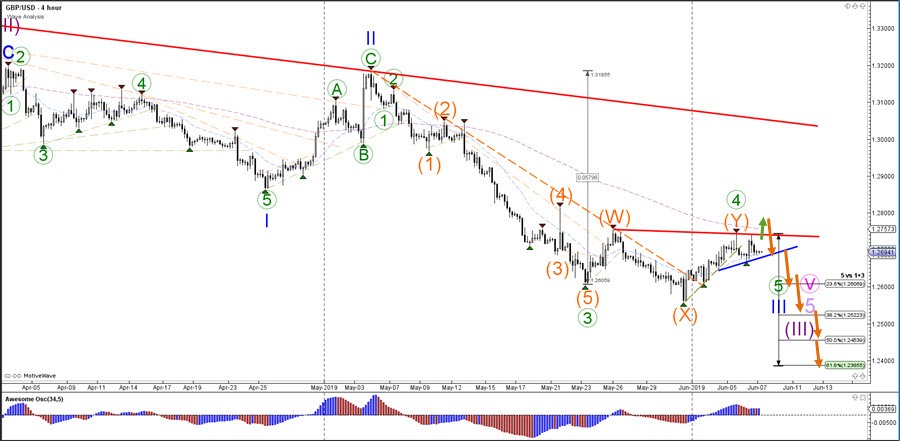
The GBP/USD break below the support trend line (blue) would confirm the end of the wave 4 (green) and the start of the downtrend via wave 5 (green). A push above the resistance trend line (red) is not likely to move far because the 1.2775-1.28 is considered a resistance zone due to the 50% of wave 4. A bearish breakout is aiming for the Fibonacci targets of wave 5 vs 1+3.
The GBP/USD could be in a wave 1-2 (orange) pattern as long as price stays below the 100% Fibonacci level. A break below the support trend line (blue) is the key factor for a continuation of the bearish trend and a confirmation of the current wave 1-2 (orange) pattern. Otherwise the wave 4 (green) pattern could still be active and might expand higher first.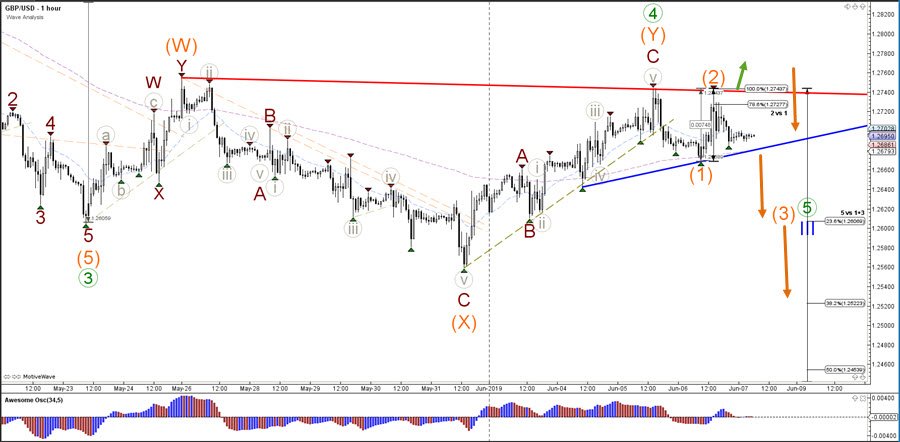
Asian Equity Markets Trade Higher After US Stocks Mostly Gained
General Trend:
- Resources, energy, utilities and REIT companies rise in Australia
- Automakers, securities brokers and electric appliance firms are among the gainers in Japan
- Japan’s wages declined for the 4th straight month in April
- US Treasury Sec Mnuchin is expected to meet with China PBoC Gov Yi Gang at this weekend’s G20 Finance Ministers/Central Bank Governors meetings
- China PBoC Gov: [This weekend's] trade talks with US Treasury Sec Mnuchin at G20 to be 'difficult'; no yuan exchange rate number more important than others, trade war would have temporary depreciation effect on CNY
- Japan Finance Min and US Treasury Sec Mnuchin are speculated to discuss possible currency clause related to trade talks at the upcoming G20 meetings
- US monthly payrolls data due later today
Headlines/Economic Data
Australia/New Zealand
- ASX 200 opened +0.5%
- (AU) AUSTRALIA APR HOME LOANS M/M: -1.1% V 0.0%E
- (AU) Australia May AiG Performance of Construction Index: 40.4 v 42.6 prior (6-year low, 9th consecutive month of contraction)
- (AU) RBA: Adjusts committed liquidity facility (CLF), cites rise in the volume of high quality liquid assets securities over recent years
- (NZ) NEW ZEALAND Q1 VOLUME OF ALL BUILDINGS Q/Q: 6.2% V 1.1%E
China/Hong Kong
- Shanghai Composite and Hang Seng are closed for holiday
- (US) US President Trump: decision on additional China tariffs will be made after G20 meeting (June 28-29), will make decision in the next two weeks
- (CN) China MOF spokesperson: U.S. tariff deadline extension will not change tariff date [Comments on US tariff deadline extension to Jun 15th]
- (CN) China Commerce Ministry (MOFCOM) Spokesman Gao Feng: Will release list of 'unreliable' foreign companies in the near future
- (CN) China National Development and Reform Commission (NDRC) holds meeting with local govts related to rare earths - press
Japan
- Nikkei 225 opened +0.4%
- (JP) JAPAN APR LABOR CASH EARNINGS Y/Y: -0.1% V -0.7%E; REAL CASH EARNINGS Y/Y: -1.1% V -1.5%E (4th consecutive decline)
- (JP) Japan Apr Household Spending Y/Y: 1.3% v 2.6%e
- (JP) Japan May Foreign Reserves: $1.31T v $1.29T prior
- (JP) Bank of Japan (BOJ) announcement related to daily bond buying operation: Increases 10-25 yr JGB purchases to ¥200B from ¥160B (in line with prior BOJ comments)
Korea
- Kospi opened +0.1%
- (KR) US President Trump to visit South Korea June 29-30th - South Korean Press
Other
- (ID) Indonesia Central Bank Deputy Gov Waluyo: Rate cut is not a matter of if but when
North America
- (MX) Mexico Foreign Min Ebrard: Talks on tariffs and migration to continue on Fri; confirms will deploy National Guard to border with Guatemala to contain migrants; talks are advancing but no agreement yet
- (MX) Mexico and US considering outlines of deal that could boost Mexico immigration enforcement efforts andgive US more latitude to deport asylum-seekers - Washington Post
- (MX) US said to be considering delaying Mexico tariffs as implementation date approaches; Mexican officials seek more time for talks – press
- (MX) White House Press Sec Sanders: US is still moving ahead with Mexico tariffs on Monday at this time
- (US) Fed's Williams (moderate, voter): We must remain prepared to adjust views on where economy is going to go; may need to keep rates the same or may need to adjust them
Europe
- (UK) Germany and most other EU governments will back another delay to Brexit regardless of who becomes the new UK PM - UK Press
- (UK) Labour Party reportedly won election in Peterborough - UK Press
Levels as of 1:20 ET
- Nikkei 225, +0.5%, ASX 200 +0.7%, Hang Seng closed; Shanghai Composite closed; Kospi +0.1%
- Equity Futures: S&P500 +0.1%; Nasdaq100 +0.1%, Dax +0.3%; FTSE100 +0.2%
- EUR 1.1286-1.1267 ; JPY 108.53-108.31; AUD 0.6983-0.6972 ;NZD 0.6628-0.6614
- Gold -0.4% at $1,337/oz; Crude Oil +1.3% at $53.25/brl; Copper +0.3% at $2.656/lb
ECB Disappoints The Market
Market movers today
Today's highlight will be the US labour market report. The wage growth figures will be in focus as many FOMC members have opened up for a change in the policy rate during the past days.
In the European space, the French and German industrial production figures will take centre stage. German prints have recently been bad and are particularly important in order to see whether the verge between hard and soft data starts to close or it remains wide. Furthermore, markets will digest yesterday's ECB meeting, where focus will also be on the inflation market pricing which suffered late yesterday.
Today and during the weekend the US-Mexico tariff war will gain focus as Trump has threatened to put a 5% tariff on Mexican goods starting Monday. Mexico wants a delay 'as negotiations advance'.
We also get the Norwegian GDP figure for April and manufacturing production (see next page).
Selected market news
The ECB yesterday joined the camp of central banks looking at easing monetary policy to fend off moderation in economic growth and declining inflation expectations. At the meeting the ECB extended its forward guidance to "at present levels at least through H1 2020" and Draghi also acknowledged on the subsequent press conference that a possible rate cut or restart of QE as a contingency tool had been discussed at the meeting. Yet, it was not as dovish as expected by markets given the market pricing of an almost 50/50 chance of a 10bp cut already in September. As a result, the EUR/USD and the front-end of the euro curve moved higher. The announced TLTRO3 modalities were broadly as expected. The new staff projections were broadly unchanged, leading to an unchanged baseline narrative, although the external environment posed a more prominent risk than previously. Markets are still pricing a 10bp rate cut by summer next year, for more details see, ECB not delivering to market expectations.
Yesterday, US president Trump said that he will decide whether to enact tariffs on another USD 325 billion of Chinese imports after the Group of 20 summit at the end of the month in Japan, where President Trump is expected to meet with Chinese President Xi Jinping. In a taped interview with Fox News the US president also said that China wanted a deal and predicted the two sides would definitely reach agreement. Meanwhile, the governor of The Peoples Bank of China stressed yesterday that China has a lot of options to stimulate its economy, including cutting interest rates and the required reserve ratio rate, as well as stimulating the economy through fiscal measures. For our latest take on the difficult US-China trade discussion, please see yesterday's China Weekly Letter - Are we heading for an all-out trade war? .