Sample Category Title
MARKET WRAP: ECB Leaves Monetary Policy Unchanged; Trade War Remain A Major Risk
*The ECB left the powder dry, no change in the interest rate. *Investors are doubtful if European Central Bank can revive the growth
Stocks
- The S&P 500 Index dropped 0.2% to 2,825.90 as the trade war issues remain a major talking point among investors.
- The Stoxx Europe 600 Index jumped 0.15% after the ECB showed its dovish monetary policy stance which triggered a risk on trade.
- The MSCI Asia Pacific Index trade mostly flat.
Currencies
- The Dollar Spot Index still remained under the influence of the Fed’s dovish stance and the focus remain on the upcoming US NFP data. It dropped 0.32%.
- The Euro recovered further losses despite the ECB moved its rate hike calendar. It jumped 0.36% to $1.1271.
- The Japanese yen gained 0.2% to 108.18 per dollar.
Bonds
- The yield on 10-year Treasuries dropped another four basis points to 2.09%.
- Germany’s 10-year yield advanced less than one basis point to -0.22%.
- Britain’s 10-year yield fell two basis point to 0.841%.
Commodities
- The shinning metal gained 0.71 percent and it is on its way to kiss the resistance of 1350.
- West Texas Intermediate crude is still in the bear market territory but moved higher by 0.68% to $51.69 a barrel.
IMF raises US growth forecasts to 2.6% in 2019, agrees to Fed pausing rate hikes
IMF Managing Director Christine Lagarde said economic forecasts for US for 2019 will be raised by 0.3% to 2.6%. For 2020, growth is expected to slow to 1.9%. IMF is "seeing a lot of positives in the macroeconomic outcomes" and "there is a lot for Americans to be proud of".
Meanwhile, IMF "full agree" with Fed's approach in "pausing its process of raising interest rates". That will "give policymakers time to gauge the balance of risks to both inflation and employment outcomes and to build a clearer picture of whether further adjustments in the federal funds rate are warranted."
On trade, however, Lagarde emphasized "it will be essential that the U.S. and its trading partners work constructively together to better address distortions in the trading system". And, "it is especially important that the trade tensions between the U.S. and its trading partners including China and Mexico... are quickly resolved through a comprehensive agreement that results in a stronger and more integrated international trading system."
Trump to decide on more China tariffs over the new few weeks
After repeating his threat to China for tariffs on the currently untaxed USD 300B in imports, Trump said he's make a decision over the next few weeks.
Trump is in France for a ceremony for the 75th anniversary of D-Day with France President Emmanuel Macron. He said "I will make that decision I would say over the next few weeks, probably right after the G20".
And, "One way or another I'll make that decision after the G20. I'll be meeting with President Xi and we will see what happens."
Fed Kaplan reiterates it’s too soon to cut rates for trade tensions
Dallas Fed President Robert Kaplan reiterated his stance today that it's premature to cut interest rates due to trade tensions. He noted "it would make sense to let this situation breathe a little bit". And, "some of these decisions can change. We may see a new announcement and new decisions in the next four or five weeks. He added, "I am concerned...But it is too soon to make a judgment about whether there is any action that would be appropriate."
He also said that trade with Mexico was "overwhelmingly" in US interest. He warned "if you put sand in the gears of that relationship it is going to bite and affect businesses," Kaplan said.
Could German Industrial Output Turn Bleak for the Euro?
Despite GDP growth rebounding in the first quarter, industrial output and trade data out of Germany at 0600 GMT on Friday are projected to show that the biggest EU economy is not out of the woods yet.
In the first three months of the year, the German economy which stagnated at the end of 2018, expanded by 0.4% q/q and in line with forecasts. Although the stats flagged that the export-oriented economy is resilient enough to global challenges such as the tough US trade protectionism and the Brexit crisis, analysts believe that the growth-supporting business sector is still fragile. Specifically, industrial output is said to have retreated by 0.4% month-on-month in April following two consecutive months of gains. Exports and imports of goods are also estimated to contract by 0.9% and 0.2% respectively in the same period, reducing the trade surplus by 1.4 billion euros to 18.6bln.
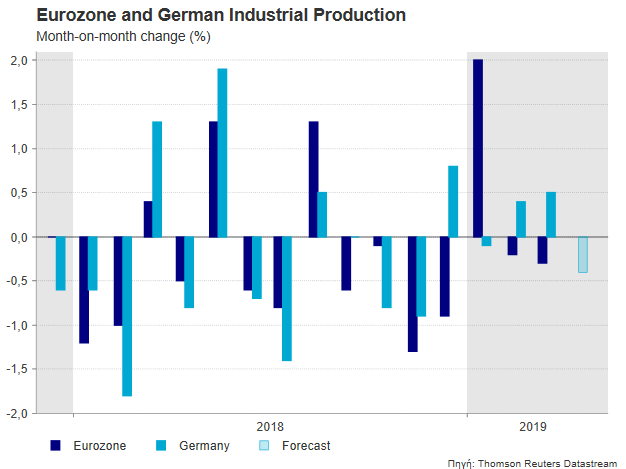
Weak manufacturing PMI readings in May and a declining Ifo business index is another indication that German factories are still lacking healthy momentum needed to mitigate any potential economic downturn.
The solid services sector and a multi-year low unemployment rate could somewhat curb the weakness from factories, but questions are arising about whether those could prove supportive if the US decides to raise tariffs on EU car imports in six months.
At the current time, the future of the trade negotiations between the sides looks rather muddy thanks to the recent negative political developments in Germany. Following the dramatic results of the EU elections, the SPD coalition leader announced her resignation on Sunday, bringing new headwinds to the already unpopular alliance it holds with Merkel’s CDU/CSU party. Even if Merkel, who completes her last term in 2021, remained confident on the partnership, latest polls revealed that the SPD was third behind the ecologists Greens, a signal that the current coalition would potentially not survive in case snap elections take place.
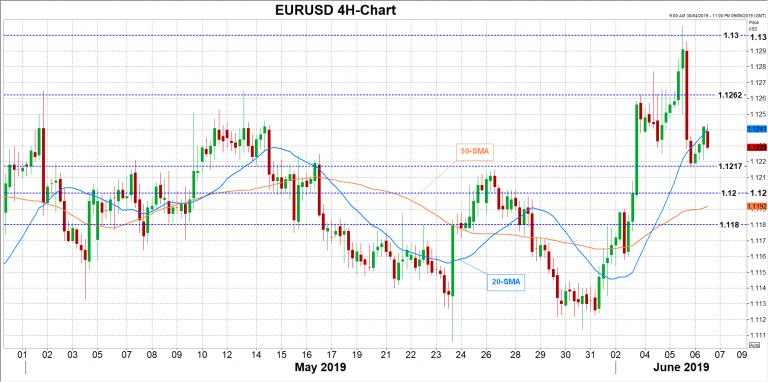
Since the euro is frequently responding to German headlines, someone could expect exposures to decline if the data miss expectations, flagging a softer performance for the German economy in Q2. In this case EURUSD could slip back into the 1.1217-1.12 area, while lower, the 1.1180 mark could also attract attention.
In case of a positive surprise, the pair may move up to 1.1262, while higher, the price may next pause near 1.1300.
CADJPY Remains in Bearish Phase
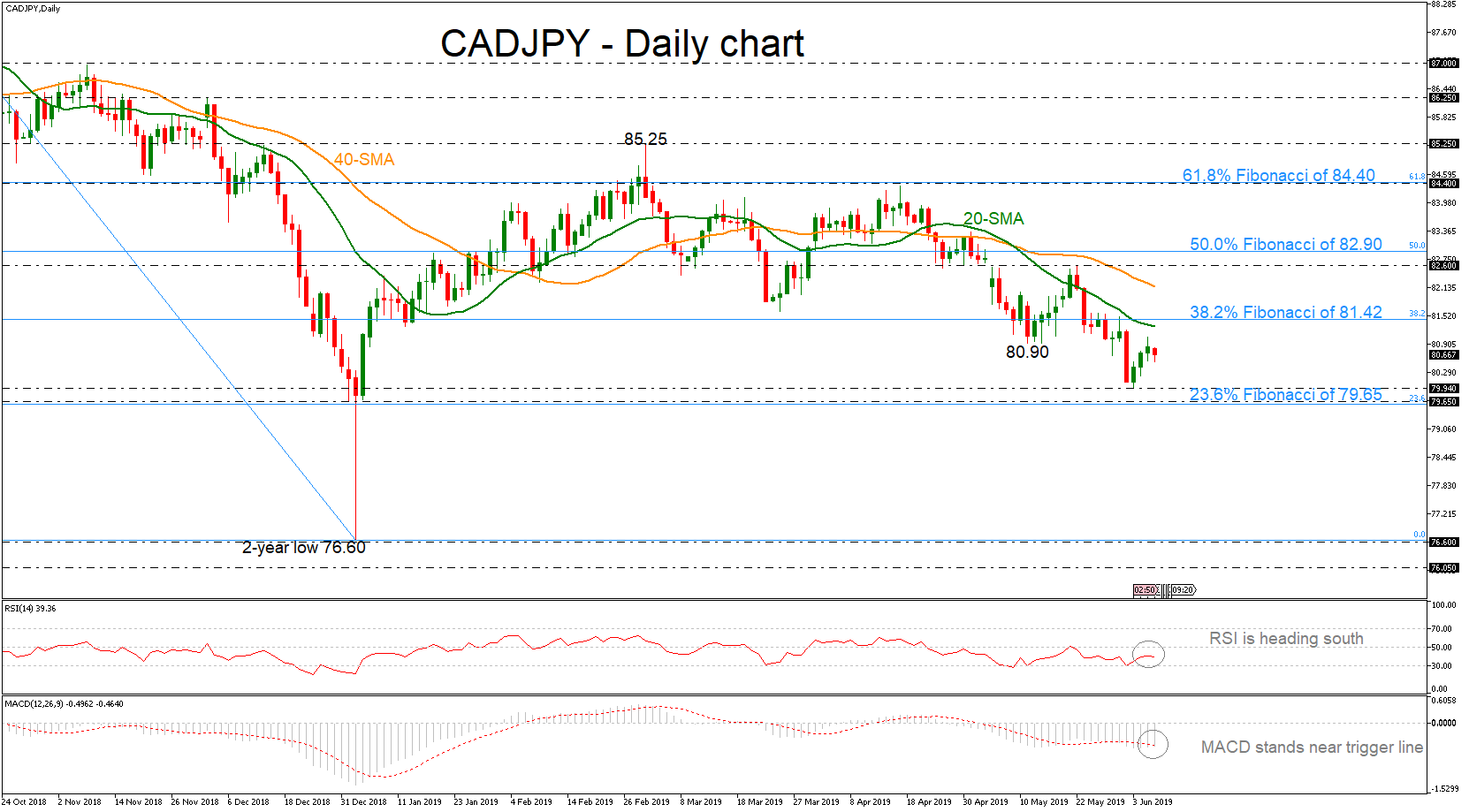
CADJPY has been finding strong resistance on the 38.2% Fibonacci retracement level of the downward wave from 89.25 to 76.60, near 81.42, falling beneath the 20-simple moving average (SMA) in the daily chart. Having a look at the momentum indicators, the RSI is sloping down below the neutral threshold of 50 and the MACD is hovering near the trigger line and below the zero line.
A step lower could find immediate support at the 79.94 support and the 23.6% Fibonacci of 79.65. More downside pressures could drive the pair towards the two-year low of 76.60, taken from the bottom on January 3.
An advance above the 38.2% Fibonacci of 81.42 and the 20-day moving average could open the door for bullish actions until the 40-SMA of 82.13 and the 82.60 resistance. If there is a successful jump above the 50.0% Fibonacci of 82.90, prices could challenge again the significant 61.8% Fibonacci of 84.40.
However, a break below the 23.6% Fibonacci of 76.65 could confirm the long-term negative momentum.
Stocks Rise as Central Banks Bring Back the Punch Bowl
Financial markets are still clinging to belief central banks will come to rescue as President Trump tries to prevent his multi-front trade war from crushing the American economy. With the ECB joining the likes of the RBNZ, RBA, and Fed in signaling dovishness, it appears the punch bowl is back, and global equities could resume the longer-term bullish trend if we start seeing some progress with some trade wars. The dollar remains on soft footing as the 10-year Treasury yield continues to slide, down 3.6 basis points to 2.098%. The VIX continues to decline now trading below the $16 level.
A wrath of US data saw limited reaction. US weekly jobless claims came in unchanged at 218,000, still relatively close to the recent cycle lows, also providing a supporting view that the labor market remains strong. US first quarter productivity posted a 3.4%, a miss of the 3.5% estimate analysts provided and down from the 3.6% prior. The US trade deficit for the month of April also narrowed modestly to $50.8 billion. The big takeaway is that US good shipments to China dropped 20% year-to-date to $8.5 billion. US economic data is only get worse as the effects of the multi-front trade wars will start to hit the May data. Fed rate cut expectations by the end of the week could see the June meeting be a live one. Current expectations are only for 21.3% chance for a rate cut at the Fed’s June 19th meeting.
- EUR – No surprises from ECB; sees rates at present levels at least through H1 2020
- MXN – Peso falls as talks gets extended and Fitch cuts rating to BBB
- Oil – Bear Market Bounce
- Gold – Bullish Sentiment in place; rising along stocks
EUR
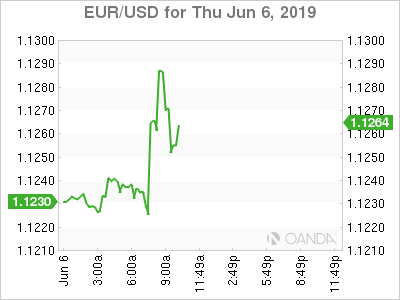
The European Central Bank (ECB) statement went as expected, with the biggest change being the change in forward guidance which now calls for rates to stay at present levels at least through H1 2020. They announced the new long-term loan rate can be as low as Depo Rate plus 0.1 percentage points.
The market reaction to the ECB saw the Italian 10-year yield rising 2.5 basis points to 2.491%. The euro also whipsawed, initially to session lows than turning positive and up 0.3% to 1.1250. The statement was not as dovish as many thought it could have been. Markets are still pricing in the next move to a rate cut, with the January meeting being a coin flip.
MXN
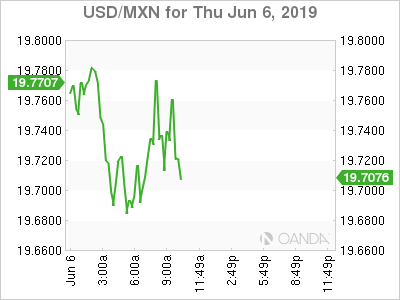
The Mexican peso remains on soft footing after US and Mexico trade officials failed to reach a deal on immigration and tariffs at yesterday’s meeting. President Trump noted that progress was made but that it was not enough. Trump said talks will resume on Thursday, but that tariffs will take effect on Monday. Expectations are growing for Mexico to get hit with tariffs. Mexico consistently remains optimistic but markets are starting to doubt a deal will get done before the June 10th deadline.
The peso was also weighed down by the news rating agencies were lowering their stances on Mexico. Fitch cut their sovereign rating one notch to BBB, which is just two notches above junk status and Moody’s revised their outlook to negative while affirming their A3 rating.
Oil
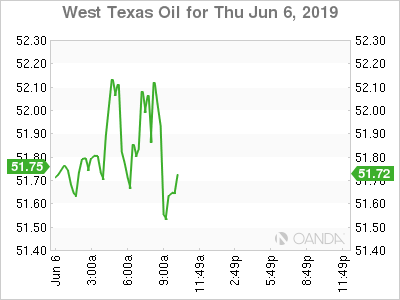
Crude prices are positive this morning following the move into bear market territory that stemmed from the surge in US stockpiles. The rebound is mostly profit taking and some bets that the we will see some constructive outcomes in trade talks potentially alleviating global demand concerns.
Oil prices could see some further gains if we continue to a risk-on tone with US equities combined with a softer dollar. Geopolitical risks have done little to support crude here, but we should start seeing that become a focal point as we enter a long pause until the June 28-29th G20 summit for a meaningful update on the US-China trade war. We could see resistance start to form around the $55 a barrel level for West Texas Intermediate crude.
Gold
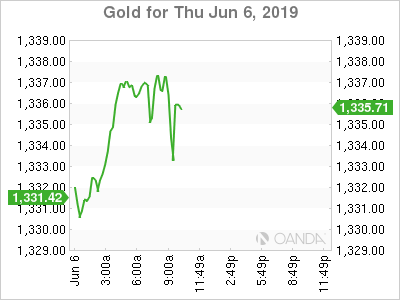
Gold prices are still rallying higher, but are finding formidable resistance from the February 20th high of $1,349.80. The yellow metal still remains bullish, especially as it is still able to rise on days when equities are climbing higher. The safe-haven is also benefitting on softer dollar flows. If we continue to see deterioration in US data, especially with tomorrow’s non-farm payroll report, we could see that be the catalysts for gold to break above $1,350. If the labor market which has been the backbone to the US expansion is starting to weaken, the Fed’s potential rate cuts will likely become a certainty, with possibly two cuts happening before the end of summer.
Sunset Market Commentary
Markets
The ECB left its deposit rate (-0.4%) and the refinancing repo rate (0.0%) unchanged today, as expected. The bank further eased/prolonged its forward guidance. It will keep interest rates at current low levels at least through the first half of 2020. The bank also specified that it will provide long term financing in the new quarterly TLTRO’s at 10 basis points above the average rate over of the main Eurosystem refinancing rate over the life of the respective TLTRO. For banks with eligible net lending surpassing a benchmark, the rate can be reduced to as low as the average interest rate on the deposit facility plus 10 basis points. Conditions on the new TLTRO thus are slightly less favourable than on the previous series. The ECB also published new staff projections for growth and inflation over the policy horizon. The forecast for 2019 growth (1.2% from 1.1%) and inflation (1.3% from 1.2%) was slightly upwardly revised. 2020 growth (1.4%) and inflation (1.4%) were revised slightly lower. During the press conference, the ECB president acknowledged headwinds from the global context, but he also indicated that the ‘domestic’ economic context remains favourable. The ECB president saw no reason to expected a recession or deflation. Today’s decision was taken unanimously but some governors raised the issue of cutting the (deposit) rate or restarting QE. For now, this is not deemed necessary. With respect to the negative deposit rate, the ECB president said that the positive contribution of negative interest rates is not undermined by side effects.
German bonds gained slightly ahead of today’s ECB meeting. The German 10y yield slipped to a new all-time low of -0.24% before rebounding after the policy statement was published. The package of ECB decisions wasn’t considered as soft as expected, pushing the 10y yield to an intraday high of -0.19. Draghi mentioning that some officials raised the possibility of rate cuts or reviving the asset purchasing program deprived the upward move of its momentum however. Yet, the German yield curve still bear flattens with yield changes varying from 4 bps (5y) to 2 bps (10y). US yields entered calmer waters compared to a few days earlier lately. The yield curve bull flattens as the 2y yield remains unchanged while the 10y yield loses about 2 bps. On currency markets, EUR/USD showed a similar move as German yields. The couple spiked after the press release and during Draghi’s first minutes during the press conference but had to give in some of the gains later on. EUR/USD is currently struggling to hold above the 1.1265 resistance.
EUR/GBP trading was again mostly technical in nature and held to a tight sideways range in the mid 0.88 area. Calm in sterling trading was briefly disturbed on headlines from BoE’s Carney’s introduction to the BoE annual report as the BoE Governor maintained its assessment that the BoE will need to raise interest rates if the economy develops as expected. However, this wasn’t really new and any sterling gain was almost immediately reversed. Later in the session, EUR/GBP gained some ground in line with overall ECB driven rebound of then euro. EUR/GBP is currently trading in the 0.8870 area.
News Headlines
The US could slap China with another batch of tariffs on goods worth “at least” $300 bn, Trump told reporters today, adding however that he thinks China (and Mexico) very much want to make a deal. China reiterated it does not want a trade war but is not afraid of one.
The central bank in India cut rates from 6% to 5.75% and switched its monetary policy stance to accommodative, suggesting more rate cuts going forward. The central bank also downgraded growth forecasts for 2020 to 7% (from 7.2%) as the economy continues to suffer from a marked slowdown.
USD/JPY Mid-Day Outlook
Daily Pivots: (S1) 108.02; (P) 108.25; (R1) 108.70; More...
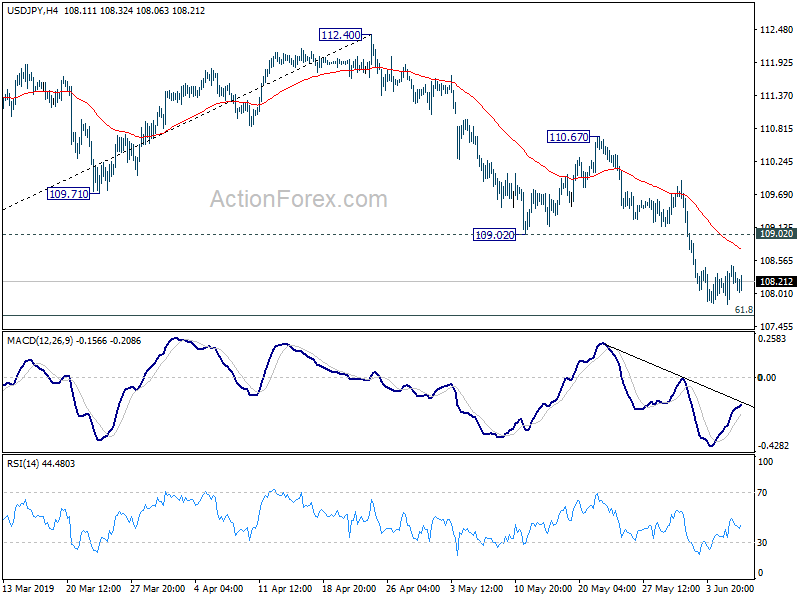
Outlook is USD/JPY remains unchanged. With 109.02 support turned resistance intact, current fall from 112.40 is expected to extend further. Sustained break of 61.8% retracement of 104.69 to 112.40 at 107.63 will pave the way back to 104.62/9 key support zone. Though, break of 109.02 support turned resistance will indicate short term bottoming and bring lengthier consolidations first.
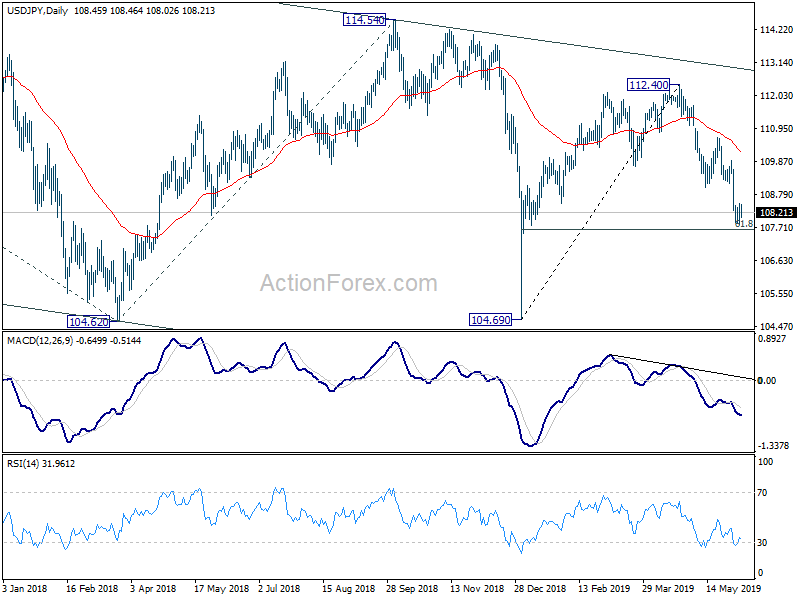
In the bigger picture, decline from 118.65 (Dec 2016) is still in progress, with the pair staying indicate long term falling channel. Break of 104.62 will target 100% projection of 118.65 to 104.62 from 114.54 at 100.51. For now, we'd expect strong support above 98.97 (2016 low) to contain downside to bring rebound.
USD/CHF Mid-Day Outlook
Daily Pivots: (S1) 0.9885; (P) 0.9918; (R1) 0.9981; More...
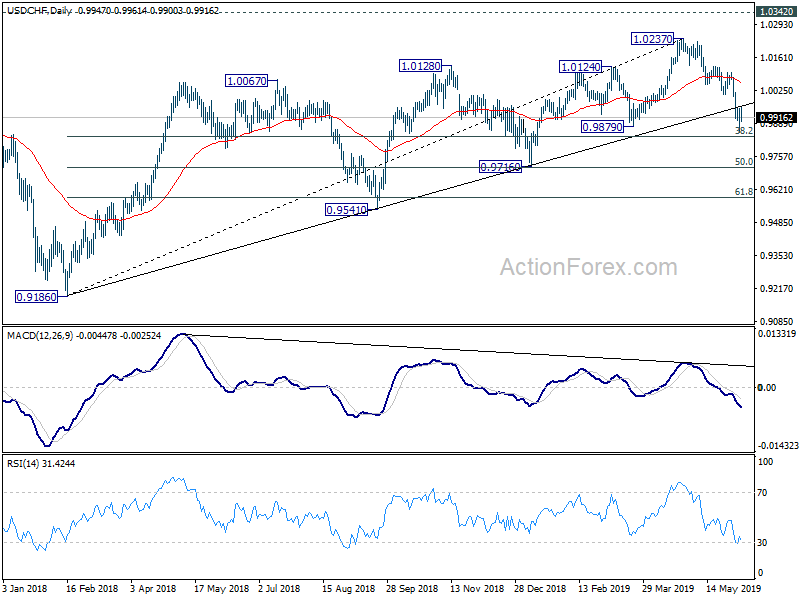
Intraday bias in USD/CHF remains neutral for consolidation above 0.9854 temporary low. Upside of recovery should be limited by 1.0008 support turned resistance to bring fall resumption. On the downside, break of 0.9854 will extend the decline from 1.0237 to 0.9716 cluster support (50% retracement of 0.9186 to 1.0237 at 0.9712).
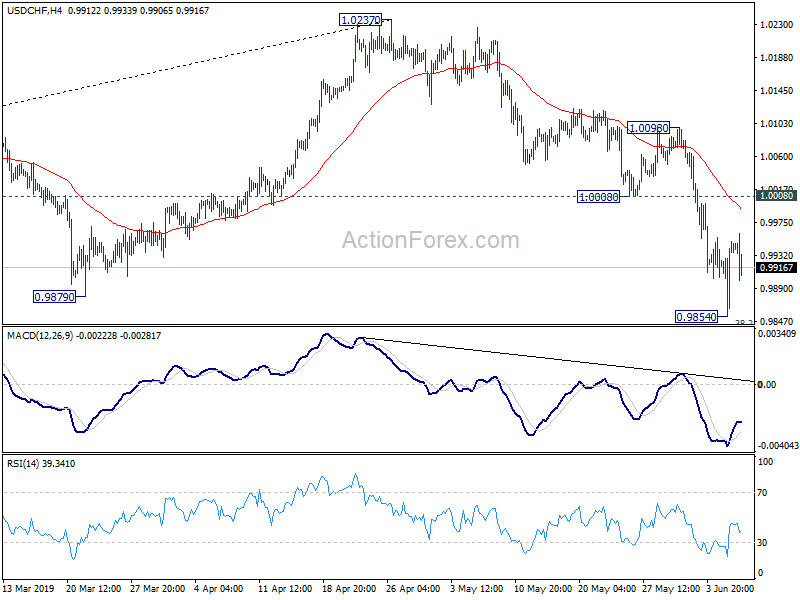
In the bigger picture, USD/CHF's break of long term trend line support is the first indication of medium term reversal. Focus is now back on 0.9879 support. Sustained break should confirm that medium term up trend from 0.9186 has completed at 1.0237 already. Further fall should be seen to 0.9716 cluster support (50% retracement of 0.9186 to 1.0237 at 0.9712) next. Break will target 61.8% retracement at 0.9587.