

Sample Category Title
UK Construction PMI Slips Into Contraction
Construction activity in the United Kingdom slipped into contraction as activity fell to 48.6. Data from IHS/Markit saw construction activity falling to the lowest level since March 2018. Companies indicated a renewed decline in business activity with new orders falling due to subdued demand. The pound sterling was unmoved by the report.
GBPUSD is Likely to Form a Bottom
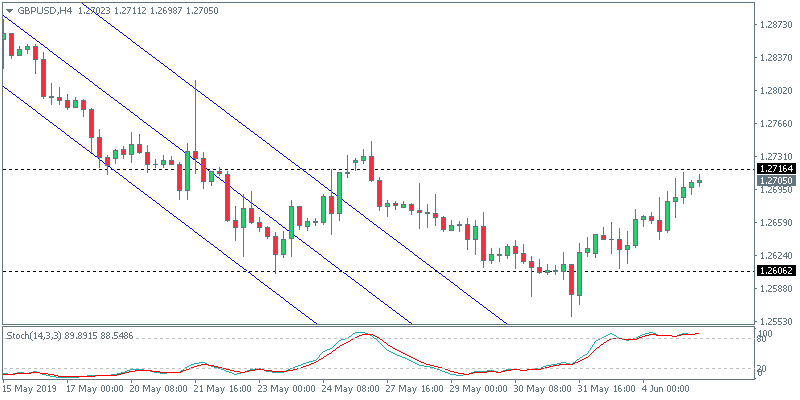
The GBPUSD currency pair continues to trade within the range of 1.2716–1.2606. Price action suggests that there could be potential for an upside breakout on a close above 1.2716. This will potentially open the way for the GBPUSD to test the 1.2895 level at the next resistance. The GBPUSD has been steadily posting gains for the past three consecutive sessions giving further weight to the upside bias.
Euro Gains Despite Inflation Falling Sharply
The common currency rose 0.10% on the day, brushing aside weak inflation data. Flash estimates for May put the inflation rate to rise by 1.2%. This was a sharp pullback from the 1.7% increase the month before and missed estimates of a 1.4% increase. Core inflation which excludes food and energy prices rose 0.8%, down from 1.3% previously.
EURUSD Reclaims the 1.1200 Handle
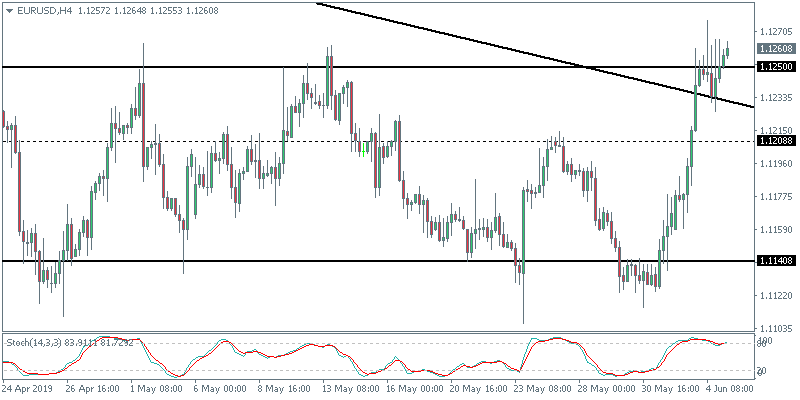
The common currency posted gains, rising to settle above the 1.1200 handle by Tuesday's close. Price action remains a bit volatile near the top as the euro currency is seen trading near the 1.1250 resistance level. If the bullish momentum is maintained, EURUSD could be seen advancing gains to test the 1.1400 level.
Winter Period To Continue For British Pound?
The month of June usually represents the time of the year where many regions across the world prepare for the upcoming summer period, but this is unlikely to be the case for the British Pound where we should not rule out an extended winter freeze.
Weakness in the Greenback behind near-term Pound bounce
The Pound/Dollar has managed to rebound just above 0.5% so far in June, but no one should be getting carried away from the price bounce as this is a mild recovery from losses above 3% last month. The recovery in Pound sentiment has also been driven by softness in the USD, which has coordinated strength in all of the G10 currencies so far during June. The US Dollar does appear heavily oversold heading into the upcoming Federal Reserve US interest rate decision later in June and any recovery in the Pound from current levels will once again be encouraged from softness in the Dollar.
Problems for the Pound remain unchanged
Problems for the Pound stretch far and wide, meaning buying sentiment will remain restricted until several of the United Kingdom's structural issues are sorted out with long-term solutions.
Weakness in investor sentiment stretches beyond Brexit uncertainty with the near-term risk for the Pound standing on who will emerge as the replacement for UK Prime Minister Theresa May. The worst- case scenario for the Pound that has arguably still not been priced in is that Boris Johnson will win the upcoming Tory leadership race to become the new Prime Minister.
Although a victory for any Eurosceptic believer will install the same level of pessimism in Pound sentiment as the probability increases that a Brexiteer is more likely to settle for the United Kingdom leaving the European Union in a no-deal Brexit.
How low can the Pound go?
Potential levels in the Pound/Dollar from this point in terms of upside are relatively thin, but a sudden surge in anxiety of a Eurosceptic taking the helm at 10 Downing Street can realistically drive the British Pound all the way to a potential 1.20 against the US Dollar as early as the next two months.
Upside in GBPUSD restricted below 1.30
What can be considered as a positive for the Pound is that a great deal of negative sentiment is already in the atmosphere. If whoever wins the Tory leadership race to take over Number 10, even a Eurosceptic, is able to ease nerves by stating that they would still like to leave the European Union ideally with a Brexit deal this would relieve persistent pressure from Sterling
EURJPY Struggles Below 40-SMA After Pullback On 5-Month Low
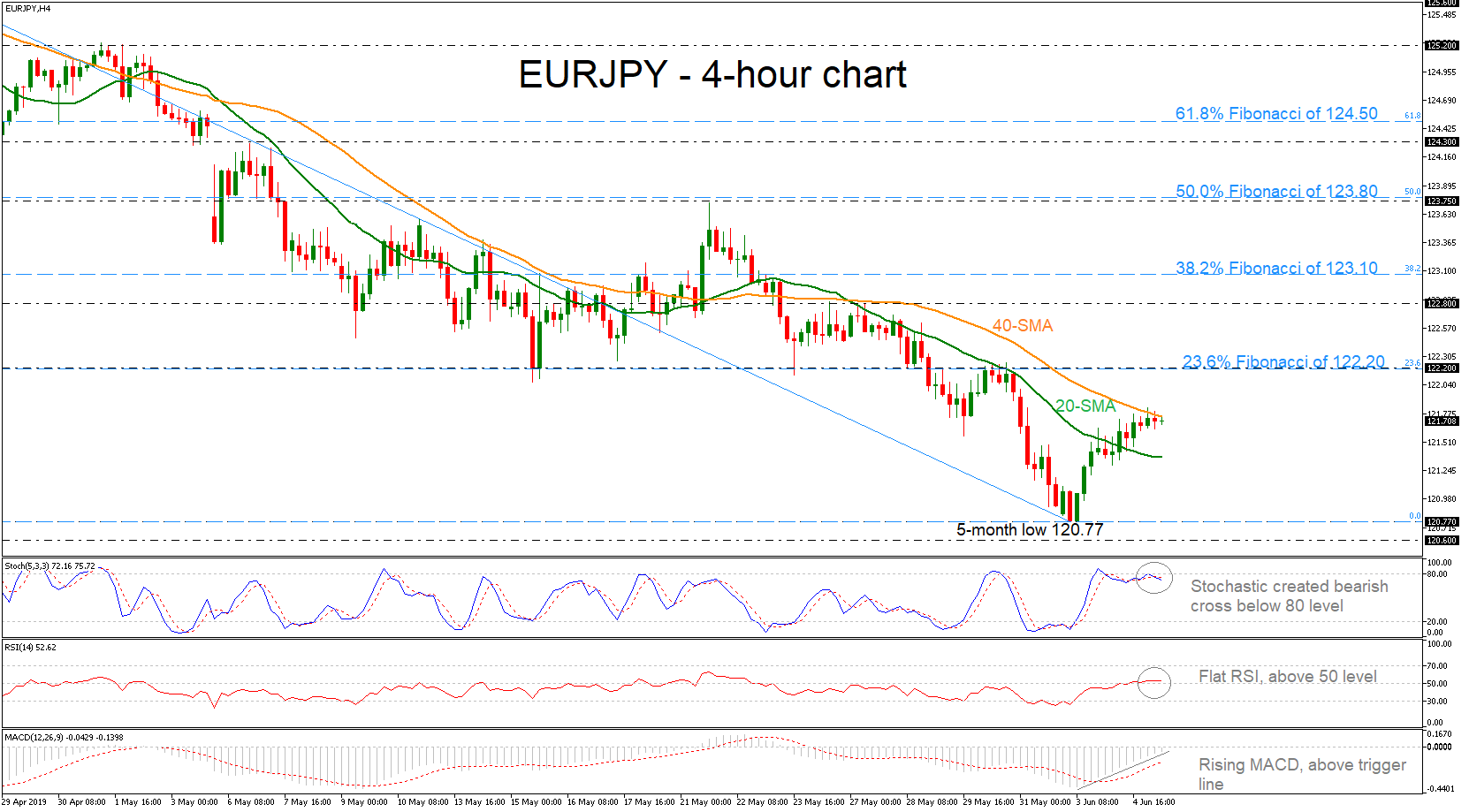
EURJPY had a bullish start on Monday, after the strong rebound on the five-month low of 120.77, with the price breaking a crucial level of 121.00 and the 20-period simple moving average (SMA) in the 4-hour chart. The pair is approaching its negatively sloped 40-SMA, which is acting as a key resistance level.
The RSI and the stochastic oscillator are suggesting a possible overstretched market as both are returning slightly lower. The stochastic posted a bearish crossover within the %K and %D lines below the oversold area, while the RSI is flattening near the neutral threshold of 50. However, the MACD oscillator is still increasing its distance above the trigger line in the bearish area.
In case the pair continues its short-term direction to the upside, the bulls will probably challenge the 23.6% Fibonacci retracement level of the downleg from 126.80 to 120.77, around 122.20. A break higher, could last until 122.80, taken from the peaks on May 24 and the 38.2% Fibonacci of 123.10.
Alternatively, declines may drive the pair towards the 20-SMA currently at 121.40 before the five-month low (120.77) and the 120.60 support level come into view again.
Briefly, the pair switched to positive mode after the rally off 120.77. However, a run above the 61.8% Fibonacci (124.50) could switch the medium-term negative outlook to bullish. In case of a failed attempt to surpass the 40-SMA the bias could turn back lower.
AUDUSD Could Cautiously Gear Up In Short-Term
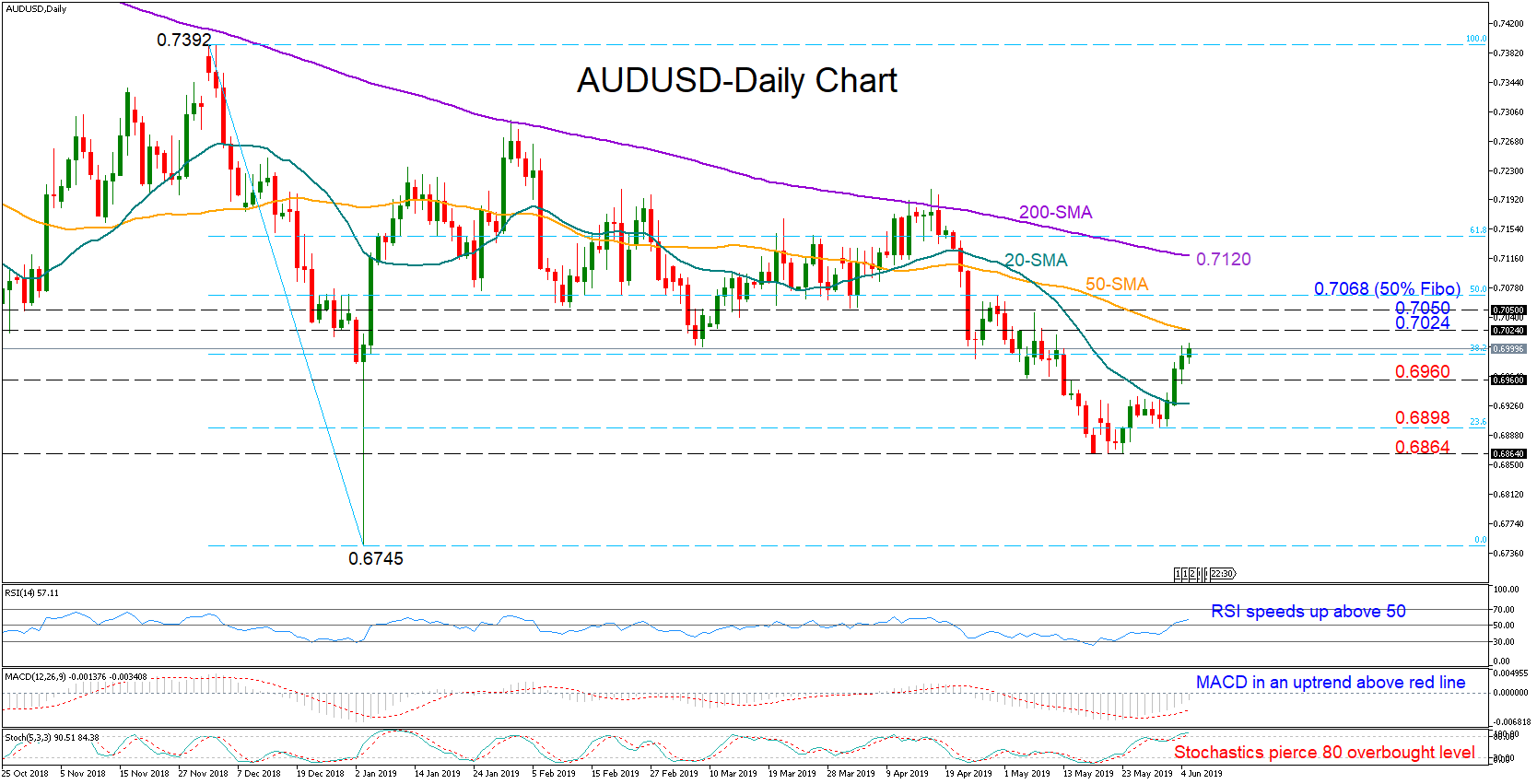
AUDUSD gained stronger positive traction this week, with momentum indicators giving the green light for further bullish action in the short term; the MACD is in an uptrend well below its red signal line, while the RSI is speeding up above its 50 neutral level. According to Stochastics though, room for improvement could be limited as the index has already pierced its 80 overbought mark.
The rally could get more legs if the market manages to clear the 0.7024-0.7050 congested area, while slightly higher the 61.8% Fibonacci of 0.7068 of the 0.7392-0.6745 downleg could curb upside corrections as well. Further up, the spotlight will turn to the 200-day simple moving average (SMA) currently at 0.7120.
Should the price slip below 0.70, immediate support could come from the 0.6960 number. Breaking the 20-day SMA (0.6928) too could open the door for the 0.6898 barrier, where any violation may trigger another rundown towards the 0.6864 bottom.
In the meantime, the medium-term traders who look at the three-month picture continue to face a bear market. A decisive close above the 50-day SMA would shift the outlook back to neutral.
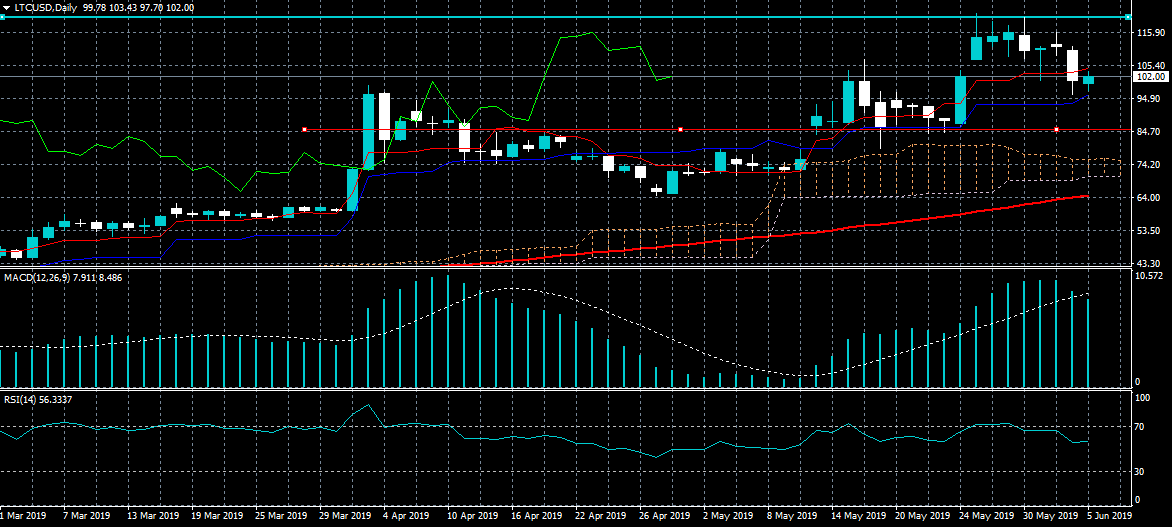
LTCUSD $100.00 Breakout Support
Litecoin has followed the broader cryptocurrency market lower this week, with the sixth largest crypto so far finding technical support from the $96.50 level. The $100.00 level is still seen as major breakout support on both the four-hour and daily time frames. Bulls need to rally the cryptocurrency towards the $120.00 level to negate the bearish double-top pattern formation on the four-hour time frame.
The LTCUSD pair is only intraday bullish while trading above the $110.00 level, key resistance is found at the $120.00 and $135.00 levels.
If the LTCUSD pair trades below the $110.00 level, key support is found at the $96.50 and $85.00 levels.
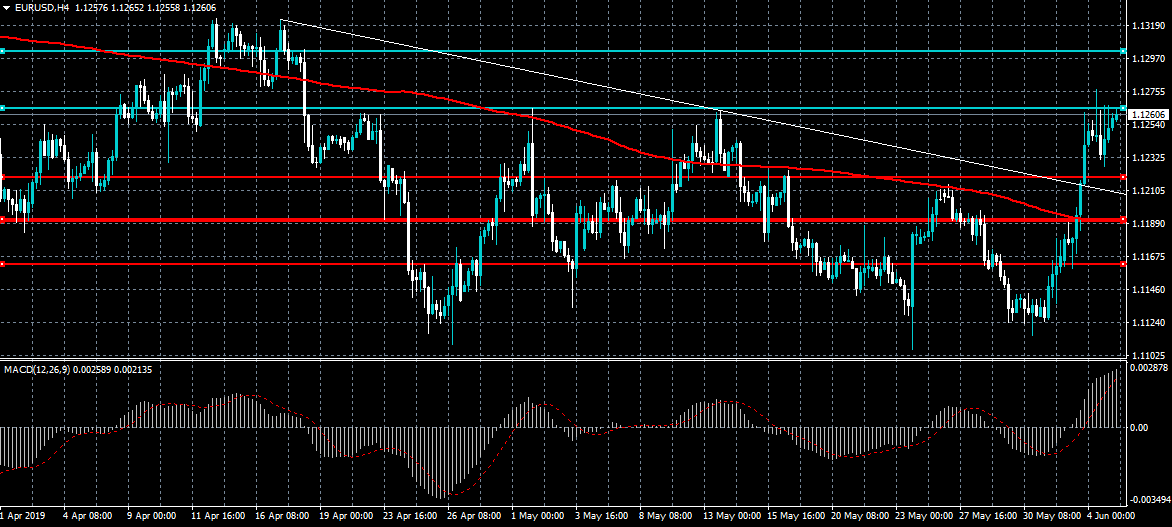
EURUSD Gains Slowing
The recent gains in the euro currency against the US dollar has started to slow as traders await EU PMI data and Thursday’s important ECB meeting. EURUSD buyers are now testing the 1.1265 level, with further gains towards the 1.1300 to 1.1320 resistance level is still possible. Overall, the next strong directional move in the EURUSD is unlikely to occur until after ECB President Mario Draghi speaks on Thursday.
The EURUSD pair is only bullish while trading above the 1.1265 level, key technical resistance is found at the 1.1300 and 1.1320 levels.
If the EURUSD pair trades below 1.1265 level, key technical support is found at the 1.1230 and 1.1215 levels.
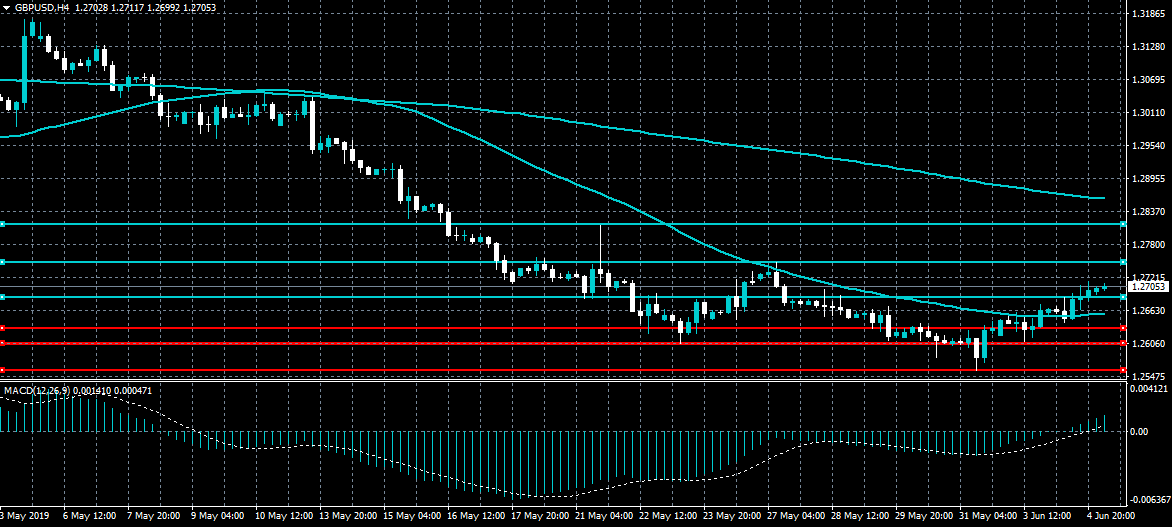
GBPUSD Awaiting UK Services Data
The British pound is trading towards the best levels of the week against the US dollar ahead of the release of key PMI Services data from the United Kingdom economy this morning. The GBPUSD pair has been overlooking weaker than expected UK data this week, with bulls now needing to send price above the former weekly high, at 1.2747. Overall, buyers now have the upper hand in the short-term, despite the bearish monthly candle and the uncertainty towards the UK political landscape.
The GBPUSD pair is only intraday bearish while trading below the 1.2655 level, key support is located at the 1.2600 and 1.2550 levels.
The GBPUSD pair is bullish while trading above the 1.2655 level, key intraday resistance is found at the 1.2747 and 1.2800 levels.
US Stocks Gain As Powell Signals Flexibility To Lower Rates
US stocks rose sharply after a few days of major losses. The Dow, Nasdaq and S&P 500 gained by 512, 195 and 60 points respectively. These gains were because of a statement by Federal Reserve chair, Jerome Powell, who said that the Fed was ready to cut rates if the trade war hit the economy. He was speaking at an event hosted by the Federal Reserve Bank of Chicago. He was not the only Fed speaker to suggest a rate cut. Others who spoke at the event like John Williams and Lael Brainard said that the Fed was prepared to cut rates as a way of supporting the economy.
There was more bad news for the Australian economy a day after the RBA slashed interest rates to historic lows. Today, data from the statistics office showed that the economy grew at the slowest pace in a decade in the first quarter. The economy grew by an annualized rate of 1.8% in the quarter after growing by 2.3% in the fourth quarter of last year. This was also below the long-term average of 3.5%. On a QoQ basis, the economy grew by just 0.4%. The country has had 28 straight years of expansion.
Today, investors will receive employment data from the United States. The number from ADP is expected to show that the economy created 180K jobs in April. This will be lower than the 275K jobs created a month ago. This number will come two days before the official jobs number from the government. The ISM non-manufacturing PMI is expected to remain unchanged at 55.5. In addition, the EIA will release crude inventory data, which is expected to show a drawdown of more than 849K barrels.
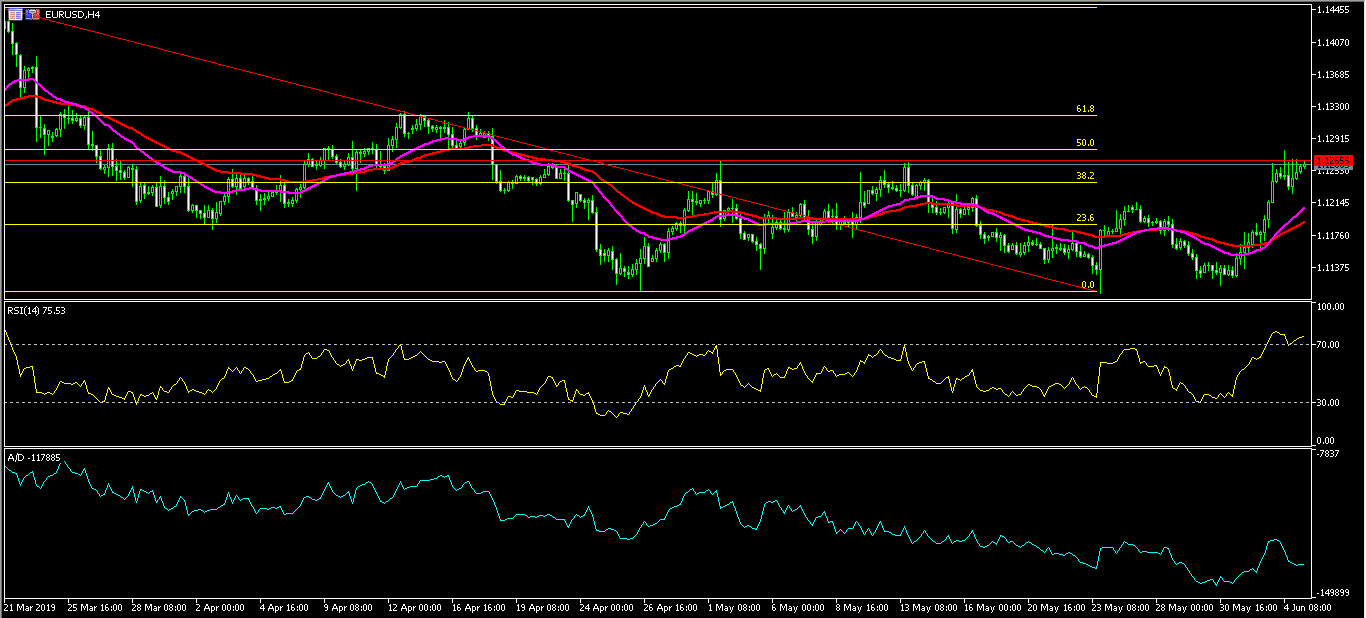
EUR/USD
The EUR/USD pair remained at the important resistance level of 1.1260. This level is slightly below the 50% Fibonacci Retracement level and above the 25% and 50% moving averages. The RSI remains above the overbought level of 70, while the accumulation/distribution indicator has eased a bit. The pair will likely remain along these levels ahead of the ECB decision tomorrow.
AUD/USD
The AUD/USD pair was relatively unmoved today after the GDP numbers. The pair is trading at 0.6997, which is slightly lower than yesterday’s high of 0.7004. On the hourly chart, the price is slightly above the 25-day and 50-day moving averages. The RSI has remained slightly below the overbought level of 70. It is also between the equidistant channel shown below. It is likely that the pair will see a short-term decline after forming a double top pattern. If it does, it will test the 50% Fibonacci level at 0.6940.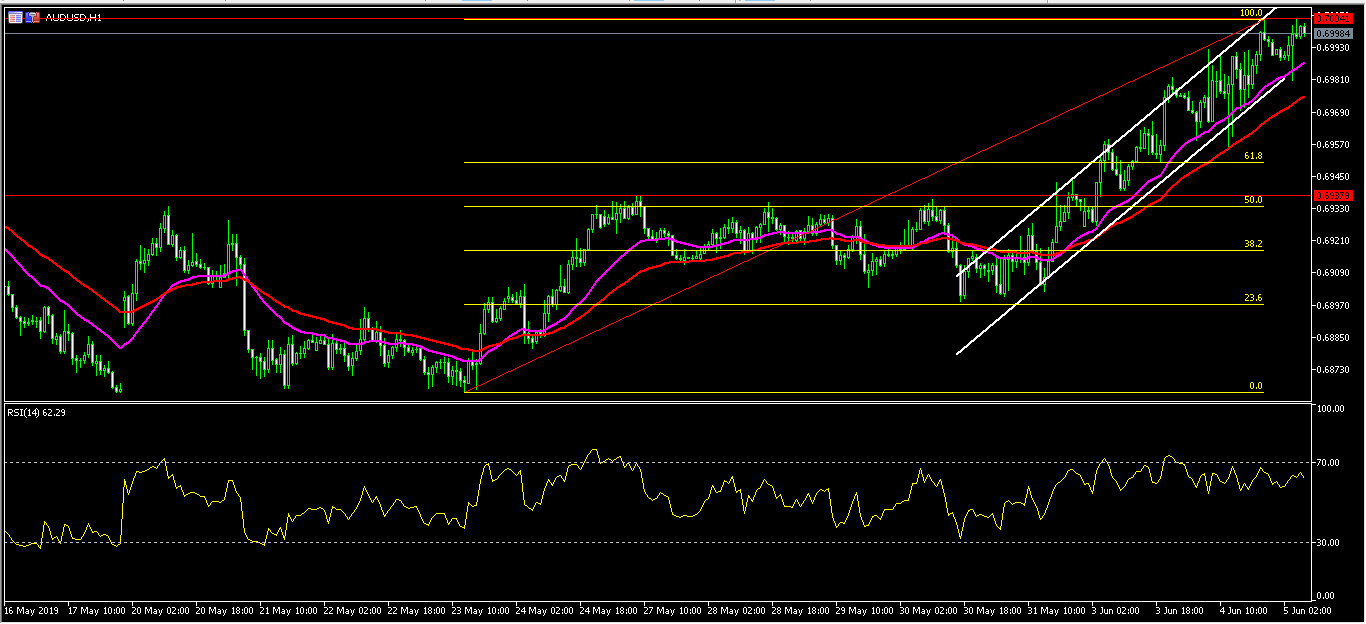
NZD/USD
The NZD/USD pair continued rising, reaching a high of 0.6637. This was the highest level since May 6. On the four-hour chart, this price is slightly below the 38.2% Fibonacci Retracement level. The price is along the upper line of the Bollinger Bands while the RSI remains above the overbought level. The standard deviation too has been rising. The pair will likely continue moving higher to test the important 38.2% Fibonacci level at 0.6657.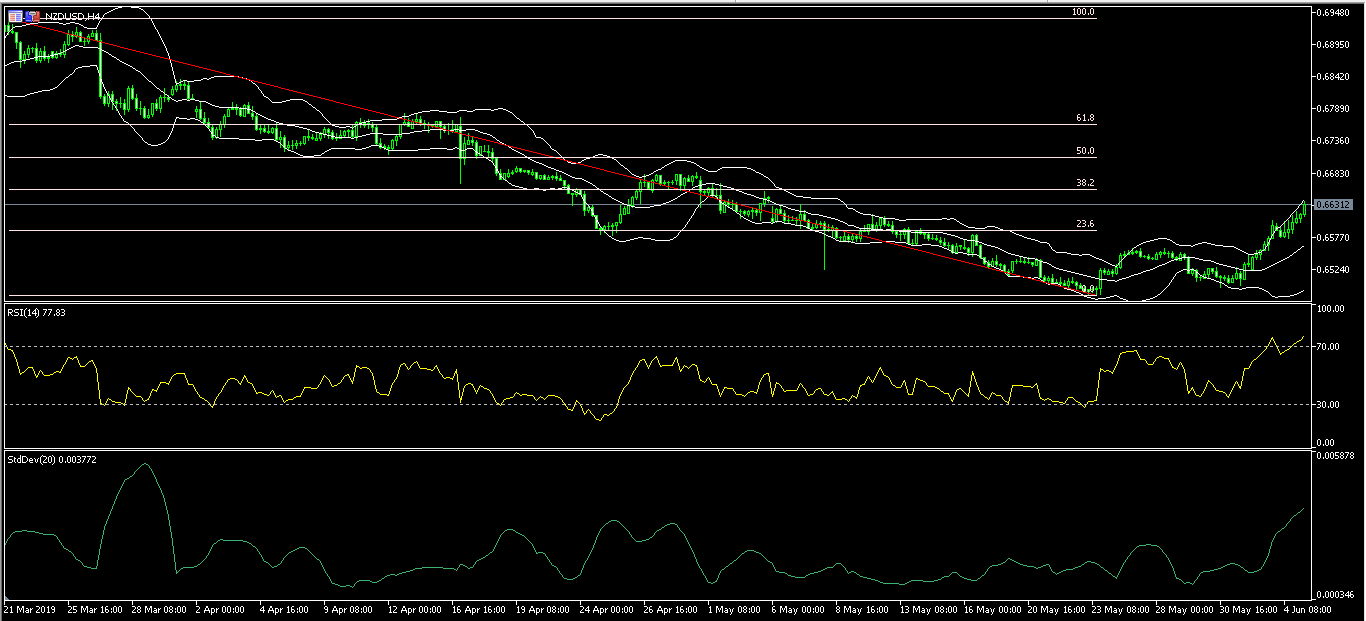
Currencies: USD Fails To Rebound As Markets See Chances On Fed Cut Confirmed
Rates: Fed Chair Powell ready to cut rates if needed
US Treasuries fell prey to minor profit taking yesterday. Fed Chair Powell hinted at what has been discounted over the past weeks/days: readiness to cut policy rates if needed. US stock markets rallied. The environment is nevertheless expected to remain bond friendly with downside risks to US eco data.
Currencies: USD fails to rebound as markets see chances on Fed cut confirmed
Equites rebounded and US yields rose a few basis points yesterday after Monday’s fall. It didn’t help the dollar much as Fed comments indicated that Powell and co are prepared to support the economy if needed. EUR/USD is holding near recent correction top. USD/JPY struggles to prevent a next down-leg below 108. Soft US data might weigh further on the dollar.
The Sunrise Headlines
- US stocks jumped yesterday after Powell flagged the Fed’s willingness to act “appropriate” to sustain the expansion. The Nasdaq (+2.65%) outperformed. Asian markets track Wall Street’s gains. Japan outperforms (+2%).
- Powell’s comment were later echoed by Fed’s number 2, Clarida. The vice-chair said if the central bank senses growth slowing, they will act to maintain growth at potential, referring to the “insurance cuts” back in the 90’s.
- The Japanese composite PMI (50.7) creeps closer to the 50 boom-bust mark in May. The services index declined to 51.7. Caixin’s composite PMI in China tumbled to 51.5 in May (52.7 in April). Services slip to 52.7 (vs. 54.5 in April).
- Mexican president Obrador is confident a deal with the US can be struck before June 10, when tariffs kick in. US president Trump sounded less optimistic and keeps the pressure on Mexico, saying the tariff threat is “no bluff”.
- The World Bank cut global GDP projections from 2.9% to 2.6% for 2019 as trade slows. The US/Sino trade conflict, financial turbulence in emerging markets and unexpectedly weak growth in advanced nations skew risks to the downside.
- Australian GDP growth accelerated to 0.4% QoQ in 2019Q1 after slowing three quarters. On a yearly basis growth was still the lowest (1.8%) since 2009Q3 as the country struggles with a housing downturn and a slowing Chinese economy.
- In today’s economic calendar the US takes centre stage. We watch for the ADP job report and ISM non-manufacturing index. The Fed releases its beige book while Fed-heavyweight Clarida is scheduled to speak
Currencies: USD Fails To Rebound As Markets See Chances On Fed Cut Confirmed
Soft Fed speak keeps USD in the defensive.
The dollar stabilized yesterday after a sharp, interest rate driven decline on Monday. Trading in EUR/USD (and USD/JPY) was mainly inspired by the US side of the story. EMU CPI dropped more than expected to 1.2% Y/Y, but was ignored by euro traders. The USD tried comeback, but it had no strong legs even as US yields reversed part of Monday’s fall. Fed Powell and Clarida gave a balanced view on the US economy but the Fed is prepared to take action if the fall-out from the trade tensions would warrant to do so. Equities rebounded. US yields and the dollar reacted more to the dovish side of this Fed guidance. EUR/USD closed at 1.1252 (from 1.1241). USD/JPY hardly profited from the risk rebound closing at 108.15 (from 108.07).
This morning, Asian equites join the risk-rebound on WS with japan outperforming. Japanese yields continue to decline as markets are mulling additional BoJ easing. Still the yen hardly declines. USD/JPY fails to move higher off the 107.85/108 support. The dollar continues trading soft against the euro (EUR/USD near 1.1260). The Australian Q1 GDP was soft at 0.4% Q/Q, but with little impact on the Aussie dollar. AUD/USD hovered in the 0.70 area as the focus stays on Fed easing.
Today, the calendar contains final EMU (services) PMI’s. In the US, ADP job growth is expected at 185K. The ISM (non-manuf.) is expected little changed at 55.4. We see downside risk for both indicators. Several Fed members will speak and the Fed Beige book will be published.
Of late, EUR/USD extensively tested the 1.1110 support, but no break occurred. The USD topside test was rejected as markets anticipate Fed rate cuts as trade tensions might hurt US growth. Yesterday’s price action suggests USD momentum to remain fragile. Mediocre US data might cement Fed rate cut expectations and weigh on the USD. EUR/USD still tries to break the 1.1265 level in a sustainable way. A break would improve the technical picture with 1.1324 the next target.
Recent sterling decline took a breather yesterday. A new attempt of EUR/GBP to extend gains beyond the 0.8840/0.8900 area was rejected. USD softness also protected the downside in cable. EUR/GBP returned to the 0.8860 area. Brexit and the campaign to succeed PM May remain the dominant factor sterling trading. However, in a daily perspective, the UK services PMI remains interesting too. A stabilisation just above the 50 boom or bust level is expected. Some ST sterling consolidation might be on the cards, but we stay cautious on sterling LT
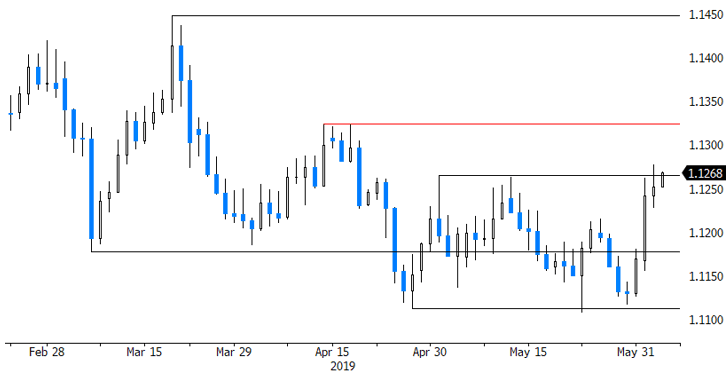
EUR/USD holding near recent correction top as markets expected Fed easing soon