

Sample Category Title
Dollar in Deep Selloff as Markets Price in 90% Chance of Fed Cut by September
Talks of Fed rate cut intensified overnight after comments from Fed Chair Jerome Powell. Markets are now even pricing in 90% of a cut by September FOMC meeting. US stocks rebounded strongly with DOW closed up 512.40 pts or 2.06%. Positive sentiments carried through to Asia will broad based rallies in the markets. Meanwhile, Dollar is clearly the casualty in the turn in sentiments.
In the currency markets, after this week's selloff, the greenback remains the weakest one for today so far. Swiss Franc follows as second weakest, then Sterling. Commodity currencies are the strongest ones, led by New Zealand Dollar and then Aussie. The picture for the week is similar, Dollar is overwhelming the weakest one, followed by Yen and then Sterling. Commodity currencies are strongest for the week so far.
Technically, the first thing to note is that Dollar index breached 97.02 support yesterday, and the case of bearish trend reversal is building up. Both AUD/USD and USD/CAD are showing some commitment to reversals. In particular, USD/CAD has taken out 1.3429 support firmly. Focus will immediately be on 1.3357 support today. Firm break will confirm bearish reversal in USD/CAD. EUR/USD is, for now, still hesitating and pressing 1.1263 resistance. But decisive break would prompt more broad based selling in Dollar.
In other markets, currently, Nikkei is up 1.77%. Hong Kong HSI is up 0.72%. China Shanghai SSE is up 0.63%. Singapore Strait Times is up 0.61%. Japan 10-year JGB yield is down -0.0188 at -0.119. Overnight, DOW rose 2.06%. S&P 500 rose 2.14%. NASDAQ rose 2.65%. 10-year yield rose 0.038 to 2.119.
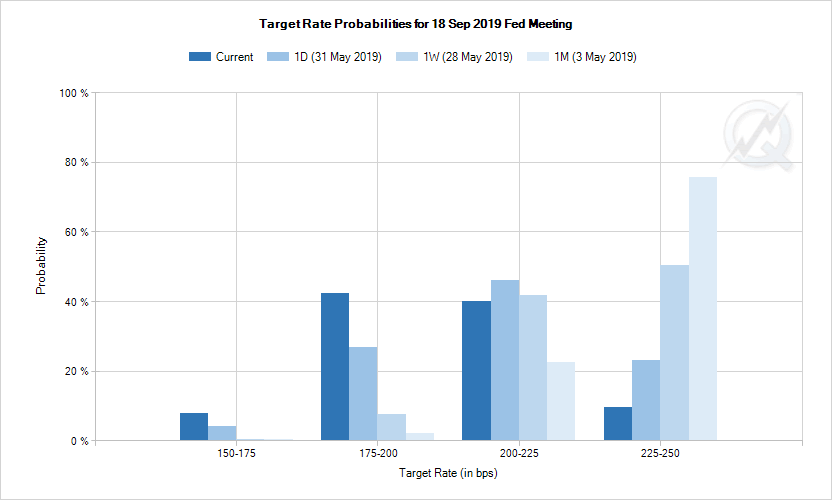
Markets pricing in 90% chance of Fed cut by September
Markets are adding their bets on Fed rate cut after recent development in the markets as well ass comments from Fed officials. As of now, Fed fund futures are pricing in 90.3% chance of a Fed cut by September meeting. That's sharply higher that around 49.6% a week ago and 24.6% a month ago.
Fed chair Jerome Powell's comments yesterday, while brief, were taken most seriously. He firstly noted " recent developments involving trade negotiations and other matters". Fed is "closely monitoring the implications of these developments for the U.S. economic outlook". And Fed " will act as appropriate to sustain the expansion, with a strong labor market and inflation near our symmetric 2 percent objective." His comments were taken a nod to cutting interest rates if outlook worsen on trade wars.
Vice Chair Richard Clarida some what echoed Powell's comments. Clarida noted " policymakers would "put in place policies that not only achieve but sustain price stability and maximum employment". The key here is again to "sustain" price stability and maximum employment. Though, he also emphasized that fed shouldn't be "handcuffed" to market pricing. And the US is just "early into" yield curve inversion while is not a "strong signal of concern" yet.
As a recall, St. Louis Fed President James Bullard was the first one to call for a rate cut earlier this week. He noted , a rate cut could be coming soon to help "re-center inflation and inflation expectations". That would provide "insurance" in case of "sharper-than-expected slowdown" as "global trade uncertainties have become more severe." Meanwhile, "even if the sharper-than-expected slowdown does not materialize, a rate cut would only mean that inflation and inflation expectations return to target more rapidly."
Chicago Fed President Charles Evans was still confident on the economy but he's open to some policy actions. He said in a CNBC interview that the economy remains solid and interest rate is at the right place. And, "our current setting has been appropriate, but if we sense that there was some greater uncertainty, some softening, we'd have to take that into account and ask, are we getting in the way of the economy."
Dallas Fed President Robert Kaplan was more patient regarding the impact of trade tensions between US, China and Mexico. He said: "I want to take a little bit more time and be patient here, because some of these recent events could be reversed... Worth being cognizant of the fact that these recent tensions have just elevated in the last five, six weeks... And in the next five, six weeks, a number of them could be alleviated."
Australia GDP grew 0.4% in Q1, driven mainly by government spending
Australian GDP grew 0.4% qoq in Q1, matched expectations. Annually, growth slowed to 1.8% yoy, down from 2.3% yoy and matched expectations too. But the details are rather weak. Government spending was the main contributor to growth, while rose 0.8%. Household spending slowed to 0.3% and contributed a modest 0.1%. And, dwelling investment contracted by -2.5% while slowing housing market has resulted in significant falls in ownership transfer costs. Non-mining investment rose 2.0% while mining investment dropped -1.8%.
Separately, RBA Head of Economic Analysis Alexandra Heath said in a report that "mining investment is probably around its trough and is likely to pick-up gradually over the next year or so". And, "resource exports are also expected to contribute to GDP growth before plateauing at a new, higher level."
Also from Australia, AiG Performance of Services Index rose to 52.5 in May, up fro 46.5.
China Caixin PMI Services dropped to 52.7, subdued expectations linked to ongoing China-US trade dispute
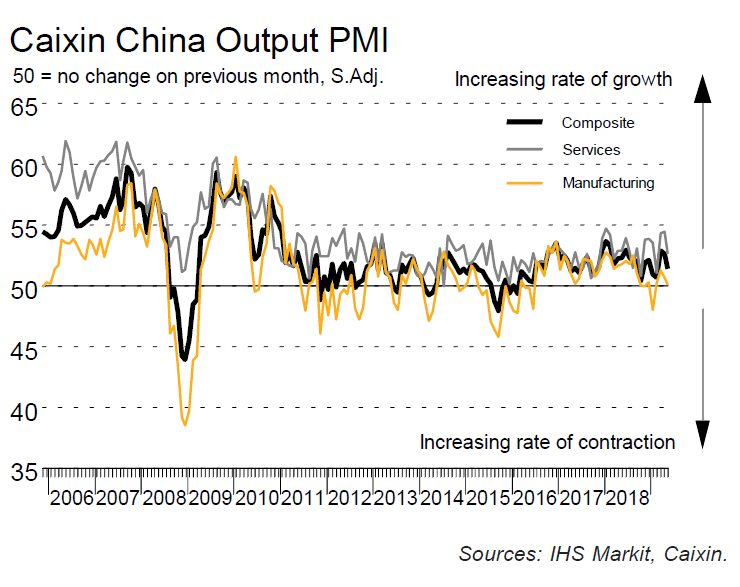
China Caixin PMI Services dropped to 52.7 in May, down from 54.5 and missed expectation of 54.2. PMI Composite dropped to 5.15, down from 52.7. Markit noted that "overall confidence towards the year ahead weakened to the lowest on record, which was primarily driven by weaker sentiment at manufacturers". Also, "expectations at goods producers were the least upbeat since the series began in April 2012", " services firms registered the lowest degree of confidence since July 2018".
And, "subdued expectations were often linked to the ongoing China-US trade dispute and relatively subdued global demand conditions."
Looking ahead
Services data will be the major focus for today. Eurozone will release PMI services final, retail sales and PPI. UK will release PMI services. US will release ISM non-manufacturing and ADP employment. Fed's Beige Book economic report will also be featured. Canada will release labor productivity.
USD/CAD Daily Outlook
Daily Pivots: (S1) 1.3365; (P) 1.3409; (R1) 1.3437; More...
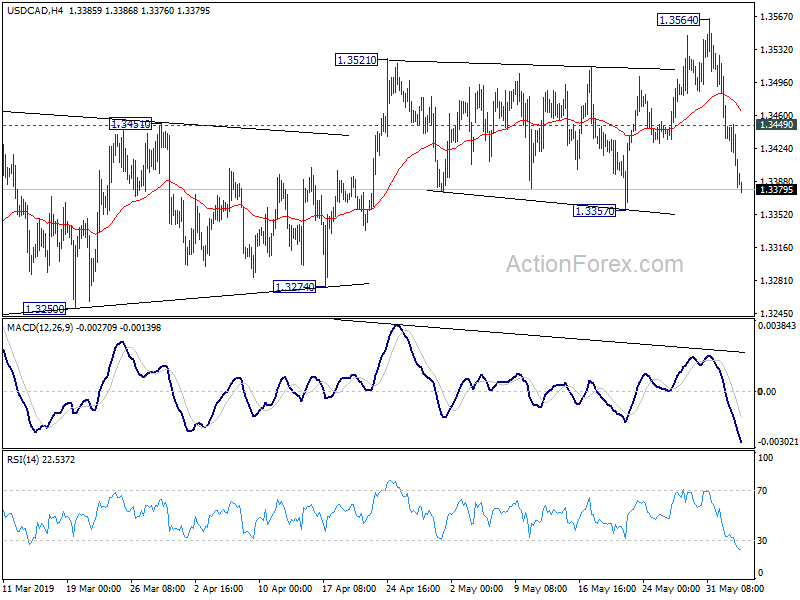
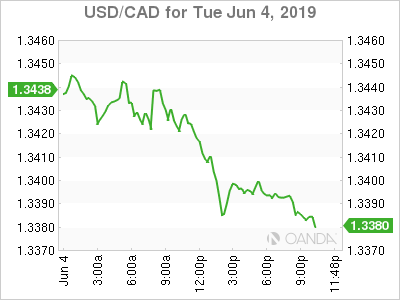
USD/CAD drops to as low as 1.3376 so far and intraday bias remains on the downside. Current development suggests that choppy rise from 1.3068 has completed at 1.3564, on bearish divergence condition in 4 hour MACD. Decisive break of 1.3357 support will confirm this bearish case and target 1.3274 support next. More importantly, that could also have medium term channel support taken out, which carries larger bearish implications too. On the upside, break of 1.3449 minor resistance is needed to indicate completion of fall from 1.3564. Otherwise, further decline remains in favor in case of recovery.
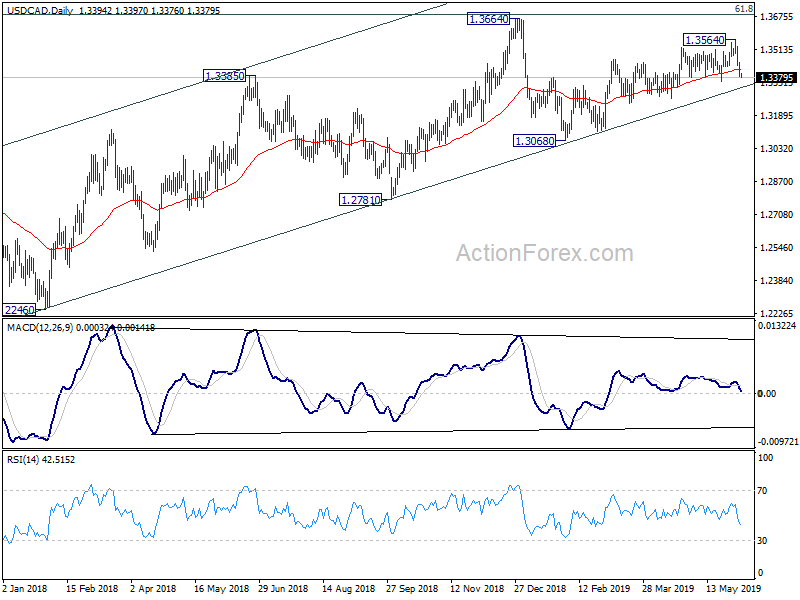
In the bigger picture, USD/CAD is staying well inside medium term rising channel (support at 1.3335). Thus, the up trend from 1.2061 (2017 low) should be in progress. On the upside, decisive break of 61.8% retracement of 1.4689 (2016 high) to 1.2061 at 1.3685 will pave the way to 78.6% retracement at 1.4127 next. This will remain the favored case as long as 1.3068 support holds. However, sustained break of the channel support will be the first sign of medium term reversal. Firm break of 1.3068 would confirm.
Economic Indicators Update
| GMT | Ccy | Events | Actual | Forecast | Previous | Revised |
|---|---|---|---|---|---|---|
| 22:30 | AUD | AiG Performance of Service Index May | 52.5 | 46.5 | ||
| 1:30 | AUD | GDP Q/Q Q1 | 0.40% | 0.40% | 0.20% | |
| 1:30 | AUD | GDP Y/Y Q1 | 1.80% | 1.80% | 2.30% | |
| 1:45 | CNY | Caixin PMI Services May | 52.7 | 54.2 | 54.5 | |
| 7:45 | EUR | Italy Services PMI May | 49.8 | 50.4 | ||
| 7:50 | EUR | France Services PMI May F | 51.7 | 51.7 | ||
| 7:55 | EUR | Germany Services PMI May F | 55 | 55 | ||
| 8:00 | EUR | Eurozone Services PMI May F | 52.5 | 52.5 | ||
| 8:30 | GBP | Services PMI May | 50.6 | 50.4 | ||
| 9:00 | EUR | Eurozone PPI M/M Apr | 0.20% | -0.10% | ||
| 9:00 | EUR | Eurozone PPI Y/Y Apr | 3.10% | 2.90% | ||
| 9:00 | EUR | Eurozone Retail Sales M/M Apr | -0.50% | 0.00% | ||
| 12:15 | USD | ADP Employment Change May | 185K | 275K | ||
| 12:30 | CAD | Labor Productivity Q/Q Q1 | 0.40% | -0.40% | ||
| 13:45 | USD | Services PMI May F | 50.9 | 50.9 | ||
| 14:00 | USD | ISM Non-Manufacturing/Services Composite May | 55.5 | 55.5 | ||
| 14:30 | USD | Crude Oil Inventories | -0.3M | |||
| 18:00 | USD | Federal Reserve Beige Book |
China Caixin PMI Services dropped to 52.7, subdued expectations linked to ongoing China-US trade dispute
China Caixin PMI Services dropped to 52.7 in May, down from 54.5 and missed expectation of 54.2. PMI Composite dropped to 5.15, down from 52.7. Markit noted that "overall confidence towards the year ahead weakened to the lowest on record, which was primarily driven by weaker sentiment at manufacturers". Also, "expectations at goods producers were the least upbeat since the series began in April 2012", " services firms registered the lowest degree of confidence since July 2018".
And, "subdued expectations were often linked to the ongoing China-US trade dispute and relatively subdued global demand conditions."
Commenting on the China General Services PMI™ data, Dr. Zhengsheng Zhong, Director of Macroeconomic Analysis at CEBM Group said:
"The Caixin China General Services Business Activity Index fell to 52.7 in May from the recent high of 54.5 in April, although it remained firmly within expansionary territory. Among the gauges included in the survey:
- The gauge for new business fell from the past month's recent high but remained in expansionary territory, reflecting slowing growth in demand across the services sector.
- The measure for employment fell from the past month's recent high while remaining within expansionary territory, suggesting jobs growth is slowing.
- Gauges for input costs and prices charged by services providers both fell slightly while remaining in expansionary territory. Growth in input costs outpaced that of prices charged, indicating that services companies remained under significant pressure.
- The measure for business expectations continued to fall, despite staying in positive territory, reflecting services providers' weakening confidence in their future prospects.
"The Caixin China Composite Output Index fell to 51.5 in May from 52.7 the month before, mainly due to slower growth in the service sector.
- The gauge for new orders edged down while remaining in expansionary territory, while the measure for new export orders returned to growth, pointing to weakening demand at home but improved demand abroad. The negative effects of China-U.S. tensions on exports have yet to emerge, perhaps due to exporters front-loading shipments of products that are in the remaining $300 billion of goods not subject to punitive tariffs.
- The employment gauge continued to fall, entering contractionary territory. This suggested the labor market is under pressure. In a move that is likely related, the State Council recently set up a new leading group on employment.
- Both gauges for input costs and output charges edged down while remaining in expansionary territory. Growth in input costs outpaced that of output charges, indicating companies continued to be squeezed.
- The measure for future output fell markedly, to the lowest reading since the series began in 2012, although it remained in positive territory. This indicates business confidence is in urgent need of a boost.
"Overall, China's economic growth showed some signs of slowing in May. Employment and business confidence in particular merit policymakers' attention."
Australia GDP grew 0.4% in Q1, driven mainly by government spending
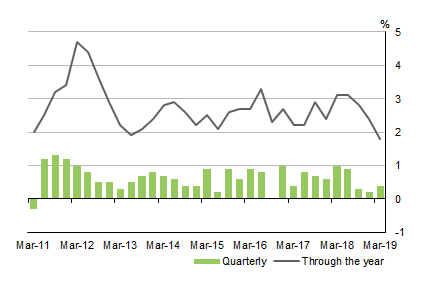
Australian GDP grew 0.4% qoq in Q1, matched expectations. Annually, growth slowed to 1.8% yoy, down from 2.3% yoy and matched expectations too. But the details are rather weak. Government spending was the main contributor to growth, while rose 0.8%. Household spending slowed to 0.3% and contributed a modest 0.1%. And, dwelling investment contracted by -2.5% while slowing housing market has resulted in significant falls in ownership transfer costs. Non-mining investment rose 2.0% while mining investment dropped -1.8%.
Gross domestic product, Volume measures: Seasonally adjusted
Separately, RBA Head of Economic Analysis Alexandra Heath said in a report that " mining investment is probably around its trough and is likely to pick-up gradually over the next year or so". And, "resource exports are also expected to contribute to GDP growth before plateauing at a new, higher level."
Fed Clarida: Will put in place policies to sustain price stability and maximum employment
Fed Vice Chair Richard Clarida emphasized yesterday that policymakers would "put in place policies that not only achieve but sustain price stability and maximum employment, and we'll do that if we need to." He added that interest rates are now at the lower end of that range consistent with 2% inflation. While markets are pricing in rate cuts as tariff wars have intensified, he noted Fed shouldn't be "handcuffed" to fluctuations in markets.
On yield curve, Clarida said "historically a flat yield curve doesn't convey a lot of information". However, if yield curve inversion "persists for some time", "that's obviously something I would definitely take seriously." But for now, "I would not view this as a strong signal of concern. We are early into it. It's certainly something we'll keep looking at."
Separately, in a WSJ interview, Dallas Fed Robert Kaplan sounded calm regarding the trade tensions between US, China and Mexico. He said: "I want to take a little bit more time and be patient here, because some of these recent events could be reversed... Worth being cognizant of the fact that these recent tensions have just elevated in the last five, six weeks... And in the next five, six weeks, a number of them could be alleviated."
Gold Price Breaks Key Resistance, Dips Remain Supported
Key Highlights
- Gold price started a fresh increase above $1,288 and $1,300 resistances against the US Dollar.
- There was a break above a key bearish trend line at $1,281 on the 4-hours chart of XAU/USD.
- The US Factory Orders in April 2019 declined 0.8%, less than the -0.9% forecast.
- The US ISM Non-Manufacturing Index in May 2019 is likely to remain stable at 55.5.
Gold Price Technical Analysis
The $1,275 level acted as a strong support and gold price bounced back against the US Dollar. The price broke the key $1,288 and $1,295 resistance levels to move into a positive zone.
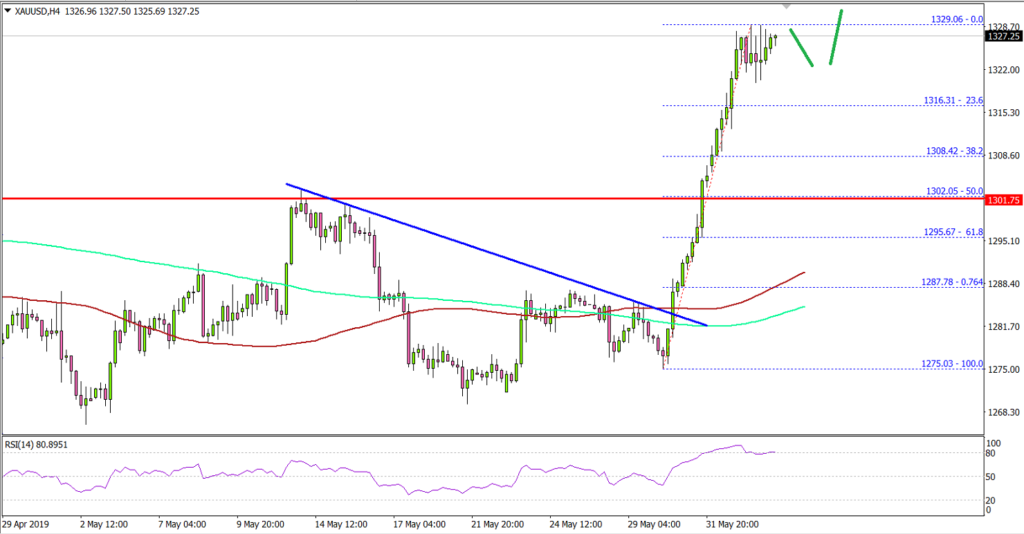
The 4-hours chart of XAU/USD indicates that the price surpassed the $1,300 resistance area and the 100 simple moving average (4-hours, red). There was a close above the $1,310 level and the 200 simple moving average (4-hours, green).
The bulls gained traction, resulting in a solid upward move above the $1,320 level. The price traded close to the $1,300 level and it is currently consolidating gains.
On the upside, an immediate resistance is near the $1,330 and $1,335 levels. If there is an upside break above $1,335, the price could accelerate above the $1,340 level.
On the downside, an initial support is near the $1,316 level or the 23.6% Fib retracement level of the last wave from the $1,275 swing low to $1,329 swing high. If there is an extended downside correction, the price might find bids near the $1,300 support area.
Looking at the major pairs, EUR/USD gained momentum above the 1.1225 resistance level and GBP/USD is slowly recovering above the 1.2650 level.
Economic Releases to Watch Today
- Germany’s Services PMI for May 2019 – Forecast 55.0, versus 55.0 previous.
- Euro Zone Services PMI for May 2019 – Forecast 52.5, versus 52.5 previous.
- UK Services PMI for May 2019 – Forecast 50.6, versus 50.4 previous.
- US Services PMI for May 2019 – Forecast 50.9, versus 50.9 previous.
- US ISM Non-Manufacturing Index for May 2019 – Forecast 55.5, versus 55.5 previous.
First Impressions: Australian Q1 GDP
Q1 GDP: 0.4%qtr, 1.8%yr. A downside surprise, detail on the soft side - private demand contracting.
Q1 GDP
- Sluggish output growth has extended into 2019, with Q1 printing at 0.4%qtr, 1.8%yr.
- This was a downside surprise and the detail was on the soft side.
- Annual output growth is now the slowest since 2009Q3, when the GFC impacted.
Key surprises
- The expenditure measure of GDP grew by only 0.2%. We expected a figure close to 0.5%/0.6%.
- Key surprises were: (1) consumer spending disappointed, 0.3% vs a f/c 0.4%; (2) ownership transfer costs (relating to real estate turnover) fell very sharply, -13%; and (3) inventories were a negative, -0.1ppt vs a f/c flat ~ suggesting a larger drag from ‘other’ inventories.
- Domestic demand grew by only 0.1% vs a f/c 0.3%. Private demand contracted in the quarter, -0.2% and contracted over the past 3 quarters, -0.3%.
- Annual GDP growth at 1.8% is a full percentage point below ‘trend growth’, judged to be 2.75%.
Details
- Real GDP: 0.4%qtr, 1.8%yr
- Nominal GDP: 1.4qtr, 4.9%yr
- Terms of trade: 3.1%qtr, 6.0%yr
- Hours worked: 0.9%qtr, 2.8%yr
- Domestic demand: 0.1%, 1.6%yr
- Inventories: -0.1ppt qtr
- Net exports: +0.2ppts qtr
- Consumer spending: 0.3%qtr, 1.8%yr
- Home building: -2.5%qtr, -3.1%yr
- Business investment: 0.5%qtr, -1.3%yr
- Public demand: 1.1%qtr, 5.7%yr
- Farm output: -0.2%qtr, -6.8%yr
- Wage incomes: 1.2%qtr, 4.3%yr
- Wages (average earnings non-farm sector): 0.4%qtr, 1.4%yr
- Household consumption deflator: 0.4%qtr, 1.5%yr
- Household saving ratio: 2.8%, up from 2.6% in Q4 but down from 3.9% a year earlier.
Comments
The economy lost considerable momentum in 2018, slowing from around a 4% annualised pace in the first half of the year to around a 1% pace in the second. Sluggish conditions have extended into early 2019.
The slowdown was centred on housing and the consumer against the backdrop of a further tightening of lending standards and persistent weak wages growth. A negative supply shock from the drought in NSW and surrounds is another negative.
Mid-2018 was the turning point for new home building, with strong gains now giving way to sizeable declines. The slump in dwelling approvals points to the downtrend continuing in 2019. Dwelling activity fell further in Q1, down 2.5%.
Consumer spending has shifted to a lower growth path constrained by weak wages growth, high debt levels and declining house prices, with the savings rate edging higher suggesting a negative wealth effect may be impacting. Consumer spending rose by only 0.3% in the quarter, following a 0.3% in Q3 and a 0.4% in Q4, with annual growth now at 1.8% - the slowest since mid-2013.
Notably, there is a stark divide between private demand and public demand. Private demand is particularly weak, down 0.2% in the quarter and down 0.3% over the past three quarters. Public demand (accounting for 25% of the economy) is up 1.1%qtr, 5.7%yr in Q1.
Public demand is a source of strength, with growth well above trend. Spending on health and on transport infrastructure projects are trending sharply higher. Tax revenues have been boosted by higher profits (centred on mining) providing the government with additional flexibility on fiscal policy.
The national income picture remains positive. The terms of trade rose by 3.1% in the quarter, to be 6.1% above a year ago.
National income (nominal GDP), in Q1 grew by a robust 1.4%qtr, 4.9%yr
Exports resumed their uptrend in the quarter, advancing by 1.0%. That followed a disappointing second half of 2018, when volumes were flat in Q3 and slipped 0.5% lower in Q4 – dented by drought and supply disruptions in the resources sector.
Net exports were a swing factor over the past year, turning around from a negative in Q4, a -0.2ppt impact, to being a positive in Q1, adding 0.2ppts.
Business investment was mixed in the quarter, +0.5%qtr, -1.3%yr – with the recent completion of work on major gas projects still a drag in the period.
USD/CAD Canadian Dollar Higher On US Rate Cut Expectations
The Canadian dollar rose 0.31 percent against the US dollar on Tuesday. Rising commodities and a softer dollar combined to appreciate the loonie. US rate cut probabilities jumped after Fed Chief Powell, while not outright mentioning a rate cut, did suggest the central bank is ready to act if needed. A prolonged trade war with China and new fronts ready to be open are big obstacles for the US economy to navigate, which is why the Fed could add some stimulus via lower interest rates.
Oil and gold rose taking advantage of the US dollar softness. Risk appetite was also higher as investors bought equities putting behind some fears of antitrust measures in the tech sector.
The USMCA remains on track with the three signing nations making comments for a swift ratification. The fly in the ointment could be actions such as Trump’s decision to target tariffs against Mexico for issues outside of the agreement.
Canadian manufacturing remains below 50 at 49.1, so technically it is not expanding, and it was a lower index than last month. Employment data will be released on Friday alongside the U.S. non-farm payrolls (NFP) report. Canadian jobs in April saw a massive 106.5K gain and there is a correction expected when the May data is released.
The US dollar is lower against major pairs on Tuesday. The greenback was sold across the board as remarks from U.S. Federal Reserve Chair Jerome Powell signalled the central bank could cut interest rates this year. The Fed hiked the benchmark rate four times in 2018, but as the US-China trade war drags on, it continues to have a negative impact on American growth.
The stock market saw a huge boost of the narrative that a rate cut could come sooner than later. The CME FedWatch tool points to a 23.3 percent chance of a rate cut in the upcoming June meeting. Fed Fund rate levels in December show a less than 15 percent probability the benchmark interest rate will be at the current 200-225 basis points.
OIL – Soft Dollar Boosts Energy Prices
Brent jumped 1.11 percent and WTI rose 0.38 percent after the US dollar fell on a possible rate cut gaining traction this year. Trade disputes have been negative for energy prices, and the White House decision to open a trade front with Mexico investors were anxious about sustained growth.
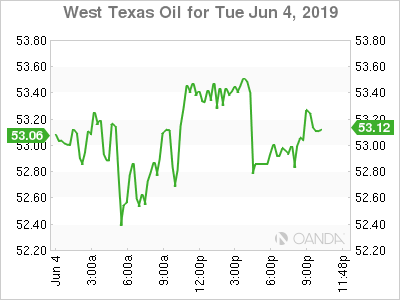
The US is impacting prices in three ways. Sanctions against Iran and Venezuela for political reasons have boosted prices as it reduced supply. US-China and US-Mexico trade disputes have a negative effect on global growth forecast reducing energy demand going forward. The final factor has been the rise of American output. While sanctions reduce supply and boost prices, lower energy demand and rising production depreciates crude as there is a higher risk of oversupply. 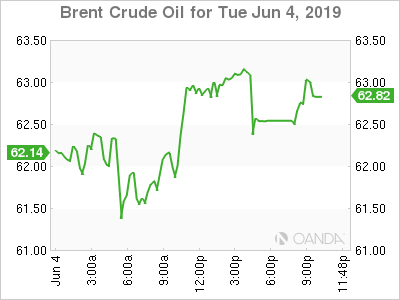
The OPEC+ deal has been the major stabilizing force holding energy prices, but the agreement to cut output comes with an expiration date. Russia has not committed publicly to an extension which could put more pressure on Saudi Arabia to keep the group united if they lose such a major producer.
US crude inventories are expected to shrink in this week’s data release. The softness of the dollar and a lower drawdown would be a positive for crude prices. Tougher trade rhetoric and risk aversion coupled with a lower than forecasted drawdown would once again cause a drop in energy prices.
GOLD – Gold Rises on Dollar Weakness
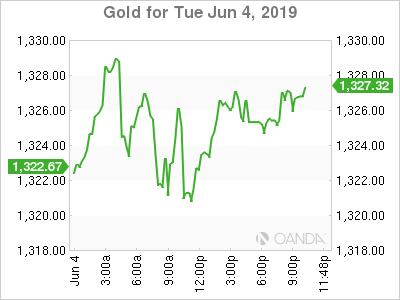
Gold rose 0.31 percent on Tuesday as the trade war drums in the US keep beating. The decision by President Trump to open more than one trade front at the time resulted in a weaker dollar. The yellow metal is being used by investors as a safe haven to reduce dollar exposures.
The words from Chair Powell were taken from the central banker handbook, he said very little of substance beyond the fact that the U.S. Federal Reserve will act if needed. A rate cut could be one of the measures needed, but the economy would have to show bigger signs of lack of momentum, even as trade disputes are slowing down growth.
Gold remains well above the $1,320 price level and given the geopolitical conditions there would have to be major advances on the trade war fronts and improving economic fundamentals for the yellow metal to depreciate against the greenback.
STOCKS – Tech Sector Shakes Off Anti-Trust Jitters
Investors bought into the stock market after Fed Chief Powell’s remarks hinted at a higher possibility of an interest rate cut this year. The Fed with four rate hikes in 2018 caused a major sell-off in December and had to reverse course in January. Today’s words by the top US central banker put US equities in its second-best day of the year.
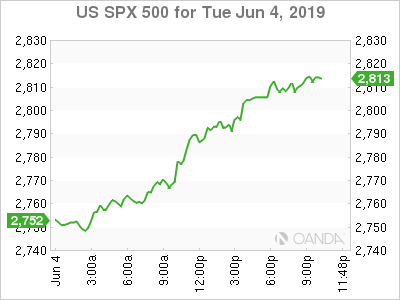
Anti-trust concerns were lower on Tuesday and the softness of the dollar gave a boost to equities. Trade war anxiety remains and companies with the biggest exposure to China and Mexico were affected. Chief Powell also mentioned the negative effect of a prolonged trade war and with is pledged to sustain the pace of growth of the US economy opened the door to an interest rate cut in the near to mid-term.
Pound Rises Despite Construction Disappointment
The pound rose 0.31 percent on Tuesday despite another economic indicator falling below expectations. British construction PMI dropped to 48.6 and is now below the level considered to be an expansion. Brexit anxiety has led to various data points pointing to a downward trend, but for now the political drama in the United Kingdom is focused on who will succeed Theresa May at the head of the Conservative party.
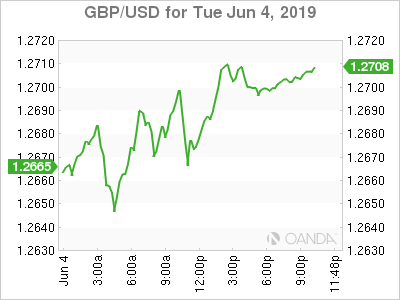
The ghost of a no-deal Brexit haunts the currency as the battle to gain support within the Tories heats up. The European parliament elections ironically showed a high support for the Brexit Party and in turn could put a hard Brexiteer at the head of the government.
Central banks took the center stage as an US interest rate cut could be on the table sooner than expected. Trade war headwinds and economic uncertainty could force the Fed to lower rates.
Eco Data 6/5/19
[php_everywhere instance="1"]
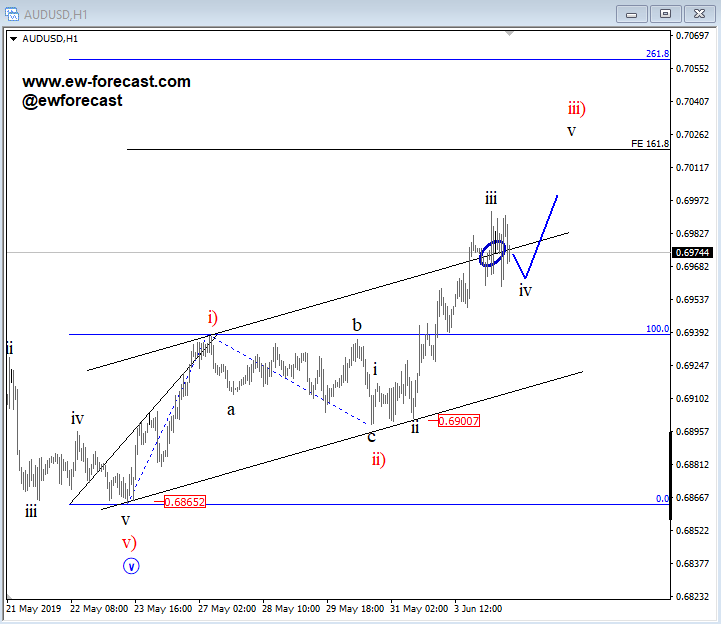
Elliott Wave Analysis: Bulls Pushing AUDUSD Towards 0.70
Aussie remains under bullish pressure towards 0.70 area and seems like it's trying to break above channel resistance line which would confirm a rally within wave iii). However, as long as price keeps trading above 0.6900 region, we will remain bullish.
AUDUSD, 1h
Gold Takes Breather after Fed Hints at Rate Cuts
Gold is relatively stable today after a strong three day run that’s seen is gain around 3.5% and burst back above $1,300.
The yellow metal is now trading back around three month highs and looking in a strong position, especially if central bank easing is going to become the theme for the rest of the year. The dollar, as ever, will play a big role in how far this will go and it is looking vulnerable.
Gold Daily Chart
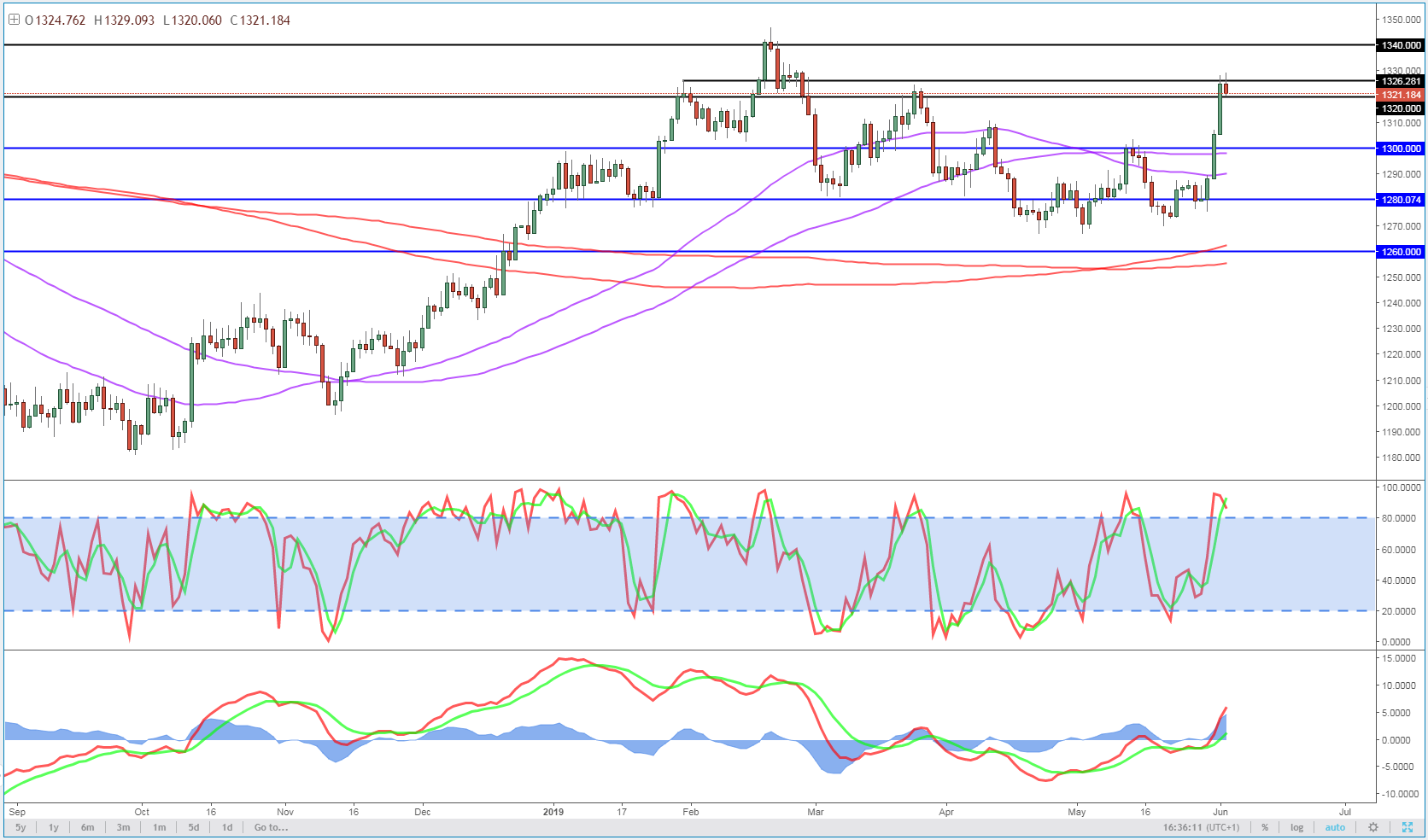
The dollar index has found support today around the May lows but I’m far from confident that will hold for long and a break could be the trigger for another sizable drop. This should naturally be good news for gold, which typically benefits when the greenback is struggling. There is plenty of potential resistance ahead for gold though but a weaker dollar would clearly help.
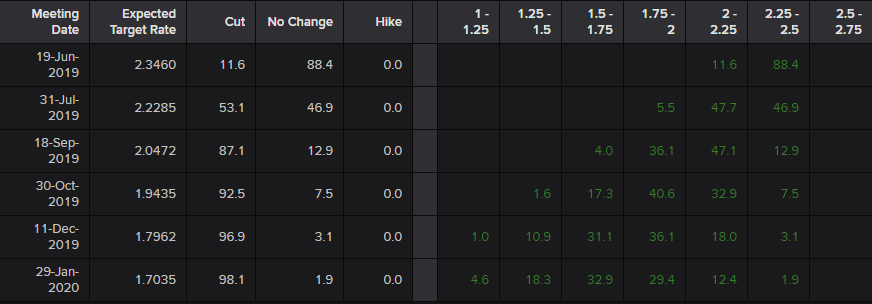
Time will tell whether markets are getting too carried away with various Fed comments but it seems traders are convinced that a rate cut is in the offing. With traders responding so strongly to these hints, there’s little reason to believe we won’t see more in the coming weeks.
This all puts more focus on the US jobs report this Friday, with a bad set of numbers likely further convincing traders that a cut is coming and warranted. What’s more, a June hike is still not priced in – only 10% according to Reuters Eikon – and a poor report on Friday could change that.
Fed Interest Rate Probability
There’s still plenty of resistance above for gold, most notably this year’s high but even just above here, gold has struggled around $1,360 over the last few year. This will likely be challenging for gold bulls again but if they can break above, it could be the catalyst for another big push.