Sample Category Title
DOW rises over 400pts on Fed Powell’s openness to rate cut
US stocks stage a very strong rebound today with DOW trading up over 400 pts at the time of writing. Fed Chair Jerome Powell's short comments on current outlook and policy seemed to be the trigger. Markets believed that Powell signaled his openness to rate cut.
This is the exact quote from the remarks: "I'd like first to say a word about recent developments involving trade negotiations and other matters. We do not know how or when these issues will be resolved. We are closely monitoring the implications of these developments for the U.S. economic outlook and, as always, we will act as appropriate to sustain the expansion, with a strong labor market and inflation near our symmetric 2 percent objective. My comments today, like this conference, will focus on longer-run issues that will remain even as the issues of the moment evolve.
It's firstly seen as acknowledgement on risks from "trade negotiations and other markets" And Fed will "act as appropriate" after monitoring the implications on economic outlook. That is, some saw that as a node to cutting rates if the economy worsen due to Trump's trade wars.
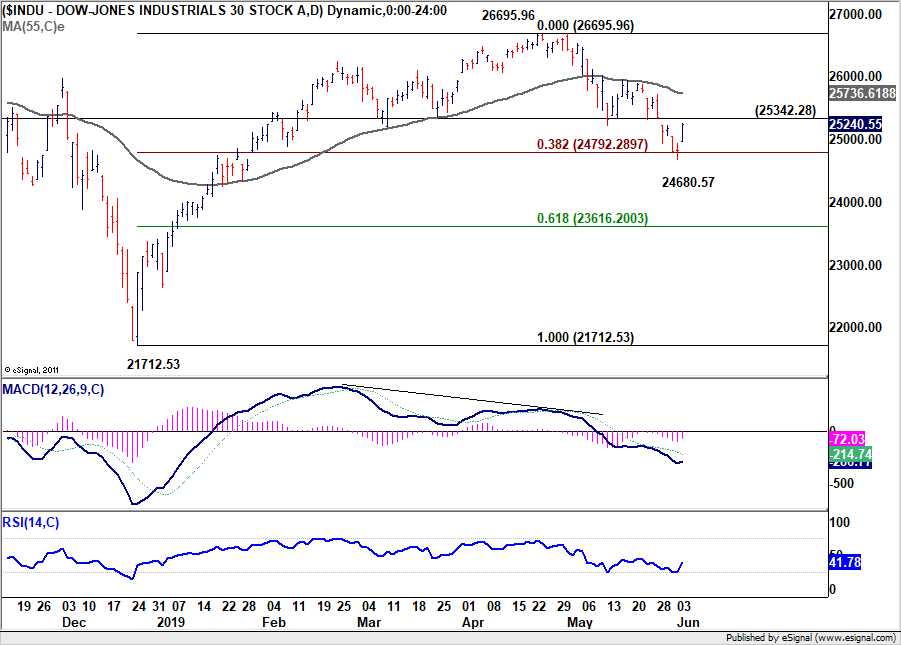
Technically, it now looks like DOW has drawn strong support from 38.2% retracement of 21712.53 to 26695.96 at 24792.28. The gap resistance at 25342.28 will likely be taken out this week to confirm short term bottoming at 2480.57. The real test is on 55 day EMA (now at 25736). Before sustained trading above this EMA, we'd still favor another decline to 61.8% retracement at 23616.20 and below.
British Pound Steady But Construction PMI Contracts
GBP/USD has posted slight gains in the Tuesday session. Currently, GBP/USD is trading at 1.2689, up 0.20% on the day. On the fundamentals front, British Construction PMI disappointed, with a score of 48.6, indicating contraction. This missed the estimate of 50.6 points. In the U.S., the sole event was Factory Orders. The indicator declined by 0.8%, above the estimate of -1.0%. This marked the second decline in three months. On Wednesday, the U.K. releases Services PMI. The U.S. releases ADP payrolls and ISM Non-Manufacturing PMI.
British PMIs, which are key gauges of the economic activity, dropped into contraction territory in April. Construction PMI fell to 48.6, its third decline in four months. This followed a manufacturing PMI of 49.4, marking the first contraction since July 2016. Manufacturing news from the U.S. also disappointed, as ISM Manufacturing PMI slowed to 52.1, down from 53.0 a month earlier. This was the PMI’s weakest reading since November 2018. Global demand has fallen off due to trade tensions, and unless this situation improves, manufacturing in the U.K and the U.S. could continue to head downwards.
The Federal Reserve has sounded neutral about the direction of a rate move, but the markets are expecting a rate cut, and the president of the St. Louis Fed came out in favor of a cut on Monday. James Bullard was blunt and pessimistic, saying that the Fed might have to lower rates shortly due to low inflation and the ongoing trade war with China. Bullard warned that the Fed may have to deal with “an economy that is expected to grow more slowly going forward, with some risk that the slowdown could be sharper than expected due to ongoing global trade regime uncertainty“. Bullard added that the current benchmark rate, which is at a range of 2.25% to 2.50%, is too high for current economic conditions, and recommended lowering rates in order to stabilize the economy.
Base Effects in the Driver’s Seat but ECB Concerns
- Today's euro area inflation print came in below our estimate and market consensus at only 0.8% (1.3% in April). Headline inflation was 1.2%. We expect core inflation to rebound to 1.0% in June.
- We do not throw in the towel on our relatively upbeat inflation projections for this year, as we continue to find reasons to expect core inflation to trend gradually upwards towards year-end, albeit we acknowledge downside risks to our inflation forecast as outlined in Euro Area Research – Inflation under the microscope: simmering, not boiling, 13 May.
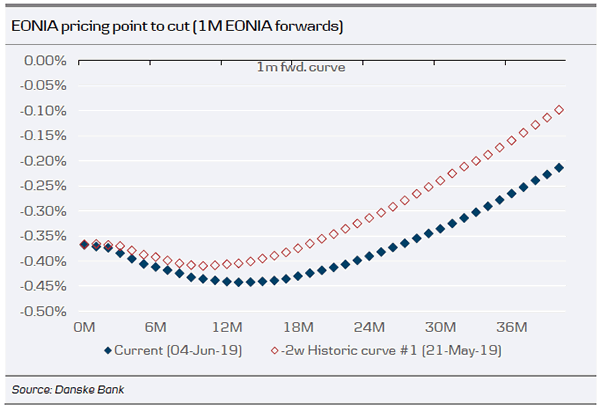
- We expect the ECB to reflect on the new information but believe it is unlikely to change its monetary policy stance ahead of the meeting on Thursday. While previously inflation pricing and first rate hike pricing have been correlated, the market discussion focuses on an ECB cut.
Base effect in the driver's seat – details yet to be released
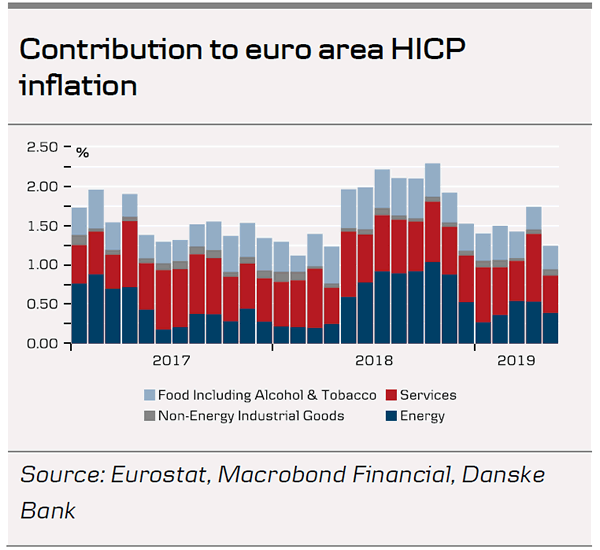
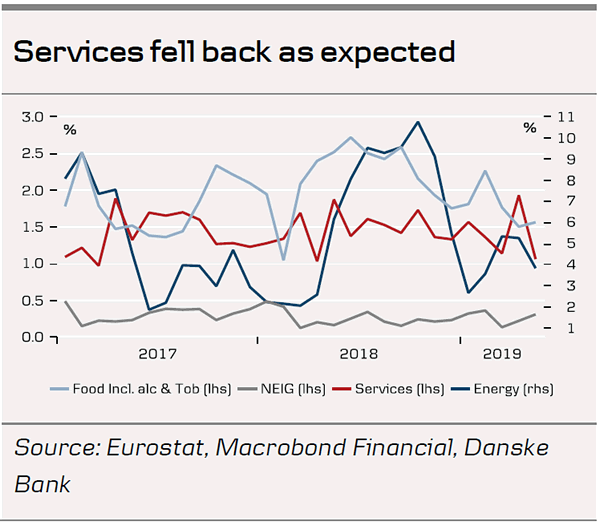
The May core inflation figure was already expected to decline from the high 1.29% in April due to the timing of Easter but we were surprised with the low 0.79% reading. Base effects from, for example, Whitsun is likely to have been a drag in May. While the full details of the May print have not been released yet, we note that at the aggregate level the main driver for the decline in core inflation was the services component (as expected) as it fell back to 1.06% from 1.93%, probably weighed down by a reversal in the holiday and package component. Non-energy industrial goods rose marginally from 0.22% in April to 0.31% in May. The volatile food component was marginally higher at 1.56%, while the energy price component declined from 5.27% in April to 3.84% in May.
As a result, and unsurprisingly, the headline inflation print declined from 1.72% to 1.24%, driven mainly by the services component in core and energy.
ECB set to be worried but not to change stance
In our opinion, President Mario Draghi and the ECB will have to walk a tightrope at the upcoming meeting on Thursday. The May inflation print is on the low side compared with expectations despite the decline being attributed to base effects. Therefore, the ECB may want to see a 'clearer' underlying inflation print in late June before changing its stance. However, the recent print, combined with deteriorating inflation expectations, is concerning and we expect Draghi to face questions on this at the Q&A session on Thursday.
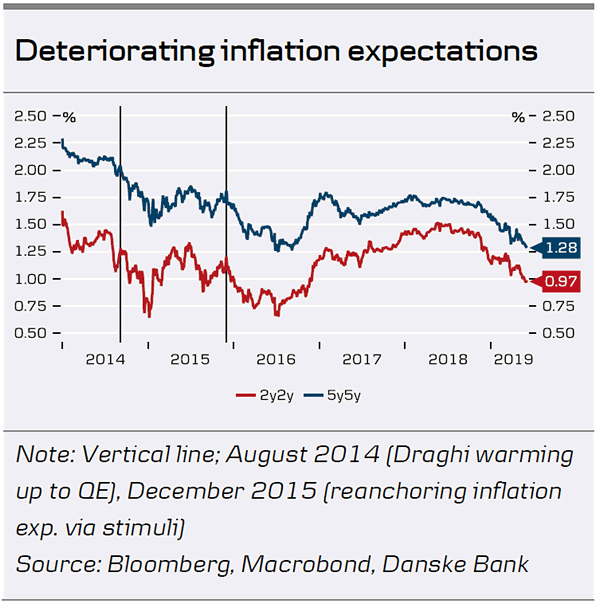
The 5Y5Y and 2Y2Y inflation swap is trading close to an all-time low. The ECB has previously stepped up its policy stimuli when inflation expectations were at much higher levels, which has led to the market speculating about the next stimuli measure. Most prominently, the 5Y5Y inflation expectation was just below 2% when Mario Draghi warmed up to QE in August 2014, which is well above the 1.28% at the time of writing – only 3bp above the all-time low. Recently, when 5Y5Y inflation was trading at these levels, the ECB bought EUR80bn per month as part of its APP.
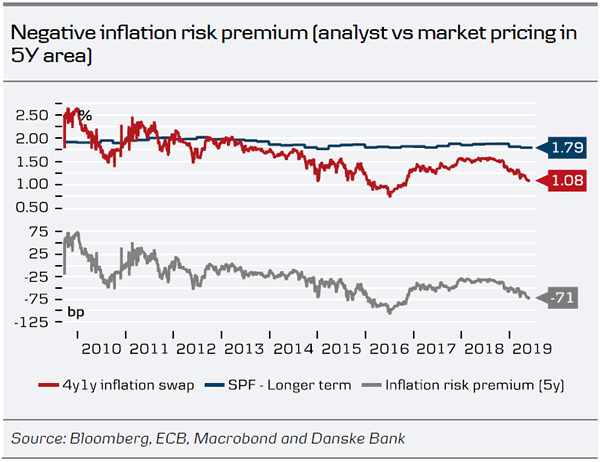
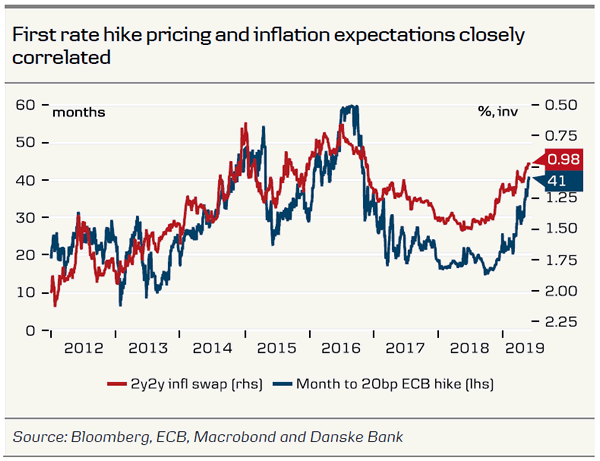
However, the ECB's gauge of inflation risk premium continues to decline (currently around 70bp in the 5Y area). We also note the historically rather strong correlation between the market pricing of the first rate hike and that the inflation swap continues despite the focus having been on rate cuts rather than on any tightening of policy stance.
WTI Oil: Bears Consolidating Before Clear Break Below Key Supports
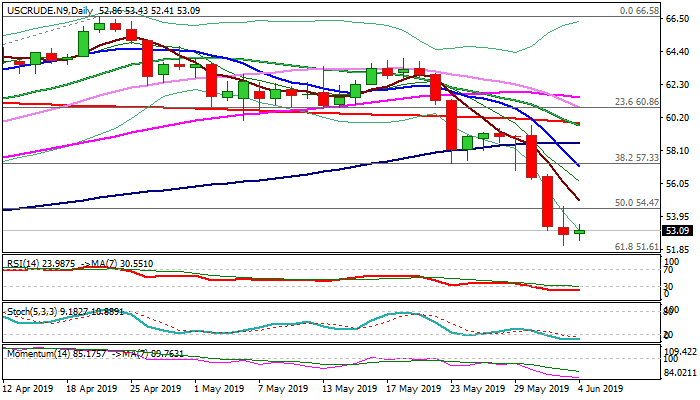
WTI oil consolidates within narrow range above new multi-month low at $52.10 on Tuesday but maintains negative tone.
Bears reduced pace after cracking 200WMA ($52.64) and approach to key Fibo support at $51.61 (61.8% of $42.36/$66.58), following fall of 15% in past two weeks, as deeply oversold daily studies warn of adjustment before bears resume.
Sentiment remains negative on rising worries that persisting trade conflict intensifies risk of global recession that could negatively affect demand for crude oil.
Downtrend from $66.58 (23 Apr high) maintains strong bearish momentum, but bears need confirmation on close below 200WMA and $51.61 Fibo support, to generate strong bearish signal and expose psychological $50 support.
Weekly crude inventories reports today and on Wednesday, are focused for fresh signals, however, repeated failure to close below 200WMA would signal extended consolidation.
Falling 5SMA offers initial resistance at $54.92 with extended upticks to be capped by falling 10SMA ($57.14) to keep bearish bias.
Res: 54.47; 54.92; 56.58; 57.17
Sup: 52.10; 51.61; 50.83; 50.00
Trump: It’s more likely tariffs on Mexico go on
Trump indicates at a news conference that he is likely to go ahead with tariffs on Mexico. And Mexico should "step up" to stop "invasion" to the US. At the same time he blamed Democrats for stalling Congress' efforts to address the situation at border.
He said "We're going to see if we can do something, but I think it's more likely that the tariffs go on... Mexico should step up and stop this onslaught, this invasion into our country."
Mexican Foreign Minister Marcelo Ebrard is "going to find common ground" with the US and hoped Wednesday's meeting in Washington could be a starting point for negotiations.
Fed Powell: Policymakers do not know how or when trade war will end
In the opening remarks at the "Conference on Monetary Policy Strategy, Tools, and Communications Practices", Fed Chair Jerome Powell said policy makers "do not know how or when" the issues on trade negotiations and other matters will be resolved. But they are closely monitoring the implications on economic outlook. And, Fed will "act as appropriate to sustain the expansion, with a strong labor market and inflation near our symmetric 2 percent objective."
For the rest of the remarks, Powell focus on the longer-run issues related to the public review on monetary policy strategy, tools and communications. Specifically, the review in focused on three questions:
- Can the Federal Reserve best meet its statutory objectives with its existing monetary policy strategy, or should it consider strategies that aim to reverse past misses of the inflation objective?
- Are the existing monetary policy tools adequate to achieve and maintain maximum employment and price stability, or should the toolkit be expanded?
- How can the FOMC's communication of its policy framework and implementation be improved?
Stocks Rise after China’s MOFCOM eases trade tensions
US stocks are off to a good start after positive comments from China’s Ministry of Commerce reiteration that the US-China trade dispute should be solved via dialogue and based upon mutual trust. Equities have been supported by some optimism on the trade front and growing expectations the Fed will come to the rescue and deliver a couple rate cuts this year. No material progress was made with trade talks, but not seeing additional fallout was good enough of a reason to provide a bid for risk appetite.
The focus in the Americas falls on Fed Chair Jerome Powell’s comments at the Fed conference on policy strategy. Powell will provide his first comments since the recent escalation in trade with both China and Mexico. Markets are currently pricing in only a 10% chance of a rate cut at the June 19th meeting and have the July 31st meeting as a coin flip.
- AUD – RBA cuts and says not unreasonable to expect another rate cut
- Oil – Crude weakness underpinned on trade uncertainty
- Gold – Slightly softer on easing of trade tensions
AUD
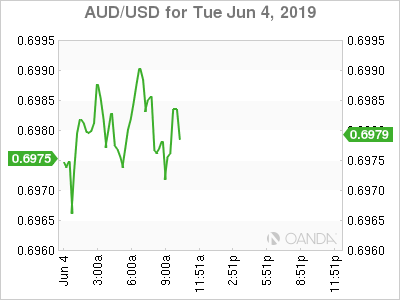
The Australia Central Bank (RBA) delivered the first rate cut since 2016 last night and Governor Lowe signaled he could cut again to drive down unemployment and drive inflation. Lowe noted that the recent escalation in global trade disputes provided the biggest risks to the economy. The RBA may need to take rates below 1%, but domestic outlook would have to look a lot worse. The RBA followed the RBNZ and now the focus will come to the Fed to see if they will succumb to rate cuts.
Oil
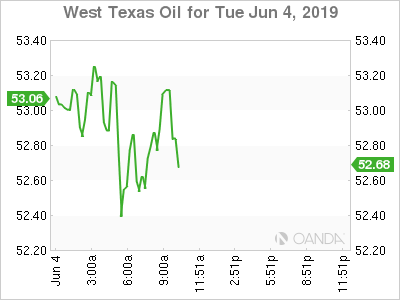
Crude prices remain under pressure falling global demand outweigh any optimism that OPEC + will deliver another round of production cuts at their next meeting. West Texas Intermediate crude is now in bear market territory and weakness could accelerate if OPEC and allies are unable to find an agreement on extending curbs.
Gold
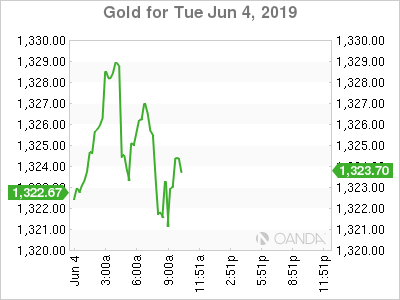
Gold prices are modestly down as trade tensions ease, but should remain fairly supported as a soft dollar bets increase as markets are now pricing in two 25 basis point Fed rate cuts by the end of the year.
Sunset Market Commentary
Markets
Core bonds trade again mixed today with US Treasuries underperforming German Bunds, thereby shrugging off overbought conditions. The weakness in the US Note future occurs after yesterday’s first failed test of 2.06% support in the US 10-yr yield. The move accelerated after the Chinese Commerce Ministry released a statement, arguing that the US-Sino trade dispute should be solved through dialogue, based on mutual respect and benefit. Dovish Chicago Fed governor Evans said that monetary policy and the US economy are in a good place right now, but he warned for weak inflation and uncertainty over the trade conflict. St.-Louis Fed Bullard yesterday was the first to openly call for a rate cut “soon”. Several Fed heavyweights speak later on at a Chicago Fed conference. Earlier on the day, the Bund didn’t react to a bigger than expected setback in EMU inflation (headline: 1.2% Y/Y; core 0.8% Y/Y) following the exceptional, Easter-related, rebound in April. The EMU unemployment rate reached a new cycle low at 7.6%. The US yield curve bear flattens with yields 8.2 bps (2-yr) to 5.2 bps (30-yr) higher. Changes on the German yield curve vary between -0.4 bps (2-yr) and -1.3 bps (30-yr). 10-yr yield spread changes vs Germany narrow up to 4 bps (Italy) with Greece underperforming (+7 bps).
The dollar lost substantial interest rate support yesterday on a mediocre US manufacturing ISM, ongoing risk-off sentiment due to lingering trade tensions and Fed’s Bullard plea for a Fed rate cut in a not-that-distant future. USD sentiment was still cautious this morning. EUR/USD filled offers in the 1.1277 area around the open of European equity markets. However, risk sentiment improved and core/US yields bottomed. EMU CPI dropped more than expected to 1.2% Y/Y, but the euro hardly reacted. Recent moves in EUR/USD were USD-driven rather than euro-inspired. A new downtick of the dollar in the run-up to the US session was blocked by comments of Fed’s Evans on the state of the US economy (see above). The Chinese Ministry of Commerce provided reconciliatory comments on the US-China trade talks. Risk sentiment improved further. US yields reversed part of yesterday’s decline and so did the dollar before losing again on Powell’s remarks. EUR/USD is trading in the 1.125 area. USD/JPY also rebounded (currently 108.10 area) but gains remain modest given the intraday rise in US yields and improved equity sentiment.
Sterling trading was still driven by technical considerations. Markets are now waiting on developments with respect to Brexit as the process to choose a new leader of the UK conservative party continues. Poor BRC retail sales and a strong start of EUR/USD pushed EUR/GBP for a test of the 0.89 big figure. However, sterling selling gradually slowed and the euro also couldn’t maintain its positive intraday momentum. A soft UK manufacturing PMI (48.6) didn’t affect intraday sterling trading in any profound way. EUR/GBP (0.8660 area) is currently trading off the intraday peak, but sentiment on the UK currency remains fragile.
News Headlines
EMU inflation decelerated slightly more than expected in May, printing at 1.2% YoY vs. 1.7% YoY in April as the Easter-related boost faded out. Core inflation slipped to 0.8% (vs. 1.3% last month). The EMU unemployment rate unexpectedly declined to 7.6% in April, the lowest since July 2008.
South Africa posted its worst growth figure since 2009. GDP contracted by a whopping -3.2% QoQ (0.0% YoY) during the first quarter of this year, twice as much as markets anticipated. The South African rand lost more than 2% (USD/ZAR near 14.71) as bets on a rate cut by the central bank increase.
During the Chicago Fed conference Fed chair Powell said the central bank is closely watching the impact of the trade developments, adding they will “act as appropriate” to sustain the expansion. The USD and US yields slipped.
USD/JPY Mid-Day Outlook
Daily Pivots: (S1) 107.82; (P) 108.14; (R1) 108.38; More...
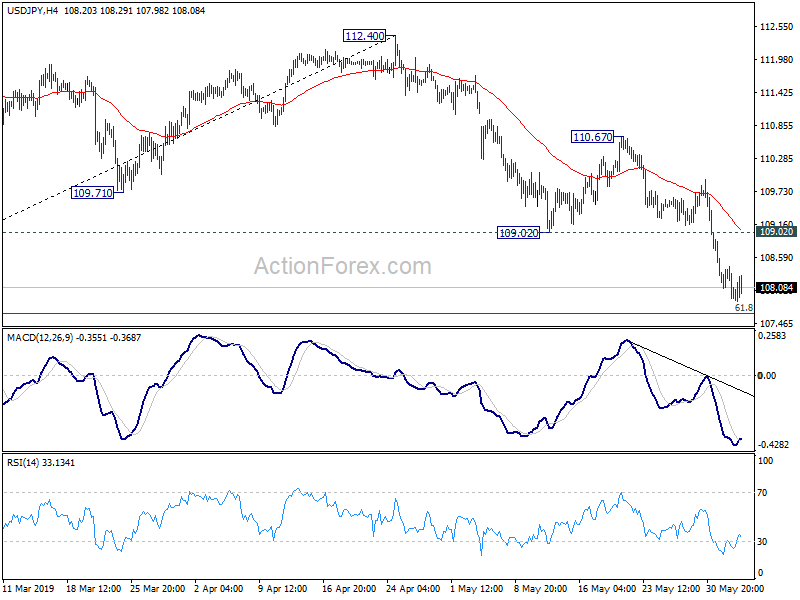
There is no clear sign of bottoming in USD/JPY yet. Intraday bias remains on the downside for 61.8% retracement of 104.69 to 112.40 at 107.63. Sustained break there will pave the way back to 104.62/9 key support zone. On the upside, break of 109.02 support turned resistance is needed to be the first sign of short term bottoming. Otherwise, outlook will remain bearish in case of recovery.
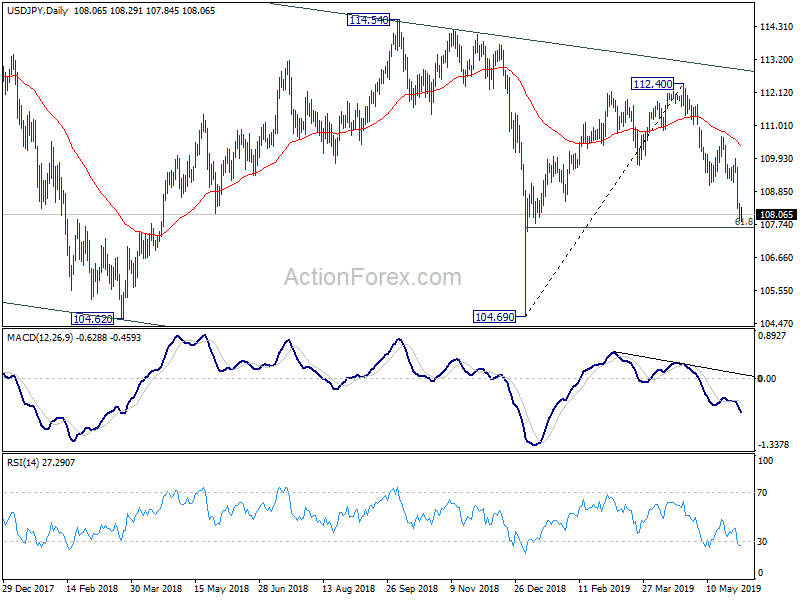
In the bigger picture, decline from 118.65 (Dec 2016) is still in progress, with the pair staying indicate long term falling channel. Break of 104.62 will target 100% projection of 118.65 to 104.62 from 114.54 at 100.51. For now, we'd expect strong support above 98.97 (2016 low) to contain downside to bring rebound.
USD/CHF Mid-Day Outlook
Daily Pivots: (S1) 0.9881; (P) 0.9953; (R1) 0.9996; More...
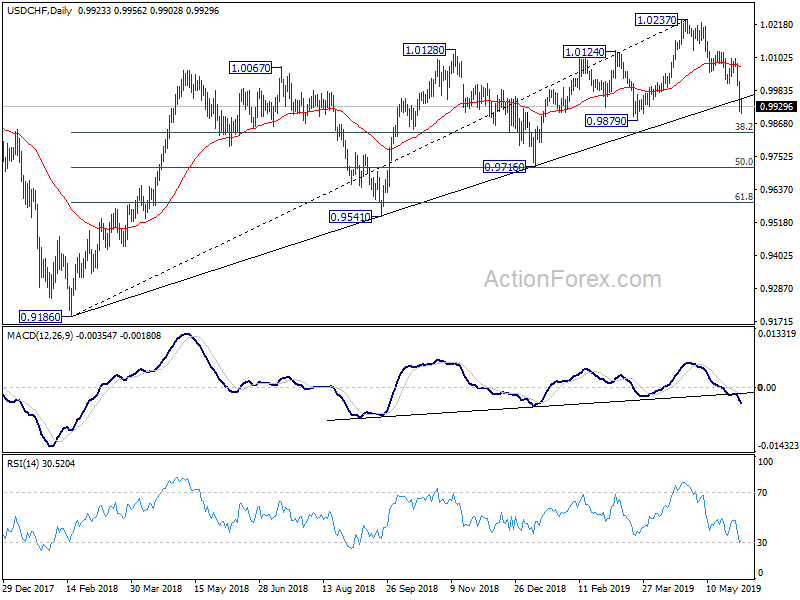
Intraday bias in USD/CHF remains on the downside for the moment. Current fall from 1.0237 is still in progress for 0.9879 key support. Decisive break there will carry larger bearish implications and target 0.9716 support next. On the upside, break of 1.0008 support turned resistance is needed to indicate short term bottoming. Otherwise, outlook will remain mildly bearish in case of recovery.
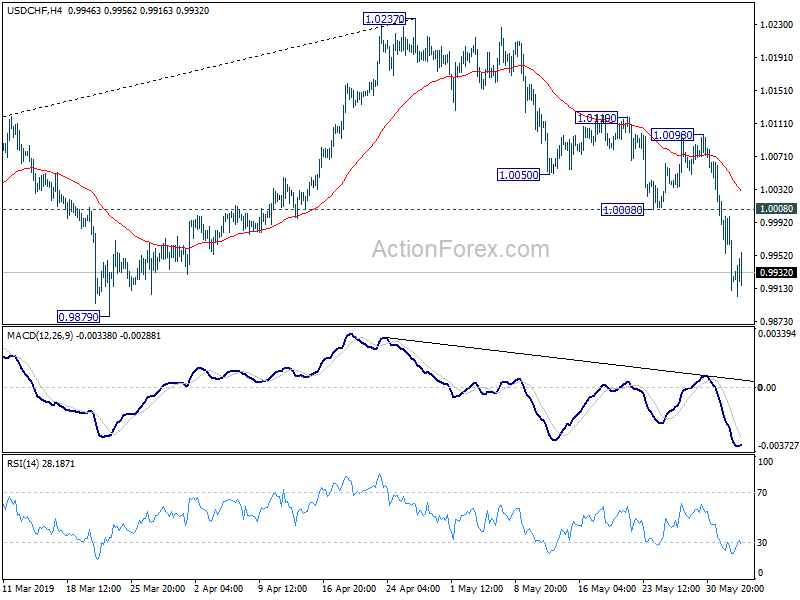
In the bigger picture, USD/CHF's break of long term trend line support is the first indication of medium term reversal. Focus is now back on 0.9879 support. Decisive break should add to the case that rise from 0.9186 has completed at 1.0237 already. Further fall should be seen to 0.9716 cluster support (50% retracement of 0.9186 to 1.0237 at 0.9712) next.