Sample Category Title
GBP/USD Breaks Resistance
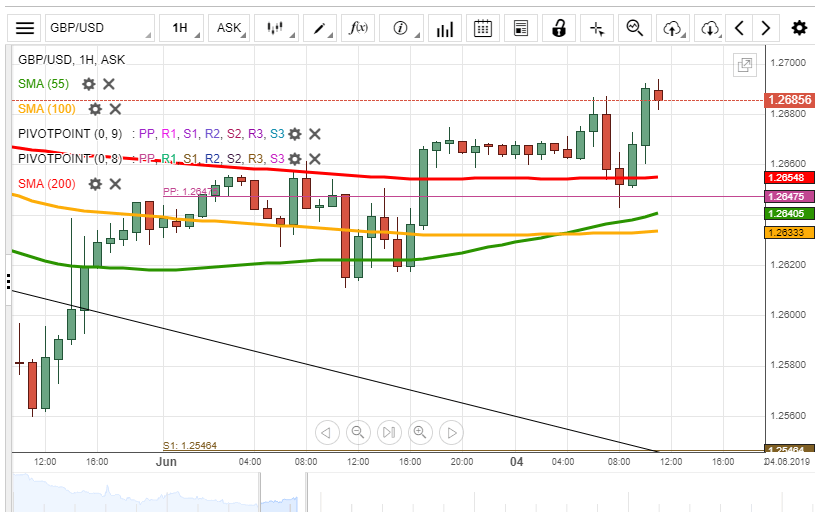
The GBP/USD has surged above the technical resistance cluster, which was located near 1.2650. Namely, a pivot point and the 200-hour simple moving average were broken.
Moreover, the rate declined on Tuesday morning and confirmed the technical levels as support levels.
By the middle of the day a surge began, which was expected to reach the R1 pivot point at 1.2735. Although, note that the move will most likely occur gradually not in a sharp surge up.
On the other hand, note that the 1.2700 level will provide psychological resistance to the pair and slow down the surge of the rate.
EUR/USD Jumps Above 1.1250
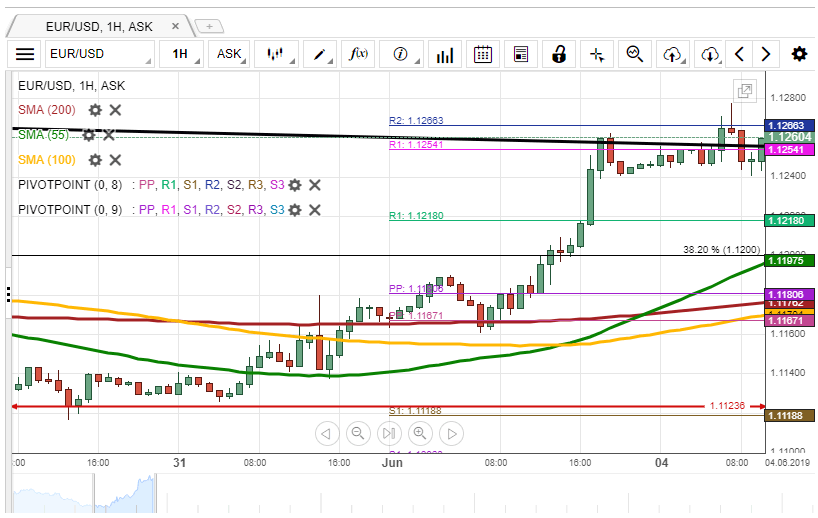
The EUR/USD has passed the resistance of a dominant descending pattern on the hourly candle chart. This occurred in a sharp surge, which began after the rate broke short term resistance.
Take into account that to properly observe the dominant pattern one needs to zoom out and load previous price info. In that way the reference points are set properly.
Meanwhile, from a fundamental perspective the surge was caused by rumors of an upcoming Federal Reserve rate cut.
In regards to the short term future, from technical theory perspective the rate could surge, if it passes the resistance of a pivot point at 1.1266.
On the other hand, after a sharp move like the one experienced on Monday, the rate should trade sideways or decline to consolidate its new price.
DAX Soars As Fed Regional President Calls For Rate Cut
The DAX has posted sharp gains in the Tuesday session. Currently, the index is at 11,909, up 0.99% on the day. In economic news, eurozone consumer inflation indicators disappointed. The estimate for annual inflation in May slowed to 1.2%, down from 1.7% in April. The core indicator also fell, dropping to 0.8%, after a reading of 1.2% in April. Both indicators missed their forecasts.
After a dismal month of May, the DAX has looked sharp in June, gaining 1.5% this week. Investors have flocked to the stock markets after James Bullard, president of the St. Louis Fed, said on Monday that the Federal Reserve should lower interest rates. Bullard argued that low inflation and the ongoing trade war with China were likely to result in an economic slowdown in the U.S. Bullard added that the current benchmark rate, which is at a range of 2.25% to 2.50%, is too high for current economic conditions, and recommended lowering rates in order to stabilize the economy. The dovish comments about lower rates have energized the blue-chip DAX index.
The week has started out with disappointing data in the eurozone. The estimate for consumer inflation slowed in May, a reflection of weaker economic activity in Germany as well as the rest of the eurozone. The downward slide continues for German and eurozone manufacturing PMIs, which have been mired in contraction territory for most of 2019. This is a result of ongoing trade tensions, which have reduced global demand for German and eurozone exports, and dampened the manufacturing sectors.
ECB To Hold Rates, Reveal Details Of TLTRO3 As Euro Edges Higher
The European Central Bank is due to announce its latest policy decision on Thursday at 11:45 GMT. No change in policy is being anticipated by the Bank but the meeting will still attract plenty of attention as details about the terms of the new round of cheap long-term loans are expected to be revealed. The Bank will also publish its latest macro-economic projections, which could provide clues as to what direction monetary policy is headed.
As ECB policymakers head for Lithuania for the Bank’s annual external meeting, speculation about the forthcoming Targeted Longer-Term Refinancing Operations (TLTROs) is dominating market talk. There are concerns that the third-round of this funding scheme for Eurozone banks won’t be as generous as the previous one that carried the same negative interest as the ECB deposit rate of -0.4%.
Should the ECB opt for tighter lending terms for TLTRO3, the program is likely to have less of an impact in boosting borrowing across the euro bloc, and hence, growth. It’s possible policymakers would be minded approving another generous lending scheme after the Eurozone economy grew by a solid 0.4% quarter-on-quarter in the first three months of the year.
The uptick in growth could also lead to a small upward revision to the Bank’s growth projection for 2019. Back in March, the ECB slashed its forecasts for 2019 and 2020 as the outlook dramatically turned gloomier. Although there’s still plenty of dark clouds hanging over the Eurozone, the resilience of domestic demand appears to be supporting growth for the time being.
But while there may be some positive surprises to the growth forecasts, the inflation projections may be more telling as there’s still no clear trend that underlying inflation is on the way up. The unexpected jump in both headline and underlying inflation in April was seen to be a temporary effect from the timing of Easter and the two measures fell back sharply in May in this week’s flash readings. A downward revision in the inflation forecasts would signal the ECB is not anticipating any pick-up during the forecast period.
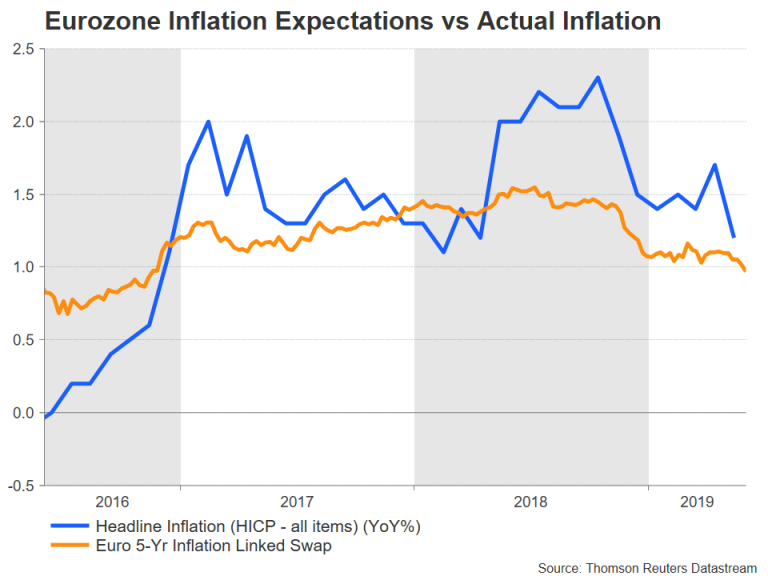
Some traders could interpret this as a sign the Bank is open to returning on an easing path in the coming months. At the last meeting, Governing Council members were worried about the recent decline in inflation expectations. The five-year market-based expectations of inflation continue to slide, hitting the lowest since September 2016. Should President Mario Draghi reiterate the Bank’s concern about this trend in his press conference, the euro is likely to face some downside moves.
It would also pile pressure on the ECB’s newly appointed chief economist, Philip Lane, to devise fresh policy options to put forward to the Governing Council to combat the muted inflation picture. However, whether the ECB chooses to make a bold move, such as follow in the footsteps of the US Federal Reserve by adopting a symmetrical 2% inflation target, will probably depend on who will replace Mario Draghi when his term expires at the end of October.
In the meantime, Draghi will likely be quizzed about his home country by reporters as there’s renewed risks of a major clash between Italy and the European Commission over fiscal discipline. While Draghi will probably do his best to evade getting into a political debate, Italy’s rising debt level is bound to be worrying ECB policymakers, as well as simmering trade tensions and the ongoing Brexit drama.
All of the above are factors that have driven the euro to two-year lows against the US dollar and the single currency could again be testing that low of $1.1106 on Thursday if Draghi strikes a downbeat tone over the outlook.
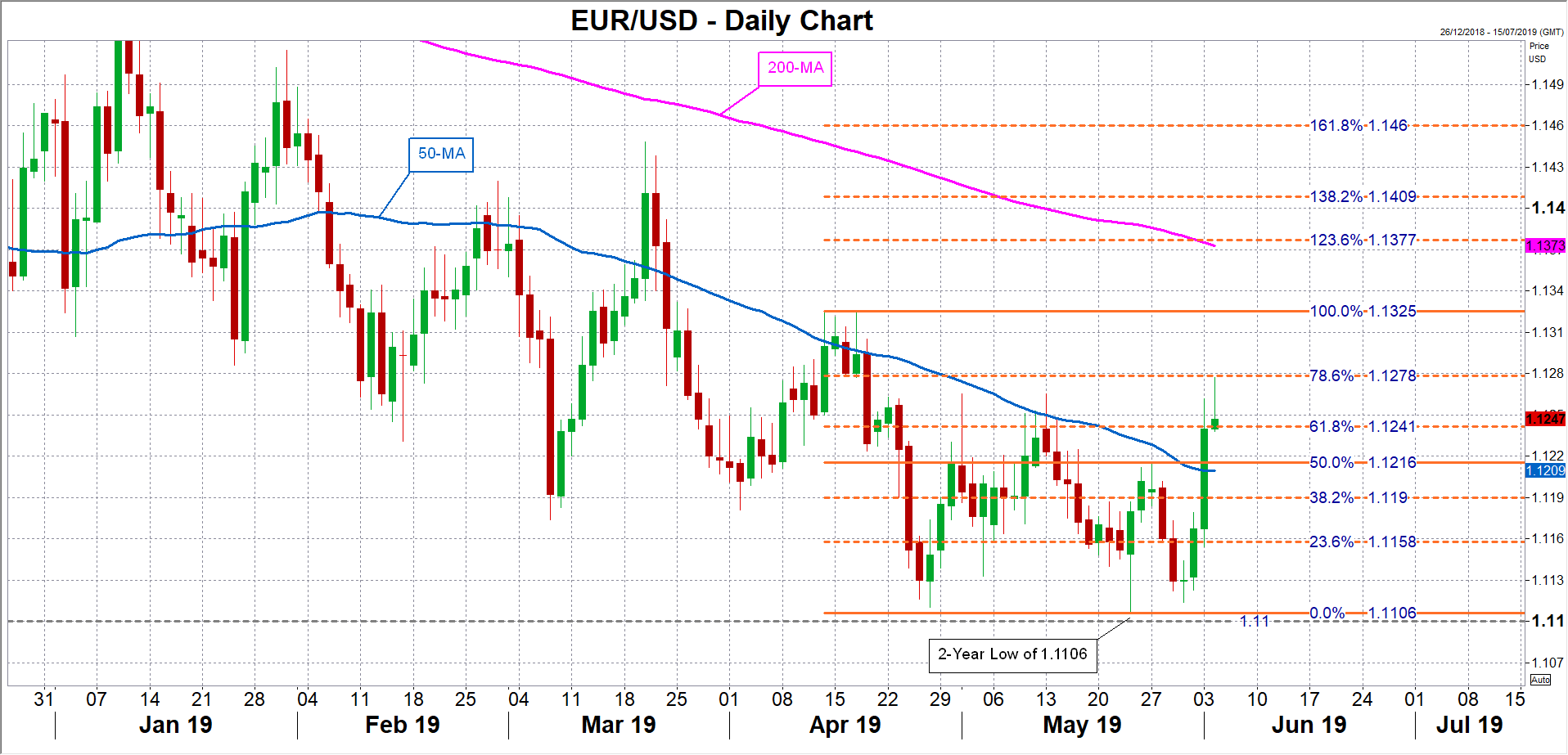
Traders shouldn’t rule out some upside for the euro, however, as it’s possible the ECB won’t significantly lower its economic forecasts, if at all, and Draghi will sound cautiously optimism about the growth outlook. If that happens, and the dollar remains on the backfoot, the euro could extend its three-day bounce and challenge immediate resistance at $1.1280 before aiming for the April top of $1.1325.
EURUSD Bullish Invalidation
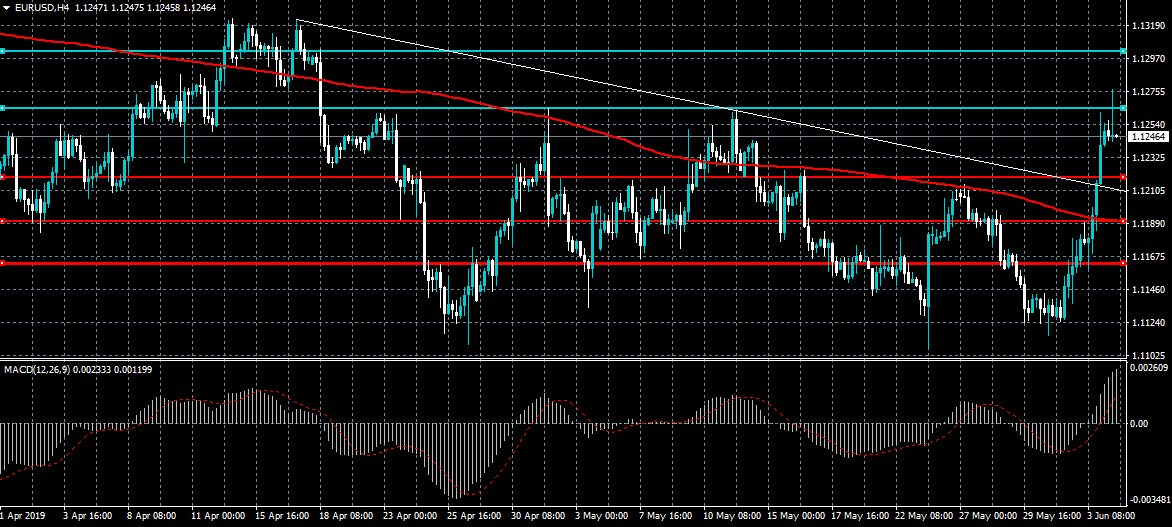
The euro has started to move lower against the US dollar after invalidating the bearish head and shoulders pattern on the four-hour time frame. EURUSD buyers need to move price above the 1.1265 level to regain the recent bullish short-term momentum. Sellers need to move price below the 1.1216 level to change the current intraday sentiment towards the EURUSD pair.
The EURUSD pair is only bullish while trading above the 1.1216 level, key technical resistance is found at the 1.1277 and 1.1300 levels.
If the EURUSD pair trades below 1.1216 level, key technical support is found at the 1.1190 and 1.1165 levels.
GBPUSD Bearish Reversal
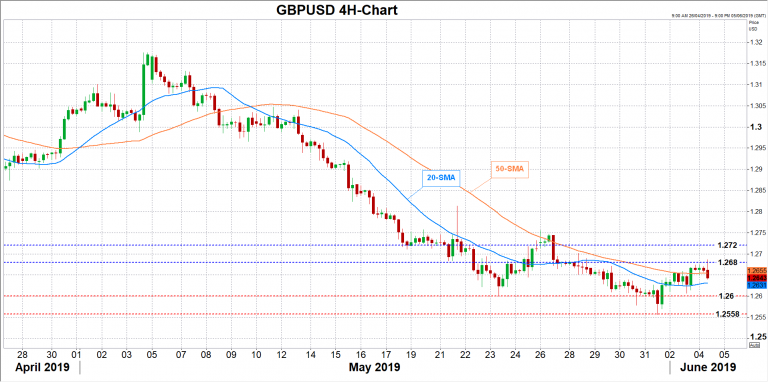
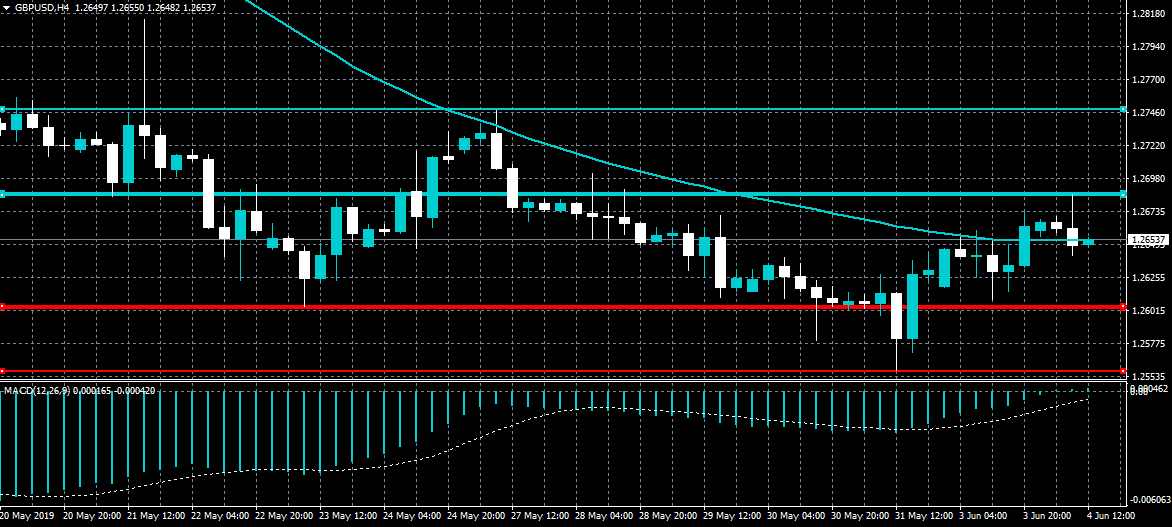
The British pound has reversed sharply from the 1.2687 level against the US dollar after yet more weak economic data from the United States economy. The move higher in the GBPUSD pair has also helped to complete the bearish head and shoulders pattern on the four-hour time frame. Overall, sellers need to move price back under the 1.2600 level to trigger the bearish pattern.
The GBPUSD pair is bearish while trading below the 1.2655 level, key support is located at the 1.2600 and 1.2550 levels.
If the GBPUSD pair holds trades the 1.2655 level, key intraday resistance is found at the 1.2687 and 1.2747 levels.
European Update – Central Banks Offer Reprieve
Central banks provide reprieve for stock markets
Stock markets are rebounding again on Tuesday, an encouraging sign at a time when sentiment has appeared to have been significantly harmed by tariffs
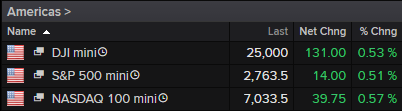
Perhaps we have central banks to thank for the bounce over the last couple of days, with the RBA cutting interest rates to record lows – in line with expectations – overnight and a Fed official suggesting a cut may be warranted soon. James Bullard is one of the most dovish members of the Federal Reserve, so his comments should perhaps not come as too great a surprise, but he is a voter this year so maybe carry a little more weight.
It may just also be an overreaction at a time when the market seemed to only be headed in one direction. At times, it seems traders are looking for any reason to take a little profit off the table and maybe this is the reason to do so. The important thing though is that we have seen a clear shift from the Fed over the course of this year and talk of a rate cut is in line with what markets were already factoring in.
While the risks are building and sentiment becoming increasingly fragile, I still feel the markets are getting a little ahead of themselves. Markets are now pricing in more than an 80% chance of two rate cuts this year and have a third as a coin toss. That strikes me as being quite extreme even given expectations for the economy for the rest of the year and risks that exist. Could be a rough few months if markets are correct.
Euro Area Inflation Remains Subdued, China Issues A Travel Alert To US
Notes/Observations
- Risk aversion sentiment continues to simmer as traders nervously take note of the escalation of the global trade conflict
- Euro Zone May Advance inflation data misses expectations ahead of ECB’s rate decision on Thursday
- Euro Zone Apr Unemployment Rate posts a fresh 10-year low at 7.6%
- RBA resumes its easing cycle after a nearly 3-year pause
Asia:
- RBA cut the Cash Rate Target by 25bps to 1.25% (as expected) to resume its easing cycle after a 2 ½ year pause
- Australia Apr Retail Sales registered its 1st decline since Dec (MoM: -0.1% v +0.2%e
- Australia Q1 Current Account registered its smallest deficit since 1996 (-A$2.9B v -A2.9Be)
- China govt affirmed support for full implementation of the JCPOA Iran nuclear agreement
Europe/Mideast:
- Italy PM Conte confirmed that he would offer his resignation if the coalition parties did not cooperate. Could not be certain of how long government would last as its future did not depend entirely on him
- Italy Dep PM Salvini (League): League party wants govt to press ahead
Americas:
- Fed Bullard (dove, voter) stated that rate cuts may be warranted soon to lift inflation (Note: 1st such Fed member to comment on a rate cut). Low unemployment was no reason for Fed policy to stand pat. Trade dispute might have larger impact on global markets. US economy was facing mounting risks to outlook
- GOP lawmakers said to discuss vote to block Trump's new tariffs on Mexico as some Republican opposition said to occur to the tariffs that Trump proposed for Mexico. Unclear if the vote would receive a veto-proof majority.
- Mexico Econ Min Marquez stated that the govt could take several paths if the US went ahead with the tariffs. Mexico could ask for help from WTO, but added that was a slow route or country could implement its own tariffs on US goods
SPEAKERS/FIXED INCOME/FX/COMMODITIES/ERRATUM
Equities
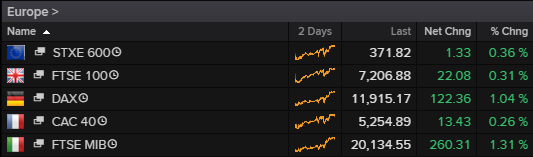
- Indices [Stoxx600 +0.30% at 371.30, FTSE +0.24% at 7,201.81, DAX +0.86% at 11,893.15, CAC-40 +0.15% at 5,251.76, IBEX-35 +0.66% at 9,081.04, FTSE MIB +1.14% at 20,100.50, SMI +1.58% at 9,617.50, S&P 500 Futures +0.47%]
Market Focal Points/Key Themes:
- European Indices trade mostly higher across the board following a weaker session in Asia and higher US futures this morning. Yields continue to be near all time lows for the German Bund as trade tensions continue.
- On the corporate front shares of Prosafe gains following a merger with Floatel International; Julius Baer also gains after Singapore's GIC disclosed a 3.1% stake.
- On the earnings front VP plc gains after profits and Rev came ahead of consensus, while Aryzta declines almost 10% cut its full year EBITDA outlook. Gooch & Housego also declines on earnings and the steeping down of its COO, while Bang & Olufsen declines almost 20% after lowering its full year outlook on weaker European Sales.
- In other news, Hargeaves Landsdown falls following the suspension of Woodford Equity Income Fund, with TCS Group declines after the company announced it aims to complete its $300M capital raise.
- Looking ahead notable earners include Tiffany & Co, Cracker Barrel and Donaldson among others.
Equities
- Consumer discretionary: AO World [AO.UK] -5.5% (earnings), Bang & Olufsen [BO.DK] -18% (outlook cut), Aryzta [ARYN.CH] -8% (earnings; outlook cut), Scout24 [G24.DE] % (names CFO)
- Consumer staples: Greenyard [GREEN.BE] +3% (earnings)
- Energy: Prosafe [PRS.NO] +12% (merger)
- Financials: VP plc [VP.UK] +7% (earnings)
- Healthcare: Camurus [CAMX.SE] +4.5% (study results), Tissue Regenix Group [TRX.UK] +10.5% (credit facilities)
- Industrials: Porsche [PAH3.DE] +2%, Fiat Chrysler [FCA.IT] +2.5% (car sales)
- Technology: Gooch & Housego [GHH.UK] -22% (earnings)
Speakers
- ECB's Villeroy (France): Europe faced grate economic uncertainties with rising trade tensions being the biggest threat to growth
- Renewed speculation that EU Commission might propose beginning procedure on Italy as soon as Wed, Jun 5th
- Italy Dep PM Salvini (League) reiterated stance that he had no intention of making the govt to collapse; wanted govt to accelerate its action. Renegotiating EU rules was in the interest of all member States
- Italy Dep PM Di Maio (5-Star): Ready to back 'flat tax' and devolution measures under certain conditions
- UK Trade Min Fox: Looking to back Jeremy Hunt for the upcoming conservative leadership race
- Germany BDI Industry Association Kempf: German 2019 GDP growth seen around 1.0%with nominal export growth of 3%
- Turkey President Erdogan stated that govt would not step back from purchasing the S-400 from Russia. Claimed that the US patriot missile was not as good as Russia's S-400
- China Foreign Ministry issued a travel alert to US which would be effective until end of 2019. Govt cited shootings, robbery, theft for the travel alert
- China Foreign Ministry spokesperson Geng Shuang urged U.S. to read China white paper on Trade War, stop making laughing stock of itself
- President Trump reiterated that was going to have a 'very substantial' US, UK trade deal
Currencies/ Fixed Income
- USD remained on the defensive after comments from the Fed’s Bullard spoke openly about a potential rate cut on Tuesday. Bullard stated that an interest rate cut might be warranted soon due to trade and inflation risks. The USD index futures were trading lower but bouncing off the level in the 96.90 region (a level set earlier last month). US 10 year trade higher off the back of the comments with the futures making a new high for the year.
- EUR/USD benefited from the greenback's weakness as it broke the 1.12 handle and continued to trade higher. Dealers noted that the pair might embark to a new range if the Euro could hold this level for the next few days. No real distinct moves from the Bund futures as it continue its contract role. Price asction was subdued following mixed Euro Zone data (CPI miss and better Unemployment Rate for the region).
- GBP/USD: The cable was less effected by the USD move as it remained in its 1.26 to 1.27 range even though we saw a weaker construction and manufacturing PMI both setting into contraction range. We will be looking to see what happens during the services PMI tomorrow.
Economic Data
- (FR) France Apr YTD Budget Balance: -€67.2B v -€40.7B prior
- (CZ) Czech Q1 Average Real Monthly Wage Y/Y: 4.6% v 4.0%e
- (ES) Spain May Net Unemployment M/M: -67.2K v -74.5Ke
- (SE) Sweden Q1 Current Account Balance (SEK): 62.7B v 29.0B prior
- (SE) Sweden Apr Private Sector Production M/M: 0.6% v 0.0%e; Y/Y: 4.2% v 1.1% prior
- (SE) Sweden Apr Industrial Orders M/M: +9.1% v -5.2% prior; Y/Y: +0.1% v -7.1% prior
- (SE) Sweden Apr Industry Production Value Y/Y: +3.3% v -1.3% prior; Service Production Value Y/Y: 3.5% v 2.4% prior
- (IT) Italy Apr Preliminary Unemployment Rate: 10.2% v 10.3%e
- (PL) Poland May Preliminary CPI M/M: 0.2% v 0.3%e; Y/Y: 2.3% v 2.4%e
- (BR) Brazil May FIPE CPI (Sao Paulo) M/M: 0.0% v 0.1%e
- (UK) May Construction PMI: 48.6 v 50.6e (moved back into contraction and weakest reading since Mar 2018)
- (EU) Euro Zone May Advance CPI Estimate Y/Y: 1.2% v 1.3%e; CPI Core Y/Y: 0.8% v 0.9%e
- (EU) Euro Zone Apr Unemployment Rate: 7.6% v 7.7%e (lowest level since 2008)
- (GR) Greece Q1 Final GDP Q/Q: +0.2% v 0.2e; Y/Y: 1.3% v 1.6% prior; GDP NSA (unadj) Y/Y: 0.9% v 1.6% prior
- (BE) Belgium Apr Unemployment Rate: 5.7% v 5.7% prior
Fixed Income Issuance
- (IN) India sold total INR200B vs. INR200B indicated in 3-month, 6-month and 12-month bills
- (DK) Denmark sold total DKK2.825B in 2022 and 2029 DGB Bonds
- (AT) Austria Debt Agency (AFFA) sold total €1.38B vs. €1.38B indicated in 2029 and 2034 bonds
Looking Ahead
- 05:30 (ZA) South Africa Q1 GDP Annualized Q/Q: -1.6%e v +1.4% prior; Y/Y: 0.7%e v 1.1% prior
- 05:30 (UK) Weekly John Lewis LFL Sales data
- 05:30 (AU) RBA Gov Lowe
- 05:30 (EU) ECB allotment in 7-Day Main Refinancing Tender (MRO)
- 05:30 (HU) Hungary Debt Agency (AKK) to sell in 3-month Bills
- 05:30 (DE) Germany to sell I/L 0.5% Apr 2030 bonds (Bundei)
- 05:30 (UK) DMO to sell £3.0B in 1.00% May 2024 Gilts
- 05:30 (BE) Belgium Debt Agency (BDA) to sell 3-month bills
- 06:30 (EU) ESM to sell €2.0B in 3-month bills
- 06:45 (US) Daily Libor Fixing
- 07:45 (US) Weekly Chain Stores Sales data
- 08:00 (BR) Brazil Apr Industrial Production M/M: +0.7%e v -1.3% prior; Y/Y: -2.6%e v -6.1% prior
- 08:00 (UK) Daily Baltic Dry Bulk Index
- 08:00 (RU) Russia announces upcoming OFZ Bond issuance
- 08:30 (US) Fed's Williams at Conference on Reforming Bank Culture
- 08:55 (US) Weekly Redbook LFL Sales data
- 09:00 (MX) Mexico May Consumer Confidence Index: No est v 110.9 prior
- 09:00 (MX) Mexico Apr Leading Indicators M/M: No est v 0.05 prior
- 09:00 (MX) Mexico May Vehicle Domestic Sales: No est v 98.1K prior
- 09:00 (EU) Weekly ECB Forex Reserve data
- 09:45 (US) Fed Chair Powell gives welcoming remarks at Fed Framework Conference
- 10:00 (US) Apr Factory Orders: -1.0%e v +1.9% prior; Factory Orders (Ex-transportation): No est v 0.7% prior (revised from 0.8%)
- 10:00 (US) Apr Final Durable Goods Orders: No est v -2.1% prelim; Durables Ex Transportation: No est v 0.0% prelim; Capital Goods Orders (Non-defense/ex-aircraft): No est v -0.9% prelim; Capital Goods Shipments (Non-defense/ex-aircraft): No est v 0.0% prelim
- 10:00 (MX) Mexico Weekly International Reserves
- 11:00 (DK) Denmark May Foreign Reserves (DKK): No est v 452.9B prior
- 11:00 (CO) Colombia Apr Exports: $3.5Be v $3.3B prior
- 16:30 (US0 Weekly API Oil Inventories
EUR/USD – Euro Rally Hits 6-Week High As Fed’s Bullard Says Rate Cut Needed
EUR/USD continues to gain ground, after starting the week with strong gains. Currently, the pair is trading at 1.1249, up 0.06% on the day. Earlier in the day, the pair touched a high of 1.1277, its highest level since mid-April. On the release front, eurozone consumer inflation indicators disappointed. The estimate for annual inflation in May slowed to 1.2%, down from 1.7% in April. The core indicator also fell, dropping to 0.8%, after a reading of 1.2% in April. Both indicators missed their forecasts. There are no major events out of the U.S. On Wednesday, the eurozone releases retail sales, while the U.S. posts ADP nonfarm payrolls and ISM Non-Manufacturing PMI.
The week has started out with disappointing data in the eurozone. The estimate for consumer inflation slowed in May, a reflection of weaker economic activity in Germany as well as the rest of the eurozone. The downward slide continues for German and eurozone manufacturing PMIs, which have been mired in contraction territory for most of 2019. This is a result of ongoing trade tensions, which have reduced global demand for German and eurozone exports, and dampened the manufacturing sectors.
Despite soft eurozone data this week, the euro has gained ground, courtesy of FOMC member James Bullard. The president of the St. Louis Fed was blunt and pessimistic, saying that the Fed might have to lower rates shortly due to low inflation and the ongoing trade war with China. Bullard warned that the Fed may have to deal with “an economy that is expected to grow more slowly going forward, with some risk that the slowdown could be sharper than expected due to ongoing global trade regime uncertainty“. Bullard added that the current benchmark rate, which is at a range of 2.25% to 2.50%, is too high for current economic conditions, and recommended lowering rates in order to stabilize the economy. The dovish comments about lower rates helped boost the euro on Monday.
UK Services PMI Could Dampen Pound Volatility
The past four weeks have been the hardest so far this year for the British pound but also for UK manufacturers, the IHS Markit/CIPS readings showed on Monday. According to analysts, the survey for the services sector might bring better results on Wednesday at 0830 GMT. Still, the outcome may not be very pleasing, reflecting the disruptions from the Brexit paralysis.
In the first quarter of 2019, the British economy expanded at the fastest rate in more than a year as businesses rushed to build supplies of components and finished goods to avoid any supply disruption after the original March 29 Brexit deadline. Theresa May, however, could not pass her withdrawal plan through the parliament on time and with lawmakers struggling to find common ground, the EU and the UK have mutually agreed to postpone the exit date to October 31. Conditions got even more complicated after her Conservatives forced her to step down as the country's leader on June 7, making unclear of when, how and even if Brexit will happen.
With Brexit uncertainty entering a new era, markets were not much surprised to see the manufacturing PMI for the month of May unexpectedly falling into the contraction territory on Monday, something evident from the low volatility in the pound at the time of the release. The survey on construction activity also displayed a shrinking sector, endorsing the rising risk aversion among businesses.
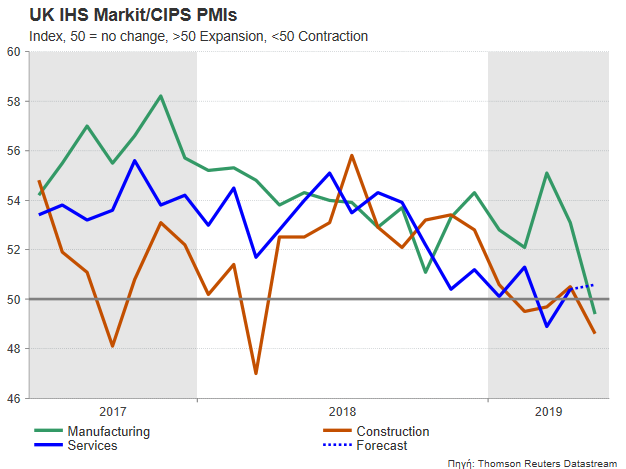
Wednesday's Services PMI, though, could be key for investors as the sector accounts for 80% of the economy compared to manufacturing's 15% and construction's 5%. Expectations are for the measure to inch up to 50.6 from 50.4 in April and above the three-year low of 48.9 registered in March. Anyhow, as long as the measure holds close to the crucial 50 threshold that separates expansion from contraction, fears of a slowdown always remain.
Elevated wages and a smaller unemployment rate may have kept the measure marginally within the positive growth area. But since risks for a no deal Brexit are currently heating up and factories have already started to cut jobs for the second month in May, questions are rising about whether the recovery in the services sector could continue in coming months.
Another miss in the data could be a bad omen for the country's Q2 growth outlook and a warning that expansion may weaken more than the Bank of England forecasted at its previous meeting, as the BoE Debuty governor David Ramsden also claimed on Saturday. GBPUSD may retest the 1.26-1.2560 region in the wake of a disappointing Services PMI reading, while a positive surprise could push the price back above the 50-period simple moving average (1.2655) and towards the 1.2720 barrier.
Nevertheless, politics and particularly the Brexit strategy of the new Tory leader, who will take up the position after the summer break, will determine the direction of the pound for the remainder of the year. Should the new Prime Minister hold a harsh stance against the divorce terms agreed with the EU, the UK could leave the bloc without a deal, pushing the pound sharply to the downside and closer to the 1.20 mark versus the dollar.