Sample Category Title
The US Dollar Is Still Under Pressure
The US dollar has reached three-week lows against the basket of major currencies. The dollar index (#DX) closed in the negative zone (-0.06%). Yesterday, Fed Chairman Jerome Powell said that the regulator closely followed the US trade disputes with other countries, and was ready to take appropriate measures to stimulate economic growth in order to maintain a strong labor market and inflation around a target of 2%. Investors took his speech as a signal that the Fed was ready to consider an issue of lowering interest rates, if necessary.
Yesterday, weak economic reports were published in the UK and the Eurozone. Thus, the UK construction PMI fell to 48.6 in May, while experts expected 50.5. Eurozone inflation slowed down to 1.2% in May, although experts forecasted an increase by 1.3%. Today, during the Asian trading session weak data on Australian GDP have been published: the figure has risen in the first quarter only by 0.4% instead of the expected growth by 0.5%.
The "black gold" prices are consolidating. At the moment, futures for the WTI crude oil are testing $52.95 per barrel. At 17:30 (GMT+3:00), a report on the US crude oil inventories will be published.
Market Indicators
- Yesterday, aggressive purchases were observed in the US stock market: #SPY (+ 2.17%), #DIA (+ 2.07%), #QQQ (+ 2.82%).
- The 10-year US government bonds yield is recovering. At the moment, the indicator is at the level of 2.12-2.13%.
The news feed on 2019.06.05:
- UK services PMI at 11:30 (GMT+3:00);
- ADP nonfarm employment change at 15:15 (GMT+3:00);
- ISM non-manufacturing PMI in the US at 17:00 (GMT+3:00);
- Fed's Beige Book at 21:00 (GMT+3:00).
Is The USD About To Roll Over? Gold Up, Oil Down
Wednesday June 5: Five things the markets are talking about
Global stocks have surged overnight, rebounding sharply from their recent declines after Fed Chair Powell hinted that the central bank could lower interest rates if the economy slows in response to escalating tariffs and economic uncertainty. U.S Treasuries have again advanced, while the ‘big dollar is trading steady after four session of declines.
In commodities, oil is under renewed pressure along with MXN after Twitter Trump tweeted that the U.S is not bluffing on its tariff proposal that is due to take effect next week. However, Mexico’s president has indicated that he hopes to reach a deal before the deadline.
Elsewhere, the World Bank lowered its outlook for global growth, noting that “international trade and investment flows dropped faster than expected in the first six-months of the year, curtailing economic activity.”
Note: Global economic growth is on track to be the weakest since 2016, while trade growth is set to be the weakest since the financial crisis in 2008. The world economy is to expand at a +2.6% pace this year and below its 2.9% forecast made in January.
On tap: ECB monetary policy statement & press conference, CAD trade balance & CNY Bank Holiday (Jun 6), CAD & U.S employment data (Jun 7).
1. Stocks get the thumbs up
In Japan, the Nikkei rebounded sharply overnight, following yesterday’s rally in U.S equities after Fed Chair Powell signalled a possible rate cut. The Nikkei share average ended +1.8% higher, posting the biggest daily percentage gain since March 26. The broader Topix jumped +2.1%.
Down-under, Aussie shares finished higher overnight, in line with the rally in global stocks after ‘dovish’ Fed comments. Australia’s S&P/ASX 200 index rose +0.4%, in its second session of gains. Stocks also rose on Tuesday after the Reserve Bank of Australia (RBA) lowered its cash rate to a record low (+1.25%) to revive the country’s slowing economy. In S. Korea, the Kospi added +0.1%.
In China, the main indexes ended close to flat overnight as Beijing’s plans to conduct accounting checks pushed healthcare firms lower. At the close, the Shanghai Composite index was down -0.03%, while the blue-chip CSI300 index was down -0.04%.
In contrast, Hong Kong Shares ended higher overnight as comments from the U.S Fed raised investor hopes for an interest rate cut this year. At the close of trade, the Hang Seng index was up +0.5%, while the Hang Seng China Enterprises index rose +0.04%.
In Europe, regional bourses trade higher, tracking gains across Asia and in U.S futures after steep gains yesterday following a slightly more ‘dovish’ Fed.
U.S stocks are set to open higher (+0.28%).
Indices: Stoxx600 +0.17% at 373.54, FTSE +0.23% at 7,230.58, DAX +0.18% at 11,993.16, CAC-40 +0.23% at 7,230.58, IBEX-35 +0.22% at 9,137.44, FTSE MIB -0.33% at 20,163.50, SMI +0.44% at 9,639.80, S&P 500 Futures +0.28%
2. Oil prices fall on U.S stocks rise and Russia comments
Oil prices remain under pressure, dragged down by an unexpected gain in U.S inventories and comments from the head of Russian state oil producer Rosneft questioning the point of a deal with OPEC to withhold supplies.
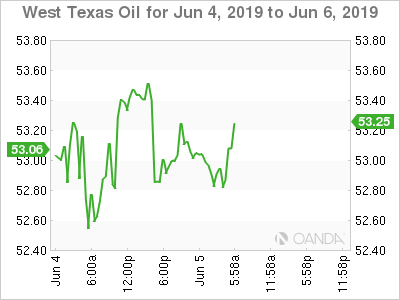
Brent futures are down -42c, or -0.7%, at +$61.55 a barrel. They rose +1.1% yesterday after a near -13% fall in the previous four-sessions. U.S West Texas Intermediate (WTI) crude is down by -48c, or -0.9%, at +$53 a barrel. The U.S benchmark closed +0.4% higher yesterday.
Oil prices have been under pressure from investor fears about slowing global demand. However, yesterday’s rally was helped by a global stock market rally on hopes of a cut in U.S interest rates.
Nevertheless, providing new pressure is U.S crude stock numbers which rose unexpectedly last week. According to API data released yesterday, crude inventories rose by +3.5M barrels in the week to May 31 to +478M, compared with expectations for a decrease of -849K barrels.
Expect investors to take direction from today’s official numbers from the U.S Energy Information Administration (EIA) – the report is released at 10:30 am ET.
OPEC+ continues to give assurances that they would continue to manage global crude supplies to avoid a surplus.
Note: OPEC+ will decide later this month or in early July whether to continue the supply curbs.
However, underlining concerns about oversupply, the head of Russia oil giant Rosneft said Russia “should pump at will” and he would “seek compensation from the government if cuts were extended.”
Ahead of the U.S open, gold prices have rallied to a three-month high after the latest comments from Fed officials lifted expectations of a cut in interest rate, pushing the dollar to a multi-week low. Spot gold jumped +0.7% to +$1,333.90 per ounce, while U.S gold futures have climbed +0.8% to +$1,339.60 an ounce.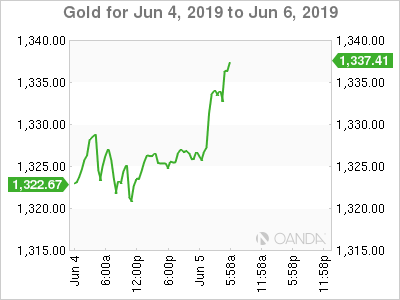
3. Sovereign yields ease again
Four weeks ago, market consensus believed the Fed would hold rates steady for the rest of this year. However, that was before President Trump decided to take a hard-line stance on his trade policies with both China and Mexico. Ten-days ago, U.S fixed income dealers were pricing in one-rate cut in 2019. But now, in the past seven-days, money market dealers pricing of rate cuts has got a tad more aggressive, futures prices are now implying two-to-three -25 bps rate cuts by the end of this year.
The yield on U.S 10-year Treasuries eased -1 bps to +2.12%. In Germany’s the 10-year Bund yield declined -1 bps to -0.21%, the lowest on record. In the U.K, the 10-year Gilt yield decreased -2 bps to +0.884%, while in Japan, the 10-year JGB yield declined -2 bps to -0.123%, the lowest in almost three-years on the largest decrease in almost 10-weeks.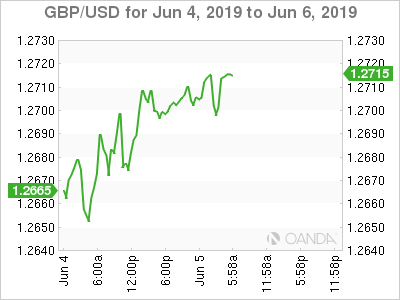
4. Pound rises as UK services sector activity picks up
The ‘big’ dollar continues to struggle, trading atop of its two-month lows on rising expectations of a U.S Fed interest rate cut in response to trade conflict-related risks. With the Fed possibly rethinking their current strategy, has investors gravitating towards safe-haven assets like the EUR (€1.1284) and the Japanese yen (¥108.24).
The pound (£1.2729) has rallied to a nine-day high after the U.K services purchasing managers’ survey rose to 51.0 in May, up from 50.4 in April, and above market expectations of 50.5. There was a “greater intakes of new work and a slight improvement in underlying business conditions since the start of spring,” said IHS Markit. However, “there were again widespread reports that Brexit uncertainty had held back client demand and remained a headwind to growth.”
The EUR continues to hold its ground outright despite the focus for the ‘single’ unit continues to be the Italian government and their tensions with the EU. According to techies, the next levels to the upside will be in the €1.1320 area, a level set as the high in May. However, market focus remains on tomorrow’s ECB’s meeting, but many believe the event to be likely to be more an important driver for Italian government bonds (BTP’s) than the EUR.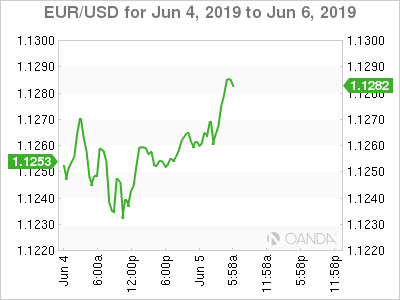
5. Eurozone private sector growth remains subdued during May
Data this morning from Europe for the month of May saw the continued expansion of the euro area private sector.
After accounting for seasonal factors, the IHS Markit Eurozone PMI Composite Output Index rose to 51.8 in May, up from April’s 51.5 and slightly better than the earlier flash reading (51.6).
Note: The latest reading was the highest for three-months and extends the current period of continuous growth to just under six-years.
Digging deeper, it was the service sector that provided the impetus to overall growth during May, expanding at a solid pace. In contrast, manufacturing output fell for a fourth successive month.
Germany saw growth improve to a three-month high and, despite recording its weakest expansion for five-and-a-half years, Spain continued to expand solidly. In France, output increased modestly, but Italy remained just inside contraction territory for a second successive month.
Note: With activity increasing solidly, firms were subsequently able to reduce their overall backlogs of work for a third consecutive month.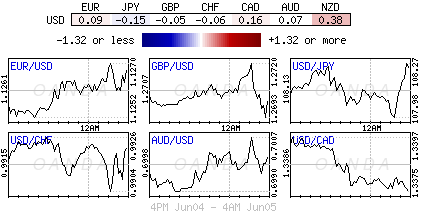
Dovish Fed, ZAR Weakening
Fed goes 'Full-Dovish'
The one-two punch of St. Louis Fed Bullard and Chair Powell could have not been clearer. The Fed now has a dovish tilt. Yesterday Powell remarked that given the lack of inflation pressure emulating for the US economy, the Fed has the right and ability to target economic growth. The remarks sent global yields lower with Germans 10-yr govies yields hitting a new record low (-0.225%). Powell also specifically mentioned that central banks were prepared to respond to the risk generated by a global trade war. A shift in Fed rhetoric has done little to damage the USD as investors are preparing for a US equity market rally. Despite 'this time is different' discussions, the pattern of central bank stimulus inflating asset prices has been observed for over ten years. While USD relationship with TIIPS is well-known deviations occur when the Fed quickly changes direction, especially implying additional stimulus. Inflight of increase recession probability and weak inflation pressure, we anticipate that USD will remain in demand. Also, President Trump has a historical pattern of pushing issues to the breaking point only to pull them back from the brink. This suggests that markets should anticipate an 'unexpected' breakthrough on trade with China, Mexico, and Britain a "phenomenal" post-Brexit trade agreement. Markets will be watching for Feds Beige Book for further evidence of the weak economic condition, which could provide clues to the pace of Fed interest rate cuts. We remain constructive on USD despite marginal short-term weakness.
ZAR weakening as headwinds strengthens
The change in tone from the South African Reserve Bank is more than understandable. Although Cyril Ramaphosa emerged victorious from general elections, political, structural and growth uncertainties weigh on the South African economy and ultimately its currency, which is losing steam this week. The SARB is now signaling a rate cut for early 2020 to 6.50%.
The surprise came from SARB as it confirmed a rate hike for 2019 in its prior statement, while it adjusted its growth and inflation (headline + core) forecasts to 1% (prior: 1.30%) and 4.50% (prior: 4.80%). Yet in addition to the release of 1Q GDP figure, with quarter-on-quarter down 3.20% (prior: 1.40%), largely below expectations of -1.60% and lowest in 10 years, including flat year-on-year growth data (prior: 1.10%), further risks need to be considered. Restructuring of the heavily indebted energy department and current debates on Cabinet reshuffle, scope of SARB's mandate should maintain the ZAR under pressure until positive resolutions emerge.
USD/ZAR is currently trading at 14.6830, approaching 14.80 short-term.
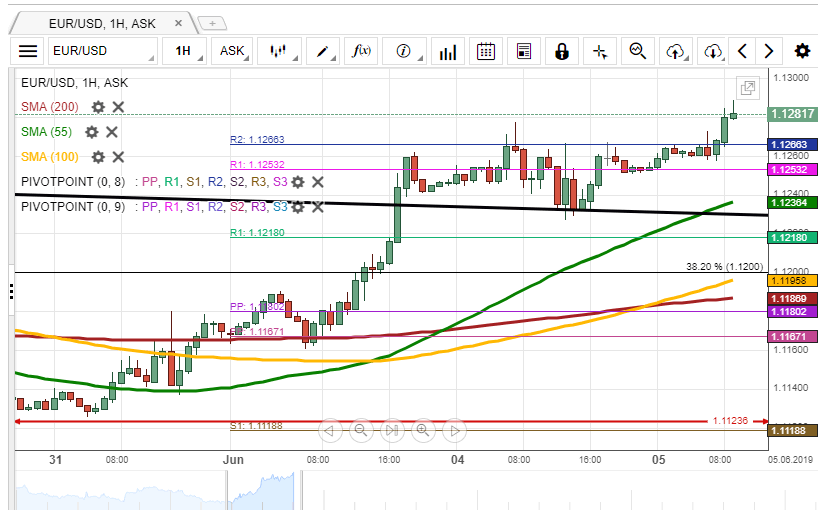
EUR/USD Tests 100-Period SMA
Yesterday, the EUR/USD currency pair breached the long-term descending channel north. During Wednesday's morning, the pair was testing the 1.1280 level.
Note, that the 100-period moving average is located at the given level on the 1D time frame. If the given resistance holds, it is expected, that the exchange rate could trade sideways between the given level and the monthly R1 at 1.1254.
If the given moving average does not hold, it is likely, that the rate could maintain its growth. A possible upside target is the resistance level—the weekly R3 at 1.1317.
From a technical perspective, it is unlikely, that the pair could drop lower than the 1.1235 in the short term due to the support of the 55-hour SMA
GBP/USD Could Trade Up
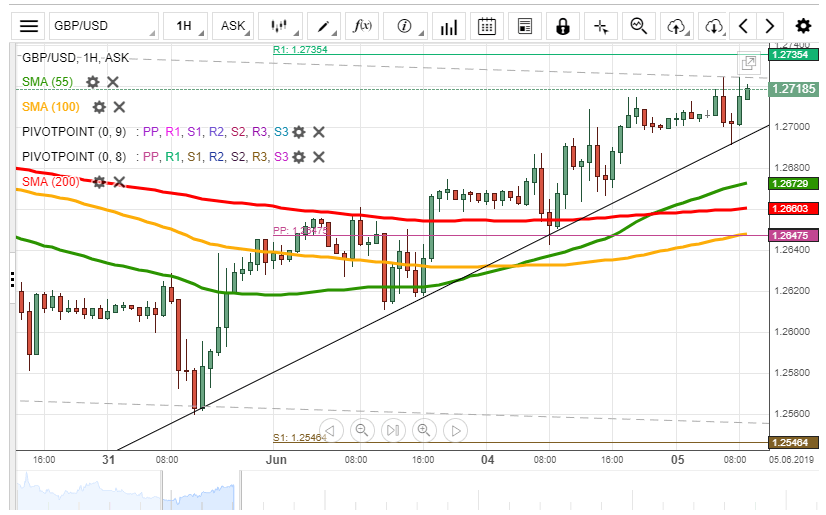
During the previous trading session, the GBP/USD exchange rate reached the psychological level at 1.2700.
The rate could continue to extend gains in the short run. However, the currency pair has to surpass the resistance level formed by the weekly R1 at 1.2735. If it does not hold, the pair could reach the psychological level at 1.2760.
If the given resistance holds, it is expected, that the pair could trade sideways, trying to surpass it. Also, it is unlikely, that the rate could tumble lower than the 1.2648/1.2673 range due to the support cluster formed by the 55-, 100– and 200-hour SMAs, as well the weekly PP.
USD/JPY Likely To Trade Sideways
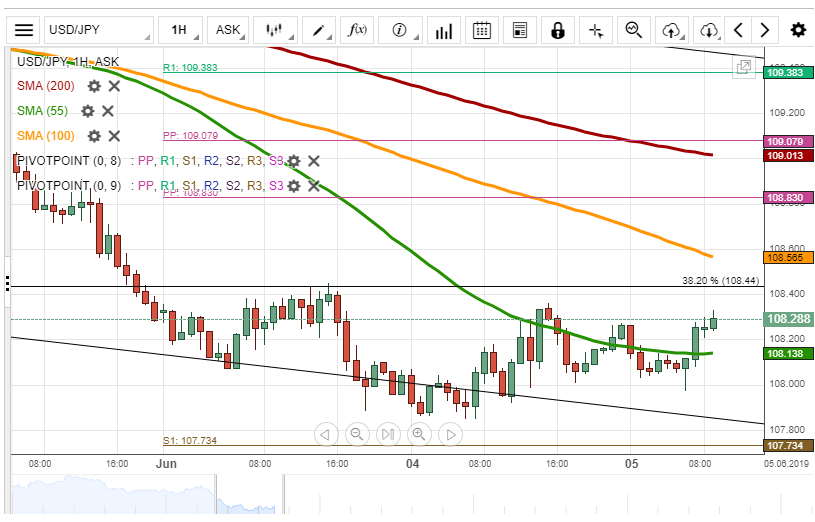
On Tuesday, the USD/JPY currency pair traded sideways, trying to surpass the resistance of the 55-hour SMA, currently located at 108.14. During today's morning, the pair surpass the given resistance.
Note, that the exchange rate is pressured by the 100-hour moving average, currently located at the 108.57 mark, thus, it is unlikely, that some upside potential could prevail in the market in the short term.
It is expected, that the rate could trade sideways between the given moving averages in the nearest future.
Also, it is unlikely, that the pair could decline lower than the 107.80 level due to the support of the lower boundary of the short-term descending channel.
XAU/USD Tests Monthly R2
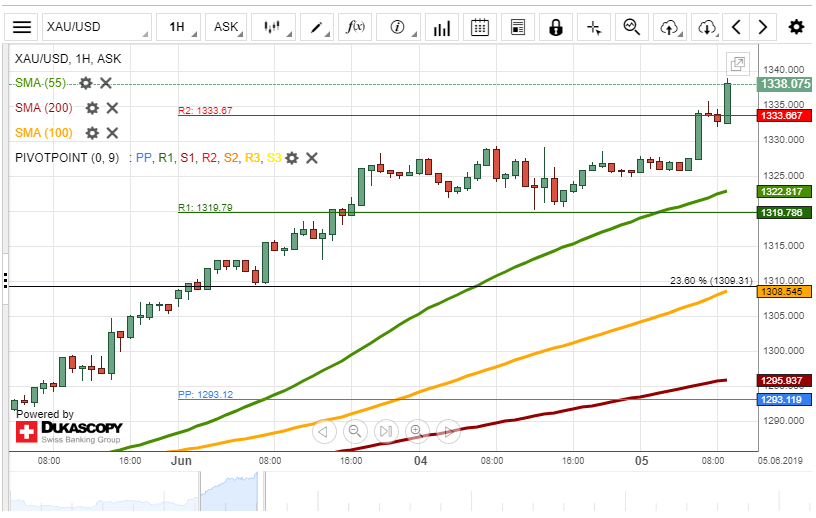
Yesterday, the XAU/USD exchange rate traded sideways around the psychological level at 1,325.00. During Wednesday's morning, the rate was testing the resistance level—the monthly R2 at 1,333.67.
If the given resistance holds, it is expected, that a reversal south could occur within the following trading hours. In this case, the price for gold could be supported by the 55-hour SMA and the monthly R1 at 1,319.79.
Otherwise, it is likely, that gold could continue to appreciate against the US Dollar. In this case, the price for gold could surpass the psychological level at the 1,240.00 mark.
European Markets In Recovery Mode | Fed May Cut Interest Rate
European markets and US futures are trading higher, it seems like bulls are in mood for some revenge trade. Traders are picking up the momentum from Asia. The recent dovish comment by the Fed has also helped the sentiment among investors.
During his visit to the UK, Donald Trump sent several different signals that the US is ready to make trade deals with the country as the UK prepares its self to leave the EU. His comments will only help to divide the lawmakers more as their vision will be more clouded. He has clearly backed up those officials who favour nationalism and back a no deal Brexit. He is expected to travel to France today and the focus will shift to European politics now.
Throughout this year, there has been one clear dominant trend for the dollar index, and this trend has been skewed to the upside. Remember, this is despite the fact that the Federal Reserve over in the US changed its hawkish monetary policy stance. However, traders always had their doubt and due to this reason we have seen the rally in the dollar index during this year.
Fed Likely To Make A Move
Last night, the Fed once again sent a very clear message for the markets: the committee is on the verge of cutting the interest rate. Over in the US, Jerome Powell, the Fed chairman said in his statement that the Fed will “act as appropriate to sustain the expansion”. These comments were enough to boost confidence among investors and this is the chief reason that we experienced a rally in the stocks over in the US.
The Dow Jones rallied over 500 points last night. The index is down more than 5 percent during the past month, the NASDAQ index lost the most of its value among major bench mark indices, down nearly 8 percent.
Australian GDP Data
Overnight, we also had the Australian GDP data, the headline number came in a little soft: missed the forecast. Gross domestic product reading came in at 0.4 percent while the forecast was 0.5 percent and this confirmed that the Reserve Bank of Australia wasn’t wrong in its monetary policy decision. Recently, the bank has cut the cash rate to a record low. The fact is that under the current circumstances, it is highly likely that the bank will have to cut the growth forecast once again.
Trade War
As for the trade war, tensions are still very prominent however there is some softness in stance. The Chinese commerce minister indicated in his latest comments that the differences between Beijing and Washington can be resolved through constructive dialogues. However, the US needs to understand that the word called “mutual respect”. For traders, this is more a signal that country is perhaps ready and open for discussion and this has also helped the sentiment.
EUR/GBP Bullish Continuation Towards 0.8910 Zone
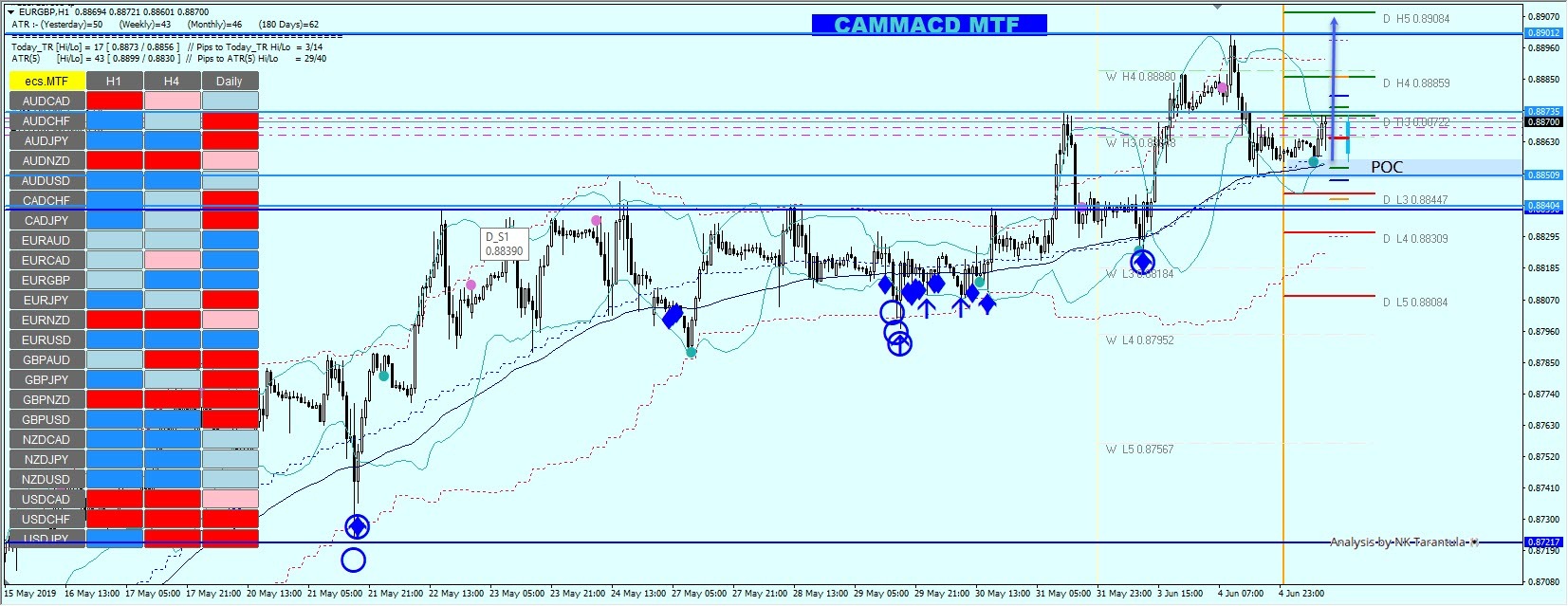
The EUR/GBP continues with uptrend as the price trying to push above 0.8873 level .
The EUR/GBP needs to break the 0.8873 level to validate the spike from 0.88555-65 POC zone. Bullish continuation move should target 0.8885 and 0.8910. We can spot many trend confluence entries (blue arrows) with re entry dots (green dots). This further signifies the bullish trend on the pair. As W H4 has been broken the price should follow it to W H5 but since the ATR(5) is 43 pips, 0.8910 as the target seems more realistic.
Dollar Weakened On Fed Rates Speculations
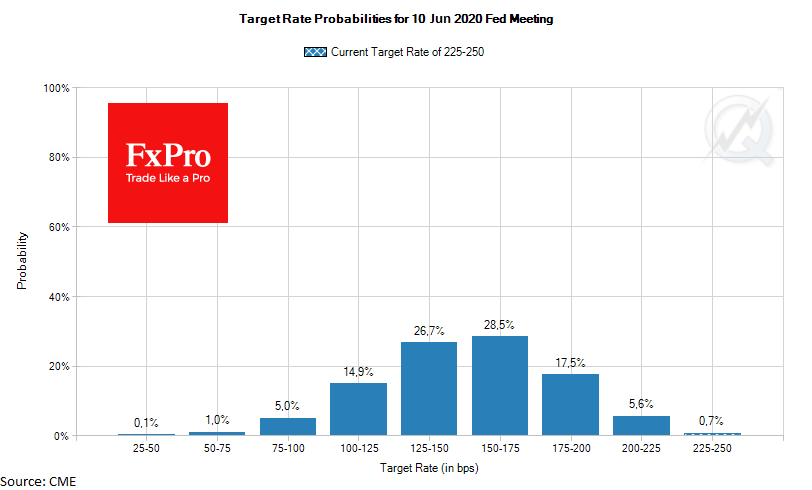
Fed Chairman Powell in his speech on Tuesday noted that, as always, he is ready to soften policies in case of increased risks for economic growth, employment, and inflation. These words convinced market participants that the rates would soon be lowered. These words of the Fed chairman followed similar hints from other FOMC members about the possible soon easing of the policy due to the risks of trade wars. Strictly speaking, the obvious words were perceived by the markets as a signal for policy easing. The chances that the rate will remain at the current level, the markets estimate at a negligible 0.6% versus 32% a month ago and 78% in March. This dramatic turnaround in expectations looks like the main driver for the markets, causing a dollar sharp sell-off and breathing life into stock indexes the day before.
As a result, the dollar weakens, and stock indexes sharply turned to growth. Futures markets are currently pricing in two rate cuts this year and one more until next March.
Stocks
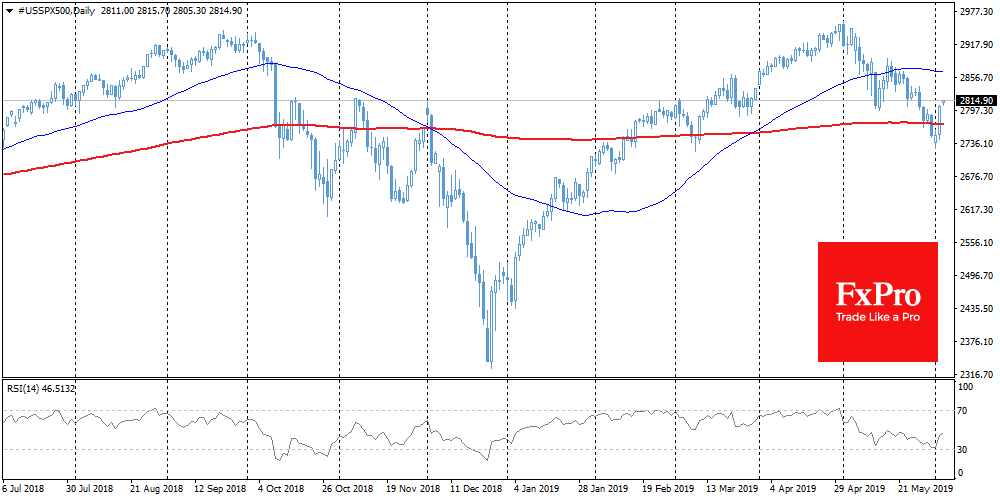
American indices SPX, DJI climbed yesterday by more than 2% in anticipation of active actions related to monetary policy easing. SPX strengthened above 2800 and rose above the level of the 200-day moving average. In case of continued growth, the decline under this level at the end of last week can be considered as false and can attract buyers after more than a month of decline in stock markets. On the other hand, the chances of a false start of the markets are high, because the Fed has made it clear that they are only monitoring economic data, and it can still be very far from actual easing.
EURUSD
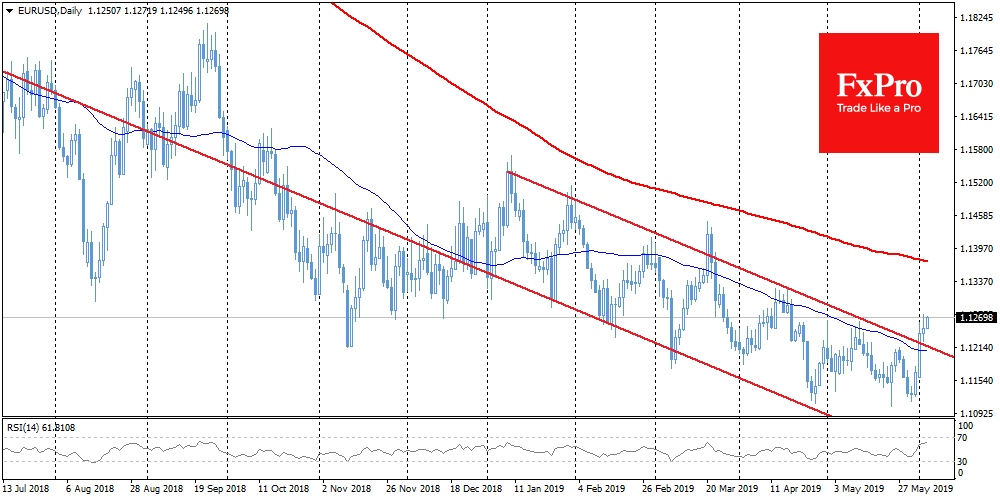
The dollar retreat occurred at a critical moment when EURUSD tested the upper limit of the downward channel. The technical picture is very favorable for EURUSD. The pair managed to break the downward trend with a strong movement and confirmed this breakdown by growth above 1.1260 - previous local maximums. In theory, this opens the way for the pair to the area of 1.1370 (MA200), but in practice, the emerging growth trend has to be tested in the form of the Fed Beige Book, the ECB press conference and data on the US labor market.
Gold
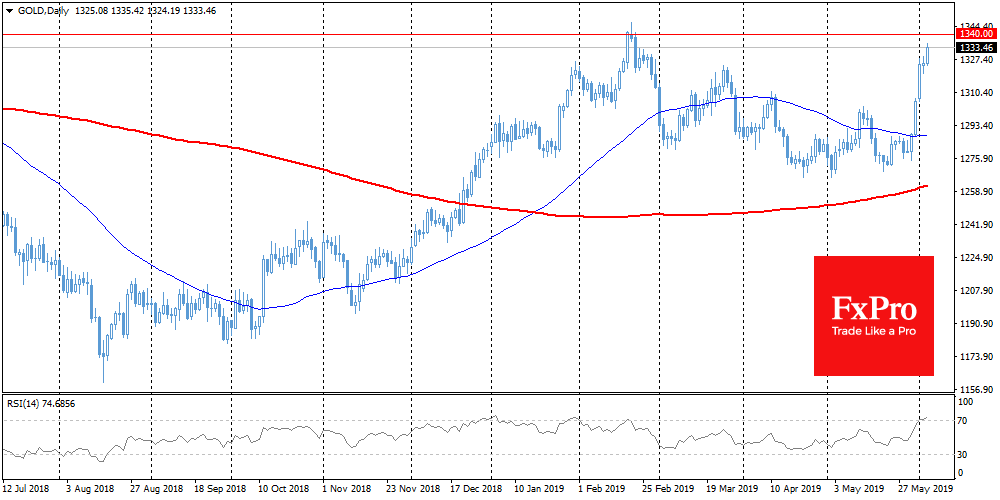
Gold resumed growth against the backdrop of the rally from the end of last week after a pause on Tuesday. At the time of writing, the price of an ounce increased to $1,333, adding 0.5% in less than an hour. Above the current levels, gold spent only three days in February. The decline in US government bond yields spurs gold purchases amid a decline in the attractiveness of investments in short-term debt securities.