Sample Category Title
WTI hits 51.38 fib level as oil inventories rose 6.8M barrels
WTI crude oil drops sharply as US commercial crude oil inventories surprisingly rose 6.8M barrels in the week ending May 31. That's way above expectation of -1.7M barrels decline. Now at 483.3M barrels, US crude oil inventories are about 6% above five year average for this time of the year.
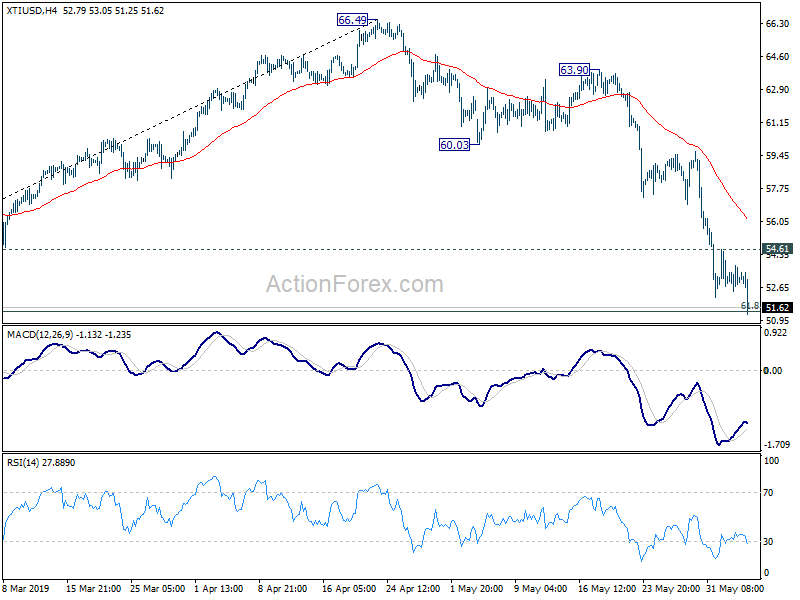
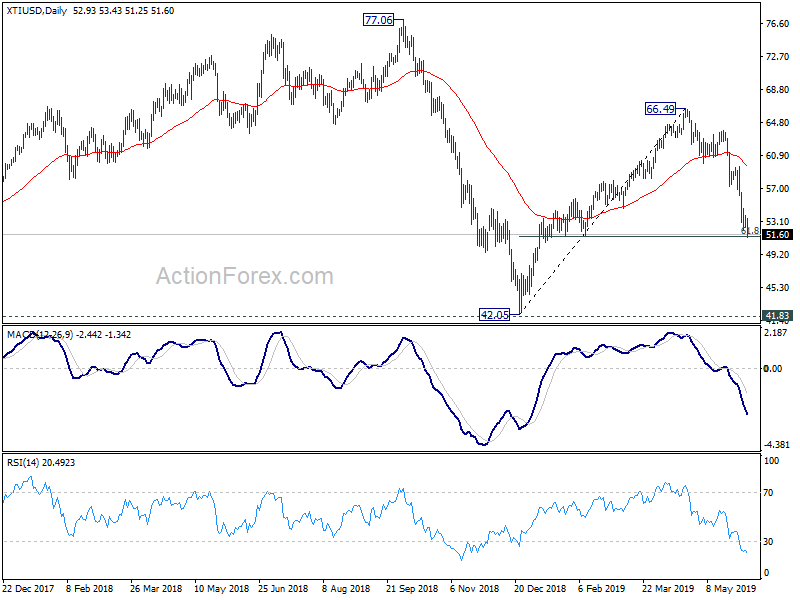
WTI's fall from 66.49 resumes and hits as low as 51.25. It's now pressing 61.8% retracement of 42.05 to 66.49 at 51.38. Further decline will now remain in favor as long as 54.61 minor resistance holds. Sustained break of 51.38 could pave the way to retest 42.05 low.
Elliott Wave Analysis: Weakness on Gold Around The Corner!
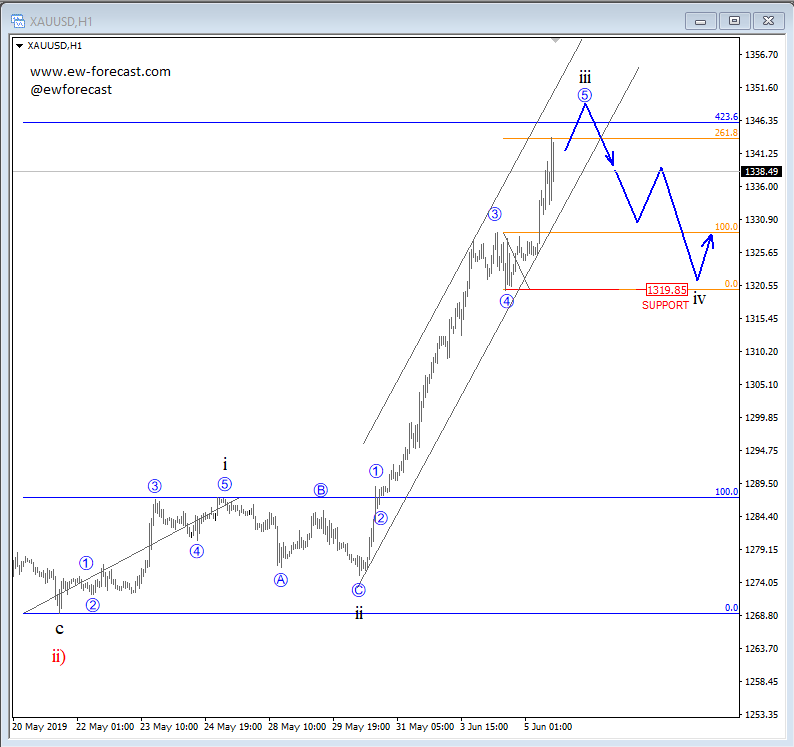
GOLD is trading higher, now unfolding final stages of a wave five as part of a higher degree wave iii of a bigger bullish cycle. We labelled possible turning point regions for the metal, which are at 1345/1351 area, where Fibonacci ratios of 261.8 and 423.6, and the upper corrective channel lines can project end for wave iii. An impulsive turn, and a break below the lower Elliott wave channel line would suggest a completed impulse, and corrective wave iv to be in play.
GOLD, 1h
FTSE Pauses after Fed Rate Comments Boost Equities
The FTSE has paused on Wednesday, after climbing close to 1.0% on Tuesday. Currently, the FTSE index is trading at 7,218, up 0.05% on the day. In economic news, British Services PMI improved in May to 51.0, above the estimate of 50.6.
Equity markets were up sharply on Tuesday, after comments from senior Federal Reserve officials strongly hinted at a rate cut. In recent months, the Fed has tried to present an aura of neutrality regarding rate moves, but has taken a sharp U-turn this week in favor of an easing bias. On Tuesday, Fed chair Jerome Powell said that the Fed would “act as appropriate to sustain the expansion”, and analysts noted that he did not mention his “patient” approach to monetary policy, which has been a buzzword in Powell’s recent comments. This comes on the heels of comments from James Bullard, president of the St. Louis Fed. Bullard stated that the Fed might have to lower rates shortly due to low inflation and the ongoing trade war with China. Bullard added that the current benchmark rate, which is at a range of 2.25% to 2.50%, is too high for current economic conditions, and recommended lowering rates in order to stabilize the economy.
British PMI scores are closely watched by investors, as they are key indicators of the health of key sectors in the economy. April numbers have been soft, as PMI data pointed to contraction in the manufacturing and services sectors. Construction PMI fell to 48.6, its third decline in four months. This followed a manufacturing PMI of 49.4, marking the first contraction since July 2016. Manufacturing news from the U.S. also disappointed, as ISM Manufacturing PMI slowed to 52.1, down from 53.0 a month earlier. This was the PMI’s weakest reading since November 2018. Global demand has fallen off due to trade tensions, and unless this situation improves, manufacturing in the U.K and the U.S. could continue to head downwards.
MARKET WRAP: US ADP Missed Forecast, Italian Stocks Under Hammer
*Stocks struggle to move higher *US ADP missed forecast *Crude oil drops off the cliff
Stocks
- The S&P 500 Index gained 0.29 percent as of 15:35 in London. The US ADP number came in very soft but the US Non-ISM manufacturing saved the day.
- The Stoxx Europe 600 Index jumped 0.55 percent while the FTSE soared 0.05 percent.
- The MSCI EM Index fell 0.22 percent.
Currencies
- The Dollar Spot Index made another low today and dropped 0.40 percent. All eyes are focused on the US NFP data.
- The Euro continued its move towards the upside and gained 0.34 percent to $1.1219. The move supported by the services ISM.
- The Japanese yen gained 0.20 percent to 111.34 per dollar.
- The British pound has moved back above the 1.25 and gained 0.18 percent to $1.2615.
Bonds
- The yield on 10-year Treasuries moved lower by one basis points to 2.49 percent.
- Germany’s 10-year yield was unchanged at -0.01 percent.
- Britain’s 10-year yield gained two basis point to 1.19 percent.
Commodities
- Crude oil dropped 1.48 percent to $52.19 a barrel.
- Gold moved higher by 0.76 percent to $1,339 an ounce.
How Are China-Dependent Economies Performing?
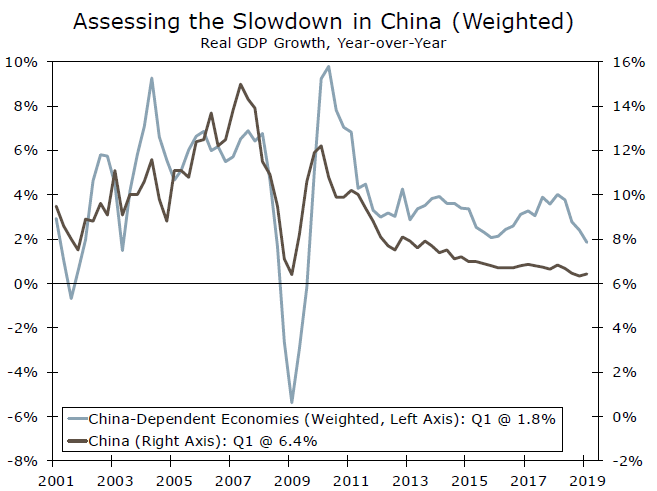
Fears about a deceleration in the Chinese economy continue to weigh on financial markets. When looking at GDP growth in China-dependent economies, growth has not fallen off a cliff, but it is the slowest since 2009.
Analyzing the Chinese Economy Through a Different Lens
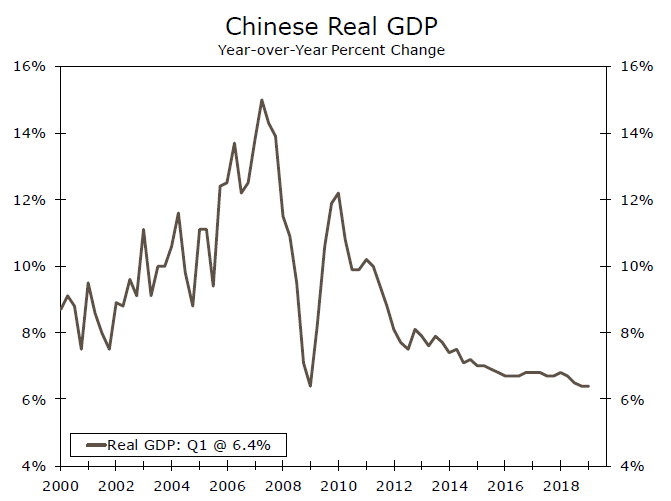
Fears about global growth generally and China specifically remain at the forefront for financial markets. Yet, even just analyzing the current state of the Chinese economy can be a challenging task. Economic data in China is less granular and transparent than it is in places like the United States, and some analysts have questioned the veracity of the Chinese figures. Unlike most countries, China also has an explicit growth target, perhaps making GDP and other indicators partly endogenous variables (top chart).
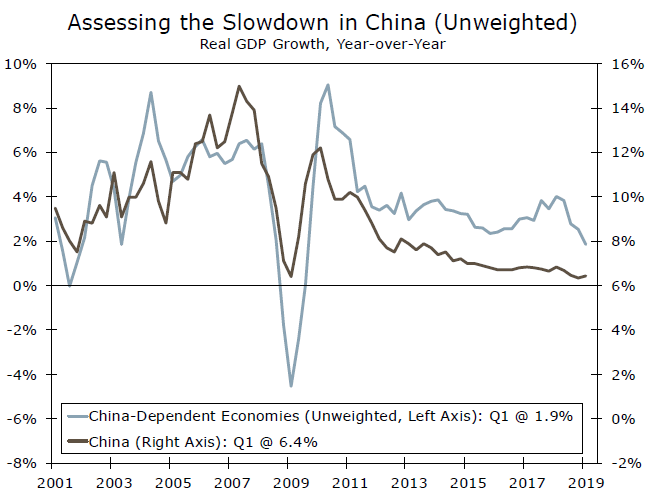
To develop another lens through which to view the Chinese economy, we first ranked the world's economies by how much of each country's total value added is derived from final demand in China. Next, we took an unweighted average of year-over-year real GDP growth in the five economies with the largest China exposure (Taiwan, Hong Kong, Malaysia, Singapore and Korea) as well as Chile and Australia, which ranked eighth and tenth, respectively, and provide some geographic diversity. Using an unweighted average of GDP growth in these seven economies gives a sense of whether all of these economies are moving in the same direction, as a quirk in one economy's performance is less likely to dominate the overall measure.
Perhaps the first conclusion we can draw from this measure is that there exists a fairly solid relationship between this constructed series and Chinese economic growth, though there are differences in magnitude (middle chart, note the two different axes). The correlation coefficient between the two is relatively high, about 0.62 since 2001. Another interesting finding is that China is not alone in seeing less volatile economic growth in the current expansion. The standard deviation in the average growth rate for the China-dependent economies was 2.1 from 1999 to 2007 but just 1.6 from 2010 to the present. This provides some evidence that the remarkable steadiness in Chinese real GDP growth over the past several years is not solely due to calculation methods used by the Chinese authorities.
The implications for global growth are more mixed. Encouragingly, average growth in the China-dependent economies has not completely fallen off a cliff, as it did during the Great Recession or the Asian Financial Crisis. This is consistent with reported real GDP growth in China, which has only slowed by 0.4 percentage points since Q1-2018. That said, average growth in the China-dependent economies has been halved since Q1-2018 and is below 2% for the first time since 2009. Using the same methodology but instead weighting the economies by their relative exposure to China offers a similar result (bottom chart). In our view, this analysis suggests that the Chinese economic outlook may be a bit more concerning than the official data suggest. Thus, with China-dependent economies flashing a warning sign and the struggles in Europe ongoing, a further escalation in the U.S.-China trade dispute could slow global growth to lows not seen since the Great Recession.
USD/CAD Outlook: Loonie Advances Further on Dovish Fed and Downbeat US ADP Jobs Data
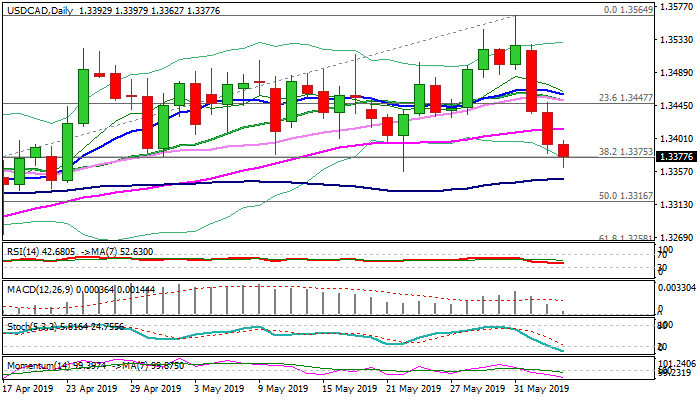
The pair holds firmly in red and extends weakness for the third straight day, to crack pivotal Fibo barrier at 1.3375 (38.2% of 1.3068/1.3564) on Wednesday. The greenback fell across the board on dovish steer from Fed and was additionally hit by downbeat US ADP private sector employment data on Wednesday (May 27K vs 180K f/c and 271K in Apr). The ADP figure is often seen as an indication for more significant US NFP data release (due on Friday; 185K f/c vs 263K in Apr) which could further sour the sentiment on miss. Strong bearish momentum adds to pair's negative stance which requires confirmation on sustained break below 1.3375 trigger that would open way towards 100SMA (1.3347) and 1.3316 (Fibo 50%) in extension. Broken daily cloud top and 55SMA (1.3412/14) mark solid resistances and expected to ideally keep the upside protected and guard a cluster of south-turning and converged MA's at 1.3451/59 zone (30;20;10SMA).
Res: 1.3397; 1.3414; 1.3451; 1.3459
Sup: 1.3375; 1.3362; 1.3347; 1.3316
Japan’s Household Spending to Allay Worries on Slowing Demand
The Japanese safe-have yen, as usual, is not expected to react much on Friday midnight when household spending data for the month of April come out. But the numbers may ease worries over a slowing domestic demand that the initial Q1 GDP report generated, giving some relief to the Bank of Japan (BoJ) which has been long struggling to drive inflation to its target.
In the first quarter, the Japanese economy expanded surprisingly by 0.5% q/q, beating forecasts of a mild contraction. Despite that, stats showed that private consumption declined in the aforementioned period, while imports fell more than exports, reflecting deterioration in domestic demand.
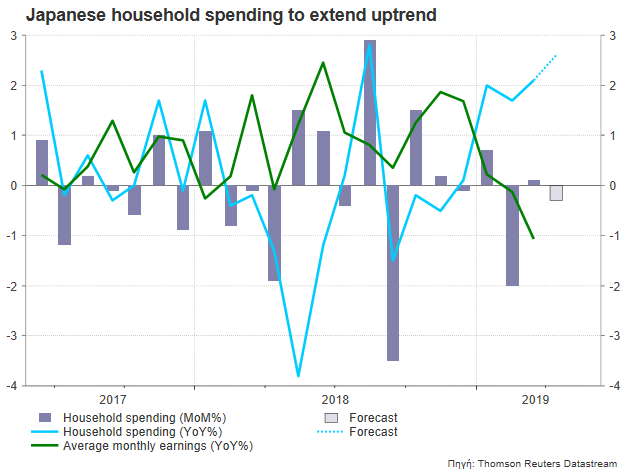
According to forecasts, April’s household spending is likely to show a different picture on Friday as analysts predict a steeper rise of 2.6% year-on-year compared to 2.1% in the preceding month. Such an outcome would bring good news to the BoJ policymakers who have been constantly criticized over their super-easy policy. Month-on-month the measure is anticipated to fall by 0.3% after inching up by 0.1% previously.
Despite negative interest rates hurting banks’ profitability, the central bank continues to prioritize inflation as an objective. The massive stimulus has miserably failed to fire up price growth towards its 2.0% goal, but the Bank remains ambitious that inflationary pressures will spiral by 2021. With wages marking the sharpest fall in almost four years in March and trade risks threatening over a global economic rundown, markets in contrast believe that the 2.0% target is likely to remain elusive.
Of course the BoJ, like other major central banks, has already showed willingness to adjust policy to sustain the economy at a healthy path but the kinds of tools it can use seem to be limited at the moment. For instance, lower interest rates would give little space to policymakers to further reduce borrowing costs in case of a recession, while the quantitative easing over the past decade proved fruitless to be extended at a larger scale. Hence among the few and safer options left is a Japanese version of the ECB’s TLTRO program. Credit aid to banks already exists at a zero interest rate and the BoJ could expand that program to further liquidize the banks which in turn could increase cash for companies and households.
Higher household spending would also give the green light to the government to follow its plans and hike the already twice-delayed sales tax from 8% to 10% in October.
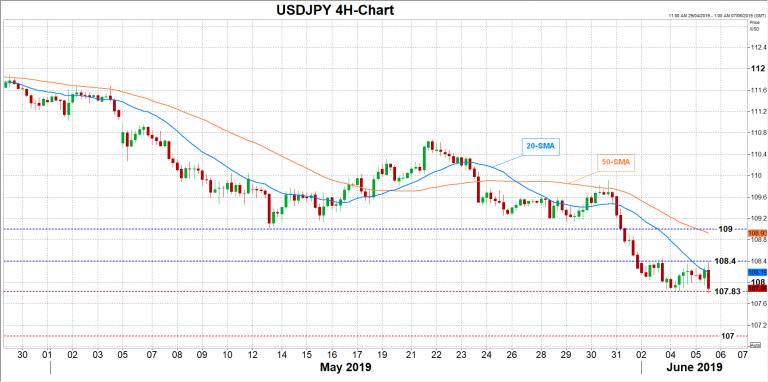
Meanwhile in exchange markets, the data may cause little impact, especially on the safe-haven Japanese yen, which is rather strictly driven by factors such as the Sino-US trade developments and the Fed rate strategy. Therefore, any surprise in household spending is expected to be shrugged off. Nevertheless, a descent rally above 108.50 per dollar may reduce negative sentiment in the market, while a closing price above 109 would turn the sell-off from 112.39 less reliable.
On the flip side, a clear break below 107.83 could trigger another bearish wave, probably towards the 107.00 psychological level.
Sunset Market Commentary
Markets
Global core bonds extended their rally today with US Treasuries hugely outperforming German Bunds. A very poor US ADP employment report (+27k) pulled the trigger. One swallow doesn’t make a Summer, but it’s the first time the final stronghold of the US economy – the labour market – shows signs of cracks. The stakes for Friday’s payrolls are high. Consensus forecasts another strong 180k net job gain. Yesterday’s comments by Fed Chair Powell and vice-chair Clarida, both hinting at a rate cut if warranted, echoed through investors’ minds. Washington Fed Brainard (“our job to keep the US expansion going”) and Chicago Fed Evans (“I see insurance reasons to talk about policy adjustments”) added to the dovish chorus. The US yield curve showed another bull steepening with daily yield changes ranging between ‑8 bps (2-yr) and flat (30-yr). The German yield shifts in more or less similar fashion with yields 2.9 bps (5-yr) to 0.2 bps (30-yr) lower. 10-yr yield spreads vs Germany narrowed marginally with Greece (+5 bps) and Italy (+6 bps) underperforming. The EC started fiscal disciplinary action against Italy over its public debt.
EUR/USD trading was driven divergent factors today. (Modest) USD weakness initially prevailed as markets considered yesterday’s Fed comments as raising chances on a rate cut later this year. Final PMI’s still suggest sluggish growth in the euro area, but at least didn’t bring any negative surprise anymore. EUR/USD touched a minor new correction top beyond yesterday’s intraday peak of 1.1277. Around noon, the euro faced setback on headlines that the EU commission concluded that Italy is in breach of the EU fiscal rules, which, after a long procedure, might lead to disciplinary action. EUR/USD (temporary) returned to the 1.1260 area. Early in US dealings, USD weakness soon returned to the forefront as the ADP private job report showed net job growth of only 27 K vs 185k expected. US yields tumbled again and weighed on the dollar, too. EUR/USD tested the 1.13 big figure but ran into resistance. Even so, next resistance at EUR/USD 1.1324 is looming on the horizon. USD/JPY initially outperformed on a better risk sentiment. A decline in yen interest rates was a (slightly) yen negative, too. However, the intraday bid in USD/JPY was abruptly aborted after the ADP job report. The pair is again trading in 108 area. The decline of the dollar still develops very orderly, especially against the likes of the euro, but the erosion of the USD momentum continues.
EUR/GBP trading was confined to a tight range in the 0.8855/0.8880 area. There was little high profile news on Brexit and on UK politics. The UK May services PMI printed marginally stronger than expected at 51.0. However, the report still suggests meagre growth and was not enough to trigger a positive reaction of sterling, in particular after very poor manufacturing and construction PMI’s earlier this week. EUR/GBP is trading in the 0.8860/65 area. Cable is regained the 1.27 area, but this was mainly due to USD weakness, not sterling strength.
News Headlines
The ADP jobs report disappointed hugely in May, printing at a mere 27 000. Markets anticipated a rise of 185 000 after an already stellar 271 000 in April. Details showed a negative contribution from the goods producing sector of - 43 000 (the bulk of which in construction) while services added 71 000 new jobs.
After weighing Italian arguments for its bigger than projected budget deficit, the European Commission ruled today that a disciplinary process against Italy is “warranted”. EU member states would first have to back the EC’s assessment before next steps can be taken. The EC also warned Greece, saying that the tax cuts and pension payouts introduced last month threaten the fiscal targets both parties agreed.
US ISM non-manufacturing business confidence came in better than expected (56.9 vs. 55.4), propelled by strong business activity and employment component. New orders marginally increased to a lofty 58.6.
EURGBP Looks To weaken Further Lower On Correction
EURGBP looks to weaken further lower on correction as it retains its downside pressure. On the downside, support stands at the 0.8800 level where a violation will turn focus to the 0.8750 level. A break below here will aim at the 0.8700 level. Its daily RSI is bearish and pointing lower suggesting further weakness. Conversely, resistance lies at the 0.8900 level. A violation if seen will turn risk towards the 0.8950 level. Further up, resistance comes in at 0.9000 level followed by the 0.9050 level. All in all, EURGBP remains biased to the upside on more recovery.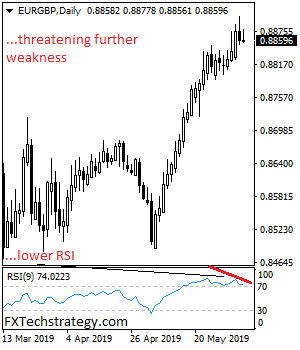
USD/ZAR Bulls Struggle at Key Fibo Barrier
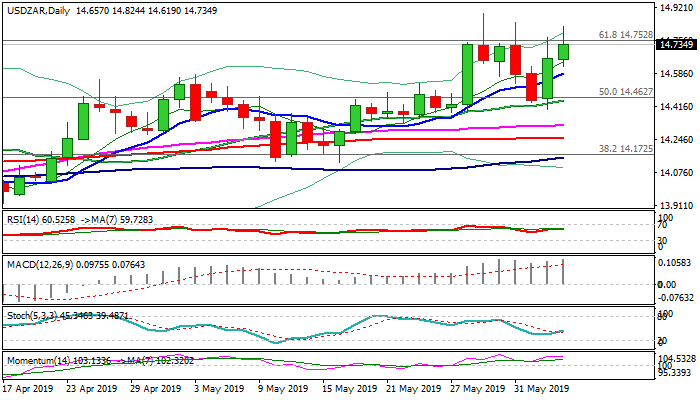
The pair continues to struggle at key Fibo barrier at 14.75 (61.8% of 15.69/13.23) and on track for the fourth failure to clearly break higher in one week. Series of daily candles with long upper shadows warns that bulls might be running out of steam, with south-turning daily momentum adding to negative signals. Daily MA's are still in full bullish setup, however, Mon/Tue probes below rising 10SMA, although short-lived and contained by 20SMA, also warn. Repeated failure at 14.75 would keep the price in extended congestion, with the action above rising 10SMA needed to keep bullish bias. Return below 10SMA will generate initial bearish signal, but extension and close below 20SMA (14.44) is needed to confirm reversal and expose a cluster of daily MA supports at 14.32/15 zone. Eventual clear break of 14.75 barrier would expose barriers at 15.05/11 (9 Oct high/Fibo 76.4% of 15.69/13.23).
Res: 14.75; 14.89; 15.05; 15.11
Sup: 14.65; 14.58; 14.50; 14.32