Sample Category Title
ECB Meeting Unlikely To Be A Game Changer
Market movers today
Focus in markets remains on US trade talks - with short-term emphasis on Mexico, and speculation of central bank easing for most notably the Fed.
Today's highlight is the ECB meeting, with a policy statement to be released at 13:45 CEST and a press conference at 14:30 CEST. We expect the ECB to maintain its easing bias, with no new additional stimulus measures announced. The update of the staff projections is unlikely to change much for inflation, but we see a downside risk to the 2020-21 growth forecast from its already low level. We will also get more information on the TLTRO3 terms, which we expect to be favourable in light of the ongoing struggles of the economy. See our full preview here and our 'cheat sheet' here .
We will also get euro area GDP details for Q1. We will closely monitor the domestic demand drivers and see how they fared; private consumption and fixed investments were probably strong judging from the German figures already released.
In the US, we get the jobless claims, which will attract attention ahead of tomorrow's NFP number amid contradicting labour market signals yesterday (see below). We expect initial jobless claims to come in at the low end.
Selected market news
Yesterday's US ADP report for May fell well short of market expectations with a monthly private job growth of only 24K - the weakest report since March 2010. Over the past years the ADP report has been a less-than-stellar predictor of the nonfarm release even if the moving average version has proven a better fit, see chart . Upon the ADP release, rates markets raised their bets on Fed rate cuts. Meanwhile, the subsequent ISM non-manufacturing was strong, with a rise to 56.9 beating both market expectations of a modest drop and the gloomy signals from the Markit Service PMI. Also, the employment index of the ISM non-manufacturing - which has historically correlated well with nonfarm payrolls, see chart - showed a strong rise to 58.1, spreading doubt as to the reliability of the weak ADP signal. Rates markets subsequently reversed most of the US fixed income rally.
Brent crude temporarily dropped below USD60/bbl yesterday as the EIA's weekly inventory report showed a historically large increase in total US petroleum stocks. This raises concerns about waning US demand at a time when trade concerns have resurfaced. On the other hand, the latest price drop increases the likelihood of OPEC+ extending its output curbs.
The general election in Denmark gave a majority to the parties that support a new government under Social Democratic leadership. There still need to be negotiations and the shape of a new government is not a done deal. We do not expect any market impact. A new government does not mean a fundamental shift in economic policy, Denmark's EU membership is not in question, and any thoughts of joining the euro are far away.
Real Estate Norway house prices showed a monthly rise in national house prices in May of 0.5% s.a. This was a little stronger than expected and shows that rising disposable income growth is more than countering the housing headwinds from rising supplies, higher nominal rates, tight regulation, lower migration and lower population growth. We expect continued moderate house price growth in the coming months.
Euro-Zone’s Services Sector Activity Surprisingly Rose In May
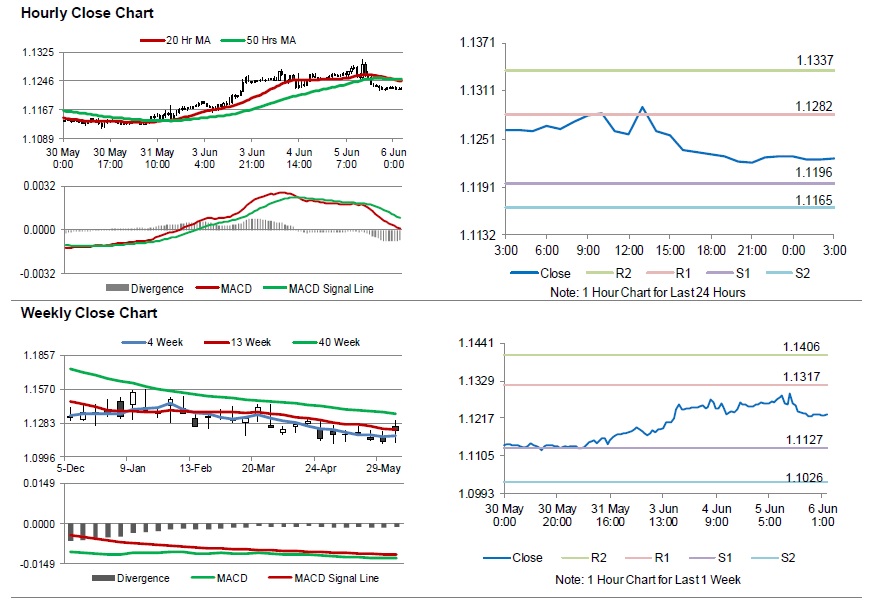
For the 24 hours to 23:00 GMT, the EUR declined 0.21% against the USD and closed at 1.1229.
In economic news, Euro-zone' s final services PMI unexpectedly rose to a level of 52.9 in May, compared to a reading of 52.8 in the previous month. Market participants and preliminary figures had anticipated the PMI to drop to a level of 52.5. Moreover, the region's producer price index (PPI) climbed 2.6% on an annual basis in April, compared to a gain of 2.9% in the previous month. Markets had envisaged the PPI to record a rise of 3.1%. Also, the nation's seasonally adjusted retail sales jumped 1.5% on an annual basis in April, in line with market expectations and following a revised rise of 2.0% in the prior month.
The US dollar gained ground against major currencies, on the back of Fed's optimistic Beige Book report.
The Fed's Beige Book indicated that the US economy slightly improved expanding at “a modest pace overall” from April to mid-May. On the inflation front, the Beige Book reported that overall prices continued to increase at a modest pace in most districts. Further, the report showed that economic outlook for the coming months remained “solidly positive but modest, with little variation among reporting districts.” However, the report highlighted concerns over trade conflict between the US and its trade partners.
Separately, in the US, data showed that the ISM non-manufacturing PMI unexpectedly rose to a level of 56.9 in May, compared to a reading of 55.5 in the prior month. Market participants had anticipated the PMI to register a fall to a level of 55.4. Furthermore, the nation's ADP private sector employment growth slowed to 9-year low level of 27.0K in May, following a revised level of 271.0K in the prior month. Also, the nation's MBA mortgage applications climbed 1.5% on a weekly basis in the week ended 31 May 2019, following a fall of 3.3% in the preceding month.
On the contrary, the US final Markit services PMI declined to a level of 50.9 in May, in line with market expectations and confirming the preliminary figures. In the prior month, the PMI had registered a level of 53.0.
In the Asian session, at GMT0300, the pair is trading at 1.1227, with the EUR trading a tad lower against the USD from yesterday's close.
The pair is expected to find support at 1.1196, and a fall through could take it to the next support level of 1.1165. The pair is expected to find its first resistance at 1.1282, and a rise through could take it to the next resistance level of 1.1337.
Looking ahead, traders would closely monitor the European Central Bank's interest rate decision along with the Euro-zone's gross domestic product for the first quarter followed by Germany's factory orders for April and the Markit construction PMI for May, slated to release in few hours. Later in the day, the US trade balance data for April and initial jobless claims, will keep traders on their toes.
The currency pair is trading below its 20 Hr and 50 Hr moving averages.
Britain’s Services PMI Advanced To 3-Month High Level In May
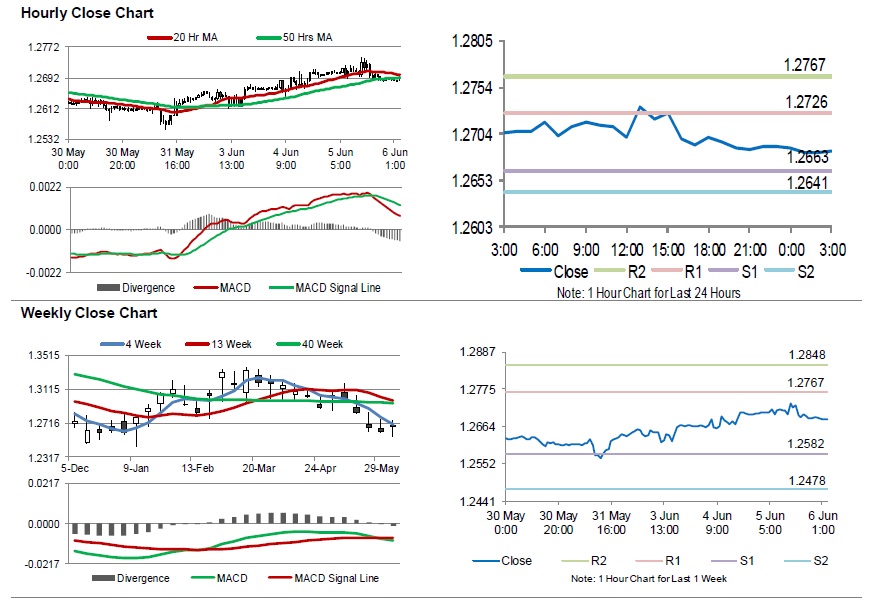
For the 24 hours to 23:00 GMT, the GBP declined 0.07% against the USD and closed at 1.2691.
On the data front, Britain's services PMI advanced to a level of 51.0 in May, expanding a at a three-month high level and surpassing market expectations for a rise to a level of 50.5. In the prior month, the PMI had recorded a reading of 50.4.
In the Asian session, at GMT0300, the pair is trading at 1.2686, with the GBP trading slightly lower against the USD from yesterday's close.
The pair is expected to find support at 1.2663, and a fall through could take it to the next support level of 1.2641. The pair is expected to find its first resistance at 1.2726, and a rise through could take it to the next resistance level of 1.2767.
Trading trend in the British Pound today, is expected to be determined by the Bank of England Governor Mark Carney's speech, due in a few hours.
The currency pair is trading below its 20 Hr and 50 Hr moving averages.
Japanese Yen Trading A Tad Lower In The Asian Session
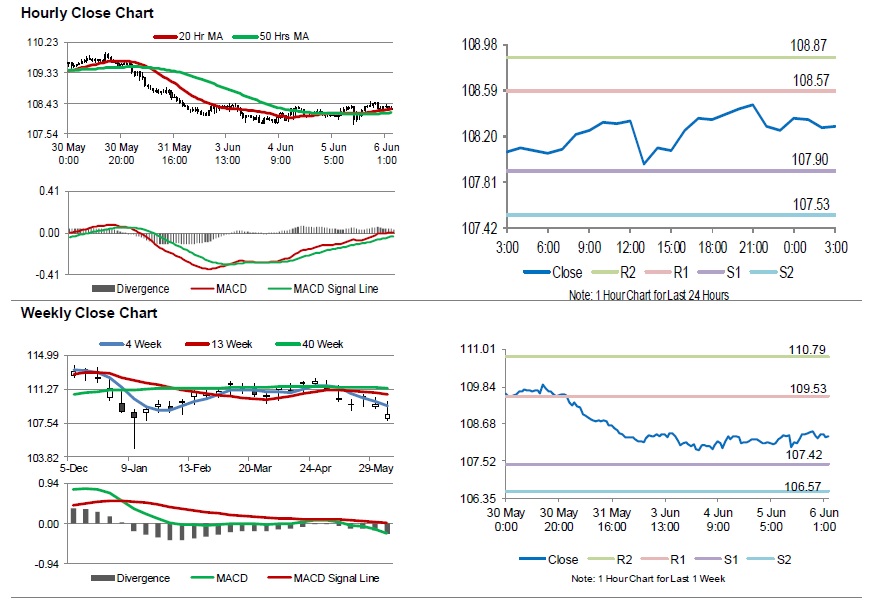
For the 24 hours to 23:00 GMT, the USD slightly rose against the JPY and closed at 108.24.
In the Asian session, at GMT0300, the pair is trading at 108.28, with the USD trading marginally higher against the JPY from yesterday’s close.
The pair is expected to find support at 107.90, and a fall through could take it to the next support level of 107.53. The pair is expected to find its first resistance at 108.57, and a rise through could take it to the next resistance level of 108.87.
The currency pair is showing convergence with its 20 Hr moving average and trading above its 50 Hr moving average.
Swiss Franc Extends Its Losses In The Morning Session
For the 24 hours to 23:00 GMT, the USD rose 0.16% against the CHF and closed at 0.9939.
In the Asian session, at GMT0300, the pair is trading at 0.9945, with the USD trading 0.06% higher against the CHF from yesterday’s close.
The pair is expected to find support at 0.9882, and a fall through could take it to the next support level of 0.9820. The pair is expected to find its first resistance at 0.9979, and a rise through could take it to the next resistance level of 1.0014.
The currency pair is trading above its 20 Hr and 50 Hr moving averages.
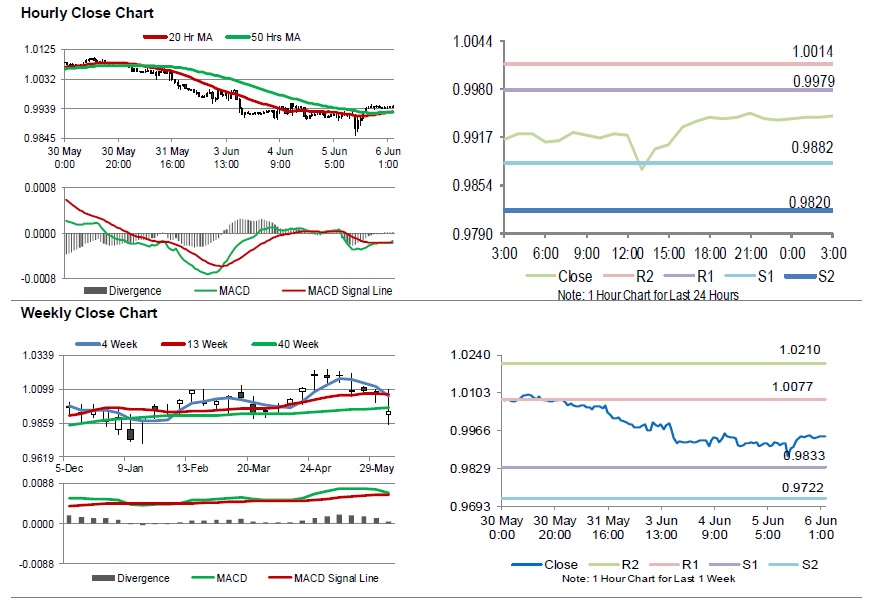
USD/CAD Daily Outlook
Daily Pivots: (S1) 1.3377; (P) 1.3403; (R1) 1.3445; More...
USD/CAD recovered after dipping to 1.3363, held above 1.3357 support. Intraday bias is turned neutral first. Further decline will remain in favor as long as 1.3449 minor resistance holds. Current development suggests that choppy rise from 1.3068 has completed at 1.3564, on bearish divergence condition in 4 hour MACD. Decisive break of 1.3357 support will confirm this bearish case and target 1.3274 support next. More importantly, that could also have medium term channel support taken out, which carries larger bearish implications too. However, break of 1.3449 will revive near term bullishness and turn bias back to retest 13564.
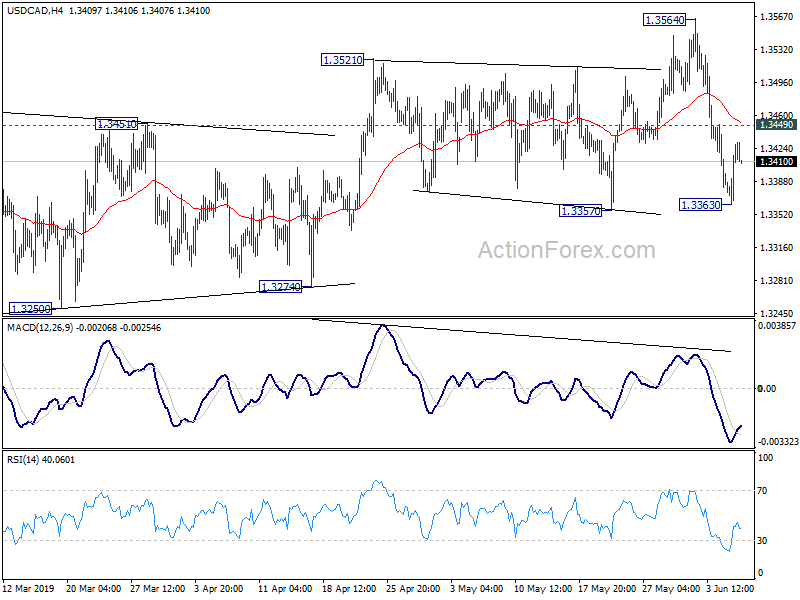
In the bigger picture, USD/CAD is staying well inside medium term rising channel (support at 1.3335). Thus, the up trend from 1.2061 (2017 low) should be in progress. On the upside, decisive break of 61.8% retracement of 1.4689 (2016 high) to 1.2061 at 1.3685 will pave the way to 78.6% retracement at 1.4127 next. This will remain the favored case as long as 1.3068 support holds. However, sustained break of the channel support will be the first sign of medium term reversal. Firm break of 1.3068 would confirm.
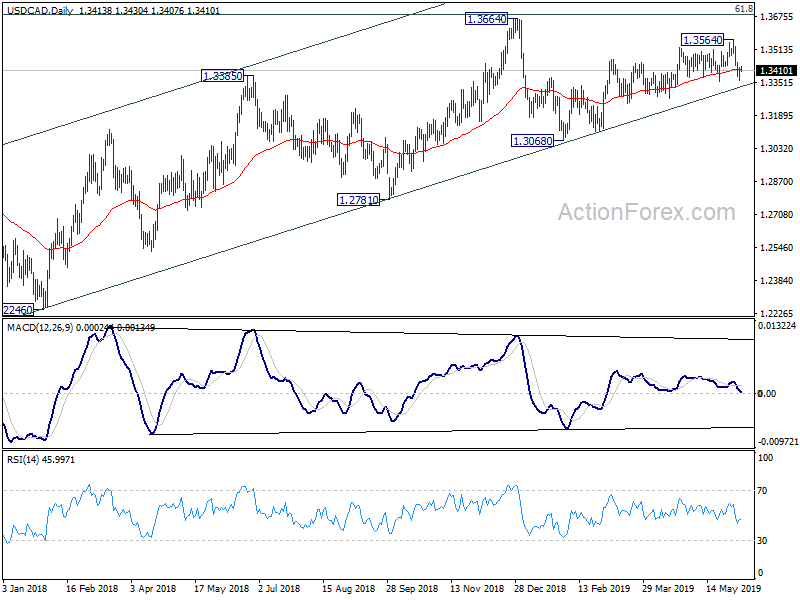
Loonie Trading Higher In The Asian Session
For the 24 hours to 23:00 GMT, the USD rose 0.22% against the CAD and closed at 1.3423.
In the Asian session, at GMT0300, the pair is trading at 1.3413, with the USD trading 0.07% lower against the CAD from yesterday’s close.
The pair is expected to find support at 1.3374, and a fall through could take it to the next support level of 1.3334. The pair is expected to find its first resistance at 1.3442, and a rise through could take it to the next resistance level of 1.3470.
Trading trend in the Loonie today, is expected to be determined by Canada’s Ivey Purchasing Managers Index for May and trade balance data for April, scheduled to release later in the day.
The currency pair is showing convergence with its 20 Hr and 50 Hr moving averages.
Dollar Recovered From Overly Bearish Sentiments as Focus Turns to ECB
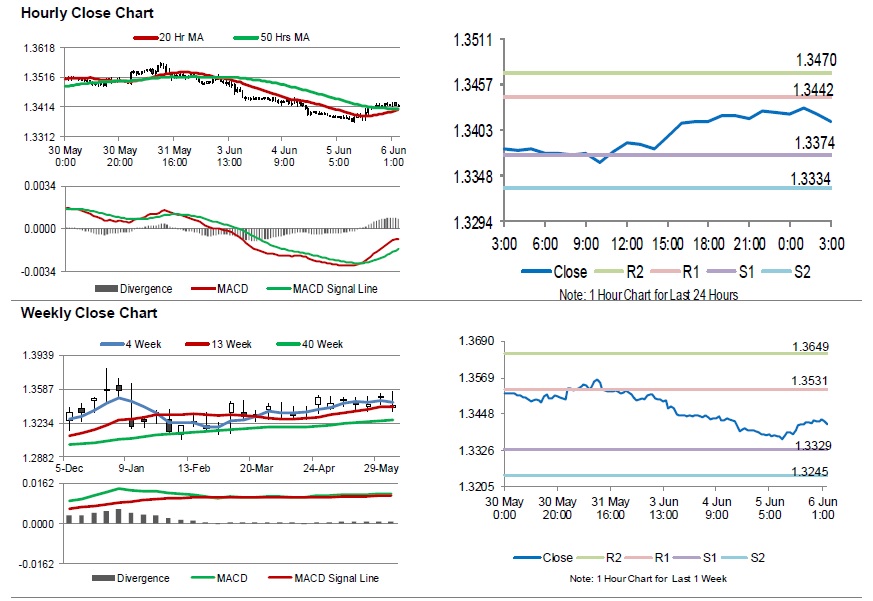
Dollar tried to stage a reversal overnight after initial selloff, but upside is so far limited and there is no confirmation of bottoming yet. There are a couple of factors behind the move. Post ADP employment decline was largely undone by better than expected ISM services. In particular, the employment component of ISM service improved notably by 4.4 to 58.1. The upcoming non-farm payroll report may not be as bad as ADP suggests.
Also, while more Fed officials expressed their openness to rate cuts, the development remain very fluid. At least, economic data don't point to any reversal in the trend in employment, not the economy yet. Inflation outlook is just subdued but not deteriorating. Trump's tariffs threat to Mexico is a main risk to the economy. Yet firstly, once imposed, the impact on inflation is unknown. Secondly, even if there is no agreement between the two countries in non-trade issue of migration flow, US Congress could challenge Trump's tariffs and block the move. For now, it's probably too early to overly bearish on Dollar even though technically it's not doing very well.
Staying the currency markets, Dollar is currently the weakest one for today, followed by Swiss Franc and then Australian. Yen is the strongest one for today, followed by Kiwi and then Euro. Over the week, Dollar is undoubtedly the weakest one, followed by Yen and then Sterling. Kiwi is the strongest followed by Canadian.
Technically, for now, further rise is expected on EUR/USD as long as 1.1215 minor support holds. And current rebound from 1.1107 could target a test on key resistance level at 1.1448. However, break of 1.1215, possibly on dovish ECB, could turn its focus back to 1.1107 low. USD/CAD recovered ahead of 1.3357 support, thanks to selloff in WTI oil. Further decline is in favor with 1.3349 minor resistance intact. And break of 1.3357 will indicate larger bearish reversal. However, above 1.3449 will revive near term bullishness and turn focus back to 1.3564 high. GBP/USD was held below 1.2747 minor resistance so far. Thus, it remains near term bearish for now.
In Asia, currently, Nikkei is up 0.22%. Hong Kong HSI is up 0.08%. China Shanghai SSE is down -0.77%. Singapore Strait Times is down -0.29%. Japan 10-year JGB yield is up 0.0088 at -0.117. Overnight, DOW rose 0.82%. S&P 500 rose 0.82%. NASDAQ rose 0.64%. 10-yer yield rose 0.004 to 2.123.
ECB to stand pat, may have dovish shift, some previews
ECB rate decision is the main focus for today. The central bank is widely expected to keep benchmark interest rate at 0.00%. Marginal lending facility rate and the deposit facility rate will be held at 0.25% and -0.40% respectively. The forward guidance that interest rates will "remain at their present levels at least through the end of 2019" would likely be untouched too.
Eurozone economy has been slowing down since late last year and the recovery has been very weak. That's very much reflected in manufacturing PMI which was stuck at 47.7 in May. Deterioration was spreading over to services with PMI held at just 52.9. The survey data indicate a mere 0.2% GDP growth in Q2. Headline CPI also slowed notably to 1.2% yoy in May, well below ECB's 2% target.
The weak growth and inflation outlook will likely be reflected in the new economic projections to be released today. The question is whether ECB President Mario Draghi will shift to a more dovish tones in the press conference. Also, there's a chance Draghi could even signal some openness to further easing. Indeed, there are speculations that ECB could cut the deposit rate further into negative territory next year. ECB would also release details of the TLTRO III.
Here are some previews on ECB:
- ECB Preview- More on Dovish Side. Focus on Forward Guidance Extension and Pricing of TLTRO-III
- Does Draghi Have One Last Surprise In Store?
- Base Effects in the Driver's Seat but ECB Concerns
- ECB To Hold Rates, Reveal Details Of TLTRO3 As Euro Edges Higher
US-Mexico migration meeting ended with insufficient progress, double downgrade for Mexico
The high-level meeting between US and Mexico on migration ended with insufficient progress. Trump tweeted that "Progress is being made, but not nearly enough!" He threatened again "If no agreement is reached, Tariffs at the 5% level will begin on Monday, with monthly increases as per schedule. The higher the Tariffs go, the higher the number of companies that will move back to the USA!"
Vice President Mike Pence, who chaired the meeting including Secretary of State Michael Pompeo and Mexican Foreign Minister Marcelo Ebrard, also echoed Trump's comments. He tweeted "Progress was made but as @POTUS said "not nearly enough." @SecPompe, @DHSMcAleenan, & I made clear: Mexico must do more to address the urgent crisis at our Southern Border."
Ebrard said after the meeting that there was no discussions on tariffs. "The dialogue was focused on migration flows and what Mexico is doing or is proposing to the United States, our concern about the Central American situation." He noted "what the US government is looking for are measures in the short-term and medium-term". Instead, Mexico is promoting long term fix involving a development deal for Central America which would eventually slow migration.
Meeting will continue on Thursday and if no agreement is made, US will starting imposing 5% tariffs on all Mexican imports on June 10. That rate would "gradually" go up to 25% on October 1.
Fitch cut Mexico's rating from BBB+ to BBB and cited that "growth continues to underperform, and downside risks are magnified by threats by U.S. President Trump." Moody's downgraded Mexico's outlook from stable to negative and noted "further evidence that medium-term growth is in decline, whether as a result of policies that actively undermine growth or because of continued policy unpredictability, would put downward pressure."
USD/MXN has a rough ride but is generally kept inside this week's range.
Fed officials open to rate cut to counter risks of trade tensions
More Fed officials spoke yesterday today. While they generally sound non-committal to a rate cut, they are all open to, if trade tensions worsen.
Dallas Fed President Robert Kaplan said it's "early to make a judgement" on rate cut. But he noted "we're going to be very vigilant in understanding these heightened trade tensions. See if they feed through to the economy. Most importantly, see if they persist."
Fed Governor Lael Brainard told Yahoo Finance that "we'll be prepared to adjust policy to sustain the expansion." And "trade policy is definitely a downside risk to the economy. And our job is to sustain the expansion, and we'll need to see going forward what that means for policy."
Chicago Fed President Charles Evans told Bloomberg TV that he's "a little nervous about the low inflation rate". And, "that by itself could be a reason for a little more accommodation."
IMF Lagarde: Global growth stabilizing, but must avoid self-inflicted wounds
In a blog post, released yesterday, titled "How to Help, Not Hinder Global Growth", IMF Managing Director Christine Lagarde "most recent economic data indicate that global growth may be stabilizing". She noted "while first-quarter economic activity disappointed in parts of emerging Asia and Latin America, growth was stronger than expected in the United States, the euro area, and Japan. "
The most important "stumbling block" is trade tensions. Lagarde said "there is strong evidence that the United States, China, and the world economy are the losers from the current trade tensions". Overall, US-China-tariffs could reduce global GDP by 0.5% in 2020, or USD 455B. And she warned that "these are self-inflicted wounds that must be avoided".
Later Lagarde told Reuters that the global economy is not under threat of recession due to US tariffs actions on other countries. She said, "Decelerating growth, but growth nonetheless — 3.3 percent at the end of this year, and certainly a strong U.S. economy. We do not see at the moment, in our baseline, a recession." However, still, "one more tariff here, one more threat there, one more negotiation that has not yet started, add to a global uncertainty which is not conducive to additional growth," she added.
Australia trade surplus at AUD 4.87B in Apr, exports rose 2.5% mom, imports rose 2.8% mom
Australia trade surplus came in smaller than expected at AUD 4.87B in April. Exports rose 2.5% mom, 17.2% yoy to AUD 40.42B. Imports rose 2.8% mom, 5.4% yoy to AUD 35.55B.
Looking at the details of exports, non-rural goods rose AUD 691m (3%), non-monetary gold rose AUD 272m (20%) and net exports of goods under merchanting rose AUD 8m (73%). Rural goods fell AUD 67m (2%). Services credits rose AUD 65m (1%).
For imports, intermediate and other merchandise goods rose AUD 423m (4%), capital goods rose AUD 308m (5%) and consumption goods rose AUD 298m (3%). Non-monetary gold fell AUD 40m (9%). Services debits fell AUD 5m.
On the data front
Germany will release factory orders. Eurozone will release Q1 GDP final and employment. Later in the data, Canada will release trade balance and Ivey PMI. US will release trade balance, jobless claims and non-farm productivity.
USD/CAD Daily Outlook
Daily Pivots: (S1) 1.3377; (P) 1.3403; (R1) 1.3445; More...
USD/CAD recovered after dipping to 1.3363, held above 1.3357 support. Intraday bias is turned neutral first. Further decline will remain in favor as long as 1.3449 minor resistance holds. Current development suggests that choppy rise from 1.3068 has completed at 1.3564, on bearish divergence condition in 4 hour MACD. Decisive break of 1.3357 support will confirm this bearish case and target 1.3274 support next. More importantly, that could also have medium term channel support taken out, which carries larger bearish implications too. However, break of 1.3449 will revive near term bullishness and turn bias back to retest 13564.
In the bigger picture, USD/CAD is staying well inside medium term rising channel (support at 1.3335). Thus, the up trend from 1.2061 (2017 low) should be in progress. On the upside, decisive break of 61.8% retracement of 1.4689 (2016 high) to 1.2061 at 1.3685 will pave the way to 78.6% retracement at 1.4127 next. This will remain the favored case as long as 1.3068 support holds. However, sustained break of the channel support will be the first sign of medium term reversal. Firm break of 1.3068 would confirm.
Economic Indicators Update
| GMT | Ccy | Events | Actual | Forecast | Previous | Revised |
|---|---|---|---|---|---|---|
| 1:30 | AUD | Trade Balance (AUD) Apr | 4.87B | 5.05B | 4.95B | 4.89B |
| 6:00 | EUR | German Factory Orders M/M Apr | 0.00% | 0.60% | ||
| 9:00 | EUR | Eurozone Employment Q/Q Q1 F | 0.30% | |||
| 9:00 | EUR | Eurozone GDP Q/Q Q1 F | 0.40% | 0.40% | ||
| 11:30 | USD | Challenger Job Cuts Y/Y May | 10.90% | |||
| 11:45 | EUR | ECB Rate Decision | 0.00% | 0.00% | ||
| 12:30 | EUR | ECB Press Conference | ||||
| 12:30 | CAD | International Merchandise Trade (CAD) Apr | -2.8B | -3.2B | ||
| 12:30 | USD | Nonfarm Productivity Q1 F | 3.50% | 3.60% | ||
| 12:30 | USD | Unit Labor Costs Q1 F | -0.90% | -0.90% | ||
| 12:30 | USD | Initial Jobless Claims (JUN 1) | 215K | 215K | ||
| 12:30 | USD | Trade Balance Apr | -50.5B | -50.0B | ||
| 14:00 | CAD | Ivey PMI May | 56.2 | 55.9 | ||
| 14:30 | USD | Natural Gas Storage | 114B |
Australia’s Trade Surplus Unexpectedly Narrowed In April
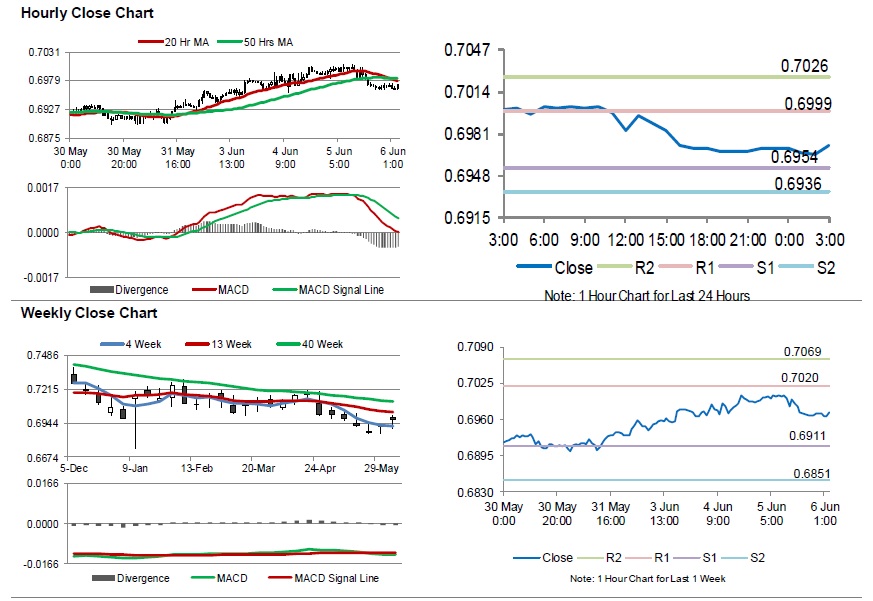
For the 24 hours to 23:00 GMT, the AUD declined 0.29% against the USD and closed at 0.6970.
LME Copper prices rose 0.5% or $28.5/MT to $5832.5/MT. Aluminium prices rose 0.8% or $14.5/MT to $1766.0/MT.
In the Asian session, at GMT0300, the pair is trading at 0.6972, with the AUD trading marginally higher against the USD from yesterday's close.
Overnight data showed that Australia's seasonally adjusted trade surplus narrowed to A$4871.0 million in April, compared to a revised surplus of A$4887.0 million in the previous month. Market participants had expected the nation recorded a surplus of A$5000.0 million.
Separately, the IMF cut Australia's largest trade partner, China's growth forecast citing trade tensions.
The pair is expected to find support at 0.6954, and a fall through could take it to the next support level of 0.6936. The pair is expected to find its first resistance at 0.6999, and a rise through could take it to the next resistance level of 0.7026.
Looking ahead, traders would await Australia's AiG performance of construction index for May and home loans for April, set to release overnight.
The currency pair is trading below its 20 Hr and 50 Hr moving averages.
Gold: Yellow Metal Reverses Its Gains In The Asian Session
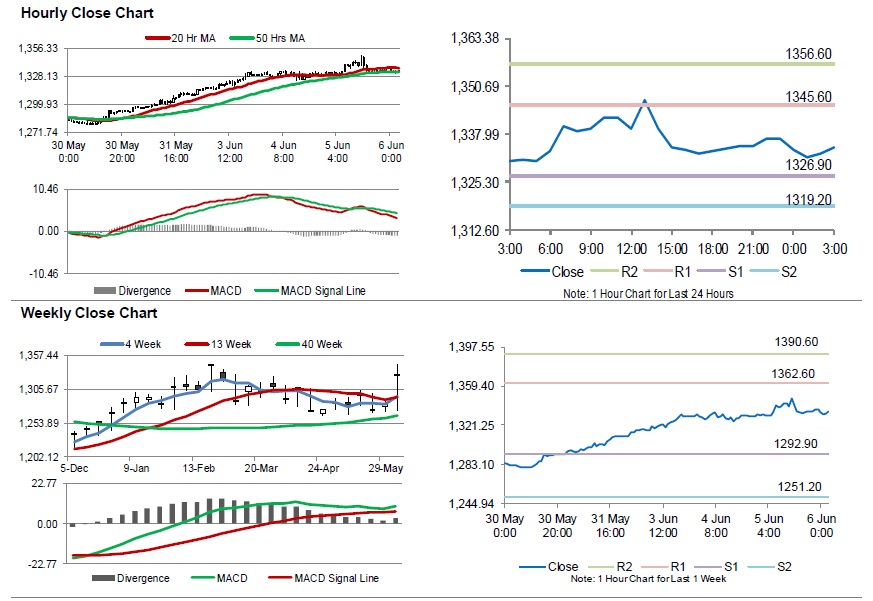
For the 24 hours to 23:00 GMT, Gold rose 0.51% against the USD and closed at USD1336.70 per ounce, amid expectations that the Federal Reserve would cut interest rates in the upcoming policy meeting.
In the Asian session, at GMT0300, the pair is trading at 1334.60, with gold trading 0.16% lower against the USD from yesterday’s close.
The pair is expected to find support at 1326.90, and a fall through could take it to the next support level of 1319.20. The pair is expected to find its first resistance at 1345.60, and a rise through could take it to the next resistance level of 1356.60.
The yellow metal is trading below its 20 Hr moving average and showing convergence with its 50 Hr moving average.