

Sample Category Title
Crude Oil Inventory Build Adds to Oversupply Concerns amidst Global Slowdown
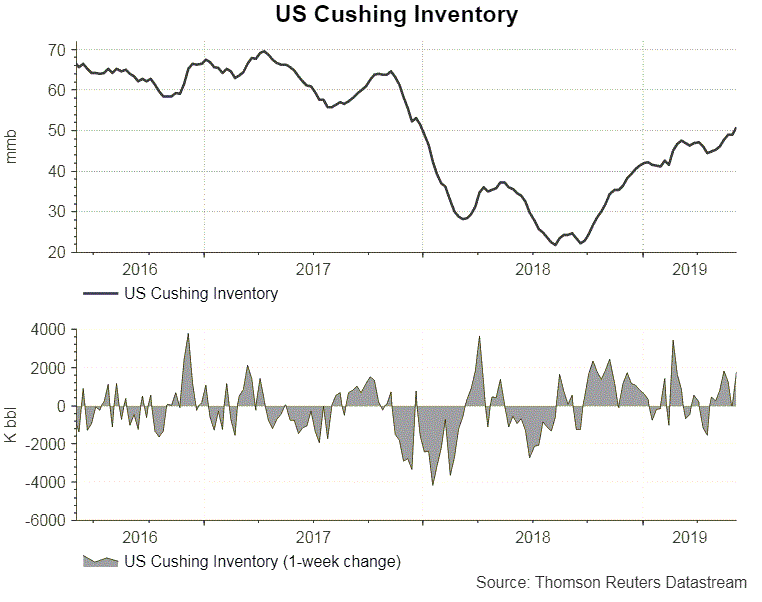
Having fallen over -20% from April's peak, oil price has uncomfortably entered a bear market. Intensification of US- China trade war, slowdown in economic growth in major economies, Brexit uncertainty and other geopolitical factors have heightened concerns about the global oil demand. Stock- builds in the US only adds to the weakness in oil price. The report from the US Energy Information Administration (EIA) shows that total crude oil and petroleum products (ex. SPR) stocks jumped sharply, by +22.44 mmb to 1307.93 mmb in the week ended May 31. Crude oil inventory jumped +6.78 mmb to 483.26 mmb (consensus: -0.85 mmb). Inventories rose in 4 out of 5 PADDs. Stockpile in PADD3 (Gulf Coast) alone gained +3.47 mmb during the week. Utilization rate climbed +0.6% to 91.8% while crude production added +0.1M bpd to 12.4M bpd for the week. Crude oil imports added +1.07M bpd to 7.93M bpd in the week.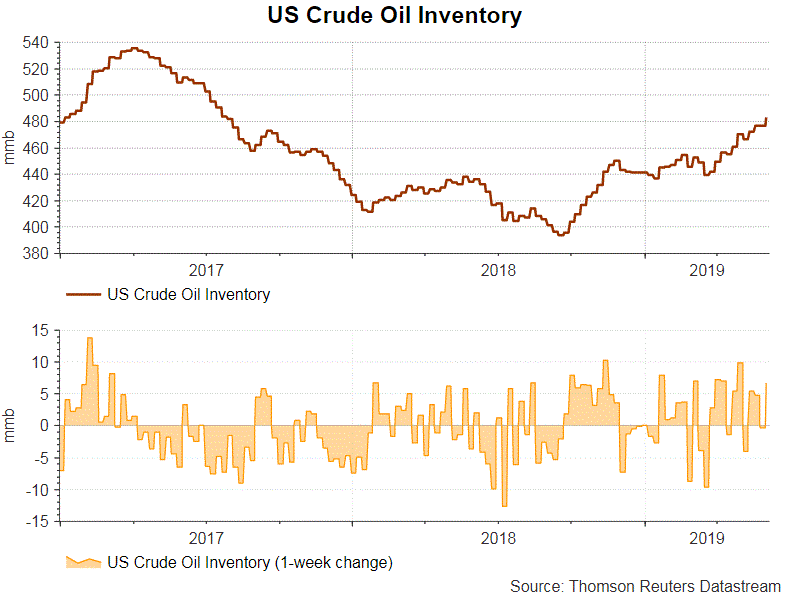
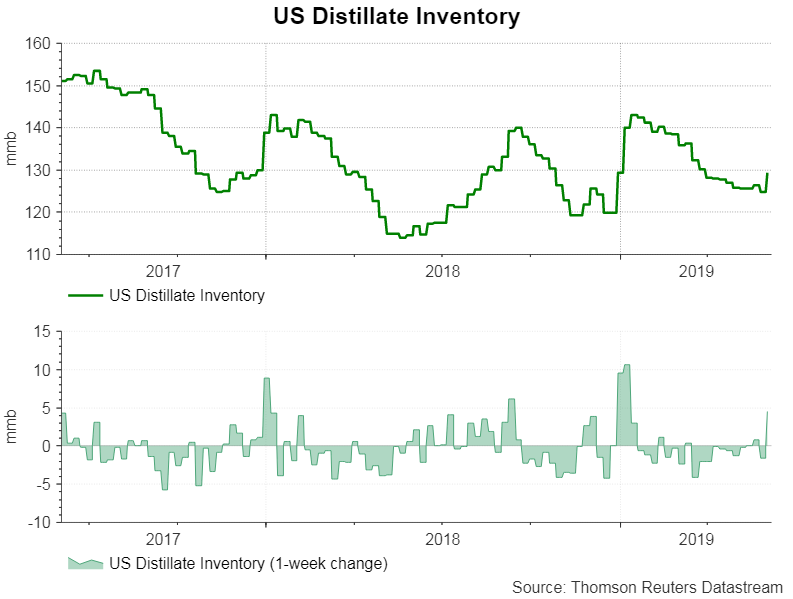
 Concerning refined oil product inventories, gasoline inventory gained +3.21 mmb to 234.15 mmb although demand increased +0.5% to 9.44M bpd. The market had anticipated a +0.63 mmb increase in stockpile. Production rose +1.89% to 10.05 bpd while imports added +0.74% to 1.1M bpd during the week. Distillate inventory rose +4.57 mmb, to 129.37 mmb. Demand declined -20.9% to 3.39M bpd. The market had anticipated a +0.5 mmb gain in inventory. Production slumped -36.72% to 0.11M bpd while imports gained +4.28% to 5.4M bpd during the week.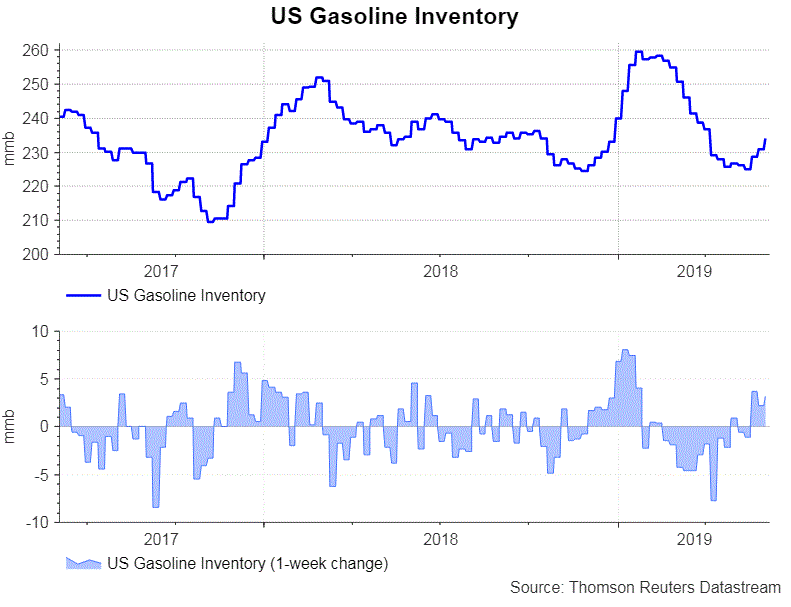
 Released after market close on Thursday, the industry- sponsored API estimated that crude oil inventory rose +3.55 mmb during the week. For refined oil products, gasoline stockpile added +2.70 mmb while distillate jumped +6.31 mmb.
Fed Beige Book Points to Modest Economic Expansion from April to Mid-May, But Uncertainty Has Risen
- Today's Beige Book showed that economic activity increased at a modest pace across the twelve Federal Reserve Districts from April to mid-May, a slight improvement over the previous period. Almost all Districts reported some growth and a few saw moderate improvement in activity.
- Reports on manufacturing activity were generally positive, but some Districts noted signs of slowing activity (Boston, Cleveland and Richmond) and a more uncertain outlook due to trade tariffs. Notably, "tariffs" were mentioned 37 times in the report – up from 19 in the previous issue, and "uncertainty" was mentioned 19 times – up from 12.
- Its characterization of the labor market remained unchanged relative to prior issues of Beige Book. Businesses continued to report significant labor shortages, which was keeping a lid on employment growth in some Districts and industries.
- Both inflation and wage pressures remained relatively subdued. In terms of prices, some Districts cited an easing in prices of steel, metal and lumber, but noted higher freight prices. Prices of agricultural commodities remained low relative to historical levels. Retailers were reportedly keeping their prices flat or increasing slightly. Despite tight labor markets, the majority of Districts reported modest-to-moderate wage growth, but employers continued to ramp up non-wage benefits in order to attract and retain employees.
- Activity in the residential construction and real estate was said to be expanding, but there were large variations in sentiment across Districts. Reports on consumer spending were positive but tempered, while auto sales were said to be lower.
Key Implications
- Similarly to the previous report, this Beige Book continued to paint the picture of modest economic activity in the second quarter of the year. One notable change was a significant increase in the number of times tariffs were mentioned. Both the current tariffs and the lingering trade uncertainly were clearly top of the mind for businesses. Several contacts mentioned that they have been developing contingency plans to reduce capital spending and payrolls to offset tariffs. Others have mentioned that they expected much more of an impact on consumers from the recent 25% tariff on some Chinese imports relative to the initial 10% increase, which was largely "absorbed along the supply chain".
- Trade tensions are also front and center on the Fed's risk radar. Earlier this week, Fed Chairman Jerome Powell reaffirmed that the Fed was closely monitoring the impact of trade developments on the U.S. economy, and was ready to "act as appropriate to sustain the expansion.”
- Overall, we expect economic growth to moderate in Q2, and today's edition of the Beige Book appears to be consistent with this view. As the temporary factors that boosted headline growth in Q1 reverse course this quarter, growth is likely to slow below 2%.
Oil Drops After Monster Surprise Buildup Of US Inventories
Oil prices fell on Wednesday after the Energy Information Administration (EIA) published the weekly US crude inventories. The surprise buildup of 6.8 million barrels of crude and 3.2 million barrels of gasoline put downward pressure on energy prices. Brent fell 2.28 percentage and WTI recorded a loss of 3.31 percentage as the US dollar also found its footing and rose against major pairs.
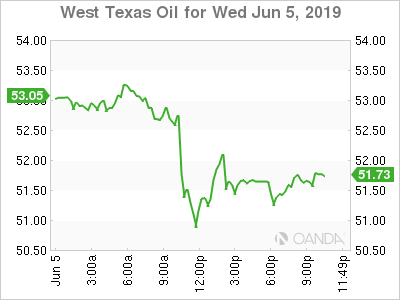
A rate cut by the U.S. Federal Reserve is rising in probability and with it the greenback has lost its appeal as investors are seeking yield elsewhere. Trade wars have kept the US dollar bid and were in a factor in the rebound seen on Wednesday. 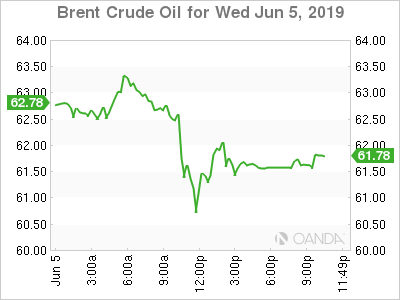
Rising US production is more than offsetting the efforts from the OPEC+ and if we add the negative effect a trade war could have on energy demand the result is lower prices. Russia has not been totally on board with rejoining the agreement to cut output after it ends in June, without a major producer the weight of the cuts would be even more on Saudi Arabia.
Does Draghi Have One Last Surprise In Store?
Plenty for traders to be on the lookout for on Thursday
The ECB meeting on Thursday may be an interesting affair given the current global economic environment – one the euro area has shown it’s far from immune to – but we shouldn’t expect any knockout announcements.
- ECB may await Draghi successor
- Traders eye TLTRO III details
- Macroeconomic projections may signal future stimulus
I don’t think anyone would suggest we won’t see further attempts at stimulus over the next 6-12 months – although how they would do that having just wrapped up the QE program would be interesting – but the timing of the meeting may discourage any significant action.
Draghi is due to be replaced as ECB President at the end of October and while his successor hasn’t yet been selected, he may prefer to leave it to them to lead the next phase of the central bank. Perhaps if his predecessor had made a similar choice, the ECB wouldn’t have had to reverse course and cut rates at his first meeting back in November 2011.
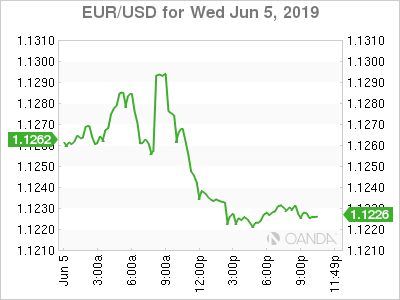
As I said though, that doesn’t mean this won’t be an interesting and potentially market moving meeting. The central bank doesn’t stop just because plans are already underway for its chief’s leaving party.
In fact, another round of TLTROs were recently announced and traders are keen to find out exactly what the terms of it will be. Will they be generous and therefore act as a small stimulus during a difficult period for the region, or will they be less so and rather just intended to ensure the continued flow of liquidity for the regions more stressed banks.
Could the ECB respond to weaker inflation readings?
We’ll also get a new batch of growth and inflation forecasts from the central bank which will be of interest, especially when you consider the direction of travel recently from almost every major central bank.
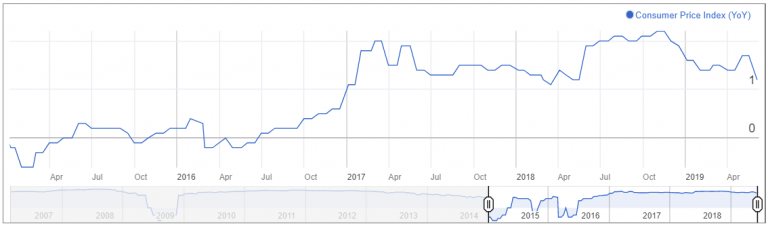
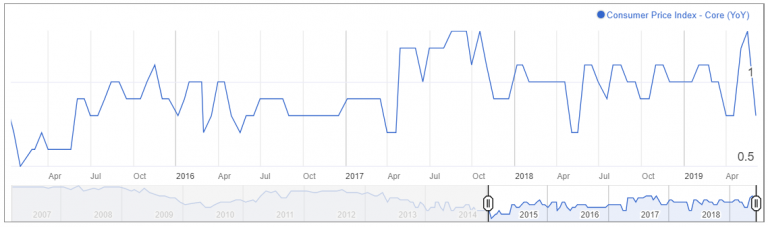
Moreover, the latest dip in inflation suggests the central bank may have to once again get creative, not only to boost growth but also to drive inflation higher, with 1.2% overall and 1% on a core basis not even near the target of below but close to 2%.
The next ECB President has quite a job on their hand and tomorrow may give us a better idea of just how big a job that is. I think Draghi will think it easy by comparison to what he’s dealt with over the last eight years and fingers crossed, the next President won’t have to rely on a now infamous, euro-saving, “whatever it takes” speech, to prevent the collapse of the common currency.
Eco Data 6/6/19
[php_everywhere instance="1"]
Spot Gold Spikes to 3-Mth High on Risk Aversion and Signals of Fed Rate Cut
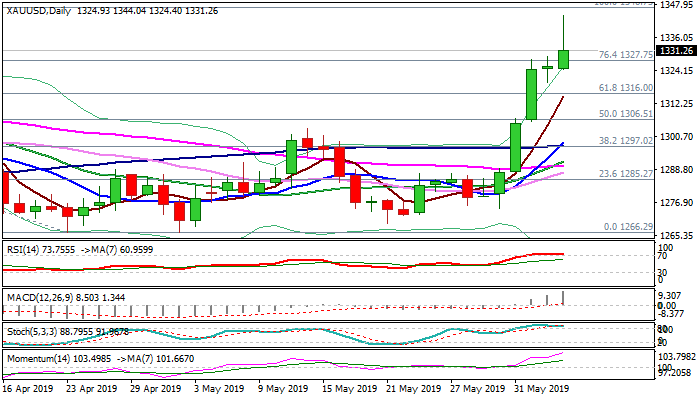
Spot gold spiked to three-month high at $1344 on Wednesday, extending strong rally from last Thursday’s low at $1275 and approaching key short-term barrier at $1346 (2019 high, posted on 20 Feb).
Fresh advance is on track to fully retrace multi-month $1346/$1266 pullback and resume larger uptrend from 2018 low at $1160 (16 Aug).
The yellow metal’s price accelerated higher last week on signs of spreading trade war that prompted investors from riskier assets into safe-haven, with dovish comments from top Fed officials, signaling that the Fed may start cut interest rates on growing concerns about global growth slowdown.
Bulls show hesitation ahead of key $1346 barrier, as bulls started to run out of steam on strongly overbought studies.
Price adjustment may precede final attempt through $1346 pivot, with $1327 (broken Fibo 76.4% of $1346/$1266) and former high of 25 Mar ($1324) marking solid supports which should ideally contain dips and guard pivotal supports at $1316 (broken Fibo 61.8%) and $1315 (rising 5SMA).
Res: 1344; 1346; 1355; 1365
Sup: 1327; 1324; 1315; 1310
Brexit Waiting Game; Who’s Next? What GBP Positioning We Could Expect after First Couple Rounds of Votes
The Conservative Party will deliver a new Prime Minister to Britain on the week of July 22nd. A lot will happen before we have clarity on who the final two candidates will end up being and we could see the British pound trade more so on the broader dollar moves, than to anything about the UK economy in the short-term.
About 11 MPs are interested in running, two candidates, James Cleverly and Kit Malthouse have dropped out, and more are expected to announce their intentions. Nominations will close on June 10th.
The crowded field of candidates will thin following initial ballots on June 13th, 18th, 19th, and 20th. The key thresholds for the first round of voting is 16 votes. The second round will require 32 votes. The next rounds will then see the candidate with the least votes be excluded, which will likely see many dropping out when it becomes apparent they will not win the top spot. Once the field is narrowed to the top two, the Conservative Party and their over 200,000 members will decide on who gets to reside at 10 Downing Street.
Historically the front-runner does not do well with Prime Minister selections. In 2016, Boris Johnson was the front-runner, but he didn’t fair to well. Eventually, PM May won after Andrea Leadsom dropped out. The current favored candidates are Boris Johnson, Michael Gove, Jeremy Hunt, Dominic Raab and Sajid Javid. If we end up seeing Johnson, Gove and Raab become the favorite after the first few rounds of voting, we could see GBP soften as the hardest Brexit odds will likely go up. If Javid or Hunt get the nod, that could be pound neutral or bullish.
Positioning also firmly depends on market expectations on Fed rate cuts, both timing and size. The dollar could be at a key turning point so the British pound could see a strong rebound if we see an easing of no-deal exit expectations.
Once we have a new PM, the scenarios for Brexit remain countless. The new leader will likely seek renegotiations with the EU, but if that does not go well, like it did for PM May, we could see a no-deal Brexit be pursued, a general election or even a second referendum.
Australia GDP Improves in Q1, but Aussie Edges Lower
AUD/USD has posted slight losses in the Wednesday session, erasing the gains seen on Tuesday. In North American trade, AUD/USD is trading at 0.6976, down 0.18% on the day. In Australia, AIG Services Index improved to 52.5 in May, showing slight expansion in the services sector. This follows four straight months of contraction. Australian GDP improved to 0.4% in Q1, matching the forecast. Later in the day, Australia releases trade balance, which is expected to widen to A$5.05 billion. In the U.S., ADP nonfarm payrolls posted a meager gain of 27 thousand, compared to the estimate of 185 thousand. In the services sector, the ISM Non-Manufacturing PMI improved to 56.9, above the estimate of 55.6. On Thursday, the U.S. posts unemployment claims.
As expected, the RBA lowered the benchmark rate by 25 basis points, to 1.25%. The Australian economy has been gripped by a slowdown due to weaker demand from China, but the RBA had balked at cutting rates, despite acknowledging the weaker economic outlook. The cut is aimed at stabilizing the economy and encouraging stronger consumer consumption, a key driver of economic growth.
Is the Federal Reserve planning a rate cut? Fed policymakers have tried to present an aura of neutrality regarding rate moves, but has taken a sharp U-turn this week in favor of an easing bias. On Tuesday, Fed chair Jerome Powell said that the Fed would “act as appropriate to sustain the expansion”, and analysts noted that he did not mention his “patient” approach to monetary policy, which has been a buzzword in Powell’s recent comments. This comes on the heels of comments from James Bullard, president of the St. Louis Fed. Bullard stated that the Fed might have to lower rates shortly due to low inflation and the ongoing trade war with China. Bullard warned that the Fed may have to deal with “an economy that is expected to grow more slowly going forward, with some risk that the slowdown could be sharper than expected due to ongoing global trade regime uncertainty“. Bullard added that the current benchmark rate, which is at a range of 2.25% to 2.50%, is too high for current economic conditions, and recommended lowering rates in order to stabilize the economy.
IMF Lagarde: Global growth stabilizing, but must avoid self-inflicted wounds
In a blog post titled "How to Help, Not Hinder Global Growth", IMF Managing Director Christine Lagarde "most recent economic data indicate that global growth may be stabilizing". She noted "while first-quarter economic activity disappointed in parts of emerging Asia and Latin America, growth was stronger than expected in the United States, the euro area, and Japan. "
The most important "stumbling block" is trade tensions. Lagarde said "there is strong evidence that the United States, China, and the world economy are the losers from the current trade tensions". Overall, US-China-tariffs could reduce global GDP by 0.5% in 2020, or USD 455B. And she warned that "these are self-inflicted wounds that must be avoided".
U.S. Non-Manufacturing Sector’s Expansion Strengthens in May
- The Institute for Supply Management's (ISM) non-manufacturing index rose to 56.9 in May (from 55.5), ending its two-month losing streak. The headline print came in above consensus expectations, which called for the index to remain relatively flat at 55.4.
- Three of the index's four key subcomponents strengthened on the month. Delving into details, the employment subcomponent posted the biggest gain, surging to 58.1 (from 53.7). Business activity improved for the second month in a row, rising to 61.2 (from 59.5), and new orders edged slightly higher to 58.6 (from 58.1).That being said, the backlog orders declined to 52.5 (from 55.0), and supplier deliveries fell by 1.0 points, moving into contractionary territory for the first time since December 2015.
- After pulling back in April, price pressures eased further in May. The prices paid subcomponent edged down 0.3 points to 55.4, and is considerably below its year-ago level.
- Trade-related components showed broad-based deterioration. Export orders fell to 55.5 from 57.0, and import orders declined to 50.0 from 55.0, narrowly avoiding slipping into contractionary territory. It's important to note that trade components are not seasonally adjusted, and thus the monthly moves should be interpreted with caution. Both export and import orders remain below their year-ago levels.
Key Implications
- May's headline for the ISM non-manufacturing index delivered a nice surprise, diverging from its manufacturing counterpart and defining expectations of a flat reading. While both indexes trended lower since the second half of last year, the services sector continues to outperform its manufacturing counterpart, with the wedge between the two measures that opened up last September widening in May. This suggests that the services sector is facing fewer challenges than the relatively more trade-exposed manufacturing sector.
- Survey respondents remained upbeat about the economy and domestic demand, even as concerns about labor shortages and tariffs persisted. The desire to continue adding to payrolls is a testament to business optimism.
- Despite the solid performance last month, service-sector performance may deteriorate in the coming months if trade tensions continue to escalate. Recent increase in tariffs on imports from China, and potential tariffs on goods from Mexico will impose real cost on the U.S. consumers, with adverse implications to the bottom lines of service-sector businesses. Agriculture, hospitality, and trade-related industries look to be particularly hard-hit, with the feedback loop to manufactures of items such as agricultural equipment, machinery and autos.