

Sample Category Title
Aussie Remains Bid But Needs Clear Break Above 0.70 Barrier For Bullish Continuation
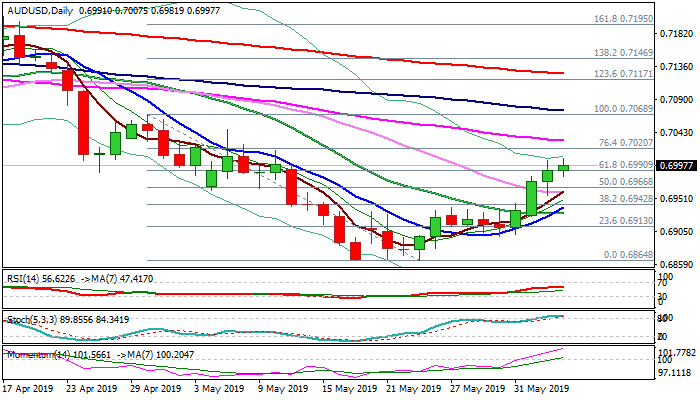
The Australian dollar remains at the front foot on Wednesday and probes again through cracked double-Fibo barriers at 0.6990/94 and psychological 0.70 level.
Positive tone on weaker US dollar after further dovish comments from Fed officials, offsets negative signals from weaker than expected Australian GDP (Q1 0.4% vs 0.5% f/c) which adds to signals for further RBA easing and China’s Services PMI falling well below expectations (May 52.7 vs 54.3 f/c).
Strong bullish momentum and multiple daily MA’s bull-crosses underpin the advance, which requires close above 0.70 barrier to signal continuation of recovery phase from 0.6864 base towards 0.7032 (falling 55SMA) and 0.7074 (falling 100SMA) in extension.
Bull-cross (5/30SMA’s) at 0.6961 marks solid support which should contain dips and keep bullish bias.
Res: 0.7007, 0.7020, 0.7032, 0.7074
Sup: 0.6981, 0.6961, 0.6944, 0.6926
EU Dombrovskis: EDP on Italy is not just about procedure
European Commission Vice President Valdis Dombrovskis said the Commission concluded that Italy's debt criterion is not complied with and there fore a "debt-based excessive deficit procedure (EDP) is warranted". EDP is not opened today yet. And EU member states will give their views on the report on Italy first. Then, economic and financial committee has two weeks to form its opinion. He added "it's much more than just about the procedure, when we look at the Italian economy we see the damage that recent policy choices are doing."
The Commission estimated that Italy used EUR 2.2B more than expected to service its debt in 2018. And it's paying as much toward its debt servicing as it does toward its entire education system. Dombrovskis added "growth has come to almost a halt ... and we now expect the Italian debt (to GDP) ratio to rise in 2019 and 2020 to over 135%."
Earlier today, coalition League's economic chief Claudio Borghi rejects fiscal tightening measures and warned that Economy Minister Giovanni Tria must take a "hard line on EU budget talks".
Loonie Turns Eyes To Canadian Jobs Data
The latest monetary policy meeting in the preceding week by the Bank of Canada highlighted the importance of the labor market, making the Canadian employment report due on Friday at 1230 GMT the next major event for the loonie.
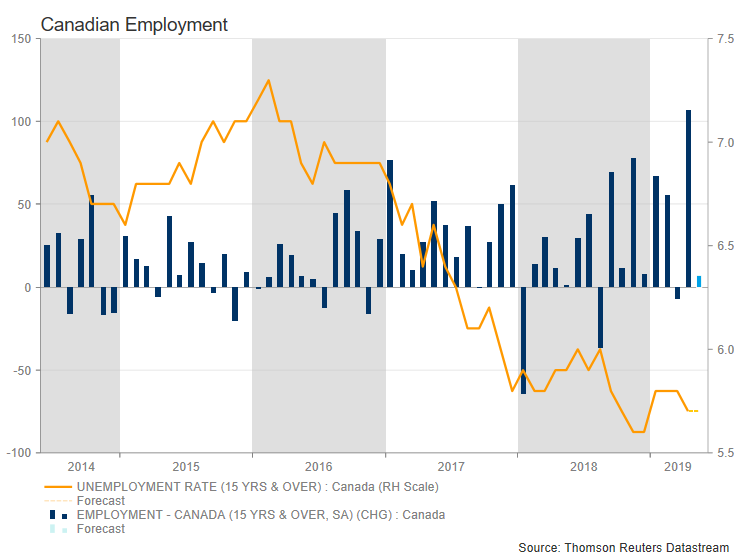
After hitting a record of 106.5k increase in April, the Canadian economy is expected to have created 7.5k new job positions in May. The participation rate is predicted to tick lower to 68.5% from 65.9% previously, while the unemployment rate is not anticipated to excite as the measure is seen steady at 5.7% so there could be some gains ahead for the loonie if wage growth and employment numbers show some improvement in the labour market.
The Bank of Canada (BoC) left its interest rates unchanged at 1.75% on May 29, as widely expected, which is the highest rate since December 2008. The Bank Rate is correspondingly 2% and the deposit rate is 1.5%. The Bank, which has increased interest rates five times since July 2017, mentioned that it expects growth to advance in the second half of the year, as housing market indicators point to a more stable national market, albeit with continued weakness in some regions.
Policymakers mentioned that the economic slowdown in late 2018 and early 2019 was temporary. The BoC attributed the vulnerability of the economy to global developments, stating that global trade tensions were high risks over the country’s economic outlook. Good news came from the monthly GDP estimates, which ticked higher with a gain of 0.6% in March, after a drop of 0.1% before.
Trade risks continue to have an impact on the Canadian dollar. Tensions between the US and China remain high, with no talks scheduled between the two sides. Last week, US President Donald Trump threatened to slap tariffs on all Mexican products for Mexico’s failure to deal with the large influx of illegal immigrants into the US. Although, Trump said that tariffs would be set at just 5%, stock markets edged aggressively lower. The new tariffs between the US and Mexico could also hurt the Canadian economy and the loonie.
Inflation has grown in line with the Bank’s April projection. The Bank expects CPI inflation to remain around the 2% target in the coming months. Core inflation measures all remain close to 2%.
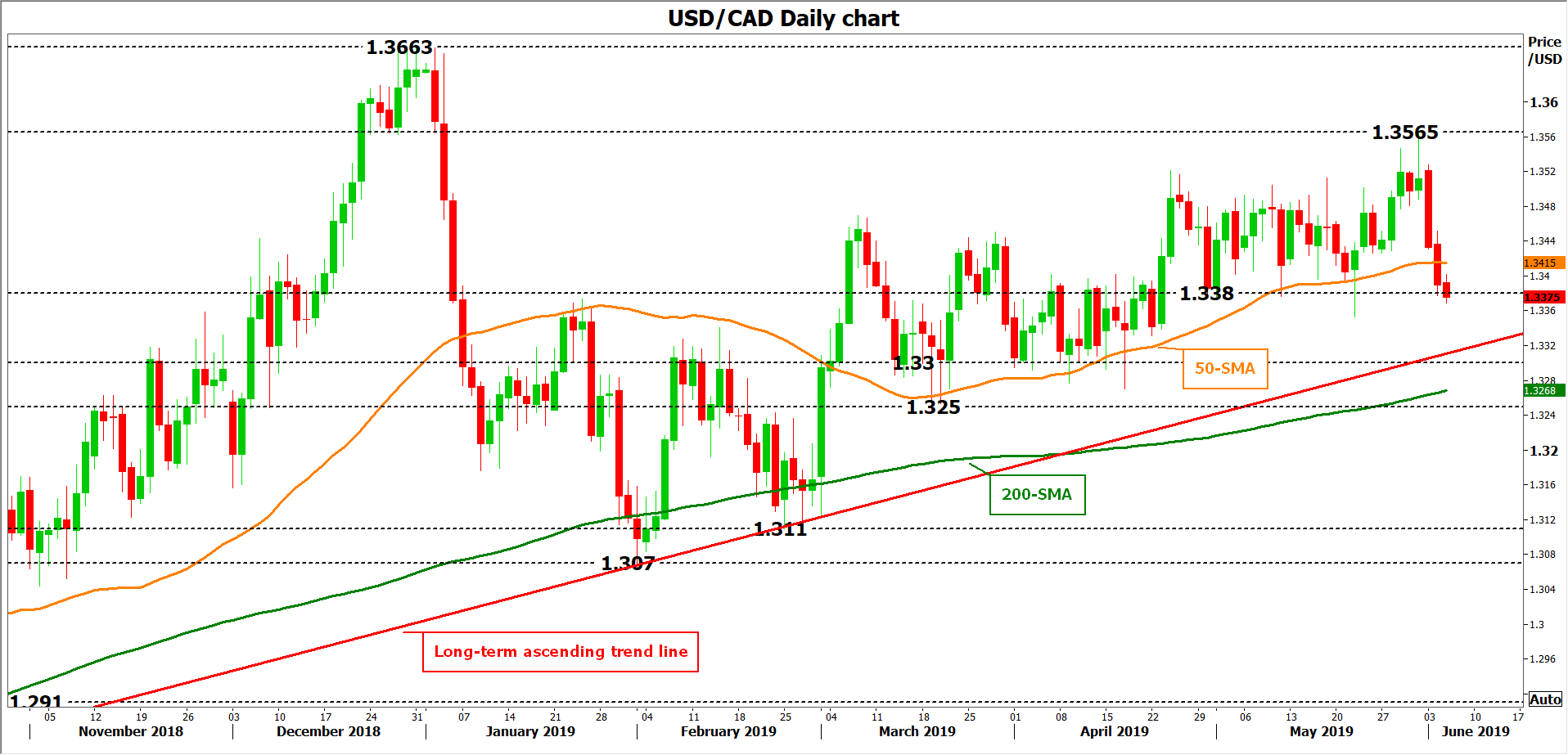
Turning to market reaction, the Canadian dollar has been gaining considerable ground against the dollar over the last few days. However, a weaker-than-predicted jobs report on Friday, could reduce chances for a rate hike and drive USDCAD to test the four-month high of 1.3550 and then the 19-month high of 1.3663, identified by the peaks on December 31.
Alternatively, if the employment report shows growth or/and the unemployment rate shifts lower, the pair could return to the 1.3300 support area, below the long-term rising trend line while steeper declines could also revisit the 1.3250 barrier.
US Nonfarm Payrolls Eyed As Market Pressure Grows On Fed To Cut Rates
It's that time of the month again and all eyes will be on the latest jobs report out of the United States on Friday at 12:30 GMT. The May figures are expected to be somewhat softer from April but no doubt still indicative of a strong economy. However, with markets strongly convinced that the Fed will have to cut rates soon, the jobs data is unlikely to alter those expectations unless there are big surprises in the data.
With some early signs that the US economy could be headed for a slowdown as the worsening trade dispute starts to bite into business confidence, the labour market so far remains very tight. But despite the decades-low unemployment rate, wage growth has been disappointingly tepid, keeping a lid on inflationary pressures.
Fewer jobs likely added in May
The May report is expected to underline this picture. Nonfarm payrolls are forecast to have risen by 185k in May, easing from the prior number of 263k. Anything above 100k is seen as consistent with jobs growth keeping up with population growth, meaning alarm bells won't be ringing about the labour market until the headline figure drops below this benchmark.
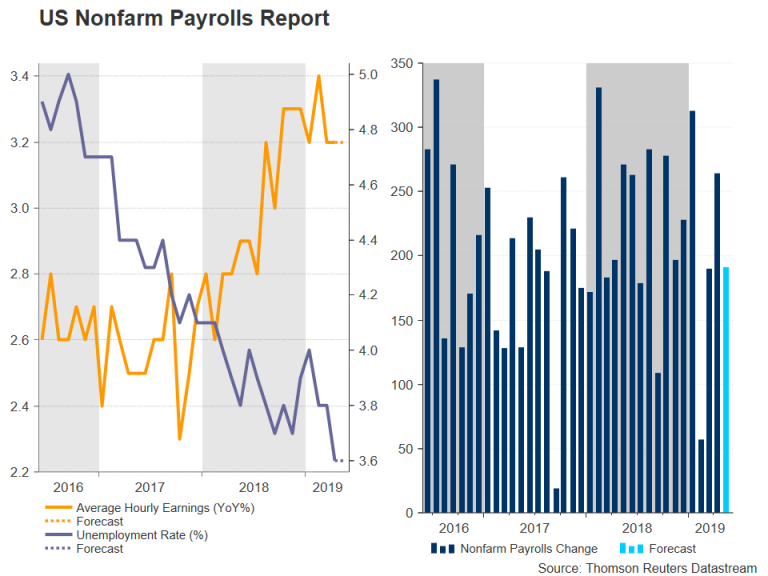
The jobless rate is forecast to stay unchanged at the 49-year low of 3.6%. More significantly, average hourly earnings are expected to have increased by 0.3% month-on-month, which would keep the annual rate at 3.2%. Wage growth has eased slightly from the decade-high of 3.4% y/y reached in February in a setback for policymakers who were hoping a healthy jobs market would fuel pay increases, which in turn would drive consumer prices higher.
Moderate wage growth a concern for the Fed
A further easing in wage growth would be a major worry for the Fed given that the central bank's favoured inflation gauge, the core PCE price index, is already running uncomfortably below the 2% target; it stood at 1.6% y/y in April. Some would argue that alone gives the Fed a strong case to lower borrowing costs even before there's been a notable impact from the brewing trade tensions.
Markets have clearly made up their minds, though, as Fed fund futures are pointing to as much as three 25-bps rate cuts over the next 12 months. That's been enough to send Treasury yields spiralling downwards and the US dollar losing its safe-haven allure to plunge against its major peers.
Dollar seeks support, looking for a rebound
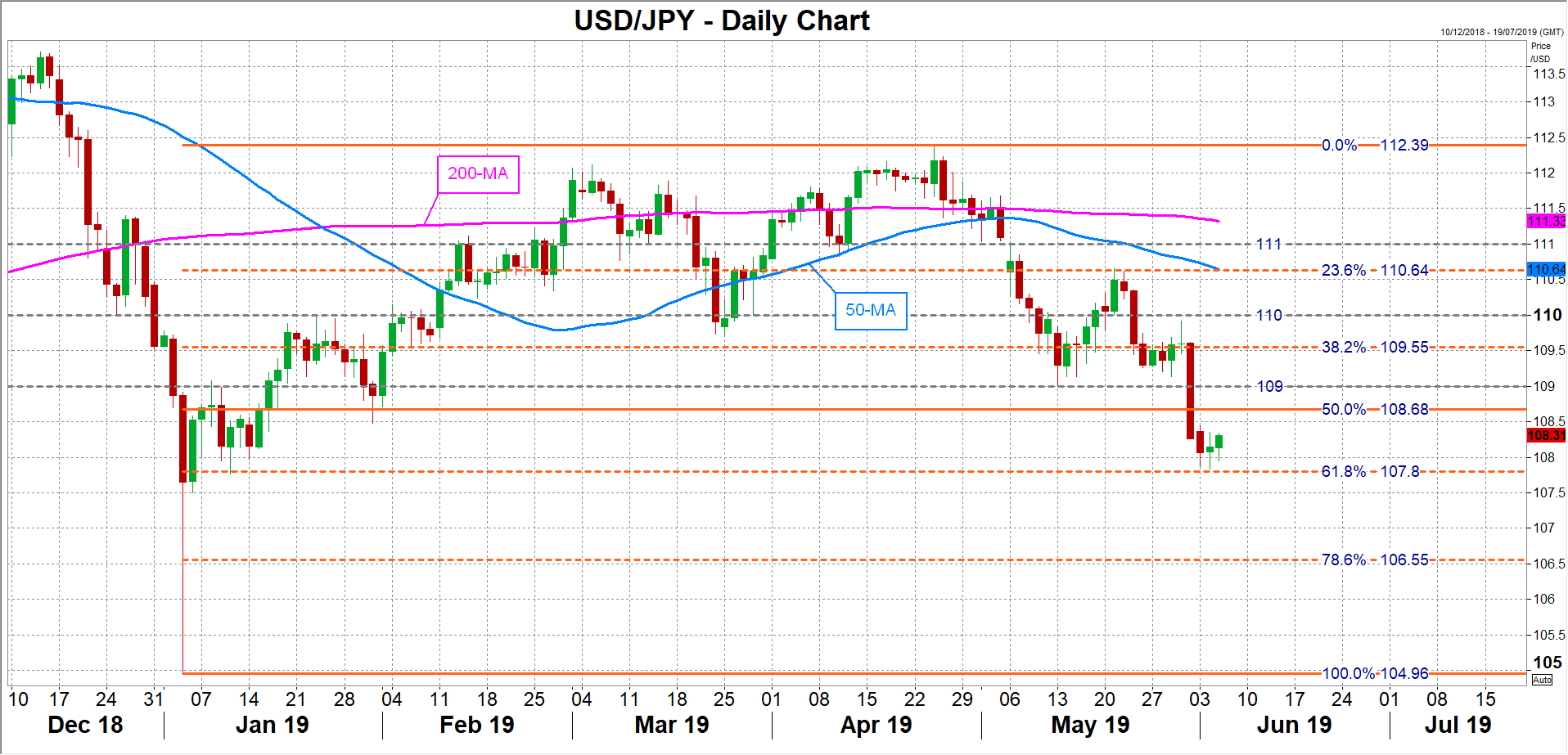
At the moment, the dollar has found support at the 61.8% Fibonacci retracement of the 104.96-112.39 uplgeg at 107.80 yen. Should a weaker-than-expected jobs report pull dollar/yen below this level, the next support could arrive at the 78.6% Fibonacci at 106.55.
However, if the payrolls data impresses, giving the Fed reason to remain patient, the bulls could see ground for a rebound. A possible important resistance level to overcome that could help ease the selling pressure is the 23.6% Fibonacci at 110.64, which is near the 50-day moving average.
Traders may be cautious ahead of June Fed meeting
But with the next FOMC meeting about two weeks away, market reaction to the NFP report may be muted and investors will probably be paying more attention to what Fed officials will be signalling in their remarks in the coming days ahead of the blackout period before the meeting.
St. Louis Fed President James Bullard became the first voting FOMC member to suggest the Fed should cut rates if the trade uncertainty causes a sharper-than-expected slowdown in growth. Fed Chairman Jerome Powell gave less away when he spoke on Tuesday. However, he did indicate the Fed was ready to act “as appropriate” to the growing risks to the economy, potentially opening the way for a rate cut.
EUR/USD – Euro Rally Continues As Fed’s Powell Hints At Rate Cut
EUR/USD has posted winning sessions for three successive days, and the upward trend has continued on Wednesday. Currently, the pair is trading at 1.1284, up 0.26% on the day. On the release front, German and eurozone services PMIs beat expectations, with scores of 55.4 and 52.9, respectively. Eurozone retail sales dropped 0.4%, its first decline in four months. In the U.S., ADP nonfarm payrolls is expected to drop to 185 thousand in May, after a sparkling gain of 275 thousand in April. ISM Non-Manufacturing PMI is projected to show strong expansion, with an estimate of 55.6. On Thursday, the ECB is expected to maintain its key interest rate at a flat 0.00%. In the U.S., the key event is unemployment claims.
There were no surprises from the PMIs readings in May. The services sector continue to shows expansion in both Germany and the eurozone. The German release slowed to 55.4, down from the reading of 55.7 in April. It was a different story for manufacturing, as manufacturing PMIs pointed to contraction in Germany and the eurozone. Both indicators have been mired in contraction territory for most of 2019. This is a result of ongoing trade tensions, which have reduced global demand for German and eurozone exports, and dampened the manufacturing sectors.
The Federal Reserve has tried to present an aura of neutrality regarding rate moves, but has taken a sharp U-turn this week in favor of an easing bias. On Tuesday, Fed chair Jerome Powell said that the Fed would “act as appropriate to sustain the expansion”, and analysts noted that he did not mention his “patient” approach to monetary policy, which has been a buzzword in Powell's recent comments. This comes on the heels of comments from James Bullard, president of the St. Louis Fed. Bullard stated that the Fed might have to lower rates shortly due to low inflation and the ongoing trade war with China. Bullard warned that the Fed may have to deal with “an economy that is expected to grow more slowly going forward, with some risk that the slowdown could be sharper than expected due to ongoing global trade regime uncertainty“. Bullard added that the current benchmark rate, which is at a range of 2.25% to 2.50%, is too high for current economic conditions, and recommended lowering rates in order to stabilize the economy.
Stocks Edge Higher Again
Stocks edge higher again
Stock markets are edging higher again on Wednesday, although gains are far more modest than the rebound we saw a day earlier after Fed Chair Jerome Powell opened the door to a rate cut.
While Powell's comments weren't quite as dovish as Bullard's a day earlier and didn't suggest any change was imminent, they quite clearly intentionally didn't dispel the suggestion that a rate cut is on the horizon either. As far as traders are concerned, that's clearly as good as a confirmation, although June is still viewed as a long shot with markets pricing in only an 18% chance of a cut.
It may be the case that 19th June is viewed as coming too soon but that could change if we get a bad jobs report on Friday, something that may justify the case for a cut in the eyes of some policy makers. Ultimately, the trade war remains the greatest risk factor in many people's eyes though which makes the G20 meeting all the more important, not to mention how the data performs in the interim.
I'm sure views would change if talks between Trump and Xi this month are positive and the data holds up but as ever, there's a lot of if's and buts in there. The Fed will likely want to hold off as long as possible to avoid talk of policy mistakes in December, when they rather oddly decided to raise interest rates for a fourth time in 12 months, rather than hold off during a period of significant instability in the markets.
Gold surges again as dollar breaks key support
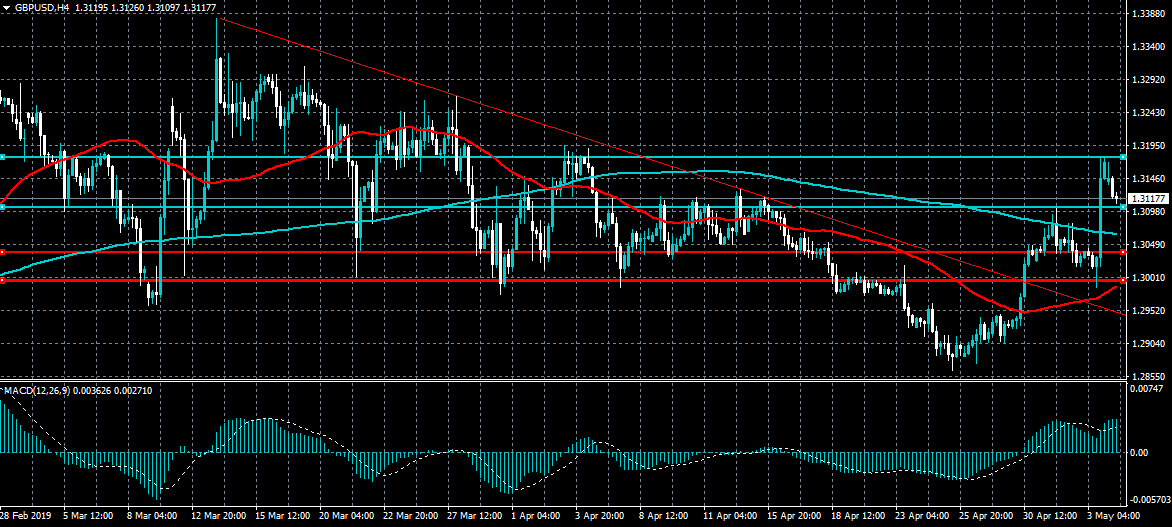
The dollar didn't soften as much as you may expect to the Powell comments, consider just how much of a bump they gave to equity markets, but it has continued to edge lower today. The greenback was trading around a potentially important support level when the comments were made which may explain the reluctance but we are below here now so the resistance didn't last long.
This has propelled gold higher today as it broke beyond the March high before running into resistance again just shy of the 2019 peak, around $1,340. There's no shortage of resistance just above here as well, should it break, with much longer term resistance being seen around $1,360-1,370. Momentum is already starting to fade as we approach these levels which may suggest they could at least trigger some profit taking and a correction after such a strong surge.
PMIs offer slight reprieve for battered currencies
We're seeing small gains in the euro and pound early in European trade, after a batch of PMI reports offered some minor good news. The reports for the UK and euro area pointed to slight improvements in the services sector – particularly important for UK – and exceeded expectations. Unfortunately, the trend is still very much against both so the numbers won't really change the perception that they're experiencing a slowdown with little sign of improvement.
An underperforming greenback and improved risk appetite though means both currencies are trading a little higher today, with the euro the slight outperformer. Both currencies have been under pressure for some time, the pound considerably so over the last month after the UK failed to leave the EU in March which then ultimately led to the resignation of Prime Minister May. With the prospect of a harder Brexit now more real, as various Brexiteers put themselves forward for the top job – one of which is currently the strong favourite – the pound may remain under pressure for a while.
Gold May Touch $1,350
Gold Ready To Make A Move
Back in the commodity space, gold price has moved higher once again because of the dovish stance adopted by the Fed. The precious metal price is trading near three-month high and it appears that the price may touch the level of 1350. The dollar index has touched seven week low, and the economic number released yesterday also confirmed that it is highly likely that the Fed will take some more favourable steps towards their monetary policy in order to stimulate the economy. As long as the dollar continues to move lower, I think it is likely that the path of the least resistance for the dollar price may remain to the downside.
Trade woes have taken another shape after Trump said that the is going to go ahead with trade tariffs on Mexico. The comments around more tariffs on Mexico, and the weakness in the dollar index, have brought major moves in the gold price. We have also seen more inflow in the gold ETFs and this confirms that the appetite for gold has strengthened.
USDJPY Watching Price Gap
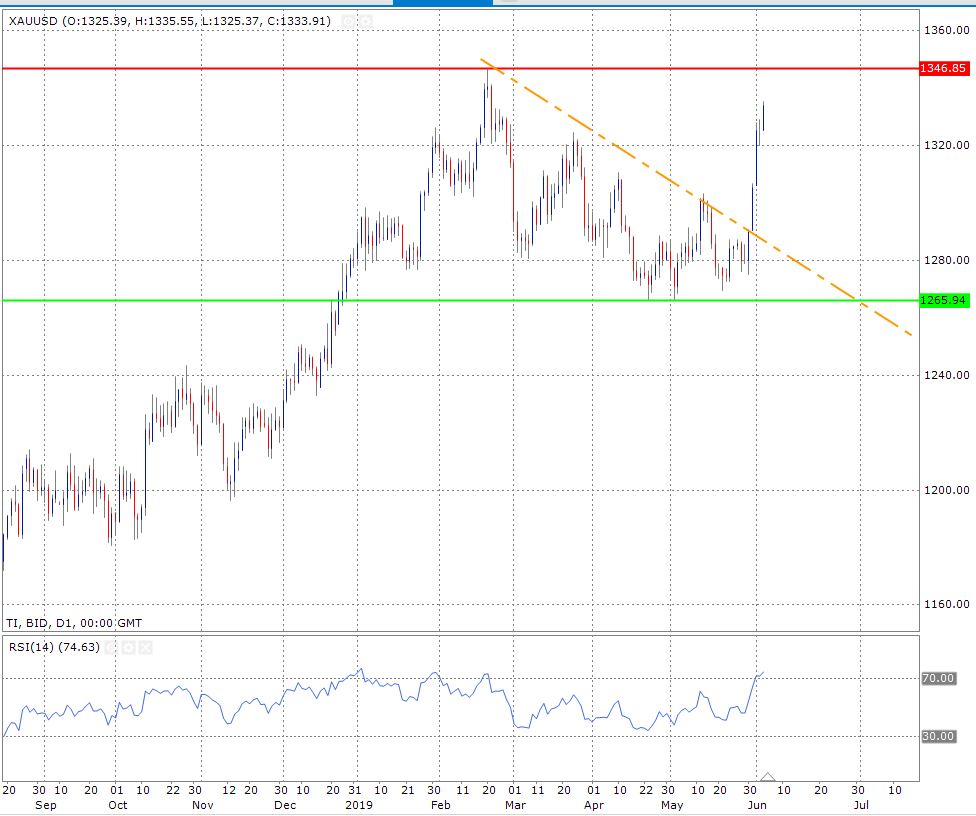
The US dollar is attempting to recover higher against the Japanese yen currency following the earlier heavy sell-off in the risk-sensitive pair. The opening price gap has yet to close on the charts and currently extends towards the 111.24 resistance level. Overall, the USDJPY pair is still at risk of even greater intraday losses while trade below the pivotal 110.90 resistance level.
The USDJPY pair is heavily bearish while trading below the 110.90, key intraday support is found at the 110.40 and 110.00 levels.
If the USDJPY pair trades above the 110.90 level, key intraday resistance remains at the 111.24 and 111.60 levels.
GBPUSD 1.3064 Key Pivot
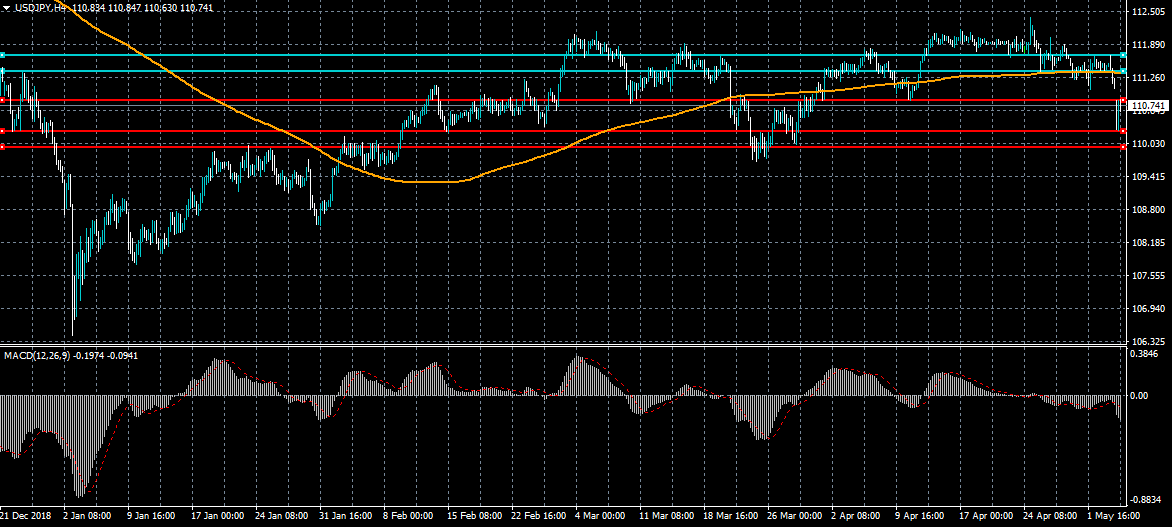
The British pound is starting to give back Friday’s trading gains against the US dollar as the greenback enjoys strong early week demand. The GBPUSD could fall back towards its key weekly pivot point, at 1.3064, if the 1.3100 support level is breached. If bulls defend the 1.3100 level, the 1.3180 level currently offers the strongest form of intraday technical resistance.
The GBPUSD pair is only bearish while trading below the 1.3100 level, key support is found at the 1.3064 and 1.3040 levels.
If the GBPUSD pair continues to trade above the 1.3100 level, key intraday resistance is found at the 1.3150 and 1.3180 levels.
Various Euro Area PMI Services Data Stay In Growth Territory
Notes/Observations
- Expectations rising that the Fed might be poised to cut interest rates this year.
- EU Commission seems likely to recommend an excessive deficit procedure against Italy
- Major European PMI services data remain in growth territory (Beats: Euro Zone, Germany, UK, Spain. Italy; Misses: France)
Asia:
- Australia Q1 GDP registered its slowest pace since 2009 (Q/Q: 0.4% v 0.5%e v 0.2% prior; Y/Y: 1.8% v 1.8%e)
- China May Caixin PMI Services: 52.7 v 54.0e
- RBNZ Assistant Gov Hawkesby stated that the central view was for interest rates to remain broadly around current levels for foreseeable future but did have room to provide stimulus if needed
Europe/Mideast:
- Italy Dep PM Di Maio (5-Star): confirmed he and Dep PM Salvini (League) had spoken and reached agreement to work together. Intended to govern for four more years, it's key to give govt stability
- Dep PMs Di Maio and Salvini said to have discussed option of breaching the EU’s 3% budget deficit rule
- EU Finance Ministers said to tell G20 counterparts this week resolving global trade tensions has highest priority
- UK Conservative Party spokesperson confirmed party would name a new PM by week of July 22nd
Americas:
- Fed Chair Powell: using low rates to lift inflation could risk fueling financial market excesses; Fed will act as appropriate to sustain expansion
- US Treasury Dept Spokesperson confirmed that PBoC Gov Yi Gang to meet with US Treasury Sec Mnuchin at upcoming G20 Finance Meeting
- US Commerice Dept Report noted to accelerate permitting process for rare earths mining. Cautioned that a halt in Chinese and Russian exports of critical minerals could cause significant shocks throughout the US and foreign supply chain
Energy:
- Weekly API Oil Inventories: Crude: +3.5M v -5.3M prior
SPEAKERS/FIXED INCOME/FX/COMMODITIES/ERRATUM
Equities
- Indices [Stoxx600 +0.17% at 373.54, FTSE +0.23% at 7,230.58, DAX +0.18% at 11,993.16, CAC-40 +0.23% at 7,230.58, IBEX-35 +0.22% at 9,137.44, FTSE MIB -0.33% at 20,163.50, SMI +0.44% at 9,639.80, S&P 500 Futures +0.28%]
Market Focal Points/Key Themes:
- European Indices trade higher once again tracking gains across Asia and further strength in US futures after steep gains yesterday following a slightly more dovish FED and slightly better Services PMI readings out of Europe.
- On the corporate front Norsk Hydro shares rise sharply on an earnings beat, with Card Factory gaining on a trading update, Biffa and GB Group also gain following earnings. Elsewhere Babcock International gains after the company affirmed their outlook.
- Meanwhile Impax Asset Management and Clas Ohlson decline on earnings, with Varta also falling following its production plans.
- In other news Bourbon gains following a restructuring offer from creditors; Provident Financial rises ~15% after Non-Standard finance withdrew its offer for the company, while Evotec gains following a strategic alliance with Celgene.
- Looking ahead notable earners include retailers G-III apparel, Brown Forman, American Eagle as well as Campbell Soup.
Equities
- Consumer discretionary: Card Factory [CARD.UK] +1.5% (earnings)
- Consumer staples: Clas Ohlson [CLSB.SE] -1.5% (earnings)
- Energy: Norsk Hydro [NHY.NO] +3% (earnings), Bourbon [GBB.FR] +15% (restructuring)
- Financials: Provident Financial [PFG.UK] +10% (lapse of offer), AA PLC [AA.UK] +4% (AGM statement), Impax Asset Management [IPX.UK] -5% (earnings)
- Healthcare: Evotec [EVT.DE] +2.5% (collaboration)
- Industrials: Varta [VAR1.DE] -3.5% (expands production), Babcock [BAB.UK] +2.5% (outlook), Chemring Group [CHG.UK] +1% (earnings)
- Technology: Learning Technologies [LTG.UK] +4% (AGM statement)
- Materials: Voestalpine [VOE.AT] +4% (earnings)
Speakers
- Italy League party official Borghi (budget committee) reiterated stance that Italy would not accept any belt tightening measures in 2019. Budget talks with EU Commission must not end with compromise like it did in Autumn 2019 and stressed that PM Conte and Fin Min Tria must take a hard line in budget talks
- Italy Stats Agency (Istat) Monthly Economic Note: Leading indicators fell in May bit at a pace slower than April
- IMF cut China 2019 and 2020 GDP growth forecast citing trade uncertainties and saw growth slowing to 5.5% by 2024. Cuts China 2019 GDP forecast from 6.3% to 6.2% and 2020 GDP forecast from 6.2% to 6.1%. IMF noted that China current stimulus efforts were enough to stabilize growth but additional easing might be necessary if trade tension escalate. Fiscal expansion could be used to stabilize the economy
- President Trump: Do not want to take military action against Iran but there is always the chance of military action
Currencies/ Fixed Income
- USD: The dollar index futures continued slightly lower as prices stayed around the 97 handle. The next level we will look to at the downside is not too far away in the 96.54 region. We also saw Fed Chair Powell comment that using low rates to lift inflation could risk fueling financial market excess and that the Fed will act as appropriate to sustain expansion.
- EUR/USD: the Euro held its ground yesterday against the dollar as the focus for the Euro continues to be the Italian government and their tensions with the EU. The next levels to the upside will be in the 1.1320 area a level set as the high last month. Focus remains on Thursday ECB's meeting but analysts believe event likly to be more important driver for Italian government bonds than the Euro currency.
- GBP/USD: cable resumed its grind back up as comments regarding Brexit and the EU remain muted as the Tory leadership looks to choose a new successor for PM May. The cable currently trades around 1.2700 as we look to PMI services to create some volatility for the cable, something manufacturing and construction figures were unable to do.
Economic Data
- (IN) India May PMI Services: 50.2 v 51.0 prior (12th month of expansion but lowest since May 2018)
- (RU) Russia May PMI Services: 52.0 v 53.9e (40th month of expansion but lowest since May 2016); PMI Composite: 51.5 v 53.0 prior
- (NO) Norway Q1 Current Account Balance (NOK): 67.8B v 47.3B prior
- (SE) Sweden May PMI Services: 53.3 v 53.9 prior; ; PMI Composite: 53.3 v 53.0 prior
- (ES) Spain Apr Industrial Output NSA Y/Y: -2.0% v -0.2% prior; Industrial Output SA Y/Y: +1.7% v -0.2%e; Industrial Production M/M: 1.8% v 0.5%e
- (CZ) Czech Apr Retail Sales Y/Y: 4.8% v 3.4%e; Retail Sales (ex-auto) Y/Y: 6.9% v 5.4%e;
- (HU) Hungary Apr Retail Sales Y/Y: 7.1% v 6.3%e
- (ZA) South Africa May PMI (whole economy): 49.3 v 50.1e (moves back into contraction)
- (ES) Spain May Services PMI: 52.8 v 52.5e (67th month of expansion); Composite PMI: 52.1 v 52.1e
- (IT) Italy May Services PMI: 50.0 v 49.8e (4th straight month above expansion level); Composite PMI: 49.9 v 49.3e
- (FR) France May Final Services PMI: 51.5 v 51.7e (confirms 2nd month of expansion); Composite PMI: 51.2 v 51.3e
- (DE) Germany May Final Services PMI: 55.4 v 55.0e (confirms 71st month of expansion); Composite PMI: 52.6 v 52.4e
- (EU) Euro Zone May Final Services PMI: 52.9 v 52.5e (confirms 71st month of expansion); Composite PMI: 51.8 v 51.6e
- (UK) May New Car Registrations Y/Y: -4.6% v -4.1% prior
- (TW) Taiwan May CPI Y/Y: 0.9% v 0.8%e; CPI Core Y/Y: 0.6% v 0.8%e; WPI Y/Y: -0.2% v -0.9%e
- (TW) Taiwan May Foreign Reserves: $464.4B v $464.8B prior
- (UK) May Services PMI: 51.0 v 50.6e (2nd straight expansion); Composite PMI: 50.9 v 51.0e
- (UK) May Official Reserves Changes: $2.3B v $1.5B prior
- (EU) Euro Zone Apr Retail Sales M/M: -0.4% v -0.5%e; Y/Y: 1.5% v 1.5%e
- (EU) Euro Zone Apr PPI M/M: -0.3% v +0.2%e; Y/Y: 2.6% v 3.1%e
Fixed Income Issuance
- (NO) Norway sold NOK2.0B vs. NOK2.0B indicated in 3.75% 2021 bonds; Avg Yield: 1.15% v 1.12% prior; Bid-to-cover: 1.80x v 4.75x prior
Looking Ahead
- 05:30 (ZA) South Africa May SACCI Business Confidence: 94.0e v 93.7 prior
- 05:30 (GR) Greece Debt Agency (PDMA) to sell €1.25B in 26-week bills
- 05:30 (ZA) South Africa announces details of next bond auction (held on Tuesdays)
- 05:45 (NO) Norway Central Bank (Norges) Gov Olsen speaks in Stavanger
- 06:00 (IE) Ireland May Unemployment Rate: No est v 5.4% prior
- 06:00 (IE) Ireland Apr Industrial Production M/M: No est v 1.1% prior; Y/Y: No est v 18.6% prior
- 06:00 (PL) Poland Central Bank (NBP) Interest Rate Decision: Expected to leave Base Rate unchanged at 1.50%
- 06:00 (FI) Finland to sell €1.0B in Sept 2029 RAGB bonds
- 06:00 (RU) Russia OFZ bonds auction
- 06:45 (US) Daily Libor Fixing
- 07:00 (US) MBA Mortgage Applications: No est v -3.3% prior
- 07:00 (UK) Weekly PM May question time in House of Commons
- 08:00 (UK) Daily Baltic Dry Bulk Index
- 08:15 (US) May ADP Employment Change: +185Ke v +275K prior
- 08:30 (CA) Canada Q1 Labor Productivity Q/Q: +0.4%e v -0.4% prior
- 08:30 (CL) Chile Apr Economic Activity Index (Monthly GDP) M/M: 0.2%e v 0.6% prior; Y/Y: 2.1%e v 1.9% prior; Economic Activity (ex-mining): No est v 2.3% prior
- 09:00 (BR) Brazil May PMI Services: No est v 49.9 prior; PMI Composite: No est v 50.6 prior
- 09:45 (US) May Final Services PMI: 50.9e v 50.9 prelim; Composite PMI: No est v 50.9 prelim
- 09:45 (US) Fed's Clarida gives welcoming remarks at Fed Conference
- 10:00 (US) May ISM Non-Manufacturing Index: 55.4e v 55.5 prior
- 10:30 (US) Weekly DOE Oil Inventories
- 11:00 (US) Fed's Bostic speaks on Housing Panel in Atlanta
- 12:00 (CA) Canada to sell 3 Year Bonds
- 13:00 (NZ) New Zealand May QV House Prices Y/Y: No est v 2.7% prior
- 14:00 (US) Federal Reserve Beige Book
- 15:00 (AR) Argentina Apr Industrial Production Y/Y: No est v -13.4% prior; Construction Activity Y/Y: No est v -12.3% prior