Sample Category Title
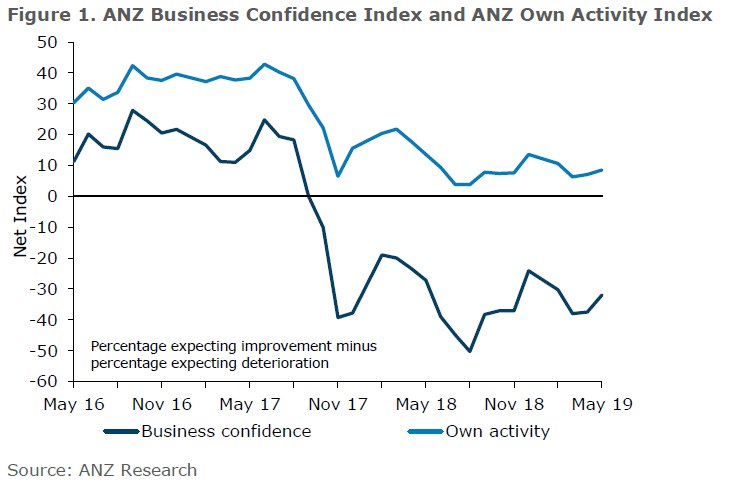
New Zealand ANZ business confidence improved to -32.0
New Zealand ANZ Business Confidence rose to -32.0 in May, up from -37.5. But all sectors remained deeply negative, with agriculture confidence worst at -63.9. Activity Outlook also improved to 8.5, up from 7.1. Manufacturing scored best in activity at 21.5.
ANZ noted that "how quickly the economy will bounce back is a key question. If the forward indicators start to suggest that the Reserve Bank's relatively sharp V-shaped recovery is overly optimistic, it will be game on for further OCR cuts this year."
US Curve Flattens Again And The Recession Fear Is Once Again Out Of The Bottle
Market movers today
It is another relatively quiet day in terms of data releases, and hence market focus will be on political developments, notably in Europe following the EU elections.
The risk of a battle between the EU and Italy is looming after the EU signalled the launch of an EDP on the deviation of Italy's 2018 fiscal figures from the EU targets. Statements from the Italian government suggest Italy will not stand down.
The Bank of Canada (BoC) is widely expected to leave policy rates unchanged at today's interim monetary policy meeting. At the previous meeting the central bank removed its modest tightening bias and focus today will be on any new policy signals. We do not expect any significant news and see the potential for a moderately stronger CAD on an 'on-hold' announcement.
In Sweden, first-quarter GDP numbers are released today, where we expect a weaker-than-consensus number (see page 2 for further details).
In Norway, we have retail sales, where after some weak months we see upside risks that would come after the strong oil investment survey yesterday (see page 2).
Selected market news
US equity markets came under strong pressure last night and closed with broad-based losses and we can expect a negative opening in Europe this morning. Asia is also in red. Lower equities and trade war concerns have pushed 10Y US treasuries yields down to 2.24%, the lowest level since the autumn of 2017. The 2s10s curve flattened further to 14bp. The curve has flattened 7bp in less than two weeks and the discussion of whether the curve is a reliable recession indicator is back on the agenda.
The market continues to focus on Italy, where the more conciliatory rhetoric from Italy we saw late last week is gone after it has become clear that the EU Commission has sharpened its rhetoric towards Italy. Yesterday, Deputy Prime Minister Salvini said that he will devote all his energy to changing the "old and obsolete rules" of the EU. Hence, BTPs remained under pressure yesterday, though it helped sentiment somewhat that EU Commissioner for Economic and Financial affairs Moscovici said that he is not in favour of sanctions against Italy. The EU Commission and Italy will "exchange views" he added.
The political clean-up after the EU elections over the weekend yesterday spread to Germany. Bloomberg reported that Merkel apparently decided that CDU party leader Annegret Kramp-Karrenbauer (AKK) is not up for the job to succeed her as chancellor and that Merkel will stay in her position until her term ends in 2021. The CDU's weak election result on Sunday was probably the main reason why Merkel 'ditched' AKK.
This morning, the Trump administration published its semi-annual FX report and put nine countries on a watch list for being currency manipulators. Importantly, China was again on the list, but was not named as a 'currency manipulator', which could have been in a new escalation of the trade conflict.
BoJ Kuroda: Best to manage inflation expectations with flexible targeting framework
In academic conference organized by BoJ, Governor Haruhiko Kuroda expressed his openness to flexible inflation targeting. Former ECB President Jean-Claude Trichet also emphasized that medium- to long-term inflation expectations are what really matter.
Kuroda said "If missing inflation comes from structural factors such as globalization and digitalization, central banks should continue examining how best to manage inflation expectations .. within the flexible inflation targeting framework." He also noted the need to expand the policy tools to fight the next downturn. "While policy makers have developed a wide range of unconventional policy tools, their effectiveness and transmission mechanisms may differ depending on financial conditions and economic structure," Kuroda said.
Trichet also said it's not necessary for central banks to target exactly the same level of inflation in a set period of time. Instead, "there is a consensus among central banks that real success is to solidly anchor inflation expectations in the medium- to long-term in line with their definition of price stability."
Elliott Wave View: S&P 500 (SPX) Has Resumed Lower
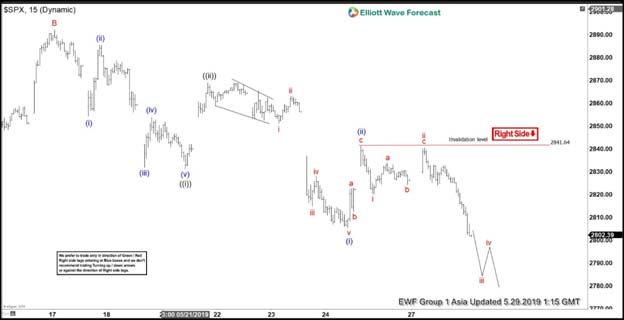
Short term Elliott Wave view on S&P 500 (SPX) suggests that it has resumed the next leg lower. The Index has ended the cycle from December 26, 2018 low after a 5 months rally. After topping at 2961.25 on May 1, 2019, it is now expected to pullback in larger 3, 7, 11 swing to correct the cycle from December 2018 low. We are calling the decline from May 1, 2019 as a zigzag Elliott Wave structure. On the chart below, we can see the bounce to 2892.15 ended wave B.
The Index has resumed lower in wave C with potential 100% extension target towards 2702.4 – 2738.4 area. The internal of wave C is unfolding as Elliott Wave impulse structure. Down from wave B at 2892.15, wave ((i)) ended at 2831.29 and wave ((ii)) ended at 2868.88. Wave ((iii)) is nesting and currently unfolding also as an impulse in lesser degree. Wave (i) of ((iii)) ended at 2805.49 and wave (ii) of ((iii)) ended at 2841.36. Near term, while rally fails below 2840.21 in the first degree, and 2892.15 in second degree, expect the Index to extend lower.
Euro-Zone’s Consumer Confidence Index Advanced In May
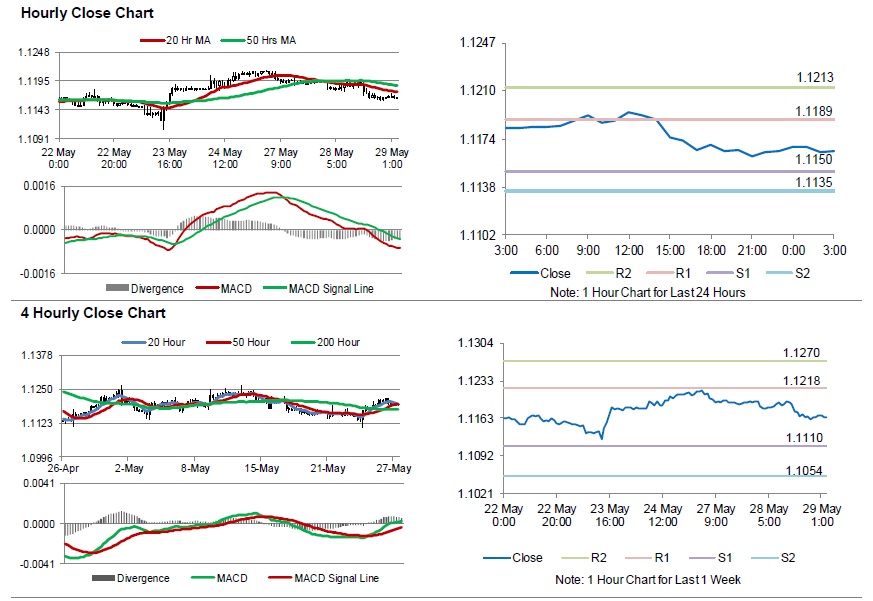
For the 24 hours to 23:00 GMT, the EUR declined 0.25% against the USD and closed at 1.1165.
On the data front, the Euro-zone's final consumer confidence index rose to a level of -6.5 in May, in line with market expectations and compared to a revised reading of -7.3 in the prior month. Moreover, the economic sentiment indicator climbed to a level of 105.1 in May, more than market expectations for a gain to a level of 103.9. The indicator had recorded a revised reading of 103.9 in the previous month. Meanwhile, the nation's business climate indicator eased to a level of 0.3 in May, compared to market anticipations for a fall to a level of 0.4. The indicator had recorded a level of 0.4 in the prior month.
Separately, in Germany, the Gfk consumer confidence index unexpectedly slid to a level of 10.1 in June, defying market consensus for a rise to a level of 10.4. In the previous month, the index had registered a revised reading of 10.2.
The US dollar gained ground against a basket of currencies, as rising US-China trade tensions, sparked fears of recession in the economy.
In the US, data showed that the CB consumer confidence index climbed to a six-month high level of 134.1 in May, following market anticipations for a gain to a level of 130.0. In the previous month, the index had registered a level of 129.2. Furthermore, the housing price index advanced 0.1% on a monthly basis in March, rising at its weakest pace in 7 years and undershooting market expectations for an increase of 0.2%. In the prior month, the index had registered a revised rise of 0.3%. Meanwhile, the US Dallas Fed manufacturing business index unexpectedly declined to a level of -5.3 in May, compared to market expectations for a gain to a level of 5.8. The index had recorded a reading of 2.0 in the prior month.
In the Asian session, at GMT0300, the pair is trading at 1.1165, with the EUR trading flat against the USD from yesterday's close.
The pair is expected to find support at 1.1150, and a fall through could take it to the next support level of 1.1135. The pair is expected to find its first resistance at 1.1189, and a rise through could take it to the next resistance level of 1.1213.
Going forward, traders would keep an eye on Germany's unemployment rate for May, set to release in a few hours. Later in the day, the US Richmond Fed manufacturing index for May and the MBA mortgage applications, will be on investors' radar.
The currency pair is trading below with its 20 Hr and 50 Hr moving averages.
UK’s Mortgage Approvals Surprisingly Climbed To A Two-Year High Level In April
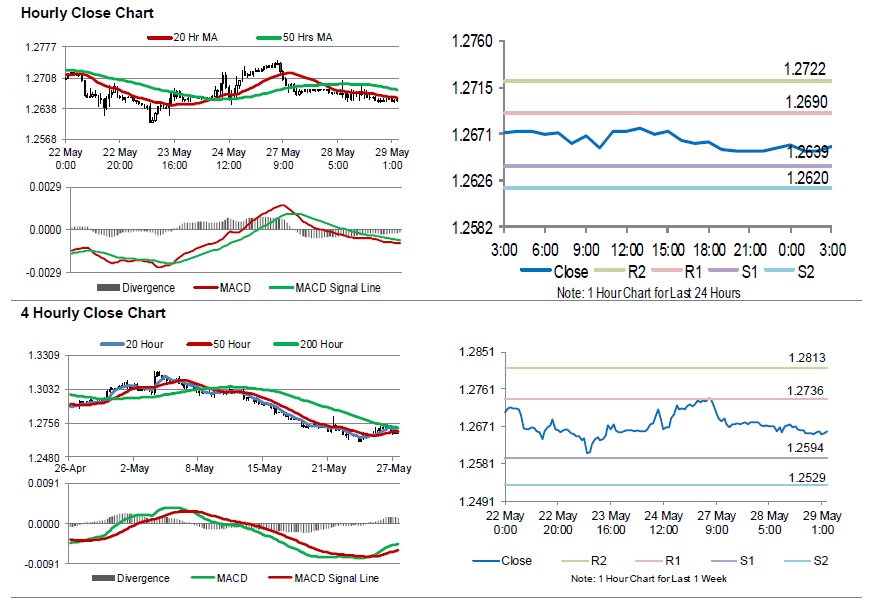
For the 24 hours to 23:00 GMT, the GBP declined 0.20% against the USD and closed at 1.2657.
Data showed that UK's BBA mortgage approvals surprisingly rose to a two-year high level of 42.9K in April, signalling recovery in the housing market growth and defying market expectations for a fall to a level of 39.5K. In the previous month, mortgage approvals had recorded a revised level of 40.6K.
In the Asian session, at GMT0300, the pair is trading at 1.2659, with the GBP trading slightly higher against the USD from yesterday's close.
Overnight data indicated that the nation's BRC shop price index advanced 0.8% on a yearly basis in May. In the prior month, the index had recorded a climb of 0.4%.
The pair is expected to find support at 1.2639, and a fall through could take it to the next support level of 1.2620. The pair is expected to find its first resistance at 1.2690, and a rise through could take it to the next resistance level of 1.2722.
In absence of key economic releases in UK today, investor sentiment would be determined by global macroeconomic events.
The currency pair is showing convergence with its 20 Hr moving average and trading below its 50 Hr moving average.
Japanese Yen Trading A Tad Lower In The Asian Session
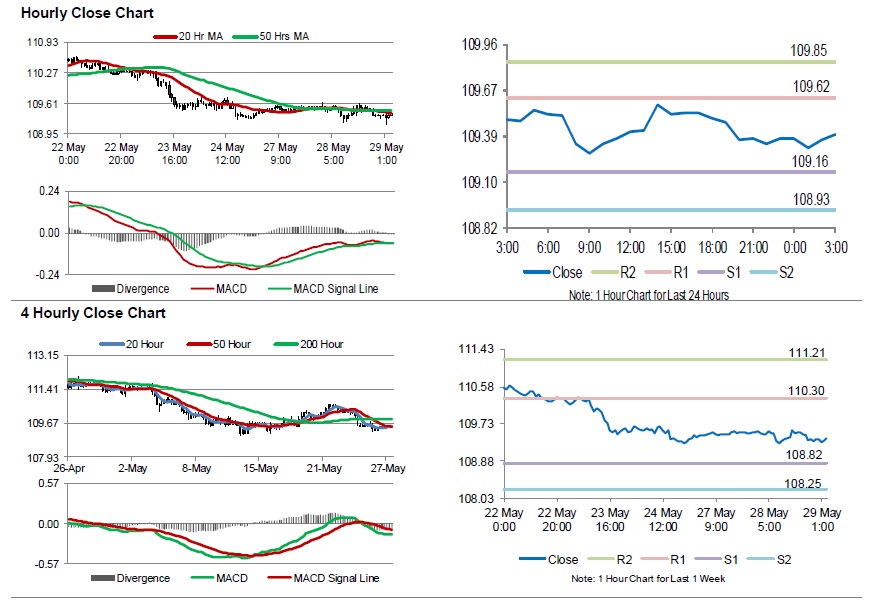
For the 24 hours to 23:00 GMT, the USD declined 0.16% against the JPY and closed at 109.37.
In the Asian session, at GMT0300, the pair is trading at 109.40, with the USD trading marginally higher against the JPY from yesterday’s close.
The pair is expected to find support at 109.16, and a fall through could take it to the next support level of 108.93. The pair is expected to find its first resistance at 109.62, and a rise through could take it to the next resistance level of 109.85.
The currency pair is showing convergence with its 20 Hr moving average and trading below its 50 Hr moving average.
Switzerland’s GDP Growth Accelerates In The First Quarter
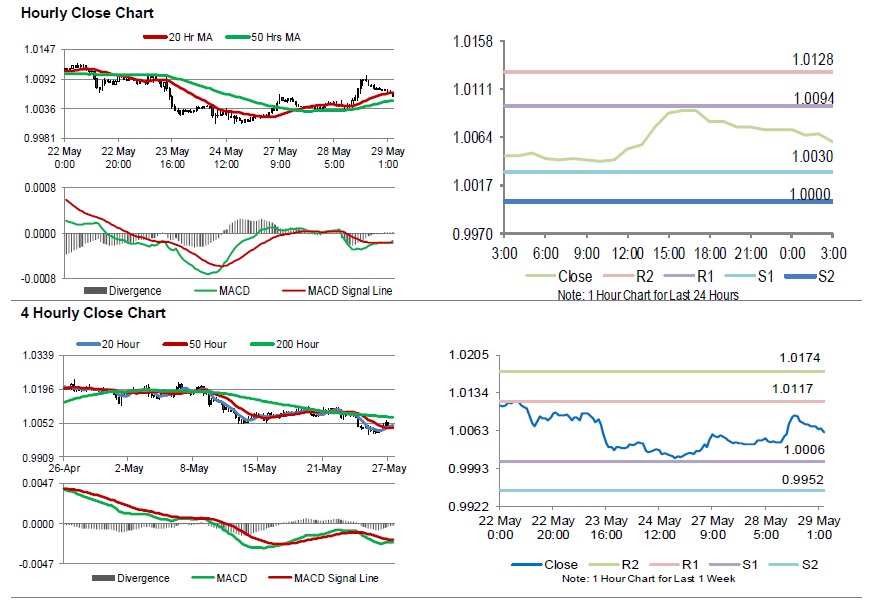
For the 24 hours to 23:00 GMT, the USD rose 0.34% against the CHF and closed at 1.0072.
Macroeconomic data indicate that Switzerland's seasonally adjusted gross domestic product (GDP) advanced 0.6% on a quarterly basis in 1Q 2019, surpassing market expectations for a gain of 0.4%. In the preceding quarter, GDP had recorded a revised rise of 0.3%. Moreover, the seasonally adjusted trade surplus narrowed to CHF1.9 billion in April, amid surge in imports and compared to a revised surplus of CHF2.5 billion in the previous month.
In the Asian session, at GMT0300, the pair is trading at 1.0060, with the USD trading 0.12% lower against the CHF from yesterday's close.
The pair is expected to find support at 1.0030, and a fall through could take it to the next support level of 1.0000. The pair is expected to find its first resistance at 1.0094, and a rise through could take it to the next resistance level of 1.0128.
Trading trend in the Swiss Franc today, is expected to be determined by Switzerland's KOF leading indicator and Credit Suisse survey expectations, both for May, scheduled to release in a while.
The currency pair is showing convergence with its 20 Hr moving average and trading above its 50 Hr moving average.
Loonie Trading Higher, Ahead Of BoC’s Key Interest Rate Decision
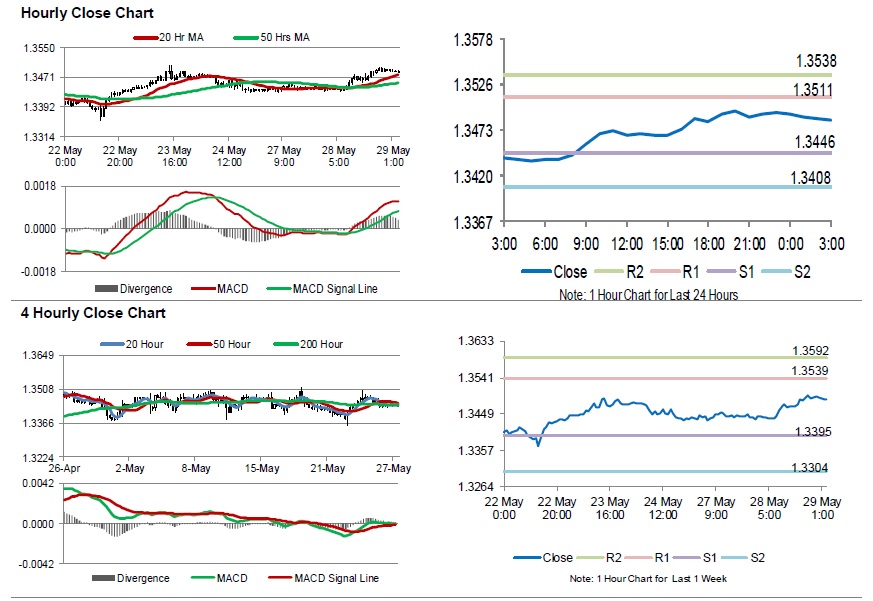
For the 24 hours to 23:00 GMT, the USD rose 0.39% against the CAD and closed at 1.3493.
In the Asian session, at GMT0300, the pair is trading at 1.3485, with the USD trading 0.06% lower against the CAD from yesterday's close.
The pair is expected to find support at 1.3446, and a fall through could take it to the next support level of 1.3408. The pair is expected to find its first resistance at 1.3511, and a rise through could take it to the next resistance level of 1.3538.
Looking ahead, traders would closely monitor the Bank of Canada's interest rate decision, slated to release later in the day.
The currency pair is trading above its 20 Hr and 50 Hr moving averages.
Aussie Extends Its Gains In The Morning Session
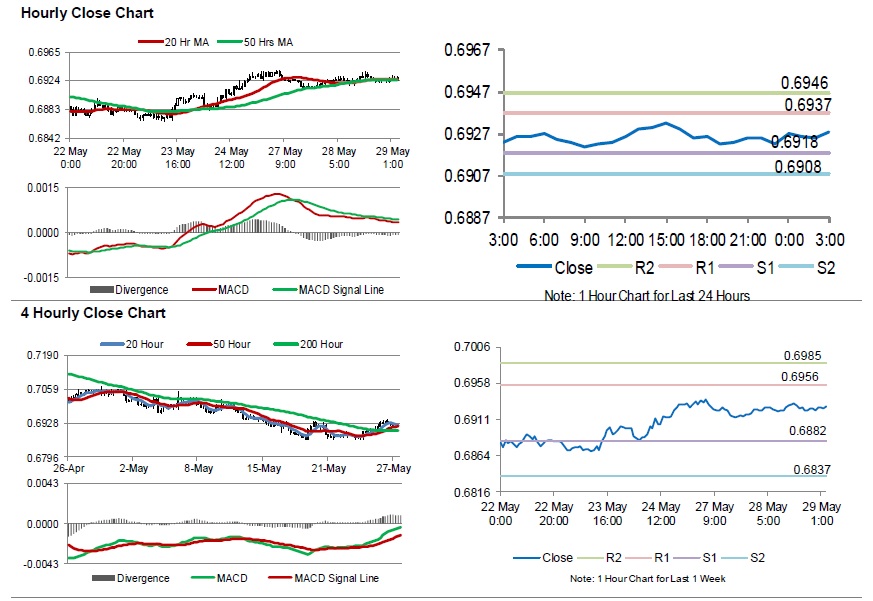
For the 24 hours to 23:00 GMT, the AUD slightly rose against the USD and closed at 0.6922.
LME Copper prices rose 0.6% or $37.5/MT to $5956.5/MT. Aluminium prices rose 0.7% or $11.5/MT to $1773.0/MT.
In the Asian session, at GMT0300, the pair is trading at 0.6928, with the AUD trading 0.09% higher against the USD from yesterday’s close.
The pair is expected to find support at 0.6918, and a fall through could take it to the next support level of 0.6908. The pair is expected to find its first resistance at 0.6937, and a rise through could take it to the next resistance level of 0.6946.
Moving ahead, traders would keep an eye on Australia’s building permits for April, set to release overnight.
The currency pair is showing convergence with its 20 Hr and 50 Hr moving averages.