Sample Category Title
Markets Face The End Of Mays
Markets face the end of Mays
Global markets will be happy to see the back of May on several fronts as the central-bank led global recovery play ran into severe turbulence with the unexpected disintegration of the US-China trade talks. Global stock markets and energy markets have run into serious headwinds at these pumped-up levels as both stubbornly refused to re-price a trade war’s likely effect on global growth. To some extent, that process has begun, as both equities and oil face their worst month of the year as we enter the last week of May. That process, however, has only just started and their respective tentative rallies on Friday show the optimists won’t go down without a fight.
The United Kingdom saw its own end of May with the Prime Minister officially tendering her resignation, finally accepting defeat in her attempts to push a Brexit agreement through a fractured Parliament. This led to an impressive 100-point rally in Her Majesty’s British pound (GBP) back up through 1.2700, but this is but a small proportion of its overall losses in May.
The European elections over the weekend have seen the separatist Brexit Party trounce both the Conservative and Labour parties into European Parliament oblivion, although elsewhere in Europe, the moderates have got off their sofas and turned out in record numbers, albeit from a very low base. This highlights the problems that Theresa May faced will not go away with a new leader. In fact, they may get worse, because this weekend’s election shows a large proportion of voters out there are still adamant they want a Brexit and don’t seem minded to negotiate with Brussels. Sterling rallies should be treated with caution – something I have been saying all year.
Wall Street rallied slightly on Friday, driven by unexpected resilience in Asian and European markets earlier and a marginally weaker dollar after an unexpected fall in US durable goods. The climb had a rear-guard-action feel about it though, as the optimists stubbornly refuse to accept our new global growth reality. The no-news-is-good-news strategy has never been sustainable past the short-term.
Asia has a quiet day ahead data-wise, and indeed, the week globally is relatively quiet on significant data points. The exception being the US Personal Consumption and Expenditure figures due on Thursday. Headlines and geopolitics will, therefore, be the major drivers of ebbs and flows on global markets.
On the headline and political front, Asia is well served this week. US President Donald Trump and his social media account are visiting Japan for four days until Wednesday. Although many would have wished that a Sumo had fallen on the President yesterday, I take a more positive view. We will almost certainly see some interesting “comments” to drive volatility in Asia this week. Forgotten by many, Japan and the US have been conducting their own trade talks over the past months, and these will continue in Tokyo in between Abe and Trump’s rounds of golf. Some might say fighting a trade war on two fronts is crazy, but stranger things have happened over the last few years.
FX
The US dollar fell on durable-goods data on Friday, but not by much. The pullback was probably as much to do with profit taking and weekend position lightening as anything else. We can likely expect regional currencies to move tentatively higher against the greenback in early trade. Nothing in the bigger picture has changed though, nor the reasons for the dollar being so strong in 2019. Therefore, any sell-off in the dollar is likely to be modest and short-lived this week, all other things remaining equal.
GBP was a notable mover on PM May’s resignation, rising from 1.2600 to 1.2720 at the end of the week. That said, the Brexit Party’s storming of the gates of the European elections over the weekend should highlight how fractured both Parliament and the British electorate remain. The new Prime Minister will face the same issues – including a non-majority in Parliament – as his or her predecessors. GBP may enjoy a few days in the Benidorm sun, but like a week-long holiday there, the feel-good factor will soon fade.
Equities
Wall Street staged a dead-cat bounce on Friday as the dollar fell. The S&P 500 rose 0.15%; the Nasdaq was up 0.10%, and the Dow Jones jumped 0.40%. Both Tokyo and Sydney markets have moved gently higher in early trading with the rest of the region likely to cautiously follow suit as the day progresses.
With President Trump in Japan and the US closed for Memorial Day, volumes are likely to be lower than usual with traders presumably happy to stay on the sidelines watching social media and news tickers.
Oil
Oil made an impressive correction on Friday with Brent Crude jumping 2.05% to USD69.25 a barrel and WTI rising 1.70% to USD58.90 a barrel. Impressive as it was, the corrective rally did not cover even half of the losses of Thursday with short-term profit-taking rather than a sentiment change responsible for the bounce.
Sentiment remains fragile and vulnerable to any deterioration in US-China trade frictions or a breakdown in US-Japan talks. With the US on holiday, oil volumes will be lower than normal as traders will likely be content to rest on the sidelines.
Gold
Gold survived an initial sell-off on Friday to end the session flat at USD1,284.60 an ounce. The fightback is still rather unconvincing in my mind, driven entirely by risk aversion in other markets rather than a sea change in the perception of gold itself. Initial resistance is at USD1,290.00 an ounce and support at USD1,270.00 an ounce. Unless we have some sort of headline-driven price action, gold will likely have a quiet day in Asia.
Daily Markets Broadcast
Wall Street higher ahead of holidays
Wall Street indices were either flat or marginally higher on Friday amid some position squaring ahead of the long weekend. US President Trump is in Japan now. Weekend European election results are drifting in. There are public holidays in the UK and US.
US30USD Daily Chart
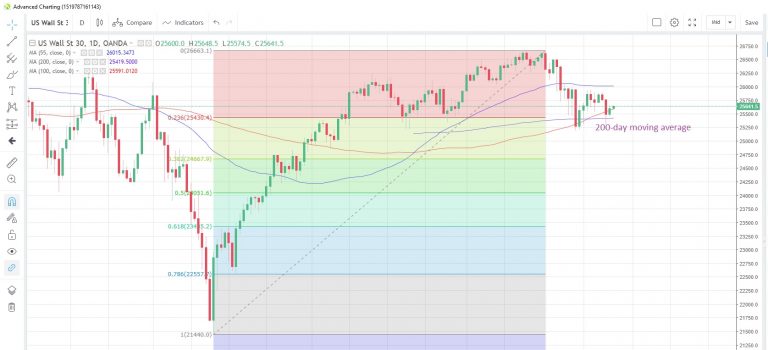
The US30 index rose on Friday, snapping a two-day losing streak but it wasn't enough to prevent a third weekly loss in a row
The 200-day moving average at 25,419 is still acting as a support level, with prices holding above it on a closing basis since May 13
US President says a trade deal with Japan will not happen during his trip. The initial target period for an agreement is after the Japanese elections in July.
DE30EUR Daily Chart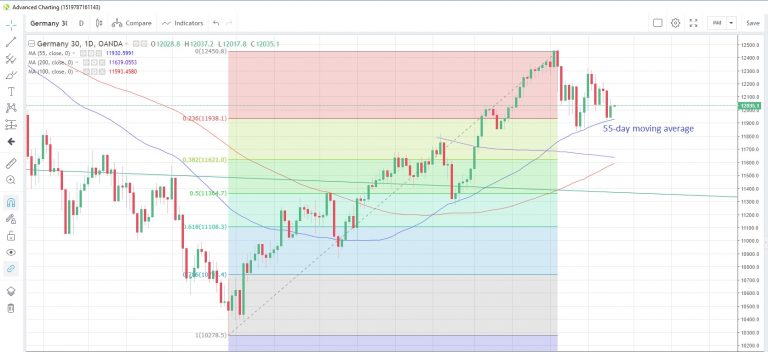
The Germany30 index is marginally higher this morning after EU election exit polls suggested that mainstream EU parties were holding off an assault by the more populist parties
Support at the 55-day moving average at 11,930 remains intact and has supported prices on a closing basis since February 8
ECB's Weidmann said Friday he sees no need for ECB to change its monetary policy at the moment, despite current weakness in the Euro-zone economy.
JP225USD Daily Chart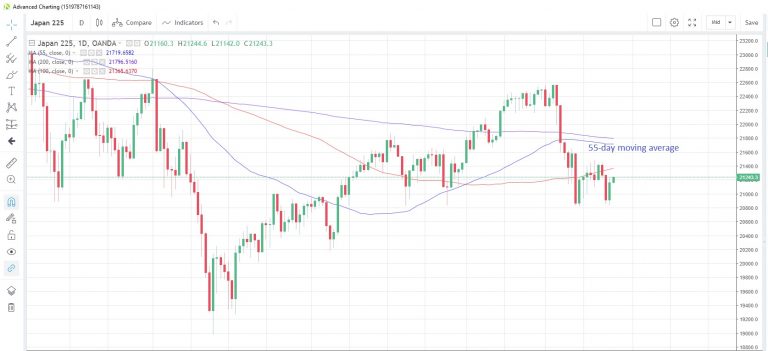
The Japan225 index is higher for a second straight day in early trading this morning as Trump said that the US and Japan were “close” to a trade deal, though it will likley not be finalised until after the Japanese elections in July
The index has traded below the 55-day moving average, which is at 21,719 today, since May 7
Japan's March leading economic index is seen holding steady at 96.3. BOJ's Kuroda is scheduled to speak at 0300GMT.
USD/CAD Canadian Dollar Higher On Risk Appetite Return
The Canadian dollar rebounded on Friday as risk appetite rose putting the greenback on the back foot. Trade tensions between the US and China put pressure on the loonie, which got no help from falling energy prices.
The Bank of Canada (BoC) is expected to keep rates unchanged on Wednesday despite economic indicators like employment and inflation showing positive signs. Macro headwinds are unlikely to subside in the short term, leaving the central bank little choice but to adopt a patient stance, and act if needed.
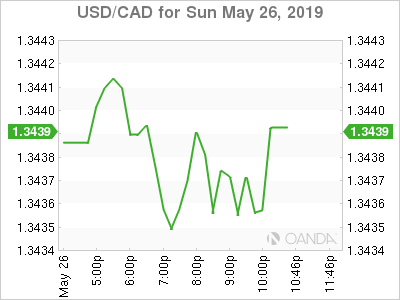
The US dollar will not put up a fight on Monday as the Memorial holiday and a bank holiday in the United Kingdom will significantly reduce the trading volume. European parliament results did not provide major surprises but a continuation of political trends. Centrist parties keep losing support as other parties chip at the status quo.
Results in Britain point to a major win by the Brexit Party, as voters used the ballot to show their frustration with the two major parties. The resignation of Prime Minister Theresa May has once again opened the door for a no-deal exit, although pursing that agenda, could end up with Conservatives losing the reins of the government.
OIL – Crude to Rebound on Soft Dollar During Memorial Day Holiday
Oil prices continue their rebound after experiencing the worst week of 2019. Crude fell on Wednesday after the release of the weekly US crude inventory data. A surprise buildup of 4.7 million barrels of crude and 3.7 million barrels of gasoline pushed prices down.
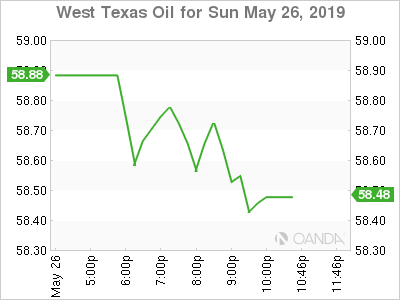
The US is impacting prices in three ways. Sanctions against Iran and Venezuela for political reasons have boosted prices as it reduced supply. US-China trade disputes have a negative effect on global growth forecast reducing energy demand going forward. The final factor has been the rise of American output. While sanctions reduce supply and boost prices, lower energy demand and rising production depreciates crude as there is a higher risk of oversupply.
Middle East tensions and the ongoing OPEC+ crude output cut deal have kept prices in a higher range, but higher US production keeps putting downward pressure on prices. The balance between the OPEC+ cutting supply and the US ramping up production was broken in favor of lower prices as the trade war is tipping the scale by reducing future demand.
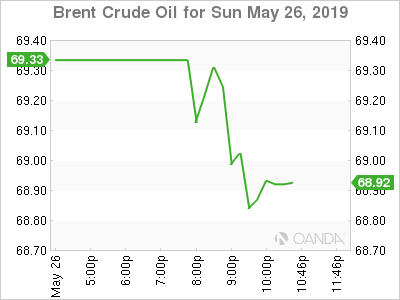
China appears to be digging its heels and won’t rejoin trade talks until the US tones down the combative rhetoric. The fact that the two largest economies are so far apart is convincing the market that the negotiations still have a long way to go before a deal is reached.
GOLD – Trade and Politics Increase the Appeal of Gold
Gold prices remain near the $1,285 price level. The rise of volatility triggered by geopolitics benefited the yellow metal and if the UK political game of thrones and US-China trade keep uncertainty levels high, gold could once again jump above $1,300.
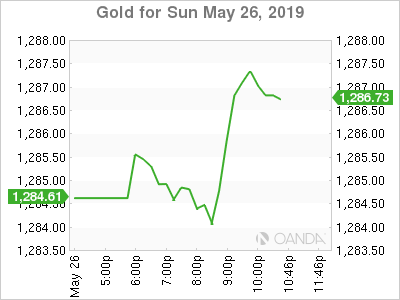
The metal has been in and out of favor as a safe haven, as risk appetite has adapted to rising volatility. The Trump administration concentrated its trade efforts on China, by delaying EU tariffs and agreeing on steel and aluminum with Canada and Mexico. The focus on China by closing other trade battlefronts solidified its appeal as a safe haven, but as data disappointed and UK politics are once again grabbing headlines gold became a preferred hedge against uncertainty.
STOCKS
US and UK traders will welcome the three-day weekend as markets were on a downward spiral as pessimism rose as China’s trade rhetoric got harder and the resignation of Prime Minister May in the UK puts the dreaded no-deal exit back on the table.
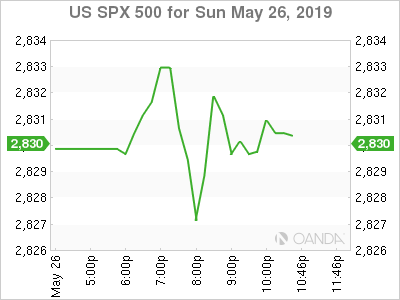
The trade deal between the US and China seemed close to an agreement, but that feels like ago. Now both camps have used financial media to present their positions with mostly a negative result for equities. China is not backing down and US companies that depend on Chinese imports, like the tech sector, have dropped. Economic indicators in the US have not reassured investors, as a potential rate cut still seems far off, even as growth appears to be losing momentum.
US PCE inflation and GDP data will be anticipated to have a better idea on the state of the economy. Markets are sensitive to lower than expected data as trade war headlines will continue to guide equities.
FX – GBP/USD Pound Rises Despite Political Drama
The pound rose against the dollar despite an upcoming leadership challenge to choose the successor to Prime Minister May who quit last week. The softness of the greenback offered the British currency the chance to gain even as the possibility of a no-deal exit could once again be part of the menu if the next PM pushes hard for that outcome.
The Brexit Party was one of the big winners of the European parliament elections, once again proving how divisive the topic is in the UK. Polls show that a second referendum would probably give the edge to Remain this time around, but results such as the Brexit Party win show that there is still a lot of support for the divorce with the EU.
EURUSD Holds Off Lower Prices With Eyes On 1.1263 Zone
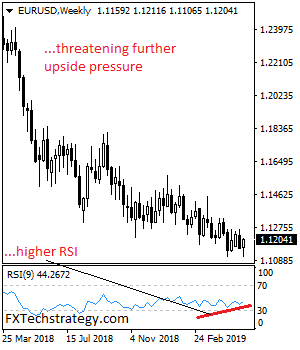
EURUSD holds off lower prices with eyes on 1,1263 zone as we enter a new week. Support comes in at the 1.1150 where a violation will turn risk to the 1.1100 level. A break below here will target the 1.1050 level. Further down, support sits at the 1.1000. Conversely, on the upside, resistance resides at 1.1250 level with a break through there opening the door for further upside towards the 1.1.1300 level. Further up, resistance comes in at the 1.1350 level where a violation will expose the 1.1400 level. All in all, EURUSD continues to threaten further upside pressure.
USDCHF Closed Lower On Bearish Pressure
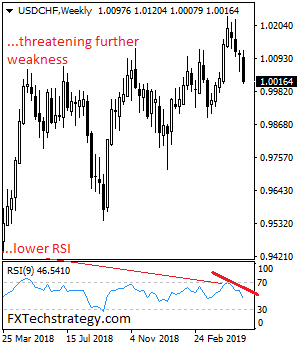
USDCHF closed lower on bearish pressure the past week, opening the door for more decline. Resistance resides at the 1.0050 level. Above here, resistance lies at the 1.0100 level and then the 1.0250 level. Further out, resistance comes in at the 1.0150 level. On the downside, support is seen at the 1.0000 level with a turn below here setting the stage for more decline towards the 0.9950 level. And then the 0.9900 level. Further down, support resides at the 0.9850 level. Its weekly RSI is bearish and pointing lower suggesting further weakness. All in all, USDCHF targets further recovery on correction.
Eco Data 5/27/19
[php_everywhere instance="1"]
Forex Forecast and Cryptocurrencies Forecast
First, a review of last week’s events:
EUR/USD. Complaints and sometimes even moans have been heard everywhere in the last months about the low volatility of this pair. The same is true about last week, until the second half of Thursday, the maximum range of its fluctuations did not exceed 45 points. The pair spent most of the time napping, sleepily crawling along the narrow corridor of 25 points. However, the events of the week, from the aggravation of the US-China trade war and the upcoming elections to the European Parliament to the statements by the Fed leadership and poor data on business activity in Germany and the Eurozone, played into the hands of the dollar. As a result, the pair, as most experts had suggested (75%), fell to the two-year lows, stopping at $1.1105 per euro.
But it is not only the economy of Europe, but also that of the USA which is experiencing problems. The unexpectedly weak preliminary business activity index Markit (50.9 instead of the expected 53.0) and the weak statistics on the real estate market led to a collapse in the yield of US government bonds and a sharp reversal of the EUR/USD pair to the north.
The euro's recovery was also facilitated by the closure of short positions at the lows reached before the three-day weekend in the USA and the UK. Apparently, the European currency and the statement of the British Prime Minister Theresa May about her resignation added to this. As a result, the euro won back 100 points, and the pair finished the week at 1.1205;
GBP/USD. So, Mrs. May is leaving. Her version of the Brexit agreement will not be voted once again in Parliament. And the country is in for the next reshuffle in the leadership of the Conservative Party. According to many analysts, the head of the government can now be someone from the supporters of a hard exit from the EU, like the former mayor of London and Foreign Minister Boris Johnson. How will the market react? Most likely the reaction will be negative. But this news has not so far greatly affected investor sentiment: following the euro, taking advantage of weak US macroeconomic statistics, supported by the elimination of short positions, the pair pushed off from the two-year low in the 1.2600 zone and went up, putting the final point in this session at 1.2710;
USD/JPY. The Japanese yen could not resist the dollar in the first half of the week either. Recall that 50% of analysts had expected the pair to rise to the height of 111.00, and one third of them has called the highest resistance 110.00 The truth, as often happens, was somewhere in the middle, and the pair fixed the week high at 110.65. After that, investors started to doubt: thanks to the harsh statements of Chinese leader Xi Jinping about the “new Great March” and “independence”, they began to realize that the yen could be a more reliable haven than the dollar. The yield on US government bonds went down, while Wall Street analysts started to talk about a high probability of deterioration in the financial results of American companies in the second half of the year and that the US economy could now be under attack due to rising prices and lower consumer demand. As a result, the pair turned around and, returning to the values of a week ago, completed the five-day week at 109.30;
Cryptocurrencies. The crypto market capitalization schedule almost repeats what happens to the reference coin. Bitcoin dropped from $8,335 to $7,000 - capitalization fell from $255.8 billion to $229.2 billion. Bitcoin adjusted to $8.265, and capitalization rose to $255.5 billion. Quite often, this graph can be successfully used as a leading indicator.
It should be recalled that only 25% of experts predicted a trend reversal last week. The overwhelming majority voted for its continuation, finding that the decline in the BTC/USD pair to the level of $7,000 is just a temporary correction. In their opinion, it had to return to the $8,000 zone, after which it should move for some time in the side channel, then approaching the resistance level of 8,500, where its growth was stopped last July, then moving away from it. That's exactly what happened.
As for the forecast for the coming week, summarizing the opinions of a number of analysts, as well as forecasts made on the basis of a variety of methods of technical and graphical analysis, we can say the following:
EUR/USD. Both graphical and technical analysis point to continued growth of the pair on the H4 timeframe. But at the same time, 25% of oscillators are already in the overbought zone. At D1, the situation is different: one third of the indicators are colored red, one third are green and another third are gray, neutral. But the graphical analysis insists on further strengthening of the dollar and the continuation of the downward trend.
In fact, the situation in the global economy is quite complicated. There are more obscure prospects for Brexit, the lack of clarity with the results of the elections to the European Parliament on May 26, and multi-pass maneuvers in the US-China trade war here. The forecasts regarding the Fed's monetary policy also vary. So far, the chances of its mitigation for this year have grown from 68% to 78%. If this forecast comes true, the interest rate on the US dollar can be reduced by 0.25% in less than four months. But at the same time, the ECB, recognizing the weakness of the European economy, speaks of its readiness to take supporting measures in the minutes of the last meeting.
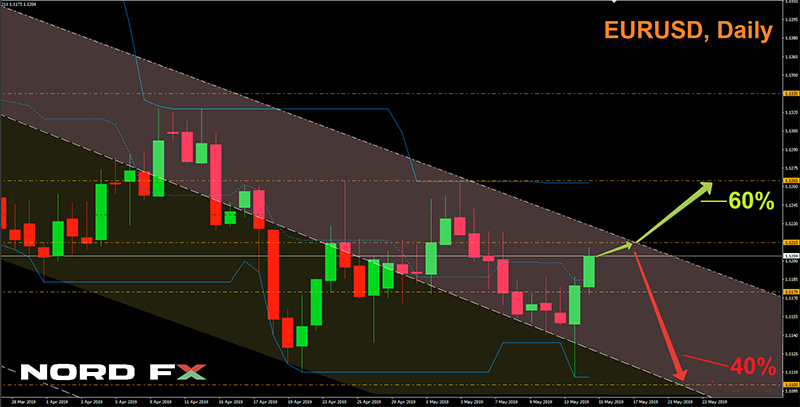
So far, 60% of analysts side with the bulls, believing that the powerful rebound of the pair from support in the 1.1110 zone has shown the bears' fatigue and their inability to continue the struggle.
The support levels are 1.1150 and 1.1110. The resistance levels are 1.1225 and 1.1263. The next target is 1.1325;
GBP/USD. At the time of writing this forecast, it is not yet known which of the British parties will show which result in the elections to the European Parliament. Who will get the advantage, Brexit supporters or its opponents? Who will be the head of the UK government? Theresa May' departure may in the short term strengthen the pound, but in no way will it eliminate the long-term risks. That is why 65% of experts, supported by 90% of oscillators and trend indicators on D1, have voted for the pair to fall further. The nearest support is at 1.2660 and 1.2600, followed by the 2018 lows, 1.2475 and 1.2405.
35% of analysts rely on the growth of the pair. The immediate goals are 1.2825 and 1.3000, then 1.3125 and 1.3200.
A compromise forecast is given by graphical analysis on D 1. First, supported by 1.2600, a rise to the height of 1.2825, and then the collapse and the bottom in the zone 1.2475;
USD/JPY. 100% of the trend indicators and 85% of the oscillators on H4 and D 1 are colored red. 70% of experts have also voted for the further fall of the pair and the strengthening of the yen as a reserve currency. At the same time, 15% of oscillators give signals about the pair being oversold. As for the graphical analysis, it draws first a fall to the horizon 108.50, and then a trend reversal and a growth to the height of 110.65. It should be borne in mind that one or two unpredictable tweets of US President Trump regarding the prospects for relations with China are enough to deploy the pair and accelerate it to either side.
The support levels are 109.00, 108.50 and 107.75, the resistance levels are 110.25, 110.65, 111.00 and 111.65;
Cryptocurrencies. The European Central Bank has released a report stating that, although cryptocurrencies do not have a serious impact on the real economy now, in the future it is possible that they can replace the euro. But this is for the future. As for the present, analysts at JPMorgan Chase believe that the recent rise in the price of Bitcoin has brought it beyond what they call the inherent value of cryptocurrency. And that this could be a harbinger of another long recession.
However, if we sum up the opinions of their colleagues, only 15% of experts now support the scenario with a fall. 45% believe that the pair will move to the side channel of $7,500-8,400, and 40% are optimistic about the upward direction, indicating the April-May 2018 high as their closest target. at the height of $9,550. Note that in the transition to the medium-term forecast, the number of such optimists increases to 70%.
EUR/USD Weekly Outlook
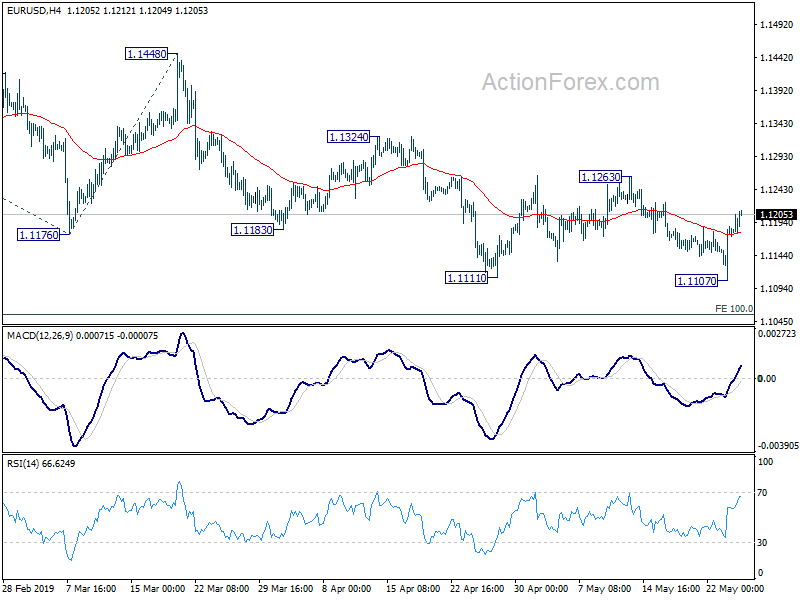
EUR/USD dropped to 1.1107 last week and breached 1.1111 low but quickly recovered. The development suggests that consolidation from 1.1111 is extending. Initial bias remains neutral this week first for more sideway trading. Upside of recovery should be limited by 1.1263 resistance to bring down trend resumption. On the downside, firm break of 1.1107 will target 100% projection of 1.1448 to 1.1183 from 1.1324 at 1.1059. However, sustained break of 1.1263 resistance will now be an early sign of trend reversal and turn bias to the upside for 1.1448 key resistance.
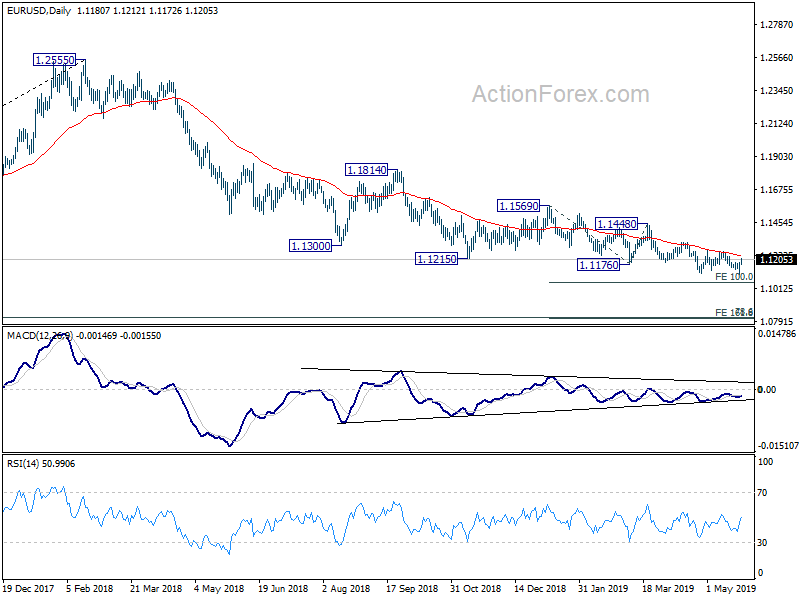
In the bigger picture, down trend from 1.2555 (2018 high) is still in progress. Such decline would target 78.6% retracement of 1.0339 (2016 low) to 1.2555 (2018 high) at 1.0813 next. Sustained break there will pave the way to retest 1.0339. On the upside, break of 1.1448 resistance is needed to be the first sign of medium term bottoming. Otherwise, outlook will stay bearish in case of rebound.
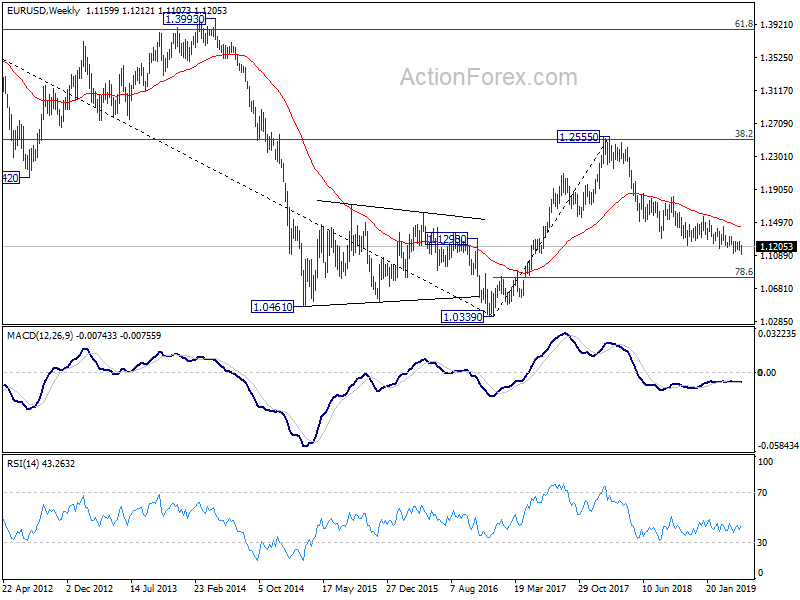
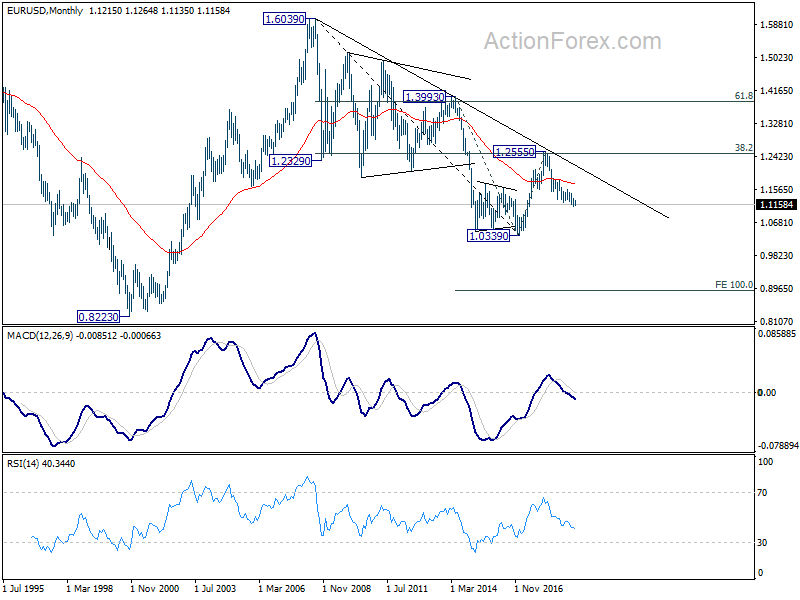
In the long term picture, the rejection from 38.2% retracement of 1.6039 to 1.0339 at 1.2516 argues that long term down trend from 1.6039 (2008 high) might not be over yet. EUR/USD is also held below decade long trend line resistance, 55 month and 55 week EMA. Break of 1.0339 will resume the down trend to 100% projection of 1.3993 to 1.0339 from 1.2555 at 0.9501
USD/JPY Weekly Outlook
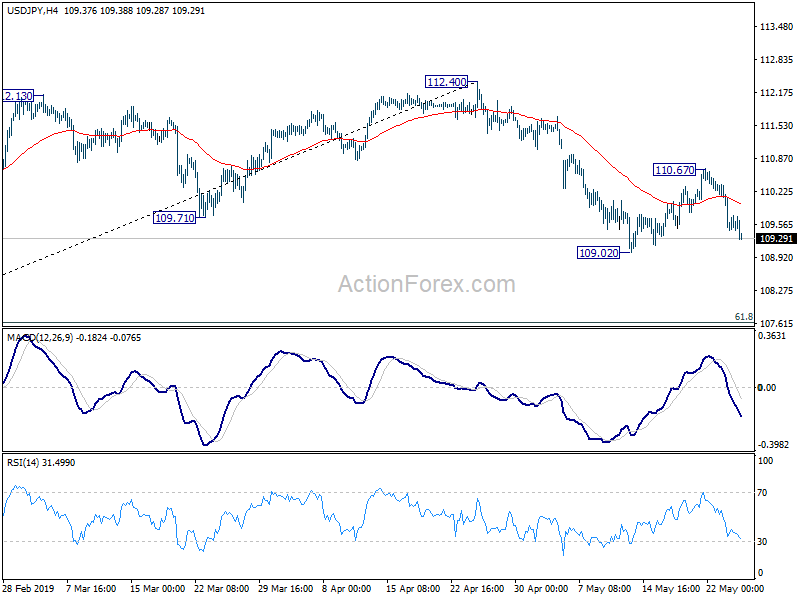
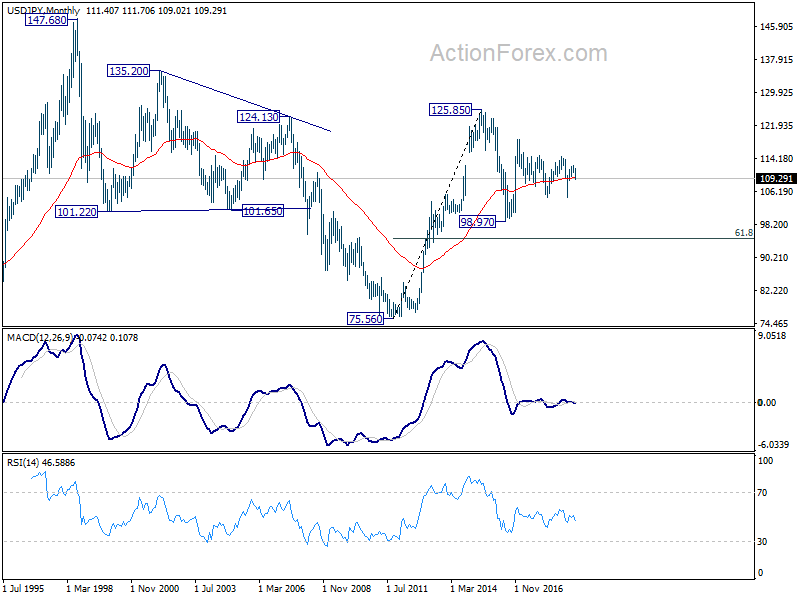
USD/JPY edged higher to 110.67 last week but was limited well below 55 day EMA and reversed. Current development suggests that corrective recovery from 109.02 has completed. Initial bias remains on the downside this week for 109.02 first. Break will resume fall from 112.40 and target 61.8% retracement of 104.69 to 112.40 at 107.63. In any case, near term outlook will stay bearish as long as 55 day EMA (now at 110.72) holds.
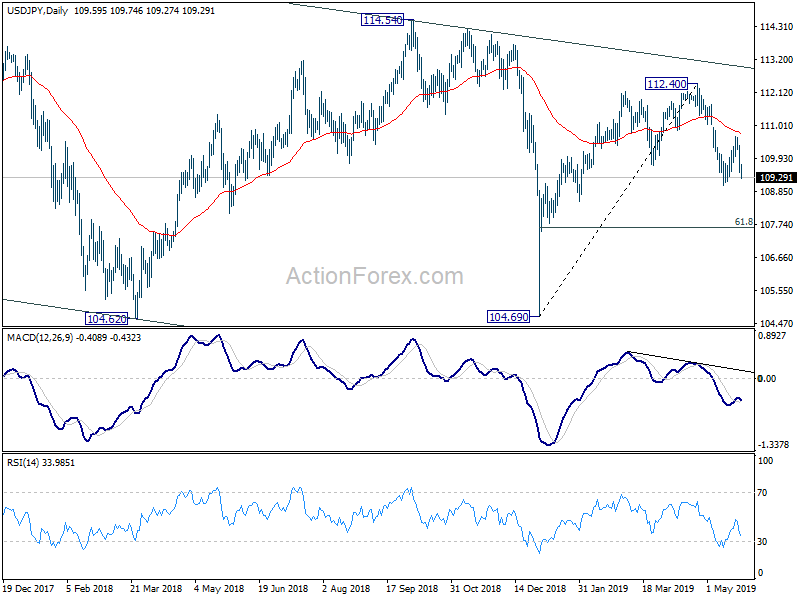
In the bigger picture, USD/JPY is staying inside falling channel from 118.65. Current development suggests that rebound from 104.69 is only a corrective move. And fall from 118.65 is not completed yet. Decisive break of 104.69 will extend the down trend towards 98.97 support (2016 low). For now, we'd expect strong support above there to bring rebound.
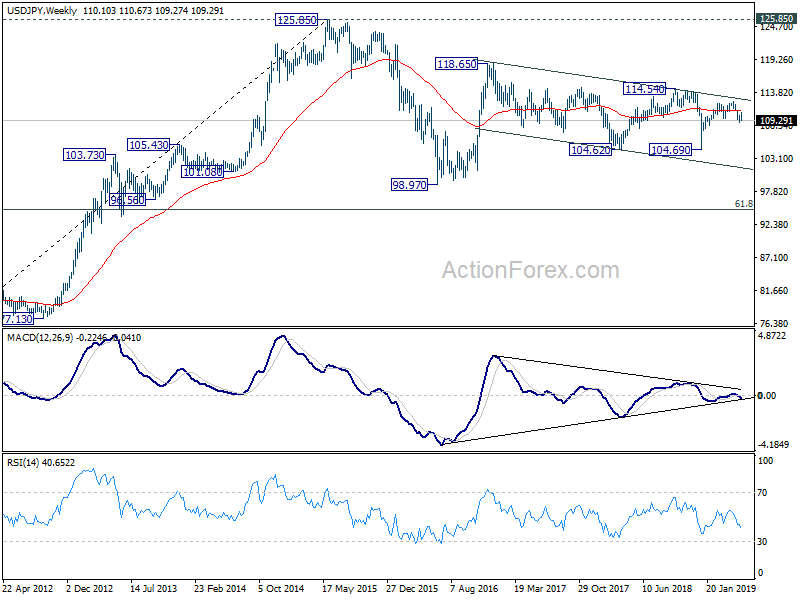
In the long term picture, the rise from 75.56 (2011 low) long term bottom to 125.85 (2015 high) is viewed as an impulsive move, no change in this view. Price actions from 125.85 are seen as a corrective move which could still extend. In case of deeper fall, downside should be contained by 61.8% retracement of 75.56 to 125.85 at 94.77. Up trend from 75.56 is expected to resume at a later stage for above 135.20/147.68 resistance zone.
GBP/USD Weekly Outlook
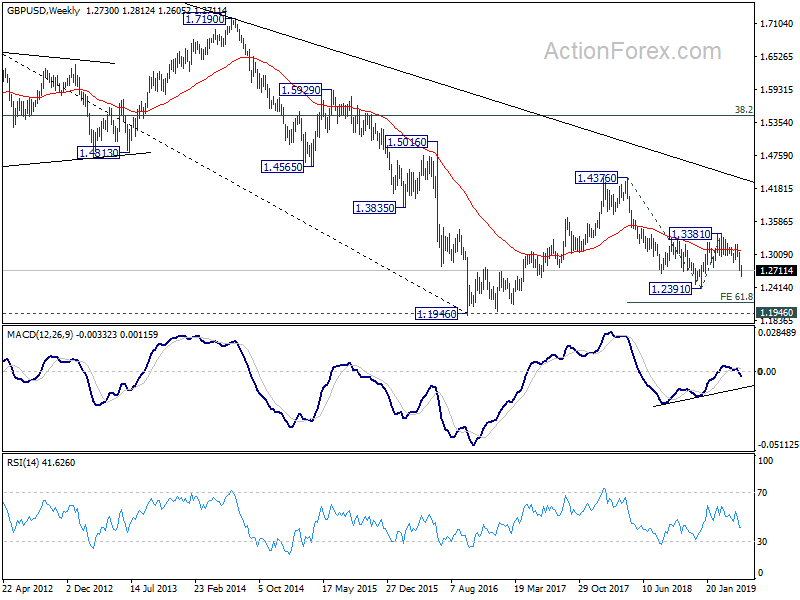
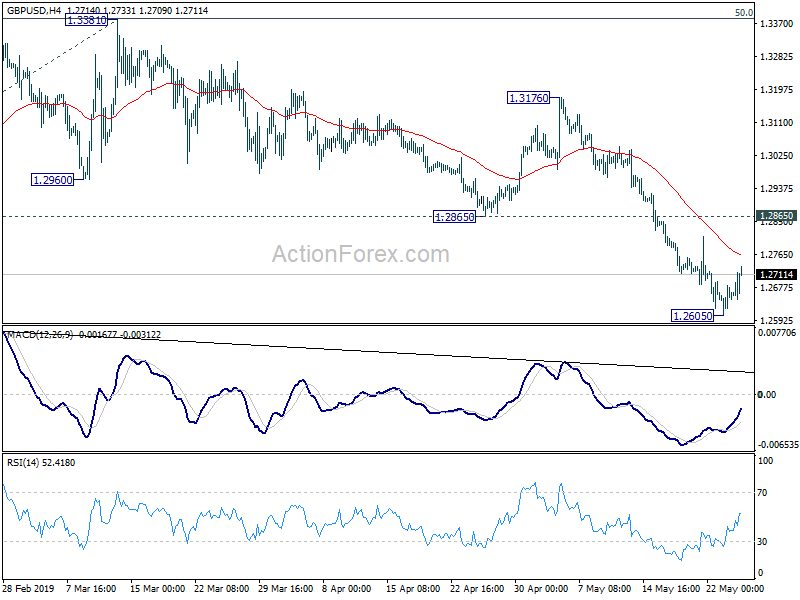
GBP/USD's fall from 1.3381 extended to as low as 1.2605 last week but formed a temporary low there and recovered. Initial bias remains neutral this week for some sideway trading first. Upside of recovery should be limited by 1.2865 support turned resistance to bring fall resumption. On the downside, break of 1.2605 will will target a test on 1.2391 low first. Firm break there will resume larger down trend to 61.8% projection of 1.4376 to 1.2391 from 1.3381 at 1.2154 next.
In the bigger picture, current development suggests that medium term decline from 1.4376 (2018 high) is not completed, and is possibly ready to resume. Decisive break of 1.2391 would target a test on 1.1946 long term bottom (2016 low). For now, we don't expect a firm break there yet. Hence focus will be on bottoming signal as it approaches 1.1946. In any case, medium term outlook will stay bearish as long as 1.3381 resistance holds, in case of strong rebound.
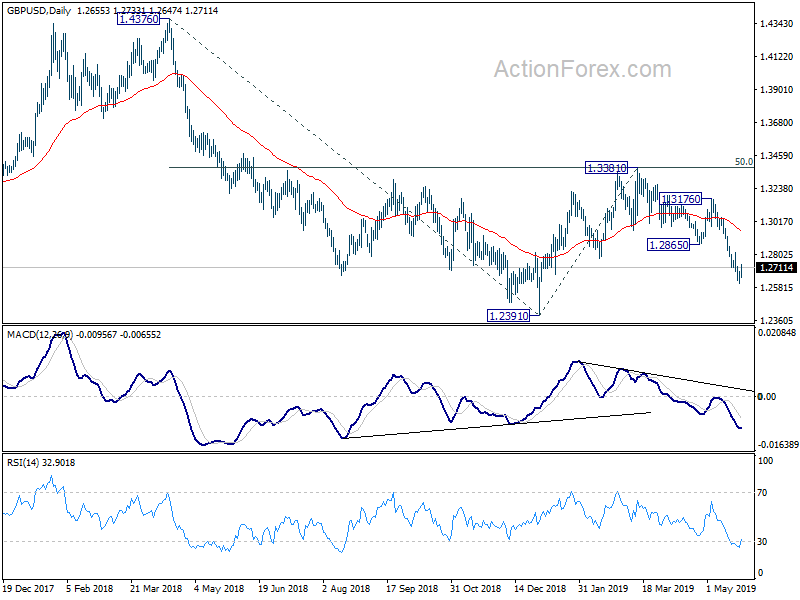
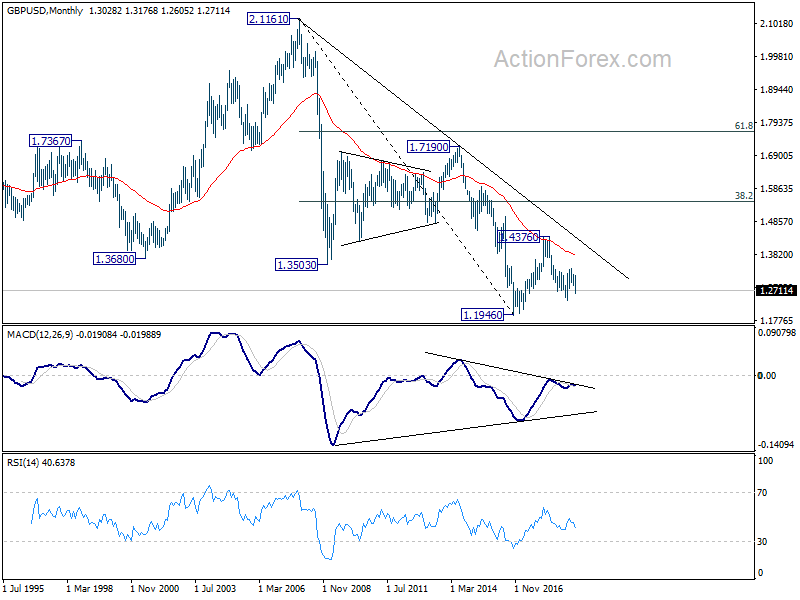
In the longer term picture, consolidative pattern from 1.1946 (2016 low) could still extend with another rising leg. But after all, decisive break of 38.2% retracement of 2.1161 (2007 high) to 1.1946 at 1.5466 is needed to indicate long term reversal. Otherwise, an eventual downside breakout will remain in favor.