Sample Category Title
Rising Political Risks Keep Both The Euro And Pound On The Back Foot
It's been a horrid month for Theresa May, as uncertainty around the fate of the UK Prime Minister and her Brexit plans have sent the Pound plummeting towards the 1.26 psychological mark. The departure of the Leader of the House of Commons, Andrea Leadsom, the 36 th Ministerial resignation during May's reign as PM, highlights the draining support for May's Brexit deal, while raising the risk of a hardline Brexiteer potentially taking over the reins at 10 Downing Street.
The GBPUSD's previous floor around the 1.30 level was predicated on the United Kingdom being able to avoid a no-deal Brexit. However, the doors to that psychological support level have been left wide open following the concerns from investors over the feared prospects of an increased worst-case scenario for Brexit.
The ongoing political saga can by all means eventually lead to another general election or potentially a second referendum, with either outcome opening up the doors for further volatility in the Pound ahead.
Given the record losing streak in the Sterling that has seen the British currency drop against the Euro for 13 consecutive days, alongside the Sterling being the worst performing currency in the G10 this month with losses close to 3%, it is clear that the downside is where the Pound is the most vulnerable right now.
European Parliament elections likely not enough to deter Euro's 2019 bearish trend
The European Parliament elections kick off Thursday and will go on through Sunday, adding another layer of risk to the Euro which has already declined by over 2.7 percent so far this year against the US Dollar. Should populist and Eurosceptics see gains at the polls, that is expected to exert more downward pressure on the Euro which is already suffering from the resumption of the Eurozone's economic woes.
However, even a Euro-positive outcome from the elections and the shoring up of support for the EU establishment, will likely not be enough to significantly alter EURUSD's 2019 bearish trend.
With both Brexit uncertainties and US-China trade tensions threatening to inflict more damage on the EU economy, any post-election reprieve for the bloc's currency would likely prove short-lived, as markets refocus attentions to macro global headwinds.
EU, UK political uncertainties strengthen Dollar's support
With the Euro and the Pound accounting for a large proportion of the US Dollar Index (DXY), the political risks that are weighing on the EU and the UK are translating into support across the Atlantic for the US Dollar. The DXY was further supported by the latest Fed minutes, which indicated that the central bank is set to remain patient on US interest rates "for some time", while showing support for Fed Chair Jerome Powell's "transitory" view on inflation.
As the latest Fed minutes should push back against market expectations for lower US interest rates this year, this should have a subsequent downside limitation to the Greenback. As long as the US economy doesn't show meaningful signs of a sharper economic slowdown and the trade tension concerns continue to linger in the atmosphere, this should help support the "resilient Dollar" narrative.
US-China tensions remain primary driver of global risk sentiment
Most Asian stocks are in the red on Thursday morning, as regional currencies turn in a mixed performance against the Greenback, as the region continues to showcase its sensitivity to the US-China trade outlook.
Judging by how Gold has traded around the mid-$1,270 range this week, while USDJPY continues to hover above the psychological 110 level, markets appear to have priced in the recent deterioration in US-China relations, but remain on edge awaiting the next catalyst that could swing risk sentiment either way. Overall, the likelier base case for investors is that the US-China tensions will persist, which is a far cry from the prospects of a formalized US-China trade deal that anchored market expectations up until April.
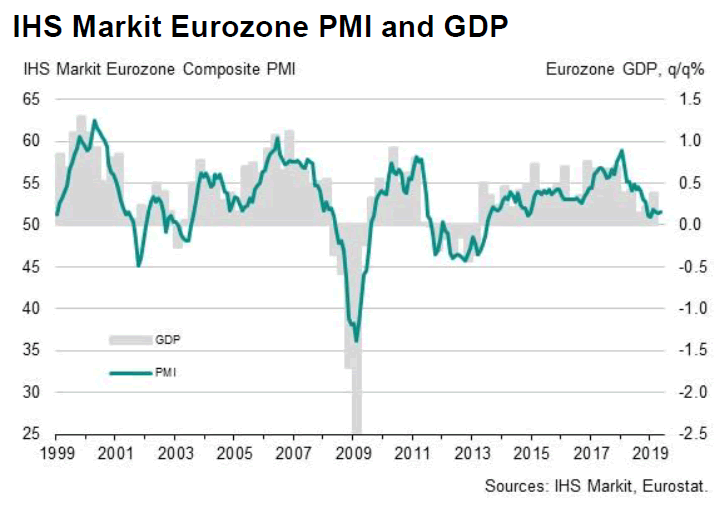
Eurozone PMIs suggests just 0.2% GDP growth in Q2, renewed deterioration in optimism
In May, Eurozone PMI manufacturing dropped to 47.7, down from 47.9 and missed expectation of 48.1. PMI services dropped to 52.5, down from 52.8 and missed expectation of 53.0. PMI Composite rose to 51.6, slightly up from 51.5. Markit noted that "the weak reading puts growth in the second quarter so far on a par with the lacklustre gain seen in the first quarter and is among the lowest recorded since mid-2013."
Commenting on the flash PMI data, Chris Williamson, Chief Business Economist at IHS Markit said:
"The eurozone economy remained becalmed in the doldrums in May, adding to signs that only modest growth will be achieved in the second quarter. At current levels the PMI is so far indicating GDP growth of only 0.2% in the second quarter.
"A renewed deterioration in optimism about the year ahead suggests that the business situation could deteriorate further in coming months. Worries reflected concerns over lower economic growth forecasts, signs of weaker sales and rising geopolitical uncertainty, with escalating trade wars and auto sector woes commonly cited as specific causes for concern.
"Sector divergences remain marked, with manufacturing still in decline and the region therefore reliant on the service sector to support growth.
"While some encouragement can be gained from the manufacturing sector showing signs of its downturn having bottomed out in March, the concern is that the slowdown is spreading to the service sector, where new business growth has slipped to one of the weakest seen since 2014.
"Germany is on course for a 0.2% expansion of GDP in the second quarter while the survey for data France point to a meagre 0.1% gain. However, the bigger concern is for the rest of the region, which collectively saw growth falter amid the first fall in orders for almost six years."
Currencies: Will (Poor) EMU Data Push EUR/USD For A Test Of The 1.1110 Support?
- Rates: Cautiousness ahead of EMU PMI's and German Ifo
Risk-off prevails on markets again as the US-Sino trade spat continues to dominate trading. Core bonds profited with US Treasuries outperforming. EMU PMI's and the German Ifo survey might offer some guidance today. AS risks are probably tilted to the downside, we expect core bonds to maintain their upward tendency. - Currencies: Will (poor) EMU data push EUR/USD for a test of the 1.1110 support?
The dollar traded mixed as the trade ware intensifies. USD/JPY lost modest ground, but the dollar gained a few ticks against the euro. Today, the trade war will continued to dominated FX trading, but the EMU data have also potential to move the euro. A test of the EUR/USD year low might be on the cards in case of poor PMI's/ifo. The sterling sell-off continues.
The Sunrise Headlines
- Losses on US equities eventually remained contained to -0.4%. Asian bourses lose ground as well this morning with India outperforming (+2%) as early vote counting shows a majority for PM Modi. The Nifty 50 sets an all-time high.
- FOMC Minutes of the May policy meeting revealed that many officials expected the recent soft patch in inflation to be temporary. The threshold to either raise or cut the policy rate is high.
- The Japanese manufacturing PMI dropped back below the 50 boom/bust mark in May (49.6 from 50.2) with export orders falling at their fastest rate in four months. A subindex on future expectations turned negative.
- South Korean newspaper Chosun Ilbo reports that the US government is lobbying not to use Huawei products, hoping US allies will also reject the Chinese tech firm's goods.
- Brent crude prices return towards $70/barrel after data showed that US crude stockpiles unexpectedly rose (+4.7m) to the their highest level in nearly two years (+476.8m barrels).
- The Times hints that UK PM May will announce her departure from office tomorrow after a scheduled meeting with the chair of the conservative 1922 committee of backbenchers.
- Today's eco calendar contains May EMU PMI's, German Ifo Business sentiment, US weekly jobless claims and new home sales. Spain taps the bond market. The UK holds European parliamentary elections.
Currencies: Will (Poor) EMU Data Push EUR/USD For A Test Of The 1.1110 Support?
Will data push EUR/USD for a test of 2019 low?
Global trading (including FX) yesterday was again driven by the trade war, as investors pondered the impact of the US measures against Huawei. Still the moves developed orderly. The US dollar initially ceded ground, but recouped the loss against the euro in the US session. The Minutes of the May meeting showed that the Fed is firmly on hold. The report had little impact on the dollar. EUR/USD closed at 1.1150 (from 1.1161). The yen gained slightly with USD/JPY closing at 109.36.
The sell-off on Asian equity markets accelerates as investors see the impact of the trade war between the US and China filtering through in the activity of ever more businesses. The yuan is holding near recent lows (USD/CNY 6.9150 area), but for now Chinese authorities apparently want no further depreciation. The yen hardly gains despite the risk-off (USD/JPY 110.30 area). EUR/USD stays under modest pressure (1.1150).
Later today , the EMU PMI's, the details of German Q1 GDP, and the Ifo business climate will be published. In the US, jobless claims and new home sales are on the agenda. The EMU data have most market moving potential. Any big miss in EMU data might further undermine confidence in the region and weigh on the euro. Positive EMU surprises will probably have less impact than negative ones. We also keep an eye at EUR/JPY in this context of a deteriorating global sentiment, even as the yen only profits modestly until now. EUR/USD has returned to the lower part of the 1.1265/1.1110 ST trading range. For now, the dollar retains the benefit of the doubt. Poor EMU data might push the pair for a test of the 1.1110 support. However, even in that scenario, we assume that further US gains will remain modest as the trade ware will also filter through into the US economy and as the US doesn't want a (too) strong dollar.
Sterling continued to suffer as political uncertainty in the UK mounts. All parties in Parliament rejected May's latest Brexit deal and the UK PM will probably have to quit in the near future. Next steps in the Brexit process are almost impossible to predict. EUR/GBP settled well above the 0.88 big figure. UK politics (including the outcome of the EU parliamentary elections) will dominate the (market) headlines. We stay cautions/negative on sterling. The EUR/GBP 0.8840 resistance is being tested; a break would bring the 0.90/0.91 area back on the radar.
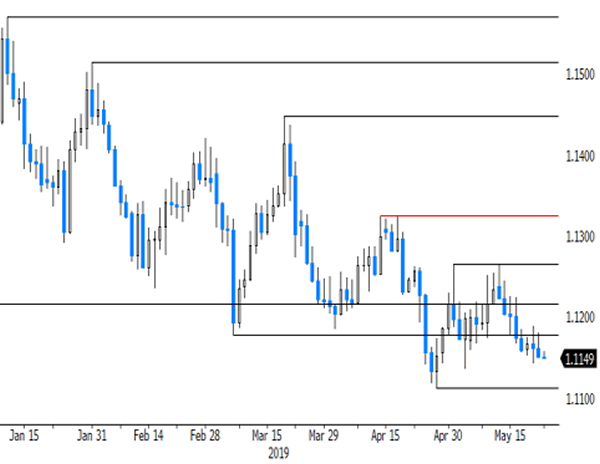
EUR/USD nears the bottom of the 1.1265/1.1110 ST range
Gold Muted To Fed Minutes
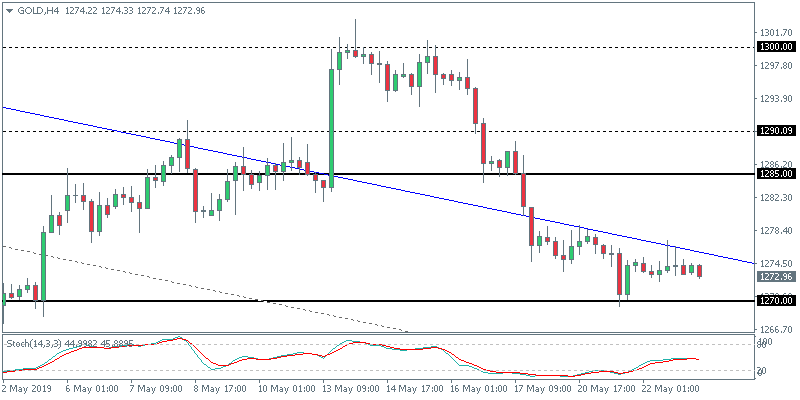
Gold prices did not react much to the release of the FOMC meeting minutes. This comes amid the market sentiment trading mixed. The threat of the trade wars continues to remain a concern among investors. This has kept a lid on the declines in gold prices which trade near the recent lows of 1270.
Can Gold Rebound in the Near Term?
Price action is rather subdued near the 200-day moving average. With the support level established at 1270, gold prices could remain biased to the upside. The immediate resistance level at 1285 remains key in the short term. Unless gold breaks down below the 1270 level, we expect price to remain muted at the current levels. Watch for any potential reversal in gold that could see price retesting the 1285 level of resistance.
Sterling Slips To Fresh 4-Month Lows
The UK's inflation report showed that consumer prices edged slightly higher in April. Headline inflation rose 2.1% on the year advancing from 1.9% previously. This was slightly below the estimates of a 2.2% increase. Core inflation also grew at a slower pace of 1.8%, missing estimates of a 1.9% increase. Brexit continues to dominate the GBP flows. The currency fell after the UK's House of Commons leader resigned on PM May's approach to Brexit.
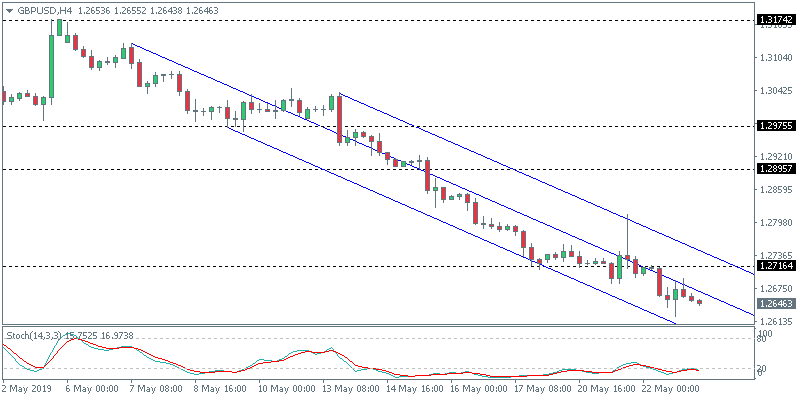
GBPUSD to Extend Declines
The currency pair lost 0.35% on the day and the bearish momentum indicates further declines. The GBPUSD could fall to 1.2606 level which would test the close from early January this year. If price does not stabilize at this level, the currency pair could be facing further losses. However, there is scope for a rebound in price given that the GBPUSD is down for the third consecutive week.
Euro Stays Subdued
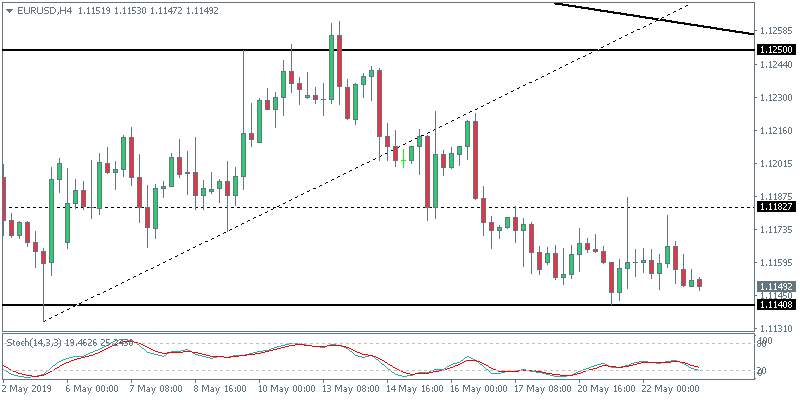
The common currency posted modest declines losing 0.09% on the day. The soft declines came despite the greenback posting strong gains on the day. Economic data from the eurozone was sparse. But, looking ahead, the flash PMI reports are due out later today including the start of the EU elections.
EURUSD Likely to Settle Lower on the Day
The common currency could continue extending the declines as it approaches the support area near 1.1140. We expect to see some consolidation taking place at this level. The EURUSD currency pair will maintain its sideways range within 1.1182 and 1.1140 levels in the near term. However, there is a risk of a break down below 1.1140 which could push the common currency to break down to fresh lows.
Germany PMI manufacturing dropped to 44.3, manufacturers remain the most downbeat
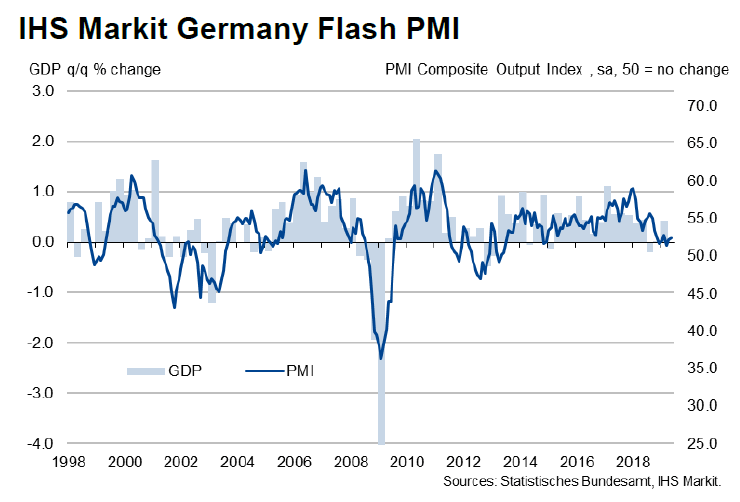
In May, Germany PMI manufacturing dropped to 44.3, down from 44.4 and missed expectation of 44.8. It's the second weakest reading in nearly seven years. PMI services dropped to 55.0, down from 55.7 and missed expectation of 55.4. PMI Composite rose to 52.4, up from 52.2.
Commenting on the flash PMI data, Phil Smith, Principal Economist at IHS Markit said:
"At 52.4, the headline Germany PMI remains in modest growth territory in May, indicating that the economy is course to see sustained expansion in Q2 following the rebound of GDP in the opening three months of the year.
"May data for the service sector were slightly less punchy than in recent months, with business activity, new orders and employment all rising more slowly. Thankfully, the manufacturing indicators for output, orders book and export sales have all picked up further from their low points in the first quarter, albeit remaining among the weakest since 2012. However, goods producers' increased efforts to streamline workforces means that factory job numbers are now falling at the steepest rate in over six years.
"It is manufacturers who remain the most downbeat about the outlook amid lingering global trade tensions, though the survey highlights that fears of a slowdown may have started to spread to services, where confidence is now at its joint-lowest since 2014."
USD/JPY Under Pressure
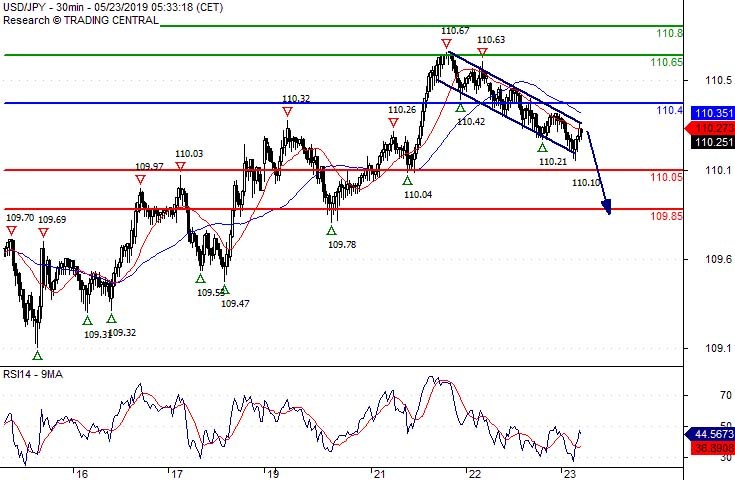
Pivot (invalidation): 110.40
Our preference Short positions below 110.40 with targets at 110.05 & 109.85 in extension.
Alternative scenario Above 110.40 look for further upside with 110.65 & 110.80 as targets.
Comment As Long as 110.40 is resistance, look for choppy price action with a bearish bias.
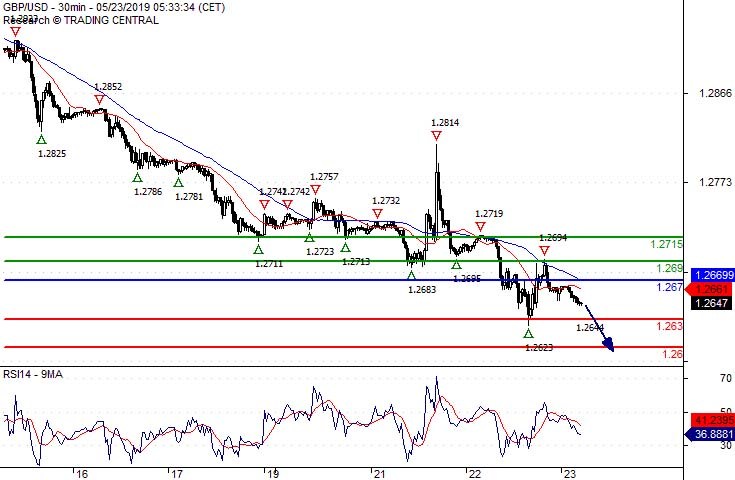
GBP/USD Watch 1.2600
Pivot (invalidation): 1.2670
Our preference Short positions below 1.2670 with targets at 1.2630 & 1.2600 in extension.
Alternative scenario Above 1.2670 look for further upside with 1.2690 & 1.2715 as targets.
Comment The RSI calls for a new downleg.
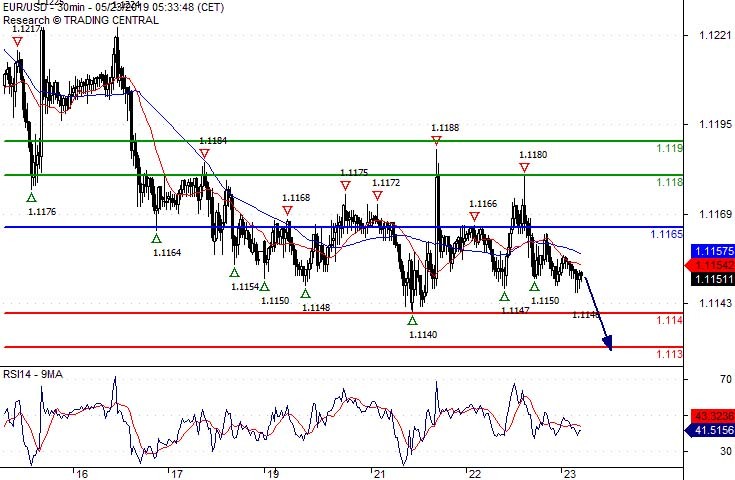
EUR/USD Under Pressure
Pivot (invalidation): 1.1165
Our preference Short positions below 1.1165 with targets at 1.1140 & 1.1130 in extension.
Alternative scenario Above 1.1165 look for further upside with 1.1180 & 1.1190 as targets.
Comment As Long as 1.1165 is resistance, look for choppy price action with a bearish bias.