Sample Category Title
British Pound Under Pressure as May Shelves Withdrawal Bill
The pound slide continues this week. Currently, GBP/USD is trading at 1.2645, down 0.13% on the day. On the release front, unemployment claims, today’s highlight is unemployment claims, which is expected to drop to 212 thousand. On Friday, the U.S. releases durable goods orders.
This week’s election for the European parliament could have significance for the Brexit negotiations. Starting on Thursday, voters in the 28 EU countries (including the U.K.) will elect lawmakers to the European parliament. Key issues included the economic slowdown, Brexit and the rise in Euroskpeticism. Euro-skeptics increased their representation in parliament from 12% to 25% in the last election, and with the dramatic increase in strength of populist parties, this trend could well continue. The Brexit party, headed by Nigel Farage, is expected to do well, while the Conservatives could be trounced, adding to Prime Minister May’s woes. There have been rumors swirling about May being forced out in the next few days or weeks, and the government has delayed the withdrawal bill, which was scheduled to be voted on in parliament on June 4.
There were no surprises from the Federal Reserve minutes, which provided details of the policy meeting earlier in May. Fed members continued to preach patience, stating that rates will likely remain unchanged for some time. The minutes indicated that although members are more optimistic about economic growth, they remain committed to maintaining current rate levels, given that inflation remains low. It should be noted that the policy meeting took place on May 1-2, one week before President Trump announced new tariffs on China, which has significantly escalated trade tensions between the U.S. and China.
The Fed minutes may have reinforced the central bank’s stance that no rate moves are planned until next year, but the markets don’t share this view, with many analysts expecting at least one rate cut in 2019. Lower U.S. rates could dampen enthusiasm for the U.S. dollar. The CME Group has priced in a 36% likelihood of a 25-point basis cut at the September meeting.
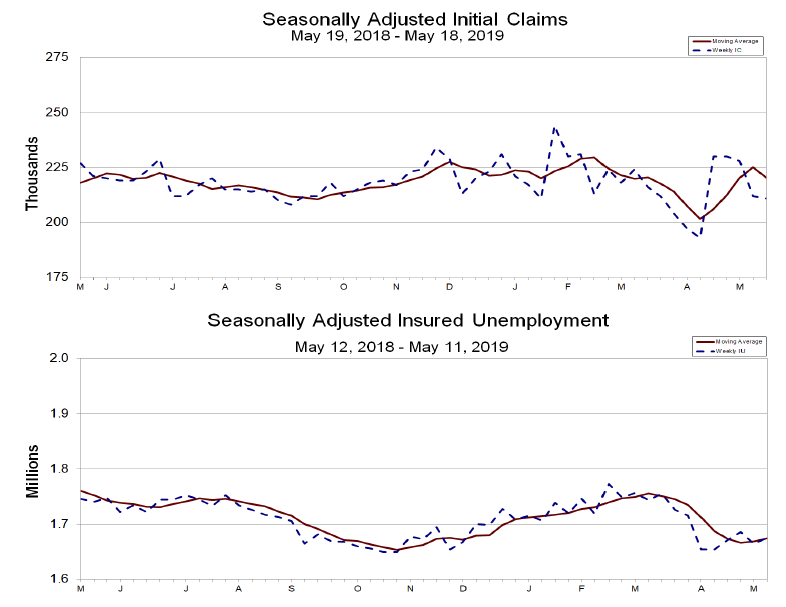
US initial jobless claims dropped slightly to 211k, below expectations
US initial jobless claims dropped -1k to 211k in the week ending May 18, below expectation of 215k. Four-week moving average of initial claims dropped -4.75k to 220.25k.
Continuing claims rose 12k to 1.676M in the week ending May 11. Four-week moving average of continuing claims rose 5.5k to 1.674M.
DAX Slumps as German Business Confidence Falls
The DAX started the week with a sharp decline and has resumed the downward trend on Thursday. Currently, the index is at 11,987, down 1.5% on the day. On the release front, it’s a very busy Thursday. German Ifo Business Climate fell to 97.9, shy of the estimate of 99.2. This marked the lowest reading in over nine years. German Final GDP posted a gain of 0.4%, matching the estimate. This was unrevised from the initial GDP reading earlier in May. German Manufacturing PMI dropped to 44.3 in April, down from 44.5 in March. Services PMI continued to point to expansion, with a score of 55.0. Eurozone PMIs followed a similar trend, with expansion in the services sector but contraction in manufacturing. The ECB releases the minutes of its April policy meeting, and voters go to the polls over the next several days to elect a new European parliament.
German business confidence dropped to 97.9 in May, down sharply from 99.2 in April. The decline was in response to weaker PMIs scores in May. German manufacturing PMI dropped to 44.3, marking a fifth straight contraction. Although services PMI continue to point to expansion, the May release disappointed, dropping from 55.6 to 55.2 and missing the forecast of 55.0 points. The manufacturing sector has been hit hard by the global trade war, and the German economy, the largest in the eurozone, managed just a 0.4% gain in the first quarter.
Investors are keeping a close eye on this week’s election in the European Union. Starting on Thursday, voters in 28 member states (including the U.K.) will elect lawmakers to the European parliament. Key issues included the economic slowdown, Brexit and the rise in Euroskpeticism. Euro-skeptics increased their representation in parliament from 12% to 25% in the last election, and with the dramatic increase in strength of populist parties, this trend could well continue. A strong showing by parties with an anti-EU agenda could have an important impact on upcoming elections in Italy, where the populist government wants to raise its deficit above EU rules. If euroskeptic parties do well in the election, investors could give a thumbs-down to the euro. As well, the outcome of the vote could have an impact on the choice of the new head of the ECB, as Mario Draghi steps down in October, after an eight-year term.
Into US session: Risk off as China said no more negotiations unless US correct their wrong actions
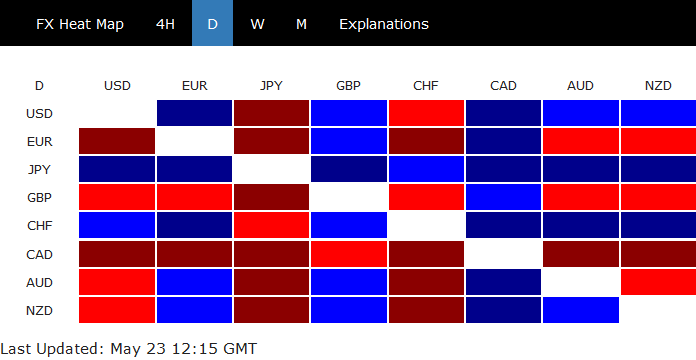
Entering into US session, Yen and Swiss Franc are the strongest ones today as risk aversion seems to be intensifying. On the one hand, Huawei was given another blow after ARM is said to cut ties with the Chinese telecom giant. On the other hand, China is stepping up hard line rhetoric on trade with US. Asian markets closed broadly lower while European indices are in deep red. DOW futures is down more than -200 pts at the time of writing. German 10-year yield is back pressing -0.1 handle. US 10-year yield is down -0.025 at 2.361. Outlook in the financial markets are rather bad.
Chinese Commerce Ministry spokesman Gao Feng warned: "If the United States wants to continue trade talks, they should show sincerity and correct their wrong actions. Negotiations can only continue on the basis of equality and mutual respect... We will closely monitor relevant developments and prepare necessary responses." Foreign Ministry spokesman Lu Kang said "relevant U.S. actions obviously do not create a good atmosphere or environment for consultations." It's pretty clear there is no case to resume trade negotiations any time soon. US-China trade war will at least drag into US elections next year, with possibility of much more serious escalations.
In Europe, currently:
- FTSE is down -1.21%.
- DAX is down -1.63%.
- CAC is down -1.58%.
- German 10-year yield is down -0.0148 at -0.099.
Earlier in Asia:
- Nikkei dropped -0.62%.
- Hong Kong HSI dropped -1.58%.
- China Shanghai SSE dropped -1.36%.
- Singapore Strait Times dropped -0.70%.
- Japan 10-year JGB yield dropped -0.0104 at -0.061.
ECB minutes: Less confidence in baseline growth scenario, range of possibilities widened
Minutes of ECB's April 9-10 meeting showed that policy makers were getting less confident on Eurozone recovery. The minutes noted "it was acknowledged that some recent data had turned out even weaker than expected". And, "there was now somewhat less confidence in the baseline scenario and that the range of other possible outcomes had widened."
Also, "the global outlook remained subject to the continued risk of an escalation of trade conflicts and the uncertainty surrounding the withdrawal of the United Kingdom from the EU."
Regarding the new TLTROs, "some arguments were put forward in favor of pricing the new operations so they would primarily serve as a backstop, providing insurance in times of elevated uncertainty." Also, "other arguments supported the view that the TLTRO-III operations should be seen as a potential tool for adjusting the monetary policy stance."
(ECB) Account of the monetary policy meeting 9-10 April 2019
1. Review of financial, economic and monetary developments and policy options
Financial market developments
The Vice-President, standing in for Mr Cœuré, reviewed the latest financial market developments. Since the Governing Council's previous monetary policy meeting on 6-7 March 2019, global risk sentiment had improved across various market segments. Equity market indices had continued to rise, recording one of the strongest first quarter performances since the global financial crisis, while government bond prices had also increased. At the same time, foreign exchange rates had mostly remained broadly stable.
Expectations that monetary policy would remain supportive globally had been an important factor behind these developments. In the United States, at its meeting in March 2019 the Federal Open Market Committee had lowered its projections for the federal funds target rate for the period 2019 to 2021 and had also announced that it would reduce its holdings of US Treasuries at a slower pace from May 2019, concluding its balance sheet run-off by the end of September 2019.
This, combined with revisions to the global economic outlook, had led to a decline in global government bond yields over the review period. The ten-year German Bund yield had moved into negative territory, although over the past few days it had risen slightly and was currently trading around zero. With regard to the euro area, market expectations for a first increase in ECB policy rates had been pushed further out in time since the Governing Council's March 2019 monetary policy meeting. Market views regarding the medium-term outlook for euro short-term money market rates had shifted further to the downside, standing close to the low levels seen in late 2016.
A decomposition of the euro area ten-year overnight index swap (OIS) rate highlighted that the decline in the rate seemed to have been driven mainly by the inflation component, although the real component had also decreased somewhat since the Governing Council's March 2019 monetary policy meeting. In contrast, in the United States, the real component seemed to have been the main driver of a decline in the ten-year spot OIS rate, consistent with the softer US economic data releases in the first quarter of 2019. The inflation component had increased since the start of the year, supported by an increase in oil prices.
Euro area government bond yields had declined to a similar degree across all jurisdictions. Market participants' anticipation of "low rates for longer" had possibly spurred a renewed search for yield and a stronger risk appetite, as evidenced also in declining euro area corporate bond market yields and asset swap spreads. Overall, as a result of these global bond market movements 20% of worldwide investment-grade debt was trading at yields below zero, compared with the historical high of 25% seen in mid-2016.
Nominal effective exchange rates of major currencies had remained broadly stable, with the exception of the pound sterling, which had strengthened by around 4% against its trading partners' currencies during the first quarter of this year.
The global environment and economic and monetary developments in the euro area
Mr Praet reviewed the global environment and recent economic and monetary developments in the euro area. Regarding the external environment, there were signs that the moderation in global activity had continued in early 2019 and that the weakness in global trade was persisting. Global survey indicators pointed to a further slowdown in manufacturing activity, while services appeared more resilient. In three-month-on-three-month terms, global merchandise import growth had decelerated further in January. The slowdown had continued to be largely driven by emerging market economies and, in particular, emerging Asia.
Annual consumer price inflation in the OECD area stood at 2.1% in February. Core inflation had fallen slightly from 2.2% in January to 2.1% in February. After the strong jump in mid-February, oil prices had increased again, rising by 9% since the Governing Council's March 2019 monetary policy meeting, with the price of Brent crude oil standing at almost USD 71 per barrel. Food prices had declined by 2.5%, while metal prices had remained broadly stable. The euro had depreciated since the March meeting, both against the US dollar (by 0.7%) and in nominal effective terms (by 0.3%).
Turning to the euro area economy, high frequency information that had become available since the Governing Council's March 2019 monetary policy meeting continued to signal positive, albeit subdued, growth in the first quarter of 2019. Indicators related to the manufacturing sector had weakened further, whereas those related to services had shown signs of stabilisation. The European Commission's Economic Sentiment Indicator (ESI) had dropped to 106.0 in the first quarter of 2019, from 108.9 in the previous quarter, and the composite output Purchasing Managers' Index had stood at an average of 51.5, down from 52.3 in the previous quarter.
Domestic demand was being supported by favourable financing conditions, employment growth and rising wages. Private consumption growth had stabilised at 1.0% in the fourth quarter of 2018. It was expected to gradually accelerate again, in line with developments in real disposable income, which were in turn largely driven by continued labour income growth. The four main factors behind the recent weakness in private consumption had been the higher oil prices in the first half of 2018, car delivery bottlenecks owing to the new emissions testing procedures, increased macroeconomic uncertainty, and some country-specific factors. Business investment had slowed in the fourth quarter of 2018. Looking ahead, business investment was expected to continue expanding, albeit at a lower rate, as had also been reflected in the March 2019 ECB staff macroeconomic projections. This was consistent with lower corporate earnings expectations.
Employment had continued to expand, albeit at a slower pace. Employment growth had slowed in manufacturing and market services, while it had remained resilient in the construction sector. Looking ahead, survey indicators for employment continued to indicate further employment growth, albeit at a more moderate pace.
Growth in extra-euro area exports had remained subdued, while intra-euro area trade had contracted at the end of 2018. Based on leading indicators, no immediate recovery was in sight.
Turning to price developments, according to Eurostat's flash estimate, annual HICP inflation had stood at 1.4% in March, down from 1.5% in February, while HICP inflation excluding food and energy had decreased to 0.8%, from 1.0% in February. Measures of underlying inflation had remained generally muted. Domestic cost pressures had been increasing, but had yet to translate into higher underlying inflation.
Growth in compensation per employee had remained above its long-term average (of 2.1%), although it had fallen from 2.5% in the third quarter of 2018 to 2.2% in the fourth quarter. The third quarter reading, however, had been driven in part by some one-off payments. At the same time, negotiated wages had continued to increase, rising from 2.1% in the third quarter of 2018 to 2.2% in the fourth quarter, and further to 2.5% in January 2019. The pick-up in January had been quite broad-based across euro area countries.
Price pressures for non-energy industrial goods had increased in the later stages of the supply chain, while signals in the earlier stages were mixed. Inflationary pressures along the pricing chain for services had also strengthened slightly again. Services producer price inflation had continued the upward trend that had started at the beginning of 2016. This trend had been broad-based and was supported by all the main sub-categories.
The results of the ECB Survey of Professional Forecasters for the second quarter of 2019 had shown slight downward revisions of 0.1 percentage points for HICP inflation expectations for 2019, 2020 and 2021. At the same time, average longer-term inflation expectations had remained broadly unchanged at 1.8%. Expectations for inflation excluding food and energy had been revised down by 0.1 percentage points for 2019 and 2020, while remaining unchanged for 2021. Market-based measures of inflation expectations derived from the five-year forward inflation-linked swap rate five years ahead had stood at 1.4%, which was 15 basis points lower than the level that had prevailed before the Governing Council's March 2019 monetary policy meeting.
Financial conditions had eased since the March monetary policy meeting against the backdrop of a further reappraisal of monetary policies at the global level as well as improved risk sentiment. Credit conditions had generally remained very accommodative. The overall cost of financing for euro area firms had declined by 9 basis points since the March meeting and stood at 4.5%. The expected timing of the ECB's policy rate "lift-off" had shifted out substantially. At the same time, equity prices had increased amid large swings and corporate bond spreads had tightened somewhat.
The annual growth rate of broad money (M3) had rebounded in February to 4.3%, from 3.8% in January. From a counterpart perspective, while private credit had remained the main source of money creation, since July 2018 the decline in the contribution of the asset purchase programme (APP) had been replaced by external monetary inflows and, to a lesser extent, by bank credit to the general government.
The annual growth of bank loans to non-financial corporations (NFCs) had dropped to 3.4% in January, but had rebounded to 3.7% in February. The volatility in the first two months of 2019 had reflected base effects related to banks' efforts to reach minimum threshold loan flows within the benchmark period for the second series of targeted longer-term refinancing operations (TLTRO-II) in early 2018. Looking through this volatility, a weakening in NFC loan dynamics had been observed since September 2018, when the annual growth rate had peaked at 4.3%. This moderation was consistent with the observed weakening in economic growth during 2018.
According to the bank lending survey results for the first quarter of 2019, both credit standards for loans to enterprises and demand for loans to enterprises had remained broadly unchanged. Overall, bank lending conditions remained favourable and continued to support credit provision.
As regards fiscal developments, the euro area fiscal stance was projected to turn mildly expansionary in 2019.
Monetary policy considerations and policy options
Summing up, Mr Praet noted that financial conditions had eased since the Governing Council's March 2019 monetary policy meeting. In line with the Governing Council's forward guidance, the risk-free yield curve had flattened in response to the ECB's monetary policy decisions and also to a stream of negative surprises about the euro area economy. Bank lending conditions remained favourable.
Incoming data confirmed that the slower growth momentum was extending into the current year. Activity in the manufacturing sector had decelerated markedly, mainly on account of external headwinds, as global growth and trade dynamics remained weak. At the same time, domestic demand remained resilient and some of the idiosyncratic domestic factors dampening growth were fading.
The balance of risks surrounding the growth outlook remained on the downside, as the persistence of uncertainties, related to geopolitical factors, the threat of protectionism and vulnerabilities in emerging markets, was weighing on confidence.
HICP inflation had fallen in March, primarily reflecting a decline in inflation excluding food and energy. Market-based, longer-term inflation expectations had also declined, mainly in reaction to weak macroeconomic data releases, and measures of underlying inflation remained muted. Domestic cost pressures, in particular in wages, had been strengthening, but had yet to translate into higher underlying inflation.
Against this background, Mr Praet proposed to reiterate the forward guidance on the key ECB interest rates and on reinvestments, and the readiness to act by employing all available monetary policy tools should inflation convergence require more support. It was essential to preserve the ECB's accommodative monetary policy stance for as long as necessary for growth to regain a faster pace and thereby foster convergence of inflation to its aim.
Concerning the parameters of the new targeted longer-term refinancing operations (TLTRO-III), set to be discussed at one of the Governing Council's forthcoming meetings, Mr Praet suggested that their pricing would take into account a thorough assessment of the bank-based transmission channel as well as further developments in the economic outlook. In the context of its regular assessment, the Governing Council could also consider whether the preservation of the favourable implications of negative interest rates for the economy would require the mitigation of their possible side effects, if any, on bank intermediation.
Accordingly, the public communication should: (a) stress that the incoming information confirmed slower growth momentum extending into the current year; (b) underline that further employment gains and rising wages continued to underpin the resilience of the domestic economy and gradually rising inflation pressures; (c) recognise that the risks surrounding the euro area growth outlook remained tilted to the downside on account of the persistence of uncertainties, related to geopolitical factors, the threat of protectionism and vulnerabilities in emerging markets; (d) emphasise that an ample degree of monetary policy accommodation remained necessary to safeguard favourable financing conditions and support the economic expansion, and thus to ensure that inflation remained on a sustained path towards levels that were below, but close to, 2% over the medium term; (e) reiterate that significant monetary policy stimulus was being provided by the forward guidance on the key ECB interest rates, reinforced by the reinvestments of the sizeable stock of acquired assets and the new series of TLTROs; (f) announce that the details on the precise terms of the new TLTROs would be communicated at one of the Governing Council's forthcoming meetings and that their pricing would take into account a thorough assessment of the bank-based transmission channel of monetary policy, as well as further developments in the economic outlook; (g) highlight that, in the context of its regular assessment, the Governing Council would consider whether the preservation of the favourable implications of negative interest rates for the economy would require the mitigation of their possible side effects, if any, on bank intermediation; and (h) finally, underscore that, in any event, the Governing Council stood ready to adjust all of its instruments, as appropriate, to ensure that inflation continued to move towards its aim in a sustained manner.
2. Governing Council's discussion and monetary policy decisions
Economic and monetary analyses
With regard to the economic analysis, members generally shared the assessment of the outlook for economic activity in the euro area provided by Mr Praet in his introduction. Incoming data confirmed that the slower growth momentum was extending into the current year. There were signs that some of the country and sector-specific domestic factors dampening growth were fading, but global headwinds continued to weigh on euro area activity and were leaving marks on economic sentiment. At the same time, further employment gains and rising wages continued to underpin the resilience of the domestic economy and gradually rising inflation pressures. The risks surrounding the growth outlook remained tilted to the downside.
In discussing the outlook and risks for the external environment, members took note of the continued moderation of global activity and the ongoing weakness of global trade. Some comfort was drawn from recent signs that economic activity in China was stabilising. Concerns were reiterated that the global outlook remained subject to the continued risk of an escalation of trade conflicts and the uncertainty surrounding the withdrawal of the United Kingdom from the EU. It was also recalled that the complexity of global value chains made it difficult to gauge the precise implications of such risks for trade and activity over time.
Turning to euro area activity, members agreed that the slower growth momentum observed in the second half of 2018 was extending into the current year. Incoming data had continued to be weak, especially for the manufacturing sector. The extension of the slower growth momentum had, in part, already been anticipated in the March 2019 ECB staff projections, but it was also acknowledged that some recent data had turned out even weaker than expected. Looking further ahead, members widely shared the view that the more protracted "soft patch" suggested by the latest data remained consistent with the baseline scenario of a return to more solid growth in the second half of the current year. At the same time, it was acknowledged that there was now somewhat less confidence in this baseline scenario and that the range of other possible outcomes had widened. More information would need to be gathered in the run-up to the Governing Council's June monetary policy meeting, when new Eurosystem staff projections would become available.
Members put forward a number of views on how to interpret and assess the more protracted "soft patch" and the baseline scenario. The important role of exports and manufacturing in driving the current outlook was emphasised. Given that the euro area was running a persistent current account surplus, it was naturally more exposed to the slowdown in global trade than the rest of the world. As this shock was transmitted mainly through manufacturing, some euro area countries were more exposed than others. Attention was also drawn to the role of inventories and whether they were indicating an unanticipated lack of demand or deferred demand.
Concern was again expressed that the return to more solid growth rates expected in the baseline scenario was currently based on the assumption that the shocks behind the "soft patch" would be temporary and that there would be no new negative shocks. However, it was also remarked that "soft patches" in economic growth had been observed on numerous occasions and that historical data implied a low probability of them turning into recessions. Reference was made to a number of positive indicators and supportive factors. The service sector had remained more resilient than manufacturing. Financial market developments, which were typically more forward looking, were more upbeat. Favourable financing conditions, and the positive real income developments implied by further employment gains and rising wages, continued to underpin the resilience of domestic demand and to support the underlying strength of the euro area economy.
Members generally concurred with the view that the balance of risks surrounding the euro area growth outlook remained tilted to the downside on account of the persistence of uncertainties, related to geopolitical factors, the threat of protectionism and vulnerabilities in emerging markets. Downside risks, from Brexit and the threat of protectionism in particular, had the potential to further affect confidence and negatively spill over to activity. In this context, it was recalled that, insofar as uncertainties related to the Chinese economy and Brexit had been two main factors in previously shifting the risk balance from neutral to negative, a recovery in China and the avoidance of a "no-deal" Brexit should by the same token imply an improvement in the risk balance.
Members took note of the outlook for fiscal policy, with the mildly expansionary euro area fiscal stance and the operation of automatic stabilisers providing support to economic activity. With regard to the role of other policy areas, it was underlined that structural reforms were important for ensuring that the economy could reap the full benefits of the ECB's monetary policy measures. It was seen as essential for other policy areas to contribute more decisively to raising the longer-term growth potential and reducing vulnerabilities.
With regard to price developments, there was broad agreement with the assessment presented by Mr Praet in his introduction. According to Eurostat's flash estimate, euro area annual HICP inflation was 1.4% in March, after 1.5% in February 2019, reflecting declines in food, services and non-energy industrial goods price inflation. On the basis of current futures prices for oil, headline inflation was likely to decline over the coming months. Measures of underlying inflation remained generally muted, but labour cost pressures had strengthened and broadened amid high levels of capacity utilisation and tightening labour markets. Looking ahead, underlying inflation was expected to increase over the medium term, supported by the ECB's monetary policy measures, the ongoing economic expansion and rising wage growth.
Members acknowledged the negative surprise in the March outcome for HICP inflation excluding energy and food. A need for caution was expressed, though, as the interpretation of this surprise was complicated by the impact of recent methodological changes in the compilation of the HICP and calendar effects related to the timing of Easter. Members underlined that the transmission of wage inflation to consumer price inflation remained a key issue for the medium-term inflation outlook. Although, according to the latest data, growth in compensation per employee in the euro area continued to stand above its long-term average, it was observed that the lack of pass-through of wages to underlying inflation so far implied that firms and retailers were compressing their profit margins rather than raising prices. All in all, however, it was generally considered that the observed wage growth should also lead to higher inflation in due course.
Members took note of the latest developments in longer-term inflation expectations. While longer-term survey-based inflation expectations in the ECB Survey of Professional Forecasters for the second quarter of 2019 had been unchanged at 1.8%, the market-based measure of the five-year forward inflation-linked swap rate five years ahead had declined further since the Governing Council's March 2019 monetary policy meeting, to stand at 1.4%. Some concern was expressed that market-based inflation expectations had shifted downwards in parallel with actual inflation and across all maturities. At the same time, the deterioration was seen to mainly reflect a response to the weaker economic outlook rather than an unanchoring of inflation expectations.
With regard to the monetary analysis, members widely shared the assessment provided by Mr Praet in his introduction. The annual growth rate of broad money M3 had rebounded somewhat in February. The narrow monetary aggregate M1 had remained the main contributor to broad money growth. The gradually declining contribution to the growth momentum of M3 from the APP continued to be replaced by a rising contribution from credit to the private sector, which had remained robust. At the same time, a remark was made that the gradual recovery in the growth of MFI loans to the private sector, which had been observed since the beginning of 2014, showed signs of stalling in a number of countries.
Credit provision to the private sector continued to be supported by very favourable borrowing costs for firms and households across euro area jurisdictions, which remained close to their historical lows. Reference was made to the bank lending survey for the first quarter of 2019, which pointed to demand for loans to enterprises remaining robust, while demand for housing loans continued to increase. Credit terms and conditions remained broadly unchanged, following a protracted easing period.
At the same time, it was cautioned that the implications of very easy credit conditions and low lending rates for banks' capacity to appropriately price credit risk through the cycle warranted close monitoring. In this regard, concerns were expressed that banks' profitability and market valuations remained weak. Structural factors, such as cost efficiency, excess capacity and the need for consolidation, were seen to be primarily responsible for this. It was reiterated that further analysis was warranted on the effects of persistently low and negative interest rates on banks' interest rate margins and profitability, as well as on the potential implications for bank intermediation and financial stability over time. In this context, the point was made that, in the responses to the bank lending survey, banks had indicated that the negative deposit facility rate was still contributing to increased lending volumes across all loan categories.
Monetary policy stance and policy considerations
With regard to the monetary policy stance, members broadly agreed with the assessment provided by Mr Praet in his introduction. The incoming information since the Governing Council's March 2019 monetary policy meeting had confirmed that the slower growth momentum was extending into the current year and might delay convergence to the Governing Council's medium-term inflation aim. At the same time, further, albeit slowing, employment gains and rising wages continued to underpin the resilience of the domestic economy and gradually rising inflation pressures. Still, an ample degree of monetary accommodation remained necessary to safeguard favourable financing conditions and support the economic expansion as well as a sustained adjustment in the path of inflation.
Financial conditions had eased since the March monetary policy meeting. The risk-free yield curve had flattened in reaction to the decisions communicated at that meeting as well as to negative economic data surprises in the intervening period. Moreover, subsequent market developments had brought about a substantial additional easing of financial conditions. Policy rates were now expected to remain at current levels for almost a year longer than had been the case before the March meeting. Overall, there was broad agreement that the response by financial markets showed that the Governing Council's reaction function was well understood.
Against this background, all members agreed to maintain the current monetary policy stance and to reconfirm all elements of the Governing Council's forward guidance. Significant monetary policy stimulus would be provided by the forward guidance on the key ECB interest rates, reinforced by the reinvestments of the sizeable stock of acquired assets and the new series of TLTROs. The present monetary policy stance was considered to be consistent with the Governing Council's data-driven approach to monetary policy, oriented towards the medium term. The baseline outlook of the March 2019 ECB staff projections had remained broadly intact, notwithstanding evidence of greater uncertainty around the central projection, with risks remaining tilted to the downside. A wider information set would be available in June, including a fresh round of Eurosystem staff projections.
While it was acknowledged that contingencies for the Governing Council to act again had not materialised, the point was made that inflation remained uncomfortably below the Governing Council's inflation aim and market-based inflation expectations had receded, while the projected inflation convergence had been repeatedly delayed. Against this background, the Governing Council reiterated its determination to stand ready to adjust all of its monetary policy tools, as appropriate, to ensure that inflation continued to move towards its aim in a sustained manner. It was emphasised that inflation was ultimately a monetary phenomenon, while structural factors and other policy areas were responsible for determining growth potential and reaping the full benefits of the Governing Council's monetary policy.
There was broad agreement among members that details on the precise terms of the new series of TLTROs should be considered at one of the Governing Council's forthcoming meetings. The pricing of the new TLTRO-III operations should be data-dependent and take into account a thorough assessment of the bank-based transmission channel of monetary policy, as well as further developments in the economic outlook. Some arguments were put forward in favour of pricing the new operations so that they would primarily serve as a backstop, providing insurance in times of elevated uncertainty. Other arguments supported the view that the TLTRO-III operations should also be seen as a potential tool for adjusting the monetary policy stance.
Members supported the proposal made by Mr Praet in his introduction that, in addition to assessing the pricing of the new TLTRO-III operations, the Governing Council should also consider in its regular assessment whether the preservation of the favourable implications of negative interest rates for the economy called for the mitigation of their possible side effects, if any, on bank intermediation.
Turning to communication, members widely agreed with the elements proposed by Mr Praet in his introduction. It was appropriate for the Governing Council to acknowledge that the incoming information confirmed that the slower growth momentum was extending into the current year. The baseline scenario of a rebound in growth in the second half of the year remained broadly intact, while the risks surrounding the euro area growth outlook remained tilted to the downside.
An ample degree of monetary policy accommodation remained necessary to safeguard favourable financing conditions and support the economic expansion, and thus to ensure that inflation remained on a sustained path towards levels below, but close to, 2% over the medium term. In this regard, it was important to reiterate that significant monetary policy stimulus was being provided by the Governing Council's forward guidance on the key ECB interest rates, reinforced by the reinvestments of the sizeable stock of acquired assets and the announced new series of TLTROs. It was also worth reiterating that, on account of the stock effects of the sizeable APP portfolio, the end of net asset purchases did not represent a tightening of the monetary policy stance.
There was, furthermore, wide agreement among members that the Governing Council should reiterate that all monetary policy tools remained available and that it stood ready to adjust all of its instruments, as appropriate, to ensure that inflation continued to move towards its inflation aim in a sustained manner. Members also widely agreed to communicate that the details on the precise terms of the new TLTROs would be announced following one of the Governing Council's forthcoming meetings.
Monetary policy decisions and communication
Taking into account the foregoing discussion among the members, on a proposal from the President, the Governing Council decided that the interest rate on the main refinancing operations and the interest rates on the marginal lending facility and the deposit facility would remain unchanged at 0.00%, 0.25% and -0.40%, respectively. The Governing Council expected the key ECB interest rates to remain at their present levels at least through the end of 2019, and in any case for as long as necessary to ensure the continued sustained convergence of inflation to levels that were below, but close to, 2% over the medium term.
The Governing Council intended to continue reinvesting, in full, the principal payments from maturing securities purchased under the asset purchase programme for an extended period of time past the date when it started raising the key ECB interest rates, and in any case for as long as necessary to maintain favourable liquidity conditions and an ample degree of monetary accommodation.
The members of the Governing Council subsequently finalised the introductory statement, which the President and the Vice-President would, as usual, deliver at the press conference following the end of the current Governing Council meeting.
Introductory statement
https://www.ecb.europa.eu/press/pressconf/2019/html/ecb.is190410~c27197866f.en.html
Press release
https://www.ecb.europa.eu/press/pr/date/2019/html/ecb.mp190410~3df2ed8a4c.en.html
Meeting of the ECB's Governing Council, 9-10 April 2019
Members
- Mr Draghi, President
- Mr de Guindos, Vice-President
- Mr Costa*
- Ms Georghadji
- Mr Hansson
- Mr Hernández de Cos
- Mr Knot
- Mr Lane
- Ms Lautenschläger
- Mr Makúch*
- Mr Mersch
- Mr Nowotny
- Mr Praet
- Mr Rehn
- Mr Reinesch
- Mr Rimšēvičs
- Mr Stournaras
- Mr Vasiliauskas
- Mr Vasle*
- Mr Vella
- Mr Villeroy de Galhau*
- Mr Visco
- Mr Weidmann
- Mr Wunsch
* Members not holding a voting right in April 2019 under Article 10.2 of the ESCB Statute.
Other attendees
- Mr Teixeira, Secretary, Director General Secretariat
- Mr Smets, Secretary for monetary policy, Director General Economics
- Mr Winkler, Deputy Secretary for monetary policy, Senior Adviser, DG Economics
Accompanying persons
- Mr Alves
- Mr Arce
- Mr Aucremanne
- Mr Bradeško
- Ms Buch
- Mr Demarco
- Mr Gaiotti
- Ms Goulard
- Mr Kaasik
- Mr Kuodis
- Mr Mooslechner
- Mr Ódor
- Mr Pattipeilohy
- Mr Rutkaste
- Mr Schoder
- Mr Šiaudinis
- Mr Sinnott
- Mr Stavrou
- Mr Tavlas
- Mr Välimäki
Other ECB staff
- Ms Graeff, Director General Communications
- Mr Straub, Counsellor to the President
- Mr Bindseil, Director General Market Operations
- Mr Sousa, Deputy Director General Economics
- Mr Rostagno, Director General Monetary Policy
- Ms Valla, Deputy Director General Monetary Policy
Release of the next monetary policy account foreseen on Thursday, 11 July 2019.
Copper Futures Record 4-Month Low, Bears Have Control
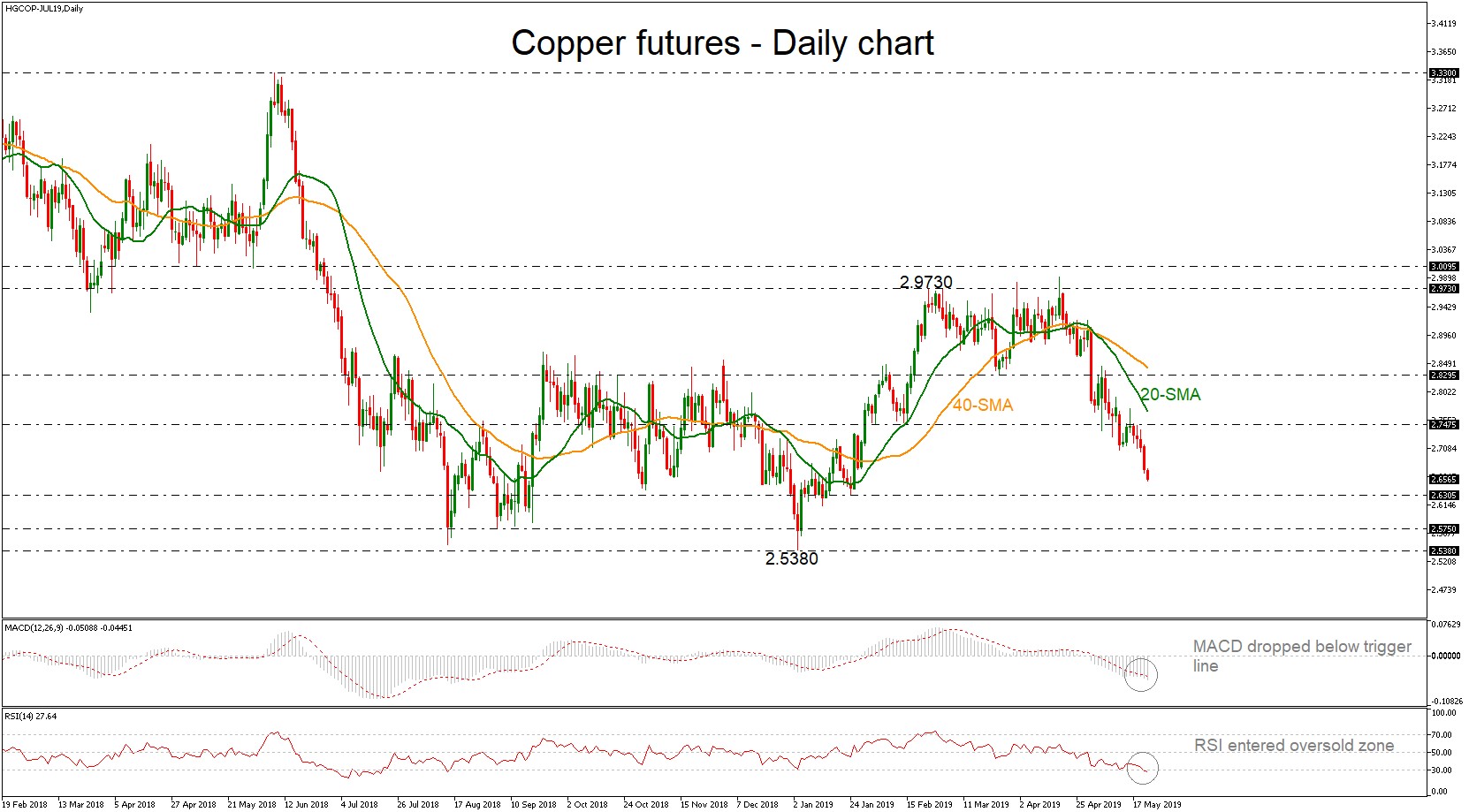
Copper futures with delivery on July 2019 are falling below the 20- and 40-simple moving averages (SMAs) in the daily chart. Moreover, the technical indicators remain in bearish territory, with the RSI sloping down in oversold zone and the MACD oscillator is still endorsing the bearish view as it is weakening below its trigger line.
In case the price extends the bearish move, the next immediate support is expected to come from the 2.6305 barrier. A significant penetration of this line would drive prices lower until the 2.5380 – 2.5750 region.
On the other hand, if there is an upside reversal, the price could reach the 2.7475 resistance taken from the inside swing bottom on February 14. Above this line, the 20-day SMA currently at 2.7680 could halt bullish movements before challenging the 2.8295 resistance.
Briefly, copper prices maintain a bearish bias after the pullback on 2.9730, posting a fresh four-month low of 2.6545.
Stocks In Free-Fall, US Dollar Is King, Yields Lower
Thursday May 23: Five things the markets are talking about
U.S equity futures and European bourses are again under pressure, following Asian stocks lower, as Sino-U.S trade tensions show little sign of easing. The street is now officially worried that what started as a ‘tiff over tariffs' is turning into a full-blown trade war. U.S Treasuries are steady while the ‘big' dollar remains King.
Yesterday's FOMC minutes showed that U.S policy makers are broadly comfortable with their current “make-no-moves” posture. A number of officials said they thought the Fed might need to raise rates because they expected tight labour markets to eventually lead wages and prices to rise, while others thought there was more labour slack than implied by the unemployment rate, at +3.8% in April.
In FX, the pound has extended its losses amid a “growing revolt over Brexit” that looks increasingly likely to force PM Theresa May from power sooner rather than later. Europe's single unit, the EUR is steady as voting gets underway in Day 1 of the European elections. While crude oil comes under pressure from inventory data and commodities from a “grinding trade war.”
On tap: Fr. & Gr. flash services & manufacturing PMI, Day 1 EUR parliamentary elections (May 23), GBP retail sales, Day 2 EUR parliamentary elections & U.S durable goods (May 24), Day 3 EUR parliamentary elections (May 25).
1.Stocks sea of red, except for India
In Japan, the Nikkei dropped overnight after renewed U.S-China trade tensions dragged down tech stocks, while index-heavyweight SoftBank Group fell more than -5%. The Nikkei share average ended -0.6% lower, while the broader Topix lost -0.4%.
Note: SoftBank Group, which has a stake in Sprint, fell on news that the U.S Justice Department's have recommended the agency blocks T-Mobile US Inc's +$26B acquisition of smaller rival Sprint.
Down-under, Aussie shares ended lower, ending six consecutive sessions of gains, on concerns U.S-China trade frictions were spilling into the tech sector. The S&P/ASX 200 index fell -0.3%. The benchmark rose +0.2% on Wednesday. In S. Korea, The Kospi index closed down -0.26%.
The outlier in Asia, Indian shares hit a record high overnight as results showed that the incumbent Modi-led coalition is leading in most seats in the lower house of Parliament and is set to win re-election.
In China, the blue-chip stock index dropped to a three-month low, as investors dumped tech names amid worries that Chinese tech firms could bear the brunt of an escalating trade war. The blue-chip CSI300 index fell -1.8%,while the Shanghai Composite Index lost -1.4%.
In Europe, regional bourses have declined sharply across the board led by losses in the auto and tech sector amid weaker than expected PMI data from Germany and Eurozone and German IFO Business Climate release.
U.S stocks are set to open deep in the ‘red' (-0.8%).
Indices: Stoxx600 -1.24% at 374.50, FTSE -1.07% at 7,255.83, DAX -1.58% at 11,976.78, CAC-40 -1.54% at 5,296.19, IBEX-35 -1.24% at 9,121.00, FTSE MIB -1.54% at 20,255.50, SMI -0.53% at 9,593.80, S&P 500 Futures -0.75%
2. Oil slips -1% as U.S. stockpiles surge, gold little changed
Oil prices remain under pressure, extending this week's falls amid surging U.S crude inventories and weak demand from refineries.
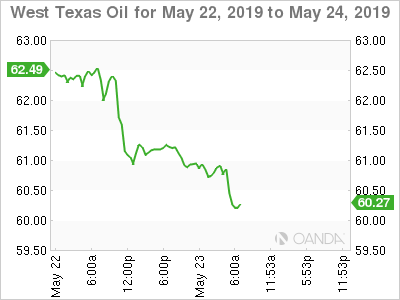
Brent crude futures are at +$70.36 per barrel, down -63c, or -0.9%, from Wednesday's close. U.S West Texas Intermediate (WTI) crude futures are down by -51c, or -0.8%, at +$60.91 per barrel.
Note: Crude futures fell by around -2% Wednesday.
Data from the EIA Wednesday showed that U.S crude oil inventories rose last week, hitting their highest levels in nearly two-years, due to weak refinery demand. Commercial U.S crude inventories rose by +4.7M barrels in the week ended May 17, to +476.8M barrels, their highest since July 2017.
Despite weak refinery demand for feedstock crude oil, the increase in commercial inventories also came on the back of planned sales of U.S strategic petroleum reserves (SPR) into the commercial market. U.S crude oil production climbed by +100K bpd to +12.2M bpd.
Crude ‘bears' have been getting a helping hand from slowing demand growth due to the negative impact on the global economy of the Sino-U.S trade war, while the crude ‘bull' has been relying on escalating political tensions between the U.S and Iran, as well as ongoing supply cuts led by OPEC+.
Ahead of the U.S open, gold prices are little changed as simmering Sino-U.S trade tensions support the dollar, while the ‘yellow metal' investors continue to look for a direction after the Fed minutes indicated that U.S rates will remain unchanged for the foreseeable future. Spot gold is flat at +$1,274.03 per ounce, just shy of its lowest level in three-weeks at +$1,268.97. U.S gold futures are unchanged at +$1,274.20.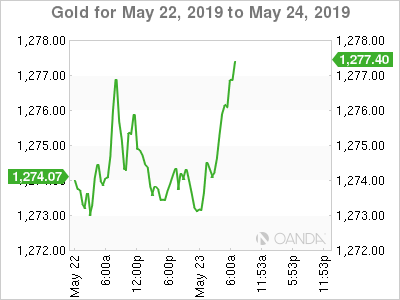
3. German Bund yields still negative after trade gloom hits PMI
Germany's 10-year Bund yield fell further into deeply negative territory this morning after a survey showed business activity in the bloc was weaker (see below) than expected in May, adding further evidence that trade wars are dampening economic growth.
Note: Eurozone PMI's – in the individual readings, French business activity jumped to its strongest level in six months, but German business activity undershot expectations.
Germany's 10-year Bund yield has fallen to an intraday low of -0.111%, sliding back down towards the recent three-year low of -0.132%. French 10-year OAT yields are also under pressure, falling to +0.29%, down -1.5 bps.
Note: European parliamentary elections begin today, and initial results will be announced on Sunday evening.
Elsewhere, the yield on 10-year Treasuries has dipped -1 bps to +2.37%, the lowest in two-months. In the U.K, the 10-year Gilt yield has declined -3 bps to +0.986%, the lowest in more than 20-months, while in Italy, the 10-year BTP yield has advanced less than +1 bps to +2.637%.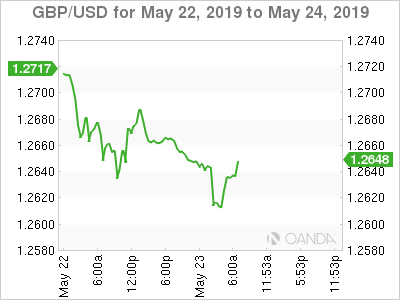
4. Dollar in demand
Sterling bears believe the pound is on course to hit £1.25 sooner rather than later now that PM May could be resigning sometime over the next week since she has lost the support of some of her key cabinet members and replaced by a hard Brexiter. However, any positive comments about Brexit and a break of the £1.27 handle could see a gap higher as the weaker shorts seek a quick exit.
EUR/USD (€1.1131) the single unit continues its slow grind down lower towards the €1.1050 handle as Euro area Flash PMI figures showed a mixed bag in both services and manufacturing (see below). The EU Trade Minister also commented that they were ready to start trade talks, but believed the US was not ready to start tariff discussions.
The PBoC moved the dollar-yuan fix by only ¥0.02 for a third-straight day as the midpoint of daily trading remains stronger for the Chinese currency than where prior-day trading closed. The overnight fix was at ¥6.8994, vs. ¥6.8992 Wednesday. The ‘big' dollar weakened in onshore trading, finishing at ¥6.9040.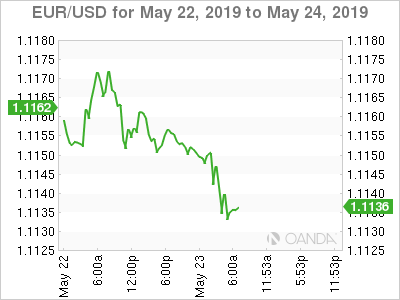
5. German business sentiment deteriorates sharply as do PMI's
Euro data this morning showed that German business sentiment dropped this month, as companies' assessment of their current situation worsened.
The Ifo business-climate index slipped to 97.9 points from 99.2 points in April. Market expectations were looking for a reading of 99.1 points for May.
However, not all was negative, according to the Ifo companies in Germany's important manufacturing sector raised their expectations for the first time since 2018.
In the chemicals industry, “optimism has taken the place of recent pessimism,” Ifo President Clemens Fuest said, but he added that “the German economy is still lacking in momentum.”
Elsewhere, the eurozone flash PMI's for May remained fairly weak, suggesting that the eurozone economy slowed in Q2. The slight increase in the Composite PMI, from 51.5 to 51.6, was in line with the consensus (51.7). Digging deeper, the manufacturing component rose from 48.0 to 49.0, but remained below 50 for the fourth consecutive month, while the services component was unchanged at 52.5.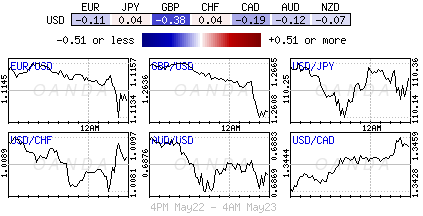
EUR/USD – Euro Dips To 4-Week Low As German Manufacturing PMI Falls
EUR/USD is slightly lower in Thursday trade. Currently, the pair is trading at 1.1133, down 0.16% on the day. After a dearth of fundamental releases this week, the markets will be knee-deep in data on Thursday. German Final GDP posted a gain of 0.4%, matching the estimate. This was unrevised from the initial GDP reading earlier in May. German Manufacturing PMI dropped to 44.3 in April, down from 44.5 a month earlier. Services PMI continued to point to expansion, with a score of 55.0. It was a similar story for Eurozone PMIs – contraction in manufacturing, expansion in the services sector. The ECB releases the minutes of its April policy meeting, and voters go to the polls over the next several days to elect a new European parliament. In the U.S., today's highlight is unemployment claims, which is expected to drop to 212 thousand. On Friday, the U.S. releases durable goods orders.
Will the European parliament elections shake up the euro? Starting on Thursday, voters in the 28 EU countries (including the U.K.) will elect lawmakers to the European parliament. Key issues included the economic slowdown, the migrant crisis and the rise in Euroskpeticism. Euro-skeptics increased their representation in parliament from 12% to 25% in the last election, and with the dramatic increase in strength of populist parties, this trend could well continue. A strong showing by parties with an anti-EU agenda could have an important impact on upcoming elections in Italy, where the populist government wants to raise its deficit above EU rules. If euroskeptic parties do well in the election, investors could give a thumbs-down to the euro. As well, the outcome of the vote could have an impact on the choice of the new head of the ECB, as Mario Draghi steps down in October, after an eight-year term.
There were no surprises from the Federal Reserve minutes, which provided details of the policy meeting earlier in May. Fed members continued to preach patience, stating that rates will likely remain unchanged for some time. The minutes indicated that although members are more optimistic about economic growth, they remain committed to maintaining current rate levels, given that inflation remains low. It should be noted that the policy meeting took place on May 1-2, one week before President Trump announced new tariffs on China, which has significantly escalated trade tensions between the U.S. and China.
The Fed minutes may have reinforced the central bank's stance that no rate moves are planned until next year, but the markets don't share this view, with many analysts expecting at least one rate cut in 2019. Lower U.S. rates could dampen enthusiasm for the U.S. dollar. The CME Group has priced in a 36% likelihood of a 25-point basis cut at the September meeting.
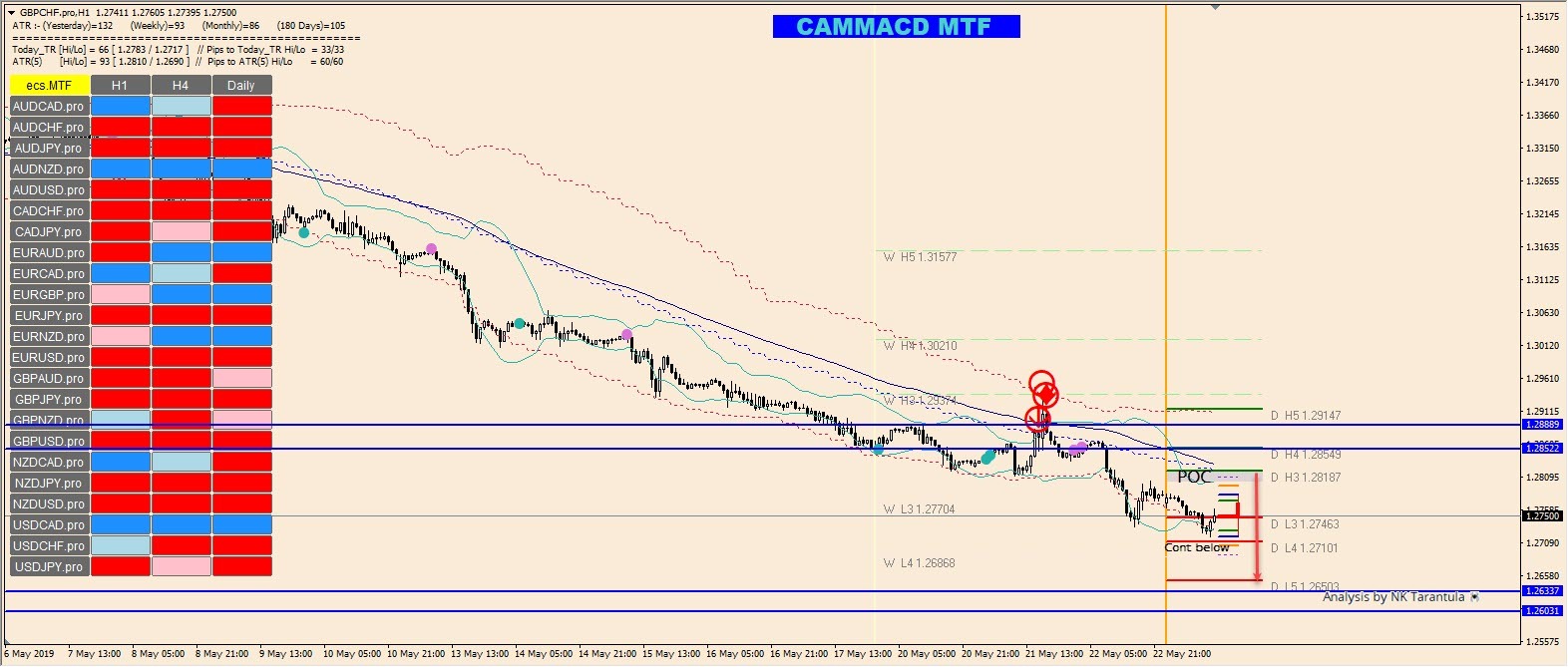
GBP/CHF Bearish Continuation Towards 1.2633 If 1.2700 Fails
The GBP/CHF has formed a bearish zigzag which is very strong on both intraday and higher timeframes. The price looks determined to push towards lower support levels.
The POC zone 1.2800-20 should reverse the price on a bearish candlestick formation after a retracement, if it happens. At this point the price is supported slightly above D L3, which could indicate a possible upside correction. If we don’t see any retracement pay attention to 1.2746 and 1.2710. The loss of 1.2710 support should initiate another bearish breakout towards 1.2650 and 1.2633. Only a close above 1.2914 would temporarily negate a strong bearish momentum in the GBP/CHF pair.