Sample Category Title
US PMI manufacturing dropped to 50.6, 116-month low, spreading to services
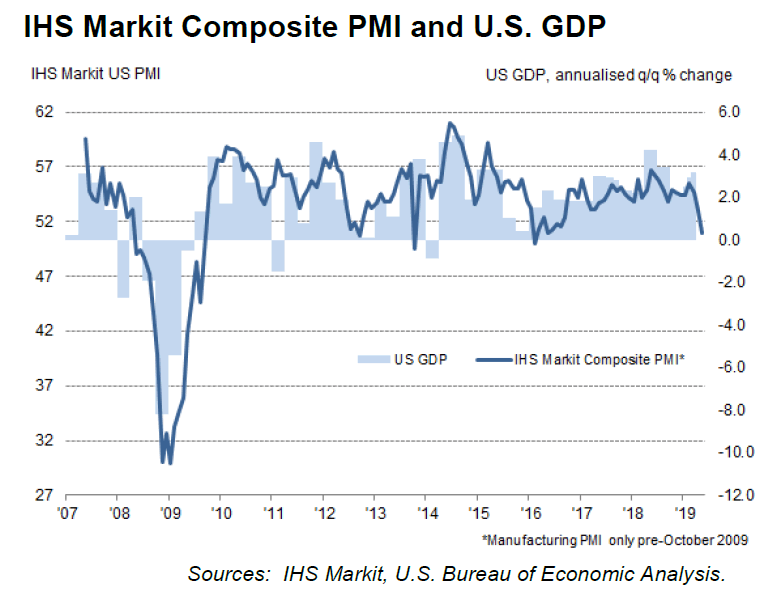
In May, US PMI manufacturing dropped sharply to 50.6, down from 52.6, missed expectation of 52.7. It's also the lowest level in 116 months. PMI services dropped to 50.9, down from 53.0 and missed expectation of 53.5. it's the lowest level in 39 months. PMI Composite dropped to 50.9, down from 53.0, a 36-month low.
Commenting on the flash PMI data, Chris Williamson, Chief Business Economist at IHS Markit said:
"Growth of business activity slowed sharply in May as trade war worries and increased uncertainty dealt a further blow to order book growth and business confidence.
"A decline in the headline 'flash' PMI to its lowest for three years pushes the survey data down to a level historically consistent with GDP growing at an annualised rate of just 1.2% in May. Worse may be to come, as inflows of new business showed the smallest rise seen this side of the global financial crisis. Business confidence has meanwhile slumped to its lowest since at least 2012, causing firms to tighten their belts, notably in respect to hiring. Jobs growth in May was the weakest seen for over two years.
"The slowdown has been led by manufacturing, but shows increasing signs of spreading to services. The survey data have been consistent with falling manufacturing output since February, but suggest that the sector's woes intensified in May to mean factories will therefore likely act as an increasing drag on the economy in the second quarter. Trade wars remained top of the list of concerns among manufacturers, alongside signs of slower sales and weaker economic growth both at home and in key export markets.
"However, an additional concern is the spreading of the malaise to the service sector, growth of which slumped in May to one of the weakest since the global financial crisis. With the service sector's performance being a key gauge of the health of domestic demand, this broadening-out of the slowdown poses downside risks to the outlook."
USD/JPY Mid-Day Outlook
Daily Pivots: (S1) 110.18; (P) 110.40; (R1) 110.58; More...
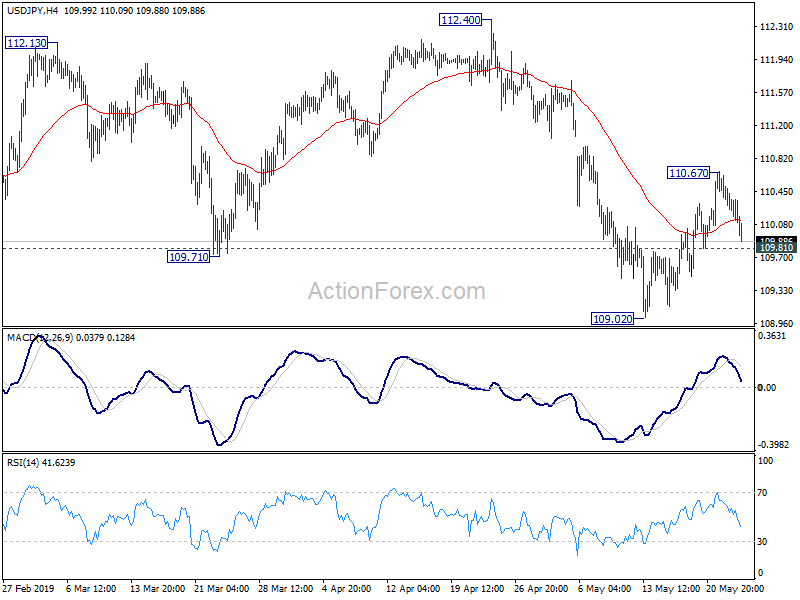
Intraday bias in USD/JPY remains neutral first and outlook is unchanged. Corrective recovery from 109.02 should be limited by 55 day EMA (now at 110.82) to bring another fall. On the downside, below 109.81 minor support will turn bias back to the downside for 109.02. Break there will extend the decline from 112.40 to retest 104.69 low. However, sustained trading above 55 day EMA will indicate completion of the fall from 112.40 and bring retest of this high.
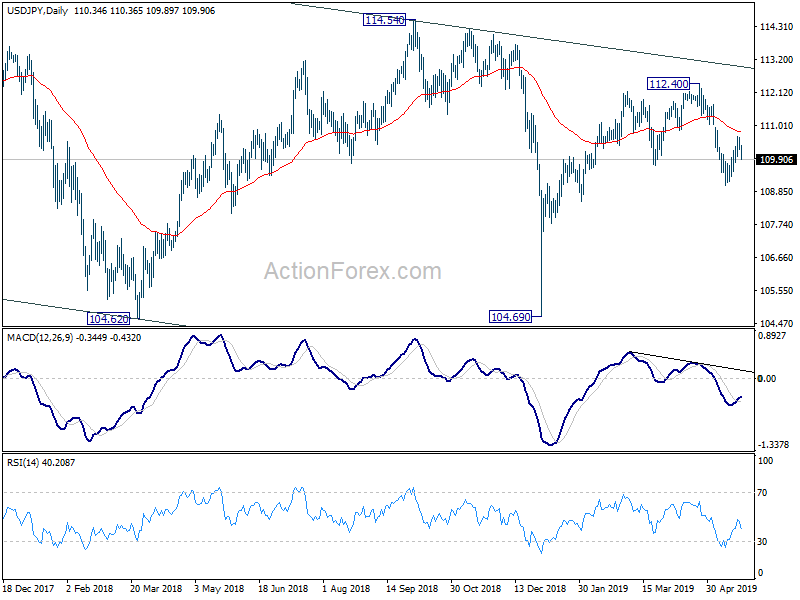
In the bigger picture, USD/JPY is staying inside falling channel from 118.65. Currently development suggests that rebound from 104.69 is only a corrective move. And fall from 118.65 is not completed yet. Decisive break of 104.69 will extend the down trend towards 98.97 support (2016 low). For now, we'd expect strong support above there to bring rebound.
USD/CHF Mid-Day Outlook
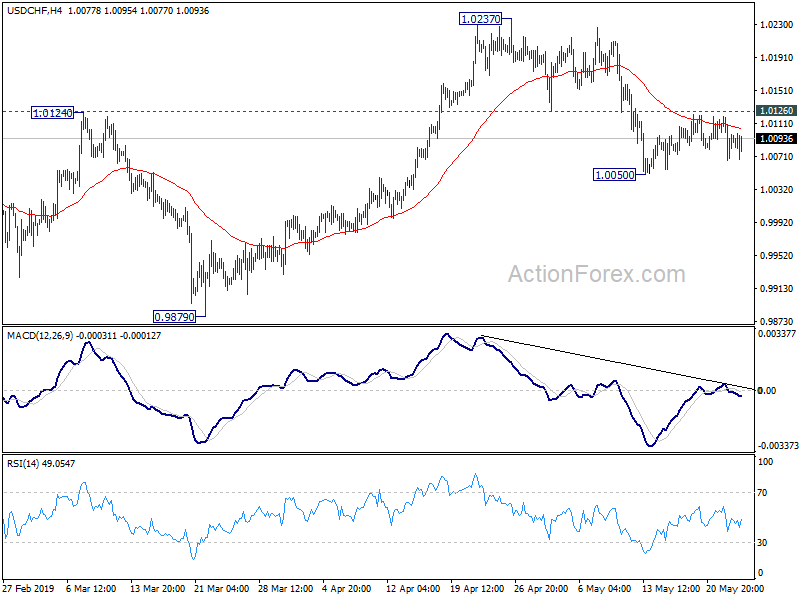
Daily Pivots: (S1) 1.0068; (P) 1.0094; (R1) 1.0122; More...
Intraday bias in USD/CHF remains neutral for consolidation above 1.0050 temporary low first. With 1.0126 support turned resistance intact, another decline is mildly in favor. On the downside, break of 1.0050 will resume the fall from 1.0237 to retest 0.9879 key support. However, firm break of 1.0126 will turn bias back to the upside for 1.0237 resistance.
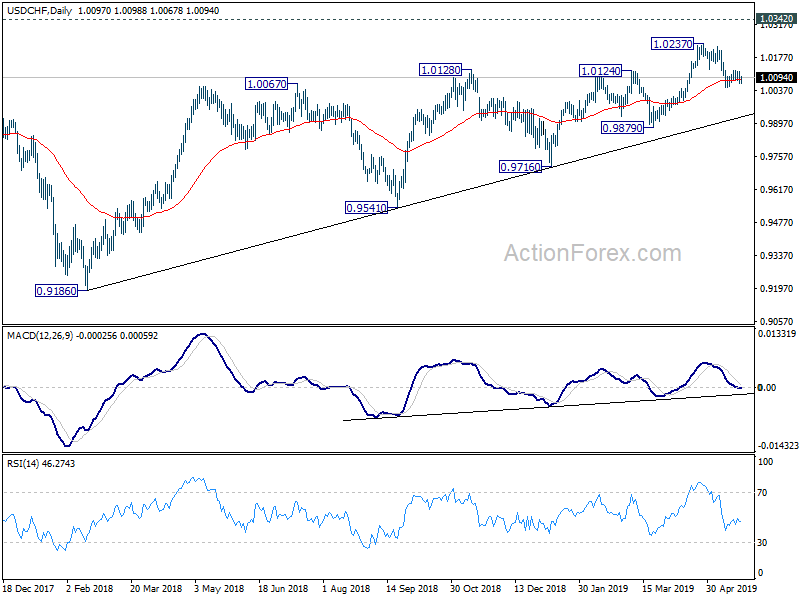
In the bigger picture, as long as 0.9879 support holds, medium term up trend form 0.9186 is still in progress. Break of 1.0237 will target 1.0342 resistance next. For now, we'd be cautious on strong resistance from there to limit upside, until we see medium term upside acceleration. However, decisive break of 0.9879 will be a strong sign of medium term reversal. Focus will be turned back to 0.9716 support for confirmation.
GBP/USD Mid-Day Outlook
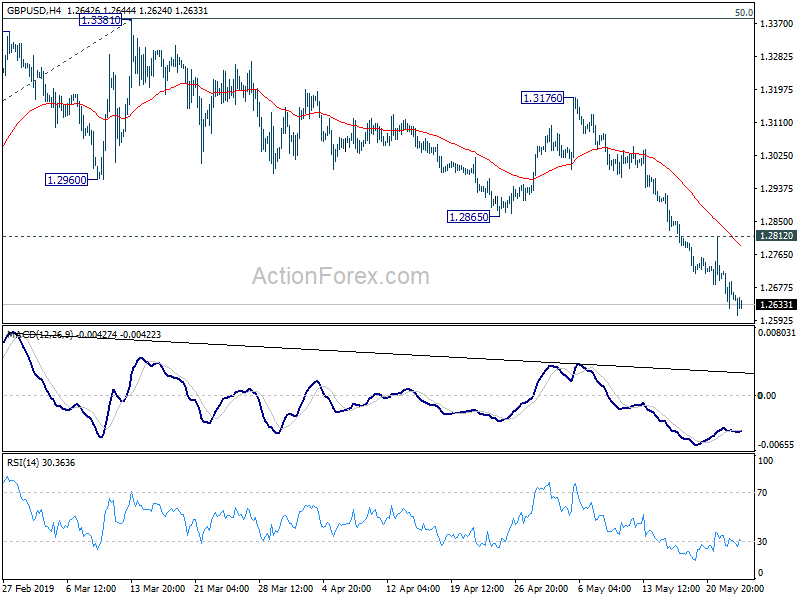
Daily Pivots: (S1) 1.2617; (P) 1.2668; (R1) 1.2713; More....
GBP/USD's decline is in progress and intraday bias remains on the downside. Current fall from 1.3381 should target 1.2391 low. Larger decline from 1.4376 might be resuming. Break of 1.2391 will target 61.8% projection of 1.4376 to 1.2391 from 1.3381 at 1.2154 next. On the upside, above 1.2812 minor resistance will turn intraday bias neutral again for more consolidation first.
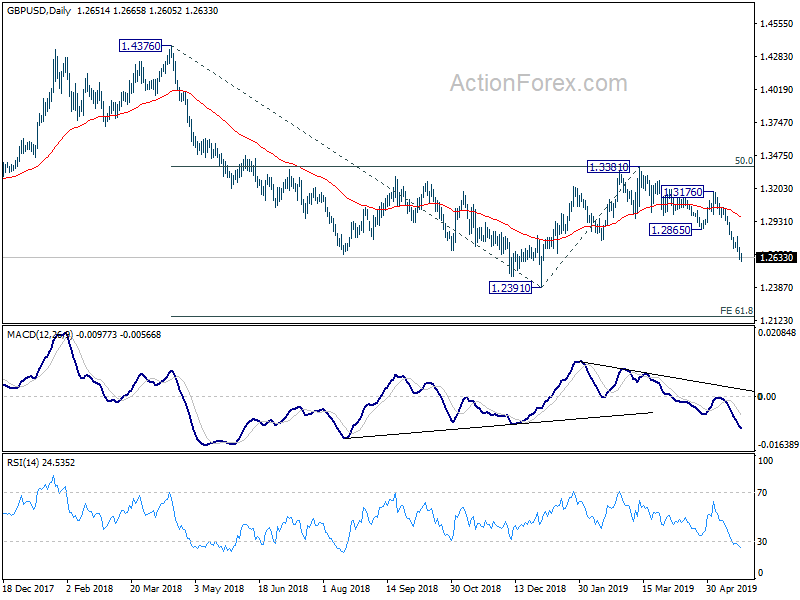
In the bigger picture, current development suggests that medium term decline from 1.4376 (2018 high) is not completed, and is possibly ready to resume. Decisive break of 1.2391 would target a test on 1.1946 long term bottom (2016 low). For now, we don't expect a firm break there yet. Hence focus will be on bottoming signal as it approaches 1.1946. In any case, medium term outlook will stay bearish as long as 1.3381 resistance holds, in case of rebound.
EUR/USD Mid-Day Outlook
Daily Pivots: (S1) 1.1138; (P) 1.1159; (R1) 1.1171; More.....
EUR/USD's selloff gathers momentum again today and focus is immediately on 1.1111 low. Decisive break there will resume larger down trend from 1.2555. Next target will be 100% projection of 1.1448 to 1.1183 from 1.1324 at 1.1059. Nevertheless, on the upside, above 1.1186 minor resistance will delay the bearish case and bring another recovery to extend the consolidation from 1.1111 first.
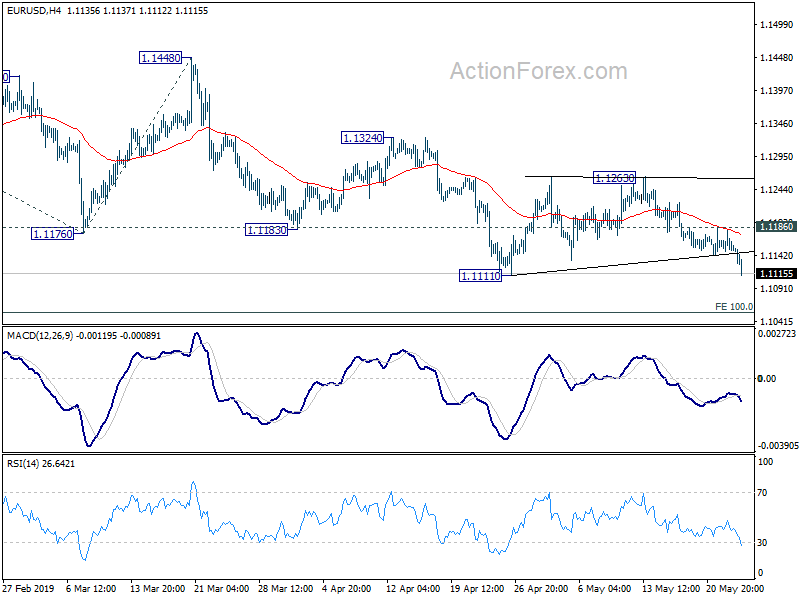
In the bigger picture, down trend from 1.2555 (2018 high) is still in progress. Such decline would target 78.6% retracement of 1.0339 (2016 low) to 1.2555 (2018 high) at 1.0813 next. Sustained break there will pave the way to retest 1.0339. On the upside, break of 1.1448 resistance is needed to be the first sign of medium term bottoming. Otherwise, outlook will stay bearish in case of rebound.

Risk Off on Trade War Escalations and Eurozone Slowdown, EUR/USD to Break 1.1111 soon
Global markets are back is heavy risk-off mode today as US-China tensions keep on escalating. Words from both sides suggest that neither one is going to back down from the current stance and there is no chance of returning to the table any time soon. More importantly, it's seems that neither US or China is worried about the escalations.
On the Chines side, Commerce Ministry spokesman Gao Feng warned: "If the United States wants to continue trade talks, they should show sincerity and correct their wrong actions. Negotiations can only continue on the basis of equality and mutual respect... We will closely monitor relevant developments and prepare necessary responses." Foreign Ministry spokesman Lu Kang said "relevant U.S. actions obviously do not create a good atmosphere or environment for consultations.
On the US side, Secretary of State Mike Pompeo said he's been "explaining the risks" regarding Huawei about national security as he travels around the world. And he criticized that "for them (Huawei) to say that they don't work with the Chinese government is false." He added, "If you're a state-directed business and you take on subsidies direct from the Chinese government, there's no doubt you can make real hay."
Additionally, sentiments are weighed down by poor economic data from Eurozone. Most importantly, both German Ifo Business Climate and PMIs suggested that slowdown in German manufacturing factor is quickly spreading over to services. Meanwhile, risks of no-deal Brexit is increasing. There are rumors flying around regarding the exit date of UK Prime Minister Theresa May. While she may stay till Trump's visit in early June, her position won't last long.
In the currency markets, Yen and Swiss Franc remain the strongest one on risk aversion, followed by Dollar. Canadian Dollar is the weakest one for today, followed oil prices lower. Euro is the second weakest on it's down economy challenges.
Technically, with today's decline, EUR/JPY is eyeing 122.08 temporary low. EUR/USD is accelerating and could take out 1.1111 bottom to resume larger down trend soon. Given the weak sentiments, AUD/USD will likely follow through 0.6864 temporary low too.
In Europe, currently, FTSE is down -1.34%. DAX is down -1.58%. CAC is down -1.63%. German 10-year yield is down -0.019 at -0.103, back below -0.1 handle. Earlier in Asia, Nikkei dropped -0.62%. Hong Kong HSI dropped -1.58%. China Shanghai SSE dropped -1.36%. Singapore Strait Times dropped -0.70%. Japan 10-year JGB yield dropped -0.0104 at -0.061.
IMF: New US-China tariffs will subtract about 0.3% of global GDP in short term
In blog post published today, IMF noted that US-China trade tensions have "negatively affected consumers as well as many producers in both countries." It pointed out while tariffs have reduced trade between the two countries, "bilateral trade deficit remains broadly unchanged". It also warned that "latest escalation could significantly dent business and financial market sentiment, disrupt global supply chains, and jeopardize the projected recovery in global growth in 2019."
In the global level, recently announced measures and envisaged new US-China tariffs will "subtract about 0.3 percent of global GDP in the short term, with half stemming from business and market confidence effects." Furthermore, " failure to resolve trade differences and further escalation in other areas, such as the auto industry, which would cover several countries, could further dent business and financial market sentiment, negatively impact emerging market bond spreads and currencies, and slow investment and trade."
In addition, "higher trade barriers would disrupt global supply chains and slow the spread of new technologies, ultimately lowering global productivity and welfare. More import restrictions would also make tradable consumer goods less affordable, harming low-income households disproportionately."
US initial jobless claims dropped slightly to 211k, below expectations
US initial jobless claims dropped -1k to 211k in the week ending May 18, below expectation of 215k. Four-week moving average of initial claims dropped -4.75k to 220.25k. Continuing claims rose 12k to 1.676M in the week ending May 11. Four-week moving average of continuing claims rose 5.5k to 1.674M.
ECB minutes: Less confidence in baseline growth scenario, range of possibilities widened
Minutes of ECB's April 9-10 meeting showed that policy makers were getting less confident on Eurozone recovery. The minutes noted "it was acknowledged that some recent data had turned out even weaker than expected". And, "there was now somewhat less confidence in the baseline scenario and that the range of other possible outcomes had widened."
Also, "the global outlook remained subject to the continued risk of an escalation of trade conflicts and the uncertainty surrounding the withdrawal of the United Kingdom from the EU."
Regarding the new TLTROs, "some arguments were put forward in favor of pricing the new operations so they would primarily serve as a backstop, providing insurance in times of elevated uncertainty." Also, "other arguments supported the view that the TLTRO-III operations should be seen as a potential tool for adjusting the monetary policy stance."
German Ifo Business climate dropped to 97.9, deterioration spreading to services
In May, Germany Ifo Business Climate dropped to 97.9, down from 99.2 and missed expectation of 99.1. Current Assessment index dropped to 100.6, down from 103.3 and missed expectation of 103.5. Expectations Index rose to 95.3, up from 95.2 and beat expectation of 95.0.
Ifo President Clemens Fuest said "the German economy is still lacking in momentum." Manufacturing index dropped "slightly" but expectations rose for the first time since September 2018. However, Also, "in the services, the business climate took a substantial hit. Not since April 2013 has the indicator of current sentiment fallen as far as it did this month. Optimism with regard to the coming months also declined."
Eurozone PMIs suggests just 0.2% GDP growth in Q2, renewed deterioration in optimism
In May, Eurozone PMI manufacturing dropped to 47.7, down from 47.9 and missed expectation of 48.1. PMI services dropped to 52.5, down from 52.8 and missed expectation of 53.0. PMI Composite rose to 51.6, slightly up from 51.5. Markit noted that "the weak reading puts growth in the second quarter so far on a par with the lacklustre gain seen in the first quarter and is among the lowest recorded since mid-2013."
Chris Williamson, Chief Business Economist at IHS Markit said: "The eurozone economy remained becalmed in the doldrums in May, adding to signs that only modest growth will be achieved in the second quarter. At current levels the PMI is so far indicating GDP growth of only 0.2% in the second quarter."
Also, "A renewed deterioration in optimism about the year ahead suggests that the business situation could deteriorate further in coming months. Worries reflected concerns over lower economic growth forecasts, signs of weaker sales and rising geopolitical uncertainty, with escalating trade wars and auto sector woes commonly cited as specific causes for concern...
"While some encouragement can be gained from the manufacturing sector showing signs of its downturn having bottomed out in March, the concern is that the slowdown is spreading to the service sector, where new business growth has slipped to one of the weakest seen since 2014."
Germany PMI manufacturing dropped to 44.3, down from 44.4 and missed expectation of 44.8. It's the second weakest reading in nearly seven years. PMI services dropped to 55.0, down from 55.7 and missed expectation of 55.4. PMI Composite rose to 52.4, up from 52.2. Germany GDP was finalized at 0.4% qoq in Q1, unrevised
France PMI manufacturing rose to 50.6, up from 50.0, and beat expectation of 50.0. That's also a 3-month high. PMI services rose to 51.7, up from 50.0, beat expectation of 50.8. it's a 6-month high. PMI composite rose to 51.3, up from 50.1, a 6-month high.
Japan PMI manufacturing dropped to 49.6, re-escalation of US-China trade frictions heightened concern
Japan PMI manufacturing dropped to 49.6 in May, down from 50.2 and missed expectation of 50.5. The reading is also back in contraction territory. Markit noted that output and new orders decrease for fifth successive month. Businesses cast pessimistic outlook towards the coming year for the first time in six-and-a-half year.
Joe Hayes, Economist at IHS Markit, said: "Following some tentative signs that the downturn in Japan's manufacturing sector had softened in April, flash data for May revealed these were short-lived, as output and export orders fell at stronger rates. The re-escalation of US-China trade frictions has heightened concern among Japanese goods producers.
" Underlying growth weakness across much of Asia led to struggling exports, which fell at the sharpest rate in four months. Difficulties on the international front merely add to uncertainties domestically, with upcoming upper house elections in July, and the impending sales tax hike later this year. Subsequently, sentiment turned negative in May for the first time in six-and-a-half years."
EUR/USD Mid-Day Outlook
Daily Pivots: (S1) 1.1138; (P) 1.1159; (R1) 1.1171; More.....
EUR/USD's selloff gathers momentum again today and focus is immediately on 1.1111 low. Decisive break there will resume larger down trend from 1.2555. Next target will be 100% projection of 1.1448 to 1.1183 from 1.1324 at 1.1059. Nevertheless, on the upside, above 1.1186 minor resistance will delay the bearish case and bring another recovery to extend the consolidation from 1.1111 first.
In the bigger picture, down trend from 1.2555 (2018 high) is still in progress. Such decline would target 78.6% retracement of 1.0339 (2016 low) to 1.2555 (2018 high) at 1.0813 next. Sustained break there will pave the way to retest 1.0339. On the upside, break of 1.1448 resistance is needed to be the first sign of medium term bottoming. Otherwise, outlook will stay bearish in case of rebound.
Economic Indicators Update
| GMT | Ccy | Events | Actual | Forecast | Previous | Revised |
|---|---|---|---|---|---|---|
| 00:30 | JPY | PMI Manufacturing May P | 49.6 | 50.5 | 50.2 | |
| 06:00 | EUR | German GDP Q/Q Q1 F | 0.40% | 0.40% | 0.40% | |
| 07:15 | EUR | France Manufacturing PMI May P | 50.6 | 50 | 50 | |
| 07:15 | EUR | France Services PMI May P | 51.7 | 50.8 | 50.5 | |
| 07:30 | EUR | Germany Manufacturing PMI May P | 44.3 | 44.8 | 44.4 | |
| 07:30 | EUR | Germany Services PMI May P | 55 | 55.4 | 55.7 | |
| 08:00 | EUR | Eurozone Manufacturing PMI May P | 47.7 | 48.1 | 47.9 | |
| 08:00 | EUR | Eurozone Services PMI May P | 52.5 | 53 | 52.8 | |
| 08:00 | EUR | German IFO Business Climate May | 97.9 | 99.1 | 99.2 | |
| 08:00 | EUR | German IFO Expectations May | 95.3 | 95 | 95.2 | |
| 08:00 | EUR | German IFO Current Assessment May | 100.6 | 103.5 | 103.3 | |
| 11:30 | EUR | ECB Monetary Policy Meeting Accounts | ||||
| 12:30 | CAD | Wholesale Trade Sales M/M Mar | 1.40% | 0.80% | 0.30% | 0.20% |
| 12:30 | USD | Initial Jobless Claims (MAY 18) | 211K | 215K | 212K | |
| 13:45 | USD | Manufacturing PMI May P | 52.7 | 52.6 | ||
| 13:45 | USD | Services PMI May P | 53.5 | 53 | ||
| 14:00 | USD | New Home Sales Apr | 678K | 692K | ||
| 14:00 | USD | New Home Sales M/M Apr | -2.50% | 4.50% | ||
| 14:30 | USD | Natural Gas Storage | 106B |
Risk Aversion Returns on Trade Jitters
Global trade tensions intensified overnight after China’s Commerce Ministry noted China will not make concessions on key major issues. The recent theme over the past several trading days has been mostly negative for trade talk progress. With fading signs that talks will resume, US Stocks remain vulnerable and we could see the S&P 500 poised to break below the May 14th low. Safe-haven currencies, the yen and franc are rising heavily against their major trading partners. World bond markets are seeing Bunds and Treasuries rise as yields slide. The US 10-year Treasury yield is down 2.5 basis points to 2.359%.
This morning, the Parliamentary elections started. Britain and the Netherlands will vote on 99 Members of the European Parliament (MEPs), the UK will get 73 seats and the Dutch 26 spots. When the UK leaves the EU, the Netherlands will then get an additional 3 seats. Between tomorrow and Sunday voting for the rest of the EU will continue, with results coming shortly after the last polling station closes on Sunday.
The weekly jobless claims release shows the US labor market remains strong as claims fell 1,000 to 211,000, roughly in-line with estimates. For Canada, wholesale sales continued the strong batch of data, with the March reading rising 1.4%.
- EUR – EZ PMIs and German IFO disappoint
- GBP – 14 consecutive days of weakness to euro
- Modi – Retail sales deliver biggest gain in 10 months
- Oil – WTI dips below $60 a barrel for first time since March
- Gold – Continues to sink as ETF holdings rise
EUR
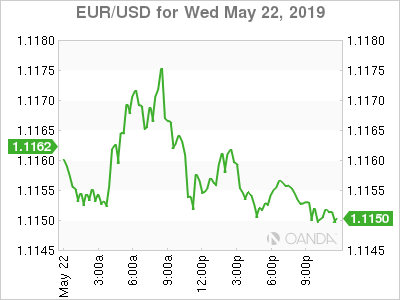
A wrath of European data dampened prospects that growth concerns were starting to stabilize. The eurozone manufacturing PMI delivered a third straight contraction, which would imply growth of only 0.2% for the second quarter.
The German IFO business confidence declined sharply to 97.9 and missed analysts’ expectations of 99.1. Concerns are growing for German manufacturing as it continues to shrink for possibly a third quarter in a row and fears are growing this will move into the service sector. The base case remains for a strong German rebound in the second half of the year, but we may not be at the bottom yet. Both trade spats between US/China and the US/EU and falling domestic demand for industrial goods will continue to weigh on the German data.
The euro is down 0.1% to the dollar as tentatively finds some support from the 2019 low of 1.1112.
GBP
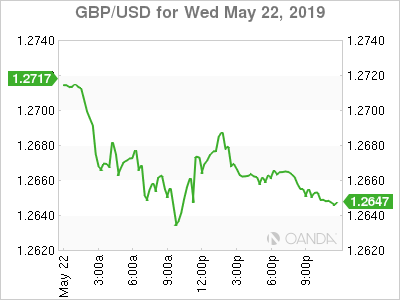
The British pound’s record losing streak combined with the growing risks that Brexit will see a hard exit, is making fund managers abandon long-term bullish bets. Just a few months ago, the base case was that Brexit would be delivered by PM May and that it would be a soft exit. Now expectations are running high that PM May will give up pushing her Brexit deal and possibly quit on Friday.
If we do see Boris Johnson, the current oddsmaker favorite, become May’s successor, we could see the hardest Brexit occur. Cable, which is currently at four-month lows, could see further pressure target the psychological 1.2000 level and eventually the 2016 lows. No-deal Brexit and a general election risks are likely to keep the pound under pressure.
The European elections could provide a bid for the British pound if we see better results from pro-EU parties.
Modi
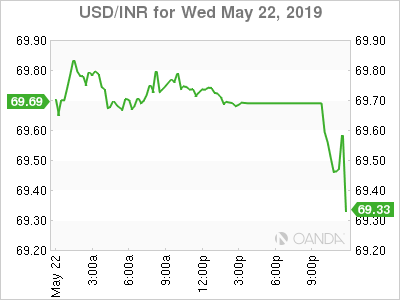
India’s polls got the general election right. Prime Minister Narendra Modi’s party celebrated a decisive victory, gaining over 290 seats, well above 272 seats needed to form a government. He now has a clear path to push his second-term policies. The benchmark Sensex rose to a record high but has given back today’s gains and turned negative. The Indian rupee has steadily given back most of the election bump gains.
Oil
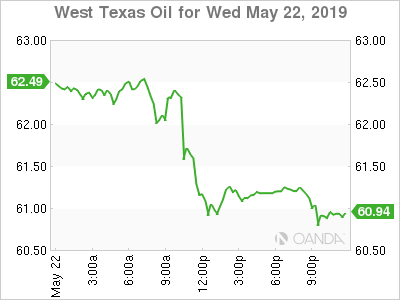
Crude prices continue to weaken following yesterday’s EIA inventory data and global demand concerns as the US-China trade war shows no signs of easing. West Texas Intermediate crude’s decline is testing some key technical levels, currently below $60 a barrel, a level that has not been tested since March. Yesterday’s close was below the 50-day SMA, and current weakness is testing below the 200-day SMA. A strong break of psychological $60 level could see further support from the $58.25 level.
Geopolitical risks are taking a backseat with today’s price action, but should eventually incentivize buyers if we see another move lower.
Gold
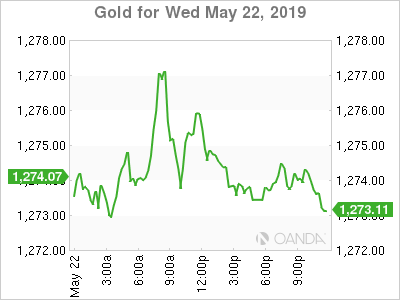
Gold prices are posting modest gains as trade worries deepen. Talks between the US and China have moved further off course and Wall Street is now expecting a deal to occur beyond summer. Global growth will take a hit from the next round of tariffs. If we see the tariffs remain for over six months, we will likely see the Fed deliver a rate cut. If by the end of the month, we do not see any positive sign that talks are resuming, gold may have a clear path above the $1,300 an ounce.
IMF: New US-China tariffs will subtract about 0.3% of global GDP in short term
In blog post published today, IMF noted that US-China trade tensions have "negatively affected consumers as well as many producers in both countries." It pointed out while tariffs have reduced trade between the two countries, "bilateral trade deficit remains broadly unchanged". It also warned that "latest escalation could significantly dent business and financial market sentiment, disrupt global supply chains, and jeopardize the projected recovery in global growth in 2019."
In the global level, recently announced measures and envisaged new US-China tariffs will "subtract about 0.3 percent of global GDP in the short term, with half stemming from business and market confidence effects." Furthermore, " failure to resolve trade differences and further escalation in other areas, such as the auto industry, which would cover several countries, could further dent business and financial market sentiment, negatively impact emerging market bond spreads and currencies, and slow investment and trade."
In addition, "higher trade barriers would disrupt global supply chains and slow the spread of new technologies, ultimately lowering global productivity and welfare. More import restrictions would also make tradable consumer goods less affordable, harming low-income households disproportionately."
Full article "The Impact of US-China Trade Tensions"
May’s “New, Bold” Brexit Deal is Dead on Arrival; Pound’s Outlook Turns Grim
Theresa May’s last-ditch attempt to secure support for her hard-fought Brexit deal failed dramatically on Tuesday with the beleaguered UK prime minister facing strong criticism from opposition parties as well as her own MPs. The pound has slumped on the overwhelmingly negative response to May’s tweaked Brexit offer to Parliament as a disorderly exit from the European Union once again started to look like a realistic prospect.
After promising a “new, bold offer” on the Brexit deal, May was struggling to convince lawmakers why they should vote in favour of the bill when it’s put to a vote for a fourth and final time in the first week of June. Although politicians have been quick to shoot it down, the revised package does contain plenty of significant concessions, which the prime minister has previously strongly resisted. May has set out plans to allow MPs to vote on whether to hold a second referendum, a vote on different customs arrangements with the EU, and provide safeguards on the Northern Irish backstop as well as guarantees on workers’ rights and environmental protection.
May’s new plan backfires
However, whilst striving to offer something for everyone, May has once again ended up pleasing no one and her amended deal looks dead on arrival. The spectacularly poor reception had a clear impact in currency markets. Speculation about what the new Brexit plan may include had briefly lifted the pound above the $1.28 level as traders got excited from market chatter of a second referendum. But the optimism didn’t last long, with sterling plummeting to 4½-month lows in the $1.26 handle after her proposals were dismissed by all sides of the political spectrum in Westminster.
The reaction has been so bad that there’s doubts about whether the government will go ahead with the vote or be forced to pull it. Either way, there appears to be little chance of the deal passing and the big question now is who will replace May when, not if, she steps down.
Boris Johnson favourite to replace May
Former foreign secretary, Boris Johnson, is the favourite at the moment to take over as leader of the Conservative party and as prime minister. Although Johnson has his fair share of critics, an expected disastrous showing for the party at the European elections on May 23 is seen as boosting his chances of winning a leadership contest as Conservative MPs are more likely to vote for a hardliner as their next leader if Nigel Farage’s Brexit party performs well at the polls.
But while such an outcome is what the Brexiteers have been dreaming about, it could spell trouble for sterling. Johnson’s first task as prime minister would probably be to try and renegotiate the Withdrawal Agreement. If the EU resists, which it most likely would, that would create a very strong risk of a no-deal Brexit as Johnson is known to favour such a scenario. Hence, the pound’s prospects over the summer months do not look particularly good.
Pound could soon be revisiting $1.21 level
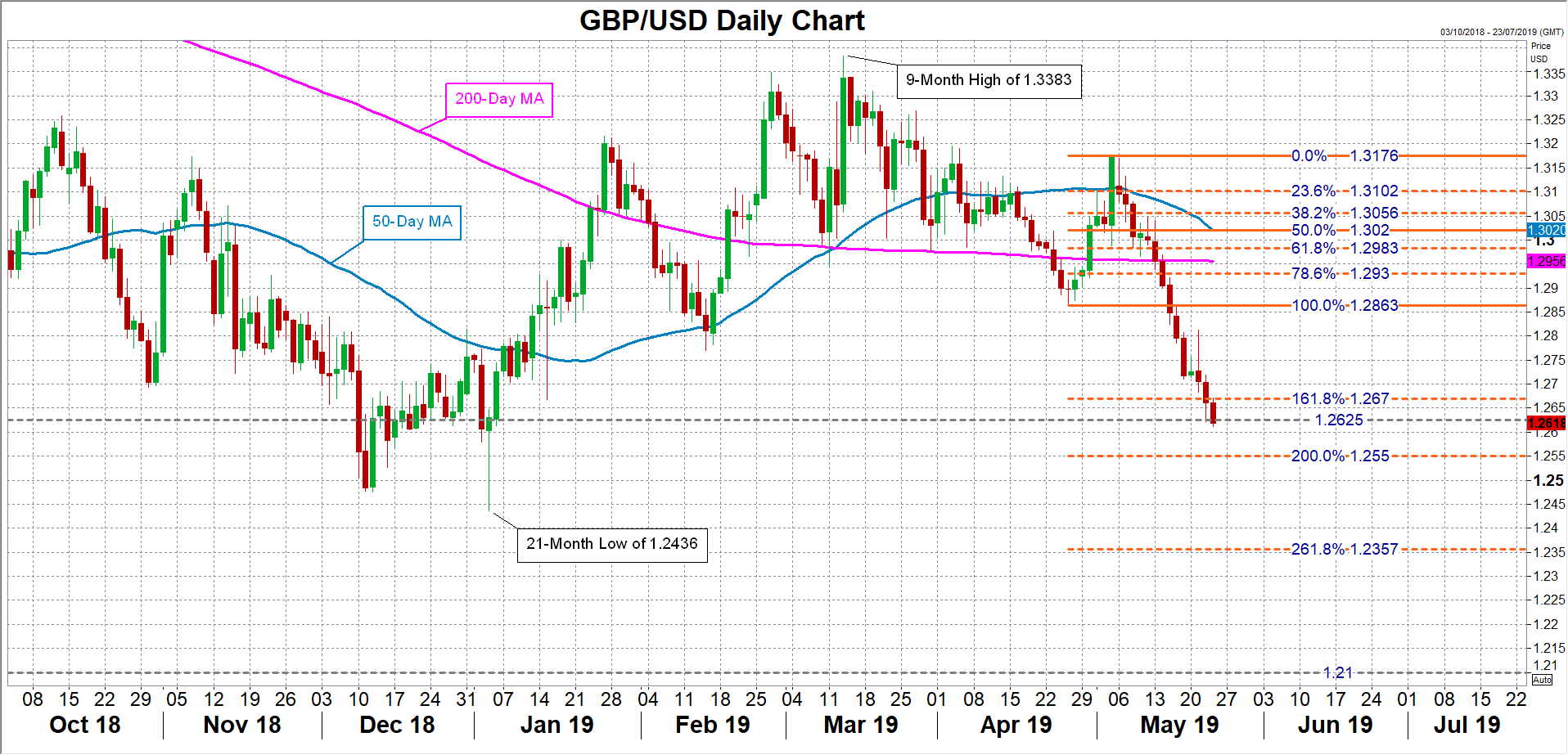
At the moment, the pound appears to be seeking support in the $1.2625 area, which has been a congested region in the past. Breaking below this point would bring into range the 200% Fibonacci extension of the $1.2863-$1.3176 upleg at $1.2555 and the 2019 low of $1.2436. Looking further ahead, if a hardline Brexiteer is elected by the Tory party to replace May and the EU rejects the idea of reopening the Withdrawal Agreement, the $1.21 level – which hasn’t been visited since 2017 – would increasingly become an important target for the bears.
While it’s very possible the new Brexit deal will not be put to the test and May could resign within days rather than weeks, all the indications at the moment are that the government wants to press ahead with the vote in the week beginning June 3. May will probably do everything she can to get the House of Commons to approve the deal before the European Parliament’s current term ends on July 1. This is crucial because it wouldn’t require newly elected British MEPs to take up their seats in the new parliamentary session and the UK would be able to leave the EU by the end of July.
Corbyn a bigger nightmare for investors than a no-deal
But things are never quite so simple at Westminster. Assuming that, as expected, MPs again vote down the deal, the main focus for investors after that will be how quickly the Tory leadership race gets underway. Britain could have a new prime minister in the summer or the autumn.
Of course, one shouldn’t rule out the possibility that a new prime minister could be the outcome of a general election rather than a Conservative party leadership contest. What many investors fear more than a no-deal Brexit is having Labour leader, Jeremy Corbyn, running the country. Markets see Corbyn’s socialist policies as too left-wing and likely doing more damage to the UK economy than a crash exit out of the EU.
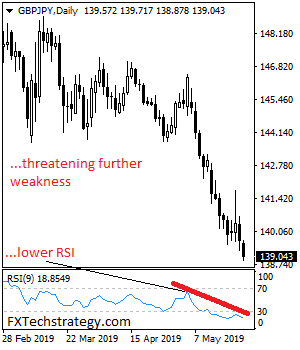
GBPJPY Remains Bearish With Eyes On 138.50 Zone
GBPJPY remains bearish with eyes on 138.50 zone following its recent weakness. On the downside, support comes in at the 138.50 level where a violation will aim at the 138.00 level. A break below here will target the 137.50 level followed by the 137.00 level. Its daily RSI is bearish and pointing lower suggesting further weakness. Conversely, resistance is seen at the 139.50 level followed by the 140.00 level. A cut through that level will set the stage for a move further higher towards the 140.50 level. Further out, resistance resides at the 141.00 level. All in all, GBPJPY remains with eyes on 138.50 zone as we expect more weakness.