

Sample Category Title
GBP/USD Daily Outlook
Daily Pivots: (S1) 1.2615; (P) 1.2649; (R1) 1.2694; More....
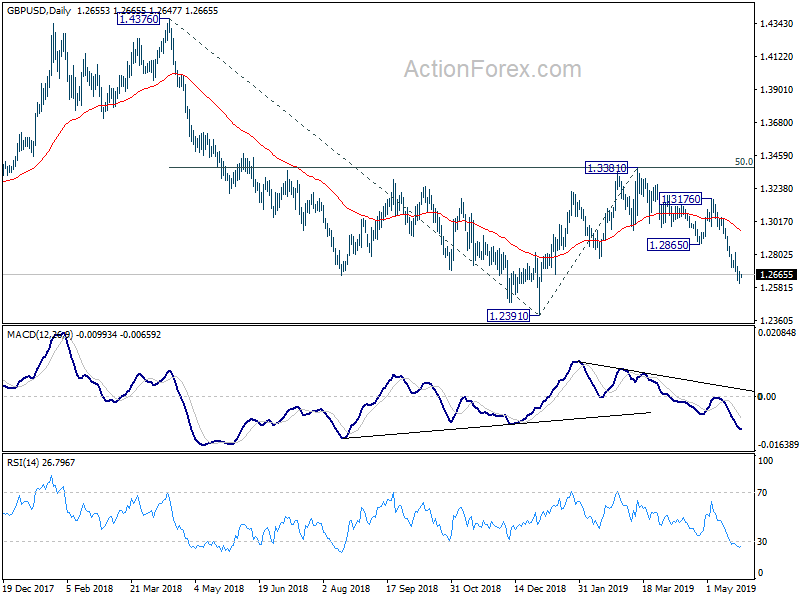
Despite diminishing downside momentum as seen in 4 hour MACD, there is no sign of bottoming in GBP/USD yet. Intraday bias stays on the downside. Current fall from 1.3381 should target 1.2391 low. Larger decline from 1.4376 might be resuming. Break of 1.2391 will target 61.8% projection of 1.4376 to 1.2391 from 1.3381 at 1.2154 next. On the upside, above 1.2812 minor resistance will turn intraday bias neutral again for more consolidation first.
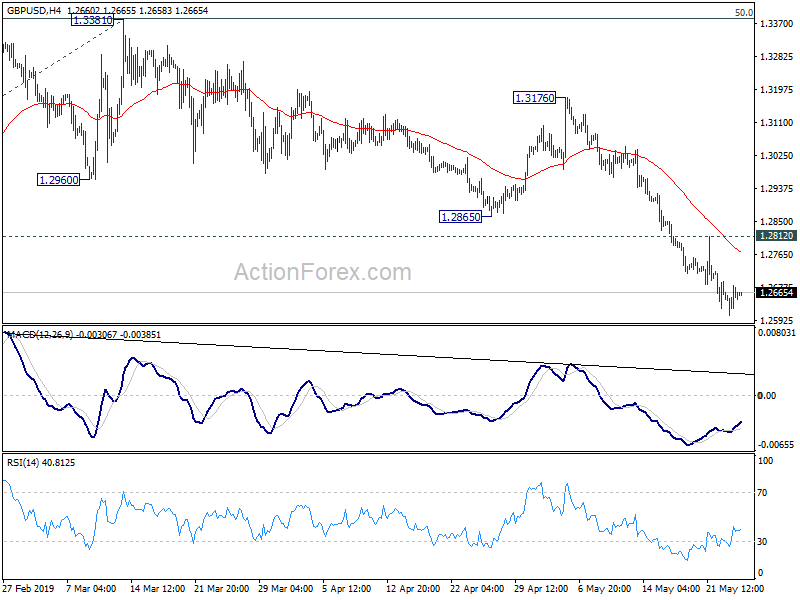
In the bigger picture, current development suggests that medium term decline from 1.4376 (2018 high) is not completed, and is possibly ready to resume. Decisive break of 1.2391 would target a test on 1.1946 long term bottom (2016 low). For now, we don't expect a firm break there yet. Hence focus will be on bottoming signal as it approaches 1.1946. In any case, medium term outlook will stay bearish as long as 1.3381 resistance holds, in case of rebound.
EUR/USD Daily Outlook
Daily Pivots: (S1) 1.1130; (P) 1.1159; (R1) 1.1210; More.....
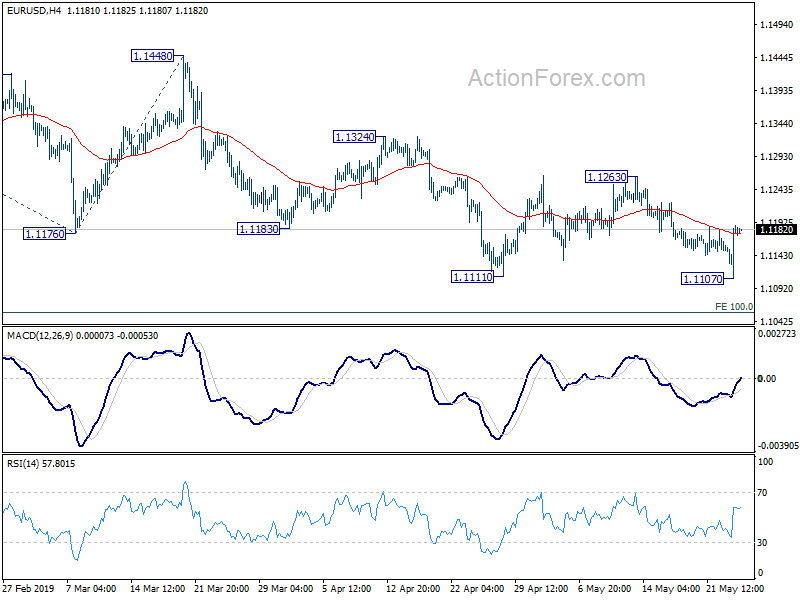
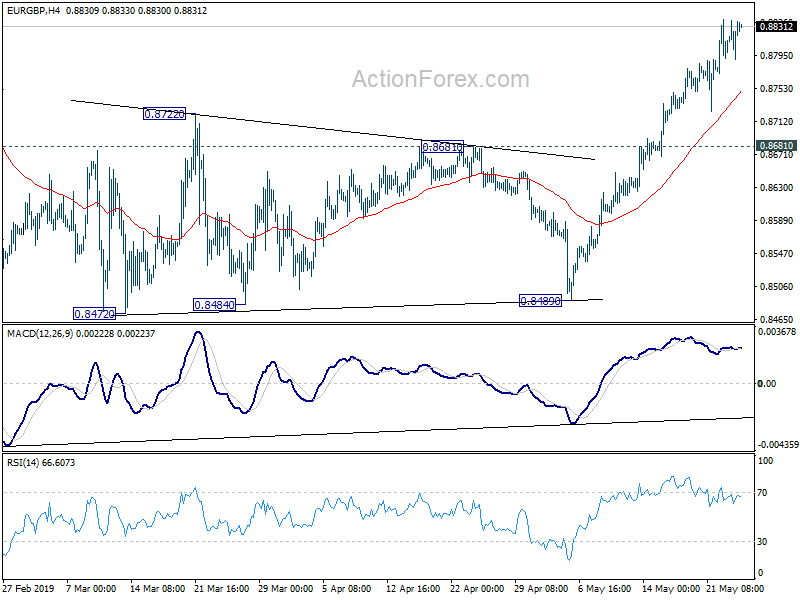
EUR/USD breached 1.1111 to 1.1107 but recovered strongly since then. The development suggests that consolidation from 1.1111 is extending and intraday bias remains neutral first. While further rise cannot be ruled out, upside should be limited by 1.1263 resistance to bring down trend resumption eventually. ON the downside, firm break of 1.1107 will resume the larger down trend from 1.2555. Next target will be 100% projection of 1.1448 to 1.1183 from 1.1324 at 1.1059. However, sustained break of 1.1263 resistance will now and early sign of trend reversal and turn bias to the upside for 1.1448 key resistance.
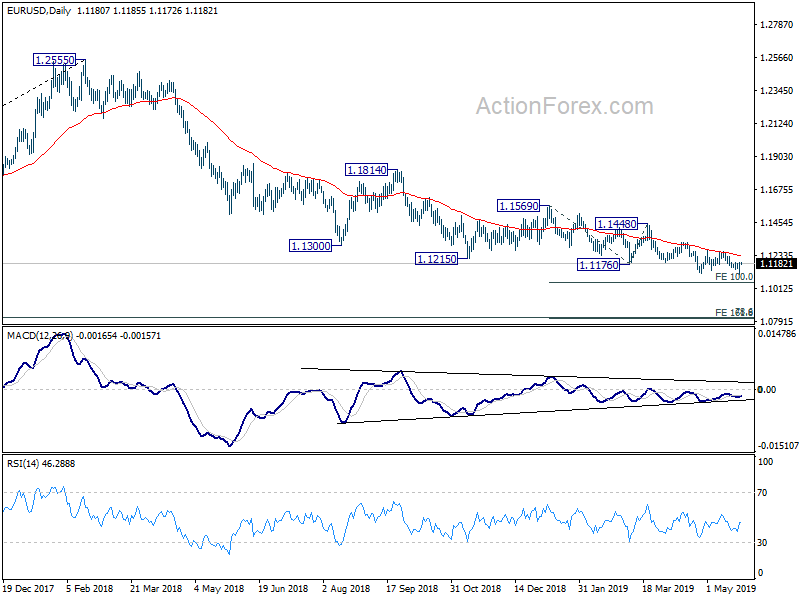
In the bigger picture, down trend from 1.2555 (2018 high) is still in progress. Such decline would target 78.6% retracement of 1.0339 (2016 low) to 1.2555 (2018 high) at 1.0813 next. Sustained break there will pave the way to retest 1.0339. On the upside, break of 1.1448 resistance is needed to be the first sign of medium term bottoming. Otherwise, outlook will stay bearish in case of rebound.
Dollar Rally Faltered on Free Fall in Treasury Yields, Trade War Drags Sentiments
Dollar's rally attempt faltered overnight as dragged down by steep decline in treasury yields. Dollar index did hit new high at 98.37 but closed sharply lower at 97.85. 10-year yield dropped -0.097 to close at 2.296, just inch above day low at 2.294. Concerns over prolonged US-China trade war dragged down sentiments as a whole. Trump repeatedly tried to sound upbeat on the negotiations but nobody is listening. The Markit PMIs for US released overnight showed deep deterioration in confidence. Upcoming data from the US will be crucial to market outlook beyond Q2.
In the currency markets, Dollar is trading to regain some ground today but lacks follow through buying. For now, Yen is the strongest one for today and looks set to extend recent rally. Australian Dollar is the weakest one for today on talks that RBA could cut as many as three times this year. For the week, Swiss Franc and Yen remain the strongest ones on risk aversion. Sterling is the weakest as Prime Minister Theresa May will most surely step down in June while risk of no-deal Brexit is on the rise. Canadian Dollar is second weakest for the week on free fall in oil prices.
Technically, EUR/USD is staying in consolidation from 1.1111 as it recovered strongly after dipping to 1.1107. More recovery would be seen but we don't expect a break of 1.1263 resistance ahead. USD/CHF decline resumed by taking out 1.0050 and is set to take on 1.0016. fibonacci support. USD/JPY's break of 109.81 minor support support suggests recent fall is ready to resume through 109.02 low. Ideally, we should also see EUR/JPY breaking through 122.08 temporary low to confirm Yen strength.
In Asia, currently, Nikkei is down -0.43%. Hong Kong HSI is up 0.21%. China Shanghai SSE is down -0.04%. Singapore Strait Times is down -0.29%. Japan 10-year JGB yield is down -0.0104 at -0.07. Overnight, DOW dropped -1.11%. S&P 500 dropped -1.19%. NASDAQ dropped -1.58%. 10-year yield dropped -0.097 to 2.296.
Trump: China trade deal happening fast, dangerous Huawei can be included
Trump sounded upbeat on US-China trade negotiation again even though, for now, there is still no more meeting scheduled. He said a the White House, "it's happening, it's happening fast and I think things probably are going to happen with China fast because I cannot imagine that they can be thrilled with thousands of companies leaving their shores for other places."
He also said Huawei is "very dangerous" if "you look at what they've done from a security standpoint, from a military standpoint". But even though it's that dangerous Trump said "If we made a deal, I could imagine Huawei being possibly included in some form or some part of it".
But separately, the Commerce Department laid out a proposal in a Federal Register notice yesterday, on punishing currency manipulating countries with tariffs. Commerce Secretary Wilbur Ross said "this change puts foreign exporters on notice that the Department of Commerce can countervail currency subsidies that harm US industries" And, "foreign nations would no longer be able to use currency policies to the disadvantage of American workers and businesses."
Fed officials expressed concerns over persisting trade tensions
Some Fed officials expressed their concerns over trade tensions and the impact on confidence and the economy at a Dallas Fed conference yesterday.
Dallas Fed President Robert Kaplan said "I'm watching very carefully how these trade tensions unfold because I have a concern.. whether that could cause some deceleration in the rate of growth." And, "new development over the last month has been increased trade tensions and more business uncertainty, and it's going to take a little while to sort out how that might unfold, or how long that might last."
San Francisco Fed President Mary Daly said for now "the data is good, but the mood is teetering". The economy's momentum would be an upside risk to growth " if we get a relaxation or a reduction in the uncertainty". However, she warned that if uncertainties persist, "that's a downside to the economy, because the uncertainty has real effects, but it also has effects on confidence, and that confidence feeds back into investment."
Richmond Fed President Thomas Barkin and Atlanta Fed President Raphael Bostic also warned that uncertainties around trade could hurt growth.
UK PM May said to announce exit date today, Sterling decline slowing but no bottoming
It's widely reported that UK Prime Minister Theresa May will finally announce her exit date on Friday. The resignation as Conservative Leader could take effect on June 10, paving the way for leadership contest. May could stay on as caretaker Prime Minister until a new one is elected, which may take up to six week's time.
At this point, Boris Johnson is the favorite among pro-Brexit Conservatives, for winning back support that swung to Nigel Farage's Brexit party. But there are also deep concerns with centrist and pro-EU party members that Johnson will eventually take UK into a no-deal Brexit that he prefers.
Other possible candidates include Michael Gove, Foreign Minister Jeremy Hunt, former Leader of the House of Commons Andrea Leadsom, former Brexit Minister Dominica Raab.
Sterling's decline slowed a little bit today but there is no clear sign of bottoming yet. We'd expect more downside in the Pound until at least it becomes clear who'll be the next Prime Minister.
Westpac forecasts three RBA cuts this year, QE becomes attractive in 2020
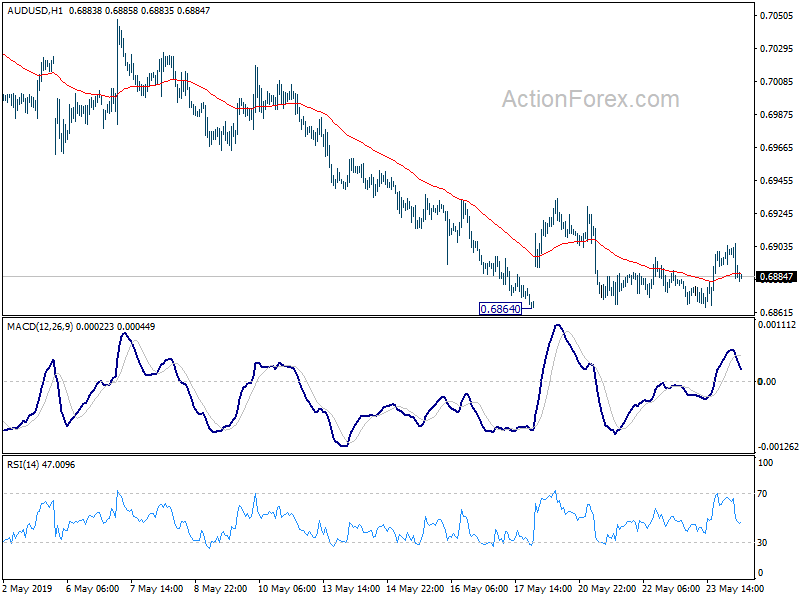
AUD/USD recovered overnight as Dollar was dragged down by heavy decline in treasury yields. US 10-year yield ended down as much as -0.097 at 2.296, showing steep downside acceleration. However, recovery in AUD/USD was relatively limited and it's indeed back under pressure today as Westpac now forecasts three rate cuts by RBA this year, with possibility to start QE in 2020.
On the economy, Westpac sees unemployment rate drifting up to 5.4% by year end, growth as 2.2% for 2019 and underlying inflation at merely 1.4%. Housing market is expected to stay weak despite some stabilization. After RBA Governor Philip Lowe's speech earlier this week Westpac believed that a June cut is a certain, and the second will come in August. Based on the weak outlook, a third in November to 0.75% is expected too.
Westpac also noted that some form of Quantitative Easing is an option for RBA if there is need to ease policy further. For now, RBA's own research suggests that policy transmission mechanism will still have some effect at a cash rate below 1%. However, in 2020, the case for QE will become more attractive.
On the data front
New Zealand trade surplus narrowed to NZD 433M in April, above expectation of NZD 400M. Japan national CPI core accelerated to 0.9% yoy in April, up from 0.8% yoy and matched expectations. UK retail sales will catch some attention today but main focus will be on May's announcement. US will release durable goods orders in US session.
EUR/USD Daily Outlook
Daily Pivots: (S1) 1.1130; (P) 1.1159; (R1) 1.1210; More.....
EUR/USD breached 1.1111 to 1.1107 but recovered strongly since then. The development suggests that consolidation from 1.1111 is extending and intraday bias remains neutral first. While further rise cannot be ruled out, upside should be limited by 1.1263 resistance to bring down trend resumption eventually. ON the downside, firm break of 1.1107 will resume the larger down trend from 1.2555. Next target will be 100% projection of 1.1448 to 1.1183 from 1.1324 at 1.1059. However, sustained break of 1.1263 resistance will now and early sign of trend reversal and turn bias to the upside for 1.1448 key resistance.
In the bigger picture, down trend from 1.2555 (2018 high) is still in progress. Such decline would target 78.6% retracement of 1.0339 (2016 low) to 1.2555 (2018 high) at 1.0813 next. Sustained break there will pave the way to retest 1.0339. On the upside, break of 1.1448 resistance is needed to be the first sign of medium term bottoming. Otherwise, outlook will stay bearish in case of rebound.
Economic Indicators Update
| GMT | Ccy | Events | Actual | Forecast | Previous | Revised |
|---|---|---|---|---|---|---|
| 22:45 | NZD | Trade Balance (NZD) Apr | 433M | 400M | 922M | 824M |
| 23:30 | JPY | National CPI Core Y/Y Apr | 0.90% | 0.90% | 0.80% | |
| 5:30 | JPY | All Industry Activity Index M/M Mar | -0.20% | -0.20% | ||
| 8:30 | GBP | Retail Sales Ex Auto Fuel M/M Apr | -0.50% | 1.20% | ||
| 8:30 | GBP | Retail Sales Ex Auto Fuel Y/Y Apr | 4.30% | 6.20% | ||
| 8:30 | GBP | Retail Sales Inc Auto Fuel M/M Apr | -0.40% | 1.10% | ||
| 8:30 | GBP | Retail Sales Inc Auto Fuel Y/Y Apr | 4.50% | 6.70% | ||
| 10:00 | GBP | CBI Reported Sales May | 6 | 13 | ||
| 12:30 | USD | Durable Goods Orders Apr P | -2.00% | 2.60% | ||
| 12:30 | USD | Durables Ex Transportation Apr P | 0.20% | 0.30% |
Westpac forecasts three RBA cuts this year, QE becomes attractive in 2020
AUD/USD recovered overnight as Dollar was dragged down by heavy decline in treasury yields. US 10-year yield ended down as much as -0.097 at 2.296, showing steep downside acceleration. However, recovery in AUD/USD was relatively limited and it's indeed back under pressure today as Westpac now forecasts three rate cuts by RBA this year, with possibility to start QE in 2020.
On the economy, Westpac sees unemployment rate drifting up to 5.4% by year end, growth as 2.2% for 2019 and underlying inflation at merely 1.4%. Housing market is expected to stay weak despite some stabilization. After RBA Governor Philip Lowe's speech earlier this week Westpac believed that a June cut is a certain, and the second will come in August. Based on the weak outlook, a third in November to 0.75% is expected too.
Westpac also noted that some form of Quantitative Easing is an option for RBA if there is need to ease policy further. For now, RBA"s own research suggests that policy transmission mechanism will still have some effect at a cash rate below 1%. However, in 2020, the case for QE will become more attractive.
Trump: China trade deal happening fast, dangerous Huawei can be included
Trump sounded upbeat on US-China trade negotiation again even though, for now, there is still no more meeting scheduled. He said a the White House, "it's happening, it's happening fast and I think things probably are going to happen with China fast because I cannot imagine that they can be thrilled with thousands of companies leaving their shores for other places."
He also said Huawei is "very dangerous" if "you look at what they've done from a security standpoint, from a military standpoint". But even though it's that dangerous Trump said "If we made a deal, I could imagine Huawei being possibly included in some form or some part of it".
But separately, the Commerce Department laid out a proposal in a Federal Register notice yesterday, on punishing currency manipulating countries with tariffs. Commerce Secretary Wilbur Ross said "this change puts foreign exporters on notice that the Department of Commerce can countervail currency subsidies that harm US industries" And, "foreign nations would no longer be able to use currency policies to the disadvantage of American workers and businesses."
USD/JPY Could Decline Further Below 109.50
Key Highlights
- The US Dollar failed to break 110.65 and declined recently against the Japanese Yen.
- A crucial bearish trend line is active with resistance at 110.50 on the 4-hours chart of USD/JPY.
- The US Initial Jobless Claims for the week ending May 18, 2019 declined from 212K to 211K.
- The US Durable Goods in April 2019 might decline 2%, down from the last +2.8%.
USDJPY Technical Analysis
The US Dollar started a decent recovery from the 109.02 low against the Japanese Yen. The USD/JPY pair traded above 110.00, but it failed to surpass 110.65 and recently started a fresh decline.
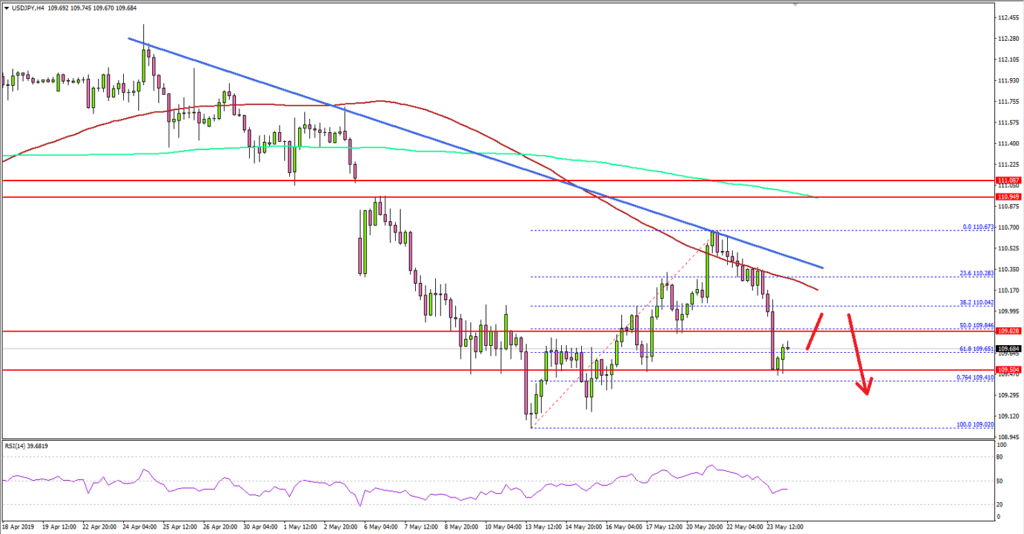
Looking at the 4-hours chart, the pair struggled to stay above the 110.60 level and the 100 simple moving average (4-hours, red). There was a break below the 23.6% Fib retracement level of the upward move from the 109.02 low to 110.67 high.
Moreover, there is a crucial bearish trend line active with resistance at 110.50 on the same chart. If the pair continues to move down, the next key support is near the 109.80 level plus the 50% Fib retracement level of the upward move from the 109.02 low to 110.67 high.
However, a successful close below the 109.50 support may perhaps open the doors for more losses towards the last swing low at 109.02.
On the upside, the 100 SMA and the bearish trend line at 1140.50 is likely to act as a strong barrier for the bulls. If they succeed in clearing the 110.50 and 110.65 levels, USD/JPY could accelerate towards the 111.00 and 111.20 levels.
Fundamentally, the US Initial Jobless Claims figure for the week ending May 18, 2019 was released by the US Department of Labor. The market was looking for a minor increase from 212K to 215K.
The actual result better than the forecast, as there was a decline in the US Initial Jobless Claims from 212K to 211K.
The report added:
The 4-week moving average was 220,250, a decrease of 4,750 from the previous week’s unrevised average of 225,000.
Overall, USD/JPY remains at a risk of more declines unless it breaks the 110.50 and 110.65 resistance levels. The main supports on the downside are 109.50 and 109.00. Looking at EUR/USD and GBP/USD, both major pairs struggled this week and they could continue to slide in the near term.
Economic Releases to Watch Today
- UK Retail Sales for April 2019 (YoY) – Forecast +4.6%, versus +6.7% previous.
- UK Retail Sales for April 2019 (MoM) – Forecast -0.3%, versus +1.1% previous.
- US Durable Goods Orders for April 2019 – Forecast -2.0% versus +2.8% previous.
Fed officials expressed concerns over persisting trade tensions
Some Fed officials expressed their concerns over trade tensions and the impact on confidence and the economy at a Dallas Fed conference yesterday.
Dallas Fed President Robert Kaplan said "I'm watching very carefully how these trade tensions unfold because I have a concern.. whether that could cause some deceleration in the rate of growth." And, "new development over the last month has been increased trade tensions and more business uncertainty, and it's going to take a little while to sort out how that might unfold, or how long that might last."
San Francisco Fed President Mary Daly said for now "the data is good, but the mood is teetering". The economy's momentum would be an upside risk to growth " if we get a relaxation or a reduction in the uncertainty". However, she warned that if uncertainties persist, "that's a downside to the economy, because the uncertainty has real effects, but it also has effects on confidence, and that confidence feeds back into investment."
Richmond Fed President Thomas Barkin and Atlanta Fed President Raphael Bostic also warned that uncertainties around trade could hurt growth.
https://www.youtube.com/watch?v=xsBT8Bk3mH0
A Bonfire Of Vanities
A bonfire of vanities
It's taken quite a while, but finally, markets appear to be starting to price in the effect of an extended US-China trade war on global growth. The two strongest bastions of denial – the equity and oil markets – led the way as oil plunged in its biggest one-day fall of the year. This collapse was the final straw for Wall Street, which had already noted less-than-impressive sessions from Asia and Europe, where investors rushed en masse for the exit doors. The US 10-year treasury was clearly the destination for much of the exit flows with its yield falling to 2.31%, leaving the curve unambiguously inverted out to ten years.
Even the mighty US dollar suffered as investors tarred everything American-made with one brush. The Japanese yen (JPY) and Swiss franc (CHF) outperformed on safe-haven flows rising 0.6% to 109.60 and 1.0030, respectively. Even the beleaguered euro (EUR), Australian dollar (AUD) and New Zealand dollar (NZD) managed to record small gains against the greenback.
Japan, Singapore and Malaysia data points today will likely be smothered in the rush for safety as the theme continues from overnight.
FX
The greenback faded against most of the majors as the US yield curve moved lower overnight. The effect may be transitory, however, as the USD remains the big dog on the block purely from an interest-rate carry perspective. That carry may have closed up somewhat, but once the dust settles, it will still be there and will remain supportive of the dollar throughout 2019.
Regional markets can expect no such luck, though. Asian currencies will almost certainly come under pressure against the dollar as the rush for the exit on Wall Street overflows into regional markets. Both AUD and NZD staged small rallies overnight, but with such a high correlation to China, it's hard to see their overnight strength being sustained if Asian currencies are falling against the dollar en masse.
The exception here will probably be the Japanese yen which has its own safe-haven status and usually rallies in times of trouble.
Equities
Wall Street's leading indices all fell by more than 1% overnight, and that theme looks likely to be the case in Asia today as well. The Nikkei 225 is already down 0.90%, and the ASX 200 has fallen 0.75%. As the rest of Asia opens, it's hard to envisage anything other than a sea of red as investors exit equities and move to the sidelines ahead of the weekend.
Emerging Asia markets could be particularly vulnerable as global wobbles typically see them sold as a group. The lower liquidity in regional markets could well exacerbate the moves.
Oil
Overnight, oil plunged in its biggest one-day loss of the year as stubbornly high US inventories and global growth worries burst the well-head. Brent Crude gushed 4.10% lower to USD68.20 a barrel while WTI dropped 5.1% to USD58.15 a barrel.
The price action completely vindicates OPEC's stance that optimism, not fundamentals, powered recent price rises and that prices were “fragile.” That will be cold comfort in the halls of power across the Middle East though.
Brent Crude broke important daily support at USD69.50 overnight, and the charts reveal no technical support until the USD66.00 regions. WTI broke support at USD60.00 and USD58.00 a barrel, and its technical picture looks even more cloudy with no support levels until USD55.00 a barrel.
After such an aggressive drop overnight, it would be nice to say Asia may see a small correction. However, oil remains acutely vulnerable to any trade headlines, and with Asian currencies and stocks most likely to be dragged lower, any rallies may be short-lived.
Gold
Gold finally caught a break as bonfires in other global markets saw safe-haven flows push it USD10 higher to USD1,283.00 an ounce. One day does not a trend make though, and it's too early to say the precious metal is about to emerge from the land that time forgot.
A continuing meltdown in other global markets as the street finally reprices the real cost to the world of an extended US-China trade war could see gold benefit. The longer-term technical picture shows a series of lower highs through 2019 as each rally faded long before the previous one. The last rally stopped at USD1,303.00 an ounce, and we would need to see a weekly close above that level before long-term optimists get excited.
Gold should be well supported on any dips today in Asia though, with safe-haven flows likely to be in full flight after last night's ructions and ahead of the weekend.
UK PM May said to announce exit date today, Sterling decline slowing but no bottoming
It's widely reported that UK Prime Minister Theresa May will finally announce her exit date on Friday. The resignation as Conservative Leader could take effect on June 10, paving the way for leadership contest. May could stay on as caretaker Prime Minister until a new one is elected, which may take up to six week's time.
At this point, Boris Johnson is the favorite among pro-Brexit Conservatives, for winning back support that swung to Nigel Farage's Brexit party. But there are also deep concerns with centrist and pro-EU party members that Johnson will eventually take UK into a no-deal Brexit that he prefers.
Other possible candidates include Michael Gove, Foreign Minister Jeremy Hubnt, former Leader of the House of Commons Andrea Leadsom, former Brexit Minister Dominica Raab.
Sterling's decline slowed a little bit today but there is no clear sign of bottoming yet. We'd expect more downside in the Pound until at least it becomes clear who'll be the next Prime Minister.
RBA to Cut the Cash Rate to 0.75% by November; AUD to USD0.66 by End 2019
Our forecasts are consistent with the need for policy to ease through the full course of 2019, not to go on hold as early as August.
Earlier this week Westpac moved forward its forecast for RBA cash rate cuts from the original forecast on February 21 of cuts in August and November to June and August.
The June cut remains almost certain; a second in August is our expectation and the November cut should also proceed.
Therefore, Westpac is now forecasting three cuts in 2019 in June; August and November to push the cash rate from 1.5% to 0.75% and to hold at that level through 2020.
Our forecasts for employment; wages growth; economic growth ; inflation and conditions in the housing market are consistent with the need for policy to ease through the full course of 2019, not to go on hold as early as August.
We see the unemployment rate drifting up to 5.4% by year’s end; economic growth at 2.2% for 2019 ; underlying inflation at 1.4%; and the housing market still weak although approaching stability.
That means that the June and August cuts should be supported by a further cut in November.
An option which we considered was a move to some form of Quantitative Easing( QE) should the RBA see the need to ease policy further beyond the 1% level. However, consideration of the RBA’s own research on the deposit structure of major banks( see below) indicates that the RBA could be expected to anticipate that the policy transmission mechanism will still have some effect at a cash rate below 1%.
2019 also seems somewhat early to expect the RBA to embrace QE. Central banks have always favoured interest rate policy over QE until they believed that rate policy flexibility had passed or further lowering rates would be ineffective. Central banks have also mainly favoured QE to ease credit conditions rather than boosting demand.
Looking into 2020 we expect that the case for policy easing could still be apparent but as rates go lower and time passes the option to use QE will become more attractive. Arguably the RBA may see our current forecast of 0.75% as the base or possibly as low as 0.5%. Beyond 0.5% QE seems to be the more effective policy if further easing was required.
Consequently our central forecast for the terminal cash rate in this cycle is 0.75% with risks to the downside, although we would certainly see 0.5% as the floor for the cash rate, with QE a more effective policy tool thereafter.
Optimism that further easing in 2020 may not be necessary would be based on the stabilisation of the housing market; a sustained boost to confidence from a stable Federal government which would be in a position to embrace genuine reform; an improving fiscal position as the terms of trade hold up much better than assumed in the Budget estimates; and a more settled global environment as trade tensions are finally settled.
The revised terminal cash rate has implications for our AUD and fixed rate forecasts. While back in February we expected the low in the AUD to be USD 0.68 we have now shaved that forecast back to USD 0.66 by end 2019. This forecast is also predicated on our constructive view on commodity prices and a steady US federal funds rate over 2019.
Markets are currently pricing in a terminal cash rate of around 0.85% by June next year so we have marginally shaved back our bond and swap rate forecasts to reflect a lower and earlier bottom in the cash rate than priced into the market.
The Case for Further Rate Cuts.
Our decision to bring forward the forecasts of rate cuts that we released in February was in response to a speech delivered by Governor Lowe on May 21 when he commented, “A lower cash rate would support employment growth and bring forward the time when inflation is consistent with the target. Given this assessment , at our meeting in two weeks’ time, we will consider the case for lower interest rates.”
However there was a fundamental change in the Governor’s approach . Whereas most of his time as Governor has been marked by an overriding concern with the risks posed to the economy around excessive household debt and frothy housing markets he has now turned his attention to the unemployment rate and labour markets.
Recall that the Bank has three objectives : stability of the currency; full employment; and economic prosperity and welfare of the Australian people. Of course “stability of the currency” relates to its objective to hold the inflation rate within the 2-3% band on average over the cycle.
The focus on household debt and asset markets emphasises “economic prosperity and welfare”.
In his speech the Governor turned to another part of his overall objective – the unemployment rate. He noted “ my judgement of the accumulating evidence is that the Australian economy can support an unemployment rate of below 5% without raising inflation concerns”. A lower unemployment rate is also supportive of the “welfare” objective , a possibility of boosting wages growth and assisting with the achievement of the inflation target.
He also noted that “ monetary policy has a role to play here.”
However the RBA’s current forecasts do not inspire confidence that the unemployment rate will fall much below 5%. The current forecasts have the unemployment rate holding at 5% out to the end of 2020 . It is important to note that those forecasts are based on market pricing at the time of the May Board meeting which the Board ( May Board Minutes) notes as “Cash rate can be expected to be lowered by 25 basis points within the next three months and again by the end of 2019”. The forecast is also based on the AUD holding steady at USD 0.70.
With our forecast that the cash rate will be lowered by 25 basis points on June 4 and August 6 the boost to the economy from rate cuts can be expected to be somewhat stronger than if they are delayed as expected in the RBA’s forecast. Furthermore, the RBA forecast assumes that the AUD holds at USD 0.70 for the duration of the forecast period whereas the current trajectory ( spot already below USD0.69) can be expected to be lower.
Nevertheless it seems unlikely that the RBA would make any significant changes to its forecasts on the basis of those second order changes in the assumptions.
The Governor notes that other policies including fiscal support through infrastructure spending; and structural reform also have a role to play.
These are longer term , necessary initiatives but the point arises as to whether the RBA should do even more than is currently factored into its forecasts.
There are three key issues here:
- Westpac forecasts that even allowing for the stimulus from the rate cuts the trend in the unemployment rate is likely to edge up. We have a target of 5.4% by end 2019 , well above the RBA’s forecast of 5%.This would reflect clear below trend growth in the economy – we expect 2.2% for 2019 compared with the RBA’s forecast of 2.6% supplemented by the weakening trend in the employment outlook – “some labour market indicators have softened a little” – RBA Governor , May 21.
- The risk of overstimulating the housing market seems low. There is some evidence that the market may be stabilising but we expect that with affordability still stretched in Sydney and Melbourne and other capital city markets now turning down due to the tight credit environment any risk of an overshooting( as we saw in 2016) in response to lower rates seems low.
- Will a lower cash rate fail to ease financial conditions due to its very low level ? The issue here revolves around the RBA’s expectation of the capacity of the banks to pass on lower rates . Of paramount importance is the structure of banks’ funding arrangements. The RBA has produced a graph in the May Statement on Monetary Policy ( Graph 3.6). Our estimate of the numbers in the graph is that : 8% of banks’ deposits are held at 0% interest rate; 25% between 0% and 1%; 15% between 1% and 1.5%; 42% above 1.5% and 10% in offset accounts ( effectively earning the mortgage rate).On these numbers the RBA would assess that around 90% of banks’ deposits could cope with the 0.5% rate cut, already expected. Arguably , on these numbers, around 75% would cope with a further cut. These numbers are approximate and , no doubt, do not cover all issues.
Without doubt the option of QE would be on the radar screen for the RBA but, given the analysis of banks’ deposit structures, it is reasonable that they would look to lower rates in the first instance. At some level of the cash rate , perhaps 0.75% but certainly 0.5% , it is likely that the transmission mechanism from QE would be more effective in easing credit conditions and boosting demand.
The most likely forms of QE would include the RBA purchasing asset backed securities issued by the non- banks or providing attractive funding for the banks secured against their securitised portfolios of mortgages aimed at supporting existing borrowers and possibly tied to new lending targets.
These policies may well be needed to help the RBA move towards its key objectives but are more likely issues for 2020 rather than the immediate challenges which are faced in 2019.