Sample Category Title
Daily Markets Broadcast
Wall Street sinks amid lack of progress in trade talks
Wall Street indices extended recent losses yesterday with a lack of new developments in the US-China trade negotiations raising fears of a global slowdown. Oil prices collapsed as a result.
US30USD Daily Chart
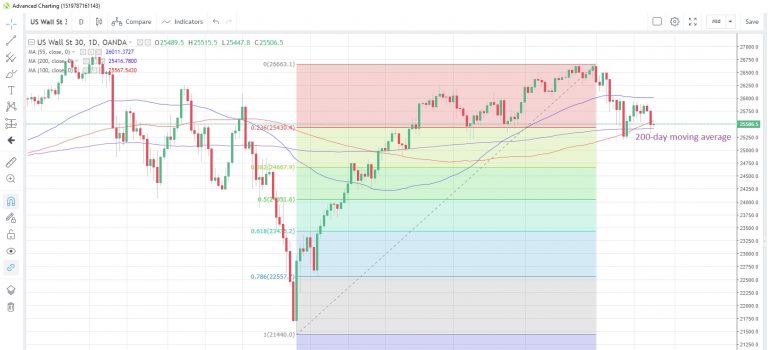
The US30 index fell the most in 10 days yesterday with trade war troubles dominating sentiment. Energy stocks came under pressure as oil prices tumbled
The index closed below the 100-day moving average at 25,539 for the first time in 10 days. The 200-day moving average is at 25,416 today
US durable goods orders are expected to fall 2.0% in April following a 2.8% increase in March.
DE30EUR Daily Chart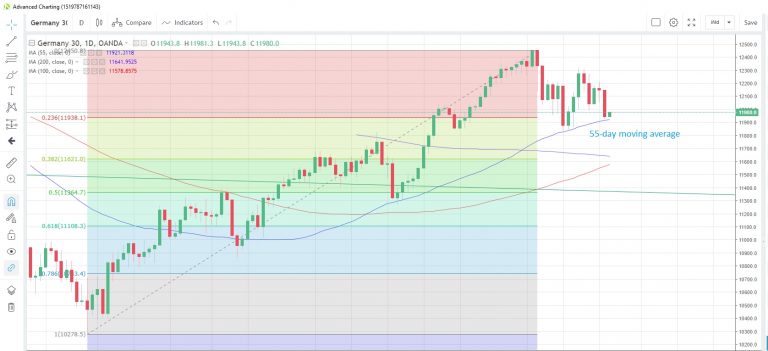
The Germany30 index had its worst down day since May 13 yesterday following some data misses for both Germany and the Euro-zone. Weakness on Wall Street didn’t help either
Support at the 55-day moving average at 11,921 remains intact and has supported prices on a closing basis since February 8
The Markit manufacturing PMI reading for Germany for May fell to 44.3, a three-month low, while the Euro-zone reading fell to 47.7. Both were below economists’ estimates. There are no data releases scheduled for today.
WTICOUSD Daily Chart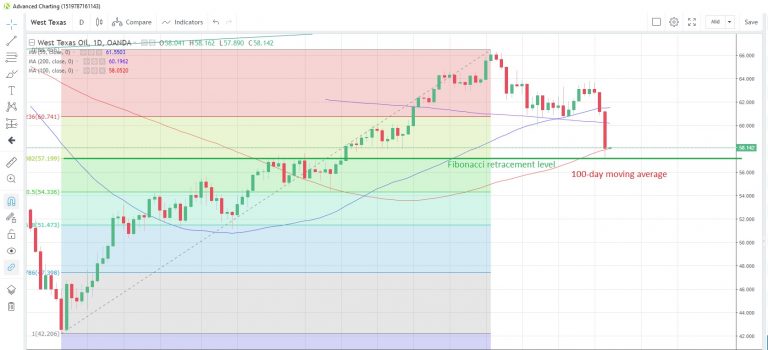
WTI prices fell the most in six months yesterday as the ongoing US-China trade conflict raised questions about global economic growth in the future
Prices fell to the lowest in 10 weeks, testing the 100-day moving average at 67.938 for the first time since March 8. Fibonacci support may be found at the 57.20 level
Weak PMI readings across Europe added to the negative sentiment for global oil demand. An easing in US-Iran tensions also eased supply concerns.
USD/CAD Canadian Dollar Falls With Lower Oil And US-China Trade Anxiety
The Canadian dollar lost 0.25 percent on Thursday. The loonie was under pressure as oil was down and it forced the currency to miss the other majors gaining on the US dollar. The greenback is on the back foot as soft economic data is increasing the probabilities of a rate cut by the Federal Reserve this year. That would mark a full 180 degree turn from last year where the benchmark Fed funds rate was raised four times.
The Canadian dollar appreciated just after the release of wholesale sales where a 1.4 percent gain was posted. The better than expected wholesale data combined with retail sales published yesterday to mark a strong rebound. Economic fundamentals are mixed in Canada, but in any other time this would have been great news for the currency.
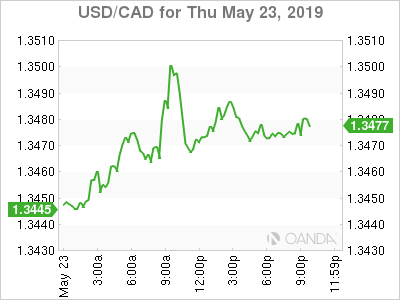
Trade war drums continue to sound and even as US President Donald Trump said that there is a good possibility of a trade deal with China, the fact that the Asian nation is stepping up its combative rhetoric is not convincing investors.
The Canadian dollar will go into Friday’s session with little on the economic calendar with the biggest market movers being British headlines on the fate of PM Theresa May and developments on the US-China negotiations and the European Parliamentary Elections.
The US dollar is lower as disappointing PMIs released on Thursday could convince the Fed to fully reverse the monetary policy course and issue an interest rate cut to stimulate the economy. The Fed lifted rates four times in 2018 and applied the brakes hard on January of this year as investor confidence tumbled. Economic indicators have been mixed, but as the US-China trade war does not appear near a peaceful agreement, the currency and the Fed are more sensitive to negative data.
Equities Drop as Trade War Drums Keep Beating
Global stocks were deep in the red on Thursday. The continuing saga of the trade battle between the US and China is taking a toll on investor confidence. The IMF published today what many feared, but the Trump administration was not willing to admit, US importers are paying the tariffs.
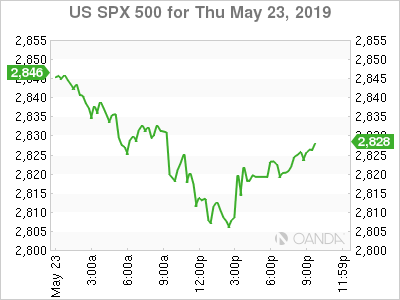
The tech sector was knocked back as supply chains depend on Chinese manufacturing. Energy shares were also hit as oil demand was hit by what looks to be a prolonged trade spat.
Lower than expected PMIs in Japan, Europe and the US put back in the spotlight the concerns about global growth. The Fed has rejoined dovish central banks, with no rate hikes this year, but now there are more conversations around a potential interest rate cut.
China is digging its heels as the US increases tariffs, so unless the awaited G20 meeting does not bear any meaningful fruit, equities will remain under pressure.
OIL – Trade War Anxiety Hits Crude Prices as Growth Indicators Disappoint
Oil prices tumbled more than 4 percent on Thursday adding to the weekly drop in energy prices. Oil prices fell by more than 2 percent on Wednesday after the release of the weekly US crude inventory data. A surprise buildup of 4.7 million barrels of crude and 3.7 million barrels of gasoline pushed prices down. West Texas Intermediate is on track to lose 7.64 percent and Brent 6.01 percent this week.
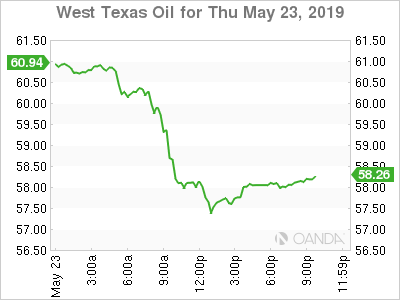
Middle East tensions and the ongoing OPEC+ crude output cut deal have kept prices in a higher range, but higher US production keeps putting downward pressure on prices. The balance between the OPEC+ cutting supply and the US ramping up production was broken in favor of lower prices as the trade war is tipping the scale by reducing future demand.
Geopolitical, weather and operational factors have reduced crude supply levels. The OPEC+ agreement has been the major factor and with the upcoming June end of the deal there is uncertainty if an extension is coming.
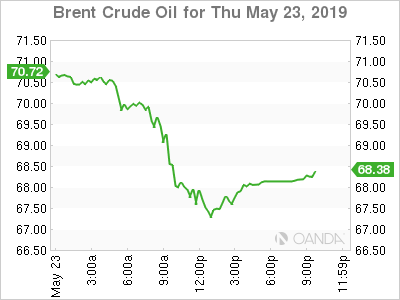
The US is impacting prices in three ways. Sanctions against Iran and Venezuela for political reasons have boosted prices as it reduced supply. US-China trade disputes have a negative effect on global growth forecast reducing energy demand going forward. The final factor has been the rise of American output. While sanctions reduce supply and boost prices, lower energy demand and rising production depreciates crude as there is a higher risk of oversupply.
GOLD – Gold Rises as Safe Haven Appeal Higher on Brexit and Trade War Concerns
Gold rose 0.71 percent on Thursday. Tariffs from both sides have escalated and China is not backing down to US pressure which could prolong the dispute with no date set for negotiations to reassume. US Secretary Mnuchin has said that there are no plans for him to visit Beijing, although he is looking forward to renewing talks.
Brexit concerns rose as Prime Minister May managed to unite all UK political factions against her. Putting a second referendum on the table did not sit well with Brexiteers but make it a condition on passing her Brexit proposal was a non-starter for Remain supporters. May’s decision to stick to her proposal could end up being the last straw that leads to her eventual downfall. The task on hand was near impossible from the start. A close Leave victory in the referendum left the historic decision with massive opposition as the perfect deal was never going to be achieved.
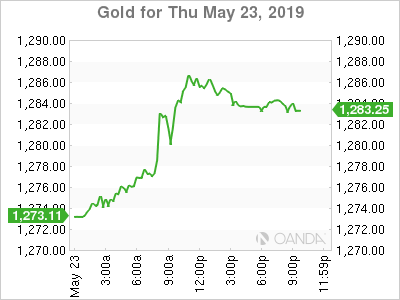
May’s almost inevitable exit would open the door for a Leave candidate to step forward. Boris Johnson is the most obvious choice, which once again would put a no-deal exit on the table. The political uncertainty in England is making investors seek the safety of gold.
Gold started gaining traction on Wednesday afternoon as the Fed published the minutes from its April/May FOMC meeting. The central stressed patience and affirmed current monetary policy would remain in place for some time. The Fed has already removed all rate hikes from its 2019 calendar as per member forecasts. Rate cut probabilities keep rising, but until there is a clear deterioration of economic fundamentals the Fed will remain on the sidelines.
Eco Data 5/24/19
[php_everywhere instance="1"]
Free fall in treasury yields drag down Dollar
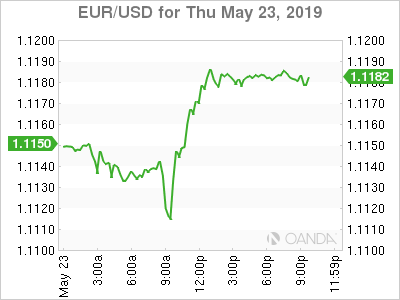
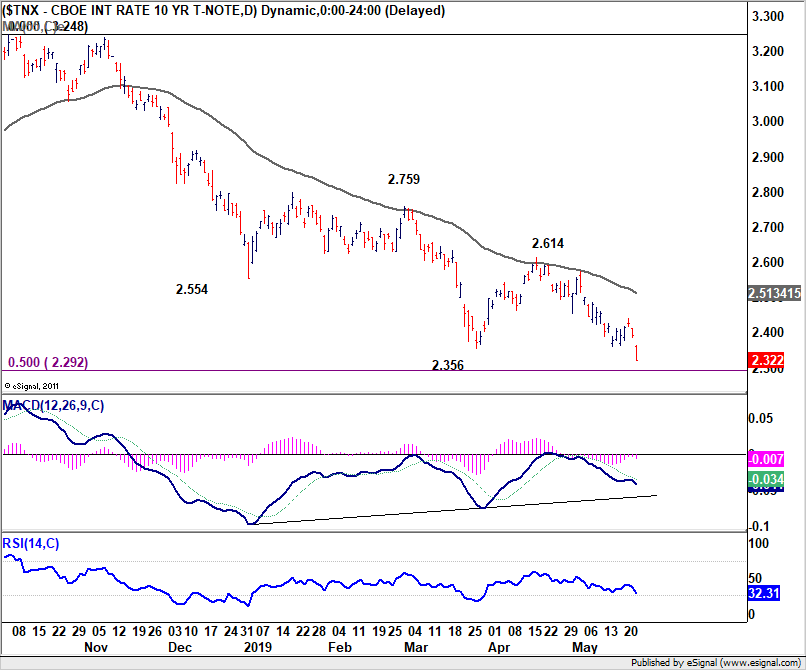
After brief rally on risk aversion in early US session, Dollar quickly reversed as dragged down by free fall in treasury yields. Dollar is currently the second weakest for the day. 10-year yield is currently down -0.069 at 2.324. It's on track for 2.292 fib level as noted here. Canadian Dollar is the worst performer on free fall in oil prices.
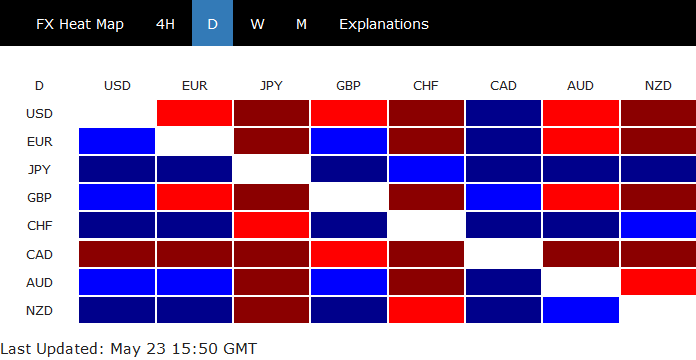
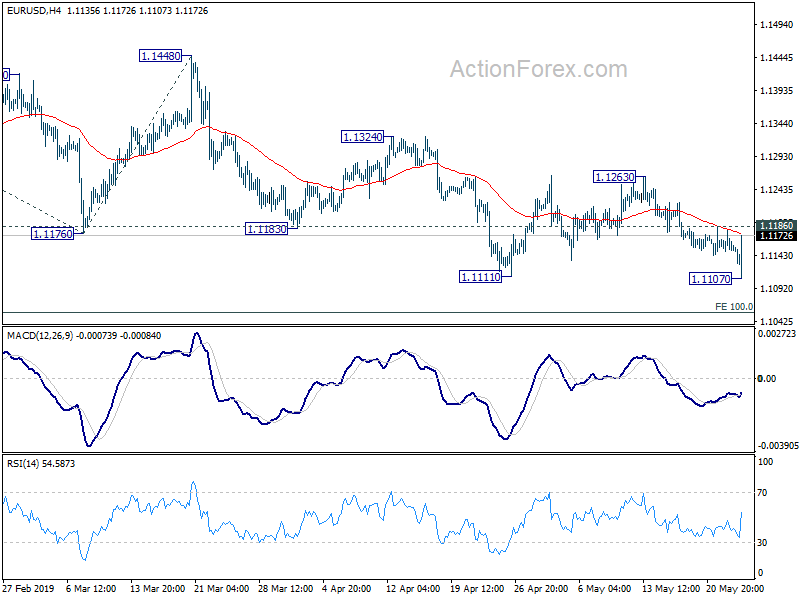
EUR/USD breached 1.1111 low to 1.1107 but recovers strongly. Medium term down trend from 1.2555 is not ready to resume yet. Consolidation from 1.1111 is going to extend with another rising leg. But we don't expect a break of 1.1263 resistance before down trend resumption.
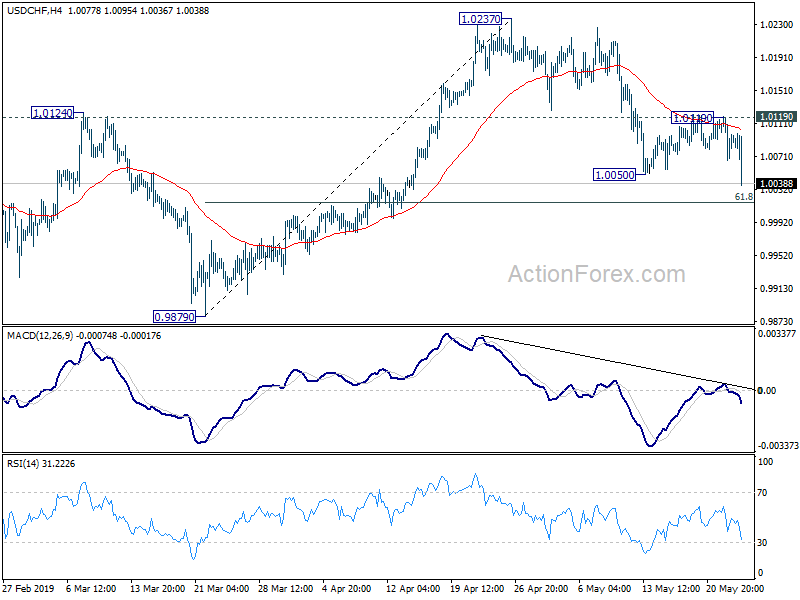
USD/CHF's near term decline from 1.0237 resumes by taking out 1.0050. Next stop is 61.8% retracement of 0.9879 to 1.0237 at 1.0016. We'd look for bottoming signal below there.
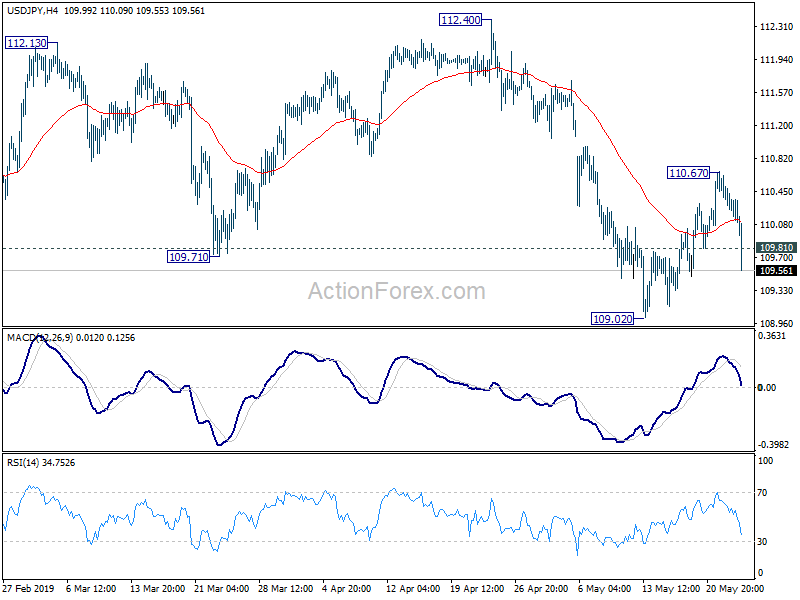
USD/JPY's break of 109.81 minor support suggest that corrective recovery from 109.02 has completed at 110.67. Retest of 109.02 should be seen next and break will resume the decline from 112.40, towards 104.69 low.
ECB Lacks Confidence that Economic Forecasts Could be Achieved. Focus on June for TLTROs Details
Reinforcing the dovish tone, the minutes for April’s ECB meeting exemplified the members’ pessimism over the economic outlook. They were becoming less confident that the baseline scenario of growth can be achieved. As such, the central bank would try to stimulate bank lending via the Targeted Longer-Term Refinancing Operations (TLTROs III), together with the exceptionally low interest rates. As in the policy statement, the minutes did not reveal any technical detail about the operations. We expect to hear the details in June or July, given the measure would take effect in September. Meanwhile, negative interest rates could affect profitability of the banking sector and there have been discussion on measures to mitigate such effect. We do not see much news on this issue. Again, we expect to know more in June. At the April meeting, ECB decided to leave the main refi rate, the marginal lending rate and the deposit rate unchanged at 0%, 0.25% and -0.40%, respectively. It would also continue to reinvest the proceeds from maturing securities purchased during the QE program which was completed in December 2019.
The members acknowledged that “some recent data had turned out even weaker than expected”, leading to “somewhat less confidence in the baseline scenario (for growth) and that the range of other possible outcomes had widened”. They also noted that inflation "remained uncomfortably" below their target level.
Policymakers were probably still working on TLTROs details at the time of the meeting. Little detail was disclosed. As suggested in the minutes, “some arguments were put forward in favor of pricing the new operations so they would primarily serve as a backstop, providing insurance in times of elevated uncertainty”, while “other arguments supported the view that the TLTRO-III operations should be seen as a potential tool for adjusting the monetary policy stance”.
ECB acknowledged that negative interest rates could affect profitability of the banking sector. As suggested in the minutes, it considered “whether the preservation of the favorable implications of negative interest rates for the economy would require the mitigation of their possible side effects, if any, on bank intermediation”. However, the minutes went short of giving any hint on the potential measures.
The April meeting affirmed policymakers’ dovish outlook over the economic outlook. This would certainly lead to more stimulus measures. The June ECB meeting would be an important event. Besides the latest staff economic projections, ECB is also expected to announce technical details about TLTROs and potential measures to mitigate adverse impacts of negative interest rates. Intensifying US-China trade war and ongoing Brexit uncertainty could force ECB to ease further to boost growth.
US Durable Orders Eyed as Dollar Remains ‘King’
The next highlight for the dollar will be the release of US durable goods orders for April, on Friday at 12:30 GMT. Forecasts point to a soft set of data, possibly due to weakness in demand for commercial aircraft. While a disappointment may hurt the dollar on the news, the broader outlook for the greenback remains positive as long as other major currencies continue to lack appeal.
New orders for durable goods are forecast to have contracted by 2.0% on a monthly basis in April, following a 2.8% rise in March. The softness seems largely owed to lackluster demand for transportation equipment, considering that the core figure – which excludes that item category – is projected to have risen by a modest 0.2%, the same pace as in March.
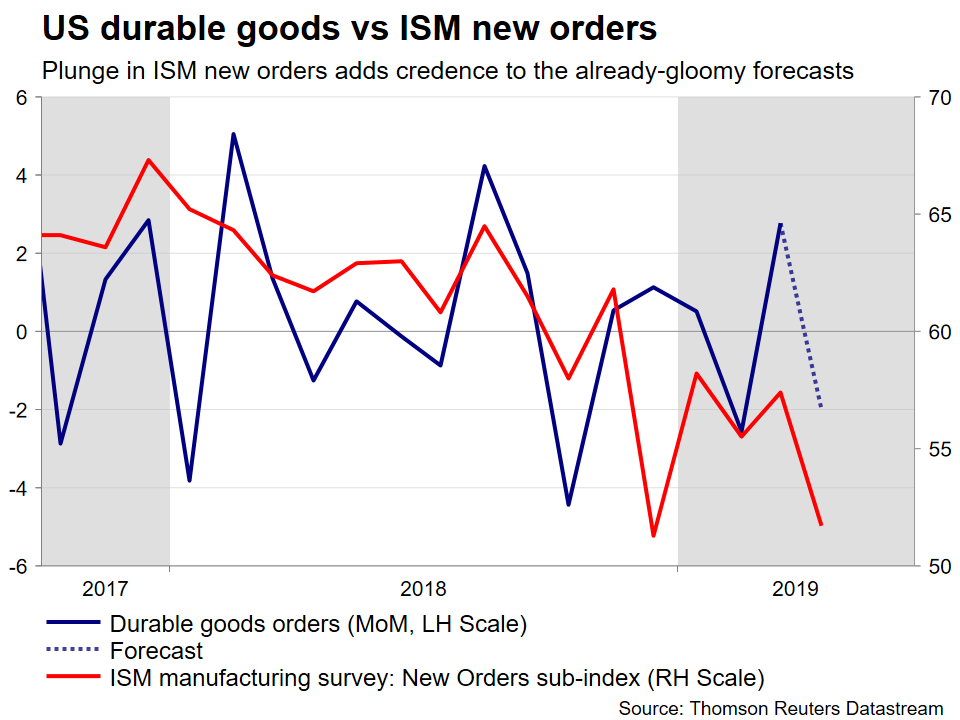
Indeed, US aircraft-maker Boeing reported zero new orders in April for its jets, as the recent scandal with its 737 MAX model kept buyers away, which explains much of the anticipated weakness in the headline print. Adding further credence to the pessimistic forecasts, the new orders sub-index of the ISM manufacturing PMI plunged in April, indicating that orders to manufacturers increased at a much slower pace. In isolation, this may even imply a weaker-than-expected data set.
If the actual prints come in as expected, or weaker, that may signal that capital investment remained fairly soft to start Q2, raising concerns about broader economic growth. Expectations on that front are already quite subdued, with the Atlanta Fed GDPNow model signaling a sluggish 1.2% annualized growth rate in Q2, with the data available so far.
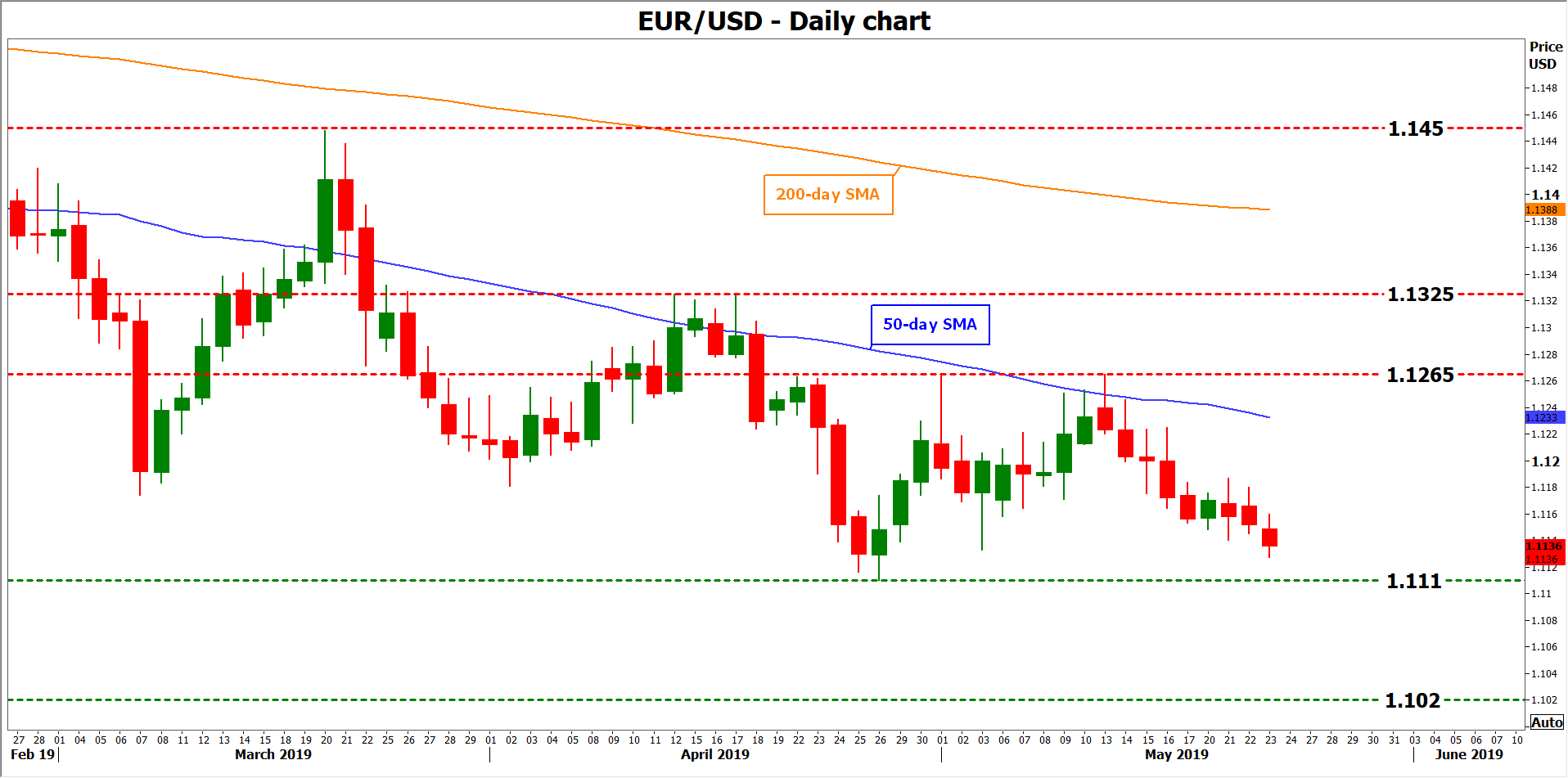
In case of a disappointment, the dollar could come under some selling pressure as expectations for a Fed rate cut this year grow further. Looking at euro/dollar technically, resistance to advances may be found near the 50-day SMA at 1.1236, with an upside break opening the way for 1.1265.
On the other hand, if durables surprise to the upside, the greenback may gain ground as rate-cut bets are unwound. Support to declines in euro/dollar could come at 1.1140, with a bearish violation turning the attention to the 2-year low of 1.1110.
In the big picture, what matters most for the dollar probably lies beyond US borders. The greenback remains the ‘king’ of the FX market for now, mainly due to other major currencies – like the euro, pound, aussie and kiwi – being unattractive. Make no mistake, this is mostly a story about global weakness driving investors to the US, as opposed to the US attracting capital flows purely on its own merits.
Therefore, the outlook for the dollar remains positive, until one of the bleak narratives in the other major economies starts to improve. In this sense, the biggest downside risk for the dollar would be a material rebound in European growth, which as the latest European PMIs showed, is not there yet.
EURGBP Climbs, But More Upside Needed to Affirm Bullish Outlook
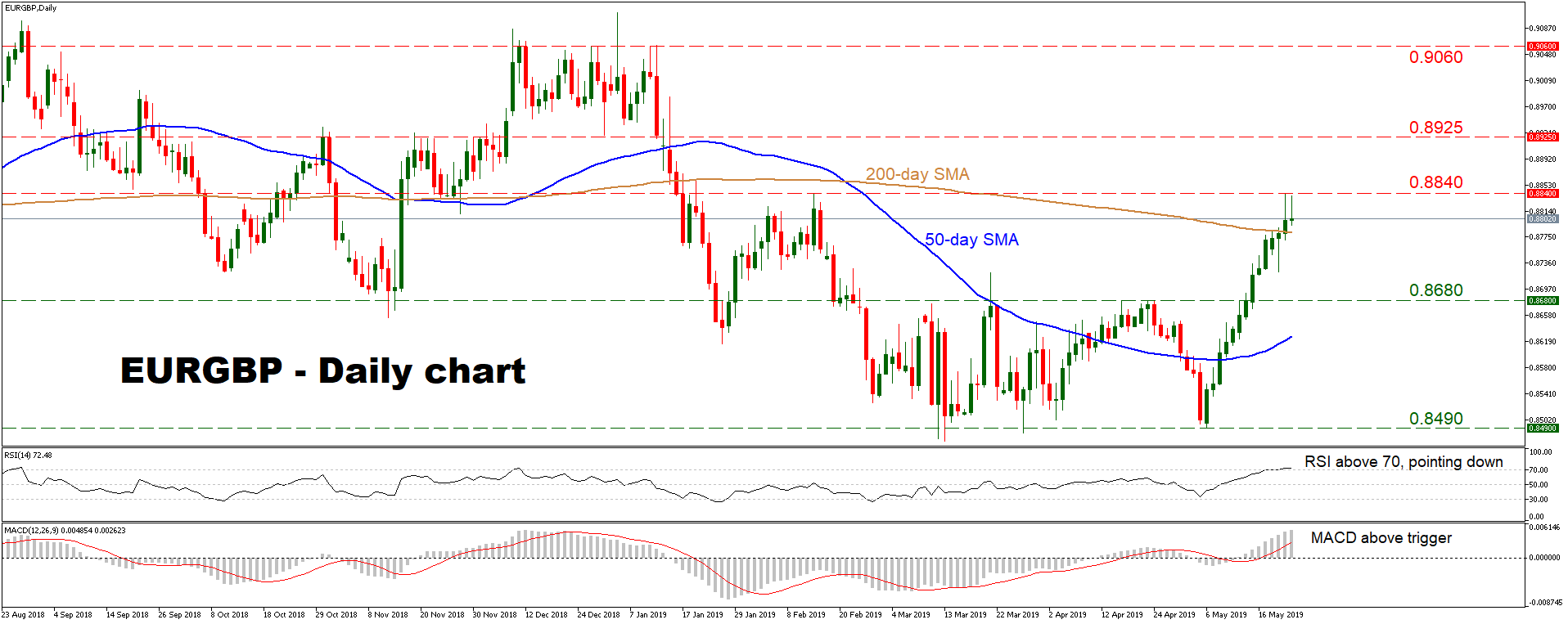
EURGBP staged a mighty rally over the past weeks, crossing above its 50- and 200-day simple moving averages (SMAs) to touch the 0.8840 zone, before retreating somewhat. The near-term outlook seems to have turned positive, though a clear break above 0.8840 is needed to confirm that.
Short-term momentum indicators, on the other hand, suggest a pullback may be looming. The RSI turned lower after entering its overbought zone, while the MACD seems to be topping above its trigger line.
A potential pullback could stall initially near the 200-day SMA, currently at 0.8781. A bearish break may open the door for a test of the 0.8680 area, where another violation would turn the outlook back to neutral.
On the flipside, if the bulls stay in control, the next obstacle is 0.8840. If buyers pierce above it, that would reaffirm the positive picture, paving the way for a test of 0.8925.
In short, a decisive move above 0.8840 would turn the picture to firmly positive, whereas a break back below 0.8680 would turn it neutral, from cautiously positive now.
CADJPY Erases Gains; Remains in Neutral Mode
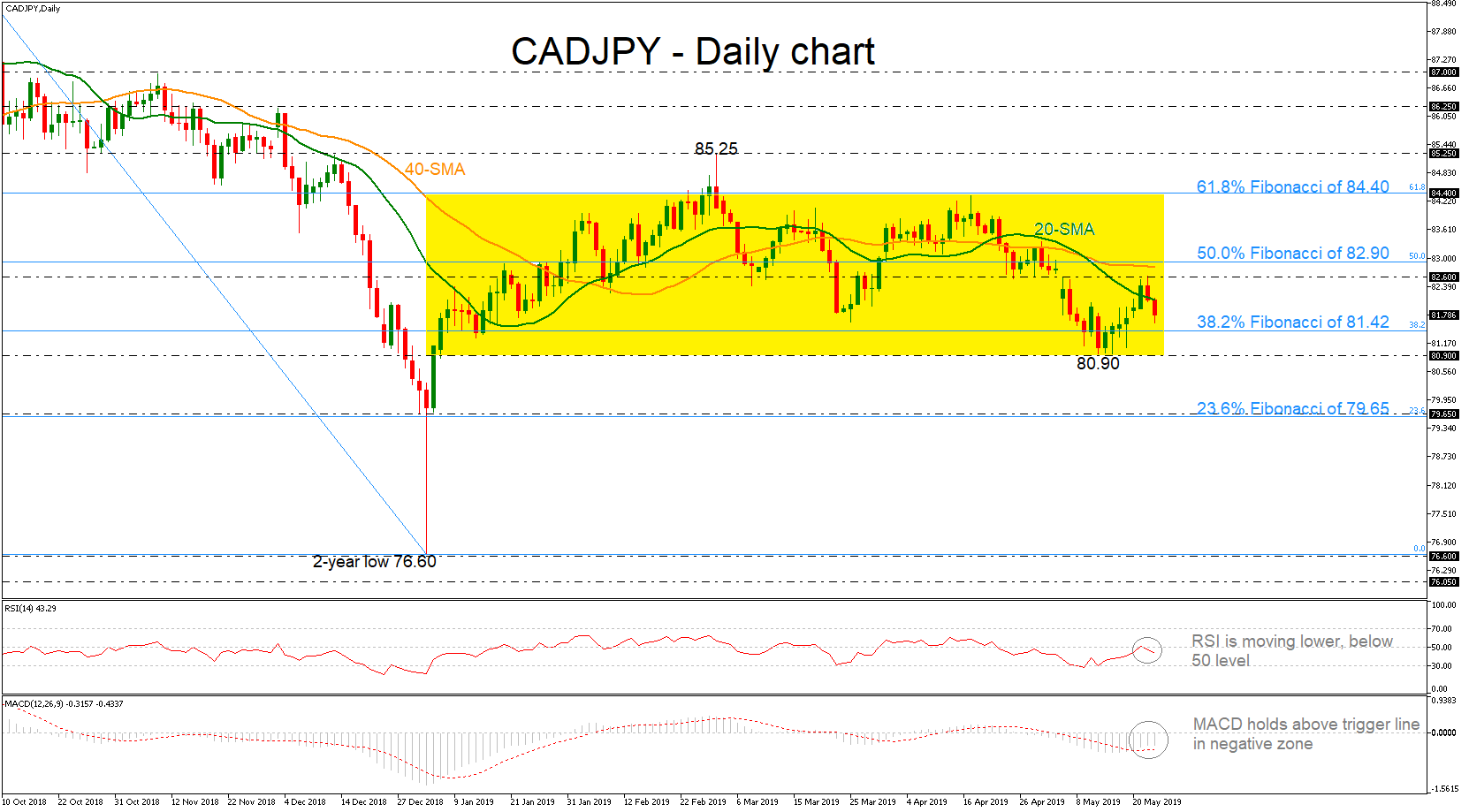
CADJPY has been finding strong resistance on the 82.60 barrier, falling beneath the 20-simple moving average (SMA) in the daily chart. Since mid-January, the pair has been trading within a narrow range between the 61.8% Fibonacci of the downleg from 89.25 to 76.60, near 84.40, and the 80.90 support.
Having a look at the momentum indicators, the RSI is pointing down below the neutral threshold of 50 and the MACD is hovering near the trigger line and below the zero line.
A step lower could find immediate support at the 38.2% Fibonacci of 81.42 and the 80.90 hurdle. More downside pressures could drive the pair towards the 23.6% Fibonacci of 79.65, increasing bearish sentiment.
An advance above the 50.0% Fibonacci of 82.90 and the 40-day moving average could open the door for bullish actions until the 61.8% Fibonacci of 84.40. If there is a successful daily close above the aforementioned obstacle, the pair could push until 85.25, while a sharper move higher could shift the neutral bias to more bullish one, testing 86.25.
However, a break below the 38.2% Fibonacci and the 81.90 support could confirm the long-term negative momentum.
Sunset Market Commentary
Markets
Global core bonds continue to gain ground today. This morning, Chinese state-run media accused the US of starting a “technology cold war”, while China’s Commerce Ministry added that the US needs to correct its wrong actions and show sincerity if it wants to continue trade negotiations. Those kinds of headlines doesn’t strike us as one of the parties is close to making the first peace offer, and continues to weigh on financial markets. Core bonds opened higher. Soft EMU PMI’s and a disappointing German Ifo survey further weighed on sentiment. The minutes of the ECB April meeting yielded little news and had no impact on trading. The German yield curve is currently moving lower with losses up to -2.5 bps (10-yr). US investors joined the debates and tried to turn the tide, but risk-off rapidly continued. This week’s jobless claims printed 211k, close to expectations but overall impact remained limited. The US yield curve is edging lower with yield changes up to -3.5 bps (5-yr). Peripheral spreads over the German 10-yr yield are widening with Greece (+4 bps) and Italy (+4 bps) underperforming.
The escalation of the trade war remained the dominant factor for global FX trading, but EMU confidence data also (PMI’s /IFO) had potential to inspire some moves in the euro. The overall EMU composite printed close to expectations, but indicated that growth remains sluggish in Q2. German IFo business climate also missed the consensus even as the forward-looking sub-index provided a glimmer of hope. EUR/USD already drifted lower in the run-up to the publication of the EMU confidence data. The pair the settled in in the 1.1130/40 area. Equities suffered substantial losses and US yields declined more than German ones. US jobless claims (211 K) still suggest a healthy US labour market, but were also ignored. Initially, this constellation had little impact on EUR/USD, but finally the law of gravity pushed EUR/USD toward the 1.1112 2019 low (test ongoing at the moment of writing). The risk-off again supported modest yen gains. USD/JPY returned to the psychological 110 barrier. So, the risk-off remains slightly supportive for the USD (ex-USD/JPY) with the US currency (trade-weighted and/or USD/EUR) testing key technical levels.
Sterling remained in the defensive today, but the recent declined slowed at least temporary. Uncertainty on the Brexit process and the battle within the conservative party to replace PM May are sterling negatives. Markets also keep an eye at the outcome of the EU parliamentary election in the UK. Technical considerations were maybe in play to ease the sterling sell-off. EUR/GBP twice (yesterday and today) tested the 0.8840 resistance area, but no sustained break occurred. This ‘rejected’ test might be caused by some GBP-shorts to take some chips off the table. The EUR/USD decline also weighed slightly on EUR/GBP. The pair is changing hands in the 0.8800 area. Cable touched a minor new correction low in the low 1.26 area, but trades currently again in the 1.2640 area. Even so, the global picture for sterling didn’t occur.
News Headlines
Confidence data suggest EMU growth to remain sluggish in Q2. The EMU composite PMI rose only marginally from 51.5 to 51.6. The manufacturing measure slipped further in contraction territory (47.7).The services PMI also disappointed at 52.5 (from 52.8). The May PMI indicates EMU Q2 growth at 0.2% Q/Q according to IHS Markit. German manufacturing activity also continued to suffer (44.3). French PMI’s/confidence data improved more than expected. Aside from the PMI’s, German ifo Business climate dropped from 99.2 to 97.9, mainly due to a decline in the current conditions assessment.
Crude oil extended losses. Brent oil fell below the $70 p/b. The US WTI contract dropped to $60 p/b. The correction accelerated after an unexpected rise in US inventories yesterday. Ongoing uncertainty also raises questions on expected global demand for oil.
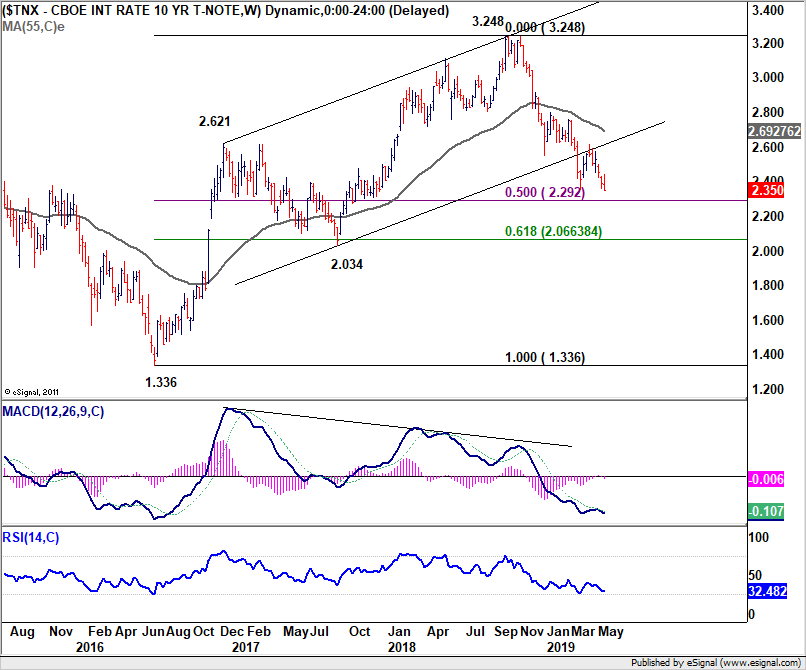
10-year yield resume medium term down trend, 2.292 fib level next
US 10-year yield opens sharply lower today and hits as low as 2.352 so far. Breach of 2.356 short term bottom suggests that recent down trend from 3.248 is ready to resume.
Outlook is rather bearish too as TNX was rejected twice by falling 55 day EMA. Next target is 50% retracement of 1.336 to 3.248 at 2.292.
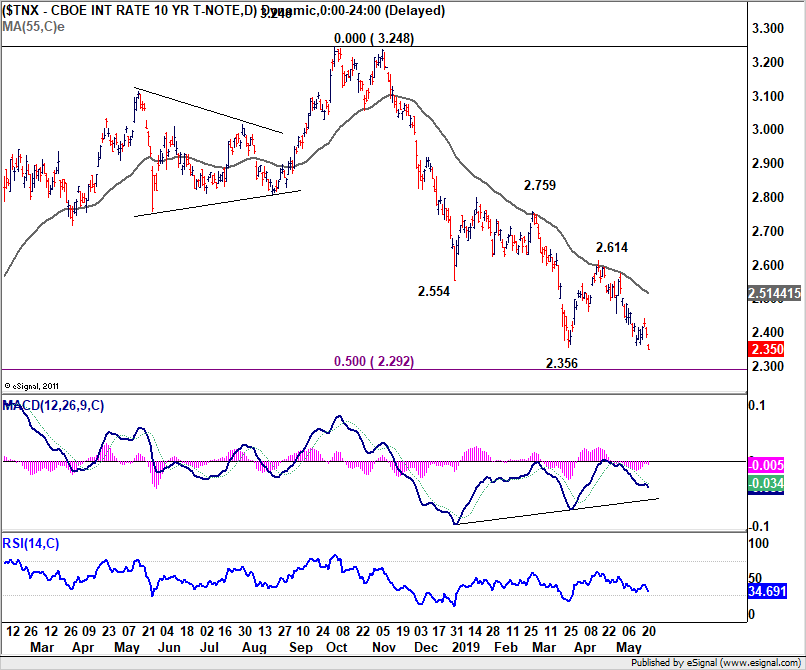
In the bigger picture, current fall is so far, seen as a correction to the up trend from 1.336 (2016 low). Rejection by long term channel support suggests it's far from over. We'd expect a test on 61.8% retracement at 2.066 before forming a bottom for sustainable rebound.