

Sample Category Title
AUD/USD Daily Outlook
Daily Pivots: (S1) 0.6869; (P) 0.6883; (R1) 0.6895; More...
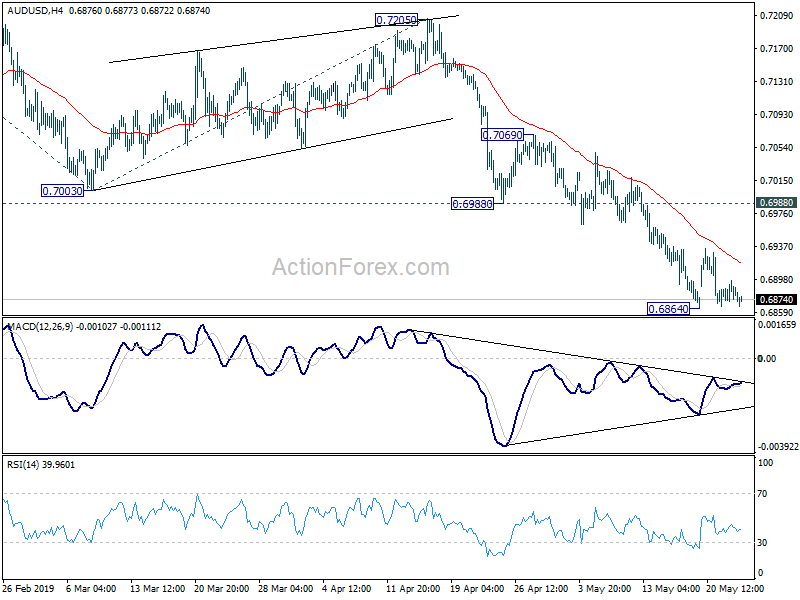
AUD/USD is staying in consolidation from 0.6864 and intraday bias remains neutral first. In case of another recovery, upside should be limited by 0.6988/7069 resistance zone to bring fall resumption. On the downside, break of 0.6864 will turn bias to the downside and extend the fall from 0.7295 to 161.8% projection of 0.7295 to 0.7003 from 0.7205 at 0.6733, which is close to 0.6722 low.
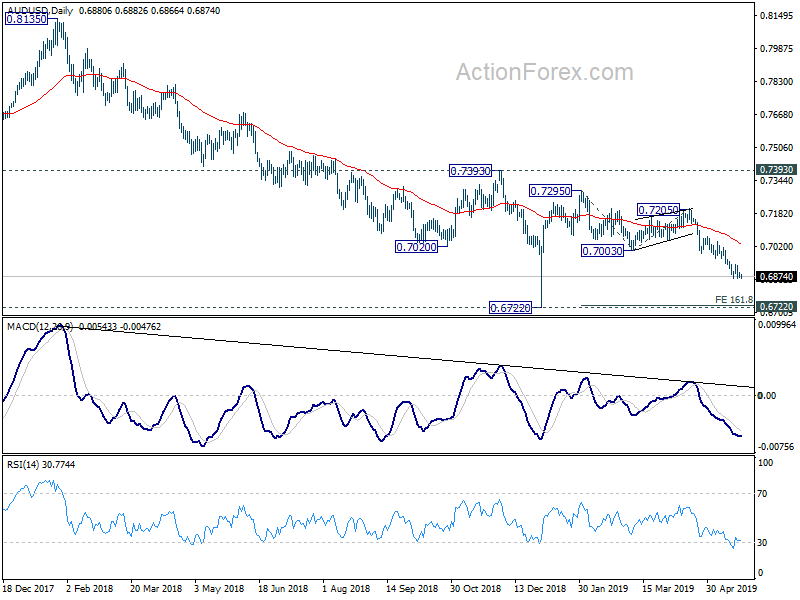
In the bigger picture, with 0.7393 key resistance intact, medium term outlook remains bearish. The decline from 0.8135 (2018 high) is seen as resuming long term down trend from 1.1079 (2011 high). Decisive break of 0.6826 (2016 low) will confirm this bearish view and resume the down trend to 0.6008 (2008 low). However, firm break of 0.7393 will argue that fall from 0.8135 has completed. And corrective pattern from 0.6826 has started the third leg, targeting 0.8135 again.
EUR/USD Daily Outlook
Daily Pivots: (S1) 1.1138; (P) 1.1159; (R1) 1.1171; More.....
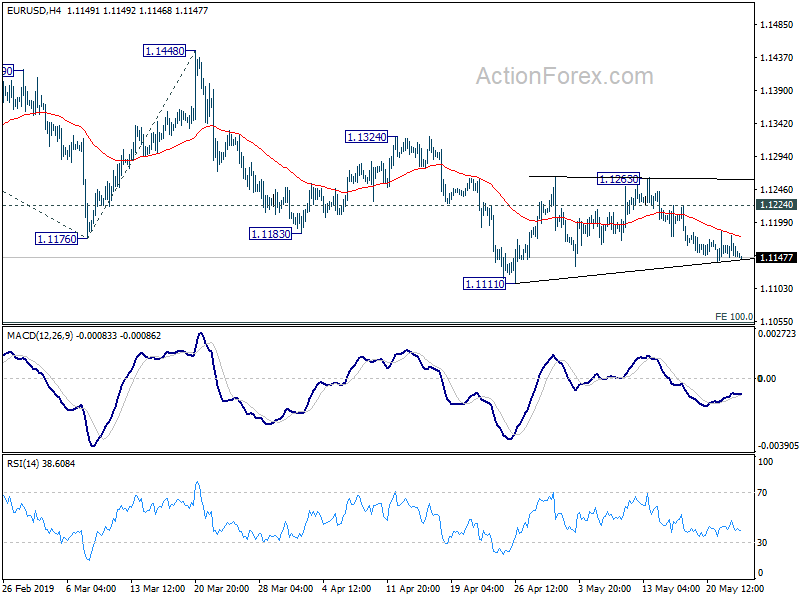
Intraday bias in EUR/USD remains neutral and outlook is unchanged. Price actions from 1.1111 is a correction pattern and could have completed at 1.1263. Decisive break of 1.1111 will resume larger down trend for 100% projection of 1.1448 to 1.1183 from 1.1324 at 1.1059. Though, on the upside, above 1.1224 minor resistance will turn bias back to the upside to extend the consolidation from 1.1111 first.
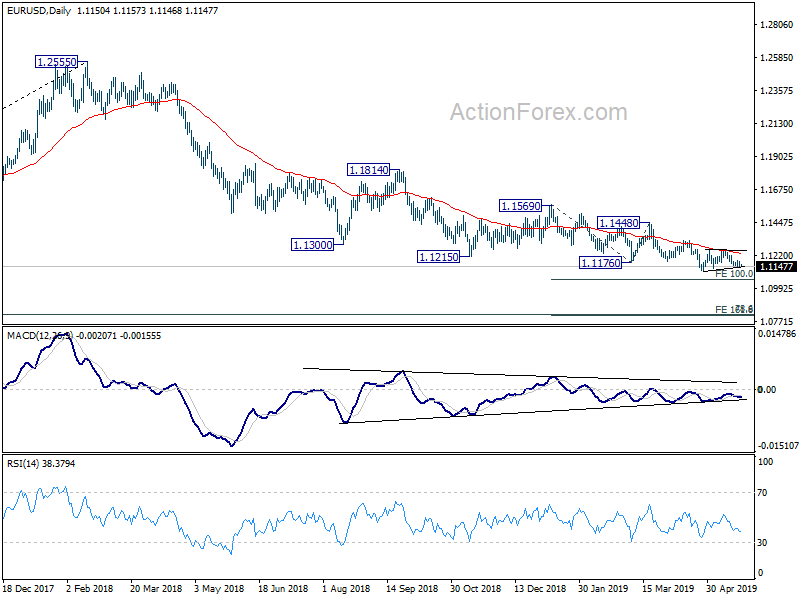
In the bigger picture, down trend from 1.2555 (2018 high) is still in progress. Such decline would target 78.6% retracement of 1.0339 (2016 low) to 1.2555 (2018 high) at 1.0813 next. Sustained break there will pave the way to retest 1.0339. On the upside, break of 1.1448 resistance is needed to be the first sign of medium term bottoming. Otherwise, outlook will stay bearish in case of rebound.
GBP/USD Daily Outlook
Daily Pivots: (S1) 1.2617; (P) 1.2668; (R1) 1.2713; More....
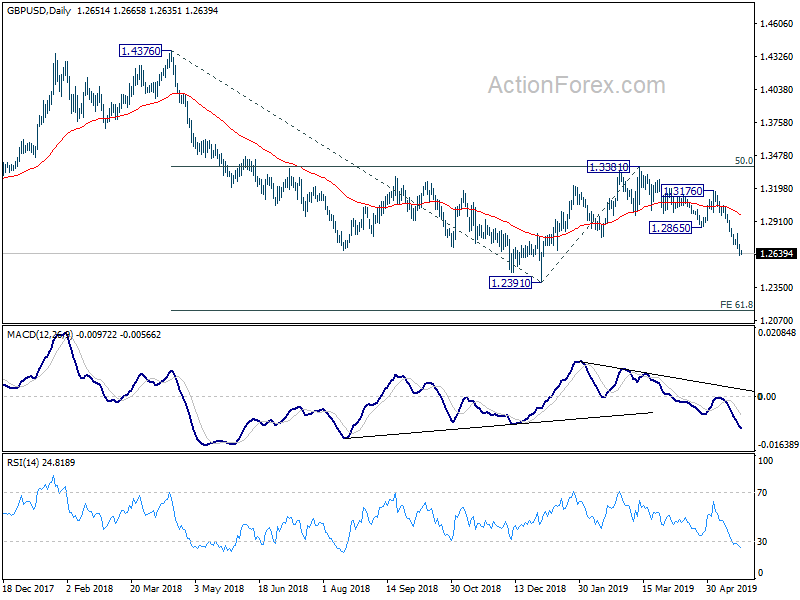
Intraday bias in GBP/USD remains on the downside for the moment. Current decline from 1.3381 should target 1.2391 low. Larger decline from 1.4376 might be resuming. Break of 1.2391 will target 61.8% projection of 1.4376 to 1.2391 from 1.3381 at 1.2154 next. On the upside, above 1.2812 minor resistance will turn intraday bias neutral again for more consolidation first.
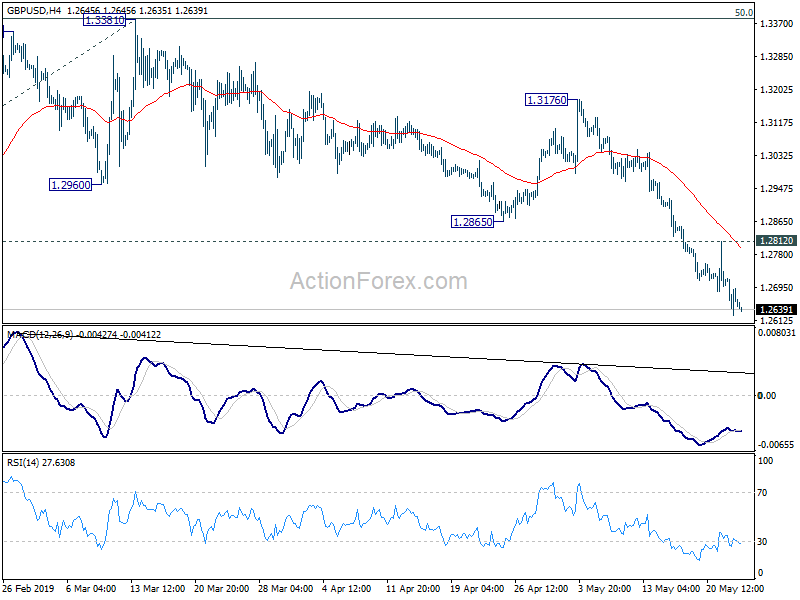
In the bigger picture, current development suggests that medium term decline from 1.4376 (2018 high) is not completed, and is possibly ready to resume. Decisive break of 1.2391 would target a test on 1.1946 long term bottom (2016 low). For now, we don't expect a firm break there yet. Hence focus will be on bottoming signal as it approaches 1.1946. In any case, medium term outlook will stay bearish as long as 1.3381 resistance holds, in case of rebound.
USD/JPY Daily Outlook
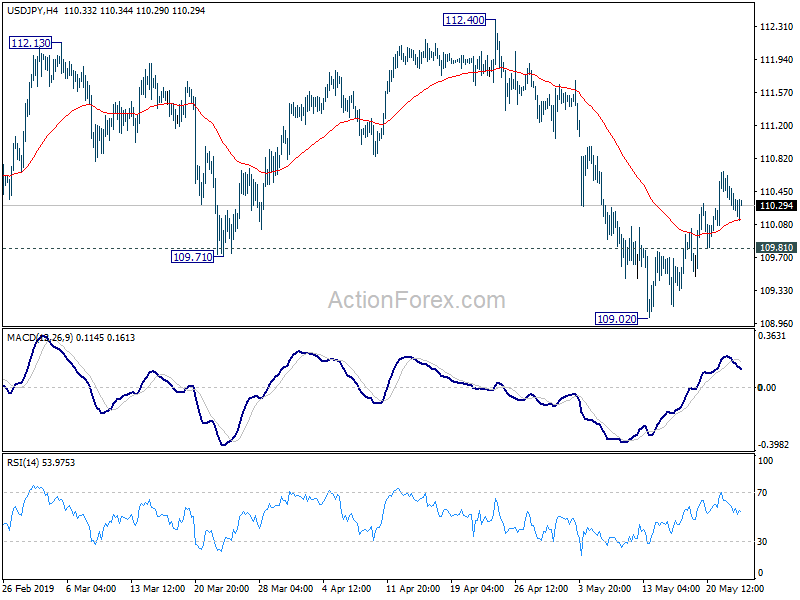
Daily Pivots: (S1) 110.18; (P) 110.40; (R1) 110.58; More...
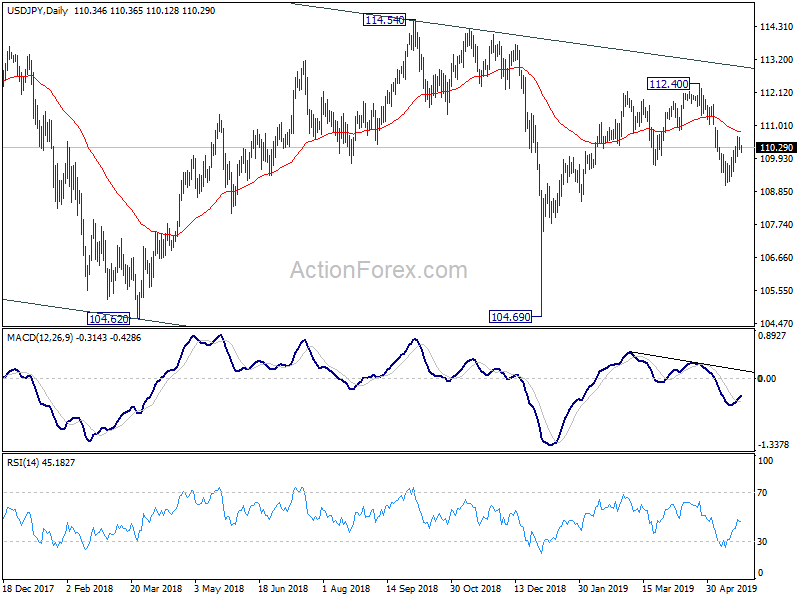
Outlook in USD/JPY remains unchanged. Corrective recovery from 109.02 should be limited by 55 day EMA (now at 110.82) to bring another fall. On the downside, below 109.81 minor support will turn bias back to the downside for 109.02. Break there will extend the decline from 112.40 to retest 104.69 low. However, sustained trading above 55 day EMA will indicate completion of the fall from 112.40 and bring retest of this high.
In the bigger picture, USD/JPY is staying inside falling channel from 118.65. Currently development suggests that rebound from 104.69 is only a corrective move. And fall from 118.65 is not completed yet. Decisive break of 104.69 will extend the down trend towards 98.97 support (2016 low). For now, we'd expect strong support above there to bring rebound.
USD/CHF Daily Outlook
Daily Pivots: (S1) 1.0068; (P) 1.0094; (R1) 1.0122; More...
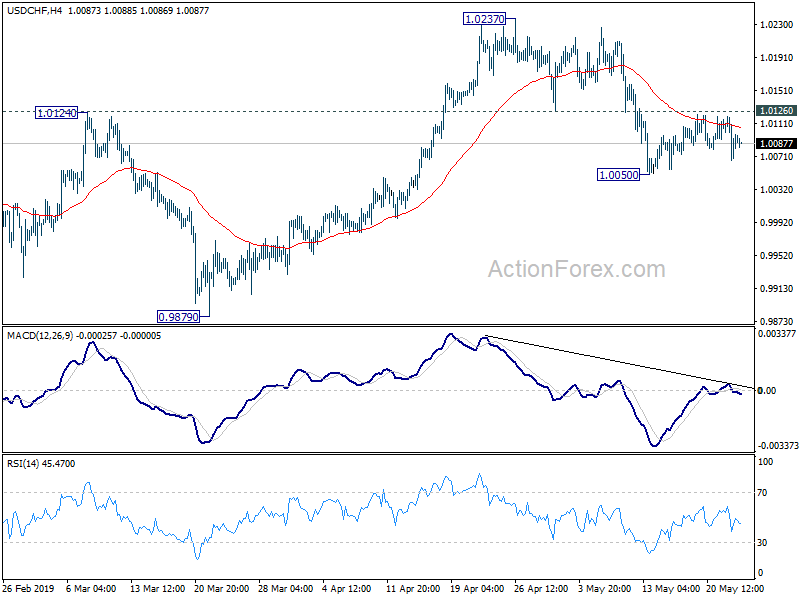
USD/CHF dipped notably overnight but stays above 1.0050 temporary low. Intraday bias remains neutral for the moment. With 1.0126 support turned resistance intact, another decline is mildly in favor. On the downside, break of 1.0050 will resume the fall from 1.0237 to retest 0.9879 key support. However, firm break of 1.0126 will turn bias back to the upside for 1.0237 resistance.
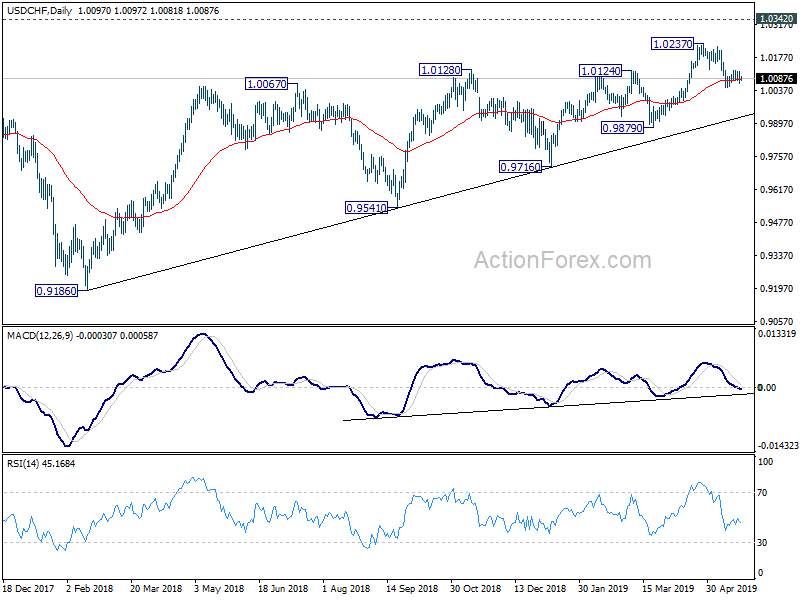
In the bigger picture, as long as 0.9879 support holds, medium term up trend form 0.9186 is still in progress. Break of 1.0237 will target 1.0342 resistance next. For now, we'd be cautious on strong resistance from there to limit upside, until we see medium term upside acceleration. However, decisive break of 0.9879 will be a strong sign of medium term reversal. Focus will be turned back to 0.9716 support for confirmation.
Trade Concerns Drag Down Asian Markets Again, Yen and Franc Lifted
Swiss Franc and Yen firm up again in Asian session as markets are gradually convinced that a full-blown US-China trade war is underway. Tensions between the two countries have clearly worsened after trade negotiation collapsed weeks ago. And it's clearly not just about trade but a broad range of practices of China, including IP theft. Huawei is highly unlikely to be the only one who will receive broad based sanctions from the US, and more are coming.
Additionally, as Treasury Secretary Steven Mnuchin, a relative trade dove, indicated, tariffs on all untaxed Chinese imports are probably just a month away. A full-blown trade war is quickly becoming the baseline scenario. Tariffs impacts are seen again in today's Japan PMI manufacturing, which is back in contraction. Eurozone PMIs and German Ifo might add more pessimistic evidence.
Back in the currency markets, Dollar is following as the third strongest one for today on risk aversion. Sterling is the weakest one for today as Brexit crisis in UK deepens with resignation of high profile minister Andrea Leadsom. Australian Dollar is the second weakest so far on anticipation of RBA cut in June. Canadian Dollar got just a very brief lift by retail sales overnight. It's then pulled down by oil price on surprised inventory build.
Technically, USD/CAD's quick rebound is inline with our view that it's just extending consolidation from 1.3521. Further rise is expected through this resistance eventually. GBP/JPY resumed recent decline through 139.54 overnight. EUR/JPY and USD/JPY might follow before weekly close, if risk sentiment worsens. Similarly, USD/CHF could break through 1.0050 to resume recent fall soon. AUD/USD, too, looks ready to break through 0.6864 temporary low any time.
In Asia, Nikkei is currently down -0.67%. Hong Kong HSI is down -1.30%. China Shanghai SSE is down -0.84%. Singapore Strait Times is down -0.41%. Japan 10-year JGB yield is up 0.0005 at -0.05. Overnight, DOWN dropped -0.39%. S&P 500 dropped -0.28%. NASDAQ dropped -0.45%. 10-year yield dropped -0.033 to 2.393, back below 2.4 handle.
US Mnuchin indicates new tariffs on China probably just a month away
Yesterday, US Treasury Secretary Steven Mnuchin reminded the House Financial Services Committee that new tariffs on USD 300B in Chinese imports are probably just a month or so away. He said, "there won't be any decision probably for another 30 to 45 days." Meanwhile, there is no plan to travel to China to resume trade negotiations yet.
On Walmart's claims that tariffs will push up retail prices, he said "that's something I can assure you the president will be focused on before we make any decisions." However, he also talked down the threat of higher prices for consumers. He said "my expectation is that a lot of this business will be moved from China to other places in the region so that there will not be a cost."
FOMC minutes show no urgency to cut interest rate
Dollar is steady after minutes of May 1 FOMC meeting showed that Fed is in no rush to move interest rates, up or down. The minutes noted that "members observed that a patient approach...would likely remain appropriate for some time". The tone regarding the economy was also upbeat, due to upside surprise in Q1 growth. GDP was forecast to "expand at a rate above the staff's estimate of potential output growth in 2019 and 2020 and then slow to a pace below potential output growth in 2021". Recent weak inflation was also viewed by many participants "as likely to be transitory."
However, firstly, there was increasing concerns over persistence of low inflation. "Several participants commented that if inflation did not show signs of moving up over coming quarters, there was a risk that inflation expectations could become anchored at levels below those consistent with the committee's symmetric 2% objective.'' Secondly, the meeting was held before current round of escalation in US-China trade war. It is possible that the Fed would turn more cautious over the economic outlook at the June meeting, when the members take into account the effects of recent re-escalation of US-China trade war.
For now, comments from Fed officials are generally inline with the minutes. But as more data come in, upcoming rhetorics leading to June FOMC meeting would reveal if there would be a shift in the board.
Suggested readings on FOMC minutes:
- FOMC Minutes Reinforced Patience Approach to Monetary Decision
- Fed Minutes Show Commitment to Patience
Japan PMI manufacturing dropped to 49.6, re-escalation of US-China trade frictions heightened concern
Japan PMI manufacturing dropped to 49.6 in May, down from 50.2 and missed expectation of 50.5. The reading is also back in contraction territory. Markit noted that output and new orders decrease for fifth successive month. Businesses cast pessimistic outlook towards the coming year for the first time in six-and-a-half year.
Joe Hayes, Economist at IHS Markit, said: "Following some tentative signs that the downturn in Japan's manufacturing sector had softened in April, flash data for May revealed these were short-lived, as output and export orders fell at stronger rates. The re-escalation of US-China trade frictions has heightened concern among Japanese goods producers. Underlying growth weakness across much of Asia led to struggling exports, which fell at the sharpest rate in four months. Difficulties on the international front merely add to uncertainties domestically, with upcoming upper house elections in July, and the impending sales tax hike later this year. Subsequently, sentiment turned negative in May for the first time in six-and-a-half years."
Brexit crisis deepens as Leadsom resigns on second referendum
Brexit crisis in UK deepened further after a key Cabinet Minister resigned in opposition to Prime Minister Theresa May's inclusion of a second referendum in the new Brexit plan.
Andrea Leadsom Leader of the House of Commons, said "I no longer believe that our approach will deliver on the referendum result". And, "I do not believe that we will be a truly sovereign United Kingdom through the deal that is now proposed".
Leadsom went further and said "I have always maintained that a second referendum would be dangerously divisive and I do not support the government willingly facilitating such a concession."
May's spokesman just praised Leadsom and expressed disappointment at her decision, but added: "The prime minister remains focused on delivering the Brexit people voted for."
There is practically no chance for May to get her Brexit deal through the Commons. The question now is who will take her place and lead Brexit after she steps down as promised. Sterling remains the weakest one for the week as markets are pricing in the chance of a pro-Brexit hardliner leading UK to a no-deal Brexit.
Looking ahead
Eurozone PMIs and German Ifo are the major focus of the data. The data will need to show more evidence of stabilization in the economy Q2 to support Euro. Germany will release Q1 GDP final. ECB monetary policy accounts will also be featured. Later in the day, Canada will release wholesale trade sales. US will release PMIs and new home sales.
USD/CHF Daily Outlook
Daily Pivots: (S1) 1.0068; (P) 1.0094; (R1) 1.0122; More...
USD/CHF dipped notably overnight but stays above 1.0050 temporary low. Intraday bias remains neutral for the moment. With 1.0126 support turned resistance intact, another decline is mildly in favor. On the downside, break of 1.0050 will resume the fall from 1.0237 to retest 0.9879 key support. However, firm break of 1.0126 will turn bias back to the upside for 1.0237 resistance.
In the bigger picture, as long as 0.9879 support holds, medium term up trend form 0.9186 is still in progress. Break of 1.0237 will target 1.0342 resistance next. For now, we'd be cautious on strong resistance from there to limit upside, until we see medium term upside acceleration. However, decisive break of 0.9879 will be a strong sign of medium term reversal. Focus will be turned back to 0.9716 support for confirmation.
Economic Indicators Update
| GMT | Ccy | Events | Actual | Forecast | Previous | Revised |
|---|---|---|---|---|---|---|
| 0:30 | JPY | PMI Manufacturing May P | 49.6 | 50.5 | 50.2 | |
| 6:00 | EUR | German GDP Q/Q Q1 F | 0.40% | 0.40% | ||
| 7:15 | EUR | France Manufacturing PMI May P | 50 | 50 | ||
| 7:15 | EUR | France Services PMI May P | 50.8 | 50.5 | ||
| 7:30 | EUR | Germany Manufacturing PMI May P | 44.8 | 44.4 | ||
| 7:30 | EUR | Germany Services PMI May P | 55.4 | 55.7 | ||
| 8:00 | EUR | Eurozone Manufacturing PMI May P | 48.1 | 47.9 | ||
| 8:00 | EUR | Eurozone Services PMI May P | 53 | 52.8 | ||
| 8:00 | EUR | German IFO Business Climate May | 99.1 | 99.2 | ||
| 8:00 | EUR | German IFO Expectations May | 95 | 95.2 | ||
| 8:00 | EUR | German IFO Current Assessment May | 103.5 | 103.3 | ||
| 11:30 | EUR | ECB Monetary Policy Meeting Accounts | ||||
| 12:30 | CAD | Wholesale Trade Sales M/M Mar | 0.80% | 0.30% | ||
| 12:30 | USD | Initial Jobless Claims (MAY 18) | 215K | 212K | ||
| 13:45 | USD | Manufacturing PMI May P | 52.7 | 52.6 | ||
| 13:45 | USD | Services PMI May P | 53.5 | 53 | ||
| 14:00 | USD | New Home Sales Apr | 678K | 692K | ||
| 14:00 | USD | New Home Sales M/M Apr | -2.50% | 4.50% | ||
| 14:30 | USD | Natural Gas Storage | 106B |
Japan PMI manufacturing dropped to 49.6, re-escalation of US-China trade frictions heightened concern
Japan PMI manufacturing dropped to 49.6 in May, down from 50.2 and missed expectation of 50.5. The reading is also back in contraction territory. Markit noted that output and new orders decrease for fifth successive month. Businesses cast pessimistic outlook towards the coming year for the first time in six-and-a-half year.
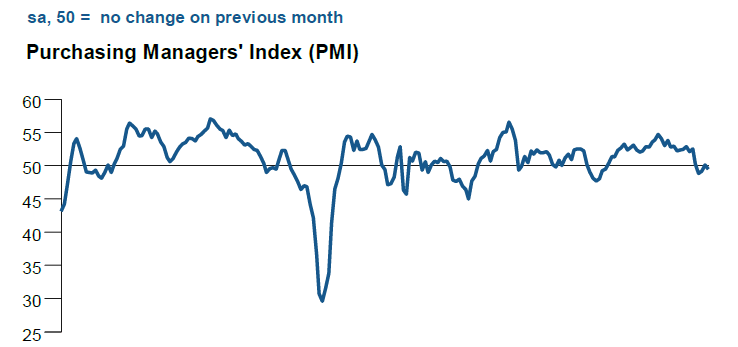
Commenting on the Japanese Manufacturing PMI survey data, Joe Hayes, Economist at IHS Markit, which compiles the survey, said:
"Following some tentative signs that the downturn in Japan's manufacturing sector had softened in April, flash data for May revealed these were short-lived, as output and export orders fell at stronger rates. The re-escalation of US-China trade frictions has heightened concern among Japanese goods producers. Underlying growth weakness across much of Asia led to struggling exports, which fell at the sharpest rate in four months. Difficulties on the international front merely add to uncertainties domestically, with upcoming upper house elections in July, and the impending sales tax hike later this year. Subsequently, sentiment turned negative in May for the first time in six-and-a-half years."
FOMC minutes show no urgency to cut interest rate
Dollar is steady after minutes of May 1 FOMC meeting showed that Fed is in no rush to move interest rates, up or down. The minutes noted that "members observed that a patient approach...would likely remain appropriate for some time". The tone regarding the economy was also upbeat, due to upside surprise in Q1 growth. GDP was forecast to "expand at a rate above the staff's estimate of potential output growth in 2019 and 2020 and then slow to a pace below potential output growth in 2021". Recent weak inflation was also viewed by many participants "as likely to be transitory."
However, firstly, there was increasing concerns over persistence of low inflation. "Several participants commented that if inflation did not show signs of moving up over coming quarters, there was a risk that inflation expectations could become anchored at levels below those consistent with the committee's symmetric 2% objective.'' Secondly, the meeting was held before current round of escalation in US-China trade war. It is possible that the Fed would turn more cautious over the economic outlook at the June meeting, when the members take into account the effects of recent re-escalation of US-China trade war.
For now, comments from Fed officials are generally inline with the minutes. But as more data come in, upcoming rhetorics leading to June FOMC meeting would reveal if there would be a shift in the board.
Suggested readings on FOMC minutes:
Brexit Monitor: End Of May
Key takeaways
- Brexit has returned to the headlines, as Theresa May's premiership is coming to an end and cross-party talks have broken down.
- A new (pro-Brexit) Prime Minister would not change the arithmetic in the House of Commons. It is difficult to predict what is going to happen, especially looking beyond the near term.
- Our base case is that a further Brexit extension beyond 31 October may be needed given the new Prime Minister will need time to settle but this is not a highconviction call.
- The GBP has weakened, which is fair given the uncertainty and that the likelihood of some of the GBP negative scenarios (e.g. no-deal Brexit) has risen.
- Near term, we do not expect a convergence towards one of the many Brexit outcomes and, hence, we expect very limited further weakness in the GBP. Rather, from the current level, small changes in the perception of the possibility of a softer Brexit could cause a non-linear reaction in favour of GBP strength.
New Prime Minister soon, same arithmetic
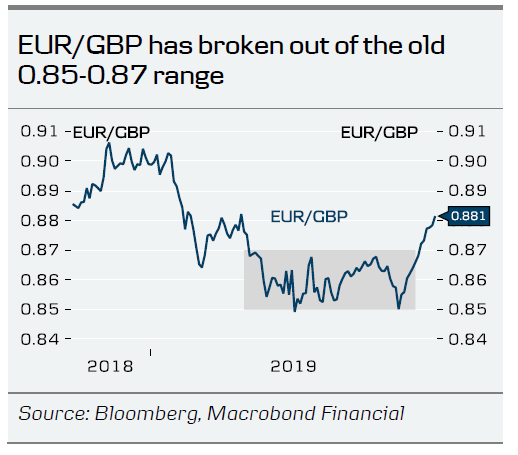
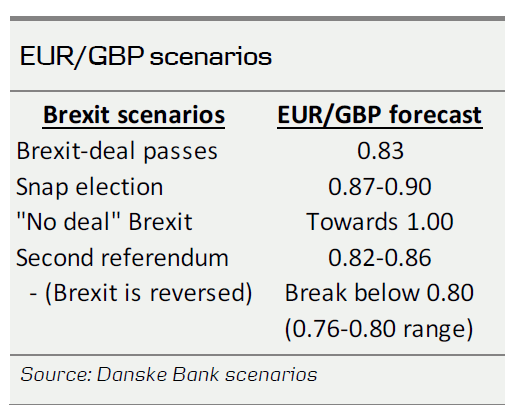
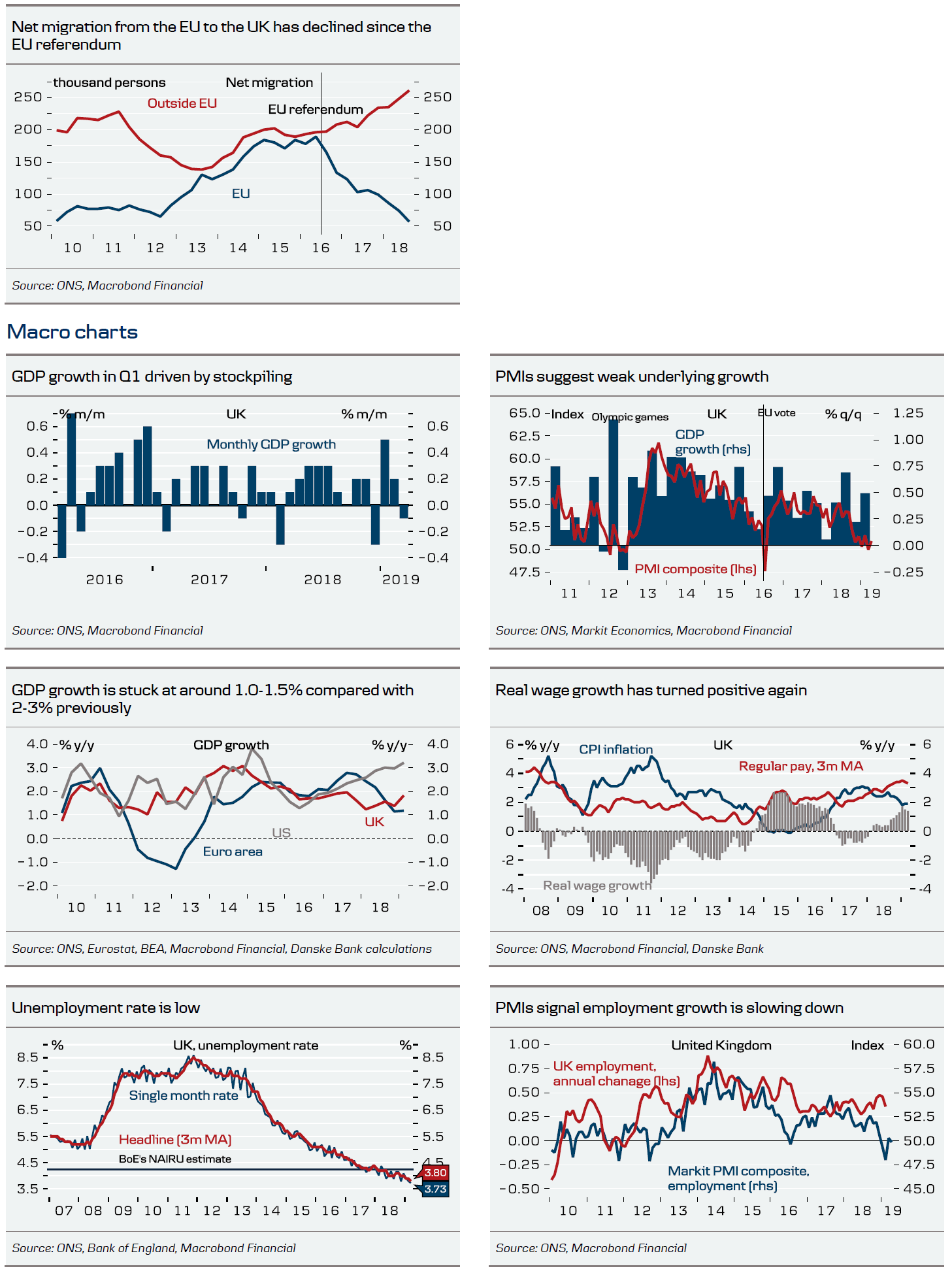
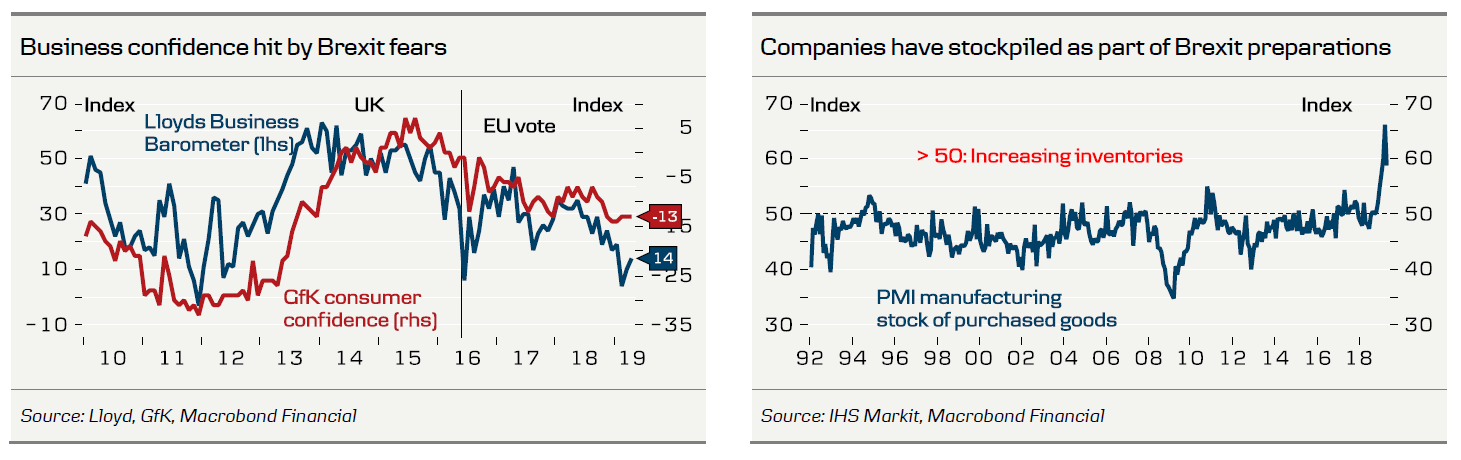
It feels like a long time since April, when the Brexit deadline was delayed by six months to 31 October. Back then we argued that markets would start to focus on other things again, as the imminent fear of the UK crashing out would diminish and the cross-party talks would be unfruitful. Both predictions were right at the time but now Brexit is back in the spotlight, as Theresa May's premiership is coming to an end. In that sense, we consider the recent GBP weakness is justified (EUR/GBP has broken the old 0.85-0.87 range and is now trading at 0.88).
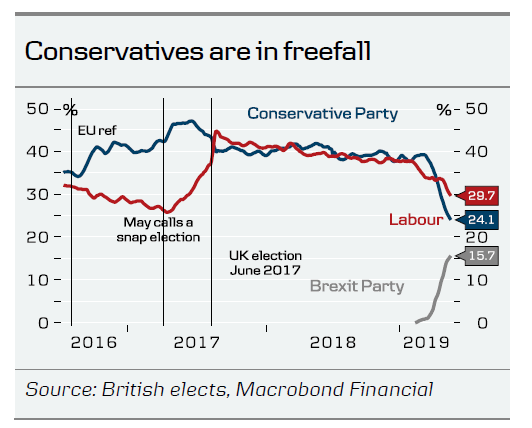
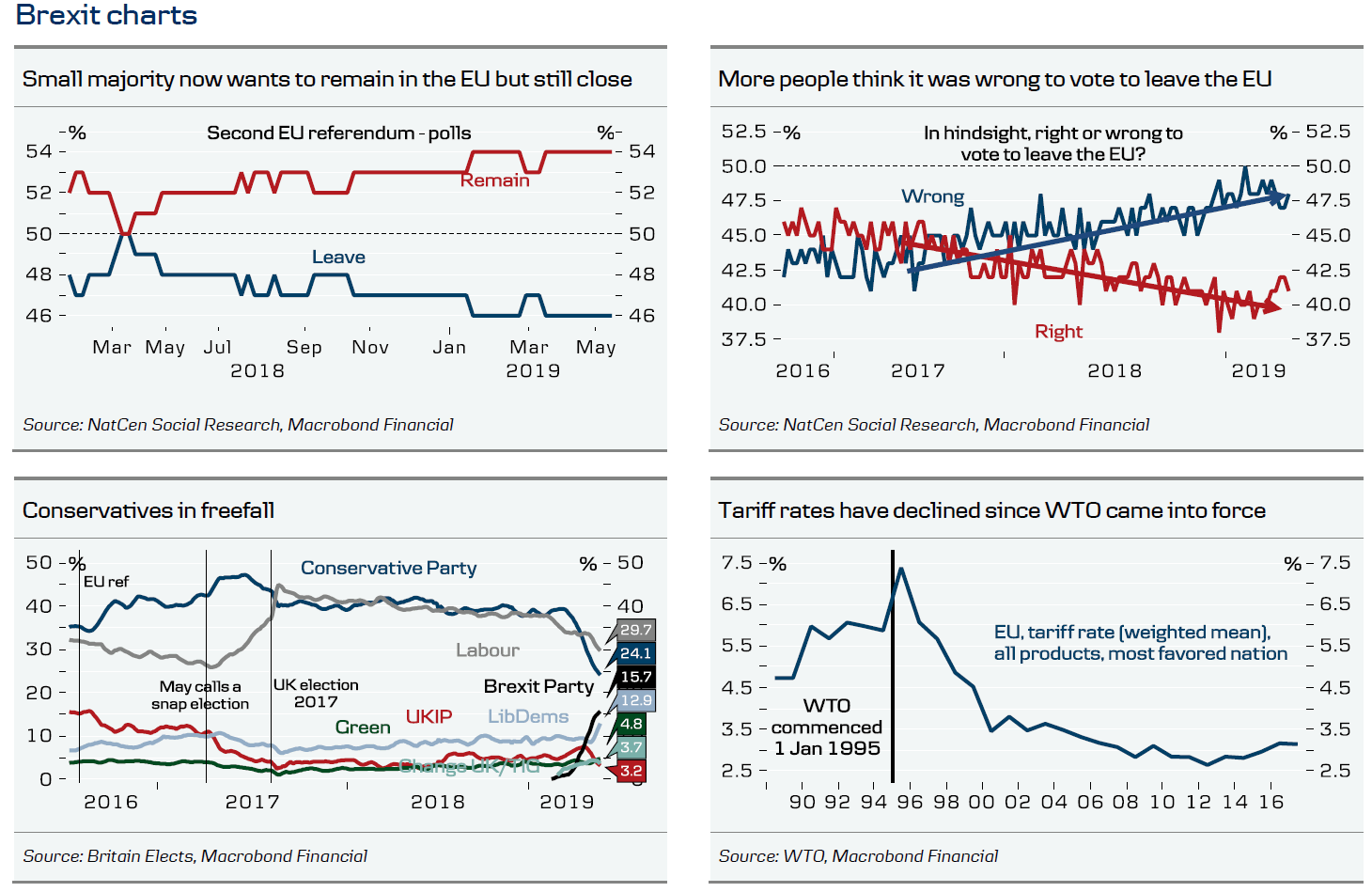
As we argued in April, a bad local election (held on 2 May) and/or bad European elections (voting is today) could be the catalyst for the Conservatives to force out Prime Minister Theresa May. This is very much what is happening right now, after the Conservatives suffered a heavy defeat in the local elections, losing more than 1,300 seats. Polls show that The Conservative Party may come in as number five in today's European Elections and one YouGov poll shows the Conservatives may get as few as 7% of the votes cast.
We do not have much faith in Prime Minister Theresa May's fourth attempt to get her deal through Parliament and it is not unlikely it will be pulled to avoid another humiliating defeat for The Conservative Party.
Instead, the uncertainty is what happens after Theresa May. Near term, she is likely to stay as a caretaker Prime Minister until the party finds a new leader. The process of finding a new party leader could happen before the UK parliamentary summer recess but, in our view, it is likely that a new leader will not be found before September
The problem for the future new Prime Minister is that the arithmetic in the House of Commons will be unchanged. The main headache has been, and still is, that there is no majority for anything and party loyalty/discipline is low. A more pro-Brexit Conservative leader would probably increase the chance of a no-deal scenario but the small majority in the House of Commons is likely continue to do as much as it can to avoid this. One attempt could be to make it illegal for the Prime Minister to pursue a no-deal Brexit. Another could be for the moderate Conservatives to join forces with the opposition to call for a general election.
A general election could solve the deadlock but the Conservatives would risk losing power to Labour or The Brexit Party (the Conservatives are in freefall [see chart on the previous page], having lost more than 15pp support in two months). A new Conservative party leader also risks splitting the party in two if he/she moves the party in a more pro- Brexit direction, complicating things further. Near term, we do not expect a convergence towards one of the many Brexit outcomes and, hence, expect very limited further weakness in the GBP.
If we are right that the party does not find a new leader until September and, given the party conference season takes place in September/October, it does not leave much time before the new cliff-edge date of 31 October. In our view, this means there is still a high probability that the deadline will be pushed somewhat further out, so the new Prime Minister can settle (potentially giving the UK time to hold a general election if needed). The problem is also that the EU is probably not going to change its current stance that the only way to leave the EU in an orderly way is to pass the Withdrawal Agreement.
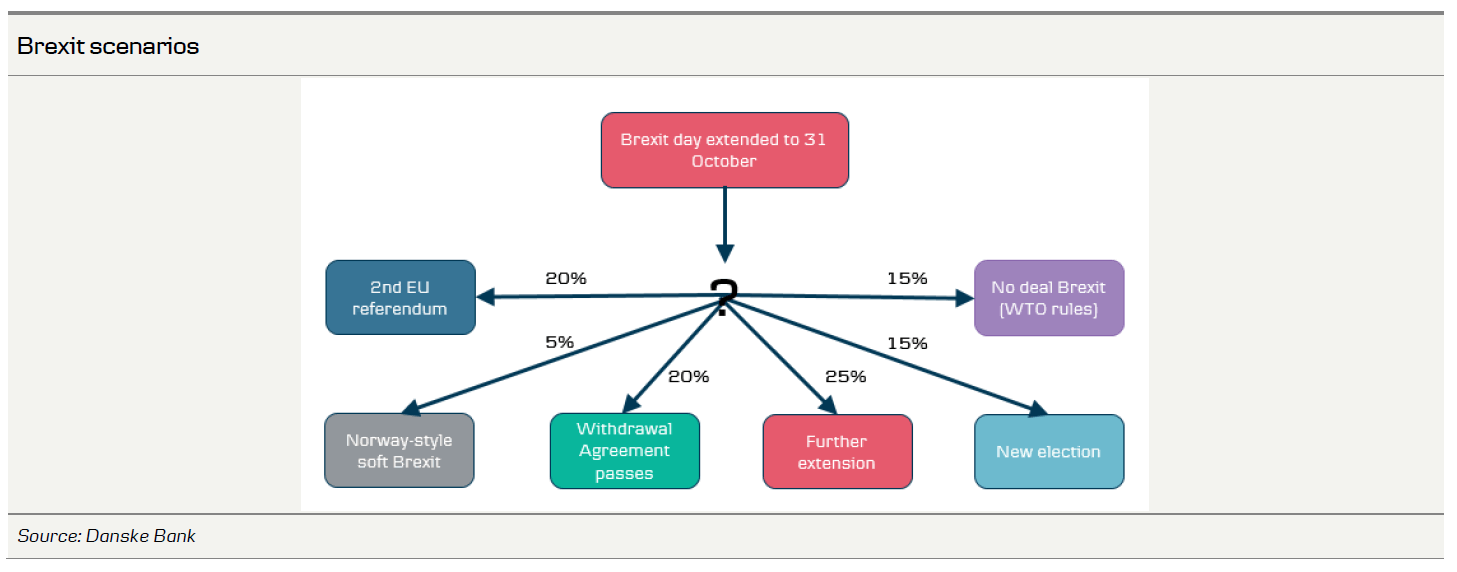
Looking at the endgame, uncertainty remains very high right now and, as we highlighted in April, it is difficult to predict what will happen. Therefore, we are still more or less happy with our old ‘game tree', although the likelihood of no deal has probably increased.
Brexit crisis deepens as Leadsom resigns on second referendum
Brexit crisis in UK deepened further after a key Cabinet Minister resigned in opposition to Prime Minister Theresa May's inclusion of a second referendum in the new Brexit plan.
Andrea Leadsom Leader of the House of Commons, said "I no longer believe that our approach will deliver on the referendum result". And, "I do not believe that we will be a truly sovereign United Kingdom through the deal that is now proposed".
Leadsom went further and said "I have always maintained that a second referendum would be dangerously divisive and I do not support the government willingly facilitating such a concession."
May's spokesman just praised Leadsom and expressed disappointment at her decision, but added: "The prime minister remains focused on delivering the Brexit people voted for."
There is practically no chance for May to get her Brexit deal through the Commons. The question now is who will take her place and lead Brexit after she steps down as promised. Sterling remains the weakest one for the week as markets are pricing in the chance of a pro-Brexit hardliner leading UK to a no-deal Brexit.