

Sample Category Title
Market Morning Briefing: Euro Is Also Slowly Inching Towards 1.11
STOCKS
Lack of fresh news about any further developments on the US-China trade war front keeps the sentiment uncertain. As such the global equities continue to remain subdued and also vulnerable for a fresh fall. The outcome of the election polls will drive the Indian equities today. Early lead numbers favors a positive open for the indices. But, we have to see how the Sensex and Nifty settles down for the week after the results.
Dow (25,776.61, -100.72, -0.39%) seems to lack momentum. This indicates that the downtrend is intact and a fall to 25000 is likely. Key resistances are at 26000 and 26250.
DAX (12,168.74 +25.27 (+0.21%) looks unclear. It has equal chances for either a rise to 12300 or fall to 12000 from current levels. However, while it trades above 12000 the broader picture is bullish to test 12400. A break below 12000 will prove our view wrong.
Nikkei (21105.48, -177.89, -0.84%) has failed to sustain above 21250. The outlook is bearish to test 21000 and 20850
Contrary to our expectation for a rise to 2950, Shanghai (2859.50, -32.10, -1.11%) has come down sharply. It looks vulnerable to break 2840 and fall to 2800.
Sensex (39110.21, +140.41, +0.36%) and Nifty (11737.90, +28.80, +0.25%) could remain volatile. We expect a broad range of 11600-11900 (Nifty) and 38500-39500 (Sensex). We would like to remain on the sidelines to see how the market closes after the poll results.
COMMODITIES
Gold and Silver remains stable within their overall downtrend. Sell-off in Copper has intensified leaving room for more fall. Oil is bearish and has declined sharply after the US reported a sharp rise in the inventories by 4.7 billion barrels.
Gold (1273) remains stable above 1270. But, while below 1280 the outlook is bearish to test 1265.
Silver (14.41) continues to consolidate around 14.40 within its overall downtrend. As we have been mentioning over the last few days, a corrective bounce to 14.6 is possible before we see a fresh fall to 14.
Copper (2.66) has tumbled much beyond our expected level of 2.68. The outlook is bearish to target 2.60 now. However, an intermediate bounce 2.70 either from current levels or from 2.65-2.64 region cannot be ruled out before we see 2.60 on the downside.
Brent (70.58) has declined below 71.60. The key resistance at 74 has held well and keeps the broader bearish view intact. A break below 70 will accelerate the fall 68 and 66.
WTI (61.06) is bearish and can test 60 and 58.
FOREX
Dollar trades strong while Yuan, Pound and Euro could fall. Aussie and Dollar Yen are to test important support levels from where a short bounce could be expected. Rupee could strengthen today aided by fall in Brent crude and if the election results turn in favor of the ruling party in line with the current market sentiment.
Dollar Index (98.12) is trading higher as expected and could move up to test immediate resistance at 98.50. Note that 98.50 and higher at 99 are crucial resistance levels that could eventually push the index back towards 97.
Euro (1.1150) is also slowly inching towards 1.11. While our longer term view is bearish for a fall towards 1.10, it would be important to see if there is an interim bounce from support at 1.11.
Euro-Yen (122.94) has dipped from levels above 123 contrary to our expectation of a rise towards 124 or higher. The currency pair could trade above 122 for some time before eventually rising higher. Our medium term view remains bullish towards 124+ levels while 122 holds.
Dollar Yen (110.27) has been falling since the last 2-sessions after testing 110.68 on the upside. The fall could be limited to 110.0 on the downside before again moving up towards 110.50-111.00. While above 110.50, there could be scope of rising towards 112 in the longer run.
Aussie (0.6875) is trading just above immediate support levels as seen on the 3-day candles. Downside could be limited to 0.6850 which if breaks could make Aussie vulnerable to a further fall towards 0.67. For now, we may look for 0.6850 to hold and produce a decent bounce back towards 0.6950 and higher. It would be important to see if Copper manages to bounce from immediate support at 2.66 that could help Aussie also to rise a bit from current levels. (refer commodities section for Copper)
Pound (1.2647) is headed to fall towards support at 1.25 in the near term. Trend remains bearish.
USDCNY (6.9131) has risen slightly and while above 6.91, there is scope of further rise towards 6.95 n the near term. View is bullish while above 6.90/91. As mentioned yesterday we could see a range trade between 6.91-6.95 for 3-4 sessions.
USDINR (69.67) could possibly open with a gap down today aided by the sharp fall in Brent crude prices (Refer commodities section for Brent view). The Election results are due today and could keep the markets on the move through the session. Our expected resistance near 69.80 is holding well for now and could keep the pair within 69.80-69.40/30 during the day. A break below 69.40/30 would increase the pace of fall towards 69.25/00, our preferred view for the medium term (would gain more weightage if the ruling party leads).
INTEREST RATES
The US yields are also down sharply post the FED minutes of the 1-2nd May released yesterday. The 30Yr (2.80%), 10Yr (2.38%), 5Yr (2.18%) and 2Yr (2.22%) have fallen sharply from yesterday's levels of 2.85%, 2.40%, 2.23% and 2.26% respectively instead of testing higher levels mentioned in the yesterday's edition. While the long term downtrend remains intact, we could see some interim corrective upmoves in the next 3-4 sessions.
The Indian 10Yr GOI (7.3945%) fell below 7.40% contrary to our expectation of a rise while above 7.40%. Note that below 7.40%, there is important support at 7.30% which could produce a bounce and push the yield back towards 7.40%. Below 7.40%, we may look for a fall towards support at 7.30%.
The UK yields have fallen sharply as Pound moved below 1.26 reinforcing the near term downtrend. The 5Yr (0.74%), 10Yr (1.01%) and 20Yr (1.48%) are sharply down from 0.80%, 1.090% and 1.54% respectively contrary to our expectation of a rise mentioned yesterday. Near term looks bearish with some more room on the downside for the next 2-3 sessions before the yields start bouncing back.
The German 10Yr (-0.085%) has fallen slightly. Trade within 0% to -0.2% looks likely for the next 3-4 sessions at least.
FOMC Minutes Reinforced Patience Approach to Monetary Decision
The FOMC minutes for the meeting in May unveiled that the members remained optimistic about the economic outlook. They also viewed that soft inflation was a transitory phenomenon. These resulted in the judgment that “a patient approach” to monetary policy decision remains appropriate and the policy rate should stay unchanged “for some time”. Note, however, that the meeting, held on May 1, predated Donald Trump’s announcement to raise tariff (to 25%) on US$200B of Chinese exports. It is possible that the Fed would turn more cautious over the economic outlook at the June meeting, when the members take into account the effects of recent re-escalation of US-China trade war.
Recall that, in the policy statement, the Fed delivered a slightly upbeat tone on economic developments due to upside surprise in first quarter growth and activity data. This was consistent with the upgrades in staff’s projections. As affirmed in the minutes, the upward revision in medium-term GDP growth “primarily reflecting a lower assumed path for interest rates, a slightly higher trajectory for equity prices, and somewhat less appreciation of the broad real dollar”. GDP was forecast to “expand at a rate above the staff's estimate of potential output growth in 2019 and 2020 and then slow to a pace below potential output growth in 2021”.
While the majority judged that low inflation was driven by temporary factors, some of them raised concerns about the increasing downside risks. The members generally viewed that recent weak inflation was “at least” partly attributed to “idiosyncratic factors that seemed likely to have only transitory effects on inflation”. These factors include “unusually sharp declines in the prices of apparel and of portfolio management services”. While members continued to expect that inflation would “most likely” stay near the +2% target, “some” were concerned about the increasing downside risks to inflation. Meanwhile, “some expressed concerns that long-term inflation expectations could be below levels consistent with the Committee's +2% target or at risk of falling below that level”. The Fed described the job market as “tight” and remained confident that the unemployment rate would “decline a little further below the staff's estimate of its longer-run natural rate and to bottom out in late 2020”.
Against the backdrop of “moderate economic growth and muted inflation pressures”, there was broad agreement to leave the monetary policy unchanged for now. As the minutes suggested, “participants generally agreed that a patient approach to determining future adjustments to the target range for the federal funds rate remained appropriate”. The patience stance signaled that the Fed would adopt a wait- and- see approach on its future monetary policy decision which would be highly date-dependent.
(FED) Minutes of the Federal Open Market Committee May 1, 2019
A joint meeting of the Federal Open Market Committee and the Board of Governors was held in the offices of the Board of Governors of the Federal Reserve System in Washington, D.C., on Tuesday, April 30, 2019, at 10:00 a.m. and continued on Wednesday, May 1, 2019, at 9:00 a.m.1
PRESENT:
Jerome H. Powell, Chair
John C. Williams, Vice Chair
Michelle W. Bowman
Lael Brainard
James Bullard
Richard H. Clarida
Charles L. Evans
Esther L. George
Randal K. Quarles
Eric Rosengren
Patrick Harker, Robert S. Kaplan, Neel Kashkari, Loretta J. Mester, and Michael Strine, Alternate Members of the Federal Open Market Committee
Thomas I. Barkin, Raphael W. Bostic, and Mary C. Daly, Presidents of the Federal Reserve Banks of Richmond, Atlanta, and San Francisco, respectively
James A. Clouse, Secretary
Matthew M. Luecke, Deputy Secretary
David W. Skidmore, Assistant Secretary
Michelle A. Smith, Assistant Secretary
Mark E. Van Der Weide, General Counsel
Michael Held, Deputy General Counsel
Steven B. Kamin, Economist
Thomas Laubach, Economist
Stacey Tevlin, Economist
Rochelle M. Edge, Eric M. Engen, Anna Paulson, Geoffrey Tootell, William Wascher, Jonathan L. Willis, and Beth Anne Wilson, Associate Economists
Simon Potter, Manager, System Open Market Account
Lorie K. Logan, Deputy Manager, System Open Market Account
Ann E. Misback, Secretary, Office of the Secretary, Board of Governors
Matthew J. Eichner,2 Director, Division of Reserve Bank Operations and Payment Systems, Board of Governors; Michael S. Gibson, Director, Division of Supervision and Regulation, Board of Governors; Andreas Lehnert, Director, Division of Financial Stability, Board of Governors
Michael T. Kiley, Deputy Director, Division of Financial Stability, Board of Governors; Trevor A. Reeve, Deputy Director, Division of Monetary Affairs, Board of Governors
Jon Faust, Senior Special Adviser to the Chair, Office of Board Members, Board of Governors
Antulio N. Bomfim, Special Adviser to the Chair, Office of Board Members, Board of Governors
Brian M. Doyle,3 Wendy E. Dunn, Ellen E. Meade, and John M. Roberts, Special Advisers to the Board, Office of Board Members, Board of Governors
Linda Robertson, Assistant to the Board, Office of Board Members, Board of Governors
Shaghil Ahmed and Christopher J. Erceg,4 Senior Associate Directors, Division of International Finance, Board of Governors; William F. Bassett, Senior Associate Director, Division of Financial Stability, Board of Governors; Joshua Gallin and David E. Lebow, Senior Associate Directors, Division of Research and Statistics, Board of Governors
Robert J. Tetlow, Senior Adviser, Division of Monetary Affairs, Board of Governors
Marnie Gillis DeBoer, Associate Director, Division of Monetary Affairs, Board of Governors; John J. Stevens, Associate Director, Division of Research and Statistics, Board of Governors
Jeffrey D. Walker,2 Deputy Associate Director, Division of Reserve Bank Operations and Payment Systems, Board of Governors
Eric C. Engstrom, Deputy Associate Director, Division of Monetary Affairs, and Adviser, Division of Research and Statistics, Board of Governors
Glenn Follette, Assistant Director, Division of Research and Statistics, Board of Governors; Laura Lipscomb2and Zeynep Senyuz,2 Assistant Directors, Division of Monetary Affairs, Board of Governors
Dana L. Burnett, Michele Cavallo, and Matthew Malloy,2 Section Chiefs, Division of Monetary Affairs, Board of Governors
Penelope A. Beattie,5 Assistant to the Secretary, Office of the Secretary, Board of Governors
David H. Small, Project Manager, Division of Monetary Affairs, Board of Governors
Juan M. Londono, Principal Economist, Division of International Finance, Board of Governors; Camelia Minoiu and Bernd Schlusche, Principal Economists, Division of Monetary Affairs, Board of Governors
Brian J. Bonis,2 Lead Financial Institution and Policy Analyst, Division of Monetary Affairs, Board of Governors
Randall A. Williams, Senior Information Manager, Division of Monetary Affairs, Board of Governors
James M. Trevino,2 Senior Technology Analyst, Division of Monetary Affairs, Board of Governors
Ron Feldman, First Vice President, Federal Reserve Bank of Minneapolis
Kartik B. Athreya, Michael Dotsey, Sylvain Leduc, and Ellis W. Tallman, Executive Vice Presidents, Federal Reserve Banks of Richmond, Philadelphia, San Francisco, and Cleveland, respectively
Evan F. Koenig, Antoine Martin,2 Samuel Schulhofer-Wohl, Mark L.J. Wright, and Nathaniel Wuerffel,2 Senior Vice Presidents, Federal Reserve Banks of Dallas, New York, Chicago, Minneapolis, and New York, respectively
David C. Wheelock, Group Vice President, Federal Reserve Bank of St. Louis
Patricia Zobel,2 Vice President, Federal Reserve Bank of New York
Mary Amiti and William E. Riordan,2 Assistant Vice Presidents, Federal Reserve Banks of New York and New York, respectively
John Robertson, Research Economist and Senior Advisor, Federal Reserve Bank of Atlanta
Justin Meyer,2 Markets Manager, Federal Reserve Bank of New York
Selection of Committee Officer
By unanimous vote, the Committee selected Anna Paulson to serve as Associate Economist, effective April 30, 2019, until the selection of her successor at the first regularly scheduled meeting of the Committee in 2020.
Balance Sheet Normalization
Participants resumed their discussion of issues related to balance sheet normalization with a focus on the long-run maturity composition of the System Open Market Account (SOMA) portfolio. The staff presented two illustrative scenarios as a way of highlighting a range of implications of different long-run target portfolio compositions. In the first scenario, the maturity composition of the U.S. Treasury securities in the target portfolio was similar to that of the universe of currently outstanding U.S. Treasury securities (a "proportional" portfolio). In the second, the target portfolio contained only shorter-term securities with maturities of three years or less (a "shorter maturity" portfolio). The staff provided estimates of the capacity that the Committee would have under each scenario to provide economic stimulus through a maturity extension program (MEP). The staff also provided estimates of the extent to which term premiums embedded in longer-term Treasury yields might be affected under the two different scenarios. Based on the staff's standard modeling framework, all else equal, a move to the illustrative shorter maturity portfolio would put significant upward pressure on term premiums and imply that the path of the federal funds rate would need to be correspondingly lower to achieve the same macroeconomic outcomes as in the baseline outlook. However, the staff noted the uncertainties inherent in the analysis, including the difficulties in estimating the effects of changes in SOMA holdings on longer-term interest rates and the economy more generally.
The staff presentation also considered illustrative gradual and accelerated transition paths to each long-run target portfolio. Under the illustrative "gradual" transition, reinvestments of maturing Treasury holdings, principal payments on agency mortgage-backed securities (MBS), and purchases to accommodate growth in Federal Reserve liabilities would be directed to Treasury securities with maturities in the long-run target portfolio. Under the illustrative "accelerated" transition, the reinvestment of principal payments on agency MBS and purchases to accommodate growth in Federal Reserve liabilities would be directed to Treasury bills until the weighted average maturity (WAM) of the SOMA portfolio reached the WAM associated with the target portfolio. Depending on the combination of long-run target composition and the transition plan for arriving at that composition, the staff reported that, in the illustrative scenarios, it could take from 5 years to more than 15 years for the WAM of the SOMA portfolio to reach its long-run level.
In its Statement Regarding Monetary Policy Implementation and Balance Sheet Normalization, the Committee noted that it is prepared to adjust the size and composition of the balance sheet to achieve its macroeconomic objectives in a scenario in which the federal funds rate is constrained by the effective lower bound. Against this backdrop, participants discussed the benefits and costs of alternative long-run target portfolio compositions in supporting the use of balance sheet policies in such scenarios.
In their discussion of a shorter maturity portfolio, many participants noted the advantage of increased capacity for the Federal Reserve to conduct an MEP, which could be helpful in providing policy accommodation in a future economic downturn given the secular decline in neutral real interest rates and the associated reduced scope for lowering the federal funds rate in response to negative economic shocks. Several participants viewed an MEP as a useful initial option to address a future downturn in which the Committee judged that it needed to employ balance sheet actions to provide appropriate policy accommodation. Participants acknowledged the staff analysis suggesting that creating space to conduct an MEP by moving to a shorter maturity portfolio composition could boost term premiums and result in a lower path for the federal funds rate, reducing the capacity to ease financial conditions with adjustments in short-term rates. A number of participants noted, however, that the estimates of the effect of a move to a shorter-maturity portfolio composition on the long-run neutral federal funds rate are subject to substantial uncertainty and are based on a number of strong modeling assumptions. For example, estimates of term premium effects based on experience during the crisis could overstate the effects that would be associated with a gradual evolution of the composition of the SOMA portfolio. In addition, a shift in the composition of the SOMA portfolio could result in changes in the supply of securities that would tend to offset upward pressure on term premiums. Nonetheless, other participants expressed concern about the potential that a shorter maturity portfolio composition could result in a lower long-run neutral federal funds rate. Moreover, while a shorter maturity portfolio would provide substantial capacity to conduct an MEP, some participants raised questions about the effectiveness of MEPs as a policy tool relative to that of the federal funds rate or other unconventional policy tools. These participants noted that, in a situation in which it would be appropriate to employ unconventional policy tools, they likely would prefer to employ forward guidance or large-scale purchases of assets ahead of an MEP. In the view of these participants, the potential benefit of transitioning to a shorter maturity SOMA composition in terms of increased ability to conduct an MEP might not be worth the potential costs.
In their discussion of a proportional portfolio composition, participants observed that moving to this target SOMA composition would not be expected to have much effect on current staff estimates of term premiums and thus would likely not reduce the scope for lowering the target range for the federal funds rate target in response to adverse economic shocks. As a result, several participants judged the proportional target composition to be well aligned with the Committee's previous statements that changes in the target range for the federal funds rate are the primary means by which the Committee adjusts the stance of monetary policy. In addition, several participants noted that while the staff analysis suggested a proportional portfolio would not contain as much capacity to conduct an MEP as a shorter maturity portfolio, it still would contain meaningful capacity along these lines. Some participants noted that a proportional portfolio would also help maintain the traditional separation between the Federal Reserve's decisions regarding the composition of the SOMA portfolio and the maturity composition of Treasury debt held by the private sector. However, a number of participants judged that it would be desirable to structure the SOMA portfolio in a way that would provide more capacity to conduct an MEP than in the proportional portfolio. In addition, a couple of participants noted that a shorter maturity portfolio would maintain a narrow gap between the average maturity of the assets in the SOMA portfolio and the short average maturity of the Federal Reserve's primary liabilities.
Participants also discussed the financial stability implications that could be associated with alternative long-run target portfolio compositions. A couple of participants noted that a proportional portfolio could imply a relatively flat yield curve, which could result in greater incentives for "reach for yield" behavior in the financial system. That said, a few participants noted that a shorter maturity portfolio could affect financial stability risks by increasing the incentives for the private sector to issue short-term debt. A couple of participants judged that financial market functioning might be adversely affected if the holdings in the shorter maturity portfolio accounted for too large a share of total shorter maturity Treasury securities outstanding.
In discussing the transition to the desired long-run SOMA portfolio composition, several participants noted that a gradual pace of transition could help avoid unwanted effects on financial conditions. However, participants observed that the gradual transition paths described in the staff presentation would take many years to complete. Against this backdrop, a few participants discussed the possibility of following some type of accelerated transition, perhaps including sales of the SOMA's residual holdings of agency MBS. In addition, several participants suggested that the Committee could communicate its plans about the SOMA portfolio composition in terms of a desired change over an intermediate horizon rather than a specific long-run target.
Several participants expressed the view that a decision regarding the long-run composition of the portfolio would not need to be made for some time, and a couple of participants highlighted the importance of making such a decision in the context of the ongoing review of the Federal Reserve's monetary policy strategies, tools, and communications practices. Some participants noted the importance of developing an effective communication plan to describe the Committee's decisions regarding the long-run target composition for the SOMA portfolio and the transition to that target composition.
Developments in Financial Markets and Open Market Operations
The manager of the SOMA reviewed developments in financial markets over the intermeeting period. In the United States, prices for equities and other risk assets reportedly were buoyed by perceptions of an accommodative stance of monetary policy, incoming economic data pointing to continued solid economic expansion, and some signs of receding downside risks to the global outlook. Treasury yields declined over the period, adding to their substantial drop since September, and the expected path of the federal funds rate as implied by futures prices shifted down as well. Market participants attributed these moves in part to FOMC communications indicating that the Committee would continue to be patient in evaluating the need for any further adjustments of the target range for the federal funds rate. Softer incoming data on inflation may also have contributed to the downward revision in the expected path of policy. Nearly all respondents on the Open Market Desk's latest surveys of primary dealers and market participants anticipated that the federal funds target range would be unchanged for the remainder of the year. In reviewing global developments, the manager noted that market prices appeared to reflect perceptions of improved economic prospects in China. However, investors reportedly remained concerned about the economic outlook for Europe and the United Kingdom.
The manager also reported on developments related to open market operations. In light of the declines in interest rates since November last year, principal payments on the Federal Reserve's holdings of agency MBS were projected to exceed the $20 billion redemption cap by a modest amount sometime this summer. As directed by the Committee, any principal payments received on agency MBS in excess of the cap would be reinvested in agency MBS. The Desk planned to conduct any such operations by purchasing uniform MBS rather than Fannie Mae and Freddie Mac securities. Consistent with the Balance Sheet Normalization Principles and Plans released following the March meeting, reinvestments of maturing Treasury securities beginning on May 2 would be based on a cap on monthly Treasury redemptions of $15 billion—down from the $30 billion monthly redemption cap that had been in place since October of last year.
The deputy manager reviewed developments in domestic money markets. Reserve balances declined by $150 billion over the intermeeting period and reached a low point of just below $1.5 trillion on April 23. The decline in reserves stemmed from a reduction in the SOMA's agency MBS and Treasury holdings of $46 billion, reducing the SOMA portfolio to $3.92 trillion, and from a shift in the composition of liabilities, predominantly related to the increase in the Treasury General Account (TGA).
The TGA was volatile during the intermeeting period. In early April, the Treasury reduced bill issuance and allowed the TGA balance to fall in anticipation of individual tax receipts. As tax receipts arrived after the tax date, the TGA rose to more than $400 billion, resulting in a sharp decline in reserves over the last two weeks of April. Against this backdrop, the distribution of rates on traded volumes in overnight unsecured markets shifted higher. The effective federal funds rate (EFFR) moved up to 2.45 percent by the end of the intermeeting period, 5 basis points above the interest on excess reserves (IOER) rate.
Several factors appeared to spur this upward pressure. Tax-related runoffs in deposits at banks reportedly led banks to increase short-term borrowing, particularly through Federal Home Loan Bank (FHLB) advances and in the federal funds market. Although some banks continued to hold large quantities of reserves, other banks were operating with reserve balances closer to their lowest comfortable levels as reported in the most recent Senior Financial Officer Survey. This distribution of reserves may have contributed to somewhat more sustained upward pressure on the federal funds rate than had been experienced in recent years around tax-payment dates. In addition, rates on Treasury repurchase agreements (repo), were, in part, pushed higher by tax-related outflows from government-only money market mutual funds and a corresponding decline in repo lending by those funds. Elevated repo rates contributed to upward pressure on the federal funds rate, as FHLBs reportedly shifted some of their liquidity investments out of federal funds and into the repo market. In addition, some market participants pointed to heightened demand for federal funds at month end by some banks in connection with their efforts to meet liquidity coverage ratio requirements as contributing to upward pressure on the federal funds rate.
The deputy manager also discussed a staff proposal in which the Board would implement a 5 basis point technical adjustment to the Interest on Required Reserves (IORR) and IOER rates. The proposed action would bring these rates to 15 basis points below the top of the target range for the federal funds rate and 10 basis points above the bottom of the range and the overnight reverse repurchase agreement (ON RRP) offer rate. As with the previous technical adjustments in June and December 2018, the proposed adjustment was intended to foster trading in the federal funds market well within the target range established by the FOMC.
A technical adjustment would reduce the spread between the IOER rate and the ON RRP offering rate to 10 basis points, the smallest since the introduction of the ON RRP facility. The staff judged that the narrower spread did not pose a significant risk of increased take-up at the ON RRP facility because repo rates had been trading well above the ON RRP offer rate for some time. However, if it became appropriate in the future to further lower the IOER rate, the staff noted that the Committee might wish to first consider where to set the ON RRP offer rate relative to the target range for the federal funds rate to mitigate this risk.
The manager concluded the briefing on financial market developments and open market operations with a review of the role of standing swap lines in supporting financial stability. He recommended that the Committee vote to renew these swap lines at this meeting following the usual annual schedule.
The Committee voted unanimously to renew the reciprocal currency arrangements with the Bank of Canada and the Bank of Mexico; these arrangements are associated with the Federal Reserve's participation in the North American Framework Agreement of 1994. In addition, the Committee voted unanimously to renew the dollar and foreign currency liquidity swap arrangements with the Bank of Canada, the Bank of England, the Bank of Japan, the European Central Bank, and the Swiss National Bank. The votes to renew the Federal Reserve's participation in these standing arrangements occur annually at the April or May FOMC meeting.
By unanimous vote, the Committee ratified the Desk's domestic transactions over the intermeeting period. There were no intervention operations in foreign currencies for the System's account during the intermeeting period.
Staff Review of the Economic Situation
The information available for the April 30–May 1 meeting indicated that labor market conditions remained strong and that real gross domestic product (GDP) increased at a solid rate in the first quarter even as household spending and business fixed investment rose more slowly in the first quarter than in the fourth quarter of last year. Consumer price inflation, as measured by the 12-month percentage change in the price index for personal consumption expenditures (PCE), declined, on net, in recent months and was somewhat below 2 percent in March. Survey-based measures of longer-run inflation expectations were little changed.
Total nonfarm payroll employment recorded a strong gain in March, and the unemployment rate held steady at 3.8 percent. The labor force participation rate declined a little in March after having risen, on balance, in the previous few months, and the employment-to-population ratio edged down. The unemployment rates for African Americans, Asians, and Hispanics in March were at or below their levels at the end of the previous economic expansion, though persistent differentials in unemployment rates across groups remained. The share of workers employed part time for economic reasons edged up in March but was still below the lows reached in late 2007. The rate of private-sector job openings in February declined slightly from the elevated level that prevailed for much of the past year, while the rate of quits was unchanged at a high level; the four-week moving average of initial claims for unemployment insurance benefits through mid-April was near historically low levels. Average hourly earnings for all employees rose 3.2 percent over the 12 months ending in March, a somewhat faster pace than a year earlier. The employment cost index for private-sector workers increased 2.8 percent over the 12 months ending in March, the same as a year earlier.
Industrial production edged down in March and for the first quarter overall. Manufacturing output declined moderately in the first quarter, primarily reflecting a decrease in the output of motor vehicles and parts; outside of motor vehicles and parts, manufacturing production was little changed. Mining output declined, on net, over the three months ending in March. Automakers' assembly schedules suggested that the production of light motor vehicles would move up in the near term, and new orders indexes from national and regional manufacturing surveys pointed to modest gains in overall factory output in the coming months. However, industry news indicated that aircraft production would slow in the second quarter.
Consumer expenditures slowed in the first quarter, but monthly data suggested some improvement toward the end of the quarter. Real PCE increased at a robust pace in March after having been unchanged in February, perhaps partly reflecting a delay in tax refunds from February into March that was due, in part, to the partial government shutdown. Similarly, sales of light motor vehicles rose sharply in March, although the average pace of sales in the first quarter was slower than in the fourth quarter. Key factors that influence consumer spending—including a low unemployment rate, ongoing gains in real labor compensation, and still elevated measures of households' net worth—were supportive of solid near-term gains in consumer expenditures. In addition, consumer sentiment, as measured by the University of Michigan Surveys of Consumers, edged down in April but was still upbeat. The staff reported preliminary analysis of the levels of and trends in average household wealth by racial and ethnic groups as measured by the Federal Reserve Board's Distributional Financial Accounts initiative.
Real residential investment declined at a slower rate in the first quarter than it did over the course of 2018. After an appreciable uptick in January, starts of new single-family homes fell in February and were little changed in March. Meanwhile, starts of multifamily units rose in February and stayed at that level in March. Building permit issuance for new single-family homes—which tends to be a good indicator of the underlying trend in construction of such homes—declined a little in February and March. Sales of both new and existing homes increased, on net, over the February-and-March period.
Growth in real private expenditures for business equipment and intellectual property slowed in the first quarter, reflecting both a slower increase in transportation equipment spending after a strong fourth-quarter gain and a decline in spending on other types of equipment outside of high tech. Nominal shipments of nondefense capital goods excluding aircraft were little changed, on net, in February and March, but they rose for the quarter as a whole. Forward-looking indicators of business equipment spending pointed to sluggish increases in the near term. Orders for nondefense capital goods excluding aircraft increased noticeably in March but were only a little above the level of shipments, and readings on business sentiment improved a bit but were still softer than last year. Real business expenditures for nonresidential structures outside of the drilling and mining sector increased somewhat in the first quarter after having declined for several quarters. Investment in drilling and mining structures moved down in the first quarter, and the number of crude oil and natural gas rigs in operation—an indicator of business spending for structures in the drilling and mining sector—declined, on net, from mid-March through late April.
Total real government purchases increased in the first quarter. Real purchases by the federal government were unchanged, as a relatively strong increase in defense purchases was offset by a decline in nondefense purchases stemming from the effects of the partial federal government shutdown. Real purchases by state and local governments increased briskly; payrolls of those governments expanded solidly in the first quarter, and nominal state and local construction spending rose markedly.
The nominal U.S. international trade deficit narrowed significantly in January and a touch more in February. After declining in December, the value of U.S. exports rose in January and February. However, the average dollar value of exports in the first two months of the year was only slightly above its fourth-quarter value. Imports fell in January before edging a touch higher in February, with the average of the two months declining relative to the fourth quarter. The Bureau of Economic Analysis estimated that the contribution of net exports to real GDP growth in the first quarter was about 1 percentage point.
Total U.S. consumer prices, as measured by the PCE price index, increased 1.5 percent over the 12 months ending in March. This increase was somewhat slower than a year earlier, as core PCE price inflation (which excludes changes in consumer food and energy prices) slowed to 1.6 percent, consumer food price inflation was a bit below core inflation, and consumer energy prices were little changed. The trimmed-mean measure of PCE price inflation constructed by the Federal Reserve Bank of Dallas was 2.0 percent over that 12‑month period. The consumer price index (CPI) rose 1.9 percent over the 12 months ending in March, while core CPI inflation was 2.0 percent. Recent readings on survey-based measures of longer-run inflation expectations—including those from the Michigan survey, the Survey of Professional Forecasters, and the Desk's Survey of Primary Dealers and Survey of Market Participants—were little changed.
Foreign economic growth in the first quarter was mixed. Among the emerging market economies (EMEs), real GDP contracted in South Korea and Mexico, but activity in China strengthened, supported by tax cuts and the easing of credit conditions. In the advanced foreign economies, economic indicators were downbeat in Japan but elsewhere pointed to some improvement from a weak fourth quarter; GDP growth rebounded in the euro area and also appeared to pick up in Canada and the United Kingdom. Foreign inflation slowed further early this year, partly reflecting lower retail energy prices.
Staff Review of the Financial Situation
Investor sentiment continued to improve over the intermeeting period. Broad equity price indexes rose notably and corporate bond spreads narrowed amid a decline in market volatility, and financing conditions for businesses and households also eased. Market participants cited more accommodative than expected monetary policy communications coupled with strong U.S. and Chinese data releases and positive sentiment about trade negotiations between the United States and China as factors that contributed to these developments.
Communications following the March FOMC meeting were generally viewed by investors as having a more accommodative tone than expected. The market-implied path for the federal funds rate shifted downward modestly, on net, resulting in a flat to slightly downward sloping expected path of the policy rate over the next few FOMC meetings. Market participants assigned greater probability to a lower target range of the federal funds rate than to a higher one beyond the next few meetings.
Yields on nominal Treasury securities declined modestly, on net, during the intermeeting period. Investors cited larger-than-expected downward revisions in FOMC participants' assessments of the future path of the policy rate in the Summary of Economic Projections, recent communications suggesting a patient approach to monetary policy, and weaker-than-expected euro-area data releases early in the period among factors that contributed to this decrease. These factors reportedly outweighed stronger-than-expected economic data releases for the United States and China and optimism related to trade negotiations between the two countries later in the period. Measures of inflation compensation based on Treasury Inflation Protected Securities were changed little, on net, and remained below their early fall 2018 levels.
Major U.S. equity price indexes increased over the intermeeting period, with the S&P 500 equity index returning to the levels it reached before its decline in the last quarter of 2018. Following the March FOMC meeting, bank stock prices declined, reportedly on concerns about the potential effects of a flat or inverted yield curve on bank profits; bank stocks subsequently retraced this decline partly in response to strong first-quarter earnings at some of the largest U.S. banks, ending the period a bit higher, on net. Option-implied volatility on the S&P 500—the VIX—decreased to a low level last seen in September 2018. Yields on corporate bonds continued to decline and spreads over yields of comparable-maturity Treasury securities narrowed.
Conditions in short-term funding markets remained stable during the intermeeting period. The EFFR rose to 5 basis points above the IOER rate after the federal income tax deadline on April 15. While a similar dynamic occurred around previous tax dates, the magnitude of the change was larger than in previous years. Spreads on commercial paper and negotiable certificates of deposits changed little across the maturity spectrum.
Global sovereign yields declined along with U.S. Treasury yields following the March FOMC meeting. Foreign equity prices increased, on balance, amid optimism around trade negotiations between the United States and China, stronger-than-expected Chinese data, and accommodative communications from some foreign central banks. Pronounced political and policy uncertainties led to a significant tightening of financial conditions in Turkey, Argentina, and, to a lesser extent, Brazil, but spillovers to other EMEs were limited, and EME credit spreads were generally little changed on net.
The broad dollar index increased modestly, supported by the strength of U.S. economic data relative to foreign data and the accommodative tone from foreign central banks. The British pound declined over the intermeeting period amid protracted discussions ahead of the original Brexit deadline, which was extended to October 31.
Financing conditions for nonfinancial businesses remained generally accommodative during the intermeeting period. Gross issuance of corporate bonds was strong against a backdrop of narrower corporate spreads and improved risk sentiment. Issuance of institutional leveraged loans increased, but refinancing volumes were low and loans spreads remained somewhat elevated. Respondents to the April 2019 Senior Loan Officer Opinion Survey on Bank Lending Practices (SLOOS) reported easing some key terms for commercial and industrial (C&I) loans to large and middle-market firms. For instance, banks reported narrowing loan rate spreads, easing loan covenants, and increasing the maximum size and reducing the costs of credit lines to these firms. C&I loans on banks' balance sheets grew at a robust pace in the first quarter of 2019. Gross equity issuance edged up later in the period and the volume of corporate bond upgrades slightly outpaced that of downgrades, suggesting that credit quality of nonfinancial corporations, on balance, improved.
Financing conditions for the commercial real estate (CRE) sector remained accommodative, and issuance of agency and non-agency commercial mortgage backed securities grew steadily. CRE loans on banks' balance sheets continued to grow in the first quarter, albeit at a slower pace than in previous quarters. Banks in the April SLOOS reported weaker demand across all major types of CRE loans. However, they also reported tightening lending standards for these loans.
Financing conditions in the residential mortgage market also remained supportive over the intermeeting period. Home mortgage rates decreased about 5 basis points, to levels comparable with 2017. Consistent with lower mortgage rates, home-purchase mortgage originations increased, reversing a yearlong decline.
Consumer credit conditions remained broadly supportive of growth in household spending, with all categories of consumer loans recording steady growth in the first quarter. According to the April SLOOS, commercial banks left lending standards for auto loans and other consumer loans unchanged in the first quarter. However, credit card interest rates rose and standards reportedly tightened for some borrowers.
The staff provided an update on its assessments of potential risks to financial stability. The staff judged asset valuation pressures in equity and corporate debt markets to have increased significantly this year, though not quite to the elevated levels that prevailed for much of last year. The staff also reported that in the leveraged loan market risk spreads had narrowed and nonprice terms had loosened further. The build-up in overall nonfinancial business debt to levels close to historical highs relative to GDP was viewed as a factor that could amplify adverse shocks to the business sector and the economy more broadly. The staff continued to judge risks associated with household-sector debt as moderate. Both the risks associated with financial leverage and the vulnerabilities related to maturity transformation were viewed as being low, as they have been for some time. The staff also noted that the sustained growth of lending by banks to nonbank financial firms represented an increase in financial interconnectedness.
Staff Economic Outlook
The projection for U.S. economic activity prepared by the staff for the April–May FOMC meeting was revised up on net. Real GDP growth was forecast to slow in the near term from its solid first-quarter pace, as sizable contributions from inventory investment and net exports were not expected to persist. The projection for real GDP growth over the medium term was revised up, primarily reflecting a lower assumed path for interest rates, a slightly higher trajectory for equity prices, and somewhat less appreciation of the broad real dollar. The staff's lower path for interest rates reflected a methodological change in how the staff sets its assumptions about the future path for the federal funds rate in its forecast. Real GDP was forecast to expand at a rate above the staff's estimate of potential output growth in 2019 and 2020 and then slow to a pace below potential output growth in 2021. The unemployment rate was projected to decline a little further below the staff's estimate of its longer-run natural rate and to bottom out in late 2020. With labor market conditions still judged to be tight, the staff continued to assume that projected employment gains would manifest in smaller-than-usual downward pressure on the unemployment rate and in larger-than-usual upward pressure on the labor force participation rate.
The staff's forecast for inflation was revised down slightly, reflecting some recent softer-than-expected readings on consumer price inflation that were not expected to persist along with the staff's assessment that the level to which inflation would tend to move in the absence of resource slack or supply shocks was a bit lower in the medium term than previously assumed. As a result, core PCE price inflation was expected to move up in the near term but nevertheless to run just below 2 percent over the medium term. Total PCE price inflation was forecast to run a bit below core inflation in 2020 and 2021, reflecting projected declines in energy prices.
The staff viewed the uncertainty around its projections for real GDP growth, the unemployment rate, and inflation as generally similar to the average of the past 20 years. The staff also saw the risks to the forecasts for real GDP growth and the unemployment rate as roughly balanced. On the upside, household spending and business investment could expand faster than the staff projected, supported by the tax cuts enacted at the end of 2017, still strong overall labor market conditions, favorable financial conditions, and upbeat consumer sentiment. On the downside, the softening in some economic indicators since late last year could be the leading edge of a significant slowing in the pace of economic growth. Moreover, trade policies and foreign economic developments could move in directions that have significant negative effects on U.S. economic growth. Risks to the inflation projection also were seen as balanced. The upside risk that inflation could increase more than expected in an economy that was still projected to be operating notably above potential for an extended period was counterbalanced by the downside risks that recent soft data on consumer prices could persist and that longer-term inflation expectations may be lower than was assumed in the staff forecast, as well as the possibility that the dollar could appreciate if foreign economic conditions deteriorated.
Participants' Views on Current Conditions and the Economic Outlook
Participants agreed that labor markets had remained strong over the intermeeting period and that economic activity had risen at a solid rate. Job gains had been solid, on average, in recent months, and the unemployment rate had stayed low. Participants also observed that growth in household spending and business fixed investment had slowed in the first quarter. Overall inflation and inflation for items other than food and energy, both measured on a 12-month basis, had declined and were running below 2 percent. On balance, market-based measures of inflation compensation had remained low in recent months, and survey-based measures of longer-term inflation expectations were little changed.
Participants continued to view sustained expansion of economic activity, with strong labor market conditions, and inflation near the Committee's symmetric 2 percent objective as the most likely outcomes. Participants noted the unexpected strength in first-quarter GDP growth, but some observed that the composition of growth, with large contributions from inventories and net exports and more modest contributions from consumption and investment, suggested that GDP growth in the near term would likely moderate from its strong pace of last year. For this year as a whole, a number of participants mentioned that they had marked up their projections for real GDP growth, reflecting, in part, the strong first-quarter reading. Participants cited continuing strength in labor market conditions, improvements in consumer confidence and in financial conditions, or diminished downside risks both domestically and abroad, as factors likely to support solid growth over the remainder of the year. Some participants observed that, in part because of the waning impetus from fiscal policy and past removal of monetary policy accommodation, they expected real GDP growth to slow over the medium term, moving back toward their estimates of trend output growth.
In their discussion of the household sector, participants discussed recent indicators, including retail sales and light motor vehicle sales for March, which rose from relatively weak readings in some previous months. Taken together, these developments suggested that the first-quarter softness in household spending was likely to prove temporary. With the strong jobs market, rising incomes, and upbeat consumer sentiment, growth in PCE in coming months was expected to be solid. Several participants also noted that while the housing sector had been a drag on GDP growth for some time, recent data pointed to some signs of stabilization. With mortgage rates at their lowest levels in more than a year, a few participants thought that residential construction could begin to make positive contributions to GDP growth in the near term; a few others were less optimistic.
Participants noted that growth of business fixed investment had moderated in the first quarter relative to the average pace recorded last year and discussed whether this more moderate growth was likely to persist. A number of participants expressed optimism that there would be continued growth in capital expenditures this year, albeit probably at a slower pace than in 2018.Several participants observed that financial conditions and business sentiment had continued to improve, consistent with reports from business contacts in a number of Districts; however, a few others reported less buoyant business sentiment Many participants suggested that their own concerns from earlier in the year about downside risks from slowing global economic growth and the deterioration in financial conditions or similar concerns expressed by their business contacts had abated to some extent. However, a few participants noted that ongoing challenges in the agricultural sector, including those associated with trade uncertainty and low prices, had been exacerbated by severe flooding in recent weeks.
Participants observed that inflation pressures remained muted and that the most recent data on overall inflation, and inflation for items other than food and energy, had come in lower than expected. At least part of the recent softness in inflation could be attributed to idiosyncratic factors that seemed likely to have only transitory effects on inflation, including unusually sharp declines in the prices of apparel and of portfolio management services. Some research suggests that idiosyncratic factors that largely affected acylical sectors in the economy had accounted for a substantial portion of the fluctuations in inflation over the past couple of years. Consistent with the view that recent lower inflation readings could be temporary, a number of participants mentioned the trimmed mean measure of PCE price inflation, produced by the Federal Reserve Bank of Dallas, which removes the influence of unusually large changes in the prices of individual items in either direction; these participants observed that the trimmed mean measure had been stable at or close to 2 percent over recent months. Participants continued to view inflation near the Committee's symmetric 2 percent objective as the most likely outcome, but, in light of recent, softer inflation readings, some viewed the downside risks to inflation as having increased. Some participants also expressed concerns that long-term inflation expectations could be below levels consistent with the Committee's 2 percent target or at risk of falling below that level.
Participants agreed that labor market conditions remained strong. Job gains in the March employment report were solid, the unemployment rate remained low, and, while the labor force participation rate moved down a touch, it remained high relative to estimates of its underlying demographically driven, downward trend. Contacts in a number of Districts continued to report shortages of qualified workers, in some cases inducing businesses to find novel ways to attract new workers. A few participants commented that labor market conditions in their Districts were putting upward pressure on compensation levels for lower-wage jobs, although there were few reports of a broad-based pickup in wage growth. Several participants noted that business contacts expressed optimism that despite tight labor markets they would be able to find workers or would find technological solutions for labor shortage problems.
Participants commented on risks associated with their outlook for economic activity over the medium term. Some participants viewed risks to the downside for real GDP growth as having decreased, partly because prospects for a sharp slowdown in global economic growth, particularly in China and Europe, had diminished. These improvements notwithstanding, most participants observed that downside risks to the outlook for growth remain.
In discussing developments in financial markets, a number of participants noted that financial market conditions had improved following the period of stress observed over the fourth quarter of last year and that the volatility in prices and financial conditions had subsided. These factors were thought to have helped buoy consumer and business confidence or to have mitigated short-term downside risks to the real economy. More generally, the improvement in financial conditions was regarded by many participants as providing support for the outlook for economic growth and employment.
Among those participants who commented on financial stability, most highlighted recent developments related to leveraged loans and corporate bonds as well as the current high level of nonfinancial corporate indebtedness. A few participants suggested that heightened leverage and associated debt burdens could render the business sector more sensitive to economic downturns than would otherwise be the case. A couple of participants suggested that increases in bank capital in current circumstances with solid economic growth and strong profits could help support financial and macroeconomic stability over the longer run. A couple of participants observed that asset valuations in some markets appeared high, relative to fundamentals. A few participants commented on the positive role that the Board's semi-annual Financial Stability Report could play in facilitating public discussion of risks that could be present in some segments of the financial system.
In their discussion of monetary policy, participants agreed that it would be appropriate to maintain the current target range for the federal funds rate at 2-1/4 to 2-1/2 percent. Participants judged that the labor market remained strong, and that information received over the intermeeting period showed that economic activity grew at a solid rate. However, both overall inflation and inflation for items other than food and energy had declined and were running below the Committee's 2 percent objective. A number of participants observed that some of the risks and uncertainties that had surrounded their outlooks earlier in the year had moderated, including those related to the global economic outlook, Brexit, and trade negotiations. That said, these and other sources of uncertainty remained. In light of global economic and financial developments as well as muted inflation pressures, participants generally agreed that a patient approach to determining future adjustments to the target range for the federal funds rate remained appropriate. Participants noted that even if global economic and financial conditions continued to improve, a patient approach would likely remain warranted, especially in an environment of continued moderate economic growth and muted inflation pressures.
Participants discussed the potential policy implications of continued low inflation readings. Many participants viewed the recent dip in PCE inflation as likely to be transitory, and participants generally anticipated that a patient approach to policy adjustments was likely to be consistent with sustained expansion of economic activity, strong labor market conditions, and inflation near the Committee's symmetric 2 percent objective. Several participants also judged that patience in adjusting policy was consistent with the Committee's balanced approach to achieving its objectives in current circumstances in which resource utilization appeared to be high while inflation continued to run below the Committee's symmetric 2 percent objective. However, a few participants noted that if the economy evolved as they expected, the Committee would likely need to firm the stance of monetary policy to sustain the economic expansion and keep inflation at levels consistent with the Committee's objective, or that the Committee would need to be attentive to the possibility that inflation pressures could build quickly in an environment of tight resource utilization. In contrast, a few other participants observed that subdued inflation coupled with real wage gains roughly in line with productivity growth might indicate that resource utilization was not as high as the recent low readings of the unemployment rate by themselves would suggest. Several participants commented that if inflation did not show signs of moving up over coming quarters, there was a risk that inflation expectations could become anchored at levels below those consistent with the Committee's symmetric 2 percent objective—a development that could make it more difficult to achieve the 2 percent inflation objective on a sustainable basis over the longer run. Participants emphasized that their monetary policy decisions would continue to depend on their assessments of the economic outlook and risks to the outlook, as informed by a wide range of data.
Committee Policy Action
In their discussion of monetary policy for the period ahead, members judged that the information received since the Committee met in March indicated that the labor market remained strong and that economic activity had risen at a solid rate. Job gains had been solid, on average, in recent months, and the unemployment rate had remained low. Growth of household spending and business fixed investment had slowed in the first quarter. On a 12-month basis, overall inflation and inflation for items other than food and energy had declined and were running below 2 percent. On balance, market-based measures of inflation compensation had remained low in recent months, and survey-based measures of longer-term inflation expectations were little changed.
In their consideration of the economic outlook, members noted that financial conditions had improved since the turn of the year, and many uncertainties affecting the U.S. and global economic outlooks had receded, though some risks remained. Despite solid economic growth and a strong labor market, inflation pressures remained muted. Members continued to view sustained expansion of economic activity, strong labor market conditions, and inflation near the Committee's symmetric 2 percent objective as the most likely outcomes for the U.S. economy. In light of global economic and financial developments and muted inflation pressures, members concurred that the Committee could be patient as it determined what future adjustments to the target range for the federal funds rate may be appropriate to support those outcomes.
After assessing current conditions and the outlook for economic activity, the labor market, and inflation, members decided to maintain the target range for the federal funds rate at 2-1/4 to 2-1/2 percent. Members agreed that in determining the timing and size of future adjustments to the target range for the federal funds rate, the Committee would assess realized and expected economic conditions relative to the Committee's maximum-employment and symmetric 2 percent inflation objectives. They reiterated that this assessment would take into account a wide range of information, including measures of labor market conditions, indicators of inflation pressures and inflation expectations, and readings on financial and international developments. More generally, members noted that decisions regarding near-term adjustments of the stance of monetary policy would appropriately remain dependent on the evolution of the outlook as informed by incoming data.
With regard to the postmeeting statement, members agreed to remove references to a slowing in the pace of economic growth and little-changed payroll employment, consistent with stronger incoming information on these indicators. The description of growth in household spending and business fixed investment in the first quarter was revised to recognize that incoming data had confirmed earlier information that suggested these aspects of economic activity had slowed at that time. Members also agreed to revise the description of inflation to note that inflation for items other than food and energy had declined and was now running below 2 percent.
Members observed that a patient approach to determining future adjustments to the target range for the federal funds rate would likely remain appropriate for some time, especially in an environment of moderate economic growth and muted inflation pressures, even if global economic and financial conditions continued to improve.
At the conclusion of the discussion, the Committee voted to authorize and direct the Federal Reserve Bank of New York, until instructed otherwise, to execute transactions in the SOMA in accordance with the following domestic policy directive, to be released at 2:00 p.m.:
"Effective May 2, 2019, the Federal Open Market Committee directs the Desk to undertake open market operations as necessary to maintain the federal funds rate in a target range of 2-1/4 to 2-1/2 percent, including overnight reverse repurchase operations (and reverse repurchase operations with maturities of more than one day when necessary to accommodate weekend, holiday, or similar trading conventions) at an offering rate of 2.25 percent, in amounts limited only by the value of Treasury securities held outright in the System Open Market Account that are available for such operations and by a per-counterparty limit of $30 billion per day.
Effective May 2, 2019, the Committee directs the Desk to roll over at auction the amount of principal payments from the Federal Reserve's holdings of Treasury securities maturing during each calendar month that exceeds $15 billion. The Committee directs the Desk to continue reinvesting in agency mortgage-backed securities the amount of principal payments from the Federal Reserve's holdings of agency debt and agency mortgage-backed securities received during each calendar month that exceeds $20 billion. Small deviations from these amounts for operational reasons are acceptable.
The Committee also directs the Desk to engage in dollar roll and coupon swap transactions as necessary to facilitate settlement of the Federal Reserve's agency mortgage-backed securities transactions."
The vote also encompassed approval of the statement below to be released at 2:00 p.m.:
"Information received since the Federal Open Market Committee met in March indicates that the labor market remains strong and that economic activity rose at a solid rate. Job gains have been solid, on average, in recent months, and the unemployment rate has remained low. Growth of household spending and business fixed investment slowed in the first quarter. On a 12-month basis, overall inflation and inflation for items other than food and energy have declined and are running below 2 percent. On balance, market-based measures of inflation compensation have remained low in recent months, and survey-based measures of longer-term inflation expectations are little changed.
Consistent with its statutory mandate, the Committee seeks to foster maximum employment and price stability. In support of these goals, the Committee decided to maintain the target range for the federal funds rate at 2-1/4 to 2-1/2 percent. The Committee continues to view sustained expansion of economic activity, strong labor market conditions, and inflation near the Committee's symmetric 2 percent objective as the most likely outcomes. In light of global economic and financial developments and muted inflation pressures, the Committee will be patient as it determines what future adjustments to the target range for the federal funds rate may be appropriate to support these outcomes.
In determining the timing and size of future adjustments to the target range for the federal funds rate, the Committee will assess realized and expected economic conditions relative to its maximum employment objective and its symmetric 2 percent inflation objective. This assessment will take into account a wide range of information, including measures of labor market conditions, indicators of inflation pressures and inflation expectations, and readings on financial and international developments."
Voting for this action: Jerome H. Powell, John C. Williams, Michelle W. Bowman, Lael Brainard, James Bullard, Richard H. Clarida, Charles L. Evans, Esther L. George, Randal K. Quarles, and Eric Rosengren.
Voting against this action: None.
Consistent with the Committee's decision to maintain the federal funds rate in a target range of 2-1/4 to 2-1/2 percent, the Board of Governors voted unanimously to lower the interest rates on required and excess reserve balances to 2.35 percent, effective May 2, 2019. Setting the interest rate paid on required and excess reserve balances 15 basis points below the top of the target range for the federal funds rate was intended to foster trading in the federal funds market at rates well within the FOMC's target range. The Board of Governors also voted unanimously to approve establishment of the primary credit rate at the existing level of 3.00 percent, effective May 2, 2019.
Update from Subcommittee on Communications
Governor Clarida reported on the progress of the review of the Federal Reserve's strategic framework for monetary policy. Fed Listens events to hear stakeholders' views on the strategy, tools, and communications that would best enable the Federal Reserve to meet its statutory objectives of maximum employment and price stability had already taken place in two Federal Reserve Districts. Numerous additional events were planned, including a research conference scheduled for June at the Federal Reserve Bank of Chicago. Following these public activities, the Committee was on course to begin its deliberations about the strategic framework at meetings in the second half of 2019.
It was agreed that the next meeting of the Committee would be held on Tuesday–Wednesday, June 18–19, 2019. The meeting adjourned at 9:50 a.m. on May 1, 2019.
Notation Vote
By notation vote completed on April 9, 2019, the Committee unanimously approved the minutes of the Committee meeting held on March 19–20, 2019.
_______________________
James A. Clouse
Secretary
1. The Federal Open Market Committee is referenced as the "FOMC" and the "Committee" in these minutes. Return to text
2. Attended through the discussion of developments in financial markets and open market operations. Return to text
3. Attended Wednesday session only. Return to text
4. Attended opening remarks for Tuesday session only. Return to text
5. Attended Tuesday session only. Return to text
Sell May And Go Away
Sell May and go away
The old stock investing adage of “sell in May and go away” took a distinctively British turn last night, with UK Prime Minister Theresa May’s tenure on its last legs after her latest Brexit proposal was shot down in flames by all sides of the House. Her most recent bill is unlikely even to make it into Parliament. The much-beleaguered Game of Thrones writers needed to look no further than Westminster for inspiration it seems. The British pound (GBP) continued to sink, touching a four-month low at 1.2625 before staging a minor comeback to 1.2660.
With the Conservatives facing a complete wipeout in European elections today, and a hard Brexiter the leading candidate to replace Mrs May in a drawn out and convoluted leadership process, the UK is entering uncharted Brexit waters. Markets are having to reluctantly face the much higher odds of a hard Brexit, having been in denial for most of the year. Still, things aren’t all bad, despite the Brexit doom-mongers predictions, UK unemployment is at record lows, record numbers of Europeans are still coming to work there, and inflation is tracking nicely at 2%, driven by higher wages. This central bank Nirvana would probably have the Bank of England looking to hike rates if only that pesky Brexit weren’t still around.
Elsewhere, global equity markets entered into hand-wringing mode as a lack of news on US-China trade frictions this week has led to sentiment flip-flopping on a daily basis. The FOMC minutes provided no help as they clearly show the Federal Reserve is happy to be singing “patience” at the moment rather than trying to anticipate unknown unknowns and known unknowns. The Fed will react appropriately once both become known knowns. Markets could possibly take a leaf from their book.
Wall Street retreated slightly today, in contrast to yesterday, with the S&P 500 falling 0.30%, the Nasdaq dropping 0.45% and the Dow Jones easing 0.40%. The US dollar made modest gains overnight on light haven flows and no dovish insights from the FOMC Minutes. In a very low-to-no interest rate world, the US 10-year treasury yield of around 2.40% should ensure the dollar remains strong for much of 2019.
Turning to Asia, Jakarta was rocked by rioting following the official election results announcement yesterday. The Indonesian rupiah (IDR) sank to 14,525.00 against the dollar before rallying to 14,488.00 in the overnight session. Sitting in Jakarta, I can say the riots looked terrible on television but were small in scale and very localised, and the tensions will pass quickly.
Elsewhere, the Japan May Flash PMI has just been released, coming in at a disappointing 49.60 versus a consensus of 50.50. This is a rather large miss and may send some shivers through Japanese markets, which have, until now, avoided trade friction overspill.
Singapore releases inflation data at 13:00 local time (SGT) before the closely watched German GDP at 14:00 SGT.
FX
The dollar rose gently against most currencies, the exception being the Japanese yen (JPY), which benefitted from its own safe-haven flows. The most notable loser was the GBP, falling on political and thus Brexit woes. Having broken 1.2700, the technical picture looks cloudy with the market scrambling to reprice hard Brexit odds. The 1.2600 region looms as the next important support.
Regional currencies will likely follow the overnight lead and ease gently against the greenback. The IDR recovered nicely overnight, and the political worries caused by yesterday’s overblown coverage of the riots will probably fade quickly.
Equities
Asian stock markets are likely to follow Wall Street’s lead and track lower on trade-friction nerves. The Nikkei 225 is already 0.70% lower, post a poor flash PMI, and the ASX is down 0.20%.
As ever, the sentiment is vulnerable to headline flashes on trade, and we can expect this sort of flip-flopping in sentiment daily until more clarity emerges on any progress on the US-China trade front. In the bigger picture, equities may find upward momentum difficult on a consistent basis, while the trade picture and its knock-on effects remain so cloudy.
Oil
A giant build in US Crude Inventories overnight – 4.7 million barrels versus an expected drop of 600,000 barrels – torpedoed both Brent Crude and WTI below the water lines. Brent fell 2% to USD70.75 a barrel while WTI dropped a massive 3% to USD61.25 a barrel. The unexpected build-up – the second in two weeks – vindicates OPEC’s position somewhat, meaning production cuts should remain in place and the recent rally in prices is fragile.
The US is clearly pumping enough black gold to cover any typical shortfalls absent from a substantial supply disruption in the Middle East. If the trade frictions between the US and China escalate and/or drag on, the knock-on global growth will almost certainly make this equation worse.
Traders will be eyeing the USD70.00 a barrel level on Brent, but the real technical support rests at USD69.00. Technical support on WTI rests just below at USD60.50, with major support at USD60.00 a barrel. A break of USD69.00 and/or USD60.00 respectively implies a much more significant downward correction could be on the horizon.
Gold
Gold continues to be the investment that time forgot, finishing unchanged overnight at USD1,274.00 an ounce. In the face of political and economic uncertainty, gold price action continues to be underwhelming with eager sellers on any sort of rally.
The USD1,265.00 region continues as critical support with a daily close below implying a much deeper correction for the beleaguered precious metal is ahead.
Daily Markets Broadcast
Wall Street slides on trade war worries
Tuesday’s relief rally proved to be fleeting, with US indices resuming their recent slide yesterday with no deal in sight in the US-China trade negotiations. Oil prices fell as inventories increased.
IUS30USD Daily Chart
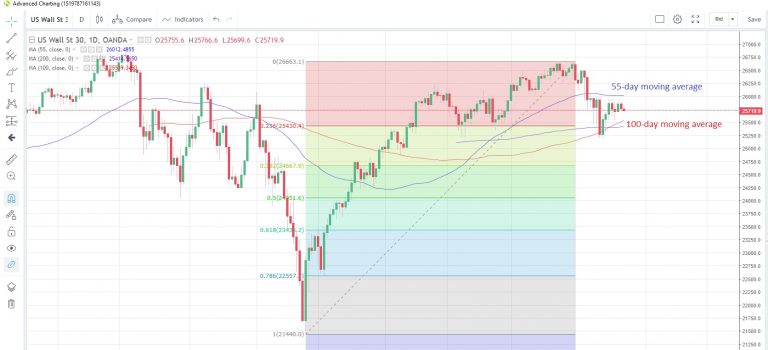
The US30 index fell yesterday amid reports that the US was considering blacklisting more Chinese companies
The index is sandwiched between 55-day moving average resistance at 26,012 and 100-day moving average support at 25,539
US new home sales are expected to fall 2.8% m/m in April, according to the latest poll of economists. There’s a slew of Fed speakers at 1700GMT including Kaplan, Daly, Bostic and Barkin.
DE30EUR Daily Chart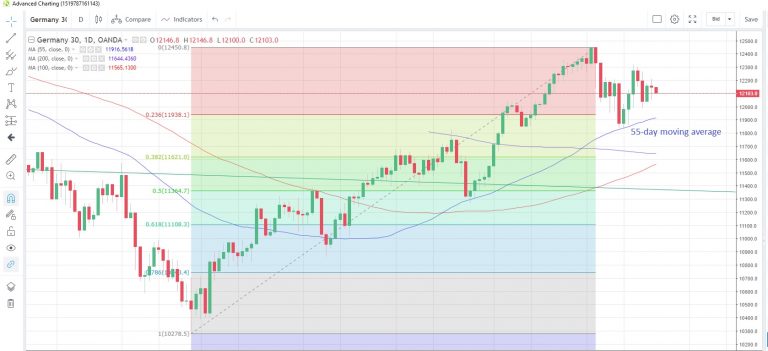
The Germany30 index edged lower yesterday but closed off the intraday lows
The 55-day moving average at 11,916 continues to support prices, as it has done on a closing basis since February 8
The Markit manufacturing PMI reading for May is expected to improve slightly to 44.8 from 44.4, but still in contraction territory. The IFO expectations index is seen edging lower to 95.0 from 95.2.
WTICOUSD Daily Chart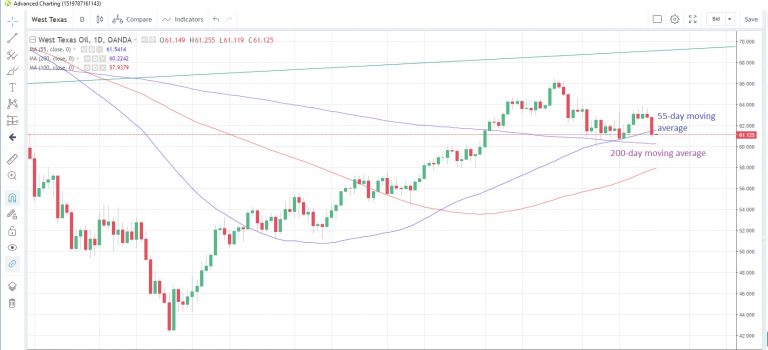
WTI prices fell the most in three weeks yesterday after weekly stockpiles data showed another increase
Prices fell to the lowest in a week, closing below the 55-day moving average at $61.45 for the first time since January 17. The 200-day moving average is at $60.22
EIA weekly crude oil stockpiles data showed an increase of 4.74 million barrels in the week to May 17, well above analysts’ forecasts of a drawdown of 600,000 barrels.
Fed Minutes Show Commitment to Patience
- The minutes from FOMC's April 30th-May 1st meeting reiterated the Committee's commitment to patient monetary policy. It noted that although uncertainty around the outlook had moderated and global economic and financial conditions continued to improve, inflationary pressures remained muted, warranting patience.
- Participants observed the near-term boost in growth might be short-lived as dissipating fiscal stimulus and past interest rate hikes weigh on activity. However, growth should remain solid due to the strong labor market, improved consumer confidence and financial conditions. It should be noted, however, that during the time of the meeting there were reports that trade negotiations between U.S. and China were nearing an end. Negotiations have since soured, with both sides now reportedly nowhere near striking a deal.
- A lengthy discussion on inflation was undertaken as participants explored the muted nature of price pressures in the economy. Some participants expressed the opinion that inflation could pick-up quickly as capacity constraints are met, while others noted that given persistently low inflation, there was a risk that inflation expectations can become anchored at levels below the two percent target.
Key Implications
- The Committee's affinity for patience was on display yet again in the FOMC minutes. Participants were clear that they would continue to watch the evolution of the data in setting monetary policy. However, the upside and downside discussion on inflation risks was a clear sign that they are not just viewing a one-track mindset for monetary policy, rather there is a case to be made for decisions in either direction.
- The participants discussion on the growth outlook has been clouded somewhat by the fast-moving, turbulent nature of the U.S. and China trade negotiations. Where participants expressed views of improving business sentiment and the reduction of uncertainty, the recent escalation in trade tensions may prompt participants to reassess their views in the next meeting.
EUR/GBP Analysis: Daily Chart Suggests Crucial Bullish Break
Key Highlights
- The Euro climbed above the 0.8700 and 0.8750 resistance levels against the British Pound.
- EUR/GBP surpassed a major bearish trend line with resistance near 0.8640 on the daily chart.
- The UK CPI increased 2.1% in April 2019 (YoY), less than the 2.2% forecast.
- The Euro Zone Manufacturing PMI in May 2019 (Prelim) could rise from 47.9 to 48.1.
EURGBP Technical Analysis
Earlier this month, EUR/GBP retested the key 0.8480 support area and later started a strong upward move. The Euro broke many hurdles and moved into a positive zone above 0.8750 against the British Pound.
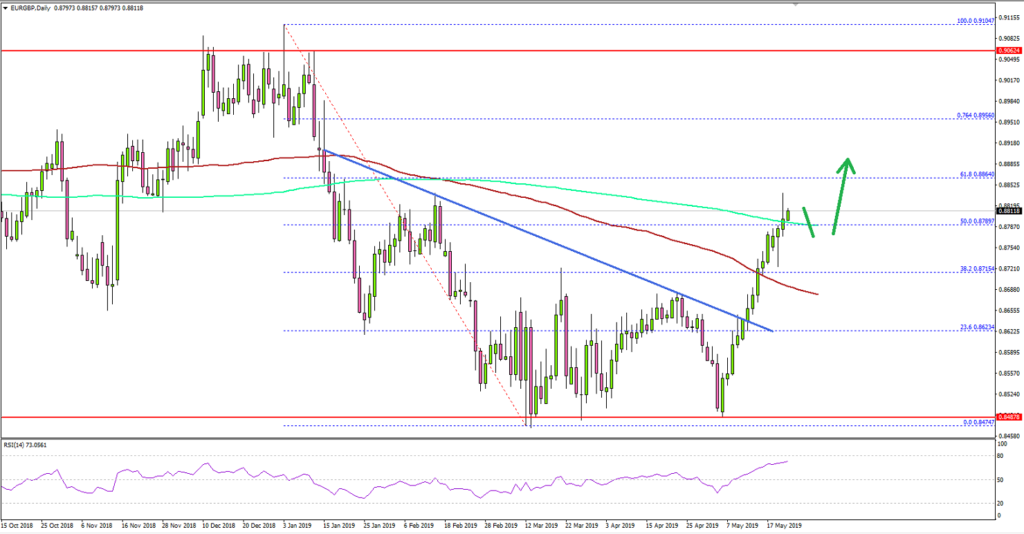
Looking at the daily chart, the pair formed more than twelve green candles from the 0.8489 swing low. During the rise, the pair broke many important resistances near 0.8600 and the 100-day simple moving average (red).
Moreover, the pair traded above a major bearish trend line with resistance near 0.8640 on the same chart. Finally, there was a break above the 50% Fib retracement level of the major drop from the 0.9104 high to 0.8474 low.
The pair is now trading above 0.8800 and the 200-day simple moving average (green). If the pair continues to move higher in the medium term, it could test the 0.8950 level (the 76.4% Fib level). Any further gains could lead the pair towards the 0.9000 resistance area.
Conversely, if EUR/GBP starts a downside correction, it could find support near 0.8750. However, the main support is near 0.8680 and the 100-day simple moving average (red).
Fundamentally, the UK Consumer Price Index for April 2019 was released by the National Statistics. The market was looking for a 2.2% rise in the CPI compared with the same month a year ago.
The actual result lower than the forecast, as the CPI increased 2.1%, but it was better than the last 1.9%. Looking at the monthly change, there was a 0.6% rise in the CPI, less than the 0.7% forecast.
The report added:
The Consumer Prices Index including owner occupiers’ housing costs (CPIH) 12-month inflation rate was 2.0% in April 2019, up from 1.8% in March 2019. Rising energy prices and air fares, which were influenced by the timing of Easter, produced the largest upward contributions to change in the rate between March and April 2019.
Overall, EUR/GBP is showing a lot of bullish signs on the daily chart and it could continue to grind higher in the medium term towards 0.8900, 0.8950 or even 0.9000, considering the recent downward pressure on GBP/USD.
Economic Releases to Watch Today
- German GDP for Q1 2019 (YoY) – Forecast 0.6%, versus 0.6% previous.
- Germany’s Manufacturing PMI for May 2019 (Preliminary) – Forecast 44.8, versus 44.4 previous.
- Germany’s Services PMI for May 2019 (Preliminary) – Forecast 55.5, versus 55.7 previous.
- Euro Zone Manufacturing PMI May 2019 (Preliminary) – Forecast 48.1, versus 47.9 previous.
- Euro Zone Services PMI for May 2019 (Preliminary) – Forecast 53.0, versus 52.8 previous.
- US Manufacturing PMI for May 2019 (Preliminary) – Forecast 52.5, versus 52.6 previous.
- US Services PMI for May 2019 (Preliminary) – Forecast 53.2, versus 53.0 previous.
- US Initial Jobless Claims – Forecast 215K, versus 212K previous.
- US New Home Sales for April 2019 (MoM) – Forecast -2.8% versus +4.5% previous.
USD/CAD Canadian Dollar Falls On Risk Aversion As Geopolitics Increase Market Anxiety
The Canadian dollar lost 0.19 percent on Wednesday. The loonie gave back the gains from Tuesday when optimism about USMCA ratification and trade goodwill made the currency an outlier of major pairs. Safe haven currencies were the big draw in the market with the JPY and the CHF rising against the US dollar, while the greenback appreciated against the rest.
The Canadian dollar was off to a good start at the beginning of the North American session gaining on its way to break below 1.3350. The better than expected retail sales data in March sparked a short lived rally as US crude weekly inventories showed a larger than expected buildup. The price of crude plummeted as rising US production, the ongoing US-China trade war and the end of the OPEC+ agreement to cut output weighed on energy prices.
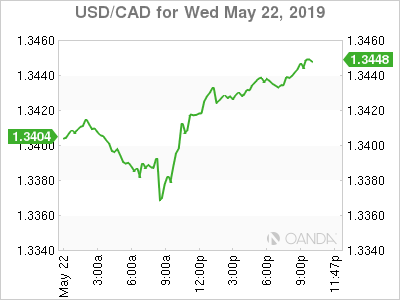
Risk aversion reduced the upside for the loonie, even as fundamentals point to a stronger currency. Wholesale sales in Canada will have to impress after European PMIs are released in the midst of the EU parliamentary elections. European growth has lacked momentum 11 years after the recession. Voters have grown disillusioned with the Union, and the market could witness a rise of eurosceptic parties.
Crude Falls After Surprise US Weekly Crude Buildup
Oil prices dropped by more than 2 percent on Wednesday after the release of the weekly US crude inventory data. A surprise buildup of 4.7 million barrels of crude and 3.7 million barrels of gasoline pushed prices down. Middle East tensions and the ongoing OPEC+ crude output cut deal have kept prices in a higher range, but higher US production keeps putting downward pressure on prices.
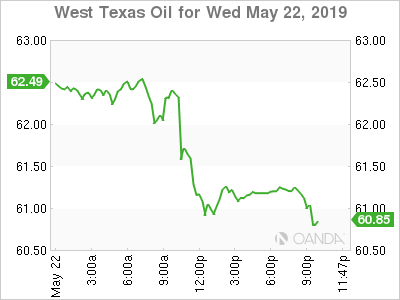
Geopolitical, weather and operational factors have reduced crude supply levels. The OPEC+ agreement has been the major factor and with the upcoming June end of the deal there is uncertainty if an extension is coming.
Russia has sent mixed signals and the effectiveness of a production output cut would be limited if it does not rejoin the group. Saudi Arabia has carried a heavy load to soak up excess supply and will steward the group form committing the same mistakes that lead to a free fall in crude prices.
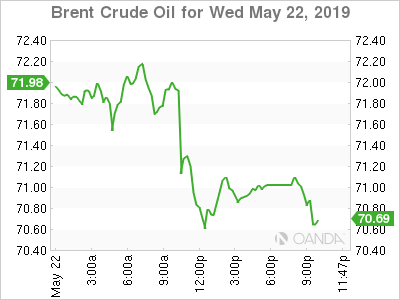
The US is impacting prices in three ways. Sanctions against Iran and Venezuela for political reasons have boosted prices as it reduced supply. US-China trade disputes have a negative effect on global growth forecast reducing energy demand going forward. The final factor has been the rising American output. While sanctions reduce supply and boost prices, lower energy demand and rising production depreciates crude as there is a higher risk of oversupply.
Trade War Concerns Keep Gold Flat as Safe Haven Appeal Rises
Gold rose 0.03 percent on Wednesday. The yellow metal is caught in a tight range as investors are anxious about the US-China trade war. Tariffs from both sides have escalated and China is not backing down to US pressure which could prolong the dispute with no date set for negotiations to reassume. US Secretary Mnuchin has said that there is no plans for him to visit Beijing, although he is looking forward to renewing talks.
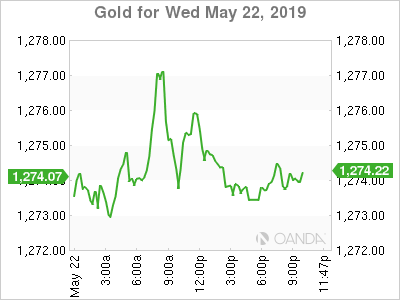
Brexit concerns rose as Prime Minister May managed to unite all UK political factions against her. Putting a second referendum on the table did not sit well with Brexiteers, but make it a condition on passing her Brexit proposal was a non-starter for Remain supporters. May’s decision to stick to her proposal could end up being the last straw that leads to her eventual downfall. The task on hand was near impossible from the start. A close Leave victory in the referendum left the historic decision with massive opposition as the perfect deal was never going to be achieved.
Gold had an afternoon revival as the Fed published the minutes from its April/May FOMC meeting. The central stressed patience and affirmed current monetary policy would remain in place for some time. The Fed has already removed all rate hikes from its 2019 calendar as per member forecasts. Rate cut probabilities keep rising, but until there is a clear deterioration of economic fundamentals the Fed will remain on the sidelines.
Rising US Inventory Adds Selling Pressure To Crude Oil
Crude oil price weakened for a third consecutive day. Besides the risk-off mode driven by intensifying US-China trade war, further increase in oil inventory has substantiated near-term bearishness in the oil market. The report from the US Energy Information Administration (EIA) shows that total crude oil and petroleum products (ex. SPR) stocks surged +14.64 mmb to 1270.26 mmb in the week ended May 17. Crude oil inventory rose +4.74 mmb to 476.78 mmb (consensus: -0.6 mmb). Inventories rose in PADD 3 and PADD 3. Meanwhile, Cushing stock added +1.27 mmb to 49.07 mmb. Utilization rate dropped -0.6% to 89.9% while crude production added +0.1M bpd to 12.2M bpd for the week. Crude oil imports fell -0.67M bpd to 6.94M bpd in the week.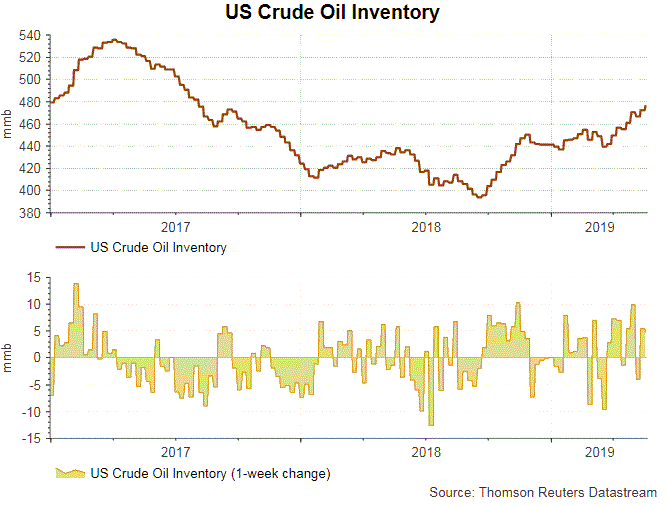
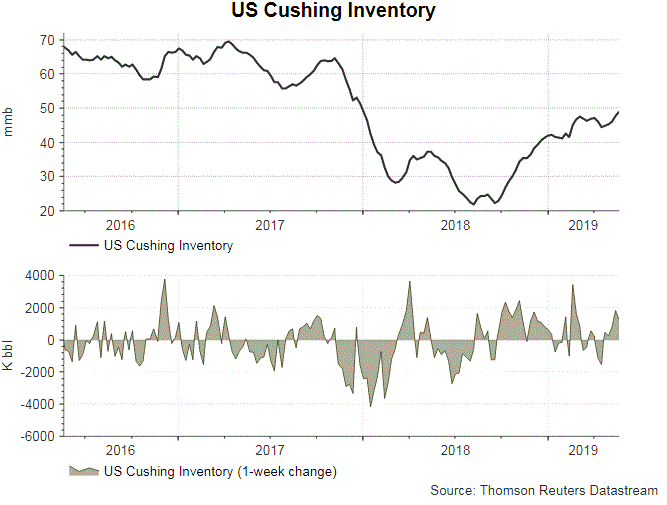 Concerning refined oil product inventories, gasoline inventory gained +3.72 mmb to 228.74 mmb although demand rose +3.07% to 9.43M bpd. The market had anticipated a -0.82 mmb drop in stockpile. Production added +0.02%% to 10.294 bpd while imports jumped +79.52% to 1.35M bpd during the week. Distillate inventory climbed higher, by +0.77 mmb, to 126.42 mmb. Demand dropped -7.5% to 3.79M bpd. The market had anticipated a -0.05 mmb decline in inventory. Imports soared +148.78% to 0.102M bpd while production slipped -1.1% to 5.21M bpd during the week.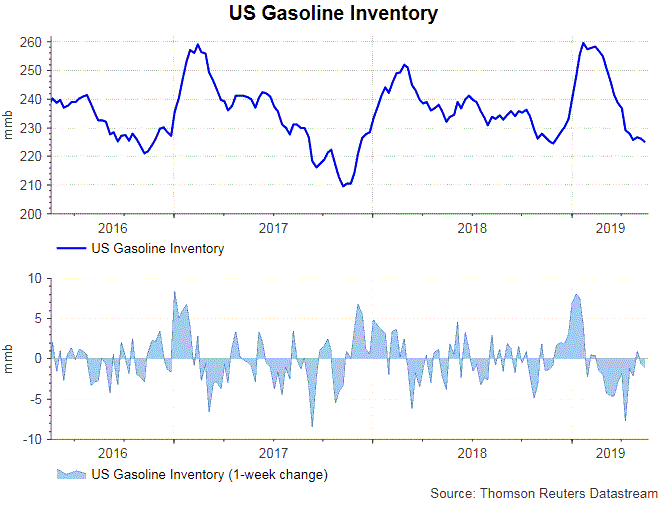
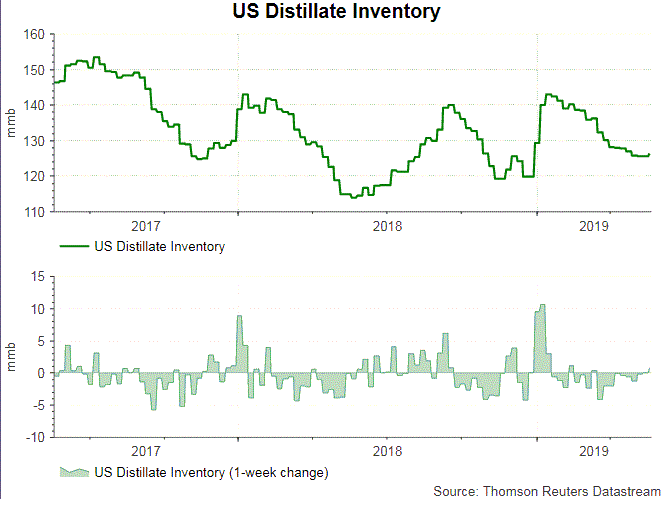
Released after market close on Wednesday, the industry- sponsored API estimated that crude oil inventory gained +2.4 mmb during the week. For refined oil products, gasoline stockpile added +0.35 mmb while distillate dropped -0.24 mmb.
Eco Data 5/23/19
[php_everywhere instance="1"]