

Sample Category Title
Japanese Yen Edges Higher on Positive Japanese Data
USD/JPY has posted slight losses on Wednesday. In the North American session, the pair is trading at 110.29, down 0.18% on the day. In economic news, Japan released strong numbers. Core Machinery Orders climbed 3.8%, crushing the estimate of o.0%. This marked a 5-month high. Japan’s trade deficit declined by JPY 11.0 trillion, beating the estimate of JPY 12.0 trillion. In the U.S. today’s highlight is the minutes of the Federal Reserve’s policy meeting earlier this month. On Thursday, the U.S. releases unemployment claims.
Investors are keeping a close eye on the Federal Reserve meeting. Will the minutes point to any bias regarding the next rate move? At the May meeting, the Federal Reserve maintained the benchmark rate for a fourth straight month. The rate statement noted that inflation pressures remain muted and that the FOMC would remain patient regarding future rate movements. Jerome Powell reinforced this stance after the meeting, saying that “we don’t see a strong case for moving in either direction”. The Fed is already on record as saying it does not expect to raise rates before 2020, and with inflation levels persistently below the Fed’s target of 2.0%, the Fed can afford to continue its wait-and-see stance.
Trade tensions between the U.S. and China have escalated in recent weeks, causing strong volatility on global equity markets. This has also affected the movement of the Japanese yen, which is a safe-haven asset. It has been a tale of two Mays for the Japanese currency. The yen posted strong gains in the first half of the month, but has reversed directions and given up much of those gains. With the equity markets continuing to show strong swings and risk appetite unsteady, traders should be prepared for more volatility from USD/JPY.
Crude Falls After Surprise US Weekly Crude Buildup
Oil prices dropped by more than 1 percent on Wednesday after the release of the weekly US crude inventory data. A surprise buildup of 4.7 million barrels of crude and 3.7 million barrels of gasoline pushed prices down. Middle East tensions and the ongoing OPEC+ crude output cut deal have kept prices in a higher range, but higher US production keeps putting downward pressure on prices.
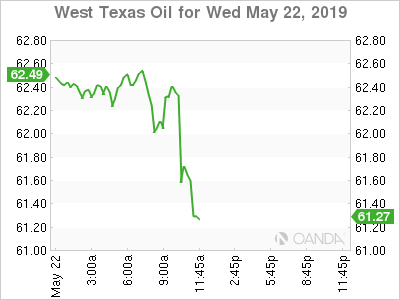
Geopolitical, weather and operational factors have reduced crude supply levels. The OPEC+ agreement has been the major factor and with the upcoming June end of the deal there is uncertainty if an extension is coming.
Russia has sent mixed signals and the effectiveness of a production output cut would be limited if it does not rejoin the group. Saudi Arabia has carried a heavy load to soak up excess supply and will steward the group form committing the same mistakes that lead to a free fall in crude prices.
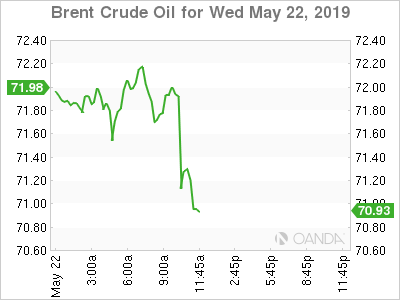
The US is impacting prices in three ways. Sanctions against Iran and Venezuela for political reasons have boosted prices as it reduced supply. US-China trade disputes have a negative effect on global growth forecast reducing energy demand going forward. The final factor has been the rising American output. While sanctions reduce supply and boost prices, lower energy demand and rising production depreciates crude as there is a higher risk of oversupply.
WTI oil tumbles on surprised inventory build, heading to 57 fibonacci level
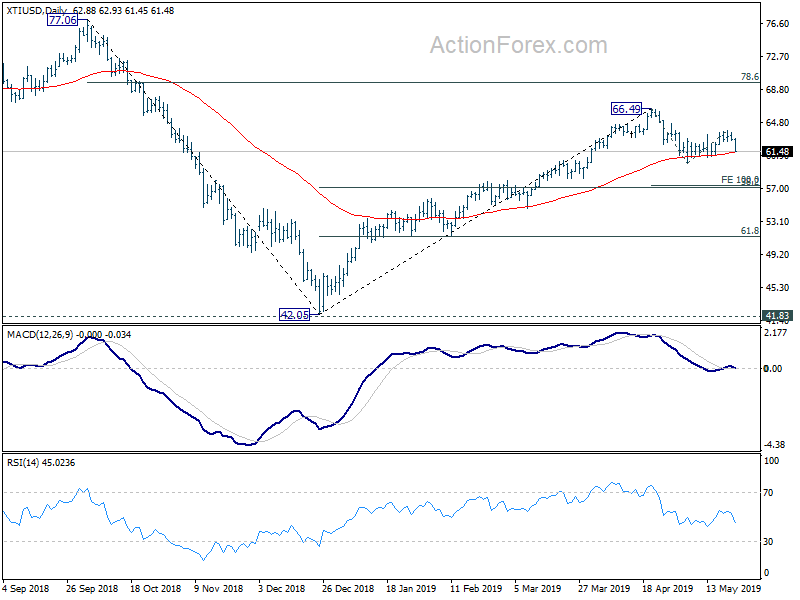
WTI crude oil drops sharply today as crude inventory unexpectedly rose 4.74M barrels in the week ending May 17, versus expectation of -1.2M barrels decline. Current development suggests that recovery from 60.03 has completed at 63.90 already. And the fall from 66.49 might be ready to resume.
Deeper decline should be seen to 60.03 first. Break will confirm this bearish case and target 100% projection of 66.49 to 60.03 from 63.90 at 57.44.
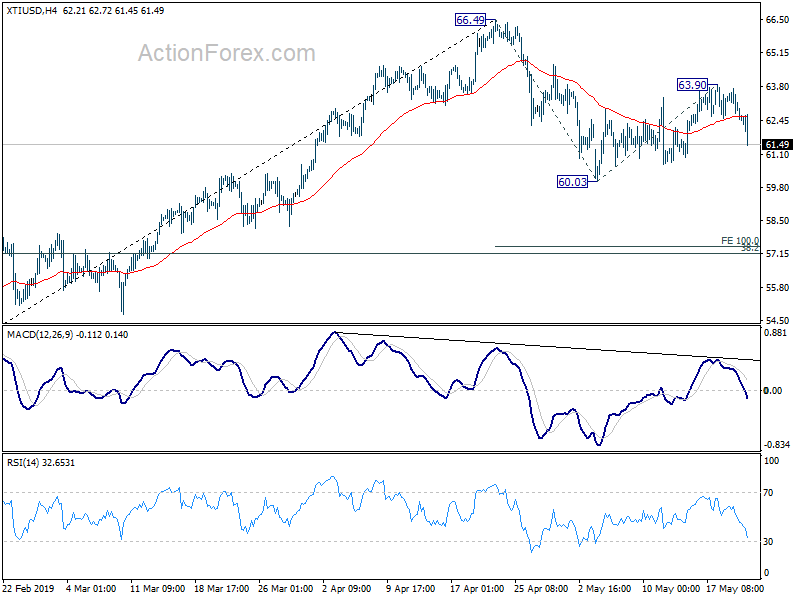
Nevertheless, fall from 66.49 is seen as a corrective move so far. Downside should be contained by 38.2% retracement of 42.05 to 66.49 at 57.15 to bring rebound.
EURCHF Cautiously Negative in Short Term, Neutral Overall
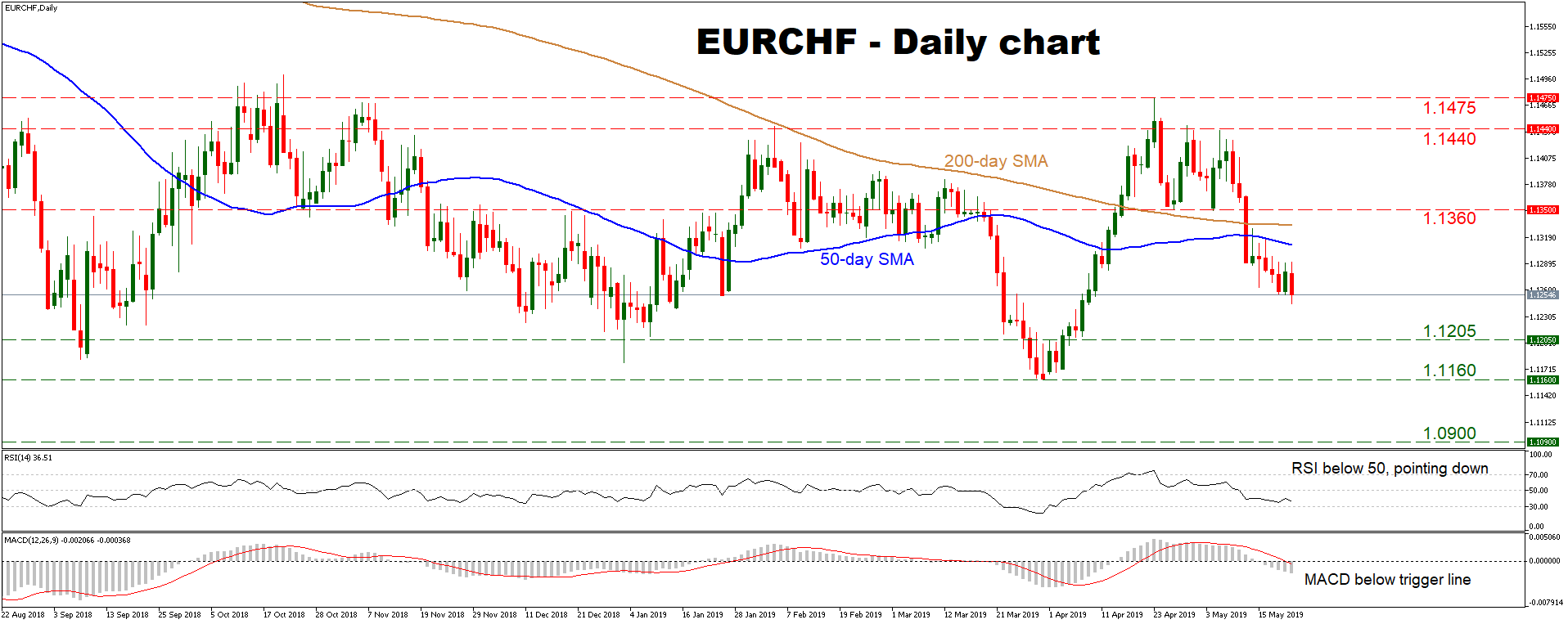
EURCHF retreated in recent weeks, falling below both its 50- and 200-day simple moving averages (SMAs). The near-term outlook has thus turned to cautiously negative, though the bigger picture still seems neutral – with a decisive break either above 1.1475 or below 1.1160 needed to change that.
Short-term momentum oscillators concur, with the RSI already below 50 and pointing lower, and the MACD being in negative territory and below its red trigger line.
Further declines could meet immediate support near the 1.1205 zone, defined by the inside swing high on April 1, with a downside break opening the door for the 22-month low of 1.1160.
On the flipside, a rebound may stall near the neighborhood of 1.1310 – 1.1330, where the 50- and 200-day SMAs are located, respectively. Close to that region is also the support-turned-resistance level of 1.1360, marked by the swing lows in late April and early May.
In short, some further losses shouldn’t be ruled out in the immediate term, but as long as the price remains between 1.1475 and 1.1160, the broader outlook is neutral.
Australian Dollar Ticks Lower, Fed Minutes Loom
AUD/USD has posted small losses on Thursday. Currently, the pair is trading at 0.6875, down 0.12% on the day. On the release front, Australian indicators pointed lower. The MI Leading Index dropped 0.1%, while the Construction Index declined 1.9%, much weaker than the estimate of a 0.1% gain. This was a third straight decline, indicative of persistent weakness in the construction sector. Later in the day, Australia releases manufacturing and services PMIs. In the U.S. today’s highlight is the minutes of the Federal Reserve’s policy meeting earlier this month. On Thursday, the U.S. releases unemployment claims.
Traders have circled June 4 on their calendars, the date of the RBA’s next policy meeting. The bank surprised the markets at the May meeting, when it maintained the key interest rate at 1.50%. The markets had priced in a rate cut of 25 basis points, given that economic growth has been dampened by the global trade war, in particular the slowdown which has gripped China. The RBA minutes were dovish, with a reference to the “uncertainties” regarding the bank’s inflation target of 2.0%. As well, policymakers dropped a reference to “not a strong case” for a rate move in the near future, which appears to be a bias in favor of easing. RBA Governor Lowe spoke on Tuesday and the message was even clearer. Lowe stated that a “decrease in the cash rate would likely be appropriate.” The markets responded by pricing in a rate cut in June at 91%, so the Aussie could face further headwinds as investors look for more attractive alternatives.
All eyes are on the Federal Reserve meeting. Will the minutes point to any bias regarding the next rate move? At the May meeting, the Federal Reserve maintained the benchmark rate for a fourth straight month. The rate statement noted that inflation pressures remain muted and that the FOMC would remain patient regarding future rate movements. Jerome Powell reinforced this stance after the meeting, saying that “we don’t see a strong case for moving in either direction”. The Fed is already on record as saying it does not expect to raise rates before 2020, and with inflation levels persistently below the Fed’s target of 2.0%, the Fed can afford to continue its wait-and-see stance.
Fed Williams: Interest rates in the right place with essentially nonexistent inflation pressures
New York Fed President John Williams said the current interest rates in US are in the right place with "essentially nonexistent" inflation pressures. Additionally, some downside risks to global growth have receded. US economy is also strong and is on track to growth above potential at above 2% this year.
The downtick of inflation is expected to reverse this year even though there is a risk that inflation gets stuck. However, Williams noted that Fed is not at a point to respond to low inflation by changing monetary policy yet. And he doesn't expect that to be the case in the near term neither.
Separately, Boston Fed President Eric Rosengren said Fed currently assumes the US and China to eventually reach a trade agreement. However, if trade war drags on, uncertainty will weigh on the economy. He reiterated that tariffs are one of the biggest risks to the US economy.
US Mnuchin indicates new tariffs on China probably just a month away
US Treasury Secretary Steven Mnuchin reminded the House Financial Services Committee that new tariffs on USD 300B in Chinese imports are probably just a month or so away. He said, "there won't be any decision probably for another 30 to 45 days." Meanwhile, there is no plan to travel to China to resume trade negotiations yet.
On Walmart's claims that tariffs will push up retail prices, he said "that's something I can assure you the president will be focused on before we make any decisions." However, he also talked down the threat of higher prices for consumers. He said "my expectation is that a lot of this business will be moved from China to other places in the region so that there will not be a cost."
GBP/JPY Mid-Day Outlook
Daily Pivots: (S1) 139.45; (P) 140.59; (R1) 141.52; More...
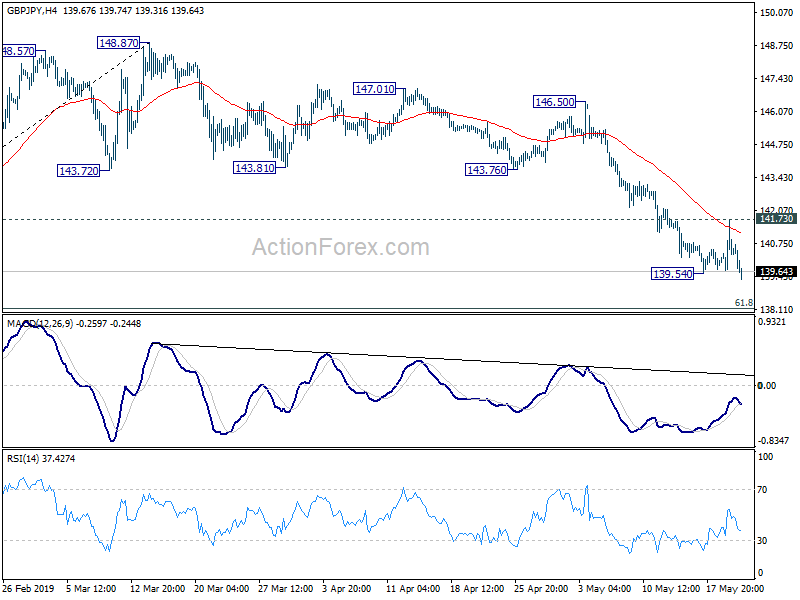
GBP/JPY's fall resumed by breaking 139.54 temporary low to as low as 139.31 so far. Intraday bias is back on the downside. Current fall from 148.87 should target 61.8% retracement of 131.51 to 148.87 at 138.14 next. Sustained break there will pave the way to retest 131.51 low. On the upside, above 141.73 resistance would indicate short term bottoming, possibly on bullish convergence condition in 4 hour MACD. Stronger rebound would then be seen.
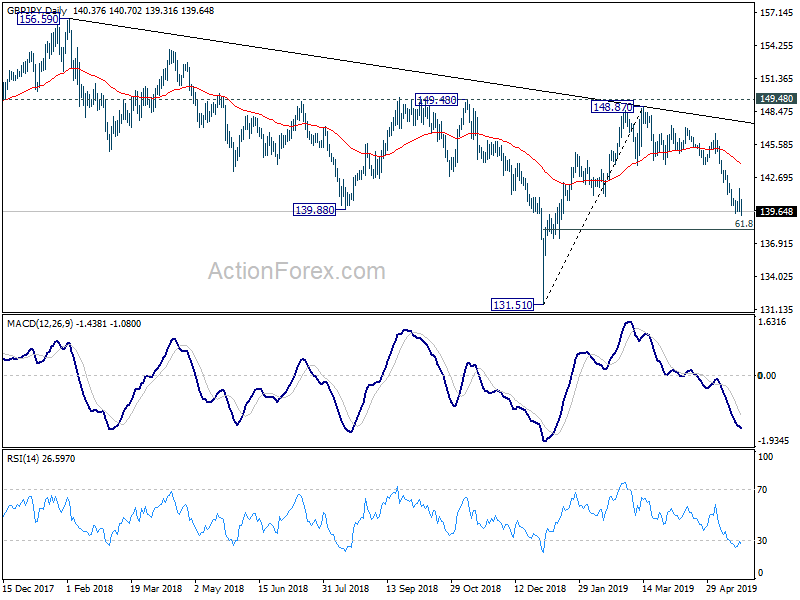
In the bigger picture, current development suggests that GBP/JPY was rejected by 149.98 key resistance. And medium term fall from 156.59 is still in progress. Break of 131.51 will target 122.36 (2016 low). On the other hand, decisive break of 149.98 should confirm that medium term fall from 156.59 (2018 high) has completed at 131.51 already. Further rally would be seen back to 156.59 resistance and above.
USD/CAD Outlook: Upbeat Canada Retail Sales Push Loonie to One-Month High
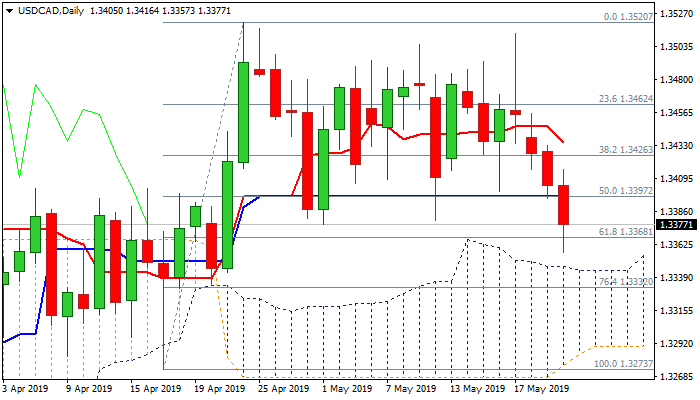
Better than expected Canada's retail sales (Mar 1.1% vs 1.0% f/c / Core 1.7% vs 0.9% f/c) pushed loonie to new one-month high at 1.3357. USDCAD's fresh bearish acceleration broke through 55SMA support (1.3394), former lows (1.3380/76) and pivotal support at 1.3368 (Fibo 61.8% of 1.3273/1.3520 upleg) to stall on approach to daily cloud top (1.3346). The pair is in red for the fourth straight day and maintaining strong bearish momentum, with upbeat data coming as a catalyst. Bears need close below cracked Fibo support at 1.3368 to generate negative signal for extension lower and penetration of daily cloud. Broken 55SMA should ideally cap upticks and maintain bearish stance, while extension above 30SMA (1.3422) would question bears.
Res: 1.3394; 1.3422; 1.3445; 1.3462
Sup: 1.3368; 1.3357; 1.3346; 1.3332
FTSE Pauses after Sharp Gains, Investors Wary as U.S-China Tensions Continue
The FTSE index has steadied on Wednesday, after posting strong gains on Tuesday. In the North American session, the pair is at 7,349, down 0.16% on the day. On the release front, British CPI jumped to 2.1% in April, up from 1.9% in March. Still, this missed the estimate of 2.2%. The U.K. deficit jumped to GBP 5.0 billion, shy of the estimate of GBP 5.2 billion. This marked a 5-month high. Later in the day, the Federal Reserve releases the minutes of its May policy meeting.
The FTSE has sparkled in 2019, with gains of 9.1%. Will the positive streak continue even with Brexit tensions heating up? Prime Minister May is desperately trying to prevent the U.K. from crashing out of the EU without a deal, but it’s unclear if she will succeed. May will attempt to push a withdrawal deal through parliament for a fourth time in early June, after three previous deals failed. May has said that this deal will include a compromise on the customs union issue, but Labor and many Conservative MPs have already dismissed May’s proposal. If lawmakers shoot down the latest withdrawal proposal, the wobbly pound could fall even lower.
U.S-China trade tensions continue to trigger volatility in the equity markets. On Friday, the Trump administration announced it was imposing trade sanctions on the Chinese telecom giant Huawei, a move which sent stock markets reeling on Monday. However, the U.S. Commerce Department has taken a step back, saying that it will provide 3-month exemptions to U.S. companies that sell to Huawei. The tussle over Huawei has exacerbated the trade war between the two economic giants, and risk appetite will likely remain soft until the sides resume negotiations.