

Sample Category Title
Canadian Retail Sales Advance in March, but with a Disappointing Volumes Print
- Canadian retail sales advanced 1.1% (m/m) in March, following a 1% increase in February (previously reported as 0.8%). The release came close to consensus expectations for a 1.2% increase.
- After stripping out price movements, the picture was less impressive, with volumes up a modest 0.3%.
- The sectoral composition of the gains was decent, with 7 out of the 11 sectors recording a gain. Sales at gasoline stations (+6%) drove a large chunk of the overall increase, on the back of increased gasoline prices. Sales were also positive at clothing stores (+3.4%), and encouragingly, at furniture and home furnishing stores (+3.3%) and building material and garden equipment stores (+4.3%). Providing some offset were lower sales at motor vehicle and parts dealers (-0.7%).
- Regionally, 9 provinces saw retail sales increase. The increase was mostly driven by Alberta (+2.4%), Ontario (+0.8%), and Quebec (+0.7%). Manitoba was the only province that saw retail sales decline in March (-0.7%).
Key Implications
- March's retail sales increase was not sufficient to change an overall poor Q1 performance, which ended with nominal retail sales up a modest 0.1% and volumes down 0.1%. Like other recent data releases, the March uptick points to improving momentum heading into Q2. Additionally, some details in the report, including an increase in clothing and housing-related retail sales (both in nominal and real terms), and the broad-based composition of the gains, point to a potentially improving domestic demand picture heading into the next quarter.
- The modest volumes uptick and the minor revisions to February's data have, on their own, little impact on our Q1 growth tracking. That said, Statistics Canada's data on investment in building construction (released yesterday) casts doubt on residential construction's performance this quarter, adding another sign that the Canadian economy likely struggled to eke out any overall growth at the start of the year.
Canada Retail Sales Rise Again in March
- Headline sales jumped 1.1% to build on a 1.0% increase in February, although the March gain was boosted by a price-led 6% increase in sales at gasoline stations
- Controlling for price-effects, sale volumes edged up 0.3% after a 0.4% increase in February but were still down slightly on average from Q1
Even with an increase in March, retail sale volumes were down slightly in Q1 as a whole – consistent with prior expectations for another soft quarter for consumer spending growth. Job growth has been almost unbelievably strong, supporting overall household income growth despite wage gains that are still lackluster for this point in the economic cycle. But debt payments are still eating up a larger share of incomes than before. Bucking a flattish trend for sales overall, sale volumes at both furniture and building material sales bounced back solidly in the first quarter after declining over the second half of last year. That probably is related to some of the more recent stabilization in home resales. Nonetheless, housing markets are still softer than in earlier years, and that means earlier boosts to broader purchasing power from increases in real-estate equity are not being repeated.
Household expenditure growth is clearly providing less support to economic growth than in recent years, but the broader backdrop has still looked okay – at least once looking through the likely transitory impact of Alberta’s oil production cuts and bad weather over the winter. The intensification of the U.S.-China trade dispute has raised some grey clouds for the U.S. industrial sector and, by extension, Canada’s. But the removal of U.S. steel and aluminum tariffs on Canada, along with Canada’s retaliatory measures, will provide some offset. And the tick up in retail sale volumes in March follows earlier-reported bounce-backs in manufacturing sales and exports after likely weather-related drops in February. The data on balance is still consistent with GDP growth coming in at a sub-1% rate in Q1 but better reports later in the quarter also still leave the odds on a bounce-back to a 2% rate in Q2.
Canadian retail sales rose 1.1%, ex-auto sales jumped 1.7%, USD/CAD dives
Canadian Dollar jumps notably after stronger than expected retail sales data. Headline sales rose for the second consecutive month, up 1.1% mom. to CAD 51.3B in March, above expectation of 1.00%. Ex-auto sales was even stronger, up 1.7% mom versus expectation of 0.8% mom.
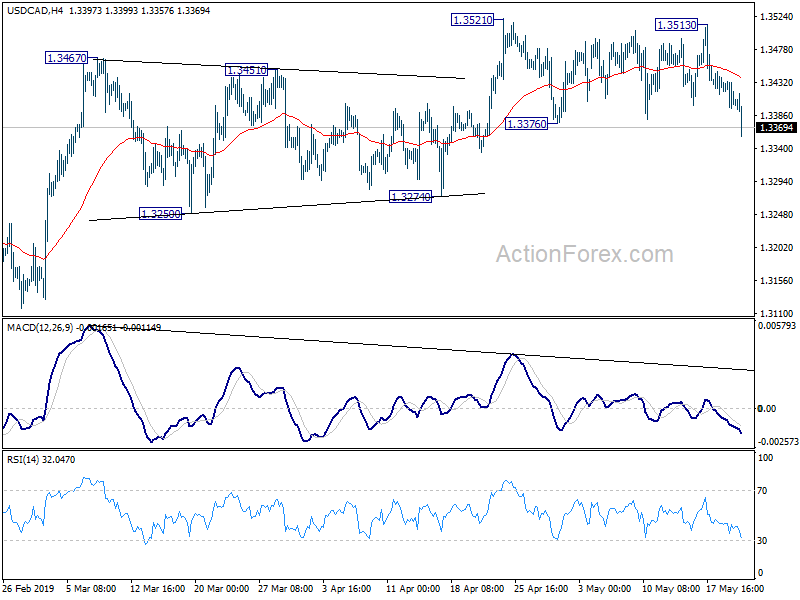
USD/CAD drops through 1.3376 support after the release. But at the point, current fall is seen as part of consolidation pattern from 1.3521. Hence we'd expect strong support above 1.3274 to contain downside. Larger rise from 1.3068 is still in favor to resume later.
Into US session: Sterling extends decline on Brexit and CPI, Swiss Franc jumps
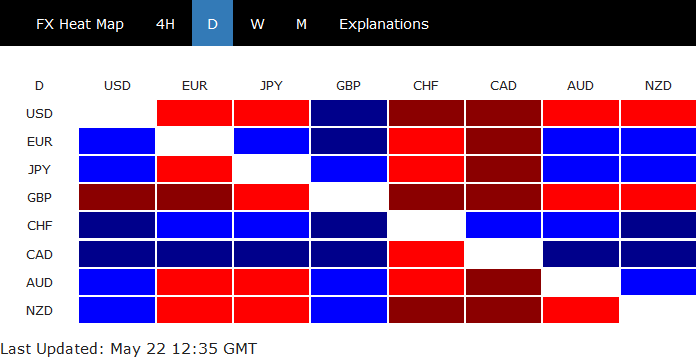
Entering into US session, Swiss Franc is so far the strongest one for today, with a wave of buyers just jumping in. Meanwhile, Sterling remains the weakest one for. MPs and Sterling traders are all unhappy with UK Prime Minister Theresa May's new Brexit plan announced yesterday. May is having her PMQ at the moment but it's unlikely to turn the corner. Traders continue to price in risks of no-deal Brexit, after May steps down. Meanwhile, slightly weaker than expected CPI reading in UK also gives the Pound some pressure. On the other hand, mild risk aversion is giving Swiss Franc a lift.
Dollar is mixed as trades await minutes of May 1 FOMC meeting. There, Fed decided to keep interest rates unchanged and more importantly, chair Jerome Powell indicated there is no need to adjust monetary policy in either direction for the near term. Markets would like to dig into details of discussions that might hint on the chance of rate cuts. But based on recent comments by Fed officials, it's likely to have some strong voices for rate cut during the meeting. Fed policymakers have been generally patient and talked down the imminent need of rate cut.
In Europe, currently:
- FTSE is down -0.13%.
- DAX is down -0.50%.
- CAC is down -0.59%.
- German 10-year yield is down -0.0145 at -0.074.
Earlier in Asia:
- Nikkei rose 0.05%.
- Hong Kong HSI rose 0.18%.
- China Shanghai SSE dropped -0.49%.
- Singapore Strait Times dropped -0.00%.
- Japan 10-year JGB yield dropped -0.0057 to -0.05.
GBP/USD Follows Through Lower On Further Downside Pressure
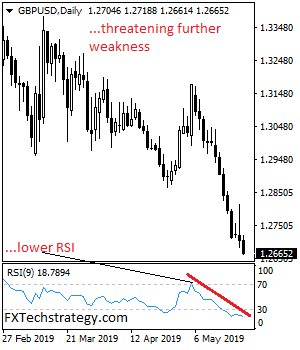
GBPUSD follows through lower on further downside pressure with eyes on support located at 1.2600 level. Support lies at 1.2550 as it looks for more weakness. Below that level will turn attention to the 1.2500 level. Further down, support comes in at the 1.2450 level where a break will turn focus to the 1.2400 level. Further down, support lies at the 1.2350 level. On the upside, resistance stands at the 1.2700 with a turn above here allowing for additional strength to build up towards the 1.2750 level. Further out, resistance stands at the 1.2800 level followed by the 1.2850 level. On the whole, GBPUSD looks to weaken further lower on bear threats.
DAX Posts Gains As U.S. Lowers Trade Tensions
The DAX started the week with a sharp decline, but has reversed directions and recovered much of these losses. Currently, the index is at 12,171, up 0.23% on the day. Today's highlight is the minutes of the Federal Reserve's most recent meeting. Thursday will be busy, as Germany releases GDP and Ifo Business Climate. The eurozone and Germany release service and manufacturing PMIs, while the ECB posts the minutes of the April policy meeting.
U.S-China trade tensions continue to trigger volatility in the equity markets. On Friday, the Trump administration announced it was imposing trade sanctions on the Chinese telecom giant Huawei, a move which sent stock markets reeling on Monday. However, the U.S. Commerce Department has taken a step back, saying that it will provide 3-month exemptions to U.S. companies that sell to Huawei. The tussle over Huawei has exacerbated the trade war between the two economic giants, and risk appetite will remain soft until the sides resume negotiations.
Investors will be keeping a close eye on the minutes of the Fed meeting earlier this month. At the meeting, the Federal Reserve maintained the benchmark rate for a fourth straight month. The rate statement noted that inflation pressures remain muted and that the FOMC would remain patient regarding future rate movements. Jerome Powell reinforced this stance after the meeting, saying that “we don't see a strong case for moving in either direction”. Will the minutes point to any bias regarding the next rate move? The Fed is already on record as saying it does not expect to raise rates before 2020, and with inflation levels persistently below the Fed's target of 2.0%, the Fed can afford to continue its wait-and-see stance.
EUR/USD Outlook: Studies Signal Correction But Bears Remain In Control, Fed Minutes In Focus
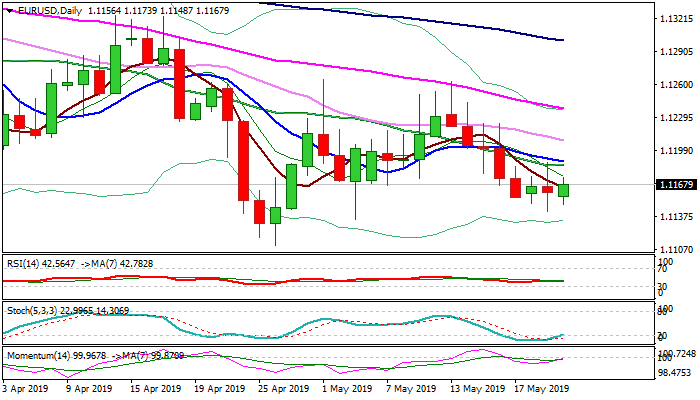
The Euro ticks higher in European trading on Wednesday, supported by rising momentum and daily stochastic reversing from oversold territory. Tuesday's long-legged Doji suggests that the bear-leg from 1.1263 (13 May spike high/strong upside rejection at falling 55SMA) might be running out of steam. Recovery should be ideally capped at 1.1190 zone (Tuesday's high/falling 10SMA) to keep bears intact for renewed attack at 1.1147 Fibo support (76.4% of 1.1111/1.1264) and possible extension towards key support at 1.1111 (2019 low, posted on 26 Apr). Conversely, break and close above 10SMA would put bears on hold, but lift above falling 30SMA (1.1208) is needed to confirm reversal. FOMC minutes are due later today and would provide fresh signals, with neutral cb's stance to increase pressure on Euro, while dovish steer would provide relief on weaker dollar.
Res: 1.1173, 1.1190, 1.1208, 1.1217
Sup: 1.1142, 1.1134, 1.1111, 1.1075
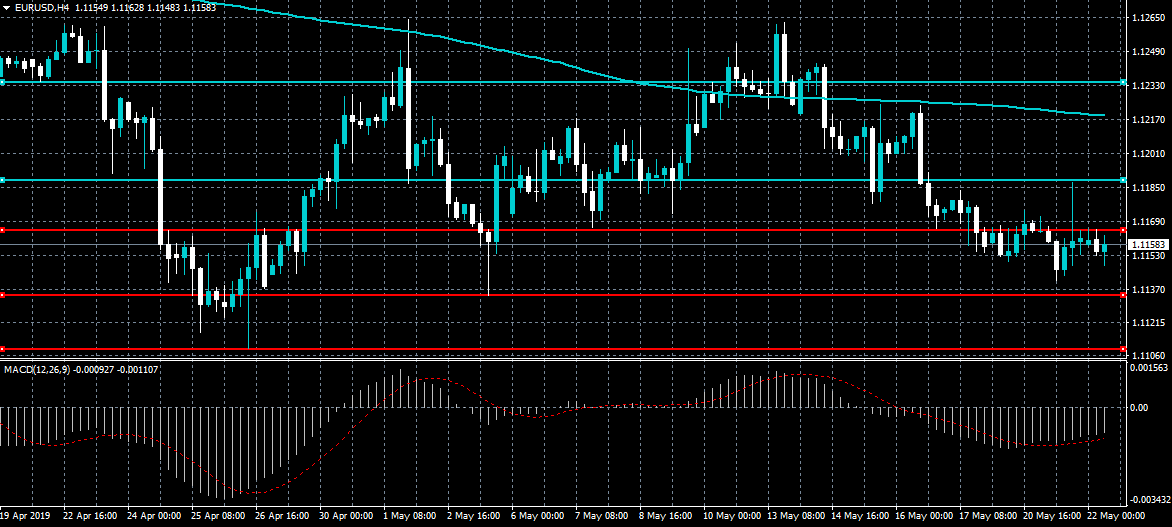
EURUSD Bearish Below 1.1165
The euro currency is testing towards the top of its daily price range against the US dollar after sellers failed to break below the 1.1130 support level. If buyers force price above the 1.1165 level the EURUSD pair is likely to test towards the 1.1190 resistance level. Traders may remain cautious towards positions until the FOMC meeting minutes are released during the US trading session.
The EURUSD pair is only bearish while below the 1.1165 level, key technical support is found at the 1.1130 and 1.1110 levels.
If the EURUSD pair moves above the 1.1165 level, key technical resistance is found at the 1.1190 and 1.1234 levels.
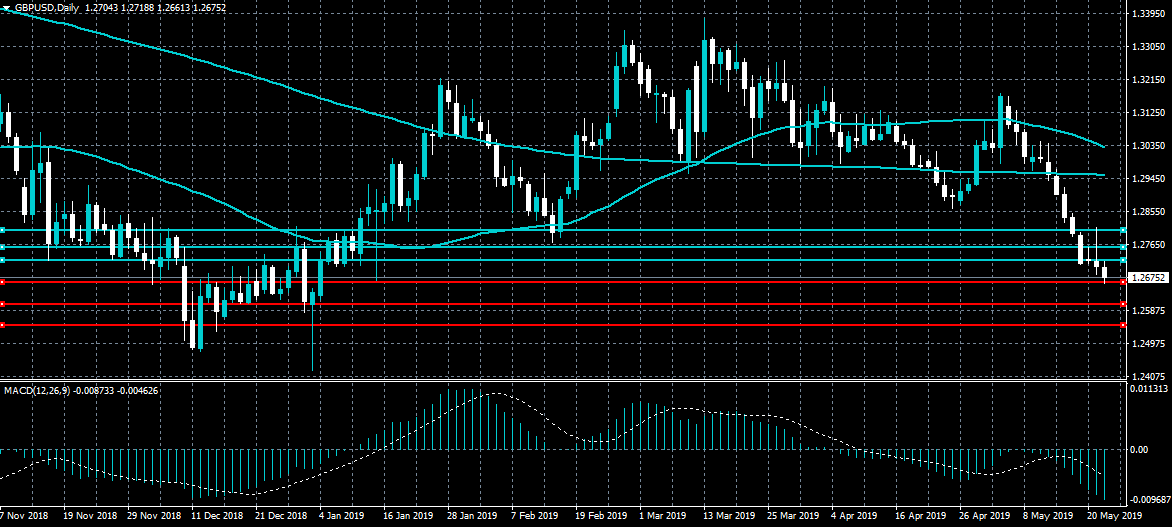
GBPUSD Watching 1.2660
The British pound has fallen to a new monthly trading low against the US dollar during the European trading session due to ongoing United Kingdom political uncertainty. If sellers can hold price under the 1.2660 level the GBPUSD is likely to decline towards the 1.2610 support level. Overall, the 1.2550 level offers the strongest form of technical support for the GBPUSD pair.
The GBPUSD pair is heavily bearish while trading below the 1.2660 level, key support is located at the 1.2610 and 1.2550 levels.
If the GBPUSD pair trades above the 1.2660 level, key intraday resistance is found at the 1.2690 and 1.2710 levels.
The Analytical Overview Of The Main Currency Pairs
The EUR/USD currency pair
Technical indicators of the currency pair:
Prev Open: 1.11650
Open: 1.11568
% chg. over the last day: -0.06
Day's range: 1.11494 – 1.11660
52 wk range: 1.1111 – 1.2009
EUR/USD stabilized after a long fall. The trading instrument is consolidating. The market participants are waiting for the FOMC minutes. Keep an eye on the rhetorics of the Central Bank officials, especially since Jerome Powerll mentionted that they aren't going to force the key interest rates' change. Right now the key levels are at 1.11450 and 1.11650. You should open positions from the key levels.
At 21:00 (GMT+3:00) the US will publish the FOMC Minutes.
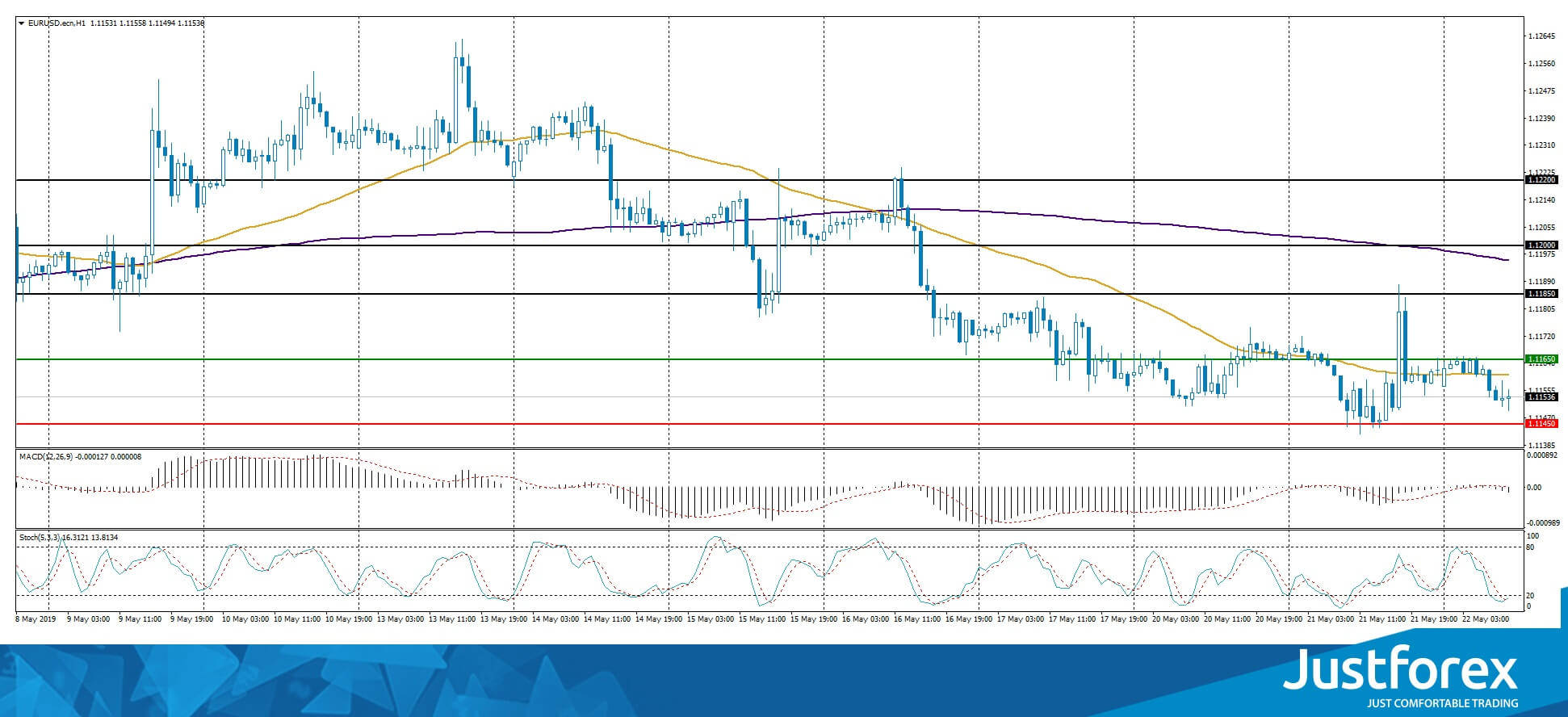
The indicators do not provide precise signals, the price has crossed 50 MA.
The MACD histogram started to descend which points towards further fall of the EUR/USD quotes.
The Stochastic Oscillator is in the neutral zone, the %K line is crossing the %D line. There are no signals at the moment.
Trading recommendations
Support levels: 1.11450, 1.11200, 1.11000
Resistance levels: 1.11650, 1.11850, 1.12000
If the price fixes below 1.11450, expect further descend towards the round 1.11000.
Alternatively, the quotes can correct towards 1.11850-1.12000.
The GBP/USD currency pair
Technical indicators of the currency pair:
Prev Open: 1.27210
Open: 1.27047
% chg. over the last day: -0.15
Day's range: 1.26617 – 1.27193
52 wk range: 1.2438 – 1.3631
GBP/USD remains in the bearish mood. The trading instrument updated the local minimums. Theresa May is not sure she can convince the lawmakers to accept the updated Brexit agreement. The quotes are testing the support at 1.26600 with the mirror resistance being at 1.27100. They can descend further.
At 11:30 (GMT+3:00) the UK will publish an inflation report.
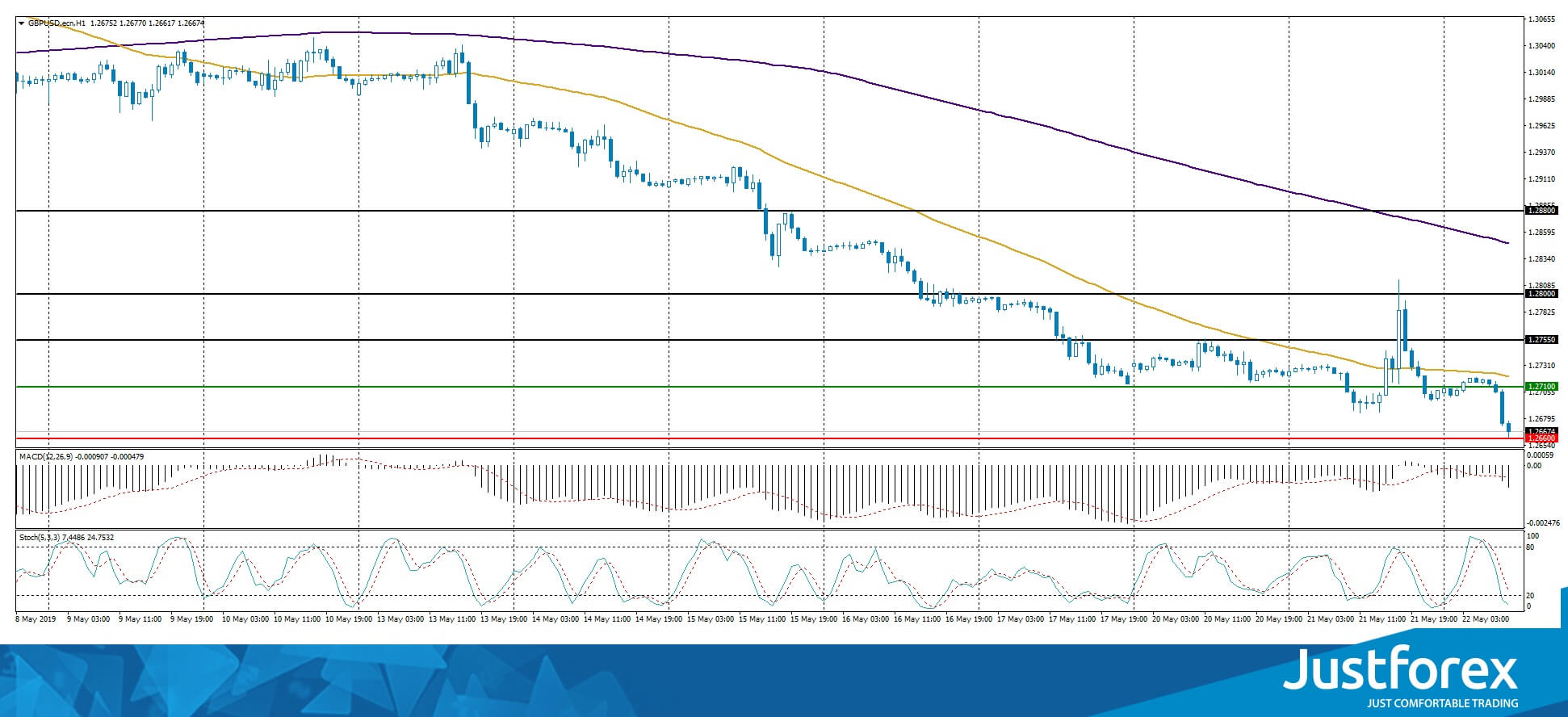
The price fixed below 50 MA and 200 MA which points towards the power of the sellers.
The MACD histogram is in the negative zone and below the signal line which gives a strong singal to sell GBP/USD.
The Stochastic Oscillator is in the neutral zone, the %K line is below the %D line which points toward a bearish mood.
Trading recommendations
Support levels: 1.26600, 1.26200, 1.26000
Resistance levels: 1.27100, 1.27550, 1.28000
If the price fixes below 1.26600, expect further descend towards 1.26300-1.26000.
Alternatively, the quotes can recover towards 1.27500-1.27800.
The USD/CAD currency pair
Technical indicators of the currency pair:
Prev Open: 1.34246
Open: 1.34018
% chg. over the last day: -0.18
Day's range: 1.33947 – 1.34165
52 wk range: 1.2727 – 1.3664
USD/CAD remains ambiguous. The trading instrument keeps consolidating. The local support and resistance levels are 1.34000 and 1.34250. The investors are waiting for reports from the US and Canada, as well as the oil quotes dynamics. You should open positions from the key levels.
At 15:30 (GMT+3:00) Canada will publish the retail sales report.
Economic Event (CAD) – 00:00 (GMT+3:00);
Economic Event (CAD) – 00:00 (GMT+3:00);
Economic Event (CAD) – 00:00 (GMT+3:00)
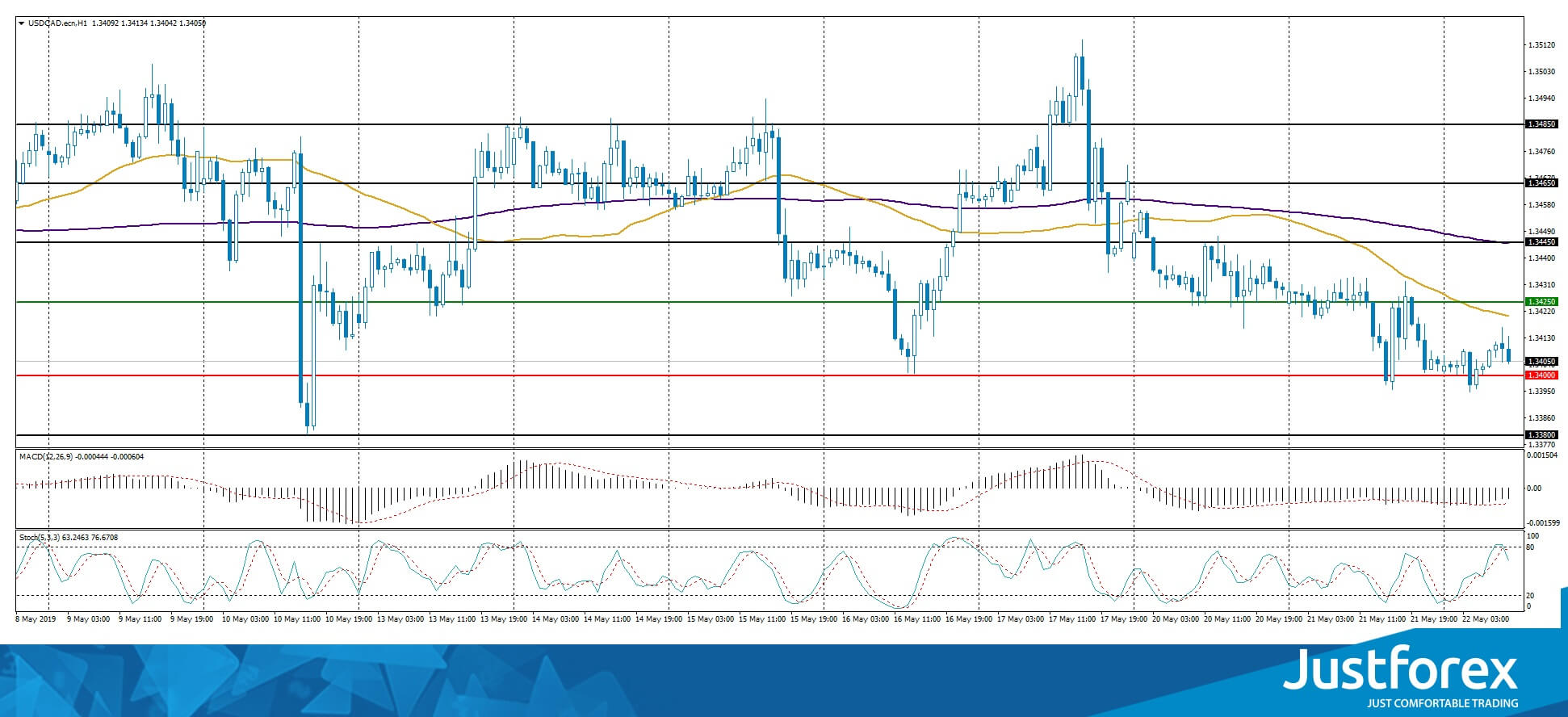
The price fixed below 50 MA and 200 MA which points toward the power of the sellers.
The MACD histogram is in the negative zone but above the signal line which gives a weak signal to sell USD/CAD.
The Stochastic Oscillator is in the neutral zone, the %K line is crossing the %D line. There are no signals at the moment.
Trading recommendations
Support levels: 1.34000, 1.33800
Resistance levels: 1.34250, 1.34450, 1.34650
If the price fixes below the round 1.34000, expect further descend towards 1.33800-1.33600.
Alternatively, the quotes can grow towards 1.34400-1.34600.
The USD/JPY currency pair
Technical indicators of the currency pair:
Prev Open: 110.068
Open: 110.484
% chg. over the last day: +0.46
Day's range: 110.362 – 110.626
52 wk range: 104.97 – 114.56
USD/JPY started to grow again and updated the local maximums. The key support and resistance levels are 110.300 and 110.650. The quotes can grow further. The market participants are waiting for the FOMC Minutes. Keep an eye on the US Treasury bonds and open positions from the key levels.
During the Asian trading session Japan published weak trading balance reports.
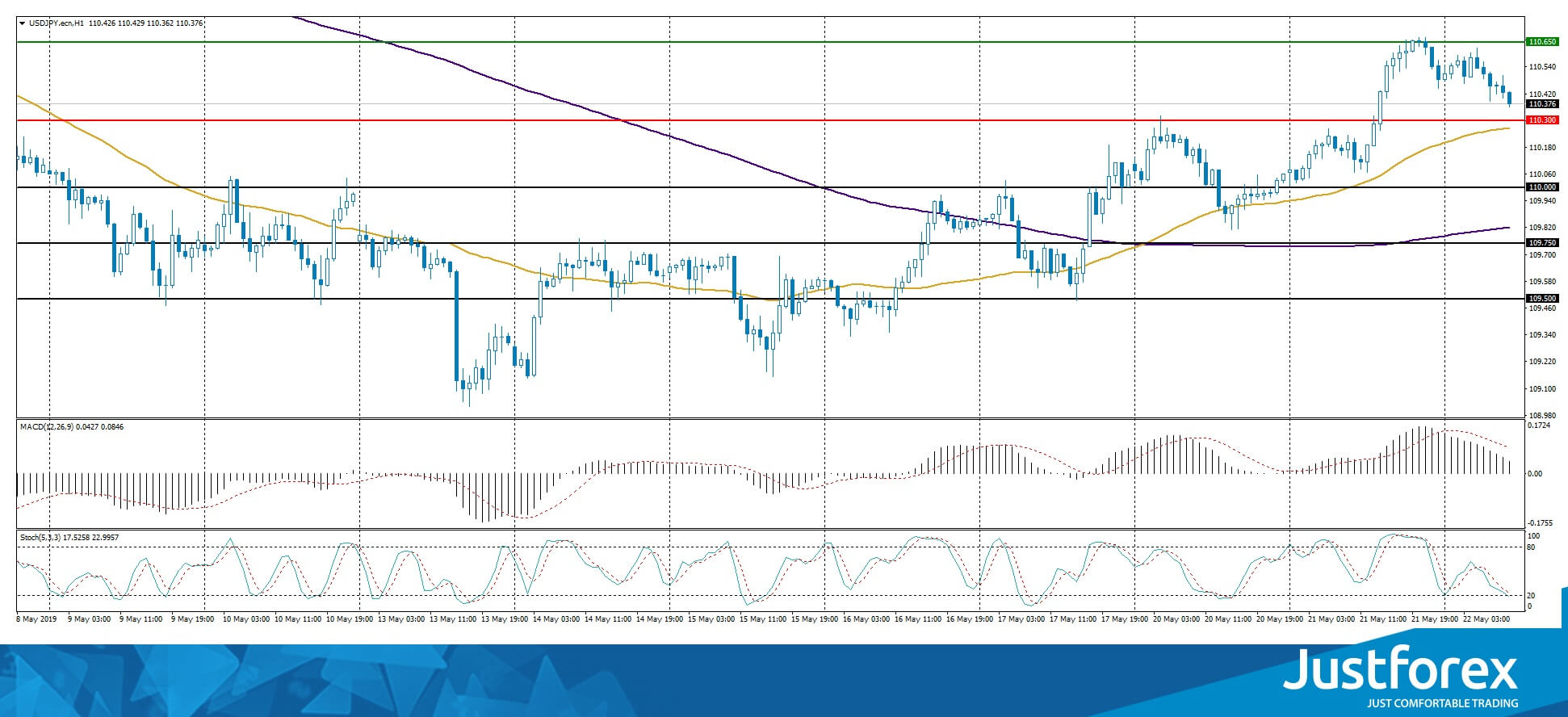
The price fixed above 50 MA and 200 MA which points towards the power of the buyers.
The MACD histogram is in the positive zone but below the signal line which gives a weak signal to buy USD/JPY.
The Stochastic Oscillator is in the neutral zone, the %K line is below the %D line which points towards a bearish mood.
Trading recommendations
Support levels: 110.300, 110.000, 109.750
Resistance levels: 110.650, 111.000
If the price fixes above 110.650, expect further growth towards 111.000.
Alternatively, the quotes can fall towards 110.000-109.750.