Sample Category Title
USTR Lighthizer said to meet Japan Motegi on May 24, dashing to close trade deal
It's reported, without confirmation yet, US Trade Representative Robert Lighthizer will travel to Japan on May 24. He will meet Japanese Economy Minister Toshimitsu Motegi to resume trade negotiations. Trump declared auto-imports as threat to national security last week. And Lighthizer will have 180 days to complete the trade agreement. Otherwise, Trump might start imposing tariffs on autos and parts from Japan.
The claim of auto imports as national security threat to US infuriated Japanese maker Toyota Motor. Toyota said in a statement that Trump's proclamation "sends a message to Toyota that our investments are not welcomed, and the contributions from each of our employees across America are not valued."
Toyota added "our operations and employees contribute significantly to the American way of life, the U.S. economy and are not a national security threat". Toyota added that "history has shown" that limiting imports is "counterproductive in creating jobs, stimulating the economy and influencing consumer buying habits." "If import quotas are imposed, the biggest losers will be consumers who will pay more and have fewer vehicle choices."
Market Morning Briefing: Euro-Yen Has Moved Up Slightly
STOCKS
Asians are trading mixed as further developments on the US-China trade talks remain uncertain. However, the domestic indices, the Sensex and Nifty are set to open with a wide gap-up. Exit polls which are in favour of the ruling party to retain the power can boost the Indian markets today. The SGX Nifty (11701, +2.33%) is up over 2 per cent.
Sensex (37930.77, +537.29, +1.44%) and Nifty (11407.15, 150.05, 1.33%) can add on to their Friday's gains and can breach their respective resistances at 38500 and 11600. While the momentum sustains Nifty and Sensex can revisit 11800 and 39500 levels ahead of the Lok Sabha election results on Thursday (23-May-19).
Dow (25764.00, -98.68, -0.38%) is struggling to breach 26000 which is much needed for it to gain strength and move up to 26250 and higher levels. But while below 26000 the outlook is negative for it to test 25000 in the short term.
DAX (12238.94, -71.43, -0.58%) can test 12400 while it sustains above 12100.
Nikkei (21303.72, +53.63, +0.25%) has immediate support at 21250. While this support hold, a rise to 21500-21750 can be seen in the coming days.
Shanghai (2850.34, -31.95, -1.11%) is under pressure. It looks vulnerable to break the current 2850-2950 range below 2850 and fall to 2800.
COMMODITIES
Recovery in equities coupled with the strength in dollar has dragged gold and silver lower. They can dip further in the near term. Copper remains bearish. Oil is moving up in line with our expectation. But a crucial resistance is coming up which will need a close watch to see if the current upmove will sustain or not.
Gold (1276.7) can test 1270-1266 again. The broader bearish outlook intact for it to fall to 1260 and even lower levels in the coming weeks. Immediate resistance is at 1280 and the next significant near-term resistance is in between 1290-1292.
Silver (14.40) remains bearish for a fall to 14.15-14.0
Copper (2.74) has come-off after testing 2.78 last week and remains bearish for a fall to 2.70-2.68. Immediate support is at 2.72, a break below which can trigger a fresh fall.
Brent (73.20) heading towards 74 in line with our expectation. What happens after testing 74 will be crucial to watch. A strong break above 74 will pave way for 76 or even 78. But a pull-back from 74 can drag it to 72-71.
Similarly, Nymex (63.68) can rise in the near-term test its crucial resistance level of 65.
FOREX
Overall the US Dollar is strong and could move up in the near term. Aussie and Dollar-Yen looks strong for the coming sessions while Euro, and Yuan could witness some weakness against the US Dollar. Rupee may be impacted by the election poll results for the next few sessions.
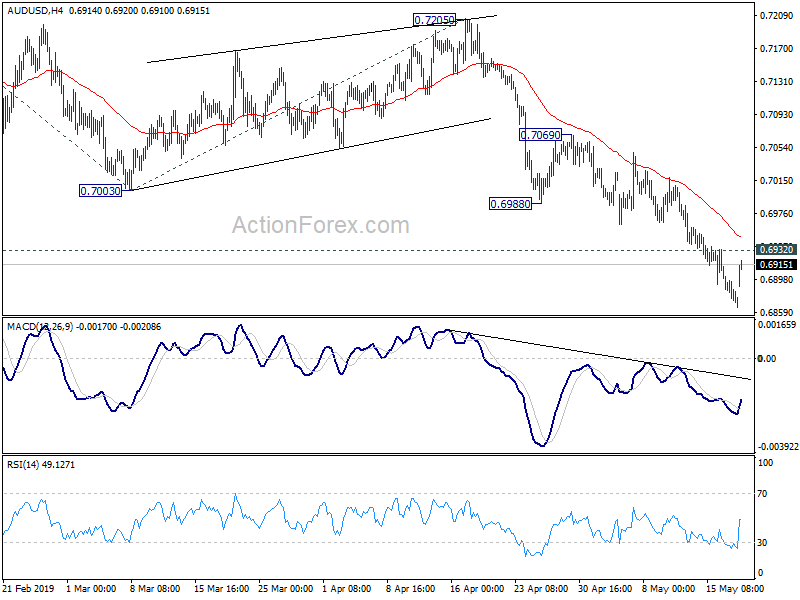
Australia witnessed surprise victory of the ruling liberal National Coalition on Saturday that boosted a rise in Aussie (0.6915). Aussie jumped up from levels near 0.6864 and now while the rise continues, Aussie could move up towards 0.70.
Dollar Index (97.99) has moved up as expected and could well test immediate resistance near 98.50 on the upside. Near term looks bullish.
Euro (1.1159) is trading lower on fresh rise in the US dollar and while the dollar index continues to move higher towards 98.50, Euro could be bearish towards 1.11 or even lower in the near term.
Euro-Yen (123) has moved up slightly in an attempt to move higher while above immediate support at 122. A break above 123.30/50 would make the pair bullish for the near term towards 125.
Dollar Yen (110.23) is up along with the US Dollar and while the Dollar strengthens further, Dollar-Yen could also move higher towards 111.
USDCNY (6.9067) is trading higher but it would be crucial to see if the pair manages to break above 6.91 or comes off from here back towards 6.87/85 in the near term. A rise above 6.91 could gradually take it higher to 6.95.
Although strength in Dollar Index and Brent crude is visible on the global front, we could possibly see a gap down opening on Dollar Rupee as the Exit polls are in favor of the ruling BJP-led NDA in the Lok Sabha Elections. Dollar Rupee (70.23) could likely open near 70.00 and could test support at 69.75. Movement in Dollar-Rupee could be impacted by Election poll results this week although global factors may indicate a possible weakness in the Rupee. We would continue to watch movement in Brent Crude and US Dollar in the near term.
INTEREST RATES
The US yields are stable. The 30Yr (2.83%), 10Yr (2.40%) and 5Yr (2.19%) are down by 1bps and could turn to move down in the near term. The 30-10Yr (0.43%) and the 30-5Yr (0.64%) are moving down and look bearish in the near term towards 0.40% and 0.35% respectively.
The Indian 10Yr GOI (7.4782%) could open gap down today. Supports are seen at 7.40% and 7.355 respectively.
EU’s Parliamentary elections are to take place this week that could possibly keep the yields low.
The UK yields are down sharply. The 5Yr (0.75%), 10Yr (1.04%) and 20Yr (1.50%) are trading lower and could head towards 0.70%, 1% and 1.45% respectively. Near term looks weak.
The German 10Yr (-0.102%) could also move down a bit during the week towards -0.2%.
Australian Dollar rebounds on election results, upside capped by RBA and trade
Australian Dollar spikes higher today after the central-right coalition's surprising victory in the elections over the weekend, securing an outright majority too. The Liberal-Party led coalition is seen by some economists as better manager of the economy. Also, returning to power, the coalition will continue with their promised tax cuts on July 1. That's seen by some as stimulus equivalent to a 25bps rate cut, without the cut of course.
Nevertheless, upside in Aussie is so far limited. There are two major factors that's clouding the outlook. Firstly, RBA Governor Philip Lowe Philip Lowe will deliver a speech on Tuesday. After surprised jump in unemployment rate in April, there are speculations that Lowe could make use of the occasion to chart out the course for rate cuts in the second half of the year. Secondly, after recent escalations in US-China trade war, there is only one way to go in tensions between the two countries. Relationships will only worsen.
OPEC+ Maintains Output Cut. Market Balance Suggests No Practical Need to Raise Output
OPEC+ stayed put, maintaining the output cut agreed in December last year while pledging to monitor market developments with an option to raise production later. In our opinion, there is no practical need for OPEC+ to officially raise output. Despite US sanctions against Venezuela and Iran, as well as geopolitical tensions in the Middle East, world supply is still sufficient to meet the demand. Undoubtedly, some producers find raising output desirable to boost their national revenues, while others attempt to talk down oil prices (by hinting a possibility of raising output) in accommodation to Donald Trump, who always pressures his Middle East allies to lower oil price. There is a real risk that disruption in production in some countries, such as Iran, Venezuela and Libya, could lead to global oil deficit. Yet, production data have suggested that OPEC+ has, in aggregate, reduced output significantly more than required. Producers that have lowered output more than required can increase production to offset the loss in Iran and Venezuelan production when necessary. There is no need to officially break the output cut deal.
Oil Demand/Supply Balance
As suggested in the latest reports by three major oil agencies, both US Energy Information Agency (EIA) and the Paris-based International Energy Agency (IEA) have revised slightly lower their forecasts for global oil demand for 2019. Meanwhile, both have upgraded non-OPEC oil supply for the year. The balance signals reduced need for OPEC’s production. According to the EIA, world oil demand would reach 101.36M bpd this year, down -0.02M bpd or -0.02%, from April’s forecast. While about 70% of it would be met by non-OPEC production and natural gas liquids (NGLs) and unconventional liquids, the rest would depend on OPEC’s output. EIA forecasts the demand for OPEC’s output would be 30.54M bpd. Ongoing political uncertainty in the Middle East region and US sanctions against Iran and Venezuela have raised uncertainty about OPEC’s output. The EIA anticipates that the loss of Iranian output would be compensated by increases in Saudi Arabia, the United Arab Emirates, Kuwait, and Russia. Yet, the decline in Venezuelan production would hardly be substituted. This is also a caused of EIA’s upward adjustment in its oil price forecast. As noted in the report, “unrest within Venezuela contributes to a highly uncertain situation that could immediately disrupt the remaining oil production there”. It is expected that “Venezuela’s production will continue to see significant declines through 2020”. Moreover, “although recent fighting in Libya had not affected any crude oil production or export infrastructure as of the time of writing, the civil unrest has increased the disruption risk significantly”. EIA forecast the call for OPEC production would be 30.54M bpd.
The IEA revised lower slightly its forecast for global demand for this year. It forecast demand would reach 100.4M bpd in 2019, up from 99.1M bpd a year ago but down from April’s projection of 100.6M bpd. On the supply side, the agency indicated that Trump’s decision to end sanctions waivers in Iran has added to the “confusing supply outlook”. Yet, it also has noted a “very welcome signals from other producers that they will step in to replace Iran’s barrels, albeit gradually in response to requests from customers”. While the majority of global oil demand would be met by non-OPEC supply, IEA forecasts the balance would be matched by OPEC supply of 30.9M bpd 2Q19. The amount would then drop to 30.2M bpd in 2H19.
OPEC’s report revealed that the cartel estimated global oil demand to reach 99.94M bpd in 2019. While it remains the lowest among the three agencies, it has already modestly revised from April’s forecast of 99.91M bpd. On the supply side, OPEC forecast the world needs 30.64M bpd of its output. The cartel reported that its 15 members produced 30.03M bpd in April, down from 30.46M bpd in 1Q19 and 31.86M bpd in the full year of 2018.
OPEC+ Compliance
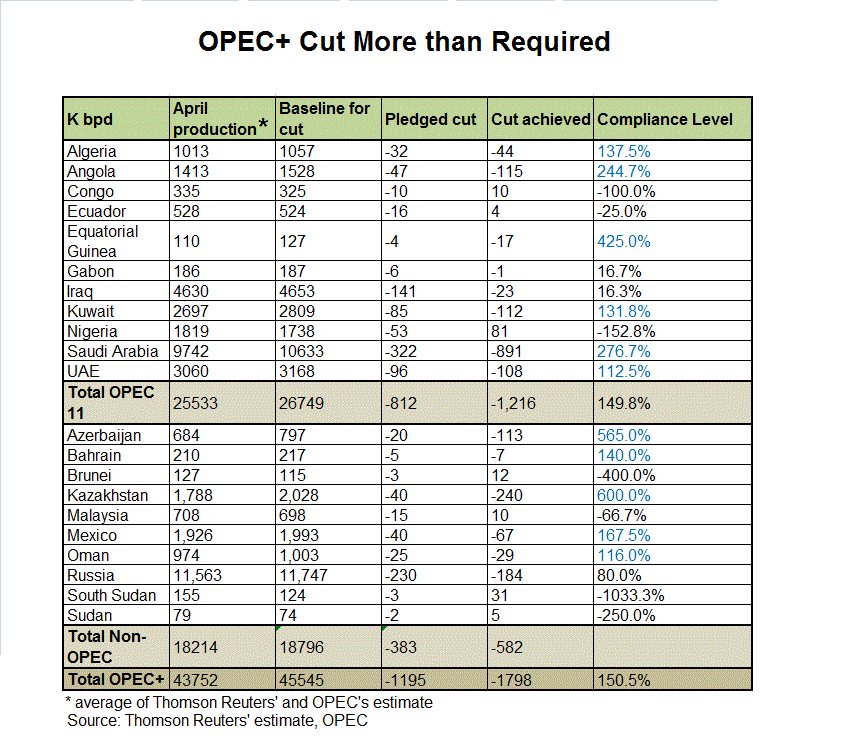
On aggregate, OPEC+ has been producing much less than their quotas. In April, compliance rate for OPEC-11 reached 150%*. That is, the members almost doubled the output cut they are required. 6 out of the 11 members cut more than required, while the rest either cut less or actually raised production. For instance, Saudi Arabia, the world’s largest oil exporter, lowered its output by 891K bpd, while it was required to cut only by -322K bpd. UAE also lowered its output by 108K bpd, although it agreed to cut by 96K bpd. Concerning non-OPEC participants of the deal, oil giant Russia’s compliance level is persistently below 100%, i.e. cutting less than agreed. Indeed, the country is always vocal of raising output and threatening about quitting the deal. Yet, there are 5 out of 10 non-OPEC participants that cut more than required.
it appears that OPEC production has been short of the world's demand for its supply. Yet, it was driven by some producers' deliberate reduction of output. These producers can increase production to offset the loss in Iran and Venezuelan production when necessary. There is no need to officially break the output cut deal.
EURUSD Broader Bias Remains Lower Towards The 1.1109 Support Zone
EURUSD broader bias remains lower towards the 1.1109 support zone. Support comes in at the 1.1050 where a violation will turn risk to the 1.1000 level. A break below here will target the 1.0950 level. Further down, support sits at the 1.0900. more decline. Its weekly RSI is bearish and pointing lower suggesting further weakness. Conversely, on the upside, resistance resides at 1.1200 level with a break through there opening the door for further upside towards the 1.1.1250 level. Further up, resistance comes in at the 1.1300 level where a violation will expose the 1.1350 level. All in all, EURUSD broader bias remains lower towards the 1.1109 support zone.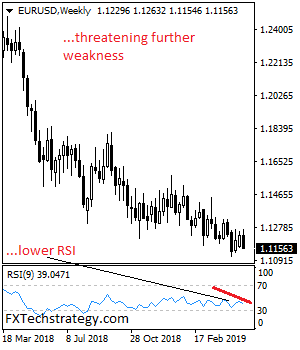
CFTC Commitments of Traders – USD Bets Trimmed Further as Trader War Uncertainty Persists
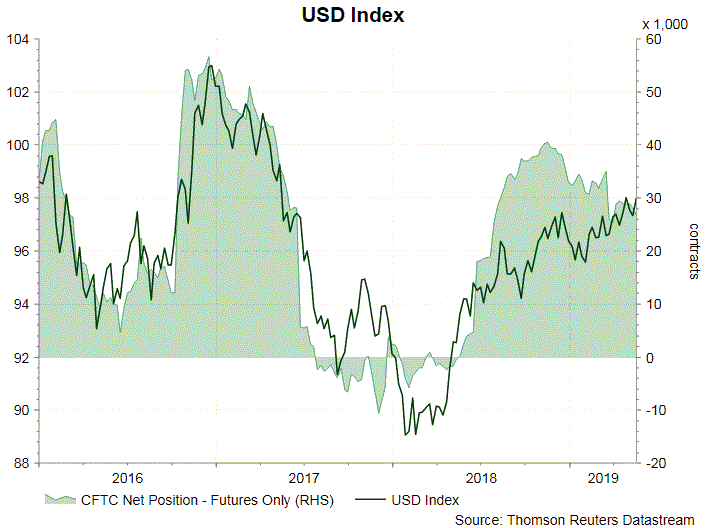
As suggested in the CFTC Commitments of Traders report in the week ended May 14, traders trimmed their bets, on both long and short sides, on futures of US dollar index, euro, Swiss franc, and Canadian dollar. On the other hand, bets on both sides were increased in the futures of British pound and New Zealand dollar. NET LENGTH in USD Index decreased -1 556 contracts to 26 677. Both speculative long and short positions fell during the week, but the decline in the former outweighed that of the latter. All other major currencies stayed in NET SHORT positions.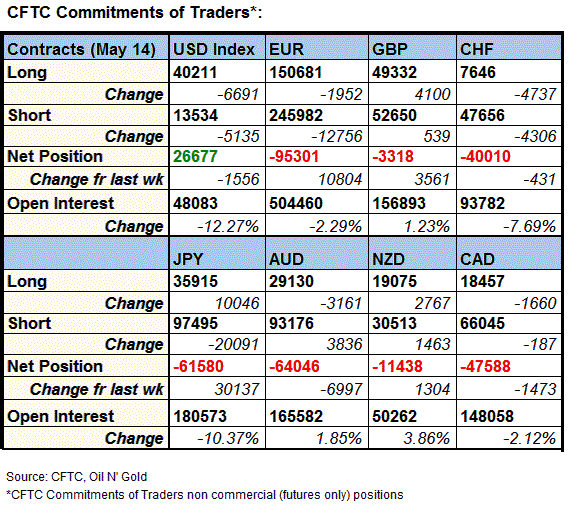
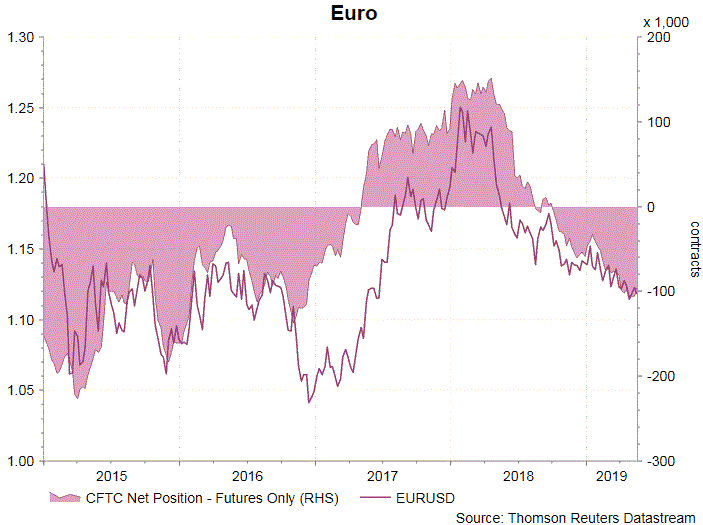
Concerning European currencies, NET SHORT for euro futures plunged -10 804 contracts to 95 301. NET SHORT for GBP futures declined -3 561 contracts to 3 318. Speculative long positions gained +4 100 contracts while speculative shorts added +539 contracts for the week. We expect both European currencies to trade with increased volatility this week as the upcoming European Parliament election might lead to more power for the Euro-skeptic camp. The outlook for British pound can be more uncertain as the result might again reveal the loss of support of the Conservative Party, mainly due to dissatisfaction of the incumbent's handling of Brexit.
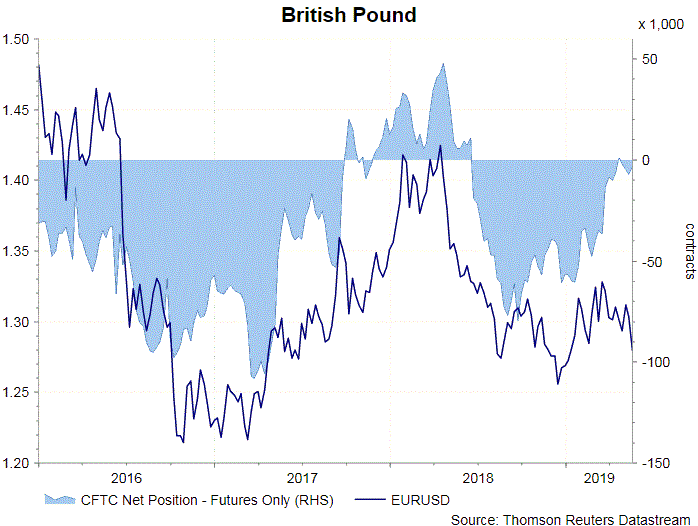
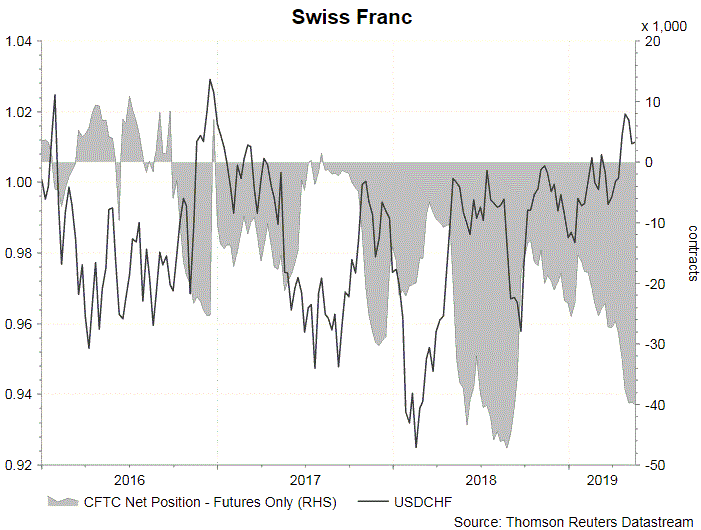
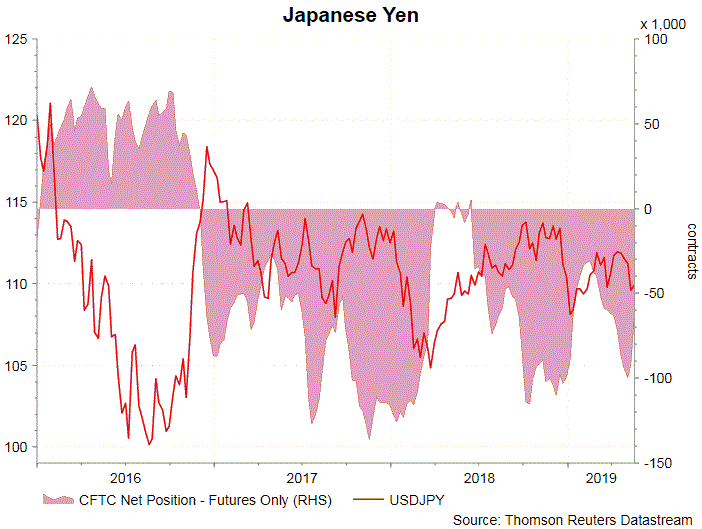
On safe-haven currencies, Net SHORT for CHF futures gained +431 contracts to 40 010. NET SHORT for JPY futures plunged -30 137 contracts to 61 580 during the week. Speculative long positions rose +10 046 contracts while shorts fell -2 0 091 contracts.
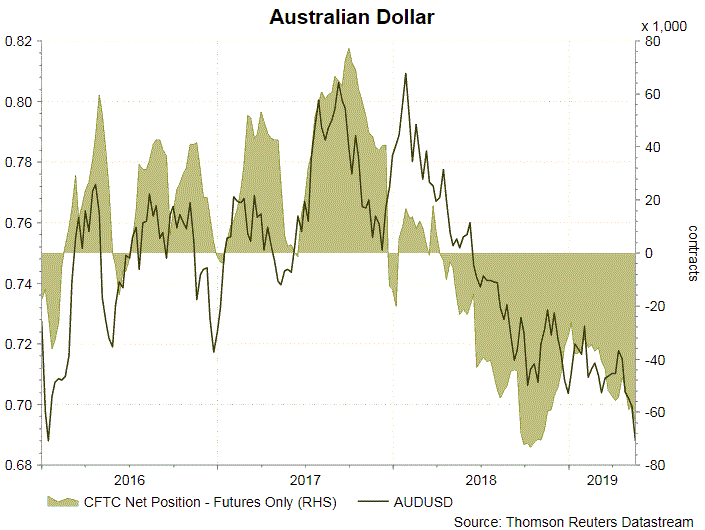
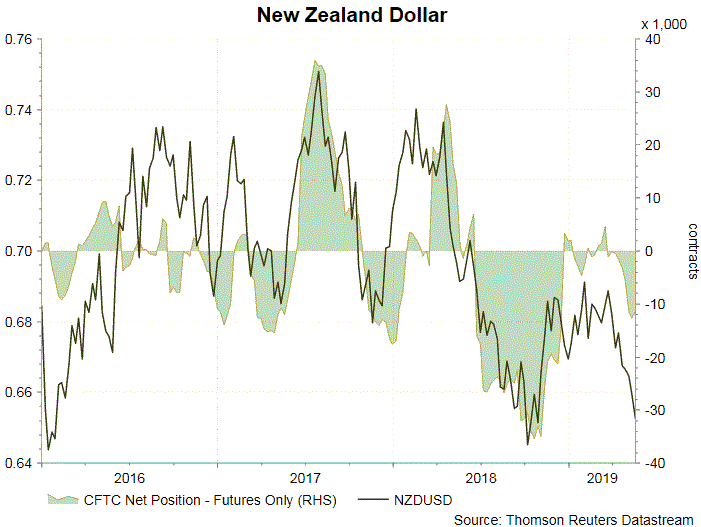
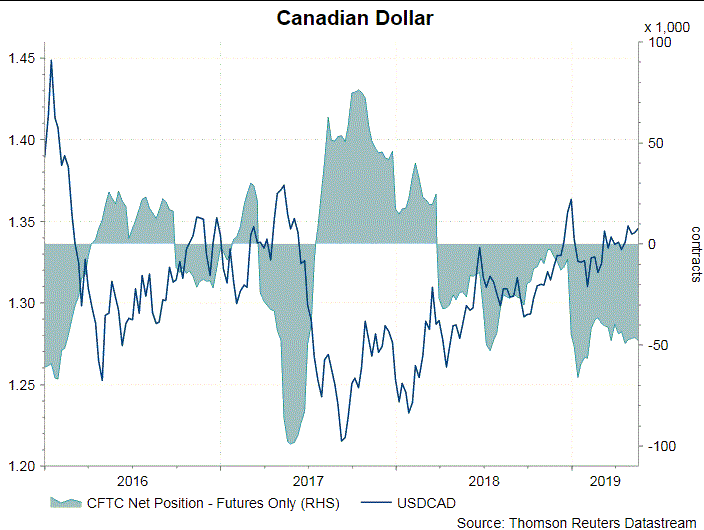
On commodity currencies . NET SHORT for AUD futures rose 6 997 contracts to 64 046. Speculative long positions dropped -3 161 contracts while shorts gained +3 836 contracts. Separately, NET SHORT for NZD dropped -1 304 contracts to 11 438 contracts last week. NET SHORT for CAD futures increased +1 473 contracts to 47 588.
Eco Data 5/20/19
[php_everywhere instance="1"]
CFTC Commitments of Traders – Oil Traders Awaited OPEC+ Meeting; Bets for Higher Gold Price Surged Amidst Safe Haven...
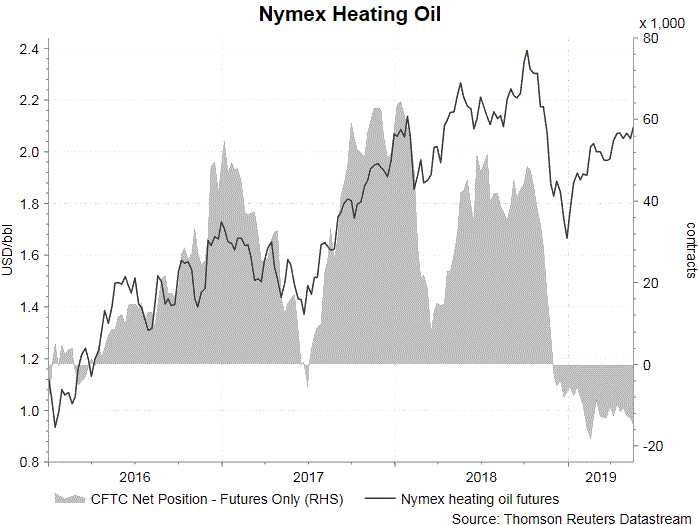
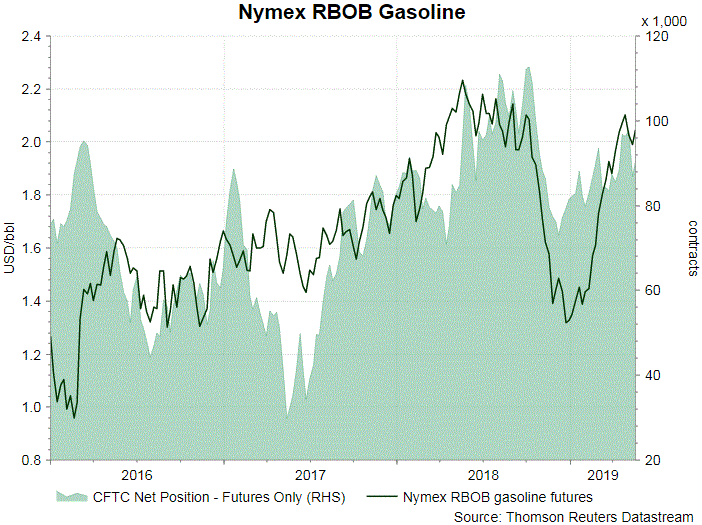
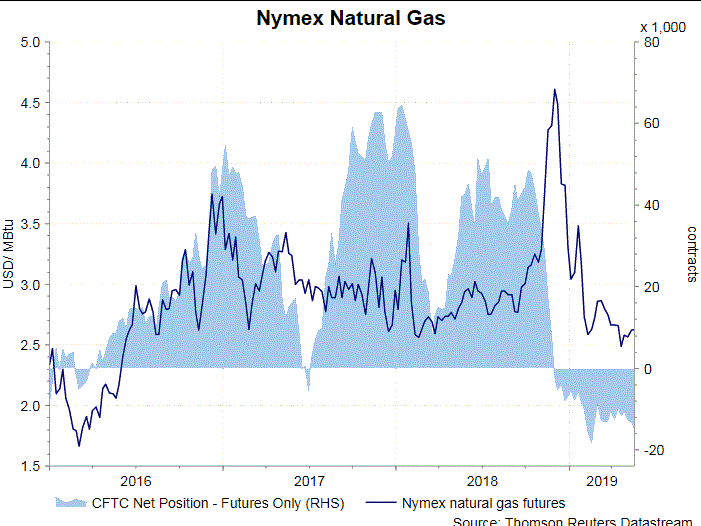
According to the CFTC Commitments of Traders report for the week ended May 14, NET LENGTH for crude oil futures fell -6 528 contracts to 487 808 for the week. Speculative long positions declined -8 810 contracts while shorts slipped -2 282. Overall bets for crude oil diminished as traders awaited OPEC+ meeting. While they awaited the decision on whether the producers would agree to raise output, in the midst of recent Middle East tensions, the members decided to continue the predetermined output quotas. It could be a boost for oil price in the week ahead. For refined oil products, NET LENGTH for gasoline rose +3 523 contracts to 90 423, while NET SHORT for heating oil added +1 903 contracts to 14 935 contracts for the week. NET SHORT for natural gas futures soared +5 998 contracts to 73 899 contracts for the week.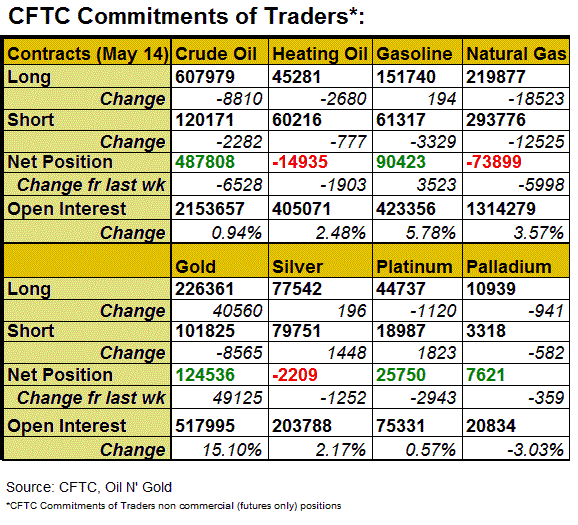
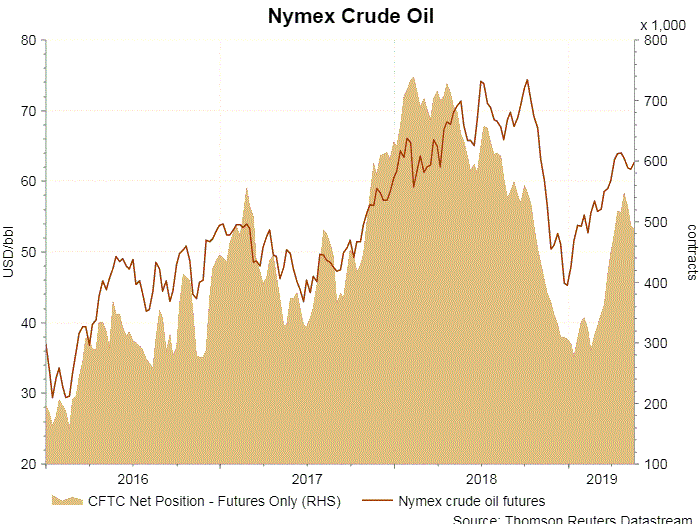
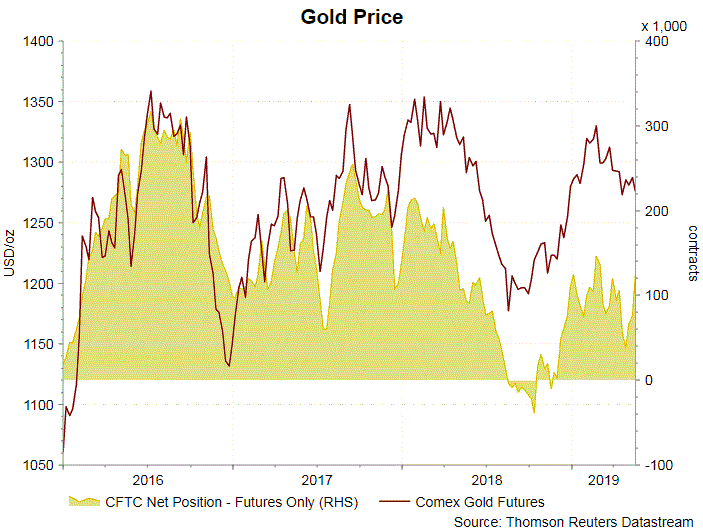
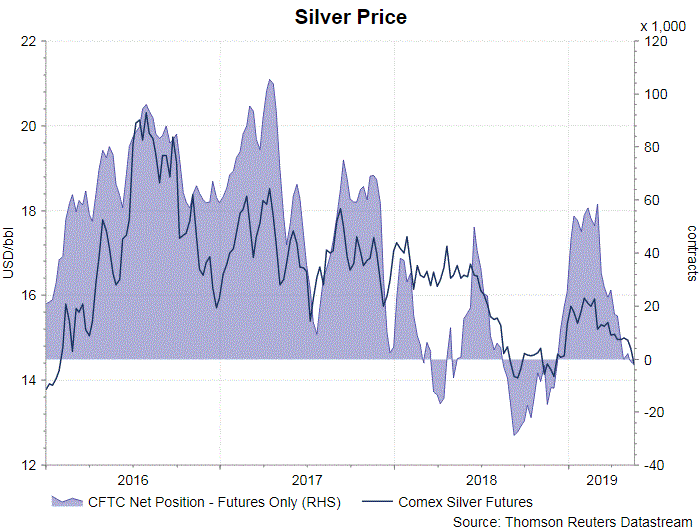
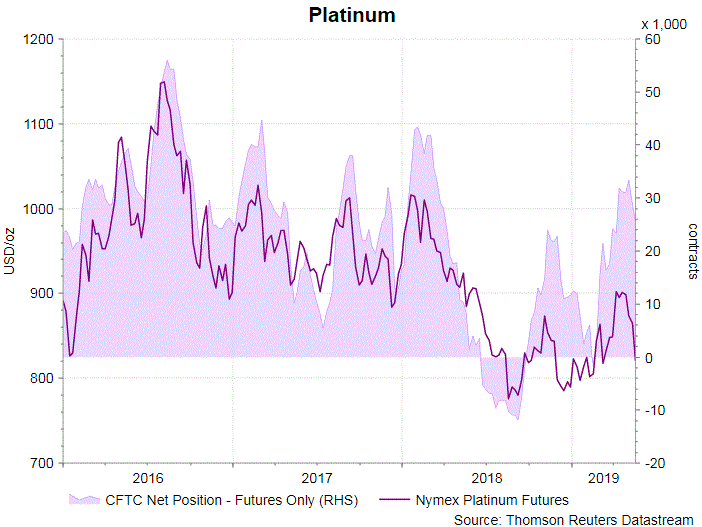
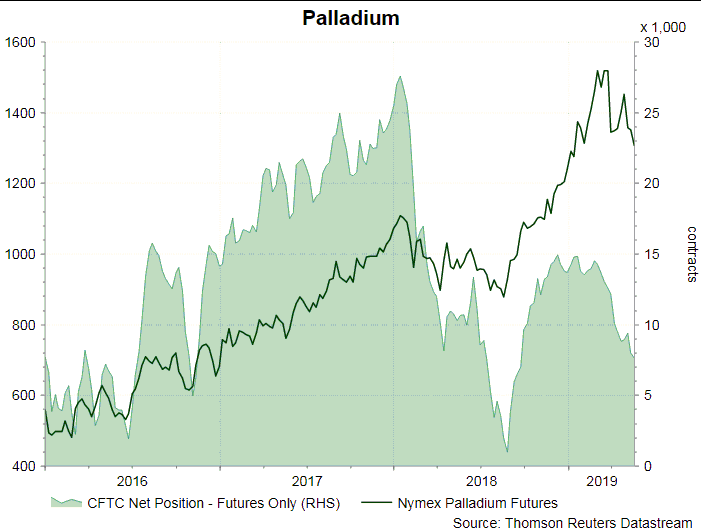
Gold's safe haven demand jumped sharply. NET LENGTH for gold futures surged +49 125 contracts, to 124 536 last week. Speculative long positions soared +40 560 contracts, while shorts plunged -8 565, resulting in the rise in NET LENGTH. We expect the increase in NET LENGTH for gold to stabilise in the coming week as the recent rally take a breath. For silver futures, speculative long positions added +196 contracts while shorts rose +1 448. These resulted in an increase in NET SHORT to 2 209 contracts. For PGMs, NET LENGTH of Nymex platinum futures declined -2 943 contracts to 25 750 while that for palladium decreased -359 contracts to 7 621.
Forex Forecast and Cryptocurrencies Forecast
First, a review of last week’s events:
EUR/USD. The upcoming elections to the European Parliament, as well as multi-episode confusion with Brexit continue to put pressure on the European currency. Even the escalation of tensions in the US-China trade war does not help the euro: despite the fighting mood of the PRC leadership, the markets are betting on the US victory. And the failure of China will automatically exacerbate the problems of the closely related Eurozone.
Recall that, giving a monthly forecast, 70% of experts have expressed an opinion that the pair will continue to move along the medium-term downward channel and will again test the low of the end of April 1.1110. The past week was a confirmation that this forecast was correct: the pair lost about 80 points in five days and finished not far from the set goal, at around 1.1155;
GBP/USD. Nothing new has happened here, and the movements of this pair still depend on just one short word, Brexit. Last week, we expressed the opinion that Prime Minister May would not be able to solve this problem at all. And now the media is full of headlines about her inevitable resignation. The impossibility (or inability) of the government to negotiate with the opposition brings the pound down. As a result, the pair easily broke through the April lows and, starting the week from 1.3000, completed it at 1.2715, losing 285 points;
USD/JPY. The result of the last week for this pair is almost zero, the difference in quotes between midnight on Friday, May 10 and midnight on May 17 did not exceed 10 points, and the pair ended the week at 110.00;
Cryptocurrencies. Few people had expected this: in six days, Bitcoin quotes soared by 30%, reaching $8,335 on Thursday May 16 and exceeding the most optimistic forecast of experts by almost $1,000. The increase since the beginning of the year has made 120%, which, according to Tom Lee, co-founder of Fundstrat Global Advisors, means the arrival of the next season after the crypto winter, "crypto spring".
The reason for such a “spring” mood was the closure of short positions by major players and the opening of long ones at the level of $5,500-6,000, after which numerous small investors joined them. Some experts also believe that a sharp aggravation in the trade war between the United States and China played a role, after which Chinese investors decided to protect their capital by investing in Bitcoin.
However, the main cryptocurrency has failed to firmly fix at the heights taken. Part of the players began to fix profits, and by Friday evening, May 17, the BTC/USD pair slipped to the level of $7,000, losing more than half of the gains won from the bears and leaving those who had opened long positions above this zone, counting possible losses.
As for the main altcoins, as usual, they followed their “elder brother”, repeating its rise and its fall. As a result, Litecoin (LTC/USD) increased by 11% over the past week, Ripple (XRP/USD) by 25%, and Ethereum (ETH/USD), showing the best result, by 30%.
As for the forecast for the coming week, summarizing the opinions of a number of analysts, as well as forecasts made on the basis of a variety of methods of technical and graphical analysis, we can say the following:
EUR/USD. The greatest interest this week is focused on the American Fed. The head of this organization, Jerome Powell, will speak at the annual conference on financial markets on Tuesday, May 21, with a report on the risks of the US financial system. And the next day, the minutes of the Fed's Open Market Committee meeting of May 1 will be released. Investors are looking forward to what will be said in the report and in the protocol on the future monetary policy of the Fed, as well as what forecasts will be made there on the US economy.
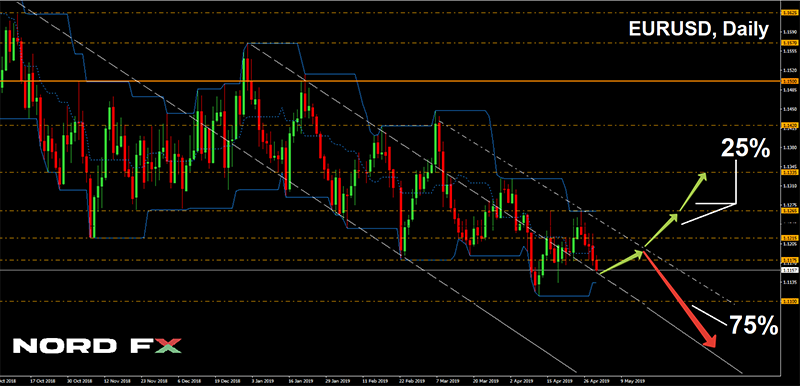
At the moment, the situation looks quite optimistic, and 75% of experts, supported by the overwhelming majority of oscillators and 100% of trend indicators on H4 and D1, expect the US currency to strengthen further. In their opinion, the pair will definitely try to break through support in the zone of the April lows and will drop below the level of 1.1100.
At the same time, 15% of oscillators warn of the pair being oversold. A correction to the north is also expected by 25% of analysts and graphical analysis on D 1, which draws the rise of the pair to the resistance of 1.1265, and possibly even higher, to a height of 1.1335. However, as already mentioned, the events listed above on May 21 and 22 may have a strong influence on the behavior of the pair;
GBP/USD. It seems that the market does not know what other surprises can be expected in the next Brexit episodes. When will the resignation of May take place and which of the British parties will win the elections to the European Parliament? What will the next, fourth in a row, vote of the bill on the withdrawal of Great Britain from the EU bring? There are more questions than answers, and in such a situation, the majority (60%) of the experts simply shrug. The rest of the experts are equally divided, giving 20% of votes to the bulls and the same to the bears.
As for the readings of the indicators, they are exactly the same as for EUR/USD. Similarly, 15% of oscillators are in the oversold zone, and graphical analysis on D1 insists on upward corrections. The support levels are 1.2665, 1.2614, 1.2475 and 1.2400. The resistance levels are 1.2865, 1.3000 and 1.3165.
It should be noted that in the transition to the forecast for the coming months, the number of supporters of bulls, waiting for the rise of the pair above 1.3200, increases to 65%. The increase of the consumer price index (CPI), which will be published on Wednesday May 22, and is projected to grow from 1.9% to 2.1%, may help the pound sterling this week;
USD/JPY. Data on Japan's GDP growth will be released on Monday, May 20, and analysts expect it to be zero. Such a result could be a bad signal for the yen, and it will continue its retreat against the dollar. 50% of analysts expect the pair to rise to the height of 111.00. A third of experts believe that the pair will move in the range of 109.00-110.00. As for the remaining 20%, in their opinion, the Japanese currency will strengthen to the values around 108 yen per $1.
At the same time, almost all experts agree that the main trends for this pair will be determined not in Tokyo, but in the USA, and depend on the Fed's forecasts on Tuesday and Wednesday, as well as the course of battles on the fields of the US-China trade war.
Cryptocurrencies. Despite the bad news last Friday, crypto bulls along with crypto hamsters, who obtained their bitcoins back in the autumn of 2017, hope that the fall of the BTC/USD pair to the $7,000 mark is just a correction, and Bitcoin will soon continue to grow. About 50% of experts agree with them. The target for the coming months is the height of $10,000. And in the opinion of the Canaccord Genuity analysts, the BTC rate will reach $20,000 over two years. “We have found a coincidence between the periods of 2011-2015 and 2015-2019 and have realized that the first cryptocurrency operates within the framework of four-year cycles. This is confirmed by the fact that the decrease in the miner’s reward occurs every four years,” their statement says.
A quarter of experts suggest that the pair will find it difficult to consolidate above the resistance level of $8,500 (it was there that its growth stopped last July) and for some time it will move closer to this horizon, then moving away from it.
And finally, the remaining 25% of analysts predict Bitcoin to decline to support $6,000, based on which the pair moved from February to November 2018.
EUR/USD Weekly Outlook
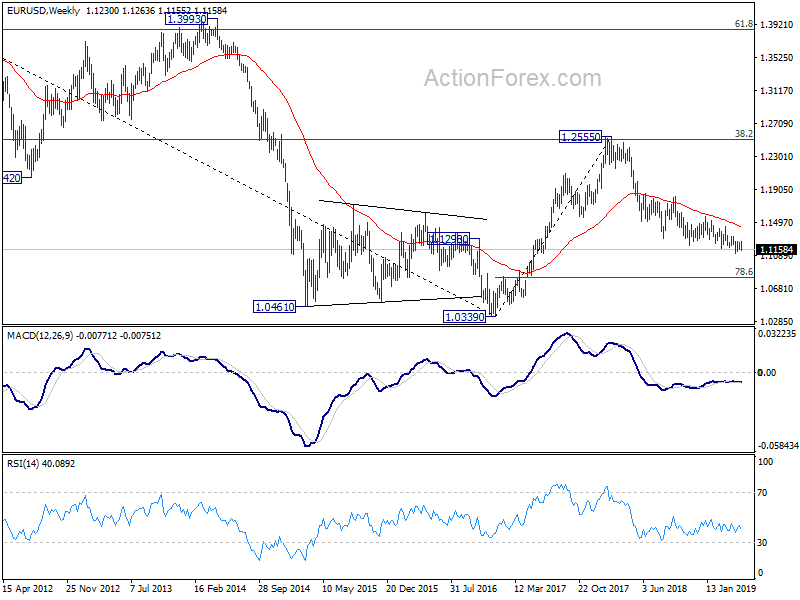
EUR/USD's decline and break of 1.1173 support last week suggests that consolidation pattern from 1.1111 has completed at 1.1263, after hitting 55 day EMA. Initial bias remains on the downside this week for retesting 1.1111 first. Break will resume larger down trend for 100% projection of 1.1448 to 1.1183 from 1.1324 at 1.1059. Though, on the upside, above 1.1224 minor resistance will turn bias back to the upside to extend the consolidation from 1.1111 first.
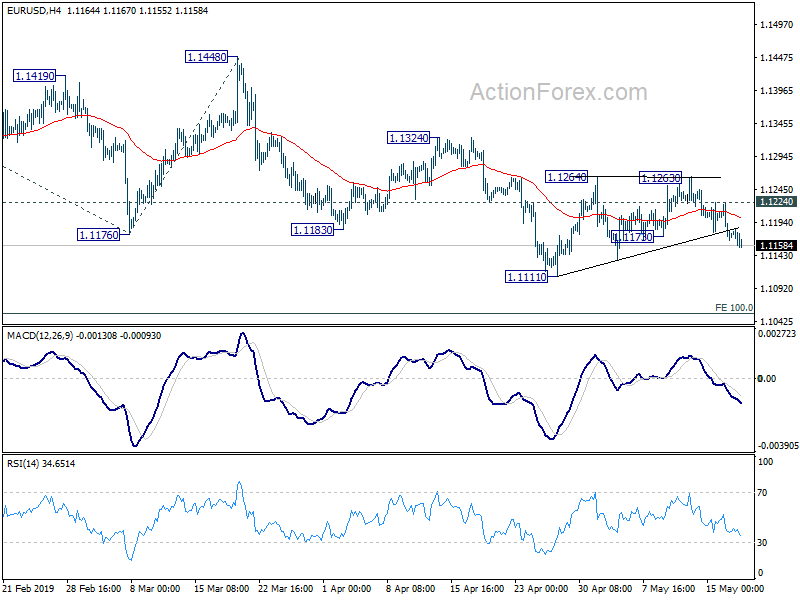
In the bigger picture, down trend from 1.2555 (2018 high) is still in progress. Such decline would target 78.6% retracement of 1.0339 (2016 low) to 1.2555 (2018 high) at 1.0813 next. Sustained break there will pave the way to retest 1.0339. On the upside, break of 1.1448 resistance is needed to be the first sign of medium term bottoming. Otherwise, outlook will stay bearish in case of rebound.
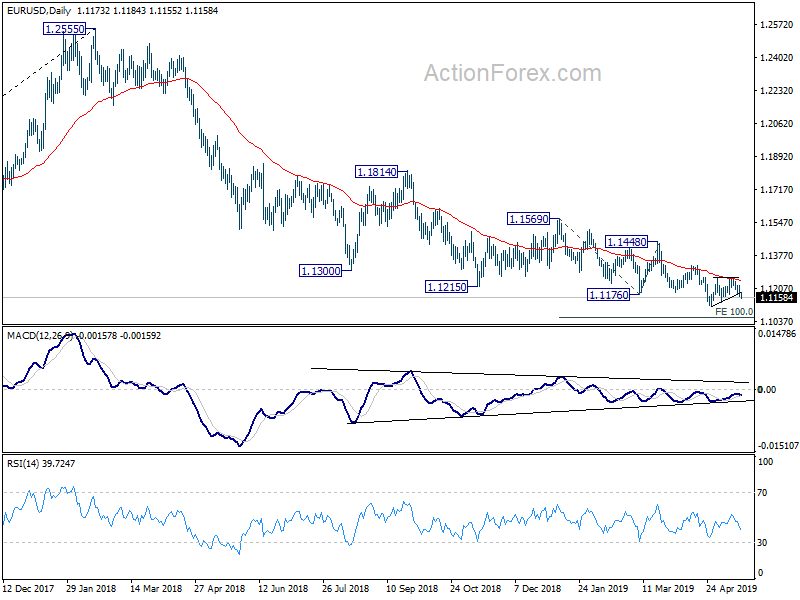
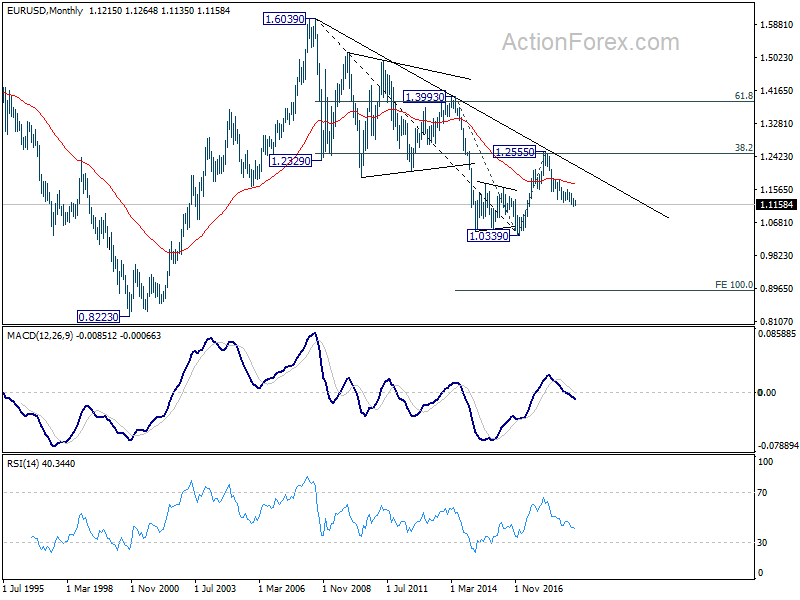
In the long term picture, the rejection from 38.2% retracement of 1.6039 to 1.0339 at 1.2516 argues that long term down trend from 1.6039 (2008 high) might not be over yet. EUR/USD is also held below decade long trend line resistance, 55 month and 55 week EMA. Break of 1.0339 will resume the down trend to 100% projection of 1.3993 to 1.0339 from 1.2555 at 0.9501