

Sample Category Title
CHF, USD & JPY Surged on Deals, Sterling Plummeted
Deal, deal, deals. They're the main themes in the markets last week. The cross-party Brexit talks in UK collapsed and a high profile Brexiteer is tipped to lead the Brexit process after current Prime Minister steps down. Tensions between US and China escalated further. A trade deal is now rather out of sight, not even a next meeting. While the decision on auto tariffs was postponed, US did confirm auto imports as national security threats. Major exporters like EU and Japan will have six months to make a deal with the US, or we'll see US-led trade wars escalating further. Nevertheless, the better news was that a deal was agreed between US, Canada and Mexico to eliminate steel and aluminum tariffs.
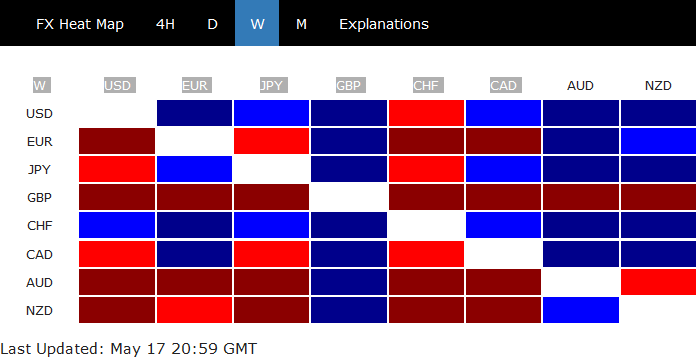
In the currency markets, Sterling ended as the worst performing one on Brexit uncertainties, and probably increasing chance of a no-deal one. Australian and New Zealand Dollars were the weakest ones on risk aversion, and poor economic performance in China. Swiss Franc, Dollar and Yen were the strongest ones on risk aversion and falling global treasury yields. Also, it should be noted that Chinese Yuan tumbled sharply with USD/CNH eyeing the important psychological level of 7.0.
US, Canada and Mexico - Steel tariffs and USMCA
Some good news first. In a joint announcement, US, Canada and Mexico said a deal was reached to remove Section 232 steel and aluminum tariffs, and related retaliatory tariffs. Under the agreement, aggressive monitoring and a mechanism will be set up to "prevent surges in imports of steel and aluminum.". US may re-impose the Section 232 tariffs if surges occur. And retaliation by Canada and Mexico would then be "limited to steel and aluminum products" only.
With the most important hurdle cleared, the three countries could see the USMCA ratified by respective parliament rather quickly.
US, EU and Japan - Auto tariffs
It's true that Trump annonced to delay decisions on auto tariffs by 180 days. But the most important point of the announcement is that auto imports are delcared as threat to national security of US. Their rationale is that the countries' defense and military superiority depend on the competitiveness and R&D of its automobile industry.
Competitiveness of US-owned auto companies waned in the past decades, with domestic market share dropped from 67% in 1985 to 22% in 2017. ALso, global market share dropped fom 36% in 1995 to 12% in 2017. Defense purchases alone are not sufficient to support R&D in key automotive technologies. Ann they claimed that "domestic conditions of competition must be improved by reducing imports."
Later, Trump also repeated his accusation of EU as treating the US "worse than China, they're just smaller". Nevermind that there was no explanation on how EU is worse comparing to China's IP theft, forced technolgy transfer, or unfair competition with state-owned enterprises. Still, the message is clear, a delay is only a delay. Auto tariffs threats remain there and EU's retaliations are ready (probably Japan too). Of course, until deals are made.
US and China - Full-blown trade war
On the US side, the latest round of 25% ofon US 200B of tariffs took effect on May 10 already. Public comments on new tariffs on USD 300B in Chinese products (essentially all remaining) started with hearing scheduled on June 17. US also announced double assault on China's telecom Giant Huawei.
Firstly, the U.S. Commerce Department is adding Huawei and 70 affiliates to its "entity List" that bans them from buying US technologies without government approval. Secondly, Trump signed an executive order banning US companies from using telecom equipment made by companies deemed to pose a national security risk. Simply speaking, the decision was to prevent American technology from being used by foreign-owned entities in ways that potentially undermine U.S. national security or foreign policy interests.
On China's side, retaliation of new round of US tarrifs were announced, effective June 1. It's widely reported that China is not keen to resume negotiations, unless three core issues are resolved. They include elimination of all tariffs upon an agreemnt, amount on additional purchases as part of the deal, the the "balance" of the text of the deal itself. China saw the requests regarding legislations as intrusion of its soverignity and dignity.
China side negotiations haven't broken down. Trump said he's going to mee Xi soon. But at this point, there is no scheduled meeting between the two delegations announced. And it's even unsure if anything would be done before G20 summit in Japan in June.
Cross-party Brexit talks collapsed in UK
The cross-party Brexit talks in UK collapsed after opposition Labour leader Jeremy Corbyn declared that talks ad "gone as far as they can" due to increasing weakness and instability of the Conservative government. He also declared that Labour will oppose May's Brexit deal when it returns to the parliament early June.
Prime Minister Theresa May promised to agree to a timetable for stepping down after another vote for the Brexit Withdrawal Agreement on June 3, regardless of the result. Boris Johnson, a high profile Brexiteer whoe prefers no-deal Brexit to the current deal, is currently the favorite among party members to replace May.
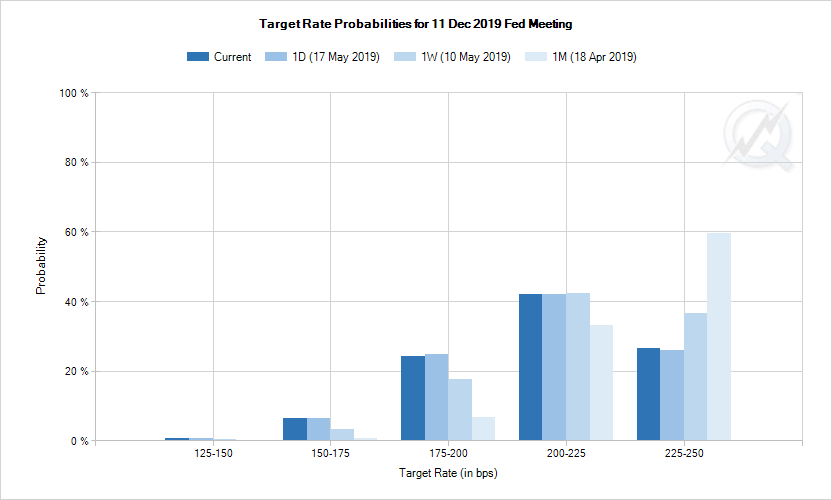
Market pricing in 73.4% chance of Fed rate cut by December
Before going into some charts, we'd like to point out that according to Fed fund futures, markets are now pricing in 73.4% chance of a Fed cut by December FOMC meeting. That's higher than around 63.5% a week ago, and way higher than around 40% chance a month ago.
DXY on track to extend medium term up trend
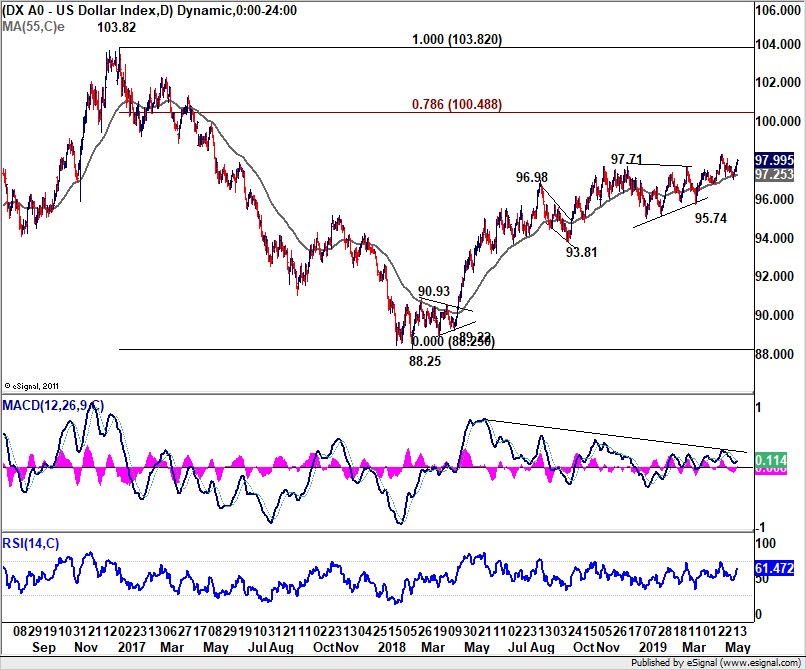
But Dollar Index actually ended higher even though markets are increase bets on Fed cut. Upside momentum in DXY hasn't been too convincing. Nevertheless, strong support from 55 day EMA was a bullish sign. From medium term point of view, outlook stays bullish with 95.74 support firmly intact. DXY is on track to 78.6% retracement of 103.82 to 88.25 at 100.48.
Bearish view in DOW still holds after late rebound
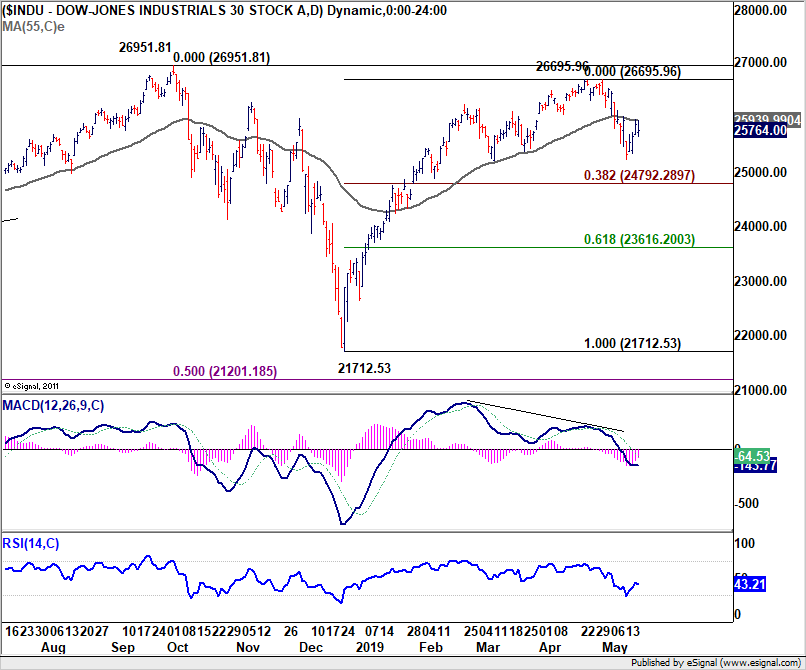
Stocks apparently received little support from Fed cut speculations. DOW dropped to as low as 25568.06 last week then recovered. Though, upside was limited by flat 55 day EMA so far and more downside is still expected to 38.2% retracement of 21712.53 to 26695.96 at 24792.28 at least. We're still seeing fall from 26696.96 as the third leg of consolidation pattern from 26951.81. Sustained break of 24792.28 will affirm our bearish view. Meanwhile, the main risks to this view is the lack of confirmation from S&P 500 and NASDAQ so far. But have indeed rebounded to close above 55 EMAs. It will probably take a while for the three indices to sort themselves out.
10-year yield on track to break 2.356 low
Development in 10-year yield provide missing piece that could tie everything together. TNX dropped to as low as 2.361 before closing at 2.393. Some support was seen above 2.356 low but there is no loss of downside momentum yet. We'd expect further decline through 2.356 to 50% retracement of 1.336 to 3.248 at 2.292 at least. We'd actually expect further fall through this 2.292 to 61.8% retracement at 2.066, which is close to 2.0 handle.
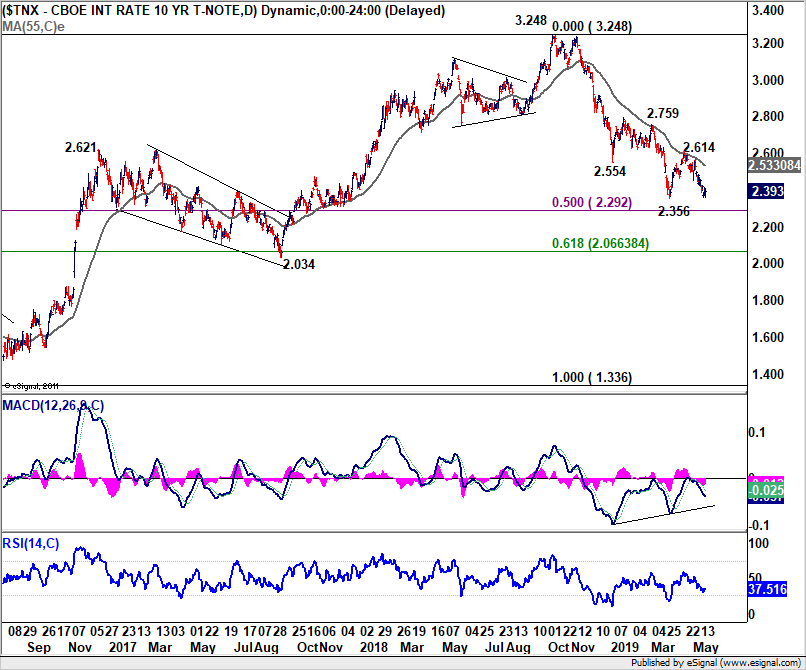
With 3-month yield at 2.389, the 3-month-10-year yield curve should eventaully inverts persistently, unless Fed cuts interest rates. That would be inline with sharp slowdown in the US economy ahead, even withou recession. Stocks selling should finally pickup momentum to align with such development. In such case, there will be spillover to other economies, in particular emerging markets, which could be affected by China too. And global risk aversion will help lift Dollar. We'll see if that's how things develop in the months ahead.
GBP/USD Weekly Outlook
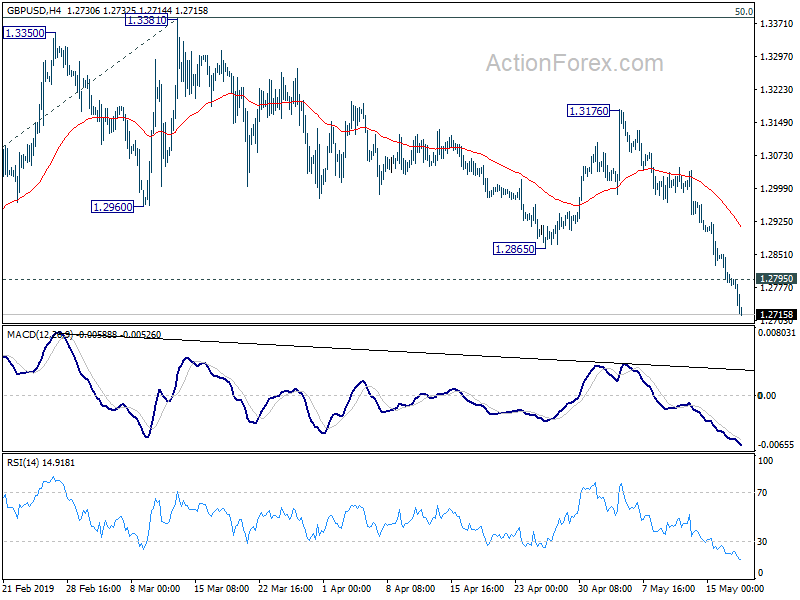
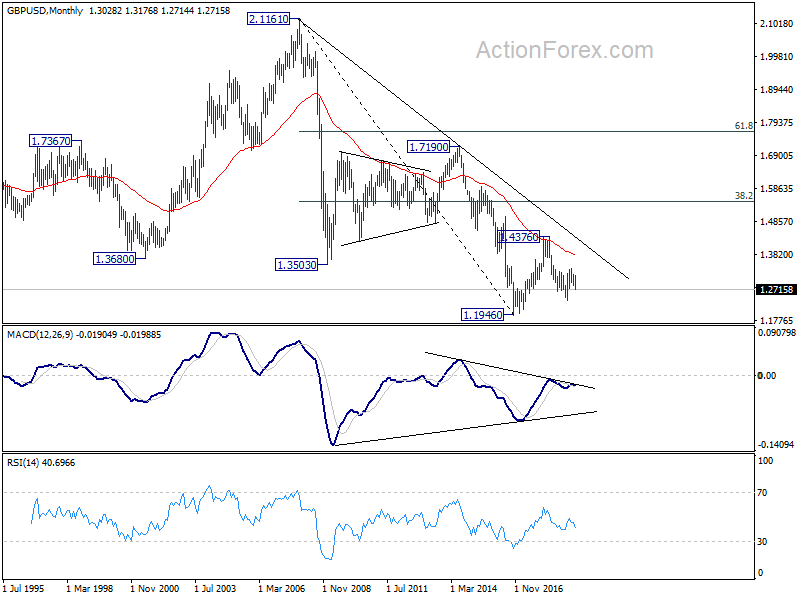
GBP/USD's decline accelerated to as low as 1.2714 last week. The development confirmed completion of corrective rebound from 1.2391 at 1.3381. Larger decline from 1.4376 might be resuming. Initial bias stays on the downside this week for retesting 1.2391 low first. Break will target 61.8% projection of 1.4376 to 1.2391 from 1.3381 at 1.2154 next. On the upside, On the upside, above 1.2795 minor resistance will turn intraday bias neutral for consolidation first before staging another decline.
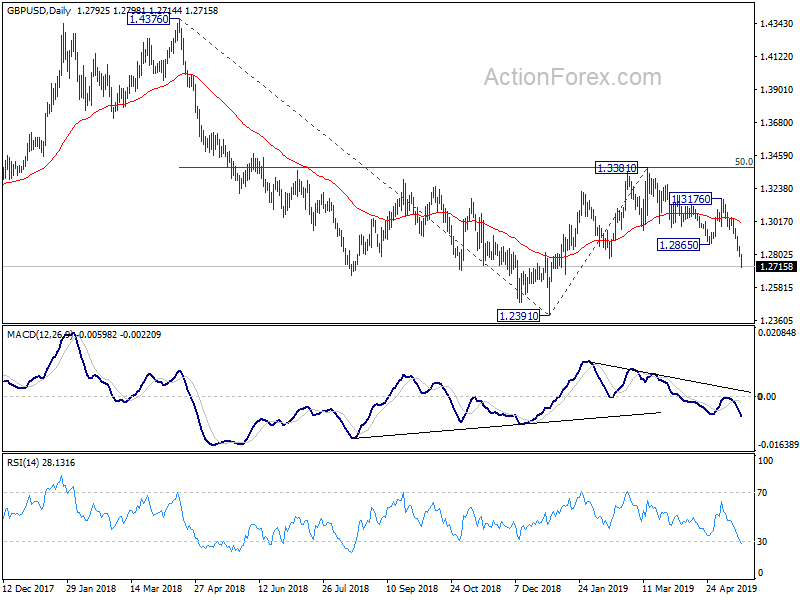
In the bigger picture, current development suggests that medium term decline from 1.4376 (2018 high) is not completed, and is possibly ready to resume. Decisive break of 1.2391 would target a test on 1.1946 long term bottom (2016 low). For now, we don't expect a firm break there yet. Hence focus will be on bottoming signal as it approaches 1.1946. In any case, medium term outlook will stay bearish as long as 1.3381 resistance holds, in case of rebound.
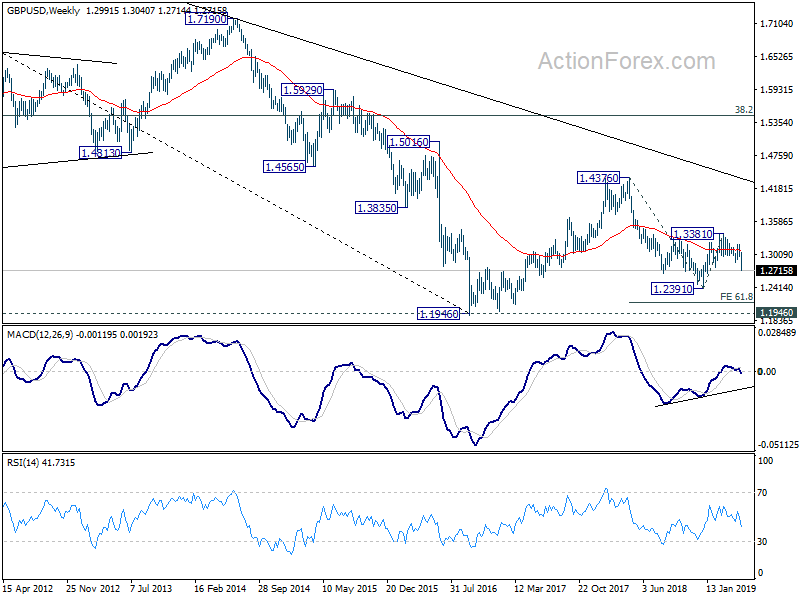
In the longer term picture, consolidative pattern from 1.1946 (2016 low) could still extend with another rising leg. But after all, decisive break of 38.2% retracement of 2.1161 (2007 high) to 1.1946 at 1.5466 is needed to indicate long term reversal. Otherwise, an eventual downside breakout will remain in favor.
US, Canada and Mexico reached deal to remove steel and aluminum tariffs
In a joint announcement, US, Canada and Mexico said a deal was reached to remove Section 232 steel and aluminum tariffs, and related retaliatory tariffs.
Under the agreement, aggressive monitoring and a mechanism will be set up to "prevent surges in imports of steel and aluminum.". US may re-impose the Section 232 tariffs if surges occur. And retaliation by Canada and Mexico would then be "limited to steel and aluminum products" only.
With the most important hurdle cleared, the three countries could see the USMCA ratified by respective parliament rather quickly.
Summary 5/20 – 5/24
Monday, May 20, 2019
[php_everywhere instance="1"]
Tuesday, May 21, 2019
[php_everywhere instance="2"]
Wednesday, May 22, 2019
[php_everywhere instance="3"]
Thursday, May 23, 2019
[php_everywhere instance="4"]
Friday, May 24, 2019
[php_everywhere instance="5"]
Weekly Economic and Financial Commentary: Two Steps Back and One Step Forward
U.S. Review
Two Steps Back and One Step Forward
- Retail sales stumbled again in April, falling 0.2%. Core retail sales were flat and suggest the Q2's bounceback in consumer spending may not be as strong as previously thought.
- Output in the manufacturing sector fell 0.5% in April. The industry was already struggling before the recent trade war escalation due to slower global growth and the stronger dollar.
- Housing starts increased 5.7% in April and point to residential investment growing in Q2 for the first time in six quarters.
At Least Housing is Looking Better
Trade tensions were top of mind again this week, with markets keeping a close eye on negotiations between the U.S. and China as well as the Trump administration's decision to impose broad tariffs on auto-related imports (the decision was delayed six months). Consumer spending and business investment were already looking somewhat shaky before the most recent tumult, however.
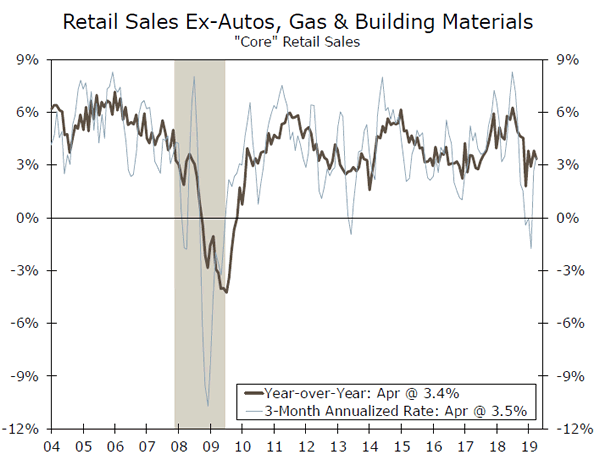
Retail sales stumbled again in April, falling 0.2%. As expected, weaker auto sales dragged down the headline, but core sales were also flat. We continue to expect consumer spending to strengthen in the second quarter after a paltry showing in Q1. Personal spending jumped 0.9% in March, which puts outlays in a good spot to start the quarter. Continued strength in the labor market, including a 16K drop in initial jobless claims this week, should further underpin a rebound. However, April's underwhelming retail sales report suggests the pickup may be more modest than previously thought.
Near-term growth does not look to be getting much help from manufacturing and business investment either. Industrial production fell 0.5% in April. A drop in utilities output offset an increase in mining. The real sore spot in the report, however, was the 0.5% drop in manufacturing output. Consistent with softness at the retail level, auto production fell 2.6%, but just as weak was production of machinery—an ominous sign for business investment. Output in the manufacturing sector has not risen since December and is down 1.6% since then.
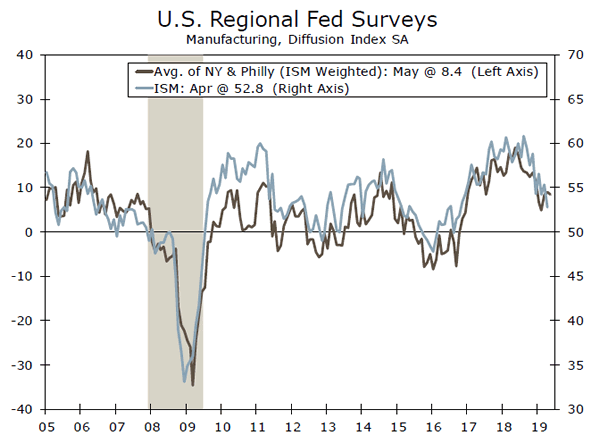
In early May, there were at least a few glimpses of factory activity beginning to turn around. Both the Empire and Philly Fed surveys improved more than expected in May. General sentiment was a bit better than the details when looking at each index on an ISM-weighted basis (the headline for each survey is derived from a separate question on general business conditions). One factor weighing both ISM-weighted Fed indices, however, was a contraction in inventories. Given the massive build in the first quarter, a reduction was inevitable and suggests orders remain strong enough to where production should firm up soon, barring a further escalation in the trade war.
With tariffs upped at the tail-end of the survey periods for the Empire and Philly Fed indices, May's improvement in general sentiment may be short-lived. The same may prove true for small businesses. The NFIB Small Business Optimism Index rose to a four-month high in April, but smaller firms have less bargaining power with suppliers and are therefore more susceptible to higher input costs. Owners had already begun reporting poor sales as a growing concern, suggesting limited scope to pass on higher prices.
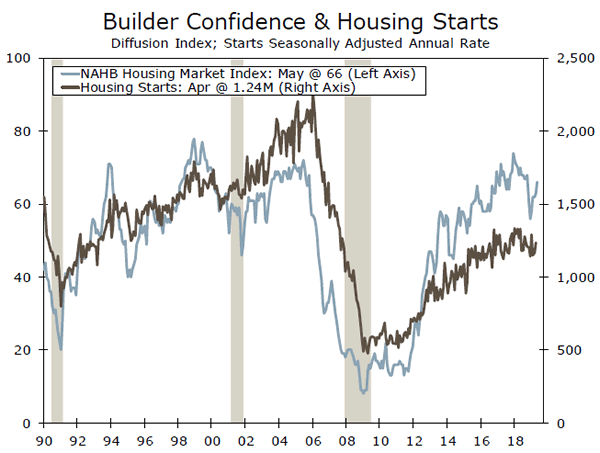
At least the recent pickup in the housing market remains on track. Housing starts rose 5.7% in April. Building permits also improved, and do not look to have been quite as low as previously thought. The pullback in mortgage rates, lower material costs and improved builder sentiment should help to keep the rebound in residential construction intact.
U.S. Outlook
Existing Home Sales • Tuesday
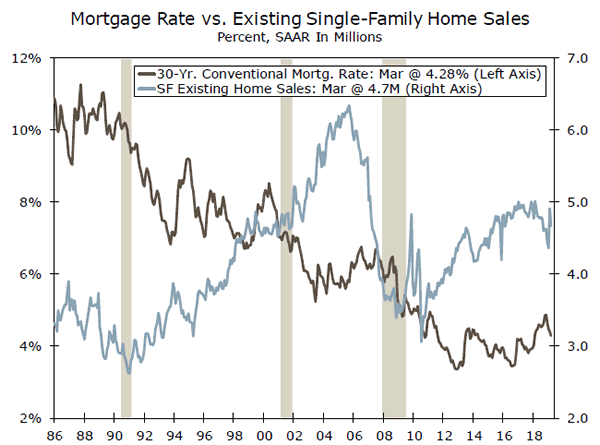
Sales of existing homes gave back some February's 11.2% surge and fell 4.9% during March. Sales declined in each of the four census regions last month; however, the National Association of Realtors noted that the pullback was most acute in higher-priced markets adversely impacted by new limitations on state and local tax deductions brought on by the new tax law.
While resales have been running somewhat soft, they are by no means weak and have averaged a 5.21 million-unit pace in the first three months of the year. Demand has been comparatively stronger at more affordable price points, where inventory is still relatively scarce. Overall, we look for a sturdy gain in existing home sales during April. Mortgage rates remain low, which has led to purchase applications steadily trending higher. Furthermore, pending home sales, which represent signed contracts and lead closings by a month or two, rose 3.8% during March.
Previous: 5.21M Wells Fargo: 5.37M Consensus: 5.35M
New Home Sales • Thursday
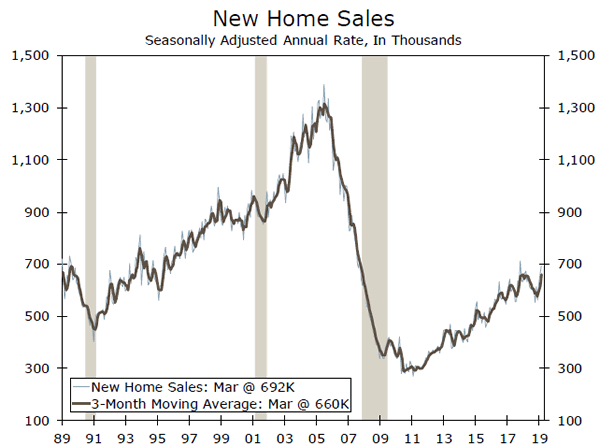
The broad improvement in buying conditions should keep new home sales on an upward trend over the next several months. That said, a repeat of last month's 4.5% surge in sales is unlikely. We look for a modest drop in sales to a still-solid 685,000 unit pace during April.
Similar to resales, new home sales have been strengthening at lower price points. During March, an estimated 50% of sales were priced below $300,000, which is up from around the 43% average during 2018. Homebuilders have mostly responded in kind and shifted their focus toward constructing lower-priced homes. Builders have also responded to rising inventories by offering price discounts to entice potential buyers off the sidelines. As a result, the median sales price fell 9.7% year-over-year to $302,700 in March, the fifth consecutive drop (by that measure). Easing home prices and lower mortgage rates should lay the groundwork for a modest pickup in new home sales over the next few months.
Previous: 692,000 Wells Fargo: 685,000 Consensus: 677,000
Durable Goods Orders • Friday
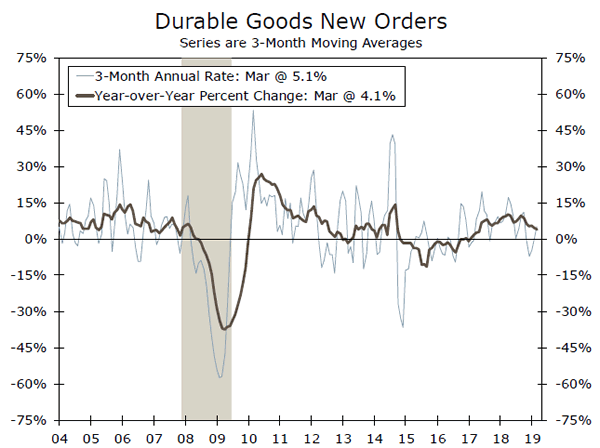
Durable goods orders rebounded in March, rising 2.6%. February's initial 1.6% drag was also revised higher to a more moderate 1.3% decline. In recent months orders have been influenced by aircraft orders, which tend to be highly volatile. The commercial aircraft sector is likely to reprise its starring role in April's report. The grounding of the Boeing 737 MAX and subsequent negative headlines have led to net cancellations, which will weigh heavily on April's outcome as aircraft orders account for roughly 10% of the total. As a result, we expect total orders fell 3.8% during April.
Industrial production fell 0.5% during April, and the machinery production component dropped 2.6%, an indication that weakness in durable goods orders may extend beyond the aircraft sector. Excluding transportation, we look for March's 0.4% gain to be followed by a 0.2% decline during April.
Previous: 2.6% Wells Fargo: -3.8% Consensus: -2.0% (Month-over-Month)
Global Review
Global Trade Relations Continue to Dominate Headlines
- Trade tensions between the U.S. and China continue to escalate, with China officially announcing reciprocal tariffs on $60B of U.S. exports. Chinese state media suggested trade negotiations are on hold for now; however, President Trump has indicated he will meet with President Xi at the G20 summit to discuss trade relations between the two countries.
- Despite deteriorating trade relations with China, President Trump has delayed imposing tariffs on autos and auto parts for 180 days. Optimism surrounding the USMCA trade agreement has increased as media reports suggest the U.S., Mexico and Canada are close to a deal to lift tariffs on steel and aluminum.
Global Trade Relations Remain in Focus
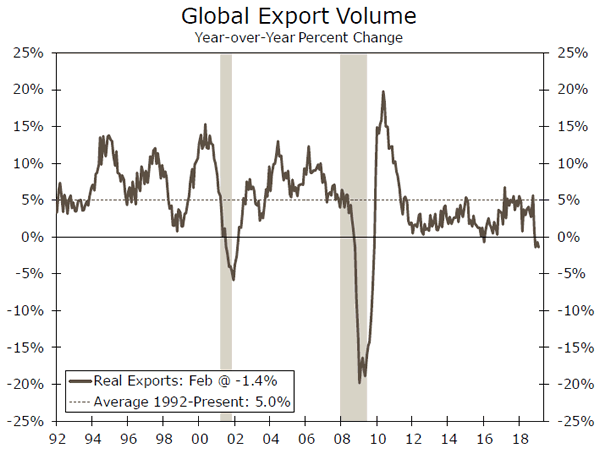
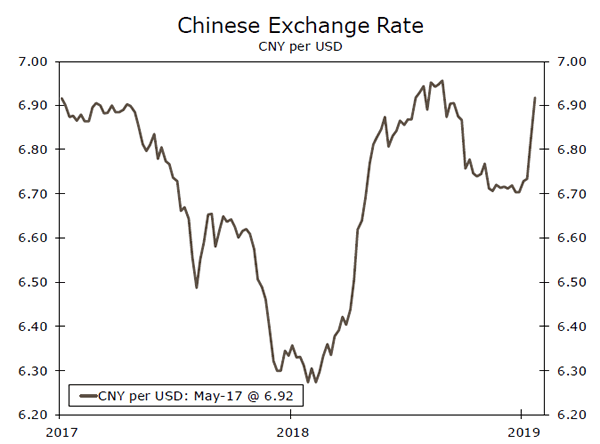
Following President Trump's increase in tariffs on Chinese exports, relations between the major trading partners continue to stay in focus and impact global financial markets. U.S.-China trade tensions continue to dominate headlines, with China officially announcing retaliation measures, placing reciprocal tariffs on $60B of U.S. exports to China. In response to China's tariffs, the U.S. administration has escalated trade tensions even further, with President Trump recently signing an order designed to restrict major Chinese corporations from accessing U.S. markets. Should the U.S. move forward with implementing these restrictions, this would risk damaging relations with China even further and make finding common ground towards making a comprehensive trade deal more challenging. President Trump also suggested Chinese authorities have a one month timeframe to agree on a trade deal or the remaining $300B in Chinese exports could be subject to tariffs as well. Given the hardline approach by the United States, Chinese state media suggested trade negotiations may be on hold for now; however, President Trump has indicated he will meet with Chinese President Xi at the upcoming G20 meeting in mid-June to discuss trade relations. We expect financial markets to remain volatile in the lead up to the G20 meeting, with any further escalation likely to put additional pressure on the Chinese renminbi.
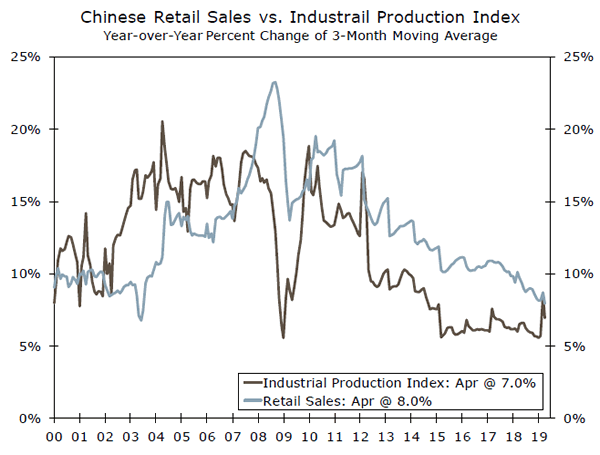
While existing tariffs have not had a material impact on the Chinese economy, Chinese economic data released this week underperformed expectations. Chinese industrial production in April increased 5.4% year-over-year, missing consensus forecasts of 6.5%, while retail sales rose only 7.2% year-over-year, also softer than expectations for an increase of 8.6%. China's weaker-thanexpected economic activity data have renewed concerns that global GDP growth may be decelerating more quickly than previously forecasted. Should the United States move forward with 25% tariffs on all of China's exports, we would expect a more pronounced impact on global GDP growth, as well as China's domestic growth trajectory.
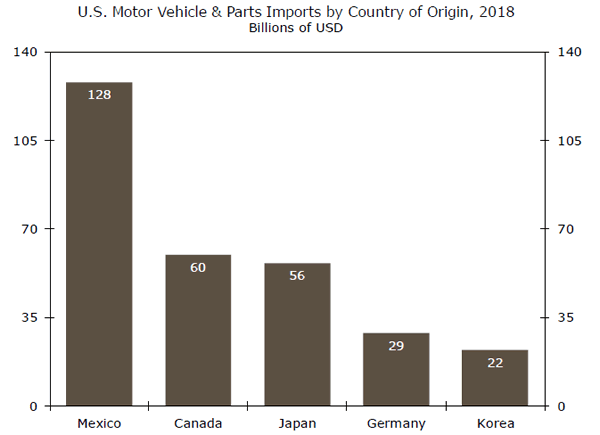
Despite elevated trade tensions between the United States and China, President Trump provided some temporary optimism for global trade relations, as he decided to delay the imposition of tariffs on autos and auto parts coming into the United States. Similar to the China deadline, President Trump has given the EU and Japan 180 days to make a deal on how to limit the number of autos and auto parts being exported to the United States, once again citing national security issues. While Mexico and Canada are two of the larger exporters of autos and auto parts to the United States, both countries would be protected under the new USMCA trade agreement. Although yet to be ratified by each country's respective congress, the U.S. administration provided renewed optimism for final ratification of the USMCA as well. Media reports suggest that the United States, Mexico and Canada are close to finalizing a deal which would remove existing tariffs on steel and aluminum. Should steel and aluminum tariffs be lifted, the prospects for the USMCA to be ratified would increase as tariffs have been a key point of contention to finalizing the USMCA trade agreement.
Global Outlook
Argentina Economic Activity • Wednesday
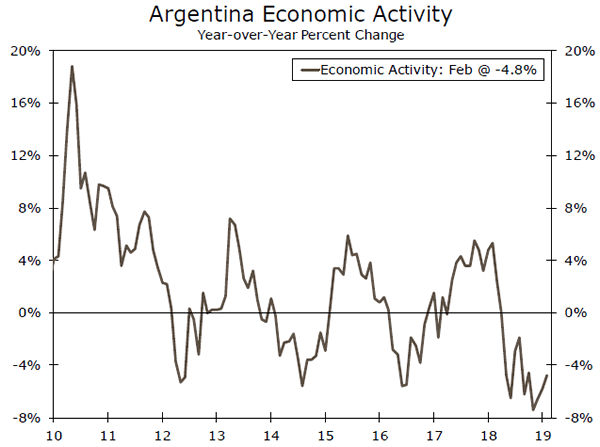
Argentina's economy remains in recession following the country's currency crisis and extreme monetary tightening in 2018. While we expected the economy to remain fragile, Argentina's economy has not recovered the way we expected it to at this point. The economic activity index, widely used a proxy for tracking Argentina's progress towards economic recovery, contracted 4.8% year-over-year in February and has been contracting on a year-over-year basis since May 2018. The health of the economy will likely play an important role in Argentina's presidential election later this year. In a recent poll, potential voters cited the health of the domestic economy as their primary concern. With the economic activity index likely to contract again in March, and with CPI inflation hitting a new high of 55.8% year-over-year in April, the probability of market-friendly Mauricio Macri being re-elected is likely to continue to decline even further.
Previous: -4.8% (Year-over-Year)
Australia PMIs • Wednesday
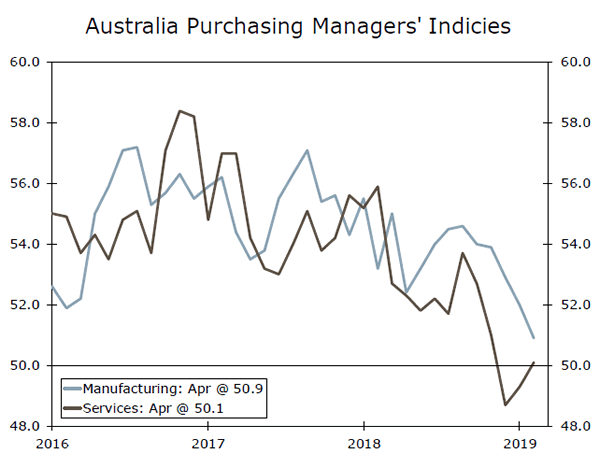
Australia's economy has been slowly deteriorating for some time now, as the country is particularly exposed to China's decelerating economy as well as U.S.-China trade tensions. Leading economic indicators suggest the economy will continue to slow, although next week's manufacturing and services PMIs may give markets an indication of just how pronounced the deceleration may be. As of now, both PMIs remain in expansion territory, but been trending lower since the end of 2018. Given the underwhelming performance of the economy, we believe the Reserve Bank of Australia (RBA) will look to ease monetary policy and cuts to its Cash Target Rate this year. Markets have taken a similar view as well, with implied policy rates pricing in two interest rate cuts from the RBA over the next 12 months. Policy rate cuts could help stabilize the economy, but any further escalation in U.S.-China tariffs would likely weigh on the economy.
Previous: 50.9 (Manufacturing), 50.1 (Services)
Eurozone PMIs • Thursday
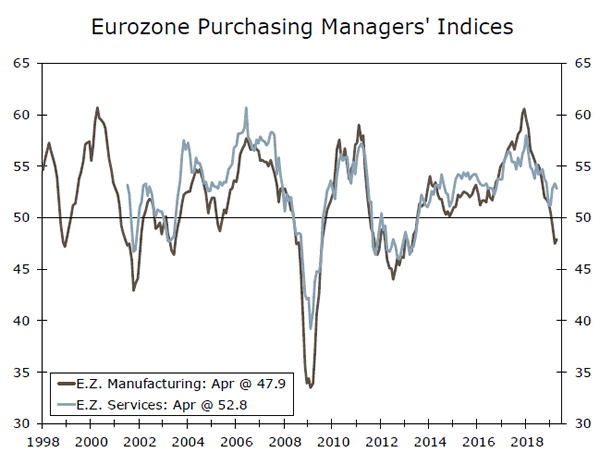
Despite soft manufacturing and a relatively subdued services sector, the Eurozone economy grew at a 0.4% quarter-over-quarter pace in Q1. However, we believe it is too early to say the European economy has bottomed out and is on the path to recovery, which should keep investors and ECB policymakers particularly focused on PMIs for any further indications of how the economy is performing. As of now, the services sector remains in expansionary territory, and despite expectations for a modest improvement, the manufacturing PMI is likely to remain in contraction for the time being. Amid a backdrop of a fragile economy and subdued sentiment data, we continue to believe ECB policymakers will remain on hold through the end of this year, but may look to reduce accommodative monetary policy in 2020 if a sustained recovery starts to takes shape.
Previous: 47.9 (Manufacturing), 52.8 (Services) Consensus: 48.1 (Manufacturing), 53.0 (Services)
Point of View
Interest Rate Watch
Rates Continue to Move Lower
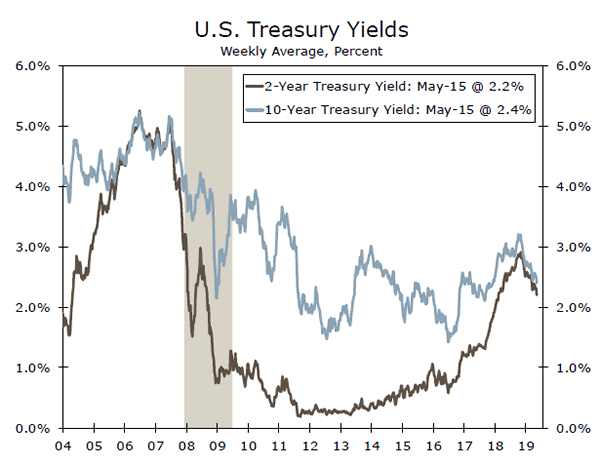
Yields on U.S. Treasury securities have generally been in retreat recently due to concerns over an escalating trade war. Not only has volatility in the stock market risen, which has led to safe-haven buying of Treasury securities, but market participants have inferred that the growth-depressing effects of a trade war would lead the Fed to cut rates. The yield on the 2-year Treasury security fell to a 15-month low this week, and the yield on the 10-year Treasury matched its low for 2019 (top chart).
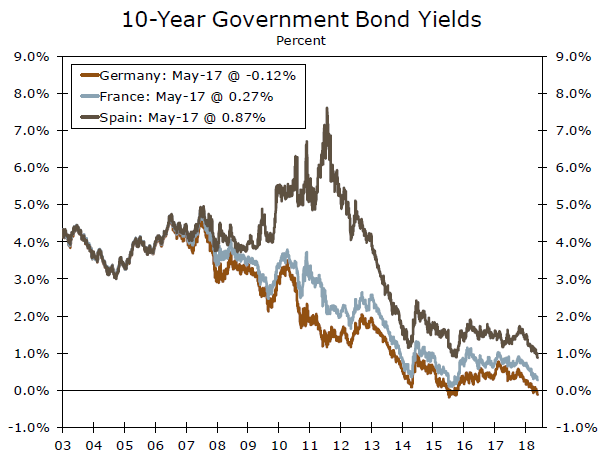
But lower government bond yields have not been confined solely to the United States. The yield on the 10-year German government bond fell to its lowest level in nearly three years this week (middle chart). Indeed, yields on German government bonds are negative out through the 10-year maturity. Yields on many other European sovereign bonds fell to multi-year lows this week as well.
As we have written previously, we believe that the Fed would look through any nearterm increase in inflation that would result from higher tariffs on U.S. imports. And we agree with the market assessment that a trade war would bring forward expected Fed rate cuts. A month ago, market pricing indicated that investors thought there was a 40% probability that the Fed would cut rates by the end of the year. That probability is nearly 80% today. Although we think that the odds of a Fed rate cut by December are significantly lower than 70%, we acknowledge that a full-blown trade war, should one occur, would lead the Fed to cut rates.
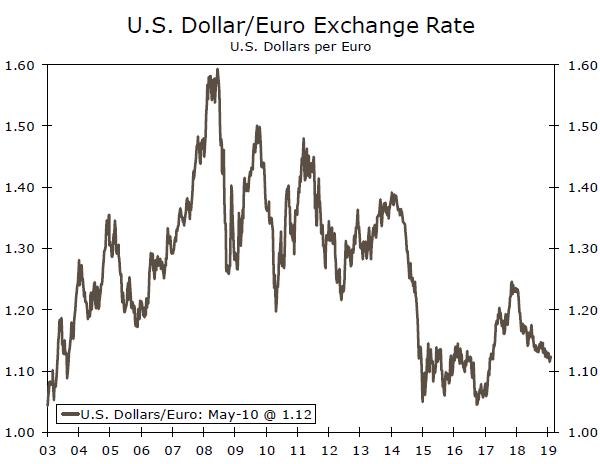
Although the odds of Fed easing have risen recently, the U.S. dollar has generally strengthened recently. As shown in the bottom chart, the euro is approaching a two-year low vis-à-vis the greenback. Although the odds of a Fed rate cut have risen recently, the probability of further easing by foreign central banks has also gone up. For example, the probability that the ECB would cut its deposit rate, which currently stands at -0.40%, was less than 10% a month ago. That probability today it is up to about 25%. Restrictions on imported cars, should they materialize, would be especially onerous for the German economy.
Credit Market Insights
All Quiet on the Treasury Front?
News this week from state-run media that Chinese officials were discussing large scale selling of U.S. Treasurys gave rise to fresh fears that China will use its sizable holdings of U.S. government debt as another front of the trade war to retaliate over tariff escalations. Hard data released on Wednesday revealed that China sold a net $20.4 billion of Treasurys in March, which was before the latest round of tariffs hikes but nevertheless its largest unloading in over two years. China has now reduced its holdings for five of the past six months. Yet yields have fallen significantly over this period, as domestic investors continue to be drawn to the risk-return tradeoff of U.S. government debt. While China is the largest foreign owner, its $1.1 trillion of holdings is a fraction of the $22 trillion of Treasurys outstanding. Any dramatic unloading of Treasurys would also be partially selfdefeating. A spike in yields would decrease the value of China's remaining portfolio of Treasurys, which represent perhaps the most viable option for its substantial foreign reserves, in terms of liquidity and yield. Moreover, selling would exert downward pressure on the dollar versus the yuan, hindering the competitiveness of Chinese exporters precisely at a time when they could use some relief. In short, rapid Chinese selling of Treasurys likely will not cause a significant spike in yields. Such a move would entail self-inflicted damage for China, while demand for U.S. government debt has been consistently robust and increasingly domestic.
Topic of the Week
All Trade Wars are Local
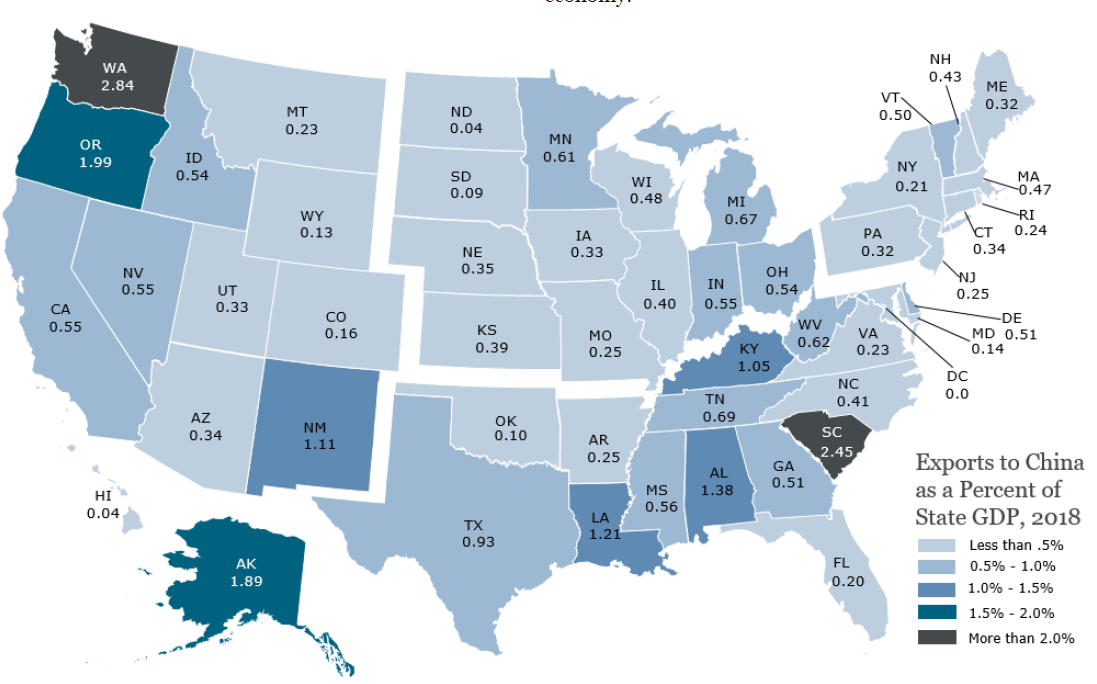
Beginning on June 1, China will raise tariffs on $60 billion dollars of U.S. goods to as high as 25%, in retaliation for a similar U.S. tariff hike on $200 billion of Chinese goods that took effect May 10. The S&P 500 fell almost 2.5% on Monday as the prospects of a prolonged and more pronounced trade war increased. Only around 7% of total U.S. exports head to China, and on a value-added basis, exports to China account for less than 1% of the U.S. economy. Yet this masks the underlying trade exposures of various states, some of which are much more susceptible to disruptions to trade with the world's second largest economy. Looking at exports to China as a percent of state GDP, Washington, South Carolina and Oregon are the most exposed—not surprising given that all are home to large port complexes and a bevy of advanced manufacturing firms. Texas leads on a dollar basis, exporting $16.6 billion to China in 2018, followed by California and Washington at $16.3 billion and $16.0 billion, respectively. Only one other state, South Carolina, exported more than $5 billion to China last year. The methodology is worth noting here. Exports reflect the 'origin of movement', which is where goods are consolidated. Agricultural products from inland states that are 'consolidated' at a port are therefore counted in the exports for the port state. The effect is to understate the export exposure of agriculturally focused states and overstate exposure for states with ports. Indeed, farmers have been hit particularly hard by retaliatory Chinese tariffs and plunging commodity prices, pushing the Trump administration to pledge as much as $20 billion in relief funds, despite the low exposure on paper. Moreover, the economic impact of trade extends well beyond the value of the goods in transit. For example, while manufactured goods produced and consolidated in Ohio are counted in that state's GDP, their transport and export from ports across the Eastern seaboard support an array of logistics and distribution jobs in various other states. Industry-level employment data in trade-dependent regions can thus serve as a harbinger for the rest of the nation, and provide clues to the extent of the trade war's effect on the broader economy.
The Weekly Bottom Line: Housing Market Stabilizing, Debt Risks Still Elevated
U.S. Highlights
- Equity markets rebounded this week as the U.S. administration delayed its decision on auto tariffs for six months.
- Housing starts and retail sales data for April support the narrative of healthy domestic spending this quarter.
- That said, externally oriented industries appear to be getting caught in the downdraft of weak foreign demand. Formerly resilient, U.S. manufacturing activity has softened this year, in line with global developments.
Canadian Highlights
- Canada's housing market showed further signs of stabilization in April with home sales rising 3.6%. Still, the market is highly fragmented between east and west. Activity is weak and relatively oversupplied in markets west of Ontario, but strong and relatively tight in Ontario and eastward.
- The Bank of Canada released its annual Financial System Review this week outlining its assessment of vulnerabilities to financial stability. Little surprise, the level of household debt topped the list. However, with slowing credit growth and tighter mortgage lending conditions this vulnerability was characterized as moderating relative to previous years.
- Inflation ticked up to 2.0% in April as energy prices advanced. Core inflation measures, on the other hand, ticked down, and on average are running just below the Bank of Canada's target.
U.S. - Domestic Resilience, But Weakness Abroad Taking a Toll
U.S. equity markets managed to shrug off much of last week's losses after rumors earlier this week, confirmed by the White House this morning, that the U.S. administration would delay a decision on auto tariffs for six months. However, this somewhat-renewed sense of optimism in equities was not shared by the bond market. U.S. Treasury yields hit lows last seen in late 2017, just prior to fiscal stimulus being announced. Moreover, markets are raising their bets that the Fed's next move will likely be a rate cut rather than a rate hike.
Unease about U.S. economic performance is building for good reason. Economic growth is set to moderate this year after a blowout, stimulus-fueled 2018. Foreign demand remains weaker than last year, while geopolitical risks and trade policy uncertainty appear to be on the rise. Moreover, high frequency indicators are beginning to diverge. Domestic demand remains resilient, but externally oriented industries are combatting stronger headwinds.
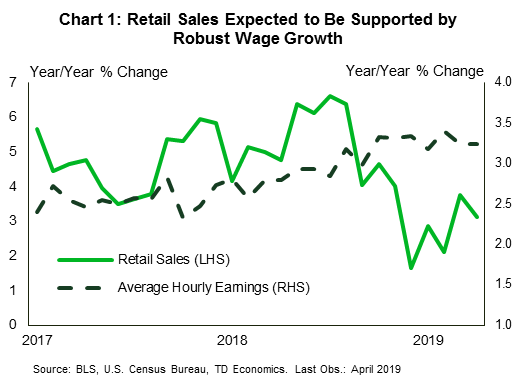
Data for retail sales and housing starts for April support the view that the domestic economy remains healthy. Although retail sales pulled back in April, this came after a very strong March. Some payback was to be expected. Even with the decline, the strength in March, alongside continued income gains supports a very healthy 3% quarterly annualized rate of expansion in consumer spending in the second quarter (Chart 1).
Housing starts, on the other hand, surprised to the upside. After December's dip, housing starts appear to have regained stronger footing, but activity has been choppy through April. Home builder sentiment is improving as well, reaching a 7-month high in May. Moderating home price growth, combined with lower mortgage rates, rising wage growth, and decades-low vacancy rates should support more homebuilding in the months to come.
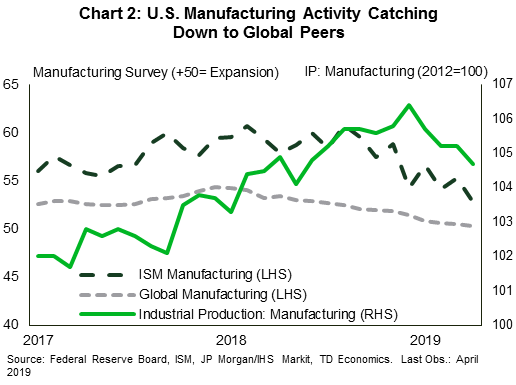
All told, the data this week remains consistent with our forecast for the U.S. economy to expand at a 2% annualized pace this quarter, largely on the back of a more confident consumer. That said, signs continue to build that this may be as good as things get for the rest of this year. Cracks are beginning to appear in what was previously a very resilient manufacturing sector. Industrial production contracted 0.5% in April, the third contraction monthly contraction this year. This mirrors the declining pace of output reported in the ISM manufacturing survey (Chart 2). Softer auto sales are partly to blame, as motor vehicle assemblies have fallen 12.8% since December's peak.
Although manufacturing is a relatively small share of the U.S. economy (about 11%), its performance is still considered a harbinger of the direction of the U.S. economy largely due to its sensitivity to changes in foreign demand. On that front, there are some signs that the global economy is gradually improving. However, escalating trade and geopolitical risks threaten to derail this nascent recovery.
Canada - Housing Market Stabilizing, Debt Risks Still Elevated
Global equity markets had a raucous week as China announced countermeasures in response to increased U.S. tariffs. Canada was pulled along for the ride, but despite declines early in the week it looks to have managed to scrape by with a modest gain as the week came to a close.
In terms of economic data, the key release this week was data on home sales, new listings and prices. Signs of a stabilization in housing demand continued in April. Canadian home sales rose 3.6%, accelerating from an upwardly-revised 2.3% reading in March. Sales were up across most provinces, with only Manitoba seeing a pullback.
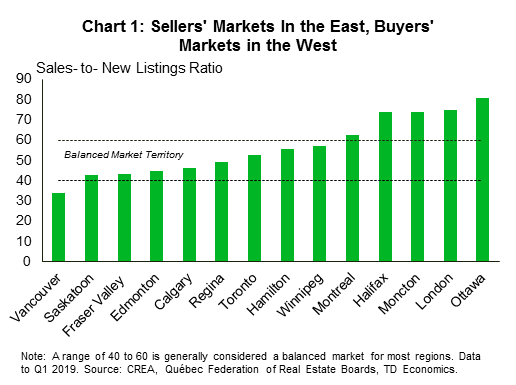
The Canadian housing story remains one of stark divergence between markets in Western Canada and those in the east. There are two sub-threads here. First, weakness in energy-producing provinces is not confined to housing. Fortunately, major markets in Saskatchewan and Alberta saw solid sales gains in home sales in April, evidence perhaps of underlying economic improvement that has also been echoed in recent jobs reports. Still, these markets remain over-supplied with sales to new listings ratios generally in buyers' market territory (Chart 1).
In Vancouver, the story is not about economic weakness. The B.C. economy has been one of Canada's fastest growing, and seemingly immune to the slowdown in this important sector. Instead, the cumulative impact of higher mortgage rates, measures to stem foreign demand at the provincial level, and tighter mortgage lending standards at the national level have combined to pull the chair out from under home sales. In April, sales in Greater Vancouver hit a new cycle low. The sales to new listings ratio is deep in buyer's market territory, suggesting yet further price declines on the horizon.
In Central and Eastern Canada the story is one of either stability following past adjustments, or of outright strength. Sales were up again in the Greater Toronto Area in April, raising the sales to new listings ratio further into balanced market territory. In markets in the province's east, such as Ottawa, sales are close to record highs and well into seller's market territory, contributing to healthy price gains. The same is true in Quebec, where both sales and prices are up and with tight markets look to remain so.
The performance of the housing market is of central concern to the Bank of Canada, which noted these divergences in its Financial System Review (FSR) released this week. Overall, the Bank judges imbalances in housing markets to have moderated, but remain a source of vulnerability.
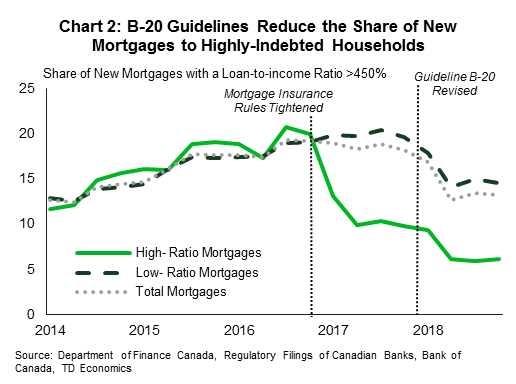
The Bank's number one vulnerability is the intrinsically related one of elevated household debt. This risk too is seen as moderating, reflecting a slowdown in household credit growth and reduction in the share of new mortgage debt going to highly-indebted households (Chart 2). Still, given its potential to exacerbate an economic downturn, this is one the Bank of Canada will watch closely.
Canada: Upcoming Key Economic Releases
Canadian Retail Sales - March
Release Date: May 22, 2019
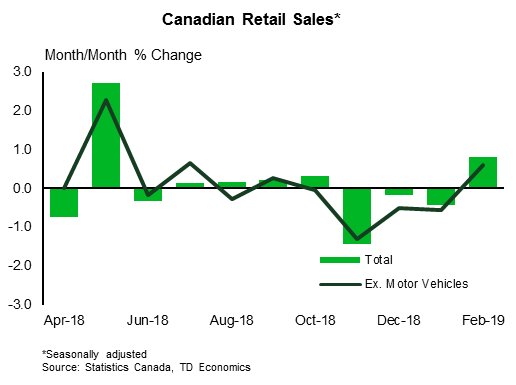
Previous: 0.8%, ex-auto: 0.6%
TD Forecast: 1.4%, ex-auto: 1.3%
Consensus: 1.2%, ex-auto: 1.0%
TD looks for retail sales to build on recent gains with a 1.4% advance in March, reflecting broad strength in household goods consumption. Gasoline stations and motor vehicle sales should lead the move, with the former benefitting from a 10% m/m increase in the price at the pump. This will allow the ex-autos measure to come in near the headline print at 1.3%, although sales should see more modest gains (0.8%) when excluding gasoline as well. Core retail sales rose by 0.4% in February for their first increase since September and we expect this performance to continue into March on the heels of a sharp increase in consumer goods imports and strong labour market data. Real retail sales should underperform the headline print owing to the sharp increase in gasoline prices although we still expect to see an increase of roughly 0.8% m/m. This is consistent with a flat print on Q1 after soft data in January and February, although stronger retail volumes will provide a solid handoff to Q2.
Forward Guidance: Retail Sales to Continue Canada’s Run of Strong Economic Data
Growing trade tensions between the world’s two largest economies drew plenty of attention this week, and for good reason with the US and China tagging each other with higher tariffs. The Bank of Canada highlighted potential escalation of trade conflicts as a key economic risk, and in turn a risk to the stability of the financial system. But let’s not lose sight of the fact that Canada enjoyed a run of solid economic data though the first half of May. This week it was stronger home sales and manufacturing activity; last week it was record job growth and a surge in housing starts. We expect the trend will continue next week with March’s retail sales.
Recall that the retail sector has underperformed recently with sales volumes effectively flat-lining over the second half of last year. Yes, sales rose at their fastest pace in nine months in February, but that was a low hurdle to clear and a good chunk of the increase was price-related. We think March’s numbers will look better in both the headline and details. Earlier data showed motor vehicle sales rose for a third consecutive month, with recent easing in financial conditions likely helping to put a stop to the slowdown in auto purchases seen throughout 2018. Other retailers that have suffered under rising interest rates and a housing slowdown—think furniture and building material stores—also appear to have found a bottom and could continue to tick higher alongside most resale markets. As was the case in February, rising gasoline prices will flatter the retail sales numbers, but it’s overall sales volumes that count and are likely to post a decent increase.
A healthier consumer and housing backdrop are necessary conditions for Canadian GDP growth to pick up as 2019 progresses. Recent data are pointing in that direction—let’s hope the improving trend doesn’t continue to be overshadowed by trade conflicts.
Week ahead – European Elections & PMIs, Fed Minutes, and Much More
While lacking in central bank meetings, the coming week is still a busy one. A poor showing by the UK Conservatives in the European Parliament elections could make it even more likely that Theresa May is replaced with someone that wants to deliver Brexit ‘no matter what’, keeping the pound on the back foot. Meanwhile, preliminary Eurozone PMIs are unlikely to change the euro’s fortunes, while the Fed minutes may strike a ‘neutral’ tone, leading to a slight unwinding of rate-cut bets.
Japanese GDP & inflation data on tap, but trade war may drive yen
The week kicks off with preliminary GDP data for Q1 from Japan early on Monday. Forecasts suggest the economy contracted by 0.2% in annualized quarterly terms, amid weakness in industrial production and exports. The US-China trade conflict and the broader global slowdown seem to have taken their toll on Japan, which is highly reliant on foreign demand for its products.
Inflation data for April are also due on Friday. The forward-looking Tokyo CPIs for the same month picked up speed, so the nationwide prints could follow suit. As for the yen, it’s unlikely to react much to data releases. Instead, the safe haven currency may take its cue mainly from changes in risk sentiment.
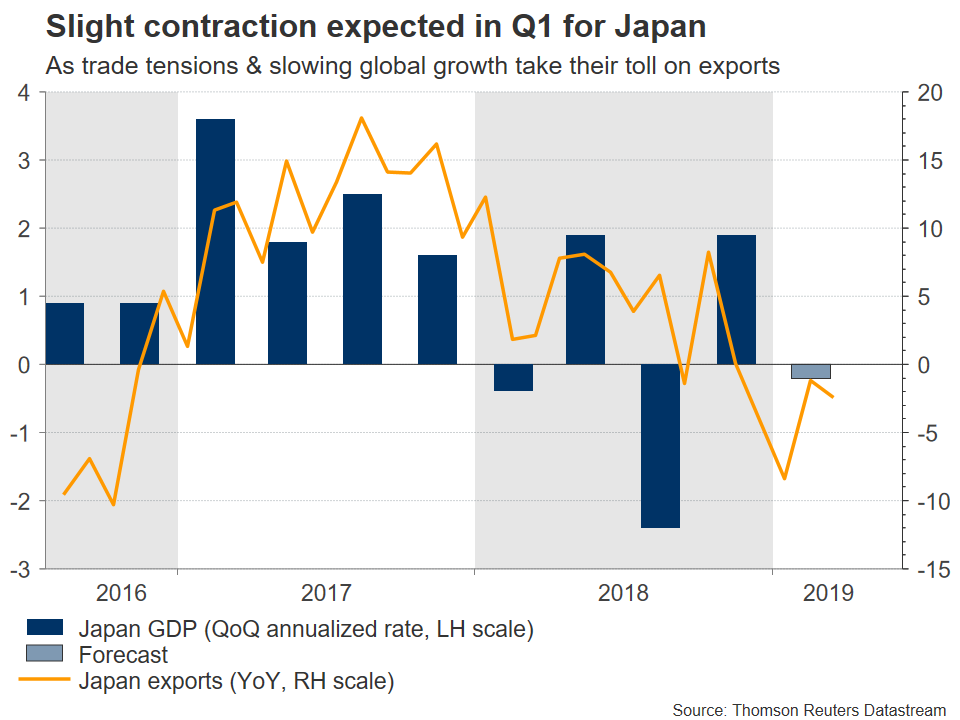
On that front, US-China tensions seem set to escalate further as Trump is already threatening more tariffs on all remaining Chinese imports. He’s probably bluffing, meaning he’s unlikely to actually impose more duties as that could really impact US consumers, and thus hurt his approval rating ahead of the 2020 elections. Still, he’ll certainly threaten playing that card, so risk aversion may remain high in the summer months, spelling upside risks for the yen.
Fed minutes could lead to some unwinding of rate-cut bets
The highlight in the US will be the minutes of the latest Fed meeting, due on Wednesday. Chairman Powell was less cautious than markets had anticipated back then, indicating that the recent softness in inflation is likely to be only transitory – overall downplaying the prospect of a rate cut in the foreseeable future.
His fairly confident tone caused market bets for a cut to be pared back, but that didn’t last long. Investors saw the latest escalation in the US-China trade conflict as raising the odds for the Fed to ease this year, with a quarter-point rate cut by December now being fully priced in. Crucially though, trade tensions escalated several days after the Fed meeting in question, so these minutes probably won’t reflect any major trade concerns.
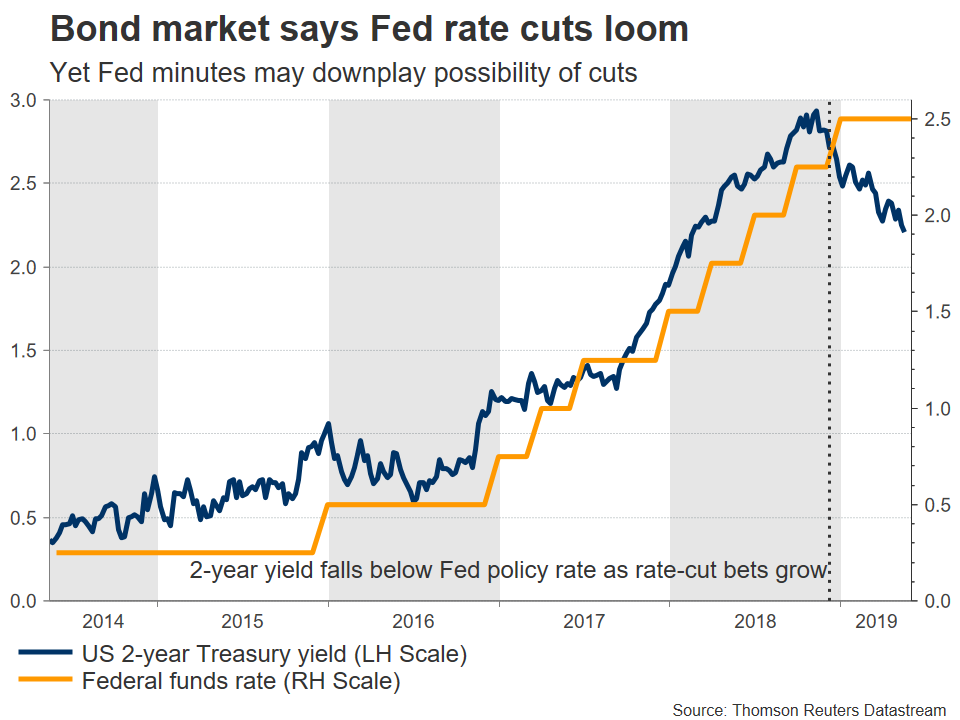
Rather, they may echo Powell’s sanguine tone, emphasizing that the Fed is neutral for now and that economic data would need to deteriorate sharply for a cut. Given how dovish market pricing currently is, a neutral bias could trigger a slight unwinding of rate-cut bets, benefiting the dollar a little.
The nation’s durable goods orders for April are also coming out on Friday.
Euro area PMIs may overshadow everything else
Perhaps the most crucial release of the week, will be the Eurozone’s preliminary PMIs for May – out on Thursday. Euro area growth has struggled in recent quarters, leading the European Central Bank (ECB) to put its rate-hike plans on ice and consequently hurting the euro. In fact, investors believe the normalization ship has sailed, with money markets now suggesting a small probability for an ECB rate cut this year, not a hike.
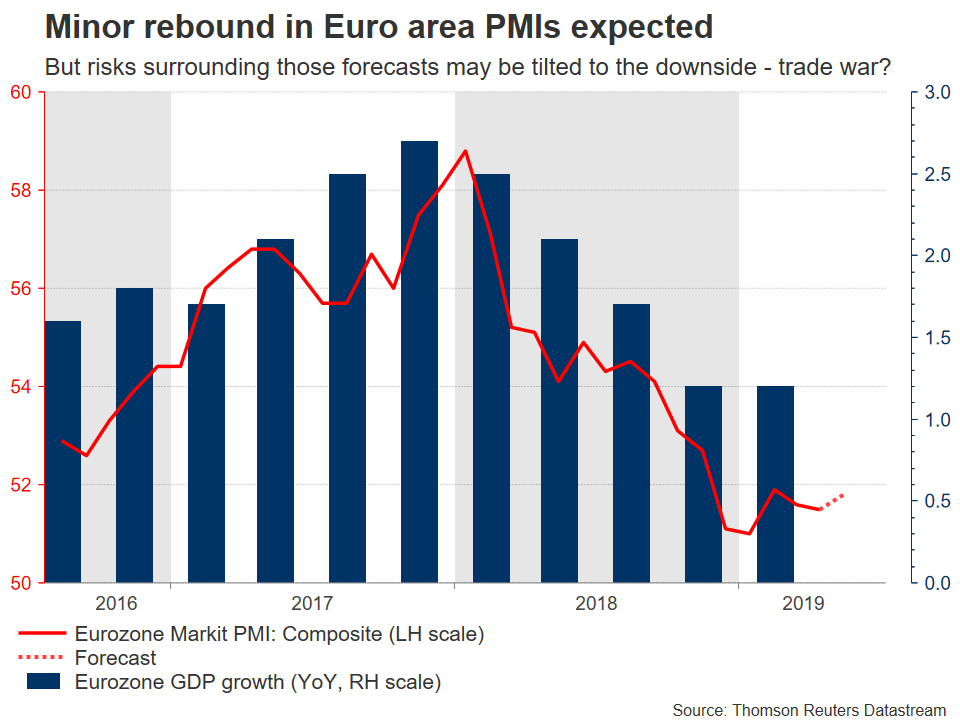
Forecasts point to a minor rebound in both the manufacturing and the services PMIs, though manufacturing is expected to remain in contractionary territory. Alas, the risks surrounding these forecasts may be tilted to the downside, considering that the recent escalation in the US-China trade tensions may have weighed on European business sentiment too. Another soft set of PMIs could spell more trouble for the already-battered euro, indirectly helping to keep the dollar buoyant, for a lack of better alternatives.
Germany’s Ifo survey for May and the minutes of the latest ECB meeting are also coming out on Thursday.
UK data unlikely to distract pound from resurgent no-deal Brexit risk
In the UK, inflation and retail sales figures for April will hit the markets on Wednesday and Friday respectively. As usual though, the pound is unlikely to react much to economics. Politics continue to drive sterling, which has taken a beating lately as the Brexit outlook worsened. Cross-party talks between Theresa May’s Conservatives and Labour are ready to collapse, dashing hopes for a bipartisan compromise to break the deadlock.
More importantly, May’s premiership won’t last much longer. She will bring her Brexit deal back to Parliament for yet another vote in the first week of June, and if she loses that one too, reports suggest she could resign immediately. Even if she wins the vote, she has still agreed to step aside for a new Conservative leader before long. Make no mistake, this is a disaster in the making for the pound. Most of her potential Tory replacements are ‘hardline’ Brexiters that may want to exit the EU in October no matter what, implying that a no-deal Brexit is slowly becoming a realistic scenario again.
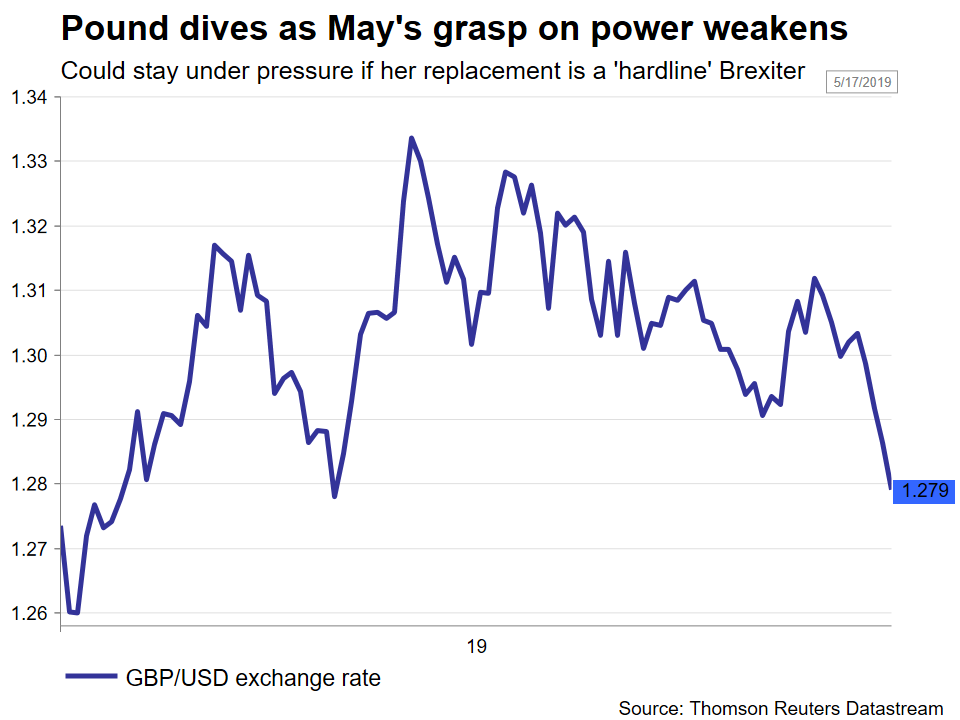
On a related note, the UK will hold EU Parliament elections on Thursday. Markets usually ignore such events, but this time may be different as opinion polls suggest May’s Conservatives will get crushed, with many voters defecting to Nigel Farage’s new Brexit Party. A poor showing could add even more pressure on the Tories to rebrand their image by replacing May with a much more ‘Leave friendly’ leader – like Boris Johnson.
New Zealand and Canadian retail sales, RBA minutes coming up
Besides trade news, the commodity linked currencies – aussie, kiwi, and loonie – will also look to key releases from their respective economies. In Australia, minutes from the latest RBA meeting are due on Tuesday. These may attract some attention this time as investors try to gauge the likelihood for a rate cut at the next gathering on June 4, something currently seen as a coin flip according to market pricing.
Meanwhile, New Zealand’s retail sales for Q1 will be released during the early Asian session on Wednesday. Canada’s retail numbers for March will follow later the same day.
MARKET WRAP: Stocks and Gold Moved Lower; Dollar Up
Investors kept their focus on trade talk and Brexit chaos. Sterling remained in free fall and there are strong chances of another referendum
Stocks
- The S&P 500 Index dropped 0.58% as 14:50 London time.
- The Stoxx Europe 600 Index decreased by 0.63%.
- The MSCI All-Country World Index fell 0.5%.
- The U.K.’s FTSE 100 Index dipped 0.33%.
Currencies
- The Dollar Spot Index jumped 0.1% hitting the highest level in nearly 21 weeks.
- The Euro remained below the level of 1.12 and dropped by 0.06%.
- The British pound continued its declined and dropped 0.4% to $1.2745, the lowest point in four months.
- The Japanese yen jumped 0.5% to 109.84 per dollar.
Bonds
- The yield on 10-year Treasuries dropped three basis points to 2.39%, touching the lowest level in seven weeks.
- Germany’s 10-year yield dipped three basis points to -0.12%.
- Britain’s 10-year yield plunged by five basis points to 1.033%,
Commodities
- West Texas crude moved higher by 0.49% to $63.17 a barrel, the highest in more than two weeks.
- Gold dropped 0.51% to $1,279 an ounce.
Sunset Market Commentary
Markets
US Treasuries and German Bunds edged higher today. Markets took a breather yesterday but that proved to be short-lived. This morning, Chinese state media signaled a lack of interest to continue trade talks with the US under the current threat to escalate tariffs and the absence of “sincerity”. Core bonds jumped higher on the news. Despite some easing when European equity markets opened, core bonds maintained an upward bias throughout the day. A final reading of the EMU core CPI rose 1.3% (Y/Y), more than the 1.2% expected, but the result was ignored by markets. The risk-off prevailed, especially with cross-party Brexit negotiations breaking up in the UK. The German yield curve is edging lower with changes varying between -0.3 bps (2-yr) to -1.7 bps (10-yr). The tide turned ahead of the WS opening, as US president Trump confirmed that the auto tariffs (that would have hit EU and Japan most) will be delayed for at least 180 days. Core bonds fell on the news, albeit rather modestly. US investors still eye the University of Michigan sentiment gauge for May later today. At the time of writing, the US yield curve is moving lower with changes up to -2.3 bps (10-yr). Peripheral spreads over the German 10-yr yield are tightening with Italy (‑4 bps) outperforming.
Earlier this week, EUR/USD reversed a cautious rebound from earlier this month. The new flaring up in the trade war didn’t help the euro anymore. Yesterday, the dollar profited temporary from a (re)widening of the US-German interest rate differential on good US eco data. Today, EUR/USD trading entered some kind of no-man’s-land. There were few eco data in Europe and the US. Sentiment on risk remained fragile as Chinese sources indicated that the country wasn’t convinced whether or not it would continue the trade talks in current negative context. This weighed on European equities. The risk-off trade kept EUR/USD, EUR/JPY and the USD/JPY on an (albeit cautious) downward trajectory. European and US yields declined more or less in lockstep. The EUR/USD and USD/JPY downtrend slowed in the run-up to the US open. The trend even turned as the White House confirmed that it prolonged the deadline for talks on Japanese and EU auto imports by six months. Still, the market reaction to the announcement was modest. Even so, EUR/USD (1.1180 area) is trading off the intraday low. The gain of USD/JPY (109.60) is negligible.
The sterling decline from earlier this week simply continued as political disarray in UK politics intensified. Labour leader Jeremy Corbyn in a statement indicated that the talks with the government on a Brexit deal have become almost impossible as the government isn’t able to deliver a compromise. The break of the talks with labour make an approval of May’s Brexit deal early June very unlikely. At the same time, the battle for leadership of the conservative party continues. The roadmap for the Brexit process is becoming ever more unpredictable and weighs on sterling. EUR/GBP is trading in the 0.8760 area. Cable lost a next big figure and is trading in the 1.2750 area.
News Headlines
UK opposition leader Corbyn walked out of talks with PM May’s Conservatives to find a compromise Brexit deal. He said that only “significant changes” would bring him back to the negotiating table. May is now expected to schedule a 4th vote on het Brexit deal in parliament early June.
US President Trump officially delayed imposing levies on imported car and car parts from the EU, Japan and other nations for 180 days, opening space for negotiations without first escalating the conflict.
Trump declares auto imports as national security threats, order negotiations to complete in 180 days
In a White House Proclamation published today, Trump declared automobile imports and certain parts "threaten to impair the national security of the United States". And, the countries' defense and military superiority "depend on the competitiveness of our automobile industry and the research and development that industry generates."
Thus, Trump directed US Trade Representative Robert Lighthizer to start negotiation process. And, if agreements cannot be reached within 180 days, Trump will determine whether and what further actions to take.
In a more detailed release, it's noted that American-owned automotive R&D and manufacturing are vital to national security. But with increased competitions from imports, American-owned producers' share of the domestic automobile market has "contracted sharply", declining from 67% in 1985 to 22% in 2017.
Meanwhile, "protected foreign markets, like EU and Japan, "impose significant barriers to automotive imports from the United States, severely disadvantaging American-owned producers and preventing them from developing alternative sources of revenue for R&D in the face of declining domestic sales. " American-owned producers' share of the global automobile market fell from 36% in 1995 to just 12% in 2017
And, "defense purchases alone are not sufficient to support . . . R&D in key automotive technologies." Sales revenue enables R&D expenditures that are necessary for long-term automotive technological superiority, and automotive technological superiority is essential for the national defense.
Thus, "domestic conditions of competition must be improved by reducing imports. American-owned producers must be able to increase R&D expenditures to ensure technological leadership that can meet national defense requirements."
Full releases: