

Sample Category Title
EURUSD Await US Data
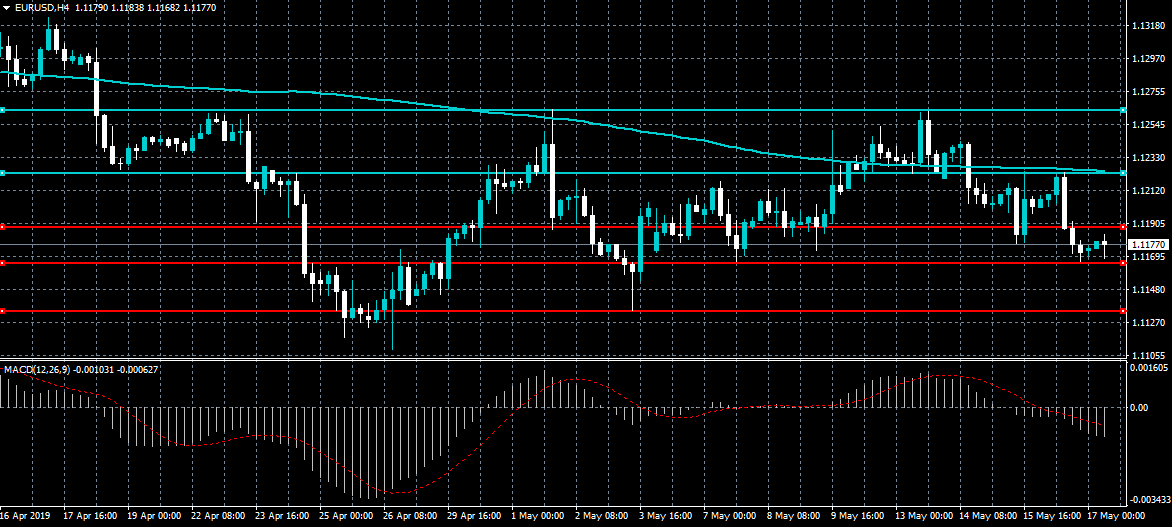
The euro is trading close to the worst levels of the week against the US dollar as traders await key macroeconomic data from the United States economy. A further bearish breakdown below the 1.1165 support level is likely to expose the EURUSD pair to losses towards the 1.1130 level. Technical indicators on the four-hour time frame continue to signal growing downside pressure.
The EURUSD pair is heavily bearish while below the 1.1165 level, key technical support is found at the 1.1130 and 1.1110 levels.
If the EURUSD pair moves above the 1.1190 level, key technical resistance is found at the 1.1216 and 1.1264 levels.
GBPUSD Probing Breakdown Support
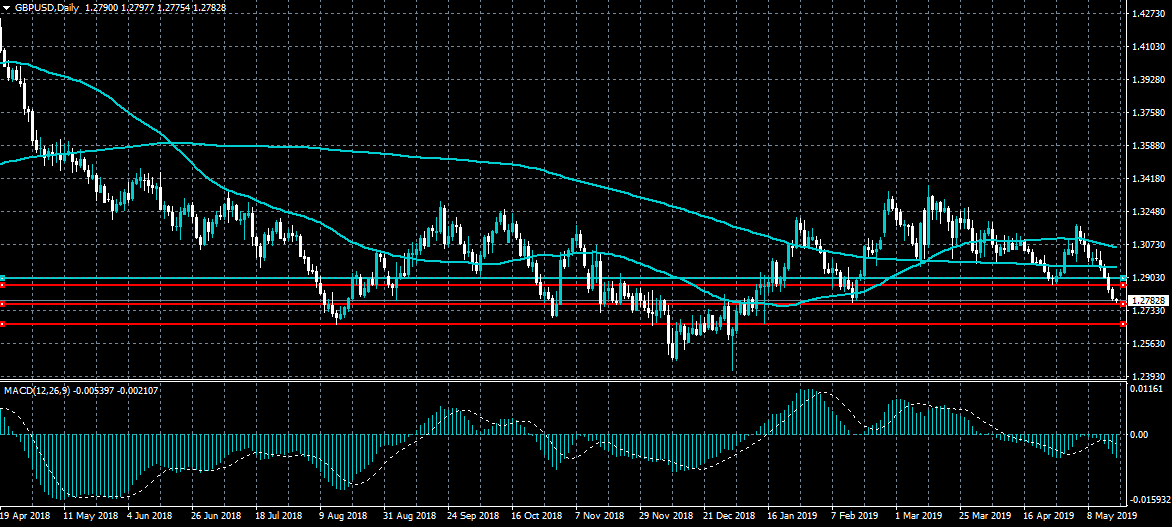
The British pound remains extremely weak against the US dollar during, with the pair trading closer to an even larger technical breakdown. The GBPUSD pair offers only limited technical support if the 1.2772 is broken, with the 1.2660 level the likely bearish target. The daily time frame is also showing that sellers are moving closer to invalidating a bullish inverted head and shoulders pattern.
The GBPUSD pair is heavily bearish while trading below the 1.2772 level, key support is found at the 1.2710 and 1.2660 levels.
If the GBPUSD pair trades holds above the 1.2772 level, key intraday resistance is found at the 1.2790 and 1.2830 levels.
EUR/USD Tests Short-Term Channel
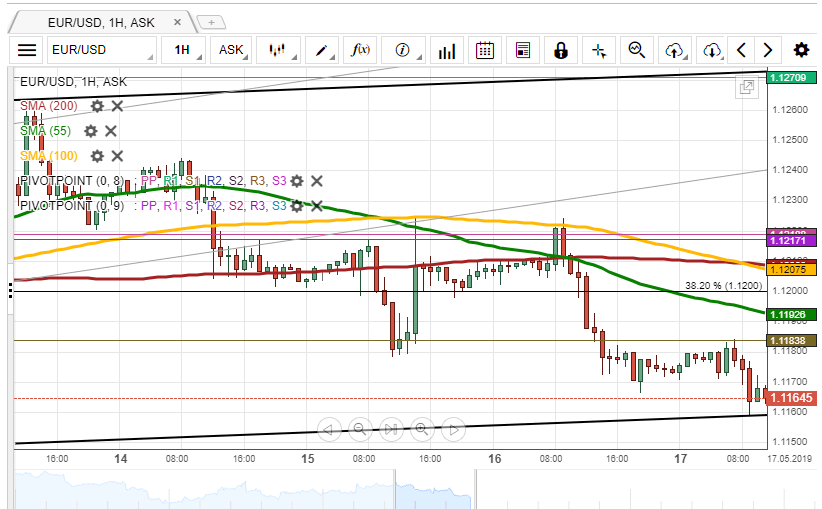
During the previous trading session, the EUR/USD currency pair surpassed the weekly S1 at 1.1184.
During Friday's morning, the pair was testing the lower boundary of the short-term ascending channel at 1.1160. From a theoretical perspective, it is likely, that a reversal north occurs in the nearest future. The pair could try to surpass the resistance cluster formed by the 55-, 100– and 200-hour SMAs, as well the weekly and monthly PPs in the 1.1194/1.1219 range.
However, if the given channel does not hold, it is expected, that a breakout south could occur soon. Note, that the nearest possible support level is the weekly S2 located at the 1.1132 mark.
GBP/USD Likely To Maintain Its Decline
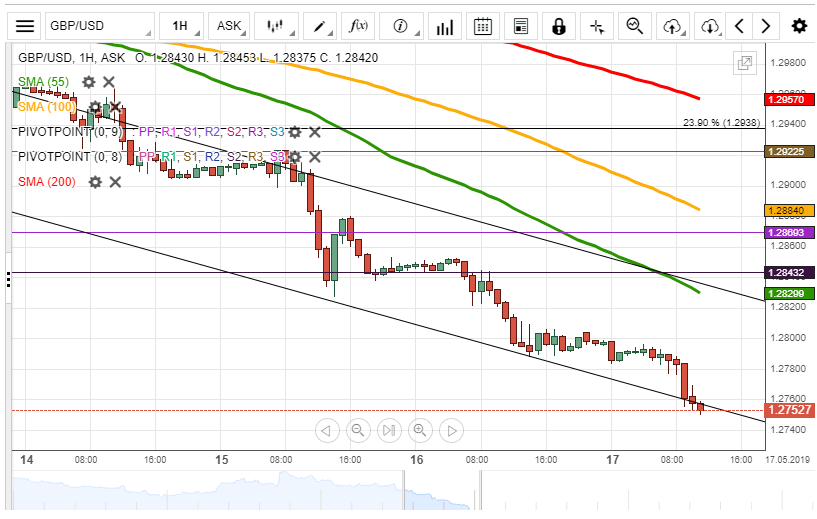
Yesterday, the GBP/USD exchange rate traded down and surpassed the psychological level at the 1.2800 mark.
Given that the currency pair is pressured by the 55-hour moving average, currently located at 1.2834, it is expected, that bears could continue to prevail in the nearest future. A possible downside target is the weekly S3 at the 1.2719 mark.
However, note, that the rate is trading near the lower boundary of the short-term descending channel. Thus, theoretically, it is likely, that some upside potential could prevail in the market. It is unlikely, that the pair could jump higher than 1.2869 due to the resistance of the monthly S1.
USD/JPY Could Trade Sideways
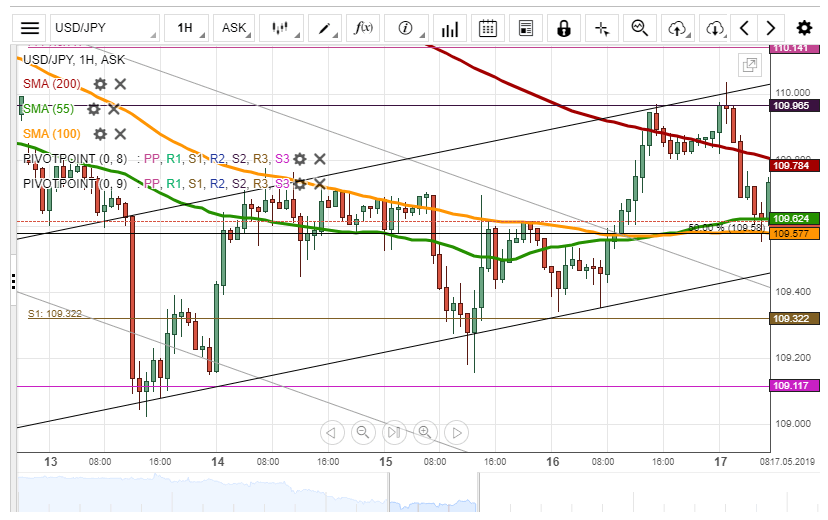
On Thursday, the USD/JPY currency pair skyrocketed to the monthly S2 at the 109.97 mark.
During Friday's morning, the exchange rate was squeezed by 55-, 100– and 200-hour SMAs, currently located at 109.60 and 109.79 respectively. If the given moving averages hold, the pair could trade sideways.
From a technical point of view, it is unlikely, that the rate could go downwards, as it is supported by the Fibonacci 50.00% retracement and the lower boundary of the short-term channel located circa 109.50.
XAU/USD: Two Scenarios Likely
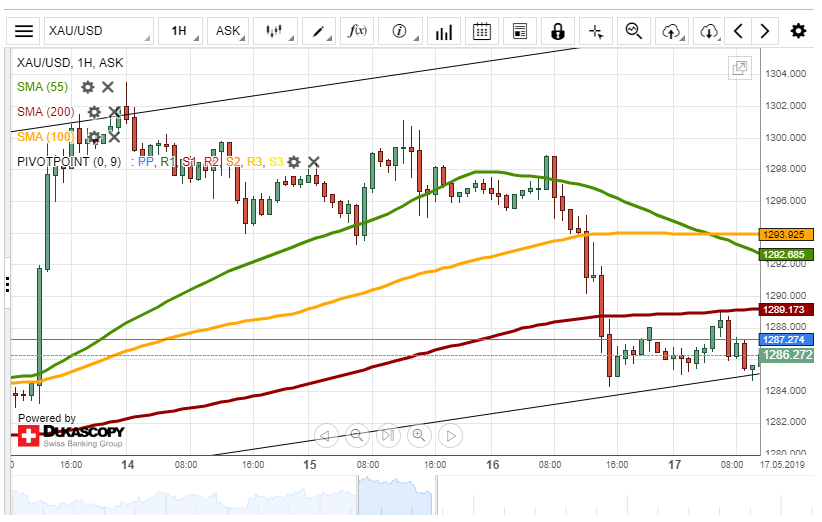
Yesterday, the XAU/USD exchange rate dropped to the lower boundary of the short-term ascending channel at the 1,284.00 mark.
During today's morning, the rate was testing the given boundary. From a theoretical point of view, it is expected, that a reversal north could occur in the nearest future. However, note, that gold has to surpass the 200-hour SMA at 1,289. 15.
If the given channel does not hold, it is likely, that a breakout south occurs soon. In this case the exchange rate could target the psychological level located at 1,280.00.
AUD/USD – Australian Dollar Slide Continues As China Chastises U.S
AUD/USD continues to lose ground this week. Currently, the pair is trading at 0.6878, down 0.21% on the day. On the release front, it's a light day. There are no Australian releases and only one major event in the U.S. The UoM Consumer Sentiment is expected to rise to 97.8.
It's been a rough week for the Aussie, which has fallen 1.75% this week. This is the sharpest weekly drop since early February. The currency has been hit hard, as risk appetite has soured over the escalating trade war between the U.S. and China. The U.S. raised tariffs on $200 billion in Chinese goods late last week, and the Chinese responded this week with tariffs on $60 billion in U.S. products. On Thursday, China accused the U.S. of manipulating the talks, after the U.S. blacklisted Huawei, a Chinese telecom company. As well, an escalation in tensions between the U.S and Iran, which could lead to an interruption in oil shipments, has raised crude prices and sent equity markets sharply lower on Friday.
Australians head to the polls on Friday in a very tight race between the center-right Liberals and the left-leaning Labor. After years of a booming economy, Australia has been gripped by a slowdown, as the global trade war and a weaker Chinese economy has damaged the export-reliant Australian economy. The markets are hopeful that the winner will be able to form a majority government that will be able to serve a full term. A close finish between the parties could result in a minority government, and the resulting uncertainty could dampen sentiment towards the struggling Australian dollar.
Consensus 2019: More Banks And Enterprise Solutions
The biggest event of the Blockchain calendar, Consensus 2019, took place this week, sending Bitcoin to a 2019 high of $8,386 yesterday. Today, the price has retraced from its recent high and is down nearly 8%. Now, the question which many investors are asking is if it was the Consensus event itself that moved the price this far?
Well, not really.
This is because the momentum was already building before the event and Bitcoin’s volatility has been on the move for the past few weeks. Speaking strictly about the conference, its most pleasing aspect was that there were more banks and serious enterprise solutions in attendance. This is a sign that the industry is maturing and due to this reason, it has started to attract the right kind of crowd, more suits!
Deloitte, IBM, Microsoft and Tata, all names which we are familiar in our traditional world, had a major presence with one common aim: to provide a solution for the industry. According to Deloitte, the volume of companies using the blockchain has doubled in the past couple of years. Their focus is to support their existing clients with appropriate blockchain solutions and also provide an advisory service in this area for new business. Their blockchain advisory division is booming.
The most dominant theme during the conference was tokenization of real estate and custody solutions. I like BitGo’s new custody solution which which improves the settlement process. ConsenSys also announced new partnerships during this even.
In my opinion, the overall problem in the industry is a lack of interoperability. Everything needs to talk to each other in an effective manner to create real value. Until that happens, I think it is extremely hard for real value to emerge. I am not discounting the fact that most enterprises actually prefer a permission-based protocol rather than permissionless and they identify that scalability is a big hurdle
Going back to the Bitcoin price, many investors are asking themselves if they should buy Bitcoin at its current level?
Well, the approach is still the same, look through the lens of risk premium. I define the risk premium as the premium paid compared to the previous low (which could have been a better entry point). Keep an eye on the moving averages, 200, 100 and 50-day averages. The price is trading well above these indicators and this confirms that the trend is strongly skewed to the upside.
Another important thing is that the 50-day moving average has crossed above the 200-day moving average, and this is a sign of bull momentum.
I think as long as the price stays above $5360, the level where the 50-day moving average is trading, the current retracement could be another good opportunity for investors who have been sitting on the sideline.
Gold Fundamental And Technical Analysis
Fundamental Analysis
The gold price has lost its shine and it is trading lower due to the strength in the dollar index. The year to date performance for the yellow metal has been lackluster, it is up only 0.31%.
The interesting fact is that despite a subdued interest for the riskier assets, we are still not seeing any upward movement in the gold price and this is because the earning season has delivered strong results for this quarter. Apart from the US retail sales number, the economic data in the US has been robust and investors are finding it difficult to believe how the Fed is going to keep its current monetary policy.
The US-China trade war also appears to be back on track and this was one of the key reason that the gold price surged previously. However, we are not out of the wood yet because the Chinese media has signaled a tougher stance on the trade dispute. If we do see some sort of reaction from China, the first impact of this could be seen in the gold price.
Technical Analysis
Speaking from the price action perspective, it seems like that the price doesn’t have strong momentum. This is the reason that the price cannot cross above the critical level of 1300.
In terms of technical analysis, the gold price is trading below the 50 and 100-day moving averages but above the 200-day moving average. This means that the bulls have lost control of the price but there is still some hope for them to get the power back because the price is still above the major moving average, the 200-day SMA. The near term support is at 1266 and the resistance is at 1303.
European Update – Back In Risk Aversion Mode?
Markets in the red as trade concerns remain
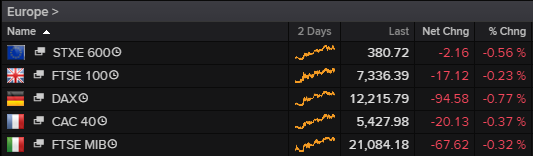
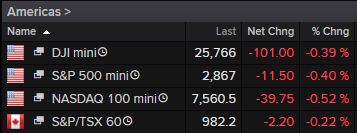
It's been a bizarre week in the markets, one that looks set to end on a negative note in a potential sign that investors are not particularly comfortable despite a three day winning streak.
The week got off to a woeful start after China announced counter-tariffs against the US as trade talks broke down. Markets had been surprisingly resilient at the end of last week when the US announced its tariff increase on $200 billion worth of goods but once China followed, all hope quickly disappeared as investors prepared for more friction and further tariffs.
Trump then succeeded in calming investor fears, claiming the fallout was just a mere “little squabble” between the world's two largest economies before then offering further hope to investors as reports claimed auto-tariffs may be delayed by six months. Clearly the prospect of fighting a trade war on multiple fronts isn't too desirable, particularly heading into an election year.
That proved enough to settle investors and markets have recovered since Monday but I wonder whether futures trading in the red heading into the weekend is a sign they're not entirely convinced. A lot can happen while the markets are closed and we clearly live in uncertain and uneasy times. If this is to last, we'll need to see more evidence that the situation can lead to a positive conclusion but for now, talking a good game looks to be doing the job.