Sample Category Title
Risk Aversion Sentiment Continues To Muster Momentum
Notes/Observations
- Trade and Brexit uncertainty continues to fuel risk aversion appetite; China has yet to name any specific retaliatory measures to US tariffs
Asia:
- China reiterated that the door for talks with US on trade was always open and that trade and economic cooperation between the two countries was the best choice. Reiterated stance that there were no winners in a trade war, China did not want a fight but was not afraid of one
Europe/Mideast:
- UK PM May said to be promising to reopen Brexit talks with EU to take the UK out of the bloc by summer in order to keep cross party negotiations with labour alive. PM to explore with the EU this week how to rewrite outline political agreement on future customs ties
- UK PM May said to be under pressure from Cabinet ministers to drop cross party talks in favor of more indicative votes in the Commons. To use cabinet meeting on Tuesday, May 14th to urge the prime minister to set a timetable for indicative votes by MPs after the European elections
- UK Shadow Brexit Sec Starmer: Cross party deal will not get through parliament unless it's subject to a confirmatory vote. Without a new referendum ,up to 150 labour MPs would vote against any deal
- ECB's Nowotny (Austria): ECB did not mean to tell markets easy policy would be prolonged when Draghi said it would consider steps to mitigate impact of negative rates on banks; Next policy steps would depend on data. Added that was premature to talk about what to do if growth slowed further
Americas:
- US President Trump tweeted on China: "Deal would become far worse for them if it had to be negotiated in my second term. I think that China felt they were being beaten so badly in the recent negotiation that they may as well wait around for the next election, 2020, to see if they could get lucky & have a Democrat win
- White House Economic adviser Kudlow: China had invited Trade Rep Lighthizer and Treasury Sec Mnuchin to China to continue trade talks but plans were not firmed up yet. President Trump and Chinese President Xi Jinping were likely to talk directly at a G-20 meeting in Japan at the end of next month
SPEAKERS/FIXED INCOME/FX/COMMODITIES/ERRATUM
Equities
- Indices [Stoxx600 -0.63% at 375.14, FTSE -0.05% at 7,199.89, DAX -0.78% at 11,966.36, CAC-40 -0.51% at 5,300.30, IBEX-35 -0.27% at 9,092.44, FTSE MIB -0.77% at 20,714.50, SMI -0.64% at 9,412.50, S&P 500 Futures -1.23%]
- Market Focal Points/Key Themes: European Indices trade lower across the board tracking sharply lower US Indices and weaker Asian Indices as trade tensions continue. On the corporate front shares of Dax heavyweight EON trades higher after earnings and affirmed outlook; Centrica rises in the UK as the company confirmed their full year targets while Paragon, KPS and Hypoport were among other notable risers after earnings. Meanwhile Dignity declines following earnings with, Victrex, QSC and Global Ports Holdings among other names declining on earnings. In other news Ambu declines sharply again, after sharp declines on Friday following multi analyst downgrades, while ThyssenKrupp pulls back from the strong gains seen last week with commentary from the CEO pushing for more focus on the steel division. Elsewhere EssilorLuxottica gains following a settlement with Delfin, while Medivir rises sharply after results from Remetinostat Phase II study in Basal Cell Carcinoma Patients. Looking ahead notable earners include National Energy Services and Navios Maritime Acquisitions.
Equities
- Consumer discretionary: Dignity [DTY.UK] -7% (earnings), Casino Guichard-Perrachon [CO.FR] -4.5% (analyst action)
- Utilities: E.ON [EOAN.DE] -0.5% (earnings)
- Energy: Centrica [CNA.UK] +2% (trading update)
- Financials: Hypoport [HYQ.DE] +2% (earnings), Euronext [ENX.FR] +1.5% (Norwegian Ministry of Finance approves Nasdaq as suitable owner of Oslo Børs VPS)
- Healthcare: Ambu [AMBUB.DK] -5.5% (analyst action), Medivir [MVIRB.SE] +12.5% (data)
- Industrials: ThyssenKrupp {TKA.DE] -7.5% (momentum; CEO comments), Diploma [DPLM.UK] -1.5% (earnings), Hochtief [HOT.DE] -0.5% (earnings), MTU Aero Engines [MTX.DE] -1.5% (analyst action)
- Technology: Paragon [PGN.DE] +4.5% (earnings), KPS [KSC.DE] +4% (earnings)
- Telecom: Vodafone [VOD.UK] -3.5% (to cut dividend to finance 5G)
Speakers
- UK Brexit Sec Barclay: Country at risk of sleepwalking into staying in the EU
- UK Labour party Dep leader Watson: Hard to achieve Brexit without a 2nd referendum
- China Foreign Ministry spokesperson Geng Shuang: Details of trade retaliatory measures to be released at some point. Reiterated that China would never give in to foreign pressure. Reiterated stance to meet US half-way on trade issues; tariffs was not the way to resolve disputes
- Reports circulate that recent China/US trade talks stalled over 3 areas including whether to remove all increased US tariffs. Also disagreement over targets set for US imports were seen as unrealistic by China and that both sides could not agree to the wording of the text of the trade agreement
Currencies/Fixed Income
- A new trading week brought little clarity on outstanding issues of US-China trade and UK cross-party talks on a path forward for Breixt which provided risk aversion sentiment to peculate.
- EUR/USD continue to hover within a tight range around 1.12 level
- GBP/USD was steady just above the 1.30 level with focus on the Tuesday UK Cabinet meeting. PM May said to be under pressure from her ministers to set a timetable for indicative votes by MPs after the European elections. To date cross-party talks between Tory and Labour have yet to yield any fruit.
- USD/JPY was lower by 0.3% as the JPY currency (Yen) remained the safe-haven currency of choice.
- Emerging market currencies were broadly lower with ZAR and TRY both lower by 1% in the session.
- Core bond yields were lower led by the US Treasury with the 10-year yield lower by 5bps to test below 2.42% area
Economic Data
- (RO) Romania Apr CPI M/M: 0.6% v 0.4%e; Y/Y: 4.1% v 3.9%e
- (NO) Norway Q1 GDP Q/Q: -0.1% v +0.2%e; GDP Mainland Q/Q: 0.3% v 0.4%e
- (NO) Norway Mar GDP M/M: +0.2% v -0.4% prior; GDP Mainland M/M: +0.3% v -0.2% prior
- (FR) Bank of France Apr Industrial (Business) Sentiment: 99 v 100e
- (SE) Sweden SEB Swedish Housing-Price Indicator: 27 v 13 prior
- (CZ) Czech Apr CPI M/M: 0.1% v 0.3%e; Y/Y: 2.8% v 3.0%e
- (CZ) Czech Mar Export Price Index Y/Y: 2.6% v3.4% prior; Import Price Index Y/Y: 2.8% v 3.3% prior
- (TR) Turkey Mar Current Account Balance: -$0.6B v -$1.0Be
- (CH) Swiss Weekly Total Sight Deposits (CHF): 578.1B v 577.7B prior; Domestic Sight Deposits: 484.3B v 480.8B prior
Fixed Income Issuance
- None seen
Looking Ahead
- (RU) Russia Apr Light Vehicle Car Sales Y/Y: 1%e v 2% prior
- 05:30 (DE) Germany to sell €2.0B in 6-month Bubills
- 05:30 (ZA) South Africa announces details of upcoming I/L bond sale (held on Fridays)
- 06:00 (PT) Portugal Apr Final CPI M/M: No est v 0.6% prelim; Y/Y: No est v 0.8% prelim
- 06:00 (PT) Portugal Apr Final CPI EU Harmonized M/M: No est v 1.0% prelim; Y/Y: No est v 0.9% prelim
- 06:00 (SE) Sweden Central Bank (Riksbank) Dep Gov Ohlsson
- 06:00 (IL) Israel to sell bonds
- 06:00 (TR) Turkey to sell 2020 and 2024 Bonds
- 06:00 (RO) Romania to sell Bonds
- 06:45 (US) Daily Libor Fixing
- 07:00 (CZ) Czech Central Bank to comment on CPI data
- 07:00 (IN) India announces details of upcoming bond sale (held on Fridays)
- 07:25 (BR) Brazil Central Bank Weekly Economists Survey
- 08:00 (IN) India Apr CPI Y/Y: 3.0%e v 2.9% prior
- 08:00 (UK) Baltic Dry Bulk Index
- 09:00 (FR) France Debt Agency (AFT) to sell combined €3.3-4.5B in 3-month, 6-month and 12-month Bills
- 09:05 (US) Fed members Rosengren and Clarida at event
- 11:00 (CO) Colombia Mar Trade Balance: -$0.8Be v -$0.6B prior; Total Imports: $4.3Be v $4.0B prior
- 11:30 (US) Treasury to sell 3-Month and 6-Month Bills
- 15:00 (AR) Argentina Mar Capacity Utilization: No est v 58.5% prior
- 16:00 (US) Crop Progress
Trump: Nobody left in China to do business with. That’s very bad for China, very good for USA
Trump continues to "demonstrate" his verbal threats to China with his tweets. He claimed that of the 25% tariffs, only "4 points were paid by the US". "21 points" will be paid by China because it "subsidizes product to such a large degree". And, people can by products "inside the USA". Tariffs companies will be "leaving China for Vietnam and other such countries in Asia.
He also claimed that "there will be nobody left in China to do business with" and that's "very bad for China, very good for USA". He warned that "China should not retaliate - will only get worse!". Also, Trump told Chinese President Xi "you had a great deal, almost completed & you backed out".
Trump also claimed that the unexpected 3.2% GDP growth was "greatly helped by tariffs fro China".
https://twitter.com/realDonaldTrump/status/1127886307118678016
https://twitter.com/realDonaldTrump/status/1127886309316599808
https://twitter.com/realDonaldTrump/status/1127888569543077888
https://twitter.com/realDonaldTrump/status/1127891815628144640
Elliott Wave Analysis: DAX Can Find Support And A Bullish Turn Around 11800-11950
Yen opened stronger and dollar rallied as stocks turned down following new Trump tweets about US-China trade deal.
We see SP500 futures gaping down, same as DAX which is headed back to the lows it seems after only three waves up to 12200 area. There are new supports that we have to keep an eye on DAX; first one is at 11930 followed by second one at 11800.
German DAX, 30Min
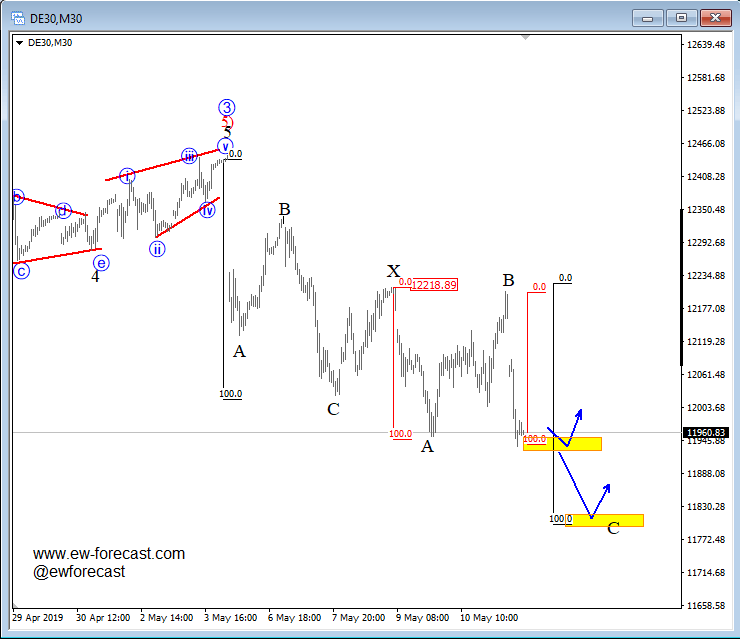
Stocks are in bearish mode, but not necessarily in a higher degree downtrend; it can be just another pullback. Notice that DAX loves 500-650 points of pullback. If this will repeat then support is at 11800-11950.
German DAX, Daily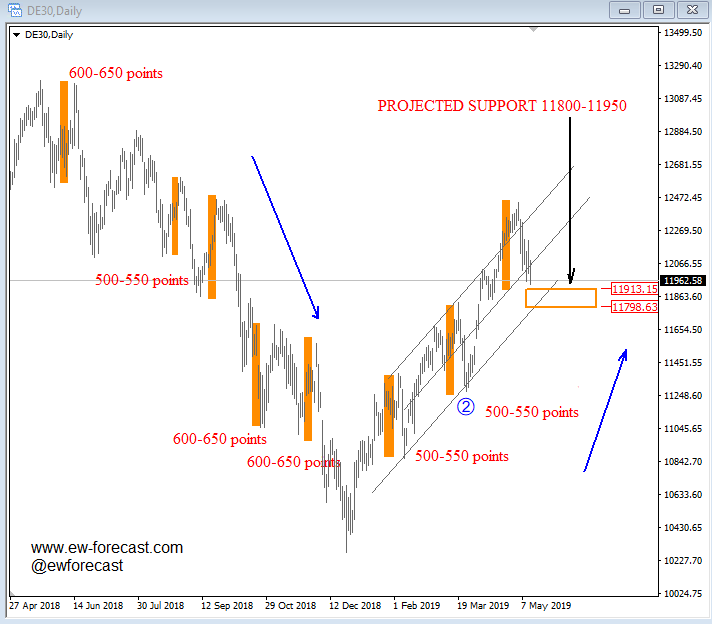
Risk Aversion Has U.S Yield Curve Inverting Again
Monday May 13: Five things the markets are talking about
This week begins again with global equity markets on the back foot, sovereign debt in demand, and the risk averse go-to positioning investors primary trade. Bets on a Fed rate cut are also now gaining momentum.
Currently, U.S and China remain some distance away from agreeing any kind of trade deal. While waiting for China’s retaliatory counter punch, it seems more obvious than before, any short-term prospect of a deal occurring is a figment of one’s imagination.
On the data front, it’s an intense packed Tues-Thurs calendar, starting with Germany’s CPI where strength is expected, followed by the UK’s labour market report and Eurozone industrial production (May 14). The mid-week session will be focused on China which will release fixed asset investment, industrial production and also retail sales data for April. Next up, German GDP, as well as U.S retail sales and U.S industrial production (May 15), both of which are expected to show a mix of flat to respectable results. Thursday’s U.S manufacturing report from the Philadelphia Fed could show some clues on U.S tariff actions.
On tap: GBP average earnings index & AUD wage price index (May 14), CAD CPI, U.S retail sales & AUD employment change (May 15), AUD Parliamentary Elections (May 17).
1. Stocks slow burn lower
Capital markets are bracing itself for the promised ‘counter-measures’ from China in retaliation for Presidents Trump’s tariff increase late last week on +$200B worth of Chinese goods.
In Japan, the Nikkei saw red as most cyclical sectors lost ground after the Sino-U.S trade war escalated. The Nikkei share average ended -0.7% lower, the lowest closing since March 28, while the broader Topix shed another -0.5%.
Note: In 2018, equity losses were sharper when Trump first imposed tariffs on imports from China.
Down-under, Aussie shares ended lower overnight, pressured by disappointing Bank earnings, although losses were offset by gains in healthcare and gold stocks. The S&P/ASX 200 index closed down -0.2%. The benchmark rose +0.3% on Friday. In S. Korea, the Kospi index (-1.38%) closed out at its lowest since January 15 on anxiety over whether Washington and Beijing could make headway in their trade talks.
In China, shares tumbled, with the benchmark Shanghai Composite and the blue-chip CSI 300 shedding -1.3% and -1.8%, respectively, while in Hong Kong, financial markets were closed for a Bank holiday.
In Europe, regional bourses trade lower across the board tracking sharply lower U.S indices and weaker Asian indices as trade tensions continue.
U.S stocks are set to open deep in the ‘red’ (-1.23%).
Indices: Stoxx600 -0.63% at 375.14, FTSE -0.05% at 7,199.89, DAX -0.78% at 11,966.36, CAC-40 -0.51% at 5,300.30, IBEX-35 -0.27% at 9,092.44, FTSE MIB -0.77% at 20,714.50, SMI -0.64% at 9,412.50, S&P 500 Futures -1.23%
2. Oil prices rise as Middle East tanker attack increases supply concerns
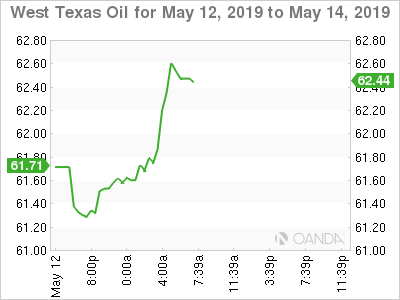
Oil prices start the week on firmer footing on dealer concerns about supply disruptions in the Middle East and this despite market worries over global growth prospects amid a standoff in the Sino-U.S. trade talks.
Brent crude futures are at +$71.00 a barrel, up +38c, or +0.5%, from Friday’s close. U.S West Texas Intermediate (WTI) futures are at +$61.73 per barrel, up +7c, or +0.1%, from their previous close.
Supply disruptions
Providing a market bid was the Saudi’s indicating this morning that two Saudi oil tankers were among vessels targeted by a “sabotage attack” off the coast of the UAE – the Saudi’s and UAE are the third-largest producers in OPEC+.
Expect the crude ‘bulls’ to continue to rely on rising geopolitical tensions in the Middle East, coupled with declining oil supplies from Venezuela and Iran, to remain bullish for medium term black gold prices.
OPEC-led production cuts since Jan 2019, has certainly contributed to higher crude prices. There is market consensus that OPEC+ will extend their six-month output-cut agreement when they meet in June. However, any intensification in the Sino-U.S trade war should convince crude ‘bears’ to keep a lid on prices.
Ahead of the U.S open, gold prices are steady as trade talks between the U.S and China hit a wall, raising investor doubts over whether the two world’s largest economies would be able to reach a deal, thereby lifting demand for safe-haven assets. Spot gold gained +0.1% to at +$1,286.59 per ounce, while U.S gold futures are steady at +$1,287.90 an ounce.
However, ongoing Sino-U.S trade tensions will eventually weigh heavily on China’s yuan, which will making the ‘yellow metal’ much more expensive for buyers in world’s largest consumer – China.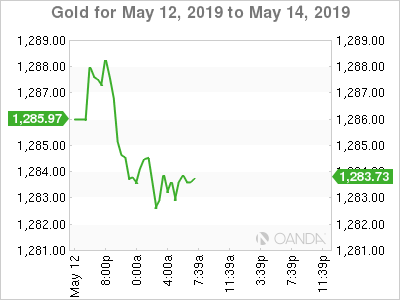
3. U.S yield curve inverts again
The U.S Treasury bond yield curve between three-month and 10-year rates has inverted again for the second time in the past week, pressured by escalating trade tensions raising dealer concerns that the U.S economy could fall into recession.
The yield of 3’s have backed up to +2.45%, +3 bps higher than U.S 10’s, which are trading at a six-week low of +2.42%.
Currently, the market is waiting for the other shoe to drop, China’s retaliation to Trump’s tariff increase last Friday on +$200B worth of Chinese goods. The tariff spat is expected to hit the U.S economy which is seeing the impact of fiscal stimulus fade.
Elsewhere, in the Eurozone, bond yields trade only marginally higher but this week’s key data releases – German ZEW business sentiment index on Tuesday, German and eurozone Q1 GDP data – and policy makers’ speeches have the potential to move them more significantly.
Investors can expect the various central bank speeches from U.S Fed and ECB representatives and the EU and euro-area finance minister meetings at the end of the week to dominate this week’s rate agenda.
The 10-year Bund yield trades at -0.044%, up +0.5 bps.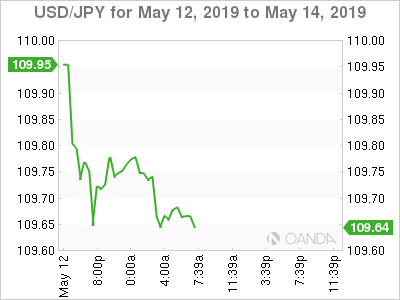
4. Risk aversion positioning dominate proceedings
A number of major currencies remain at the mercy of Sino-U.S trade disputes. With the markets in a risk-off mood, investors can expect the NOK, AUD, SEK, NZD & CAD to underperform. Even the EUR could be expected to come under renewed pressure if there is a possibility that the trade conflict could spread to Europe. For now, the EUR continue to hover within a tight range around the €1.12 level.
UK PM May said to be promising to reopen Brexit talks with EU to take the UK out of the bloc by summer in order to keep cross party negotiations with Labour alive. PM to explore with the EU this week how to rewrite outline political agreement on future customs ties.
GBP/USD (£1.3022) is steady just above the psychological £1.30 level with focus on tomorrow’s U.K Cabinet meeting. PM May said to be under pressure from her ministers to set a timetable for indicative votes by MP’s after the European elections. To date cross-party talks between the Tories and Labour have yet to lead to anything.
USD/JPY (¥109.67) is lower by -0.3% as the JPY currency remains the safe-haven currency of choice.
Bitcoin (BTC) has climbed above $7,000 to $7,094 as the recent gains in cryptocurrencies extended over the weekend.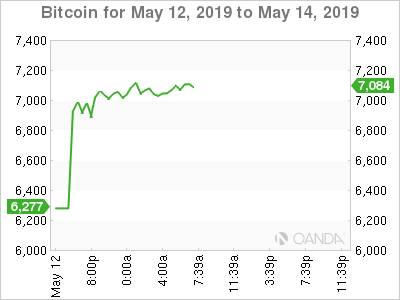
5. Aussie home loans fall
Data overnight showed that Australian home loan lending fell heavily again in March, driven by declines to both owner-occupiers and investors.
According to figures released by the Australian Bureau of Statistics (ABS), the total value of new loans fell -3.2% to A$16.937B after seasonal adjustments, leaving the decline on a year earlier at -18.4%.
Note: The decline in March followed a smaller +2% increase in the value of new home loans in February, resuming the downtrend that’s now been in place for well over a year.
New lending to owner-occupiers fell -3.4% from February to A$12.396B, reversing the +2.8% increase reported one month earlier.
“There were large falls in the value of lending for owner-occupier dwellings in seasonally-adjusted terms in both New South Wales and Queensland in March, after rises in both states the previous month” said Bruce Hockman, chief economist at the ABS, in an accompanying statement.
From a year earlier, the total value of new owner-occupier home loans nationally slumped 15.2%.
The ABS said total new loans to owner-occupiers fell -2.8% after adjusting for seasonal patterns, leaving the number down -13.8% y/y.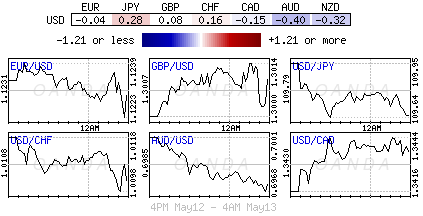
DAX Slips After Trump Tariffs
The volatility continues for the DAX on Monday. Currently, the DAX is at 11,977 points, down 0.66%. There are no releases out of Germany or the eurozone. On Tuesday, Germany and the eurozone release ZEW Economic Sentiment and we’ll also get a look at German CPI.
The trade war between the U.S. and China escalated last week, as the U.S. slapped China with new tariffs on Friday. The move raised tariffs on some $200 billion in Chinese goods from 10% to 25%. The move was announced a week ago, and global equity markets have responded with sharp swings. There are concerns that the U.S. could follow up with 25% tariffs on all Chinese imports, which would target European cars produced in China. This has led to sharp losses for German automakers listed on the DAX. BMW declined 1.0%, Daimler is down 2.2% and Volkswagen has dropped 1.2%.
Despite the dramatic rise in tariffs and the Chinese promise to retaliate, talks between the sides continue, with officials scheduled to meet in Beijing. The new tariffs do not apply to Chinese goods that left port prior to May 10, affording a 2-week window for negotiators before the tariffs take effect. The escalation in tensions has shelved a meeting between President Trump and Chinese President Xi, but the two leaders could meet at the G-20 summit in Japan in June.
The week ended on a positive note, as Germany’s trade balanced improved. The trade surplus widened to EUR 20.0 billion in March, up from EUR 18.7 billion a month earlier. This is the first time that the trade surplus has exceeded the EUR 20-billion level since May. A surge in exports was responsible for the larger trade surplus. German exports increased by 1.5% in March, well above the estimate of -0.3%. This was a marked improvement from February, when exports declined by 1.3%.
European Update – Risk Aversion Remains
Markets back in the red as tariffs increased
European markets are mostly lower at the start of the week and the US is expected to open even deeper in the red after talks between the US and China broke down and tariffs were increased.
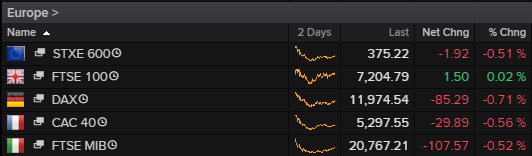
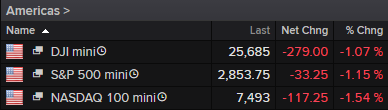
The talks appeared to be going quite smoothly until a week ago when the cracks started to appear, since when markets have given up a chunk of their first quarter gains. There is still some hope that a deal can be reached, with a possible meeting at next month’s G20 being touted between Trump and Xi in an attempt to break the impasse.
It will now be interesting to see just how much conviction there is in the first quarter rebound, with the prospect of a Sino-US deal a big contributor to the improved sentiment in the markets. Of course, there were other important factors as well and central banks have made a significant effort to alleviate those concerns but trade tariffs are a major concern at a time when global growth is already expected to slow.
EUR/USD – Euro Coasting In Light-Data Session
EUR/USD is flat at the start of the new trading week. Currently, the pair is trading at 1.1229, down 0.04% on the day. There are no data releases out of the eurozone or the U.S., so we can expect the pair to continue to drift on Monday. On Tuesday, Germany and the eurozone release ZEW Economic Sentiment and we’ll also get a look at German CPI.
The trade war between the U.S. and China escalated last week, as the U.S. slapped China with new tariffs on Friday. The move raised tariffs on some $200 billion in Chinese goods from 10% to 25%. The move was announced a week ago, and global equity markets have responded with sharp swings. However, the reaction of the currency markets has been muted, and EUR/USD ended the week with slight gains. China is yet to retaliate with counter tariffs on U.S. goods, but has allowed the Chinese yuan to fall to its lowest level in four months. A lower yuan makes Chinese exports more competitive and will help cushion the effect of the new U.S. tariffs.
Despite the dramatic rise in tariffs and the Chinese promise to retaliate, talks between the sides continue, with officials scheduled to meet in Beijing. The new tariffs do not apply to Chinese goods that left port prior to May 10, affording a 2-week window for negotiators before the tariffs take effect. The escalation in tensions has shelved a meeting between President Trump and Chinese President Xi, but the two leaders could meet at the G-20 summit in Japan in June.
U.S. consumer inflation levels were soft in April. CPI dipped to 0.3%, down from 0.4% a month earlier. This missed the forecast of 0.4%. The core release remained at a weak 0.1% for a third straight month, shy of the forecast of 0.2%. The Federal Reserve has said that it is open to rate moves in either direction, and inflation levels will be a critical factor in any rate move. The Fed follows a different indicator for monetary policy, the core personal consumption expenditures (PCE) price index. This index increased 1.6% in March year-to-year, its smallest rise in 14 months. However, the new tariffs will increase the price on Chinese goods and boost inflation, which could lead the Fed to raise rates in the near future.
Markets Tumble As Trade Talks Crumble
Global equities fell across on the board on Monday as investors await the details of US tariffs on $300 billion worth of Chinese imports. European shares followed Asia’s lead with the German DAX sliding 0.80% to a fresh monthly low. Wall Street also tumbled with front-month futures S&P 500 futures falling more than 1.30% to 2,845 points. In Switzerland, the SMI gave up 0.60% and hit 9,380 points, the lowest level since April 15th.
In the FX market, the Japanese yen, the Swissy and greenback benefited from the deterioration in risk sentiment. The Swiss franc continued to appreciate against the buck with USD/CHF sliding towards party. Over the last three weeks, the Swiss franc appreciated more than 1.40% against the dollar. Similarly, USD/JPY is testing again the 109.50 support; it is the third time since the beginning of February. Surprisingly, the yellow metal has been struggling to add gains despite the rise in uncertainty. The price of an ounce of gold eased to 1,283.60 on Monday morning, down 0.20% on the session.
This week will be a landmine for investors as they remain at the mercy of Donald Trump’s random tweets. Now, it looks like China and the US are both trying to reassure the international community that they are still working on a deal. However, it is clear now that they can’t trust each other and it would be difficult to reach an agreement when you do no trust your representative. It is difficult to say whether a deal could be reached or the China-US relation is doomed. Meanwhile, market conditions will remain choppy and erratic.
Forex Technical Analysis: EUR/USD, USD/JPY, GBP/USD
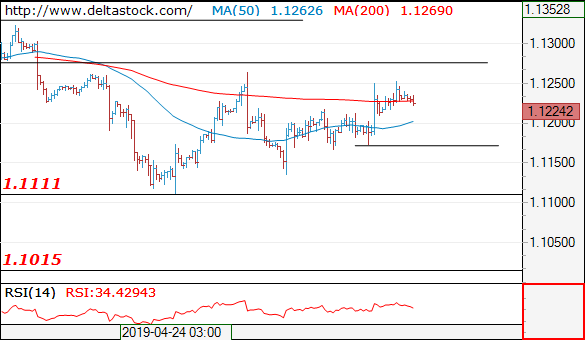
EUR/USD
Current level - 1.1224
There is still more room on the upside, for a tighter test of 1.1275 hurdle, before drowning towards 1.1110. Trigger lies at 1.1170.
| Resistance | Support | ||
| intraday | intraweek | intraday | intraweek |
| 1.1275 | 1.1330 | 1.1170 | 1.1010 |
| 1.1275 | 1.1450 | 1.1110 | 1.0860 |
USD/JPY
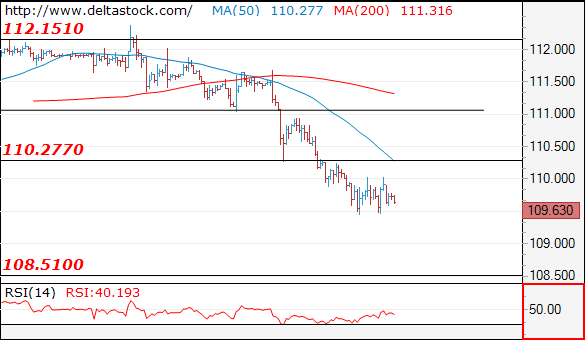
Current level - 109.63
The bias is still bearish, for a slide towards 108.50 zone. Initial resistance is projected at 110.30.
| Resistance | Support | ||
| intraday | intraweek | intraday | intraweek |
| 110.30 | 113.20 | 108.50 | 108.50 |
| 111.65 | 114.50 | 108.50 | 107.40 |
GBP/USD
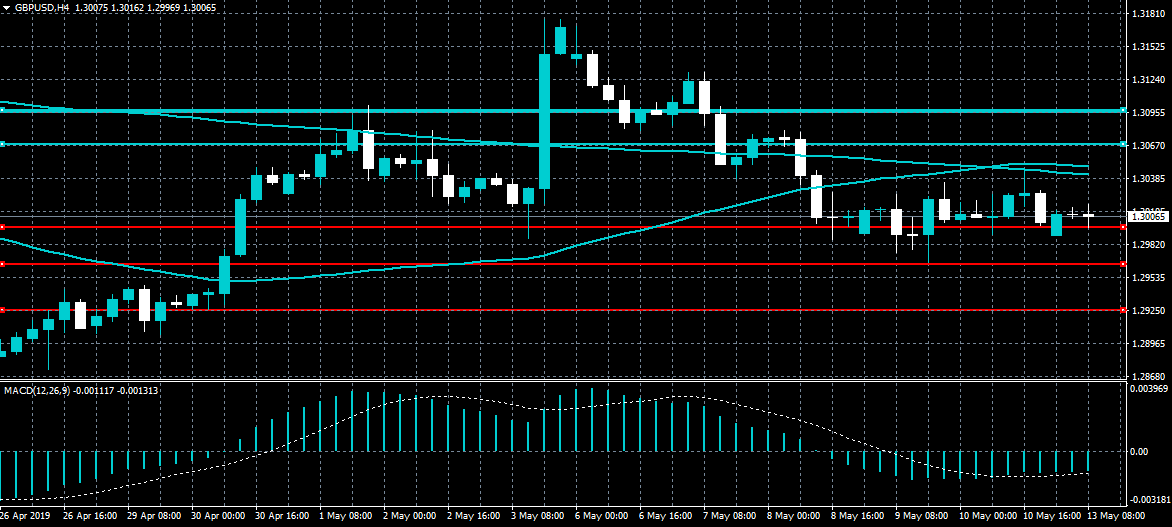
Current level - 1.3000
Intraday allow another rise towards 1.3080 resistance area and it should be followed by a slide through 1.2960, towards 1.2860 low.
| Resistance | Support | ||
| intraday | intraweek | intraday | intraweek |
| 1.3030 | 1.3340 | 1.2960 | 1.2860 |
| 1.3080 | 1.3450 | 1.2860 | 1.2610 |
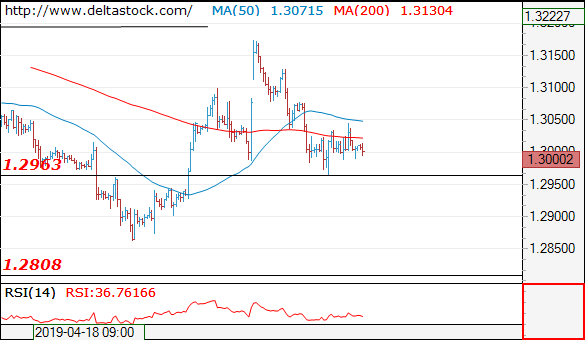
GBPUSD 1.3040 Key Resistance
The British pound remains weak around the 1.3000 level against the US dollar as the pair struggles to build upside momentum. If bulls can move the GBPUSD pair higher the 1.3040 level currently offers the strongest form of intraday resistance. Further weakness below the important 1.2990 level will likely trigger the next round of heavy GBPUSD technical selling.
The GBPUSD pair is only bullish while trading above the 1.3040 level, key resistance is located at the 1.3064 and 1.3100 levels.
If the GBPUSD pair trades below the 1.2990 level, key intraday support is found at the 1.2966 and 1.2925 levels.