

Sample Category Title
GBP/USD Mid-Day Outlook
Daily Pivots: (S1) 1.2981; (P) 1.3014; (R1) 1.3038; More....
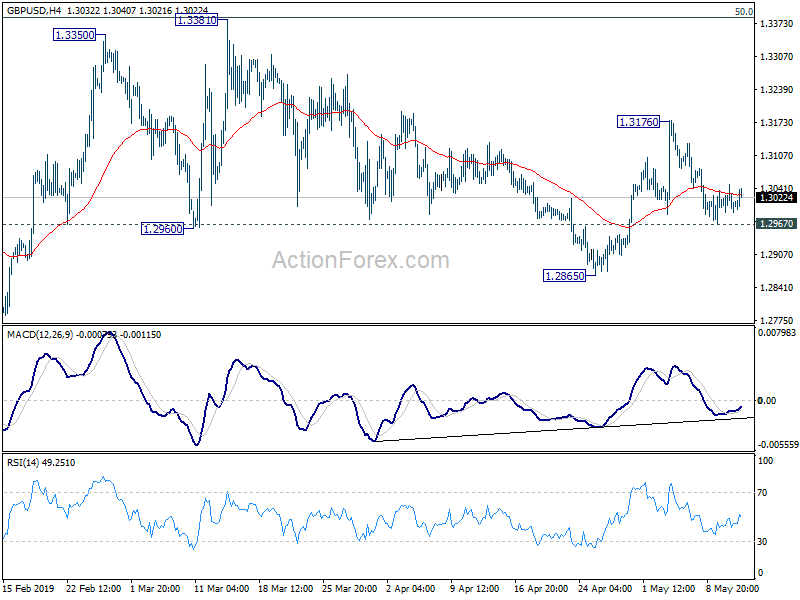
No change in GBP/USD's outlook. Intraday bias stays neutral with focus on 1.2967 minor support. On the downside, break of 1.2967 will turn bias to the downside for 1.2865 support. Decisive break there will revive the bearish case that rebound from 1.2391 has completed at 1.3381. Near term outlook will turn be turned bearish. On upside, above 1.3176 will retain the bullish case and target a retest on 1.3381 high next.
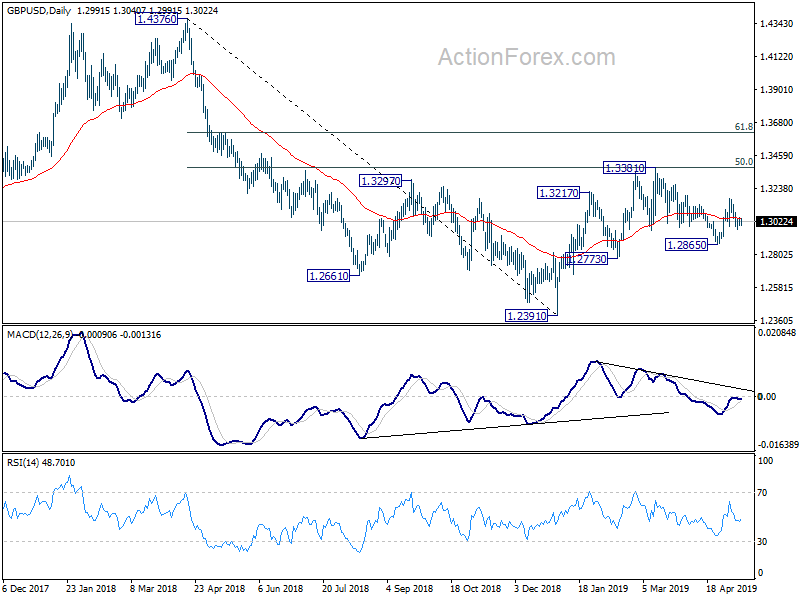
In the bigger picture, medium term decline from 1.4376 (2018 high) halted and made a medium term bottom after hitting 1.2391. Rebound from 1.2391 is seen as a corrective move for now. In case of another rise, strong resistance could be seen around 61.8% retracement of 1.4376 to 1.2391 at 1.3618 to limit upside. On the downside, break of 1.2773 support will suggests that such corrective rise is completed and bring retest of 1.2391 low first.
USD/CHF Mid-Day Outlook
Daily Pivots: (S1) 1.0093; (P) 1.0127; (R1) 1.0154; More...
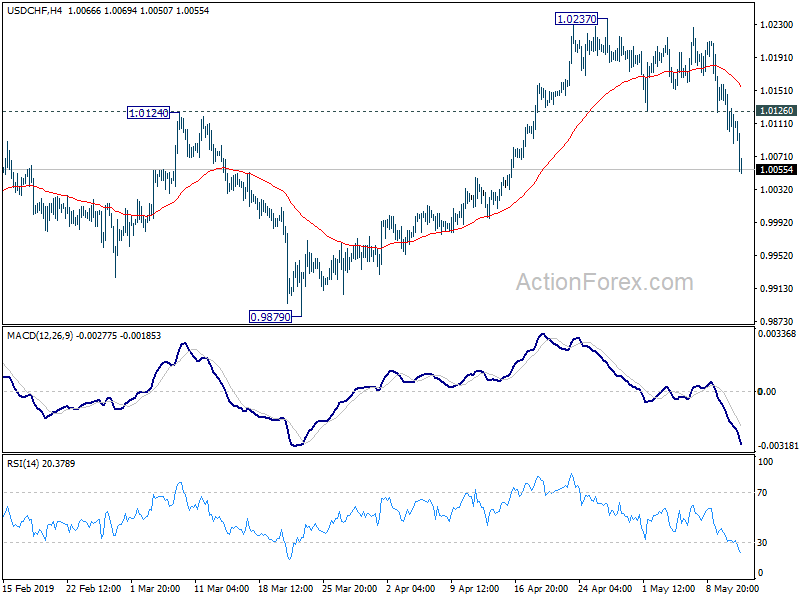
USD/CHF's decline from 1.0237 accelerates to as low as 1.0050 so far. No support is see at 55 day EMA. Intraday bias remains on the downside for retesting 0.9879 key support. On the upside, break of 1.0126 support turned resistance is needed to indicate completion of the fall from 1.0237. Otherwise, risk will now stay on the downside in case of recovery.
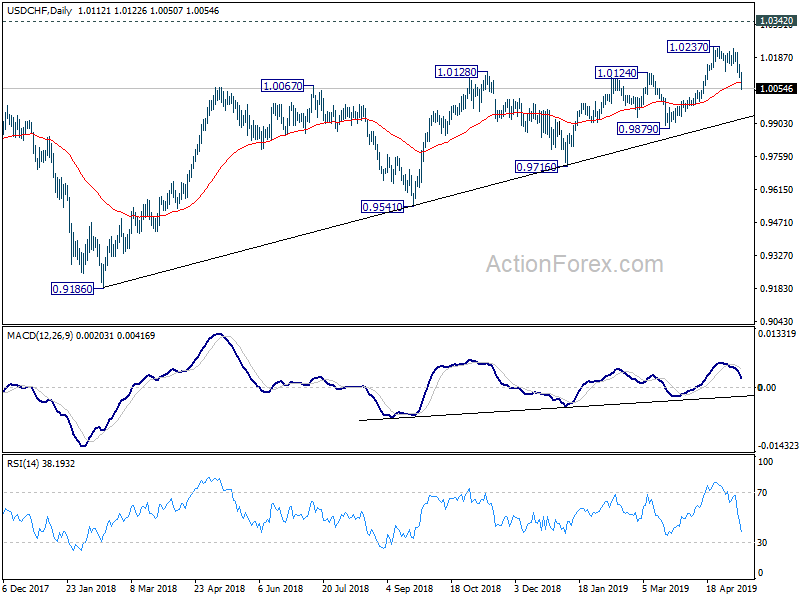
In the bigger picture, as long as 0.9879 support holds, medium term up trend form 0.9186 is still in progress. Break of 1.0237 will target 1.0342 resistance next. For now, we'd be cautious on strong resistance from there to limit upside, until we see medium term upside acceleration. However, decisive break of 0.9879 will be a strong sign of medium term reversal. Focus will be turned back to 0.9716 support for confirmation.
Gold Failing to Capitalize on Risk Averse Markets
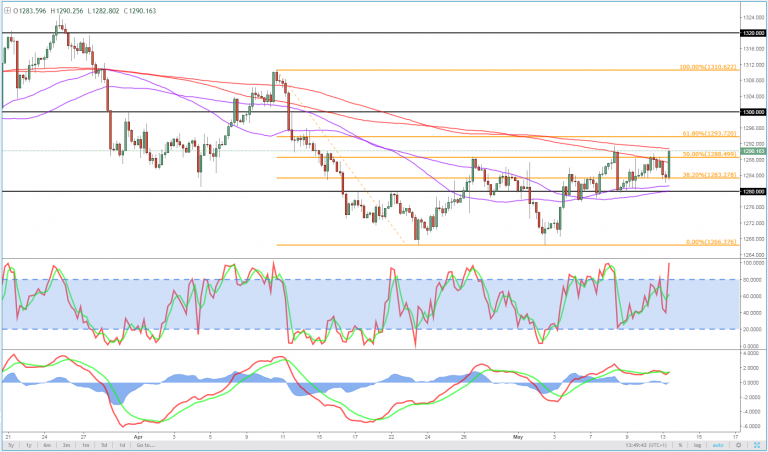
It’s interesting to see that gold is struggling to break back above $1,290 at the start of the week, despite the risk aversion we’re seeing in the markets and the softer dollar.
Gold Daily Chart
OANDA fxTrade Advanced Charting Platform
Gold is a traditional safe haven and often performs well when the greenback is weaker. The fact that it’s struggling to make any real strides to the upside may be a real concern for gold bulls and suggest the downtrend since the middle of February may not have passed.
Gold was actually lower earlier in the session, despite US index futures being off more than 1%. The selling has picked up significantly following news that China will respond by increasing tariffs on $60 billion of their own imports, in response to Trump’s increase, on 1 June. That’s been enough to push gold into positive territory but not yet to make a significant break higher.
If a significant break does follow – and market moves have picked up in the last hour quite clearly – then momentum will be key because a failure to confirm the rally – higher highs on MACD and stochastic – won’t offer any more comfort. Anything that indicates reluctance doesn’t fill me with hope that we’re going to see a big shift in that direction. Confirmation on the other hand would be very interesting.
Gold 4-Hour Chart
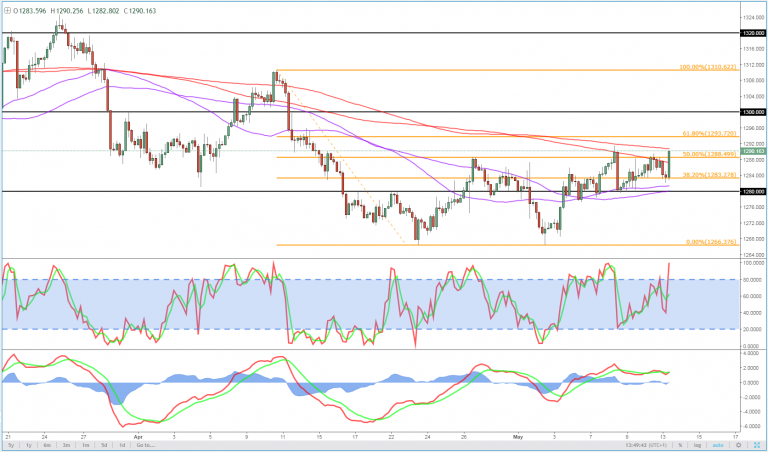
The important level to the downside remains $1,265, where gold has run into support on a couple of occasions over the last month. It’s not yet clear that we’ll see a test of this in the near term, with gold continuing to hold around the recent highs but the inability to capitalize on otherwise risk averse markets and a softer dollar is not an encouraging signal.
Bitcoin Shines Through Market Uncertainty; Uber Shares Sink
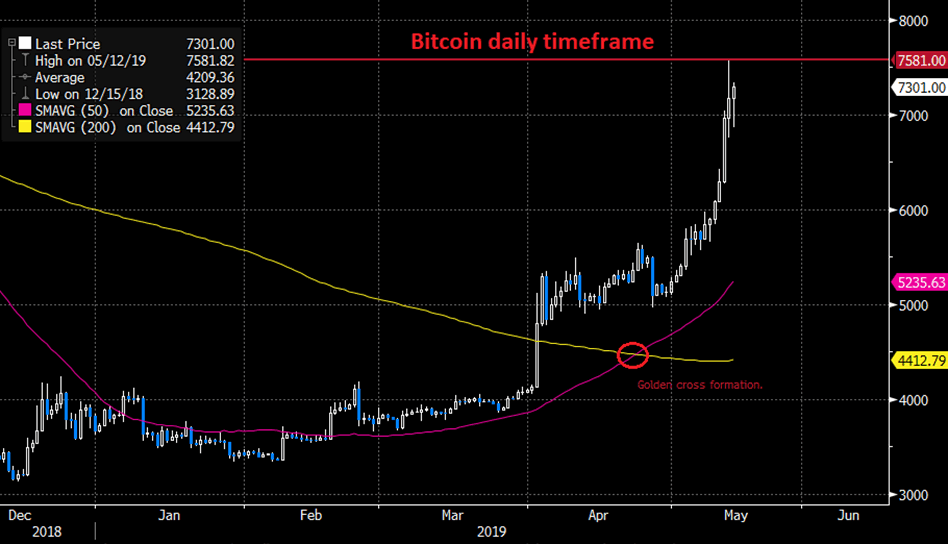
Bitcoin bulls shifted into higher gear over the weekend, as prices surged to above $7550, levels not seen since August 2018.
With no major news factors behind the aggressive appreciation, the sharp $1000 jump over the weekend remains a mystery to investors. Although such explosive moves are nothing new in the volatile world of cryptocurrency, there is the coincidental view that the rally in Bitcoin has come around the same time as heightened US-China trade tensions have eroded risk sentiment. While it’s far too premature to suggest that Bitcoin has restored itself as a potential safe-haven asset for investors, the idea will attempt to pick up further momentum if the cryptocurrency continues to explode higher amid the risk-off conditions.
There is a likelihood that Bitcoin bulls are finding inspiration to jump into the market on the headlines of a rally in Bitcoin. The bullish ‘golden cross’ is already in play on the daily charts. This occurs when the 50-day simple moving average has crossed above the 200-day moving average. With prices punching above $7400 and currently trading around the $7000 region, bulls remain in the driving seat. A solid weekly close above $7400 may open the gates towards $8000 in the short to medium-term.
Source: Bloomberg Terminal
Uber shares tumble on debut
Uber shares have stumbled into the trading week, struggling to shake off the hangover from the company’s rough and rocky debut on the New York Stock Exchange last Friday.
Its shares closed down nearly 8% last week thanks to investor skepticism over the company’s unprofitability and general lack of risk appetite amid escalating US-China trade tensions.
The launch of Uber on the stock market was one of the most highly anticipated additions since Facebook shares many years ago, but it is a surprise to see how unsuccessful the launch has been given the widespread popularity of the Uber brand globally.
Overall, it does appear that risk aversion will remain the name of the game for financial markets further into the trading week as trade tensions, geopolitical risk factors and repeated concerns over global growth diminish risk appetite. Uber shares, like many other financial asset classes, are set to stay under a negative spotlight as investors instead favor safe-haven assets.
USD/JPY Mid-Day Outlook
Daily Pivots: (S1) 109.60; (P) 109.82; (R1) 110.18; More...
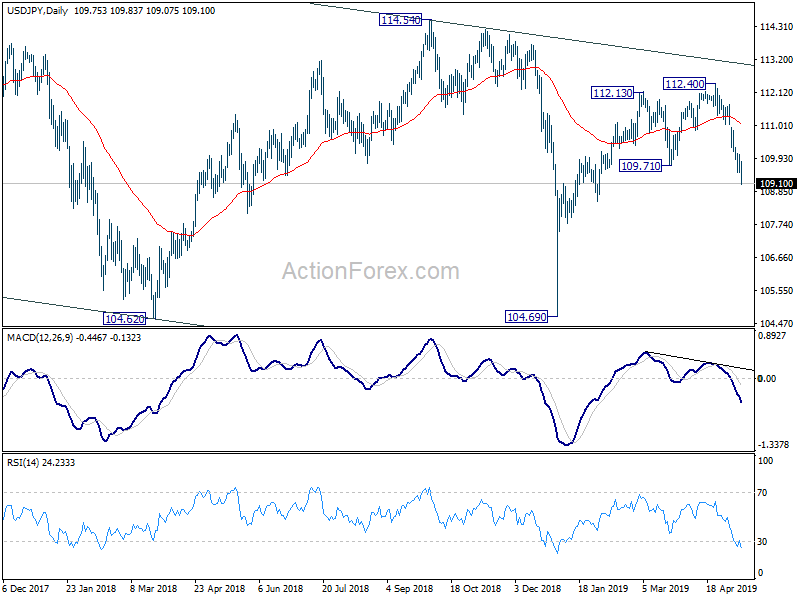
USD/JPY's fall resumes after brief consolidation and intraday bias is back on the downside. Firm break of 109.71 confirmed completion of rebound from 104.69, on bearish divergence condition in daily MACD. Deeper decline should now be seen back to retest 104.69 low. On the downside, break of 110.04 minor resistance will turn intraday bias neutral and bring consolidations, before staging another decline.
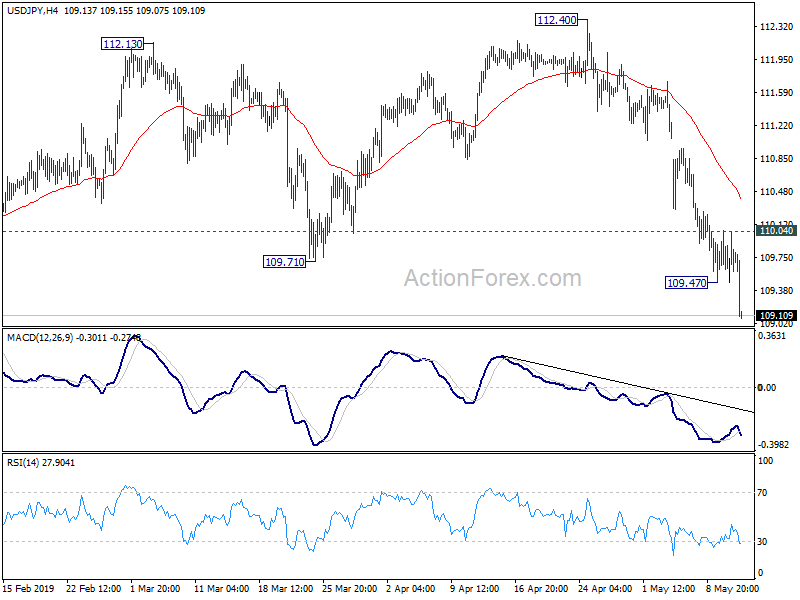
In the bigger picture, USD/JPY is staying inside falling channel from 118.65. Currently development suggests that rebound from 104.69 is only a corrective move. And fall from 118.65 is not completed yet. Decisive break of 104.69 will extend the down trend towards 98.97 support (2016 low). For now, we'd expect strong support above there to bring rebound.
China Announced Retaliations as Nobody Read Trump’s Threat Tweets
Rallies in Yen and Swiss Franc accelerate while selloffs in commodity currencies intensify on US-China trade war today. Trump "stepped up" his pressure on China and warned the latter not to retaliate. But it's actually unsure who he was talking to as it's a known that Twitter is blocked in the locked-up China.
Even China's internet space is open, Xi is not known to be a social-media addict. Even if Xi is secretly a social media enthusiast, Weibo or Wechat are the ways to go rather than Twitter. So, unsurprisingly, China didn't listen to the threat tweets that Trump directed to somebody else, and announced retaliation to US, effective Jun 1.
In the currency markets, Australian Dollar is leading other commodity currencies down on risk aversion. Yen is the strongest one for today so far, followed by Swiss Franc. Selloff in Chines Yuan remains in acceleration phase as USD/CHN breaks 6.9. Key psychological level at 7.0 should be within reach shortly.
Technically, USD/JPY's fall quickly resumes through 109.47 temporary low. It's heading towards 104.69 key support. GBP/JPY is likely resuming recently decline too and breaches 142.22. EUR/JPY might soon have a take on 122.48 temporary low. EUR/AUD breaks 1.6122 key resistance and could be heading back towards 1.6765 high. AUD/USD is still pressing 0.6962 temporary low and is vulnerable.
In other markets, DOW futures is currently down over -500 pts and should gap lower at open. US 10-year yield is down -0.0523 at 2.416. 3-month-10-year yield curve inversion is back. In Europe, FTSE is currently down -0.58%. DAX is down -1.59%. CAC is down -1.24%. German 10-year yield is down -0.012 at -0.054. Earlier in Asia:, Nikkei dropped -0.72%. Hong Kong was on holiday. China Shanghai SSE dropped -1.21% to 2903.71. Singapore Strait Times dropped 1.20%. Japan 10-year JGB yield dropped -0.0008 to -0.046.
China announced retaliation on US tariffs hikes, effect Jun 1
China official announced retaliation to US tariffs hikes from 10% to 25% on USD 200B in Chinese import effective on May 9.
In a statement of the Office of the Customs Tariff Commission of the State Council, China criticized that the above move by the US "led to an escalation of economic and trade frictions, which violates the consensus of China and US to resolve trade differences through consultations". And, that "harms the interests of both sides and does not meet the general expectations of the international community."
The Commission announced to "adjust" and raise current tariffs on US imports, effect June 1. For the list of USD 60B tariffs US products, rate will be raised to 25%, 20% or 10%. For those products at 5% tariffs, the rate will be maintained.
Trump: Nobody left in China to do business with. That's very bad for China, very good for USA
Trump continues to "demonstrate" his verbal threats to China with his tweets. He claimed that of the 25% tariffs, only "4 points were paid by the US". "21 points" will be paid by China because it "subsidizes product to such a large degree". And, people can by products "inside the USA". Tariffs companies will be "leaving China for Vietnam and other such countries in Asia.
He also claimed that "there will be nobody left in China to do business with" and that's "very bad for China, very good for USA". He warned that "China should not retaliate – will only get worse!". Also, Trump told Chinese President Xi "you had a great deal, almost completed & you backed out".
Trump also claimed that the unexpected 3.2% GDP growth was "greatly helped by tariffs fro China".
US Perdue to Japan: We're aware of your July election, but Trump expects you to treat us a premier customers in trade
On trade negotiation with Japan, US Secretary of Agriculture Sonny Perdue warned that "we cannot continue to kick this trade can down the road forever." While a quick deal might be difficult, he said Trump is is really looking forward to a deal sooner rather than later".
Meanwhile, Perdue also said they're "very much aware of the elections of the upper body", in July in Japan. But he added, Trump is "expecting again Japan would treat us as their premier customer as we are."
EU Malmström: US could extend May 18 deadline for auto tariffs decision
EU Trade Commissioner Cecilia Malmström told newspaper Süddeutsche Zeitung that the deadline regarding US decision on auto tariffs on EU could be extended.
She recalled that "as long as we are in negotiations, no new tariffs will be imposed and we hope the US President will stick to them". Also, while the deadline for car tariffs decision in May 18, "the deadline can be extended… because of the negotiations between the US and China."
Though, Malmström reiterated the EU is prepared for any consequences. She pointed to the case of "Boeing and Airbus". She said, "we are prepared for the worst", and the retaliation list to US is ready.
Bank of France business survey suggests 0.3% Q2 GDP growth
According Bank of France business survey results, the economy could be expanding by 0.3% in Q2. The survey noted that:
- In the manufacturing industry, the business sentiment indicator stood at 99 in April, after 100 in March. Industrial production slowed down in April but business leaders expect it to pick up in May.
- In services, the business sentiment indicator stood at 100 in April, after 101 in March. Service sector improved moderately and growth is expected to continue in May.
- In construction, the business sentiment indicator stood at 105 in April, after 106 in March. Construction activity decelerated but improvement is expected.
BoE Broadbent: A Brexit deal would lead to quite a strong bounce-back in investment
BoE Deputy Governor Ben Broadbent warned that further Brexit delays beyond October 31. risks greater damage to the economy. He said "it's pretty clear that investment has been feeling the consequences of the uncertainty about Brexit and particularly the possibility of a bad outcome".
He warned, "if you continually expect news to arrive imminently – a resolution – then that can have quite a depressing effect on investment". And, persistent depression on investment is clearly bad for the economy as "we rely on investment for making us collectively more productive and better off.
Instead, a Brexit deal would lead to "quite a strong bounce-back in investment." "There would be quite a strong bounce-back in investment," he said. "These are not cancelled projects – it's delay. If, as a business person, you're assured that the worst thing is suddenly off the table, that has quite a powerful effect on your incentive to invest."
Japan leading index dropped to 96.3, coincidence index dropped to 101.9, "worsening"
Japan leading index dropped to 96.3 in March, down from 97.1. Coincidence indicator dropped to 101.9, down from 102.8. The Cabinet Office described the assessment of coincidence index as "worsening". That's a clear follow up to February's assessment of "a turning point towards a downgrade".
The deterioration in economic situation raised the chance that Japan is already heading to a recession. US-China trade conflict has been a clear drag to the export-led economy. With current escalation in tensions, Japan could start to feel heavier impact ahead.
USD/JPY Mid-Day Outlook
Daily Pivots: (S1) 109.60; (P) 109.82; (R1) 110.18; More...
USD/JPY's fall resumes after brief consolidation and intraday bias is back on the downside. Firm break of 109.71 confirmed completion of rebound from 104.69, on bearish divergence condition in daily MACD. Deeper decline should now be seen back to retest 104.69 low. On the downside, break of 110.04 minor resistance will turn intraday bias neutral and bring consolidations, before staging another decline.
In the bigger picture, USD/JPY is staying inside falling channel from 118.65. Currently development suggests that rebound from 104.69 is only a corrective move. And fall from 118.65 is not completed yet. Decisive break of 104.69 will extend the down trend towards 98.97 support (2016 low). For now, we'd expect strong support above there to bring rebound.
Economic Indicators Update
| GMT | Ccy | Events | Actual | Forecast | Previous | Revised |
|---|---|---|---|---|---|---|
| 1:30 | AUD | Home Loans M/M Mar | -2.50% | 0.40% | 2.00% | 0.80% |
| 5:00 | JPY | Leading Index CI Mar P | 96.3 | 96.3 | 97.1 |
Australian Dollar Dips as U.S hits China with NewTariffs
AUD/USD has started the trading week with losses. Currently, the pair is trading at 0.6969, down 0.46% on the day. On the fundamentals front, Australian home loans disappointed with a decline of 2.5%, well below the estimate of 2.2%. This marked the fourth decline in five releases. The downward trend continued for NAB business confidence, which fell to zero in March. There are no U.S. data releases on Monday. On Tuesday, Australia posts Westpac consumer sentiment and the wage price index.
The slowdown in the Chinese economy has damaged the Australian economy, so an escalation in the global does not bode well for the Australian dollar. The trade war between the U.S. and China escalated last week, as the U.S. slapped China with new tariffs on Friday. The move raised tariffs on some $200 billion in Chinese goods from 10% to 25%. China is yet to retaliate with counter tariffs on U.S. goods, but has allowed the Chinese yuan to fall to its lowest level in four months. A lower yuan makes Chinese exports more competitive and will help cushion the effect of the new U.S. tariffs.
Despite the dramatic rise in tariffs and the Chinese promise to retaliate, talks between the sides continue, with officials scheduled to meet in Beijing. The new tariffs do not apply to Chinese goods that left port prior to May 10, affording a 2-week window for negotiators before the tariffs take effect. The escalation in tensions has shelved a meeting between President Trump and Chinese President Xi, but the two leaders could meet at the G-20 summit in Japan in June.
The RBA released its quarterly policy statement on Thursday, sending a pessimistic message to the markets. The bank downgraded its GDP forecast to 2.75%, down from 3.0% in February. Inflation remains low, and the RBA rate statement, released on Tuesday, said that the labor market would have to improve before inflation could reach the bank’s target of 2.0%. The RBA has been dovish about the economic outlook, and thus surprised the markets when it did not lower the key interest rate last week. Despite the cloudy economic outlook, rate-setters are hopeful that the limping economy can rebound without the help of a rate cut.
China announced retaliation on US tariffs hikes, effect Jun 1
China official announced retaliation to US tariffs hikes from 10% to 25% on USD 200B in Chinese import effective on May 9.
In a statement of the Office of the Customs Tariff Commission of the State Council, China criticized that the above move by the US "led to an escalation of economic and trade frictions, which violates the consensus of China and US to resolve trade differences through consultations". And, that "harms the interests of both sides and does not meet the general expectations of the international community."
The Commission announced to "adjust" and raise current tariffs on US imports, effect June 1. For the list of USD 60B tariffs US products, rate will be raised to 25%, 20% or 10%. For those products at 5% tariffs, the rate will be maintained.
Looking at the details, a total of 5140 lines of US products will be affected. Among them, additional 25% will imposed of 2493 lines, additional 20% will be on 1078 lines
Full statement (in Simplified Chinese).
Into US session: Risk aversion intensifying as China readies retaliation on Jun 1
US-China trade war is the major, if not the only, theme today. Trump "demonstrated" his threat to China by warning the latter not to retaliate with his tweets. Whether Twitter is blocked in China or not, we believe that it's a known (including Trump) that Xi doesn't read it. Anyway, China is said to hit back on tariffs on some USD 60B in US import, with tariffs ranging from 5-25%, effect June 1.
Global stock markets suffer steep selloff today as there is only one way to go for US and China, further escalation in trade and diplomatic tensions. In particular, DOW future is down -400pts as US stocks are set to open sharply lower. 10-year yield is currently down -0.043 at 2.425 and 3-month to 10-year yield inversion is back. China Shanghai SSE just lost -1.21% and defended 2900 handle. But Yuan selloff is accelerating with USD/CNH breaking 6.9 handle.
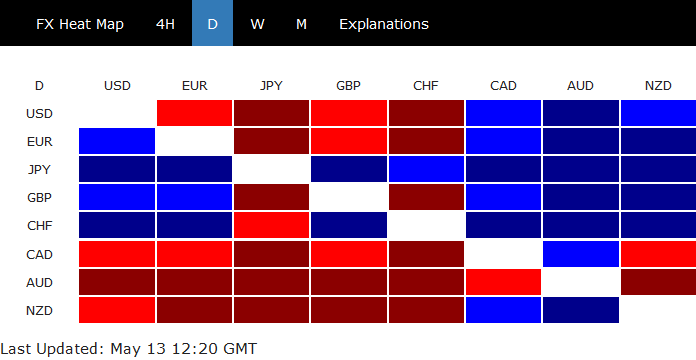
In the currency markets, Australian Dollar leads other commodity currencies down. Swiss Franc and Yen are the strongest ones. In particular, USD/JPY breaks 109.47 temporary low to resume recent decline. USD/CHF also breaks 55 day EMA decisively. Both are near term bearish developments.
In Europe, currently:
- FTSE is down -0.25%.
- DAX is down -1.00%.
- CAC is down -0.76%.
- German 10-year yield is down -0.009 at -0.051.
Earlier in Asia:
- Nikkei dropped -0.72%.
- Hong Kong was on holiday.
- China Shanghai SSE dropped -1.21% to 2903.71.
- Singapore Strait Times dropped 1.20%.
- Japan 10-year JGB yield dropped -0.0008 to -0.046.
BoE Broadbent: A Brexit deal would lead to quite a strong bounce-back in investment
BoE Deputy Governor Ben Broadbent warned that further Brexit delays beyond October 31. risks greater damage to the economy. He said "it's pretty clear that investment has been feeling the consequences of the uncertainty about Brexit and particularly the possibility of a bad outcome".
He warned, "if you continually expect news to arrive imminently - a resolution - then that can have quite a depressing effect on investment". And, persistent depression on investment is clearly bad for the economy as "we rely on investment for making us collectively more productive and better off.
Instead, a Brexit deal would lead to "quite a strong bounce-back in investment." "There would be quite a strong bounce-back in investment," he said. "These are not cancelled projects – it's delay. If, as a business person, you're assured that the worst thing is suddenly off the table, that has quite a powerful effect on your incentive to invest."