

Sample Category Title
USD/CAD Canadian Dollar FX Tumbles On Trade Concerns
The Canadian dollar dropped 0.51 percent on Monday. The ongoing trade dispute between the US and China was the biggest factor behind the drop of the loonie. Oil prices had rallied after news of an attack on Saudi oil tankers, but in the end the downward pressure from lower demand estimates if the trade war becomes a reality took crude into negative territory.
The biggest concern for investors is that not reaching an agreement with China could jeopardize the chances of the USMCA as it awaits to be ratified. Hard negotiating tactics had the loonie scrambling before concessions were made in the last days of talks between the US, Mexico and Canada.
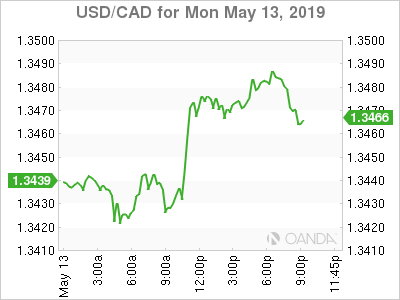
Job gains in Canada beat expectations but it was not enough if the trade deal with its largest trading partner is not ratified.
The US dollar is mixed after China announced its retaliation against rising US tariffs. Safe havens were higher against the greenback with the Japanese yen, Swiss franc and gold all appreciated as investors lost their appetite for risk. Commodity currencies were lower as a trade war would impact global growth.
Global stocks were in the red as the trade war narrative continues with the tech sector particularly hit.
OIL – Energy Demand Impacted by Ongoing Trade Dispute
GOLD – Yellow Metal Rises as Safe Haven Appeal Returns
STOCKS – US-China Dispute Hits Tech Sector the Hardest
OIL – Energy Demand Impacted by Ongoing Trade Dispute
Oil prices fell on Monday as China retaliated against US tariffs despite earlier reports of attacks on Saudi crude tankers. Brent dropped 0.96 percent and West Texas Intermediate 1.33 percent as global growth expectations were hit by the trade dispute escalation. Supply disruptions have been the biggest factor driving prices higher. Geopolitical disruptions like the US sanctions against Iran and Venezuela, the Russian contaminated supply and the coordinated output cut from the OPEC+ have moved prices higher. The sabotage on Saudi tankers at first was positive for crude prices, but it was offset by the pessimism surrounding global trade.
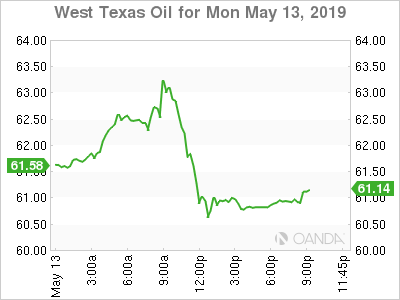
A full-blown trade war would have lasting consequences on global growth, seriously limiting the upside for energy demand. Disruptions have balanced the market, but lower demand and rising US production could make for a quick reversal. 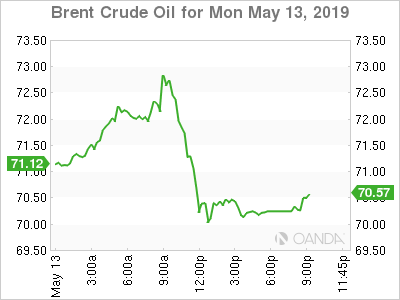
The US-China trade deal was all but signed 10 days ago, and at this point it could be back on the table in the short term, removing some of the downward pressure for crude, but with higher disruptions to supply the agreement between OPEC and other major producers reaching an extension could be off the table. Political infighting at OPEC and Russia’s lack of commitment could end up disbanding the output limit deal, leaving Saudi Arabia with much to ponder on how to rebalance the market by itself.
GOLD – Yellow Metal Rises as Safe Haven Appeal Returns
Gold rose 1.03 percent on Monday. The yellow metal was a clear safe haven for investors after the US and China failed to reach an agreement on trade. Gold broke through the $1,300 price level as China announced it would retaliate against US tariffs triggering a bout of risk aversion that was beneficial to metal prices.
Trade pessimism impacted markets with yields falling and stocks being rattled. The market is starting to price in a rate cut for the Fed’s benchmark interest rate in 2019 as the economy could slow down if a trade war is not averted. The move could signal a return to lower rates that prevailed after the 2008 crisis. The US had managed to climb out of near zero rates but picking a fight with the second largest economy and raising barriers could end up losing all the momentum.
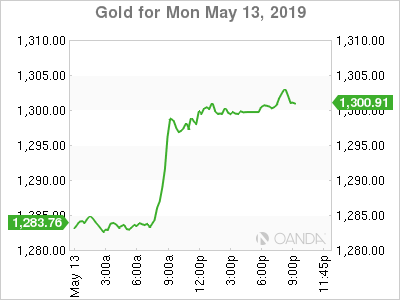
Gold remains bid as uncertainty on the outcome of the US-China trade negotiations will bring, with US Sec Mnuchin saying there are no set dates for a next round of talks.
STOCKS – US-China Dispute Hits Tech Sector the Hardest
Investors sold off equities as China answered the US tariffs that went live on Friday with their own tariffs. The trade deal between the two largest economies was all but signed, but last week a break in negotiations has made a positive outcome cloudier as both nations seem ready for a fight.
Volatility will remain high as the two nations remain far apart with the next meeting between leaders could come next month during the G20 in Japan. Equities will remain sensitive to trade comments as both parties seem confident with little signs of making concessions.
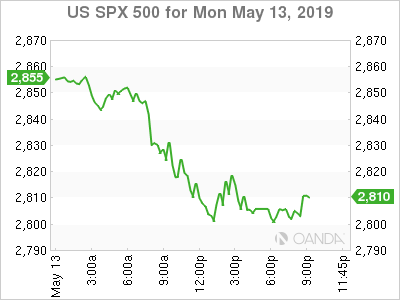
Apple was hit by a Supreme Court decision opening US antitrust rules to be used against the California company for its App Store. Uber would be ruing their luck as the timing of their IPO brought them to market during a new round of trade disputes. The ride hailing company is trying to convince investors that its post IPO pricing will mirror that of Facebook and Amazon which also had less than impressive debuts.
Eco Data 5/14/19
[php_everywhere instance="1"]
FTSE Plunges as Tariff Tussle Sets Back Equity Markets
The FTSE has dropped sharply on Monday. In the North American session, the pair is at 7,167, down 1.5% on the day. Earlier in the day, the blue-chip FTSE dropped to 7,152, lowest level since late March. There are no U.K. events on the schedule. On Tuesday, the U.K. releases wage growth and unemployment claims.
Trade tensions between the U.S. and China continue to rock global equity markets. The blue-chip FTSE index has been hit hard, falling 1.5% last week and falling sharply on Monday. The US. and China have exchanged tariffs on each other product’s dampening hopes for a trade deal and weighing on risk appetite. Nervous investors have been dumping equities in favor of safe-haven assets, such as the U.S. dollar and the Japanese yen. On Friday, the U.S. raised tariffs on $200 billion in Chinese goods, from 10% to 25%. The move was announced a week ago, and sharp declines in the equity markets have boosted the yen. The Chinese response was vigorous, with Bejing announcing earlier on Monday that it would slap tariffs on $60 billion of U.S products.
Despite the escalation in the trade war, talks between the U.S and China continue, with officials scheduled to hold the next round of talks in Beijing. The new tariffs do not apply to Chinese goods that left port prior to May 10, affording a 2-week window for negotiators before the tariffs take effect. The escalation in tensions has shelved a meeting between President Trump and Chinese President Xi, but the two leaders could meet at the G-20 summit in Japan in June.
British data was a mixed bag on Friday, leaving the pound unchanged. The monthly GDP release declined in March by 0.1%, above the estimate of 0.0%. There was better news from the quarterly indicator. Preliminary GDP for Q1 came in at 0.5%, matching the forecast. This was up from final GDP in Q4, which climbed 0.2%. Manufacturing Production remained steady at 0.9% in March, crushing the estimate of 0.1%.
Pound Drops to 2-Week Low as Trade Tensions Weigh on Risk Appetite
GBP/USD has resumed its losing ways on Monday, after falling 1.3% last week. In the North American session, the pair is trading at 1.2960, down 0.30% on the day. On the release front, there are data indicators in the U.K. or the U.S. On Tuesday, the U.K. releases wage growth and unemployment claims.
The pound is under pressure, as nervous investors are snapping up the safe-haven greenback due to rising trade tensions between the U.S. and China. On Friday, the U.S. raised tariffs on $200 billion in Chinese goods, from 10% to 25%. The move was announced a week ago, and sharp declines in the equity markets have boosted the yen. The Chinese response was vigorous, with Bejing announcing earlier on Monday that it would slap tariffs on $60 billion of U.S products.
Despite the tit-for tat tariffs between the U.S. and China, talks between the sides continue, with officials scheduled to hold the next round of talks in Beijing. The new tariffs do not apply to Chinese goods that left port prior to May 10, affording a 2-week window for negotiators before the tariffs take effect. The escalation in tensions has shelved a meeting between President Trump and Chinese President Xi, but the two leaders could meet at the G-20 summit in Japan in June.
British data was a mixed bag on Friday, leaving the pound unchanged. The monthly GDP release declined in March by 0.1%, above the estimate of 0.0%. There was better news from the quarterly indicator. Preliminary GDP for Q1 came in at 0.5%, matching the forecast. This was up from final GDP in Q4, which climbed 0.2%. Manufacturing Production remained steady at 0.9% in March, crushing the estimate of 0.1%
Japanese Yen Climbs to 14-Week High as US-China Tensions Worsen
USD/JPY has resumed its downward trend on Monday. In the North American session, the pair is trading at 109.20, down 0.69% on the day. It’s quiet on the release front, with no U.S. events. In Japan, today’s highlight is current account, which is expected to fall to JPY 1.71 trillion.
The yen hasn’t received much help from economic conditions or Bank of Japan policy, but the currency has taken full advantage of rising tensions between the U.S. and China. The Japanese currency has gained 0.8% on Monday, and has climbed 2.6% in May, as risk appetite has sagged and investors have snapped up the safe-haven Japanese currency. On Friday, the U.S. raised tariffs on $200 billion in Chinese goods, from 10% to 25%. The move was announced a week ago, and sharp declines in the equity markets have boosted the yen. On Monday, China retaliated, announcing that it would slap tariffs on $60 billion of U.S products.
Despite the dramatic rise in tariffs and the Chinese promise to retaliate, talks between the sides continue, with officials scheduled to meet in Beijing. The new tariffs do not apply to Chinese goods that left port prior to May 10, affording a 2-week window for negotiators before the tariffs take effect. The escalation in tensions has shelved a meeting between President Trump and Chinese President Xi, but the two leaders could meet at the G-20 summit in Japan in June.
US GDP Growth Outlook: Trade War Skews Risks to Downside
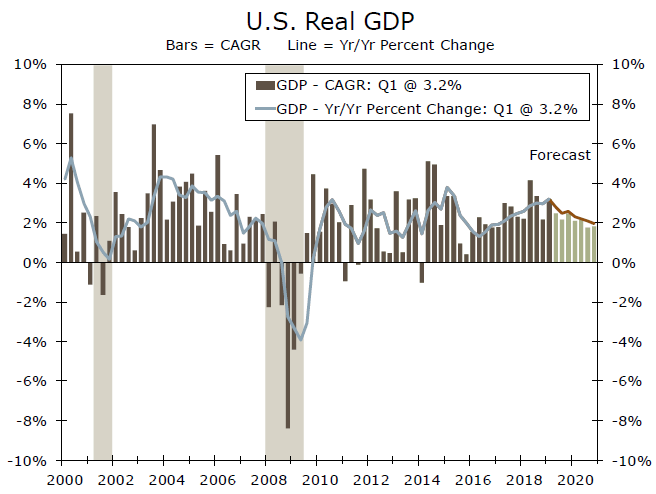
We maintain the forecast that we released on May 8. However, we acknowledge that the recent escalation of the U.S.-China trade war skews the risks to our GDP forecast to the downside.
We Maintain Our Forecast, at Least for Now
President Trump has carried through on his threat to raise tariffs to 25% from 10% on $200 billion worth of Chinese imports, and the administration is drawing up plans to potentially levy tariffs on the $300 billion or so of Chinese imports that have not yet been subject to tariffs. In response, China has jacked up tariffs on $60 billion of American exports. What are the implications of these moves for our economic outlook?
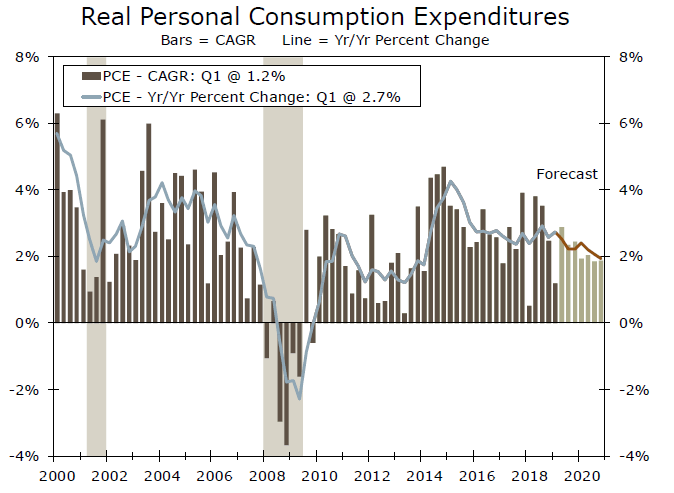
In the forecast that we released on May 8, we projected that U.S. real GDP would grow 2.8% in 2019 and 2.1% next year. Because the United States and China may still eventually agree to a trade deal, which would lead authorities to rescind the tariffs, we have not made any formal changes to this forecast. However, we readily acknowledge that the risks to our GDP forecast are skewed to the downside. We estimate that higher tariffs on Chinese goods could lift consumer price inflation between 0.1 percentage point, if duties are confined to only $200 billion of Chinese imports, and 0.4 percentage point, if duties are placed on all Chinese goods. Everything else equal, higher inflation would reduce growth in real disposable income, which could erode growth in real personal consumption expenditures (PCE). The stock market has weakened recently because of trade tensions, and continued declines in equity prices would impart a negative wealth effect on real PCE as well.
In addition, business fixed investment spending, which we project will grow 3.9% this year and 3.5% next year, could also be negatively affected by the hit to American exports to China as well as to uncertainty related to U.S. trade policy. We maintain our view, which we have highlighted previously, that a trade war probably would not lead to a U.S. recession. But we also acknowledge a trade war would weigh on overall GDP growth.
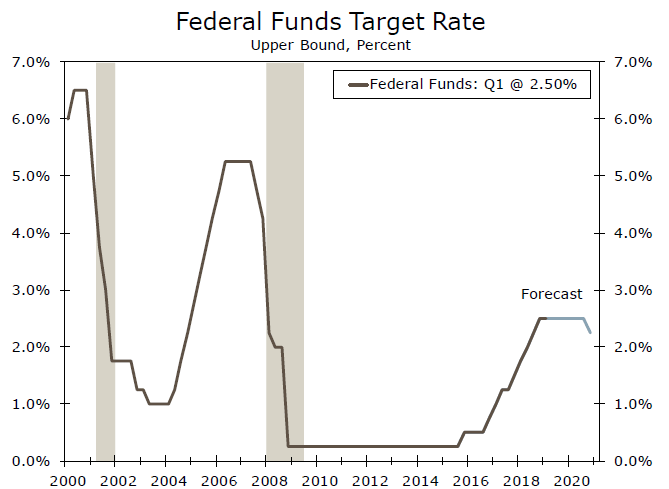
We believe that the Federal Reserve would look through any near-term increase in inflation that resulted from higher tariffs. We currently forecast that the Fed will be on hold through most of next year. But we would be inclined to move forward our expectation for a rate cut, which we currently forecast for Q4-2020, if higher tariffs lead to slower GDP growth. The escalation of the trade war would lead to slower growth in China as well, although it would likely not bring the economy to its knees because Chinese authorities would respond with more accommodative economic policies. The Chinese renminbi, which has already weakened versus the U.S. dollar, would probably depreciate further.
It appears that President Trump will meet Chinese President Xi on the sidelines of the G-20 meeting in Japan on June 28-29. The two leaders could potentially agree on a deal, or at least a potential truce, at that meeting. However, if negotiations fall apart, we will need to make the changes to our current forecast that are discussed above. Stay tuned.
US udpate: DOW drops -600 pts, 10-year yield breaks 2.4, yield curve inversion back
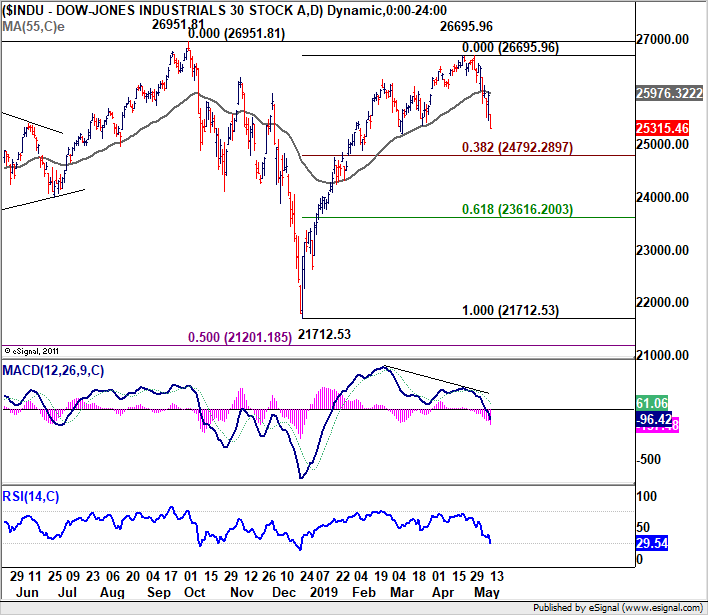
Selloff in US stocks intensify today after China announced to start retaliation on US tariffs on June 1. At the time of writing, DOW is down more than -600 pts or -2.4%, moving further way from 55 day EMA. As noted before, the whole rise from 21712.53 has completed at 26695.96, on bearish divergence condition in daily MACD, ahead of 26951.81 high. The -2.34% decline is S&P 500 and -3.17% decline in NASDAQ put both indices well below 55 day EMA too. Such development affirms our bearish view in US stocks.
Back on DOW, fall from26696.96 is on track to 38.2% retracement of 21712.53 to 26695.96 at 24792.28. Sustained break there will affirm the case that this decline is the third leg of the corrective pattern from 26951.81. DOW should then target 61.8% retracement of 23616.20 and below. This will remain the base case for now as long as 55 day EMA holds.
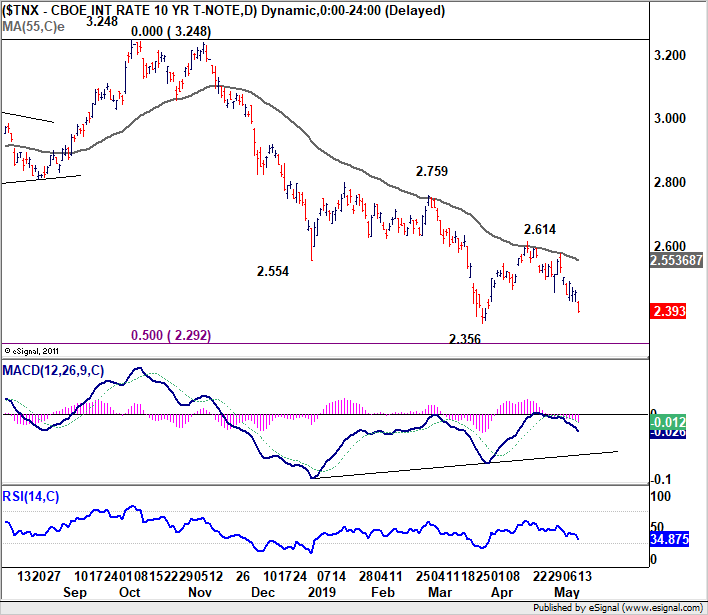
10-year yield is also in free fall today and breaks 2.4 handle to as low as 2.393 so far. The development is in line with our view that larger decline from 3.248 is resuming through 2.356 low. More importantly, 3-month yield is currently at 2.417. That is, 3-month to 10-year yield curve inversion is back. Given current developments, such inversion would likely persist. That smells big trouble for the US economy ahead.
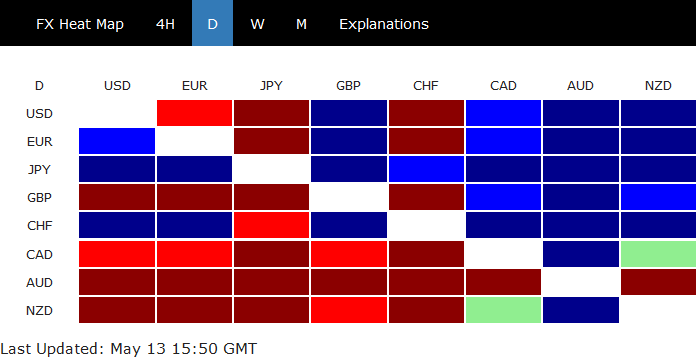
In the currency markets, commodity currencies are the weakest ones. Yen and Swiss Franc the strongest. No surprise at all.
GBP/JPY Mid-Day Outlook
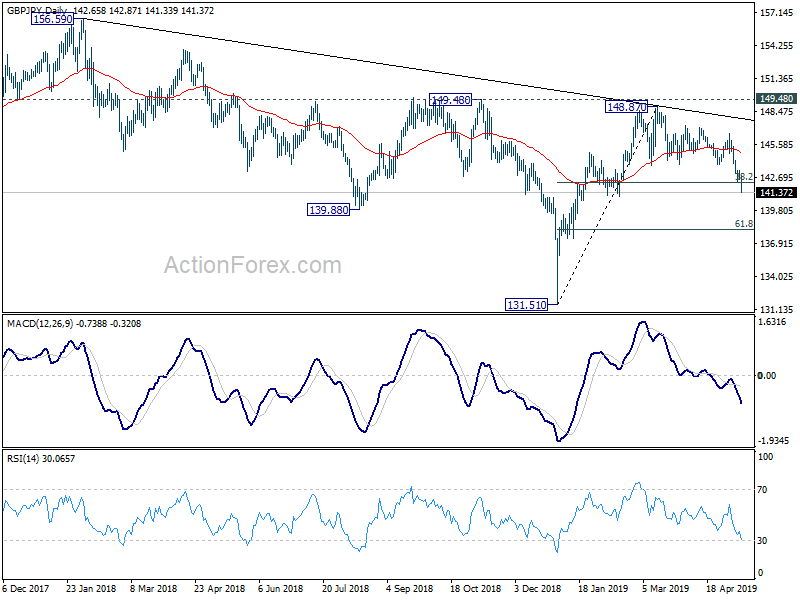
Daily Pivots: (S1) 142.58; (P) 142.92; (R1) 143.32; More...
GBP/JPY's fall resumes after brief consolidation and hits as low as 141.33 so far. Intraday bias is back on the downside for 61.8% retracement of 131.51 to 148.87 at 138.14 next. Sustained break there will pave the way to retest 131.51 low. On the upside, above 143.24 minor resistance will turn intraday bias neutral and bring consolidations, before staging another decline.
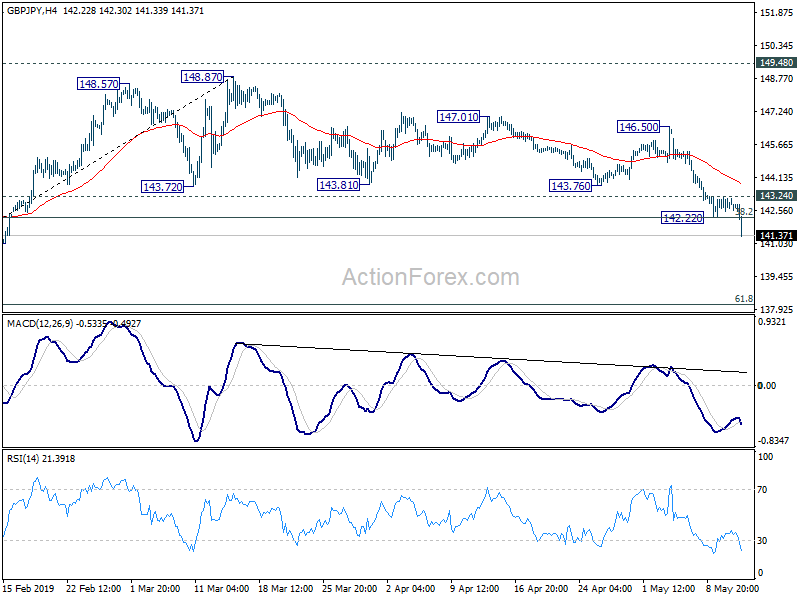
In the bigger picture, current development suggests that GBP/JPY was rejected by 149.98 key resistance. And medium term fall from 156.59 is still in progress. Break of 131.51 will target 122.36 (2016 low). On the other hand, decisive break of 149.98 should confirm that medium term fall from 156.59 (2018 high) has completed at 131.51 already. Further rally would be seen back to 156.59 resistance and above.
AUD/USD Mid-Day Outlook
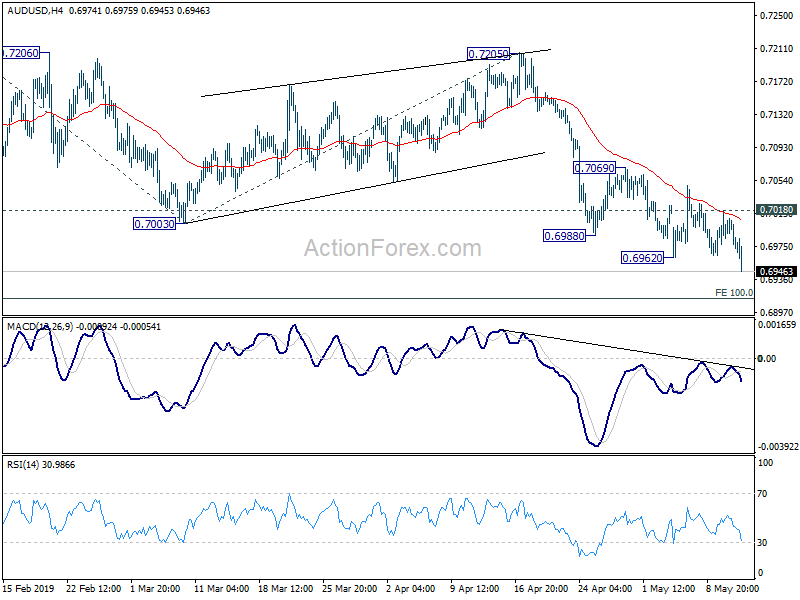
Daily Pivots: (S1) 0.6980; (P) 0.6999; (R1) 0.7019; More...
AUD/USD's drops to as low as 0.6945 so far as recent decline resumed by breaking 0.6962 temporary low. Intraday bias is back on the downside for 100% projection of 0.7295 to 0.7003 from 0.7205 at 0.6913. Decisive break there will indicate further downside acceleration and pave the way to retest 0.6722 low. On the upside, break of 0.7018 minor resistance is needed to indicate short term bottoming. Otherwise, outlook will remain bearish in case of recovery.
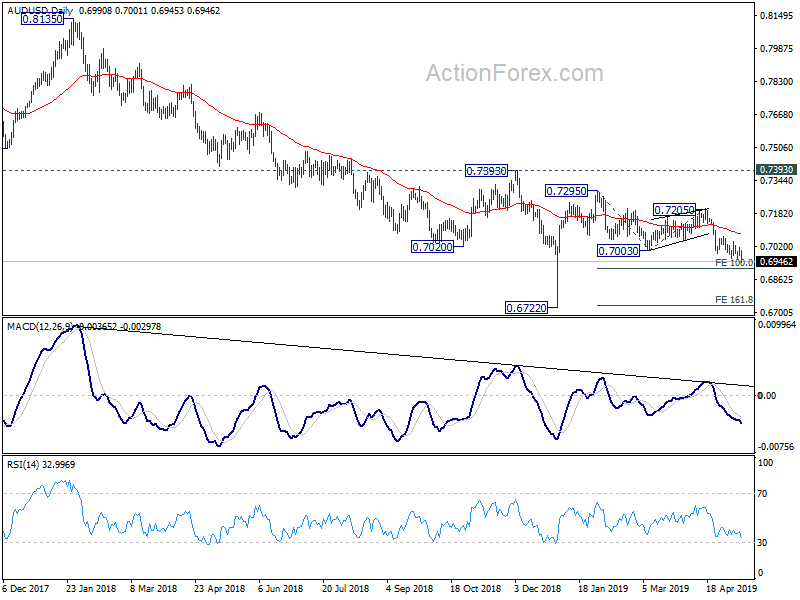
In the bigger picture, with 0.7393 key resistance intact, medium term outlook remains bearish. The decline from 0.8135 (2018 high) is seen as resuming long term down trend from 1.1079 (2011 high). Decisive break of 0.6826 (2016 low) will confirm this bearish view and resume the down trend to 0.6008 (2008 low). However, firm break of 0.7393 will argue that fall from 0.8135 has completed. And corrective pattern from 0.6826 has started the third leg, targeting 0.8135 again.
UK Jobs Data on Tap as Brexit Deadlock Persists
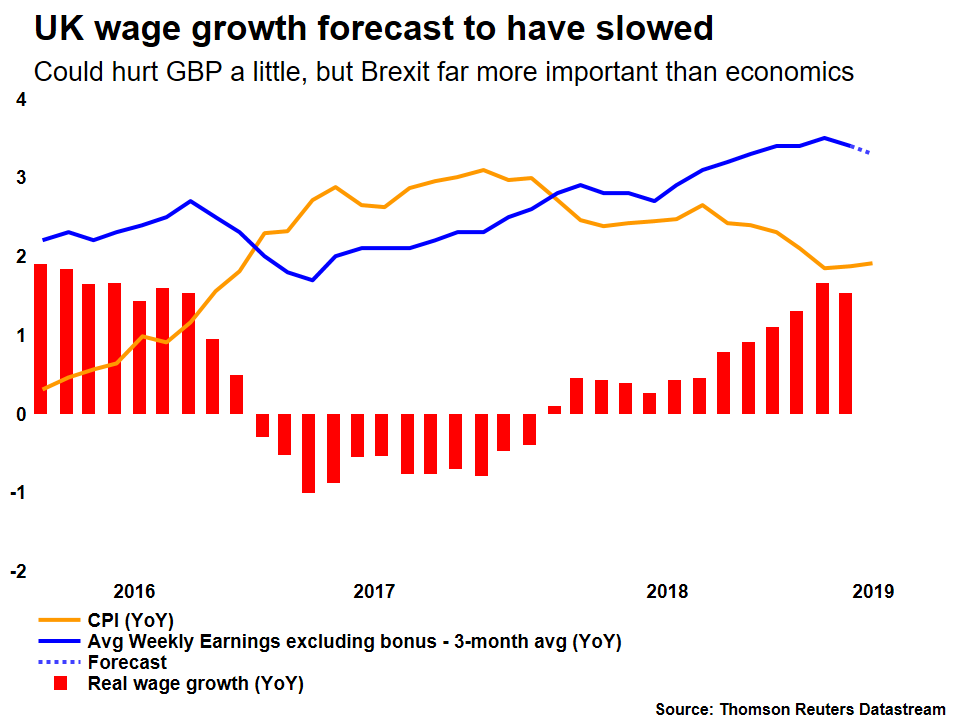
The UK jobs report is due out on Tuesday (09:30 GMT) and forecasts point to a slowdown in wages, which may weigh on the pound a little. In the bigger picture, the risks around sterling also seem tilted to the downside, as any breakthrough in the cross-party Brexit talks seems unlikely, and May’s premiership is increasingly under threat.
The pound continues to be driven almost entirely by Brexit, with markets overlooking economic data. The logic behind this rests on two arguments. First, a solution to the political crisis would also solve most of the nation’s economic issues, mainly by restoring confidence and boosting business investment. Second, the Bank of England has its hands tied by political uncertainty, so incoming data are less vital for monetary policy. Hence, while the upcoming figures may still impact sterling a little, they are unlikely to be a game changer.
In March, the unemployment rate is forecast to have held steady at 3.9%, while average weekly earnings are projected to have slowed somewhat, both including and excluding bonuses. Indeed, the Markit Report on Jobs showed a notable slowdown in both hiring and wages in March, adding credence to the gloomy forecasts.
In the big picture, sterling’s direction will depend on how Brexit unfolds. Cross-party talks between PM May’s Conservatives and the opposition Labour party have stalled, though recent reports suggest May will try to rekindle them by reopening negotiations with the EU on future customs ties. If these cross-party discussions finally produce something of substance, the pound could soar.
However, that seems unlikely. The two sides are still far apart, with Labour insisting May must change her ‘red lines’ for a deal to happen, which she doesn’t seem willing to do. Even if an accord is reached, pushing it through Parliament is a different story. Any deal that includes a permanent customs union as Labour wants, would infuriate Tory Brexiters. Likewise, Labour MPs are demanding that any deal be attached to a second referendum, which the Conservatives won’t agree to.
Further clouding the outlook, May’s premiership is under threat, with several members of her party calling for her to step down. This is probably the biggest risk for the pound. If May goes, the odds of a no-deal exit rise drastically, as most of her potential Tory replacements are ‘hardline’ Brexiters that may want to deliver Brexit no matter what.
Weighing everything together, the risks surrounding sterling seem tilted to the downside. The only saving grace for the currency would be if the cross-party talks suddenly bore fruit, which doesn’t seem probable. On the contrary, the pound could suffer if these negotiations break down, and even worse if May resigns.
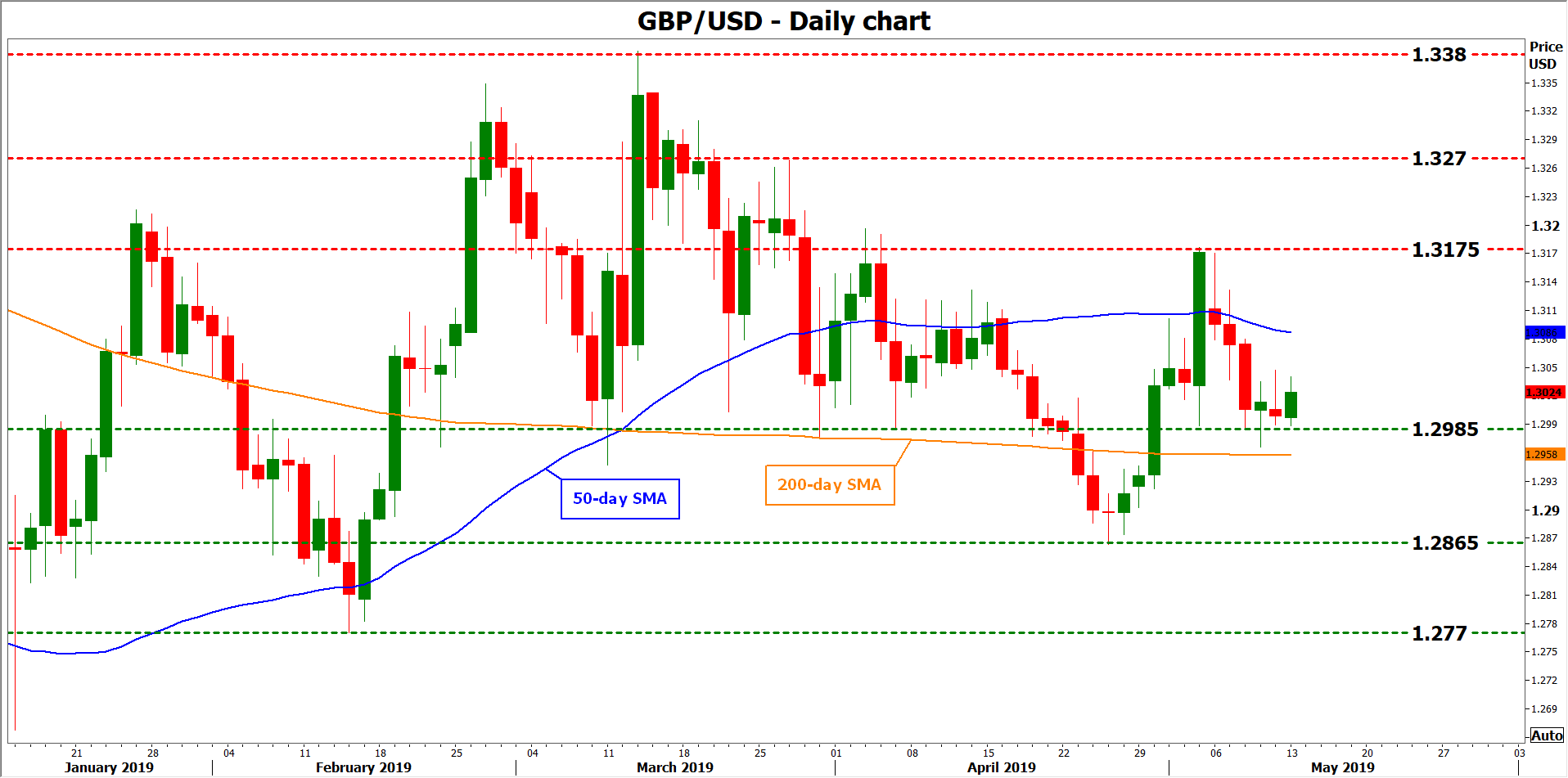
Technically, immediate support to declines in sterling/dollar may be found near 1.2985, with a downside break opening the way for the April lows at 1.2865.
On the flipside, a recovery may meet initial resistance around 1.3175. If the bulls pierce above that zone, attention would next turn to 1.3270.