

Sample Category Title
Australia’s NAB Business Conditions Index Dropped In April
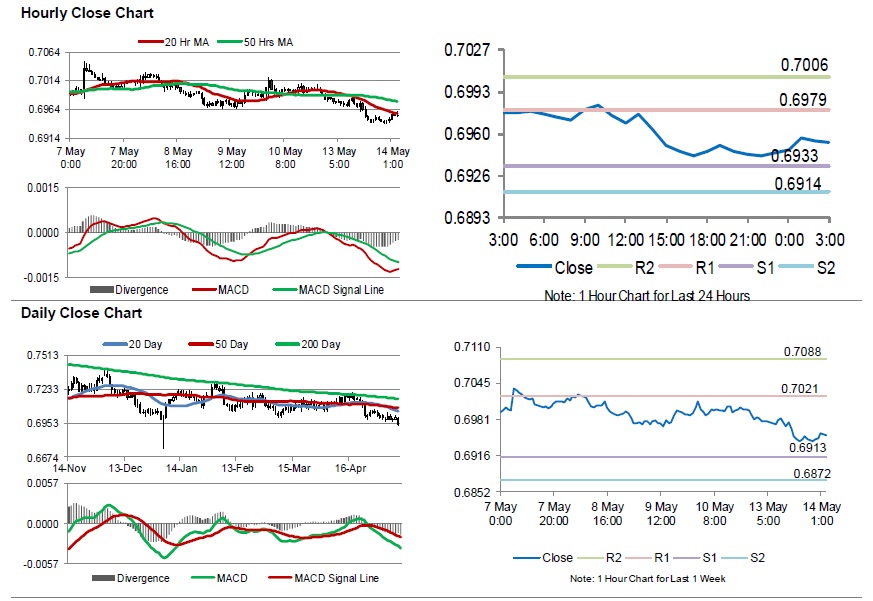
For the 24 hours to 23:00 GMT, the AUD declined 0.53% against the USD and closed at 0.6945.
LME Copper prices declined 1.5% or $93.0/MT to $6042.5/MT. Aluminium prices rose 0.03% or $0.5/MT to $1765.5/MT.
In the Asian session, at GMT0300, the pair is trading at 0.6953, with the AUD trading 0.12% higher against the USD from yesterday's close.
Overnight data showed that Australia's NAB business conditions index declined to a level of 3.0 in April, following a level of 7.0 in the prior month.
The pair is expected to find support at 0.6933, and a fall through could take it to the next support level of 0.6914. The pair is expected to find its first resistance at 0.6979, and a rise through could take it to the next resistance level of 0.7006.
Looking forward, traders would keep an eye on the Australia's Westpac consumer confidence index for May, set to release overnight.
The currency pair is showing convergence with its 20 Hr moving average and trading below its 50 Hr moving average.
Gold: Yellow Metal Trading Lower In The Morning Session
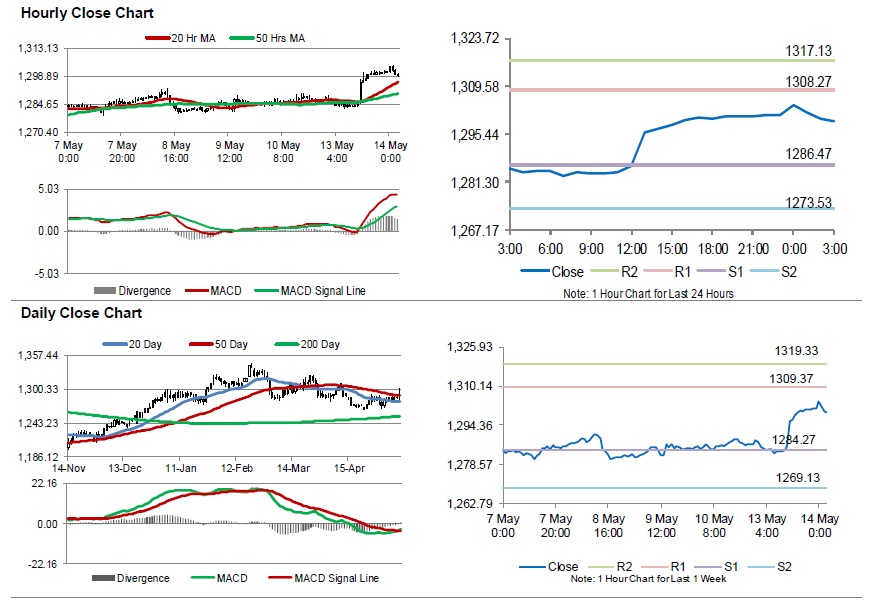
For the 24 hours to 23:00 GMT, Gold rose 1.21% against the USD and closed at USD1301.20 per ounce, amid weakness in the US equities.
In the Asian session, at GMT0300, the pair is trading at 1299.40, with gold trading 0.14% lower against the USD from yesterday’s close.
The pair is expected to find support at 1286.47, and a fall through could take it to the next support level of 1273.53. The pair is expected to find its first resistance at 1308.27, and a rise through could take it to the next resistance level of 1317.13.
The yellow metal is trading above its 20 Hr and 50 Hr moving averages.
Silver: White Metal Trading On A Stronger Footing This Morning
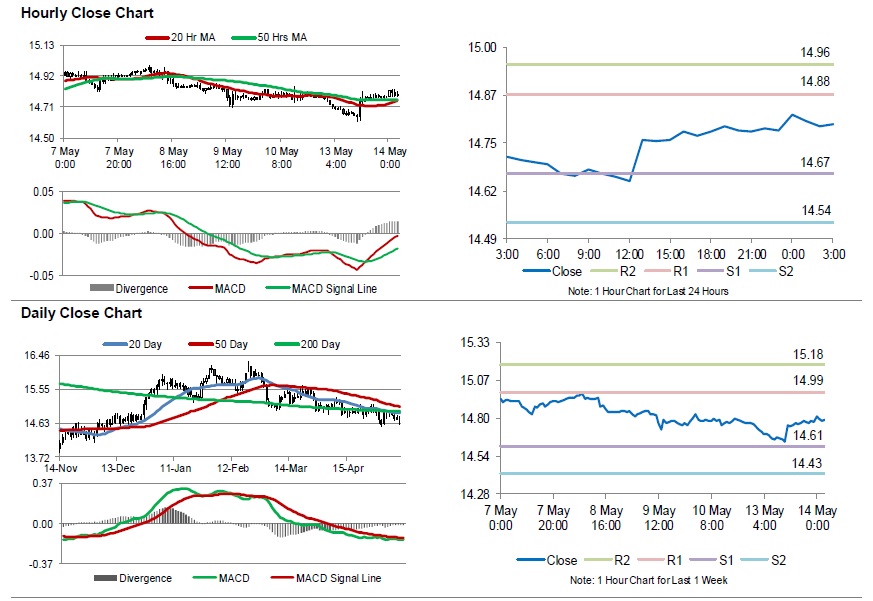
For the 24 hours to 23:00 GMT, Silver rose 0.37% against the USD and closed at USD14.78 per ounce, tracking gains in gold prices.
In the Asian session, at GMT0300, the pair is trading at 14.79, with silver trading 0.10% higher against the USD from yesterday’s close.
The pair is expected to find support at 14.67, and a fall through could take it to the next support level of 14.54. The pair is expected to find its first resistance at 14.88, and a rise through could take it to the next resistance level of 14.96.
The white metal is trading above its 20 Hr and 50 Hr moving averages.
Crude Oil: Oil Trading Higher, Ahead Of API’s Weekly Crude Oil Inventories Data
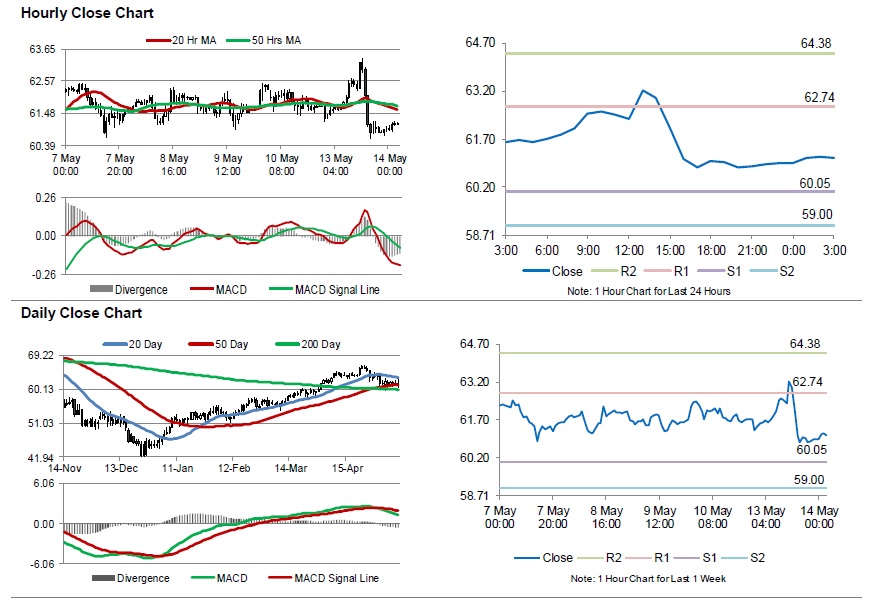
For the 24 hours to 23:00 GMT, Crude Oil declined 1.01% against the USD and closed at USD60.95 per barrel, as rising US-China trade tensions fuelled concerns over global economic growth.
In the Asian session, at GMT0300, the pair is trading at 61.10, with oil trading 0.25% higher against the USD from yesterday’s close.
The pair is expected to find support at 60.05, and a fall through could take it to the next support level of 59.00. The pair is expected to find its first resistance at 62.74, and a rise through could take it to the next resistance level of 64.38.
Crude oil is trading below its 20 Hr and 50 Hr moving averages.
USD/JPY Daily Outlook
Daily Pivots: (S1) 108.93; (P) 109.39; (R1) 109.78; More...
USD/JPY dropped to as low as 109.02 but quickly recovered. Still, with 110.04 resistance intact, further decline is expected. As noted before, whole rebound from 104.69 has completed at 112.40 already. Current fall from 112.40 should extend to retest 104.69 low. Nevertheless, break of 110.04 minor resistance will indicate short term bottom. Lengthier consolidation could be seen before another decline.
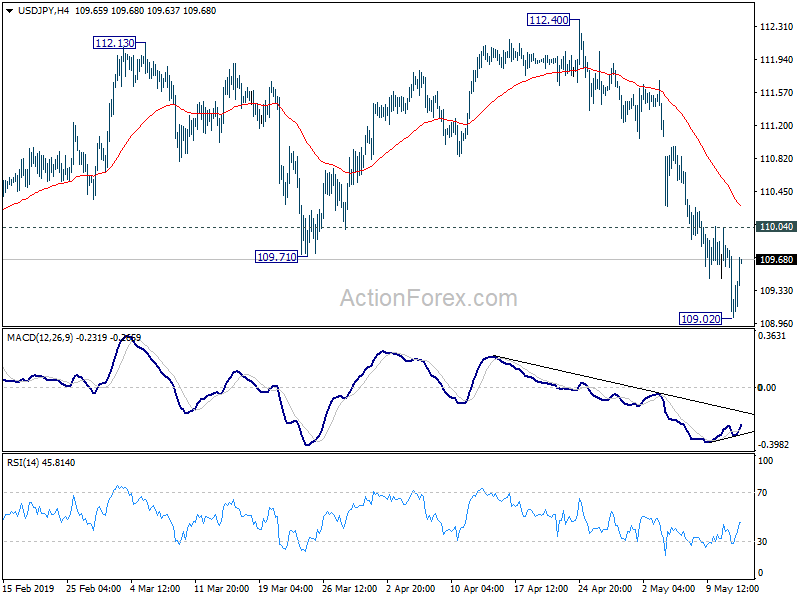
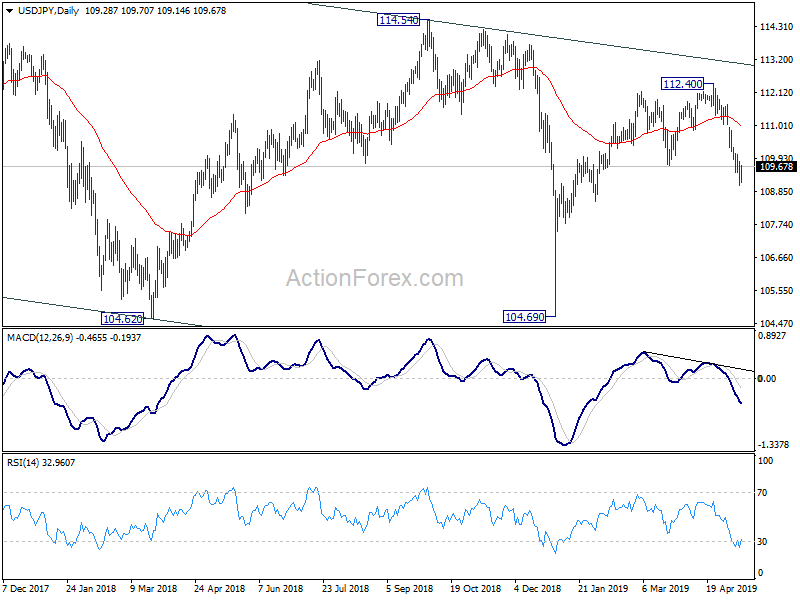
In the bigger picture, USD/JPY is staying inside falling channel from 118.65. Currently development suggests that rebound from 104.69 is only a corrective move. And fall from 118.65 is not completed yet. Decisive break of 104.69 will extend the down trend towards 98.97 support (2016 low). For now, we'd expect strong support above there to bring rebound.
Yen and Franc Retreat as Sentiments Stablized Somewhat, But More Tariffs Still on the Way
Market sentiments somewhat stabilized in Asian session today. Major indices opened lower, following the selloff in US. But losses are so far rather limited. Indeed, in the currency markets, Yen and Swiss Franc are paring some of yesterday's strong gains while Gold also retreats back to below 1300. USD/CNH also dips back below 6.9 handle as Yuan recovers mildly.
The stage for this round of US-China trade war is set, with US tariffs effective last Friday and China's retaliation ready for June 1. Next is US tariffs on USD 300B of essentially all other Chinese products. The public comments process has begun with hearing to be held on June 17. Between now and then, we'll see if there is other progress that could pave the way for a Trump-Xi meeting at G20 meeting on June 28/29. Or, tensions could just continue to escalate.
In the currency markets, technically, USD/JPY dropped to as low as 109.02 yesterday but quickly recovered. EUR/JPY also holds on to 122.48 temporary low. We'll see if Yen's retreat is going to extend further. 110.40 minor resistance in USD/JPY is a level to watch. EUR/GBP is pressing 0.8681 resistance and break will suggests bullish reversal. That would be a strong indication of weakness in the Pound for near term. EUR/USD, while recovered yesterday, is considered to be in corrective pattern from 1.1111. Euro will look into today's German ZEW to decide whether to extend the correction, or resume larger decline.
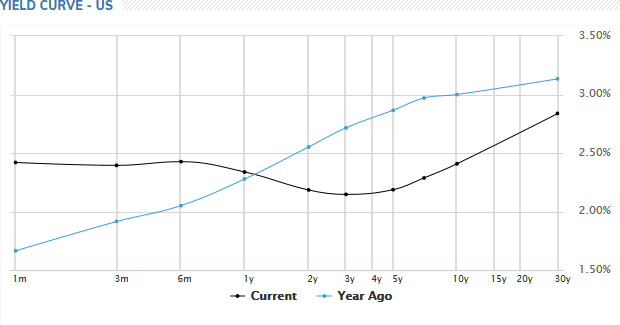
In Asia, currently, Nikkei is down -0.59%. Hong Kong HSI is down -1.58%. China Shanghai SSE is down -0.36%. Singapore Strait Times is down -0.85%. Japan 10-year JGB yield is down -0.0018 at -0.048. Overnight, DOW dropped to as low as 25222.51 but ended just down -2.38% or -617.38 pts at 25324.99. S&P 500 lost -2.41% while NASDAQ suffered more and dropped -3.41%. What's more serious was in treasury yields. 10-year yield dropped to as low as 2.389 then closed down -0.050 at 2.405. However, 3-month yield closed at 2.395. Thus, 3-month-10-year curve is technically not inverted.
USTR announced tariffs list of essentially all Chinese products not currently covered
The US Trade Representative formally announced the product list of around USD 300B of Chinese imports for an additional ad valorem duty of up to 25 percent. The list "covers essentially all products not currently covered" by Section 301 tariffs on China. Though the list excludes "pharmaceuticals, certain pharmaceutical inputs, select medical goods, rare earth materials, and critical minerals. "
Public comments are invited up till June 17, when hearing will be held in the main hearing room of the US . International Trade Commission. Final rebuttal comments are due seven days after the end of the hearing. The duration of consultation is notably shorter than before. 71 days was used last year for tariffs on USD 200B of Chinese goods. 42 days would be spend for the current round.
Trump hoping for fruitful meeting with Xi, announced new aids to farmers
In the Oval Office, Trump expressed his optimism on US-China trade negotiation despite current escalation in trade war, and announced new plan to aid farmed affected.
Trump reiterated that the negotiations were 95% done when China suddenly backtracked on its commitments. And, the US cannot let China continue to take advantage on trade. But he on further talks, he added "we'll let you know in about three or four weeks whether of not it was successful. ... But I have a feeling it's going to be very successful". Regarding the new round of tariffs on USD 325B in Chinese imports, Trump sounded non-committal and said he hasn't made a decision yet.
He went further to once again hailed his "very good relationship" with Xi and indicate there could be a meeting soon. He said: "Maybe something will happen. We're going to be meeting, as you know, at the G20 in Japan and that's be, I think, probably a very fruitful meeting."
Additionally, Trump indicated the administration was planning a second round aids to farmers, at around USD 15B due to trade war. He said "we're going to take the highest year, the biggest purchase that China has ever made with our farmers, which is about $15 billion, and do something reciprocal to our farmers so our farmers can do well." And, "Out of the billions of dollars that we're taking (tariffs), a small portion of that will be going to our farmers, because China will be retaliating, probably to a certain extent, against our farmers."
Losing soy farmers fed up with Trump's tariff war
Some American farmers are clearly frustrated with the way Trump handles trade negotiation with China. American Soybean Association shouted loud and clear in a statement that "Soy Growers Are Fed Up with Tariffs". The ASA "cannot support continuing and escalating the use of tariffs" but the US would with "like-minded countries" to pursue the negotiation goal with China.
ASA President Davie Stephens criticized that US has been at table with China 11 times and "still has not closed the deal". He added: "What that means for soybean growers is that we're losing. Losing a valuable market, losing stable pricing, losing an opportunity to support our families and our communities. These trade negotiations are serious for us. Farming is our livelihood."
Stephens added: "The soybean market in China took us more than 40 years to build, and as this confrontation continues, it will become increasingly difficult to recover. With depressed prices and unsold stocks expected to double by the 2019 harvest, soybean farmers are not willing to be collateral damage in an endless tariff war,"
John Heisdorffer, ASA Chairman, warned further to warn that "we cannot withstand another year in which our most important foreign market continues to slip away and soybean prices are 20 to 25 percent, or even more, below pre-tariff levels". "The sentiment out in farm country is getting grimmer by the day. Our patience is waning, our finances are suffering, and the stress from months of living with the consequences of these tariffs is mounting", he added.
Canada to Trump: Sending farm products to poor countries sounds easy, but it's complicated
Trump indicated he's thinking about buying US farm products and distribute to poor countries, as a way to help farmers affected by trade war with China. But such simplistic, shallow way of thinking immediately drew criticism from Canada.
Canadian Agriculture Minister Marie-Claude Bibeau said yesterday that "dumping products in developing countries is not the way we do things."
She added, "it seems easy, but it is complicated to do it the right way". The process will need multilateral coordination. And, "obviously, it may create some distortion in the market and this is what we want to avoid."
Fed Kaplan: Interests rate about where they should be, tariffs have come chilling effects
Dallas Fed President Robert Kaplan said interests are now "about where they should be". And Fed should "move off to the side and be patient." He added that fed should neighing be raising interest or cutting interest rates for now. "We'll have to see where we go from here, and I'll keep updating my judgment based on what we see in the economy," He said.
Regarding trade war escalation with China, Kaplan said "what we don't know right now is how long these issues will persist, how far will they go, will these tariffs, that have just been put on, and counter tariffs, will they be with us for months, weeks, or longer."
But he admitted that trade situation creates uncertainty, "creates uncertainty for businesses, it creates uncertainty generally — and uncertainty by and large". And he warned " if it goes on for an extended period of time, probably is not helpful if you are a business and trying to manage your business ... it has some chilling effect on business."
Fed Rosengren: If Trump's trade war causes slowdown, Fed has the tool to deal with it
Boston Fed President Eric Rosengren said Fed is well prepared to react if Trump's trade war with China causes slowdown in the economy. He said, "if the impact of the tariffs - and whatever financial market reaction to those tariffs is - causes more of a slowdown, then we do have the tools available to us, including lower interest rates".
But for now, "it's hard for the Fed to react until we have better information, so in terms of us viewing our policies as being patient, I'm not sure this alters our view of that until we have a better sense of whether this is going to have more long-lasting effects," Rosengren added.
Separately, Minneapolis Fed President Neel Kashkari said the "relative to China, the US is in a very strong position." "Not only is our economy bigger, our economy is much less sensitive to trade. Trade is important to the U.S. economy, but it's much more important to the Chinese economy, just as a share of its economy," he added.
Hence, Kashkari said "if there's a tit-for-tat strategy, and I'm not advocating it, but a tit-for-tat strategy would seem to lean toward the US strength rather than the China strength."
Australia NAB business conditions unwound March rebound, employment dived
In April, Australia NAB Business Conditions deteriorated further to 3, down from 7 and missed expectation of 4. The surprised jumped in Conditions from 4 to 7 was more than unwound. Business Confidence, though, improved slightly to 0, up from -1, but still missed expectation of 1.
Looking at the details, business conditions, confidence and forwards orders are all below average. More worryingly, there was sharp decline in employment index from 6 to -1, first below average reading since late 2016. By industry, largest fall in employment occurred in retail, manufacturing an wholesale. But overall deterioration was rather broad-based.
Alan Oster, NAB Group Chief Economist noted: "We will continue to watch the employment index as well as the other forward looking variables over coming months for further slowing. In particular, the readings of labour market related variables will remain important as, for now, the interest rate outlook appears to hinge on continuing strength in the labour market".
Looking ahead
UK job data and German ZEW economic sentiments will be the major focuses in European session. Germany will also release CPI final. Swiss will release PPI. Eurozone will release industrial production. Later in the day, US will release import price index.
USD/JPY Daily Outlook
Daily Pivots: (S1) 108.93; (P) 109.39; (R1) 109.78; More...
USD/JPY dropped to as low as 109.02 but quickly recovered. Still, with 110.04 resistance intact, further decline is expected. As noted before, whole rebound from 104.69 has completed at 112.40 already. Current fall from 112.40 should extend to retest 104.69 low. Nevertheless, break of 110.04 minor resistance will indicate short term bottom. Lengthier consolidation could be seen before another decline.
In the bigger picture, USD/JPY is staying inside falling channel from 118.65. Currently development suggests that rebound from 104.69 is only a corrective move. And fall from 118.65 is not completed yet. Decisive break of 104.69 will extend the down trend towards 98.97 support (2016 low). For now, we'd expect strong support above there to bring rebound.
Economic Indicators Update
| GMT | Ccy | Events | Actual | Forecast | Previous | Revised |
|---|---|---|---|---|---|---|
| 23:50 | JPY | Current Account (JPY) Mar P | 1.27T | 1.71T | 1.96T | 1.90T |
| 1:30 | AUD | NAB Business Conditions Apr | 3 | 4 | 7 | |
| 1:30 | AUD | NAB Business Confidence Apr | 0 | 1 | 0 | -1 |
| 5:00 | JPY | Eco Watchers Survey Current Apr | 45.8 | 44.8 | ||
| 6:00 | EUR | German CPI M/M Apr F | 1.00% | 1.00% | ||
| 6:00 | EUR | German CPI Y/Y Apr F | 2.00% | 2.00% | ||
| 6:30 | CHF | Producer & Import Prices M/M Apr | 0.20% | 0.30% | ||
| 6:30 | CHF | Producer & Import Prices Y/Y Apr | -0.40% | -0.20% | ||
| 8:30 | GBP | Jobless Claims Change Apr | 24.2K | 28.3K | ||
| 8:30 | GBP | Claimant Count Rate Apr | 3.00% | |||
| 8:30 | GBP | Average Weekly Earnings 3M/Y Mar | 3.40% | 3.50% | ||
| 8:30 | GBP | Weekly Earnings ex Bonus 3M/Y Mar | 3.30% | 3.40% | ||
| 8:30 | GBP | ILO Unemployment Rate 3Mths Mar | 3.90% | 3.90% | ||
| 9:00 | EUR | Eurozone Industrial Production M/M Mar | -0.30% | -0.20% | ||
| 9:00 | EUR | Eurozone Industrial Production w.d.a. Y/Y Mar | -0.80% | -0.30% | ||
| 9:00 | EUR | German ZEW Economic Sentiment May | 5 | 3.1 | ||
| 9:00 | EUR | German ZEW Current Situation May | 6 | 5.5 | ||
| 9:00 | EUR | Eurozone ZEW Economic Sentiment May | 5 | 4.5 | ||
| 12:30 | USD | Import Price Index M/M Apr | 0.70% | 0.60% |
Asia update: Stock markets plunged but loss limited, Yen and Swiss retreat
Following the selloff in US stocks overnight, Asian markets opened generally lower today but losses are so far limited. China Shanghai SSE hit as low as 2872.83 but quickly pared losses to 2893.35, down only -0.36%. Yuan also recovers mildly with USD/CNH back below 6.9 handle at 6.895, down from yesterday's high at 6.9189.
The current round of US-China trade war is settled there with news US tariffs effect last Friday and Chinese retaliation ready for June 1. Next to come are tariffs on essentially all other Chinese imports, with public hearing on June 17 at USTR. For today, focus will turn to UK job data and German ZEW first.
Overnight, DOW dropped to as low as 25222.51 but ended just down -2.38% or -617.38 pts at 25324.99. S&P 500 lost -2.41% while NASDAQ suffered more and dropped -3.41%. What's more serious is treasury yields. 10-year yield dropped to as low as 2.389 then closed down -0.050 at 2.405. 3-month yield closed at 2.395. Thus, 3-month-10-year curve is technically not inverted.
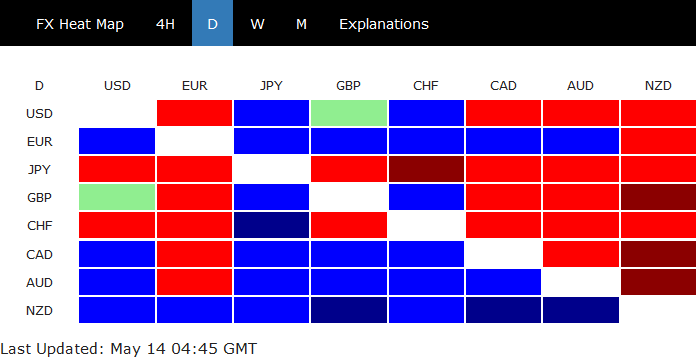
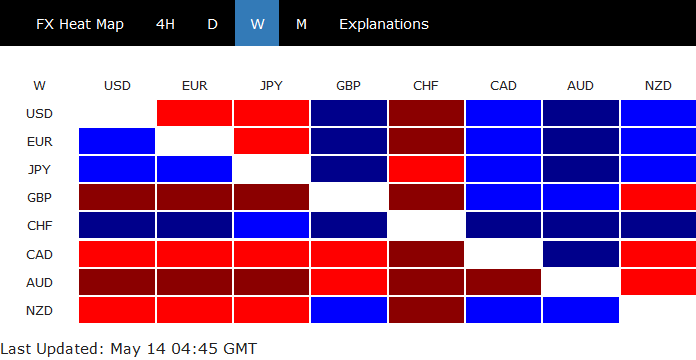
In the currency markets, New Zealand Dollar, Euro and Australian Dollar are the strongest one for today so far, recovering. Yen and Swiss Franc are weakest, digesting this week's rally. For the week, Swiss Franc and Yen are the strongest without a doubt, followed by Euro. Aussie and Loonie are the worst, followed by Sterling.
Australian Business Conditions & Confidence, April 2019
Employment conditions slump - jobs growth to slow. Business conditions: down 4pts to +3. Business confidence: up 1pt to 0.
The NAB business survey for April was particularly weak, providing further evidence of the economic slowdown which emerged in mid-2018 and has extended into 2019.
The survey was conducted from April 18 to 30.
One word of caution, this year with Easter falling in the same week as ANZAC Day many folk took an extended break - hence the business surveys may overstate the extent of weakness in April.
That said, the trend is clear - the economy has slowed and slowed substantially, with the downturn broadening across industries. The downturn was led by the housing sector and the consumer, constrained by weak wages growth and high debt levels.
The international backdrop is also challenging, with slow slowing of global growth and a weakening of international trade. The exception is the lift in key commodity prices - notably, iron ore and coal - which is boosting national income growth to a pace in excess of 5%.
Business confidence has evaporated, with the index at 0 a well below average reading. Confidence averaged +9 over the first half of 2018.
Business conditions fell by 4pts to +3, also a below average reading. This reading, along with a +3 for December, is the softest result since the start of 2016. By comparison, conditions averaged +18 over the first half of 2018.
Forward orders remained weak, steady at -1.
As we have highlighted previously, the key question is how the economic slowdown and the loss of business confidence will impact business spending decisions.
We expect jobs growth and investment to slow. The April survey provides evidence of this.
Employment conditions have slumped, falling from +6 to -1. That is a well below average reading and the first negative since January 2016.
The survey suggests that employment conditions at these levels are consistent with near-term job gains of around 14k per month. This equates to a 1.3% annual pace, well down from the 2.4% rise over the past year and below working age population growth of around 1.7% - pointing to upward pressure on the unemployment rate.
On capital expenditure, there has been a trend softening since the start of the year, with the index in March touching a 5 year low (see chart overleaf).
Firms are experiencing a loss of profitability, with the index falling to only +1, down from +19 over 2018 H1. This loss of profitability across the non-mining economy will weigh on the investment outlook.
By industry, business conditions in April were relatively soft across all industries with the exception of mining (which is benefitting from high commodity prices - notably iron ore and coal). See charts below.
By state, business conditions have slowed in each of the four major states - with the housing downturn and weak wages growth key dynamics that are relatively broadly based.
Market Morning Briefing: Euro-Yen Has Bounced Back From 122.5
STOCKS
The US-China trade war has been heated up further after China announced to impose tariffs on US good which will come into effect from June 1. This has triggered further sell-off in the equity segment and continues to keep the outlook bearish. Further developments on the this trade negotiation front will need a close watch in the coming days.
Dow (25324.99, -617.38, -2.38%) has tumbled over 2% yesterday and keeps our bearish view intact. Some support is near current levels at 25200 which is vulnerable to break given the current scenario. Dow can fall to 25000 and 24800 in the coming sessions.
DAX (11876.65, -183.18, -1.52%) is closer to a key support level of 11800. While this support holds, a corrective bounce to 12000-12100 is possible. But a break below it can drag DAX to 11700-11600.
Though Nikkei (21025.71, -165.57, -0.78%) has bounced from its low of 20751.45 today, the outlook remains bearish for a fall to 20500
Shanghai (2902.29, -1.42, -0.05%) seems to be consolidating within its overall downtrend between 2850 and 2950. While below 2950, the downtrend is likely to remain intact for a test of 2800.
Sensex (37090.82, -372.17, -0.99%) and Nifty (11148.20, -130.70, -1.16%) can test their crucial intermediate supports at 36800 and 11000 respectively. It will have to be seen if these supports can hold and trigger a corrective rally to 11200-11300 on the Nifty and 37500 on Sensex before a fresh fall happens.
COMMODITIES
Gold has gained safe haven after China's retaliation with a tariff on US goods. It can move further higher in the near term. Silver may remain range bound. Copper continues to trade weak and can fall further. Oil could not sustain the intermediate upmove seen yesterday and looks vulnerable for a fresh fall.
Contrary to our expectation for a fall, Gold (1299.5) has broken the 1266-1292 range above 1292. While above 1290 now, a further rise to 1320 is possible.
Silver (14.79) fell to 14.60 as expected but has bounced sharply from there. It is range bound between 14.6 and 15 and can rise to 15 - the upper end of this range in the near term.
Copper (2.735) remains weak. It has resistance at 2.75 which can cap the upside and keep the downtrend intact for a test of 2.70-2.68.
WTI (61.29) has come-off sharply from 63.50 and looks vulnerable to break its support at 60.8 and fall to 60 and 58 in the coming days.
Brent (69.4) spiked to 71.63 and has come-off from there. It can test the key support in the 68.5-68.2 region, a break below which can take it to 66.
FOREX
The announcement of increasing tariffs on $60 bln worth of American goods by China would be the trigger for the market which was already showing weakness admist the US-China trade tensions. This week and the next is likely to see volatile movement before a pause comes into the picture. However, the impact of the trade war could be relatively more on the equities and commodities than that we may see on the currencies.
USDCNY (6.8737) has moved up further and may continue to rally towards 6.90/91. A break above 6.91, if seen would take it towards higher resistance at 6.95 from where a fall could be seen. Very important levels to watch would be 6.90/91 and 6.95.
Dollar Index (97.36) initially dipped below 97 yesterday but bounced back soon after. Our earlier view of a rise towards 98-99 remains intact for the medium term while 97 holds.
Euro (1.1231) has immediate resistance near 1.1265 and higher near 1.13. We could see some range trade within 1.12-1.13 in the near term. A sharp rise towards 98 or higher if seen could possibly lead to a break below 1.12 on the Euro.
Euro-Yen (123.06) has bounced back from 122.5 and while the bounce sustains, it could move higher towards 123.30/50 again. Movement within 124-122 looks likely for the near term.
Dollar Yen (109.56) is trading above crucial support near 109 and while that holds, there could be some hope of rising back again towards 110+ which could indicate that the Dollar Index could remain above 97. We would keep a close watch on price action near crucial support of 109.
JPYINR(0.6429) is down from levels near 0.6465 seen yesterday. Note that 0.6475/80 is an important resistance on the near term charts and while the pair trades low, the extent of Rupee weakness could be curbed. EURINR (79.1475) is also slightly lower than 79.52. We would watch the above levels closely in the very near term.
Dollar Rupee (70.54) is likely to breach the crucial level of 70.60 that we have been mentioning in our previous editions. For the near term we keep open chances of testing 70.80/90 on the upside. While Yuan weakens, Rupee could also continue to remain weak.
Aussie (0.6953) has scope to fall towards 0.69 in the near term on a sustained break below 0.6950. Near term looks bearish.
INTEREST RATES
Overall global bond yields are trading low and look bearish for the near term. US yields slid after the China announced of tariffs yesterday. Near term is bearish for the yields for the rest of the sessions this week.
The US yields have fallen and look weak for the near term. The 30Yr (2.85%), 10Yr (2.42%) and 5Yr (2.20%) have fallen and could continue to move down towards 2.80% (30Yr), 2.40% (10YR) and 2.17% (5Yr) respectively. Our mentioned 2.20% has been tested on the 5Yr and while the 10Yr and 30Yr falls, 5YR could come down further towards 2.17/15% in the near term.
The German-JGB 10Yr (-0.02%) is in a channel downtrend and could fall towards -0.05% in the near term before bouncing back. This could indicate that euro-Yen could possibly be limited to 122 on the downside.
The US-JGB 10Yr (2.47%) is down by 2bps and has enough room to fall just now. It could test 2.45% in the near term, before bouncing back from there.
The Indian 10Yr GOI (7.48%) is holding above immediate support near 7.45/46% and while that holds, we could see some range trade within 7.45-7.55% for the next couple of sessions
US-China Trade War Intensifies as China Retaliates
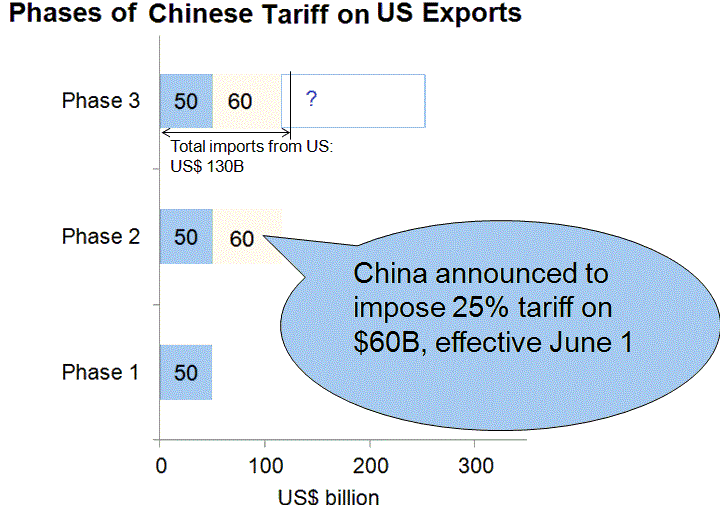
Financial markets are in turbulence as China announced to raise tariff of US$60B of US exports to 25% from 10%, effective June 1. This was followed by US’ threat to levy tariff on the remaining Chinese exports (worth of about US$ 300B) in as soon as summer. While China's retaliation on US’ increase of US$200B of Chinese exports had been widely anticipated, the market has reacted rigorously upon its announcement. Risk assets got dumped as led by US equities. Commodity currencies (especially Australian dollar due to the close economic relation between China and Australia) slumped while safe- haven currencies, e.g. Japanese yen and Swiss franc jumped. UST yields slumped as led by the front end of the curve, with the market more than fully priced in a rate cut by December.
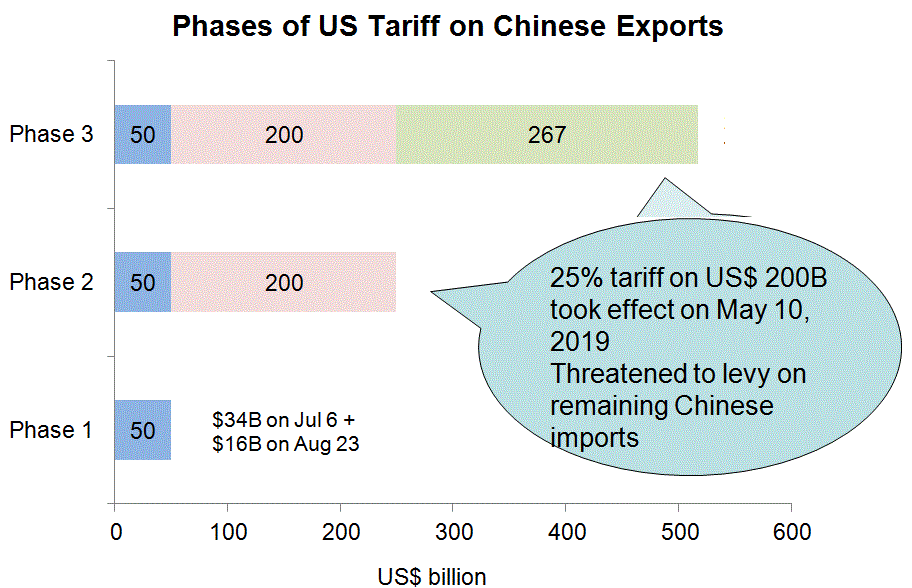
As a recap, US imposed 25% tariff on US$50B of Chinese exports back in July and August 2018. In response, China matched by imposing same rate of tariff on the same size of US exports. US then imposed 10% tariff on US$ 200B exports from China in September last year. It also threatened to raise the tariff to 25% in January 2019, together with new tariff on remaining Chinese exports. China retaliated by imposing 5-10% tariff on $60B of US goods. As trade negotiations proceed, Trump announced in December to postpone the increase in tariff rate as well as imposition of addition tariff. While the market has been anticipating a trade deal within reach, Trump surprisingly increased tariff on US$200B of Chinese exports to 25% last week. The move was followed by China’s retaliation and US’ further escalation of tariff on the rest of Chinese goods.
Why Re-Escalates?
Besides narrowing trade deficit with China, the most important objective of US’ initiation of trade war is to correct the unfair trade and investment practices in China. We summarize here the unfair practices into three key areas: 1. Forced technology transfer and theft. 2. Prolonged license approval process as overseas firms seek to do business in China, 3. Foreign companies have to form JVs with Chinese firms as they seek to operate in China. Despite pledges to o eradicate forced technology transfer and theft at the National People’s Congress in March and drafting laws to open up its market, it appears that the Chinese government “broke the deal” by reneging on earlier commitments made during months of negotiations.
1. Forced technology transfer and theft.
There have been numerous criticisms that US’ initiation of trade war is to prevent China from taking over US’ leadership in global economy and technology. Such rhetoric has grown rapidly as the trade war was believed to be a response to China’s “Made in China 2025” grand plan, lain down by Premier Li Keqiang in 2015.According to the Chinese government, Made in China 2025 is a 10-year plan to transform the Chinese manufacturing sector to be innovation-driven, and a high-tech one. It aims at raising domestic content of core components and materials to 40% by 2020 and 70% by 2025. The government has also pledged significant role by providing an overall framework, utilizing financial and fiscal tools, and supporting the creation of manufacturing innovation centers. Some believe that the plan would change US- China trade relations change form “complementary” to competitive” and this is a key reason triggering US’ dissatisfaction.
Yet, those who have made this claim has omitted the fact that China required transfer of core technology knowledge to local firms as overseas companies attempt to run business in China. Although China has insisted that forced technology transfers are against its policy and denied such things had occurred, the government drafted a Drafted new law in December 2018 to fight against such practice. It also pledged to eradicate this at the National People’s Congress in March.
2. Prolonged License Approval Process
Despite a WTO member since 2001, China has no intention to open up its market. It protects the “core” businesses in areas such as pharmacy, insurance, credit cards’ payment clearing and settlement by taking longer-than –international-standard time in the license approval process. Back in 2012, WTO ruled that China is discriminating against foreign credit card companies. Yet, little has been done to reform this as Union Pay remains the only company eligible in handling renminbi payment and settlement.
3. Foreign companies have to form JVs with Chinese firms
As a requirement to operate business in China, foreign companies have to form JVs with Chinese firms. They are prohibited from holding majority stake, let alone taking full control, in its Chinese operations. In order to alleviate US’ discontent and to get better terms in a trade deal, China announced that it would allowing foreign financial institutions (banking, securities and insurance industries) to take control of domestic securities brokerages biz of up to 51%. UBS has got approval in December. China also indicated that it would accept applications this year from foreign insurers seeking to take control of their local joint ventures and is even weighing giving them full ownership
Impacts on Economic Outlook
Trade war would likely be lose-lose scenario on both sides. As a tax on consumption, the increase in tariff might dampen household spending, business investment and sentiment. These could lead to deceleration of economic growth in coming quarters. The real impacts depend on the duration of the current stand-off. The market has priced in over 100% of a Fed funds rate cut by December. Undoubtedly, re-escalation of trade war might have increased the odds of a precautionary rate cut. Yet, we for now opt to retain the expectations that the Fed would stand on the sideline for the rest of the year, while closely monitoring the developments of trade war.
The economic impact on China would be more severe, in particular the country is torn between huge debts and growth slowdown. It is obvious since the start of trade war that the Chinese authority has prioritized growth stimulation. We expect PBOC to maintain a easing monetary policy by cutting RRR later this year. It might need to cut interest rate if the situation worsens. Deceleration of renminbi is a dilemma. While a weaker renminbi might help exports and act as retaliation to the US, excessive depreciation would trigger capital outflow and instability in China’s domestic financial markets.