

Sample Category Title
Australia NAB business conditions unwound March rebound, employment dived
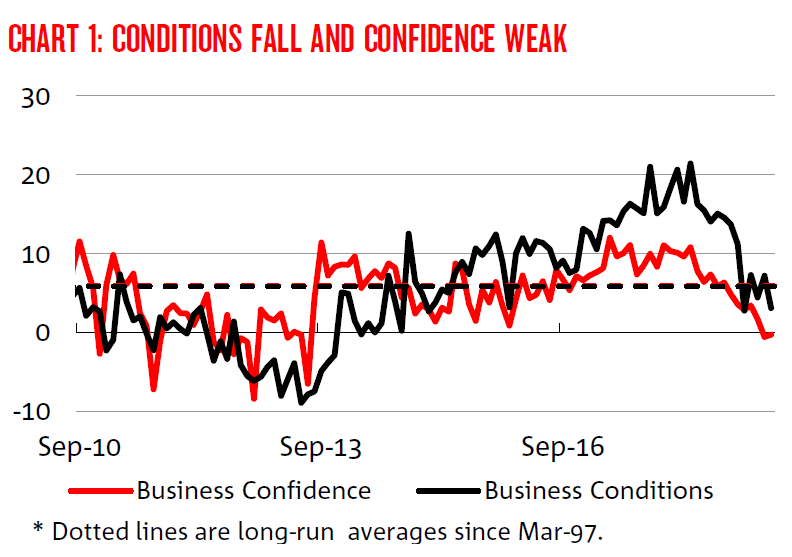
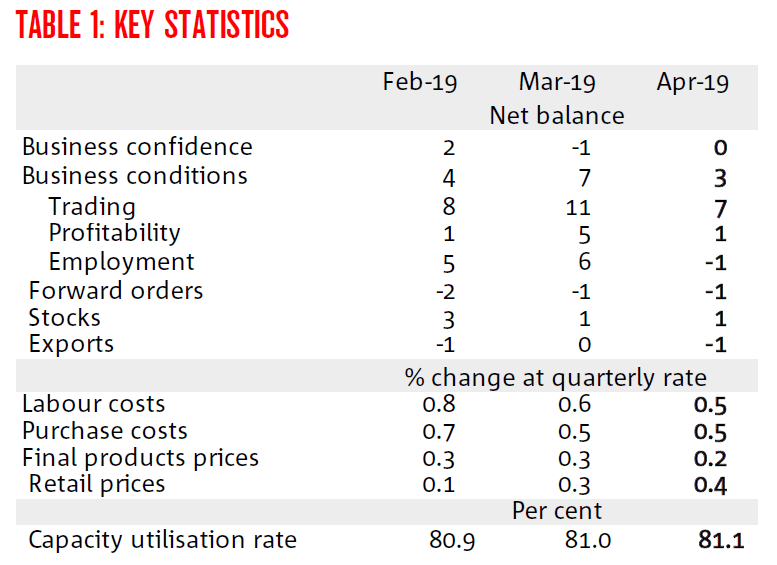
In April, Australia NAB Business Conditions deteriorated further to 3, down from 7 and missed expectation of 4. The surprised jumped in Conditions from 4 to 7 was more than unwound. Business Confidence, though, improved slightly to 0, up from -1, but still missed expectation of 1.
Looking at the details, business conditions, confidence and forwards orders are all below average. More worryingly, there was sharp decline in employment index from 6 to -1, first below average reading since late 2016. By industry, largest fall in employment occurred in retail, manufacturing an wholesale. But overall deterioration was rather broad-based.
Alan Oster, NAB Group Chief Economist noted: "We will continue to watch the employment index as well as the other forward looking variables over coming months for further slowing. In particular, the readings of labour market related variables will remain important as, for now, the interest rate outlook appears to hinge on continuing strength in the labour market".
USTR announced tariffs list of essentially all Chinese products not currently covered
The US Trade Representative formally announced the product list of around USD 300B of Chinese imports for an additional ad valorem duty of up to 25 percent. The list "covers essentially all products not currently covered" by Section 301 tariffs on China. Though the list excludes "pharmaceuticals, certain pharmaceutical inputs, select medical goods, rare earth materials, and critical minerals. "
Public comments are invited up till June 17, when hearing will be held in the main hearing room of the US . International Trade Commission. Final rebuttal comments are due seven days after the end of the hearing. The duration of consultation is notably shorter than before. 71 days was used last year for tariffs on USD 200B of Chinese goods. 42 days would be spend for the current round.
Fed Rosengren: If Trump’s trade war causes slowdown, Fed has the tool to deal with it
Boston Fed President Eric Rosengren said Fed is well prepared to react if Trump's trade war with China causes slowdown in the economy. He said, "if the impact of the tariffs - and whatever financial market reaction to those tariffs is - causes more of a slowdown, then we do have the tools available to us, including lower interest rates".
But for now, "it's hard for the Fed to react until we have better information, so in terms of us viewing our policies as being patient, I'm not sure this alters our view of that until we have a better sense of whether this is going to have more long-lasting effects," Rosengren added.
Separately, Minneapolis Fed President Neel Kashkari said the "relative to China, the US is in a very strong position." ""Not only is our economy bigger, our economy is much less sensitive to trade. Trade is important to the U.S. economy, but it's much more important to the Chinese economy, just as a share of its economy," he added.
Hence, Kashkari said "if there's a tit-for-tat strategy, and I'm not advocating it, but a tit-for-tat strategy would seem to lean toward the U.S. strength rather than the China strength."
Fed Kaplan: Interests rate about where they should be, tariffs have come chilling effects
Dallas Fed President Robert Kaplan said interests are now "about where they should be". And Fed should "move off to the side and be patient." He added that fed should neighing be raising interest or cutting interest rates for now. "We'll have to see where we go from here, and I'll keep updating my judgment based on what we see in the economy," He said.
Regarding trade war escalation with China, Kaplan said "what we don't know right now is how long these issues will persist, how far will they go, will these tariffs, that have just been put on, and counter tariffs, will they be with us for months, weeks, or longer."
But he admitted that trade situation creates uncertainty, "creates uncertainty for businesses, it creates uncertainty generally — and uncertainty by and large". And he warned " if it goes on for an extended period of time, probably is not helpful if you are a business and trying to manage your business ... it has some chilling effect on business."
GBP/USD Trading Near Make-Or-Break Support
Key Highlights
- The British Pound declined recently below the 1.3050 support against the US Dollar.
- A key bullish trend line is forming with support at 1.2948 on the 4-hours chart of GBP/USD.
- There are many resistances on the upside near 1.2975, 1.3020, 1.3050 and 1.3060.
- The UK Claimant Count in April 2019 could change 24.2K, less than the last 28.3K.
GBPUSD Technical Analysis
After trading towards the 1.3180 resistance, the British Pound started a significant downward move against the US Dollar. The GBP/USD pair broke the 1.3140 and 1.3060 support levels to move into a bearish zone.
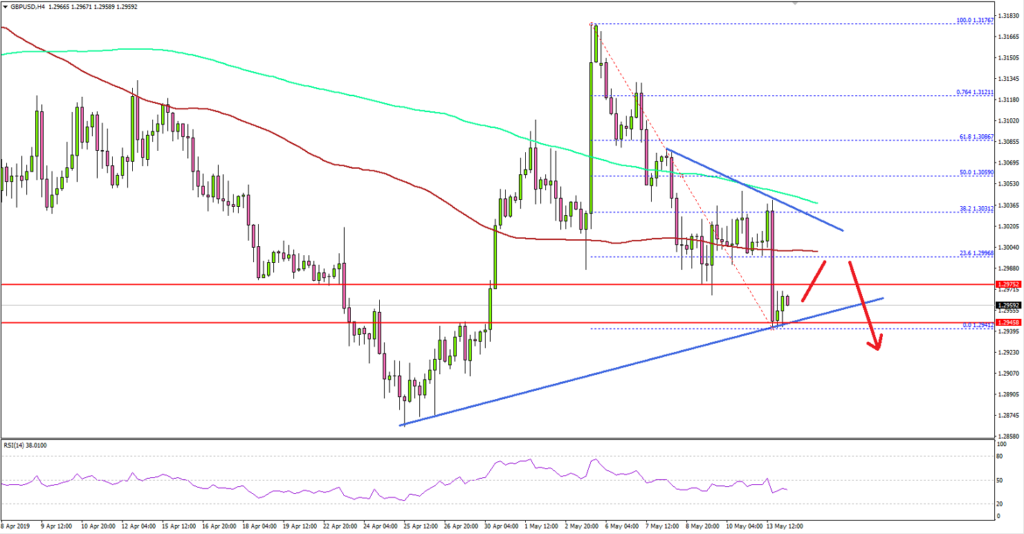
Looking at the 4-hours chart, the pair broke the 1.3050 level and the 200 simple moving average (green, 4-hours). The decline was such that the pair even traded below the 1.3000 handle and the 100 simple moving average (4-hours, red).
A weekly low was formed at 1.2941 and the pair recently recovered a few pips, but it stayed well below 23.6% Fib retracement level of the major drop from the 1.3176 high to 1.2941 low.
On the upside, it seems like the 1.3050 level and the 200 simple moving average (green, 4-hours) are strong resistances along with the 38.2% Fib retracement level of the major drop from the 1.3176 high to 1.2941 low.
If there is an upside break above the 1.3030 and 1.3050 levels, GBP/USD could recover towards the 1.3100 and 1.3120 levels.
On the downside, there is a crucial support near 1.2950 and a key bullish trend line 1.2948 on the same chart. If there is a downside break below the trend line, the pair could retest the 1.2875 swing low. The next key supports are near 1.2845 and 1.2820.
On the other hand, there was a decent recovery in EUR/USD above 1.1220 and it seems like it could extend gains towards 1.1300 in the coming sessions.
Economic Releases to Watch Today
- German Consumer Price Index April 2019 (YoY) – Forecast +2.0%, versus +2.0% previous.
- German Consumer Price Index April 2019 (MoM) – Forecast +1.0%, versus +1.0% previous.
- UK Claimant Count Change April 2019 – Forecast 24.2K, versus 28.3K previous.
- UK ILO Unemployment Rate March 2019 (3M) – Forecast 3.9%, versus 3.9% previous.
- German ZEW Economic Sentiment Index May 2019 – Forecast 5.0, versus 3.1 previous.
Canada to Trump: Sending farm products to poor countries sounds easy, but it’s complicated
Trump indicated he's thinking about buying US farm products and distribute to poor countries, as a way to help farmers affected by trade war with China. But such simplistic, shallow way of thinking immediately drew criticism from Canada.
Canadian Agriculture Minister Marie-Claude Bibeau said yesterday that "dumping products in developing countries is not the way we do things."
She added, "it seems easy, but it is complicated to do it the right way". The process will need multilateral coordination. And, "obviously, it may create some distortion in the market and this is what we want to avoid."
Losing soy farmers fed up with Trump’s tariff war
Some American farmers are clearly frustrated with the way Trump handles trade negotiation with China. American Soybean Association shouted loud and clear in a statement that "Soy Growers Are Fed Up with Tariffs". The ASA "cannot support continuing and escalating the use of tariffs" but the US would with "like-minded countries" to pursue the negotiation goal with China.
ASA President Davie Stephens criticized that US has been at table with China 11 times and "still has not closed the deal". He added: "What that means for soybean growers is that we're losing. Losing a valuable market, losing stable pricing, losing an opportunity to support our families and our communities. These trade negotiations are serious for us. Farming is our livelihood."
Stephens added: "The soybean market in China took us more than 40 years to build, and as this confrontation continues, it will become increasingly difficult to recover. With depressed prices and unsold stocks expected to double by the 2019 harvest, soybean farmers are not willing to be collateral damage in an endless tariff war,"
John Heisdorffer, ASA Chairman, warned further to warn that "we cannot withstand another year in which our most important foreign market continues to slip away and soybean prices are 20 to 25 percent, or even more, below pre-tariff levels". "The sentiment out in farm country is getting grimmer by the day. Our patience is waning, our finances are suffering, and the stress from months of living with the consequences of these tariffs is mounting", he added
Daily Markets Broadcast
Wall Street slumps as China retaliates
China went ahead with retaliatory tariffs on US goods yesterday, despite Twitter warnings from US President Trump to resist doing so. US indices tumbled, safe haven assets including US Treasuries benefited while oil fell.
US30USD Daily Chart
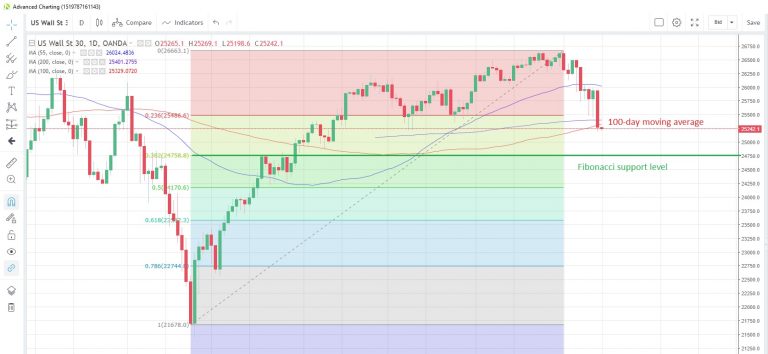
The US30 index posted the biggest one-day decline so far this year, falling to the lowest level since February 12, amid news of the tariff war escalation
The index closed below the 100-day moving average at 25,307 for the first time since January 29 yesterday. The 38.2% Fibonacci retracement of the December-May rally is at 24,758
Trump confirmed that he will meet China’s President Xi at the G-20 summit in June. Fed’s George is scheduled to speak today.
DE30EUR Daily Chart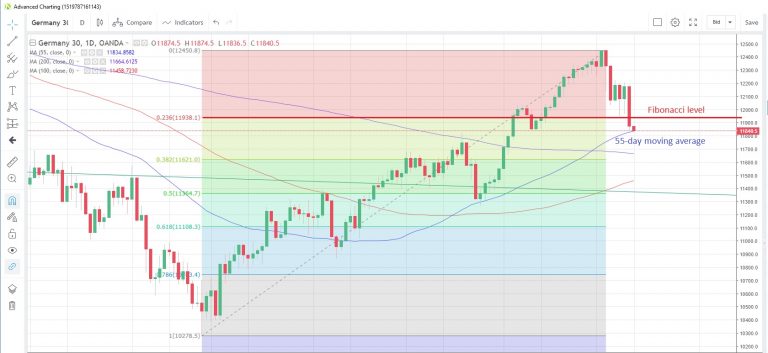
The Germany30 index fell the most in more than five months yesterday, following cues from Wall Street
The index has breached the 23.6% Fibonacci retracement of the rally since December at 11,938 and is now testing the 55-day moving average at 11,458
The EU is reportedly finalizing plans to target US imports if President Trump goes ahead with proposed tariffs on European car imports by May 18. German April CPI data are due today and seen steady at +1% m/m.
WTICOUSD Daily Chart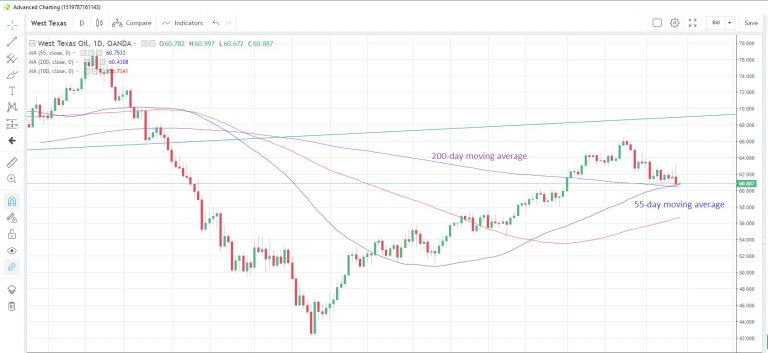
Crude oil prices fell yesterday as the tariff war between the US and China took a turn for the worst, with China’s latest retaliation to US tariffs. This dealt prospects for global growth a severe blow and hence the potential future demand for oil
WTI is currently testing the 55-day moving average at $60.75. This moving average has supported prices on a closing basis since January 17. The 200-day moving average lurks beneath at $60.43
Weekly crude stocks for the American Petroleum Institute are due today. Last week saw a surprise addition of 2.8 million barrels.
From BRICS To WOWS
From BRICS to WOWS
Financial markets finally pulled their heads out of the sand overnight as the US-China trade war escalated when China responded by imposing USD60 billion in tariffs of their own on imported US goods. A healthy dose of reality bites saw the equity markets and oil crumple, US bond yields fall and gold finally rally, all of which should have happened at least a week ago.
The greenback was, of course, mostly resplendent, rising 1% against both the offshore and onshore Chinese yuan, leaving both around 6.9000 to the dollar and within shouting distance of 7.0000 – a level that will almost certainly have President Trump’s Twitter account working overtime.
A look around Asia, however, revealed several less mainstream currencies have actually surprised with their strength. The Thai baht, Vietnamese dong, Bangladeshi taka, Indian rupee and yes, the Japanese yen, all either held their own or rallied against the mighty greenback. Readers will know the BRICS of course; I am calling these countries the WOWS – the Workshop Of the World Substitutes. (If readers can construct something wittier, I would love to hear it!)
If the US-China trade war digs in for a very long campaign, many of those products we’ve never heard of from the workshop of the world will have to come from somewhere, and cheaper. It’s highly unlikely that USD500 billion of widget manufacturing will magically transpose itself to the rust belt of America in an employment Nirvana, I’m afraid. Perhaps the strength of these lesser-traded currencies reflects that theme – they’re simply best poised to benefit from a shift in trade-war production.
Equities
Wall Street had a terrible night with the S&P 500 falling 2,40%, the Nasdaq choking on an Apple and falling 3.40% and the Dow Jones down 2.40%. It was really a continuation of the rot that had set in throughout Asia and Europe earlier in the day, but it likely means that regional stock markets will be a sea of red this morning.
Given that equity markets are so far behind the curve in repricing the risk to the new-world reality, equities could be in for an extended period of pain. Those with high beta to China such as Taiwan, Hong Kong, Indonesia and Australia may find it reaches migraine levels.
Currencies
The US dollar remained firm overnight supported by safe-haven inflows into the bond market where US yields continued to fall. One of the first things my grizzled Chief Dealer told me 30 years ago as a spotty junior was always to buy dollars in a war. He didn’t specify what sort of war, but the advice remains sound, especially so as US interest rates make it an effective high-yielder in a zero interest rate world.
The British pound (GBP) notably fell through the critical 1.3000 level to 1.2950 as the Conservative and Labour Brexit talks look close to collapse. At least UK politics remain consistent.
Regional currencies will remain under pressure to varying degrees today with the Australian dollar (AUD) a noted underperformer, falling 0.80% to 0.6950. With NAB Business Confidence this morning, a Federal election on Saturday and its role as a China proxy, the sharks are well and truly circling the not-so-lucky country dollar.
Oil
That other bastion of irrational exuberance, oil finally felt the chill winds of potential trade war fallouts on consumption overnight. Attacks on two oil tankers in the Middle East was not enough to save the black gold as Brent crude fell 1.30% to USD70.25 a barrel, and WTI dropped 1.40% to USD60.90 a barrel.
Iranian tensions and a possible escalation of hostilities in the Middle East may slow oil’s pullback, but trade tensions should mean that oil finds plenty of willing sellers on any intra-day rallies in Asia.
Gold
Gold rallied USD14 or 1.1% to recapture the USD1,300.00 an ounce level overnight, propelled by belated but heavy safe-haven buying. The yellow metal enjoyed a sprightly start in Asia, rising to USD1,302.00 in early trading with USD1,310.00 the next major technical resistance area.
Trade war fallout can finally put a floor under gold for now, and it may well continue to make upside progress as investors seek shelter from the storms. It’s important to realise, however, that gold’s rally is not a gold story, but a safe harbour story. That is a crucial difference; with any sudden breakthroughs in the trade standout possibly seeing investors stampeding for the exit as fast as they arrived.
Trump hoping for fruitful meeting with Xi, announced new aids to farmers
In the Oval Office, Trump expressed his optimism on US-China trade negotiation despite current escalation in trade war, and announced new plan to aid farmed affected.
Trump reiterated that the negotiations were 95% done when China suddenly backtracked on its commitments. And, the US cannot let China continue to take advantage on trade. But he on further talks, he added "we'll let you know in about three or four weeks whether of not it was successful. ... But I have a feeling it's going to be very successful". Regarding the new round of tariffs on USD 325B in Chinese imports, Trump sounded non-committal and said he hasn't made a decision yet.
He went further to once again hailed his "very good relationship" with Xi and indicate there could be a meeting soon. He said: "Maybe something will happen. We're going to be meeting, as you know, at the G20 in Japan and that'll be, I think, probably a very fruitful meeting."
Additionally, Trump indicated the administration was planning a second round aids to farmers, at around USD 15B due to trade war. He said "we're going to take the highest year, the biggest purchase that China has ever made with our farmers, which is about $15 billion, and do something reciprocal to our farmers so our farmers can do well." And, "Out of the billions of dollars that we're taking (tariffs), a small portion of that will be going to our farmers, because China will be retaliating, probably to a certain extent, against our farmers."