Sample Category Title
Eurozone unemployment dropped to 7.7%, lowest since 2008
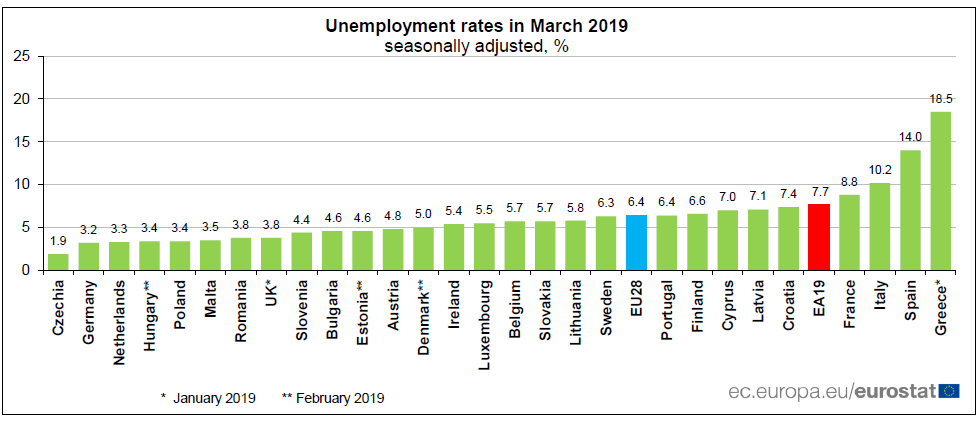
Eurozone unemployment rate dropped to 7.7% in March, down from 7.8% and beat expectation of 7.8%. It's also the lowest level since September 2008. EU28 unemployment rate also dropped to 6.4%, down from February's 6.5%.
Among the Member States, the lowest unemployment rates in March 2019 were recorded in Czechia (1.9%), Germany (3.2%) and the Netherlands (3.3%). The highest unemployment rates were observed in Greece (18.5% in January 2019), Spain (14.0%) and Italy (10.2%).
Mixed Markets as We Head into the Business End of the Week
Mixed markets as we head into the business end of the week
Markets in Europe are once again mixed, with US indices eyeing a similar open as we head into the business end of the week.
Earnings season remains a key focal point for investors and Monday got us off to a slow – albeit disappointing in the case of Alphabet – start but this should pick up in the coming days. The Fed begins its two day meeting today with the policy decision and press conference following on Wednesday, while the jobs report is also due on Friday to bring a heavy week to a close. We're probably seeing some caution right now in anticipation of these, particularly as we're now back at record highs in the case of the S&P 500 and Nasdaq.
The Chinese PMIs overnight won't have spread much optimism, only a month after that very data led many to question whether they had become too pessimistic about the world's second largest economy. It's important to note that the manufacturing PMI remained in growth territory – just – but this was undoubtedly a setback. This is probably a sign of what we can expect in the near-term, mixed data that's volatile from month to month.
Data from the eurozone has provided some positivity – against the backdrop of a broadly negative environment, it's worth pointing out – with first quarter growth and unemployment figures both exceeding expectations. I don't think anyone is kidding themselves after this data – 7.7% unemployment is still not good enough and 1.2% annual growth certainly isn't but at a time when the data seems to be deteriorating month on month, we have to take what we can get.
Oil higher again but rally in doubt
We're seeing a second day of gains in the oil market but I'm not getting too excited just yet. The market was feeling toppy prior to Friday's sell-off, which was further highlighted by WTI making significant declines on a story that was nothing more than a slightly altered rehash of something we've heard numerous times before, without substance.
We may be seeing some gains now but this currently looks like little more than a slight correction of Friday's declines after price bounced off a key support zone. I wouldn't be surprised to see this area come under pressure once again with today's API inventory report – and the EIA report tomorrow – potentially providing the catalyst.
Gold in limbo as major US events line up
Gold is on the up again on Tuesday, with a softer dollar aiding the rise as the yellow metal bounces back from its declines at the start of the week. To rebound this quickly may be seen as an encouraging sign but I remain unconvinced by rise we've seen over the last week. The picture is clearly clouded for gold, with a break below $1,280 clearly being a negative development as this proved to be a strong support zone since the start of the year.
We've broken back above here and now found support at $1,280 which may indicate a false breakout but upside momentum is also looking limited which casts doubt over this. Everything should become clearer over the coming days with numerous major US events potentially playing havoc with the greenback – Fed decision, jobs report, earnings – but for now we remain in limbo. We may make new highs but as long as we remain below $1,300, gold continues to look bearish.
Eurozone Q1 GDP grew 0.4%, France steady, Spain strong, Italy rebounds
Euro rebounds as Eurozone economy displayed larger then expected strength. Eurozone Q1 GDP grew 0.4% qoq, above expectation of 0.3%, and doubled Q4's 0.2%. EU 28 GDP grew 0.4% qoq.
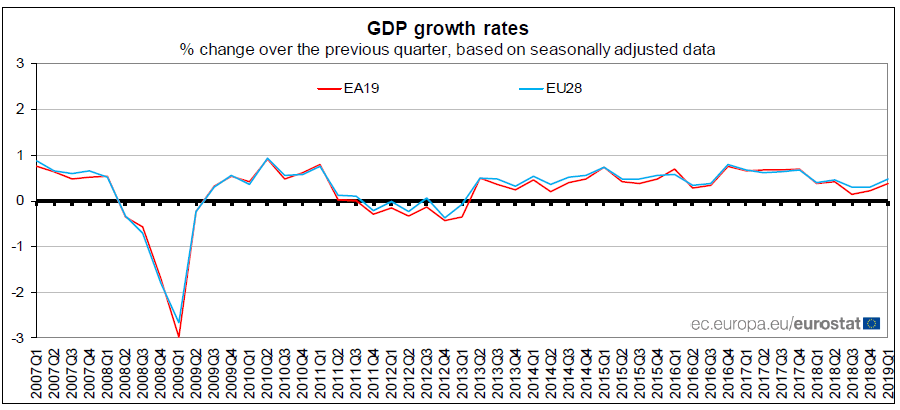
Other GDP data released today are also positive. France GDP grew 0.3% qoq in Q1, same as Q4 and matched expectations. Italy GDP grew 0.2% qoq in Q1, much better than expectation of -0.1% qoq. Spain GDP grew 0.7% qoq, accelerated from Q4's 0.6% and beat expectation of 0.6% qoq.
Also from Eurozone, unemployment rate dropped to 7.7 in April, better than expectation of 7.8%. That's also the lowest level since September 2008. German import price rose 0.0% mom in March, below expectation of 0.3% mom. German Gfk consumer sentiment for May was unchanged at 10.4, above expectation of 10.3. German unemployment dropped -12k in April, worse than expectation of -6k. German unemployment rate was unchanged at 4.9% in April.
NZD/USD Huge Inverted SHS Pattern Suggests Bullish Reversal
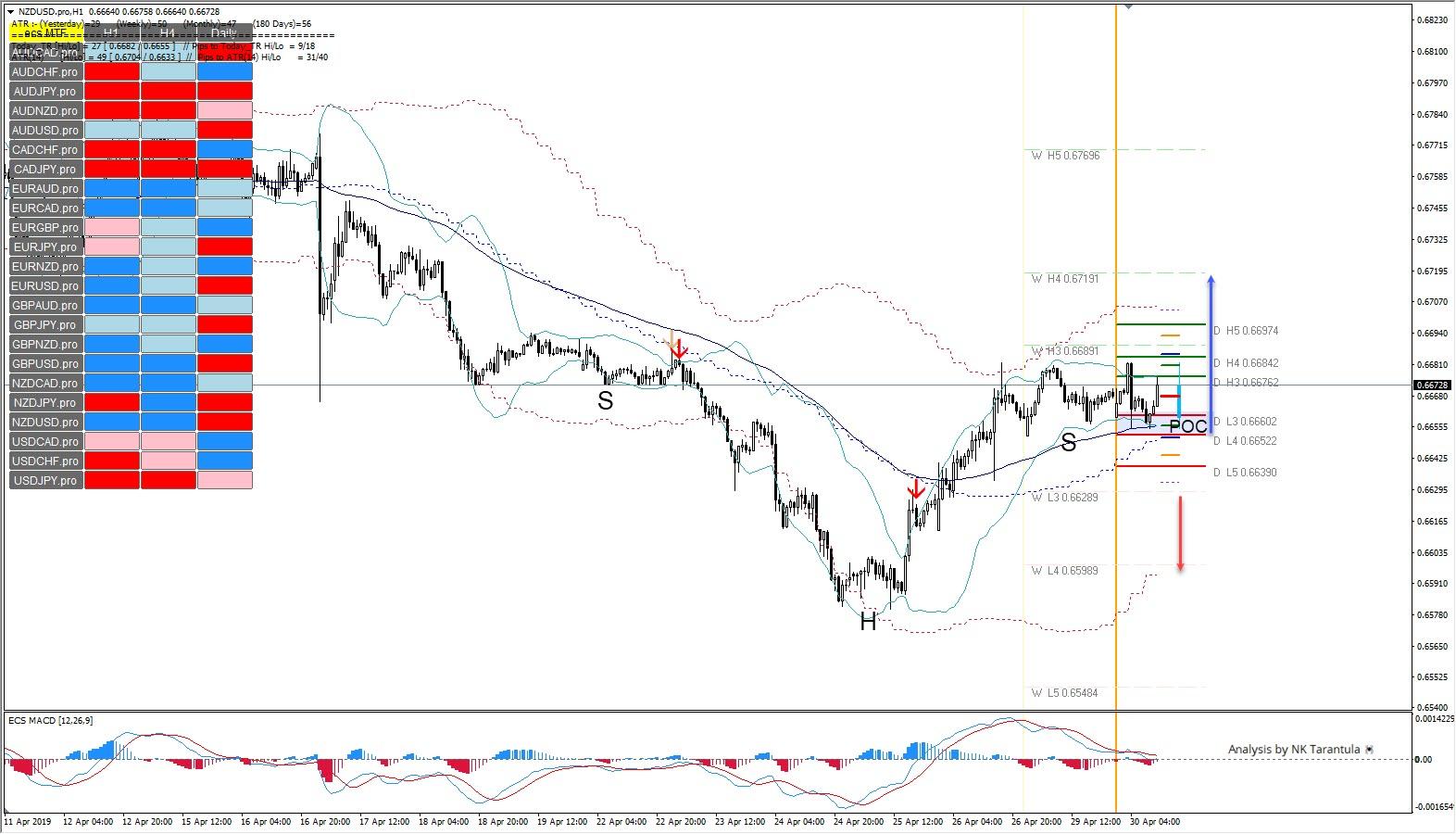
The NZD/USD has formed a bullish SHS pattern so we might see another bullish reaction from the POC zone .
The NZD is gaining momentum vs USD just a day prior to FOMC statement and FED cash rate decision. Equities remain solid, so a sense of a mild risk-on sentiment is in play, which may see some capital move into other currencies outside the USD. 0.6650-60 is the zone where fresh buyers are and as long as 0.6628 holds, bulls should be safe. Targets are 0.6648 and 0.6697 with 0.6719 as the final target. Only a drop below 0.6628 could cause a temporary relief where the price might reach 0.6589.
Is the US Dollar Losing Love?
Tuesday April 30: Five things the markets are talking about
The Fed's two-day policy meeting gets underway today. Officials are poised to keep interest rates steady when it concludes Wednesday. Fed Chair Jerome Powell's press conference will surely not want to be missed – will he be standing by his recent ‘dovish' outlook?
Currently, solid U.S growth and muted price measures continue to support the Fed's holding stance. The Fed's preferred inflation gauge, the price index for personal-consumption expenditures, rose just +1.5% last month from March 2018. Ex-food and energy, core inflation was only slightly stronger at +1.6%, well below the Fed's desired +2%.
Global equities had been trading under pressure in the overnight session on reported disappointed earnings from Alphabet and Samsung, one day after new record high prints stateside. Both U.S treasuries' and the ‘big' dollar have found a small bid on the back of disappointed investors. Nevertheless, some positive Euro data ahead of the U.S open has managed to pare back some of euro-equities losses.
This morning's plethora of economic releases saw European data beat expectations on both the growth and inflation fronts (eurozone, Italian and Spanish GDP data; Italian unemployment, French, German, Spanish, Italian CPI readings).
Note: Markets in Japan remain closed for Golden Week, reopens May 6, while a number of other countries are set to follow suit on May 1 (CNY, CHF, GER. Fr. & ITL).
For now, various asset classes seem caught in the ‘twilight zone.' Expect investors and dealers to continue to look for signals at the Feds policy meeting on Wednesday and earnings reports from the likes of Apple, GE and McDonald's for some conviction.
On the Sino-U.S trade front, the next round of trade talks are expected to get underway later today with significant issues still unresolved, but with enforcement mechanisms “close to done” according to Treasury Secretary Mnuchin.
On tap: CAD GDP, consumer confidence & NZD employment change (Apr 30), Bank holiday – CNY, CHF, GER. Fr. & ITL, U.S ISM manufacturing PMI, FOMC monetary policy statement & CNY Caixin manufacturing PMI (May 1), U.K inflation report, BoE monetary policy statement & AUD building approvals (May 2), non-farm payroll (May 3).
1. Stocks start to wobble
Global equities have mostly edged down overnight after Wall Street hit a new high closing Monday, raising questions about how much longer the rally can continue while rising oil prices threaten to push inflation higher.
Note: Tokyo's Nikkei was closed for a public holiday, reopens May 6.
Down-under, Aussie shares ended atop of their one-week low overnight as energy and mining stocks dropped sharply after disappointing factory data from China highlighted weakness in its economy. The S&P/ASX 200 index closed down -0.5%, after losing -0.4% yesterday. However, the index has advanced for a fourth consecutive month in April, gaining +2.3%. In S. Korea, the Kospi stock index ended lower, down -0.58%, also hit by disappointing China April factory growth. For the month, the Kospi has rallied +2.94%.
In China, stocks rallied overnight despite lacklustre factory activity data. The blue-chip CSI300 index rose +0.3%, while the Shanghai Composite Index gained +0.5%.
China April manufacturing PMI (OFFICIAL): 50.1 vs. 50.6E; Non-manufacturing PMI: 54.3 vs. 55.0e; Composite PMI: 53.4 v 54.0 prior. China April Caixin PMI manufacturing: 50.2 vs. 50.9E – however, export orders and employment back in contraction (below 50).
Note: The China market will be closed starting tomorrow due to the Labour Day holidays, and will reopen on Monday, May 6.
In Hong Kong, shares ended weaker overnight, hurt by declines in property and energy stocks, as the market awaits fresh stimulus after decent returns thus far in 2019. The Hang Seng index closed -0.7% lower at 29,699.11, while the China Enterprises Index ended down -0.8%.
Note: The index will be closed on Wednesday for Labour Day holiday, and will resume trading on Thursday, May 2.
In Europe, regional bourses trade mostly lower after mixed session in Asia and mixed U.S futures.
U.S stocks are set to open in the ‘red' (-0.6%).
Indices: Stoxx600 -0.14% at 390.68, FTSE -0.14% at 7,430.25, DAX -0.10% at 12,315.72, CAC-40 -0.40% at 5,558.48, IBEX-35 -0.32% at 9,487.06, FTSE MIB +0.15% at 21,821.50, SMI +0.31% at 9,770.50, S&P 500 Futures -0.06%
2. Oil prices firm as Saudi's says OPEC may extend supply cuts, gold higher
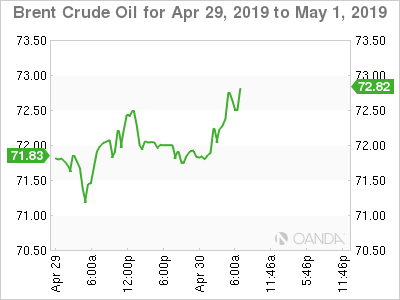
Oil prices are better bid this morning after Saudi Arabia said a deal between producers to withhold output in 2019, year to date, could be extended beyond June to cover all of 2019.
Saudi energy minister Khalid Al-Falih statement comes despite pressure by Trump directly insisting that OPEC raise output to make up for a supply shortfall expected from tightening U.S sanctions against Iran.
Brent crude futures are at +$72.25 per barrel, up +21c, or +0.3c, from their last close. U.S West Texas Intermediate (WTI) crude futures are at +$63.67 per barrel, up +17c, or +0.3%, from Tuesday's close.
Despite a questionable global economy, oil prices have surged +40 ytd, supported mostly by supply cuts led by OPEC+ as well as by U.S sanctions on producers Iran and Venezuela and not necessarily by an increase in global demand.
Consensus expect a balanced output for the remainder of this year – U.S sanctions are estimated to be counter balanced by an increase in production from OPEC+ and the U.S.
Note: U.S. exports exceeded +3M bpd for the first time in early 2019 amid a more than +2M bpd production surge over the past year, to a record of more than +12M bpd.
Ahead of the U.S open, gold prices have been small better bid as lacklustre Chinese factory activity data have renewed concerns about the health of the global economy. Spot gold has rallied +0.3% to +$1,283.44 per ounce, while U.S gold futures are up +0.3% at +$1,285.30 an ounce. Expect investors to wait for the Fed's two-day policy meeting starting later this morning for clues on the interest rate outlook.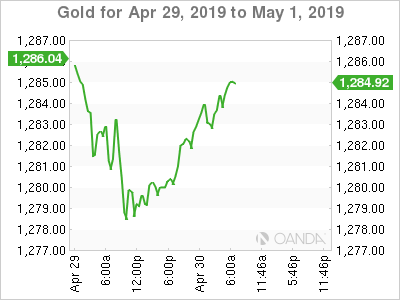
3. Eurozone bond yields little changed
Euro government bond yields are little changed despite investor focus falling on economic growth and inflation numbers across the bloc's biggest economies.
Data this morning showed that France, the second largest in the eurozone, grew +0.3% in Q1, the third quarter in a row at that rate. It was in line with market expectations. Spain's economy, the fourth biggest, expanded a stronger-than-expected +0.7% in Q1. This stronger data has helped to offset the weaker tone overnight from China, where readings on manufacturing activity failed to meet expectations.
Germany's 10-year Bund yield has pushed back through zero percent to trade at +0.002% but remains below the one-month highs hit earlier this month.
Elsewhere, the yield on two-year Treasuries notes has fallen -2 bps to +2.27%, while the yield on 10-year Treasuries fell -1 bps to +2.51%. In Japan, the 10-year JGB yield is unchanged at -0.04%.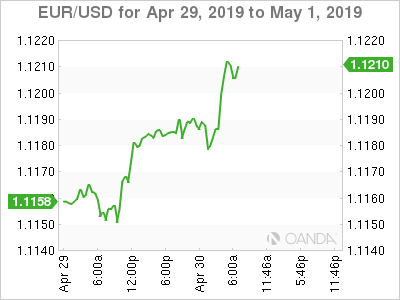
4. Dollars defining moment
The ‘mighty' USD is trading atop of its one-week lows against G10 currency pairs ahead of the U.S open. The greenback retreated from its recent cycle highs as US inflation data has been below expectations. Despite some of the negativity against the dollar, investors are content to continue buying U.S dollars on pullbacks.
EUR/USD (€1.1212) has edged above the psychological €1.12 handle as a plethora of Euro economic releases beat expectations on both the growth and inflation fronts (Euro Zone, Italian and Spanish GDP data; Euro Zone, German, Italian unemployment; French, German, Spanish, Italian CPI readings all exceeded consensus).
Rounding out the majors: USD/JPY at ¥111.31, lower by -0.2%; GBP/USD at £1.2989, higher by +0.4%; USD/CHF at $1.0180, lower by -0.1%
Argentina's central bank (BCRA) said it will step in to the FX market more readily to support the peso after several days of volatility last week sent the currency plunging outright. BCRA expects to sell dollars even if the exchange rate is stronger than 51.45 pesos to the dollar, which was the level the bank had previously set for interventions. The peso lost more than -5% of its value in one day last week.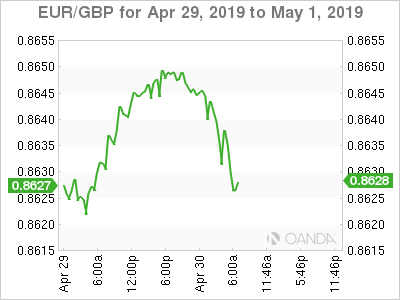
5. Eurozone economic growth stronger than expected
Data this morning showed that Eurozone economic growth was stronger than expected in the Q1, rebounding strongly from a slump in H2, 2018, while unemployment fell to its lowest rate in more than a decade.
Eurostat said that according to a preliminary estimate, GDP in the 19 countries sharing the EUR rose +0.4% q/q in Q1, up from +0.2% in Q4 of 2018 and +0.1% in Q3. Year-on-year, eurozone GDP rose +1.2%.
Note: Market expectations were looking for a +0.3% quarterly increase and a +1.1% annual expansion.
Other data showed that eurozone unemployment fell to +7.7% in March vs. +7.8% in February.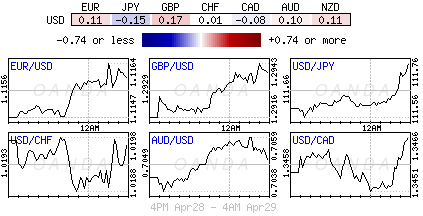
EUR/USD – Euro Points Upwards As Eurozone GDP Beats Estimate
EUR/USD has posted gains for two days straight and the upward trend continues on Tuesday. Currently, the pair is trading at 1.1212, up 0.17% on the day. After a quiet start to the week, there are a host of German and eurozone events. German GfK consumer climate remained pegged at 10.4, just above the forecast of 10.3 points. Investors will be keeping a keen eye on German CPI, with an estimate of 0.5%, and eurozone Flash GDP, which is expected to rise slightly to 0.3%. In the U.S., Chicago PMI is expected to rise to 59.1, and CB Consumer Confidence is also projected to climb to 126.2 points.
Is a U.S-China trade deal imminent? Negotiations will continue on April 30, in Beijing, and U.S. Treasury Secretary Mnuchin waxed positive on Sunday, saying that the talks were in their “final laps”. However, Mnuchin cautioned that the talks could still end without an agreement. The nasty trade war between the two largest economies in the world has rocked the global economy and curbed growth. If the sides can hammer out an agreement, investor risk appetite would likely soar, which could boost the euro against the safe-haven greenback.
The Federal Reserve has said it expects to hold interest rate levels for the rest of the year, and the most recent inflation numbers will reinforce that stance. The Core PCE Price Index, which is the Federal Reserve’s preferred gauge for inflation, came in at 0.0% in March and 0.1% in February (the two events were released on Tuesday due to the government shutdown earlier this year). On an annualized basis, the indicator gained 1.6%, just shy of the estimate of 1.7%. There was better news from consumer spending, which jumped 0.9% in March, compared to the estimate of 0.7%. The strong reading was a result of increased spending on motor vehicles and health care.
GBPUSD Gains Some Ground But Still Below Descending Line
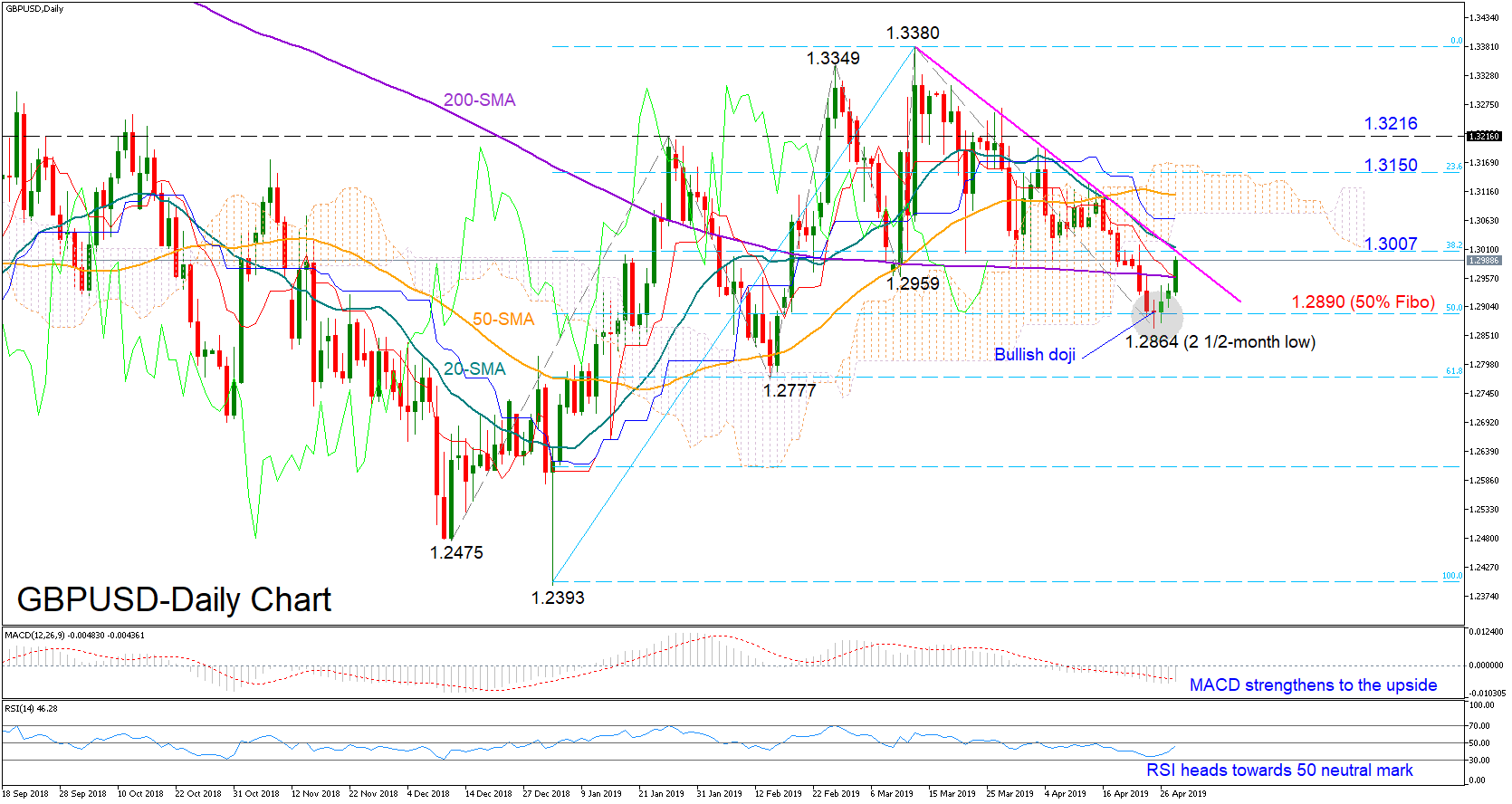
GBPUSD printed a bullish doji on Thursday near a 2 ½ -month low of 1.2864 before showing some recovery in the following sessions.
While the RSI and the MACD seem to be improving in bearish territory, the market needs to overcome the descending trend-line drawn from the 1.3380 peak for the bulls to energize. The 38.2% Fibonacci level of 1.3007 of the 1.2393-1.3380 uptrend and the 20-day simple moving average (SMA) also happen to be in the same neighborhood.
Should the price jump above the line, the spotlight will turn to the 50-day SMA currently at 1.3107, while higher the area between 1.3150-1.3216 where the top of the Ichimoku cloud is also located, may bring a new bullish wave if significantly violated.
Alternatively, the price could shift lower to retest the 50% Fibonacci of 1.2890 and its recent troughs near 1.2864. if the decline extends further, a stronger challenge may come around the 61.8% Fibonacci of 1.2777.
Meanwhile in the medium-term picture, the outlook has shifted from bullish to neutral after the market reached a bottom at 1.2864, below the previous low of 1.2959 , breaking the upward pattern started in mid-December.
EURUSD Testing Breakout Area
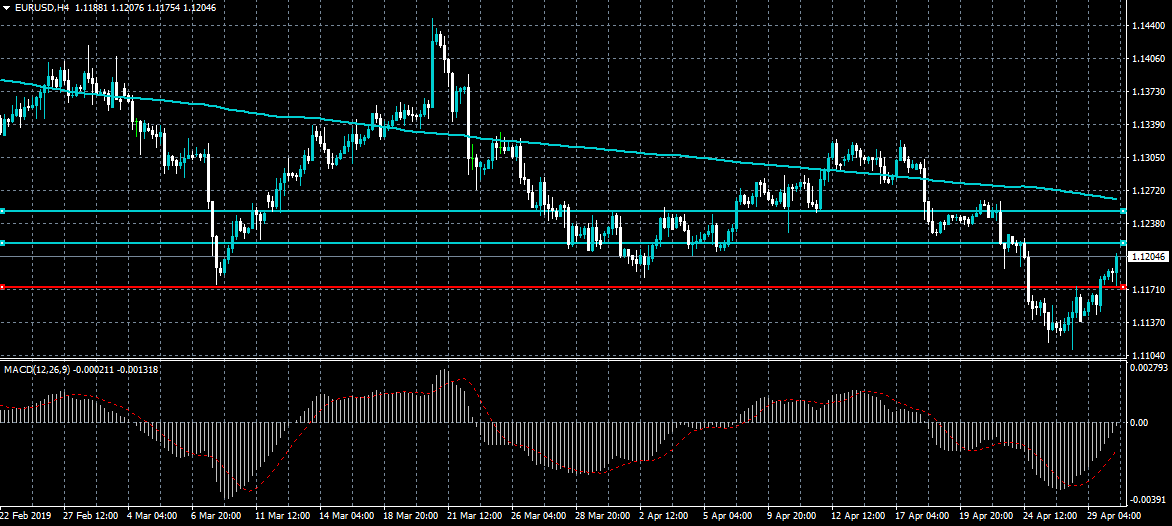
The euro has moved above the 1.1200 level against the US dollar following much stronger than expected economic data from the eurozone economy this morning. The EURUSD pair could surge towards the 1.1250 level if bulls can move price above the important 1.1216 level. Overall, the EURUSD pair now has a bullish short-term trading bias while trading above the 1.1174 level.
The EURUSD pair is only bearish while trading below the 1.1174 level, key technical support remains at the 1.1150 and 1.1135 levels.
If the EURUSD pair trades above the 1.1216 level, key resistance is found at the 1.1250 and 1.1267 levels.
GBPUSD Turning Bullish
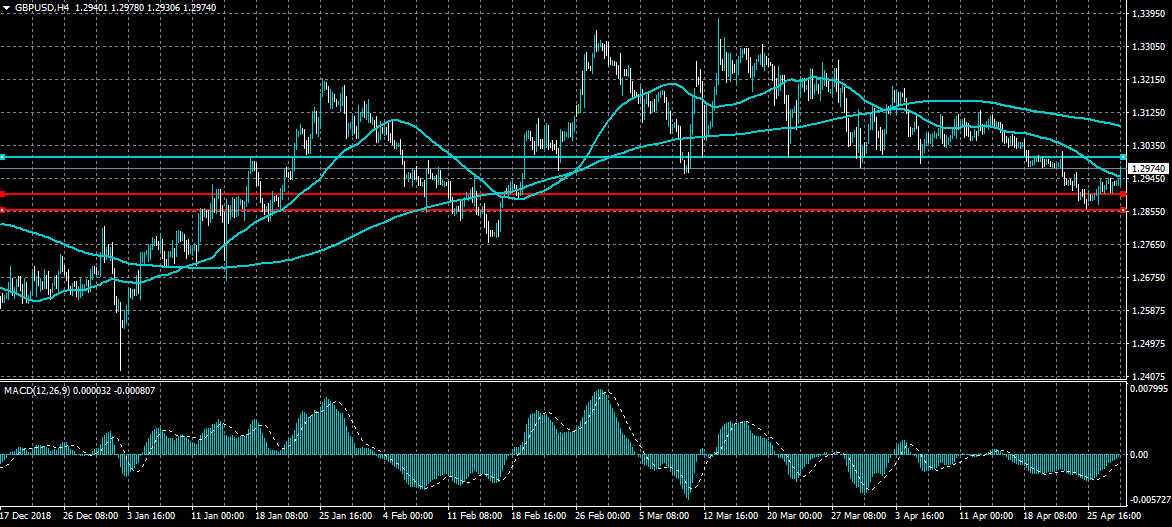
The British pound has moved sharply higher against the US dollar during the European trading session as the greenback comes under pressure across the board. The GBPUSD pair has a bullish weekly trading bias while trading above the 1.2965 level. If bulls can move the GBPUSD pair above the 1.3000 level, the 1.3100 level offers the strongest form of upside technical resistance.
The GBPUSD pair is only bearish while trading below the 1.2965 level, key support is then found at the 1.2900 and 1.2865 levels.
If the GBPUSD pair holds above 1.2965 level, key intraday resistance is found at the 1.3000 and 1.3100 levels.
EUR/USD Pressured By 200-Hour SMA
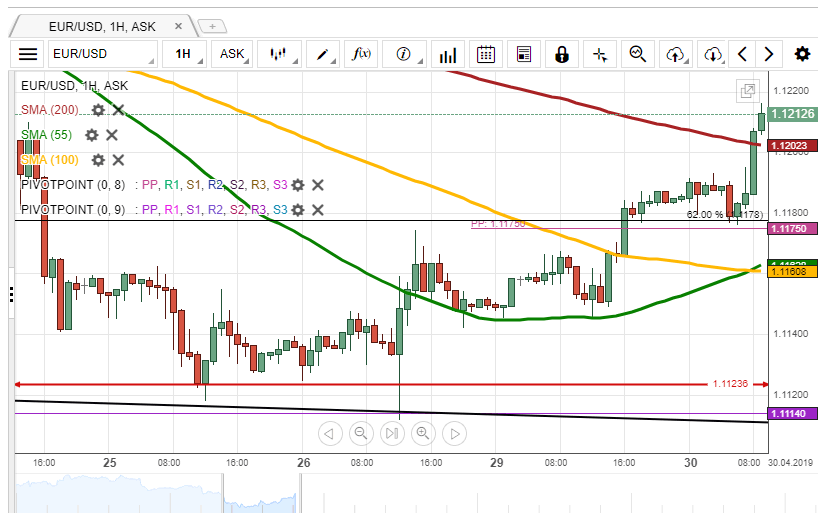
During Monday's session, the EUR/USD currency pair surpassed the 1.1180 level. During Tuesday's morning, the pair was testing the 200-hour SMA at 1.1203.
If the given moving average does not hold, it is likely, that the exchange rate could continue to extend gains. In this case, the rate could surpass the psychological level at the 1.1220 mark.
On the other hand, the rate could trade sideways between the given SMA and the support level formed by a combination of the 55– and 100-hour moving averages at 1.1161. If the given support does not hold, the pair could decline to the 1.1140 mark.