Sample Category Title
Forex Technical Analysis: EUR/USD, USD/JPY, GBP/USD
EUR/USD
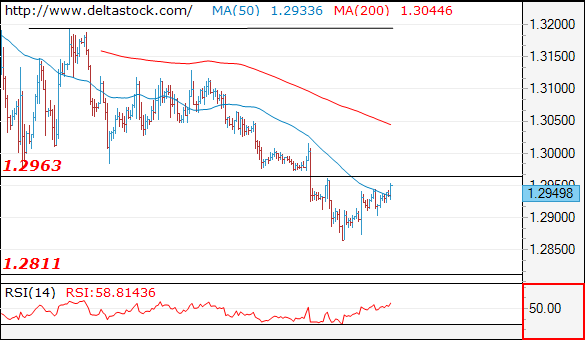
Current level - 1.1184
The intraday bias is positive above 1.1170, for a test of 1.1230 area. Crucial on the downside is 1.1140 and dive through that area will signal a renewal of the sell-off towards 1.1015.
| Resistance | Support | ||
| intraday | intraweek | intraday | intraweek |
| 1.1230 | 1.1330 | 1.1170 | 1.1010 |
| 1.1330 | 1.1450 | 1.1110 | 1.0860 |
USD/JPY
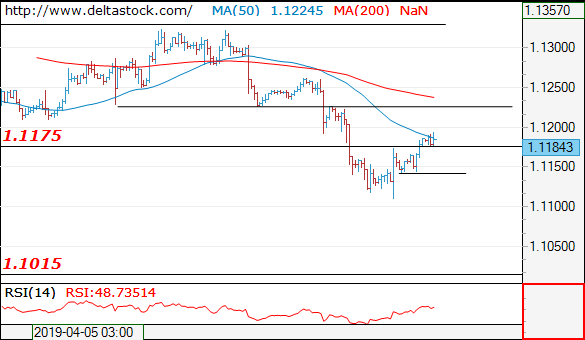
Current level - 111.33
The outlook is bearish, for a slide towards 110.50 zone. Crucial on the upside is 111.87 peak.
| Resistance | Support | ||
| intraday | intraweek | intraday | intraweek |
| 111.87 | 113.20 | 110.80 | 108.90 |
| 113.20 | 114.50 | 110.50 | 107.40 |
GBP/USD
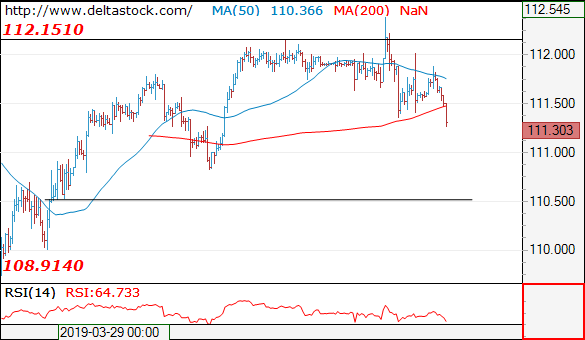
Current level - 1.2948
The rebound after 1.2860 low should be considered corrective, preceding a slide towards 1.2810 area. Initial resistance lies at 1.2960, followed by 1.3020.
| Resistance | Support | ||
| intraday | intraweek | intraday | intraweek |
| 1.2960 | 1.3450 | 1.2810 | 1.2810 |
| 1.3020 | 1.3450 | 1.2810 | 1.2610 |
China’s PMIs Lose In Momentum
After showing a series of upbeat PMI figures last month, it seems that today's data is running short of expectations. China bears have therefore well-founded reasons to dump both Chinese yuan and Australian dollar in today's trading session as major trading partners should face the direct consequence of the drawdown. Yet perspectives have not fundamentally changed, as the readings still remain in expansion territory while the recent announcement made by Chinese authorities to moderate expansionary stimulus policies in order to curb debt risk necessarily induces further volatility along 2Q 2019.
Official Manufacturing PMI dropped to 50.1 from 50.5 in March while the Caixin gauge was at 50.2 whereas the recent readings are pointing to a slowdown in construction growth. Market reaction was overall negative as most Asian shares fell, including Japanese Topix 500 and Nikkei 225 down 0.22% and 0.11% followed by Hong Kong Hang Seng -0.65% while China mainland CSI 300 progressed by 0.33% as trade negotiations from the US and China are expected to come to an end within the next two rounds of talks. Focus is turning towards final issues relating to trade duties introduced last year by both sides. It is expected that a process of gradual elimination of tariffs will be synchronized with the timetable established under the enforcement mechanism.
Currently trading at 6.7339, USD/CNY is expected to firm slightly.
EW Update: EUR/USD And USD/CHF In A Temporary Pause, More Gains Expected
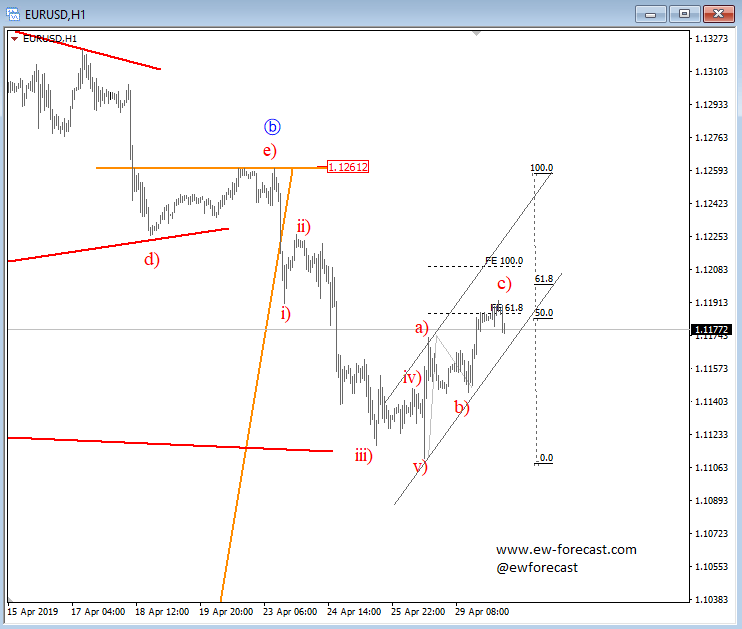
Dollar is lower this morning with EURUSD retesting 1.1195/1.1200 area when USDJPY and USDCHF came down to 111.30 and 1.0180. But when looking at the price action across these three pairs I see possible corrective activity. EURUSD has three legs up so far into some important Fib. resistance from where new intraday sell-off may occur. However, channel support and 1.1140 has to be broken before weakness may resume.
EURUSD, 1h
USDCHF can be forming a flat correction; now wave c in play for 1.0140/60 area where bulls may step in for a rise into a fifth wave.
USDCHF, 1h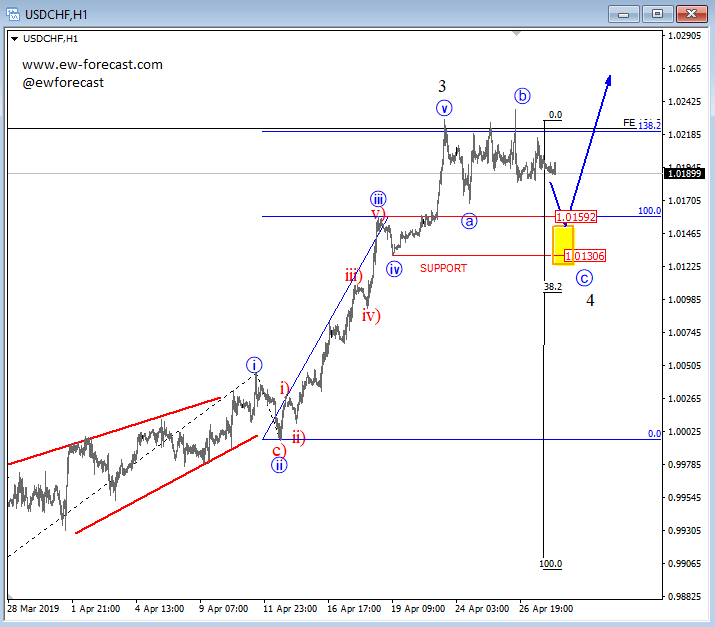
China: PMI Lower But Moderate Recovery On Track
Key points
- Chinese PMI corrects lower in April.
- We see it as mainly a correction to strong March numbers.
- The numbers confirm the recovery is likely to be moderate
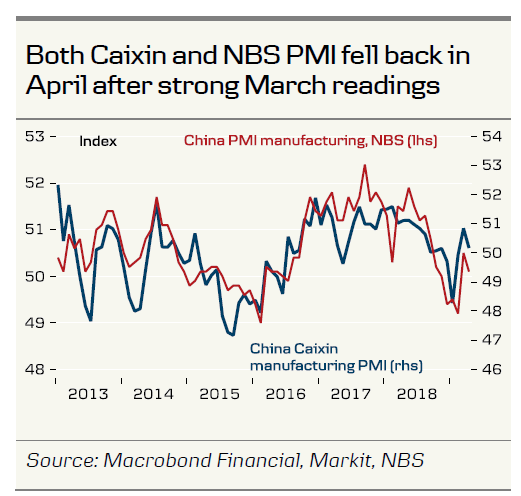
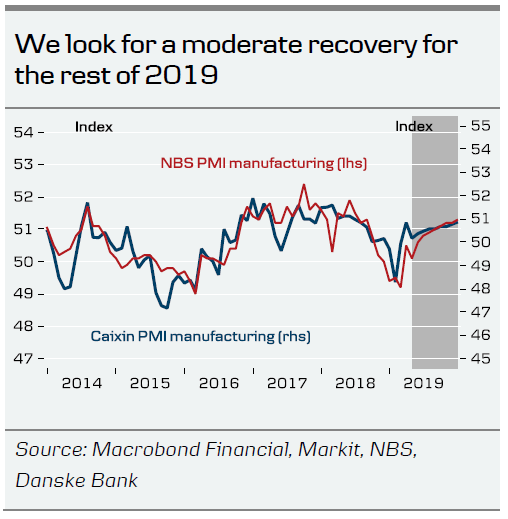
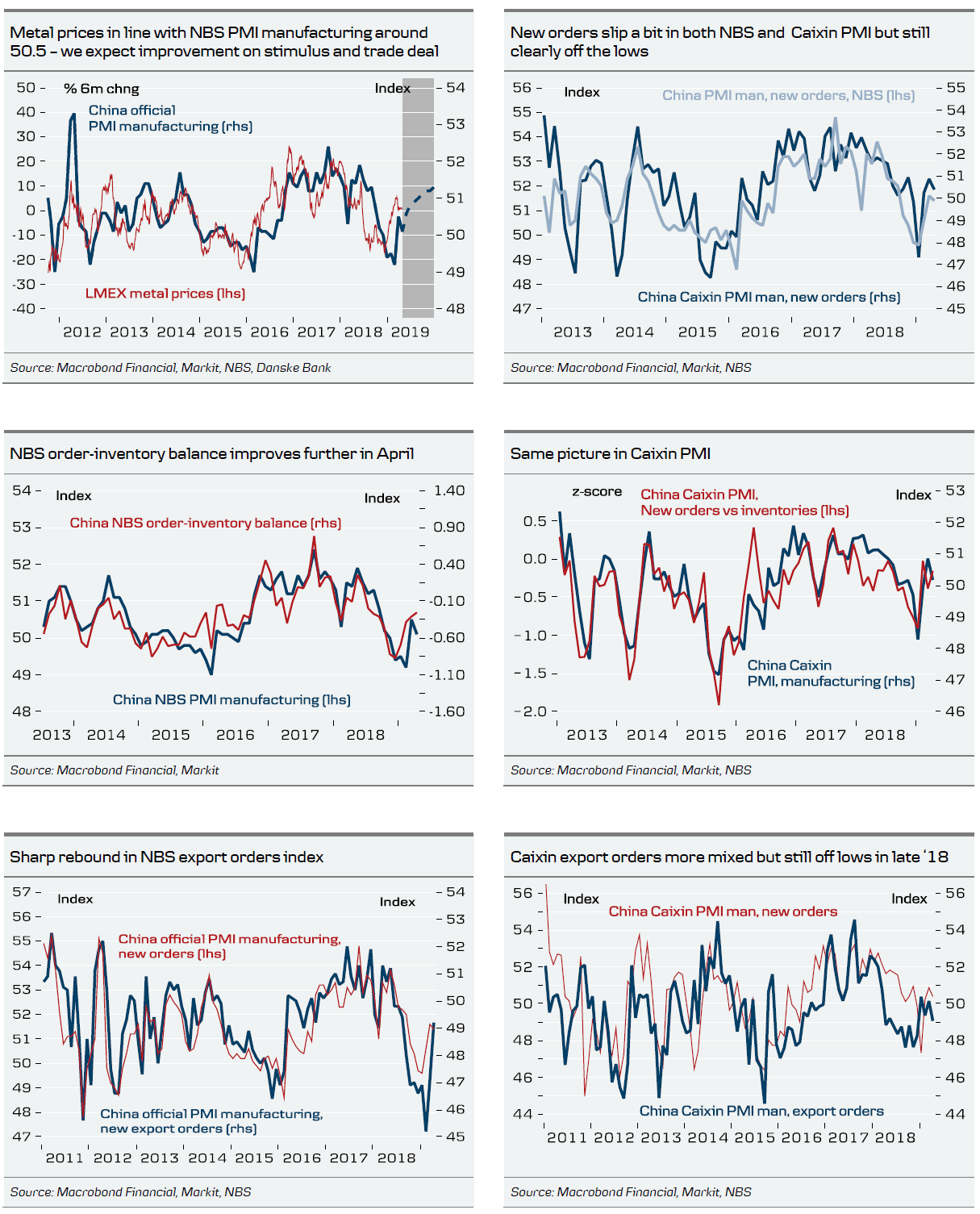
Chinese PMI came out weaker than expected (see charts for details) but as we wrote in China Weekly Letter on Friday, the rebound in March data was probably too good to be true and some correction in April was to be expected. We should expect the same in other April data coming up. Hence, the positive surprise from China is probably behind us for now, leaving more of the burden of recovery evidence on other regions. We still expect a recovery in China, but the numbers support the case that the recovery will be moderate.
The weaker numbers will keep the hope of further monetary easing alive in markets, so the numbers may not be that negative for Chinese stocks or global stock markets. We see a 50-50 chance of a broad-based cut in the Reserve Requirement Ratio, as China needs to weigh the short-term need for more support to the recovery against the long-term goal of financial stability and not fuelling financial leverage in markets. However, we do expect more measures to lift private consumption of autos and home appliances, etc. and more targeted lending towards SMEs in the private sector.
Just to recap why we expect a Chinese recovery, we see three drivers: First, Chinese stimulus from both monetary policy and fiscal policy should increasingly kick in. We have seen more signs lately that housing demand is getting a lift and retail sales have improved somewhat following household tax cuts. Second, we expect a US-China trade deal to be signed within the next 1-2 months, which will further reduce the uncertainty from the trade war that seems to have weighed significantly on sentiment in China both among consumers and businesses. Third, there are some signs that companies have responded to the uncertainty by cutting inventories, which led to a temporary drop in production. The PMI data suggests that this process is coming to an end as the orderinventory balances improve in both the NBS and the Caixin PMI data.
The Turkish Lira Decline May Spread To The Euro
The demand for safe-haven assets has increased after S&P had touched a record high. The problems of the Turkish lira can exacerbate the market concerns.
Stocks
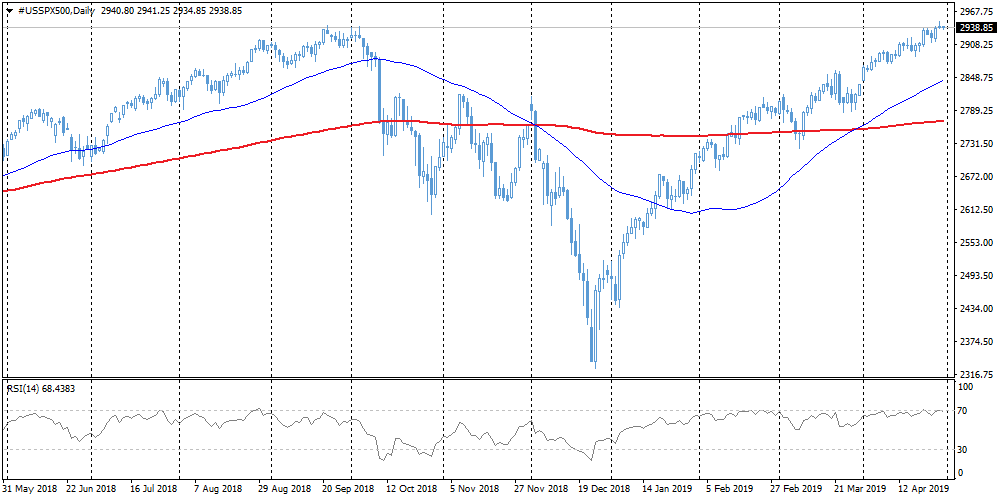
S&P 500 futures on Monday updated historic highs but shortly after fell under some pressure. One of the reasons is the disappointment in Alphabet report, whose stocks are losing more than 7% in premarket. But even worse, Chinese data showed a decline in production activity. The technical analysis demonstrates the weakening growth momentum in the markets and increases the chances of a quick corrective pullback. The markets may require an impressive positive factor to continue the rally, which may be a further sharp easing of the Fed position (Wednesday), and a strong labour market report (on Friday).
EURUSD
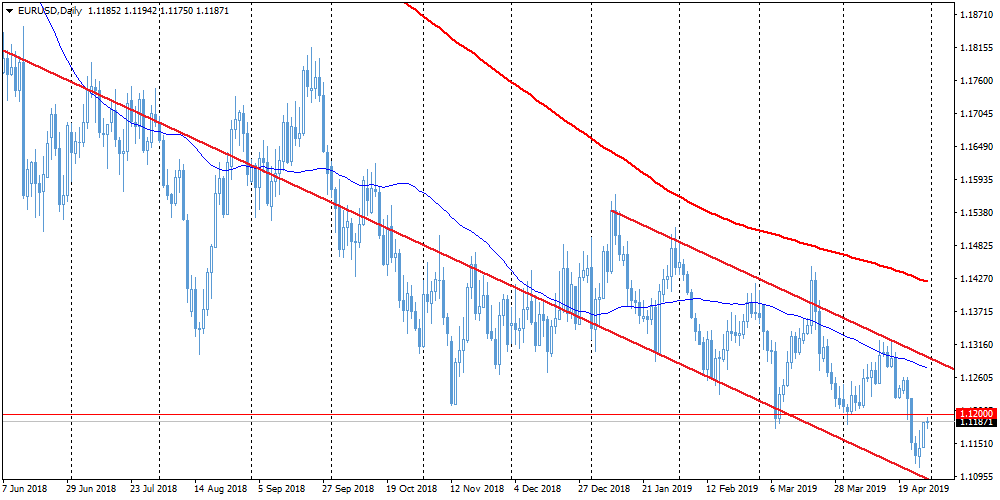
EURUSD has added about 40 pips on Monday to 1.1180. At the beginning of trading in Europe, the pair came close to the level of 1.1200. The former strong level of support now risks becoming important resistance, heightening the pressure on the euro. Among the news, quotes may be affected by estimates of GDP in the eurozone, as well as inflation in Germany.
GBPUSD
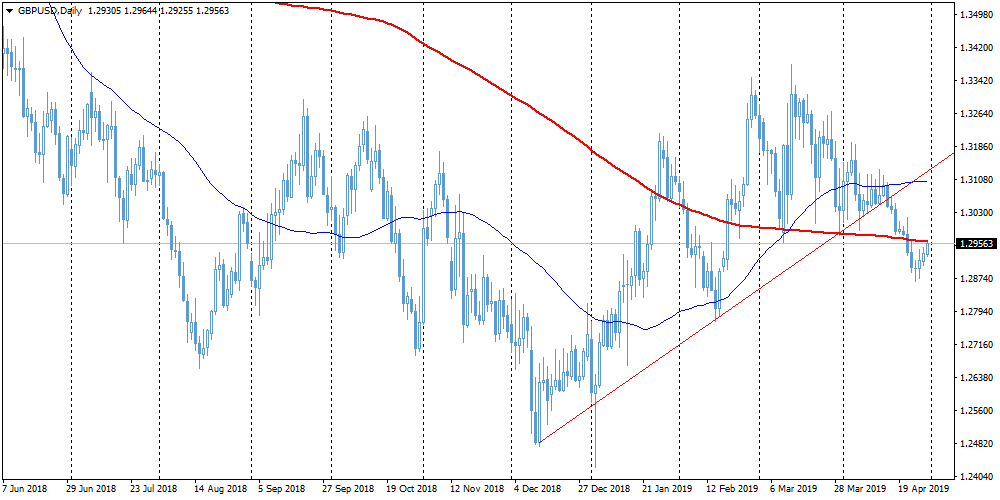
The British pound rose to 1.2950 dollars, adding about 50 points to Monday's intraday lows. Behind the growth is the caution of players in front of a tense second half of the week. The combination of the demand for safe assets and reduced trading activity can make MA(200) a relatively strong resistance in the coming days.
USDTRY
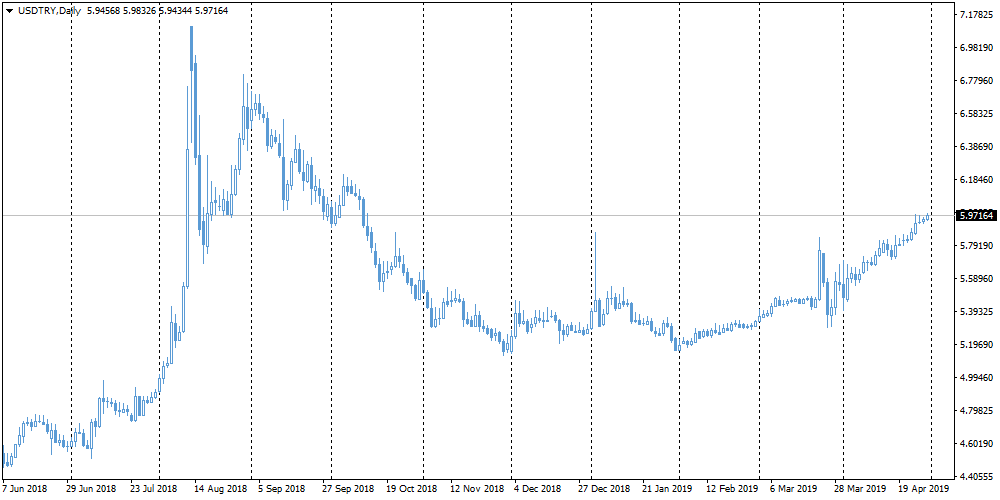
Turkish lira continues to decline against the dollar. The financial markets of the country are experiencing serious outflows, and the national Central Bank (TCMB) burns foreign exchange reserves to curb the weakening of the national currency. The situation is aggravated by the economic downturn in the country, which limits the ability of the TCMB to raise the rate in order to stabilize the TRY. Potentially, the focus of anxiety can spread to the whole emerging markets sector and to the European markets, including EUR.
Equity Markets Trade Lower Due To Economic Data
European markets are trading lower after the disappointing German and French economic data. The German consumer climate number didn't show any improvement as compared to the previous reading of 10.4. In addition to this, the German import prices month/month also dropped to zero while the forecast was 0.3 percent.
The focus is on China, the Chinese economic engine has sputtered and the risk sentiment is impacted by this. The Chinese Caixin manufacturing PMI fell to 50.2 missing the forecast of 51. However, the bright side is that it is still in the positive territory. A number above 50 represents expansion and below 50 represents contraction.
Further pessimism in the market comes from earnings. Samsung, the world's biggest phone maker, was also unable to impress the markets. The Korean giant missed analysts forecast, the weakness was mostly in the screen display- this was due to the lower orders from Apple.
The share buy back story remains the dominant force among corporates, Standard Charted announced that it will buy back as much as 1,000,000,000 of shares. This is the first time in more than 2 decades that the bank will repurchase its shares and this comes after the bank reached a settlement with the US authorities over several different sanction breaches. Winter has been long for Standard Charted shareholders, the bank battled with its loan losses, penalties, and feeble returns.
For me, the key thing in Standard Chartered's earnings was the reduction in the operating expenses, it fell by 2% to $2.4 billion. Investors need to see healthy returns, and for this to happen, the bank needs to tighten its belt around its operational expenses and avoid penalties. The role of Standard Chartered Bank around “One Belt and One Road” is also of critical importance. The bank needs to make sure it plays the main role here given the scope.
Alphabet posted another disappointing quarter last night, the earnings result missed analyst estimates. The concerns are that the firm is losing its ad revenue to other digital rivals. As a result of this, the shares plunged by 7% yesterday and we are expecting the sell-off to continue today. The company reported sales of $29.5 Billion while Wall Street was looking for $30.04 Billion. The revenue grew by 15%, however, this was the slowest pace in growth going all the way to 2015. Alphabet needs to assure investors that the firm’s R&D lab has enough potential to combat the limited growth and surge in competition.
AUD Drops On Weak Chinese Data
The AUD weakened during the Asian session today as the Chinese manufacturing activity dropped, disappointing the markets. It should be noted that the drop of manufacturing PMI was also followed by a drop of the services PMI and the Caixin manufacturing PMI, all for April. Analysts point out that the drop consists a blow to hopes for global growth to rebound. The Aussie is considered as a close proxy for China, yet its drop could also lead other risk assets to also weaken. With the Chinese data already out for the week and Australian data left to release, we could see the Aussie taking a bearish momentum. On the other hand it should be noted that a fresh round of the US-Sino negotiations about trade is to begin. Should there be positive headlines or even better some concrete results, we could see the AUD strengthening. AUD/USD rose yesterday testing the 0.7065 (R1) resistance line. We could see the pair having some bearish tendencies in the aftermath of the release, yet at the same time we expect it to be sensitive to any headlines relating to the US-Sino negotiations. Should the bears be in control of the pair’s direction, we could see it breaking the 0.7000 (S1) support line and aim for lower grounds. Should the bulls take over, we could see the pair rising breaking the 0.7065 (R1) resistance line and aim for the 0.7120 (R2) resistance level.
USD weakens ahead of Fed and employment report
The USD weakened against some of its counterparts yesterday and especially the EUR. The move is considered as a correction of last week’s upward movement and in anticipation of the Fed’s interest rate decision. Also yesterday, despite the personal consumption accelerating somewhat, the core PCE prices showed a slight moderation. On the contrary the common currency strengthened as the market may be positioning for the release of favorable data later today. Especially the preliminary GDP growth rate for Q1 is expected to be closely watched, along with April preliminary CPI rates for Germany and France. We could see the EUR marking some gains should today’s releases favor it, if they fail the market, we could see an asymmetrical bearish reaction. EUR/USD rose yesterday breaking the 1.1175 (S1) resistance line (now turned to support). We could see the pair having some bullish tendencies, should today’s financial releases, favor the EUR side of the pair. If the pair finds fresh buying orders along its path, we could see it breaking the 1.1220 (R1) resistance line. Should the pair come under the selling interest of the market, we could see it breaking the 1.1175 (S1) support line and aim for the 1.1125 (S2) support level.
Other economic highlights, today and early tomorrow
On a busy Tuesday, we get in the European session, Germany’s GfK consumer sentiment for May, unemployment data for April and the preliminary HICP rate for April. From France we get the preliminary CPI (EU Norm.) rate for April and from the Eurozone the preliminary GDP growth rate for Q1. In the American session, we get Canada’s GDP for February and from the US the CB Consumer Sentiment for April, the Pending home sales rate for March and the API weekly crude oil inventories figure. Early in tomorrow’s Asian session New Zealand’s employment data for Q1 are to be released. As for speakers please note that BoE’s Ramsden is scheduled to speak while BoC Governor Poloz along with Deputy Governor Wilkins are to testify at the finance committee of the Canadian Parliament.
EUR/USD H4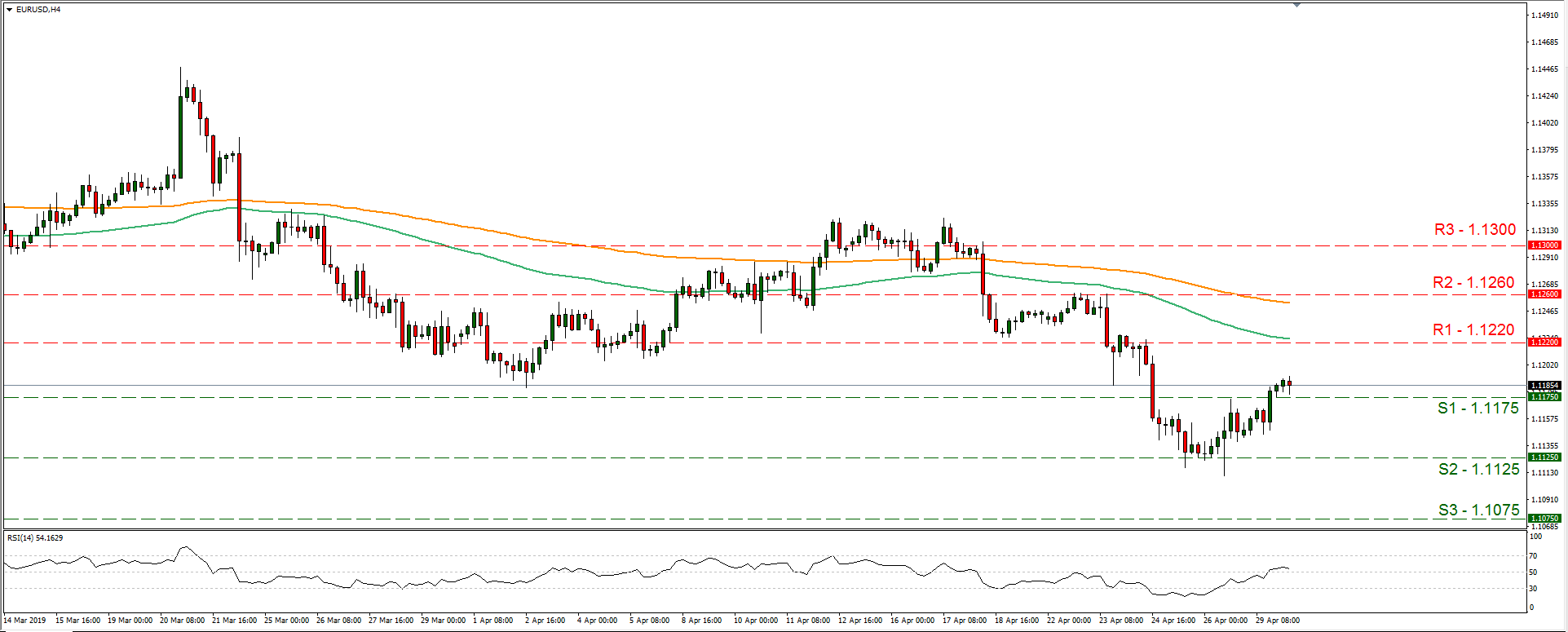
Support: 1.1175 (S1), 1.1125 (S2), 1.1075 (S3)
Resistance: 1.1220 (R1), 1.1260 (R2), 1.1300 (R3)
AUD/USD H4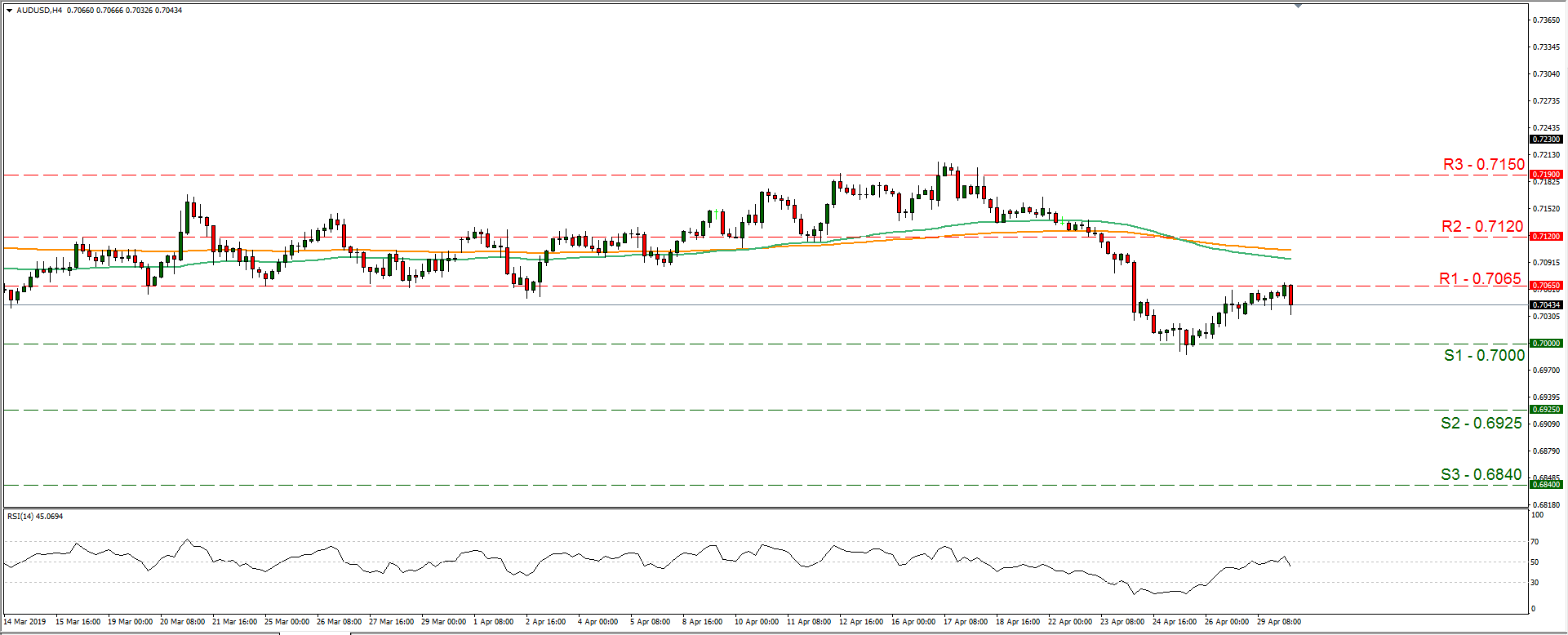
Support: 0.7000 (S1), 0.6925 (S2), 0.6840 (S3)
Resistance: 0.7065 (R1), 0.7120 (R2), 0.7150 (R3)
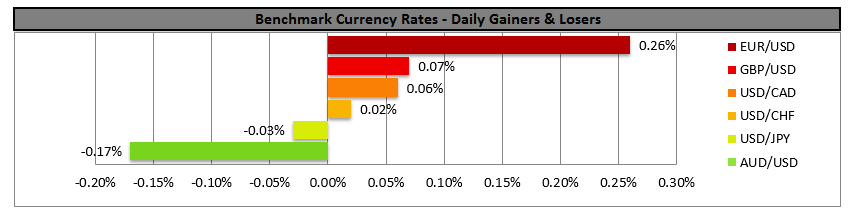
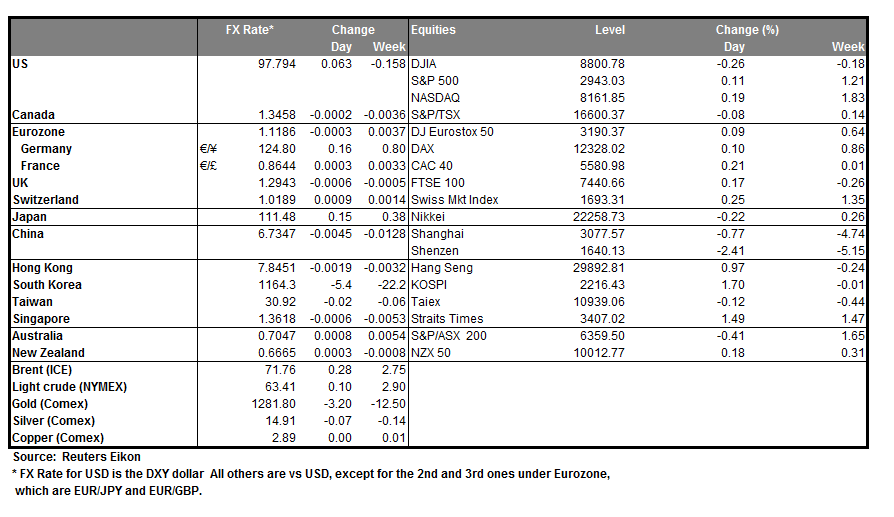
Dollar Buoyant Ahead Of Fed, But Caution Elsewhere Amid Mixed Growth Signals
- Solid US growth and muted inflation boosts US dollar and Wall Street
- But other majors sag as disappointing Chinese PMIs revive growth fears
- Fed to start two-day monetary policy meeting, unlikely to alter stance
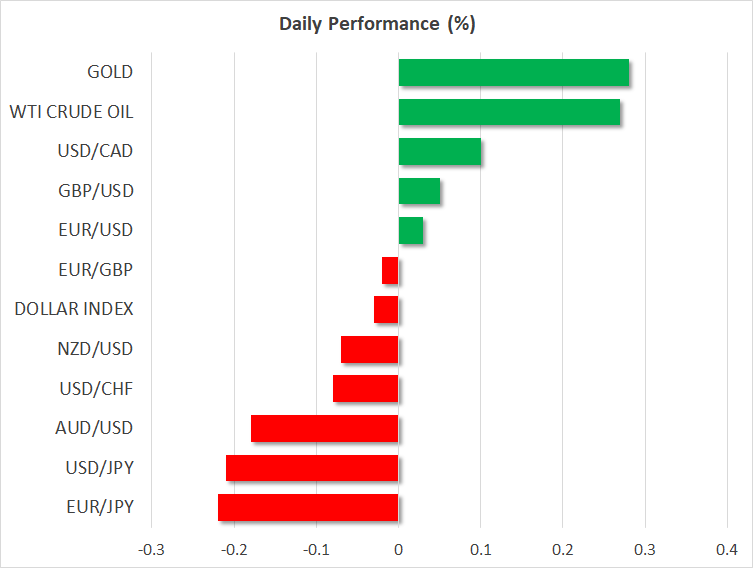
Dollar eases from 22-month high but remains supported ahead of FOMC meeting
The US currency was outperforming its peers early on Tuesday as there was further evidence on Monday that growth in the world’s largest economy is picking up speed. Personal consumption in the US rose at the fastest pace in nearly 10 years in March, while the Fed’s preferred inflation gauge, the core PCE price index, unexpectedly slipped to 1.6% year-on-year – the lowest in 14 months.
The data reinforced the view that the Federal Reserve will keep interest rates on hold on Wednesday when it concludes a two-day meeting that starts today. The Fed has little reason to tighten policy when underlying inflation is weakening even as growth is rebounding from a short-lived soft patch.
In comparison, PMI figures released in China earlier today raised fresh concerns about the growth outlook outside of the United States. Both the official and Caixin/Markit manufacturing PMIs missed expectations in April, easing slightly from the prior month.
The relative strength of the US economy drove the greenback higher against its peers, with the dollar index edging higher to 97.86, not far from last week’s 26-month top. However, against the Japanese currency, the dollar was slightly lower at 111.38 as the safe-haven yen was lifted from the risk-off mood triggered by the Chinese PMIs.
Aussie dips after China PMIs as risk sentiment sours
The Australian dollar took a knock from the soft manufacturing numbers out of China as risk appetite deteriorated, with investors shrugging off yesterday’s strong performance on Wall Street. Both the S&P 500 and the Nasdaq Composite closed at an all-time high following the US data and a raft of upbeat earnings results.
However, it was a more subdued picture in Asia and Europe where concrete signs of a turnaround have yet to be seen. The risk-sensitive aussie was down about 0.2% at $0.7040, heading back towards last week’s near 4-month lows. The yen was broadly firmer even with Japanese markets closed for the entire week to celebrate the enthronement of a new Emperor.
The negative market mood wasn’t enough to dent commodity prices, however, as both oil and gold turned higher. WTI oil attempted to recover from the 3-week lows touched last week when it slumped on reports that US President Trump had again asked OPEC to lower prices. Gold also moved higher after coming under pressure yesterday from the strong US data.
Euro flat ahead of Eurozone GDP figures
The focus in the European trading will be first quarter GDP numbers out of the Eurozone. The euro area is projected to have expanded by 0.3% quarter-on-quarter in the first three months of the year. But many market participants are more pessimistic so if growth does come in line with expectations than the euro could enjoy a bit of a boost.
The single currency was last trading flat on the day at around $1.1180. The pound was also little changed at around $1.2940. There was only limited reaction in forex markets to several reports in the past 24 hours that progress is being made in the talks between the UK government and the opposition Labour party to find a solution to the Brexit impasse as traders maintained caution.
Also coming up later today is the Canadian monthly GDP estimate for February. The Canadian dollar has been on the backfoot following last week’s dovish Bank of Canada meeting and Friday’s slide in oil prices. Today’s GDP data may provide the loonie some support if it does not disappoint, but a better-than-expected figure may fail to generate much of a rally.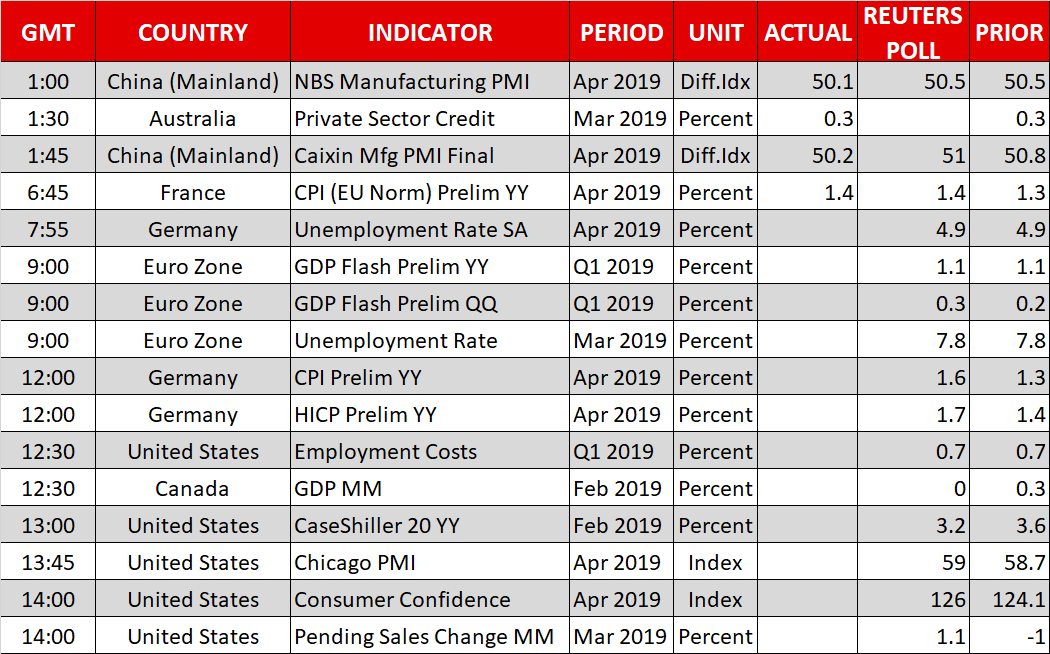
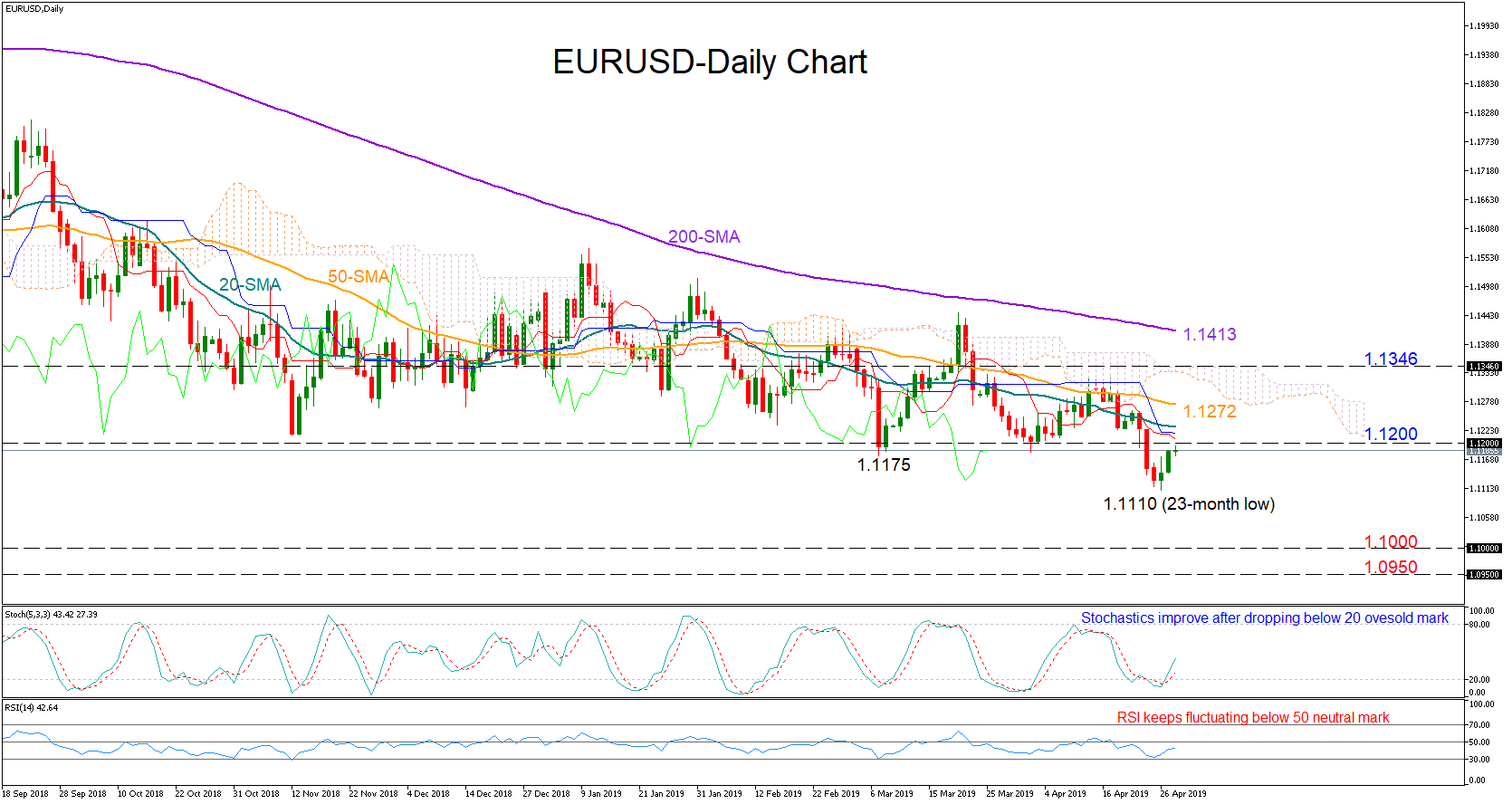
EURUSD Lacks Strong Bullish Signals Below 1.12
EURUSD tumbled into the 1.11 region on Friday for the first time after almost two years, stretching further its long-term downward pattern. While Monday’s bounce justified oversold signals by the Stochastic indicator, the weakness in the RSI, which continues to hover below 50, and the negative slope in the Ichimoku indicators (red Tenkan-sen and blue Kijun-sen) question how far any upside could go.
The 1.1200 mark is currently keeping the bulls under control and any climb above that border would likely improve sentiment, with resistance probably running next towards the 50-day simple moving average (SMA) at 1.1272. Should the bulls beat the wall around 1.1320 and more importantly climb above the top of the Ichimoku cloud seen near 1.1346, the rally may then extend up to the 200-day SMA (1.1413).
Otherwise, a reversal to the downside is expected to find immediate support around the 1.1110 bottom. In case the bears clear that barrier, the sell-off could pick up steam, pushing the price probably down to the 1.1000-1.0950 key restrictive area.
In the medium-term picture, the outlook has turned even more bearish after the close below the previous low of 1.1175. The falling 50- and 200-day SMAs are also a sign that a bull market is still far in the horizon.
Elliott Wave Analysis Of SPY
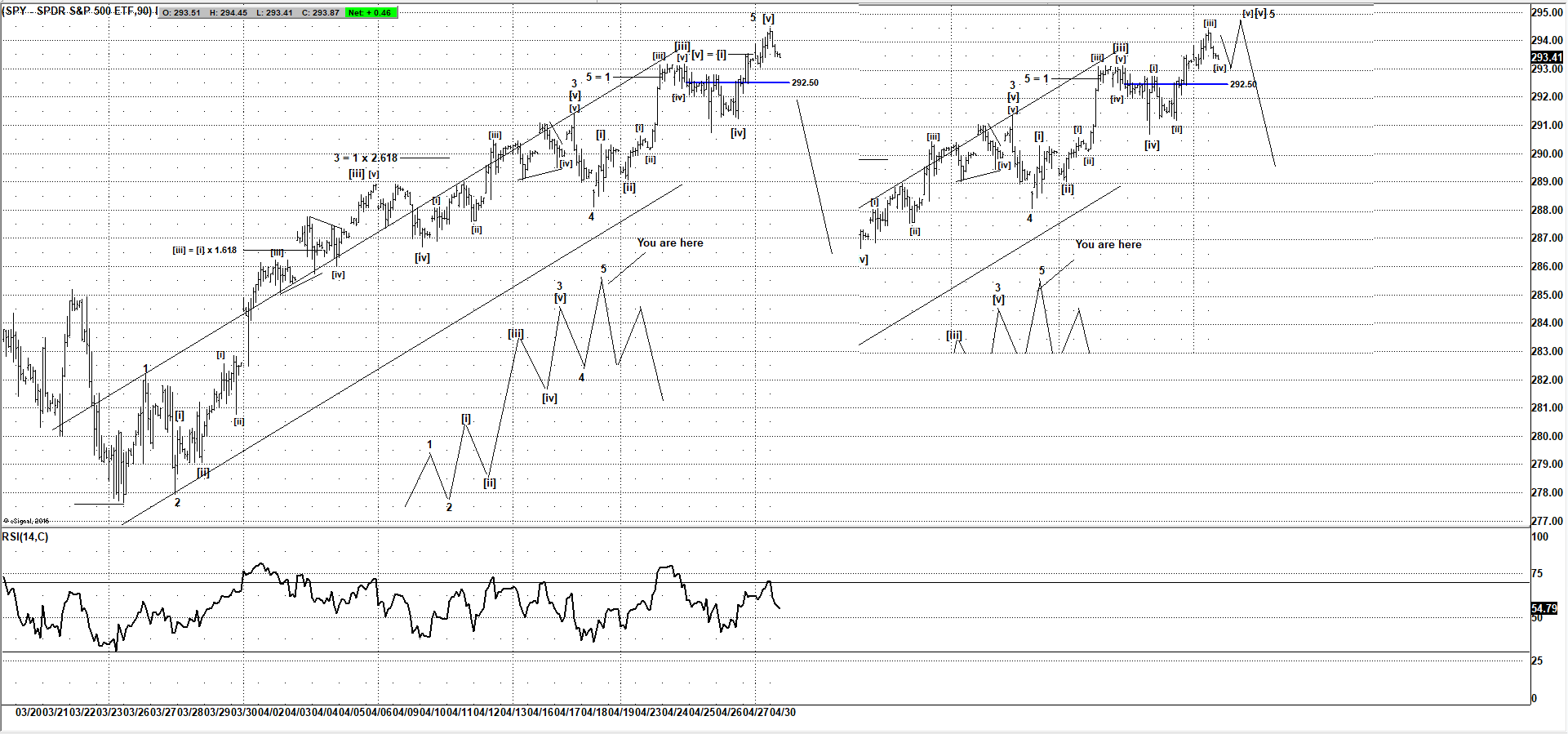
With the new high it's now possible to suggest a completed impulse wave from the 25th March low. So a pullback/decline is favored soon, a strong move below 292.50 is needed to further argue for a move lower. There is a way to allow for a minor new high to end wave 5 (see insert), I would again look for a rejection and a move back under 292.50 to support a decline.
Based on the bigger picture wave count for the Dec 2018 low, the recent high could well be an important one. A decline in 5 waves would be a strong sign to support a reversal and further weakness.