

Sample Category Title
Sunset Market Commentary
Markets
Core bonds erased gains built up during Asian trading following stronger than expected EMU eco data. German Bunds underperformed US Treasuries. Today’s early upleg came on the back of disappointing Chinese PMI’s and earnings. Better national Q1 GDP numbers eventually resulted in an upward surprise for the EMU as a whole (0.4%Q/Q) while the unemployment rate reached a cycle low in March (7.7%). Q1 GDP releases from China, the US and the EMU put worst case growth scenarios at least temporary to bed. We still prefer to err on the side of caution given lackluster indications at the start of Q2. Regional German inflation readings in the meantime suggested an upward surprise for the national outcome. The 1% M/M and 2.1% Y/Y increase is hugely influenced by the timing of Easter holidays though. German yields increased by 0.3 bps (2-yr) to 2.3 bps (10-yr). US yields are slightly lower after a weak Chicago PMI. 10-yr yield spreads vs Germany narrowed by up to 5 bps (Italy).
EUR/USD extended yesterday’s rebound. Yesterday, we interpreted the move mainly as USD softness as investors turned more cautious on the dollar ahead of tomorrow’s Fed policy meeting. Today, the move was also supported by euro strength. EMU Q1 growth printed stronger than expected. Labour data from EMU but also from Germany and even Italy printed stronger than expected. Last but not least, German April HCIP inflation unexpectedly jumped to 2.1% Y/Y. Especially the latter is at least partially driven by one-off factors that will likely be reversed in the coming months. Even so, the market couldn’t fully ignore the flood of better than expected EMU data. European yields and the euro turned north. EUR/USD trades currently in the 1.1220 area, regaining the 1.1177/87 previous support. With the Fed decision (tomorrow) and the payrolls (Friday) still ahead of us, the EUR/USD picture might still change later this week. Even so, the EUR/USD 1.1110 support area apparently won’t be that easy to break. USD/JPY still suggests some underlying USD softness, too. The pair is trading in the 111.30 area.
Sterling showed decent gains against a weak dollar, but also against a broadly stronger euro. We didn’t seen any obvious news to explain the move. EUR/GBP drifted gradually lower in the 0.86 big figure throughout the day. End of month sterling sales against the dollar were rumoured to play a role. The Brexit negotiations between Labour and the Conservative party are said to continued but there are no signs of big progress yet. EUR/GBP is trading in the 0.8615/20 area. Cable regained the 1.30 mark.
News Headlines
European 2019Q1 growth figures mostly surprised on the upside today. French growth stabilized at 0.3% QoQ while Spanish growth unexpectedly accelerated to 0.7% QoQ. Italy left recession territory, printing a 0.2% QoQ growth (0.1% expected). The preliminary growth figure for the euro zone came in at 0.4% QoQ, beating the 0.3% market estimates and up from 0.2% in the previous quarter.
German inflation crushed estimates in April, printing at 1.0% MoM and 2.1% YoY. Regional inflation data showed that the strong uptick is due to a sharp increase in prices of (Easter) holiday sensitive items which is expected to fade out in the following month(s).
The Case-Shiller index showed home prices in the US decelerated further in February. The indicator has fallen steadily since early 2018 to reach the lowest reading since 2012 of 3%. This is despite solid wage increases during 2019Q, other US data showed today. The Chicago PMI disappointed strongly (52.6 vs. 58.5 expected).
EURUSD Remains On Third Consecutive Day Of Gain
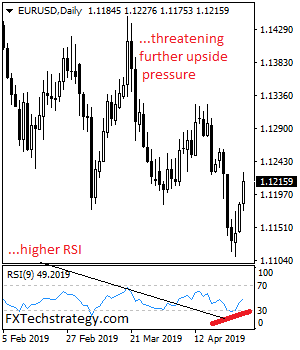
EURUSD remains on third consecutive day of bullish offensive as the pair eyes more strength. Support comes in at the 1.1200 where a violation will turn risk to the 1.1150 level. A break below here will target the 1.1100 level. Further down, support sits at the 1.1050. Conversely, on the upside, resistance resides at 1.1250 level with a break through there opening the door for further upside towards the 1.1.1300 level. Further up, resistance comes in at the 1.1350 level where a violation will expose the 1.1400 level. Its daily RSI is bullish and pointing higher suggesting more strength. All in all, EURUSD continues to threaten further upside pressure.
USD/JPY Mid-Day Outlook
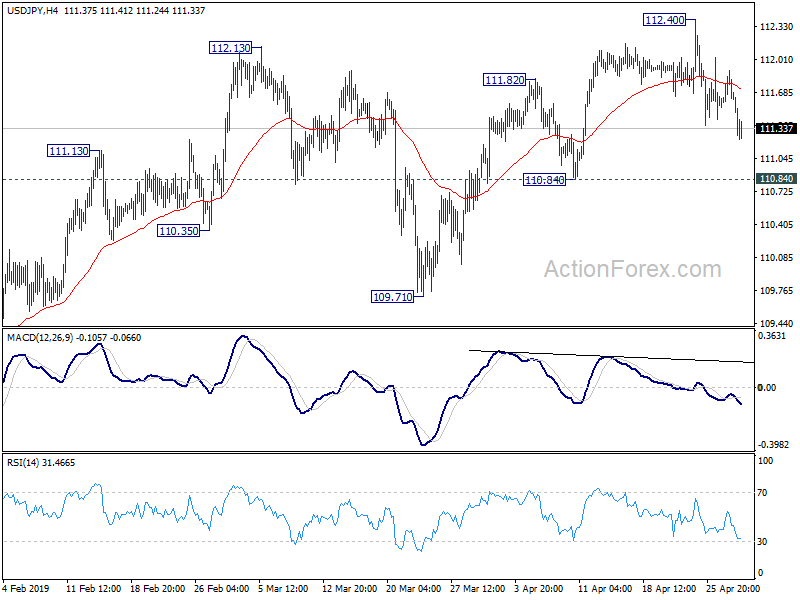
Daily Pivots: (S1) 111.49; (P) 111.70; (R1) 111.84; More...
USD/JPY's fall from 112.40 resumes after brief recovery and intraday bias is back on the downside for 110.84 support. Break of 110.84 will add to the case of reversal and target 109.71 support and below. In any case, break of 112.40 is needed to confirm rise resumption. Otherwise, risk will stay mildly on the downside in case of recovery.
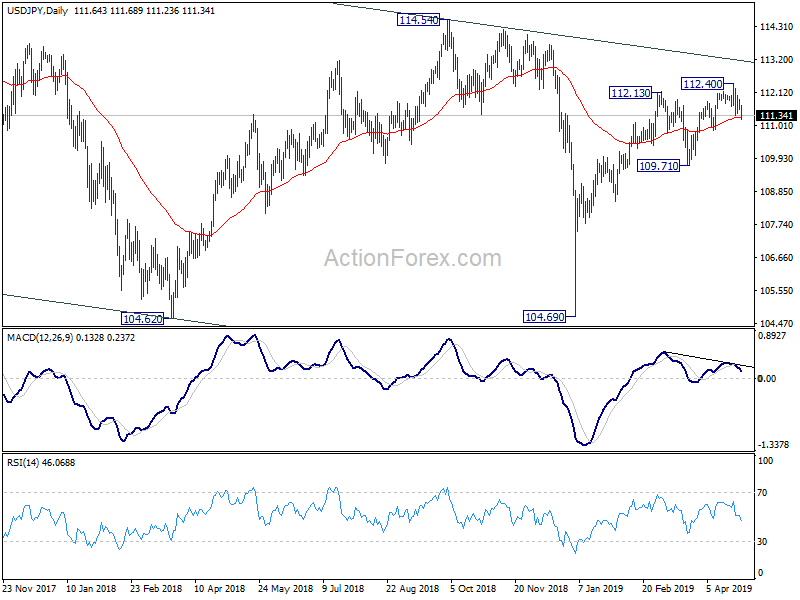
In the bigger picture, medium term outlook in USD/JPY remains a bit mixed as it's staying inside falling channel from 118.65, but there are signs of bullish reversal. On the upside, break of 114.54 resistance will revive the case the corrective fall from 118.65 has completed with three waves down to 104.69. And whole rise from 98.97 (2016 low) is resuming for 118.65 and above. But before that, outlook stays neutral first.
USD/CHF Mid-Day Outlook
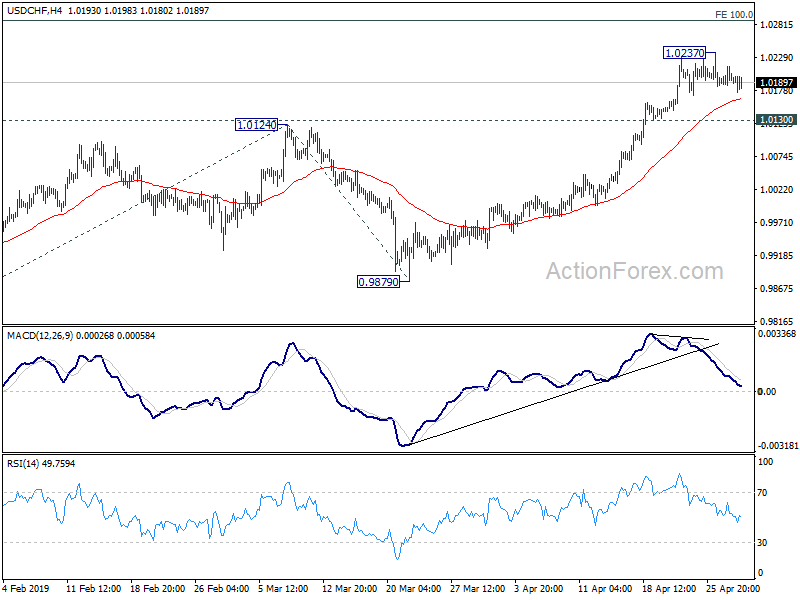
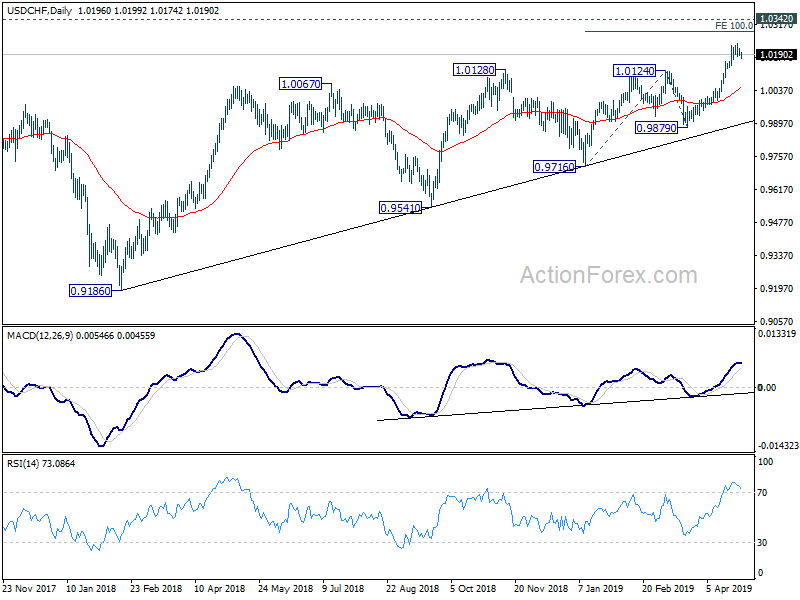
Daily Pivots: (S1) 1.0182; (P) 1.0199; (R1) 1.0214; More...
Intraday bias remains neutral for consolidation below 1.0237 temporary top. In case of deeper retreat, downside should be contained by 1.0130 minor support to bring rise resumption. Prior break of 1.0128 resistance confirmed resumption of up trend from 0.9186. On the upside, above 1.0237 will target 100% projection of 0.9716 to 1.0124 from 0.9879 at 1.0287, and then 1.0342 key resistance. However, break of 1.0130 will indicate short term topping and bring deeper retreat first.
In the bigger picture, medium term up trend from 0.9186 is extending. Current rise should target 1.0342 resistance next. For now, we'd be cautious on strong resistance from there to limit upside, until we see medium term upside acceleration. On the downside, break of 0.9879 support is needed to indicate reversal. Otherwise, outlook will stay bullish in case of deep pull back.
EUR/USD Mid-Day Outlook
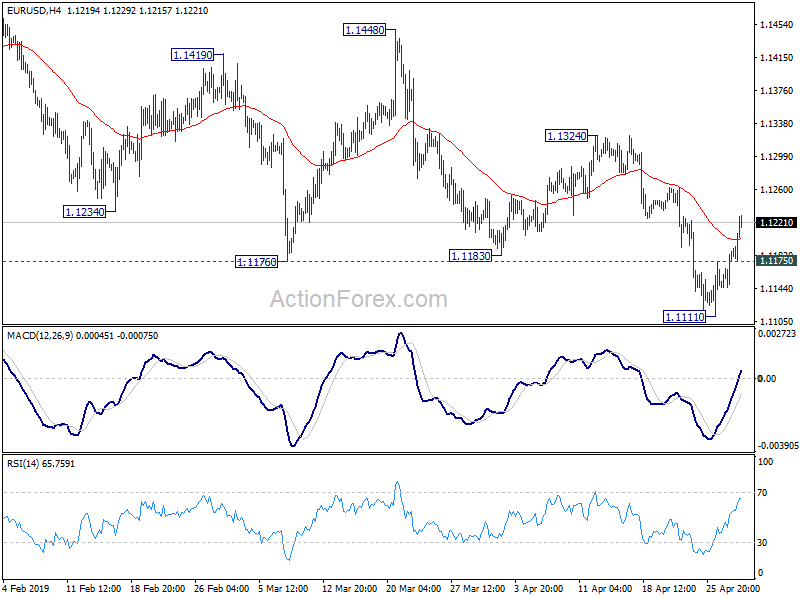
Daily Pivots: (S1) 1.1156; (P) 1.1173; (R1) 1.1200; More.....
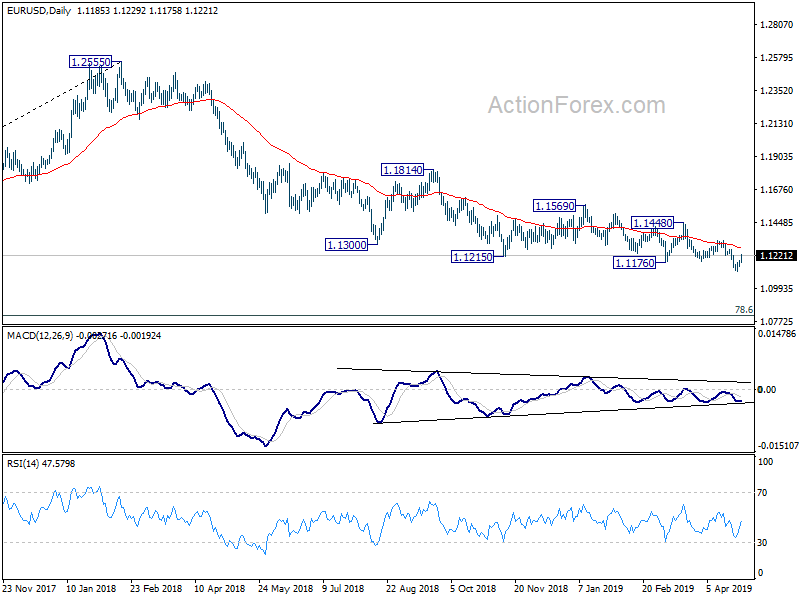
EUR/USD's rebound from 1.1111 extends higher today but still, it's seen as a corrective move. Upside should be limited well below 1.1324 resistance to bring fall resumption. On the downside, below 1.1175 minor support will turn bias to the downside for 1.1111 first. Break there will resume larger down trend from 1.2555.
In the bigger picture, down trend from 1.2555 (2018 high) has just resumed. Current fall should now target 78.6% retracement of 1.0339 (2016 low) to 1.2555 (2018 high) at 1.0813. Sustained break there will pave the way to retest 1.0339. On the downside, break of 1.1448 resistance is needed to be the first sign of medium term bottoming. Otherwise, outlook will stay bearish in case of rebound.
GBP/USD Mid-Day Outlook
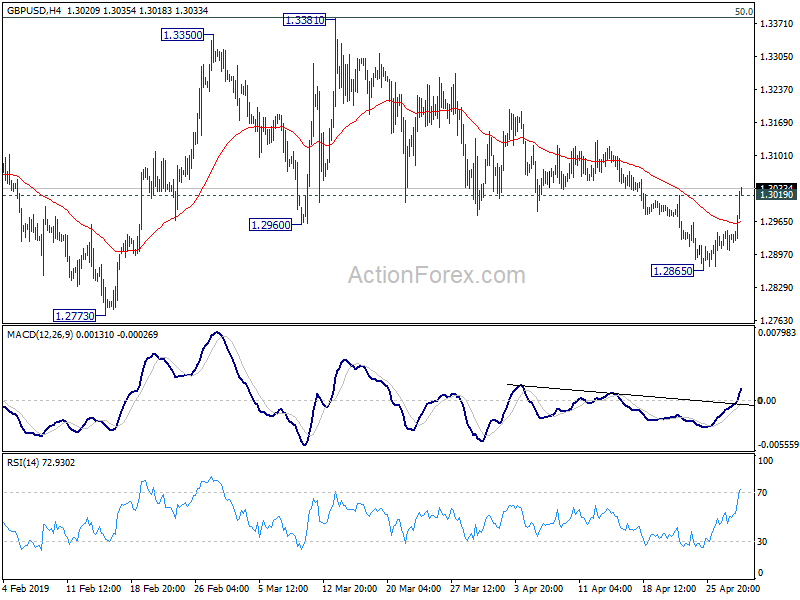
Daily Pivots: (S1) 1.2908; (P) 1.2927; (R1) 1.2951; More....
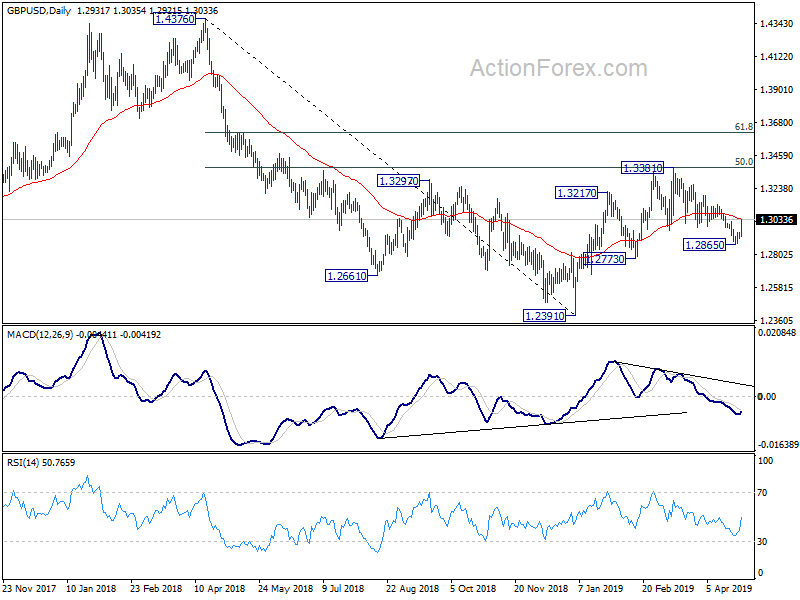
GBP/USD's rebound from 1.2865 extends through 1.3019 minor resistance today. The development dampens original bearish view. It suggest that corrective pull back from 1.3381 has completed at 1.2865. And rebound from 1.2391 hasn't completed yet. Intraday bias is back on the upside for retesting 1.3381 first. On the downside, though, break of 1.2865 will target 1.2773 key support.
In the bigger picture, medium term decline from 1.4376 (2018 high) halted after hitting 1.2391. The structure of the rebound from 1.2391 suggests that it's a corrective move. In case of another rise, strong resistance could be seen around 61.8% retracement of 1.4376 to 1.2391 at 1.3618 to limit upside. On the downside, break of 1.2773 support will suggests that such corrective rise is completed and bring retest of 1.2391 low first.
Euro Surges as Data Paint Improved Growth and Inflation Outlook
Euro surges broadly today as boosted a series of better than expected economic data. GDP beat market expectations and argue that the slowdown wasn't as worse as expected. In particular, strength was also seen in problematic countries like Italy and Spain. Unemployment rate dropped to lowest in more than a decade. Inflation could also be coming back as German CPI accelerated much more than expected.
Nevertheless, Euro was just the second strongest, following Sterling. The Pound could been lifted by "talks" that Prime Minister Theresa May is targeting to conclude Brexit negotiation with Labour by mid next week. Australian Dollar remains weakest ones for today as weighed down by China PMI misses. Sustainability of post lunar new year seasonal rebound in Chinese economy is in serious doubt. Canadian Dollar is also among the weakest on surprised GDP contraction in February.
Technically, GBP/USD's break of 1.3019 minor resistance now argues that corrective decline from 1.3381 has completed. That in turns argue that rise from 1.2391 is not finished yet. Retest of 1.3019 could be seen soon. GBP/JPY's rebound also suggests that it has defended 143.72 support, and thus retain near term bullishness.
In other markets, DOW opens mildly higher and is up 0.10%. In Europe, FTSE is down -0.38%. DAX is down -0.23%. CAC is down -0.38%. German 10-year yield is up 0.0413 at 0.048. Earlier in Asia, Hong Kong HSI dropped -0.65%. China Shanghai SSE rose 0.52%. Singapore Strait Times dropped -0.2%. Japan remains in ultra-long 10 days holiday.
Eurozone Q1 GDP grew 0.4%, France steady, Spain strong, Italy rebounds
Eurozone Q1 GDP grew 0.4% qoq, above expectation of 0.3%, and doubled Q4's 0.2%. EU 28 GDP grew 0.4% qoq. Other GDP data released today are also positive. France GDP grew 0.3% qoq in Q1, same as Q4 and matched expectations. Italy GDP grew 0.2% qoq in Q1, much better than expectation of -0.1% qoq. Spain GDP grew 0.7% qoq, accelerated from Q4's 0.6% and beat expectation of 0.6% qoq.
Eurozone unemployment dropped to 7.7%, lowest since 2008
Eurozone unemployment rate dropped to 7.7% in March, down from 7.8% and beat expectation of 7.8%. It's also the lowest level since September 2008. EU28 unemployment rate also dropped to 6.4%, down from February's 6.5%. Among the Member States, the lowest unemployment rates in March 2019 were recorded in Czechia (1.9%), Germany (3.2%) and the Netherlands (3.3%). The highest unemployment rates were observed in Greece (18.5% in January 2019), Spain (14.0%) and Italy (10.2%).
German CPI accelerated to 2% in April, well above expectation
German inflation data. CPI rose 1.0% mom in April, double of expectation of 1.0% mom. Annually, CPI accelerated to 2.0% yoy, up from 1.3% yoy and beat expectation of 1.5% yoy. Import price rose 0.0% mom in March, below expectation of 0.3% mom. Gfk consumer sentiment for May was unchanged at 10.4, above expectation of 10.3. Unemployment dropped -12k in April, worse than expectation of -6k. Unemployment rate was unchanged at 4.9% in April.
UK May said to target to complete Brexit negotiation with Labour by mid next week
Several British media, including BBC and Guardian, reported today that Prime Minister Theresa May is now targeting to reach a Brexit compromise with opposition Labour Party by the middle of next week. May's spokesman had declined to set an end date for the talks, and described the latest round of talks as "serious and constructive".
Separately, Labour Party is meeting today to hammer out its position on whether to demand a second referendum on any Brexit deal as part of its campaign for the European parliament election next month.
Swiss KOF dropped to 96.2, largely due to deterioration in manufacturing
Swiss KOF Economic Barometer dropped to 96.2 in April, down from 97.1 and missed expectation of 97.0. KOF noted that the Barometer value is still "clearly below average". Also, the Swiss economy will remain sluggish in the coming months.
KOF also said that the decline was largely due to deterioration in manufacturing sector. Construction also dropped slightly. The signals for private consumption as well as the banking and insurance sector was almost unchanged. The outlook for other service providers, accommodation and food service activities and for foreign demand was slightly better than in the previous month.
Canada GDP contracted -0.1% mom, missed expectations
Canada GDP unexpected dropped -0.1% mom in February, worse than expectation of 0.0% mom. Looking at some details, mining, quarrying and oil and gas extraction sector declines (-1.6%) for the sixth consecutive month. All subsectors decline. Transportation and warehousing contract as rail transportation drops -1.6%, largest fall since June 2011. That's largely due to a 10.8% drop in rail transportation. Finance and insurance sector declined -0.6%., Manufacturing sector contracted -0.4%. Though, utilities were up 1.5% due to record-setting cold weather in Western Canada. Construction grew for the second month by 0.2%. Also from Canada, IPPI rose 1.3% mom, RMPI rose 2.8% mom in March.
US Mnuchin hopes to make substantial progress in China trade talks
US Treasury Secretary Steven Mnuchin said he hopes to make "substantial progress" on trade negotiations as he arrived in Beijing with Trade Representative Lighthizer today. Mnuchin said "we've a meeting here, and then the vice premier and team will be coming back to Washington D.C., and we hope to make substantial progress in these two meetings." He added: "I'm not going to comment on specific issues of the discussions… They've been quite broad as I've said before. We've made a lot of progress. We look forward to the meetings here."
China's Foreign Ministry said "in recent months, both countries' economic and trade teams have held many rounds of high-level consultations and achieved much positive progress." China hopes that both sides can "work hard, exclude disturbances, and reach a mutually beneficial, win-win agreement".
China PMI manufacturing dropped in April, no upward turning point
China's April PMIs came in all weaker than expected. The results raised much doubt on the case of recovery in the economy. And, they suggested that even the post lunar new year seasonal rebound in Mach couldn't sustain. The official PMI manufacturing dropped to 50.1, down from 50.5 and missed expectation of 50.6. Official PMI non-manufacturing dropped to 54.3, down from 54.8 and missed expectation of 55.0.
Caixin PMI manufacturing dropped to 50.2 in April, down from 50.8 and missed expectation of 50.2. Zhengsheng Zhong, Director of Macroeconomic Analysis at CEBM Group said: "In general, China's economy showed good resilience in April, yet it stabilized on a weak foundation and is not coming to an upward turning point. The Politburo meeting signalled that in the first quarter of this year China had adjusted its countercyclical policy marginally. As pressure on the economy remains in the second quarter, we expect that there will be minor adjustments to the policy but not a turnaround."
New Zealand business confidence dropped to -37.5, soft patch proving reasonably long-lasting
New Zealand ANZ Business Confidence dropped slightly from -38.0 to -37.5 in April. Agriculture has the least confidence at -62.9 while manufacturing at -25.8 was already the best. Activity Outlook improved from 6.3 to 7.1. Agriculture outlook was the best at 20.0 while retail was worst at -7.5.
ANZ noted that the economy is "experiencing a soft patch that is proving reasonably long-lasting". Steadily declining GDP is expected to continue to middle of this year. However, , easier monetary conditions and policy certainty should see momentum recover, assuming the global outlook continues to improve.
Also, "cost pressures are expected to dissipate as capacity pressures wane, reducing the pressure on firms' profitability." ANZ expects RBNZ to cut the OCR, starting in August, to support growth in inflation.
GBP/USD Mid-Day Outlook
Daily Pivots: (S1) 1.2908; (P) 1.2927; (R1) 1.2951; More....
GBP/USD's rebound from 1.2865 extends through 1.3019 minor resistance today. The development dampens original bearish view. It suggest that corrective pull back from 1.3381 has completed at 1.2865. And rebound from 1.2391 hasn't completed yet. Intraday bias is back on the upside for retesting 1.3381 first. On the downside, though, break of 1.2865 will target 1.2773 key support.
In the bigger picture, medium term decline from 1.4376 (2018 high) halted after hitting 1.2391. The structure of the rebound from 1.2391 suggests that it's a corrective move. In case of another rise, strong resistance could be seen around 61.8% retracement of 1.4376 to 1.2391 at 1.3618 to limit upside. On the downside, break of 1.2773 support will suggests that such corrective rise is completed and bring retest of 1.2391 low first.
Economic Indicators Update
| GMT | Ccy | Events | Actual | Forecast | Previous | Revised |
|---|---|---|---|---|---|---|
| 23:01 | GBP | GfK Consumer Confidence Apr | -13 | -13 | -13 | |
| 01:00 | NZD | ANZ Business Confidence Apr | -37.5 | -38 | ||
| 01:00 | CNY | Manufacturing PMI Apr | 50.1 | 50.6 | 50.5 | |
| 01:00 | CNY | Non-manufacturing PMI Apr | 54.3 | 55 | 54.8 | |
| 01:45 | CNY | Caixin PMI Manufacturing Apr | 50.2 | 51 | 50.8 | |
| 05:30 | EUR | French GDP Q/Q Q1 P | 0.30% | 0.30% | 0.30% | |
| 05:30 | EUR | French GDP Y/Y Q1 P | 1.10% | 1.10% | 1.00% | |
| 06:00 | EUR | German Import Price Index M/M Mar | 0.00% | 0.30% | 0.30% | |
| 06:00 | EUR | German GfK Consumer Confidence May | 10.4 | 10.3 | 10.4 | |
| 07:00 | CHF | KOF Leading Indicator Apr | 96.2 | 97 | 97.4 | |
| 07:55 | EUR | German Unemployment Change (000's) Apr | -12K | -6K | -7K | |
| 07:55 | EUR | German Unemployment Claims Rate Apr | 4.90% | 4.90% | 4.90% | |
| 09:00 | EUR | Eurozone Unemployment Rate Mar | 7.70% | 7.80% | 7.80% | |
| 09:00 | EUR | Eurozone GDP Q/Q Q1 A | 0.40% | 0.30% | 0.20% | |
| 10:00 | EUR | Italian GDP Q/Q Q1 P | 0.20% | -0.10% | 0.00% | -0.10% |
| 12:00 | EUR | German CPI M/M Apr P | 1.00% | 0.50% | 0.40% | |
| 12:00 | EUR | German CPI Y/Y Apr P | 2.00% | 1.50% | 1.30% | |
| 12:30 | CAD | GDP M/M Feb | -0.10% | 0.00% | 0.30% | |
| 12:30 | CAD | Industrial Product Price M/M Mar | 1.30% | 0.30% | ||
| 12:30 | CAD | Raw Materials Price Index M/M Mar | 2.80% | 4.60% | ||
| 12:30 | USD | Employment Cost Index Q1 | 0.70% | 0.70% | 0.70% | |
| 13:00 | USD | S&P/Case-Shiller Composite-20 Y/Y Feb | 3.00% | 3.10% | 3.60% | |
| 13:45 | USD | Chicago PMI Apr | 59 | 58.7 | ||
| 14:00 | USD | Pending Home Sales M/M Mar | 0.70% | -1.00% | ||
| 14:00 | USD | Consumer Confidence Apr | 126.5 | 124.1 |
February Chill Hits Canadian GDP
- Canadian economic activity contracted 0.1% month-on-month in February, falling a bit shy of market expectations of no change. The decline was fairly widespread, with just 11 of the 20 major sector groupings in expansionary territory.
- The biggest drag on growth was again the mining, quarrying and oil and gas sector, driven lower by mining (excluding oil and gas), down 4.4%. Oil and gas sector output was down again in February, contracting 0.6%. The ongoing challenges of this sector, together with cold weather, sent activity in transportation and warehousing lower (-1.6%) driven largely by a 10.8% drop in rail transportation.
- Weather related impacts appear to have impacted real estate, with activity 0.2% lower. However, this drop was offset by a 1.5% rise in utilities output also attributable to cold weather. Interestingly, the construction industry eked out a second monthly gain despite the weather, driven by residential construction.
Key Implications
- February's chilly weather didn't just make your commute worse, it also took a bite out of economic activity. We've seen quite a bit of volatility in the data recently, but the underlying message appears to be one of an economy still in the midst of a soft patch, but one driven by temporary factors.
- It looks like we may be in the soft patch for a bit, particularly as trade and transportation sector data suggests little destocking in the energy sector despite production curtailments. This suggests a risk of another subpar performance in the second quarter. The good news, however, is that the underlying economic signals remain generally healthy, with construction activity rising for a second month, and some modest signs of life in investment.
- With the February GDP data in hand, we track first quarter growth at 0.6% (q/q, annualized). This is only moderately higher than the Bank of Canada's view, and, as mentioned, Q2 may be held back a bit as well. This suggests that the Bank's conservative near-term forecast (see commentary), is likely to be more or less realized. This is fully consistent with their cautious messaging of late. As we discussed in TD Economics' latest Dollars and Sense, the Bank has set itself up for a long-term pause, and today's data only reinforce that the overnight rate looks set to stay at 1.75% for some time to come.
Wintry Weather Not the Only Factor in Canada’s Soft February GDP Report
- Canadian GDP edged down 0.1% in February, just short of expectations for no change following a solid 0.3% gain in January
- Industries were evenly split between gains and losses, though both headline goods and services output declined
- Oil and gas extraction failed to increase despite the Alberta government scaling back mandatory production curtailments in February
- Mining excluding oil and gas fell by more than 4% for a second consecutive month
A sharp pullback in rail transportation and slower home sales, both likely held back by wintry weather, weighed on growth to the tune of 0.1 ppt - Utilities output got a boost from the cold weather, and the construction industry didn’t appear to be impacted
While January’s GDP report showed plenty of life in non-energy industries, today’s data was a bit disappointing on that front with activity slowing modestly in February. Wintry weather had a negative impact, though growth wouldn’t have been much better than flat without that factor. Today’s softer-than-expected GDP report leaves Q1 growth tracking somewhere between our 1.2% forecast and the BoC’s 0.3% call, which looked pessimistic when it was unveiled last week.
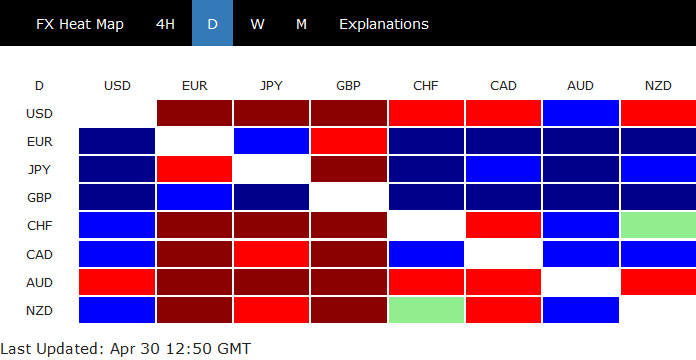
Into US session: GBP and EUR strongest, AUD weakest
Entering into US session, Sterling is the strongest one for today followed by Euro. The Pound is apparently lifted by news that Prime Minister Theresa May is targeting to conclude Brexit negotiation with Labour by mid next week. Euro's rally was more solidly triggered by a string of stronger than expected data. Eurozone GDP grew 0.4% qoq versus expectation of 0.3% qoq. Germany CPI also accelerated sharply to 2.0% yoy in April, up fro 1.3% yoy and beat expectation of 1.5% yoy.
On the other hand, Australian Dollar remains the weakest ones for today as weighed down by China PMI misses. Sustainability of post lunar new year seasonal rebound in Chinese economy is in serious doubt. Swiss Franc, New Zealand and Canadian Dollar are among the next weakest. In particular, Loonie is dragged down by unexpected contraction in Canadian GDP in February.
In Europe, currently:
- FTSE is down -0.23%.
- DAX is down -0.19%.
- CAC is down -0.29%.
- German 10-year yield is up 0.0395 at 0.046.
Earlier in Asia:
- Hong Kong HSI dropped -0.65%.
- China Shanghai SSE rose 0.52%.
- Singapore Strait Times dropped -0.2%.
- Japan remains in ultra-long 10 days holiday.