

Sample Category Title
US: Headline CPI accelerated to 1.9%, but core slowed to 2.0%
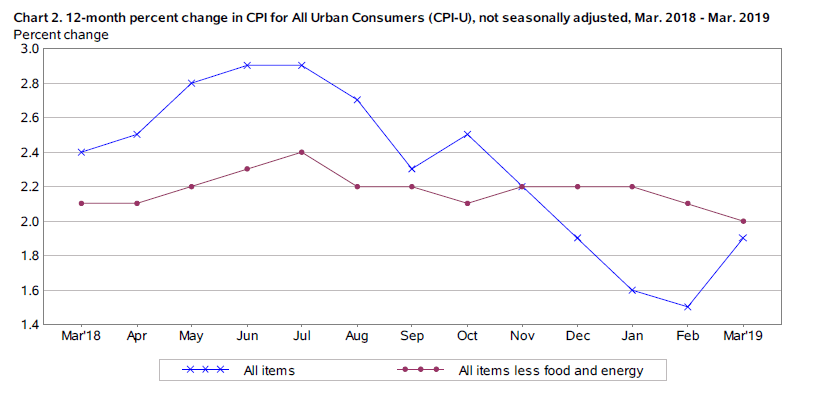
Dollar turns mixed in early US session after March CPI release. Headline CPI accelerated to 1.9% yoy, up from 1.5% yoy and beat expectation of 1.8% yoy. However, core CPI slowed to 2.0% yoy, down from 2.1% yoy and missed 2.1% yoy.
ECB Draghi: Persistence of uncertainties is leaving markets on economic sentiment
Euro weakens broadly today even though ECB delivered little news with the rate decision and press conference. The main refinancing rate is kept at 0.00%. Marginal lending facility rate and deposit rate are kept at 0.25% and -0.40% respectively. Also, forward guidance is unchanged. ECB expects to keep key interest rates at present level "at least through the end of 2019". No detail of the TLTRO III is provided as they will be released at one of the next meetings.
President Mario Draghi's overtone in the post meeting conference is dovish. He noted that incoming data "confirms slower growth momentum extending into the current year." "Global headwinds continue to weigh on euro area growth developments". Also, "persistence of uncertainties, related to geopolitical factors, the threat of protectionism and vulnerabilities in emerging markets, is leaving marks on economic sentiment."
Meanwhile, risks surrounding growth outlook remain "tilted t the downside". They're "on account of the persistence of uncertainties related to geopolitical factors, the threat of protectionism and vulnerabilities in emerging markets." Draghi also urged "other policy areas" to contribute more decisively to raise longer-term growth potential and reducing vulnerabilities. Those include structure reforms and fiscal policies.
Sunset Market Commentary
Markets
Core bonds edged higher ahead of the European market opening, awaiting the ECB meeting and the EU summit on Brexit. Industrial production for February printed above expectations in Italy, France, and the UK, lifting risk sentiment. EU equities gained ground, weighing core bonds down. Both moves remained limited ahead of the ECB meeting. The ECB eventually didn’t change its stance, reiterating that policy rates will remain low at least through the end of 2019. In the press conference ECB’s Draghi confirmed that the ECB will consider if negative rates need mitigation. However, he said it is too early to commit to ‘tiering’ or to give details on the new TLTRO bank loans. Draghi also stressed that the ECB is ready to use all instruments if warranted, putting an emphasis on the word “all”. Draghi’s message was slightly more dovish than expected, pushing the Bund higher. The German yield curve moves lower with changes up to -2.8 bps (5-yr). US Treasuries were largely stable throughout the day, awaiting the March consumer inflation. The result printed close to expectations, little impacting trading. UST’s tracked Bund gains and moved higher as well. The US yield curve edges lower with changes up to -3.0 bps (5-yr).
EUR/USD remained well bid in the run-up to the ECB policy decision/press conference. The start of the ECB press conference also coincided with the publication of the US CPI. EUR/USD retested the 1.1285 area as the US (core) CPI printed slightly softer than expected (2.0% Y/Y vs 2.1% Y/Y expected) but headline US inflation printed marginally higher than expected at 1.9%. So, the US CPI was too close to expectations/balanced to force a clear directional move of the USD. The focus immediately turned to ECB press conference. The ECB’s economic assessment was little changed from the March meeting. Still the euro declined during the ECB press conference. The ECB president apparently failed to convince markets what would be the drivers for the economy to unwind/reverse recent weakness. Draghi indicating that the ECB will investigate whether negative rates need to be mitigated also can be seen as a euro negative as it might reinforce the idea that rates will have to remain low for longer. Whatever the trigger, the EUR/USD topside test was rejected. EUR/USD is currently trading in the 1.1240 area. USD/JPY trading was confined to a very tight sideways ranges . The pair is trading in the 111.15 area.
Today is set to be a milestone for Brexit as EU leaders will decide on the conditions and the length of a possible Brexit delay. Several EU leaders incl. German Chancellor Merkel indicated that any delay should be rather short. However, the delay as proposed by the EU will be longer than the 30 June deadline UK PM May is aiming for. The EU proposal will meet tough resistance within PM May’s conservative party. At this stage, sterling traders are not able to draw firm conclusions on the next steps in this political process and the implications for BoE policy and for sterling. EUR/GBP initially held a relatively tight range in the 0.8620/30 area, but dropped back to the 0.86 big figure on euro weakness during the ECB press conference. Cable rebounded temporary to the 1.31 area, but this move was partially due to USD softness and was also reversed later in the session. The pair currently trades in the 1.3065 area.
News Headlines
Norwegian inflation topped market estimates in March. Headline inflation increased at 0.2% MoM (2.9% YoY) vs. 0% MoM (2.8% YoY) expected. Core inflation accelerated to 0.3% MoM (2.7% YoY) vs. a 0.1% MoM (2.5% YoY) increase expected. EUR/NOK slipped below 9.60 as the data support the central bank’s normalization process.
Turkey announced a $4.9 billion injection in the country’s state banks to boost the capital level and relieve bad debts. It is the first step of the government’s reform package to revive its economy that has been pressured by high inflation and a recession. Other measures include promises to boost exports and adjust taxes.
(ECB) Introductory Statement to the Press Conference
Mario Draghi, President of the ECB,
Luis de Guindos, Vice-President of the ECB,
Frankfurt am Main, 10 April 2019
INTRODUCTORY STATEMENT
Ladies and gentlemen, the Vice-President and I are very pleased to welcome you to our press conference. We will now report on the outcome of today's meeting of the Governing Council.
Based on our regular economic and monetary analyses, we decided to keep the key ECB interest rates unchanged. We continue to expect them to remain at their present levels at least through the end of 2019, and in any case for as long as necessary to ensure the continued sustained convergence of inflation to levels that are below, but close to, 2% over the medium term.
We intend to continue reinvesting, in full, the principal payments from maturing securities purchased under the asset purchase programme for an extended period of time past the date when we start raising the key ECB interest rates, and in any case for as long as necessary to maintain favourable liquidity conditions and an ample degree of monetary accommodation.
The Governing Council stands ready to adjust all of its instruments, as appropriate, to ensure that inflation continues to move towards the Governing Council's inflation aim in a sustained manner.
Details on the precise terms of the new series of targeted longer-term refinancing operations (TLTROs) will be communicated at one of our forthcoming meetings. In particular, the pricing of the new TLTRO-III operations will take into account a thorough assessment of the bank-based transmission channel of monetary policy, as well as further developments in the economic outlook. In the context of our regular assessment, we will also consider whether the preservation of the favourable implications of negative interest rates for the economy requires the mitigation of their possible side effects, if any, on bank intermediation.
The information that has become available since the last Governing Council meeting in early March confirms slower growth momentum extending into the current year. While there are signs that some of the idiosyncratic domestic factors dampening growth are fading, global headwinds continue to weigh on euro area growth developments. The persistence of uncertainties, related to geopolitical factors, the threat of protectionism and vulnerabilities in emerging markets, is leaving marks on economic sentiment. At the same time, further employment gains and rising wages continue to underpin the resilience of the domestic economy and gradually rising inflation pressures. However, an ample degree of monetary accommodation remains necessary to safeguard favourable financing conditions and support the economic expansion, and thus to ensure that inflation remains on a sustained path towards levels that are below, but close to, 2% over the medium term. Significant monetary policy stimulus is being provided by our forward guidance on the key ECB interest rates, reinforced by the reinvestments of the sizeable stock of acquired assets and the new series of TLTROs.
Let me now explain our assessment in greater detail, starting with the economic analysis. Euro area real GDP rose by 0.2%, quarter on quarter, in the fourth quarter of 2018, following an increase of 0.1% in the third quarter. Incoming data continue to be weak, especially for the manufacturing sector, mainly on account of the slowdown in external demand, which has been compounded by some country and sector-specific factors. As the impact of these factors is turning out to be somewhat longer-lasting, the slower growth momentum is expected to extend into the current year. Looking ahead, the effect of these adverse factors is expected to unwind. The euro area expansion will continue to be supported by favourable financing conditions, further employment gains and rising wages, and the ongoing – albeit somewhat slower – expansion in global activity.
The risks surrounding the euro area growth outlook remain tilted to the downside, on account of the persistence of uncertainties related to geopolitical factors, the threat of protectionism and vulnerabilities in emerging markets.
According to Eurostat's flash estimate, euro area annual HICP inflation was 1.4% in March 2019, after 1.5% in February, reflecting mainly a decline in food, services and non-energy industrial goods price inflation. On the basis of current futures prices for oil, headline inflation is likely to decline over the coming months. Measures of underlying inflation remain generally muted, but labour cost pressures have strengthened and broadened amid high levels of capacity utilisation and tightening labour markets. Looking ahead, underlying inflation is expected to increase over the medium term, supported by our monetary policy measures, the ongoing economic expansion and rising wage growth.
Turning to the monetary analysis, broad money (M3) growth increased to 4.3% in February 2019, from 3.8% in January. Looking through some volatility in monthly flows, M3 growth continues to be backed by bank credit creation, notwithstanding a recent moderation in credit dynamics. The narrow monetary aggregate M1 remained the main contributor to broad money growth.
The annual growth rate of loans to non-financial corporations rebounded to 3.7% in February 2019, from 3.4% in January, reflecting mainly a base effect. Looking through short-term volatility, the annual growth rate of loans to non-financial corporations has moderated in recent months, reflecting the typical lagged reaction to the slowdown in economic growth. At the same time, the annual growth rate of loans to households remained broadly unchanged at 3.3% in February. The euro area bank lending survey for the first quarter of 2019 suggests that overall bank lending conditions remained favourable.
Our monetary policy measures, including the new series of TLTROs that we announced in March, will help to safeguard favourable bank lending conditions and will continue to support access to financing, in particular for small and medium-sized enterprises.
To sum up, a cross-check of the outcome of the economic analysis with the signals coming from the monetary analysis confirmed that an ample degree of monetary accommodation is still necessary for the continued sustained convergence of inflation to levels that are below, but close to, 2% over the medium term.
In order to reap the full benefits from our monetary policy measures, other policy areas must contribute more decisively to raising the longer-term growth potential and reducing vulnerabilities. The implementation of structural reforms in euro area countries needs to be substantially stepped up to increase resilience, reduce structural unemployment and boost euro area productivity and growth potential. Regarding fiscal policies, the mildly expansionary euro area fiscal stance and the operation of automatic stabilisers are providing support to economic activity. At the same time, countries where government debt is high need to continue rebuilding fiscal buffers. All countries should reinforce their efforts to achieve a more growth-friendly composition of public finances. Likewise, the transparent and consistent implementation of the European Union's fiscal and economic governance framework over time and across countries remains essential to bolster the resilience of the euro area economy. Improving the functioning of Economic and Monetary Union remains a priority. The Governing Council welcomes the ongoing work and urges further specific and decisive steps to complete the banking union and the capital markets union.
We are now at your disposal for questions.
(ECB) Monetary Policy Decisions
At today's meeting the Governing Council of the European Central Bank (ECB) decided that the interest rate on the main refinancing operations and the interest rates on the marginal lending facility and the deposit facility will remain unchanged at 0.00%, 0.25% and -0.40% respectively. The Governing Council expects the key ECB interest rates to remain at their present levels at least through the end of 2019, and in any case for as long as necessary to ensure the continued sustained convergence of inflation to levels that are below, but close to, 2% over the medium term.
The Governing Council intends to continue reinvesting, in full, the principal payments from maturing securities purchased under the asset purchase programme for an extended period of time past the date when it starts raising the key ECB interest rates, and in any case for as long as necessary to maintain favourable liquidity conditions and an ample degree of monetary accommodation.
The President of the ECB will comment on the considerations underlying these decisions at a press conference starting at 14:30 CET today.
US: Another Goldilocks Inflation Report
Consumer prices jumped up 0.4% on a month-on-month basis in March, driven higher by a 3.5% increase in energy prices. March's headline increase was in line with market expectations. The jump lifted headline inflation to 1.9% on a year-on-year basis in March, up from 1.5% in February.
It was another soft month for core price pressures. CPI excluding food and energy was up a slight 0.1% in March, matching February's modest gain. Core inflation is now up 2.0% on a year-on-year basis, a continued deceleration from readings of 2.3-2.4% in the middle of 2018.
Core inflation was held back by a 1.9% drop in apparel prices in March – the biggest one-month drop in 70 years. Prices also fell for used cars and trucks (-0.4% m/m), airline fares (-0.6%), communication (-0.2%), and motor vehicle insurance. Prices for shelter continued to rise (+0.4%), as did medical care (+0.3%), new vehicles (+0.4%), recreation(+0.3%) and education(+0.5%). Many of these hotter categories are services, and core services inflation did accelerate, up 0.3% in March, after a string of 0.2% readings. Core services inflation was steady at 2.7% on a year-on-year basis in March.
In contrast to the acceleration in services inflation, core goods inflation was non-existent in March, flat on a year-on-year basis.
Food inflation continued to strengthen in March. Food prices rose 0.2% on the month, and are up 2.1% versus a year ago. That may not sound too impressive, but food prices were in deflationary territory two years ago, and 2.1% is the fastest pace in four years.
Key Implications
There was a little something for everyone in this report. Another soft reading for core inflation signals a lack of inflationary pressures in the U.S. economy so far in 2019. On the other hand, a pick-up in core services inflation in March puts a halt to the worrying deceleration in price pressures on the services side. And, the likely temporary nature of the drop in apparel prices mutes the impact of the soft core reading somewhat.
Overall, the March CPI data is another month of goldilocks inflation. Not too hot that the Fed needs to reevaluate its pause, and not so cold that it needs to consider easing policy. CPI is not the Fed's preferred metric. However, because of the government shutdown-related data delays, it is two months ahead of PCE inflation at the moment, and therefore a more timely indicator. With inflation just right, the FOMC can go upstairs and take a nice nap for quite some time.
EUR/USD Outlook: Euro Eases on Soft Tone from Draghi, Stronger Dollar after US Inflation Data
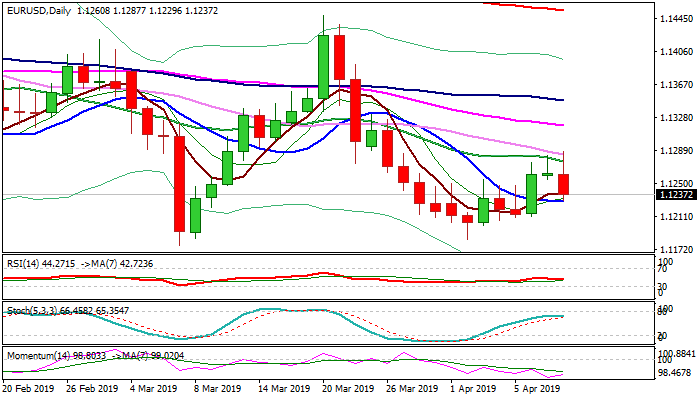
The Euro fell over 50 pips after data on Wednesday, pressured by stronger dollar and soft tone from ECB President Draghi in the press conference that followed policy meeting.
The European Central Bank left interest rates unchanged, as widely expected, also Draghi's rhetoric showed no significant changes from the previous meeting, as he pointed on persisting downside risk on slower economic growth and signaled likely no rate hikes this year on muted inflation, which may increase over medium term.
The sentiment softened, sending the Euro down to important 10SMA support at 1.1229.
Weaker than expected US inflation figures in March (Core CPI y/y 2.0% vs 2.1% f/c and m/m 0.1% vs 0.2% f/c) revive idea for US rate cuts and boost risk appetite that lifted dollar as the most liquid currency.
Fresh weakness further supports scenario of recovery stall as today's pre-ECB action was repeatedly rejected at 1.1280 zone (Fibo 38.2% of 1.1448/1.1183/falling 30SMA).
Close below 10SMA is needed to signal an end of corrective phase and open way for retest of key short-term supports at 1.1186/76 (Fibo 61.8% of 1.0340/1.2555/2019 low), violation of which would signal continuation of larger downtrend. Only sustained break above 1.1280 zone would sideline growing downside risk.
Res: 1.1274; 1.1284; 1.1318; 1.1348
Sup: 1.1229; 1.1200; 1.1176; 1.1118
US CPI Back Around 2% as Energy Deflation eases
- All-items inflation rose to 1.9% year-over-year in March from 1.5% in February, which was the slowest in more than two years
- Energy price deflation continued to ease, with gasoline prices now little changed from a year ago
- Food prices continued to trend higher and are now running at their fastest year-over-year pace since 2015
- CPI excluding food and energy continued to edge lower; March’s 2.0% pace was the slowest in a year
Headline inflation was a touch higher than expectations, though core inflation came in slightly below consensus in March. It’s the latter that matters more for the Fed, and with little sign of momentum in underlying inflation, it’s hard to see the central bank getting back to raising rates anytime soon. We are seeing some upward trends—prices for non-food and energy commodities are no longer falling, for the first time in several years—but those items haven’t been enough to move the inflationary needle. Meanwhile, headline CPI is likely to be capped by the energy component. While oil prices are up roughly US$20/barrel year-to-date, they remain slightly below year-ago levels. We expect that will remain the case through summer. All told, a benign inflationary environment gives the Fed plenty of time to be patient.
ECB on Hold, Draghi’s Press Conference Comments
The European Central Bank (ECB) left its policy mix unchanged today, giving the bank more time to assess the impact of its latest burst of stimulus on the faltering eurozone economy.
In a statement Wednesday, the ECB reiterated that it doesn’t “expect to increase its key short-term interest rate, currently set at -0.4%, before next year.” It also pledged “to continue reinvesting maturing bonds” from its giant bond-buying program “for an extended period of time” after it starts to raise rates.
Press conference comments
- ECB Stands Ready to Adjust All Instruments, If Needed
- Details on New LTROs Will be Communicated in One of Next Meetings
- Incoming Data Confirm Slower Growth Momentum
- Some of the Special Factors Dampening Growth Appear to Be Fading
- Geopolitical Risks, Protectionist Threats Weighing on Econ Sentiment
- Ample Degree of Monetary Stimulus Still Needed
- Significant Monetary Policy Stimulus Provided by Forward Guidance
- Incoming Data Still Weak, Particularly in Manufacturing
- Weaker Econ Data Reflect Slowdown in External Demand, Country-Specific Factors
- Slower Growth Momentum Extending Into Current Year
- Favorable Financing Conditions, Rising Wages to Support Econ Activity
- Risks to Eurozone Growth Outlook Still Tilted to Downside
- Headline Inflation Likely to Decline Over Coming Months
- Measures of Underlying Inflation Remain Generally Muted
- Labor Cost Pressures Have Strengthened, Broadened
- New TLTROs Will Help Ensure Favorable Lending Conditions Going Forward
- Bank Lending Survey Shows Overall Lending Conditions Still Favorable
- Growth of Loans to Businesses Has Moderated in Recent Months
- Underlying Inflation Expected to Rise Over Medium-Term
- Urges Decisive Steps to Complete Banking Union, Capital Mkts Union
- Will Need to See How Econ Will Turn Out to Decide on New TLTRO Terms
- Inflation Expectations Have Deteriorated Mainly Because of Negative Risk Premium
- We Have Shown That We Have “Plenty of Instruments”
- We Remain Fully Committed to Return Inflation to Target
- Protectionist Threats Undermining Confidence Globally
- Currently Analyzing Effects of Negative Depo Rate on Banks’ Profitability
- We Have Optionality to Extend Existing Instruments
- ECB’s Forward Guidance Has Responded to Weakening Econ Conditions
- Probability of Recession Remains Low
The EUR currently trading atop of its intraday low at €1.1230
Draghi, Brexit Deadlines & FOMC
Wednesday's FX & Indices levels are back to where they stood 24 hrs ago but a busy schedule today will make for meaningful price action. The monthly ECB press conference and FOMC minutes from the March meeting are due at 13:30 and 19:00 London time respectively (GMT is now 1 hour behind London). US CPI is also due at 13:30. A new trade was posted yesterday with detailed chart & rationale. UK GDP and industrial production beat forecasts but GBP is focused on the EU's decision regarding Brexit extension.
The EU is pushing for a March 30, 2020 Brexit extension in what would be another blow to Conservative party unity but it would calm some UK economic nerves and likely aid the pound. But critical details are yet to be scrutinized as it could imply a flexible, allowing an earlier withdrawal.
So far EU leaders have been accommodative – at least in public – to the endless tomfoolery from UK parliament but there is no guarantee their patience won't run out. By the same token, Theresa May is on her last legs as PM and a victory for her would be a miracle but not impossible. There was short-lived rumor of a 5-year cap on the Brexit backstop Tuesday, but it was denied swiftly. Even with that, she would have a tough time cobbling together enough votes to pass her deal.
Today's ECB decision/press conference won't be as captivating as last month but there is some intrigue. Draghi will be grilled on TLTRO details but is likely to punt until June. The market mover is likely to be the assessment and commentary on the economy. Risks are still to the downside and Italy cut its GDP forecast to just 0.2% on Tuesday but will Draghi still hold out hope for an H2 rebound? The latest reading from the Eurozone's Economic Surprise Index by Citi is at -51.80, its highest since March 22, besting its US counterpart of -55.70.
Technically, the euro held 1.1180 last week and that's the key level to watch.
On the US side, CPI is a top-tier data point to watch but it's tough to see it jarring the market unless it's a significant miss. Inflation pressures are muted.
The Fed minutes could be a bigger market mover. The latest comments from policymakers suggest more of a hawkish bias than the market is currently pricing. If they emphasize that in the minutes and economic data solidifies for a few months, there is a risk of a rethink (and the risk-off mode that will come with it).