

Sample Category Title
GBP/USD Mid-Day Outlook
Daily Pivots: (S1) 1.3015; (P) 1.3068; (R1) 1.3106; More....
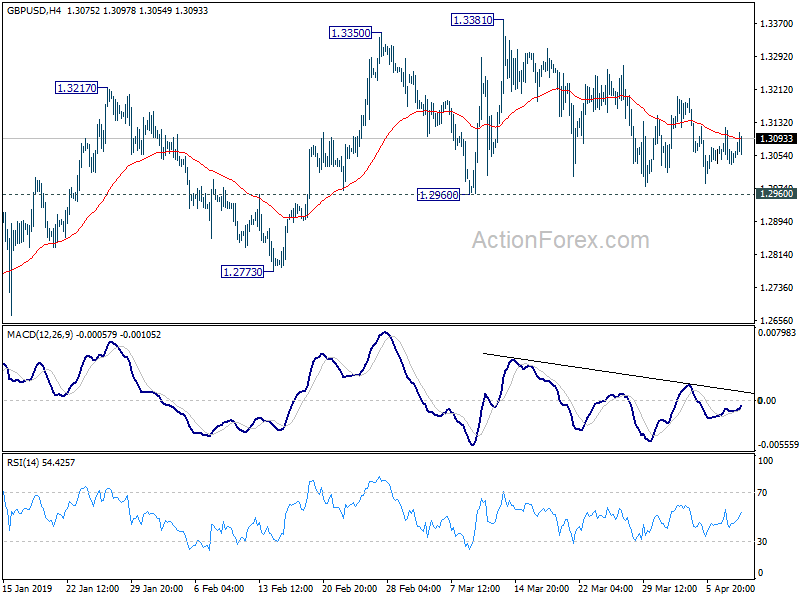
No change in GBP/USD's outlook as it's staying in consolidation from 1.3381. Intraday bias remains neutral first. Further rise is still mildly in favor as long as 1.2960 support holds. On the upside, decisive break of 1.3381 will extend the rise from 1.2391 and target 61.8% retracement of 1.4376 to 1.2391 at 1.3618 next. However, on the downside, sustained break of 1.2960 will indicate that rebound from 1.2391 has completed earlier than expected. Deeper fall would then be seen to 1.2773 support for confirmation.
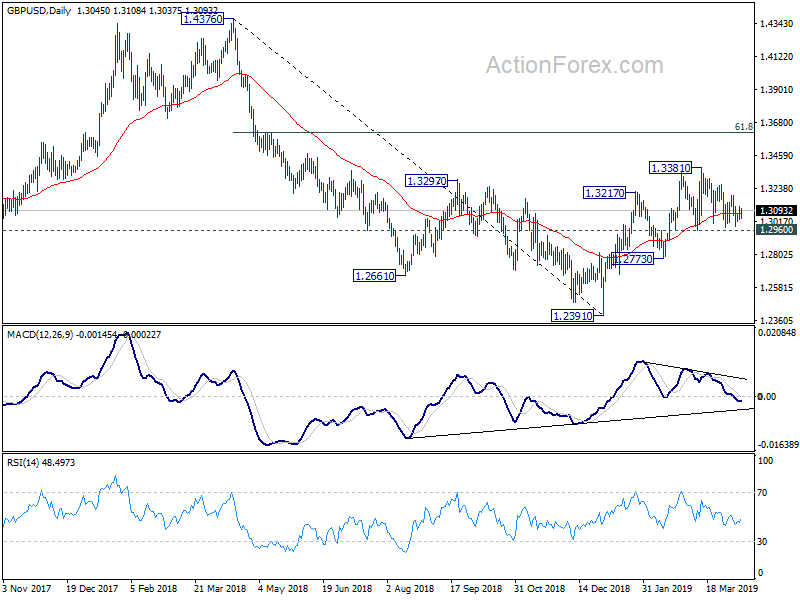
In the bigger picture, medium term decline from 1.4376 (2018 high) should have completed at 1.2391. Rise from 1.2391 is seen as the third leg of the corrective pattern from 1.1946 (2016 low). Further rise could be seen through 1.4376 in medium term. On the downside, though, break of 1.2773 support will dampen this view. Focus will be turned back to 1.2391 low and break will resume the fall from 1.4376 to 1.1946.
USD/CHF Mid-Day Outlook
Daily Pivots: (S1) 0.9982; (P) 0.9996; (R1) 1.0012; More...
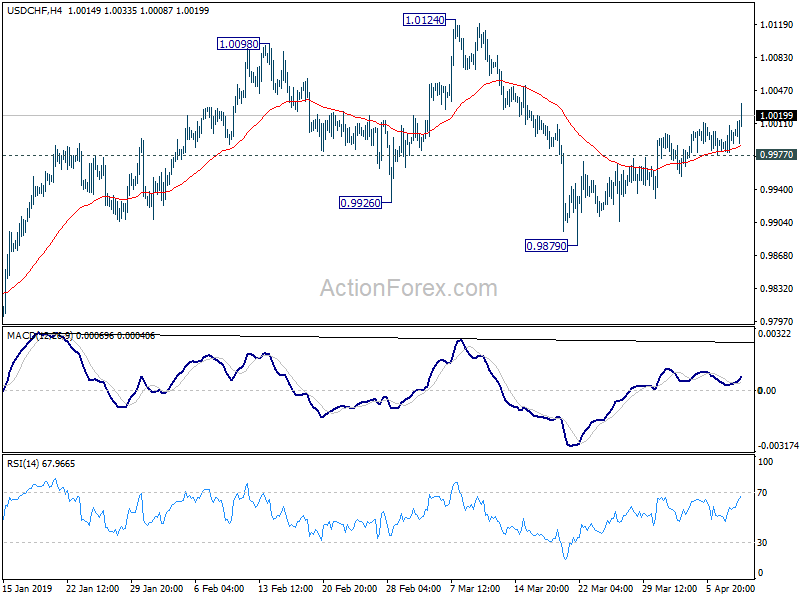
USD/CHF's rebound from 0.9879 extends higher today. Break of 1.0010 resistance indicates completion of pull back from 1.0124. Intraday bias is back on the upside for retesting 1.0124/28 resistance zone. On the downside, though, below 0.9977 minor support will turn bias back to the downside for 0.9879 support intact.
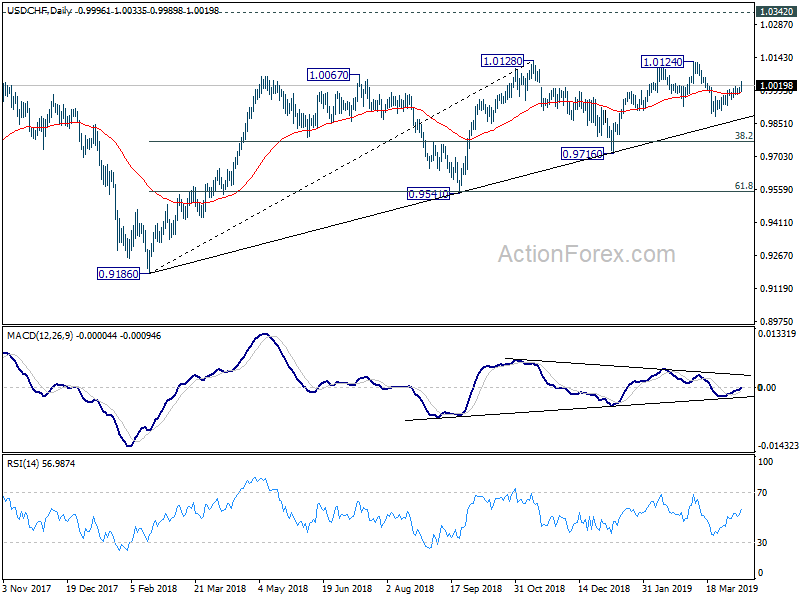
In the bigger picture, USD/CHF is still holding above medium term trend line. Rise from 0.9186 could still be in progress. Decisive break of 1.0128 will resume this medium term rally to 1.0342 resistance next. Meanwhile, sustained break of the trend line (now at 0.9884) will argue that whole rise from 0.9186 has completed. Further break of 0.9716 will confirm reversal and target next support level at 0.9541.
USD/JPY Mid-Day Outlook
Daily Pivots: (S1) 110.89; (P) 111.24; (R1) 111.49; More...
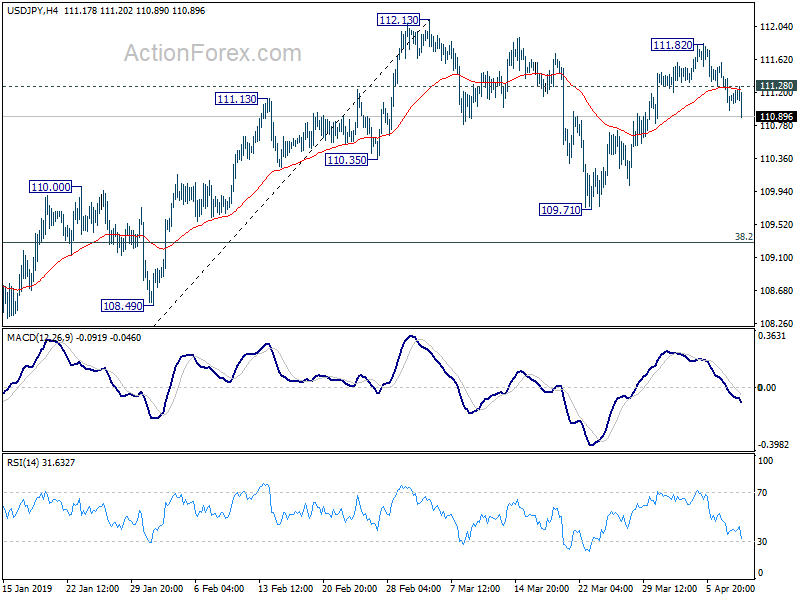
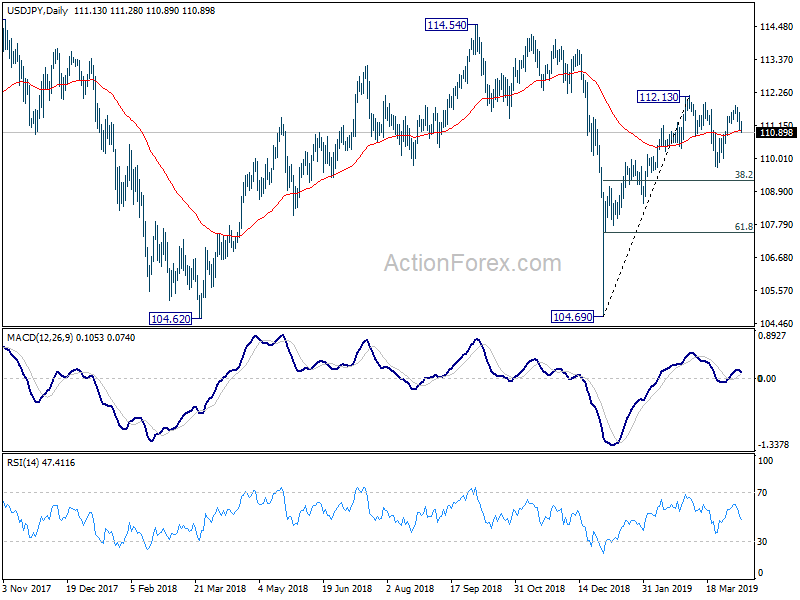
USD/JPY's fall from 111.82 is still in progress and intraday bias remains on the downside. Such decline is seen as the third leg of consolidation pattern from 112.13. Deeper decline would be seen to 109.71 and below. But downside should be contained by 104.69 to 112.13 at 109.28 to bring rebound. On the upside, above 111.28 minor resistance will turn intraday bias back to the upside for 112.13 resistance. Decisive break of 112.13 will resume whole rally from 104.69 and target 114.54 resistance next.
In the bigger picture, medium term outlook in USD/JPY remains a bit mixed as it's staying inside falling channel from 118.65, but there are signs of bullish reversal. On the upside, break of 114.54 resistance will revive the case the corrective fall from 118.65 has completed with three waves down to 104.69. And whole rise from 98.97 (2016 low) is resuming for 118.65 and above. But before that, outlook stays neutral first.
EUR/CHF Mid-Day Outlook
Daily Pivots: (S1) 1.1243; (P) 1.1262; (R1) 1.1280; More...
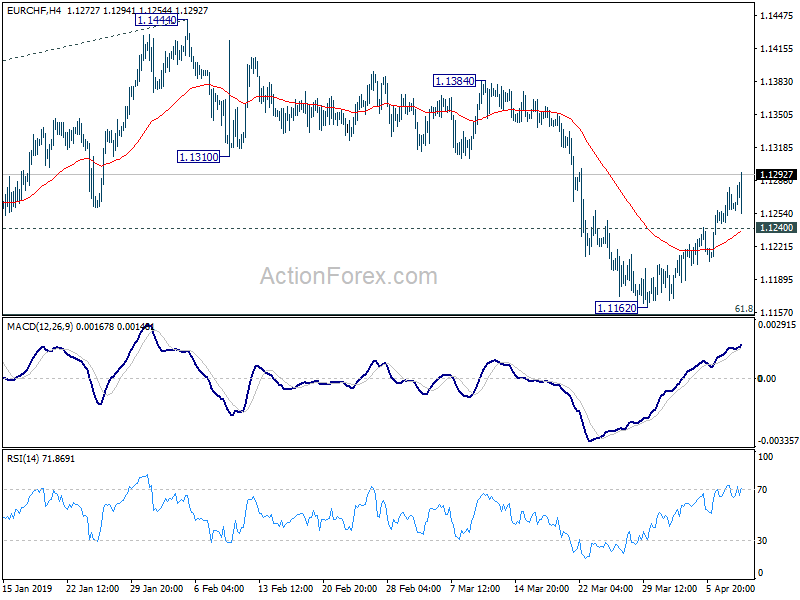
EUR/CHF's rebound from 1.1162 is still in progress. Intraday bas remains on the upside for 1.1310 support turned resistance first. Firm break there will target 1.1444 key resistance next. On the downside, below 1.1240 minor support will turn bias back to the downside for 1.1154 key fibonacci level instead.
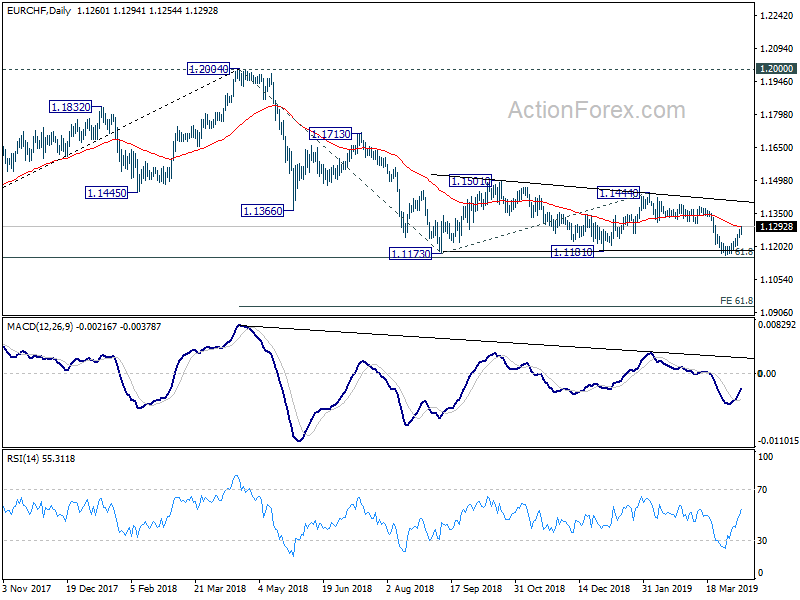
In the bigger picture, multiple rejection by 55 week EMA indicates medium term bearishness. Focus remains on 1.1154/98 support zone (2016 high and 61.8% retracement of 1.0629 to 1.2004 at 1.1154). Decisive break there will confirm resumption of whole down trend from 1.2004 and long term bearish reversal. EUR/CHF should then target 1.0629 support and below. This will now remain the favored case as long as 1.1444 resistance holds.
Flash ECB Review: Little News But Tiering System Still Part of Discussion
- The ECB was on the dovish side today, with little new information in terms of policy signals, but it opened the door for further policy easing, in particular the tiering system.
- The pros and cons of the tiering system are still to be assessed, although Mario Draghi was very careful not to use the word 'tiering' as such.
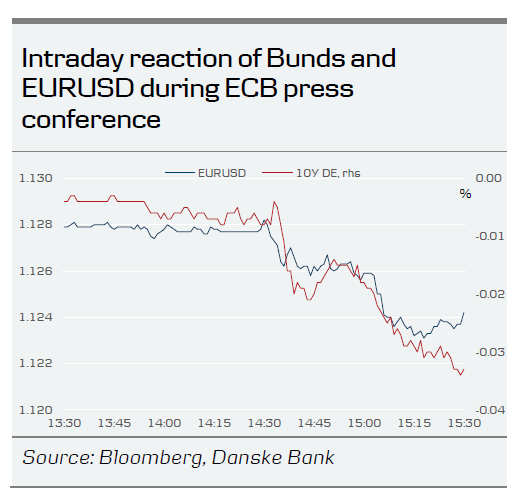
- The Bund and EUR/USD traded lower throughout the press conference on the remit of a potential tiering system and a low-for-longer narrative.
Not much discussed today
The introductory statement was generally on the soft side and we take note, in particular, of the comment regarding mitigation of the negative side effects of negative interest rates. We cannot rule out a potential tiering system at a later stage but see this as more of a policy discussion that may unfold (see ECB Research – ECB Watchers conference: is a tiering system really the answer?, 28 March, for our reflections on a tiering system).
During the press conference, Draghi reflected that the GC meeting today was more of 'stock taking' nature about possible future policy actions and to reassert the ECB's readiness to act if required, meaning all options are on the table.
Growth and inflation
On growth, Draghi sounded on balance slightly more downbeat than at the March meeting, saying today that 'the slower growth momentum is expected to extend into the current year.', which compares with March's '…the near-term growth outlook will be weaker than previously anticipated', i.e. the ECB expects a slightly longer time for pickup in the data. However, although the slower growth momentum was seen as extending further into the current year, the ECB still assesses the probability of a euro area recession as low.
The inflation outlook carried no new information. Draghi repeated his message of inflation expectations not being deanchored but only low. He said that 5Y5Y inflation swap deterioration reflects the deterioration in growth momentum. Similarly, he repeated his message on the negative inflation risk premium as an explanation of lower market-based inflation expectations.
Tiering and TLTRO3
There were no details or colour on the TLTRO3 that was announced at the March meeting, only a comment that it would come at the forthcoming meetings.
On tiering, there was some colour given that the ECB plans to consider measures to preserve the favourable implications of negative interest rates for the economy and to mitigate possible side effects, if any, on bank intermediation. Draghi did not want to use the word tiering as such but, in our view, markets took it quite clearly that he was referring to tiering. We repeat our view that a tiering system would make more sense if this implies only higher rates to help banks' profitability but that we have to price a non-zero probability to tiering, which could include a cut as well. We recall that in 2016, the ECB did not announce a tiering system as it did not want to signal a cut.
FX: EUR/USD set to stay close to 1.13 in 3M
ECB President Draghi used to be known for his ability to intervene verbally in financial markets, e.g. during ECB press conferences. When he today stressed that the ECB intends to go after hitting its inflation target 'without undue delay', that the ECB can allow inflation to overshoot 2% and that all options are on the table, EUR/USD did not bite. This illustrates to us that words are not enough and that action is needed to weaken EUR and regain confidence in the market with regard to the ECB's inflation target. EUR/USD decreased from around 1.1280 before the meeting to around 1.1230-40 in response to the market pricing the ECB to keep rates low for even longer. In our view, the ECB did not provide arguments for EUR/USD to fall much further from here and we stick to our call for the cross to trade around 1.13 in 3M.
Fixed income: implicit yield curve controller
The ECB continues to support the bond market, as the comments on the negative impact of negative policy rates suggest that rates will remain low for long. The ECB is still refraining from talking about 'Japanification' but the low rates makes investing in Europe attractive for foreign investors such as Japan due to the positive yield pickup from the FX hedge. Given Japanese investors purchase of European government bonds such as France and Finland, this is almost like 'exporting' yield curve control from Japan to Europe.
Hence, the message from the ECB is still supportive for spread compression between core EU and both semi-core and periphery. Furthermore, the curve is flattening between 2Y and 5Y, while there was a modest bullish steepening of the 5-10Y curves. However, a further flattening of 2Y-5Y would have a spillover effect to the 5-10Y curve. We continue to see 10Y Bund yields trading close to zero or even below for the rest of the year.
The rally in Italian government bonds continued on the back of the ECB comments and the 10Y spread continued to tighten despite the weak growth outlook presented by the Italian government yesterday. However, with investors starved for yield and no action from rating agencies, we believe there is room for more performance.
US: Consumer Price Inflation Still No Threat to Fed
The CPI picked up in March as food and gas prices are rising once again. Core CPI inflation softened a touch, due in part to new data methods. But the trend in inflation is likely to remain within the Fed's comfort zone.
Trend Still Manageable Despite Rising Food and Gas Costs
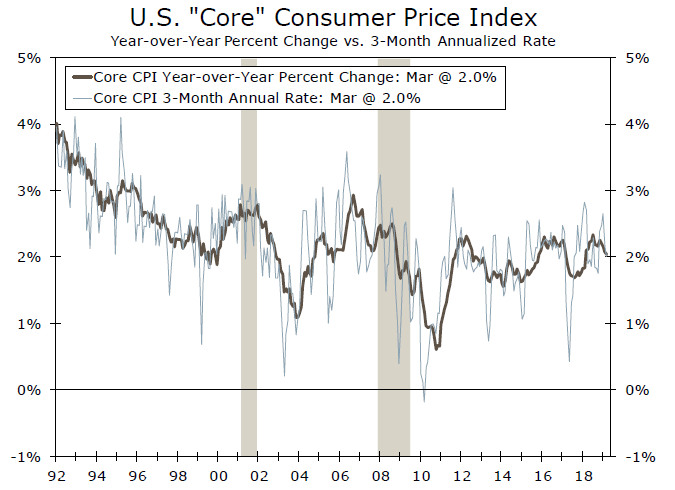
The latest CPI data show that the trend in inflation remains tame. Core inflation came in a touch softer than expected with the index rising 0.1% (0.148% before rounding). Core goods prices fell 0.2% for a second consecutive month, due, at least in part, to the BLS beginning a new collection procedure that uses actual transactions rather than field surveyors for a department store. For example, apparel prices tumbled 1.9%, the largest monthly drop on record. Core services held up better, increasing 0.3% on another strong gain in shelter costs and a rebound in medical care prices. Nevertheless, core CPI inflation slipped to 2.0% on a year-ago basis and is running at the same rate on a three-month annualized basis, suggesting core inflation is likely to remain near its current run rate.
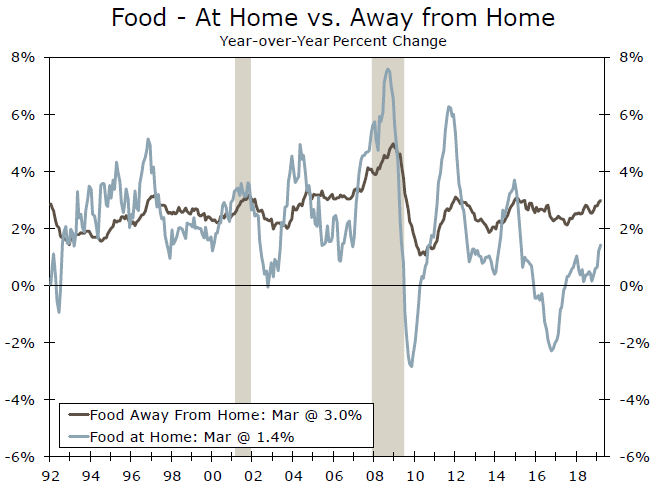
Overall consumer prices rose 0.4% in March, which was the largest monthly gain in more than a year. A 6.5% jump in gasoline prices was a significant culprit of the increase. We expect oil prices will remain close to current levels over the course of this year and for gasoline prices to exert less sway on headline inflation on a monthly basis as a result. The turnaround in energy prices since December, however, is now pushing total inflation higher again on a year-ago basis. Consumer prices are up 1.9% over the past 12 months compared to 1.5% in February. A pickup in food inflation in recent months also has helped drive the headline index higher. Grocery store prices rose 0.4% last month, while total food prices, including the cost of eating out, are rising at the fastest pace in nearly four years.
Inflation Giving the Fed Breathing Room
We see little risk of inflation moving meaningfully above 2% this year. Slowing growth in the United States and abroad has eased input cost pressures. At the same time, inflation expectations—both short- and longterm— have remained stubbornly low. While an elevated share of businesses report raising prices, low inflation expectations, stronger productivity growth and high margins should limit the magnitude of price hikes.
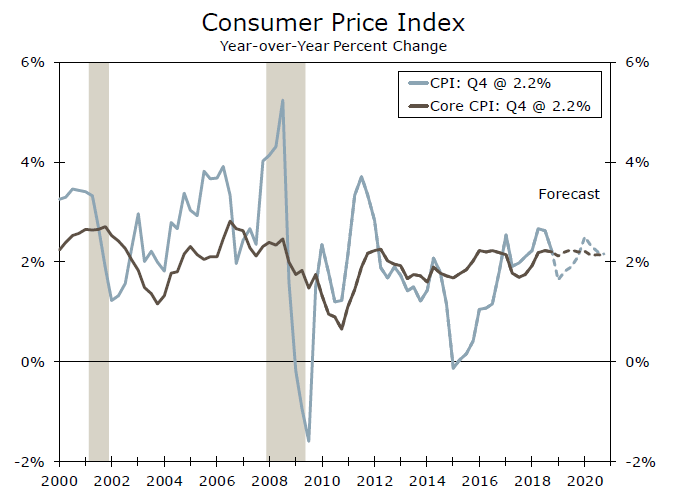
We have pared down our estimates of inflation later this year as a result. We now look for core CPI inflation to top out over the forecast horizon at 2.2% versus 2.3% previously. Core PCE inflation, the FOMC's preferred benchmark for its 2% inflation goal, is also likely to take longer than expected to return to target. We expect core PCE inflation to continue to run a touch below 2% this year.
That should allow the Fed to remain "patient" with future rate adjustments. The more cautious tenor from the FOMC lately along with more modest inflation expectations leads us to no longer expect the FOMC to raise the fed funds rate this year. But inflation remains close enough to the Fed's goal that a rate cut this year—as is currently priced in by markets—looks premature in our view.
WTI Falls After Large US Crude Stock Buildup
Oil prices traded lower after the Energy Information Administration (EIA) reported a higher than expected buildup of US crude inventories. Stock rose by 7 million, but the report was mixed as gasoline inventories fell by 7.7 million barrels. West Texas Intermediate fell after the report was released, but Brent continues to gain as OPEC cuts are forging ahead with an additional 534,000 daily barrel cut in March.
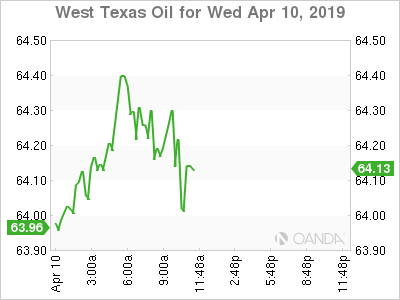
Supply disruptions have added to the OPEC+ pressure leading oil prices higher. US sanctions against Venezuela and Iran are combining with the military situation in Libya. US production has risen but for now the supply side is making a stronger push towards rebalancing of the market.
Russian comments this week on taking a more cautious approach to committing to an extension of the production cut agreement could tip the scale.
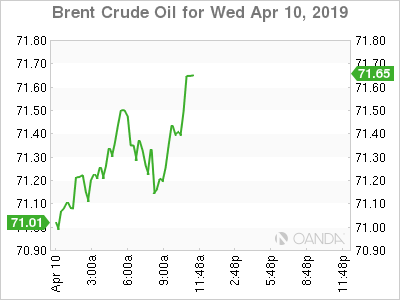
Energy prices will remain sensitive to demand fundamentals with an eye on how trade negotiations evolve. With the US-China deal closing in on an agreement, the US is now amping up disputes with Mexico and the European Union. The global growth downgrade this week by the IMF is another warning of the impact a trade war could have on the world’s demand for energy.
Japanese Yen in Holding Pattern ahead of Fed Minutes
USD/JPY is showing little movement in the Wednesday session. In the North American session, the pair is trading at 111.08, down 0.07% on the day. In Japan, Core Machinery Orders gained 1.8%, missing the estimate of 3.0%. Japanese PPI rose 1.3%, above the estimate of 1.0%. in the U.S., consumer inflation numbers were mixed. In the U.S., CPI was stronger than expected, with gain of 0.4%, above the estimate of 0.3%. Core CPI remained steady at 0.1%, shy of the estimate of 0.2%. Later in the day, the FOMC releases the minutes of the March policy meeting. On Thursday, the U.S. releases PPI.
On Wednesday, investors will be keeping a close look at Federal Reserve, which releases the minutes of the March meeting. At the meeting, the Fed said it would start tapering the reduction of its balance sheet in May. This marks a loosening of policy, and comes in response to weaker economic data out of the U.S. in recent months. The minutes should be treated as a market-mover, and if the minutes are dovish, investors could snap up the safe-haven yen.
The economic outlook for Japan remains bleak, as the bruising U.S.-China trade war has damaged the manufacturing sector and taken a toll on Japanese exports. Earlier in the week, a BoJ forecast downgraded its assessment for three of the country’s nine regions. Despite the pessimistic report, BoJ Governor Haruhiko Kuroda remained optimistic, saying that stronger domestic demand would offset the decline in exports, which would enable the economy to grow at a moderate pace. Kuroda also said that he was confident that inflation would gradually accelerate towards the BoJ’s target of 2 percent. In March, Japanese PPI posted a strong gain of 1.3%, marking a three-month high.
EUR/JPY Mid-Day Outlook
Daily Pivots: (S1) 125.14; (P) 125.33; (R1) 125.79; More....
EUR/JPY's break of 124.96 minor support suggests that rebound from 123.65 has completed. Intraday bias is turned back to the downside for 123.65 support first. Break there will resume whole fall from 127.50 and target 61.8% retracement of 118.62 to 127.05 at 121.84. On the upside, though, above 125.61 will resume the rebound to 126.78/127.50 resistance zone.
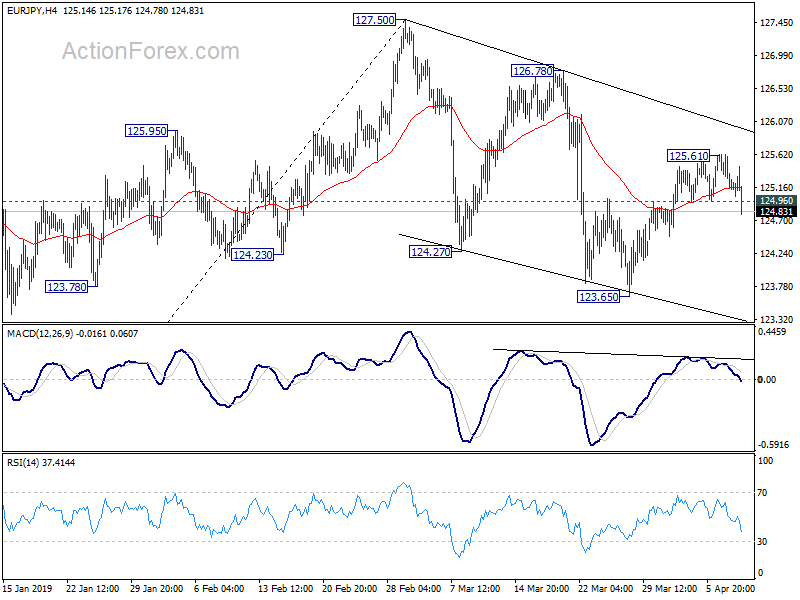
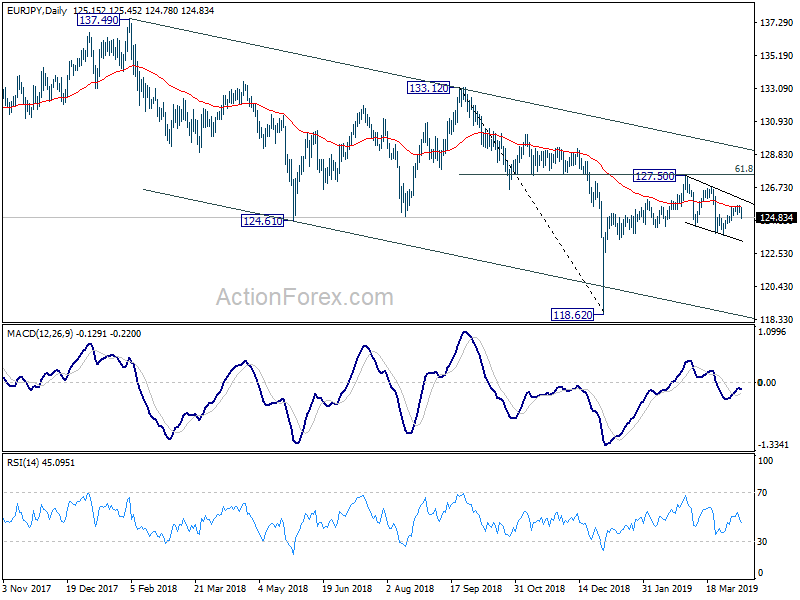
In the bigger picture, EUR/JPY is staying well inside medium term falling channel from 137.49 (2018 high). It's also held below 55 week EMA (now at 127.53). Thus, down trend from 137.49 might still extend lower. Break of 118.62 will target 109.03/114.84 long term support zone. On the upside, however, break of 127.50 will solidify the case of medium term bullish reversal. Rise from 118.76 should extend to 133.12 key resistance instead.
Euro Pressured after ECB, Yen Rises on Falling Treasury Yields
Euro weakens broadly after ECB kept monetary policies unchanged. While president Mario Draghi delivered not much new in the press conference, he did acknowledged that downside risks are materializing. Recovery in EUR/USD and EUR/JPY now look rather short-lived. Meanwhile, Dollar is mixed after CPI data offered nothing for Fed to shift from its patient stance. Yen is popped up by falling treasury yields in Germany in US.
Sterling is firmer in range as EU's decision on another Brexit extension is awaited. European Council President Donald Tusk is proposing a "flextension" of up to one year while UK can leave any time it's ready. It's reported that German Chancellor Angela Merkel prefers extension of "several months". Francs is said to be pushing for conditions to make sure UK can't disrupt EU businesses. We'll know the answer by the end of the day. But in any case, it's highly unlikely for UK Prime Minister Theresa May to get an extension just till June 30.
Technically, EUR/JPY's break of 124.96 minor support suggests that recovery from 123.65 has completed. More importantly, the choppy decline from 127.50 is possibly still in progress for another low below 123.65. EUR/USD will have 1.1210 minor support in sight after recovery lost steam. Break will put 1.1176 key support back into focus. EUR/AUD could also be heading to 1.5714/21 support zone and break will resume larger decline.
In other markets, US stocks open mixed but 10-year yield is back under pressure again. In Europe, FTSE is down -0.07%. DAX is up 0.53%. CAC is up 0.27%. German 10-year yield is down -0.243 at -0.032, deeper in negative. Earlier in Asia, Nikkei dropped -0.53%. Hong Kong HSI dropped -0.13%. China Shanghai SSE rose 0.07%. Singapore Strait Times rose 0.06%. Japan 10-year JGB yield dropped -0.0101 to -0.055.
US: Headline CPI accelerated to 1.9%, but core slowed to 2.0%
Dollar turns mixed in early US session after March CPI release. Headline CPI accelerated to 1.9% yoy, up from 1.5% yoy and beat expectation of 1.8% yoy. However, core CPI slowed to 2.0% yoy, down from 2.1% yoy and missed 2.1% yoy.
ECB Draghi: Persistence of uncertainties is leaving markets on economic sentiment
Euro weakens broadly today even though ECB delivered little news with the rate decision and press conference. The main refinancing rate is kept at 0.00%. Marginal lending facility rate and deposit rate are kept at 0.25% and -0.40% respectively. Also, forward guidance is unchanged. ECB expects to keep key interest rates at present level "at least through the end of 2019". No detail of the TLTRO III is provided as they will be released at one of the next meetings.
President Mario Draghi's overtone in the post meeting conference is dovish. He noted that incoming data "confirms slower growth momentum extending into the current year." "Global headwinds continue to weigh on euro area growth developments". Also, "persistence of uncertainties, related to geopolitical factors, the threat of protectionism and vulnerabilities in emerging markets, is leaving marks on economic sentiment."
Meanwhile, risks surrounding growth outlook remain "tilted t the downside". They're "on account of the persistence of uncertainties related to geopolitical factors, the threat of protectionism and vulnerabilities in emerging markets." Draghi also urged "other policy areas" to contribute more decisively to raise longer-term growth potential and reducing vulnerabilities. Those include structure reforms and fiscal policies.
UK GDP grew 0.2% in Feb, 0.3% in rolling three-month period
UK GDP rose 0.2% mom in February, down from January's 0.5% mom but beat expectation of 0.0% mom. Index of services rose 0.1% mom, while index of production rose 0.6% mom. Manufacturing rose 0.9% mom. Construction rose 0.4% mom. Agriculture dropped -1.3% mom. Rolling three-month growth rate (Dec to Feb) was unchanged at 0.3%. Services contributed 0.29%, production 0.02% and construction -0.04%.
Commenting on today's GDP figures, Head of GDP Rob Kent-Smith said: "GDP growth remained modest in the latest three months. Services again drove the economy, with a continued strong performance in IT. Manufacturing also continued to recover after weakness at the end of last year with the often-erratic pharmaceutical industry, chemicals and alcohol performing well in recent months."
Also from UK, in February, industrial production rose 0.5% mom, 0.1% yoy versus expectation of 0.1% mom, -0.8% yoy. Manufacturing production rose 0.9% mom, 0.6% yoy, versus expectation of 0.2% mom, -0.7% yoy. Construction output rose 0.4% mom versus expectation of -0.3% mom. Visible trade deficit widened to GBP -14.1B.
Kuroda: BoJ seeking to create positive economy cycle, not just rise in inflation
Speaking to the parliament, BoJ Governor Haruhiko Kuroda said the central bank isn't seeking to push up inflation alone. Instead, it's aiming at creating to situation where wage and employment conditions improve with corporate profits too. That is, creating a "positive economy cycle".
Meanwhile, Kuroda added the 2% inflation target helps in long-run currency stability. But for now, inflation is likely hover around 1% since wages growth is not fast enough yet.
Separately, Finance Minister Taro Aso also told the parliament that pushing up inflation alone "won't do any good" without improvement in people's livelihoods.
EUR/JPY Mid-Day Outlook
Daily Pivots: (S1) 125.14; (P) 125.33; (R1) 125.79; More....
EUR/JPY's break of 124.96 minor support suggests that rebound from 123.65 has completed. Intraday bias is turned back to the downside for 123.65 support first. Break there will resume whole fall from 127.50 and target 61.8% retracement of 118.62 to 127.05 at 121.84. On the upside, though, above 125.61 will resume the rebound to 126.78/127.50 resistance zone.
In the bigger picture, EUR/JPY is staying well inside medium term falling channel from 137.49 (2018 high). It's also held below 55 week EMA (now at 127.53). Thus, down trend from 137.49 might still extend lower. Break of 118.62 will target 109.03/114.84 long term support zone. On the upside, however, break of 127.50 will solidify the case of medium term bullish reversal. Rise from 118.76 should extend to 133.12 key resistance instead.
Economic Indicators Update
| GMT | Ccy | Events | Actual | Forecast | Previous | Revised |
|---|---|---|---|---|---|---|
| 23:50 | JPY | Domestic CGPI Y/Y Mar | 1.30% | 1.00% | 0.80% | 0.90% |
| 23:50 | JPY | Machine Orders M/M Feb | 1.80% | 2.90% | -5.40% | |
| 00:30 | AUD | Westpac Consumer Confidence Apr | 1.90% | -4.80% | ||
| 06:00 | JPY | Machine Tool Orders Y/Y Mar P | -28.50% | -29.30% | ||
| 08:30 | GBP | Visible Trade Balance (GBP) Feb | -14.1B | -12.5B | -13.1B | |
| 08:30 | GBP | Industrial Production M/M Feb | 0.60% | 0.10% | 0.60% | 0.70% |
| 08:30 | GBP | Industrial Production Y/Y Feb | 0.10% | -0.80% | -0.90% | -0.30% |
| 08:30 | GBP | Manufacturing Production M/M Feb | 0.90% | 0.20% | 0.80% | 1.10% |
| 08:30 | GBP | Manufacturing Production Y/Y Feb | 0.60% | -0.70% | -1.10% | -0.70% |
| 08:30 | GBP | Construction Output M/M Feb | 0.40% | -0.30% | 2.80% | |
| 08:30 | GBP | GDP M/M Feb | 0.20% | 0.00% | 0.50% | |
| 08:30 | GBP | Index of Services 3M/3M Feb | 0.40% | 0.40% | 0.50% | |
| 11:45 | EUR | ECB Rate Decision | 0.00% | 0.00% | 0.00% | |
| 12:30 | EUR | ECB Press Conference | ||||
| 12:30 | USD | CPI M/M Mar | 0.40% | 0.40% | 0.20% | |
| 12:30 | USD | CPI Y/Y Mar | 1.90% | 1.80% | 1.50% | |
| 12:30 | USD | CPI Core M/M Mar | 0.10% | 0.20% | 0.10% | |
| 12:30 | USD | CPI Core Y/Y Mar | 2.00% | 2.10% | 2.10% | |
| 14:30 | USD | Crude Oil Inventories | 7.0M | 2.6M | 2.8M | |
| 18:00 | USD | FOMC Meeting Minutes | ||||
| 18:00 | USD | Monthly Budget Statement (USD) Mar | -194.7B | -234.0B |