Sample Category Title
Fed Minutes Show Increasing Comfort with Patience
The minutes from the FOMC's March 19-20 meeting showed Fed members' increasing comfort with their patient approach to monetary policy. This is justified by an outlook for economic growth that is slowing to a rate close to estimates of longer-run potential, inflation that is showing little signs of heating up despite continued improvement in the labor market, and by heightened uncertainty due to trade policy and international developments.
Participants noted the recent slowing in economic activity, but repeated expectations that it would gain speed in the months ahead, supported by the improvements in financial conditions and consumer and business sentiment.
Comments on inflation noted that it has come in softer than expected, and has not picked up despite "strong labor market conditions and rising nominal wage growth, as well as short-term upward pressure on prices arising from tariff increases."
Key Implications
As in past FOMC minutes, discussions around inflation were central. The discussion made clear that further tightening in the labor market would not cause them to change course on policy unless it was accompanied by clear signs that inflation is moving higher. The onus is on the data, not modelled relationships to drive future policy. While this may suggest some risk that policy falls behind the curve, and becomes more reactionary rather than anticipatory, with several years of inflation falling short of target, the Fed can clearly afford to ere on the side of allowing it to run a bit hot. This is especially true as inflation expectations, as noted in these minutes, are currently at the lower end of their historical range.
Crude Oil Price Rallies To New 2019 High
Key Highlights
- Crude oil price started a strong rise and traded to a new 2019 high above $64.00 against the US dollar.
- There was a break above a bullish flag pattern with resistance at $62.40 on the 4-hours chart of XTI/USD.
- The US CPI in March 2019 increased 0.4% (MoM), more than the +0.3% forecast.
- The US PPI in March 2019 could rise 0.3% (MoM), less than the last +0.1%.
Crude Oil Price Technical Analysis
In the past two weeks, there was a strong rise in crude oil price from the $58.00 support against the US Dollar. The price surged above the $60.00 and $64.00 resistance levels to set a new yearly high.
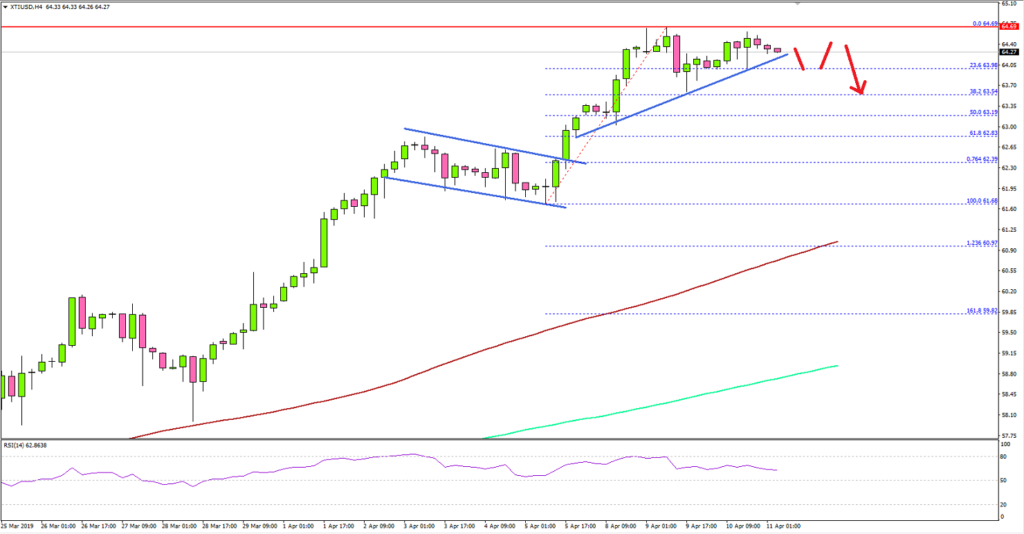
Looking at the 4-hours chart of XTI/USD, the price gained bullish momentum after it settled above the $60.00 pivot level. There was a strong close above $62.00, the 100 (red) simple moving average (4-hours), and the 200 (green) simple moving average (4-hours).
Intermediately, there was a break above a bullish flag pattern with resistance at $62.40. It opened the doors for more gains above the $63.00 and $64.00 levels. The price even broke the $62.50 level before correcting lower.
On the downside, there are many supports near the $63.50 and $63.00 levels. Therefore, if there is a downside correction, the price is likely to find bids near the $63.00 and $62.50 levels.
On the upside, there is a crucial resistance near the $65.00 level, above which bulls might eye a test of the $66.50 resistance area.
Fundamentally, the US Consumer Price Index report for March 2019 was released by the US Bureau of Labor Statistics. The market was looking for a 0.3% rise in the CPI in March 2019, compared with the previous month.
The actual result was better than the forecast as there was a 0.4% rise in the CPI. Looking at the yearly change, the CPI increased 1.9%, more than the 1.8% forecast.
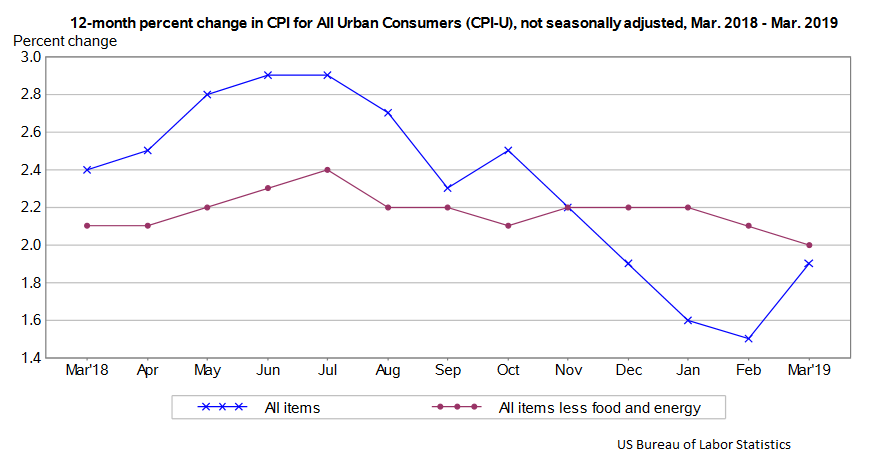
The report added:
The energy index increased 3.5 percent in March, accounting for about 60 percent of the seasonally adjusted all items monthly increase. The gasoline index increased sharply, and the electricity index also rose, although the natural gas index declined. The food index also increased in March, with the indexes for food at home and food away from home both continuing to rise.
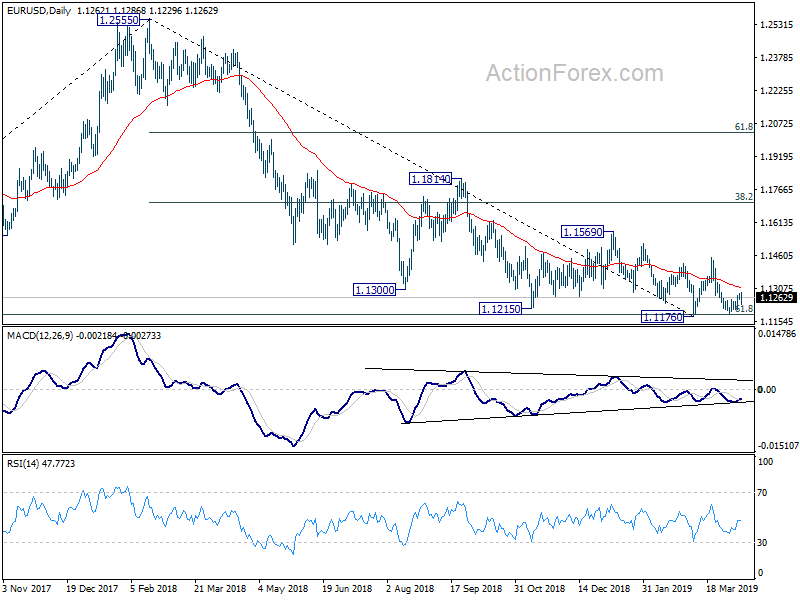
Looking at major pairs, EUR/USD and GBP/USD faced an increase in selling pressure and they remain at a risk of more losses in the near term.
Economic Releases to Watch Today
- German Consumer Price Index March 2019 (YoY) – Forecast +1.3%, versus +1.3% previous.
- German Consumer Price Index March 2019 (MoM) – Forecast +0.4%, versus +0.4% previous.
- US Initial Jobless Claims – Forecast 211K, versus 202K previous.
- US Producer Price Index March 2019 (MoM) – Forecast +0.3%, versus +0.1% previous.
- US Producer Price Index March 2019 (YoY) – Forecast +1.9%, versus +1.9% previous.
UK given “medium” Brexit delay while EU urges not to waste this time
EU agreed to give UK flexible Brexit extension at the special European Council meeting on Wednesday. The extension should last "only as long as necessary and, in any event, no longer than October 31 2019". If the Withdrawal Agreement cannot be ratified by then, Brexit will take place on November 1. During the extension, UK remains a EU remember with full right, and has a right to revoke Article 50 at any time.
In the statement, EU emphasized that "the extension cannot be allowed to undermine the regular functioning of the Union and its institutions." UK must hold European Parliament elections if it's still a EU member on May 23-26, or Brexit will happen on June 1. Also, EU reiterated there will be no renegotiations. And, the extension "cannot be used to start negotiations on the future relationship". Though, EU is open to reconsider the Political Declaration.
In the post summit press conference, European Council President Donald Tusk said "this extension is as flexible as I expected, and a little bit shorter than I expected, but it's still enough to find the best possible solution." He urged UK "please don't waste this time".
German Chancellor Angela Merkel said: "We looked at the matter and decided to shift the date to October. We want an orderly exit of Great Britain and an orderly exit of Great Britain can be best ensured if we give it some time". And, "the decisive point was when will the British parliament consent to the withdrawal agreement and we made it clear that that exit agreement applies and will not be changed".
French President Emmanuel Macron said: "It's true that the majority was more in favor of a very long extension. But it was not logical in my view, and above all, it was neither good for us, nor for the UK." And, "I take responsibility for this position, I think it's for the collective good."
EU grants UK flexible Brexit extension till Oct 31, full text
1. The European Council takes note of the letter of Prime Minister Theresa May of 5 April 2019 asking for a further extension of the period referred to in Article 50(3) TEU.
2. In response, the European Council agrees to an extension to allow for the ratification of the Withdrawal Agreement. Such an extension should last only as long as necessary and, in any event, no longer than 31 October 2019. If the Withdrawal Agreement is ratified by both parties before this date, the withdrawal will take place on the first day of the following month.
3. The European Council underlines that the extension cannot be allowed to undermine the regular functioning of the Union and its institutions. If the UK is still a Member of the EU on 23-26 May 2019 and if it has not ratified the Withdrawal Agreement by 22 May 2019, it must hold the elections to the European Parliament in accordance with Union law. If the United Kingdom fails to live up to this obligation, the withdrawal will take place on 1 June 2019.
4. The European Council reiterates that there can be no opening of the Withdrawal Agreement, and that any unilateral commitment, statement or other act should be compatible with the letter and the spirit of the Withdrawal Agreement and must not hamper its implementation.
5. The European Council stresses that such an extension cannot be used to start negotiations on the future relationship. However, if the position of the United Kingdom were to evolve, the European Council is prepared to reconsider the Political Declaration on the future relationship in accordance with the positions and principles stated in its guidelines and statements, including as regards the territorial scope of the future relationship.
6. The European Council notes that, during the extension, the United Kingdom will remain a Member State with full rights and obligations in accordance with Article 50 TEU, and that the United Kingdom has a right to revoke its notification at any time.
7. The European Council takes note of the commitment by the United Kingdom to act in a constructive and responsible manner throughout the extension in accordance with the duty of sincere cooperation and expects the United Kingdom to fulfill this commitment and Treaty obligation in a manner that reflects its situation as a withdrawing Member State. To this effect, the United Kingdom shall facilitate the achievement of the Union's tasks and refrain from any measure which could jeopardize the attainment of the Union's objectives, in particular when participating in the decision-making processes of the Union.
8. In addition to meetings under Article 50 TEU, the 27 Member States and the Commission, where appropriate together with other institutions, bodies, offices and agencies of the Union, will continue to meet separately at all levels to discuss matters related to the situation after the withdrawal of the United Kingdom.
9. The European Council will remain seized of the matter and will review progress at its meeting in June 2019.
ECB Confirm Wariness, Deposit Rate Debate In Early Stages
The April ECB meeting was a quiet one. Given that it occurred only 35 days after the March meeting, when a significant dovish shift took place, very few had high expectations for an exciting April ECB meeting (a non-projection meeting). The only new addition of substance regarded the negative deposit rate - to which we cover some of the recent research debate below - but most of April’s discussion was about confirming the adjusted policy stance set out in March - so we will begin with that.
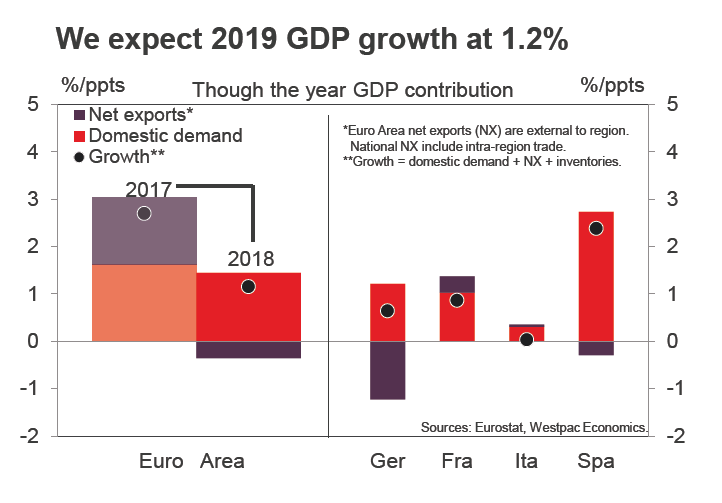
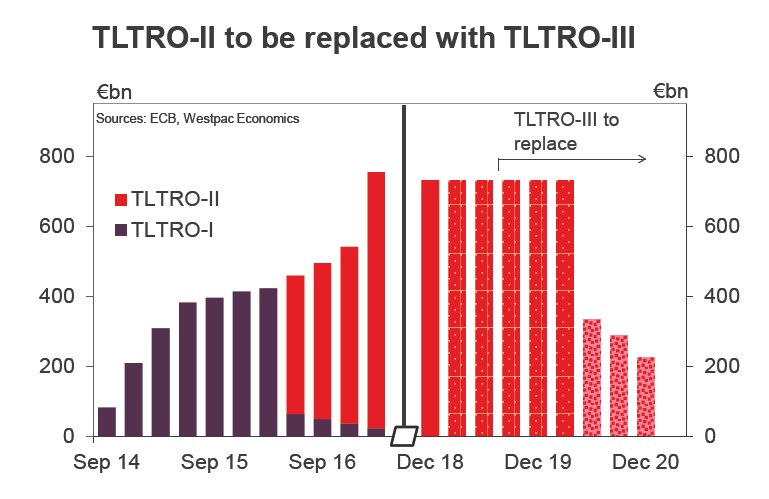
To recap March: the ECB made large downward revisions to the economic projections (growth now seen at 1.1% in 2019), extended interest rate policy forward guidance to rates expected to be on hold at least through the end of 2019, and announced a new Targeted Long-Term Refinancing Operations (TLTRO) package in response to the upcoming maturities.
In April, the ECB Governing Council note the new information since March has confirmed slower growth momentum extending into the current year. Again, they note while idiosyncratic domestic factors appear to be fading, global headwinds continue to weigh on Europe. Of most importance, the ECB continues to believe risks are tilted to the downside, citing the long list of uncertainties, which are nearly all geopolitical in nature.
Full detail on the new TLTRO package is still yet to be announced. At first glance TLTRO-III appears less favourable than its predecessor, but the ECB has indicated that there will be incentives (as there were in TLTRO-II). At the April meeting, Draghi indicated that the decision on TLTRO-III pricing will take into account the bank transmission channel and the overall economic outlook. Wording on the announcement date was also adjusted slightly to 'at one of our forthcoming meetings' as opposed to 'in due course'. We expect an announcement in June but the September start date for the package means the ECB could wait until the July or September meetings instead.
Now in regards to the negative deposit rate, the April statement added a new line: 'In the context of our regular assessment, we will also consider whether the preservation of the favourable implications of negative interest rates for the economy requires the mitigation of their possible side effects, if any, on bank intermediation.'
Of course, this relates to the recent discussion on the potential for the ECB to move to a tiered deposit rate. This would mean only a smaller portion of excess reserves would be charged the negative rate. As banks have been unable to pass on negative deposit rates to households, this would therefore reduce the overall cost paid by banks to the ECB.
Indeed the cost burden on banks is a hotly debated topic in the literature, as noted above by the ECB as having 'possible side effects'. Indeed, in this year alone, two influential papers offer opposing viewpoints on the matter.
On the affirmative, the paper by Summers, Eggertsson, Juelsrud, and Wold study the effect of negative interest rates on the bank-lending channel in Sweden. They find that while the first two cuts by the Riksbank into negative territory were transmitted to lending rates, the second two cuts to -0.35% and -0.5% respectively had the opposite effect. Their assessment suggests that a policy rate of -0.50 percent increases borrowing rates by 15 basis points.
To the contrary, a paper by the ECB themselves by Amzallag, Calza, Georgarakos and Sousa finds that the aggregate economic implications are small based on analysis of the situation in Italy. However, they do note that there is variance amongst banks due to differences in funding. Banks with a higher proportion of overnight deposits to total assets tend to charge higher rates on fixed mortgages and are more likely to originate adjustable mortgages.
Unsurprisingly, Draghi’s discussion during the press conferences have tended to favour the view of the ECB research, noting that there are numerous drivers of European bank profitability and that in aggregate, it is higher than in the UK where policy rates are positive. He does though acknowledge that there may be side effects that vary by bank.
Overall, the discussion on a tiered deposit rate within the ECB is still in its early stages. Circling back to some of Summers’ earlier work on secular stagnation, it is worth noting European population growth is low at 0.2% per year, implying a low neutral interest rate. If anything, the recent debate on a tiered deposit rate underscores the ECB’s acknowledgement of rates being ‘low for longer’.
In the here and now, we expect the ECB to favour other policy tools if economic conditions were to worsen (such as the incentives on TLTRO) and we do not expect a tiered deposit rate to be announced in the near-term. Nonetheless, it remains an interesting topic as we watch to see whether European growth stabilises in the second half of 2019, as we currently anticipate.
Eco Data 4/11/19
[php_everywhere instance="1"]
(FED) Minutes of the Federal Open Market Committee March 19-20, 2019
A joint meeting of the Federal Open Market Committee and the Board of Governors was held in the offices of the Board of Governors of the Federal Reserve System in Washington, D.C., on Tuesday, March 19, 2019, at 10:00 a.m. and continued on Wednesday, March 20, 2019, at 9:00 a.m.1
PRESENT:
Jerome H. Powell, Chair
John C. Williams, Vice Chair
Michelle W. Bowman
Lael Brainard
James Bullard
Richard H. Clarida
Charles L. Evans
Esther L. George
Randal K. Quarles
Eric Rosengren
Patrick Harker, Robert S. Kaplan, Neel Kashkari, Loretta J. Mester, and Michael Strine, Alternate Members of the Federal Open Market Committee
Thomas I. Barkin, Raphael W. Bostic, and Mary C. Daly, Presidents of the Federal Reserve Banks of Richmond, Atlanta, and San Francisco, respectively
James A. Clouse, Secretary
Matthew M. Luecke, Deputy Secretary
David W. Skidmore, Assistant Secretary
Michelle A. Smith, Assistant Secretary
Mark E. Van Der Weide, General Counsel
Michael Held, Deputy General Counsel
Steven B. Kamin, Economist
Thomas Laubach, Economist
Stacey Tevlin, Economist
Thomas A. Connors, Rochelle M. Edge, Eric M. Engen, Christopher J. Waller, William Wascher, and Beth Anne Wilson, Associate Economists
Simon Potter, Manager, System Open Market Account
Lorie K. Logan, Deputy Manager, System Open Market Account
Ann E. Misback, Secretary, Office of the Secretary, Board of Governors
Matthew J. Eichner,2 Director, Division of Reserve Bank Operations and Payment Systems, Board of Governors; Michael S. Gibson, Director, Division of Supervision and Regulation, Board of Governors; Andreas Lehnert, Director, Division of Financial Stability, Board of Governors
Daniel M. Covitz, Deputy Director, Division of Research and Statistics, Board of Governors; Michael T. Kiley, Deputy Director, Division of Financial Stability, Board of Governors; Trevor A. Reeve, Deputy Director, Division of Monetary Affairs, Board of Governors
Jon Faust, Senior Special Adviser to the Chair, Office of Board Members, Board of Governors
Antulio N. Bomfim, Special Adviser to the Chair, Office of Board Members, Board of Governors
Brian M. Doyle, Wendy E. Dunn, Joseph W. Gruber, Ellen E. Meade, and John M. Roberts, Special Advisers to the Board, Office of Board Members, Board of Governors
Linda Robertson, Assistant to the Board, Office of Board Members, Board of Governors
Shaghil Ahmed, Senior Associate Director, Division of International Finance, Board of Governors; Joshua Gallin and David E. Lebow, Senior Associate Directors, Division of Research and Statistics, Board of Governors
Edward Nelson, Senior Adviser, Division of Monetary Affairs, Board of Governors; Jeremy B. Rudd, Senior Adviser, Division of Research and Statistics, Board of Governors
Marnie Gillis DeBoer2 and David López-Salido, Associate Directors, Division of Monetary Affairs, Board of Governors
Jeffrey D. Walker,2 Deputy Associate Director, Division of Reserve Bank Operations and Payment Systems, Board of Governors
Andrew Figura, Assistant Director, Division of Research and Statistics, Board of Governors; Laura Lipscomb,2Zeynep Senyuz,2 and Rebecca Zarutskie, Assistant Directors, Division of Monetary Affairs, Board of Governors
Michele Cavallo,2 Section Chief, Division of Monetary Affairs, Board of Governors
Penelope A. Beattie,3 Assistant to the Secretary, Office of the Secretary, Board of Governors
Mark A. Carlson, Senior Economic Project Manager, Division of Monetary Affairs, Board of Governors
David H. Small, Project Manager, Division of Monetary Affairs, Board of Governors
Martin Bodenstein, Marcel A. Priebsch, and Bernd Schlusche,2 Principal Economists, Division of Monetary Affairs, Board of Governors
Mary-Frances Styczynski,2 Lead Financial Institution and Policy Analyst, Division of Monetary Affairs, Board of Governors
Achilles Sangster II, Information Management Analyst, Division of Monetary Affairs, Board of Governors
Gregory L. Stefani, First Vice President, Federal Reserve Bank of Cleveland
David Altig, Kartik B. Athreya, Michael Dotsey, Glenn D. Rudebusch, Ellis W. Tallman, and Joseph S. Tracy, Executive Vice Presidents, Federal Reserve Banks of Atlanta, Richmond, Philadelphia, San Francisco, Cleveland, and Dallas, respectively
Antoine Martin,2 Julie Ann Remache,2 and Mark L.J. Wright, Senior Vice Presidents, Federal Reserve Banks of New York, New York, and Minneapolis, respectively
Roc Armenter,2 Kathryn B. Chen,2 Hesna Genay, Jonathan P. McCarthy, and Patricia Zobel,2 Vice Presidents, Federal Reserve Banks of Philadelphia, New York, Chicago, New York, and New York, respectively
Samuel Schulhofer-Wohl, Senior Economist and Research Advisor, Federal Reserve Bank of Chicago
Daniel Cooper, Senior Economist and Policy Advisor, Federal Reserve Bank of Boston
Ellen Correia Golay,2 Markets Officer, Federal Reserve Bank of New York
A. Lee Smith, Senior Economist, Federal Reserve Bank of Kansas City
Balance Sheet Normalization
Committee participants resumed their discussion from the January 2019 meeting on options for transitioning to the longer-run size of the balance sheet. The staff described options for ending the reduction in the Federal Reserve's securities holdings at the end of September 2019 and for potentially reducing the pace of redemptions of Treasury securities before that date. Reducing the pace of redemptions before ending them would be consistent with most previous changes in the Federal Reserve's balance sheet policy and would support a gradual transition to the long-run level of reserves. It could also reinforce the Committee's communications indicating that the FOMC was flexible in its plans for balance sheet normalization and that the process of balance sheet normalization would remain consistent with the attainment of the Federal Reserve's monetary policy objectives. However, continuing redemptions at the current pace through September might be simpler to communicate and would somewhat shorten the transition to the long-run level of reserves. The staff noted that reducing the pace of redemptions before September would leave reserves and the balance sheet slightly larger than continuing redemptions at the current pace through September. However, the longer-run level of reserves and size of the balance sheet would ultimately be determined by long-term demand for Federal Reserve liabilities. Staff projections of term premiums and macroeconomic outcomes did not differ substantially across the two options.
The staff also described a possible interim plan for reinvesting principal payments received from agency debt and agency mortgage-backed securities (MBS) after balance sheet runoff ends and until the Committee decides on the longer-run composition of the System Open Market Account (SOMA) portfolio. Consistent with the Committee's long-standing aim to hold primarily Treasury securities in the longer run, any principal payments on agency debt and agency MBS would generally be reinvested in Treasury securities in the secondary market. These reinvestments would be allocated across sectors of the Treasury market roughly in proportion to the maturity composition of Treasury securities outstanding. However, the plan would maintain the existing $20 billion per month cap on MBS redemptions; principal payments on agency debt and agency MBS above $20 billion per month would continue to be reinvested in agency MBS. This cap would limit the pace at which the Federal Reserve's agency MBS holdings could decline if prepayments accelerated; the staff projected that the redemption cap on agency debt and agency MBS was unlikely to be reached after 2019.
The staff noted that, once balance sheet runoff ended, the average level of reserves would tend to decline gradually, in line with trend growth in the Federal Reserve's nonreserve liabilities, until the Committee chose to resume growth of the balance sheet in order to maintain a level of reserves consistent with efficient and effective policy implementation.
Participants judged that ending the runoff of securities holdings at the end of September would reduce uncertainty about the Federal Reserve's plans for its securities holdings and would be consistent with the Committee's decision at its January 2019 meeting to continue implementing monetary policy in a regime of ample reserves. Participants discussed advantages and disadvantages of slowing balance sheet runoff before the September stopping date. A slowing in the pace of redemptions would accord with the Committee's general practice of adjusting its holdings of securities smoothly and predictably, which might reduce the risk that market volatility would arise in connection with the conclusion of the runoff of securities holdings. However, these advantages needed to be weighed against the additional complexity of a plan that would end balance sheet runoff in steps rather than all at once.
Participants reiterated their support for the FOMC's intention to return to holding primarily Treasury securities in the long run. Participants judged that adopting an interim approach for reinvesting agency debt and agency MBS principal payments into Treasury securities across a range of maturities was appropriate while the Committee continued to evaluate potential long-run maturity structures for the Federal Reserve's portfolio of Treasury securities. Many participants offered preliminary views on advantages and disadvantages of alternative compositions for the SOMA portfolio. Participants expected to further discuss the longer-run composition of the portfolio at upcoming meetings.
Participants commented on considerations related to allowing the average level of reserves to decline in line with trend growth in nonreserve liabilities for a time after the end of balance sheet runoff. Several participants preferred to stabilize the average level of reserves by resuming purchases of Treasury securities relatively soon after the end of runoff, because they saw little benefit to further declines in reserve balances or because they thought the Committee should minimize the risk of interest rate volatility that could occur if the supply of reserves dropped below a point consistent with efficient and effective implementation of policy. Some others preferred to allow the average level of reserves to continue to decline for a longer time after balance sheet runoff ends because such declines could allow the Committee to learn more about underlying reserve demand, because they judged that such a process was not likely to result in excessive volatility in money market rates, or because they judged that moving to lower levels of reserves was more consistent with the Committee's previous communications indicating that it would hold no more securities than necessary for implementing monetary policy efficiently and effectively. Participants noted that the eventual resumption of purchases of securities to keep pace with growth in demand for the Federal Reserve's liabilities, whenever it occurred, would be a normal part of operations to maintain the ample-reserves monetary policy implementation regime and would not represent a change in the stance of monetary policy. Some participants suggested that, at future meetings, the Committee should discuss the potential benefits and costs of tools that might reduce reserve demand or support interest rate control.
Following the discussion, the Chair proposed that the Committee communicate its intentions regarding balance sheet normalization by publishing a statement at the conclusion of the meeting. All participants agreed that it was appropriate to issue the proposed statement.
BALANCE SHEET NORMALIZATION PRINCIPLES AND PLANS
(Adopted March 20, 2019)
In light of its discussions at previous meetings and the progress in normalizing the size of the Federal Reserve's securities holdings and the level of reserves in the banking system, all participants agreed that it is appropriate at this time for the Committee to provide additional information regarding its plans for the size of its securities holdings and the transition to the longer-run operating regime. At its January meeting, the Committee stated that it intends to continue to implement monetary policy in a regime in which an ample supply of reserves ensures that control over the level of the federal funds rate and other short-term interest rates is exercised primarily through the setting of the Federal Reserve's administered rates and in which active management of the supply of reserves is not required. The Statement Regarding Monetary Policy Implementation and Balance Sheet Normalization released in January as well as the principles and plans listed below together revise and replace the Committee's earlier Policy Normalization Principles and Plans.
- To ensure a smooth transition to the longer-run level of reserves consistent with efficient and effective policy implementation, the Committee intends to slow the pace of the decline in reserves over coming quarters provided that the economy and money market conditions evolve about as expected.
- The Committee intends to slow the reduction of its holdings of Treasury securities by reducing the cap on monthly redemptions from the current level of $30 billion to $15 billion beginning in May 2019.
- The Committee intends to conclude the reduction of its aggregate securities holdings in the System Open Market Account (SOMA) at the end of September 2019.
- The Committee intends to continue to allow its holdings of agency debt and agency mortgage-backed securities (MBS) to decline, consistent with the aim of holding primarily Treasury securities in the longer run.
- Beginning in October 2019, principal payments received from agency debt and agency MBS will be reinvested in Treasury securities subject to a maximum amount of $20 billion per month; any principal payments in excess of that maximum will continue to be reinvested in agency MBS.
- Principal payments from agency debt and agency MBS below the $20 billion maximum will initially be invested in Treasury securities across a range of maturities to roughly match the maturity composition of Treasury securities outstanding; the Committee will revisit this reinvestment plan in connection with its deliberations regarding the longer-run composition of the SOMA portfolio.
- It continues to be the Committee's view that limited sales of agency MBS might be warranted in the longer run to reduce or eliminate residual holdings. The timing and pace of any sales would be communicated to the public well in advance.
- The average level of reserves after the FOMC has concluded the reduction of its aggregate securities holdings at the end of September will likely still be somewhat above the level of reserves necessary to efficiently and effectively implement monetary policy.
- In that case, the Committee currently anticipates that it will likely hold the size of the SOMA portfolio roughly constant for a time. During such a period, persistent gradual increases in currency and other non-reserve liabilities would be accompanied by corresponding gradual declines in reserve balances to a level consistent with efficient and effective implementation of monetary policy.
- When the Committee judges that reserve balances have declined to this level, the SOMA portfolio will hold no more securities than necessary for efficient and effective policy implementation. Once that point is reached, the Committee will begin increasing its securities holdings to keep pace with trend growth of the Federal Reserve's non-reserve liabilities and maintain an appropriate level of reserves in the system.
Developments in Financial Markets and Open Market Operations
The manager of the SOMA discussed developments in global financial markets over the intermeeting period. In the United States, equity indexes moved higher and credit spreads tightened. Market participants attributed these moves largely to a perceived shift in the FOMC's approach to policy following communications stressing that the Committee would be patient in assessing the need for future adjustments in the target range for the federal funds rate and would be flexible on balance sheet policy.
In Europe, measures announced by the European Central Bank (ECB) in March, including an extension of forward guidance on interest rates and the announcement of another round of targeted long-term refinancing operations, were followed by a decline in euro-area equity markets, particularly bank stocks, as well as declines in euro-area rates. Market contacts attributed the price reaction to a perception that the measures were not as stimulative as might have been expected, given downward revisions in the ECB's growth and inflation forecasts. In China, authorities moved toward an easier fiscal and monetary stance; China's aggregate credit growth had rebounded slightly in recent months relative to the declining trend observed last year. The Shanghai Composite index had risen notably since the turn of the year, driven in part by fiscal and monetary stimulus measures as well as perceived progress on trade negotiations. Developments around Brexit remained a source of market uncertainty. Consistent with ongoing investor uncertainty over the outcome, risk reversals on the pound-dollar currency pair continued to point to higher demand for protection against pound depreciation relative to the dollar.
The deputy manager provided an overview of money market developments and policy implementation over the intermeeting period. The effective federal funds rate (EFFR) continued to be very stable at a level equal to the interest rate on excess reserves. Rates in overnight secured markets continued to exhibit some volatility, particularly on month-end dates. Market participants attributed some of the volatility in overnight secured rates to persistently high net dealer inventories of Treasury securities and to Treasury issuance coinciding with the month-end statement dates. Over the upcoming intermeeting period, with the combination of changes in the Treasury's balances at the Federal Reserve and additional asset redemptions, reserves were expected to decline to a new low of around $1.4 trillion by early May, with some notable fluctuations in reserves on days associated with tax flows.
The deputy manager also discussed the transition to a long-run regime of ample reserves, following the Committee's January announcement that it intends to continue to implement monetary policy in such a regime. Once the size of the Federal Reserve's balance sheet has normalized, the Open Market Desk will at some point need to conduct open market operations to maintain a level of reserves in the banking system that the Committee deems appropriate. In doing so, the Desk will need to assess banks' demand for reserves as well as forecast other Federal Reserve liabilities and plan operations to maintain a supply of reserves sufficient to ensure that control over short-term interest rates is exercised primarily through the setting of administered rates.
The deputy manager described a possible operational approach in an ample-reserves regime based on establishing a minimum operating level that would be a lower bound on the daily level of reserves. The assessment of the minimum operating level of reserves would be based on a range of information, including surveys of banks and market participants, data on banks' reserve holdings, and market monitoring. Under the proposed approach, the Desk would plan open market operations to maintain the daily level of reserves above the minimum operating level. Consistent with the Committee's intention to maintain a regime that does not require active management of the supply of reserves, the Desk could plan these open market operations over a medium-term horizon. The average level of reserves over the medium term would then be above the minimum operating level, providing a buffer of reserves to absorb daily changes in nonreserve liabilities.
Following the manager and deputy manager's report, some participants commented on various aspects of the minimum operating level approach. Decisions regarding how far to allow reserves to decline would need to balance important tradeoffs. On the one hand, a lower minimum operating level might increase the risk of excessive interest rate volatility. On the other hand, a lower minimum operating level could provide more opportunities to learn about underlying reserve demand or could be viewed as more consistent with moving to the smallest securities holdings necessary for efficient and effective monetary policy implementation. However, the scope for reducing the level of reserves much further after the end of balance sheet runoff might be fairly limited.
By unanimous vote, the Committee ratified the Desk's domestic transactions over the intermeeting period. There were no intervention operations in foreign currencies for the System's account during the intermeeting period.
Staff Review of the Economic Situation
The information available for the March 19-20 meeting indicated that labor market conditions remained strong, although growth in real gross domestic product (GDP) appeared to have slowed markedly in the first quarter of this year from its solid fourth-quarter pace. Consumer price inflation, as measured by the 12-month percentage change in the price index for personal consumption expenditures (PCE), was somewhat below 2 percent in December, held down in part by recent declines in consumer energy prices, while PCE price inflation for items other than food and energy was close to 2 percent; more recent readings on PCE price inflation were delayed by the earlier federal government shutdown. Survey-based measures of longer-run inflation expectations were little changed on balance.
Increases in total nonfarm payroll employment remained solid, on average, in recent months; employment rose only a little in February but had expanded strongly in January. The national unemployment rate edged down, on net, over the past two months to 3.8 percent in February, and both the labor force participation rate and the employment-to-population ratio rose slightly on balance. The unemployment rates for African Americans, Asians, and Hispanics in February were at or below their levels at the end of the previous economic expansion, though persistent differentials in unemployment rates across groups remained. The share of workers employed part time for economic reasons moved down in February and was below the lows reached in late 2007. The rate of private-sector job openings in January was the same as its fourth-quarter average and remained elevated, while the rate of quits edged up in January; the four-week moving average of initial claims for unemployment insurance benefits through early March was still near historically low levels. Average hourly earnings for all employees rose 3.4 percent over the 12 months ending in February, a significantly faster pace than a year earlier. The employment cost index for private-sector workers increased 3 percent over the 12 months ending in December, somewhat faster than a year earlier. Total labor compensation per hour in the business sector increased 2.9 percent over the four quarters of 2018, about the same rate as a year earlier.
Industrial production declined in January and rebounded only somewhat in February. Moreover, manufacturing output decreased over both months, as production in the motor vehicle and parts sector contracted notably in January and declines were more broad based in February. Production in the mining and utilities sectors expanded, on net, over the past two months. Automakers' assembly schedules suggested that the production of light motor vehicles would be roughly flat in the near term, and new orders indexes from national and regional manufacturing surveys pointed to only modest gains in overall factory output in the coming months.
Household spending looked to be slowing around the turn of the year. Real PCE decreased markedly in December after a solid increase in the previous month, and the components of the nominal retail sales data used by the Bureau of Economic Analysis (BEA) to estimate PCE rebounded only partially in January. Key factors that influence consumer spending--including a low unemployment rate, ongoing gains in real labor compensation, and still elevated measures of households' net worth--were supportive of a pickup in consumer spending to a solid pace in the near term. In addition, consumer sentiment, as measured by the University of Michigan Surveys of Consumers, stepped up in February and early March to an upbeat level.
Real residential investment appeared to be softening further in the first quarter, likely reflecting, in part, decreases in the affordability of housing arising from both the net increase in mortgage interest rates over the past year and ongoing house price appreciation. Starts of new single-family homes increased slightly, on net, over December and January, while starts of multifamily units declined. Building permit issuance for new single-family homes--which tends to be a good indicator of the underlying trend in construction of such homes--moved down over those two months. In addition, sales of both new and existing homes decreased in January.
Growth in real private expenditures for business equipment and intellectual property looked to be slowing in the first quarter. Nominal shipments of nondefense capital goods excluding aircraft rose in December and January, while available indicators pointed to a decrease in transportation equipment spending in the first quarter after a strong fourth-quarter gain. Forward-looking indicators of business equipment spending--such as orders for nondefense capital goods excluding aircraft and readings on business sentiment--pointed to sluggish increases in the near term. Nominal business expenditures for nonresidential structures outside of the drilling and mining sector increased in December and January. In addition, the number of crude oil and natural gas rigs in operation--an indicator of business spending for structures in the drilling and mining sector--expanded, on balance, in February and through the middle of March.
Total real government purchases appeared to be moving sideways in the first quarter. Relatively strong increases in real federal defense purchases were likely to be roughly offset by an expected decline in real nondefense purchases stemming from the effects of the partial federal government shutdown. Real purchases by state and local governments looked to be rising modestly in the first quarter, as the payrolls of those governments expanded a bit in January and February, and nominal state and local construction spending rose, on net, in December and January.
The nominal U.S. international trade deficit narrowed in November before widening in December to the largest deficit since 2008. Exports declined in November and December, as exports of industrial supplies and automotive products fell in both months. Imports decreased in November before partially recovering in December, with imports of consumer goods and industrial supplies driving this swing. The BEA estimated that the change in net exports was a drag of about 1/4 percentage point on the rate of real GDP growth in the fourth quarter.
Total U.S. consumer prices, as measured by the PCE price index, increased 1.7 percent over the 12 months ending in December, slightly slower than a year earlier, as consumer energy prices declined a little and consumer food prices rose only modestly. Core PCE price inflation, which excludes changes in consumer food and energy prices, was 1.9 percent over that same period, somewhat higher than a year earlier. The consumer price index (CPI) rose 1.5 percent over the 12 months ending in February, while core CPI inflation was 2.1 percent. Recent readings on survey-based measures of longer-run inflation expectations--including those from the Michigan survey, the Blue Chip Economic Indicators, and the Desk's Survey of Primary Dealers and Survey of Market Participants--were little changed on balance.
Economic growth in foreign economies slowed further in the fourth quarter. This development reflected slowing in the Canadian economy and some emerging market economies (EMEs), including Brazil and Mexico, along with continued economic weakness in the euro area and China. In the advanced foreign economies (AFEs), recent data suggested that economic activity, especially in the manufacturing sector, remained subdued in the first quarter of this year. Economic activity also remained weak in many EMEs, particularly in Mexico and emerging Asia excluding China, although some data pointed to a modest pickup in China. Inflation in foreign economies slowed further early this year, partly reflecting lower retail energy prices across both AFEs and EMEs.
Staff Review of the Financial Situation
Investor sentiment toward risky assets continued to improve over the intermeeting period. Market participants cited accommodative monetary policy communications and optimism for a trade deal between the United States and China as factors that contributed to the improvement. Broad equity price indexes increased notably, corporate bond spreads narrowed, and measures of equity market volatility declined. Meanwhile, financing conditions for businesses and households improved slightly and generally remained supportive of economic activity.
FOMC communications issued following the January meeting were generally viewed by market participants as more accommodative than expected. Subsequent communications--including the minutes of the January FOMC meeting, the Chair's semiannual testimony to the Congress, and speeches by FOMC participants—were interpreted as reflecting a patient approach to monetary policy in the near term and a likely conclusion to the Federal Reserve's balance sheet reduction by the end of this year. The market-implied path for the federal funds rate in 2019 declined slightly over the period, while investors continued to expect no change to the target range for the federal funds rate at the March FOMC meeting. The market‑implied path of the federal funds rate for 2020 and 2021 shifted down a little.
Yields on nominal Treasury securities declined a bit across the Treasury yield curve over the intermeeting period. Communications from FOMC participants that were more accommodative than expected amid muted readings on inflation, communications from other major central banks that, on balance, were also regarded as more accommodative than expected, and generally mixed economic data releases reportedly contributed to the decrease in yields and outweighed improved risk sentiment. The spread between the yields on nominal
10- and 2-year Treasury securities was little changed over the period and remained in the lower end of its historical range of recent decades. Measures of inflation compensation derived from Treasury Inflation-Protected Securities increased modestly, on net, although they remained below levels seen last fall.
Major U.S. equity price indexes increased over the intermeeting period, with broad‑based gains across sectors. Improved prospects for a trade deal between the United States and China and accommodative monetary policy were cited as driving factors that outweighed weaker-than-expected announcements of corporate earnings for the fourth quarter of 2018 and earnings projections for 2019. Consistent with reports about a potential trade deal, stock prices of firms with greater exposure to China generally outperformed the S&P 500 index. Option‑
implied volatility on the S&P 500 index at the one-month horizon--the VIX--declined and reached its lowest point this year. Spreads on investment- and speculative-grade corporate bonds narrowed, consistent with the gains in equity prices, but were still wider than levels observed last fall.
Conditions in short-term funding markets generally remained stable over the intermeeting period. The EFFR was consistently equal to the rate of interest on excess reserves, while take-up in the overnight reverse repurchase agreement facility remained low. Yield spreads on commercial paper and negotiable certificates of deposit generally narrowed further from their elevated year-end levels, likely reflecting an increase in investor demand for short-term financial assets. Meanwhile, the statutory federal government debt ceiling was reestablished at $22 trillion on March 1.
The prices of foreign risky assets broadly tracked the positive moves in similar U.S. assets over the intermeeting period. Communications by major central banks, which were, on net, more accommodative than expected, along with optimism regarding trade negotiations between the United States and China, contributed to the upward price moves and more than offset the effects of continued concerns about foreign economic growth. In particular, global equity prices generally ended the period higher, and dedicated emerging market funds continued to see inflows. At the same time, long-term AFE yields declined somewhat, on net, on communications from major foreign central banks and investors' concerns about foreign economic growth.
The broad dollar index appreciated slightly as the extension of accommodative policies and revised guidance by major foreign central banks weighed on AFE currencies. An exception was the British pound, which strengthened a bit against the dollar, as market participants viewed recent Parliamentary votes as reducing the likelihood of a no-deal Brexit.
Financing conditions for nonfinancial businesses continued to be accommodative overall. Gross issuance of both investment-grade and high-yield corporate bonds was strong in January and February, recovering from the low levels observed late last year. Issuance in the institutional syndicated leveraged loan market also recovered in the first two months of the year, as new issuance in February was in line with average monthly new issuance in 2018, and spreads narrowed somewhat from their December levels. The credit quality of nonfinancial corporations continued to show signs of deterioration, although actual defaults remained low overall. Commercial and industrial lending showed continued strength in January and February. Small business credit market conditions were little changed, and credit conditions in municipal bond markets stayed accommodative on net.
Private-sector analysts revised down their projections for 2019 and year-ahead corporate earnings a bit. The pace of gross equity issuance was sluggish in January but ticked up in February, consistent with the uptick in the stock market.
In the commercial real estate (CRE) sector, financing conditions continued to be generally accommodative. Commercial mortgage-backed securities (CMBS) spreads declined over the intermeeting period, with triple-B spreads moving down to near their late-November levels. Issuance of non-agency CMBS remained strong through February, and CRE lending by banks grew at a strong pace in February following relatively sluggish growth in January.
Residential mortgage financing conditions remained accommodative on balance. Purchase mortgage origination activity was flat in December but edged up in January, as mortgage rates remained lower than the peak reached last November.
Financing conditions in consumer credit markets were little changed in recent months and remained generally supportive of household spending. Credit card loan growth remained strong through December, though the pace slowed during 2018 amid tighter lending standards by commercial banks. Auto loan growth remained steady through the end of 2018.
Staff Economic Outlook
The U.S. economic projection prepared by the staff for the March FOMC meeting was revised down a little on balance. This revision reflected the effects of weaker-than-expected incoming data on both aggregate domestic spending and foreign economic growth that were only partially offset by a somewhat higher projected path for domestic equity prices and a lower projected trajectory for interest rates. The staff forecast that U.S. real GDP growth would slow markedly in the first quarter, reflecting a softening in growth of both consumer spending and business investment. But the staff judged that the first-quarter slowdown would be transitory and that real GDP growth would bounce back solidly in the second quarter. In the medium-term projection, real GDP growth was forecast to run at a rate similar to the staff's estimate of potential output growth in 2019 and 2020--a somewhat lower trajectory, on net, for real GDP than in the previous projection--and then slow to a pace below potential output growth in 2021. The staff revised up slightly its assumed underlying trend in the labor force participation rate, raising the level of potential output a bit, which contributed--along with the lower projected path for real GDP--to an assessment that resource utilization was a little less tight than in the previous forecast. The unemployment rate was projected to decline a little further below the staff's estimate of its longer-run natural rate but to bottom out by the end of this year and begin to edge up in 2021. With labor market conditions judged to still be tight, the staff continued to assume that projected employment gains would manifest in smaller-than-usual downward pressure on the unemployment rate and in larger-than-usual upward pressure on the labor force participation rate.
The staff's forecast for inflation was revised down slightly for the March FOMC meeting, reflecting some recent softer-than-expected readings on consumer prices. Core PCE price inflation was expected to remain at 1.9 percent over this year as a whole and then to edge up to 2 percent for the remainder of the medium term. Total PCE price inflation was forecast to run a bit below core inflation over the next three years, reflecting projected declines in energy prices.
The staff viewed the uncertainty around its projections for real GDP growth, the unemployment rate, and inflation as generally similar to the average of the past 20 years. The staff also saw the risks to the forecasts for real GDP growth and the unemployment rate as roughly balanced. On the upside, household spending and business investment could expand faster than the staff projected, supported by the tax cuts enacted at the end of 2017, still strong overall labor market conditions, and upbeat consumer sentiment. In addition, financial conditions might not tighten as much as assumed in the staff forecast. On the downside, the recent softening in a number of economic indicators could be the harbinger of a substantial deterioration in economic activity. Moreover, trade policies and foreign economic developments could move in directions that have significant negative effects on U.S. economic growth. Risks to the inflation projection also were seen as balanced. The upside risk that inflation could increase more than expected in an economy that is still projected to be operating notably above potential for an extended period was counterbalanced by the downside risk that longer‑term inflation expectations may be lower than was assumed in the staff forecast, as well as the possibility that the dollar could appreciate if foreign economic conditions deteriorated.
Participants' Views on Current Conditions and the Economic Outlook
In conjunction with this FOMC meeting, members of the Board of Governors and Federal Reserve Bank presidents submitted their projections of the most likely outcomes for real GDP growth, the unemployment rate, and inflation for each year from 2019 through 2021 and over the longer run, based on their individual assessments of the appropriate path for the federal funds rate. The longer-run projections represented each participant's assessment of the rate to which each variable would be expected to converge, over time, under appropriate monetary policy and in the absence of further shocks to the economy. These projections and policy assessments are described in the Summary of Economic Projections (SEP), which is an addendum to these minutes.
Participants agreed that information received since the January meeting indicated that the labor market had remained strong but that growth of economic activity had slowed from its solid rate in the fourth quarter. Payroll employment was little changed in February, but job gains had been solid, on average, in recent months, and the unemployment rate had remained low. Recent indicators pointed to slower growth of household spending and business fixed investment in the first quarter. On a 12-month basis, overall inflation had declined, largely as a result of lower energy prices; inflation for items other than food and energy remained near 2 percent. On balance, market-based measures of inflation compensation had remained low in recent months, and survey-based measures of longer-term inflation expectations were little changed.
Participants continued to view a sustained expansion of economic activity, strong labor market conditions, and inflation near the Committee's symmetric 2 percent objective as the most likely outcomes over the next few years. Underlying economic fundamentals continued to support sustained expansion, and most participants indicated that they did not expect the recent weakness in spending to persist beyond the first quarter. Nevertheless, participants generally expected the growth rate of real GDP this year to step down from the pace seen over 2018 to a rate at or modestly above their estimates of longer-run growth. Participants cited various factors as likely to contribute to the step-down, including slower foreign growth and waning effects of fiscal stimulus. A number of participants judged that economic growth in the remaining quarters of 2019 and in the subsequent couple of years would likely be a little lower, on balance, than they had previously forecast. Reasons cited for these downward revisions included disappointing news on global growth and less of a boost from fiscal policy than had previously been anticipated.
In their discussion of the household sector, participants noted that softness in consumer spending had contributed importantly to the projected slowing in economic growth in the current quarter. Many participants pointed to the weakness in retail sales in December as notable, although they recognized that the data for January had shown a partial recovery in retail sales. Participants also observed that much of the recent softness likely reflected temporary factors, such as the partial federal government shutdown and December's volatility in financial markets, and that consumer sentiment had recovered after these factors had receded. Consequently, many participants expected consumer spending to proceed at a stronger pace in coming months, supported by favorable underlying factors, including a strong labor market, solid growth in household incomes, improvements in financial conditions and in households' balance sheet positions, and upbeat consumer sentiment. Participants noted, however, that the continued softness in the housing sector was a concern.
Participants also commented on the apparent slowing of growth in business fixed investment in the first quarter. Factors cited as consistent with the recent softness in investment growth included downward revisions in forecasts of corporate earnings; relatively low energy prices that provided less incentive for new drilling and exploration; flattening capital goods orders; reports from contacts of softer export sales and of weaker economic activity abroad; elevated levels of uncertainty about government policies, including trade policies; and the likely effect of recent financial market volatility on business sentiment. However, many participants pointed to signs that the weakness in investment would likely abate. Some contacts in manufacturing and other sectors reported that business conditions were favorable, with strong demand for labor, business sentiment had recovered from its recent decline, and recent reductions in mortgage interest rates would provide some support for construction activity. Agricultural activity remained weak in various areas of the country, with the weakness in part reflecting adverse effects of trade policy on commodity prices. Recent widespread severe flooding had also adversely affected the agricultural sector.
Participants noted that the latest readings on overall inflation had been somewhat softer than expected. However, participants observed that these readings largely reflected the effects of earlier declines in crude oil prices and that core inflation remained near 2 percent. Most participants, while seeing inflation pressures as muted, expected the overall rate of inflation to firm somewhat and to be at or near the Committee's longer-run objective of 2 percent over the next few years. Many participants indicated that, while inflation had been close to 2 percent last year, it was noteworthy that it had not shown greater signs of firming in response to strong labor market conditions and rising nominal wage growth, as well as to the short-term upward pressure on prices arising from tariff increases. Low rates of price increases in sectors of the economy that were not cyclically sensitive were cited by a couple of participants as one reason for the recent easing in inflation. A few participants observed that the pickup in productivity growth last year was a welcome development helping to bolster potential output and damp inflationary pressures.
In their discussion of indicators of inflation expectations, participants noted that market-based measures of inflation compensation had risen modestly over the intermeeting period, although they remained low. A couple of participants stressed that recent readings on survey measures of inflation expectations were also still at low levels. Several participants suggested that longer-term inflation expectations could be at levels somewhat below those consistent with the Committee's 2 percent inflation objective and that this might make it more difficult to achieve that objective on a sustained basis.
In their discussion of the labor market, participants cited evidence that conditions remained strong, including the very low unemployment rate, a further increase in the labor force participation rate, a low number of layoffs, near-record levels of job openings and help-wanted postings, and solid job gains, on average, in recent months. Participants observed that, following strong job gains in January, there had been little growth in payrolls in February, although a few participants pointed out that the February reading had likely been affected by adverse weather conditions. A couple of participants noted that, over the medium term, some easing in payroll growth was to be expected as economic growth slowed to its longer-run trend rate. Reports from business contacts predominantly pointed to continued strong labor demand, with firms offering both higher wages and more nonwage benefits to attract workers. Economy-wide wage growth was seen as being broadly consistent with recent rates of labor productivity growth and with inflation of 2 percent. A few participants cited the combination of muted inflation pressures and expanding employment as a possible indication that some slack remained in the labor market.
Participants commented on a number of risks associated with their outlook for economic activity. A few participants noted that there remained a high level of uncertainty associated with international developments, including ongoing trade talks and Brexit deliberations, although a couple of participants remarked that the risks of adverse outcomes were somewhat lower than in January. Other downside risks included the possibility of sizable spillovers from a greater-than-expected economic slowdown in Europe and China, persistence of the softness in spending, or a sharp falloff in fiscal stimulus. A few participants observed that an economic deterioration in the United States, if it occurred, might be amplified by significant debt service burdens for many firms. Participants also mentioned a number of upside risks regarding the outlook for economic activity, including outcomes in which various sources of uncertainty were resolved favorably, consumer and business sentiment rebounded sharply, or the recent strengthening in labor productivity growth signaled a pickup in the underlying trend. Upside risks to the outlook for inflation included the possibility that wage pressures could rise unexpectedly and lead to greater-than-expected price increases.
In their discussion of financial developments, participants observed that a good deal of the tightening over the latter part of last year in financial conditions had since been reversed; Federal Reserve communications since the beginning of this year were seen as an important contributor to the recent improvements in financial conditions. Participants noted that asset valuations had recovered strongly and also discussed the decline that had occurred in recent months in yields on longer-term Treasury securities. Several participants expressed concern that the yield curve for Treasury securities was now quite flat and noted that historical evidence suggested that an inverted yield curve could portend economic weakness; however, their discussion also noted that the unusually low level of term premiums in longer-term interest rates made historical relationships a less reliable basis for assessing the implications of the recent behavior of the yield curve. Several participants pointed to the increased debt issuance and higher leverage of nonfinancial corporations as a development that warranted continued monitoring.
In their discussion of monetary policy decisions at the current meeting, participants agreed that it would be appropriate to maintain the current target range for the federal funds rate at 2-1/4 to 2-1/2 percent. Participants judged that the labor market remained strong, but that information received over the intermeeting period, including recent readings on household spending and business fixed investment, pointed to slower economic growth in the early part of this year than in the fourth quarter of 2018. Despite these indications of softer first-quarter growth, participants generally expected economic activity to continue to expand, labor markets to remain strong, and inflation to remain near 2 percent. Participants also noted significant uncertainties surrounding their economic outlooks, including those related to global economic and financial developments. In light of these uncertainties as well as continued evidence of muted inflation pressures, participants generally agreed that a patient approach to determining future adjustments to the target range for the federal funds rate remained appropriate. Several participants observed that the characterization of the Committee's approach to monetary policy as "patient" would need to be reviewed regularly as the economic outlook and uncertainties surrounding the outlook evolve. A couple of participants noted that the "patient" characterization should not be seen as limiting the Committee's options for making policy adjustments when they are deemed appropriate.
With regard to the outlook for monetary policy beyond this meeting, a majority of participants expected that the evolution of the economic outlook and risks to the outlook would likely warrant leaving the target range unchanged for the remainder of the year. Several of these participants noted that the current target range for the federal funds rate was close to their estimates of its longer-run neutral level and foresaw economic growth continuing near its longer-run trend rate over the forecast period. Participants continued to emphasize that their decisions about the appropriate target range for the federal funds rate at coming meetings would depend on their ongoing assessments of the economic outlook, as informed by a wide range of data, as well as on how the risks to the outlook evolved. Several participants noted that their views of the appropriate target range for the federal funds rate could shift in either direction based on incoming data and other developments. Some participants indicated that if the economy evolved as they currently expected, with economic growth above its longer-run trend rate, they would likely judge it appropriate to raise the target range for the federal funds rate modestly later this year.
Several participants expressed concerns that the public had, at times, misinterpreted the medians of participants' assessments of the appropriate level for the federal funds rate presented in the SEP as representing the consensus view of the Committee or as suggesting that policy was on a preset course. Such misinterpretations could complicate the Committee's communications regarding its view of appropriate monetary policy, particularly in circumstances when the future course of policy is unusually uncertain. Nonetheless, several participants noted that the policy rate projections in the SEP are a valuable component of the overall information provided about the monetary policy outlook. The Chair noted that he had asked the subcommittee on communications to consider ways to improve the information contained in the SEP and to improve communications regarding the role of the federal funds rate projections in the SEP as part of the policy process.
Participants also discussed alternative interpretations of subdued inflation pressures in current economic circumstances and the associated policy implications. Several participants observed that limited inflationary pressures during a period of historically low unemployment could be a sign that low inflation expectations were exerting downward pressure on inflation relative to the Committee's 2 percent inflation target; in addition, subdued inflation pressures could indicate a less tight labor market than suggested by common measures of resource utilization. Consistent with these observations, several participants noted that various indicators of inflation expectations had remained at the lower end of their historical range, and a few participants commented that they had recently revised down their estimates of the longer-run unemployment rate consistent with 2 percent inflation. In light of these considerations, some participants noted that the appropriate response of the federal funds rate to signs of labor market tightening could be modest provided that signs of inflation pressures continued to be limited. Some participants regarded their judgments that the federal funds rate was likely to remain on a very flat trajectory as reflecting other factors, such as low estimates of the longer-run neutral real interest rate or risk-management considerations. A few participants observed that the appropriate path for policy, insofar as it implied lower interest rates for longer periods of time, could lead to greater financial stability risks. However, a couple of these participants noted that such financial stability risks could be addressed through appropriate use of countercyclical macroprudential policy tools or other supervisory or regulatory tools.
Committee Policy Action
In their discussion of monetary policy for the period ahead, members judged that the information received since the Committee met in January indicated that the labor market remained strong but that growth of economic activity had slowed from its solid rate in the fourth quarter. Payroll employment was little changed in February, but job gains had been solid, on average, in recent months, and the unemployment rate had remained low. Recent indicators pointed to slower growth of household spending and business fixed investment in the first quarter. On a 12-month basis, overall inflation had declined, largely as a result of lower energy prices; inflation for items other than food and energy remained near 2 percent. On balance, market-based measures of inflation compensation had remained low in recent months, and survey-based measures of longer-term inflations expectations were little changed.
In their consideration of the economic outlook, members noted that financial conditions had improved since the beginning of year, but that some time would be needed to assess whether indications of weak economic growth in the first quarter would persist in subsequent quarters. Members also noted that inflationary pressures remained muted and that a number of uncertainties bearing on the U.S. and global economic outlook still awaited resolution. However, members continued to view sustained expansion of economic activity, strong labor market conditions, and inflation near the Committee's symmetric 2 percent objective as the most likely outcomes for the U.S. economy in the period ahead. In light of global economic and financial developments and muted inflation pressures, members concurred that the Committee could be patient as it determined what future adjustments to the target range for the federal funds rate may be appropriate to support those outcomes.
After assessing current conditions and the outlook for economic activity, the labor market, and inflation, members decided to maintain the target range for the federal funds rate at 2-1/4 to 2-1/2 percent. Members agreed that in determining the timing and size of future adjustments to the target range for the federal funds rate, the Committee would assess realized and expected economic conditions relative to the Committee's maximum-employment and symmetric 2 percent inflation objectives. They reiterated that this assessment would take into account a wide range of information, including measures of labor market conditions, indicators of inflation pressures and inflation expectations, and readings on financial and international developments. More generally, members noted that decisions regarding near-term adjustments of the stance of monetary policy would appropriately remain dependent on the evolution of the outlook as informed by incoming data.
With regard to the postmeeting statement, members agreed to characterize the labor market as remaining strong. While payroll employment had been little changed in February, job gains had been solid, on average, in recent months, and the unemployment rate had remained low. Members also agreed to note that growth in economic activity appeared to have slowed from its solid rate in the fourth quarter, consistent with recent indicators of household spending and business fixed investment. The description of overall inflation was revised to recognize that inflation had declined, largely as a result of lower energy prices, while still noting that inflation for items other than food and energy remained near 2 percent.
At the conclusion of the discussion, the Committee voted to authorize and direct the Federal Reserve Bank of New York, until instructed otherwise, to execute transactions in the SOMA in accordance with the following domestic policy directive, to be released at 2:00 p.m.:
"Effective March 21, 2019, the Federal Open Market Committee directs the Desk to undertake open market operations as necessary to maintain the federal funds rate in a target range of 2-1/4 to 2-1/2 percent, including overnight reverse repurchase operations (and reverse repurchase operations with maturities of more than one day when necessary to accommodate weekend, holiday, or similar trading conventions) at an offering rate of 2.25 percent, in amounts limited only by the value of Treasury securities held outright in the System Open Market Account that are available for such operations and by a per‑counterparty limit of $30 billion per day.
The Committee directs the Desk to continue rolling over at auction the amount of principal payments from the Federal Reserve's holdings of Treasury securities maturing during each calendar month that exceeds $30 billion, and to continue reinvesting in agency mortgage-backed securities the amount of principal payments from the Federal Reserve's holdings of agency debt and agency mortgage-backed securities received during each calendar month that exceeds $20 billion. Small deviations from these amounts for operational reasons are acceptable.
The Committee also directs the Desk to engage in dollar roll and coupon swap transactions as necessary to facilitate settlement of the Federal Reserve's agency mortgage-backed securities transactions."
The vote also encompassed approval of the statement below to be released at 2:00 p.m.:
"Information received since the Federal Open Market Committee met in January indicates that the labor market remains strong but that growth of economic activity has slowed from its solid rate in the fourth quarter. Payroll employment was little changed in February, but job gains have been solid, on average, in recent months, and the unemployment rate has remained low. Recent indicators point to slower growth of household spending and business fixed investment in the first quarter. On a 12-month basis, overall inflation has declined, largely as a result of lower energy prices; inflation for items other than food and energy remains near 2 percent. On balance, market-based measures of inflation compensation have remained low in recent months, and survey-based measures of longer-term inflation expectations are little changed.
Consistent with its statutory mandate, the Committee seeks to foster maximum employment and price stability. In support of these goals, the Committee decided to maintain the target range for the federal funds rate at 2-1/4 to 2-1/2 percent. The Committee continues to view sustained expansion of economic activity, strong labor market conditions, and inflation near the Committee's symmetric 2 percent objective as the most likely outcomes. In light of global economic and financial developments and muted inflation pressures, the Committee will be patient as it determines what future adjustments to the target range for the federal funds rate may be appropriate to support these outcomes.
In determining the timing and size of future adjustments to the target range for the federal funds rate, the Committee will assess realized and expected economic conditions relative to its maximum employment objective and its symmetric 2 percent inflation objective. This assessment will take into account a wide range of information, including measures of labor market conditions, indicators of inflation pressures and inflation expectations, and readings on financial and international developments."
Voting for this action: Jerome H. Powell, John C. Williams, Michelle W. Bowman, Lael Brainard, James Bullard, Richard H. Clarida, Charles L. Evans, Esther L. George, Randal K. Quarles, and Eric Rosengren.
Voting against this action: None.
Consistent with the Committee's decision to leave the target range for the federal funds rate unchanged, the Board of Governors voted unanimously to leave the interest rates on required and excess reserve balances unchanged at 2.40 percent and voted unanimously to approve establishment of the primary credit rate at the existing level of 3.00 percent, effective March 21, 2019.
It was agreed that the next meeting of the Committee would be held on Tuesday-Wednesday, April 30-May 1, 2019. The meeting adjourned at 10:00 a.m. on March 20, 2019.
Notation Vote
By notation vote completed on February 19, 2019, the Committee unanimously approved the minutes of the Committee meeting held on January 29-30, 2019.
1. The Federal Open Market Committee is referenced as the "FOMC" and the "Committee" in these minutes. Return to text
2. Attended through the discussion of developments in financial markets and open market operations. Return to text
3. Attended Tuesday's session only. Return to text
British Pound Gains Ground Higher as GDP Matches Forecast
GBP/USD has moved higher in the Wednesday session. In North American trade, GBP/USD is trading at 1.3085, up 0.26% on the day. On the release front, the monthly GDP release posted slight gain of 0.2%, matching the estimate. There was positive news on the manufacturing front, as manufacturing production climbed 0.9%, crushing the estimate of 0.2%. Over in the U.S., CPI was stronger than expected, with gain of 0.4%, above the estimate of 0.3%. Core CPI remained steady at 0.1%, shy of the estimate of 0.2%. Later in the day, the FOMC releases the minutes of the March policy meeting. On Thursday, the U.S. releases PPI.
The global trade war has taken a toll on manufacturing sectors worldwide, but British manufacturing data is pointing upwards. Manufacturing production in February climbed 0.9%, after a gain of 0.8% a month earlier. Last week, manufacturing PMI jumped to 55.1, its strongest gain in a year. The numbers are certainly positive, but could be a result of stockpiling as manufacturers brace for shortages once Britain leaves the European Union. Meanwhile, the latest Brexit extension expires on Friday, and both sides are keen to avoid a no-deal Brexit. Prime Minister May is seeking another short extension. European leaders have suggested a longer period, perhaps a year, but that is likely to inflame many of May’s conservative colleagues, who want to depart the EU as soon as possible. May is also holding talks with opposition leader Jeremy Corbyn, hoping to find some common ground in order to break the deadlock in parliament over Brexit.
On Wednesday, investors will be keeping a close look at Federal Reserve, which releases the minutes of the March meeting. At the meeting, the Fed said it would start tapering the reduction of its balance sheet in May. This marks a loosening of policy, and comes in response to weaker economic data out of the U.S. in recent months. The minutes should be treated as a market-mover, and if the minutes are dovish, investors could become sour on the U.S. dollar.
Aussie Looks to China’s Inflation and Trade Figures
Chinese inflation and trade data for March will hit the markets early on Thursday and Friday respectively. Expectations are for a rebound in all these figures, something that could allay some concerns around a further slowdown in the world’s second-largest economy, and thereby benefit the China-sensitive Australian dollar.
After a marked slowdown in recent quarters, China’s economy has finally started to show some signs of stabilization in March, with the official and Caixin PMIs rising notably across both the manufacturing and service sectors. Hence, investors will be looking for a meaningful rebound in the rest of the data as well, the first set of which is published this week.
In particular, consumer prices as measured by the CPI are forecast to have accelerated to 2.4% in annual terms, from 1.5% in February. Producer prices, which tend to have a bigger impact on global financial markets as they are considered a gauge of Chinese factory demand, are projected to have risen to 0.4%, from 0.1% previously.
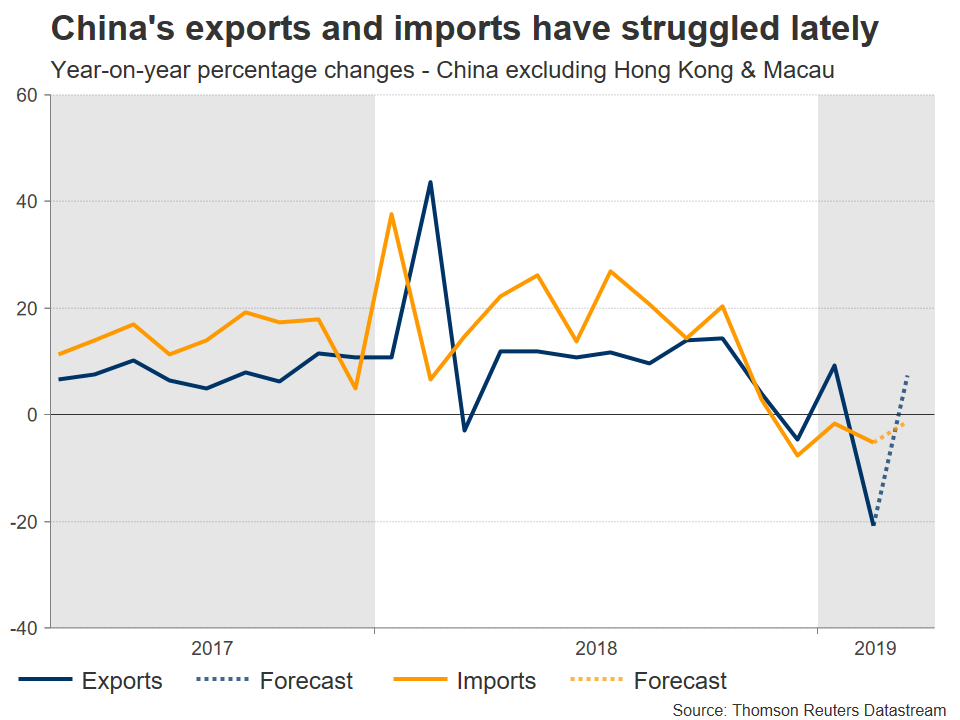
As for Friday’s trade data, the nation’s trade surplus is anticipated to have widened in March, as exports are forecast to have outpaced imports. Specifically, exports are expected to have risen by 7.3% in yearly terms, a rebound following an abysmal 20.7% drop previously. Meanwhile, imports are predicted to have fallen again but at a slower pace of 1.3%, compared to a 5.2% decline earlier.
If the actual prints meet expectations, or better yet beat them, that could help calm some nerves around the economy’s prospects, and by extent boost both the yuan and the Australian dollar. Australia and China have a very close trading relationship, so the aussie is often considered a liquid proxy for ‘China plays’. Speculators often favor the aussie over the yuan not only due to liquidity, but also because shorting the Chinese currency for instance implies taking on the additional risk of being caught on the wrong side of regular FX intervention by the nation’s authorities.
On a final note, what signals come out of the US-China trade talks will also be crucial for the aussie. Officials on both sides have consistently played up the prospect of a deal, something that has likely been a major force in pushing equity markets higher, and helping the aussie to stay resilient even amid growing RBA rate-cut bets. The bottom line is that lots of trade optimism is likely priced in already, which presents a downside risk for both stocks and the aussie going forward if this cheerful narrative changes for any reason.
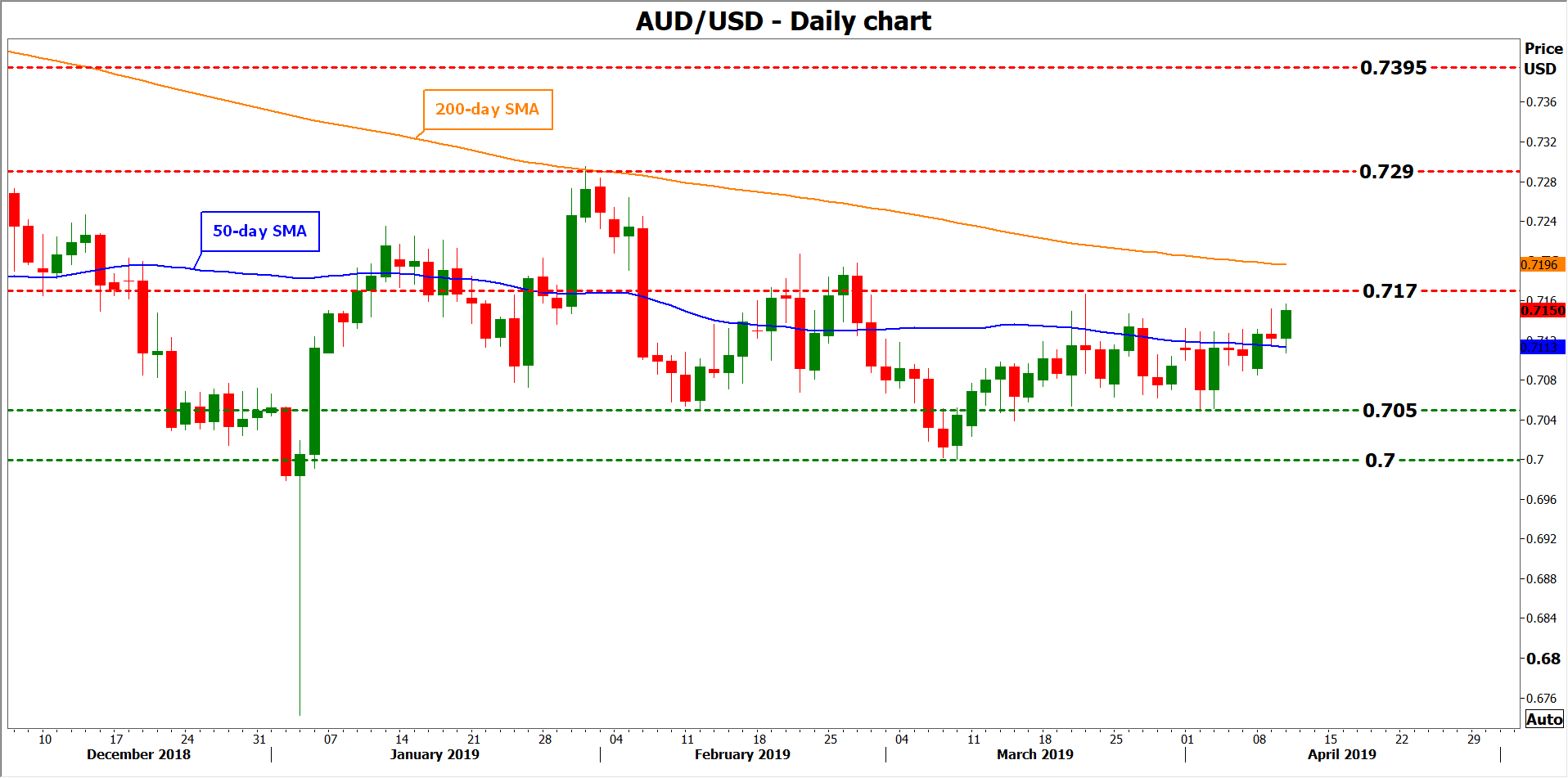
Taking a technical look at aussie/dollar, resistance to advances may be found near 0.7170, the March 21 high, with an upside break opening the door for the 200-day simple moving average (SMA) at 0.7197.
On the flipside, immediate support to declines could come near the 50-day SMA at 0.7115, with steeper bearish moves aiming for 0.7050.
EUR/USD Mid-Day Outlook
Daily Pivots: (S1) 1.1250; (P) 1.1268; (R1) 1.1280; More.....
With sharp retreat and 4 hour MACD crossed below signal line, intraday bias in EUR/USD is turned neutral first. ON the upside, above 1.1286 will extend the rise from 1.1183 for 55 day EMA (now at 1.1309) first. Break will target 1.1448 resistance next. For now, we'd expect strong resistance between 1.1448/1569 to limit upside. On the downside, decisive break of 1.1176 will resume the down trend from 1.2555.
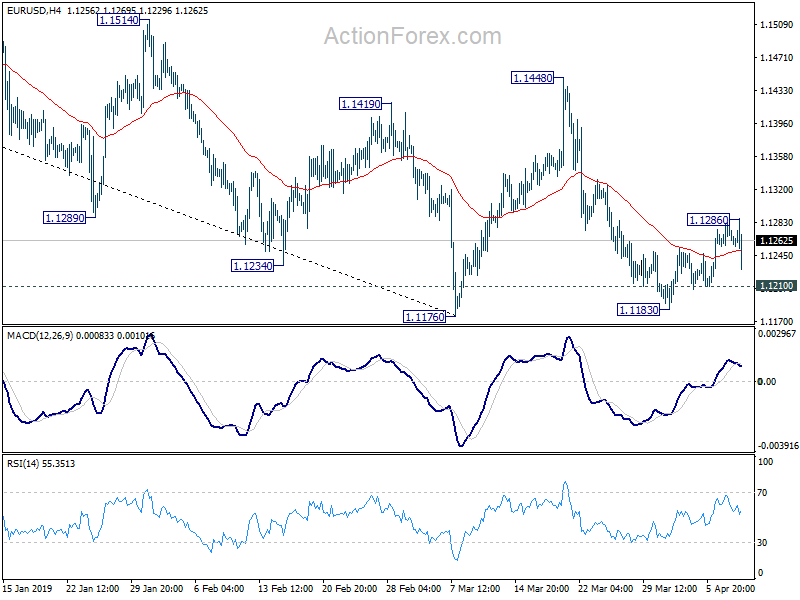
In the bigger picture, medium term weakness was revived as the weak rebound from 1.1176 was rejected well below 55 week EMA and failed to sustain above 55 day EMA. Focus is back on 1.1176 low, with 61.8% retracement of 1.0339 (2016 low) to 1.2555 (2018 high) at 1.1186. Decisive break there will resume whole down trend from 1.2555. Such decline target 1.0339 low next. On the upside, firm break of 1.1569 resistance is needed to be the first sign of medium term bottoming. Otherwise, downside breakout will be in favor.