Sample Category Title
EUR/JPY Daily Outlook
Daily Pivots: (S1) 124.80; (P) 125.13; (R1) 125.48; More....
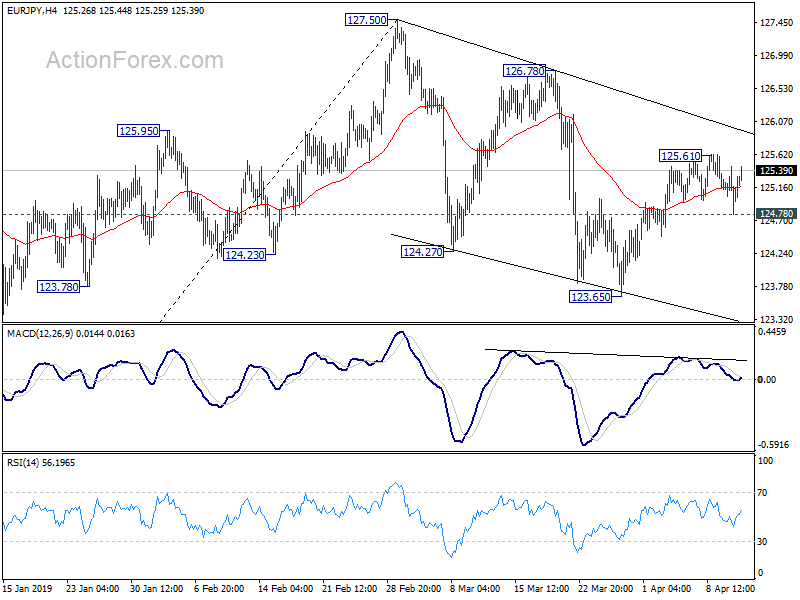
Despite dipping to 124.78, EUR/JPY quickly recovered and intraday bias is turned neural again. On the upside, above 125.61 will resume the rebound to 126.78/127.50 resistance zone. On the downside, below 124.78 will extend the fall from 125.61 back to 123.65 support first.
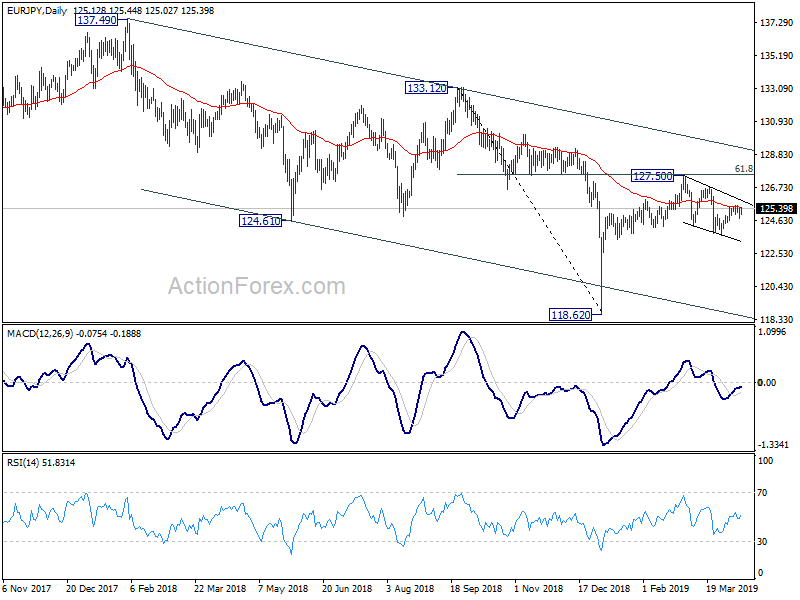
In the bigger picture, EUR/JPY is staying well inside medium term falling channel from 137.49 (2018 high). It's also held below 55 week EMA (now at 127.53). Thus, down trend from 137.49 might still extend lower. Break of 118.62 will target 109.03/114.84 long term support zone. On the upside, however, break of 127.50 will solidify the case of medium term bullish reversal. Rise from 118.76 should extend to 133.12 key resistance instead.
USDJPY Unlocks 111.00 Key Level Again, Indicators Signal Neutral Mode
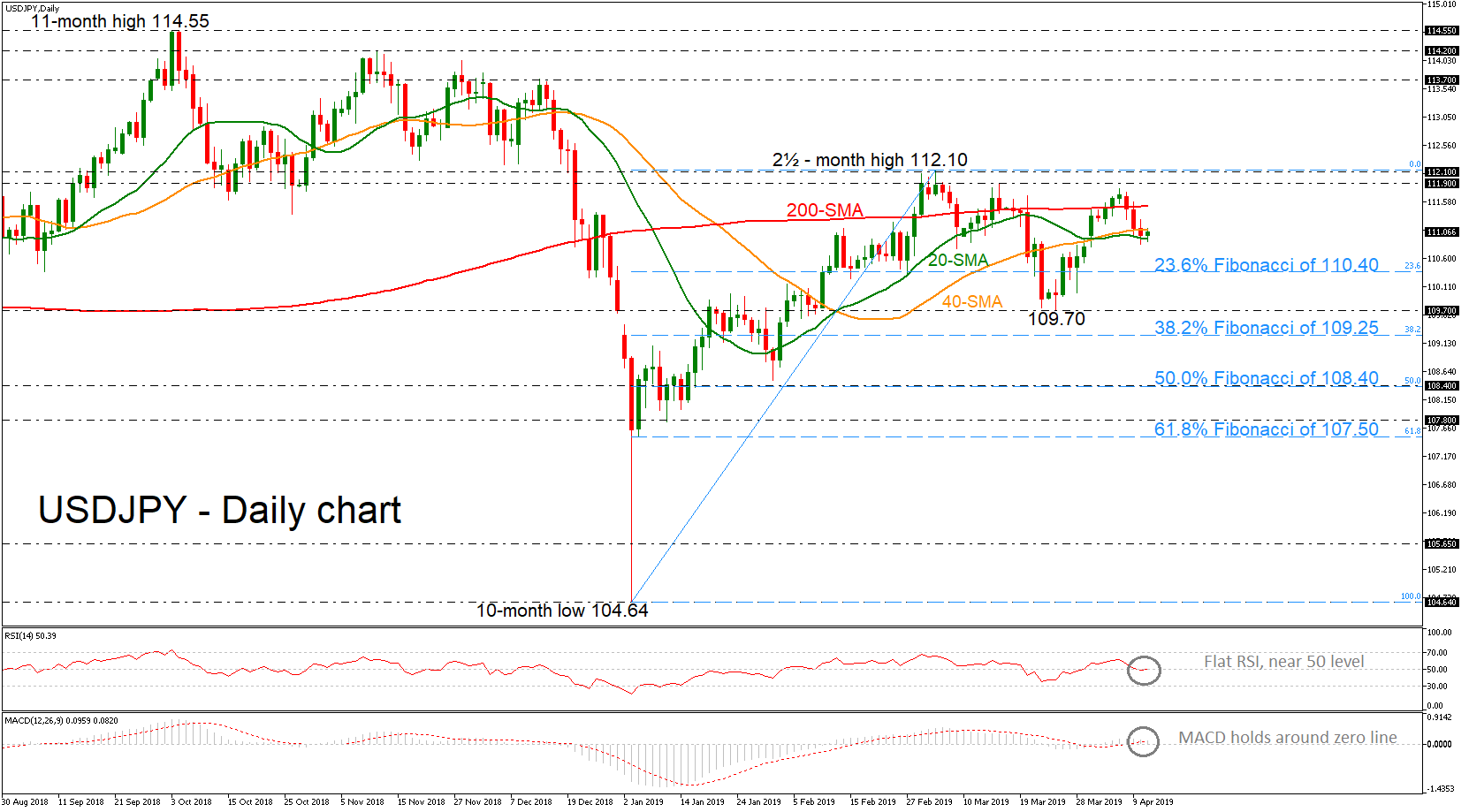
USDJPY is trading near the psychological level of 111.00 and is capped by the 40-day simple moving average (SMA). The sell-off in the preceding days drove the price well above the flat 200-day SMA indicating a possible bearish retracement in the short-term. The momentum indicators, the RSI and the MACD, are moving sideways near the 50 level and around the zero line respectively.
Should the pair continue the bearish pressure and slip beneath the 20-day SMA, it could move towards the 23.6% Fibonacci retracement level of the upleg from 104.64 to 112.10, near 110.40. Another leg lower could shift the attention south until the 109.70 support and the 38.2% Fibonacci of 109.25.
On the upside, in case of a successful jump above the 200-day SMA, immediate resistance could be faced near the 111.90 – 112.10 resistance area, which encapsulates the two-and-a-half-month highs, where it topped in the preceding month. An aggressive buying interest above these lines could confirm the recent bullish attitude of the last three months, extending gains towards the 113.70 region, reached on December 2018.
Overall, in the medium-term picture, the three-month view remains slightly bullish, however investors should wait for a daily close above 112.10 for positive actions.
Currencies: Euro Doesn’t Decline Despite Soft ECB. More By-Default USD Weakness To Come?
- Rates: ECB sends more dovish signals
Core bonds retain positive momentum after yesterday's soft message from ECB President Draghi. He stressed readiness to adjust parameters of the central bank's policy if needed to fight the economic downturn. Today's EMU eco calendar is empty while the US one only contains second tier numbers. Markets will start looking out for Q1 earnings season. - FX: Euro doesn't decline despite soft ECB. More by-default USD weakness to come?
EUR/USD showed remarkable swings yesterday. The euro declined during the ECB press conference, but at the end of the day, USD-weakness still prevailed. The US-German interest rate differential didn't widen despite the soft ECB. Has the US more leverage to keep its currency weaker than the ECB? Sterling hardly reacted to the Brexit delay
The Sunrise Headlines
- US equity markets edged higher yesterday with technology shares outperforming (Nasdaq +0.69%). Most Asian equities are losing ground this morning with Chinese indices underperforming.
- The EU has offered the UK an extension of the Brexit deadline to October 31, but with the possibility for the UK to leave sooner if the UK Parliament ratifies the divorce deal. UK PM May will now continue cross-party talks with Labour.
- US Treasury Secretary Steven Mnuchin said that the US and China nearly completed the currency agreement and agreed on an enforcement mechanism for a potential trade deal, both key elements in the final negotiations.
- The Fed Meeting Minutes of March show that FOMC members are pleading for the wait-and-see approach as risks of a global slowdown are increasing and inflation readings are weaker-than-expected.
- Chuck Grassley, US Senate Fin. Cmte chair, said that the US government report that could lead to tariffs on cars, will likely not be released as the report contains many shortcomings, possibly delaying Trump's decision to beyond May.
- Australian PM Scott Morrison called the general election for May 18. Latest polls show Morrison's Liberal-National coalition, who's seeking a third straight term, is trailing opposition party Labour by four points.
- Today's eco calendar contains producer inflation data (March) and this week's jobless claims in the US. Sweden prints its consumer inflation data (March). Fed giants Clarida, Williams and Quarles speak today. The US taps the bond market.
Currencies: Euro Doesn't Decline Despite Soft ECB. More By-Default USD Weakness To Come?
Euro doesn't decline despite soft ECB
EUR/USD made some sharp swings yesterday. The pair traded near recent top close to 1.1280 at the start of the ECB press conference. Draghi admitted that the EMU growth slowdown is more profound than expected. In this context, EMU rates might stay (very) low for longer. The euro sank during the press conference. However, US yields also declined even as US inflation was close to expectations. The US-German rate differential didn't widen despite a soft ECB. EUR/USD soon reversed its post-ECB loss. US Treasury Secretary Mnuchin indicating that the US and China agreed on the FX part of a trade deal maybe was a USD negative, too. The Minutes of the March Fed meeting confirmed a balanced wait-and-see approach and didn't cause a further USD decline. EUR/USD closed at 1.1274 (from 1.1263). USD/JPY finished at 111.01. Asian equities mostly show moderate losses this morning with China underperforming. The dollar stays in the defensive (EUR/USD 1.1280 area; USD/JPY low 111.00 area). Today, the eco data in the US and Europe are second tier. US jobless claims are expected to remain low. Y/Y US PPI inflation is expected little changed from last month. Several Fed governors are scheduled to give their view on the economy.
Yesterday price action in EUR/USD was quite remarkable. The euro and the dollar both felt downside pressure. Despite a soft ECB, the dollar finally returned near this week's lows. The jury is still out, but the US and China reaching an agreement on FX might be a harbinger of the US persuing a more active 'nottoo- strong' dollar policy. Maybe the US has more leverage/means to keep its currency weak compared to the likes of the ECB and the BOJ. Last week, EUR/USD came close to the 1.1177/87 support, but a real test/break didn't occur. For that to happen, unexpected negative EMU news or surprisingly strong US data are needed. Recent data evidence doesn't support this scenario. We keep the view that a sustained EUR/USD break lower isn't evident. Yesterday and Tuesday, it looked that the EUR/USD rebound could lose momentum. However, looking at yesterday's price action, some further by default USDlosses/ euro gains are still possible.
The EU gave the UK more time resolve the pollical statement on Brexit. A flexible time table allows the UK to stay in the EU to Oct 31. The reaction of sterling was telling. EUR/GBP hardly reacted. The pair continued to hover near the 0.86 pivot. With the UK heading for a new period of domestic political uncertainty, we see no reason to turn more positive on sterling. The BoE has also no reason to raise rates anytime soon. We assume the EUR/GBP 0.85 support area to be solid.
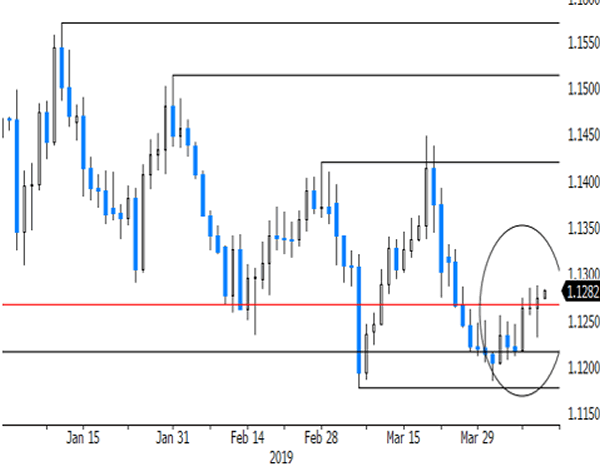
EUR/USD holding strong despite soft ECB
Draghi Steps Up Dovish Message
- No major change in economic assessment but readiness to act emphasised
- Comments suggest ECB could act further if outlook deteriorates markedly
- Draghi's verbal easing intended to encourage supportive market conditions
- Details of TLTRO's and question of tiered deposit rates now being examined…
- …Settings could differ notably depending on economic developments
- New ECB working papers highlight factors arguing ‘lower for longer' for rates
Yesterday's policy meeting of the ECB's governing council was widely expected to be a holding operation. It is not in the nature of the ECB to surprise markets twice in a row and the March policy meeting saw the ECB signal a more dovish policy outlook than had been anticipated. More fundamentally, in what is a very uncertain economic and financial market climate at present, it didn't seem likely that Mr Draghi would pre‐commit significantly in terms of the details of future adjustments to policy settings.
Work in progress … ready by June?
In the event, Mr Draghi showed his dovish nature to a greater degree than had been envisaged in several respects with the result that Euro area market rates softened in the wake of his comments. While he didn't provide specific details of prospective policy measures, he indicated that the technical terms around the upcoming Targeted longer Term Refinancing Operations (TLTRO's) announced in March '… will be communicated at one of our forthcoming meetings.' More importantly, he stated that ‘...we will also consider whether the preservation of the favourable implications of negative interest rates for the economy requires the mitigation of their possible side effects, if any, on bank intermediation
Finally, if more open to interpretation, a dovish slant to these commitments might be inferred by the greater prominence in the ECB's opening press statement given to the indication that ‘The Governing Council stands ready to adjust all of its instruments, as appropriate, to ensure that inflation continues to move towards the Governing Council's inflation aim in a sustained manner'. While this wording has appeared consistently in ECB press statements since June 2018, it hasn't usually been given the prominent positioning or separate paragraph it received in yesterday's statement. Instead, it has usually appeared at the end of paragraphs outlining how monetary accommodation would continue to support activity.
ECB able and willing to act further
The increased prominence given to a readiness ‘...to adjust all of its instruments, as appropriate…' is not down to random word sequencing. By signalling it is able and willing to use its full ‘toolbox' of policy instruments to ensure inflation converges towards its target, the ECB is adding a more dovish tilt to its forward guidance and undertaking additional ‘verbal easing'.
To emphasise this shift, Mr Draghi noted that the council meeting while reiterating confidence in the inflation path also reasserted a readiness ‘to use all the instruments necessary to cope with the contingencies to come ahead and this was I would say unanimous'. Mr Draghi later added that yesterday's meeting ‘was not an operational meeting. It was more of a meeting that would characterise the stance of the governing council towards further action… the main goal of which was to reassert the readiness to act if the contingencies would warrant so.'
This is not to say that the ECB will introduce any measures in coming months to make its stance significantly more accommodative but by clearly signalling such a possibility if it is required, Mr Draghi will hope to encourage markets to price in such an outcome. In this context, he asserted that ‘the market reaction to my ECB watchers speech ..shows that we have plenty of instruments..and markets have fully understood our reaction function.'
Mr Draghi continues a verbal easing
The rationale for a measure of ‘verbal easing‘ is partly a reflection of what Mr Draghi said was a meeting that focussed attention on assessing an outlook ‘which is a picture of weakening growth' although there was relatively little discussion of the current health of the Euro area economy in the Q&A session and little material change in the press statements description of the economic climate. Moreover, Mr Draghi suggested the probability of a recession remained low.
Mr Draghi did suggest that yesterday's meeting re‐asserted confidence that inflation would move onto a path consistent with the ECB's target although he also indicated the headline inflation rate for the Euro area might not reach a low‐point until September. Importantly, however, when asked about the recent drop in the five year‐five year inflation swap rate, a market gauge of inflation expectations, Mr Draghi noted that the ECB's analysis indicated this was predominantly because of ‘a negative risk premium' that might reflect either perceptions of either a lack of instruments or a tolerance for persistently below target inflation on the part of the ECB. Mr Draghi refuted either possibility.
Our sense is that both of these explanations might argue for the verbal easing we saw particularly in circumstances where there has been increased focus on the potential threat of what is termed the ‘Japanification' of the Euro area economy entailing the threat of a prolonged period of weak economic growth and downward rather than upward pressure on prices.
Mr Draghi emphasised on a number of occasions that yesterday's governing council meeting didn't discuss specifics in relation to the terms applying to upcoming TLTRO's and that they hadn't gone beyond setting in train an analysis of the potentially contentious issue of ‘the mitigation of ..possible side effects, if any, on bank intermediation' of negative interest rates. However, he did repeat that markets understood the ECB's reaction function which implies he could envisage reactions in terms of both the future level of market rates and shape of the yield curve in the Euro area as well as the FX value of the Euro.
What might come next?
There is a significant likelihood that, unless economic conditions improve materially, markets may begin to anticipate measures that constitute a notable further easing in ECB policy in the months to come. One element of this would be that when the interest rate to apply to the TLTRO's is finally announced, it will be markedly more attractive than the 25 basis point premium over the ECB's refinancing rate that newswire stories suggested had been initially proposed at a technical level within the ECB (but rejected by policymakers as too high).
There could be notably greater speculation and an even greater range of suggested outcomes in relation to ‘mitigants' to the impact of negative rates on bank, which is set to debate the possibility of tiered ECB deposit rates that would translate into reduced average costs to commercial banks with significant excess reserves.
The impact of negative rates on the Euro area banking sector has been a much debated issue. Previous ECB analysis has emphasised the complexity of factors likely to determine the balance between a range of benefits running from increased lending volumes, improved credit quality and capital gains on bond holdings against costs associated with a flatter yield curve and ‘sticky' nominal deposit rates.
While much of this analysis emphasised initial benefits from an improving environment, Mr Draghi acknowledged that the nature and magnitude of benefits and costs would be different at the start of the process and when it was in place for a long period of time. He also noted that ‘the way it affects different institutions was profoundly different'. Consequently, it might be expected that the associated analysis would be quite a complex and possibly protracted process.
When asked if the introduction of measures that might mitigate any adverse impact on commercial banks of negative rates might mean the ECB could have scope to cut rates further, Mr Draghi said that discussions hadn't even begun on the broader issue of whether such mitigating measures might be warranted. Again, however, depending on economic developments in coming months, market attention might turn to the possibility that the introduction of tiered deposit rates could lessen commercial bank sensitivity to the implementation of a drop in what would then be the marginal deposit rate further into negative territory.
It should be emphasised that such action appears only a remote possibility at present as any policy measures to test the lower bound for interest rates would require a marked further deterioration in economic conditions and an associated fall in the inflation outlook. However, the fact that it might even be mooted as a possibility gives some sense of the ‘negative risk premium' now seeping into market thinking.
Arguing for accommodative policy
Our sense is that Mr Draghi tried today to reinforce market perceptions of an ECB shift to a more dovish stance and attempted a further verbal easing. It would not be surprising if there wasn't unanimous support for such an approach on the governing council. Hence, we may see some variations in the tone of comments from ECB officials in coming weeks. That possibility and a still unclear economic outlook that may throw up some surprising readings from economic indicators implies the prospect of choppier conditions in Euro area interest rate markets before the ECB's next policy meeting in June.
Our sense that the ECB has moved to a somewhat more dovish position on the outlook for policy is clearly a reflection of a still threatening economic outlook. However, we think structural as well as cyclical factors may also be prompting a rethink of what ‘lower for longer' might mean in terms of the outlook for rates. In this context, a couple of ECB working papers released in late March focus attention on longer term determinants of interest rates.
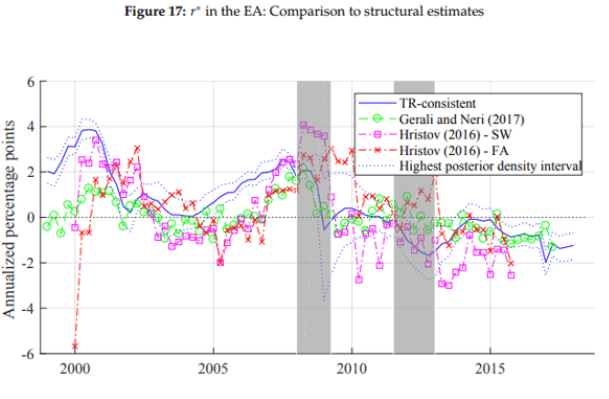
One examining the role of demographics (Demographics and the natural real interest rate: historical and projected paths for the euro area, WP2258), emphasises lasting downward pressure on interest rates from an ageing population. Another (Taylor‐rule consistent estimates of the natural rate of interest, WP 2257) compares new estimates of the ‘natural' or equilibrium interest rate for the Euro area with those from a variety of studies. As the diagram below illustrates, the ‘real' or inflation adjusted estimates vary significantly from study to study but a there is clear common ground in emphasising the substantial degree of monetary stimulus that the Euro area is estimated to require. This could be feeding into ECB thinking on how much longer and shallower the path to rate ‘normalisation' might be.
EUR/GBP Daily Outlook
Daily Pivots: (S1) 0.8587; (P) 0.8614; (R1) 0.8636; More...
EUR/GBP's consolidation from 0.8474 is still extending. Intraday bias stays neutral and more sideway trading could be seen. But as long as 0.7822 resistance holds, near term outlook remains bearish. On the downside, firm break of 0.8474 will resume larger down trend for 0.8416 long term projection next. On the upside, though, sustained break of 0.8722 will suggest near term reversal and bring stronger rise back to 0.8840 resistance and above.
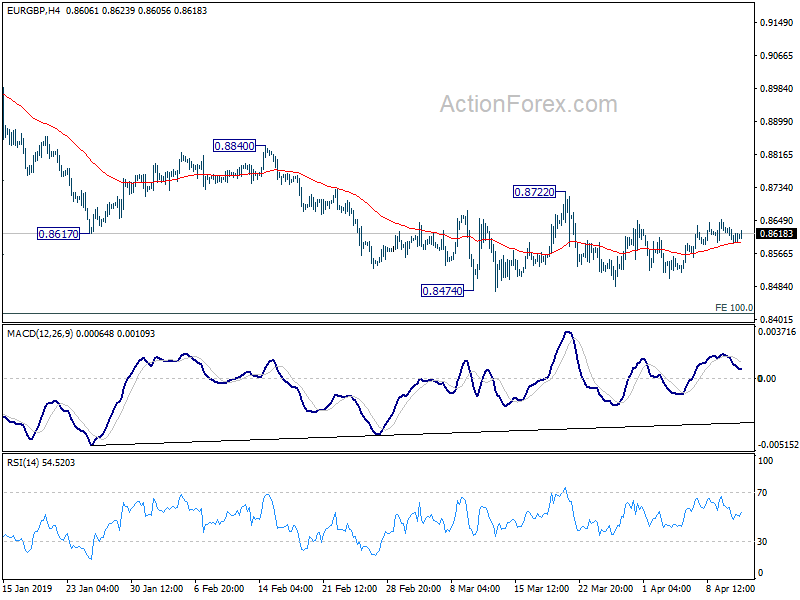
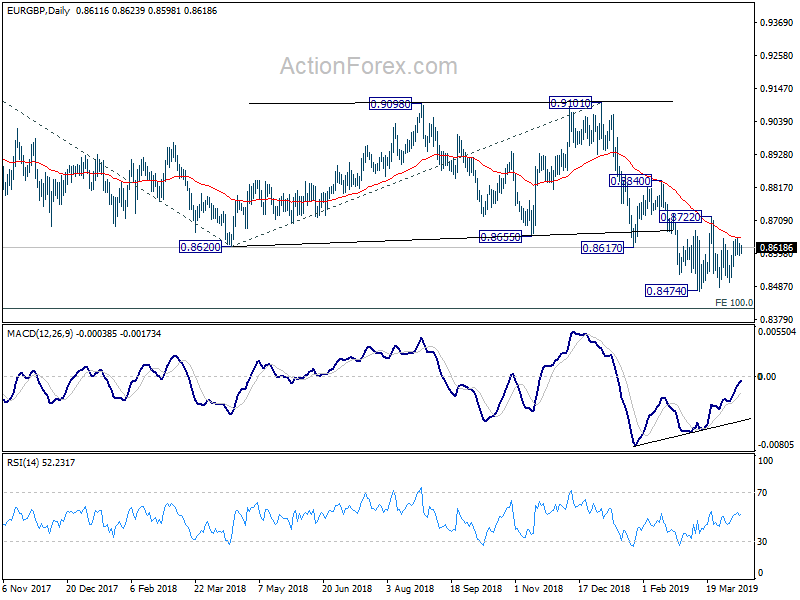
In the bigger picture, EUR/GBP is seen as staying in long term range pattern started at 0.9304 (2016 high). Current fall from 0.9305 (2017 high) is a falling leg inside the pattern. Such decline could extend to 100% projection of 0.9305 to 0.8620 from 0.9101 at 0.8416 and possibly below. But for now, we'd expect strong support around 0.8312 support to contain downside and bring rebound.
GBP/USD Prepares For Impulsive & Bullish Wave 3
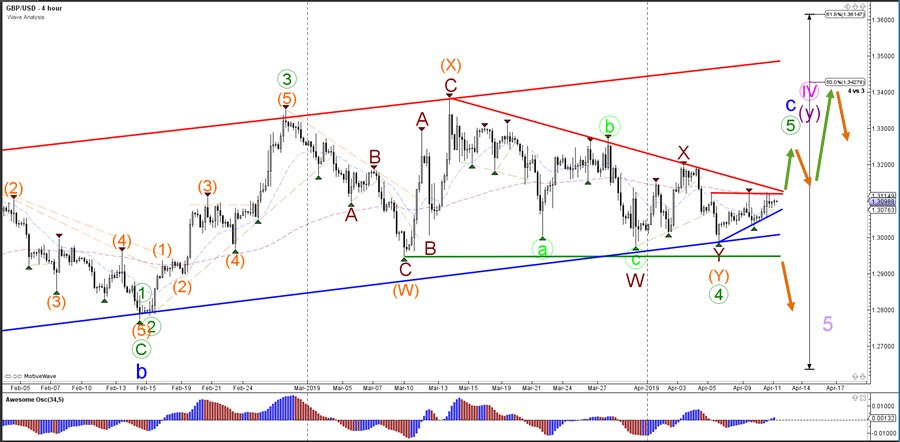
The GBP/USD seems to have completed a potential wave 4 (green) retracement but a confirmation is only possible after a bullish breakout. A bearish bounce, however, could see price move back towards the bottom of the triangle chart pattern.
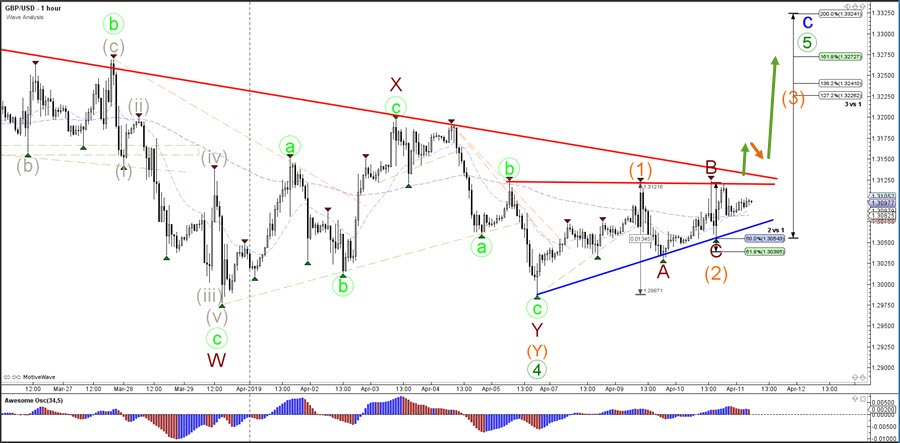
The GBP/USD could have completed a bearish ABC (dark red) zigzag pattern within the wave 2 (orange) correction yesterday. If price is starting a wave 3 (orange) impulse, then price is expected to show a bullish breakout soon. A break below the support trend line (blue) could indicate a deeper wave 2 or a chance of wave patterns.
UK Gets Another Six Months To Agree On The Brexit Deal
Market movers today
This morning the markets will digest the outcome of the EU summit on Brexit in which the deadline was postponed to 31 October (see more below).
Swedish March CPI is set to clearly undershoot the Riksbank estimate, see page 2.
On the global data front it's a very light day. US jobless claims is the only release of interest as they showed a sharp drop last week to a new cycle low underlining a still strong labour market. We expect to see a correction higher today. We also have some Fed speakers on tap today. Vice-Chairman Richard Clarida will be the most interesting one at 15.30CET.
Selected market news
Overnight, EU leaders decided to grant the UK a "medium" extension to 31 October (including taking stock in June). While a majority of the EU leaders wanted a long extension of 9-12 months, French President Macron played hard ball and argued for a much shorter extension. The extension is conditioned on no reopening of the withdrawal agreement, participating in European elections and "sincere cooperation". The UK government has accepted the offer, meaning that the new Brexit day is 31 October and the agreement does not need approval in the House of Commons (EU law is above British law).
Today, we will monitor the British politicians ' reaction. While the Conservative party rules say there cannot be another no confidence vote in May's party leadership until December, the leaders of the Conservative backbenchers (the so-called 1922 committee) decided yesterday they will try to persuade May to quit soon. It is difficult to predict what is going to happen but as it seems unlikely that the House of Commons will back Theresa May's deal and a breakthrough in the cross-party talks does not seem imminent, it may end up being the case EU leaders will have to decide once again in October. After the EU summit Merkel sounded open to the possibility of a further extension.
A dovish message from the ECB yesterday gave a lift to equity markets while sending bond yields lower. For more on the ECB meeting see our Flash ECB Review - Little news but tiering system still part of a discussion , 10 April 2019.
Chinese inflation came out as expected overnight. CPI inflation increased from 1.5% to 2.3% on the back of higher food prices. It is still below the 3% target and will not affect the policy of People's Bank of China. PPI inflation increased to 0.4% y/y from 0.1% y/y.
The UK RICS housing survey released overnight surprised to the upside rising to -24 from -27. It still points to falling house prices, though.
US core inflation fell to 2.1% y/y in March (consensus 2.2% y/y) from 2.2% in February. The numbers add to the picture of still muted inflation pressure despite low unemployment.
India began voting in the first of seven phases of the general election, which will last until 19 May with the result being announced on 23 May. Prime Minister Narendra Modi is ahead in the polls to lead India for another five years.
EUR/AUD Daily Outlook
Daily Pivots: (S1) 1.5678; (P) 1.5757; (R1) 1.5801; More...
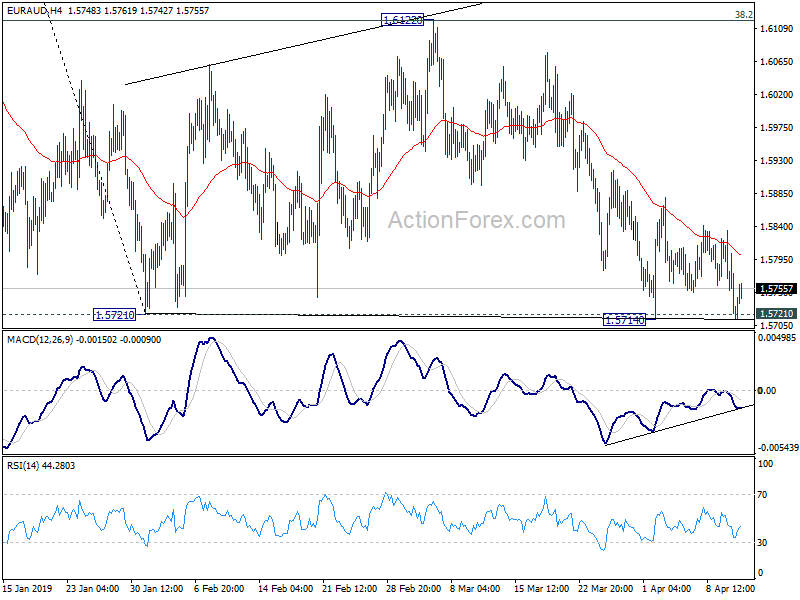
EUR/AUD breached 1.5721 key support but quickly recovered again. Intraday bias remains neutral first. Consolidation from 1.5721 might extend with another rise. But upside should be limited by 1.6122 resistance to bring fall resumption. On the downside, sustained break of 1.5721 will resume the decline from 1.6765 to 1.5346 key support next.
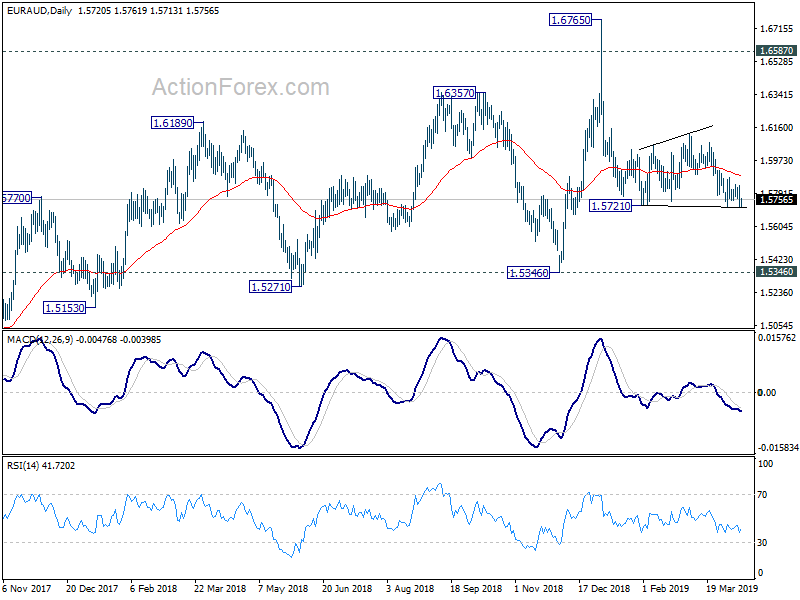
In the bigger picture, as long as 1.5346 support holds, outlook will still remain bullish. Uptrend from 1.1602 (2012 low) is expected to resume sooner or later. Break of 1.6765 will target 61.8% retracement of 2.1127 (2008 high) to 1.1602 at 1.7488 next. However, firm break of 1.5346 key support will indicate trend reversal, with bearish divergence condition in weekly MACD, and turn outlook bearish.
Asian Equities Trade Generally Lower Despite Headlines Related To ‘Trade Progress’
General Trend:
- Property sectors in China and Hong Kong decline amid rise in short-term rates, analysts debate rate outlook China
- Australia’s Bank of Queensland declines over 5% after weaker than expected earnings, cut dividend
- Big banks in Japan trade generally lower amid press coverage on CLO exposures, Wednesday’s decline in US Treasury yields
- US Treasury Sec: We have agreed [with China] on enforcement mechanism and to establish enforcement offices; not going to comment on tariffs
- China March CPI in line with expectations despite higher food prices and impact of African swine fever, remains below target
- China government bond futures rise amid in line inflation data, equity declines
- China deflation risk subsides after acceleration in March PPI (US financial press)
- PBoC changes language regarding money market liquidity levels amid expectations OMOs may be resumed ‘soon’
- China money market rates continue to rise amid the skipped OMOs
- Australia PM Morrison sets election date of May 18th, currently he lags in the polls
- South Korea April 1-10th exports rebound on shipments of petroleum products and vessels
- Currencies and autos may be sticking points in the upcoming US/Japan trade talks (Japanese Press)
- Fast Retailing expected to report earnings after today’s Nikkei close Apple supplier
- Largan Precision also expected to issue earnings today
- RBA expected to issue its Financial Stability Review on Friday, prior review did not directly address monetary policy
- Singapore due to issue the semi-annual monetary policy statement, advance Q1 GDP on Friday; expected by most analysts to leave policy unchanged (would follow 2 consecutive tightening moves)
- China March trade figures are expected April 11-12th
- South Korea President Moon and US President Trump expected to hold Washington D.C. summit later today
Headlines/Economic Data
Australia/New Zealand
- ASX 200 opened slightly lower
- (AU) Australia PM Morrison confirms elections to be held May 18th
- WHC.AU Reports Q3 managed ROM coal production 4.9Mt v 5.9Mt y/y; salable coal production 5.1Mt v 5.2Mt y/y; Cuts FY19 saleable coal 20.5-21.0Mt (prior 21.5-22.5Mt)
- BOQ.AU Reports H1 (A$) Net Cash profit 167M v 168Me ; Rev 544M, -2% y/y
Japan
- Nikkei 225 opened -0.1%
- (JP) Japan govt reportedly to reject any auto quotas or FX provisions requests as part of trade talks with the US - Nikkei
- (JP) Japan Investors Weekly Net Buying of Foreign Bonds: -¥1.75T v +¥1.24T prior; Foreign Buying of Japan Stocks: ¥1.46T v ¥438.5B prior
- (JP) Japan PM Abe: To cooperate with BOJ Gov Kuroda and take appropriate steps as needed with respect to Brexit
- (JP) Banks in Japan have increased exposures to illiquid securitized loans (primarily in the US) - financial press
Korea
- Kospi opened +0.2%
- (KR) North Korea Leader Un: Need to deliver "serious blow" to those that are imposing sanctions; calls for national self-reliance, increased economic development – Yonhap
- (KR) South Korea Apr 1-10th Exports +8.9% y/y; Chip exports -19.7%
- (KR) South Korea Feb bank loans overdue at least 1-month at 0.52%, + 7bps m/m (fastest increase in 5 years); notes rise in delinquent loans to small companies - Local press
- (KR) South Korea Q1 Foreign Direct Investment (FDI): $3.2B, -35.7% y/y; actual investment made by foreign companies $2.6B, -15.9% y/y
China/Hong Kong
- Hang Seng opened +0.1%; Shanghai Composite opened flat
- (CN) CHINA MAR CPI Y/Y: 2.3% V 2.3%E (fastest CPI pace since Oct 2018); PPI Y/Y: 0.4% V 0.4%E
- (CN) China Academy of Social Sciences (CASS): Basic pension fund may run out by 2035 as aging population grows
- (US) Treasury Sec Mnuchin: Both US and China are working hard to reach trade agreement; we have more calls scheduled this week ; We have agreed on enforcement mechanism and to establish enforcement offices; not going to comment on tariffs - CNBC interview
- (CN) China PBoC Open Market Operation (OMO): Skips for 16th consecutive session: Net: CNY0 v CNY0 prior
- (CN) China PBoC sets yuan reference rate: 6.7088 v 6.7110 prior
- (CN) China State Administration of Press, Publication, Radio, Film and Television approves 40 domestic games
North America
- DAL Reports Q1 $0.96 v $0.87e, Rev $10.5B v $10.4Be
- BBBY Reports Q4 $1.20 v $1.11e, Rev $3.31B v $3.33Be; Raises Quarterly dividend 6.3% to $0.17 from $0.16 (indicated yield 3.5%), updates Board refreshment; Guides Q1 $0.07-0.12 v $0.31e, Rev $2.6B v $2.70Be - earnings slides
- (US) FOMC MINUTES FROM MARCH 20TH MEETING: MOST OFFICIALS SAW NO CHANGE IN INTEREST RATES THIS YEAR; MAJORITY SAID PATIENT APPROACH ON RATES IS NEEDED GIVEN UNCERTAINTIES
- (US) Former Fed Chair Yellen: Do not see a need for Fed to cut rates currently, monetary policy is well positioned at this point, its appropriate for Fed to be watchfully waiting on policy
Europe
- (UK) EU's Tusk confirms EU and UK have agreed to Brexit extension to Oct 31 (additional 6-months)
- (UK) PM May: EU agrees extension can end when deal is ratified; Uk to keep full membership rights during extension
- (UK) Prime Min May reportedly would seek to stay on as PM if Brexit deal is not passed by end of June - UK's Guardian
- (EU) ECB's Draghi: Too early to provide TLTRO and any possible Tiering details; need consensus for further analysis of economic outlook - Q&A
Levels as of 1:20 ET
- Nikkei 225, flat, ASX 200 -0.3%, Hang Seng -0.7%; Shanghai Composite -1.1%; Kospi flat
- Equity Futures: S&P500 flat; Nasdaq100 flat, Dax -0.2%; FTSE100 -0.2%
- EUR 1.1283-1.1272 ; JPY 111.13-110.89 ; AUD 0.7174-0.7152 ;NZD 0.6772-0.6757
- Gold -0.3% at $1,309/oz; Crude Oil -0.4% at $64.36/brl; Copper -0.2% at $2.916/lb
EUR/CHF Daily Outlook
Daily Pivots: (S1) 1.1271; (P) 1.1288; (R1) 1.1321; More...
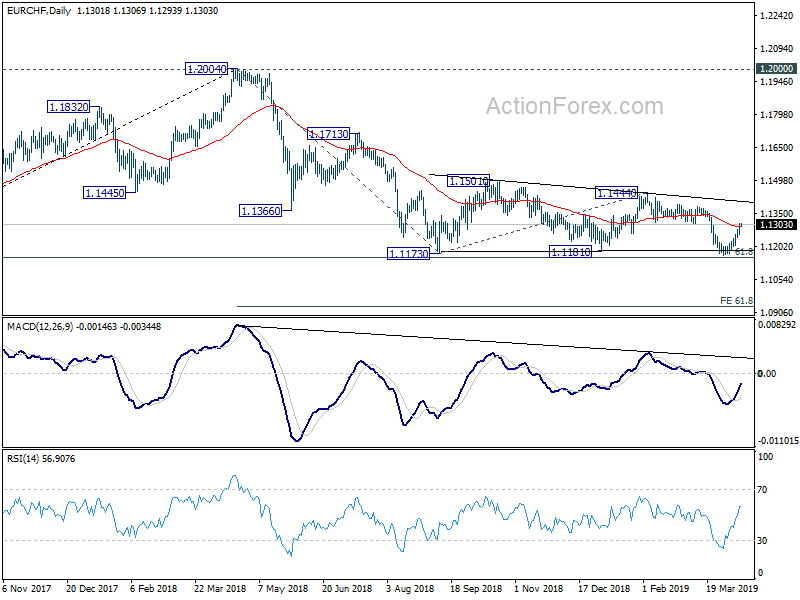
Intraday bias in EUR/CHF remains on the upside as rise from 1.1162 is in progress for 1.1310 support turned resistance. Firm break there will target 1.1444 key resistance next. On the downside, below 1.1245 minor support will turn bias back to the downside for 1.1154 key fibonacci level instead.
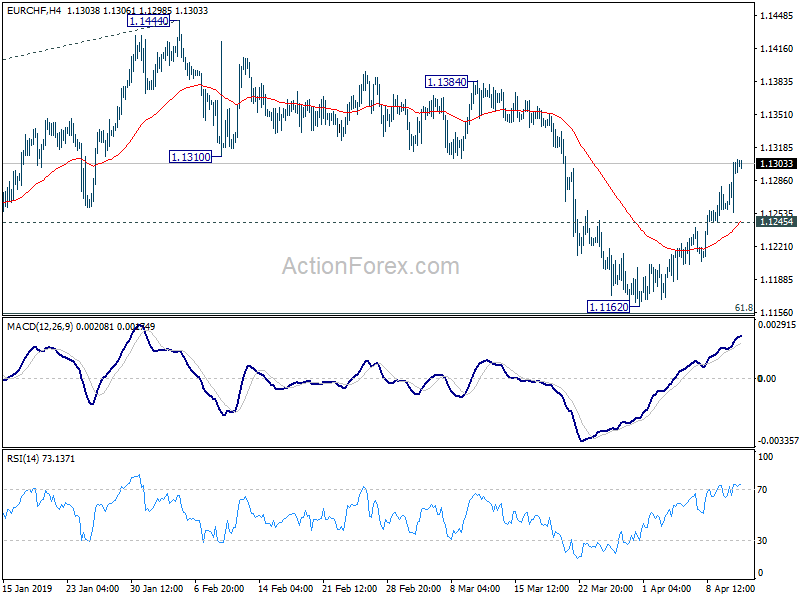
In the bigger picture, multiple rejection by 55 week EMA indicates medium term bearishness. Focus remains on 1.1154/98 support zone (2016 high and 61.8% retracement of 1.0629 to 1.2004 at 1.1154). Decisive break there will confirm resumption of whole down trend from 1.2004 and long term bearish reversal. EUR/CHF should then target 1.0629 support and below. This will now remain the favored case as long as 1.1444 resistance holds.